




Abstract
The authors write about China’s nuclear arsenal, one known for its obscure and opaque nuclear delivery systems and even more inscrutable nuclear weapons storage and production. Despite the secrecy, the authors are able to present an inventory of the country’s land-based missiles, submarines and sea-based missiles, aircraft, cruise missiles, and provide information on the nation’s warhead storage and production.
Keywords
Considerable uncertainty surrounds the composition and future development of China’s nuclear forces; however, we estimate that China has approximately 175 active nuclear warheads, plus about 65 warheads in reserve or awaiting dismantlement, for a total stockpile of approximately 240 warheads.
The US intelligence community predicts that by the mid-2020s, China could “more than double” the number of warheads on missiles capable of threatening the United States to “well over 100” (Maples, 2009: 23; National Air and Space Intelligence Center, 2009: 3).
Such predictions tend to promise too much too soon. Yet unlike the other four original nuclear weapon states, China continues to increase its nuclear arsenal and has boosted its nuclear-capable weapon systems by roughly 25 percent over the past five years, according to Pentagon estimates (Defense Department, 2005, 2010). This growth comes as part of China’s transition from older, liquid-fueled missiles to newer, solid-fueled missiles—a transition triggered, and still driven, by China’s perception that its nuclear deterrent force is vulnerable to ever-improving US (and to some extent Russian) military capabilities. Should the United States deploy an improved ballistic missile defense system, it will likely trigger additional Chinese countermeasures. Over the coming decade, China is expected to deploy more warheads on new systems, but also to retire others as it phases out older systems.
China’s nuclear weapons are not operational to the same degree as those of the other four original nuclear powers, which deploy a significant portion of their warheads on operationally deployed delivery systems, many even on high alert. Under normal circumstances, China keeps its warheads in storage rather than mated with their delivery systems. 1
Beijing has a longstanding no-first-use policy, meaning that it would use nuclear weapons only in retaliation for a nuclear attack. Despite widespread rumors and reports that China may be modifying or clarifying its nuclear use policies, the Pentagon concluded recently that although there is “some ambiguity over the conditions under which China’s [no-first-use] policy would or would not apply … there has been no indication that national leaders are willing to attach such nuances and caveats to China’s ‘no first use’ doctrine” (Defense Department, 2010: 35).
Land-based missiles
China deploys approximately 130 land-based, nuclear-capable ballistic missiles of six types: the DF-3A, DF-4, DF-5A, DF-21, DF-31, and DF-31A. The US intelligence community has consistently assessed them all as single-warhead weapons, and all are mobile, except for the silo-based DF-5A.
The liquid-fueled, single-stage, medium-range DF-3A is the oldest missile in China’s inventory and is nearing retirement after four decades of service; a single brigade of perhaps 17 missiles and 10 launchers remains operational. The DF-3A is being replaced by the DF-21.
China’s second-oldest missile, the long-range DF-4, is down to one or two brigades with about 17 of the two-stage, liquid-fueled missiles for roughly the same number of launchers. The DF-4 is being replaced with new DF-21 and DF-31 missiles.
The liquid-fueled, two-stage DF-5A is an intercontinental ballistic missile (ICBM) that can deliver a multi-megaton warhead further than 13,000 kilometers (8,100 miles); it replaced the DF-5 and improved on its range and payload. Since 1981, China has targeted the United States and Russia with DF-5 missiles, and more recently with DF-5A missiles. Should Beijing decide to deploy multiple warheads on some of its missiles as a reaction to US missile defenses, the DF-5A could probably carry up to three lighter-weight warheads. Whether China plans to phase out the DF-5A or keep it in operation alongside the newer DF-31A ICBM is unknown.
The DF-21 is China’s primary regional nuclear missile. First fielded in 1988, deployment did not get under way in earnest until 1991, and significant increases in the number of DF-21s have occurred only recently: The Pentagon estimated in 2005 that 19–23 missiles were deployed for approximately 36 launchers (Defense Department, 2008); its 2010 estimate is 85–95 DF-21 missiles for 75–85 launchers (Defense Department, 2010) – a quadrupling of the DF-21 inventory. Until 2007, the Defense Department’s annual reports on China listed the nuclear-only DF-21 and DF-21A versions, but now appear to include the dual-capable DF-21C as well. 2 The organization of DF-21s within China’s Second Artillery is unclear and complex, but nuclear and conventional units are thought to be separate. The deployment of dual-capable DF-21Cs in a conflict could create a serious risk of misunderstanding and potentially of escalation if China’s opponent was unable to distinguish between the missile types being readied for launch. The DF-21D, a conventional anti-ship ballistic missile based on the DF-21 frame, is also under development. 3 A specially configured DF-21 missile was used in China’s 2006 anti-satellite test.
In a section describing Chinese-Indian relations, the 2010 Pentagon report stated that China is using the more advanced and survivable DF-21s to replace DF-4s to improve regional deterrence (Defense Department, 2010: 38). This was picked up by the Press Trust of India, which mistakenly reported that according to the Pentagon, “China has moved advanced longer range CSS-5 [the DF-21 NATO designation] missiles close to the border with India” (Jha, 2010). Not surprisingly, the report triggered dramatic news articles in India, including rumors that the Indian Strategic Forces Command was considering or had already moved nuclear-capable missile units north toward the Chinese border. 4
The Pentagon report, however, said nothing about moving DF-21 missiles close to the Indian border. 5 Instead, it described the apparent near-completion of China’s replacement of DF-4 missiles with DF-21 missiles at two army base areas in Hunan and Qinghai provinces, a transition that has been under way for two decades. The two deployment areas are each more than 1,500 kilometers (930 miles) from the Indian border. 6
The DF-31A is a solid-fueled, three-stage, road-mobile ICBM. It has a shorter range—11,200 kilometers (7,000 miles)—and smaller payload than the DF-5A. China deploys 10–15 DF-31As, slightly more than in 2009. The transporter-erector-launcher (TEL) supposedly used with the DF-31A was displayed in the fall 2009 military parade in Beijing, but it appeared very similar to the DF-31 TEL displayed in 1999. How many DF-31As China intends to deploy is unknown, but the US intelligence community’s 2001 estimate of 75–100 warheads targeted primarily against the United States by 2015 hinges largely on the deployment of several dozen DF-31As in the next five years.
Deployment of the long-range DF-31 appears to have stalled in 2010 at fewer than 10 missiles—the same number as in 2009. Like the DF-31A, the DF-31 is carried on a six-axle TEL within a 15-meter canister, although its range does not reach the continental United States. It is expected to replace the DF-4 for regional targeting.
It was rumored that a long-range missile called the DF-41 might be shown in the 2009 military parade, but it did not appear. However, according to the Pentagon, “China may also be developing a new road-mobile ICBM, possibly capable of carrying a [sic] multiple independently targeted re-entry vehicles (MIRV)” (Defense Department, 2010: 2). China has had the capability to deploy MIRVs for years but has not done so, according to the US intelligence community; yet “continued advances in US and, to a lesser extent, Russian strategic intelligence, surveillance, and reconnaissance; precision strike; and missile defense capabilities,” the Pentagon states, are causing China to develop technologies to ensure the viability of its deterrent (Defense Department, 2010: 34).
Submarines and sea-based missiles
China’s plans for its submarines remain something of a mystery. It has only a single Xia-class nuclear-powered ballistic missile submarine (SSBN) and is building at least three Jin-class SSBNs—possibly more. However, none of the submarines has ever sailed on a deterrent patrol, and their missiles are not operational. 7
China’s Jin-class SSBN program is progressing slowly. Six years after it was launched in 2004, the first boat appears to have entered service. 8 It may have been homeported at the naval base near Yulin on Hainan Island. 9 Two additional submarines fitting out at the Hulodao shipyard in Liaoning province have not moved much since October 2007, when we first described them. 10
The Jin-class SSBN, approximately 135 meters long with 12 launch tubes for submarine-launched ballistic missiles (SLBMs), is designed to carry the JL-2 SLBM, which has been under development since the 1980s. 11 The Pentagon previously projected the SLBM would reach initial operational capability in 2010, but the JL-2, which is derived from the land-based DF-31, “appears to have encountered difficulty, failing several of what should have been the final round of flight tests” (Defense Department, 2010: 34). As a result, the date for when the Jin SSBN/JL-2 SLBM weapon system will become operational is now uncertain. The JL-2 was previously credited with a range of 8,000 kilometers (5,000 miles), but the 2008 Pentagon report lowered that estimate to 7,200 kilometers (4,500 miles), the same as the parent missile, the DF-31. There has been speculation that the JL-2 may be equipped with multiple warheads, but the US intelligence community credits it with a single warhead.
In 2008, the Pentagon estimated that by 2010 China likely would have “up to five” Jin-class SSBNs (Defense Department, 2008: 25). That prediction proved incorrect, and the 2010 report simply states that China “may field up to five new SSBNs” (Defense Department, 2010: 3). Three to five Jin-class SSBNs would carry 36–60 missiles—a significant increase from the 12 SLBMs for the sole Xia-class SSBN.
How China intends to operate its SSBNs is another unknown. As we have documented several times, Chinese SSBNs have never conducted a deterrent patrol, so the Chinese navy has no experience with operating SSBNs. 12 The annual Pentagon reports since 2008 have included this important caveat.
Even if China did deploy SSBNs, where would they go if hostilities broke out? The JL-2 cannot reach the continental United States from Chinese waters, and although the base on Hainan Island is near deep waters, it is also exposed and therefore vulnerable. For its missiles to reach the continental United States, a Jin-class SSBN would need to deploy deep into the Pacific Ocean or the East China Sea through dangerous chokepoints. Regional targeting would be a different matter because the SLBMs would be able to reach Guam, all of India, and most of Russia (including Moscow) from port.
Another interesting question: Why would China, which is concerned about the survivability of its minimum nuclear deterrent, want to deploy part of that deterrent on vulnerable SSBNs and send them to sea, where they could be sunk by hostile antisubmarine forces? 13 Furthermore, deploying nuclear weapons at sea would appear to be a departure from China’s stated pledge not to deploy nuclear weapons outside its territory.
Aircraft
Given China’s past history of nuclear tests involving air-delivered nuclear weapons for both medium- and short-range aircraft, we estimate that China has a small inventory of nuclear bombs for delivery by H-6 bombers. Although not as old as the US B-52 bomber, the H-6 is still in production. The addition of cruise missile capability to some of its H-6s suggests that China still sees an important regional role for the aircraft. To the extent that nuclear bomber capability remains, it is minor, involving a secondary mission for a small number of aircraft.
Cruise missiles
The nuclear capability of China’s DH-10 land-attack cruise missile, which has a range of more than 1,500 kilometers, is uncertain. The US National Air and Space Intelligence Center lists DH-10 capability as “conventional or nuclear”—the same characterization used for the Russian nuclear-capable AS-4 missile (National Air and Space Intelligence Center, 2009: 29), and the Pentagon has described that “new air- and ground-launched cruise missiles that could perform nuclear missions would similarly improve the survivability, flexibility, and effectiveness of China’s nuclear forces” (Defense Department, 2008: 25).
For now, however, the DH-10 program appears to be mainly conventional and ground-launched. The Pentagon estimates that the number of launchers has remained approximately 50, but that the number of missiles for those launchers has increased by about 50 percent from 2009 levels of 150–350 to 200–500 DH-10s.
Warhead storage and production
The organization of China’s nuclear weapons storage and production is even more obscure and opaque than its deployed nuclear delivery systems.
Weapons are under the control of the Central Military Commission and would be released to the Second Artillery Corps “if China comes under nuclear threat” to enable missile brigades to go on alert and be ready to retaliate (Information Office of the State Council of the People’s Republic of China, 2009).
Chinese nuclear forces, 2010
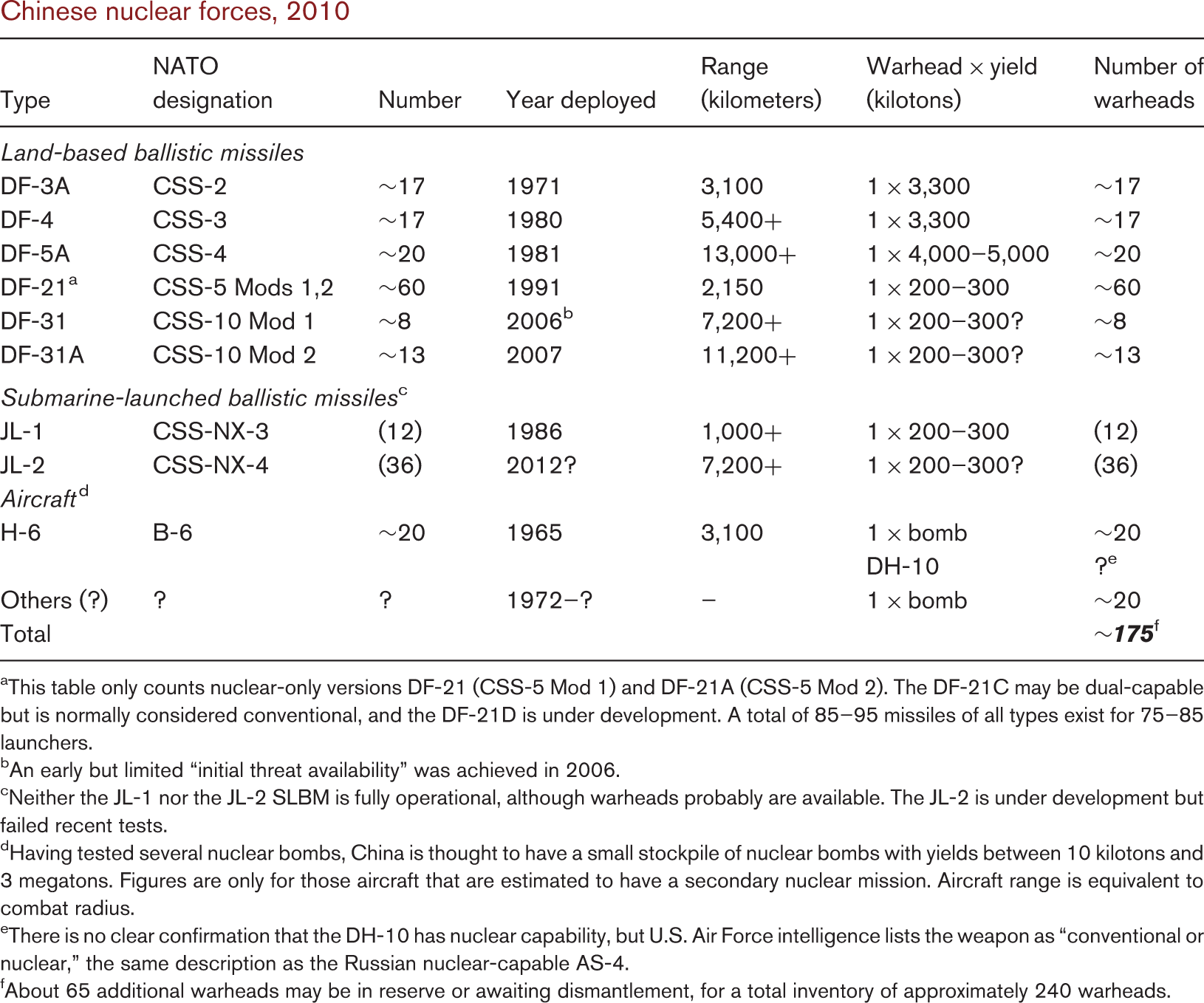
This table only counts nuclear-only versions DF-21 (CSS-5 Mod 1) and DF-21A (CSS-5 Mod 2). The DF-21C may be dual-capable but is normally considered conventional, and the DF-21D is under development. A total of 85–95 missiles of all types exist for 75–85 launchers.
An early but limited “initial threat availability” was achieved in 2006.
Neither the JL-1 nor the JL-2 SLBM is fully operational, although warheads probably are available. The JL-2 is under development but failed recent tests.
Having tested several nuclear bombs, China is thought to have a small stockpile of nuclear bombs with yields between 10 kilotons and 3 megatons. Figures are only for those aircraft that are estimated to have a secondary nuclear mission. Aircraft range is equivalent to combat radius.
There is no clear confirmation that the DH-10 has nuclear capability, but U.S. Air Force intelligence lists the weapon as “conventional or nuclear,” the same description as the Russian nuclear-capable AS-4.
About 65 additional warheads may be in reserve or awaiting dismantlement, for a total inventory of approximately 240 warheads.
The US Defense Intelligence Agency reported in 2009 that “China likely has produced enough weapon-grade fissile material to meet its needs for the immediate future” (Maples, 2009). New warheads for the DF-31, DF-31A, and JL-2 missiles (assuming they will carry new warheads) have probably already been produced; however, the resulting warhead increase is likely to be offset somewhat by the retirement of older warheads over the next several years.
Footnotes
1
For a discussion on China’s nonstrategic nuclear weapons, see Norris and Kristensen (2008): 44.
2
Although primarily considered conventional, the DF-21C is reportedly dual capable—it can be assigned both conventional and nuclear missions. See Stokes and Easton (2010).
4
Even the Indian army’s denial that missile units had been moved closer to the Chinese border did not put a damper on the misreporting and rumors ( Asian Age, 2010). For examples of these reports, see Hindustan Times (2010); Tibetan Review (2010); Times of India (2010); Voice of Russia (2010).
5
The 2010 report echoes a statement in the 2009 report: “The
[People’s Liberation Army] has replaced older liquid-fueled
nuclear-capable CSS-3 [DF-4 medium-range ballistic missiles] MRBMs with more
advanced solid-fueled CSS-5 MRBMs in Western China” (Defense Department,
2009: 29). For an in-depth analysis of the missile developments in
Western China, see (Kristensen 2007b,  ).
).
6
China also deploys DF-21 missiles in the southwestern province of Yunnan, about 600 kilometers (373 miles) from the India border. This deployment has gradually replaced older DF-3A missiles but is not described in the 2010 Pentagon report. China may also have begun deployment of DF-21 missiles even further west, in the central part of Xinjiang province, which occupies China’s northwest corner.
7
China’s sole first-generation SSBN, the Xia, is no longer considered fully operational. In 2003, the Pentagon predicted that China would deploy a JL-1 SLBM that year and that the Xia’s service life would be extended past 2010, but the submarine has never even sailed a deterrent patrol (Defense Department, 2003; Kristensen, 2008a), and the annual Pentagon reports no longer include the JL-1 on the list of Chinese missile forces.
8
9
We described development of the base in 2006 and the arrival of the first Jin SSBN in 2008 (Kristensen 2008b; Kristensen, Norris and McKinzie, 2006).
10
11
The US Office of Naval Intelligence (ONI) estimated in December 2006 that “a fleet of probably five SSBNs will be built to provide more redundancy and capacity for a near-continuous at-sea SSBN presence” (US Department of the Navy, 2006: 1). Some media reports assumed that ONI meant China is building five Jin-class SSBNs; we interpret the statement as more of a projection.
13
Chinese nuclear submarines appear to be comparatively noisy (Kristensen, 2009).
Author biographies
Inquiries should be directed to NRDC, 1200 New York Avenue, NW, Suite 400, Washington, DC, 20005, USA; 202-289-6868.