




Abstract
The author highlights Burma and recent events surrounding its nuclear program to present a case for the development of a UN technical body to investigate countries suspected of having weapons of mass destruction (WMD). International verification organizations such as the International Atomic Energy Agency (IAEA) and the Organization for the Prevention of Chemical Weapons (OPCW) have no expertise in evaluating technologies outside their core missions, which, he writes, means no international organization can assess the technology of missile delivery systems. Using Burma as a backdrop, the author makes the case for an international technical body, which he outlines in structure, function, and scope.
The Southeast Asian country of Burma (also known as Myanmar) has been ruled by a ruthless military dictatorship for 48 years. To the world, this ruthlessness became quite clear in 1988, when thousands of Burmese died during anti-government riots. A year later, the junta declared martial law and, to highlight its new control, changed the official English name of the country from “Socialist Republic of the Union of Burma” to “Union of Myanmar.” Known for its human rights violations—from the recruitment of child soldiers, to the use of rape as a military tactic, to forced labor, to name but a few—the junta continues to police the country, and control the entire economy. Top generals accumulate wealth by exploiting Burma’s many natural resources such as timber, minerals, and jade; in fact, in 2009, Burma was listed as the world’s third most corrupt country ( Kacchin News, 2009). In recent years there have been huge discoveries of natural gas which will be sold mostly to Thailand and China for large sums of money. A less lucrative—but more dangerous—venture is the country’s investment in conventional weapons. Burma has many factories producing hand-held weapons, small missiles, and military electronics. Because of international sanctions on arms imports, Burma wants its own arms production industry. 1 The pattern has been to purchase arms designs and the factories to build them, as was the case in 1998, when media outlets reported that a pre-fabricated small-arms factory had been shipped from Singapore to Burma ( Irrawaddy, 1998).
Much of the weapons spending in Burma is to outfit some 400,000 police, military, and security forces personnel employed to control the population—a large part also goes into anti-aircraft radars and small missiles for defensive purposes. In 2008, however, the ruling junta teamed with North Korea to develop Scud missiles, intermediate range ballistic weapons (DVB, 2010). The development of these offensive weapons left Burma analysts wondering if nuclear weapons might also be in the mix. Verifiable evidence soon surfaced confirming that, indeed, Burma seemed very interested in mining uranium and cooperating with Russia in the construction of a small nuclear reactor in a nuclear center (small research reactors always have their attendant laboratories carrying out research on experiments done in the reactor; Selth, 2007).
For many years, Burma has kept its nuclear ambitions secret. And there is reason for concern if indeed it intends to enter into an arms race. Offensive actions taken in the immediate region threaten its neighbor and historical enemy Thailand, and could destabilize the region (Amnesty International, 2005).
But Burma is more than just a regional threat in Southeast Asia. Burma, with its secretive nuclear ambitions, highlights the lack of an international technical body able to investigate countries suspected of developing weapons of mass destruction (WMD). International verification organizations such as the International Atomic Energy Agency (IAEA) and the Organization for the Prevention of Chemical Weapons (OPCW) have no expertise in evaluating technologies outside their core missions and have little interest in doing so. In addition, there is no international organization tasked to assess technology of missile delivery systems.
Yet, the unraveling of a WMD program—like Burma’s—is best accomplished by evaluating its entire scope: including the country’s procurement networks, foreign suppliers, and foreign assistance.
We should use the current situation in Burma as a starting point to assess a deeply flawed international system and to identify the urgent need for the UN to establish an international technical body which, for the purposes of this article, will be referred to as the proposed UN Standing Commission on Weapons of Mass Destruction, or “the commission.”
Burma’s whistle-blower
Over the past 10 years, rumors of a Russia-Burma nuclear reactor deadline have made headlines. Burma tried to buy a small reactor from Russia in 2000, but failed to reach a deal. In 2007, Russia announced a new deal, in theory, to sell Burma a research reactor, but this was never consummated. The biggest barrier to its purchase of a Russian research reactor today is that Burma has not signed the Additional Protocol to its outdated IAEA Safeguards Agreement. The Additional Protocol gives the IAEA increased rights to carry out inspections in countries that have signed. 2 While these rights are mostly limited to facilities that the country has declared to the IAEA, the IAEA may demand to inspect additional sites. In addition, Burma concluded an agreement with the IAEA in 1995 that virtually eliminates all safeguards inspections for nuclear materials on the basis that it has none. Burma has been asked to voluntarily update both agreements, but has not moved forward on this. Without this modern agreement, no country, including Russia, would consider selling a reactor to anyone, let alone a country like Burma with a poor human rights record and a history of harsh military rule.
The IAEA has the dual responsibilities of encouraging and assisting countries to develop nuclear programs, and verifying that countries with nuclear materials properly account for them. The IAEA Department of Safeguards is the “policing” function. The Department of Technical Cooperation, in concert with the departments of Nuclear Safety and Nuclear Energy, provides advice and support to nuclear programs, primarily in developing countries with no significant nuclear infrastructure of their own. In 2001, officials from the IAEA Department of Nuclear Safety traveled to Burma to determine the country’s ability to handle the operation of a small nuclear reactor. The mission is reported to have declared Burma incapable (Hibbs, 2009).
Nuclear rumors took on a new life in March 2010, however, when sources working with the Democratic Voice of Burma (DVB), an exile news organization dedicated to providing censored government information to the Burmese people, gathered fragmentary information about two special factories. DVB sources broadcast a documentary into Burma with a plea for someone to come forward with more information on the reactors. Army Major Sai Thein Win did just that after watching the broadcast; in fact, he defected, and brought DVB hundreds of color photos, documents, and information about his former workplace.
Major Win was educated in Burma as a mechanical engineer and received an additional five years’ missile engineer training at Moscow’s Bauman Institute. When he returned to Burma, he was assigned to an elite military unit known as the Defense Science and Technology Academy (DSTA) near Maymyo (known today as Pyin Oo Lwin) where he worked before he was given a special assignment as deputy director of a factory near Myaing. This factory made prototype parts for a covert missile and nuclear program, with an emphasis on missiles, Major Win’s specialty. These factories were built around 2005 and largely equipped by the Singaporean subsidiaries of several German companies (Albright et al., 2010).
In late 2009, Major Win was transferred to a different factory, also near Maymyo,
which was equipped with nearly identical German machine tools but was even more
focused on the Burmese nuclear program. Win’s photos of what is now
known as Special Factory Number 1 (see Figure 1) show chemical processing equipment.
He labels some items “bomb reactors”—strong
steel containers used to contain the violent chemical reaction that occurs when
uranium tetrafluoride is transformed into uranium metal; they are neither nuclear
reactors nor nuclear bombs. Win kept a written directive from what is identified as
the “No (1) Science and Technology Regiment Thabeikkyin” to
build these bomb reactors for “the use of special substance production
research department at technological workshop” (Kelley and Fowle, 2010). Major Win, a mechanical engineer with a specialization in programming
precision machine tools such as the ones from Germany, provided DVB with
photos of German machine tools and German technicians installing them.
Major Win was trained at the Bauman Moscow State Technical University.
Many of his friends and peers attended the Institute of Engineering
Physics and the Mendeleev Institute of Chemical Technology, known for
its nuclear studies. Thousands of young Burmese military officers have
been training in Moscow since 2000, and there is no sign that such
training is for civilian purposes.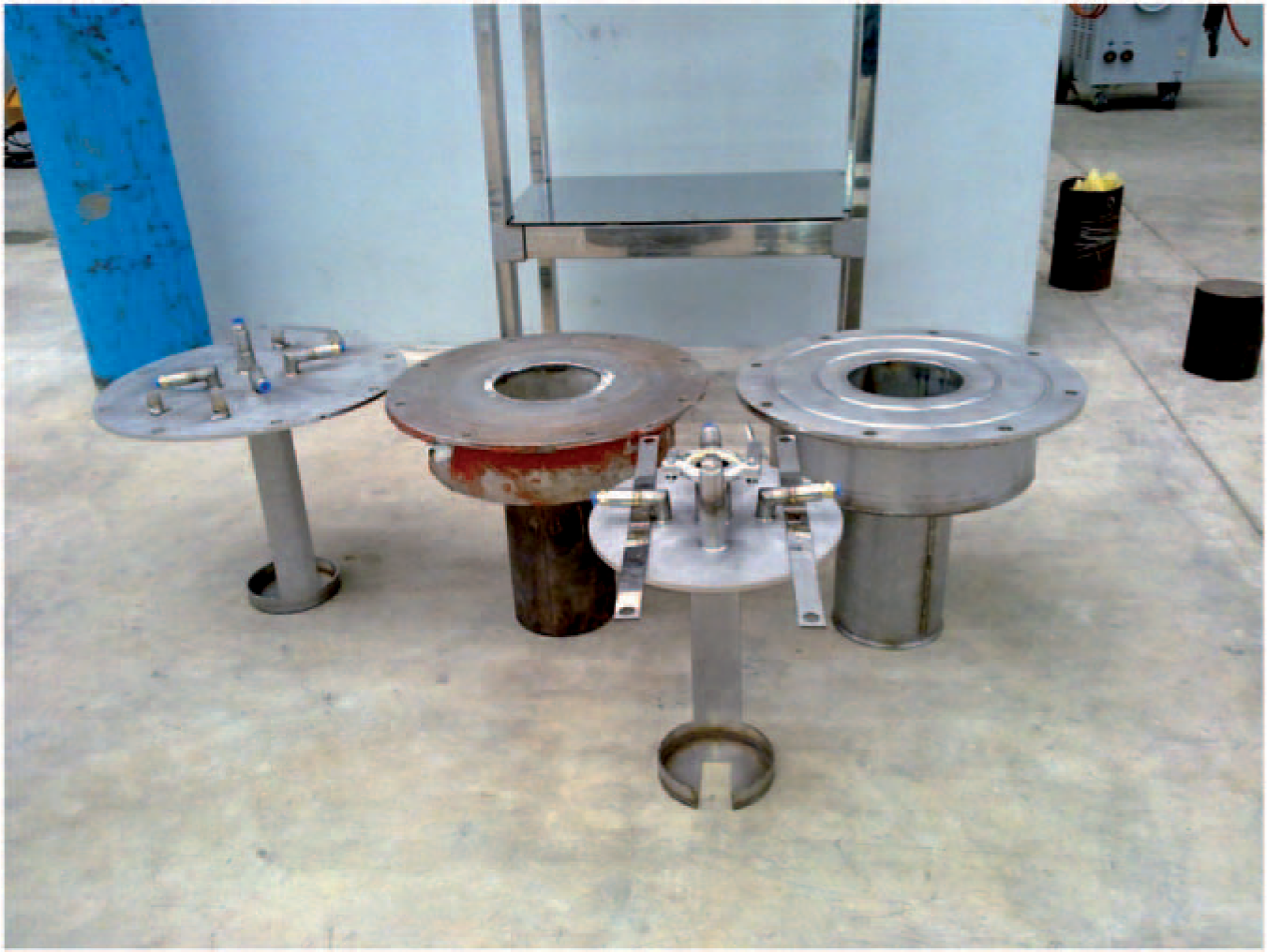
His photos also show other equipment, including an item labeled in a photo as a
“fluoride bed reactor,” which is certainly a fluidized bed
reactor used for making uranium hexafluoride for uranium isotopic enrichment. A
number of Win’s photos show equipment that have uses in the uranium
nuclear fuel cycle; further, as a mechanical engineer specialized in programming
precision machine tools, such as the ones from Germany, Major Win was explicitly
told that he was working on a program to enrich uranium, build a reactor, and build
a nuclear bomb. At a site north of Mandalay, he visited a “Nuclear
Battalion,” which has also been mentioned by other sources, and reported
a uranium ore concentration plant there. This possible site is visible at that
location in satellite imagery (see Figure 2). While all these pieces of chemical equipment could
conceivably have other uses, given the briefings Win received, it seems clear they
are for a nuclear weapons program. Although this conclusion cannot be verified by
color photos alone, the photos are unusually detailed and specific for an
intelligence analysis of a nascent program. In addition, many objects in the photos
appear to have been subjected to high temperatures such as those involved in
chemical processing. It is difficult to ascertain from the photos whether the tests
involved actual uranium, but it is clear that this is an active development program.
Major Win’s credibility was greatly bolstered by the
photographs and documents he brought with him. In briefings for his
superiors, he was told he was working on a nuclear weapons program.
Visiting a “Nuclear Battalion” at a site north
of Mandalay, Major Win reported a uranium ore concentration plant there,
and this possible site is visible in this image.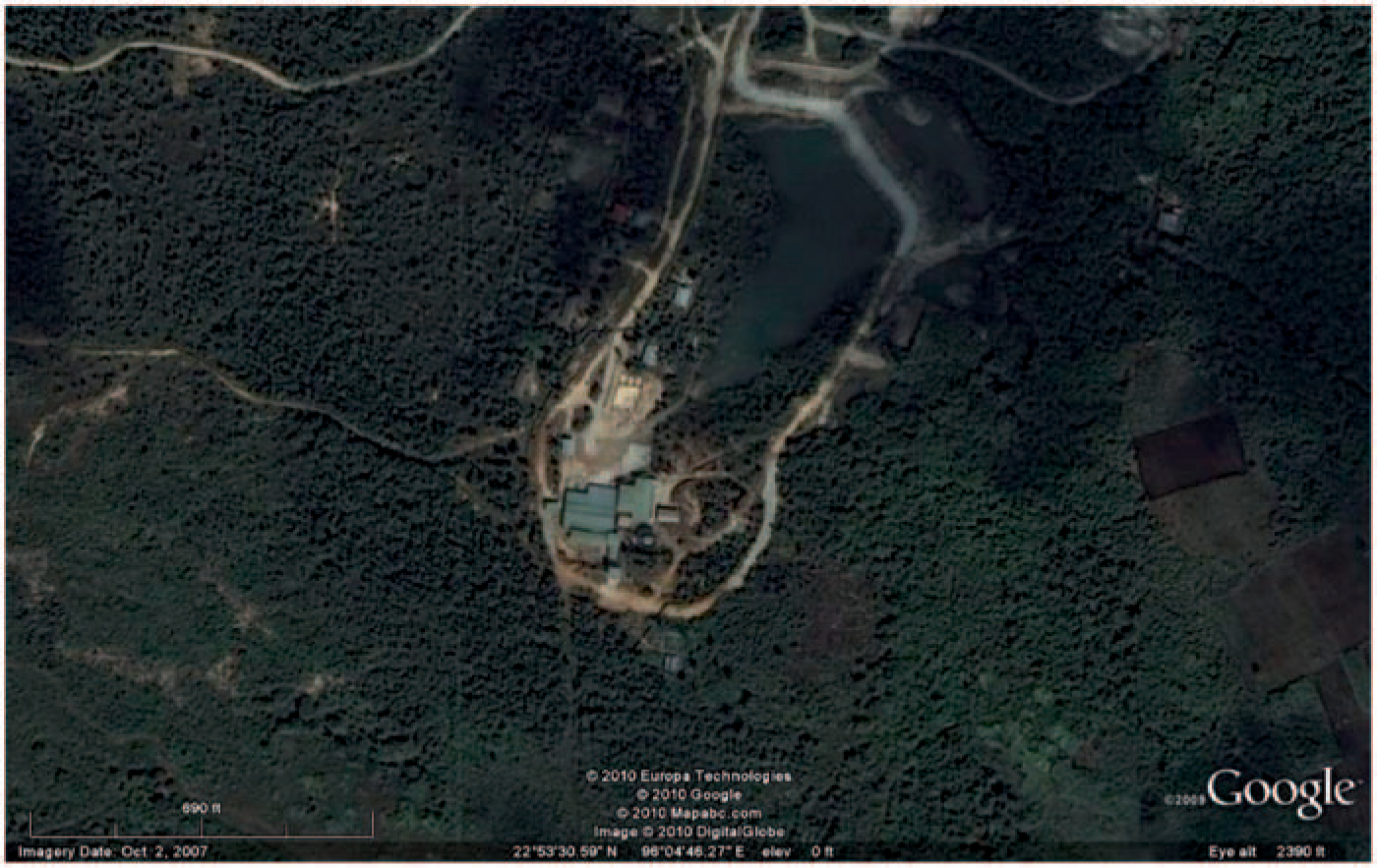
All these observations have been digested by national intelligence organizations and NGOs. Most agree that the findings point to a nuclear program in Burma, and many feel it can only be a military program.
Information concerns on nuclear and missile programs
The information provided by Major Win about the special factories suggests evidence of both nuclear technology and technology for intermediate range ballistic missiles, as well as some unexplained equipment. But there is no international organization to even assess this information. Moreover, because of its dual role in promoting nuclear energy while policing safeguards, the IAEA is compromised in its ability to challenge Burma on Major Win’s allegations—the organization, through its Department of Technical Cooperation, has supported training of a nuclear cadre in Burma (although the country denies having any nuclear program). Much of the funding is spent to train replacements for Burma’s aging nuclear scientists, including training in research reactor design. 3
A technical organization with a mandate beyond those of existing international verification organizations is needed. The IAEA, for example, focuses on the verification of declared nuclear materials in member states in good cooperative standing. Due to its limited nuclear nonproliferation treaty mandate, the IAEA cannot even ask questions in many states about suspicious activities. Even where it can, it has historically hesitated to inquire about nuclear activities outside its nuclear material verification mandate. The most famous case was in 1990, when European media uncovered Iraq’s gas centrifuge uranium enrichment program—a program the IAEA did not even question during its traditional safeguards inspections in Iraq from 1989 to 1990 (Albright, 1993).
Structure of an international technical body
The UN receives information from many sources, but has few standing technical bodies to analyze gathered information. Though the IAEA analyzes nuclear information and the OPCW investigates data about chemical weapons, there is no standing body for missile evaluation—and certainly no group charged with integrating WMD proliferation information across many disciplines.
The IAEA cannot examine evidence in areas like chemical weapons, which are outside its core area of expertise, and is actually reluctant to inspect facilities that do not have “declared nuclear materials,” like machine shops or missile facilities. Yet a WMD program may have common roots in covert procurement and management of programs, weapons, and the means to deliver them. This valuable information is often lost or overlooked because international organizations have such narrowly defined legal mandates. A major advantage of the proposed commission is that it would be multidisciplinary.
The staff
The proposed new UN technical body would consist of a very small, permanent, multidisciplinary commission in a major UN base, such as New York, Vienna, or Geneva. The commission, made up of about 10 experts and administrative staff invited from UN member states, would evaluate suspicious information on questionable states. These experts would have subject specialties on various weapons of mass destruction and missile technology and would be called upon when needed. Member states could choose their experts from places such as national laboratories, defense contractors, or universities. The commission would also maintain a roster of external experts, trained in mission specifics like inspection procedures, but acting mainly as technical experts. 4
Part of the value of such a body would be to vet information collected and provided by UN member states, especially in cases where the impartiality of the reporting member state is in doubt.
Training
The experts who make up the commission would receive specialized training in analysis, inspection procedures, recognizing disinformation, and past experiences of similar arms control verification organizations. 5 In addition, member states would be called upon to provide the commission with job-related training, such as satellite image interpretation. The commission would evaluate satellite imagery, open source data, and data provided voluntarily by UN member states. Experts must be drawn from a cross section of member states with real expertise in the areas to be inspected.
In the case of information generated by another UN organization, the Security Council would grant the new commission power to obtain such information for independent analysis. For instance, the commission could have requested results from analyses done by IAEA’s Network of Analytical Laboratories on uranium samples taken from Syria following the bombing of that country’s suspected reactor facility in 2007. In addition, the commission would have the authority to analyze samples collected by a single-mission agency for evidence of other prohibited activities—looking, for example, for radiation signatures in a sample collected at a missile plant. Institutional barriers and limited legal mandates make this type of analysis impossible under the current inspection regimes.
If inspections were to become necessary, they would be carried out by the commission, drawing upon the knowledge and experience of an external body of experts. The Security Council would provide the authority for such inspections, and also the authority to request relevant information from organizations such as the IAEA and OPCW which, strictly speaking, are not UN organizations but report to the Security Council. 6
This training, for example, would be useful in the case of Burma: The chemical equipment featured in Major Win’s photos call for detailed analysis, which would include assessment of the size of the chemical reactors, the bomb reactors, and other equipment (such as a liquid-fuel pump impeller for a SCUD-type ballistic missile). To date it is not clear that any organization has reviewed the photos for evidence of chemical weapons production. Although chemical weapons production in the equipment in the photos is considered unlikely, it is exactly why a multidisciplinary review is necessary. This type of examination could consist simply of reviewing IAEA analysis, or using the proposed commission’s on-call experts to provide an independent assessment. This would greatly increase the transparency of assessments currently being made, and would provide the established international verification organizations, or the new proposed commission, greater legitimacy in requesting access.
The approach
The commission must be multidisciplinary to properly analyze the great volume of data available from multiple sources—data that often concerns nuclear programs, missile programs, and even chemical and biological weapons. Countries developing offensive weapons of mass destruction often are considering chemical weapons and ballistic missiles as well. Suppliers in these other technologies may provide important hints about procurement networks and intentions. For example, in June 2009, a magnetometer from Japan was intercepted by customs officials and seized. It was destined for Burma. It has been reported both as a device for building gyroscopes and for centrifuge magnets. This needs to be clarified by technical experts who can define possible uses, and determine the actual end use. This would require the new commission to work with customs officials under international export control regulations to analyze data.
Such a technical commission would have been useful, for example, in assessing Syria in 2007 after it was bombed. 7 Syria was surprisingly low key in its response to this incident and seemed willing to basically ignore a bombing on its territory. In investigating the incident, the IAEA has had great difficulty getting Syria—which just wants the case to be closed—to cooperate. An investigation by multidisciplinary specialists might provide a clearer picture than what the single-mission IAEA has so far provided.
The capacity
A new technical body could investigate all open-source material related to a particular event, including satellite imagery generated after the event, and analyses of environmental samples. In the case of Syria, particles of uranium were found that should have been analyzed in an open and transparent way, not by one member state on behalf of an international organization. In the case of Burma, the German machine tools were an excellent source of information, as they are known to be used for both missile and nuclear equipment prototypes. The team evaluating this information would need to be well versed in both disciplines. It should also be looking for clues pointing to conventional or even chemical weapons. This will not happen with a single-discipline organization.
The new commission would have the technical expertise to recognize signs of nuclear, chemical, and biological weapons, and the missile means to deliver (any or all of) them. The commission would evaluate such information holistically and not limit its investigations to a single field. Further, the commission would also draw upon the experiences of many member states’ military, intelligence, and industrial programs, rather than the experience of a single country.
Conclusion
The UN relies on standing organizations such as the IAEA and OPCW to verify and report on compliance with treaties such as the NPT and the Chemical Weapons Convention. When suspicious information is received about a member state, it is often closely associated with one discipline, e.g., chemical weapons, and is assigned to the closest technical organization for evaluation. In the case of missile information, there is no standing body to analyze data; hence, significant information may be missed by analysts expert in only one area.
There are clear signs of a probable nuclear program in Burma. The fact that it is covert makes it especially suspicious. There are strong allegations of WMD activities in Syria—strong enough that a facility was bombed in the night. If analysis of these problems is left to international organizations with very limited legal mandates, they will not be adequately resolved. It is in the interest of the international community to maintain its own independent assessment center for WMD, in keeping with UN Security Council Resolution 1540 on the proliferation of weapons of mass destruction. Excellent information often comes to UN organizations from member states with vast intelligence resources, but it is shortsighted for the international community not to have its own experts.
Major Win delivered to the world a large body of new data that strongly supports claims that Burma has a covert nuclear program. This information deserves to be analyzed by a bright team, unfettered by narrow legal mandates and conflicting agendas. A new body in the UN system, at a higher level than the treaty verification organizations, could provide that analysis.
Footnotes
1
Burma has built approximately 20 numbered defense factories around the country. The purpose of all of them is not known, but there are reliable reports in great detail about the manufacturing of light arms, rifles, ammunition, mortars, landmines, and military electronics such as radios.
2
The IAEA Model Additional Protocol, INFCIRC/540 is a voluntary addition to an existing IAEA safeguards agreement. The Additional Protocol was introduced to increase IAEA investigation rights after major failures were discovered in Iraq following the 1991 Gulf War. It allows IAEA to collect information on a country’s nuclear activities, visit declared sites, and make unannounced visits to declared sites. In extraordinary circumstances IAEA can ask for access to undeclared or non-nuclear sites. Burma has an older type of Safeguards Agreement and has not accepted the Additional Protocol, which severely limits the IAEA.
3
It is also curious to note that the IAEA is training a few Burmese nuclear scientists at the same time as several thousand young Burmese military officers are going to Moscow for undergraduate training in nuclear and missile engineering. The Department of Technical Cooperation, in 2007 published their rationale for aiding Burma’s human resources in the nuclear field: “The nuclear programme in Myanmar depended on a small aging core of foreign trained scientists and engineers, and training provided to local staff was almost entirely through International Atomic Energy Agency (IAEA) assistance.” See IAEA TC Project Datasheet, 2MYA/0/007, from 2001 to completion in 2010 (IAEA, 2010).
4
The United Nations Monitoring Verification and Inspection Commission, UNMOVIC, operated on a similar basis. There was a small permanent staff planning inspections and evaluating new data. The UNMOVIC depended on a cadre of experts trained in inspection procedures but chosen for their detailed technical knowledge of weapons of mass destruction. UNMOVIC was considered as a possible permanent organization in the role I have suggested, but was not accepted due to the political pressures of 2003 following the end of the second Gulf War.
5
INF, START, IAEA Action Team, UNMOVIC, CTBTO, OPCW, etc.
6
It is worth correcting a common misconception here. IAEA is frequently called the “UN Nuclear Watchdog.” Actually, the IAEA is an independent organization affiliated with the UN system and reporting to the Security Council and not the Secretary General. The OPCW is an independent, autonomous international organization with a working relationship with the United Nations. For this reason, either would normally refuse to share samples collected for mandated purposes with other organizations with very different technical missions. It is therefore necessary for the Security Council to empower the new commission to request data from single mission international verification organizations.
7
The bombing in Syria is shrouded in mystery. Israel conducted a nighttime bombing raid to destroy what is believed to be a Magnox-type nuclear reactor under construction with North Korean assistance. The government of Israel has never confirmed the bombing, and Syria took a surprisingly low key position, trying to ignore the attack. The United States published a description of the reactor nearly eight months after the incident. IAEA managed to inspect the bombed site one time for less than one day. They were not able to make substantial conclusions about the alleged reactor because the site had been completely cleared months earlier and a new building, not a reactor, had been erected. IAEA collected a few particulate samples that they claim prove that reactor fuel was on the site, although this conclusion is highly suspect given the evidence.
Author biographies