




Abstract
Yet another year passed without a biological attack, ensuring that the international community could spend its time focusing on strengthening global biosecurity measures, rather than responding to immediate threats. In 2011, two meetings—the Seventh Biological Weapons Convention Review Conference and the G8 Global Partnership Against the Spread of Weapons of Mass Destruction—made progress on finding ways to deal with biological threats posed by non-state groups. Less progress was made in countering the prospect of nation-state biological weapons programs, which is not surprising, the author asserts, since the life sciences are not amenable to the arms control tools that have been used to monitor state compliance with other nonproliferation agreements. The author looks at how the Biological Weapons Convention is evolving to adapt to the nature of the biological threat, and at how Cooperative Threat Reduction (CTR) inspires global efforts to implement biosecurity programs outside the former Soviet Union. The transition from CTR to global scientific engagement requires the G8 Global Partnership to change its philosophy, the author writes; as the original Soviet-based programs targeted scientists known to have worked in weapons programs, the new goal is not to redirect former weapons scientists, but to establish relationships with scientists who were never in weapons programs. The success of such collaboration depends strongly on treating collaborating scientists as partners, not threats. The central questions for biosecurity in 2012 will focus on the international community’s ability to cooperate and whether it can think creatively and strategically and agree to enter partnerships with scientists from all regions of the world.
Keywords
Little happened in 2011 to change policy-making minds regarding the nature, scope, or immediacy of the biological weapons threat. Wide disparities between two opposed viewpoints remained: There were those who believe the threat of biological attack has been greatly overblown—with US biodefense activities, if anything, only exacerbating biological risks—and those who find defensive efforts to be seriously under-matched to an ever-growing challenge.
This dichotomy may be best typified by the most important news event of 2011 that didn’t happen: For the third year in a row since the congressionally mandated Commission on the Prevention of WMD Proliferation and Terrorism issued its widely publicized 2008 prediction that a bioterrorist attack was “more likely than not” within the next five years, no such attack took place (Commission on the Prevention of WMD Proliferation and Terrorism, 2008). Some saw this as one more year’s evidence that the commission had exaggerated terrorists’ interest in, and ability to pursue, biological weapons; others breathed a sigh of relief at having dodged a bullet for yet another year.
The international community made useful progress during 2011—particularly through the Seventh Biological Weapons Convention (BWC) Review Conference 1 and the G8 Global Partnership Against the Spread of Weapons of Mass Destruction—in dealing with the threat of bioterrorism by non-state groups. These activities—as well as support for technical assistance to secure materials that present biological proliferation risks and implementation of UN Security Council Resolution 1540 on non-state actors and WMD—did not represent marked departures, but rather an extension and a consolidation of previous activities in those venues. Less progress was made in countering the prospect of nation-state biological weapons programs; this inaction was seen as a failure of political will by some but a realistic allocation of effort by others, who question how political will can be expected to overcome the technical realities that are not amenable to a verification protocol for the BWC.
These incremental developments took place against the backdrop of the increasing power of and geographic access to biology and biotechnology. Each year, more and more people will get trained in relevant technical areas, resulting in a greater number who have mastered some of the skills needed to produce a biological weapon, and who can either teach themselves to master the rest or can find others with complementary skills.
Bio-Response Report Card
With 2011 marking the 10-year anniversary of both the September 11 terrorist attacks and the October 2001 anthrax letter mailings, a variety of groups issued retrospectives and assessments related to the bioterrorist threat. One comprehensive look at America’s ability to identify, respond to, and recover from a biological attack was issued in October 2011 by the WMD Center, an independent nongovernmental organization formed by the chairman, vice chairman, and executive director of the congressional commission that, three years earlier, had predicted a bioterrorist attack within five years.
The WMD Center’s Bio-Response Report Card (WMD Center, 2011) provides a sobering assessment of the challenge involved in defense against biological attack (Figure 1).
2
Grades range from “B” in many response categories for small-scale attacks, to “D” for most categories for large-scale attacks, to “F”s practically across the board for the most devastating contingencies. In no category are US capabilities getting worse, but five out of eight show no progress being made.
Bio-Response Report Card (WMD Center, 2011: 19).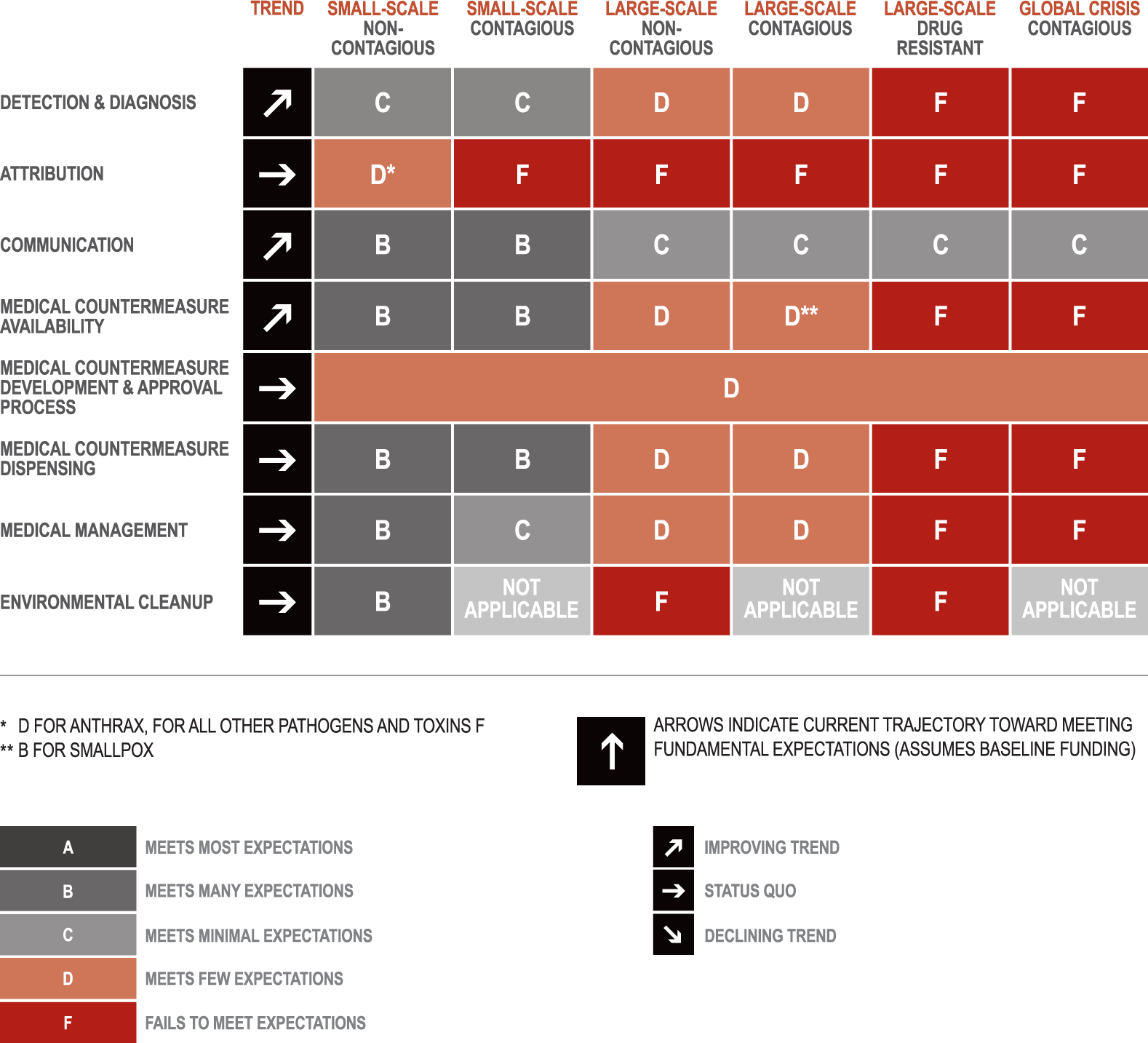
This assessment reveals a substantial vulnerability, the significance of which comes back to one’s view of the bioterror threat. Those downplaying the threat would not argue that the grades are wrong, but rather irrelevant, and that resources devoted to improving these grades would be better spent on public health, or at least in ways that both benefit public health and prepare for a biological attack. Those who cannot so easily dismiss the risk of a bioterrorist attack, however, draw different conclusions: First, many of the actions that need to be taken to prepare for an attack would not draw on a bolstered public health system; such responses require dedicated biodefense funding and—like other security investments—may not necessarily provide benefit against other public health threats. Second, to the extent that certain response categories build on others, an effective response in one category may be limited by deficiencies in another. Third, although the scorecard shows that it is much harder to defend against a large attack than a small one, a terrorist group capable of conducting a small attack does not face a comparable challenge in scaling up its ambitions. After all, a large attack may simply be a series of small attacks, repeated in multiple locations or over time. Fourth, though successful efforts to prevent bioterrorist attacks would obviate the need for response, preventive measures can never be guaranteed 100 percent effective.
While this snapshot view shows where further progress is needed, it does not reveal where progress is actually feasible and how much a country should be willing to pay to achieve it. Contrary to those who might assume that poor grades in such public policy assessments are the fault of incompetent government bureaucrats, the “D”s and “F”s on this chart typically result from extraordinarily daunting technical challenges, such as the expense, time, and scientific uncertainties involved as well as the logistical difficulties that come with distributing millions of doses of medicine quickly enough to forestall disease. Considerable judgment will be required in determining whether additional resources would have much effect on any given evaluation. The country is better off for having such an end-to-end assessment, but only if it leads to useful action to remediate the deficiencies it displays.
The Seventh Biological Weapons Convention Review Conference
In December 2011, states party to the Biological Weapons Convention (BWC) met in Geneva for its quinquennial review of the convention’s operations. This marked the Seventh Review Conference and reflected the remarkable transformation that has been made in adapting the treaty machinery to the nature of the biological weapons threat.
When the treaty was negotiated in the early 1970s, only two professional communities spent much time dealing with biological weapons—militaries concerned about encountering them on the battlefield and diplomats concerned with banning them through an international treaty. National governments were viewed as the relevant actors, and national biological weapons programs were the targets of arms control efforts. Biological agents with the potential to serve as weapons could not be banned outright, since they occurred in nature and had legitimate uses in research, commerce, and defense. However, the implicit assumption was that enacting a Biological Weapons Convention could shape the development and application of life science and biotechnology to prevent offensive biological weapons programs.
But in 2001—after the September 11 attacks, the October anthrax mailings, and the failed attempt of BWC state parties to add a legally binding treaty protocol intended to provide tools to monitor compliance—emphasis shifted from national bioweapons threats to non-state threats. A set of intersessional meetings was instituted on a range of topics necessary to detect, prevent, or respond to a biological attack, such as national implementation measures; security and oversight of pathogens; detection, diagnosis of, and response to infectious disease; investigation of suspicious disease outbreaks; and codes of conduct for scientists. These meetings, continued by the Sixth Review Conference in 2006, engaged a range of professional networks that were not traditionally involved in arms control and disarmament, including law enforcement, scientific researchers, and the public health and biosafety communities.
Continued engagement with non-traditional professional communities
The Seventh BWC Review Conference endorsed and continued these engagement and outreach efforts, bolstering the intersessional meeting process that had been successful at bringing together diplomats and non-traditional players and at catalyzing discussions about each of their roles in addressing biological weapons and bioterrorism.
The 2011 Review Conference also bolstered the treaty’s Implementation Support Unit (ISU), a three-person administrative staff established at the Sixth Review Conference in 2006. During the five years between conferences, the ISU took a proactive role in engaging the global scientific community. For example, it coordinated a security element in the International Genetically Engineered Machine competition, in which hundreds of university—and in some cases high school—teams developed projects using genetic engineering and synthetic biology (the chemical synthesis of DNA and its incorporation into organisms to produce functions that would be impossible or impractical to carry out with more conventional means of genetic engineering). The ISU also has reached out to help instill a safety and security culture within the do-it-yourself biology community, and it has worked with industry groups, scientific societies, and governments to promote the secure development of synthetic biology (ISU, 2011).
The Seventh Review Conference increased the ISU’s budget and staff. Although there is a risk that a more robust unit will succumb to the bureaucratic pathologies often affecting international organizations, such growth would enhance the ISU’s ability to engage professional communities, international organizations, industry, and civil society.
Monitoring and adapting to changing science and technology
In discussions and working papers before and during the Seventh Review Conference, participants have repeatedly come back to a central subject: How can parties to the treaty more effectively monitor advances in science and technology? The review conference took several actions to respond to this question, including addressing the topic in future intersessional meetings and bolstering the ISU. Yet keeping state parties abreast of relevant advances is difficult—not only because of the rapid pace, tremendous breadth, and worldwide scope of technological change, but also because the life sciences and biotechnology have evolved along a very different path than have other technologies of security significance, such as nuclear weapons, aerospace, or electronics. Whereas the latter areas were driven largely by military investment, national defense programs have done little to advance the state of the art in the life sciences. Most progress in that field continues to be made in a diverse array of university research groups, civilian research institutions, government laboratories, and commercial firms.
In 2011, these technologies continued their inexorable advance, both in power and geographic spread. As one example, the cost to sequence DNA—which had been dropping steadily over the past 10 years—plummeted even faster in early 2008, when a new generation of sequencer technology was introduced. From about $530 per million base pairs of DNA in early 2007, sequencing costs dropped to $100 per million base pairs in early 2008, to $2.60 in 2009, to $0.50 in 2010, and $0.10 by the middle of 2011 (Wetterstrand, 2011). The geographic spread in biotechnology might best be illustrated by allocations of exhibit space at the June 2011 Biotechnology Industry Organization International Convention in Washington, DC, which featured extensive displays from countries all over the world, including many traditionally thought of as developing.
A report written by the US National Academies (2011)—titled Life Sciences and Related Fields: Trends Relevant to the Biological Weapons Convention—made an important contribution ahead of the Seventh Review Conference’s deliberations on science and technology. Based on an international workshop held in Beijing late in 2010, the study highlighted the rapid pace of technological change in the life sciences, the extent of its diffusion around the world, its growth outside traditional research institutions, and its increasingly interdisciplinary nature.
The report was a proactive effort on the part of the scientific community to engage with the Biological Weapons Convention. Organized by the United States and Chinese Academies of Science and a consortium of international scientific societies and academies, the report pointed out that technical advances not only have implications for biological weapons development (i.e., matters captured by Article I of the treaty), but also for every other major article in the treaty. The process of developing this report showed the need for two-way engagement: It is as important for the world’s scientific community to engage with the BWC and maintain an awareness of the security implications of life science research as it is for those implementing the treaty to stay abreast of technology.
Shaping the convention and avoiding dead ends
The Seventh BWC Review Conference addressed verification and compliance, but to its credit, it avoided being paralyzed by anachronistic discussions of a formal compliance protocol that would be poorly suited to the nature of the life sciences.
The life sciences and biotechnology are not necessarily capital-intensive activities; small research groups or firms, including those in countries with less advanced technological infrastructures, can effectively compete. These fields are also thoroughly dual-use in nature: Legitimate and illegitimate applications draw on the same science and technology base, making it inherently difficult to control one without seriously disrupting the other. Almost every scientific or technological aspect needed to develop biological weapons has some legitimate scientific or commercial application (Epstein, 2005).
A science and technology enterprise of this form—highly decentralized, dynamic, global in scope, with modest barriers to entry, and most significantly, technically ambiguous with respect to intent—is not amenable to the kind of top-down control or verification measures that might be appropriate in technical areas with greater centralization, more distinctive weapons applications, and a higher degree of government control. For this reason, less progress has been made in detecting or countering state-level biological weapons programs than against non-state threats. Rather than attempt to shape the development of the life sciences, the BWC must—to remain relevant—be shaped by them, an evolutionary process of adaptation that the Seventh Review Conference has continued. 3 The treaty is stronger for developing ways to play to its strengths—including building ties to and awareness among scientific and other professional communities—and avoiding paths that are inconsistent with the nature of the life sciences.
From cooperative threat reduction to global scientific engagement
In addition to the BWC Review Conference, the 2011 G8 Summit in France also contributed to reinforcing the safe and beneficial use of the life sciences and biotechnology internationally.
At the 2002 G8 Summit, leaders created the Global Partnership Against the Spread of Weapons of Mass Destruction to garner international participation and financial support for activities similar to the Cooperative Threat Reduction (CTR) projects that the United States launched with the former Soviet states at the end of the Cold War. The G8 agreed to support the Global Partnership with $20 billion over 10 years.
By 2011, one year before its original expiration date, the Global Partnership consisted of 23 countries and was already conducting nonproliferation activities outside the former Soviet Union. At the summit that year, leaders agreed to extend the partnership indefinitely, affirming its worldwide activities and its involvement in topic areas including scientific engagement and biosecurity (G8 Summit, 2011, paragraph 78). While the decision to extend the partnership was more evolutionary than revolutionary, it was nevertheless significant because it represented a continuing commitment to provide resources. 4
Post-2011 challenges and implications
From 2012 on, as the Global Partnership works to implement biosecurity programs outside the former Soviet Union, it will have to undergo a significant change in philosophy. The original Soviet-based CTR programs targeted scientists known to have worked in weapons programs. However, the new goal is not to redirect former weapons scientists, but to establish relationships with scientists who had never been in weapons programs. The success of such collaboration depends strongly on treating these scientists as partners, not threats. For this reason, it is counterproductive to continue to call these programs “cooperative threat reduction.” US scientists need to convince their partners that they are all working on subjects of mutual interest and that they share a common purpose: protecting the life sciences from anyone who would seek to misuse them. 5
As post-2011 programs transform Cooperative Threat Reduction into global scientific engagement, one question could arise: How can funders be assured that scientific engagement programs are actually building security? In the United States, the funders have typically been national security agencies. To the extent that the scientific engagement programs look more like science for science’s sake, security agency funders may deem them to be more appropriately the province of a science agency, such as the National Institutes of Health. The inherent difficulty in developing quantitative metrics to assess the security value of these investments is a handicap in an environment that often tends to take money away from useful projects and dump it into measurable ones.
Another pitfall has been voiced many times over the past decade but needs to be repeated: Biological weapons nonproliferation is fundamentally different from nuclear nonproliferation. Nuclear nonproliferation can be furthered by restricting technology, since many of the technologies and skills needed for nuclear weapons have very specialized, if any, civilian applications. But every country in the world already has technology that could be used to develop biological weapons. It’s the same technology that can help provide every country’s citizens clean water, adequate food, and suitable medicines, among the many benefits biotechnology can provide. Restricting the underlying science and technology would not only be infeasible, but immoral.
“Sensitive information” is a valid concept in nuclear nonproliferation; some technical data and expertise relevant to nuclear weapons are not widely known and can feasibly be restricted. Because they are inherently dual-use in nature, the life sciences do not generally have sensitive information that can or should be restricted.
The states that are party to the Biological Weapons Convention, the G8’s Global Partnership Against the Spread of Weapons of Mass Destruction, and, as an acknowledged leader of global nonproliferation efforts, the United States all seem to understand the dangers of the exploding power and geographic reach of biotechnologies that could be misused to grave effect. The central questions for 2012 will revolve around the ability to cooperate. Can the international community think outside the nonproliferation box that, for decades, has stressed top-down control by the world’s developed countries—and agree to enter partnerships with scientists from all regions of the world? Cooperation developed in several venues in 2011. But these efforts are only beginnings, and they will have to expand quickly if they are to keep up with the torrid pace of biotechnological change.
Footnotes
Funding
This work was supported by the John D. and Catherine T. MacArthur Foundation.