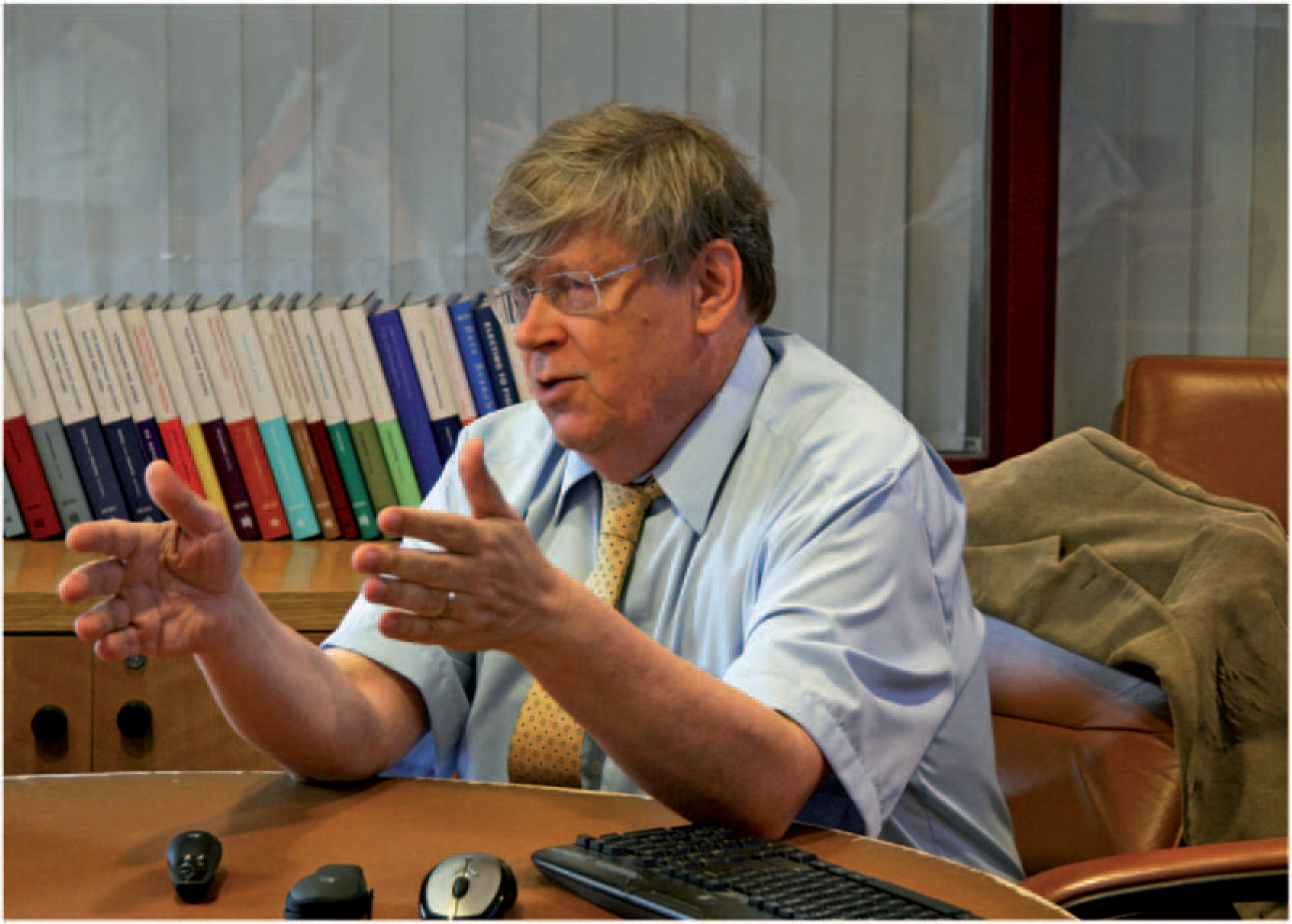
As one who has led inspection teams in North Korea, Iraq, Syria, Libya, and other nations, Olli Heinonen says he cannot discount the possibility that a nuclear weapon will be used in the next 10 years. He asserts that the verification regime of the Nuclear Non-Proliferation Treaty may need an overhaul to contend with current developments such as the nuclear ambitions of non-state actors. He offers perspective on North Korea’s acquisition of nuclear weapons, Israel’s bombing of a suspected nuclear facility in Syria, Iran’s ambition to enrich uranium, the challenges of stopping proliferation, and the need for closer international cooperation and firmer action against proliferators.
For more than a quarter-century Olli Heinonen held one of the world’s most important jobs: As the deputy director general and senior inspector of the International Atomic Energy Agency (IAEA), he worked to dismantle black markets in nuclear weapons technologies and materials and led teams of international investigators to probe state-directed nuclear programs around the world. He has inspected nuclear facilities in Iran, North Korea, Iraq, Syria, and South Africa, as well as others, under the IAEA’s mandate to ensure that nuclear technology is used for peaceful purposes and not diverted for weapons. Heinonen, a native of Finland, is a leading expert on Iran’s nuclear program and led the IAEA’s efforts to track down and disrupt the proliferation network of Pakistani scientist A. Q. Khan, who sold nuclear secrets to North Korea, Iran, and Libya. In August 2010, he concluded 27 years of service at the Vienna-based IAEA to accept a position as senior fellow at the Belfer Center at Harvard’s Kennedy School of Government. He spoke to the Bulletin about the need for far stronger international cooperation and action in the face of more widespread and dangerous threats of nuclear proliferation.
BAS: What’s the likelihood of a nuclear bomb going off somewhere in the world in the next 10 years? Who is most likely to set it off, and where?
Heinonen: Let me put it this way. The fact that I cannot discount the possibility of a nuclear device being detonated within the next decade—apart from another nuclear test the North Koreans have claimed they are currently preparing for—is very disturbing. We are living in more uncertain and less predictable times. We are still witnessing several nuclear proliferation setbacks, from North Korea to Iran to Syria. We have seen the global reach of the nuclear black market.
Today, information on building a bomb, from enrichment to reprocessing and basic nuclear weapon design, is available, though this does not make it an easy business to pursue. There is still a lot of fissile material not properly locked down. Thousands of tactical nuclear weapons remain from the Cold War days, and high-enriched uranium and plutonium are sitting in places that cannot be considered fully safe and secure. The good news is that acquiring a nuclear bomb has consequences, and these weigh heavy on the political calculations for most states to take that step. International efforts are also underway, including better export controls, sanctions where necessary, and sharing of intelligence information and counter-proliferation activities to deny proliferators easy access to sensitive nuclear technology.
But the possibility of terrorists getting their hands on fissile material or even a weapon to carry out a nuclear attack is another matter. We know that attempts have been made by terrorist organizations to acquire nuclear material. The resulting nuclear explosive might be crude, but its consequences—from the physical, psychological, economic, and environmental to those relating to national security—would be immense; far beyond the impact of 9/11. It could happen anywhere; in a big city in an industrialized well-protected country or in the developing world. Even a small likelihood of this happening is taking too much of a risk. Everyone needs to work harder at securing the “loose nukes,” tightening export controls, beefing up the international nuclear verification system, and raising the stakes and deterrence factors for countries tempted to go for a nuclear weapon.
BAS: Is the IAEA able to do this job—to keep up with its mandate to ensure that nuclear technology is used only for peaceful purposes?
Heinonen: First and foremost, the IAEA can only be as strong as its member states want it to be. There are essentially two aspects when we talk about the IAEA’s verification mandate: first, having the political will to use the rights provided within the agency’s mandate; and second, being equipped with the appropriate tools, authority, and resources to effectively meet the proliferation challenges.
The IAEA mandate needs to be expanded and made more robust. It has to preserve the flexibility and adaptability in operating and implementing safeguards to address current, as well as future, threats. However, some states are wary of expanding the IAEA’s verification mandate. They construe such moves as encroaching on their nuclear sovereignty. There is also another angle to consider, as some countries have or are trying to achieve latent nuclear weapons capability. For the IAEA, this means a shorter time lag to sound the alert on a nuclear breakout scenario. The IAEA requires the support of all its members. To ensure that the IAEA has all the necessary information to guide its work, the member states need to be proactive in identifying suspected proliferation cases for international investigation. Close cooperation between the IAEA and other UN entities such as the UN Security Council (UNSC) can facilitate the process. It might be time to revisit the nuclear non-proliferation regime as a whole and see whether the vision created in the 1960s is still adequate in the 21st century.
BAS: Let’s talk about some specifics. Some argue that it is time for the IAEA and the Organization for the Prohibition of Chemical Weapons (OPCW) to call for the establishment of an international verification organization that can assess the technology of missile delivery systems. What’s your view?
Heinonen: The question is: “Who is in charge of curbing proliferation of weapons of mass destruction (WMD)? Who maintains the ‘Nuclear Order’?”
Currently, there is no global system to look at the overall picture. The IAEA’s mandate is restricted to the implementation of the comprehensive safeguards verification system. IAEA attempts to address weaponization have been vigorously challenged by proliferators as well as some other non-nuclear weapons states as going beyond the IAEA mandate.
Let us take the case of North Korea. North Korea’s proliferation activities include nuclear and missile technology. It is currently not party to the NPT and has withdrawn from the IAEA. Even when it was still a party to the NPT, North Korea was already engaging in proliferation activities. The IAEA mandate was insufficient to “catch” North Korea’s activities, and now North Korea has thrown out inspectors. There is therefore merit—not only for the case of North Korea, but for nuclear proliferation cases as a whole—to consider a new outfit which will have overall responsibility and oversight on WMD nonproliferation. Such an entity could be attached to the office of the UN secretary-general or UNSC, and it should actively liaise with OPCW and IAEA. It might also be time to enhance verification cooperation between the two mentioned major verification entities.
BAS: You were the point person on safeguards for developments on Iran, Syria, and Myanmar, as well as other countries. What needs to be done to stop procurement and trafficking of nuclear materials and technology in these countries, including North Korea? How can A. Q. Khan’s networks, and others, be stopped?
Heinonen: In the past, we have seen cases where countries—like Pakistan, Iraq, Libya, and Iran—that wish to clandestinely develop nuclear programs have found ways and means to illicitly procure and traffic in nuclear materials and technology. These have included transfers of most sensitive technologies, including information on weapon designs. And as with any situation, where there is a demand, there will be a supply. Globalization, the free movement of information and people, and the diffusion of weapons technologies have made the job of detection more complicated and difficult. Securing and locking down fissile nuclear material can deny supply. But we see that dealing with the “hardware” side is not enough. The rise of transnational networks that include non-state actors and failed states—as well as terrorist organizations—have limited the effectiveness of adopting a state-centric approach to regulation and monitoring movement of nuclear material and technology.
Several measures to curb some of these problems are already in place, such as the Nuclear Security Summit and the UN Security Council Resolution 1540, which prevents non-state actors from acquiring WMD, related materials, and their delivery means. Along the way, we have also learned a few things from the operation of clandestine nuclear networks that use front companies, falsified end-user certificates, and trade loopholes. Collecting data, connecting the dots, educating countries on the dual-use nature of nuclear technologies, and cooperating and sharing information with countries have been pursued to better understand the pattern of clandestine nuclear networks. It is certainly not an easy process.
And as long as security concerns remain, some states may opt to develop nuclear weapons or capabilities. That is why realizing “WMD free zones” are important, but can also only be achieved with a holistic approach in mind. To stem the proliferation route, a few things can be done. Export controls should be enhanced. Proliferation financing must be continuously targeted. The IAEA should be further developed to take advantage of information analysis to support its verification work. We also need to think in the present as well as ahead.
BAS: Do you see the IAEA as being ready to take on the task of safeguarding countries starting—or thinking of starting—nuclear power activities, such as Jordan and Egypt?
Heinonen: The IAEA has a program to help “newcomer states” establish their national nuclear safety, security, and safeguards system. The states on their part have responsibilities in signing and adhering to the relevant IAEA conventions and agreements, including safeguards. What the IAEA is facing is an increased need for safeguards in many new countries with the same amount of resources—in terms of both finances and manpower. One of the efforts at the IAEA is the development of the concept of the “next generation safeguards” which takes advantage of novel technologies, remote monitoring, and even remote inspections to be able to do more with less.
BAS: You and Graham Allison wrote last year in the Wall Street Journal that had Israel not bombed the Al-Kibar reactor site, Syria would be producing plutonium and would be on its way to its first nuclear bomb. How did this program get past both IAEA inspectors, and why didn’t the UN Security Council move to stop the program?
Heinonen: The Syrian case went without the IAEA’s detection. Intelligence sources caught it at a later stage. There is much to learn from this. First of all, Syria has to provide unimpeded access to information related to its nuclear program, which has violated the NPT. Most likely some of these nuclear activities took place when North Korea was still a member of the NPT, but the actual IAEA verification mandate was then limited by the Agreed Framework. Two things need to be done. The IAEA has to use all its rights, including that of special inspections, to ensure that all nuclear material and activities in Syria are submitted to the IAEA safeguards. When the full scope of the program is known, one has to analyze how this went without detection in such a volatile area and what should be done in order to avoid it happening again.
BAS: What effect do actions like Israel bombing that purported Syrian reactor site have on the IAEA, its legitimacy, and its morale?
Heinonen: This action clearly questioned the legitimacy of the agency’s verification system. Israel may have felt that by disclosing the reactor to the IAEA, Syria could have, post-fact, submitted the facility under the IAEA safeguards and that Israel’s security would then have been compromised with a Syrian reactor producing plutonium. What we see here is a larger problem where it is difficult for the international community to stop the process of non-compliance unless the country willingly gives up its nuclear program. Iran’s case of disregarding international censure and IAEA Board of Governors’ resolutions has a very negative effect that reinforces states’ decisions to rely on their own actions—such as Israel’s bombing of the Syrian site—to deal with proliferation concerns.
BAS: What kind of message does Syria, with this stalling strategy, send to other countries in the NPT? What should be done to make the NPT more effective?
Heinonen: The international community has perhaps tolerated too much stalling not only in the case of Syria, but also with North Korea and Iran. These cases set bad examples for future nuclear proliferators. If we now take a tally on the North Korean case, after repeated stalling and stone-walling, two decades later, North Korea has nuclear weapons, separated plutonium, and is busily moving toward uranium enrichment. The international community needs to handle proliferators much more firmly and keep long-term objectives in mind.
BAS: What constitutes “more firmly”? Are you suggesting a need for military action in some cases? Or do we need new agreements or other changes to the present nonproliferation regime?
Heinonen: There are several policy-type decisions that can be considered. It is important to make sure that when the negotiators draw red lines, there will be consequences when those lines are crossed, just as it should be made clear that actions would be reversed when proliferators abide by rules. Proposals have been made to make the IAEA’s annual safeguards implementation report more transparent. This could carry a certain deterrence value and, at the same time, be able to tackle problems at an earlier stage when they might be more easily resolvable. Another avenue is to provide more regular IAEA briefings to the UNSC on nuclear security and safeguards matters. It might also be reasonable to review the principles of the IAEA’s technical cooperation to ensure that support will be provided to states with good standing with their obligations and that support serves exclusively peaceful use of atomic energy.
BAS: The IAEA has reported efforts by Iranian military-related organizations to design uranium production installations, support the construction of civilian installations, experiment with high explosives, and design missile re-entry vehicles suitable for nuclear explosives. Iran has said that these allegations are false and based on forgeries. Is there any gray area about what Iran is doing?
Heinonen: Let me begin with the facts. In particular, military workshops have been engaged in the manufacturing of equipment for gas centrifuges for uranium enrichment or to acquire special raw materials needed. It is also difficult to understand why there was a document related to nuclear weapons design among centrifuge design drawings. However, there are some gray areas when you look at it from the point of view of safeguards. Let us assume that a country decides to design a nuclear weapon. It tests all the required components and builds a delivery mechanism but does not use any nuclear material throughout the process. It just decides, as Iran has done, to stockpile enriched uranium and to master the enrichment process. Under IAEA safeguards, the country is legally not in violation of its Safeguards Agreement.
But it would be inappropriate and irresponsible to conclude there is nothing to worry about. Such actions go against the spirit of the NPT and fuel suspicion. Iran hid its nuclear activities for more than 20 years before it was forced to own up, and it was found to be non-compliant to its safeguards obligations in the process. Questions posed to Iran were not satisfactorily answered, explanations were changed, and cooperation was often difficult or not forthcoming. When Iran refuses to address outstanding questions and dismisses evidence as forgeries, one has to put this in context of the confidence deficit the international community has on Iran’s nuclear program. There is no smoke without a fire.
BAS: If a New York Times report, which was published in January, is correct, the primary reason for the slowdown in Iran’s uranium-enrichment effort is the Stuxnet computer worm—which the paper characterized as a covert joint US–Israeli program to sabotage Iran’s uranium-enrichment centrifuges. What does that say about the efficacy of the IAEA?
Heinonen: In the last two years Iran has been struggling with the performance of the centrifuges. There are several reasons for that, Stuxnet being one of them. Iranian authorities have publicly acknowledged the existence of that problem. Because the A. Q. Khan network also had detailed information about the design of the electronics of centrifuge drive systems, it is not surprising that the counter-proliferators have taken advantage of an [electronic] vulnerability. Sabotage as a counter-proliferation measure is not new; Pakistan has reportedly been long subject to that. What is now new is the use of cyber media for the attacks. The fact that Iran has acquired much of its nuclear technology from abroad, and often from less reliable sources, will continue to keep it as a hostage of cyber attacks in the future.
BAS: What are the lessons from North Korea’s successful acquisition of the bomb in the face of all the safeguards and treaties and international mechanisms put in place over the past few decades?
Heinonen: North Korea managed to get the bomb and pursue its nuclear program all this time, amongst other reasons, because the 1994 Agreed Framework had a limited verification role for the IAEA, and the 1997 monitoring arrangements were even weaker to that end. After 18 years—since the IAEA request for a special inspection—North Korea has twice tested nuclear explosives; it has stated it would be preparing for additional tests; it has separated plutonium; and it is continuing with an enrichment program with unknown magnitude. In addition, we have good reasons to believe that North Korea has been proliferating nuclear technology, at the very least, with Pakistan and Syria. From the technical standpoint, North Korea was able to continue much of its activities even under safeguards—partially stemming from the limited safeguards applied, and partially from concealment using dual-use equipment and under civilian nuclear cover.
North Korea’s case of withdrawing from the NPT and throwing out IAEA inspectors meant a black hole of missing information for the international community. There is a wide knowledge gap for the inspectors to bridge; therefore, it is important that the IAEA gets back in. At the same time, when the six-party talks resume, entirely new arrangements need to be negotiated on inspections if we want to have any assurance of comprehensive and correct information on the North Korean nuclear program. The mere presence of the IAEA in Yongbyon without a mandate for extensive and effective inspections is not good enough and can even end up giving false illusions that all nuclear-related activities are well safeguarded. Though international mechanisms have proven to be limited in effectiveness with North Korea, it does not mean we should do away with them. On the contrary, such mechanisms are still the most likely internationally acceptable and recognized route to address issues on nuclear proliferation and arms control. Therefore we need to work on improving these instruments and supplement or complement them with new or added mechanisms when there are good reasons to do so. Even when these mechanisms are not 100 percent foolproof, they can slow down proliferation and make the process much more difficult.
BAS: What are your thoughts on the Additional Protocol—whether it will be useful in propping up the nonproliferation regime or not?
Heinonen: The Additional Protocol addresses the limitation of traditional safeguards by allowing the IAEA to detect, as well as deter, undeclared nuclear activities. Particularly in today’s context, the Additional Protocol is a necessary and needed tool that would help raise red flags in terms of early safeguards violations. It is in the interest of everyone who is concerned with combating proliferation to see the Additional Protocol as a safeguards norm, and to work on its universalization. The numbers are climbing as we have over 100 countries today with the protocol. But it continues to be absent particularly in countries where an Additional Protocol is most needed. There are close to 20 countries with substantial nuclear programs but without Additional Protocols in force. We also need to go beyond universalization. Though it may be resisted by certain quarters, we need to work at making the Additional Protocol a precondition for nuclear supply arrangements as nuclear power use continues to expand.
BAS: Do you think other arms control treaties such as the Comprehensive Test Ban Treaty or the Fissile Materials Cutoff Treaty would be helpful in improving the nonproliferation regime?
Heinonen: The CTBT and FMCT are important treaties, have good reasons to be there, and support the nonproliferation regime. At the same time, the CTBT is not yet in force and the FMCT remains to be negotiated. As we work at establishing both international monitoring treaties, it is important to focus on interim measures to control fissile material and reinforce moratoria on testing. When established, both also need to ensure confidence in compliance and to ensure that they are equipped to remain relevant with the times.
BAS: Does the acquisition of nuclear energy by non-nuclear-energy countries pose a threat to the nonproliferation regime?
Heinonen: Keeping in mind that a projected nuclear renaissance will continue over the next two decades and likely beyond, the majority of users comprising the nuclear energy boom will come from developing countries that will be obtaining nuclear power for the first time. Nuclear energy does not threaten the NPT per se. In fact, the peaceful use of nuclear energy is a central tenet of the treaty. We need to remember that nuclear energy and its applications bring immense benefits. It is not unimaginable that some countries may consider latent nuclear weapons or a break-out capability. Many developing countries also continue to insist on their right, at least in theory, to have the option of pursuing a full nuclear fuel cycle process, which includes mastering sensitive nuclear technologies.
It is also not difficult to do the math that more countries possessing nuclear power also increase the risk of proliferation. The international community needs to provide the needed support for countries obtaining nuclear power to have the appropriate nuclear legislations in place, maintain a high level of nuclear safety and security culture, establish vigilant nuclear regulatory bodies with adequate human and financial resources for running its nuclear plants, and implement robust safeguards with additional protocols in place. Initiatives such as the recent creation of a multilateral fuel bank, to assure states seeking nuclear power of supplies of nuclear fuel, helps address the concern of nuclear proliferation.
BAS: You were already at the IAEA when Chernobyl exploded and
burned on April 26, 1986. As we approach the twenty-fifth anniversary of the disaster amid a new buildout of nuclear power plants internationally, can you point to lessons we haven’t adequately learned?
Heinonen: Chernobyl was a turning point. It was an accident waiting to happen. When it took place, we were unprepared to respond. It also reminded us that the impact of nuclear accidents extends beyond national borders. What we need to make sure is that there will be no new “Chernobyls” in nuclear safety, security, and safeguards. IAEA is an indispensable element in ensuring that those risks are minimized and that there is a concerted, well-coordinated international response to a disaster which taps support from the member states. The IAEA is a core part of these efforts and it needs financial and human resources now in advance, not after the accident.
BAS: You joined the IAEA in 1983, the year Reagan announced the Strategic Defense Initiative, or Star Wars. It seemed like a very dangerous time then. Is it better or worse now?
Heinonen: Though the 1980s were a period of high tension, there existed a clearly defined threat from either side, with two clear camps of the Cold War. Since then, “boundaries” defining nuclear threats have changed radically and new threats have emerged. I believe on the one hand that we live in better times today; for one, the ratification of the New START treaty brings about the lowest number of deployed nuclear warheads by the United States and Russia since the 1950s—these two countries control over 90 percent of the world’s nuclear weapons. On the other hand, we also undoubtedly live in much more dangerous times. The number of countries with nuclear weapons capability, knowledge, or ambition to possess a virtual nuclear weapon has continued to grow. Current proliferation cases such as Iran and North Korea have already acquired much of the nuclear technology. With terrorist organizations seeking nuclear weapons, identifying a possible nuclear attack has become more difficult to pin-point and therefore riskier.