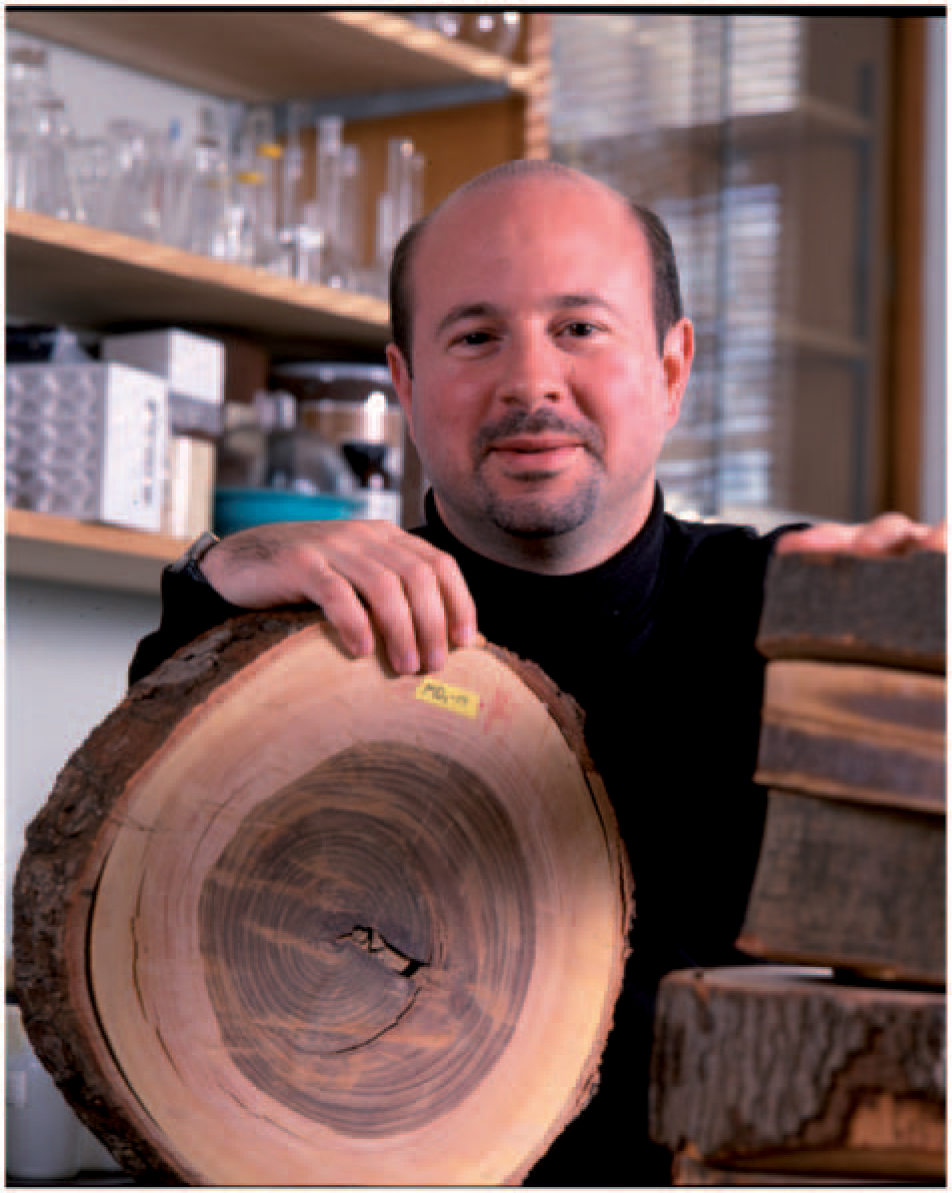
The Penn State climate scientist who helped author the “hockey
stick” global warming temperature graph describes the campaign to
discredit him following the theft of emails, including some he wrote, from
servers at England’s University of East Anglia. Climate-change
denial groups said the emails showed unethical conduct, but scientific
organizations and academic panels said this was not the case, defending Mann and
the credibility of climate science. Mann believes the widespread media coverage
contributed to the failure of the US Senate to take action on carbon dioxide
emission controls this summer. But he cites polls showing that the matter may
not have compromised public belief in climate science and expresses optimism
that policymakers will force emissions reductions in time to avert truly
catastrophic changes to Earth’s climate.
Until late last year, Penn State climate scientist Michael Mann was most widely known for
helping create the so-called “hockey stick” temperature graph,
which showed the sharp (compared to the slow cooling of the previous nine centuries) 1.5
degrees F rise in Earth’s temperatures over the past 100 years. The results
were met with some skepticism by climate-change deniers, but in 2006, a National Academy
of Sciences report endorsed the soundness of the “hockey stick”
graph, saying that the last 50 years of the twentieth century were clearly the hottest
of the past 1,000 years. Mann found greater fame in November 2009, when climate-change
denial groups won global headlines, claiming that private email conversations between
Mann and other climate scientists—stolen by unidentified hackers from
England’s University of East Anglia—showed data manipulation,
ethical lapses, and attempts to squelch opposing views.
By any objective reading, Mann’s credibility—and that of the
science— withstood the onslaught. Scientific bodies including the American
Association for the Advancement of Science, the American Meteorological Association, and
the American Geophysical Union—as well as two panels at Penn
State—said the emails were misconstrued and pronounced Mann’s
conduct ethical and the attacks baseless. But the broad media coverage inevitably
contributed to the public’s foggy understanding of climate science, which
predicts dangerous climate change if human emissions of greenhouse gases are not sharply
curtailed in the next few decades. By Mann’s own reckoning, the recent
controversies may even have contributed to the Senate’s abandonment this
summer of so-called cap-and-trade legislation on carbon emissions. Mann talked to the
BAS about the current state of climate-change science—and the embattled
state of science communication.
BAS: The 2007 Intergovernmental Panel on Climate Change (IPCC) report
projected an additional temperature rise of between 2 degrees F and a truly catastrophic
10 degrees F this century, depending on emissions trajectories. How has our
understanding of climate change been refined since 2007? Huge swaths of the northern
hemisphere experienced—and hundreds of millions of people
felt—record heat in 2010.
MANN:In many respects, the most recent IPCC report understates the rate at
which the climate is changing. Since the publication of the report, we’ve
been able to establish that both Greenland and Antarctica are losing
ice—previously the evidence had been uncertain for both
cases—and that the rate of sea level rise is accelerating. Recent estimates
suggest the possibility of as much as 1.5 meters of sea level rise by 2100, rather than
the upper bound of about 0.6 meters projected in the IPCC report. The IPCC number did
not include any contribution from the actual breakup of ice sheets, as the new estimate
does. The IPCC number only counted melting of mountain glaciers plus thermal expansion
of ocean water. While ice sheet breakup has been widely observed, the dynamics of the
process were not understood well enough to be rendered into computer models that produce
long-range predictions. The new number includes contributions from all three sources of
sea level rise.
Also, the summer melting of sea ice in the Arctic is nearly 30 years ahead of schedule
relative to IPCC projections, and we are on course for an ice-free Arctic summer in a
matter of decades. The 2000s were the warmest decade on record, and 2010 is on course to
be the warmest year in history, and we’re on the heels of the warmest summer
on record for large parts of the United States.
BAS: The National Oceanic and Atmospheric Administration’s
(NOAA) 2009 State of the Climate report said 10 out of
10 key climate indicators reaffirm that the planet is warming and that the
obvious culprit is human-caused emissions. Was this something new?
MANN: We’ve known now for more than a decade and a half that
there is a very consistent story told by surface, sub-surface, ocean, atmospheric, and
ice observations that Earth’s surface is warming, and in a way that is only
consistent with human-caused increases in greenhouse gas concentrations. What was novel
here, I think, is how the scientific findings were packaged in a way that makes it
clearer to the public that the reality of human-caused climate change
doesn’t hinge on any single piece of evidence but, rather, there are
multiple independent pillars of evidence that tell a very consistent and persuasive
story.
BAS: Despite all this, the email matter took hold, won broad global media
coverage, and led even some members of Congress to make accusations against you and the
validity of climate science. Why did this matter ever get so much attention in the first
place?
MANN: Unfortunately, there are powerful special interests in the fossil fuel
industry for whom the prospect of climate change policy—a price on carbon
emissions—would be extremely costly. They have invested millions of dollars
in well-honed disinformation campaigns to convince the public and policy makers that
human-caused climate change is either a hoax, or not nearly the threat that the
scientific community has established it to be. In many respects, it comes straight from
the same playbook used by the tobacco industry to cast doubt on the health threat of
tobacco smoking. Indeed, many of the same players are involved.
The criminal theft, release, and misrepresentation of private emails from the University
of East Anglia immediately prior to the Copenhagen Climate Summit last December was part
of a carefully orchestrated smear campaign against the climate science community timed
to thwart any binding international agreement to limit greenhouse gas emissions.
Climate-change denial outfits collaborated closely with conservative media outlets to
manufacture a fake scandal that would distract the public and policy makers at this
crucial juncture. Historians will look back at this as a low point of intellectual
dishonesty in the corporate-funded, climate-change denial campaign.
BAS: Answer the climate deniers directly: They accused you of suppressing
opposing views. What papers did Climate Research publish that you found
objectionable enough to at one point suggest, in emails, that your colleagues should
stop submitting to that journal? What was the content of these papers?
MANN: This all relates to a deeply flawed paper written by Willie Soon and
Sallie Baliunas and published by Climate Research in 2003 claiming that
recent warming is not unusual. I did, in fact, have concerns about the paper and the
process that led to its publication. As the Wall Street Journal
reported (Regalado, 2003) this
fossil fuel industry-funded study was heavily criticized by a large number of other
scientists. The journal’s editor-in-chief, Hans von Storch, found that the
paper “was flawed” and “shouldn’t have
been published.” Other editors at the journal felt (Monastersky, 2003) that the editor who had
handled the Soon and Baliunas paper had been gaming the system to allow through
substandard papers simply because they expressed a contrarian viewpoint regarding
climate change. Ultimately, both von Storch and half the editorial board quit in protest
over the apparent corruption of the peer review process at the journal. So
it’s fairly clear that my concern over the paper was more than justified.
BAS: What are we to make of Virginia Attorney General Ken
Cuccinelli’s demands for documents involving climate research grants from
your time at UVA?
MANN: At this point, this is largely a matter between the University of
Virginia, and the activist attorney general. Numerous scientific and public interest
groups denounced [Cuccinelli’s] inquisition as a transparent attempt to
chill scientific findings that he finds inconvenient for political reasons. The
Washington Post has called him out as what they call a modern-day
McCarthyist in three different editorials (
Washington Post, 2010a, 2010b, 2010c). Fortunately, a judge recently threw out
his legal challenge finding that he had provided absolutely no support at all for his
claims.
BAS: What’s all of this been like for you personally?
MANN: I’ve been the subject of attacks by climate-change deniers
for more than a decade now, because of the prominent role that the “hockey
stick” temperature reconstruction has played in the public discourse on
climate change. This doesn’t mean that I’m numb to the
outrageous attacks against me and other climate scientists. But I’m not
surprised by anything anymore. There is nothing, it would seem, that that the
climate-change denial industry isn’t willing to do in their attempts to
thwart policy action to combat human-caused climate change. While the attacks have been
tough to deal with at times, I’ve had a huge amount of support from my
colleagues, other scientists, and ordinary citizens who have come out of the woodwork
just to thank me for my contributions.
BAS: What about support from the White House? Has President Obama done
enough to communicate the reality of climate change and the need for urgent policy
action?
MANN: Certainly the president did make climate change a significant issue in
the campaign and appointed excellent people—John Holdren to head the Office
of Science and Technology Policy, Jane Lubchenco as administrator of NOAA, Steve Chu as
energy secretary—to positions relevant to climate science policy. These
appointees understand the reality of climate change and the importance of confronting
it. But it’s disappointing that the issue hasn’t been more in
the forefront of the discussion by the administration.
BAS: Was it disappointing that the president didn’t step up to
defend you and the credibility of climate science, weighing in personally as he did,
say, on the arrest of Harvard professor Henry Louis Gates Jr. at his Cambridge home, and
the consequent “beer summit” on race relations? The White House
called that a “teachable moment.”
MANN: I’m not going to second-guess the administration. The
president and the administration—I can understand their inclination to not
want to get into the mud with climate-change deniers. That having been said, the
administration could have been more out in front on this issue. But I recognize that
administration officials need to weigh all factors in deciding how to move forward on
issues like climate change.
BAS: Somebody has got to do it, no?
MANN: Edward Markey [US Rep, D-Ma] has held several hearings on the science
of climate change and the dishonest attacks against the science. He’s gone
out of his way to try to help communicate the reality of the science and the specious
nature of the attacks. But I would fault many in the media for being far more interested
in covering the manufactured scandal known as “Climategate” and
not doing nearly enough to report on the subsequent exonerations of the much-maligned
scientists involved, who have been absolved of any wrongdoing after multiple
investigations. That has not been covered nearly to the extent that the original false
allegations were covered. That’s unfair. So, yes, I do fault numerous media
outlets for their bias towards reporting on fake scandals and not doing the necessary
follow-up work to dispel the specious allegations they helped promote.
BAS: A year ago the National Research Council suggested there was a great
need to improve scientific communication on climate change suggesting, among other
things, that “leadership might come through executive orders [and] existing
units such as the Office of Science and Technology Policy,” which is, of
course, led by Holdren. Has this leadership been forthcoming?
MANN: There are many, myself included, who are disappointed that more
progress hasn’t been made on this front. This is a complicated matter,
however, and there is more than enough blame to go around. Leadership ought to be coming
from both sides of the aisle in American politics. It’s unfortunate that
climate change seems to have become a partisan political issue. There was a time when
leading politicians from both parties were advocating serious policy action to deal with
climate change. The melting ice sheets, after all, have no political agenda. Climate
change doesn’t affect Democrats and Republicans differently.
It’s time we put the politics behind us, and confront this as a non-partisan
issue.
BAS: Yet, this summer, the Senate failed to act on a House bill that would
have established a cap-and-trade system for carbon emissions, at least a start toward
dealing with the problem in the United States, which is the largest per-capita emitter
of greenhouse gases. What’s your personal view on the disconnect between
what the science tells us and the policy inaction?
MANN: This simply speaks to the success of the “merchants of
doubt,” to borrow the title of Naomi Oreskes’ and Erik
Conway’s new book. Similar points are made in Eric Pooley’s
The Climate War and Jim Hoggan and Richard Littlemore’s
Climate Cover-Up. The millions of dollars spent by the fossil fuel
industry and their front groups to confuse the public about the basic scientific
underpinnings of human-caused climate change have delayed any policy actions by at least
a decade, perhaps more. The potential opportunity cost of that delay to humanity is
impossible to estimate, but it is certainly staggering.
BAS: So how can accurate climate science be communicated without these kinds
of distractions gaining traction?
MANN: For one thing, it requires greater responsibility by our media. They
shouldn’t simply act as stenographers for carefully choreographed smear
campaigns. They have to help sort reality from fiction for the public. Scientists, in
turn, need greater support for outreach and communication, and we need greater
infrastructure to provide the necessary degree of interaction between scientists and
science communicators. I actually think that one silver lining of the recent concerted
attacks against climate science is that it has awakened the scientific community to the
need for a better outreach and communication apparatus. I expect we’ll see
that develop over the next several years.
BAS: Does the public find climate science difficult to swallow? What is the
state of public skepticism and confusion on the topic, do you think?
MANN: While the attacks against climate science may have energized
climate-change deniers, and those who derive their information from talk radio and the
conservative media, polling suggests that the public has grown more convinced and more
concerned about the reality of human-caused climate change in recent months.
Undoubtedly, the dramatic heat this summer has probably re-captured the
public’s awareness of the changes that are taking place.
Stanford pollster John Krosnik suggests that the stolen emails and fake
“Climategate” scandal had little impact on the public perception
of climate change. The fact that public concern about climate change is currently as
high as or higher than it was before that incident suggests that there was no lasting
impact on the public’s understanding. That has not stopped leading
climate-change deniers in the US Congress, however, from trying their best to use the
manufactured scandal to thwart efforts to pass meaningful climate-change legislation.
Policy figures may have believed that the contrarians had changed public opinion, and
deniers in Congress may have been emboldened by the attacks, even if public opinion has
been little influenced by them. It’s a subtle distinction, but an important
one.
BAS: Is the policy stalemate ever going to end, absent a real climate
catastrophe?
MANN:I am cautiously optimistic. I believe it’s not too late to
take the steps that are necessary to mitigate truly dangerous future climate change.
There is still time to take action to stabilize greenhouse gases to a point where they
don’t become a dangerous threat to humanity. I’d like to think
we’d take the necessary steps over the next decade to begin the transition
towards clean and renewable energy and steer away from a carbon-based energy economy.
BAS: But the dangers have been clear for years, emissions keep going up,
much of 2010 saw record heat in many regions, and the Senate went home empty handed.
What’s the basis for your optimism?
MANN: There are various episodes in our not-so-distant past when we were
threatened by global environmental catastrophe and took action. One can point to, for
example, the Montreal Protocol, which addressed the problem of stratospheric ozone
depletion, as a success story and a model for the possibility of dealing with climate
change. Of course there are differences: In the case of ozone depletion, a smaller
number of major industrial nations were involved, and there were reasonable alternatives
to CFCs [chlorofluorocarbons] readily available to industry. It’s not like
fossil fuels, which are central to today’s global energy economy.
It’s a far greater challenge to remake the way we derive and use energy, and
to change all of the practices in our daily lives that contribute to rising greenhouse
gas emissions. So certainly, it’s a bigger challenge than anything that has
come before. But I believe that we will meet that challenge in time.