




Abstract
Much as lions on the Serengeti seek out vulnerable zebras at the edge of a herd, special interests faced with adverse scientific evidence often target individual scientists rather than take on an entire scientific field at once. Part of the reasoning behind this approach is that it is easier to bring down individuals than an entire group of scientists, and it still serves the larger aim: to dismiss, obscure, and misrepresent well-established science and its implications. In addition, such highly visible tactics create an atmosphere of intimidation that discourages other scientists from conveying their research’s implications to the public. This “Serengeti strategy” is often employed wherever there is a strong and widespread consensus among the world’s scientists about the underlying cold, hard facts of a field, whether the subject be evolution, ozone depletion, the environmental impacts of DDT, the health effects of smoking, or human-caused climate change. The goal is to attack those researchers whose findings are inconvenient, rather than debate the findings themselves. This article draws upon the author’s own experience to examine the “Serengeti strategy,” and offers possible countermeasures to such orchestrated campaigns. It examines what responses by scientists have been most successful, and how to combat the doubt-sowing that industry has done regarding the science behind climate change and other fields.
Keywords

Photo credit: Brocken Inaglory.
Critics of science frequently present scientific knowledge as if all our understanding of a given field hinges on the work of just one scientist. Forget the thousands of evolutionary biologists whose work over more than a century has repeatedly confirmed the theory of evolution; to creationists, it is just “Darwinism”—the conclusions of one ostensibly suspect individual named Charles Darwin.
And it is labeled as “just a theory,” as if that somehow diminishes its validity. (For that matter, gravity is “just a theory” as well. Yet no one steps off a tall building to test it.)
This reflects a popular misconception of what a theory is to scientists. While in common parlance the word “theory” conveys something speculative, tentative, or uncertain, in the field of science the word refers to an understanding of an aspect of the natural world that has held up repeatedly to scrutiny and testing over time.
Industry-funded front groups and their hired guns have learned that they can use this confusion over terminology to their benefit. Rather than admit that decades of research has revealed dangerous effects of DDT on our environment, these organizations try to lead the public into believing that concerns about these chemical contaminants are just the hysterical speculations of one scientist named Rachel Carson. For example, the Competitive Enterprise Institute (http://www.cei.org)—an advocacy group funded by fossil fuel and chemical industry concerns and conservative private interests—maintains a website, RachelWasWrong (http://www.rachelwaswrong.org), dedicated to discrediting Carson and her legacy as a way of casting doubt upon all environmental concerns.
This is a classic ad hominem attack, consisting of innuendo and obfuscation, often focusing on irrelevant items, whose net effect is to direct attention away from the merits of an argument and instead to the character of the person making it. This approach appeals to feelings, emotions, and prejudices rather than intellect—exactly the point when the attacker is on the wrong side of the facts. This approach is not held in high regard by those interested in reason and rationalism, based as it is upon tenets that are the opposite of science.
But it is effective, for a number of reasons. By singling out a sole scientist, it is possible for the forces of “anti-science” to bring many more resources to bear on one individual, exerting enormous pressure from multiple directions at once, making defense difficult. It is similar to what happens when a group of lions on the Serengeti seek out a vulnerable individual zebra at the edge of a herd, which is why I call it the “Serengeti strategy” in my book The Hockey Stick and the Climate Wars (Mann, 2012).
An additional part of the motivation behind the targeting of individuals: It is difficult to take on an entire group of scientists at once. But bringing down individuals is easier, and it serves the larger effort of dismissing, obscuring, and misrepresenting well-established science and its implications. What’s more, these highly visible tactics create such a negative atmosphere that other scientists are discouraged from conveying their research’s implications to the public.
This strategy falls under the umbrella of a larger, overall conception, which some researchers refer to as the “tobacco strategy” because it characterizes the way that tobacco interests sought to discredit research that linked their products to lung cancer (Oreskes and Conway, 2010). Whatever it is called, it has repeatedly been adopted by the chemical industry, big agriculture, the pharmaceutical industry, and just about any corporate interest that has found itself on a collision course with scientific research—particularly research that reveals specific potential damages or threats caused by their product.
It is educational to see how long the use of these tactics has been around, and how it was applied on a massive, wide-reaching scale to make a meme—a cultural idea or belief system, similar in some ways to a catchphrase—go viral, long before the social media era. And of course, this technique has now been refined and expanded upon, to include a barrage of messages from authoritatively named pseudo-news outlets, an alphabet soup of legitimate-sounding front groups, and a bevy of experts-for-hire with impressive—or at least impressive-sounding—credentials, who together form a “Potemkin Village” (Oreskes and Conway, 2010) of antiscientific disinformation. One can observe this strategy writ large in the current public discourse in the United States over whether or not human-caused climate change exists—a debate that has been largely settled in other parts of the world, such as the European countries whose citizens have overwhelmingly accepted the evidence for it.
Indeed, when overseas Americans encounter the widespread acceptance of anthropogenic climate change, they are often surprised. “After my climate change book came out, I had dinner with a Dutch minister from a right-wing, conservative party—and he sounded like a Greenpeace guy,” commented author Elizabeth Kolbert (The Bulletin of the Atomic Scientists, 2014) about the European reception to her book The Sixth Extinction: An Unnatural History (Kolbert, 2014).
Climate change: A quick recap
A quick refresher about the present state of the discourse in the United States about climate change: Despite first impressions, only a minority of our populace clings to a wholesale rejection of all the established evidence for anthropogenic climate change. Yet this rejection can be powerful (and backed by powerful interests), as I wrote in The New York Times: This virulent strain of anti-science infects the halls of Congress, the pages of leading newspapers, and what we see on TV, leading to the appearance of a debate where none should exist. In fact, there is broad agreement among climate scientists not only that climate change is real (a survey and a review of the scientific literature published say about 97 percent agree), but that we must respond to the dangers of a warming planet. If one is looking for real differences among mainstream scientists, they can be found on two fronts: the precise implications of those higher temperatures, and which technologies and policies offer the best solution to reducing, on a global scale, the emission of greenhouse gases. (Mann, 2014a)
Such a high level of agreement among any group of people is extraordinary; just try to get 97 percent of Americans to agree about favorite pizza toppings. Nothing in the field of science ever gets 100 percent agreement—there’s still a Flat Earth Society that holds monthly meetings—but the fact that a few contrarians still exist around the topic of climate change may be one reason why the public gets confused when hearing about the issue. They expect all experts everywhere to be in complete agreement, all the time.
There is no longer any reasonable doubt among mainstream researchers about the fact that climate change is real, caused by human activity, and a potential threat to civilization. That is the conclusion of every major scientific organization that deals in any of the underlying areas of science, including the American Physical Society, the American Meteorological Society, the American Chemical Society, the Geological Society of America, the American Geophysical Union, and several dozen more. Indeed, it is the conclusion of the national academies of every major industrial nation on the planet. 1
But faced with this overwhelming scientific consensus about the threat of human-caused climate change—and, by implication, the necessity to reduce global carbon emissions—fossil fuel interests have in many cases chosen not to accept the evidence, nor to engage in good-faith discussion about possible solutions. Instead, they have opted to deny the problem exists.
For more than two decades now, leading fossil fuel companies like ExxonMobil, as well as privately held fossil fuel interests like Koch Industries, have been orchestrating attacks on the science of climate change through their various front groups (Mann, 2012; Oreskes and Conway, 2010). As the evidence has grown stronger and the scientific case more firm, they have simply doubled down on the assault.
Many of the attacks have been aimed at undermining one of the scientific community’s great strengths—the trust that the public has in scientists as communicators and messengers. A poll conducted by Yale University and George Mason University indicated that climate scientists are the most trusted source of information about global warming for voting-age Americans (Yale Project, 2012). This is in line with a number of polls regarding science that have been conducted over the years, which consistently show that the public ranks scientists near the top for trustworthiness (Pew Research Center, 2009)—while they put members of Congress, TV reporters, and used-car salesmen near the bottom. (At the very bottom are lobbyists, who have only a 6 percent approval rating for honesty and ethics (Gallup, 2014)).
In their effort to discredit the genuine science behind climate change, fossil fuel interests and their front groups have sought to undermine that trust in science and scientists.
Swiftboating comes to climate science
The earliest attacks on climate scientists were aimed at physicist-turned-climate scientist Stephen Schneider of Stanford University, a particularly effective messenger at communicating climate change risk to the public. Climate change deniers found an opening in Schneider’s use of loosely phrased, off-the-cuff comments that could be taken out of context. For example, 25 years ago Schneider did an interview for Discover magazine in which he stated: On the one hand, as scientists we are ethically bound to the scientific method, in effect promising to tell the truth, the whole truth, and nothing but—which means that we must include all the doubts, the caveats, the ifs, ands, and buts. On the other hand, we are not just scientists but human beings as well. And like most people we’d like to see the world a better place, which in this context translates into our working to reduce the risk of potentially disastrous climatic change. To do that we need to get some broad-based support, to capture the public’s imagination. That, of course, entails getting loads of media coverage. So we have to offer up scary scenarios, make simplified, dramatic statements, and make little mention of any doubts we might have. This “double ethical bind” we frequently find ourselves in cannot be solved by any formula. Each of us has to decide what the right balance is between being effective and being honest. I hope that means being both. (Schneider, 1989: 47)
Climate change critics 2 have frequently taken this statement completely out of context, editing it down to the snippet “we have to offer up scary scenarios, make simplified, dramatic statements, and make little mention of any doubts we might have.” By cutting out the sentences that follow, and not providing the full context, Schneider’s detractors misrepresented the point Schneider was actually making: that we can, and should, be both effective and honest in communicating the science and its implications to the public.
The critics ratcheted up their campaign in the mid-1990s. In December 1995, just as I was finalizing my dissertation on the topic of natural climate variability—research that had little if anything to do with the topic of human-caused climate change—a group of hundreds of leading climate experts from around the world were assessing the state of the science of climate change. Known as the Intergovernmental Panel on Climate Change, or IPCC, the group issued a report that concluded that there was now a “discernible human influence on climate” (Mann, 2012). This was the first time such a statement had been made.
Ben Santer, a relatively young scientist at the time, was the lead author of the key chapter on the “detection and attribution” of climate change—which demonstrated that the “signal” of anthropogenic climate change and global warming was now discernible from the background “noise” of natural climate variability. Santer’s own scientific work was critical to that conclusion; as a result, he found himself at the center of a campaign in which his integrity was impugned by industry affiliates, along with charges of “scientific cleansing” similar to ethnic cleansing in Wall Street Journal op-eds. His job and even his life were threatened (Mann, 2012). The assaults against Santer were just a sign of what was to come.
The hockey stick and the Serengeti strategy
From the late 1980s through the mid-1990s, scientists like Schneider and Santer were subject to “swiftboat”-like 3 attacks, owing to the prominence of their work in raising awareness of the threat of climate change. I was the involuntary next member in this lineage.
My work as a postdoctoral researcher in the late 1990s reconstructing past temperature changes led my colleagues and me to publish the now well-known “hockey stick”
4
curve depicting temperature changes over the past thousand years. Looking much like a hockey stick lying on its side—which is why it got its name—this curve graphically illustrated in easy-to-understand terms the past century’s warming spike (the “blade”), as it rose above the range of natural variation over the past millennium (the “handle”). As it sloped downward from left to right, the lengthy handle indicated that there were only relatively modest changes in Northern Hemisphere temperatures for almost 1,000 years—as far back as our data went at the time of publication. (In its September 2013 report, the IPCC extended the stick farther back in time, reflecting their conclusion that the recent warming was unprecedented for at least 1,400 years.) In contrast, the short and abruptly upturned blade, at the extreme right of the graph, indicated the abrupt rise in temperatures since the mid-1800s—which roughly corresponded to the arrival of the Industrial Revolution in the Northern Hemisphere and the emission of much more carbon into the atmosphere (see Figure 1).
“Hockey stick graph” of rising global temperatures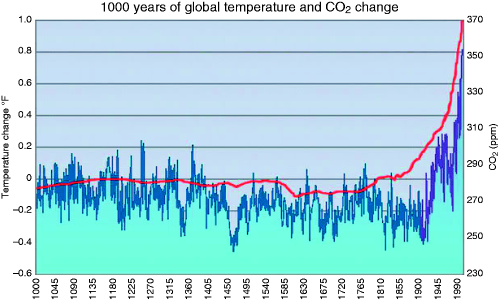
The hockey stick was featured in the summary for policy makers of the IPCC Fourth Assessment Report of 2001. It emerged as an iconic image of human-caused climate change, conveying a simple, straightforward message about the reality of global warming. To mix metaphors, this graph became a lightning rod of debate—and its publication turned me into a reluctant public figure. Some years after his own experiences, Ben Santer stated: “There are people who believe that if they bring down Mike Mann, they can bring down the IPCC” (Pearce, 2006).
I recount my experiences in full in my book The Hockey Stick and the Climate Wars (Mann, 2012), but include a brief summary of a few highlights here. I was vilified in the editorial pages of The Wall Street Journal and on Fox News. I was in the sights now of powerful, well-heeled interests such as the Scaife Foundations and the Koch brothers (Mann, 2012). A Scaife-funded front group known as the Commonwealth Foundation unsuccessfully pressured Penn State University to fire me, while the Scaife-owned Pittsburgh Tribune-Review frequently published attacks upon me personally. I’ve stopped counting the number of attacks by individuals, organizations, and front groups connected to the Koch brothers—conservative activists who are heavily invested in fossil fuel extraction and transportation (see, e.g., Mayer, 2010).
I was subject to what The Washington Post and The New York Times denounced as an “inquisition” and a “witch hunt” 5 by politicians in the pay of fossil fuel interests (Mann, 2012), looking to discredit my work. 6
The former chair of the House Energy and Commerce Committee, Texas Republican Joe Barton, attempted in 2005 to subpoena all of my personal records and those of my two “hockey stick” co-authors, even though the vast majority of what he was demanding was already in the public domain. (Among the fiercest critics of Barton’s behavior were two powerful senior members of his own party—the chair of the House Science Committee, Rep. Sherwood Boehlert of New York, and Sen. John McCain of Arizona.)
Subsequently, Ken Cuccinelli, the newly minted attorney general of Virginia, who’d received significant Koch brothers support (see Blumenthal, 2013; Cramer, 2013; and Vogel, 2011), attempted to obtain all of my personal e-mails with more than 30 scientists around the world from the 1999 to 2005 time period, during which I was a professor at the University of Virginia, under the aegis of a civil subpoena designed to root out state Medicare fraud. After Cuccinelli was repeatedly rebuffed by the courts all the way to the state Supreme Court, a Koch-funded group called the American Tradition Institute (ATI) sought to demand the same e-mails through misuse of state open-records laws. The ATI too was rebuffed all the way to the state Supreme Court, which ultimately demanded that they pay both the University of Virginia and me damages for their frivolous petitioning of the court (Sturgis, 2014).
Many of the attacks claimed that the hockey stick was simply wrong, or bad science, or that it was debunked or discredited, despite all evidence to the contrary—such as the reaffirmation of our findings by the National Academy of Sciences, 7 the subsequent reports of the IPCC, 8 and the most recent peer-reviewed research. 9
Others were challenges to my integrity and honesty. Most worrisome were thinly veiled threats leveled against my family and me. (And some not so veiled, such as letters and e-mails threatening my life and my family’s lives, including an envelope sent in the mail that contained a white powder, subsequently investigated by the FBI (Mann, 2012: Chapter 14.))
Then came the manufactured, so-called “climategate” controversy (Mann, 2012: Chapter 14), in which climate change deniers stole thousands of e-mails and mined them for words and phrases that could be taken out of context and made to sound as if scientists had been doctoring data or otherwise engaged in misbehavior. Nine investigations later, 10 we know that the only wrongdoing was the criminal theft of the e-mails in the first place.
Fighting back against the doubt-sowers
In this poisonous environment, we are each faced with a choice. Should we avoid the fray? Should we simply don our lab coats, perform our research, publish it in peer-reviewed literature, present our results at scientific meetings, and leave it to others to translate them for consumption by the public and policy makers? Do we not owe it to society to explain the potential implications of our work?
I was not given the choice of remaining outside the public arena. Arguably, I could have tried to ignore the attacks in the hope they would eventually go away. But retreating into my lab and simply focusing on my work did not feel like a responsible option. For one, it would signal the success of the Serengeti strategy, and it would encourage similar behavior against other climate scientists. It would set a poor example for younger scientists just entering the field, showing them that it is unsafe to participate in public outreach about the implications of their scientific research. What if the tobacco interests had ultimately been successful in intimidating health researchers out of studying and reporting on the link between tobacco products and lung cancer and other smoking-related ailments? The cost would have been measured in millions more human lives lost. Unchecked climate change could take an even greater toll. That is why some (Hansen, 2008) have characterized bad-faith attacks on the science of climate change a “crime against humanity.”
Perhaps it is because of my experiences in the center of the battle over climate change that I have become a passionate believer in the role of the “scientist-advocate” (Schneider, 1993). I think that it is indeed our responsibility collectively, as scientists, to convey the societal implications of our work (Mann, 2014a). Just because we are scientists does not mean that we should check our citizenship at the door of a public meeting. There is nothing inappropriate about drawing on our scientific knowledge to speak out about the very real implications of our research. As Stephen Schneider used to say, being a scientist-advocate is not an oxymoron. If scientists choose not to engage on matters of policy-relevant science, then we leave a void that will be filled by industry-funded disinformation.
While this is not what I signed up for—I majored in physics and mathematics, obtained a master’s degree in physics, and earned a doctorate in the Department of Geology and Geophysics at Yale University—in my view, there is nothing that could be more noble than striving to communicate, in terms that are simultaneously accurate and accessible, the implications of our scientific knowledge. When it comes to fighting against disinformation, the old adage “the best defense is a good offense” rings true. Consequently, I have devoted an increasing part of my career to communicating the science and its implications to the larger public, to the best of my abilities.
Successful responses
While engaged in a full-time round of teaching, advising students, performing and publishing research, and attempting to meet all my other obligations as a university professor, I spend a good deal of my time these days engaged in outreach and communication. This takes the form of more than 50 public lectures, panel discussions, and other public-speaking engagements per year; hundreds of newspaper, magazine, television, and radio interviews; and dozens of op-eds, commentaries, and letters to the editor.
In addition, I co-founded a popular science blog known as RealClimate (http://www.realclimate.org) nearly a decade ago—in part as a reaction to the fact that if one did a web search on terms like “global warming” or “climate change” what one mostly got back were links to industry-funded, antiscientific propaganda. I have also chosen to embrace newer modes of communication, including social media vehicles such as Facebook and Twitter (where I’m @MichaelEMann). Because an increasingly large share of the public—younger audiences in particular—no longer gets its news from “traditional” media sources, scientists must increasingly leave their “comfort zone” and take the social media plunge if they are to reach the broadest possible audience.
There is also something very satisfying about being able to communicate information directly to the public, without the “middleman” of journalists or media organizations. That is not to say that journalists and traditional media don’t remain vital sources of information for the public, but that scientists now find themselves in a more complex new-media “ecosystem” where they risk limiting their reach if they don’t embrace the full range of informational vehicles available.
The message I convey, naturally, depends on the venue and the audience, but if there is a common theme it is that climate change is real, it is caused by us, and it remains a grave threat if we don’t do something about it. When it comes to the issue of uncertainty, which is sometimes used as a crutch by those arguing against action, I strive to convey the idea that uncertainty is not a reason for inaction but a reason for even more immediate and greater action, because of the possibility that the impacts will be substantially worse than scientists currently predict. (This is the same principle underlying why we purchase fire insurance—it isn’t because we think it likely that our house will burn down, but because the damages would be so great if it did occur that it makes sense to invest now to hedge against this catastrophic outcome).
As for climate change denial and disinformation, I find it useful to let the words and actions of the critics speak for themselves. It can provide moments of levity, and I’m a firm believer in the principle that scientists must retain a sense of humor, even when discussing a rather dour topic like climate change. A case in point is the way that climate change contrarians like to present themselves as modern-day Galileos, fighting against the hegemony of mainstream scientific thinking. The phenomenon even has a name—the Galileo gambit. But denial for the sake of denial, without presenting any supporting evidence, is not true scientific skepticism. In fact, it is quite the opposite. When climate change deniers attempt to play the “They laughed at Galileo too” card, I’m fond of citing Carl Sagan’s retort: “They also laughed at Bozo the Clown.” 11
Where skeptics express doubt in what appears to be good faith, scientists should attempt to engage with them constructively. There may well be an opportunity to disabuse them of misconceptions, inform them of the facts, and arm them with helpful resources they can rely upon in the future. My favorite is the smartphone app offered by the site Skeptical Science (http://www.skepticalscience.com) which provides, at the touch of a finger, the responses—at the beginner, intermediate, and advanced level—to more than a hundred common denialist myths.
Yet where good faith is not evident and when critics appear more interested in personal insults, inflammatory rhetoric, and argument purely for its own sake, another quote, this time from Mark Twain, is apropos: “Never argue with a fool; onlookers may not be able to tell the difference.” Translating to 21st-century Internet-speak: “Don’t feed the trolls.” It is far better to expend your time and effort engaging with those individuals who display a capacity to reconsider their viewpoints—who are receptive to new information and evidence—than waste it on those who are not. It is also better for your emotional health (and blood pressure).
Looking forward
There is some evidence that flat-out climate change denial has lost favor over the past few years. With authoritative reports coming in from not just the scientific community but the business community, the national security community, and even some conservative groups that climate change is a very real and existential threat to society, a new breed of climate change contrarian—the delayer—has now emerged.
Examples of individuals occupying that niche in the media today are folks like Judith Curry of the Georgia Tech School of Earth and Atmospheric Sciences, former UC Berkeley astrophysicist Richard Muller, and “skeptical environmentalist” Bjorn Lomborg. Rather than flat-out denying the existence of human-caused climate change, delayers claim to accept the science, but downplay the seriousness of the threat or the need to act. The end result is an assertion that we should delay or resist entirely any efforts to mitigate the climate change threat through a reduction of fossil fuel burning and carbon emissions. Despite claiming to assent to the scientific evidence, delayers tend to downplay the climate change threat by assuming unrealistic, low-end projections of climate change, denying the reality of key climate change effects, and employing lowball estimates of the costs of those impacts. When the cost-benefit analysis of taking action is skewed by a downwardly biased estimate of the cost of inaction, it is far easier to make the Pollyanna-ish argument that technology and the free market will simply solve the problem on their own. It is a backdoor way of saying that we do not need to pursue clean, non-fossil fuel energy sources, which are arguably the only real ways to avoid locking in dangerous climate change.
So while the battle is far from over, the tide does appear to be turning. We are seeing the slow but steady retreat of climate change contrarians down the “ladder of denial” (Mann, 2012). The window of public discourse appears to be shifting away from the false debate over whether there is a problem toward the worthy debate about what to do about it. That is reason for optimism. And optimism is important, for people respond poorly to messages of doom and gloom that lack any sign of hope. Defeatism is indeed self-fulfilling. People must see a way forward, and fortunately it exists. There is still time to act so that we avert leaving a fundamentally degraded planet for future generations. But time is running out, and there is unprecedented urgency now in taking action (Mann, 2014a). 12
That brings us back, finally, to the role of the scientist in the public arena, and I find myself compelled to return to the “double ethical bind” that Schneider spoke so eloquently about. We scientists must hold ourselves to a higher standard than the deniers-for-hire. We must be honest as we convey the threat posed by climate change to the public. But we must also be effective. The stakes are simply too great for us to fail to communicate the risks of inaction.
The good news is that scientists have truth on their side, and truth will ultimately win out. That too is reason for optimism.
Footnotes
Acknowledgements
The author would like to acknowledge very helpful conversations over the years about the broad topics explored here with folks such as Steve Schneider, Naomi Oreskes, Susan Joy-Hassol, Stefan Rahmstorf, Ray Bradley, Malcolm Hughes, Ben Santer, Richard Somerville, and Gavin Schmidt. The author would also like to thank Pete Fontaine, Scott Mandia, and Josh Wolfe and the Climate Science Legal Defense Fund for their efforts.
Funding
This research received no specific grant from any funding agency in the public, commercial, or not-for-profit sectors.