



Abstract
Challenges in infrastructure planning require public infrastructure administrators, responsible for providing adequate infrastructure facilities, to be adaptive. These organizations evolve and interact with other organizations in a complex organizational landscape. This paper explores the contribution of inter-organizational communities of practice (CoPs) to collective learning and co-evolution of organizations in infrastructure planning. We conducted a case study of five inter-organizational CoPs in the domain of a typical public infrastructure administrator. The results suggest that inter-organizational CoPs enable, for example, policy and practice to co-evolve. Inter-organizational CoPs seem to provide a neutral ground where long-term sector benefits can overcome short-term organizational interests.
Keywords
Introduction
Public infrastructure administrators are responsible for providing adequate infrastructure facilities for society. Besides public infrastructure administrators, the organizational landscape in infrastructure planning comprises, for example, contractors, engineering- and consultancy companies, knowledge institutes, and different authorities. Moreover, public infrastructure administrators often manage by projects in order to efficiently build and improve infrastructure facilities, thereby organizing themselves as project-oriented organizations (Leendertse & Arts, 2020). This mixture of different permanent organizations and temporary project organizations renders the organizational landscape in infrastructure planning complex.
Organizations in infrastructure planning are confronted with challenges, such as climate change, aging infrastructure facilities, and developments in data and mobility technologies (C. Brown et al., 2017; Hijdra, 2017). Such continuously changing environments require organizations to be adaptive to maintain their performance levels and to continue to meet their objectives (Barasa et al., 2018). Each organization learns and evolves as it responds to changes. As organizations adapt, they change the landscape from the perspective of other organizations (Kauffman, 1993). In the complex organizational landscape in infrastructure planning, organizations are increasingly looking for other ways to interact, because they recognize their interdependence in providing adequate infrastructure facilities for society.
A co-evolutionary perspective is considered adequate for studying complex, interconnected, and continuously changing environments (Abatecola et al., 2020; Breslin, 2016), such as the organizational landscape in infrastructure planning. From a co-evolutionary perspective, change may be driven by direct interactions between organizations and feedback from the rest of the environment (Volberda & Lewin, 2003). This requires an arena where different organizations can collectively build knowledge and learn from each other. Research shows that inter-organizational communities of practice (CoPs) may provide such an arena. For example, Soekijad et al. (2004) concluded that the concept of CoPs is applicable in inter-organizational contexts and de Groot et al. (2020) identified inter-organizational communities of practice (CoPs) as relevant vehicles for collective learning across project-oriented organizations. However, these studies are not conclusive about the role of inter-organizational CoPs in collective learning across project-oriented organizations, nor do they address the role of CoPs in co-evolution of organizations. Since many organizations use CoPs and wonder how they can exploit the full potential of CoPs, it is important to understand their role in an inter-organizational context and their potential contribution to co-evolution of organizations.
Despite their identified importance in both practice and literature, the role of inter-organizational CoPs in collective learning and co-evolution of organizations in the field of infrastructure planning remains underexplored. Therefore, the aim of this paper is to explore the contribution of inter-organizational CoPs to collective learning and co-evolution of organizations in infrastructure planning. The findings in this paper are based on a literature review combined with an in-depth case study of five inter-organizational CoPs in the domain of Rijkswaterstaat—the executive agency of the Ministry of Infrastructure and Water Management in The Netherlands.
Theoretical Framework
Communities of Practice in Infrastructure Planning
The internal social network of a project-oriented organization in infrastructure planning was characterized by Leendertse and Arts (2020) as a system of strong relationships at project level and weaker relationships between projects and their parent organization—that is, a loosely-coupled system (Orton & Weick, 1990). At a sector scale, the multi-organizational landscape in infrastructure planning may be considered a loosely-coupled system that allows for experimentation across organizations—that is, exploration—while sharing existing knowledge between organizations—that is, exploitation—enables new possibilities to deal with change (Berkes, 2017; March & Olsen, 2006). Information flows through these networks of actors and relationships (Borgatti & Cross, 2003) and can be collectively interpreted in multi-actor arenas that are hubs in these networks. For example, spaces for innovation (Touati et al., 2019) and ba (Nonaka & Toyama, 2002), are described in literature as multi-actor arenas for connecting different views and enhancing the creation of new knowledge (Kilelu et al., 2013). In this paper, we use the term community of practice (CoP) for such multi-actor arenas.
Wenger-Trayner and Wenger-Trayner (2015, p. 1) defined a CoP as a “group of people who share a concern or a passion for something they do and learn how to do it better as they interact regularly.” CoPs can have a formal or informal character. They are different from informal networks that have the purpose of passing on business information between individuals (Wenger, 2010). CoPs are groups. They are hubs in the network of organizational entities. Practitioners share information and build knowledge through collective interpretation of information in these hubs. Additionally, a CoP is a community as members identify themselves with a domain or a learning partnership (Wenger, 2010). CoPs are also different from teams. Teams aim to deliver a product or accomplish a task, whereas CoPs are about developing knowledge and capabilities (Wenger & Snyder, 2000). These distinctions between CoPs and other arrangements of interacting individuals illustrate how CoPs may mediate co-evolution of organizations by facilitating co-evolution of individuals that participate in CoPs and may represent their organizations.
Co-Evolution and Collective Learning
During recent decades, the number of studies in social sciences adopting a co-evolutionary perspective is increasing. Through Generalized or Universal Darwinism (Hodgson & Knudsen, 2004) elements of (co-)evolution were translated from biology into social sciences. Dawkins (1976) and Hull (1980) used replicator and interactor to describe the unit that evolves. Habits and routines are examples of replicators, and individuals (cohesive) groups—such as CoPs—and organizations can be considered interactors (Aldrich et al., 2008; Hodgson & Knudsen, 2010). In accordance with Hodgson and Knudsen (2010), we relate habits—that is, “an acquired propensity or disposition, which may or may not be actually expressed in current behaviour” (Hodgson & Knudsen, 2004, p. 286)—to individuals, and routines—that is, “organisational dispositions to energize conditional patterns of behaviour within an organized group of individuals, involving sequential responses to cues” (Hodgson & Knudsen, 2004, p. 290)—to groups and organizations. The three Darwinian principles of variation, selection, and retention are key for evolution (Aldrich et al., 2008). Variation, selection, and retention of habits and routines occur at individual, group, and organizational level (Abatecola et al., 2020).
Literature describes collective learning as a one of the key elements in co-evolution (Stagl, 2007; Underdal 2013). Collective learning can be defined as “enduring changes in a collective as a result of interaction between the collective and its context” (Backström, 2004, p. 471). The ability to incorporate new information and create knowledge, relationships, and practices in response to changing contexts links collective learning to organizational evolution (Dobson, 2013; Ensor & Harvey, 2015). Both the aforementioned mechanisms of variation, selection, and retention, and the multi-level perspective apply to collective learning. Collective learning concerns developing knowledge through experimentation and innovation (Berkes, 2017; Kemp et al., 2007)—that is, variation—the development of a common understanding of problems and options, and decision-making under conditions of uncertainty (Stagl, 2007; Underdal, 2013)—that is, selection—and the retention of results in organizational processes (Levinthal, 2016). Knowledge can be defined as “a mix of information, understanding, capability, experience, skills and values” (Rowley 2007, p. 174). Knowledge is considered as the outcome of learning and can be cognitive or behavioral, tacit or explicit, and declarative (know-what) or procedural (know-how) (Argote, 2013). As such, knowledge underlies and enables changes in habits and routines. Crossan et al. (1999) elaborated the process of learning across various levels in their “4I framework of organizational learning”: intuiting and interpreting at the individual level, interpreting and integrating at the group level, and integrating and institutionalizing at the organizational level. Interpreting links individual- and group-level learning processes while integrating links group- and organizational-level learning processes.
Individuals can generate variation by trying alternative approaches in their daily jobs. If they interpret the outcome as an improvement and receive positive feedback from their environment, they can select an approach and retain it, thereby altering their habits. At group level, routines can be altered by a group decision to incorporate new habits in their routines. Feedback on altered group routines is collectively interpreted and may result in further adaptation of group routines. The knowledge of different groups is integrated within the organization to become institutionalized in organizational routines, which, in turn, affect thinking and acting of groups and individuals within organizations. Change in organizational routines depends on the feedback on altered individual habits and group routines from the wider organization and the external environment. CoPs provide an arena for individuals as interactors to receive feedback from the environment on their habits or routines in their organizations. Individuals may develop new approaches in CoPs and they may be inspired to try these approaches in their daily jobs. Participation in CoPs may also enable mutual adjustment of habits and routines across multiple organizations. Further, a CoP can be considered an interactor as the community develops its own routines and evolves over time.
Despite resemblances between biological and social evolutionary processes, there are some important differences that are relevant for learning. For example, Kallis and Norgaard (2010) point to generation of variation, which in biological systems is considered accidental through mutations while in social systems this can be guided. In this regard, Waring (2010) argued that individuals do not exactly or blindly imitate behavior, but tend to improve behavior as they enact it—that is, guided variation. Additionally, Williams (2007) argued that knowledge transfer is often a combination of replication and adaptation due to the context-dependent nature of knowledge. Hence, variation seems inherent in knowledge transfer. Furthermore, Hodgson and Knudsen (2010) argued that if the overall outcome of selection is the result of the discrete decision of an individual or group, this is considered artificial selection. Lastly, selection and retention depend on existing knowledge. Cohen and Levinthal (1990) argued that the ability to recognize the value of new information and assimilate it, which they called absorptive capacity, depends on prior related knowledge. This applies to individuals, groups, and organizations. Larger organizations appear to be able to absorb more knowledge because of their more diverse knowledge resources (Van Wijk et al., 2008). These examples illustrate that organizational evolution is more than individual learning (Dobson, 2013). Learning may initially occur at the individual level, but organizational evolution requires learning beyond the individual, and changes in a collective as a result of interaction with its context—that is, collective learning (Backström, 2004; Stagl, 2007).
Communities of Practice in the Landscape of Co-Evolving Organizations
While preserving the implementation-focused character of project-oriented organizations, inter-organizational CoPs may facilitate the inflow of new information from outside the organization (Bapuji & Crossan, 2005) and act as bridging organizations (Berkes, 2009) that offer windows for collective learning. Figure 1 illustrates inter-organizational CoPs as windows for collective learning across organizations.
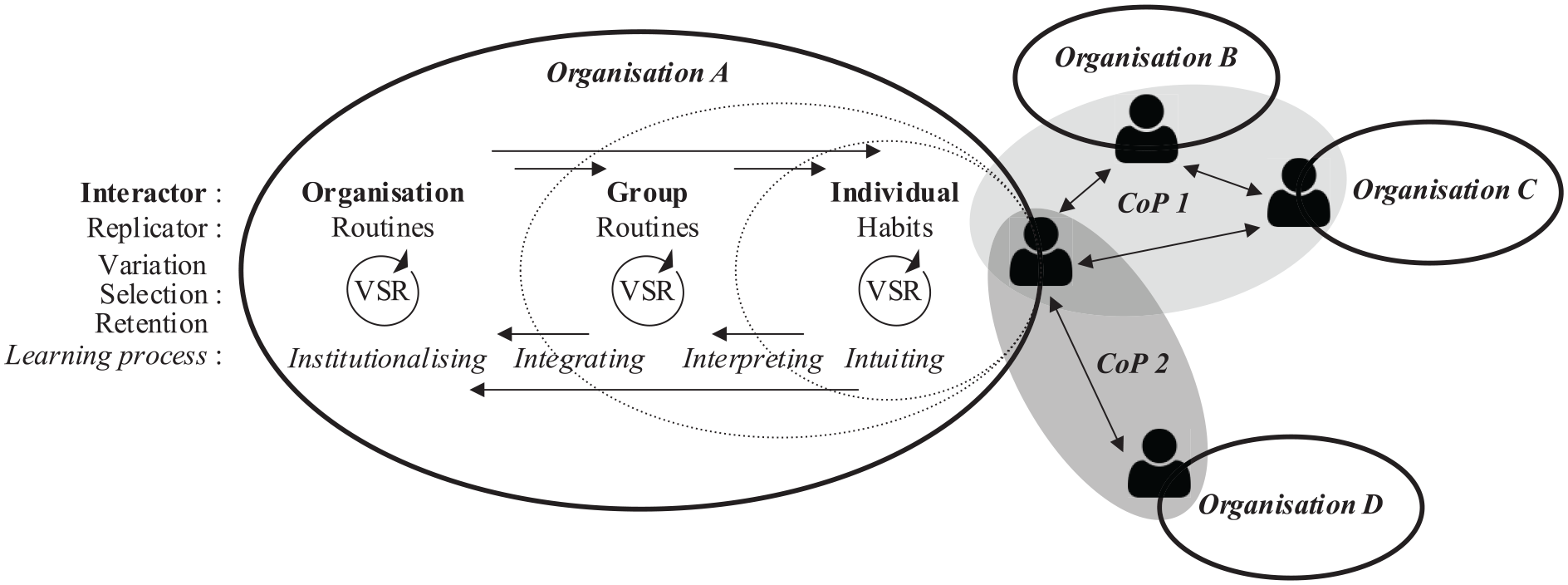
Inter-organizational communities of practice (CoPs) as windows for collective learning across organizations.
Instead of interpreting environmental changes from a single perspective, inter-organizational CoPs facilitate collective deliberation and interpretation through individuals that represent different organizations with different and, sometimes, conflicting perspectives. Existing views, predominantly based on past experience, may be confronted with information from other places in the organizational landscape and through experimentation within these inter-organizational CoPs. Such dialectical learning (Van Assche et al., 2021; Woods, 2012) may guide organizational co-evolution in a direction that could be more beneficial to the sector as a whole. J. S. Brown and Duguid (1998) used the terms translators, knowledge brokers, and boundary objects to describe the spread of knowledge between different communities. Translators are individuals that are well informed with the work of involved communities and are able to translate interests of one community in terms of another’s. Inter-organizational CoPs may appoint such translators. Knowledge brokers are individuals that participate in multiple communities and may transfer knowledge between these communities. CoP participants can be knowledge brokers between their organization and a CoP. They exchange information and build knowledge in relation to boundary objects that are of interest to each community involved, although each community views and uses them differently. Physical objects, techniques, and business processes are examples of boundary objects. Information exchange and knowledge building enables variation, selection, and retention of habits and routines across levels within an organization. In parallel, individuals keep exchanging information and building knowledge together with individuals from other organizations as they continue to meet each other in inter-organizational CoPs. As such, CoPs may support the development of a shared repertoire of routines across organizations and co-evolution of organizations in changing contexts, such as project-oriented organizations in infrastructure planning.
The theoretical discussion can be summarized in three crucial characteristics and underlying aspects that constitute a CoP (Wenger-Trayner & Wenger-Trayner, 2015, p. 2):
The domain: the identity of a CoP is defined by a shared domain of interest; membership therefore implies a commitment to the domain;
The community: in pursuing their interest in their domain, members engage in joint activities and discussions, help each other, and share information; they build relationships that enable them to learn from each other;
The practice: members are practitioners, they develop a shared repertoire of resources (experiences, stories, tools, and ways of addressing recurring problems).
Method
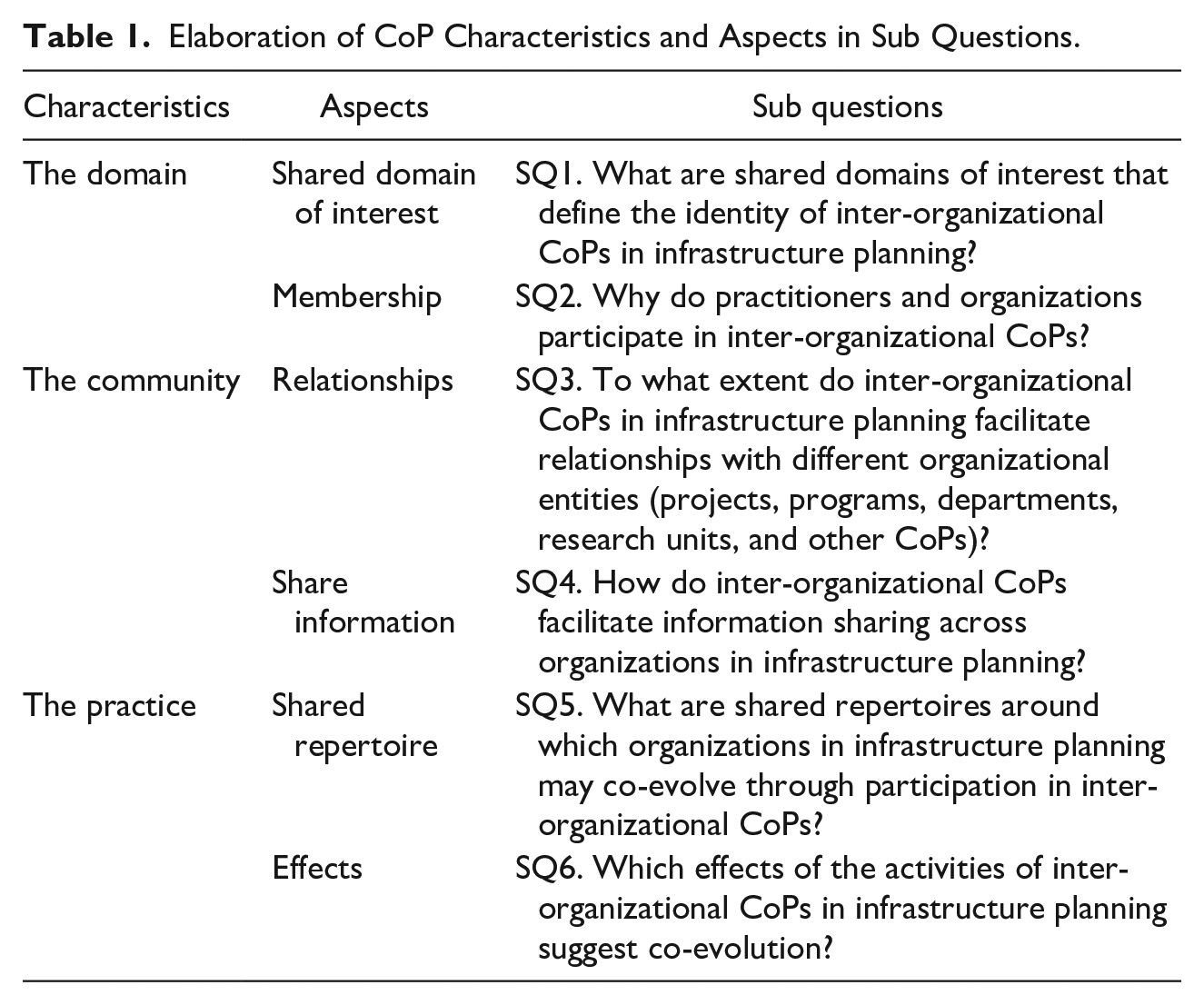
In light of the aim of this paper, the main question in this paper is: what is the function of inter-organizational CoPs in the landscape of co-evolving organizations in infrastructure planning? We structured our study based on the aforementioned three characteristics of CoPs and their included aspects (Wenger-Trayner & Wenger-Trayner, 2015). Since this study concerns co-evolution, we were interested whether activities of inter-organizational CoPs resulted in changes in the practice of infrastructure planning. Such changes point to topics around which habits and routines in organizations may be altered, and organizations may co-evolve. Therefore, we added effects as an aspect to the characteristic practice. To be able to answer the main question, we phrased a sub question for each of the CoP aspects (Table 1).
Elaboration of CoP Characteristics and Aspects in Sub Questions.
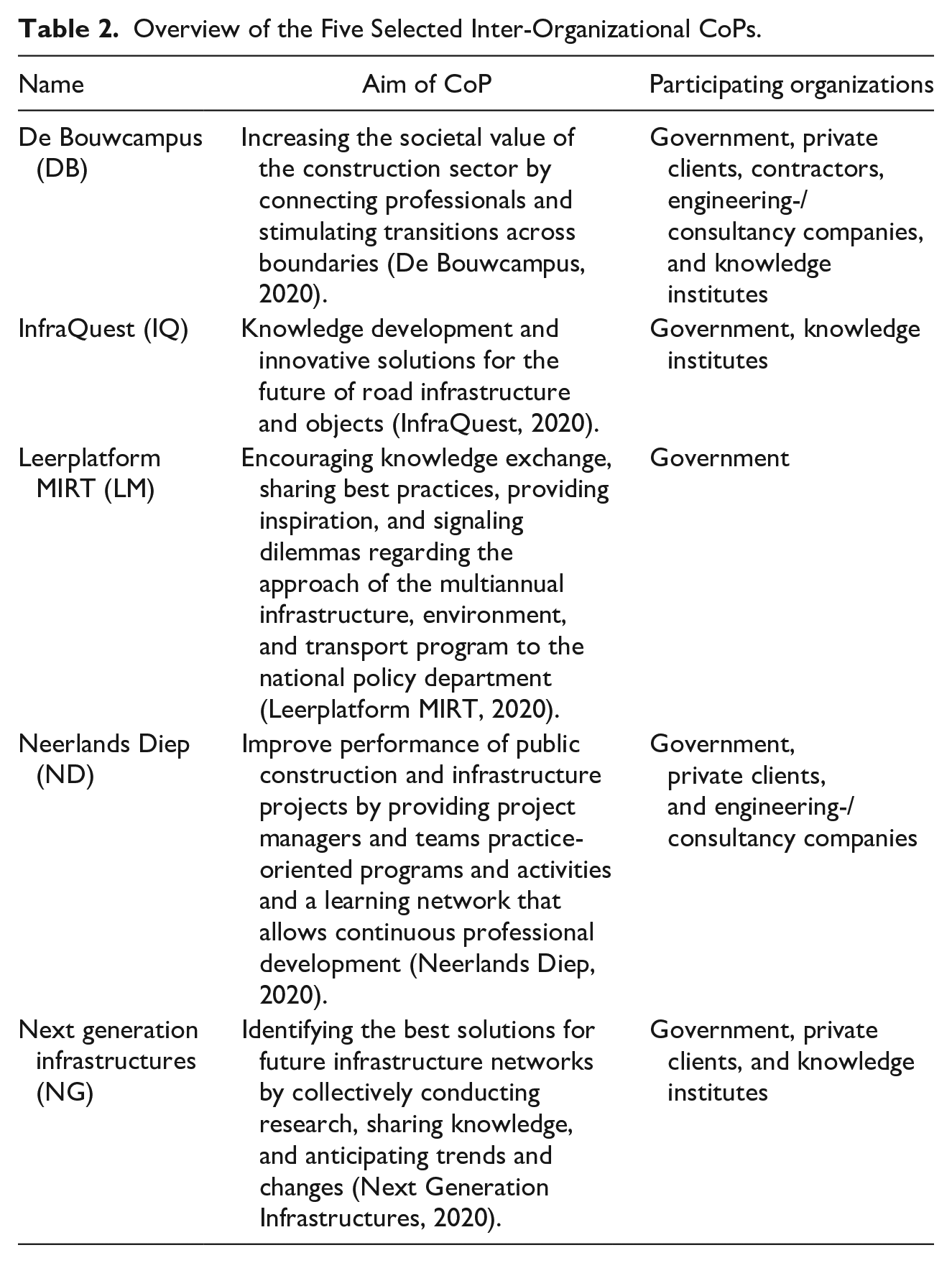
To answer these questions, we conducted an in-depth case study of five inter-organizational CoPs in the domain of a typical public infrastructure administrator. We selected Rijkswaterstaat—the executive agency of the Ministry of Infrastructure and Water Management in the Netherlands—because this project-oriented organization deliberately participates in numerous inter-organizational CoPs (Rijkswaterstaat, 2021). The five inter-organizational CoPs were selected from the various CoPs in which Rijkswaterstaat participated. Table 2 shows the selected CoPs and more information about these CoPs can be found in Supplemental Appendix I. The selection was based on the following criteria to enable us to explore the role of inter-organizational CoPs in collective learning and co-evolution as well as to identify differences among such CoPs:
Overview of the Five Selected Inter-Organizational CoPs.
Participation of one or more organizations besides Rijkswaterstaat.
Different compositions of participating organizations.
Representation of different types of organizations that are active in infrastructure planning.
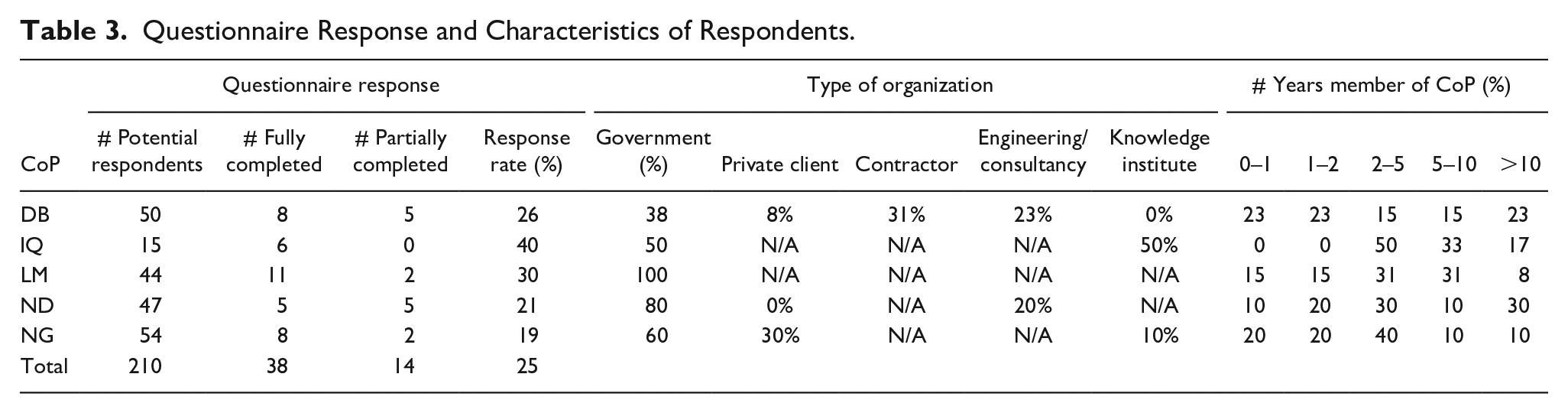
As a start, we interviewed the program manager for “shared knowledge development,” and the head of department of “knowledge and innovation management” of Rijkswaterstaat. Subsequently, we conducted a self-completion questionnaire among participants of the five inter-organizational CoPs (Supplemental Appendix II). We asked CoP representatives to send the questionnaire to CoP members to assure respondent anonymity and to avoid privacy issues. Since this questionnaire was conducted during the COVID-19 pandemic affecting CoP activities, we asked respondents to answer the questions based on their pre-COVID-19 experiences and to address the effects of COVID-19 separately at the end of the questionnaire. Table 3 gives an overview of the response. Qualtrics XM was used for the questionnaire and to analyze the data.
Questionnaire Response and Characteristics of Respondents.
To enhance the interpretation of the questionnaire results, we analyzed CoP documents, such as work plans and reports (see Supplemental Appendix III), and conducted semi-structured interviews with the five CoP representatives who sent the questionnaires to the CoP members. All interviews were recorded and transcribed. Documents and interview transcripts were analyzed based on codes retrieved from the literature review using ATLAS.ti 8.4. Subsequently, we organized a focus group with Rijkswaterstaat professionals discussing our preliminary findings through statements. We then conducted a second round of semi-structured interviews with five different CoP representatives (one per CoP) to discuss our preliminary findings, and to reflect on the results of the focus group discussion. Supplemental Appendix IV gives an overview of interviewees and focus group discussants. We incorporated the results of the focus group discussion and the second interview round in the results section.
Results
The three CoP characteristics—the domain, the community, and the practice (Wenger-Trayner & Wenger-Trayner, 2015)—are used to structure this results section. Each subsection presents the main questionnaire results in Tables and an analysis based on documents (Supplemental Appendix III), interviews and the focus group (Supplemental Appendix IV).
The Domain
The questionnaire results show that the studied inter-organizational CoPs were generally considered to facilitate sharing experience and improving the field of expertise (Table 4). There are also some differences. For example, DB provided a neutral ground for employees of participating organizations to develop solutions for challenges concerning the infrastructure and construction sector (Document1), which was considered important, because “interests are restraining and we want people to think freely” (Interviewee3). LM and ND are both considered important for professional development, but their focus and approach differed. LM facilitated the exchange of information about MIRT (Multi-year program for Infrastructure, Spatial planning, and Transport) through thematic meetings and courses, and supported putting subjects from practice on the agenda of policy makers (Interviewee7,8), while ND offered individual and team learning trajectories regarding project management (Interviewees9,10; Document6). IQ and LM were both considered specialist CoPs, but participants in IQ were specialists on road networks and constructions in road networks, such as viaducts, bridges, and tunnels (Interviewees5,6; Document3), while LM focussed on MIRT issues (Documents4,5).
Overview of the Main Questionnaire Results on the Domain.
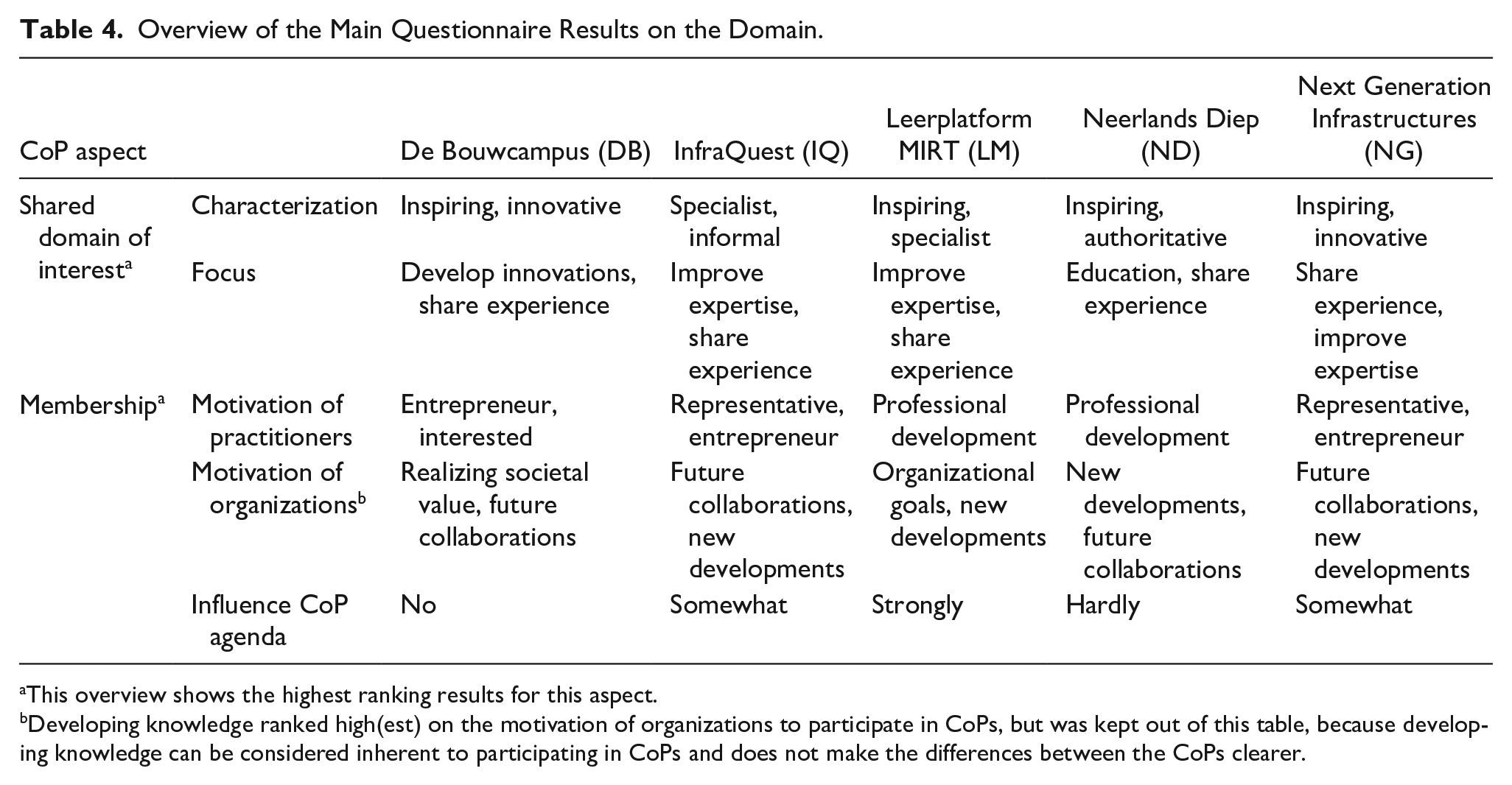
This overview shows the highest ranking results for this aspect.
Developing knowledge ranked high(est) on the motivation of organizations to participate in CoPs, but was kept out of this table, because developing knowledge can be considered inherent to participating in CoPs and does not make the differences between the CoPs clearer.
Practitioners predominantly participated in DB, IQ, and NG as entrepreneurs or representatives of organizations who wanted to initiate or contribute to developments, and in LM and ND as professionals for their own professional development. Focus group discussants argued that such intrinsic motivation is essential and that these results highlight an important difference across the studied CoPs: individuals that participate in CoPs to learn themselves versus individuals that participate as representatives of their organization to collectively develop a field of expertise or cross-sectoral solutions. Further, questionnaire respondents argued that practitioners also participate in inter-organizational CoPs to acquire outside feedback. Focus group discussants argued that discussing issues with like-minded professionals from other organizations provides multiple perspectives on both problems and solutions.
The most frequently mentioned motivation of organizations to participate in a specific CoP was the possibility to follow and influence developments in the sector and to prepare for future collaborations. Respondents generally experienced little influence of participating organizations on the agenda, except for LM. Participation in LM was predominantly considered important to realize organizational goals as this CoP concerned core activities of the Ministry and Rijkswaterstaat. Accordingly, the questionnaire results show that participating organizations strongly influenced the agenda of this CoP. Interviewee7 added that managers from the participating organizations discussed and approved the annual work plan. In contrast, NG recently developed into a CoP that takes its own position on cross-sectoral issues, “even if such a position is not supported by the participating organisations” (Interviewee12). Interviewee12 added that the participating organizations appreciated this role, because “they don’t want to become one infrastructure organisation, but they do want to think as one organisation” (Document9).
To answer SQ1 (what are shared domains of interest that define the identity of inter-organizational CoPs in infrastructure planning?), all studied CoPs concern infrastructure planning, but they have a unique focus, character, and composition. DB and NG are relatively large CoPs with broad attention for future infrastructure developments and transitions in practice. IQ is relatively small and has a specialist focus on research concerning infrastructure objects. Whereas the aforementioned CoPs focus on solutions for organizational issues or physical infrastructure objects, LM and ND focus on development of skills of (groups of) professionals in infrastructure planning.
To answer SQ2 (why do practitioners and organizations participate in inter-organizational CoPs?), practitioners participate in inter-organizational CoPs to learn themselves or as representatives of their organization to collectively develop a field of expertise or cross-sectoral solutions and organizations participate follow and influence developments in the sector. From Rijkswaterstaat’s point of view, participation different inter-organizational CoPs enables a broad view of and contribution to developments in the sector. Rijkswaterstaat depends on external knowledge to fulfil its task (Interviewee1) and inter-organizational CoPs provide access to this knowledge along with the possibility to spread its own knowledge and views.
The Community
Most of the studied CoPs showed strong relationships with projects, but there are some noticeable differences (Table 5). ND showed very strong relationships with projects and programs. Interviewee9 explained that ND had a history of strong relationships with projects, because of its focus on professional development of project managers and teams. DB also showed strong relationships with projects and programs, but they were only slightly stronger than the relationships with other entities. According to Interviewee3, this fits the intentions of DB as they “explicitly want the whole supply chain to participate.” NG also showed generally evenly strong relationships with other entities. However, NG showed the strongest relationships with research units next to projects. Interviewee12 argued that NG connected practical issues to scientific research and used scientific research to shift the view to future developments of the field of infrastructure planning. IQ showed even stronger relationships with research units than NG. Interviewee5 argued that IQ was “initiated as a sort of knowledge institute” and Interviewee6 added that IQ was “a vehicle to collectively conduct research.” Lastly, LM showed the strongest relationships with departments next to projects. Interviewee7 explained this by arguing that LM not only informed professionals about policy developments, but also contributed to putting issues from practice on the agenda of policy departments.
Overview of the Main Questionnaire Results on the Community.
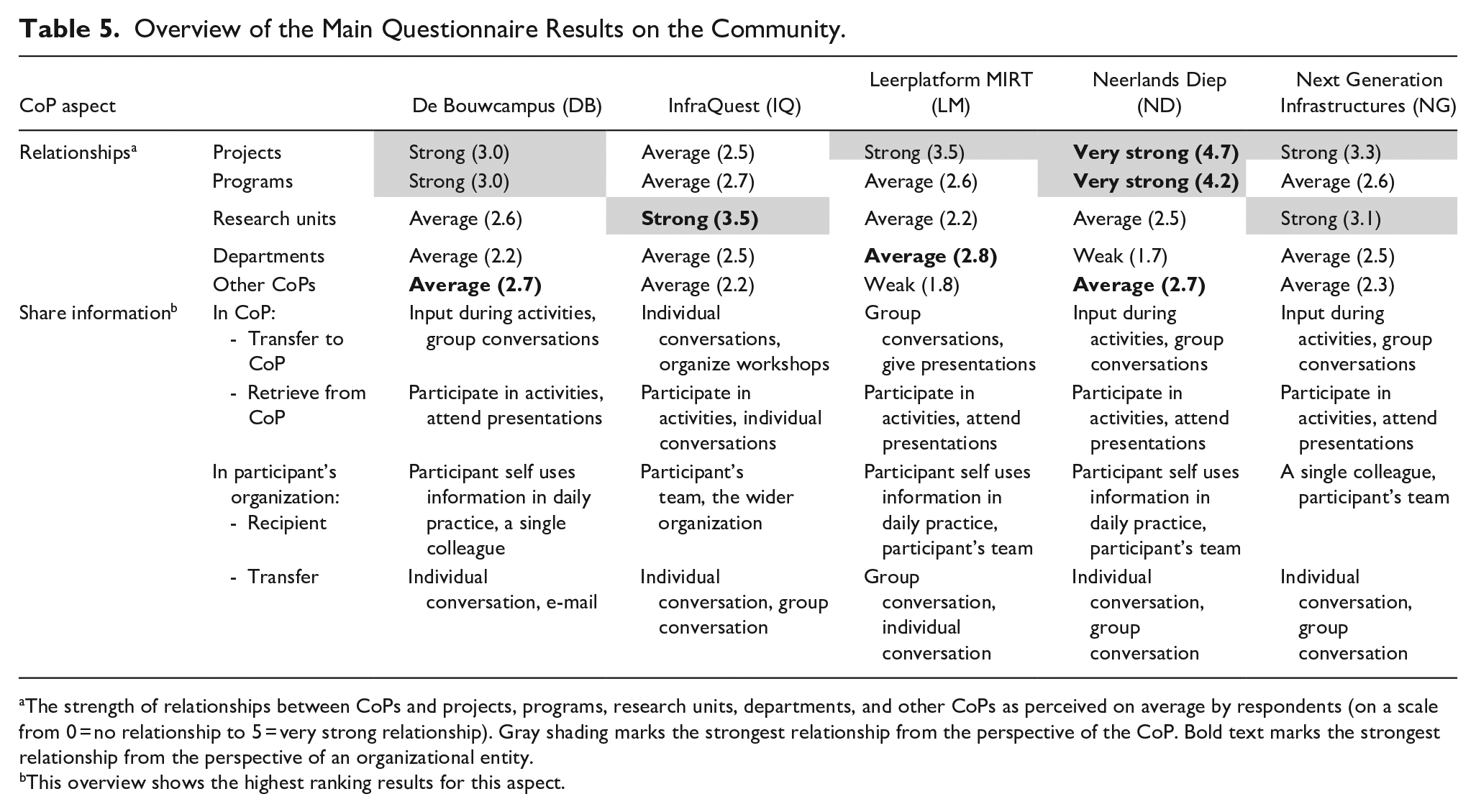
The strength of relationships between CoPs and projects, programs, research units, departments, and other CoPs as perceived on average by respondents (on a scale from 0 = no relationship to 5 = very strong relationship). Gray shading marks the strongest relationship from the perspective of the CoP. Bold text marks the strongest relationship from the perspective of an organizational entity.
This overview shows the highest ranking results for this aspect.
The questionnaire results show that information was predominantly shared in CoPs through personal interaction during activities or conversations. Multiple respondents additionally argued the value of breaks during meetings and drinks at the end of CoP activities for informal information transfer. Sharing documents generally ranked low for transferring information. Presentations also ranked low for information transfer toward CoPs. Information was mostly retrieved from CoPs through participation in activities. This allows for collective interpretation within the CoP. Attending presentations also ranked high, which implies that much information retrieved from CoPs was still interpreted individually. However, Interviewee8 argued that presentations where usually followed by discussions in breakout groups to enable collective interpretation of information. Further, respondents argued that information retrieved from CoPs was transferred in the participant’s organization through personal interaction, predominantly through individual and group conversations. Impersonal modes of information transfer, such as e-mail and an intranet, were used less to transfer information from a CoP to colleagues. Interviewees and focus group discussants added that, instead of transferring the information themselves, participants often invite other participants from other organizations to tell their story, since new information is often more easily accepted when it is presented by professionals from other organizations. The questionnaire results show that respondents also used information from CoPs in daily practice and shared it with their team, a single colleague, or the wider organization. This suggests that inter-organizational CoPs indeed affect collective learning and co-evolution of organizations.
To answer SQ3 (to what extent do inter-organizational CoPs in infrastructure planning facilitate relationships with different organizational entities (projects, programs, departments, research units, and other CoPs)?), the studied CoPs facilitated relationships between all organizational entities, although differently. The focus of the CoPs seems to determine which relationships are stronger or weaker. For example, whereas DB facilitated evenly strong relationships among diverse types of organizations in a supply chain, IQ facilitated strong relationships with research units regarding scientific research on physical infrastructure objects. Further, the motivation of organizations to participate in CoPs may have an effect as LM, the only CoP where organizational goals were considered most important, showed the strongest relationships with departments among the studied CoPs.
To answer SQ4 (how do inter-organizational CoPs facilitate information sharing across organizations in infrastructure planning?), participants in DB, LM, and ND predominantly used information retrieved from CoPs in their own daily practice, whereas participants in IQ and NG predominantly shared information with respectively their team or a single colleague. As such, the focus seems to influence on which level learning occurs and habits and routines evolve. For example, in IQ and NG, individuals participated as entrepreneurs or representatives of their organization to collectively develop a field of expertise or cross-sectoral solutions and to spread information in their own organization to improve its role in the sector. This predominantly concerns group- and organizational-level learning and evolution of group and organizational routines. In LM and ND, individuals participated to learn themselves or with their team. Hence, LM and ND predominantly facilitated individual- and group-level learning and evolution of individual habits and group routines.
The Practice
Regarding the shared repertoire, the questionnaire results show that the CoPs mostly facilitated the exchange of expertise, and successively the exchange of experiences and information about general developments in the sector (Table 6). Expertise is especially exchanged in IQ and NG, where research plays an important role, and ND, which focusses on a profession. In DB and LM, sharing experiences ranks highest. In DB, experiences—that is, existing knowledge—were used to stimulate innovations and transitions (Document1; Interviewees3,4). Interviewee3 argued that “positive experiences elsewhere bring organizations together.” Further, experiences are generally considered to be transferred more to CoPs than retrieved from CoPs, while information about general developments in the sector is generally considered to be retrieved more from CoPs than transferred to CoPs. Despite the differences between transferring and retrieving, both generally happen strongly. This reciprocity suggests that CoPs may facilitate co-evolution.
Overview of the Main Questionnaire Results on the Practice.
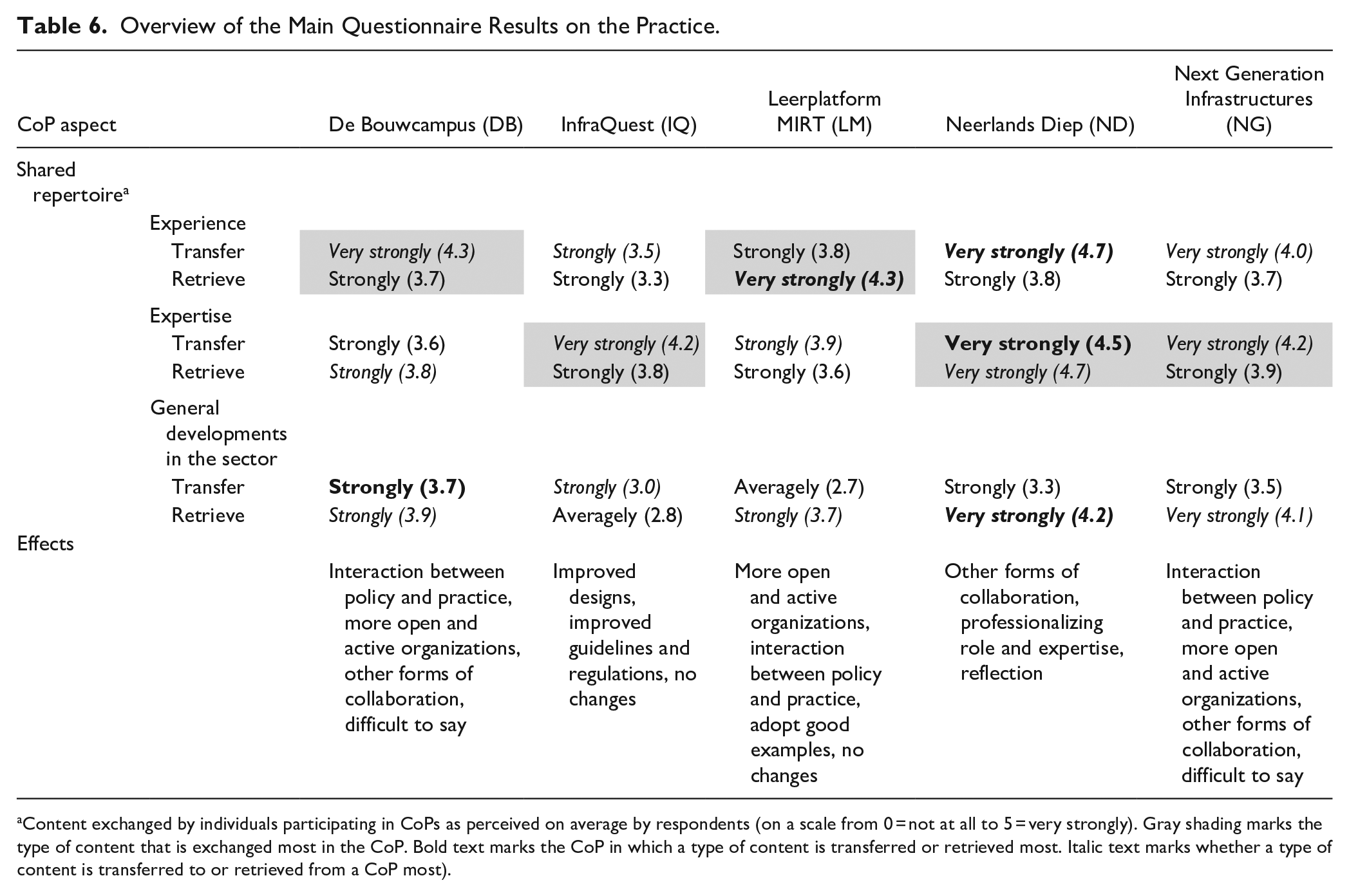
Content exchanged by individuals participating in CoPs as perceived on average by respondents (on a scale from 0 = not at all to 5 = very strongly).Gray shading marks the type of content, that is, exchanged most in the CoP. Bold text marks the CoP in which a type of content is transferred or retrieved most. Italic text marks whether a type of content is transferred to or retrieved from a CoP most).
Respondents, interviewees, and focus group discussants argued that it is difficult to measure concrete effects. For example, Interviewee12 argued that it remains unknown whether and to what extent shared information or developed knowledge is actually applied in an organization and that, once knowledge is applied, it is hard to retrace where it originated. Focus group discussants added that effects cannot be retraced to a single CoP, because organizations are affected by a multitude of influences from their internal and external environment. However, the results do show examples of CoPs facilitating co-evolutionary processes. Respondents mentioned improved interaction between policy and practice, particularly from practice to policy, as a consequence of activities in DB, LM, and NG. Participating organizations in IQ mutually adjusted their research programs on infrastructure objects (Interviewees5,6). This resulted in the improved designs, guidelines, and regulations that were mentioned by questionnaire respondents. Interviewee10 and focus group discussants argued that participants in ND exchanged experiences with the Integral Project Management model of Rijkswaterstaat, which contributed to the implementation of this model within other participating organizations and coherence in the way public clients manage infrastructure projects. This explains why questionnaire respondents mentioned other forms of collaboration and professionalizing the role and expertise regarding project management as effects of ND. NG incorporated a simulation platform from one of the participating organizations to allow scenario analyses of infrastructure networks of all participating organization and to improve cross-sectoral decision making (Interviewees12,13; Document10). This illustrates the results in terms of more open and active organizations and other forms of collaboration. In general, respondents stated that they were satisfied with their participation in a CoP if they learned something new or saw actual changes in practice. New, valuable relationships and being more effective as a collective, as opposed to operating individually, were also satisficing aspects of participation in CoPs. Such aspects are conditional for collective learning and co-evolution and the results suggest that these conditions are fulfilled in inter-organizational CoPs.
To answer SQ5 (what are shared repertoires around which organizations in infrastructure planning may co-evolve through participation in inter-organizational CoPs?), the results show that inter-organizational CoPs support collective learning and co-evolution of organizations by creating an environment where specific subjects or skills can be discussed and openings for improvement can be found. Next to a shared understanding of issues and developments in infrastructure planning, the shared repertoire of some of these CoPs comprises guidelines, regulations, and tools that support collective decision making.
To answer SQ6 (which effects of the activities of inter-organizational CoPs in infrastructure planning suggest co-evolution?), the results show that respondents experience more interaction between organizations in infrastructure planning as a consequence of the activities of inter-organizational CoPs. This interaction is conditional for collective learning and co-evolution. Although the results show that concrete effects may be difficult to measure, we found some indications of inter-organizational CoPs facilitating co-evolution, such as a simulation platform that supported cross-sectoral decision making by NG and mutual adjustment of research and knowledge programs by Rijkswaterstaat and knowledge institutes through IQ.
Discussion
Communities of Practice in Infrastructure Planning
We studied five different CoPs in infrastructure planning, each with their own domain, community, and practice. Although it is considered difficult to retrace concrete effects to a single CoP, the results also suggest that, for example, policy and practice, research programs of different organizations, and the commissioning and management of projects across different organizations co-evolve through inter-organizational CoPs. Inter-organizational CoPs facilitate such co-evolutionary processes by enabling new and diverse relationships through which information can be shared.
Our study shows that relationships between CoPs and projects are generally strong and that CoPs predominantly facilitate the exchange of experiences and expertise. This is probably explained by the role of projects as dominant vehicles for innovation and adaptation in project-oriented organizations (Kemp et al., 2007). Learning often occurs within projects (de Groot et al., 2020) and CoPs offer a window for other organizational entities to learn from experiences in projects. Conversely, experiences and expertise held by individuals serve as resources for projects. Relationships with departments in a parent organization are clearly present, but they seem relatively weak, which was also found in the study of de Groot et al. (2020). Project-oriented organizations are loosely-coupled systems in itself—as Leendertse and Arts (2020) argued—but the network of organizations in infrastructure planning also appears to be a loosely-coupled system as the results show a mixture of relationships with different strengths between each CoP and other organizational entities. The strength of relationships with other organizational entities seems to be related to the aim of the CoP. For example, research-oriented CoP IQ built strong relationships with research units, project-management-oriented CoP ND built very strong relationships with projects and programs, and the more general infrastructure planning issues in DB and NG that involved a variety of organizations were reflected in evenly strong relationships with all other organizational entities.
Co-Evolution and Collective Learning
Our study underlines the findings of de Groot et al. (2020) regarding the relevance of CoPs for collective learning in project-oriented organizations. CoPs facilitate the flow of information across organizational boundaries, which enables variation. The results show that practitioners use information retrieved from CoPs in their daily practice. As they interpret this information and try alternative approaches that fit their context, they guide variation. Practitioners (interactors) may develop new habits (replicators) as they select and retain approaches that are considered improvements. Practitioners also share information retrieved from a CoP with a colleague or their team through individual and group conversations in which this information is collectively interpreted. The results show that information is often more easily accepted when it is presented by professionals from other organizations. This resembles the suggestion of Price (1995) that organizations can call in external consultants as meme adjusters with other ideas than the ones already existing within an organization.
Practitioners may not share all information, rather, they share information that they consider useful for their colleagues or organization. Subsequently, colleagues may not use all information, but only use information that they consider useful. This process illustrates how artificial selection and absorptive capacity reduce and change the information retrieved from a CoP as it is spread and interpreted throughout an organization. Although this still enables collective learning and evolutionary processes in organizations, the direction in which organizations evolve may share little resemblance with the desired direction as discussed by participants in an inter-organizational CoP. Contrastingly, our study also shows that CoPs facilitate improved guidelines and regulations. This institutionalization forces practitioners in different organizations in the sector to adopt the same habits and routines.
Communities of Practice in the Landscape of Co-Evolving Organizations
Interaction between organizations and their environment, which is conditional for collective learning and co-evolution, was considered to be improved because of the activities of inter-organizational CoPs. For instance, physical infrastructure objects, project management techniques, and policy processes are recognized in our study as boundary objects that are of interest to practitioners from different perspectives. These practitioners act as knowledge brokers between their organization and inter-organizational CoPs, which enables learning from other places. Our study shows that this is a two-way process in which experiences (learning from the past), expertise, and information about general developments in the sector are transferred from a practitioner’s organization to a CoP and vice versa. Moreover, the studied CoPs were considered valuable for experimentation (learning through experimentation) and reflection. As such, practitioners enable variation in both CoPs and their own organization. Inter-organizational CoPs appoint program managers and facilitators as translators to support the process of confronting and connecting different perspectives. Hence, inter-organizational CoPs seem to be at the heart of dialectical learning where different types of learning meet (see Van Assche et al., 2021) and where different organizational interests can be confronted or deliberately disregarded to collectively find new directions for dealing with challenges in infrastructure planning.
Practitioners participate in inter-organizational CoPs to learn themselves or as representatives of their organization to collectively develop a field of expertise or cross-sectoral solutions. Organizations participate to follow and influence developments in the sector. Such developments were considered relevant for the participants’ parent organization, not (only) because of strategic advantage, but (also) to improve the sector and to prepare their organization for future assignments. These responses suggest a perspective different from that of Love et al. (2011) who argued that public and private clients should encourage construction companies to form learning alliances, since these companies are considered sceptical about “adopting ‘management fads’ . . . that provide no strategic competitive advantage” (Love et al., 2011, p. 194), thereby referring to CoPs among others. Our study shows that organizations also participate in CoPs without the need to yield strategic competitive advantage and without being able to point out concrete effects. The need to find solutions for problems (short term) was of little importance in the decision to participate. Inter-organizational CoPs seem to support a more long-term orientation were experiences from projects and development of policy meet each other. This corresponds to the long-term character of co-evolutionary processes (see Volberda & Lewin, 2003). On the one hand, this finding is remarkable since the relationships with projects were considered strong and projects are considered to have a predominantly problem-oriented, short-term, and internal focus (de Groot et al., 2020). On the other hand, this shows how social evolutionary processes differ from biological evolution, as we have the cognitive ability to individually and collectively imagine a possible future and to adapt our behaviors toward a desired future. The ability to put long term benefits above short term interests is explained by Dawkins (1976) in terms of altruism. Inter-organizational CoPs enable altruism as they provide a neutral ground where long-term sector benefits can overcome short-term organizational interests.
To answer the main question in this paper, inter-organizational CoPs seem to provide a neutral ground where long-term sector benefits can overcome short-term organizational interests. Inter-organizational CoPs are hubs in the organizational landscape that appear to offer windows for collective learning across project-oriented organizations and arenas that may facilitate co-evolution of organizations regarding specific topics, fields of expertise, or processes in infrastructure planning.
Conclusion
The aim of this paper was to explore the contribution of inter-organizational CoPs to collective learning and co-evolution of organizations in infrastructure planning. Therefore, we performed a case study of five inter-organizational CoPs in the domain of a typical public infrastructure administrator and analyzed the domain, the community, and the practice of these CoPs. We found examples of CoPs facilitating co-evolution, such as a simulation platform that supported cross-sectoral decision making and mutual adjustment of research and knowledge programs. Our study also shows that practitioners used information retrieved from CoPs in their daily practice, which enables alterations in individual habits and group and organizational routines.
Organizations not only (co-)evolve through CoPs. A multitude of influences affects organizations over time and information is retrieved from different sources. The idea that the outcome of co-evolutionary processes emerges, rather than that it can be controlled, may make it difficult to retrace concrete effects to a single CoP. However, our explorative study does show that CoPs facilitate collective learning and may be able to facilitate co-evolution. For further research in the contribution of inter-organizational CoPs to co-evolution, we suggest a longitudinal study to allow for a more in-depth analysis of concrete examples of perceived co-evolution involving CoPs.
Inter-organizational CoPs seem to provide a neutral ground where long-term sector benefits can overcome short-term organizational interests. As such, inter-organizational CoPs are hubs in the organizational landscape that appear to offer windows for collective learning across project-oriented organizations and arenas that may facilitate co-evolution of organizations in infrastructure planning.
Supplemental Material
sj-docx-1-aas-10.1177_00953997221100379 – Supplemental material for Co-Evolution of Organizations in Infrastructure Planning: The Role of Communities of Practice as Windows for Collective Learning Across Project-Oriented Organizations
Supplemental material, sj-docx-1-aas-10.1177_00953997221100379 for Co-Evolution of Organizations in Infrastructure Planning: The Role of Communities of Practice as Windows for Collective Learning Across Project-Oriented Organizations by Bert de Groot, Wim Leendertse and Jos Arts in Administration & Society
Footnotes
Acknowledgements
The authors thank Rijkswaterstaat, De Bouwcampus, InfraQuest, Leerplatform MIRT, Neerlands Diep, and Next Generation Infrastructures for cooperating and providing data for this study.
Declaration of Conflicting Interests
The author(s) declared no potential conflicts of interest with respect to the research, authorship, and/or publication of this article.
Funding
The author(s) received no financial support for the research, authorship, and/or publication of this article.

Supplemental Material
Supplemental material for this article is available online.
Author Biographies
References
Supplementary Material
Please find the following supplemental material available below.
For Open Access articles published under a Creative Commons License, all supplemental material carries the same license as the article it is associated with.
For non-Open Access articles published, all supplemental material carries a non-exclusive license, and permission requests for re-use of supplemental material or any part of supplemental material shall be sent directly to the copyright owner as specified in the copyright notice associated with the article.
