



Abstract
This paper introduces the concepts and ideas that frame this special issue on co-evolution in governance, and their implications for policy learning and adaptation. It offers a brief overview of co-evolutionary approaches to governance and their elementary connections with systems theories, post-structuralism, institutionalism, and actor-network theory, and explores how they are connected to co-evolution in governance. Co-evolutionary approaches differ from other influential understandings of knowledge and learning in policy and governance. It furthermore presents a typology of learning in governance and systematically discusses how each type is affected by patterns of coevolution in governance.
Introduction: Co-evolution and Learning in Governance
The scholarship on governance, administration, and organization increasingly gives weight to processes through which different systems or subsystems co-evolve and mutually adapt to each other. Co-evolutionary approaches to governance are not new (De Roo & Boelens, 2014; Kemp et al., 2007; Koza & Lewin, 1998; Nelson, 1994; Rip, 2006; Underdal, 2013; Van Assche et al., 2017a), but the arguments that have been accumulating in diverse and disparate literatures have not always been considered together. As a consequence, the value of co-evolutionary approaches—both in the analytic and normative sense—has often been underestimated. Furthermore, the potential implications of co-evolution for governance have not been fully grasped by the community of scholars working in public policy, public administration, and planning. Those implications are substantial, since a co-evolutionary perspective offers a different understanding of the ways in which different governance elements are connected and changing in an ongoing interplay (Van Assche et al., 2014a), and because it presents a different understanding of how discourses and social systems constantly reconstruct an image of their environment and adapt to changing circumstances in a self-referential manner (King & Thornhill, 2003; Luhmann, 1995).
Since knowledge plays a pivotal role in governance systems (Bennett & Howlett, 1992; Dunlop & Radaelli, 2013; Folke et al., 2005; Gerlak et al., 2018; Moyson et al., 2017; Van Buuren, 2006), processes of learning are immanent to co-evolution. In the literature, learning has referred to many things. One can analyze the processes of acquiring and disseminating new information, knowledge, and skills, the formation of new ways of seeing and understanding things, or changing beliefs. We add that an intention is not necessarily a requirement. That is, learning in a governance perspective can occur both intentionally—for example, through active attempts to acquire new knowledge or skills via search processes (Aldrich, 1999), or through deliberate attempts to change beliefs through institutional design (e.g., Klijn & Koppenjan, 2006)—and blindly—for example, as a consequence of unintentional mistakes, surprises, or misunderstandings (Aldrich, 1999). One can learn as an individual, as an organization, and as a governance system involving many organizations. Furthermore, although learning in general has a positive connotation, it is important to emphasize that governance systems, just as individuals, can also draw incorrect conclusions from their observations, that lessons learned are skewed by politico-ideological frames, positions, and interests, and that new knowledge can also be used to undermine public goods and interests.
In much of the literature rooted in rational-choice thinking, we find an understandable emphasis on the possibility to steer learning processes and to steer them in the direction of a more adaptive and sustainable system state, or toward the solution of societal problems and the achievement of collective goals. While many conventional treatments of learning portray it as a rationalist and unproblematic search for new solutions—applications of lesson-drawing, for example—it has increasingly been acknowledged that knowledge is limited and contested and that the development, selection, and use of knowledge is part of ongoing strategizing and subject to ongoing power/knowledge dynamics (Flyvbjerg, 1998b; Foucault, 1980; Jasanoff, 1987; Van Assche et al., 2021). In literatures informed by critical theorizations, we find such emphasis on the strategic deployment of learning toward predetermined projects of institutional transformation (Peck & Theodore, 2015). Hence, the importance to critically reflect upon and interrogate the nature of learning itself. For example, what appears “new” in one jurisdictional context may be the result of “competitive emulation” rather than “veritable invention” when considered alongside and in conjunction with the co-evolution of other jurisdictions (Peck, 2011). Nevertheless, we believe that it is equally important to pay attention to learning processes that are less easy to discern, not so easy to steer or manage, and which do not necessarily contribute to the efficiency, legitimacy, or stability of governance, or to the promotion of public goods or services. We also need to consider that actors may learn how to deviate from rules or may learn how to use or change existing institutions to implement a form of governance that conflicts with the interests of the community.
Co-evolution in governance thus involves various processes of learning, the conscious reflections by individuals, groups, and organizations on the ways things work and can be adapted, revised, and improved. An analytical focus on learning draws attention to the different forms of knowledge that are present in a governance system, to knowledge infrastructures, to different ways of learning, and to the effects of learning on governance. It also draws attention to the ways in which particular governance configurations influence the possibilities of learning and adaptation in society. Moreover, one can speak of learning of the governance system as a whole, in the sense that one can speak of learning organizations, policy systems, networks, and meta-organizations (Meadows, 2008; Wilson, 2020). All these aspects have been explored, but rarely been brought together in a more coherent perspective.
The aim of this paper, and of the special issue to which it presents an introduction, is to address this gap and to explore the different linkages between co-evolution, policy learning, and adaptation; and to investigate the implications a co-evolutionary perspective has for the understanding of learning in governance.
Section “Co-evolutionary approaches to governance” provides a short overview of co-evolutionary approaches to governance, and their elementary connections with broader theories, including systems theories, post-structuralism, institutionalism, and actor-network theory. This allows us to identify key features of co-evolution and to emphasize the pivotal role of knowledge and learning in co-evolution. In Section “Basic differences with influential approaches,” we distinguish a co-evolutionary approach from other influential understandings of knowledge and learning in policy and governance; and devote attention to recent developments in geography and policy studies, which start to reveal the consequences of co-evolution for learning and for the fate of knowledge and policy tools circulating the globe. In Section “A typology of learning forms in governance,” we distinguish between types of learning in governance—that is, learning through comparison, through reflection on past and present, from experts, through experimentation, and finally dialectical learning—and discuss how each type is affected by the patterns of co-evolution in a particular governance system. We conclude in Section “The typology, co-evolution, and selectivity” with a reflection on the translation of co-evolutionary processes in shifting patterns of opening and closure for learning—and hence adaptation.
Co-evolutionary Approaches to Governance
A variety of approaches to governance, to public policy and administration, and to planning can be called co-evolutionary. This section will briefly provide an overview of different co-evolutionary approaches and their underlying assumptions. Co-evolutionary approaches employ an understanding of governance that focusses on the history of governance and on the way in which different elements in governance and the overall structure co-evolved. The full diversity of approaches to governance in which co-evolution plays a prominent role cannot be adequately presented here, but we can sketch their diversity and point out that they range from social systems theory in the Luhmannian sense, via classic systems theory a la Von Bertalanffy, complex adaptive systems theory, to socio-ecological systems frames in the resilience tradition (Cole et al., 2013; Epstein et al., 2020; Folke et al., 2003; Krasny et al., 2010; Teisman et al., 2009). In addition, actor-network theories, in the Latour family of thought and beyond, and science and technology studies, deserve to be mentioned, as they pay particular attention to the processes through which elements and structures co-evolve in a configuration (Latour, 2005; Law, 2009; Müller, 2015). The presence of actor-network theories in management and organization studies contributes to the prevalence of co-evolutionary analysis of governance (Czarniawska, 2009; Whittle & Spicer, 2008).
Further, there is the rich pallet of post-structuralist approaches to public policy and administration, ranging from Foucault to Lacan, Deleuze, and Derrida, each of them starting from a constructivist premise and usually involving a critical investigation of the role of knowledge in governance, and each of them devising a different but related idea of co-evolution. In the case of Foucault, that would entail first of all a co-evolution of power and knowledge in discourse and, second, a co-evolution of different discourses, some of them institutionalized.
Particularly prominent in public policy and administration are institutionalist approaches, some deriving mostly from political science and sociology, others more in the tradition of institutionalist economics (Hall, 2010; Mahoney & Thelen, 2010; North, 2005; Ostrom, 2005, 2014). Institutionalism tends to come with an emphasis on path dependencies, an appreciation of history and institutionalized relations, on the interplay between structure and agency and, in recent versions, a recognition of informal institutions, both as starting point for formalization and as continuous accompaniment of formal institutions. Institutionalist approaches analyze the possibilities and limitations of institutional design and criticize naive or modernist ideas on optimization out of context, learning for optimization, or copying from what are labeled best practices (see e.g., Klijn & Koppenjan, 2006). These approaches bring attention to the co-evolution between formal and informal institutions and between actors and institutions in the processes of institutional change (Mahoney & Thelen, 2010; Van Assche et al., 2014b).
Co-evolution itself has a rich pedigree and varied definitions. The basic understanding we take as the starting point in the development of this special issue (cf. Van Assche et al., 2018), a version compatible with most co-evolutionary theories, highlights several features of co-evolution:
Co-evolution requires a concept of a system in which several elements co-evolve, more than merely a sum of loosely coupled elements, structures, and processes;
It requires an idea of an iterative and recursive process, where one operation is input for the next one;
It relies on an idea of selectively triggered responses in the system: not all things co-evolve in the same way; not all changes in an entity cause changes in all other entities.
These features of co-evolution have immediate implications for co-evolutionary approaches to governance. Institutional design from scratch, or a clear and manageable transition from one governance system to another one, are unlikely. The post-Soviet and sustainability transitions are cases in point. Furthermore, knowledge plays a pivotal role in evolving governance systems. Ways of understanding shape processes of governing and vice versa (Turkel, 1990; Voß & Freeman, 2016). Knowing and organizing shape each other and co-evolve (Alvesson & Spicer, 2016; Alvesson et al., 2009). The presence or absence of knowledge—or the privileging of particular sorts of knowledge in previous states of the system—is important, just as the institutionalization of certain forms of knowledge and their embedding in organizations. Path dependencies and interdependencies between different elements of the governance system and the cognitive aspects of the system, play crucial roles here (Van Assche et al., 2017b).
Through selection mechanisms, either intentional or unintentional, present knowledge often tends to persist. As such, the existing knowledge base influences the direction of the transformation or expansion of the governance system. Knowledge in the system and forms of learning in the system affect the learning of the system. The knowledge base can in many different ways set limits to the emergence and evolution of new ways of understanding and hence impact the further evolution of the governance system. It can marginalize alternative perspectives, limit the development of particular knowledges, reframe certain concepts and ideas, and therewith assimilate them to the existing understandings. This too, is a form of path dependence, which becomes more easily visible in co-evolutionary approaches to governance.
Along the same lines, one can see that concepts such as best practices or good governance—but also policy transfer and innovation diffusion—look rather problematic, because all these concepts are strongly linked with specific ways of understanding and knowledge governance, often strongly coupled to particular actors, organizations, or institutions. These concepts tend to reinforce a particular perspective or knowledge base rather than offering novel insights on the ways different knowledges co-evolve; they are themselves selection mechanisms that influence the evolutionary path of governance. One can speak here of meta-knowledges or concepts which shape the selection and use of other concepts and forms of knowledge. The embedding of particular methods and ideas about roles of investigation in the process of governance can be understood in the same way: these ideas similarly function as selectors of knowledge.
Co-evolutionary perspectives on governance do not solely emphasize conservatism, though. While they might reveal that transformation from scratch or from the desk is rarely possible and that implementation is more than pushing a button, they also reveal new mechanisms of learning and transformation. If one understands governance configurations as extended networks of co-evolving elements (possibly defined differently in different theories), then new knowledge can follow convoluted pathways. Besides a diffusion of that knowledge among those pathways, the knowledge is likely to be transformed in the series of interactions involved. The actors involved can learn, by adopting, transforming, opposing, deliberately rejecting the new knowledge, and by adjusting their strategy. The governance system as a whole can also learn; possibly by adjusting strategy, by devising new institutions, or by reinterpreting existing ones. The overall design of the governance system can engender learning without a clear awareness by the main actors; the awareness of learning potential could have been there with the original designers of the system (see the veneration of the founding fathers in the U.S.). A configuration can also emerge without a brilliant initial design, adapting to changing internal and external environments, through repeated interactions of the elements. A conscious use of “knowledge” does not have to play a role for learning in this sense to evolve.
In dealing with complex systems—aiming to manage external environments where knowledge is appreciated—competing discourses and knowledge claims exist (e.g., Van Buuren, 2006). Knowledge will tend to become a topic or tool for strategy in and through governance, since there is usually an agreement that some combination of expertise and awareness of what citizens think, is present (Briggs, 2005, 2013). Furthermore, it is well-known that certain actors strategically try to undermine knowledge claims and manufacture doubt in order to protect their own interests (Miller & Dinan, 2015; Oreskes & Conway, 2011). The role of experts in governance and their impact on policy is subject to critical reflections (e.g., Fischer, 1990), but also very influential and it brings in the idea that external complexity has to be reduced in governance to make it manageable (Berkes & Folke, 1998; Folke et al., 2007; Scott, 1998). The strong involvement of public health experts, epidemiologists, and intensive care professionals in decision-making on COVID-19 policies and measures is a case in point. The simplification of external complexity, however, requires knowledge. The greater the awareness of external complexity, the more important the role of experts, knowledge, and of learning tends to be. As we know, there is also political value in simplification without the expertise to do so responsibly. Democratic systems of governance can go in opposite directions as well. For politicians, it is useful to rely on experts and dodge questions or responsibility, but it can be just as promising to entirely ignore experts, expertise, and broader learning by simply repeating popular tropes of analysis and solutions (we all know the problem or the solution). It is often a firm belief in a particular solution that motivates experts to define it as a problem; for example: “the problem is that we need more participation” (Meadows, 2008). Appeals to common sense and to emotions can both trigger or block learning. Appeals to a broadening of the knowledge base in governance—including local knowledge—can also be abused, to stop thinking and push agendas, just as easily as they can enrich analysis and reinforce legitimacy in governance (Boezeman et al., 2014; Cooke & Kothari, 2001).
Existing knowledge bases and learning mechanisms can become a target when new actors rise to prominence, when power relations change, and when new ideas, knowledges, and ideologies gain a more dominant position. New ways of knowing and understanding governance, or the objects of governance, may trigger new forms of organizing, institutional change, evolution in actors and their relations, and may even trigger the creation of new actors. Change in such a perspective is always a process of mutual adaptation in which both elements and the embedding configuration co-evolve.
Basic Differences With Influential Approaches
The introduction to co-evolutionary approaches to governance and learning presented in the previous section already shows that co-evolution throws a monkey wrench toward some of the common approaches to knowledge, learning, and knowledge management in governance. This section explores in more detail how co-evolutionary approaches differ from other influential approaches to learning in governance that, for example, focus on the diffusion and transfer of policy ideas and innovations, policy learning, and institutional design. A key notion that differentiates co-evolutionary approaches is that learning cannot be conceived as the simple transfer of knowledge from one locality to another. Instead, learning is a contingent and relational exchange of tools, models, and practices, and an exchange that co-evolves across multiple scales, networks, and dimensions. A co-evolutionary approach to learning in governance therewith differs from the outset from a few influential approaches to knowledge and governance.
Innovation Diffusion
First, there is the idea of innovation diffusion, which is still influential in innovation and development literatures (Dearing & Cox, 2018; Karch et al., 2016; Robertson, 1967; Rogers, 2010). In a co-evolutionary perspective, innovations are not always objects that can be lifted out of context. Even if that were the case, their effects in a new context might be quite different. A focus on diffusion thus tends to obscure the inevitable need for re-interpretation and translation (Clarke et al., 2015; Mukhtarov, 2014).
Policy Diffusion and Transfer
A similar argument can be made against still influential ideas on policy diffusion and policy transfer (Brinks & Coppedge, 2006; Marsh & Sharman, 2009; Shipan & Volden, 2012; Stone, 2012). Indeed, what makes a policy or a plan work is highly dependent on context; the context of the governance system and the context of the community (Mukhtarov, 2014; Stone, 2017). One can add that the history, not as in a list of facts, but as in the relevant moments in co-evolution between the elements of governance, will further shape what is possible when a new policy lands in a policy environment. Different actors will respond differently based on their beliefs and calculations, other institutions have to be related and mobilized, old scores might be settled, and different opportunities might arise. The learning of policy, in other words, has to be understood in the context of systems constrained by co-evolving elements that are subject to ongoing confrontation between different belief systems and perspectives, something which Chantal Mouffe has referred to as the political (Mouffe, 2000, 2005). This political dimension influences the understanding of the current situation, the performance of policies in other places, and of the potential impact if such policies are transferred from one place to another. Governance systems possess a pallet of learning forms and forms of knowledge which will remold ideas and insights that come in. Policy ideas can thus be reinterpreted, reframed, promoted, or contested, and all this changes the meaning and potential impact of these ideas and the policies in which they are reflected. Similarly, “best practices” are never at their best out of context and they are never just practices. They are supported by ideas, policies, resources (Rap, 2006). So, “best practices” are an answer to questions and a response to opportunities at a specific place and time, which are likely to be different somewhere else. Therefore, they will have different effects in a new context (Mosse, 2004). Moreover, policies promoting them might not even lead to similar practices.
Institutional Design
We already mentioned institutional design, that is, design of an entire governance configuration ab ovo, and mentioned how implausible it looks from a co-evolutionary perspective. We can refine this argument now and indicate a double problem. First of all, the actors in place—and the power relations and power/knowledge relations in place—will have reasons to be suspicious. Actors will either attempt to cling to their positions of power, to the narratives they know, and to the institutions they are used to, or simply use the new opportunities for the coordination of their own interest. The balancing of perspectives and interests that might have existed before are an effect of the configuration as a whole, not of a particular feature. As building a whole new configuration without leaving gaps and without leaving some formal and informal institutions intact is not possible, this balance is hard to reach in a new design. Old forms of learning and strategizing cannot simply be erased.
The second part of the problem stemming from the idea of institutional design is that the gaps left by the new design can take over the design. By this we mean that institutional capacity is likely lost (Busscher et al., forthcoming; Niedziałkowski & Beunen, 2019). Coordination gradually emerges in the context in which it co-evolves. Coordination never relies only on visible and formal institutions; replacing a formal structure in the hope that radical learning will come, is a risky business. If we do not know what exactly is coordinated and how, then self-improvement through self-replacement is very hard indeed. In addition, we must keep in mind that learning takes place through actors and if we intend to replace the whole system, then the identity of that system and the forms of learning it inspired are at stake. If the system falls apart, it is possible that nothing learns; at the same time, the political risks are obvious. We can refer again to the Soviet experience of radical transformation, with liberal elites in administration advocating for learning from western examples and western consultants.
Learning Organization
We can also mention here approaches to policy learning informed not by simple models of policy diffusion or copying, but rather by ideas of the “learning organization” (Kumar et al., 2021; Örtenblad, 2018). Sometimes, these ideas become part of a broader perspective on the knowledge economy, or on innovation systems (Bergek et al., 2015; Binz & Truffer, 2017). The attention to what organizations (and by extensions networks of organizations) do with knowledge in governance is very useful in clarifying the (potential) roles of knowledge and learning in organizations. However, there is in this literature often a series of rather problematic assumptions; that learning is always good, that more knowledge is better, and that knowledge intensive organizations are better. Moreover, both at the level of organizations and at the level of governance, there is often the assumption that learning can be engineered, as well as the synthesis of this learning into insights, goals, and solutions useful for the organization or the governance system (e.g., Borrás & Edler, 2014).
This again underplays the importance of context, history, agency, strategy, and of co-evolution. It also underplays the possibilities for “dark learning,” in the double meaning of “playing the system” and of using the rhetoric of social learning or learning for collective goods to veil strategies for private benefit. In a co-evolutionary understanding of governance, and learning in governance, it appears as much more logical that knowledge can be used and abused, that forms of knowledge compete and constrain each other, that learning is distributed throughout the system, and that it pertains to actors and to the system itself. For those reasons, we further on, in Section “A typology of learning forms in governance,” develop a typology of learning mechanisms and a perspective on their interplay.
Policy Mobilities
For the present discussion, it is good to mention perspectives on policy mobilities, on traveling concepts, and discourses, as these attribute more agency to ideas, narratives, and knowledges (Baker & Temenos, 2015). While certainly a useful corrective to the perspectives mainly emphasizing agency of the actors or institutions (leading to an emphasis on either rational decision-making or institutional design), emphasizing the effects of traveling discursive elements often leads to blind spots with regards to the strategizing actors and institutional features of the receiving contexts (Baker & Walker, 2019). Nevertheless, the literature under the label of “mobilities,” sometimes under Deleuzian inspiration, does offer avenues of analysis which can help us to further the mapping of learning forms and functions in governance. Especially when emphasizing the relational aspect of learning in governance, the continuous altering of discourse, both subject and object (in governance), we need to incorporate the insights from these investigations in the building of our perspective.
The scholarship on policy mobilities has developed along a number of different trajectories. First, in an effort to deepen understandings of globalization, urban historians have contextualized the planning of particular cities in relation to the wider, global exchange of knowledge, ideas, and technologies (Saunier & Ewen, 2008). Here, emphasis is placed on inter-urban learning throughout history. For example, Saunier (2002) has proposed the notion of the “transnational municipal moment” which describes how, from the mid-19th century to the present, patterned interactions among urban planners, policymakers, and leaders formed a circulatory regime that framed the activities of cities on the world stage. This “world of municipalities” yielded common rules and conventions that continue to structure how municipalities are governed today (Saunier, 2002). Moreover, this “municipalization of the world” (Saunier, 2002) can be seen as a process not different from what is described above as institutional change, as evolutionary governance.
Second, adopting a more contemporary orientation, a number of geographers have explored similar processes through examinations of urban policymaking and place-making in today’s global age (McCann & Ward, 2011). Here, emphasis is placed on the spatiality of urban learning. For example, the influential volume edited by McCann and Ward (2011) theorizes urban policy learning as simultaneously territorial and relational, both embedded within particular places and facilitated through relational networks connecting a variety of people, places, and expertise. Close studies of policy mobilization across multiple sites have shown how urban policies are generated within and through “local” situations that are themselves territorialized expressions of social, economic, and political relations that exist at multiple scales. Simultaneously, these localities function as nodes within deterritorialized flows of knowledge production. Hence, policy learning proceeds through the adaptation of policies within local contexts, a process that summons the simultaneous and on-going exchange of policy knowledge among policymakers working in other contexts.
Third, conceiving urban learning in these terms—as a process of fixity/flow—has led several scholars to consider further applications of relational theory in conceptualizing learning. Here, emphasis is placed on conceiving these processes of adaptation and localization as an assemblage. McFarlane’s (2011) approach to urban learning stands out in this regard. Viewing urban learning as a “political and practical domain through which the city is assembled, lived, and contested,” McFarlane (2011, p. 1) has worked to distinguish urban learning as a vital, multifaceted, and even ontogenetic activity in and of itself. In this regard, McFarlane (2011) uses concepts such as translation, coordination, and dwelling to trace different “assemblages” of learning. For example, he chronicles the “incremental learning” engendered through the creative and improvisational construction of slum dwellings as well as the “tactical learning” engendered through the calculated interventions of housing activists to raise awareness of slum dwellers’ precarity. In doing so, McFarlane (2011, p. 175) seeks to “expose, evaluate, and democratize the politics of knowing cities by placing learning explicitly at the heart of urban debate.” His approach to learning and urban change sensitizes urban inquiries to the ways in which learning, as both process and outcome, is integral to the “emergence, consolidation, contestation, and potential of urban worlds” (McFarlane, 2011, p. 16).
Such approaches to learning invite further consideration of the variegated spatial forms that learning can take, beyond the incremental and tactical, and their respective roles in shaping urban life. It fits the initial frame of co-evolution in governance derived from systems theory and post-structuralism (see above) and provides stepping-stones in the construction of a typology of learning forms.
A Typology of Learning Forms in Governance
In governance contexts, that is, the contexts of politics, policy, and public administration, one can distinguish several forms of learning, which often co-occur, can spark each other, but can also undermine each other (cf. Van Assche et al., 2020). This section introduces a typology of different learning forms and briefly reflects on each of them. This typology includes learning through comparison, learning through reflection on past and present, learning from experts, learning through experimentation, and dialectical learning.
Learning Through Comparison
Learning through comparison (Bunnell, 2015; Dunlop, 2017; McFarlane, 2010), focusses on the deliberate comparison between different situations. What could be compared are, inter alia, whole systems of governance, particular places or practices, or particular solutions to policy problems. The comparison may involve many cases or just a few. It can also be between a case and a counterfactual and it may be performed through a range of methods for data collection and analysis. The quality of the comparison depends on the case selection and the application of the methods, but the extent to which something is learned from it depends on other forms of learning as well (Montero, 2017).
Learning Through Reflection on the Past and Present
Learning through reflexivity can be understood as a constant reflection on what is happening, and the ongoing evaluation of processes and outcomes (Dunlop & Radaelli, 2013; Newig et al., 2016). This evaluation can be ex-post, but also during and as part of the process (Patton, 2011). It can result in the drawing of lessons on how things can be improved from a particular perspective. Learning from the past and present can take place on the level of the whole system as well as in sub-systems, in different groups, and both within and between groups. Reflexive learning requires a critical reflection on the core foundations of governance, including the concepts, forms of organizing, institutions, and consequent practices that constitute governance (Voß et al., 2006). Reflexive learning can be enhanced if a governance system allows for increasingly more diverse sites of observation and if it is receptive to alternative perspectives and critiques. The presence and impact of independent assessment agencies and a certain distance between policy practices and academia are, for example, aspects that could enhance reflexive learning in governance.
Learning From Experts
Experts (Fischer, 1990) can be inside and outside the governance system, they can be representatives of bureaucratic (administrative) and/or academic institutions, they can have profit motifs or not, and they may compete with one another (Edelenbos et al., 2011; Hunt & Shackley, 1999). In complex governance systems, experts will compete for positions of influence, and this will shape the patterns of learning. The dominance of certain experts and their expertise can also hamper learning because experts marginalize alternative perspectives and different ways of thinking and reasoning (e.g., Fischer, 2009; Scott, 1998).
Learning Through Experimentation
Learning through experimentation is understood as learning by trying out an approach, policy tool, perspective, or a method, in a domain that is limited in time, space, organizational structure, and resources (Huitema et al., 2018; Nair & Howlett, 2016). The intention is to draw lessons from the experiment. However, where and how an experiment is “placed” matters. Moreover, an authentic experiment is predicated upon a genuine uncertainty regarding the result. Hence, learning through authentic experimentation always carries a risk (Castán Broto & Bulkeley, 2013).
Dialectical Learning
Dialectical learning, that is, learning through discussion and deliberation (Flyvbjerg, 1998a; Tewdwr-Jones & Allmendinger, 1998), is often forgotten or overlooked, but essential nevertheless. New knowledge can emerge in governance systems through discussion, debate, or even confrontation and conflict. This is not a matter of adding new pieces to a puzzle, but of making choices through discussion and of producing new ideas and solutions through search processes.
The various forms of learning presented above are strongly interlinked. For instance, learning by reflecting on the past and the present can be done comparatively, by comparing past cases and thinking about the impacts for present cases, or by comparing cases within a certain time period. Also, experts may use experimental methods or approaches to develop knowledge or as the backbone of learning processes. Conversely, learning from experts and through experiments might strengthen certain perspectives, while marginalizing others and hence limit reflexive learning. Managing the couplings between these forms of learning, thus managing the flows and translations of knowledge, is an essential part of governance. Dialectic learning is key to this. Dialectic learning revolves around the confrontation of diverse and possibly opposite perspectives, ideas, or insights, through discussion and deliberation. Because governance systems or networks contain diverse elements (actors, ideas, perspectives, organizations, and institutions), this confrontation seems inevitable. It also makes discussion and deliberation necessary to make the confrontation productive. Ideally, other forms of learning lead into and enable dialectical learning.
The Typology, Co-evolution and Selectivity
In a governance system, the particular pattern of co-evolution that shaped its development also defines its potential for deliberate learning and for non-intentional learning and adaptation. This section further explores the different ways in which governance influences the different forms of learning distinguished above. It is built on the basic understanding that, from a co-evolutionary perspective, the possibilities for and patterns of learning are influenced by the patterns of couplings between actors, governance system, and community. The positionality of different types of knowledges in the system plays a role: how exactly a particular role or a form of knowledge is embedded in the governance system makes a difference. Whether a method is associated with a powerful department in administration, or a marginal one, makes a difference. Whether a form of knowledge is given central place in a plan that is actually coordinating something, versus one that is gathering dust on a shelf, makes a difference.
The entrenching of particular forms of knowledge in the system, and the rules of engagement there, have implications for the openness for alternative forms of knowledge and therefore for learning. What a system is learning and how it is doing that, cannot be derived from its pattern of knowledge or the recognition of particular sites and methods of learning. The way in which institutional structures create or delimit certain couplings and linkages between actors, between knowledges, and between actors and knowledges, will affect what can be learned (Figure 1).
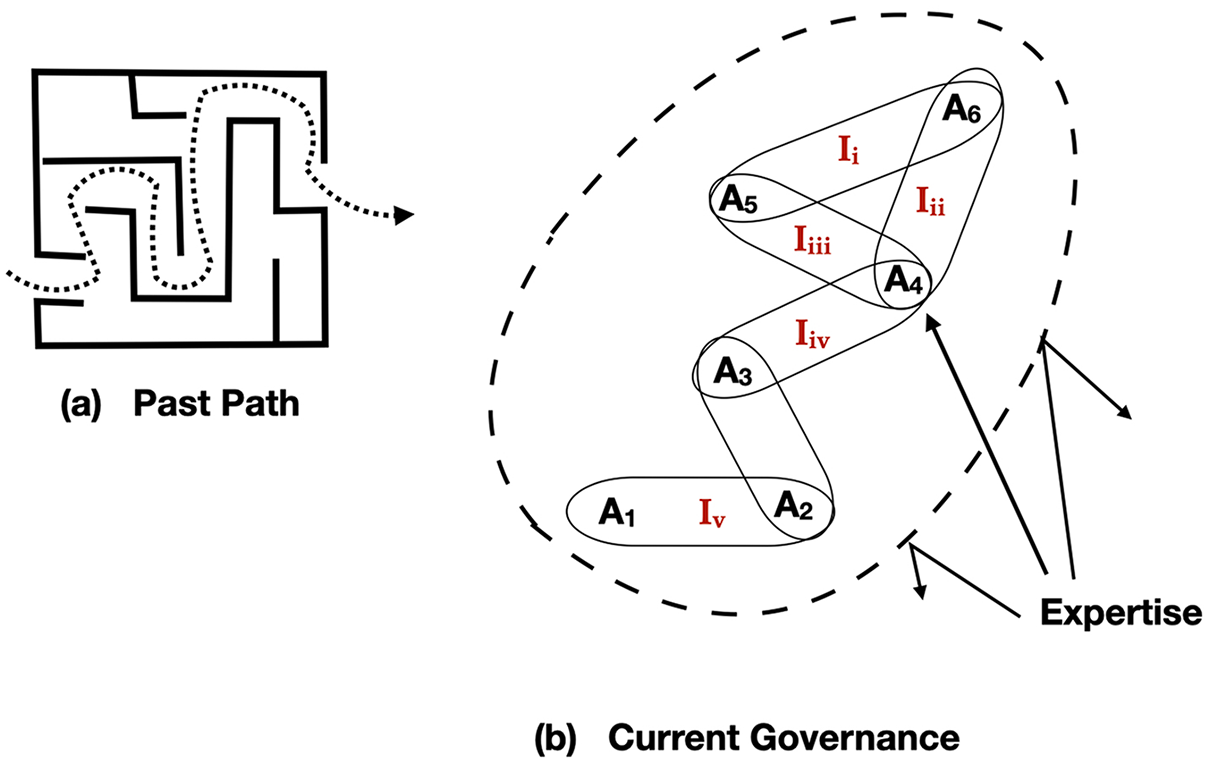
Actors (A) and institutions (I) form configurations in governance as a result of past decisions within the system. (a) These configurations evolve through time, creating a unique path and resulting in (b) a governance structure that is selective. Allowing certain types of knowledge, expertise and experts in the configuration and keeping others out.
Within the realm of power/knowledge relations, the layering of knowledges, as well as the coupling, has implications for the learning of the system. If a generally conservative ideology prevails (conservative in the sense of keeping the configuration as is), then this will limit the depth of learning, that is, the range of possible changes after learning. Certain concepts will make learning more difficult a priori: if “single family house” is the normal definition of a residential neighborhood then all alternative forms of organizations are ignored from the start and the possible bricolage with different forms and land uses is not happening. “Mixed use” is more open to various interpretations and thus to context-sensitive application and the learning involved.
Linked discourses can create opening and closure in a similar fashion. A narrative embedding a report playing a role in policy formation might trigger more research, or it can stop thinking and transformation of the system. If narratives that offer unambiguous solutions to policy problems link up, the incentive to look for alternative answers (i.e., to keep learning) will decrease. As mentioned before, it is not just the kind of coupling within the discursive domain that creates patterns of opening and closure for learning. Power relations, rigid versus flexible procedures, a different balance between participation and representation, shifting organizational structures, and so on, can all affect the production and use of knowledge and the unconscious adaptation in the system.
Coming back to our above-mentioned distinction between knowing and organizing, with co-evolution in governance systems producing an always unique set of forms and relations between them, we can say now that each governance path creates a unique distribution of knowledges. By this we mean a unique sensitivity to become open or closed to specific information, understandings, and skills, as well as a unique set of organizational tools to deploy that knowledge and create new knowledge. The relations between the knowledges and the organizational tools to use them and learn more, are unique as well. If we accept the learning of the system as a form of learning and accept as well that this learning cannot be fully codified or transparent since it is the adaptive result of the interactions between all the parts, this too therefore must hinge on both cognitive and organizational features of the system. It is most likely that through these interactions nobody involved is fully aware they are contributing to an example of system learning.
Each system of governance therefore develops selectivity at different levels, through unique patterns of co-evolution. This will be visible in the balance between the different versions of learning distinguished above. Not every form of learning is possible, acceptable, and incentivized in each system. Yet, each system will have different opportunities to game it, and to pursue private goals by steering or simply knowing the learning modes in the system. Building on these insights, one can explore how the different types of learning are influenced by the characteristics of governance.
Learning from the past depends on the version of the past which is present in the system. This is not only the official history of the system codified in notes, files, and possibly books (e.g., “History of Stockholm Planning”), but also the memories of the actors. Furthermore, it depends on the traces of history as they are visible and recognizable in the system: is it clear that this policy came out of this moment, with its own pressures and paranoia? Cultivating reflexivity in the system, making it think about itself, why things work the way they work, can bring light to more aspects of such historical contextualization (Van Assche et al., 2012). It can elucidate to a greater degree how history and the pattern of co-evolutions there has shaped governance now. Learning from history then becomes more than regurgitating the official version of the past and drawing lessons for the present, in a present which is not reflected upon. Rather, it can reconstruct both past and present simultaneously: a new understanding of the past, its traces in the present, and hence the present. Such insight can then increase the distance from assumptions, procedures, and rigid identities, and enhance learning and adaptation.
Reflexivity has its limits and no system can be entirely transparent to itself (Voß & Freeman, 2016). The burden of dealing with its own internal complexity becomes too high (Luhmann, 1995), and the system therefore cannot reflect on everything, nor on the myriad determinations by the past. Hence, the call for productive fictions and of functional stupidity or, in other words, of ways to render the system less critical (Alvesson & Spicer, 2016). Therefore, a loose coupling of episodes with deeper reflection, possibly chaired by outsiders able of second-order observation, can be helpful. Still, to give such episodes (brainstorms, retreats, visioning sessions, etc.) an impact, just like other attempts to learn from the past (e.g., in regular meetings, policy preparations sessions, or pre-studies), they will have to work their way through the pattern of coupled and co-evolving elements of the configuration. Actors have to understand the past, the present, what was wrong in past or present, which lesson could be drawn (cognitive tools needed), and they have to see how the lesson could be translated into policy or otherwise how they could coordinate action (organizational tools). Possibly, one department draws a lesson from the past yet a neighboring department, which needs to sign off, does not see that past nor the lesson.
Learning from other places similarly relies on images or understandings of those places, and, similar to the previous form of learning, on an understanding of our own place, our own vantage point. As is with learning from the past, both the perspective of the observer (the place, the observing system) and the understanding of the observed (the other community, or the other governance system) can be reconstructed in the process. The cognitive and organizational tools to observe, to draw lessons, and to implement those lessons, are here too shaped by the pattern of co-evolution, translating into a pattern of opening and closure for new ideas, into a pattern of flexibility and rigidity in transformation. Certain other places will be observed in an a priori negative way, for example, because of a conflict of ideology (“Euro-trash!”) or they can be entirely invisible because of other assumptions (“They have sewers in France?”). They can be off the radar in one department, while a neighboring, narrowly defined department is more open to examples from other places (a “planting” department could be aware of every English garden, while the “landscape” department, just sees bulldozers).
The incentives and freedoms to learn from other places are also determined by the evolution of the system. Hood and Peters (2004), speaking of the rise of New Public Management, wryly remarked that, despite NPM rhetoric of benchmarking and copying best practices, for most managers, there was no real incentive to look at other places; even if a subcontracted report discussing other places reached their desk, they might not have reason or discretion to implement change inspired by those places. If tasks are narrowly defined, because of an evolution toward specialized departments and roles, or if parallel systems of reward and parallel definitions of performance exist (resulting from a particular co-evolution between formal and informal institutions), this will form the (lack of) interest in “efficiency” and its improvement by emulating other places. Very simply, loyalty might come first, or not thinking, or sticking to an ideology. In other cases, a hierarchy of topics, of departments, of methods, might prevent the other place to appear in sight, in the perspective where it looks like something could be learned.
Learning from experts again relies on patterns of differentiation, which stem from histories of co-evolution. Here, too, the cognitive and organizational tools that become available to actors and to the system as a whole are limited yet diverse (Boswell, 2009). As we know from the Soviet experience, more experts does not necessarily mean more flexible governance systems. How and how much a system learns from experts depends on how many experts are involved, what kind of experts, how rigid and collaborative these are, and where they are located. If an expert group dominates a certain policy domain, and is completely sure they have absolutely certain problem definitions and solutions (old style engineers, classical economists), then this group will hinder learning from other experts and render the governance system less open.
Learning from experts thus follows a pattern of differentiation emerging out of histories, which established patterns of hierarchy, competition, and collaboration between expert groups. Power/knowledge configurations might have to be reshuffled in order to enable learning from a different kind of expertise. Moreover, the couplings between the governmental experts and other experts in the governance system will affect the possibilities for learning. Sub-contracting research, or hiring consultants, is a double- edged sword in this regard. The often-maligned consultants might indeed be selling pre-packaged solutions used elsewhere (making for a shallow learning from other places), while municipal experts see more but have to remain quiet. One can also imagine a situation where the cynical municipal expert starts her own consultancy, is hired, and allowed to say the things she noticed years before. We can add that opening up governance for more participation does not necessarily reduce the role of experts: sitting experts can bully the locals, block local knowledge, they can manipulate participation, but they can just as well find a listening ear with newly participating actors. Rethinking participation can sometimes increase both local and expert knowledge.
Learning through experimentation places great strains on the pattern of couplings in governance. The experiment has to be, by definition, loosely coupled from the rest of the system if it wants to be a real experiment. However, if the experiment attempts at achieving something very different or begins with assumptions that are very different from those that the previously involved actors attempted or initially had, great tensions will likely build up (this might not fare well for the experiment). It is also possible that long-time experts already placed in an influential position come up with experiments to sell ideas that had no previous impact; or, alternatively, really try something new and convince citizens, politicians, other departments, or experts of the value of the approach or their own value. Of importance is to consider to what degree the experiment is experimental, that is, to what degree is it framed by cognitive and organizational assumptions, which will reflect the pattern of differentiation in the governance system. If it is barely framed by those assumptions, it is also barely embedded in the system. This can make for more innovative experiments and unexpected results, yet also for more problems later.
An experiment in governance is about more than learning about a state of affairs; it is about alternative ways of organizing things and about collectively binding decisions. A loosely coupled experiment will most certainly trigger resistance; therefore, how significant this resistance is will have to be evaluated in each case. Is the possibility of failure acceptable for those involved if other lessons are learned? Is it acceptable to knowingly spark a conflict within administration, between administration and politicians, and between the governance system and others not (yet) part of the system? The famous Tromsø experiment, where planning and development routines were suspended for a year and where a collective, artistic, and participatory rethinking of city identity inspired alternative visions and procedures, caused serious conflict and failed to find its results implemented (due to loose couplings). Yet, routines and patterns of participation did transform afterwards. A positive effect of the experiment can also be a reshuffling of relations between actors, between actors and institutions, and between forms of knowledge, while the conditions for such reshuffling are defined by their co-evolution—for example, a faction in council might have too tight a grip on a dominant department for another department to invoke citizens in an experiment and redefine its position.
Learning through discussion and deliberation (dialectical learning) is the form where we have the strongest normative bias, as we believe that the quality of governance crucially depends on this form of learning (Van Assche et al., 2020). If this does not happen, or if other forms of learning do not coalesce and find a place in dialectic learning, then the quality of decisions will be lower and the adaptive capacity of the system will be sub-optimal (Figure 2). Excellent experts might provide excellent advice to an excellent city manager, who manages to balance different expert groups in her recommendations to council. However, if a backroom deal with outside actors prevents a real discussion there, the other forms of learning will likely have no effect.
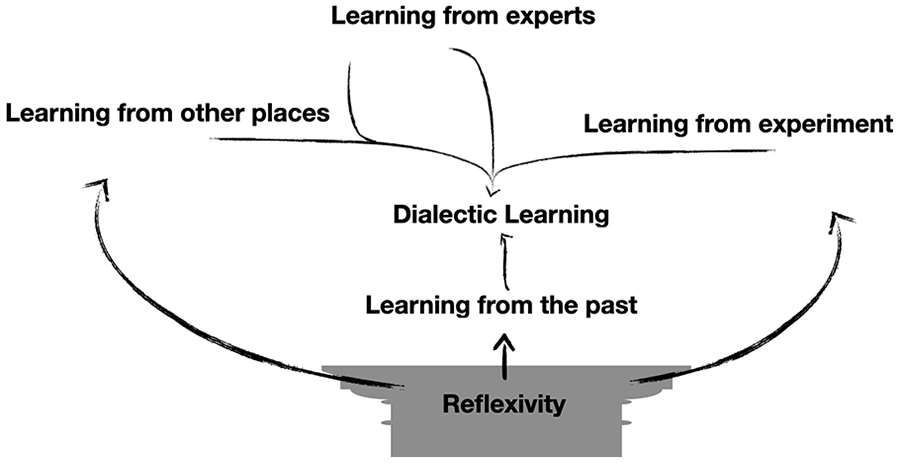
Ideally any type of learning should be incited by reflexivity in governance. The quality of governance crucially depends on dialectic learning. If other forms of learning do not coalesce and find a place in dialectic learning, then the quality of decisions will be lower and the adaptive capacity of the system will be sub-optimal.
The pattern of co-evolution again transpires here. If a council is routinely dominated by one faction, and that faction routinely considers certain administrative departments and certain civil society organizations as a nuisance, then the strategies of those departments, if they want to inspire system learning, will have to be informal. We can add that neither a direct control of administration by politics, nor a more autonomous administration, is a recipe for optimal learning as, again, it will depend on context whether an autonomous administration undermines or reinforces democracy, reduces, or enhances learning. Following the same reasoning, we can say that a perfect balance between participation and representation does not exist. Forms of participation become possible in a particular co-evolution and have effects in that particular pattern. If citizens tire of particular expert or political perspectives dominating policy, and they cannot be heard otherwise, new forms of participation might arise. If, on the other hand, a long-standing consensus exists on a particular topic (e.g., nature conservation), then a delegation to experts in administration (via the route of representation) might remain unquestioned for a long time.
Some forms of organization, some concepts and ideologies, and some types of linkage between the elements in governance system can likely be considered more general breaks on learning. If an idea prevails that everything is perfect already, that governance is scientifically organized in an objectively superior society, then learning is difficult beyond the confines of a narrowly defined science. If a neo-liberal ideology pervades politics, then the tools offered by governmental actors in governance will likely be underused. Conversely, if private companies acquire a parasitic attitude toward public resources, then the possibilities for innovation coming with their autonomy and incentive structure will not be used for public benefit. Yet, non-learning can also be broken and here again we have to follow the route of differentiation. If people are dissatisfied with their neighborhood, with the idea of neighborhood embedded in the governance system, the road to unblock and unlock learning will differ depending on the co-evolved set of relations in the system. It might be, for example, that a new actor at the neighborhood level might trigger learning; in other cases, it might be discussions at council level triggered by young planners that allow developers more room for experimentation.
Conclusion
The evolution of knowledges is one of the key drivers of evolution in governance, making learning a key selective mechanism. Learning has different forms and occurs in different places. Individual and collective actors, such as organizations, can learn. In a more radical interpretation of co-evolution in governance, inspired by social systems theory, learning is always shaped by self-reference, as both organizations participating in governance and the governance system as a whole are autopoietic in nature (Luhmann, 1995). If systems are autopoietic, that is, reproduce themselves based on their own structures, elements, and procedures, then any reference to and knowledge of the environment is rooted in self-reference. What can be learned deliberately, how it can be learned, and how unconscious adaptation (as learning) takes place, depends on the autopoiesis of the system. In any case, the system is the result of co-evolution with its environment and that environment is mostly other systems, within governance. A co-evolutionary perspective thus brings attention to the non-linear nature in which subsystems each create their own image and understanding and can only be indirectly influenced by changes in their environment (Seidl, 2016). Learning in such a perspective is part of ongoing processes of mutual adaptation, in which systems or subsystems co-evolve.
Learning influences the evolution of actors and their relations, changes in organizational and institutional structures, and the ways in which governance systems ultimately impact communities and their material environment. A co-evolutionary perspective is useful because it helps to understand how existing governance structures, and different elements and their interrelations, influence the processes of learning and adaptation (Beunen et al., 2015). It presents a perspective that draws attention to the way in which evolutionary paths are shaped and to the role learning plays in those evolutionary paths. Through co-evolutionary perspectives, it is possible to examine to what extent learning can be facilitated and managed while at the same time leaving a place for coincidence, chance, and unexpected developments. Allowing space for contingency contributes to path creation and to adaptation as learning.
Insights in learning processes within the context of governance systems that are understood in co-evolutionary terms, can shed a new light on the possibilities and limitations of managing that co-evolution; of managing the transformation of governance systems toward more adaptive yet stable states. In order to enhance learning, it is important to create circumstances that stimulate reflexive and dialectical learning. This brings attention to the interrelation between different perspectives, openness for different views, different forms of learning, ways in which new insights are incorporated, and conversely translated to different forms of organizing and different institutions.
Footnotes
Author Note
Monica Gruezmacher is now affiliated to Memorial University-Grenfell Campus, Canada.
Declaration of Conflicting Interests
The author(s) declared no potential conflicts of interest with respect to the research, authorship, and/or publication of this article.
Funding
The author(s) received no financial support for the research, authorship, and/or publication of this article.
