




Abstract
Collective learning across project teams and organisational levels enables project-oriented organisations in infrastructure planning to adapt to changing contexts. This paper aims to deliver insight in the conditions and arrangements for collective learning in such organisations and the role that programmes and communities of practice (CoPs) as different types of hubs can play in interaction for adaptation. As part of a case study of a project-oriented public infrastructure administrator, we conducted a cross-study analysis, interviews with board members and directors, and focus groups with professionals from the studied organisation and other infrastructure administrators. Although programmes and CoPs as hubs appear to facilitate interaction with a wider context differently, interaction through these hubs can lead to the broadening of views and a shared understanding about organisational adaptations and the accompanying decisions and actions in the fragmented landscape of project-oriented organisations.
Introduction
Infrastructure networks, such as road, railroad, water, electricity, and communication networks, are becoming more and more interconnected. For instance, information technology is used to control technical installations in tunnels and to operate sluices in water ways. Besides the increasing interconnectedness of various physical infrastructure networks, actors in the organisational landscape in infrastructure planning are also increasingly interconnected as local authorities, non-governmental organisations (NGOs), citizens, and other stakeholders play a more dominant role (see e.g.,, Verweij et al., 2020). This technical and organisational interconnectedness in infrastructure planning renders the management of infrastructure networks complex. Moreover, the management of transport infrastructure networks in many countries, such as the Netherlands, Germany, and the USA, currently faces major challenges due to, for example, climate change, the introduction of new mobility technologies, the energy transition, a growing societal call for sustainable solutions, and ageing infrastructure facilities (Arts et al., 2021; Brown et al., 2017; Hijdra, 2017; Spijkerboer, 2022).
To remain able to manage infrastructure networks in such complex environments, public infrastructure administrators have to adapt to the changes and challenges that confront them and, thus, be adaptive. In literature, collective learning is considered key when it comes to enhancing adaptivity, because it enables organisations to evolve by improving processes that are perceived as successful, and by abandoning or reorganising processes that are regarded as less successful (Armitage et al., 2011; Bullock et al., 2022; Dobson et al., 2013; Levinthal, 2016). Collective learning is defined as “the ability of the collective to learn from experiences drawn by members of the collective while working” (Backström, 2004, p. 471). The ability to build new knowledge, new relationships, and new practices in response to changing contexts links collective learning to adaptation (Ensor & Harvey, 2015; Garavan & Carbery, 2012). While this may be difficult enough for an individual organisation, the interconnectedness of infrastructure networks also requires organisations to address challenges collectively.
In the end, public infrastructure administrators are supposed to serve the needs of society. However, issues in daily practice can easily distract professionals and organisations from their true “raison d’être.” In order to efficiently plan, build, change, and improve infrastructure facilities, public infrastructure administrators often use a project management approach (Gareis, 1991), thereby organising themselves as project-oriented organisations (Leendertse & Arts, 2020). Recently, De Groot et al. (2020) argued that project-oriented organisations experience difficulties with learning due to the predominantly problem- and result-oriented focus of project teams (intra-project). This focus can be explained by the essence of projects as they are temporary organisations that have to deliver predefined results within set conditions of budget, time, and quality. However, an intra-project focus hinders learning from one project to another (inter-project), and between projects and their parent organisation (meta-project). For collective learning and enhancing adaptivity, interaction throughout a project-oriented organisation is necessary. Although such interaction can also be facilitated through staff departments and expertise centres, our study focuses on programmes and communities of practice (CoPs), because these organisational hubs are specifically identified as potential vehicles to support learning across project teams and their parent organisation (De Groot et al., 2020).
The aim of this paper is to deliver insight in the conditions and arrangements for collective learning in project-oriented organisations in infrastructure planning and the role that programmes and CoPs as different types of hubs can play in organisational adaptation so that public infrastructure administrators remain able to serve society’s needs despite changes and challenges in the environment. To this end, we conducted an in-depth case study of a project-oriented public infrastructure administrator in the Netherlands. This paper continues with a theoretical framework that builds from adaption via collective learning to programmes and CoPs as hubs in the social network of project-oriented organisations. Thereafter, this paper presents, analyses, and discusses the results from the case study.
Theoretical Framework
Adaptation and Learning
As mentioned above, adaptation of the organisation is important for the management of infrastructure networks (Brown et al., 2017). It is perceived in literature and practice as an answer to the aforementioned increasing uncertainty and dynamics (Pahl-Wostl, 2009; Skrimizea et al., 2019). Based on an extensive literature review, Sarta et al. (2021, p. 44) define organisational adaptation as “intentional decision making undertaken by organisational members, leading to observable actions that aim to reduce the distance between an organisation and its economic and institutional environments.” Organisations can enable adaptation by enhancing their capability to adapt, i.e., their adaptivity. Adaptivity can be defined as “the ability of a resource governance system to first alter processes and if required convert structural elements as response to experienced or expected changes in the societal or natural environment” (Pahl-Wostl, 2009, p. 355). Adaptivity, thus, comprises both responding to occurred changes and anticipating potential changes.
There is a general consensus in literature that adaptivity and learning are linked (Van Epp & Garside, 2019; Yuen, et al., 2013). In fact, literature often considers learning an important element of adaptivity (Bullock et al., 2022; Ensor & Harvey, 2015; Gupta et al., 2010; Phuong et al., 2017). This is based on the argument that learning can be seen as a process of adaptation consisting of changes in common understanding, mutual agreement, and collective action (Phuong et al., 2017). According to Cyert and March (1963), organisations learn from experience with the intention to adapt to the characteristics of the environment. The cognitive process of learning enables organisations and agents to adapt their behaviour (Levinthal, 2016). However, just as knowledge development not necessarily leads to changes in behaviour, changes in behaviour can occur without cognitive associations (Fiol & Lyles, 1985). This points to a distinction between intuiting, which is a preconscious process of recognising patterns and possibilities, and interpreting, which is a conscious process of explaining of insights or ideas that goes from preverbal to verbal (Crossan et al., 1999). Intuiting may be more likely to involve the use and production of predominantly tacit knowledge, whereas interpreting involves explicit knowledge which can be (verbally) articulated.
Learning is generally described as the process in which information is combined with experience, context, interpretation, and reflection, and which results in knowledge (Argote, 2013; Gubbins & MacCurtain, 2008). Modifying behaviour to reflect the enhanced knowledge and understanding of an organisation is what characterises organisational learning (Fiol & Lyles, 1985; Garavan & McCarthy, 2008). According to Argyris and Schön (1978), organisational learning requires individual learning, but individual learning is insufficient in itself for organisational learning. Although organisational learning may start at the level of the individual, individual knowledge will not be institutionalised in an organisation independently (Crossan et al., 1999). Moving from individual to organisational learning requires collective interpretation and developing a shared understanding (Argyris & Schön, 1978; Crossan et al., 1999; Daft & Weick, 1984). Correspondingly, the ‘4I framework of organisational learning’ of Crossan et al. (1999) links learning at an individual and organisational level through group level. This renders the group level, that comprises all kinds of collectives, crucial for organisational learning (Barker & Neailey, 1999; Senge, 1990). However, research on the link between learning at group and organisational level is still scarce (see e.g., Rebelo et al., 2020).
Collective Learning
Collective learning is the process in which members of a collective share and interpret information and integrate views into a shared understanding (Crossan et al., 1999; Doloriert et al., 2017; Garavan & Carbery, 2012; Gubbins & MacCurtain, 2008). Input for this process consists of prior knowledge, including habits and routines, and new information. The process of learning leads to altered knowledge as outcome, and potentially to altered behaviour. Collective learning occurs in interaction between the collective and its context (Backström, 2004; Garavan & McCarthy, 2008). As collective learning builds on sharing and integrating individual interpretations, this process is likely to involve explicit knowledge that can be more readily exchanged between members of the collective. We visualised this process of collective learning and its relationship with individual and organisational learning in Figure 1. Collective learning in relationship with individual and organisational learning.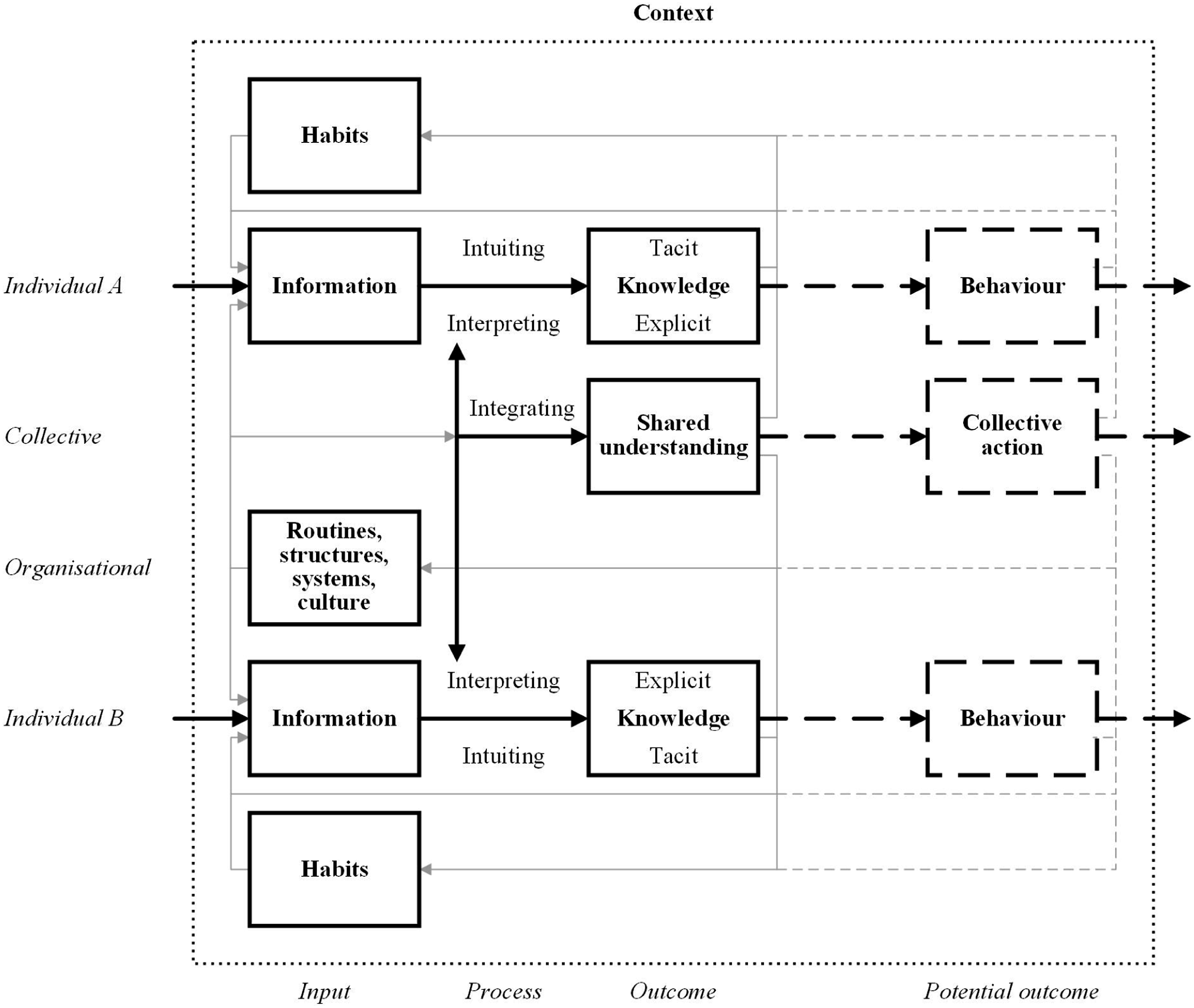
How the process of collective learning actually occurs in practice, depends on conditions in the organisation. Gerlak and Heikkila (2011) developed a framework of collective learning in which they identified three categories of characteristics or conditions that shape collective learning: (1) structure, (2) social dynamics, and (3) technology and functional domain. Later, De Groot et al. (2020) adapted this framework of collective learning by integrating conditions that they identified in their systematic literature review about the interplay between collective learning and adaptivity. As such, this adapted framework by De Groot et al. (2020) is considered particularly relevant for our study. The adapted framework consists of the three aforementioned categories that each comprise multiple conditions: • Structure comprises: institutional design, multi-level integration, and the informal social network; • Social dynamics comprises: trust and an open atmosphere, leadership, interaction, diversity, and capabilities of individuals; • Technology and functional domain comprises: information management, rules for dialogue, learning platforms, and scope for change.
Programmes and Communities of Practice as Hubs in the Social Network of a Project-Oriented Organisation
Collective learning takes place by and in interaction between actors in a social network (Zappa & Robins, 2016). A social network consists of actors, such as (groups of) individuals, departments, projects, and relationships through which material or nonmaterial resources can flow (Pryke, 2012; Robins, 2015; Wasserman & Faust, 1994). For example, information can be shared through these relationships and interpreted by the actors depending on the task or context at hand. Relationships can vary in strength. Weak relationships enable access to new information, because they often connect to diverse actors with different perspectives (Borgatti & Cross, 2003; Granovetter, 1973; Hansen, 1999). Additionally, literature suggests that relatively weak relationships foster adaptivity because they facilitate modularity (see e.g., Orton & Weick, 1990). Strong relationships are necessary for the actual transfer of information (Hansen, 1999).
Some actors have relationships with few other actors, while others are highly connected with a diverse range of other actors and can act as hubs. A hub is an actor with a central position in a social network that has “access to a greater quantity, a greater diversity of information, and is in a position to aggregate and compare information from many sources simultaneously” (Schilling & Fang, 2014, p. 977). Actors can become hubs through their formal position in the organisation. Actors can also become hubs because of their characteristics and the value attributed to them by other actors. Hence, hubs can have a formal or more informal nature, or be more or less institutionalised (Schilling & Fang, 2014). In the study of De Groot et al. (2020), programmes and CoPs emerged as hubs in the social network of a project-oriented organisation.
A programme is a framework for grouping projects to achieve benefits that would not be realised if they were managed independently (Busscher et al., 2019; Pellegrinelli, 1997). Programmes focus on meeting strategic organisational objectives, and managing projects and activities in a coordinated way (Pellegrinelli, 1997). Organisations deliberately decide to start or end programmes. As such, programmes can be considered hubs with a formal character. According to the study by De Groot et al. (2022a), programmes appear to build stronger relationships with either the embedded projects or the parent organisation depending on their focus. The effectivity focus of goal-oriented programmes and efficiency focus of portfolio or multi-project programmes appear to result in stronger relationships between projects and the programme, thereby enhancing inter-project learning. The incremental change and process improvement focus of heartbeat programmes appears to result in stronger relationships between the programme and the parent organisation, thereby enhancing meta-project learning.
A CoP is a “group of people who share a concern or a passion for something they do and learn how to do it better as they interact regularly” (Wenger-Trayner & Wenger-Trayner, 2015, p. 1). CoPs comprise groups of individuals that work in different contexts and thereby provide access to a large knowledge base. CoPs emerge based on a need that multiple professionals share and dissolve when that need ceases to exist. Different strands of literature describe other spaces in and across organisations that share characteristics with CoPs, such as spaces for innovation (Touati et al., 2019), adaptive space (Uhl-Bien & Arena, 2017), ba (Nonaka & Toyama, 2002), hallways (Dixon, 1997), soft spaces (Allmendinger et al., 2015), and organisational fields (Scott, 1995). This paper focuses on CoPs, which is a well-known concept in project-management and organisational-learning literature, because of its relevance for learning in project-oriented organisations as identified by De Groot et al. (2020). Although CoPs can be organised in a more formal or informal manner, CoPs are in essence hubs with an informal character. CoPs can exist within a single organisation (see De Groot et al., forthcoming) or between multiple organisations (see De Groot et al., 2022b). For inter-organisational CoPs, the focus of the CoPs and the motivation of participating organisations seems to determine which relationships are stronger or weaker (see De Groot et al., 2022b). CoPs that concern sector-wide issues generally develop evenly strong relationships with various organisational entities, whereas CoPs that concern a specific field of expertise within the sector develop strong relationships with specific organisational entities. Furthermore, intra-organisational CoPs seem to develop relationships based on the job position of participants (De Groot et al., forthcoming). CoPs that consist of advisors are more concerned with developing a field of expertise and maintained strong relationships with projects and departments, whereas CoPs for management professionals with a full-time position in projects or programmes were more concerned with how they fulfil their role in projects and programmes and consequently maintain strong relationships with projects and programmes.
The different characteristics of programmes and CoPs as hubs enable different possibilities for collective learning in project-oriented organisations.
Methods
Elaboration of the Main Research Question in Sub-questions.
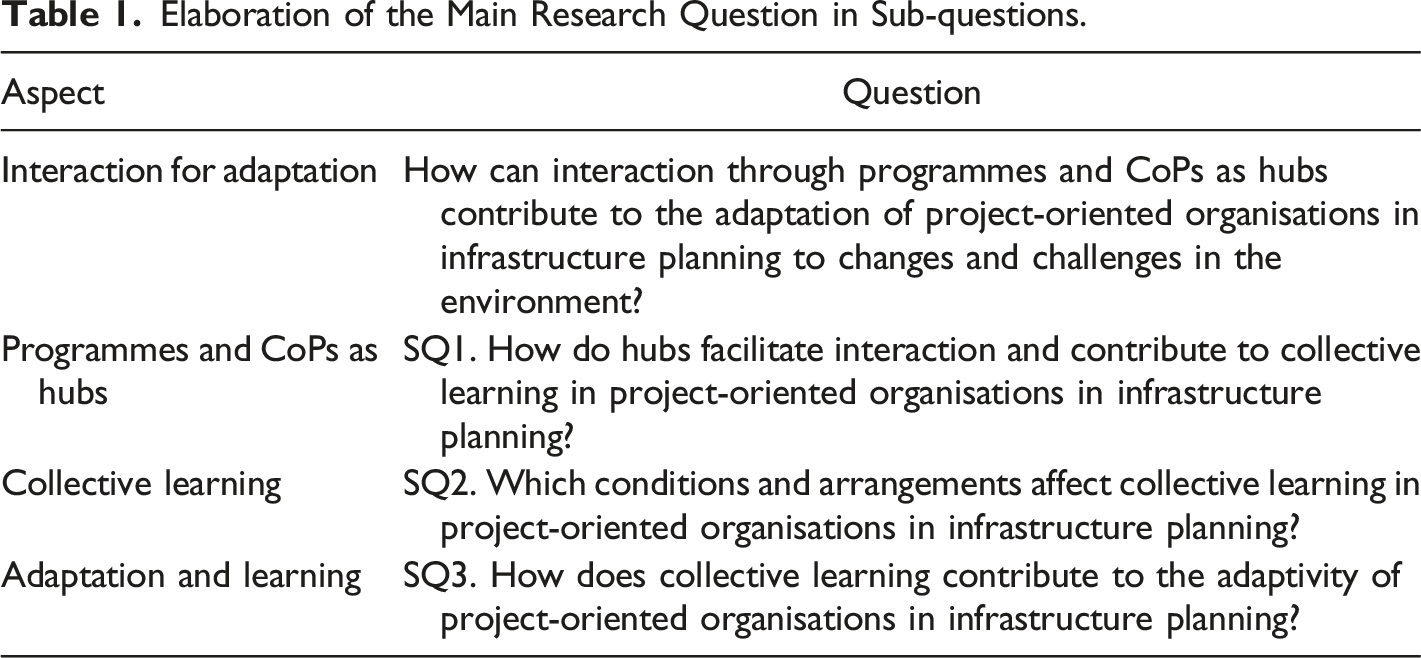
To answer these questions, we conducted an in-depth case study of a typical project-oriented public infrastructure administrator: Rijkswaterstaat – the executive agency of the Ministry of Infrastructure and Water Management in the Netherlands. Rijkswaterstaat has a rich and dynamic history of providing infrastructure facilities for society, uses projects to realise and replace infrastructure facilities, and deliberately considers the use and development of knowledge to cope with present and future challenges (Rijkswaterstaat, 2021).
Overview of the Recent Studies That Were Analyzed.
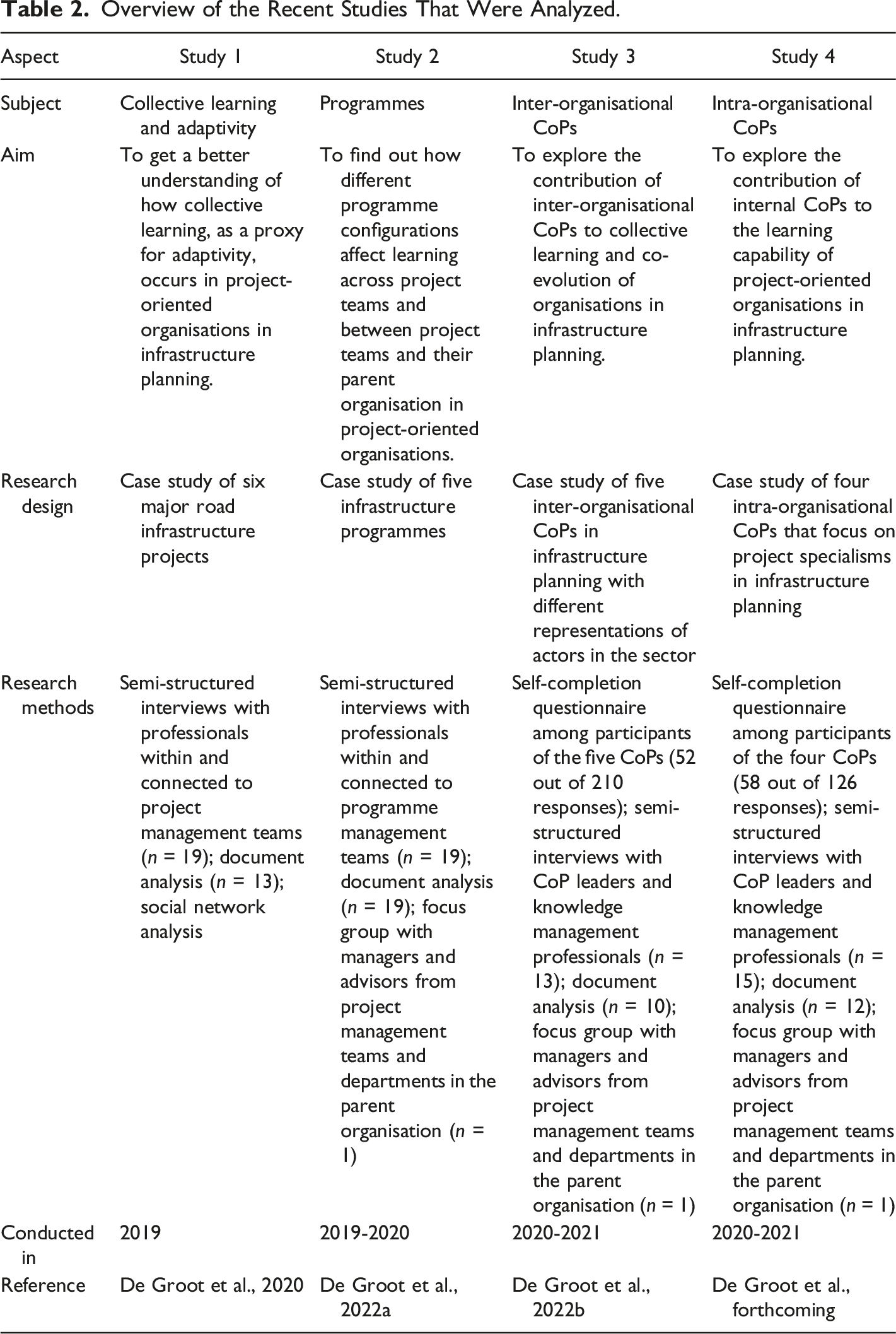
Because the cross-study analysis provided limited data about the senior-management perspective, we additionally interviewed three board members and two directors from Rijkswaterstaat (see Appendix I). These interviewees not only represented the highest and second-highest hierarchical levels in the organisation, but also represented different divisions with key responsibilities: (1) the division ‘Western Netherlands North’ that is responsible for the operation of infrastructure networks in its densely-populated region (including the capital city Amsterdam) and acts as an internal client for projects and programmes, (2) the division ‘Major Projects and Maintenance’ that is responsible for the execution of assigned infrastructure projects and programmes, and (3) the division ‘Water, Transport and Environment’ that is responsible for developing strategies to execute governmental policies and focuses on present and future developments in infrastructure planning.
Furthermore, we organised a focus group (FG1) with six Rijkswaterstaat professionals that represented different divisions and hierarchical levels in the organisation: a project director of a major infrastructure project, a head of department for project control, a director of business operations and project control, an alliance manager, a knowledge management advisor, and a team learning and development advisor. We chose for a relatively small and diverse group to ensure space for each participant to have their say and to enable a rich and in-depth discussion. The participants were selected because of their job position so that the focus group as a whole incorporated experience and expertise about projects and the parent organisation, management and advisory roles, knowledge management and learning in organisations, and knowledge transfer within and between organisations. Focus group participants commented on the identified conditions and arrangements, and discussed several questions about individual, collective, and organisational learning in relationship with adaptation in the context of Rijkswaterstaat.
To verify whether the findings were specific for Rijkswaterstaat or more generally applicable to infrastructure administrators, we organised a focus group (FG2) with professionals from other infrastructure administrators and a professor with expertise in the subject of this study: a programme manager from railway agency ProRail, a programme manager from drinking water company Vitens, a director from high-voltage grid manager TenneT, a director from electricity and gas grid manager Stedin, and a professor in infrastructure planning from Delft University of Technology. This focus group discussed the same subjects and questions as FG1.
The interviews were audio recorded, transcribed, and, subsequently, analysed using ATLAS.ti 9.0 (see codes in Appendix II). The focus groups were audio recorded and captured in a written report. The results from our analysis of the four prior studies and the additional interviews and focus groups are presented in the next section.
Results
This section follows the structure of the theoretical framework in reversed order. The first subsection presents results about programmes and CoPs as hubs in the social network of a project-oriented organisation and delivers data for the answering of SQ1. The second subsection presents results about conditions and arrangements for collective learning and delivers data for the answering of SQ2. The third, and final, subsection presents results about adaptation and learning and delivers data for the answering of SQ3.
Programmes and Communities of Practice as Hubs in the Social Network of a Project-Oriented Organisation
Overview of Findings Based on Prior Studies by De Groot et al. Concerning the Role of Programs and CoPs as Hubs in the Social Network of a Project-Oriented Organization.
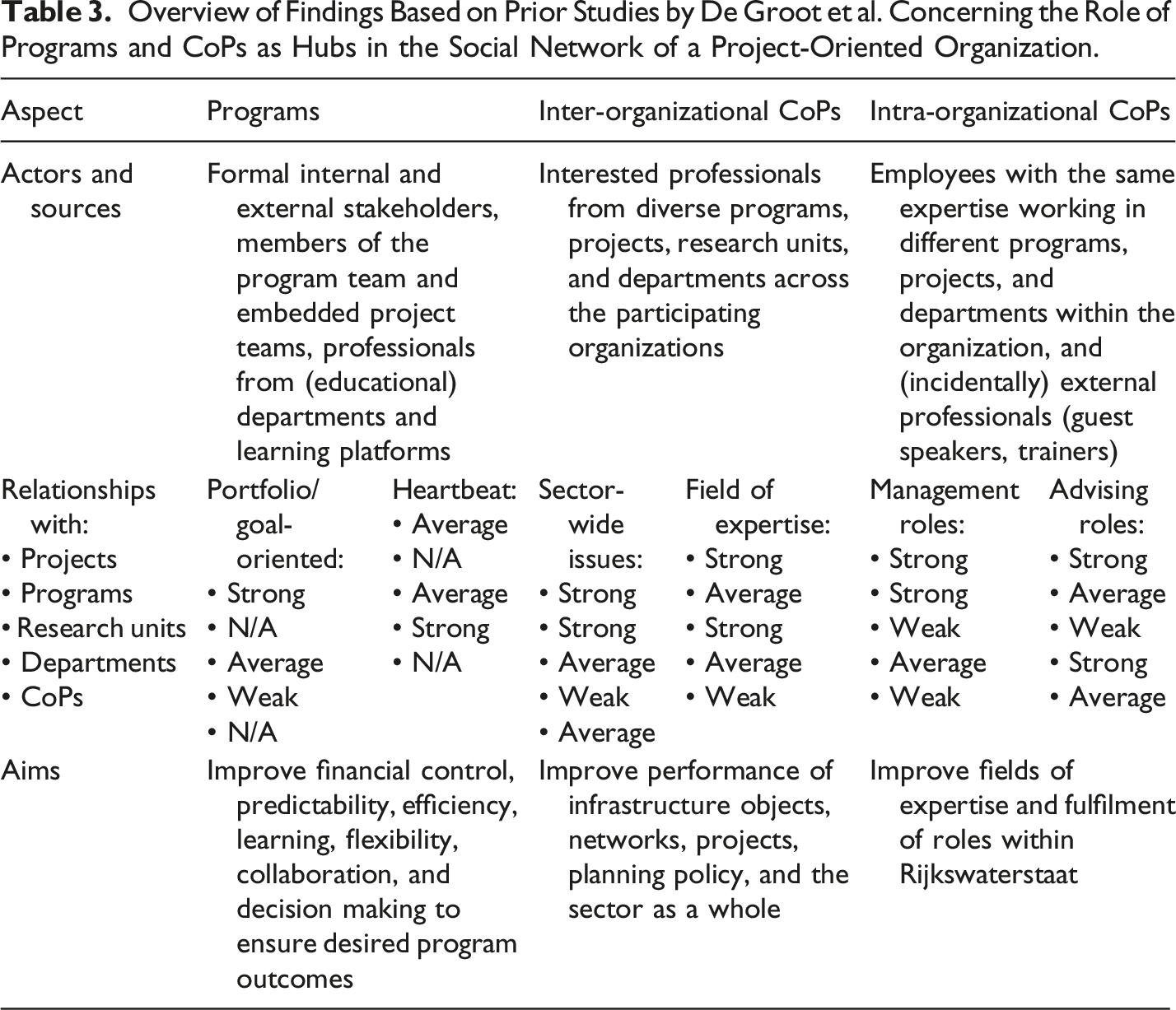
Some programmes were the sole responsibility of Rijkswaterstaat, whereas other programmes were collaborations between Rijkswaterstaat and other organisations, such as water boards, provinces, and municipalities (see De Groot et al., 2022a). Similarly, the intra-organisational CoPs existed within Rijkswaterstaat and connected entities within this project-oriented organisation (De Groot et al., forthcoming), whereas the inter-organisational CoPs enabled connections between multiple organisations (De Groot et al., 2022b). The two studies on different types of CoPs (De Groot et al., 2022b; De Groot et al., forthcoming) both analysed the strength of relationships between organisational entities, but these entities existed either across different organisations (De Groot et al., 2022b) or within a single organisation (De Groot et al., forthcoming).
The cross-study analysis shows that both programmes and CoPs appear to be in the position to aggregate and compare information from multiple projects and from other sources, such as departments, other organisations, and knowledge institutes. CoPs can additionally aggregate and compare information from multiple programmes, research units, and other CoPs. Depending on their focus, programmes can additionally process information from research units, education programmes, or learning platforms. Within a programme, programme management offices appear to fulfil the hub function as they collect information from the embedded projects and activities to prepare decision making by the programme board and to create progress reports that the programme board uses for justification towards the parent organisation(s). Programme management offices also appear to act as (group-level) knowledge centres and arrange structures, meetings, and activities for learning across projects (see De Groot et al., 2022a). The cross-study analysis reveals that both programmes and CoPs organise a variety of meetings to collectively interpret information from projects and other entities in the organisation and its environment. The prior studies show that direct interaction between individuals in small discussion groups, during activities, or in work groups is the preferred and predominant way to share information and develop a shared understanding. Sharing documents and attending presentations often occurs in conjunction with conversations to clarify or collectively interpret the transferred information. The cross-study analysis also showed an important difference, namely that interaction in programmes is aimed at developing a shared understanding of the context of the programme, developing a culture that enables coherence between actors and activities within the programme, and efficiently executing projects within a programme to reach a goal, whereas intra-organisational CoPs focus on a more uniform and enhanced performance of professionals and areas of expertise across projects and programmes within a project-oriented organisation. The aims as shown in Table 3 indicate that internal programmes and CoPs are generally focused on organisational performance from an internal perspective whereas inter-organisational CoPs focus on the organisation in relation to its environment.
Moreover, Interviewees 1, 3, and 4 argued that the subject of programmes can differ in the sense that organisations can deploy programmes to develop physical infrastructure, but programmes can also concern a development in the organisation itself, such as improving attention for sustainability or dealing with rising sea levels. The initiative for infrastructure programmes can lie with senior management from the regional divisions that act as internal clients or with project managers that identify possible benefits when they connect their projects and collectively execute them (I1). In the end, the Rijkswaterstaat board formally decides to start a programme (I2, 3, 4). However, the policy department of the ministry can also decide that major infrastructure development should be executed using a programme approach before assigning it to Rijkswaterstaat (I2). Interviewees 1 and 2 also indicated that perceived external pressure can necessitate a programme approach, such as taxpayers expecting that public organisations learn from past experiences and uniformly execute projects across the country.
Communities of practice can emerge and dissolve based on the needs of professionals within the organisation (I2). Senior management recognises the value of CoPs for professionals, and thereby for the organisation, and allows the existence of CoPs without directing the topics that CoPs address (I1, 2, 3, 4, 5). However, Interviewees 1 and 2 argued that CoPs should be linked to the “knowledge fields” that Rijkswaterstaat defined as part of the organisational knowledge management structure. Multiple interviewees in our study and the prior studies (De Groot et al., 2022b, forthcoming) argued that there is a large number of CoPs with a variety of topics and different states of activity. Although not all CoPs are considered relevant for projects, it is difficult for projects to even know which CoPs are active and could be relevant (I1).
An important aspect that may explain why programmes and CoPs emerge as hubs in the social network in project-oriented organisations is pressure. In addition to interviewees in prior studies by De Groot et al. (2020, 2022a, forthcoming), Interviewees 1 and 3 argued that the pressure on projects is relatively high, which forces projects to concentrate on their assignment and hinders learning across projects. Projects are often planned using clear milestones in a relatively short period of time. The prior studies indicate that programmes (mostly) have a longer time span and are characterised as more flexible. CoPs rarely experience pressuring deadlines due to their existence outside core production processes. The (relative) absence of pressure by short-term deadlines for delivering expected output allows professionals in programmes and CoPs to gather more information from a more diverse range of sources and to take more time to aggregate this information, for example to analyse trends across projects and to enhance forecasts.
To answer SQ1 (How do hubs facilitate interaction and contribute to collective learning in project-oriented organisations in infrastructure planning?), hubs structure interaction with more and a diverse range of organisational entities (learning process), which enables professionals in projects and programmes to develop a shared understanding about the broader context of their project or programme and to improve their individual and collective performance, the performance of a project or programme, or the organisational performance (learning products). In short, hubs such as programmes and CoPs facilitate the broadening of views through interaction with a wider context and thereby enhance collective learning in project-oriented organisations in infrastructure planning.
Collective Learning
Actors, relationships, sharing information through the relationships between actors, and the context in which the interaction occurs are prerequisites for collective learning. This paragraph identifies conditions and arrangements regarding structure, social dynamics, and technology and functional domain.
Regarding structure, the previous paragraph already mentioned the organisational knowledge management structure which also involves strategic advisors and ‘knowledge field leaders’ for each of the ‘knowledge fields’ (I2). Based on these fields, the knowledge management department develops a knowledge development strategy integrated with the overall human resources strategy (see De Groot et al., forthcoming). This strategy involves formal education, recruitment policy, and various ways of learning on the job. In contrast to this elaborate structure for organisational knowledge, various interviewees and focus group participants (FG1 and 2) argued that collective learning throughout the organisation lacked structure or facilitation in broader sense. For example, Interviewee 3 argued that “I think that we do a lot regarding education and to guide groups, but we still have a lot to do to support the organisation with learning across teams”. Additionally, participants in FG1 stressed the need for a clear direction to solve the current vagueness that resulted from the presence of too many different initiatives in different places in the organisation that facilitated learning in different ways. Interviewees and focus group participants (FG1 and 2) underlined the importance of a central point of contact that individuals and teams could consult when they were searching for knowledge or wanted to share knowledge that they considered useful for colleagues. “The desire to learn is there, but people don’t know where to find each other” (participant in FG1). In programmes, programme management offices fulfil such a connecting role, but for self-standing project teams or multiple programmes, such a role was missing. One of the participants in FG2 argued that their organisation had positive experiences with appointing such a central point of contact that could be consulted and proactively visited project teams to facilitate the connection between knowledge supply and demand throughout their organisation. Additionally, Interviewee 5 had a positive experience with an overview of where in the organisation and with whom knowledge resides. However, this interviewee also argued not to instrumentalise learning by developing tools and procedures, which Rijkswaterstaat was inclined to do according to focus group participants (FG1). Furthermore, Interviewee 3 argued that project teams struggled with articulating their questions and needs, which impeded the demand side of learning. In addition to this issue, most interviewees and focus group participants (FG1 and 2) acknowledged a dichotomy between production and learning. Consequently, production in projects was usually prioritised over learning activities throughout the organisation, because this was considered prime and urgent. Employees were struggling with having and taking time (available) for learning activities. Although the prior studies show that programmes can enhance (psychological) availability for learning, this was still considered an issue. Therefore, it was argued that learning should be explicitly incorporated in the formal scope of projects. In this light, Interviewee 4 argued that “the definition of a learning project, is a project that contributes to making other projects successful”. This argument is in line with the prior studies (e.g., De Groot et al., 2022a) that underlined the need to enable (psychological) availability by providing employees with time and means for learning activities.
Regarding social dynamics, Interviewees 1, 2, 4, and 5, and the participants in both focus groups argued that learning was treated as permissive and lacked commitment. Clear agreements about learning processes and products were lacking or deadlines in learning trajectories were simply postponed. Focus group participants (FG1 and 2) argued that there were general long-term goals, but the organisation did not make clear decisions about a learning strategy and choices to reach these goals, such as assigning capacity and postponing or cancelling other (production) activities. A participant in FG2 argued that their organisation deliberately distinguished between “running the business” and “improving the business” and used performance management to assure that the latter remained equally important as the former. This arrangement was experienced positive and considered necessary in the high-pressure environment of infrastructure projects. Although such an approach may fit the hierarchical character of the studied organisation (e.g., I4), Interviewee 1 and participants in both focus groups underlined the importance of an intrinsic motivation to continually learn in order to improve performance and efficiency. Because Rijkswaterstaat as public organisation could not go bankrupt (I1), the sense of urgency towards learning and improving was considered to differ from private companies. Interviewees and focus groups participants generally agreed that the professionals within Rijkswaterstaat, as well as in the other organisations of FG2 participants, are passionate about their work field and intrinsically motivated to perform well. However, focus group participants argued that having clear goals for organisational adaptation could enhance the understanding of the need to develop and the motivation to learn, especially across projects and other parts of the organisation. Another aspect regarding social dynamics was continuity. Multiple interviewees and especially the focus groups had a concern for staff turnover. Participants in FG1 and 2 agreed that the positive aspect of staff turnover was the increase in diversity which enabled new knowledge sources and alternative solutions. However, staff turnover was also considered to be increasing too much. The ageing population results in more retirements. Individual career paths instigate more frequent switching between job positions. Consequently, “the collective continually changes” (participant in FG2). This was considered especially problematic for projects and programmes which have a relative short time span, and experience pressure to meet deadlines. High staff turnover implies extra work to on board new colleagues but was also considered to affect the team culture and to hinder developments as a collective (FG2). Since this was considered a structural problem, organisations were looking for structural solutions, such as standardising work and bundling similar projects that could be subsequently executed by the same team.
Technology and functional domain concern the systems and ways of working for retaining knowledge in, for example, procedures and guidelines. Interviewee 1 argued that there were many procedures and guidelines in the system called “Werkwijzer RWS.” However, Interviewee 5 and participants in FG2 argued that the Werkwijzer RWS seemed to be used predominantly by the departments that managed this system rather than the professionals in the organisation. “I only look in this system when I think I need it” was the response that Interviewee 5 received after asking a group of professionals whether they used the system. This system was not used as the starting point in a search for information, as Interviewee 1 would have expected, but used a last resort. Interviewees and focus group participants argued that such information was not considered up to date or relevant for the specific characteristics of the (project or programme) context at hand. Focus group participants also argued that when searching for relevant information or knowledge takes too much time, professionals quickly turn to finding solutions by themselves, especially in the high-pressure environment of projects. Beside this process issue (technology), Interviewee 5 and participants in FG1 and 2 addressed a content issue (functional domain). They argued that project-oriented organisations should have a broad knowledge base for two reasons. First, each professional should have basic knowledge of the core business of the organisation to develop a shared knowledge base that makes it easier to understand each other across specialisms and departments (I5). A participant in FG1 gave an example of such a measure in the field of project control where all advisors and managers were obliged to attend workshops to collectively discuss and learn the basics of each specialism within project control. A participant in FG2 called this in general terms training “for dummies”. Second, a broad knowledge base was considered necessary for being a professional principal when work is being outsourced. Participants in FG1 and 2 argued that Rijkswaterstaat outsourced much work in the past without retaining knowledge or capabilities to execute that work or to thoroughly understand and discuss such work with contractors and suppliers. A participant in FG2 explained that the strategy of their organisation was to keep executing each type of work for at least 20% of the work that was being outsourced to remain a professional principal and interlocutor for contractors and suppliers. As such, a broad knowledge base supported the development of a shared understanding both within and across (project-oriented) organisations in infrastructure planning.
Despite critical notes, interviewees and participants in FG1 agreed that the attention for learning improved over the past decade. Learning was explicitly mentioned in many formal documents in the organisation. “Rijkswaterstaat is not doing a bad job at all, but learning can still be improved” (FG1).
To answer SQ2 (Which conditions and arrangements affect collective learning in project-oriented organisations in infrastructure planning?), the following conditions and accompanying arrangements that affect collective learning particularly in project-oriented organisations in infrastructure planning emerge: (1) facilitation through a central point of contact for learning, (2) availability of time and means for learning through explicitly incorporating learning in the formal scope of assignments, (3) commitment through performance management and stimulating intrinsic motivation, (4) continuity through on-boarding programmes, standardising, and assignment of a team for multiple similar subsequent projects, (5) easy access to relevant information through a user-friendly, dynamic information system, and (6) the presence of a broad knowledge base among employees through training “for dummies” and executing each type of work to a certain extent instead of completely outsourcing.
Adaptation and Learning
Participants in FG1 mentioned so-called “focus points” for the Rijkswaterstaat organisation, which are subjects that required changes in the current organisation. Sustainability was one of the focus points, but the organisation is relatively unexperienced in this field (I5). Therefore, Rijkswaterstaat appointed an extra board member specifically for this subject, according to Interviewee 5. Additionally, Rijkswaterstaat adapted its recruitment policy to attract new employees with knowledge in the field of sustainability. Although new colleagues with different knowledge may feed learning, these examples do not really involve learning. However, this does demonstrate intentional decision making to reduce the distance between the organisation and its environment. Another example of such intentional decision making is the participation in inter-organisational CoPs, as shown in the prior study by De Groot et al. (2022b). Participants in FG2 argued that other organisations also viewed participation in such CoPs as enriching. The board of Rijkswaterstaat also decided on a new strategy, called the “Kompas RWS” (“Compass RWS”) that involved a broad exploration of potential future developments in the environment of Rijkswaterstaat. The various examples of intentional decision making from an organisational adaptation perspective also point to a weakness as underlined by participants in FG1. They argued that there were so many change and development initiatives that employees lost the overview. “Rijkswaterstaat wants to be adaptive, but on which aspects? To what end? And what is expected of me? What does this mean for me?” (FG1).
A participant in FG1 argued that “doing is important in learning; however, it seems that learning, analysing, et cetera, within Rijkswaterstaat has become detached from projects.” Correspondingly, a participant in FG2 argued that Rijkswaterstaat somehow seemed to fail to incorporate learned lessons in their work as analyses of project reviews showed the same issues repeating year after year. However, an often-mentioned observable action with positive connotations, was called “Markt in transitie” (“Market in transition”) (I1, 3, 4, 5). This action was observable both within and outside Rijkswaterstaat, especially for contractors and suppliers, because it involved new ways of collaborating and experimenting with new types of contracts between Rijkswaterstaat and market parties. This action emerged from negative experiences and an ongoing discussion between Rijkswaterstaat and market parties about their collaboration, the size and risks of infrastructure projects, and challenges in the infrastructure sector in general. Two other observable actions that served as examples were the adaptation of storm surge barriers (I1 and FG2) and the application of the Soil Quality Regulation (I5). These cross-regional issues necessitated a collective learning approach, because the former involved various specialist knowledge that were scarce and spread throughout the organisation, and the latter involved a new national regulation that had to be interpreted and uniformly applied. More generally, the seven regional divisions of Rijkswaterstaat adopted the “7=1” approach to improve their performance as partner in collaborations with other public organisations, such as provinces and municipalities, for area developments (I3), and to improve cross-regional collaboration within Rijkswaterstaat (I5).
The aforementioned examples illustrate that Rijkswaterstaat intentionally decided on actions to reduce the distance between the organisation and its environment. But was this aim realised? Participants in FG1 argued that this question is hard to answer, because the effects of today’s actions often become visible in the long term and other internal and external developments affect the effectiveness of actions. Rijkswaterstaat does not only manage infrastructure, but also plays a role in societal developments (FG1). Although Rijkswaterstaat was generally not considered adaptive on short term, because implementing changes usually took a long time (I2, FG1), participants in FG1 reasoned that the organisation must be adaptive, because Rijkswaterstaat already existed over 200 years. In correspondence with statements of Interviewees 2 and 4, FG1, and the aforementioned examples of decision making and observable actions, Interviewee 3 summarised the adaptive character of Rijkswaterstaat as “we are a tanker as a whole, but there are many small initiatives”.
To answer SQ3 (How does collective learning contribute to the adaptivity of project-oriented organisations in infrastructure planning?), collective learning involves the development of a shared understanding throughout project-oriented organisations and can enhance the creation, interpretation, and execution of decisions and actions to adapt the organisation. As such, collective learning contributes to adaptivity by enhancing coherence in the fragmented landscape within project-oriented organisations.
Discussion
Programmes and Communities of Practice as Hubs in the Social Network of a Project-Oriented Organisation
The prior studies on the role of programmes and CoPs by De Groot et al. (2022a, 2022b, forthcoming) indicate that programmes and CoPs enable new relationships or strengthen existing relationships between other organisational entities. As such, programmes and CoPs can be considered knowledge brokers (see e.g., Brown & Duguid, 1998). Knowledge brokers have access to a greater quantity and diversity of information and they can enable new relationships. However, programmes and CoPs prove to be more than knowledge brokers. They are also hubs that can additionally aggregate and compare information from many sources simultaneously, because they are connected with other organisational entities through a combination of weak relationships, that enable access to new and diverse information, and strong relationships, that enable the transfer of information and facilitate learning processes (De Groot et al., 2022a, 2022b, forthcoming). Strong and weak relationships differ per type of programme or CoP, but can be influenced so as to enhance collective learning (Leenderste & Arts, 2020).
The results from De Groot et al. (2022a) and our interviews show that programmes can be initiated top-down, in this case, by the ministry or the board of Rijkswaterstaat, or bottom-up by professionals in the organisation, when the bundling of multiple projects is considered beneficial (Pellegrinelli, 1997). Project-oriented organisations can use programmes for collective learning and adaptation when these elements are incorporated early in the programme design. Multiple examples in the results section illustrate this. However, the possibilities to influence the relationships in a programme may be restricted due to defined and agreed boundaries, goals or output.
Communities of practice can emerge and dissolve based on the needs of professionals. Organisations that participate in inter-organisational CoPs operated in the same sector, in this case infrastructure planning. This shared context provided a basis to develop shared understandings. Whereas an organisational field involves “a community of organisations that partakes of a common meaning system and whose participants interact more frequently and fatefully with one another than with actors outside the field” (Scott, 1995, p. 56), an inter-organisational CoP provides the actual platform and a more focused domain of interest for practitioners to interact. Although the character of activities in inter-organisational CoPs may be less formal than in programmes, the study by De Groot et al. (2022b) indicates that participating organisations do make some formal agreements about financial contributions and expected outcomes, which renders these CoPs semi-formal. Contrastingly, intra-organisational CoPs can emerge and dissolve without formal decisions and are (mostly) not specifically designed (De Groot et al., forthcoming), which results in a loose coupling structure, mostly accompanied by the creation of more tight relationships outside the CoP directed to specific information. Hence, the CoP provides a platform for information exchange to be further detailed in specific strong relationships between certain participants. Although inter- and intra-organisational CoPs provide a soft space for emergence of knowledge (De Groot et al., 2022b), the potential of CoPs seemed not to be fully used. This could be explained by the organisational culture that seems to favour control over self-organisation.
Collective Learning
The aforementioned dichotomy between control and self-organisation also appears in collective learning. The results show that project-oriented organisations desire structure, which may be explained by the institutional distance between projects and their parent organisation (De Groot et al., 2020). Similar institutional distance seems to be present between some programmes or CoPs and the parent organisation (De Groot et al., 2022a; 2022b). Programmes sometimes even increase the institutional distance between embedded projects and their parent organisation due to a search for an own identity (De Groot et al., 2022a). The results from the cross-study analysis show that it seems difficult to extend learning outcomes within projects, programmes, and CoPs to other collectives in project-oriented organisations other than by individuals that participate in multiple collectives. Although the studied organisation did develop an elaborate knowledge management structure, real institutionalisation seems limited. Gerlak and Heikkila (2011) argued that learning may be supported by decentralised structures where certain actors serve as connections across multiple collectives. Besides individuals, programmes or CoPs can serve as such connections. However, the findings indicate that this is insufficient for learning across the studied project-oriented organisations. A more centralised learning structure seems necessary in a (too strongly) decentralised organisational structure. Practitioners appeared to depend on their personal networks and intrinsic motivation to collectively learn due to a focus on knowledge, which is a learning product, rather than on the process of learning itself. This focus on knowledge insufficiently supports practitioners with developing relationships and having interaction across the fragmented landscape of a project-oriented organisation. In fact, the study shows that the organisation struggled with facilitating learning. To solve this issue, performance management was considered to support collective learning. Touati et al. (2019) suggested that performance indicators could be used as a strategy to manage connections across boundaries within and between organisations and sectors. In their study, performance indicators are suggested to trigger actors to understand their interdependences in highly institutionalised fields. In our study, however, actors seemed to understand their interdependences, but they predominantly prioritised production activities over learning and development.
Furthermore, the results show that diversity enhances collective learning, which corresponds to literature (Phuong et al., 2017). Especially, changing team compositions can stimulate collective learning through new team members that bring other knowledge and different perspectives. However, diversity can become problematic when too many team members are changed or changes occur too often. Although our results present several arrangements to ensure continuity, high staff turnover was considered a structural problem, especially for projects with relatively short time spans. This is in line with results presented in literature (e.g., Hall et al., 2008). As high staff turnover seems common in infrastructure projects, we strongly recommend further research in adequate arrangements for coping with this problem.
Corroborating the findings of De Groot et al. (2020), our results show that interaction is considered more important than the existence of information systems. These systems were appreciated, provided that they were user-friendly and contained relevant and up-to-date information. The results show that a broad knowledge base is considered important, because this makes it easier to understand each other across specialisms and departments, and it is necessary for being a professional principal when work is being outsourced. Understanding each other enables trust and open communication and thereby strengthens relationships (see e.g., Ensor & Harvey, 2015; Yuen et al., 2013).
Adaptation and Learning
From their study of the Gaasperdammer tunnel in Amsterdam, Liu et al. (2021) concluded that the learning trajectory, which was facilitated by an inter-organisational CoP, not only enhanced learning between Rijkswaterstaat and the contractor, but also improved their collaboration because of the openness that resulted from the learning process. This leads to the conclusion that learning should not only receive attention in the beginning or ending of projects, but continuously (see also De Groot et al., 2020). It also shows that an explicitly assigned learning trajectory acts as a lever for learning activities in the high-pressure environment of infrastructure projects and that an inter-organisational CoP can facilitate this. Inter-organisational CoPs can act as such, because they are considered relevant and participation in activities is allowed by the parent organisation whereas they are not subject to the pressure to deliver results within time and budget constraints that project teams experience. Such pressure is considered to hinder the articulation and sharing of learned lessons in projects, as also argued by, for example, Liu et al. (2021) and Perminova et al. (2008). Through learning trajectories, inter-organisational CoPs and other facilitating organisational entities can enable psychological availability, which means that practitioners feel that they have the physical, emotional, or psychological resources to engage at a particular moment given the distractions they experience as members of a social system (Kahn, 1990; Rebelo et al., 2020). Furthermore, the conclusions from the study by Liu et al., (2021) indicate that learning and adaptivity are linked as the client and contractor adjusted their habits and routines to improve their collaboration in this inter-organisational project. However, in projects this concerns predominantly local adaptation.
Although progress of local adaptations can be acceptable, adaptation of the organisation as a whole can still be slow, as the results indicate. In fact, the results indicate that an organisation may initiate too many actions simultaneously. Excessive adaptation (Adegbite et al., 2018) has the opposite effect of its intention as it confuses employees and results in a loss of direction and purpose to which employees can relate. Reducing organisational adaptation initiatives and increasing efforts in the remaining initiatives may then positively affect motivation. The results of our study indicate that professionals in project-oriented organisations desire a clear organisational purpose and structure for learning. Collectively interpreting the outcomes of local adaptations against actual and expected developments in the environment in light of a clear organisational purpose can support adaptation of the organisation as a whole. However, to be able to adapt, the organisation has to provide professionals with creative and institutional space to experiment and learn and thus embrace emergence.
Conclusion
We aimed to deliver insight in the conditions and arrangements for collective learning in project-oriented organisations in infrastructure planning and the role that programmes and CoPs as different types of hubs can play in organisational adaptation so that public infrastructure administrators remain able to serve society’s needs despite changes and challenges in the environment. To this end, we conducted an in-depth case study of a typical project-oriented public infrastructure administrator in the Netherlands. The main conclusion from our study, which answers the main research question for this study, is that hubs, such as programmes and CoPs, contribute to organisational adaptation by facilitating interaction across a project-oriented organisation that leads to (1) the broadening of views (diversity), which enhances collective learning and increases possible directions for organisational adaption, and (2) a shared understanding about organisational adaptations and the accompanying decisions and actions within the organisation, which enables progression from local adaptations to overall organisational adaptation. However, since projects tend to focus on their specific problems, arenas and boundaries, the fragmented landscape of project-oriented organisations requires attention to conditions and arrangements for collective learning to enhance coherence. From our study we conclude the following: • The formal character of programmes makes them more prominent in an organisational culture that favours control over self-organisation, whereas the potential of CoPs seems not to be fully used in such a culture. This makes programmes ideally suited for structuring collective learning. To better use the potential of CoPs, organisations should pay more attention to facilitate these without squeezing the interactive space CoPs offer; • Institutional design, leadership, diversity, information management, and capabilities of individuals appear to be the predominant conditions from the framework for collective learning (De Groot et al., 2020), and the arrangements for collective learning throughout project-oriented organisations should generally be created by the parent organisation; • Project-oriented organisations, especially given their fragmented character, need a clear organisational purpose and structure for learning, because dispersed organisational adaptation initiatives do not automatically lead to, and may even hinder, overall organisational adaptation.
These main conclusions can be interpreted as a call to improve collective learning in project-oriented organisations through formal arrangements. However, focussing on formal structures only will not deliver satisfying solutions. The main point seems to be that collective learning in fragmented organisational landscapes requires deliberate guidance. Just as formal programmes or specific staff members can provide this guidance by direct steering, inspiring initiatives in the organisation or developments in society that are marked as relevant for the organisation can also provide indirect guidance by acting as anchor points against which employees individually and collectively interpret information and determine courses of action in daily practice. Such indirect guidance can be enhanced by clear and few organisational goals and by allowing space for employees to reflect on developments in and outside the organisation besides their daily activities. Besides space for reflection within individual organisations, interaction with the environment is necessary to be adaptive. Allowing space for collective reflection with employees from other national and local authorities, NGOs, citizens, and other stakeholders is necessary to determine changes in the organisation. This study shows the relevance of such interaction through, for example, inter-organisational CoPs for daily practice in project-oriented organisations in infrastructure planning.
Although our study gives insight in the conditions and arrangements for collective learning and the building of adaptivity of a project-oriented organisation through learning, our study does not show the actual adaptation of the organisation and its relationship to learning. This is because our study focused on collective learning and its contribution to adaptivity rather than how organisations adapt to changing environmental circumstances. To study the relationship between collective learning and organisational adaptation, we suggest a longitudinal study of effects of collective action on the distance between an organisation and its environment by, for example, studying processes of collective interpretation of the outcomes of local adaptations and the effects of subsequent collective action on the relationship between an organisation and its stakeholders.
We started by arguing that the challenges that confront public infrastructure administrators require them to be adaptive. In the end, public infrastructure administrators serve the needs of society. Interaction for adaptation does not end at the borders of an organisation or the infrastructure planning sector, but also involves society. Although issues in daily practice in project environments can easily distract professionals and organisations from their true “raison d’être”, this study shows how programmes and CoPs within and between organisations in infrastructure planning can help to overcome barriers for interaction across projects. These hubs not only facilitate collective learning throughout an individual project-oriented organisation, but can also enable organisational adaptation as they support interaction between such organisations and their context. Hence, interaction for adaptation.
Footnotes
Acknowledgements
We thank Rijkswaterstaat for cooperating and providing us with data for our research.
Declaration of Conflicting Interests
The authors declared no potential conflicts of interest with respect to the research, authorship, and/or publication of this article.
Funding
The author(s) received no financial support for the research, authorship, and/or publication of this article.

Overview of Interviews and Focus Groups
Code Tree