




Abstract
The future of urban-regional transport crucially depends on the ability of transport governance systems to adapt. Polycentric theory claims that the presence of polycentric attributes and conditions enables governance systems to learn and adapt. However, an analysis of the Dutch Brabant Accessibility Agenda shows that their presence says little about the adaptive capacity of transport governance systems because learning and adaptation are influenced by dependencies. To optimize the adaptive capacity of transport governance systems, it is therefore vital to acknowledge both the diverse ways in how they learn and adapt, and the dependencies that shape these processes.
Introduction
Transport governance systems are confronted with uncertainty about how the future of transport in urban regions will unfold (Lyons & Davidson, 2016; Marsden & McDonald, 2019). Transport in urban regions involves a system of relationships between locations, flows, and infrastructures (Rodrigue et al., 2013), which is tightly interwoven with other parts of society and the environment (Banister et al., 2011). As a result of this complexity, the exact impact of shocks and stresses on the functionality of transport systems is often difficult to predict (Cascetta et al., 2007). This is illustrated by uncertainty about whether the outbreak of COVID-19 will result in structural transformation of travel demand and flows (de Haas et al., 2020), what damage climate change will cause to infrastructure (Bubeck et al., 2019; Forzieri et al., 2018), and whether technological innovations such as automated vehicles and “Mobility as a Service” may change travel behavior (Docherty et al., 2018; Soteropoulos et al., 2019). The functioning of transport systems therefore crucially depends on whether transport governance systems have the capacity to adapt to changing developments (Banister et al., 2011; de Rubens et al., 2020; Geels et al., 2017).
Transport governance systems are composed of multiple, overlapping actors that increasingly take account of each other in response to uncertainty. Transport governance systems involve actors such as national, regional, and local governments, public and private transport service providers, and infrastructure network managers as well as construction companies. Traditionally, these actors operate relatively autonomous at different scales (national, provincial, and local) and in different sectors such as railways or roads (Hysing, 2009). In the Netherlands, however, there is an increasing commitment to exchange information, coordinate actions and set up collaborations to find integrated and sustainable solutions for improving transport systems. Examples include the emergence of area-oriented approaches (Heeres et al., 2012), joint accessibility strategies (Straatemeier & Bertolini, 2020), and public-private partnerships (Leendertse & Arts, 2020). In theory, this evolution toward polycentricity implies that transport governance systems may have an optimal capacity to adapt.
Polycentric governance systems are often attributed with an optimal capacity for adaptation (Carlisle & Gruby, 2019), because they are characterized as complex-adaptive systems (e.g., Andersson & Ostrom, 2008). Adaptive capacity here is understood as the capacity of a governance system to adapt structures and processes in response to social or environmental changes (Pahl-Wostl, 2009). In contrast to monocentricity, which involves a centrally organized system in which decisions are made by one dominant actor, polycentricity refers to a system composed of multiple actors that maintain a level of autonomy that allows them to individually design, adjust, and enforce institutions (McGinnis, 2016; V. Ostrom et al., 1961; E. Ostrom, 1999). The decentralized nature of polycentric systems enables the development of rules, norms, and strategies that are locally embedded and responsive to context-specific shocks and stresses. Moreover, actors in polycentric systems have overlapping jurisdictions that incentivize them to take account of each other as their actions affect each other (McGinnis, 2016). When these actors take account of each other through cooperation, competition, conflict, and conflict resolution (V. Ostrom et al., 1961), they may learn from each other’s successes and failures to adapt to changes (Crona & Parker, 2012; Newig et al., 2016). These complex dynamics underlie the theoretical claims about the functionality of polycentric governance systems, of which its capacity to adapt is the most common (Carlisle & Gruby, 2019).
However, there are also drawbacks inherently associated with the complexity of polycentric governance systems (McGinnis, 2016). Polycentricity may lead to, for example, increased transaction costs, coordination failures, and issues with democratic legitimacy (Huitema et al., 2009). Consequently, more and more studies investigate conditions that enable polycentric governance systems to learn and adapt (e.g., Carlisle & Gruby, 2019; Villamayor-Tomas, 2018). The theoretical promises about the functioning of polycentric governance systems remain to be tested nevertheless (Thiel et al., 2019). This is because, amongst other issues, learning, and adaptation are strongly influenced by contextual dependencies (Van Assche et al., 2021). The transport sector illustrates this well because learning how to decarbonize this sector in response to climate change is influenced by, for example, “sunk costs” of existing infrastructure and a traditional dominance of technological expertise (Banister et al., 2011; Marsden & Reardon, 2017). Therefore, it is questionable whether the addition of institutional features may help to better understand how adaptive capacity is realized.
Against this background, this article explores the polycentric attributes and conditions that enable learning and adaptation in a case study of transport governance in Southeast-Brabant, the Netherlands. The aim of this exploration is to critically reflect on whether the theoretical claims about polycentric attributes and enabling conditions in relation to learning and adaptation are applicable in the field of transport governance. Section 2 investigates how polycentric attributes may generate opportunities for institutional adaptation through learning from institutional diversity, and which conditions may enable the realization of this adaptive capacity. Section 3 explains the case study approach used to explore the polycentric attributes and enabling conditions in the context of transport governance in the Netherlands. Section 4 presents how polycentric attributes and enabling conditions manifested themselves in the transport governance system of Southeast-Brabant. Section 5 critically reflects on the applicability of the polycentric lens and claims of polycentric theory to transport governance, and discusses the importance of accepting the variety of how polycentric governance systems learn and adapt to optimize their adaptive capacity.
Adaptive Capacity of Polycentric Governance Systems
This section first explains why governance systems with polycentric attributes have the capacity to generate opportunities for institutional adaptation through learning. Secondly, this section presents the conditions under which this adaptive capacity is most likely to be enabled.
Polycentric Attributes for Generating Adaptive Capacity
The first attribute of a polycentric system refers to the presence of multiple, overlapping (semi-) autonomous decision-making centers (Carlisle & Gruby, 2019). Decision-making centers (DMCs) are actors or organizations that have agents that act on their behalf (McGinnis, 2016). They are called decision-making centers when they have sufficient autonomy to make and employ institutions. Institutions can be defined as “the processes through which actions take place” (McGinnis, 2016, p. 4). The multiplicity of DMCs involved in polycentric governance means that they may produce a variety of institutions. In the case of the Gotthard Region in Switzerland, for example, the planned construction of the new Gotthard Tunnel generated a diversity of institutions. The closure of the old route was seen by local actors to cause a decline of the identity, economic, and social stability of the region after which they proposed alternative solutions. Consequently, state and non-state actors were able to explore different combinations of problems and solutions to adapt the initial plan to the local context (Gerrits & Chang, 2021). The example shows that a multiplicity of (semi-)autonomous actors allows for the institutional diversity that is vital to adapt to changes. The example also illustrates the importance of overlap between actors. Overlapping jurisdictions emerge when actors share the same people, resources, or institutions and as a consequence indirectly or directly affect each other’s actions (McGinnis, 2016), and therefore generate an incentive to interact, learn, and adapt.
The second attribute refers to the interaction between DMCs which allows them to learn and select viable institutional adaptations (Carlisle & Gruby, 2019). Interaction takes place when these actors take account of each other through cooperation, competition, conflict, and conflict resolution (V. Ostrom et al., 1961). Interaction between DMCs is crucial for learning processes, as it allows for the exchange of information about each other’s failures and successes (Olsson et al., 2004), and can trigger deliberation and discussion on system level (Newig et al., 2016). Institutional adaptation requires a reflexive approach to learning, as selecting viable institutions implies that DMCs try to make their different problem definitions and solutions explicit, and reflect on the consequences (Voß & Bornemann, 2011). More specifically, DMCs should attempt to understand “the relationship between particular rules and the consequences of those rules under given conditions.” (Aligica & Tarko, 2012, p. 247), and alter “a particular set of rules [when it] failed to evoke an appropriate set of responses” (V. Ostrom, 1972, p. 8). Institutional adaptation not only requires reflection of individual DMCs, but also needs reflection on the system’s institutional configuration and changing circumstances. In doing so, learning is a key selective mechanism in complex governance systems (Van Assche et al., 2021).
The theoretical complex dynamics that derive from the polycentric governance attributes allows to characterize polycentric governance systems as complex-adaptive systems (Andersson & Ostrom, 2008). Firstly, because a lack of central command means that multiple DMCs may have sufficient autonomy to potentially generate a variety of institutions, and because their overlapping jurisdictions incentivize interaction. Secondly, because interaction between DMCs facilitates them to potentially learn from successful and unsuccessful institutional configurations, and use the acquired knowledge to select viable solutions to adapt to shocks and stresses. These complex-adaptive system dynamics explain why polycentric governance systems are often attributed with an optimal capacity to adapt (Carlisle & Gruby, 2019).
Conditions for Realizing Adaptive Capacity
The complex-adaptive dynamics of polycentric governance systems also imply that they can function suboptimal (Andersson & Ostrom, 2008), which means that it is hard to predict how and whether adaptive capacity will in fact be realized. Based on an extensive review of public administration and metropolitan governance literature, Carlisle and Gruby (2019) have identified five key conditions that enable the realization of adaptive capacity: (1) DMCs employ diverse institutions; (2) generally applicable rules and norms structure actions and behaviors within the system; (3) DMCs participate in cross-scale linkages or other mechanisms for deliberation and learning; (4) mechanisms for accountability exist within the governance system; and (5) variety of formal and informal mechanisms for conflict resolution exist within the system. These conditions and some of the challenges they address will be discussed below.
DMCs employ diverse institutions
In a functional polycentric governance system, it is expected to find institutional diversity because it is difficult for DMCs to predict the success and failures of institutions. After all, changing developments as well as local contextual variations imply that every institution has a probability to fail (E. Ostrom, 1999). Climate change, for example, may trigger different needs and opportunities among DMCs as prevailing interests and perspectives vary amongst them, and therefore require creativity and continuous innovation of tailor-made solutions (Gupta et al., 2010). However, as Carlisle and Gruby (2019) note, “there is nothing inherent in polycentricity that prevents DMCs from coalescing around a common policy or approach” (p. 937). Moreover, DMCs are often unaware of the institutional diversity within the system and consequently fail to notice diversity in on-going processes of learning (Voß & Schroth, 2018). Instead, enabling the realization of adaptive capacity requires DMCs to perceive the diversity in institutions as experiments that do not have to succeed at the first try (E. Ostrom, 1999). Experiments facilitate learning as they are means to acquire new information and knowledge to learn which problem definitions and solutions succeed or fail to address changes and thus help to inform institutional adaptation (see, e.g., Huitema et al., 2018; Nair & Howlett, 2016). It is through this process of trial-and-error that DMCs eventually learn and adapt (Aligica & Tarko, 2012).
Generally applicable rules and norms structure actions and behaviors within the system
Generally applicable rules and norms structure actions and behaviors by determining, for example, the jurisdiction of DMCs, and the procedures through which institutions are designed and adapted (Aligica & Tarko, 2012). In polycentric governance systems, actions and behaviors might appear chaotic due the decentralized nature and lack of order (Aligica & Tarko, 2012). However, such systems also include generally applicable rules and norms that structure actions and behaviors. Thereby creating stable and predictable patterns of interactions between DMCs under which cooperation, competition, conflict, and conflict resolution can take place (V. Ostrom et al., 1961). Predictable patterns of interaction are a necessary condition “to evaluate the performance of a polycentric system and anticipate its future performance” (V. Ostrom, 1972, p. 2, emphasis in original). In other words, stability and predictability helps DMCs to learn if the rules are still useful (Aligica & Tarko, 2012), or whether other rules might be more suitable to respond to shocks and stresses. To this end, it is important that rules and norms also sustain capacities to self-organize and sufficient levels of autonomy to generate institutional diversity (Aligica & Tarko, 2012; McGinnis, 2016). Generally applicable rules and norms therefore facilitate learning and adaptation through structuring actions and behaviors, and leaving enough room to experiment.
DMCs participate in cross-scale linkages or other mechanisms for deliberation and learning
Learning about institutional variation in the overarching rule system requires DMCs to interact across scales (E. Ostrom, 2015), since polycentric governance systems involve multiple DMCs that operate at different scales (V. Ostrom et al., 1961). Cross-scale linkages are indicated by a rule, norm, or strategy that establishes interdependencies between DMCs (Heikkila et al., 2011), such as an agreement between actors to jointly address cross-boundary problems. Consequently, cross-scale linkages allow for the exchange of information about the successes and failures of experiments at a particular scale, which facilitates DMCs to learn at which scale institutions need to be adapted to better address the local context, shocks, and stresses. Learning requires DMCs to frequently engage in deliberation to provide “improved information and the trust in it that is essential for information to be used effectively” (Dietz et al., 2003, p. 1910).
Mechanisms for accountability exist within the governance system
Mechanisms for accountability help to evaluate the performance of polycentric governance systems under changing developments, and thereby facilitate learning processes. Monitoring is an important accountability mechanism (Bovens, 2007), that helps to gain information about whether rule infractions occur (E. Ostrom, 2015). Rule infractions may occur when self-enforcement decreases because DMCs find that the rules are no longer useful to address newly emerging developments (Aligica & Tarko, 2012). However, too much emphasis on “administrative integrity” and “corruption control” can lead to “proceduralism” and limits higher levels of reflexivity within the system (Bovens, 2007). Therefore, monitoring should be substantiated with graduated sanctions (E. Ostrom, 2009). Graduated sanctions may facilitate learning about rule infractions without DMCs risking immediate consequences or conflict, which increases access to valuable information required to understand whether the overarching rule system may need to be adapted (Aligica & Tarko, 2012).
A variety of formal and informal mechanisms for conflict resolution exist within the system
A variety of conflict resolution mechanisms facilitates learning by sustaining interaction between DMCs. Conflict deriving from rule infractions can always occur since DMCs may have different interpretations of the rules they made together (E. Ostrom, 2009). While conflicts can increase the quality of interaction (Heikkila, 2019), when escalating, conflict can cause dejection of individual DMCs and thereby impede interaction processes required to learn (Dietz et al., 2003). Mechanisms to resolve conflict allow DMCs to exchange information about why the rule infraction or dejection took place, and help to sustain interaction between DMCs (V. Ostrom et al., 1961). However, the diverse nature of polycentric governance systems means that formal mechanisms, such as recourse to court, may be unavailable to DMCs who cannot afford the associated high costs and long procedures (E. Ostrom, 2015). Therefore, a variety of formal and informal conflict resolution mechanisms facilitates flows of information required to learn and adapt.
Methodology
This section explains the data collection and analysis used to explore how polycentric attributes and conditions that enable the realization of adaptive capacity are manifested in transport governance systems, and how they influence learning and adaptation. The aim of this exploration is to critically reflect on whether the theoretical claims about polycentric systems in relation to enabling conditions and the realization of adaptive capacity are applicable to the field of transport governance. Furthermore, this section provides a case background with some of the initial dependencies faced in transport governance that may bear on the realization of adaptive capacity.
Data Collection
Data was collected in two rounds. The first round served to select the case, interviewees and relevant documents, and took place from August until October 2020. The main case selection criteria were the two attributes of polycentric governance systems: (i) multiple, overlapping (semi-)autonomous DMCs that (ii) take account of each other through cooperation, competition, conflict, and conflict resolution (Carlisle & Gruby, 2019). More specifically, the case of Southeast-Brabant in the Netherlands was selected because it recently realized its capacity to adapt to changes (see Section 4.1). The case was therefore a “deviant case” (Flyvbjerg, 2006), which provided rich information to support the investigation of how enabling conditions manifest themselves in a polycentric transport governance system. Decision-making centers were selected based on their direct involvement in the transport governance system, as their positions imply that they may possess detailed information about the case. Information to support these decisions was collected through documents, web searches, and explorative interviews. The second round took place from November until December 2020 and consisted of 14 in-depth semi-structured interviews, and additional document analysis. Interviews were held with agents that represented the decision-making centers involved in the “Brabant Accessibility Agenda”; a regional accessibility program that is designed to implement projects and a shared agenda in Southeast-Brabant. The five conditions as discussed in Section 2.1 were central to the interviews; Interviewees were asked about the extent to which the enabling conditions were present, and what factors explained this presence (Supplemental Material A).
Data Analysis
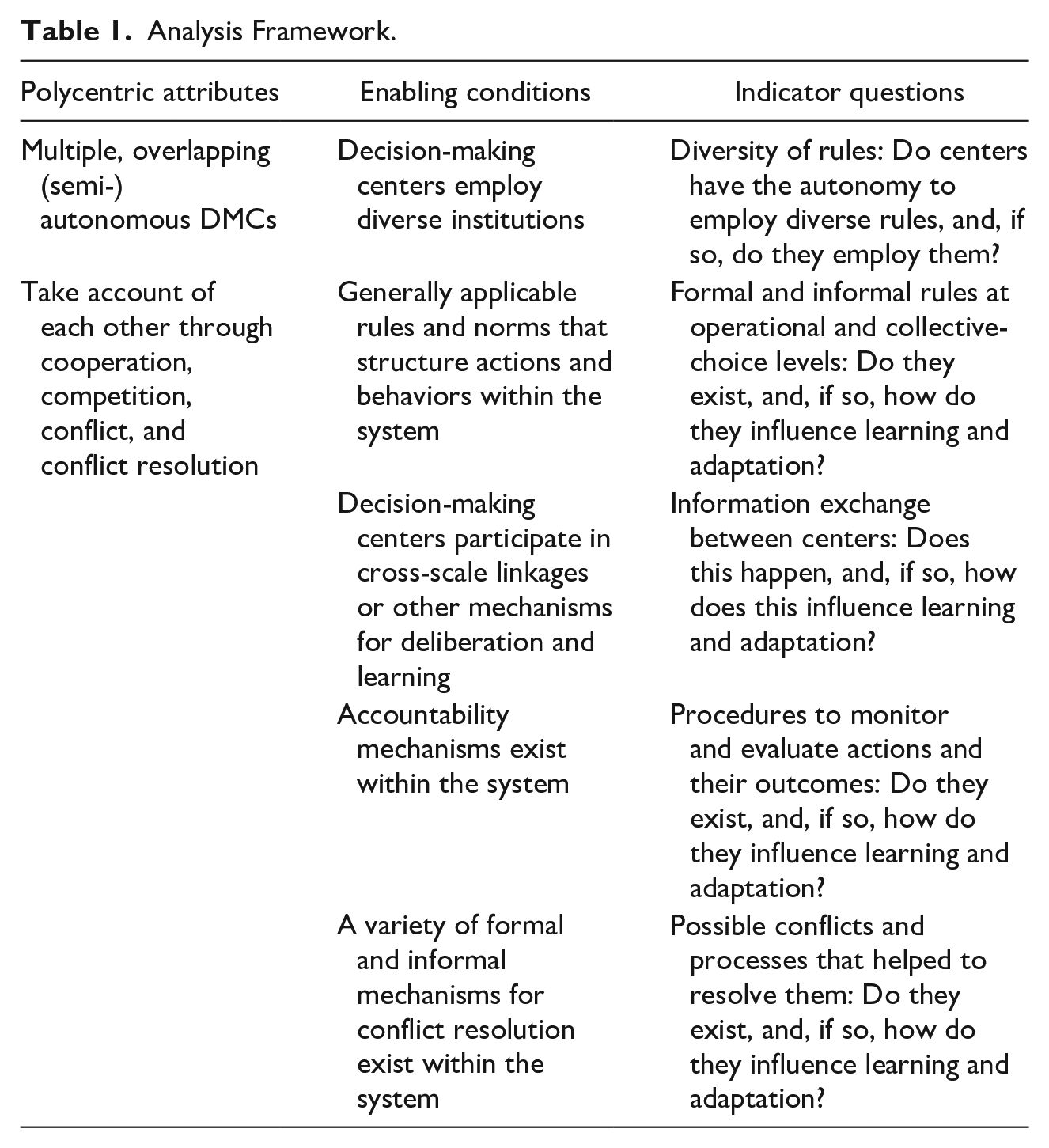
After data collection, interviews from the second round were transcribed and, together with relevant documentation, uploaded in “Atlas.ti” for deductive and inductive coding. The indicator questions in Table 1 served to analyze whether the conditions were present, and how their presence influenced learning and adaptation. Inductive codes emerged through the investigation of local factors that explained the manifestation of the enabling conditions in the transport governance systems of Southeast-Brabant (Supplemental Material B).
Analysis Framework.
Case Background
There are two main reasons for why the actors involved in the governance of the transport system in Southeast-Brabant increasingly take account of each other. First, the region of Southeast-Brabant is located on a major international transport corridor leading from Rotterdam via Frankfurt to Vienna. Second, the region of Southeast-Brabant has a population of about 790,000 (Central Bureau for Statistics, 2021), and is also known as the “Brainport” due to its technological innovations and companies such as Philips (electronics), ASML (semiconductors), and VDL (electric buses). Most of the economic activity and population is concentrated in the centrally-located, urbanized municipalities such as Eindhoven, Helmond, and Veldhoven. The international location and regional economic activity cause congestion and cut-through traffic on local roads, which subsequently put pressure on the regional accessibility and quality of life.
The issues surrounding the accessibility and quality of life of the region are addressed through initiatives at various spatial scales and levels of governance. In 2013, the national governments of the Netherlands, Germany, and Austria signed a “Memorandum of Understanding” to jointly implement an intelligent transport system to increase road safety and improve traffic flow on the international transport corridor. Zooming in on the Netherlands, the governance of transport systems is formally organized in a decentralized manner and predominantly a public matter; for example, the national government is responsible for the national high-, rail-, and waterways, the provincial government for provincial roads and bus lines, and the municipal government for local streets and parking norms.
At the national scale, the governance of transport systems is largely influenced by the “Meerjarenprogramma Infrastructuur, Ruimte en Transport” (MIRT), an overarching program that includes all national projects and programs to improve the accessibility, safety, and environment in the Netherlands. The program includes a list of “rules-in-use” that describe the process, roles, and tasks of involved actors. Moreover, the list defines the decision-making requirements of the national government that are necessary to decide on a national financial contribution from the Mobility fund, which is where the majority of transport funding in the Netherlands comes from. These decisions are made during the “MIRT-cycle”, a yearly decision-making round in which the minister and state secretary of the Ministry of Infrastructure and Water Management visit every region in the Netherlands to discuss problem definitions and solutions with transport representatives of provincial and local governments (in Dutch: “BO-MIRT”). In Southeast-Brabant, these deliberations are held in relation to “SmartwayZ.NL”: a program that includes infrastructure projects from the national and provincial government in the region.
At the regional scale local public actors aim to govern the transport system through the Brabant Accessibility Agenda. This program is designed by 21 municipalities that jointly aim to improve the accessibility and quality of life in the region of Southeast-Brabant. The high number of involved municipalities can be explained by the fact that the average municipal population in Southeast-Brabant is 37,000, which is comparatively low to the Dutch average of just under 50,000. The national average increased over the last decades due to the many municipal mergers (Boogers & Reussing, 2018). Municipalities in Southeast-Brabant have thus far escaped this trend, which may be explained by a strong sense of autonomy that prevails in this region. The transport governance system in Southeast-Brabant is thus shaped by the environment it aims to govern, existing international and national institutions, and dependencies between actors across geographical scales and levels of governance.
Polycentricity, Learning and Adaptation in Dutch Transport Governance
After the polycentric attributes of transport governance in Southeast-Brabant are explored through a historical narrative, the analysis turns toward the current manifestation of enabling conditions in the Brabant Accessibility Agenda (BAA).
Polycentricity in Action in the Southeast-Brabant Region
For decades, governments have worked together to combine various problem definitions and solutions into a coherent plan to improve the transport system in Southeast-Brabant. Back in 2014, a decision was made by the national, provincial, regional, and local governments to construct a new highway and upgrade existing roads in the eastern part of the region. The so-called “completion” of the ring road around Eindhoven and Helmond was seen as vital to maintain and improve the functioning of the transport system, and included a raised highway to reduce the environmental impact. The impact assessment gave the green light and the involved actors reserved a total budget of 647 million euros. After the municipal elections in 2015, however, the plan was cancelled as several municipalities withdrew their budget due to a lack of public support (Willems, 2014). Moreover, the validity of the impact assessments was contested by opponents as the plan would cut through several nature protection areas nevertheless.
Hereafter, the Dutch House of Representatives called on the Province of Noord-Brabant to come up with an alternative plan with public support. As an incentive the House stated that if the provincial government would fail to do so, there was no guarantee that the national budget reserved for the original plan would actually be invested in the region of Southeast-Brabant. In turn, the provincial commissioner gave the municipalities in the region an ultimatum to develop an alternative plan within 7 weeks, “If municipalities cannot find agreement, then we also know other bottlenecks in [the province of Noord-Brabant] that we can spend our money on” (Omroep Brabant, 2015). According to the commissioner, the time of experimenting with different ideas was over. In turn, the 21 municipalities of Southeast-Brabant developed a shared implementation program called the BAA. The program was substantiated by a cooperative agreement that included “region-wide” and “route-bounded” projects (ZOslimbereikbaar, 2018). The latter of which mostly included projects in replacement of the original plan.
The alternative plan proposed by the 21 municipalities was approved by the provincial and national government through a series of decisions. First, the route-bounded projects were included in the SmartwayZ.NL program. Second, the province decided to grant subsidies to the BAA-projects, most of which are allocated to the route-bounded projects because they more closely represented the original plan. The provincial subsidies comprised half of the total budget allocated to BAA-projects. Interestingly, this money had previously belonged to the municipalities. In the past, the municipalities had allocated this money to finance a public body to manage the regional transport system. When this public body was dissolved in 2015, its budget and responsibilities were transferred to the province. The other half of the BAA-budget is financed by the 21 municipalities.
The transport governance system in Southeast-Brabant, therefore, is a polycentric governance system composed of multiple nested decision-making centers and subsystems (see Figure 1), which is able to adapt to changes through cooperation, competition, conflict, and conflict resolution.
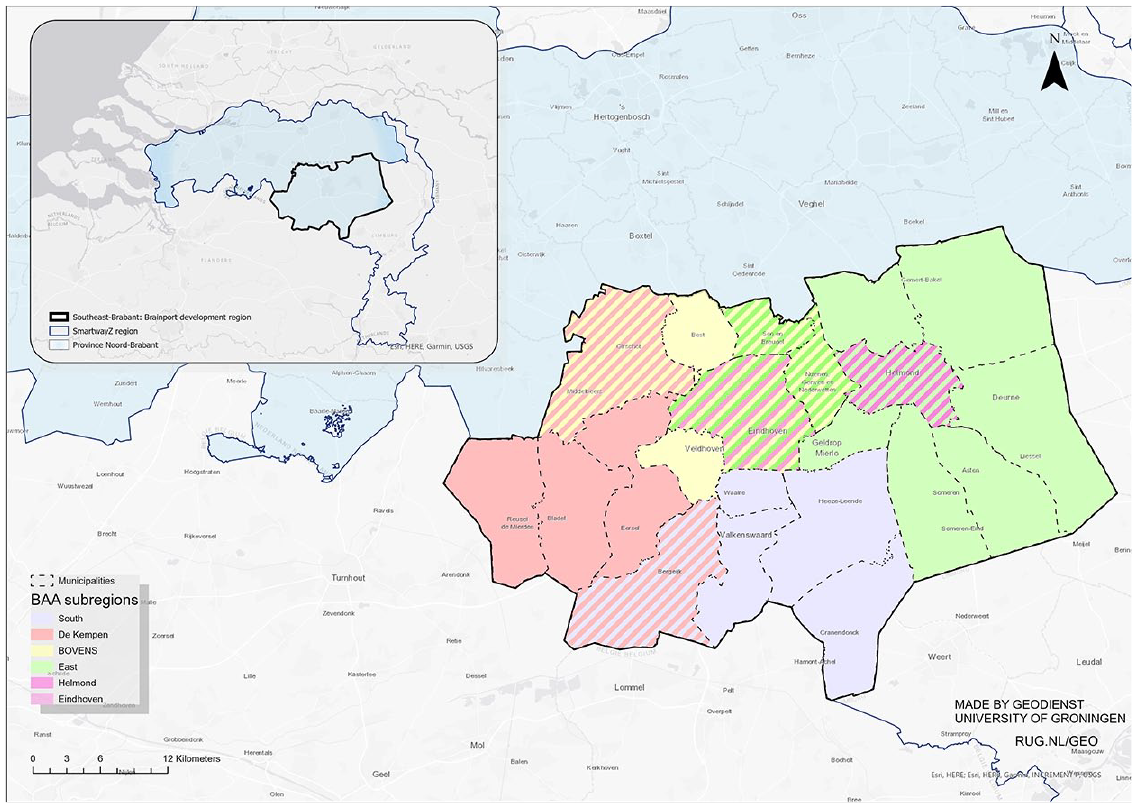
Map of Southeast-Brabant including national, provincial, and local initiatives aimed at improving the regional accessibility.
Crystallization of Enabling Conditions in the Brabant Accessibility Agenda
In the following subsections, the conditions for the realization of adaptive capacity are further analyzed in the context of the Brabant Accessibility Agenda (BAA) to understand how they influence learning and adaptation.
A diversity of institutions
The 21 municipalities in Southeast-Brabant have jointly enacted a diversity of “rules-in-use” to manage the BAA. The municipalities have divided themselves in so-called “subregions” in which they, for example, agree not to react individually on mobility issues and aim to develop a subregional mobility agenda, “The essence is that projects need to contribute to the accessibility and liveability of the whole subregion, or at least a big part of it, and that we need each other to realize the projects. If it is a solitary project, it will not get on the list.” (Interview4). Uniform institutions imply a loss of municipal autonomy, but can increase their agency (cf. Carlisle & Gruby, 2018), “for most of the municipalities it is a fact that they have inadequate capacity and knowledge to act on every issue. Therefore, they start to realise that they need each other. . . . It is too complex for individual municipalities to organise themselves” (Interview4).
The rules-in-use state that the meetings in the subregion “East” have a formal status in the sense that they are intended to develop binding advice to the other municipalities on the granting of subsidies to route-bounded projects. The formal nature of these meetings is especially important to promote the enforcement of the agreement with the provincial and national government, as this subregion includes most of the route-bounded projects in replacement of the original plan that was cancelled in 2015. The other subregional meetings are informal in nature, which resulted in institutional experiments. One of the subregions, for example, consciously did not limit themselves to the BAA, and instead used their subregional agenda to find alternative financial resources to implement their projects because of the slow decision-making process between the 21 municipalities. Institutional diversity therefore is present in the transport governance system of Southeast-Brabant. Part of the reason could be that the BAA and its rules were developed in a timeframe of 7 weeks. Within this timeframe it was only possible to find agreement on a set of rules that provided space for involved decision-making centers (DMCs) to experiment.
Voluntary cooperation
The cooperative agreement that municipalities signed in 2016 to substantiate the BAA is on a voluntary basis, which means that municipalities can leave the BAA if the respective local council wishes to. The cooperative agreement does not clearly state the consequences of leaving the BAA other than the responsibility for completing ongoing projects and losing the claim to any subsidies granted within the BAA. The voluntary basis can become problematic if there is disagreement amongst DMCs. This is illustrated by the case of the “Samenwerkingsverband Regio Eindhoven” (SRE). This public body was also voluntarily and jointly financed by 21 municipalities in Southeast-Brabant in 1993 to manage regional transport. In 2015, however, DMCs dissolved the public body because they could not find agreement about its continuation. As such, the case of the SRE shows how a voluntary base may influence decision-making in the BAA.
However, in the case of the BAA there is a strong incentive to cooperate because the municipalities have an agreement with the province and the national government. If municipalities are not able to find agreement to enforce this agreement, they cannot expect provincial and national investments in their regional transport system. Consequently, many generally applicable rules within the BAA promote consensus. Generally applicable rules determine that adaptations to the program can only be made during the biennial meeting between elected officials from the 21 municipalities and an advisor from the Province of Noord-Brabant (in Dutch: “Portefeuillehoudersoverleg”). These decisions have to be taken unanimously, and if this is not possible an alternative should be found instead. Thus, generally applicable rules and norms that structure actions and behaviors are present in the case of the BAA, and promoted learning to reach consensus and comply with agreements.
Learning to improve stability
Cross-scale linkages for learning and deliberation are present as municipalities participate in multiple meetings; for example, the subregional meetings and the biennial regional meeting with elected officials of all 21 municipalities. However, the extent to which DMCs participated in them was limited due to two reasons. First, differences between municipalities in sense of urgency resulted in large differences of participation, “you always see the same parties at the table” (Interview5). To illustrate, a representative of a rural municipality argued that his involvement in the BAA is limited due to the lack of urgency that is felt in his local council because issues discussed in the BAA often exceed the scope of his municipality. Urban municipalities, such as Eindhoven and Helmond, have a larger sense of urgency, “Eindhoven eventually makes the Brainport region . . . together with Veldhoven and Helmond. And the pressure is on regarding accessibility, which means that for us the challenge is most urgent to make disruptive decisions to keep the economic engine, the third of the Netherlands, running. In this respect, our interests are the largest of the 21 municipalities” (Interview2). Second, trust between municipalities plays an important role in participation; for example, “Trust in the subregion has grown to the extent that we can have discussions in which everyone has an equal say and can achieve its desired effect” (Interview1). At the regional meetings trust between municipalities is lower because it “has taken a dent due to the cancellation of the earlier cooperative agreement, after municipal elections led to regime shifts in Eindhoven and Helmond. After which you have to work really hard to restore trust” (Interview1).
Therefore, learning processes within the BAA focus on “the working method and anticipating new developments” (Metropoolregio Eindhoven, 2016, p. 18). A program team was instituted to support this process, “[The programme team says] are we still doing the right things? Do we have as much budget as we agreed on a few years ago, is this still allocated to the right things? Is it working, are there things we should eliminate? Are there things we need to put higher on the agenda? That is the reprioritization thought, which is located in the programme team.” (Interview3). However, DMCs have learned in the past that reprioritization may imply a loss of money. Therefore, “you always have to be careful because every time you mention the word reprioritizing everyone starts feeling their wallets like, it will not happen to me that something new is plucked from my wallet again.” (Interview3). As such, institutional adaptations are generally discouraged, “adaptations at the regional meetings do barely take place because we have agreed on the main goals. . . . If you want to deviate from it, you need a convincing story” (Interview1). Nevertheless, adaptations do take place. To illustrate, a decision has been made to change the planning and organization of a particular project after it became clear that the responsible municipality was unable to find sufficient resources to start the implementation. Thus, learning in the transport governance system of Southeast-Brabant focuses on the implementation of a priori defined BAA-projects to comply with made agreements.
Confusion about accountability
Elected officials and policy officers involved in the BAA are accountable to their respective municipal councils for any decisions made in the context of the BAA. After all, half of the money for projects in the BAA comes from the individual municipalities. In addition, the 21 municipalities are jointly accountable to the province and the national government. This is firstly organized through the subsidy agreement with the province, and secondly through the chair of the 21 municipalities who represents them in SmartwayZ.NL. If the municipalities do not fulfil their agreement with these actors, they run the risk that the provincial and national budget will be invested elsewhere.
However, interviews indicate that there is confusion about accountability. At first, because the progress of the BAA is difficult to monitor. The BAA has abstract goals that are difficult to translate into measurable indicators, “Suppose I will build a cycling road, then I can measure what the results are in terms of an increase of cyclists and a decrease in car use. . . . but what this means for the total accessibility, that is a lot more difficult to measure” (Interview6); “And what data do we need then because what defines better accessibility . . . what indicates the success of the program?” (Interview5). The potential explanation for this shortcoming is that “the BAA was designed in a hurry [. . .] meaning that procedures and methods to support the implementation of the BAA are developed along the way” (Interview4).
Furthermore, a lack of information from municipalities constrains monitoring, “If I look at the annual report, it takes us almost a year to get it how we want. . . . We have asked every project to fill in a progress report . . . It turns out that those progress reports are not complete, that a number of parties simply have not submitted them” (Interview5). Moreover, actors have not agreed on any graduated sanctions to tackle non-compliance with the agreements. In other words, it is unclear what the exact consequences will be if agreements are not met, except that ultimately no money might be invested at all or that municipalities have to pay the differences themselves if they spend more than previously agreed upon. Therefore, DMCs learned to be very careful when and how “to address each other’s deficiencies” (Interview5).
Conflict resolution to stay on course
A variety of conflict resolution mechanisms facilitates learning through sustaining interaction in polycentric transport governance systems. Recourse to court often happens in terms of conflicts over projects, “Initially it is often a matter of opinion, which is evaluated by the participants or the municipality itself. Then there are cases that are going to the advisory committee, an independent group that reviews [project] proposals. Eventually, people can go to court, in higher appeal and to the Council of State. And with larger projects these processes always . . . take years” (Interview7). Thus, a formal mechanism is in place to resolve conflicts over BAA-projects.
Additionally, the signed agreement indicates that the province is mandated to resolve any conflicts between municipalities that do not fall under the jurisdiction of the judiciary. The provincial government can request for a resolution within a specific term, and if this term is not met, or in cases of emergency, mandated to do so themselves (see also Section 4.1). In terms of the BAA, this mechanism is informal because intermunicipal cooperation is voluntary. Furthermore, the many cross-scale linkages in the context of the BAA may act as potential informal mechanisms to resolve conflict between involved actors, “if conflicts cannot be resolved, people from other scales or levels can get involved to do so” (Interview2). Thus, a variety of informal mechanisms for conflict resolution also exists within the BAA.
The conflict resolution mechanisms in the BAA enabled learning to prevent conflict from escalating and maintain interaction. This is illustrated by a conflict that emerged surrounding the smart mobility projects. The outcome of such projects is uncertain because the technology is constantly evolving, and not applicable in all spatial contexts. Actors with sufficient resources and interest, such as urban municipalities, are more inclined to implement such projects compared to those who do not, thus creating a conflict of interest. Escalation of this conflict could have potentially harmed interaction between DMCs because smart mobility projects are part of the agreements. Cross-scale linkages with the national government helped to resolve this conflict by integrating the smart mobility project portfolios of the BAA and SmartwayZ, “SmartwayZ, the [BAA] and other actors have signed an agreement called the ‘Krachtenbundeling smart mobility South-Netherlands’ in which they committed to organise a joint strategy for the implementation of mobility projects from 2020 to 2023. . . . This makes it a lot clearer how smart mobility projects will be organised and implemented and who the stakeholders will be . . . which also make it a lot clearer for outsiders because frankly there was a lot unclear to the outside world . . . Thirdly, this also prevents the spontaneous emergence of new projects from the different programmes because we learned that it is important to have one sender” (Interview8). Conflict resolution mechanisms thus served to learn how to adapt to adhere to agreements, and as such maintain interaction. It is however questionable if such a resolution works on the long term or whether it is more “an administrative construct around the conflict, to at least make the conflict less visible” (Interview4).
Reflection on Polycentricity in Relation to Learning and Adaptation
This article presented an exploration of the conditions that enable learning from institutional diversity in a polycentric transport governance system. The aim of this exploration is to critically reflect on whether the theoretical claims about polycentric governance systems in relation to adaptive capacity apply to the field of transport governance. The case study of the Dutch Brabant Accessibility Agenda (BAA) shows that the polycentric perspective is useful to analyze transport governance systems, but also illustrates some of its shortcomings. Based on this analysis, three contributions to the literature on polycentric governance systems in relation to learning and adaptation are made.
The first contribution is that the presence of polycentric attributes and enabling conditions cannot in itself explain whether a transport governance system functions well. The case study illustrates this, as the learning and adaptation are crucially influenced by inter- and goal dependencies. Interdependencies are dependencies between actors and institutions, and between actors, while goal dependencies are about the effect of goals on the reproduction of governance systems (Van Assche et al., 2022). The analysis showed that decision-making centers (DMCs) learned that they had to expedite the implementation of projects to comply with joint agreements and achieve their shared strategies. Furthermore, the DMCs heavily depend on each other as they all bring in part of the budget necessary to realize their goals. Subsequently, institutional adaptations were aimed at enforcing the initial agreements to achieve the formulated goals. Interdependencies and goal dependencies thus shaped learning and adaptation to implement the initial BAA-projects and agreements.
In addition, the analysis shows that the above-mentioned learning process partly emerged because of what DMCs had learned in the past. In 2015, the province learned that the municipalities were not able to find agreement on the plan to construct a highway. Hereafter, the municipalities learned that they would lose money if they did not come up with an alternative plan to the one that had been stranded. The municipalities then developed the BAA as an alternative, and felt a strong incentive to implement this program to claim the money that was originally theirs. This illustrates that the current learning and adaptation is also dependent on past legacies. Such path-dependencies crucially shape the evolution of governance systems (Van Assche et al., 2022).
As a second contribution, the analysis supports the growing awareness that there is a tendency to idealize polycentric governance systems as pure decentralized systems that only involve local actions and knowledge. Indeed, the original implication of polycentric theory is normative and radical in the sense that bottom-up self-organizing systems should be taken as a serious alternative to more traditional ideas of social order based on the centralization of power (Thiel et al., 2019). However, with a strong focus on variation between local actors, actions, and institutions, polycentric studies seem to forget that polycentric theory is actually “deeply concerned with the balance between polycentric and monocentric forces” (Jordan et al., 2018, p. 378, emphasis in original). This is especially true for transport governance, where the complexity of urban-regional transport generates overlapping jurisdictions that require coordination between state actors. Our case study therefore reinforces the idea that, also within polycentric governance systems, coordination by state actors is often necessary to solve complex problems (cf. Mansbridge, 2014). The idea of monocentric and polycentric systems as two theoretical extremes is thus a matter of degree and not of kind, which also shows that they essentially are two sides of the same coin when it comes to enabling the realization of adaptive capacity.
The third contribution is that to understand and improve the functionality of governance systems there is a need to take account of its relation with the material world. The analysis shows that subregions in the BAA have different problems depending on the material world that is governed (cf. Van Assche et al., 2022). Governance in the eastern subregion is characterized by formal coordination while the other subregions are characterized by more informal coordination. The reason for this difference is partly explained by the fact that the differences in spatial patterns create a situation in which issues of congestion and pollution require more coordination in the eastern subregion compared to other parts of Southeast-Brabant. This shows that the material world, human-made or natural, crucially influences the way in which decisions are made in transport governance systems. The notion of such material dependencies is acknowledged in for example, socio-ecological systems and evolutionary governance theory, but often remains understudied despite being the “hidden underpinnings” of transitions (Van Assche et al., 2022). For this reason, it is necessary to first return to the question which material problems transport governance systems face to understand how these systems can be organized in such a way that they can learn to produce sustainable and integrated solutions.
In line with these contributions, there is great potential in more fine-grained analyses that acknowledge the variety of how governance systems learn and adapt, and the dependencies that shape these processes. Such co-evolving approaches will help to discover what institutional design aspects in various contexts enable or constrain the realization of adaptive capacity, and how adaptive capacity can be optimized.
Supplemental Material
sj-docx-1-aas-10.1177_00953997221109308 – Supplemental material for Learning and Adaptation in Polycentric Transport Governance: The Case of the Dutch Brabant Accessibility Agenda
Supplemental material, sj-docx-1-aas-10.1177_00953997221109308 for Learning and Adaptation in Polycentric Transport Governance: The Case of the Dutch Brabant Accessibility Agenda by Ingo Bousema, Tim Busscher, Ward Rauws and Wim Leendertse in Administration & Society
Supplemental Material
sj-docx-2-aas-10.1177_00953997221109308 – Supplemental material for Learning and Adaptation in Polycentric Transport Governance: The Case of the Dutch Brabant Accessibility Agenda
Supplemental material, sj-docx-2-aas-10.1177_00953997221109308 for Learning and Adaptation in Polycentric Transport Governance: The Case of the Dutch Brabant Accessibility Agenda by Ingo Bousema, Tim Busscher, Ward Rauws and Wim Leendertse in Administration & Society
Footnotes
Acknowledgements
This research is part of the long-term research cooperation between Rijkswaterstaat and the University of Groningen. The content of this article does not necessarily represent the views of Rijkswaterstaat and are the authors’ responsibility. The authors would like to thank the GEODIENST of the University of Groningen for providing the map included in this article.
Declaration of Conflicting Interests
The author(s) declared no potential conflicts of interest with respect to the research, authorship, and/or publication of this article.
Funding
The author(s) received no financial support for the research, authorship, and/or publication of this article.
Supplemental Material
Supplemental material for this article is available online.
Author Biographies
 .
.
.
.
.
References
Supplementary Material
Please find the following supplemental material available below.
For Open Access articles published under a Creative Commons License, all supplemental material carries the same license as the article it is associated with.
For non-Open Access articles published, all supplemental material carries a non-exclusive license, and permission requests for re-use of supplemental material or any part of supplemental material shall be sent directly to the copyright owner as specified in the copyright notice associated with the article.
