



Abstract
Policy has been mostly approached as a rational project of setting goals and establishing rules and roles to achieve them. Alternative approaches to policy have been referred to as post-positivist, critical-reflexive and relational. They all emphasize emergent, co-evolutionary and relational aspects of policy work that cannot be reduced to rational choice and reasoning-based models alone. A shared element of such frameworks is the focus on relationships, which are seen not just in a narrow sense of the “logic of appropriateness,” but as a force that shapes actors’ identities, interests and power. Following relational analytical approaches, we analyze a triangular development cooperation project funded by the United States Agency for International Development (USAID) and the Government of Indonesia in order to strengthen gender mainstreaming (SGM) of Fijian government. Through attention to relationality as it shapes actors’ identities and narratives, we demonstrate how a different form of learning employed by each actor facilitated harmony in the project. A key mediating factor in the smooth project co-evolution that we observed, was the ambiguous project design and vaguely articulated goals, supported by fragmented project setup and reporting. Such ambiguity allowed formulation of multiple versions of the project’s outcomes for multiple audiences. However, it also resulted in little impact on the ground in Fiji. Our findings support persistent criticism of development aid projects in small island states for rarely addressing problems of target populations.
Existence is not an individual affair. Individuals do not preexist their interactions; rather, individuals emerge through and as part of their entangled inter-acting. Which is not to say that emergence happens once and for all. . .but rather that time and space, like matter and meaning, come into existence, are interactively reconfigured through each inter-action. . . (Barad, 2007, p. ix)
Introduction
On 7 August 2019, a remarkable incident has taken place in the Jakarta office of a triangular development cooperation project funded by the United States Agency for International Development (USAID) and the Government of Indonesia (GoI) for the benefit of Fiji. In the project titled “Strengthening Gender Mainstreaming” (SGM), the Fijian side unexpectedly informed the donors that it had secured a loan from other donors to implement a more ambitious project on the same subject. This news sent shockwaves through the SGM project office in Jakarta. USAID and Indonesia briefly considered halting the project or pressuring Fiji into compliance with the terms of reference. However, no visible frustration or conflict could be detected in any formal setting. Instead, policy actors worked hard to accommodate the Fijian request, showed patience and understanding and resolved the crisis within a week.
This harmony in the face of the crisis is remarkable, if not puzzling; it cannot be explained by the donor-recipient power differentials. Despite the partnership and ownership agenda of the contemporary aid regime as manifested by the Paris Declaration on Aid Effectiveness (Organisation for Economic Cooperation and Development [OECD], 2005) and the Busan Partnership for Effective Development Co-operation (OECD, 2011), donors continue to dominate agenda-setting and policy design and decide which plans or actions are considered feasible or what “best practices” are to be followed (e.g., Fraser & Whitfield, 2009, p. 84). This is especially true for small island states, such as Fiji that lack the capacity for own public sector research (Corbett & Connell, 2015). In light of such domination, an emphasis on harmony at the expense of formal project goals raises questions. This paper pursues two goals. First, it seeks to explain this policy development through the lens of relationality—an approach that emphasizes relationships between policy actors as key forces that shape their identities, practices, and hence outcomes of their policy work (e.g., Barad, 2007; Bartels & Turnbull, 2020; Lejano, 2021). The key departure point is that unfolding relationships require constant re-adjustments by involved actors and co-shape identities and policy practices as a result. We expect this to happen incrementally, interactively, and to a great extent non-intentionally. Secondly, this paper aspires to evaluate the methodological value of paying attention to narratives, identities, and policy practices as suggested by earlier writings on the subject. We expect to find fruitful connections between narratives, identities, and practices of actors as these emerge through their interactions.
Policy is conventionally understood as a “creative process of designing solutions to public policy problems” (Linder & Peters, 1984, p. 237). A policy sets goals and defines roles and rules that guide the process toward achieving these goals (e.g., Colebatch, 1998; Sabatier & Weible, 2014). This view of policy can be referred to as “instrumental-rational”; there is a clear relationship between the ends and the means of policy, and a reasoning-based procedure to establish these (e.g., Fischer, 1982). Alternative non-instrumental accounts of policy include various post-positivistic and critical frameworks of policy as a discourse or as translation (e.g., Bacchi & Goodwin, 2016; Clarke et al., 2015; Lejano, 2006; Mukhtarov, 2014).
We seek to explore new insights in policy analysis from a relational point of view as a complement to rational models. Lejano (2021, p. 7) defined relationality as “the institutional logic by which established patterns of action in the public sphere emerge from the working and reworking of relationships among policy actors.” Relationality emphasizes the eternally unfolding nature of policy that resists attempts to be rendered predictable by structures such as power, funding, and path-dependency. Relationality is rooted in the post-structuralist tradition of policy studies (e.g., Bacchi & Goodwin, 2016, p. 4) that represents opposition to “Enlightenment assumptions concerning reason, emancipation, science and progress, and disquiet regarding connections between this thinking and social inequality.” It emphasizes a plurality of practices, and stresses the realities as inherently contingent, open to challenge and change. The “eternally unfolding present” of policy (Cook & Wagenaar, 2012, p. 21) means that social arrangements involve politics, and there is always a possibility of the world otherwise (Clarke et al., 2015; Rojas, 2007).
Relationality is not a new subject. The focus on relationality is present in the literature on policy networks that emphasizes the connectedness of actors (e.g., Goodin et al., 2008; Rhodes, 1997). Goodin et al. (2008, p. 13), for example, state that “within (policy) networks, none is in command. Bringing others along, preserving the relationship, is all.” Relationality focuses attention on relationships between policy actors rather than their stand-alone qualities and identities. Much as the epigraph to this article by Barad (2007) proclaims, relationality posits that no actor “is an island” and no individual features, such as identity, interests, or power can exist in separation from other actors. To make this point clearer, Bartels and Turnbull (2020, p. 1326) make a distinction between “relationalism” and “relationality.” The former manifests itself in “concern for relationships and interactive processes” and “can be traced back to the classic literature on public policy” (p. 1326). Relationalism considers relationships within a broader rationality framework, within which individual actors have goals and interests separately from each other; these are stable over time and can be used for calculating political behavior (e.g., Lipsky, 1980; March & Olsen, 2004; Pressman & Wildavsky, 1984). A good example of relationism is the concept of “logic of appropriateness” that emphasizes compliance with established rules, roles, and norms obtained through learning and socialization (e.g., March & Olsen, 2004). Compliance with formal and informal rules is a precondition for maintaining workable relationships. Relationality, instead, suggests that relationships have an ontological quality—they shape actors’ ever-emerging identities, interests and (self)-narratives, they do not pre-exist them (Bartels & Turnbull, 2020; Lejano, 2021). As Barad (2007) argued, individuals and objects are entangled with each other and co-evolve through interactions. For these scholars, relationships are not strategic means to some rational ends or nearly insurmountable constraints on action; they form an ethic of care (Gilligan, 1993)—the necessity of humans to connect to and live in harmony with others. Relationality also offers a view into the kind of policy learning that is open and dialectical, but at the same time less procedural and more receptive to conflicts (van Assche et al., 2021).
Relationality may help understand how policies evolve. The evolutionary and contingent view of policy has been subject of much writing in post-positivist policy studies. One such strand is the scholarship on “policy translation” (Mosse & Lewis, 2006, p. 13; Mukhtarov, 2014). Policy as translation demonstrates how despite a myriad of documents and meetings that constitute and feed into projects, actors succeed in making “these fragmented activities appear coherent” and eventually, are able to claim success that suits their goals (Shore & Wright, 1997, p. 5). Translation scholars emphasize the fluidity, emergence, and contingency of policy (e.g., Clarke et al., 2015; Freeman, 2007; Mosse, 2004; Mukhtarov, 2013; Mukhtarov et al., 2013). They also claim that policy is not a clear process of designing and then implementing policies, but an iterative and intensely political translation of policy prescriptions, or “texts” in policy environments, or “contexts” (Clarke et al., 2015; Lejano, 2006; Leong & Mukhtarov, 2018).
Policy translation scholars were less successful in explaining why particular translations take place in ways they do, and whether any discernible patterns exist in understanding how translation may happen in given circumstances (see e.g., Dolowitz, 2017; Minkman, 2021). Relationality, we tentatively argue, may help by offering ideas on how relationships shape translations. We claim that while contingency and uncertainty are important parts of the story, they are not all—there may be some patterns and explanatory factors in how policies translate and evolve, and there is a role for learning to explain these patterns. We claim that harmony in SGM was achieved as a result of learning that emerged from interaction of the three actors and the desire to project a success narrative to the outer world. This outcome was made possible by various types of learning that came together in the project: dialectical learning from interaction of actors, learning from other places in the world, and learning from the past (van Assche et al., 2021).
The first author of this article conducted the 3 months of fieldwork in Jakarta in mid-2019, which combined collection and study of policy documents, semi-structured interviews with key informants, and ethnographic observations of project meetings. A total of 19 policy documents pertaining to the project were collected. Semi-structured interviews were conducted with eight informants from Indonesia and USAID including government officials, project consultants, and independent experts. Ethnographic observations of four project meetings and activities complemented document analysis and interviews. The first author has worked for the project office in the past and was regarded as an insider by his former colleagues. Ethical guidelines have been followed ensuring anonymity of all informants as well as prior approval of interview transcripts; the narration, however, is the interpretation of the authors based on the data. One limitation of this study is the lack of access to Fijian participants—our attempts to interview them have been void. We attempted to compensate this limitation by carefully studying available policy documents from Fiji and ethnographic notes of meetings, in which Fijian participants were present.
Section two discusses the project design and the background of triangular cooperation. Section 3 discusses relationality as a framework applied to the case of SGM. Section 4 then discusses the outcomes of the analysis for understanding the case study and providing insights into the methodology followed, and concludes.
Strengthening Gender Mainstreaming: A Case of Triangular Cooperation
Cooperation between Fiji and Indonesia in the areas of women empowerment began in 2013 with a memorandum of understanding between Indonesia’s Ministry of Women Empowerment and Child Protection of Indonesia (I-MWECP) and Fiji’s Ministry of Women, Children, and Poverty Alleviation (F-MWCPA). 1 The bilateral agreement led to the establishment of a joint technical working group, which convened biannually to discuss project ideas. In a 2017 meeting, the two ministries agreed that Indonesia will aid Fiji in gender mainstreaming by implementing gender-responsive planning and budgeting (GRPB) framework and tools in seven key Fijian ministries, and thus SGM was born.
SGM follows a whole-of-government approach and positions Fiji’s F-MWCPA as a “national gender machinery” (USIP-1, 2017). Since 2017, two program parts had been completed with a total of six parts planned until 2022. In part 2 I in 2017, the SGM team produced training curriculum and modules and conducted training of trainers for F-MWCPA. In part II in 2018, F-MWCPA staffs joined a one-month internship at I-MWECP in Indonesia to learn about practices on gender mainstreaming in Indonesia. Part III in 2019 was anticipated to be critical since the core mainstreaming activity—the establishment of a National Gender Policy Unit in F-MWCPA with Indonesia’s assistance—would have started then. The unit would then advocate the adoption of GRPB system in the other six ministries and to the parliament in Fiji. By the end of part III, seven ministries in Fiji were expected to delegate their representatives to form a National GRPB Working Group, and hence to make the impact of the project sustainable in Fiji to continue practices beyond the project. In 2017 to 2019, SGM was jointly managed and funded by USAID and the Indonesian government as part of the United States-Indonesia Partnership for South-South and Triangular Cooperation (USIP 1). The total project value was USD 1.9 million with 70% funded by USAID and 30% by the Government of Indonesia (USIP-1, 2017).
SGM’s part III was expected to start in April 2019. Halfway into 2019 the Fijian counterpart did not respond to Indonesia’s calls to turn in the internship evaluation and start planning part III. In early July, F-MWCPA finally agreed to meet in the joint technical working group, which granted political greenlight to part III. However, the taste of the good news was bittered when F-MWCPA declared that it had been drafting with Canadian assistance “a 5-year Master Plan for the Department of Women (2020–2024), which is a merger of Fiji’s National Gender Policy and Women Empowerment Programs” (I-MWECP, 2019, p. 1). Besides the sudden demand for Indonesia to adjust its training curriculum to the master plan, Fiji admitted that it had not conducted follow-up actions agreed in part II, notably to submit a request to Fiji’s Prime Minister for endorsing F-MWCPA as the national gender machinery (United States-Indonesia Partnership for South-South and Triangular Cooperation Component 1 (USIP-1), 2019). This caused a crisis in the project.
In a multi-stakeholder project meeting on August 8, the Fijian counter-parts demanded a number of changes to the project design—a remarkable instance given its status as aid recipient. First, it was revealed that Fiji’s Ministry of Economy (F-MOE), which presides over planning and budgeting of the whole government, had been assisted by the Asian Development Bank (ADB) in conducting budget assessment for the upcoming fiscal year, which includes gender-responsive components. Earlier, F-MOE was not interested to collaborate with Indonesia and USAID, but went on board with ADB as part of their conditional loan. This effectively took the budgeting component out of hands of the USIP project rendering its impact much less significant. Second, with gender responsive participatory budgeting now falling under the ADB project and F-MOE instead of F-MWCPA, the SGM’s main objective was to be reduced to capacity-building and training. Third, F-MWCPA would reduce the number of target ministries from initial seven to three since the remaining four would cooperated with F-MOE and ADB instead.
The proposed SGM’s design change was entirely unforeseen—a product of contingent process that involved ADB, Canada, and Fiji’s own F-MOE stepping in to influence the triangular actors to make SGM work in the new circumstances. The risk of Fiji’s actions to sour its relationships with Indonesia and USAID, and to lead eventually to SGM’s demise, seemed imminent with disastrous consequences for all actors involved. In fact, USAID considered to abandon SGM once Fiji demanded the changes, before resolving its internal conflict and agreeing to proceed with the diminished goal (Fieldnotes, 2019c). Eventually, USAID and Indonesia government agreed to the changes and referred to SGM as a success in their published materials intended for their respective constituencies.
This development of events is puzzling for several reasons. First of all, it is unusual for an aid-recipient country to make demands to donors to modify the project design, even in the context of leveraging grants/loans from other donors. Recipients of aid tend to mold project practices to the needs of the donors and rarely challenge their authority openly or explicitly (e.g., Mosse, 2004). The literature on international political economy of the Pacific islands also indicates at the abnormal development of events in the current case given the importance of the region for USA and competition with China in the region (Corbett & Connell, 2015; Veenendaal & Corbett, 2015). The Fijian approach was strategic with delaying communication, aligning projects for its own purposes and presenting USAID and SGM with the change as a fait accompli. In itself, there is not much surprising that there is a clash of interests and recipients seek to insert their own agency in project design and implementation. Indeed, Corbett and Connell (2015: 438) convincingly argued that small island states, such as Fiji, strategically leverage their participation in international organizations as well as bi-lateral projects with donors to benefit their own agenda. Nevertheless, the boldness of Fijian actions is interesting to examine from a relational lens given that relationships are of such great importance in the region (e.g., Corbett, 2013; Lejano, 2021).
Relationality Within SGM: Identities of Actors and Narratives
Bartels and Turnbull (2020), building on relational sociology, suggested that a truly relational approach must contain three core features that guide an inquiry. These are (i) a relational ontology, (ii) emergent properties of actors, and (iii) specialized methods that allow for situated understanding of practices and interactions. A relational ontology acknowledges the entangled nature of policy actors, their interactions and their relationships with each other. Actors’ features and identities readily change as a result of interactions. By focusing on identities, self-reported or inferred interests, and observed practices, one may analyze how relationality shapes actors’ features. These, naturally, require fitting methods, such as network analysis, narrative analysis, or other discourse analysis techniques (Lejano, 2021; Mukhtarov et al., 2021; van Dijk, 2009), policy ethnography (Mukhtarov et al., 2017; Schatz, 2003), and other interpretive methods (e.g., Schwartz-Shea & Yanow, 2012).
Below, we follow Bartels and Turnbull’s (2020) methodological guidance in order to explore whether it may help to explain the puzzle. As I-MWECP, F-MWCPA, and USAID built a relationship within the USIP-1 project, their identities co-evolved and influenced the project. Following Lejano (2021), for each actor we are interested in (i) identity about self, (ii) identity versus other two actors within the project, and (iii) identity as part of the whole project. These identities may differ given that relationships matter for how actors perceive themselves and represent themselves to others. In order to reliably access these identities we look at narratives that actors have crafted in their published documents, interviews with the first author, and fieldnotes from ethnographic observation in project meetings. Following Lejano (2021, p. 8), looking at identities of actors through narratives allows us to meaningfully observe the configuration of relationships in the project, and subsequently assess how actions taken in the project reflect, reinforce, and develop stated configurations. The different modes of learning are invoked as actors attempt to create harmony between project actions and their relationships.
Identities of I-MWECP (Indonesia)
Self-identity of Indonesia as a donor, and I-MWECP as an implementing agency, reveal themselves in policy documents by Indonesian government intended for domestic and international audiences. Indonesia presents itself as an active agent of South-South Cooperation, both as a donor and aid recipient, whose work is based on the principles of solidarity, demand-orientation, and recipient ownership (Government of Indonesia, 2015; Government of Indonesia and Government of Japan, 2014). In one of its annual reports on international aid, Indonesian foreign policy is articulated as to help “each other achieve mutual independence, promote development, and strengthen solidarity between developing countries” (Government of Indonesia, 2016, p. 43). These principles are in accordance with the Paris Declaration on Aid Effectiveness (OECD, 2005) and underline the self-image of Indonesia as an altruistic donor working for solidarity with its partners. This self-image becomes more pronounced with deliberately crafted contrasts with traditional agents of North-South cooperation painted as pursuing own interests (e.g., Government of Indonesia and Government of Japan, 2014, p. 30, footnote 15), a tool commonly used by other aspiring Southern donors in positioning themselves (Thérien, 2002, p. 257).
We argue that Indonesian concerns with flexibility of the project design and recipient-driven aid resulted in a simplistic project design and allowed the Fijian counter-part to leverage it for its own benefit. USAID’s engagement with Indonesia in this project was also strategic; from the minutes of the USIP 1 weekly meetings, it becomes clear that the primary concern of USAID was to achieve a verifiable impact of the project that can be reported back to Washington and internationally (Fieldnotes, 2019c). While we do not have explicit statements on how Indonesia viewed itself in interactions with other actors, it is clear that there has been hesitancy to lead, the desire to avoid conflict, and carry on with the project even if under unfavorable conditions. This timidity on the part of a donor is puzzling at first, but may be explained by the proposition that Indonesia has been interested in visible activity as a donor rather than in achieving a developmental impact through its projects. True to its role as a pivot, Indonesia facilitated multi-stakeholder meetings, and arranged evaluations, therefore providing space for dialectical learning through discussion with the other actors (van Assche et al., 2021). This proposition is only informed by the analysis of Indonesia’s South-South Cooperation reports that, unlike USAID’s, stress activity and Indonesian efforts as a donor much more than impacts of developmental interventions on the ground (Alta, 2019).
In final reporting on SGM, Indonesia claimed success in cultivating a project driven by Fijians, who determined whom they wanted to be trained and for what purposes (Interview 1, 2019). In turn, USAID praised Indonesia as a “non-political donor,” who supports its Pacific Island partners based on solidarity and without self-interest (Fieldnotes, 2019b). The mutual endorsement of USAID and Indonesia stands in stark contrast with the very limited impact of SGM on the ground—official of three ministers, instead of eight, provided with training, on the subject not controlled by USAID and I-MWECP, and without the gender mainstreaming component. It does however demonstrate the desire of the two parties to maintain a close strategic relationship despite the failure of the project. At the time of writing, Indonesia and Fiji are planning to have another working group meeting in 2022 for continued triangular cooperation projects. However, USAID’s commitment to fund Indonesia’s aid programs ended in 2019 and it is unclear if USAID will continue its support.
Identities of F-MWCPA (Fiji)
Fijian self-identity as expressed in its national development program and more specifically, gender equality projects, is that of moving away from the influence orbits of Australia and New Zealand to build cooperation with other actors (Komai, 2015; Kubuabola, 2013). Fijians have a long-standing relationship with Indonesia as a donor in various aid projects in Fiji and would like to project the image of a recipient country “open for business.”
The most interesting aspect of the Fijian identity, however, was vis-à-vis Indonesian and USAID actors. The following excerpt from the multi-stakeholder meeting demonstrates the tension, but also an opportunity, that F-MWCPA faced with when F-MoE, ADB, and Canada entered the scene. The following exchange at the meeting on finalizing the list of participant ministries in the project (Fieldnotes, 2019a) illustrates the relationship between actors at that moment of time.
Ever since we started this GRPB
3
project, we have not been able to have a working relationship with the Ministry of Economy [of Fiji]. Our trying to get their buy-in for the whole-of-government approach in implementing GRPB has not been successful. We cannot do GRPB with other agencies without the buy-in of Ministry of Economy, and that we did not have, until the ADB came in (F-MWCPA) I think this is a good opportunity for you—for [Fiji] MWCPA—to collaborate with [Fiji] MOE because they are now concerned, leading, and just work together (USIP-1 Consultant [representative of USAID and Indonesia]). Exactly. That’s what ADB has managed to do for us. They opened up the door, so now. . .You know. . .it’s not only the gender-responsive budgeting. They actually came in for something else. . .on loan concession. So ADB would ask you, “Where is the gender component of all this? We will not look at any loan application if it does not have a gender perspective.” So the Ministry of Economy wrote us in (F-MWCPA).
This excerpt from the meeting minutes demonstrates Fiji’s recipient strategy in the triangular cooperation, which was apparent in several regards. Fiji’s cooperation with ADB and Canada in the overlapping sectors was only known later rather than shared with USAID and Indonesia from the beginning. As discussed above, by continuing to receive training for its officials and to develop policy tools under SGM, F-MWCPA has attempted to alleviate the burden of managing multiple projects with various donors. Despite the clear incentives from the bigger donors, participants of the multi-stakeholder meeting were puzzled over why Fiji—a long-time Indonesian aid recipient—would prioritize other donors’ programs over Indonesia’s.
We propose that the long history of partnership may have been the factor that enabled this strategy on the Fijian side. Rossi (2006, p. 29) argued that strategies of development actors follow from awareness “of the chances available to them within policy discourses.” In other words, F-MWCPA seems to have known well that its imposition could be tolerated by Indonesia based on the logic of demand-driven programs and ownership and its implicit interest in the donor status more than developmental impact. Fiji’s maneuver might not have amounted as much to prioritizing other donors over Indonesia as to an attempt at streamlining different programs. As a small island country, the tasks of managing different aid programs and participation in international organizations are often too burdensome for Fiji’s small bureaucracy, administrative system (e.g., Corbett & Connell, 2015, p. 4; Murray & Overton, 2011). Fiji therefore seems to have learned from past experiences to streamline different donor programs while letting each donor claim success in their own right.
Meanwhile, with only a Memorandum of Understanding (MOU) as the basis of the project, I-MWECP focused on creating a sense of belonging and ownership at the Fijian ministry, for example through peer-to-peer mentoring between the two ministries, instead of formal agreements and contractual obligations. This approach of using carrots without sticks seems to have backfired when Fijians looked away to bring other donors on board. The Fijian actions have been facilitated by the project set up, an important consideration to mention.
Identities of USAID/USIP-1
USAID’s self-image as a donor is discernible from its 2011 to 2015 global Policy Framework and its current 2019 Policy Framework (USAID, 2011, 2019b). USAID’s mission is to support recipient countries to become “self-reliant” and a transition from a recipient to a fellow donor or a trade partner. USAID hence wants to see self-reliance as the result of its aid, but “does not necessarily signal the end of USAID’s engagement but, more typically, its evolution” (USAID, 2019b, p. 39).
USAID’s Policy Framework presents lessons or “success stories” learned from other places, summarized and reconstructed for reference by its agents and projects. This indicates the motivation of USAID as an established donor to teach, and its expectation for aid recipients to learn (Morvaridi & Hughes, 2018; Müller & Sondermann, 2016). These are presented as everyday pictures and quotes from the subjects of development which serve as a body of evidence (“many countries,” “some countries”) that justifies higher-level qualities and concepts such as “sustainable,” “effective,” and “impact” (Alta, 2019).
When the news broke that Fiji wanted a drastic change in SGM, the first thing USAID and USIP 1 managers did was to meet internally to furnish “sustainable storytelling out of the new project logic and justify what impact we [USAID] can claim if we can get hold of only three [ministries]” (Fieldnotes, 2019c). To solve the crisis, getting the storytelling correct was therefore more important than resisting change in project design. This is also exemplary of USAID’s openness to learn from global experiences on the one hand, and its need to summarize them as presentable generic stories for teaching purposes on the other. When part III on-field implementation started in October 2019 with the sending of trainers to Fiji, tensions in the negotiation were none to be seen. In the terms of reference (TOR) and the project design matrix (PDM), they were resolved by revising the program’s purpose to reflect the change. Its case study, in which the project is reported to the headquarter and the wider audience, USAID (2019a, p. 5) stated that “Fiji continues to show its commitment to gender equality with the recent changes on MoWCPA’s Master Plan and development of new GRPB projects with Canada and ADB.” As stated earlier, USAID also endorsed the non-political involvement of Indonesia and good progress toward becoming a donor itself. USAID (2019a, p. 5) further noted that “the success story of Indonesia in supporting GRPB Fiji has encouraged other countries such as Afghanistan to initiate a similar program with the GOI [Government of Indonesia].”
From these quotes, the success of Indonesia as an aspiring donor and Fiji as a recipient party enabled to collaborate with other donors, is indirectly a success story of USAID—a key actor that made all this happen. USAID’s framing of SGM as a success story of “strengthened institutional framework of Fiji’s GRPB policy” (USAID, 2019a, p. 4) indicates USAID’s deliberate attempt to create a positive representation of the program and itself as part of it.
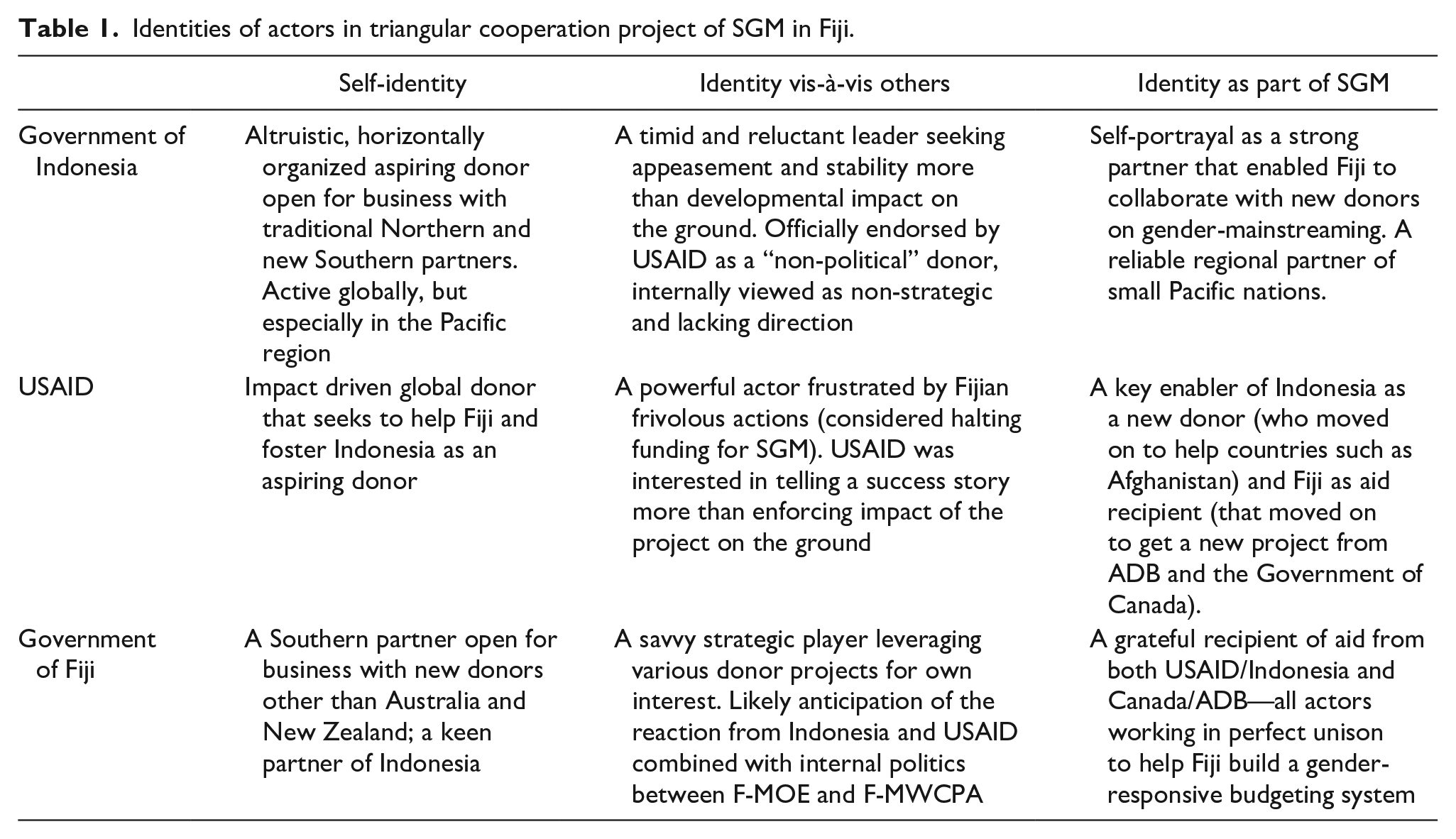
Table 1 above summarizes identities, interests, and representations of the three actors involved in this triangular cooperation project. We seek to tie loose ends and explain the evolution of the project in the next section. We also revisit the two goals of this paper stated in Introduction.
Identities of actors in triangular cooperation project of SGM in Fiji.
Discussion and Conclusions
In the introduction, we asked the question of how a relationality lens could help explain the actions of triangular actors in this project. Firstly, we sought to understand (i) whether we could discern multiple identities from actors’ documents and interviews and relate these to their actions, and (ii) whether we could view actors’ identities as contingent upon their relationships with others. Secondly, we sought to evaluate whether the methodology we applied was relevant for such an investigation.
On the first question, we found that there is a differentiated dynamic in terms of stated and implicit identities of all three actors. All actors did their utmost in order to maintain their well-articulated self-image as an impact driven donor (USAID), an aspiring Southern donor (Indonesia) working based on Paris principles on Aid Effectiveness (OECD, 2005), and an exemplary aid recipient (Fiji) seeking to make the best of cooperation with all kind of partners. Identities of these actors versus each other are more conflicted, which is in line with the thinking of relationality; relationships and identities affect each other and require constant re-adjustments. As Table 1 illustrates, from USAID being mostly concerned with its own image in claiming success of this project to the Indonesian ministry going with the flow as long as it could claim the status of a donor, and Fiji looking to benefit from the vagueness of the design, the focus on identities illuminates conflicts, and incoherencies between actors’ identities in relation to each other. The awareness of potential danger of this dissonance between self-identity, identity versus others, and identity as part of SGM may have been the key driving force behind a concerted effort to co-produce a unified coherent final narrative of the project available in the USAID case study (USAID, 2019a) and policy communications of Indonesia (Pattiro, 2019).
Each actor’s self-identity, as shown above, was maintained throughout the project meetings by tweaking narratives about own involvement and achievements of others. At the same time, identities versus other actors and with the others have evolved as the project’s planning forced compromise. We have shown that each actor’s capacity for such flexibility is facilitated by various forms of learning: dialectic learning (Indonesia), learning from other places (USAID), and learning from past experience (Fiji) as articulated by van Assche et al. (2021) For Indonesia, this meant that the rhetoric and promotional language found in its Annual Reports gave way to conduct that is accommodative of its recipient’s demands. Some consultants and experts involved term Indonesia’s brand of donorship as “charitable,” referring to how Indonesia’s role appeared to lack strategic interests and focus instead on helping USAID and Fiji find a common ground through dialogs. USAID, in turn, having learned of Indonesia’s way of doing aid, adapted its generalizing “policy framework” in cooperation with Indonesia by adopting the demand-driven principle while simultaneously maintaining its narrative of grooming Indonesia as an emerging donor. Learning from its experience of dealing with different donors, Fiji tried to maintain its relationship both with Southern partners such as Indonesia and traditional donors such as ADB and Canada. Given the limited capacity of the state in Fiji, it has strategically leveraged aid projects to become streamlined in one, behavior of small island nations that has been noted before (Corbett & Connell, 2015).
In addition to policy work to align identities and narratives, a key enabler of diversity in narratives and identities was the project design. The project design and planning instruments (e.g., the term of reference, project design matrix, articulated project goals and indicators, MoU) all got modified based on the Fijian request. Indonesia’s discourse and discursive practice of a “charitable” donor and the project set-up with no specially designated space and project office made these translations look seamless. Arguably, it would have been more difficult for Fiji to assign the trainings and mentoring a different meaning had the SGM come with a stricter program theory and required means of action verification, such as implementation of certain policies or allocation of greater budget for gender-responsive programs.
What this story tells about the project’s contingency is that its effect is cushioned by the ability of actors to articulate different claims about the same activities. The relevant concept here is “articulation,” as formulated by Stuart Hall, which explains that the unity of a discourse is really an articulation of different, distinct elements which can be rearticulated in different ways because they have no necessary “belongingness” or essence. In Hall’s words: (b)y the term “articulation,” I mean a connection or link which is not necessarily given in all cases, as a law or a fact of life, but which requires particular conditions of existence to appear at all, which has to be positively sustained by specific processes, which is not “eternal” but has to be constantly renewed, which can under some circumstances disappear or be overthrown, leading to the old linkages being dissolved and new connections – rearticulations – being forged. It is also important that an articulation between different practices does not mean that they become identical or that one is dissolved into the other. Each retains its distinct determinations and conditions of existence. However, once an articulation is made, the two practices can function together. . . as distinctions within a “unity.” (Hall, 1985, pp. 113–114, footnote 2).
Such “unity” is thus a produced, contingent, and authentic articulation of various project realities into a coherent narrative. Such narrative may be re-told in different ways, but preserves its “unity” (e.g., Lejano & Leong, 2012). Articulation is an ever-emergent process seeking to fit the project design (text), the project environment (context), and project actors’ narratives of self and others (identities). Relationality may be useful in some cases to illustrate how and why particular articulations take place and not others. We also demonstrated how various types of learning from and in relationships facilitate the process of coherence-making, articulation and action. We showed this in terms of the adjusted representation each actor conferred to the project: a recipient-accommodating aid conduct (Indonesia), a success story of an emerging donor’s ability to expand cooperation with its support (USAID), and a strategic streamlining of different donor programs (Fiji). Our argument throws light on learning as a relational concept that emerges from interaction of actors and contributes to maintaining relationships among them through articulation and narrating.
The second goal of this article is to evaluate the methodology suggested by Bartels and Turnbull (2020) and Lejano (2021). We argue that attention to identities, interests and narratives as articulated by actors in policy reports, interview transcripts and minutes of the meetings proved to be useful to understand the evolution of the project. That said, a serious limitation of our study is that we have not collected data with the relationality framework in mind—it emerged later as relevant to understand the puzzle we encountered. Asking actors to articulate own identities in interviews and focus group discussions would have helped to evaluate their malleability based on interactions and how identities, interests, and practices may have been entangled. Future researchers would do well to design interview questions and focus their observations specifically on these three types of identities as both emergent from actor interactions and giving rise to actor interests, power, and practices (e.g., see Lejano, 2021 for methodological guidance).
A number of issues require further research. Lejano (2021, p. 5) described “how a relational framework allows us to better describe innovative, emergent or hybrid policy situations.” Triangular cooperation qualifies as a hybrid form of a policy situation where goals and objectives are innovative but relatively vaguely defined. The USIP-1 had no own office (consultants worked at I-MWECP offices) and actors communicated via email or held meetings in rented spaces. The Fijian side mostly joined in via a telecommunication link. The malleability of the project design and little attention afforded to the project by the media or policy analysts allowed all actors to reframe their narratives to accommodate the shift without rupturing important relationships. It would be important for the future research to explore how project design, material artifacts, such as office space, and the nature of a policy-issue at hand may impact the utility of relationality as a descriptive or explanatory lens for policy processes.
Finally, efforts to manage contingency through aligning narratives and preserving relationships contain a danger: actors became invested in maintaining positive images and relationships more than in delivering impactful programs for formal beneficiaries. This is a well-known dynamic previously explained by Mosse (2004). Based on our research, we found little evidence of policy impact of SGM in Fiji. USAID affords significant attention to Indonesia—highlighting the latter’s “potential as a democratic, prosperous, and environmentally sustainable nation” as well as vulnerabilities to “pandemic threats, intolerance and violent extremism”—as part of its aid directive under the Indo-Pacific Strategy (USAID, 2020, p. 3). The SGM is part of this broader US pivot in the region, and maintaining good relationship with Indonesia is important for the US. Future researchers may find it important to look at how preserving relationships, crafting multiple narratives and maintaining or coordinating actor-identities may serve the purpose of making policy look coherent and successful, but at the same time, also achieve policy impact on the ground.
Footnotes
Declaration of Conflicting Interests
The author(s) declared no potential conflicts of interest with respect to the research, authorship, and/or publication of this article.
Funding
The author(s) disclosed receipt of the following financial support for the research, authorship, and/or publication of this article: This article is based on the first author’s MA thesis at the International Institute of Social Studies, supervised by the second author. The study was financially supported by the Dutch government through the StuNed scholarship.
