



Abstract
Building on a critical engagement with the diffusion literature, this article introduces a refined model of diffusion that sheds light on crucial but so far neglected aspects of the diffusion process. First, by introducing four analytically distinct constellations of diffusion, we highlight important differences between the participating units of a diffusion process. Therefore, the model also allows for analysing very early developments of social policy under the conditions of colonialism and relations between states of equal or different economic strength, and under conditions of continuing post-colonial ties. Second, we conceptualize diffusion as consisting of three stages which involve different actors from both units: the stage of perception and translation, the stage of cooperation and conflict and the stage of collective decision-making. Third, we argue that the dominant focus of diffusion research on the macro-level obscures that people, money and procedures are key promoters of diffusion. From this refined model of diffusion, it becomes possible to analyse diffusion processes in a more detailed way. We demonstrate the added value of our model by analysing the development of education policy in Chile and Argentina in the 19th century, and the establishment of project funding for social policy purposes under conditions of colonialism in the British Empire in the mid-20th century.
Introduction
Social policy has been an international phenomenon since its origins. The observation that social policy travels, that is, moves from one context, time period and place to another, is far from being new. Bismarck’s social insurance system, which is often characterized as marking the beginning of the modern welfare state, was transferred to other countries within Europe and to the Americas and Antipodes (Rodgers, 1998). The travelling of ideas is not limited to specific regions, but can be observed all over the world (for Latin America, see, for example, Artaraz, 2011; for Eastern Asia, see, for example, Leisering et al., 2017; for Africa, see, for example, Foli, 2016; for Western Europe, see, for example, Seeleib-Kaiser and Fleckenstein, 2007; for succession states of the Soviet Union, see, for example, Chandler, 2001) and at different points in time (Leimgruber, 2012). The analytical instruments of social policy research must therefore be capable of studying such processes that have taken place since the emergence of social policy to the present day. On one hand, it must be possible to analyse very early developments of social policy under the conditions of colonialism. On the other hand, it must also be possible to examine exchange relations between states of equal or different economic strengths, and under conditions of continuing post-colonial ties. Therefore, a model of diffusion between independent states cannot serve as a paradigm of diffusion processes. Social policy research that wants to investigate development processes over long periods of time must provide an analytical set of instruments for the investigation of diffusion processes that can grasp very different historical constellations, and map them in-depth.
After some preliminary work in sociology (for an overview, see Rogers, 1962), initial approaches in social policy research (Collier and Messick, 1975), and intensive usage in the field of International Relations (IR; Börzel and Risse, 2012; Checkel, 2001), the analysis of diffusion processes has become an important strand in comparative welfare state research (Obinger et al., 2013). At the centre of the diffusion literature stands a four-element typology of mechanisms, including competition, emulation, learning and coercion. Scholars have repeatedly highlighted that these diffusion mechanisms need further analytical refinement (Obinger et al., 2013), but an advanced or alternative model has not yet prevailed.
In this article, we adopt a critical perspective on the diffusion mechanisms literature and work out that the dominant typology has some analytical weaknesses (section ‘Mechanisms of policy diffusion: a critical overview’). We argue that the diffusion mechanisms mostly follow the model of exchange between independent nation states, are often exclusively focusing on the extent to which policies in one unit are adopted by another, and fall short in providing profound insights into how processes of diffusion exactly unfold. By taking a critical stand on the diffusion literature, and complementing it with insights from different strands of literature, we develop a refined model of diffusion which accounts for a more fine-grained analysis of the diffusion process (section ‘A refined model of diffusion’).
Our model aims to allow for a detailed investigation of diffusion relations in quite different historical contexts and also under conditions of colonialism and lack of independent statehood. First, in contrast to the predominant binary distinction of vertical and horizontal diffusion, we emphasize that there are important differences between the participating units of a diffusion process from which four distinct constellations of diffusion can be derived. Second, we argue that diffusion should be analysed in subsequent steps by distinguishing three different stages of diffusion: the stage of perception and translation, the stage of cooperation and conflict and the stage of collective decision-making. Studying different diffusion stages allows for a more differentiated analysis of the diffusion process by answering how exactly policies that are being transferred from one unit to another are being shaped, at which points in time, by which type of actors, and by which political and institutional structures. Third, we argue that a focus of diffusion on the macro-level does not show how ideas, concepts and instruments are diffused from one unit to another, and present people, money and procedures as key promoters of diffusion. We demonstrate the added value of our model by focusing on two historical cases, thus emphasizing our argument that the travelling of ideas is not a new phenomenon. We analyse the development of education policy in Chile and Argentina in the 19th century, and the establishment of project funding for social policy purposes under conditions of colonialism in the British Empire in the mid-20th century in order to demonstrate that the main elements of our refined diffusion model – different constellations, stages and promoters – are decisive for understanding the development of diffusion processes (section ‘Historical diffusion research using the refined model’).
Mechanisms of policy diffusion: a critical overview
Having its roots in the analysis of the diffusion of innovation (Rogers, 1962), research on diffusion has become a prominent strand within political science research (Dobbin et al., 2007; Graham et al., 2013; Maggetti and Gilardi, 2016). While in the natural sciences, diffusion refers to a physical process in which particles, due to their thermal movement, diffuse from places with higher particle density to places with lower particle density, thus balancing differences in density, the concept is used rather differently in the social sciences, referring to processes in which policies in one unit are influenced by concepts, proposals, policies or ideas from another unit (Maggetti and Gilardi, 2016). In fact, the adoption of the term diffusion from the natural sciences is somehow unfortunate for describing the travelling of ideas, as it obscures important elements of the diffusion process, such as the triggers for diffusion or the active transformation of policies within the process by political actors.
Four mechanisms which operate on the macro-level have come to be the common denominator of diffusion research (Obinger et al., 2013): competition refers to processes in which one unit is influenced by another as both compete for resources. Learning captures processes in which new information (based on own or foreign experiences) alters the beliefs of policy actors. Emulation means processes in which actors copy from others. In contrast to learning, this does not reflect a change in beliefs, but rather the ‘ambition [. . .] to conform to international trends’ (Obinger et al., 2013: 114). Finally, coercion includes pressure, violence and domination.
Although this typology has stimulated a whole plethora of research, it has been criticized for a number of reasons: first, it is argued that the mechanisms remain too abstract, neglecting the processes that are actually taking place, as well as the central actors that are being involved (Gilardi and Wasserfallen, 2019; Jahn, 2015). Second, and somehow connected to the first aspect, the mechanisms are too difficult to distinguish to provide profound causal explanations (Obinger et al., 2013; Starke, 2013). In this regard, especially the distinction between emulation and learning is hardly manageable (Jahn, 2015: 258), because in empirical studies it is extremely difficult to demonstrate whether a change in beliefs has taken place. It is also knotty to decide whether a policy adoption is an expression of economic competition or a learning process, because you can learn which policy proposal offers you the best opportunities to survive or to succeed in international market competition. The mechanism of competition can also mean that it is easier to adapt to policies that are preferred and shaped by other successful market actors than to adopt potentially better policies which enjoy an outsider position. Competition is determined by questions of image and social acceptance. Therefore, competition and emulation might become indistinguishable.
Coercion is the most contested diffusion mechanism. Some authors even argue that it does not capture diffusion, because direct pressure is involved (Maggetti and Gilardi, 2016). However, even in a relation between countries that seems at first glance asymmetric, the ‘subordinate’ actor in a situation of power and pressure is not a passive actor who simply implements policies that are imposed by another country, colonial power or international organizations (IOs). Rather, the units that are subject to coercion still make choices, often under pressure, as how to implement foreign policies. Moreover, what might at first glance look like a passive and coercive adoption of policies by a country from an IO might in fact be actively supported by national actors. A striking example is loan agreements between an IO and a country, as ‘domestic actors often request [. . .] conditionality to boost their own bargaining power in internal policy disputes’ (Weyland, 2006: 18). Economic pressure, the exercise of political power by a global hegemonic actor and direct violence in war, civil war, annexation and colonization are very different settings, but merged in the category coercion. If, on one hand, everything falls under coercion, which is not voluntary, and, on the other hand, three hardly distinguishable forms of voluntary policy adoption are mentioned, then the contrast of voluntary and imposed policy diffusion becomes the central theme of diffusion research.
Apart from these mechanisms, the diffusion literature usually focuses on only two constellations: first, concepts, ideas and programmes are developed by IOs and diffuse into the political sphere of a particular country. Or, second, concepts and programmes diffuse from one state to another. The first case is called vertical, the second horizontal diffusion (Obinger et al., 2013), with the latter being more frequently analysed than the former (Motta, 2018).
In order to overcome the described deficits of the diffusion literature, scholars often turn to the literature on policy transfer. In contrast to the predominantly quantitative literature on policy diffusion, policy transfer is more case-oriented, focusing on the ‘process by which knowledge about policies, administrative arrangements, institutions and ideas in one political setting [. . .] is used in the development of policies, administrative arrangements, institutions and ideas in another political system’ (Dolowitz and Marsh, 2000: 5; for an overview see, for example, Benson and Jordan, 2011). Scholars have argued for more exchange between these two strands of literatures (Marsh and Sharman, 2009), but the key strengths of the policy transfer literature – such as their focus on the micro-level and the role of actors, as well as on the way policies are adapted by policymakers on the national level – have rarely been applied for strengthening the mechanisms in diffusion research.
Attempts to overcome the deficits of the literature on policy diffusion have also been made in diffusion research. Relying on the seminal work of Rogers (1962), Makse and Volden (2011) have shown that the characteristics of the diffusion object determine how the diffusion process takes place. Boushey (2010) emphasizes that different dynamics of diffusion can be at play, and that analyses of diffusion need to pay attention not only to the characteristics of the diffusion object, but also to political and institutional differences, as well as characteristics of interest groups in order to explain these variations. Finally, Gilardi and Wasserfallen (2019) outline the political dimensions of diffusion.
Partly building on this literature, we aim to highlight three aspects of the current diffusion literature that we feel continue to be neglected in most studies of diffusion, and that can be improved through a refined model of diffusion. We argue that our refined model is able to give more profound accounts of how policies travel from one context to another than the existing typology of diffusion mechanisms.
A refined model of diffusion
Constellations of diffusion
As a starting point for our refined model of diffusion, we differentiate between units A and B as denomination for the participating elements of a unidirectional diffusion process. The starting ground of the diffusion is called unit A, while the receiving or absorbing part is called unit B. These ‘units’ should not be confused with ‘actors’. In the case of diffusion processes from an IO to a country, the IO as a political actor is identical with unit A, but in the political sphere of the country (unit B) there are many actors involved such as political parties, interest groups, bureaucratic agencies and so on.
Distinguishing between the participating units allows to highlight the different roles of the units in the diffusion process. In fact, many diffusion studies suggest a rather passive role of the ‘receiving’ unit B, indicating that units simply adopt ‘fully formed policy models’ (Leisering et al., 2017: 322). In contrast, especially the literature on policy transfer highlights that policy proposals are often only selectively or instrumentally adopted, and that local conditions and actors can greatly shape the incorporation of foreign concepts in the national political sphere (see also Schlichte, 2009). In fact, policies travel in bits and pieces, and it is sometimes difficult to foresee which components will be adopted. In order to integrate this insight from the policy transfer literature in the diffusion literature, it is crucial to map the potentially active role of unit B, which is done when distinguishing the different stages of diffusion (section ‘Stages of diffusion’). Our diffusion model clearly emphasizes the role of unit B for understanding diffusion processes. However, by distinguishing different constellations of diffusion, we also shed light on the role that unit A has in the diffusion process, and how this changes in the course of the different stages. Finally, we emphasize different promoters of diffusion (section ‘Promoters of diffusion’), which are crucial for understanding how policies and concepts are moving within the diffusion process.
We argue that the dominant distinction between horizontal and vertical diffusion (Motta, 2018; Obinger et al., 2013) is too broad to capture the differences in the full range of possible constellations of diffusion processes. An approach is required which differentiates the relevant constellations of the two units A and B according to the type of units involved on both sides. Based on our reading of the literature, we identify four constellations of diffusion, which stand out by different characteristics of their participating units: 1
Country-to-country diffusion: diffusion from country A to country B (Artaraz, 2011) or from several countries A1, A2 . . . An to country B (Leisering et al., 2017);
IO-to-country diffusion: diffusion from an IO or transnational NGO A to a country B (Foli, 2016);
Country-to-IO diffusion: diffusion from a country A or several countries A1, A2 . . . An to an IO or a transnational NGO B (Deacon, 2013);
Imperial diffusion: diffusion from a dominant regime A to a legally dependent unit B (Wicker, 1958).
These four constellations of diffusion shed light on power asymmetries within the diffusion process. Combining these constellations with the stages of diffusion highlights in more detail the role of units A and B within the diffusion process.
Stages of diffusion
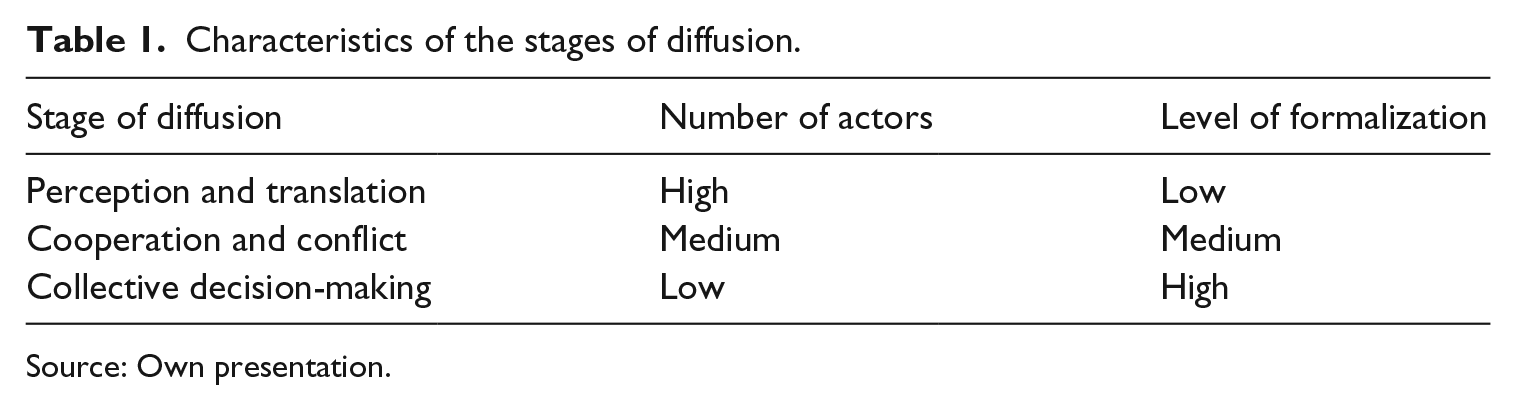
Relying on the stage heuristics of public policy (Jann and Wegrich, 2014), we distinguish different stages of the diffusion process: the stage of perception and translation, the stage of cooperation and conflict and the stage of collective decision-making. We argue that at each stage, different actors from both units are relevant, which act in a political and institutional environment that is formalized to different degrees (Table 1). We are not the only ones to identify different stages of diffusion: Gilardi and Wasserfallen (2019), for example, distinguish the stages of issue definition and policy adoption, emphasizing the often neglected fact that ‘diffusion influences policy making well before the adoption stage – at the issue-definition stage, when the nature, causes and solutions of problems are discussed from competing perspectives’ (p. 6). While policy adoption might be similar to our stage of collective decision-making, we also distinguish a stage of perception and translation as well as a stage of cooperation and conflict in order to capture how policies and ideas are diffused from one context to another.
Characteristics of the stages of diffusion.
Source: Own presentation.
The stage of perception and translation is at play when in the arena of unit B actors (national actors in constellation I or II) acknowledge international interdependence, acquire new knowledge of policies in other contexts and transform these into their own policy legacies. The active role of actors in unit B becomes tangible in emphasizing processes of perception, increased attention, deeper understanding, intellectual reception and reinterpretation. Translation includes both the transfer of ideas into different cultural and political contexts as well as the translation of terminologies in the literal sense (McCabe, 2007). It is important to note that this process is not necessarily formalized, as actors in unit B can gain new information through regular meetings or established communication channels, but can also come across foreign ideas rather accidentally. Moreover, the range of relevant actors of unit B that bring in new ideas and policies in this stage is rather broad, including not only policy actors that belong to the political system in a narrower sense – such as political parties, government officials and interest groups – but also, for example, scientists, journalists or activists. The public policy literature has conceptualized these actors as ‘policy entrepreneurs’ (Kingdon, 2011), ‘policy brokers’ (Ingold and Varone, 2012), ‘epistemic communities’ (Haas, 1992) or ‘instrument constituencies’ (Béland and Howlett, 2016) in order to emphasize the role of their experiences, networks and resources, but also by illuminating how they are bound by shared problem definitions or by advocating policy solutions.
The stage of cooperation and conflict refers to the discussion of ideas or policies on the national level (or, in constellation III, on the level of the IO) with a focus on the actors that are involved. We hypothesize that not only institutional and political structures (Boushey, 2010), but also the actors of unit B that participate in the debate at this stage of the process might significantly differ. The same holds true for the formal integration of actors such as policy entrepreneurs or epistemic communities. Actors are not determined by these institutional or political structures, but can actively shape how ideas and concepts are being processed. However, it is no exaggeration to say that the formalization at the stage of cooperation and conflict is stronger than in the previous stage.
The stage of collective decision-making refers to the actual decision on social policy programmes or reforms. Here, the circle of relevant actors is substantially narrowed down compared to the former stages and comprise the actors that are formally authorized to make decisions. Again, we expect institutional structures and relevant actors to differ substantially, and acknowledge (national) actors’ discretion in dealing with social policy suggestions.
Distinguishing the different stages of diffusion has the advantage that the stages can be used symmetrically for units A and B. Furthermore, no side is previously attributed an active or passive role. The diffusion can be solely due to the events in unit B, but it can also be due to a quite passive adoption of the proposal pushed by a persuasive and/or powerful unit A.
When distinguishing the three stages, our analytical focus is on the actors and actions taking place in unit B in order to emphasize the active role of this unit. In fact, from unit A’s point of view, the three stages can take place as isolated events in unit B without any participation by unit A. Then it is up to unit B that a proposal, for example, publicly accessible worldwide, is adopted. However, there are cases with highly active actors from unit A, who actively engage in diffusion and intensively intervene in the diffusion process in unit B, such as, for example, IOs or transnational civil society actors (Orenstein, 2008). Supported by the distinction of three stages, such an interventionist activity of unit A can also be detected.
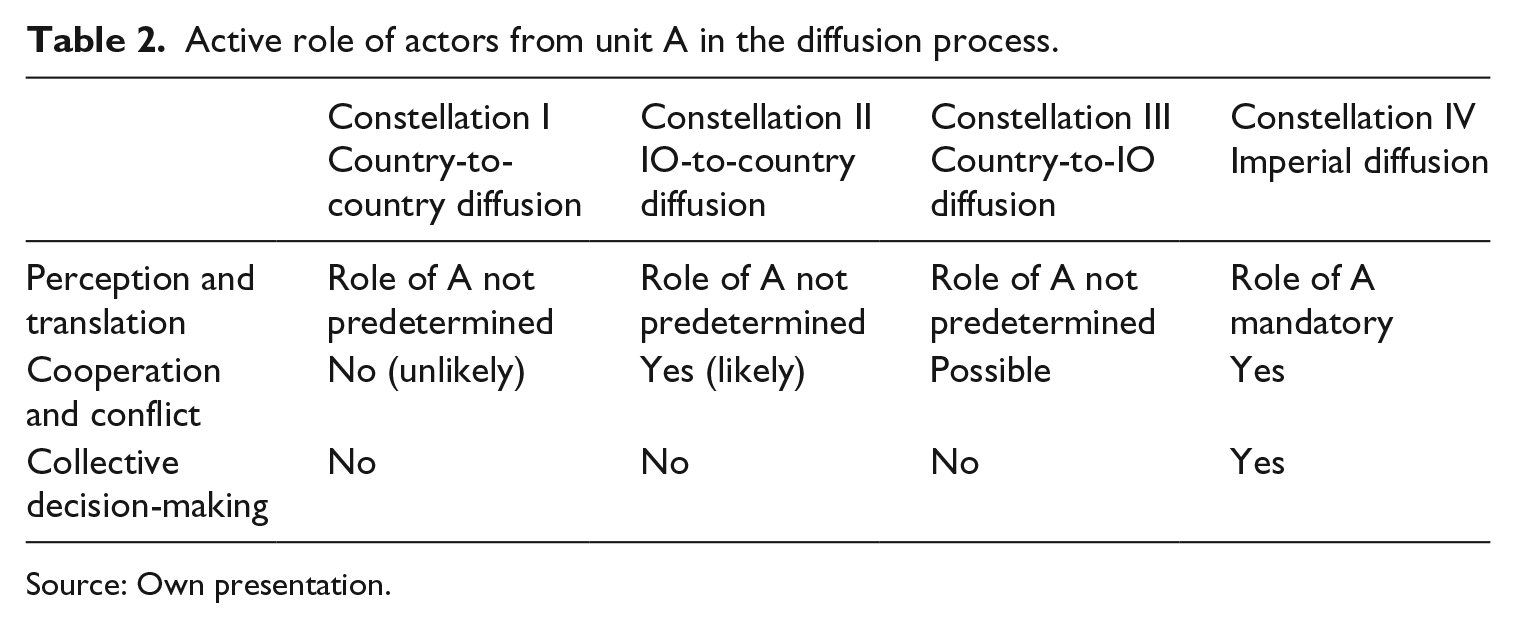
Combining the constellations of diffusion with the stages of diffusion, it becomes possible to reveal the different role of unit A within the diffusion process (Table 2).
Active role of actors from unit A in the diffusion process.
Source: Own presentation.
In constellations I–III, the fact that unit A becomes the starting ground of the diffusion process in the stage of perception and translation is not predetermined, but can be the result of different factors or processes, for example, having implemented a successful policy due to hegemonic factors (Dobbin et al., 2007 name some examples when outlining the different mechanisms of diffusion). Constellations I–III also share the characteristic that actors from unit A do not play a role in the stage of collective decision-making. However, the role of unit A in the stage of cooperation and conflict distinguishes the three constellations: an important role of actors from unit A is rather unlikely in constellation I, as unit A serves as an inspiration, but is most likely not prominently involved in the discussion on the national level. When it comes to constellation II, however, we assume that actors from unit A are involved. In constellation III, both an involvement of actors from unit A and a stage of cooperation and conflict without actors from unit A is possible. In contrast, in the fourth constellation, unit A is involved in all stages of the diffusion process.
Promoters of diffusion
If we focus on stages and constellations only, our understanding of diffusion remains rather static. If policies and concepts are moving from one context to another, there need to be entities that carry these policies from unit A to unit B. We define these entities as promoters of diffusion, meaning entities that transmit policies from one context to another. It is important to note that although promoters transmit policies, this does not mean that these policies cannot be seriously modified before they are being adopted. We argue that promoters operating on the micro-level are largely neglected in the existing diffusion literature (Jahn, 2015), leading to an undue reduction of the complexity of the diffusion process. While promoters of diffusion can be wide-ranging, we consider people, money and procedures to be of particular importance.
While actors are largely neglected in the literature on diffusion mechanisms, in the IR and public policy literature it has been widely acknowledged that people play a crucial role for the diffusion of ideas, especially when it comes to the role of knowledge. While the actor conceptualizations that have been introduced above (policy entrepreneurs, epistemic communities, etc.) underline the role of actors in generally shaping the diffusion processes (through their knowledge, resources or networks), the analytical focus of our promoters is slightly different, as we are interested in the role of individuals and their (literal) pathways from one diffusion unit to another.
Apart from people, we find that money shapes diffusion processes significantly. Existing research on diffusion emphasizes that money matters, but focuses particularly on the role of financial incentives that unit A can provide to make unit B adopt similar policies. This picture is, however, incomplete: first, the established typology of mechanisms does not capture the role of financial incentives, as these can trigger emulation, learning and competition, and also involves coercion to different degrees. More importantly, however, the role of money is not limited to the role of financial incentives but can act as a promoter of ideas in various ways, particularly to finance the transfer of ideas by providing money for research and exchange of experts (e.g. through conferences, workshops or study trips) (Foli, 2016).
Procedures are a third promoter of social policy that has so far not systematically been included in the study of diffusion. We conceptualize procedures as structured set of rules, including the sum of normative requirements that a procedure has to correspond to in order to be classified as such. It is important to note that procedures are not only a structure that is being diffused, but that this structure carries specific types of policies (such as the introduction of New Public Management which carried activation policies).
Promoters do not only help us to understand how policies are actually being transmitted from unit A to unit B; they might also be helpful for identifying the interventionist activity of unit A, as promoters can, for example, be used by unit A to enhance the perception of the unit’s suggestions.
Historical diffusion research using the refined model
We aim to demonstrate the analytical value of our refined model of diffusion – as well as the deficits of the existing diffusion mechanisms – by introducing two examples from social policy that describe the travelling of social policies in the earlier stages of social policy developments. The fruitfulness of the model should especially become evident in the analysis of historical cases in which special constellations and promoters of diffusion are to be expected. We use examples from the 19th and mid-20th centuries to underline that – in contrast to diffusion research which has only gained momentum in the second half of the 20th century – the diffusion of social policy ideas and concepts is in fact far from being new and that our conceptual endeavours are helpful to understand very different conditions of diffusion. We have selected two cases that cover different constellations, stages and promoters of the proposed model: our first example focuses on education policy in Argentina and Chile in the 19th century, highlighting the pivotal role of people as promoters in all stages of the diffusion process in a constellation of country-to-country diffusion (constellation I). Our second example focuses on a diffusion process within the British Empire (indicating a process between a dominant regime A and a legally dependent unit B, constellation IV), highlighting the stage of cooperation and conflict and procedures as promoters of social policy.
Education policy in Argentina and Chile in the 19th century: the role of exile
The first example involves the diffusion of policy ideas between Argentina and Chile in the 19th century. Both countries are until this very day connected by their shared experience of Spanish colonial rule, their common language, religion and remarkably similar sets of values. Moreover, both countries attributed a great importance to education, but only Chile managed to become a pioneer on this field. This was in large part due to the arrival of foreign intellectuals seeking exile, who can be conceptualized as promoters of diffusion.
The policy field of education was of utmost importance for the newly founded Spanish American republics because the ‘creation’ of new citizens, and thus the future of the newly established republics, was thought to depend on education. Chile devoted large amounts of money and much effort to the ‘reform of society through the educational system’ (Yaeger, 1983), while the constitutions of 1828 and 1833 conceived of the national state as the ‘educator state’. Although the state did not have to run schools directly, it was under the obligation to invest in education and to improve its quality. This provided a fertile context for the diffusion of new educational ideas and concepts which were brought to the country by, among others, exiles from Argentina.
The established connections between Chile and Argentina enabled exiles to move with relative ease from one country to another. In the aftermath of the wars of independence, political violence and exile ‘became a distinct mode of conducting politics’ (Sznajder and Roniger, 2007), particularly in Argentina. By contrast Chile was characterized by lasting political stability and the existence of individual liberties and property rights (Collier, 1967), and attracting large numbers of Spanish American intellectuals. Many of them had fled Argentina and arrived in Chile via Uruguay in the years after 1831, bringing with them their ideas about educational reform.
The key promoter of educational reform ideas was the Argentinian Domingo Faustino Sarmiento (1811–1888), who spent three periods of exile between 1831 and 1868 in Chile. Upon arriving in Chile for the first time in 1831, he took up teaching for a living and soon became known for his innovative style of teaching, which resulted from his contact with French concepts and his ideas about how to teach, as well as new insights into what was to be taught. He returned to his native country in 1836, but came back to Chile 4 years later and spent the following 11 years there. At this time, he also joined a group of young intellectuals called ‘generación del 37’, the Generation of 1837, whose members would eventually emigrate to Chile. Chile recognized them and other exiles as ‘nonpartisan experts’ (Jaksic, 2013) at a time when the notion of the policy expert did not yet exist. These men would be trusted to give advice on the creation of new institutions and working bureaucracies. Sarmiento can be seen as an important promoter, strongly shaping the diffusion of educational policy ideas at the stage of perception and translation in Chile. However, what is special in this case is that eventually, the exiles would become part of the Chilean state by obtaining official posts. Thus, they also became promoters in the stage of cooperation and conflict and even collective decision-making.
The Chilean educational system gradually expanded over the 1830s, 1840s and 1850s, and Sarmiento became an official part of this system. A reliable increase in the number of teachers, and a high standard of their education was to be achieved by the creation of the first Escuela Normal de Preceptores in 1842, which marked an important step in the professionalization of teaching. The institution owed its foundation to Sarmiento’s initiative, who also became its first director. Seen as an important investment in the country’s future, educational reform was in line with the Chilean ‘visions of modernity’ (Miller, 2008): new teachers would turn Chilean modernity from a distant utopia into a blazing reality. This required more and deeper knowledge of the American and European educations systems. Therefore, the Chilean government paid Sarmiento to tour neighbouring countries such as Brazil and Uruguay and European countries such as England, France, Germany, Italy and Spain to inspect schools and institutions of higher education. Sarmiento wrote reports for the Chilean government and published a book on this tour in 1849, again playing a key role in the stage of perception and translation. After yet another period of exile in Chile, Sarmiento returned to Argentina and became its president from 1868 until 1874, only to return to the field of education in 1875 as director of the schools of the province of Buenos Aires. His exile in Chile had provided him with the opportunity to work actively on educational reform and to establish new ideas which would drive new institutions and lead to new programmes. After his return to his native Argentina, Sarmiento would continue to work on these ideas. In 1882, he was successful in passing a law which allowed for the freedom of education, which became obligatory and separated from religion, effectively establishing lay education.
The description of the case shows the weaknesses of the mechanisms of diffusion: placing this case under the diffusion mechanisms of learning or emulation misses the point, because the ideas that Sarmiento developed and implemented in Chile had not been in his native Argentina yet. Competition and coercion are also inadequate to capture the case at hand. However, by dismissing this case as an example of diffusion we would miss the chance of gaining important insights into early diffusion processes in social policy. In fact, our refined model illuminates important aspects of the diffusion process. First, classifying the example as country-to-country diffusion (constellation I) allows us to say something about units A and B in the diffusion process. The formalized role of Argentina (unit A) in shaping education policy in Chile (unit B) is actually quite limited. Sarmientos transmitted policies from unit A to unit B, but unit A as a political system was not involved in the different stages of the diffusion process. Thus, understanding how Argentinian concepts were discussed and actually put into practice by Chile (unit B) is crucial. What is more, this example highlights that individuals take their ideas with them when they move, and therefore can be seen as key promoters of diffusion. Whether their decision to move is taken freely does not necessarily matter here unless you take into consideration that many of the experts in the field of education in the 19th century would not have considered moving to Chile under different conditions. Many of them were interested in staying close to the place they had been forced to leave, so Chile became an obvious choice. Exile thus produced a very specific transnational network in the Southern Cone and a ‘corridor of ideas’ (Biagini, 2000) that reached well up to Brazil and was decisive for education as well as other fields of social policy.
Social policy in the British Empire: emergence and spread of a procedure
Our second case focuses on the emergence and spread of a new procedure in the 1930s that has persisted ever since in the world of ‘development’, and how this procedure affected the stage of cooperation and conflict. The ‘Colonial Development Act’ of 1929 and its successor, the ‘Colonial Welfare and Development Act’ of 1940, led to numerous social policies in the 48 British colonies. The procedures that came about with this act had a lasting impact on colonial and post-colonial settings of social policy in the Commonwealth countries. The procedure can thus be understood as a key promoter that played a role in the diffusion process from a dominant regime A to a legally dependent unit B.
The main actors for social policy in the British colonial empire during the period between 1918 and 1950 were the following: colonial governments chaired by a governor in each of the 48 colonies; the Colonial Office as the ministry in London; the Treasury as a veto-player for everything the Colonial Office planned; a host of politicians with different agendas and commitments; and a national public in the United Kingdom with diverse economic interests and moral convictions. The boom of colonial social policy set in after World War II. While between 1929 and 1940 only 16% of projects in ‘development’ were dedicated to social policy, they accounted for more than 40% of expenses of the development fund between 1946 and 1957 (Wicker, 1958: 189). However, the year of 1929, when the ‘Colonial Development Act’ was passed, marked the turning point. Before 1929, any policy carried out in the colonies was ad hoc. Governors of colonies formulated demands for investments, either as grants or loans, vis-a-vis the Colonial Office. While the Colonial Office often supported the demands, the Treasury was always against them. Usually, the fight between the two government agencies would go on for a while, with the Treasury having the upper hand. In other instances, the secretary of state for the colonies could mobilize political support by high-ranking officials or politicians. They could often crush the resistance of the Treasury so that at least partial sums would be released to the respective colony (Constantine, 1984: chap. 5).
The ‘Colonial Development Act’ of 1929 brought about two changes: it meant a fixed budget of 1 million British pounds per year for ‘projects’ that colonial governments could apply for, and it created the ‘Colonial Development Advisory Committee’ (CDAC). In comparison to the practice before 1929, this meant basically a formalization and a proliferation of decision points: governors of colonial governments could send in grant applications, the CDAC would give or withhold a recommendation and, finally, both the Treasury and the Colonial Office had to approve the recommendation before funds were released (Constantine, 1984: 196). While ‘public health’ was one of the policy fields for which colonial governments now could obtain either loans or grants, most of the fund was reserved for infrastructure projects. It was believed that ‘development’ in the colonies would increase demand in the colonies for British products, thus having an effect on unemployment in Britain (Wicker, 1958).
The members of the CDAC were almost all former colonial officers with experience in India, Palestine, Nigeria or Sudan. While working for the CDAC, some of them also held positions in private companies that had branches in the colonies. This observation confirms the established knowledge about the professional trajectories in the British Empire – it was common practice that colonial officers moved from one colony to the next after a few years of service, which again illustrates the crucial role of people as promoters of diffusion.
Social policy was not the top priority of the applications coming in. In the beginning years, only 16% of the projects funded were devoted to ‘public health’ issues, but over time it became an ever more important subject of projects (Meredith, 1975: 492). Political unrest was increasingly perceived as a social problem (Veit et al., 2017). A Royal Commission, which investigated, for example, the ‘riots’ in the West Indies, came up with the recommendation of more welfare spending (Wicker, 1958: 181). In the late 1930s, within the Colonial Office plans emerged to establish its own Social Service department (Constantine, 1984: 237). Labour MPs demanded more expenses on social services than what colonies could afford by themselves (Wicker, 1958: 180). Furthermore, there was seemingly Keynesian influence also in Treasury, and government spending to create domestic demand was an idea that began to count since the mid-1930s (Constantine, 1984: 228). All these changing perceptions had an impact on the ensuing negotiations in the stage of cooperation and conflict, and the alliances and enmities between governmental and political actors that dealt with the future of the colonies. Although the Colonial Office and the CDAC clearly had a say at this stage, there was no general scheme or plan of the Colonial Office or the CDAC on how ‘development’ would work. Rather, all projects depended on the initiatives of governors (Constantine, 1984: 220). Neither the committee nor the Colonial Office had a comprehensive view of needs in each colony and left the selection of what to take care of to the governors (Wicker, 1958: 177). Not all colonial governments made use of the new scheme all the time: During the first decade, there were less appropriate applications from the colonies than hoped for – in 10 years, 1929–1939, altogether 822 applications from 48 colonial governments came in. Seemingly, many colonial governments feared the ensuing debt burden, especially as in the 1930s prices for raw materials fell, leading to less export tax earnings of colonial governments (Constantine, 1984: 202–204). Single colonial governments that wanted to gain a loan or grant for their projects had to follow this form and the reasoning on purposes and procedures in order to obtain the funds, which is why the procedure constituted a promoter of social policy ideas and concepts from the empire to the colonies. With the ‘Colonial Development and Welfare Act’ of 1940, the fund was considerably expanded – £5 instead of £1 million per year – but the new legislation did not change the procedure. It was also an extension of scope, now encompassing more elements of welfare, but not in institutional design.
This case shows as well that the four established mechanisms of diffusion are unapt to cover the spread of social policy in important instances. Although it involves the imitation of an application procedure, this does not – at least in the first place – imply emulation (or learning) of actual policies. Coercion also does not characterize the process, as the prescribed procedure for applying for money does not directly prescribe certain policies. The competition mechanism is also inadequate to define the process. Again, our refined model is able to highlight important aspects of the diffusion process. As a case of ‘imperial diffusion’, unit A is present in the stage of cooperation and conflict, but by definition also in the other stages of the diffusion process. Still, actors of unit B are crucial for making policy diffusion happen, as they had to take up initiatives and make formal decisions. Moreover, the example shows the establishment of project funding as a new procedure for diffusing social policy ideas.
Summary and conclusion: towards smaller-scale causal mechanisms of diffusion?
Building on a critical engagement with the diffusion literature, the aim of this article was to introduce a refined model of diffusion that sheds light on crucial aspects of the diffusion process that have so far been neglected in most diffusion studies and that allow to study diffusion also in historical periods in which the nation state is not the relevant unit of analysis. By introducing our refined diffusion model, we aim to show conceptual alternatives to the four mechanisms that continue to dominate most diffusion studies. Our point of departure is the distinction of unit A – providing the starting ground – and unit B – designating the ‘receiving’ unit – of the diffusion process. Based on this, we, first, introduced four constellations of diffusion. Second, we distinguished three stages of diffusion and highlighted the changing role of actors from both units within these stages, as well as the institutional and political structures that shape the diffusion process at different stages. Finally, we have complemented the macro-focus of the diffusion literature by introducing people, money and procedures as crucial promoters of diffusion at the micro-level, which play a key role across all stages and constellations of the diffusion process. By introducing two historical examples from the field of social policy, we aimed to demonstrate the added value of our model, while at the same time highlighting the deficits of the existing diffusion mechanisms to provide explanations. Moreover, the case studies have emphasized the pivotal role of actors of unit B compared to unit A.
What are the implications of our findings for future research? The need for a refined diffusion model derives, in our view, from a double terminological confusion. First, the concept of diffusion obscures – partly due to the homonymic concept from the natural sciences – that policies are not simply diffusing from one unit to another, but that they are being actively transformed by policy actors to work in new contexts, thereby not overcoming all differences between the diffusion units. While it is of course not desirable to completely abandon the term diffusion, sensitizing for the implications the term carries is a crucial first step for further refining the concepts that diffusion research has at hand for analysing empirical phenomena.
Second, the conceptual vagueness of the diffusion mechanisms entails a theoretical and methodological discussion on causal mechanisms that allows for better explanations of diffusion. For this endeavour to be successful, we think that smaller-scale mechanisms need to be identified. Causal mechanisms have been described as crucial for explanation in the social sciences, as ‘proper explanations should detail the cogs and wheels of the causal process through which the outcome to be explained was brought about’ (Hedström and Ylikoski, 2010: 50). We argue that with our refined diffusion model, we have paved the way for the identification of such smaller-scale causal mechanisms, as we have illuminated crucial elements of diffusion processes that are often overlooked in current diffusion studies, as well as in the diffusion mechanisms at hand. As our analysis has shown, such smaller-scale mechanisms would need to put actors centre stage. For our refined diffusion model to reach its full explanatory potential, further conceptual and empirical research on diffusion processes is needed, which identifies causal mechanisms by departing from the different constellations, stages and promoters.
Footnotes
Funding
The author(s) disclosed receipt of the following financial support for the research, authorship, and/or publication of this article: Funded by the Deutsche Forschungsgemeinschaft (DFG, German Research Foundation)– Projektnummer 374666841 – SFB 1342.
