



Abstract
In the network society, the capacity to deal with societal issues is spread among interacting actors in governance networks. Knowledge about this capacity, often called “governance capacity,” is still fragmented and quite incoherent. The aim of this study is therefore to gain an integrated understanding of governance capacity. To do this, we conducted a literature review and organized focus groups. This resulted in the selection of five elements of governance capacity: (1) collective action, (2) coordination, (3) resilience, (4) learning, and (5) resources. We used these elements to form the first contours of a governance capacity framework.
The Need for an Integrated Understanding of Governance Capacity
In today’s network society, the capacity to deal with societal issues and to realize public value is no longer limited to public authorities. It is spread among many different actors and is influenced by their interactions and by the context in which they operate. This collective capacity, often called governance capacity, is the focus of this paper. Governance capacity becomes visible when there is a quest for “concerted agency,” and actors have to collaborate to deal with a certain societal challenge, for example: when municipalities want to ensure public service delivery in urban neighborhoods together with community-based initiatives and local welfare providers; or when farmers want to improve fresh water supply by constructing new canals in cooperation with water management authorities; or when innovative start-ups try to cocreate sustainable energy solutions. In all three examples, the realization of these ambitions depends upon collaboration between mutually dependent (public, private, and societal) actors who possess unique resources necessary to realize the objectives.
Although the theoretical and empirical work on governance is increasing, knowledge about what constitutes governance capacity is still fragmented and quite incoherent. Most scholars focus on a specific part of governance capacity. For instance, knowledge on “adaptive capacity” focusses on the capacities of governance actors and networks to adapt to a changing environment (e.g., Gupta et al., 2010; Pahl-Wostl, 2009; Termeer et al., 2010). Taking a similar nonintegrative approach, studies on “collaborative capacity” have emphasized the capacity of actors to engage in processes of collaboration and deliberation, to align their ambitions, and to come to joint action (e.g., Healey, 1998; Imperial, 2005; Innes & Booher, 2003; Weber et al., 2007). Meanwhile, authors on “policy capacity” have concentrated their research on the capacities needed to prepare and implement policy in a multi actor-setting (e.g., Parsons, 2004; Wu et al., 2015). Also in recent attempts to assess governance capacity, only specific capacities are taken into account. Like a framework on the capacities to know, want and enable action in water governance (Koop et al., 2017), and a framework to analyze the combination of formal and interactional capacities (Stoker, 2019). All these related capacities seem to be relevant for governance capacity, but do not cover the concept fully.
A more comprehensive and integrative understanding of governance capacity is lacking. This comprehensive understanding contributes to the debate on and analyses of governance capacity by scholars, and could help actors to reflect on and develop their governance capacity. The research question of this study is, how can governance capacity be understood in an integrative way, and, consequently, can a framework be developed for integrative governance capacity? To answer this, we conducted a literature review and discussed the (preliminary) results in focus groups with experts from both the science of public administration and from governance practice. In this paper, we present the results of this research process. In the next sections, we introduce the concept of governance capacity and describe the research process in detail. Thereafter, we select five elements of governance capacity based on the results of the literature review. In the fifth section, these elements are elaborated and operationalized. We finish the paper with the first contours of a governance capacity framework.
Introduction on Governance Capacity
Governance
In the 1990s, the concept of governance was used to describe different shifts in government, such as the shift to the market, and the simultaneous shifts to the regional and the international governance levels (Pierre & Peters, 2000). In 1996, Rod Rhodes described the variety of interpretations of governance and defined governance as “self-organizing interorganizational networks” (Rhodes, 1996, p. 660). In line with this reasoning, different scholars created the background for more precise understandings of the concept of governance. Stoker (1998) presented five propositions on governance, in which he focused on the blurring boundaries and responsibilities, the power dependence involved in relationships, and the autonomous self-governing dynamics of governance. The work of Pierre and Peters (2000) was also of importance, especially their distinction between governance as a structure with different appearances—hierarchies, markets, networks, communities—and governance as a dynamic process—which is about evolving relations and interaction between actors with different agendas using different strategies. This distinction was further elaborated on by Levi-Faur (2012), who stated that the concept of governance has at least four meanings in the literature: a structure, a process, a mechanism, and a strategy. Besides the work on governance related to government and public value creation, the concept governance was also applied in other contexts, like in economics and management (e.g., Williamson, 1996).
In the literature on governance, three main characteristics can be found. Firstly, governance is always related to a collective issue. Governance is about issues in which actors aim for collective action (Kooiman, 1999; Stoker, 1998). Secondly, governance is about interaction between different actors. These actors have different frames, and the boundaries between their interests and responsibilities are blurred (Osborne, 2006; Stoker, 1998). Governance is about “a shift in responsibility, a stepping back of the state and a concern to push responsibilities onto the private and voluntary sectors and, more broadly, the citizen” (Stoker, 1998, p. 21). Given these blurring boundaries, collective action on these issues requires the involvement of all these actors. Thirdly, these actors have different resources related to the collective issue. These resources are spread and, to deal with the collective issue, exchange of resources is necessary (Bevir, 2011; Koppenjan & Klijn, 2004; Rhodes, 1996; Stoker, 1998).
Governance Capacity
When it comes to the concept of capacity, there is a lack of a shared understanding, and, moreover, a common frame of reference is missing (Morgan, 2006). Morgan (2006) suggested defining capacity in general as “that emergent combination of attributes that enables a human system to create developmental value” (p. 8). Such general definition becomes meaningful in relation to a specific object or context. For instance, capacity in health care is about the availability of beds and doctors, whereas the capacity of a computer is about the amount of information which can be stored and processed in a period of time. Fukuyama (2013) mentions another crucial characteristic of capacity; capacity is about a potential. He made this clear by indicating capacity measurement as a way to measure input, which differs from procedural and output measurements. By capacity measurement, the potential could be analyzed without analyzing whether this is successfully used or whether the use of the capacity leads to better performance.
Combining the three general characteristics of governance—collective issues, interaction between different actors, and the exchange of resources—and our understanding of capacity, we can formulate a provisional definition on governance capacity as a starting point for the literature review: governance capacity is the potential of actors to coordinate their actions and the deployment of resources in the pursuit of collective issues. In the literature on governance, many other characteristics can be found, including a wide range of specific activities, structures, procedures, and techniques. However, we will approach governance from these three general characteristics to ensure a broad perspective on governance capacity.
Methods
To come to an integrated understanding of governance capacity and, consequently, to develop a comprehensive framework, we combined a systematic literature review with focus groups with experts from science and from governance practice.
Systematic Literature Review
Part of the iterative research process is a literature review on governance capacity. To ensure the systematic approach of the literature review, we applied the widely used Preferred Reporting Items for Systematic reviews and Meta-Analyses; the PRISMA Statement (Liberati et al., 2009; Moher et al., 2009). This statement comprises three phases: identification, screening, and analysis.
In the identification phase, we selected relevant records in a three-step process:
(1) Records on governance capacity: all records with “governance capacity/ies” or “governance capability/ies” in the title/abstract/keywords were selected.
(2) Related concepts: based upon the working definition of governance capacity, related concepts were identified (see Appendix 1). We mention these related concepts as “* capacity.” The list of related concepts was based on all related capacities which we found in governance literature.
(3) Records on related concepts and governance capacity: all records with “* capacity” AND “governance” in the title/abstract/keywords were selected; all records with “* capacity” in the title/abstract/keywords AND “governance capacity” in the full text were selected.
For the selection of records, we used Scopus and Google Books (at 24–25 October 2016).
In the screening phase, in which abstracts and full texts were screened, several eligibility criteria were used. From the provisional definition of governance capacity as presented in Section 2.2, we formulated five eligibility criteria:
(a) We select only those studies in which the actors, the holders of governance capacity, are mentioned.
(b) We select only those studies in which governance capacity is about coordination, and not those about steering, regulating, controlling, et cetera.
(c) We select only those studies on governance capacity in which resources and/or the deployment of resources is mentioned.
(d) We select only those studies in which governance capacity is related to collective goals.
(e) We select only those studies in which governance capacity is defined as a distinctive concept, and not those in which governance capacity is used as a synonym for other concepts.
Furthermore, we choose to select empirical as well as conceptual studies, to get a broad view on the concept of governance capacity in the existing literature. We selected only publications in English and limited our selection to peer-reviewed journal articles, books, and book chapters. We did not limit ourselves to the year of publication, although the search was limited to online sources. As researchers, we deliberated the selection of records by joint screening of some records and discussing the eligibility criteria.
The search resulted in 1.193 records (after duplicates removed). After screening and assessing for eligibility, a selection of 228 records remained and was analyzed (see PRISMA flow diagram, Figure 1). Among these records were 222 journal articles and 6 book chapters. These records were coded in NVivo12. We decided to code four broad categories: (a) definitions, (b) key elements, (c) mechanisms, and (d) interventions. Within these broad categories, we conducted a process of open coding. The codes as well as several coded papers were discussed by the researchers.
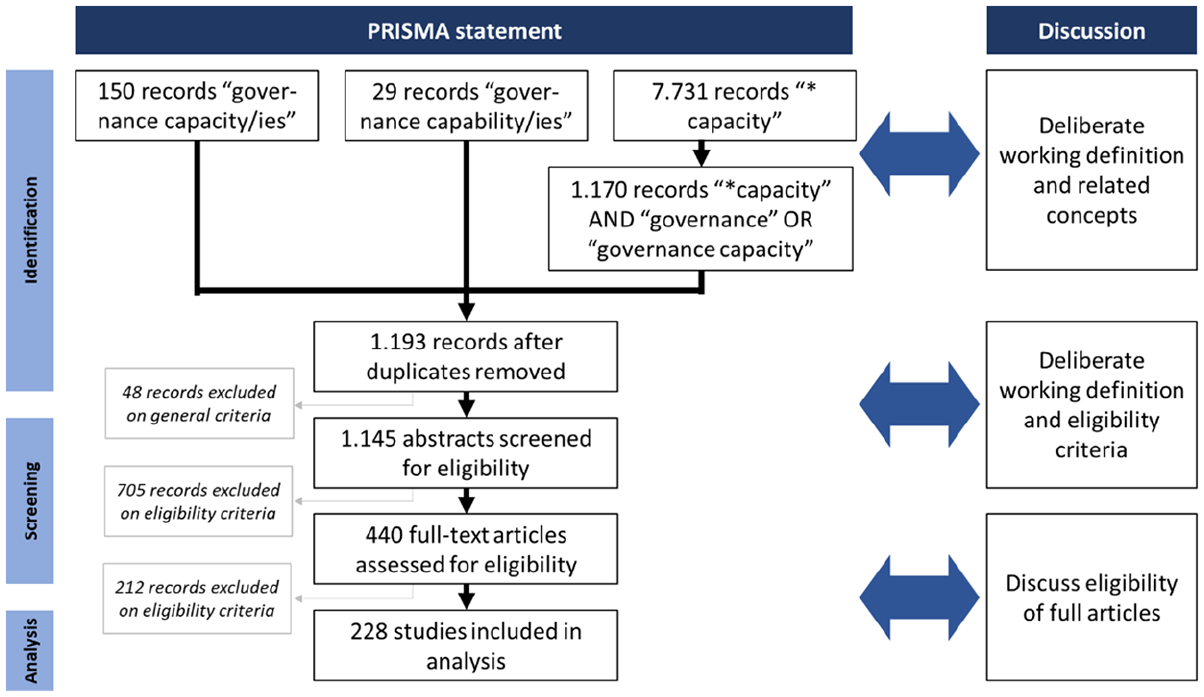
PRISMA flow diagram.
Focus Groups
During the systematic literature review, we organized four focus groups. In each of these groups, we used the preliminary findings to draft a preliminary version of the governance capacity framework, and discussed this framework in the focus groups. We summarize the four focus groups below:
Focus group with researchers from public administration. Six researchers involved in two recently studied governance cases were asked to use the first version of the framework to reflect on the governance capacity in the two cases. The first case was a network of regional public actors which collaborate to strengthen the labor market. The second case was a commercial initiative to introduce new tidal energy technology in partnership with governments, knowledge institutes, and private stakeholders.
Interactive session with the research team. The research team organized an interactive session to apply a revised version of the framework to reflect on a governance case. The case was a non-governmental organization for nature conversation which was developing a new governance strategy.
Focus group with civil servants. We invited fifteen civil servants involved in a collaborative water management program. We used the draft of the framework to analyze and discuss the current situation in this program. At the end, we reflected with them on the use of the framework.
Interviews with mayors and CEOs of municipalities on the local governance capacity of their municipality. We used the framework to structure the interviews and reflected at the end with the researchers involved on the use of the framework.
By means of the focus groups, we validated the draft framework which was based on the preliminary results of the literature review. The results of the focus groups were used to refine the literature review with some specifications. For instance, to improve the codes or to add sub-codes (the focus groups were during the literature review, earlier articles were re-coded), and to further specify the framework.
Construction of a Framework
In social science research concept construction is an important part of the research effort itself. Without making a clear choice for a theoretical concept or lens to collect and examine data, no meaningful conclusions can be achieved. We have adopted the concept of concerted agency to look at governance capacity. From the literature review and the focus groups, we constructed a framework for governance capacity. Although the literature was focused and demarcated by governance literature (as presented in Section 2), constructing the framework was an inductive process in which the results and the literature review were leading for the concepts and elements in the framework. This was validated in the focus groups (see Section 3.2). In this way, it is a conceptual framework in which existing views and the main concepts are structured and integrated (Goertz, 2006; Imenda, 2014), and which provides language to discuss on governance capacity (Ostrom, 2009 Nobel address).
Specifying Governance Capacity
In the literature review on governance capacity, different elements on governance capacity are mentioned. In this section, we use the results of the literature review to select the key elements of governance capacity and clarify the object of governance capacity.
Selecting Five Elements of Governance Capacity
In the literature on governance capacity, authors mention different key elements of governance capacity. In 100 of the 228 articles, authors mention explicitly these key elements. These elements do not refer to the components, conditions, or mechanisms which lead to governance capacity, but to what is perceived or understood as governance capacity. In the other 128 articles, authors did not mention explicitly what they understood as governance capacity. The elements of governance capacity were coded in the literature review and we analyzed the number of sources (papers and book chapters) for each element. The five elements that were by far the most mentioned are collective action, coordination, resilience, learning, and resources (see Figure 2, see Appendix 2 for corresponding references).
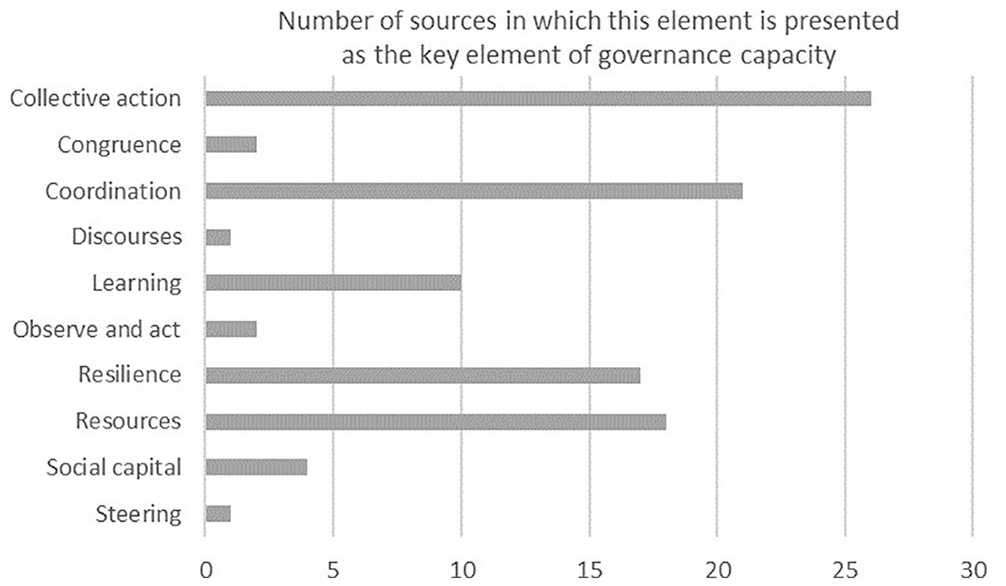
Number of sources for each key element of governance capacity.
When mirroring the five identified elements against the introductory remarks about governance and governance capacity that were combined in a provisional definition as a basis for the literature review, we find that three of them are well-captured and two tend to stand out: resilience and learning. These outliers broaden our understand of governance capacity because the emphasize the ability of interorganizational networks to (1) cope with and accommodate shocks in society, and (2) reflect on (the effectiveness of) their actions and adopt their ways of conduct accordingly. These additional elements seem to refer to “innate or given characteristics” of interorganizational networks in coping with societal challenges and steering productively toward their solutions. As such, the literature review reveals two elements that go beyond our initial understanding of governance capacity that was substantiated in the provisional definition. In the section below, the five elements will further be discussed.
Whose Governance Capacity?
Besides the selection of elements of governance capacity, we must also answer what the object is when governance capacity is studied. In the working definition, the focus is on actors around a collective issue. However, in the focus groups, we found two levels of abstraction that are both relevant for identifying and assessing governance capacity: (1) individual organizations in a network setting could have more or less governance capacity, and (2) networks could have more or less governance capacity.
The first level refers to the capacity of a single organization in tackling a governance issue. For instance, what is the governance capacity of a public water management agency to deal with the issue of climate change in different networks? The second level is the capacity of an inter-organizational network around an issue that calls for a collaborative steering effort. For instance, what is the governance capacity of a network of public actors, companies, and knowledge institutes to deal with the impact of climate change on water management? Governance capacity is thus relevant for organizations as well as for the networks they are part of. Of course, organizations and networks are highly intertwined in today’s networked societies, and their relationship is referred to as embeddedness (Granovetter, 1985) or part/whole (Provan et al., 2007). For deploying governance (for solving, mitigating, influencing, and/or reframing a societal issue), an actor needs a certain capacity of which mobilizing the relevant network is an important component.
The Concept of Governance Capacity Further Explained
In the previous section, five elements of governance capacity were presented: collective action, coordination, resilience, learning, and resources. In this section, we further explain the results of the literature review on these five elements and specify the adjustments we made during developing and using the framework in the focus groups. The references on each element are in Appendix 2.
Collective Action
In the literature on governance capacity, the capacity to come to collective action is mentioned most frequently. The most well-known author describing the concept of collective action is Elinor Ostrom, who extensively studied the roles that institutions play in either improving or blocking capacities to solve a governance problem, especially when governing a common good. Collective action is according to Ostrom, cooperative behavior of individuals or organizations to perform and to protect a joint goal (Ostrom, 2000, 2007).
In the literature on governance capacity, we found three complementary views on collective action. Firstly, governance is the result of the actions of actors. Consequently, the capacity to come to actual actions is part of governance capacity. Governance capacity is about the “flow of day-to-day actions” (Coaffee & Healey, 2003, p. 228).
Secondly, governance is also about the relation between the actions of individual actors: the interrelated actions. In a governance setting, actions influence each other. As Fallov (2010, p. 797) stated: “It is the ‘actions upon actions of others.” This relation is described by authors as the interlinks, the interrelatedness and synergies between actions. Altogether, the interrelated actions result in collective action. Because the actions interlock, actors within a governance network are able to “operate as a collective actor” (González & Healey, 2005, p. 2056), thereby overcoming the social dilemma between individual actors. In Ostrom’s (2007) work about common pool resources, she described the way in which interrelated actions emerge in self-organized collective action, moving beyond individual interests, and resolving the inevitable tensions between them.
Finally, authors mention the “room for action.” In a governance setting, the actions of one actor could leave more or less room for the action of other actors. This room is referred to as the field of action (Fallov, 2010) or the action potential (Caffyn & Jobbins, 2003). Collective action is thus also about “the ‘space’ or room for action within which stakeholders have to operate” (Caffyn & Jobbins, 2003, p. 228) and about “the management of possibilities, understood as the structuring of the possible field of action and thinking/knowing of others” (Fallov, 2010, p. 797). Some authors also mention the importance of decisive actions (D’Agostino & Kloby, 2011; Gissendanner, 2004), but, based on the focus groups, the room for action proved to be more important than decisive action. Particularly in a network setting, actors can leave more or less room for others to act, thus creating more or less potential for collective action.
Coordination
Governance capacity is also frequently defined as the capacity to coordinate. Collective action and coordination seem to be closely related or even the same. However, especially in a governance setting, actors attempting to coordinate their action may not necessarily achieve collective action. On the other hand, actions could strengthen other actions rather spontaneously without deliberate coordination. Therefore, we make a distinction between collective action and coordination.
The literature on governance capacity indicates that coordination is about the capacities of actors in a governance setting to inform each other about goals and actions, about opportunities and threats, and about issues and ambitions. This capacity also relates to the number of people with whom information is shared. Coordination will only arise if information is shared among some number of actors; a number of actors is needed “to achieve critical mass” (Meijers & Romein, 2003, p. 177) and “to feel included”(Forsyth, 2010, p. 685).
On coordination as part of governance capacity, authors not only emphasize attempts to share information, but also the realized coordination. Coordination can be realized at different levels, for instance, horizontal coordination (between organizations or networks at the same level) or vertical coordination (between organizations and networks at different levels). At these different levels, coordination is about “mechanisms that facilitate coordination within networks of interdependent actors” (Schout & Jordan, 2008, p. 959). This coordination leads to coherence and integration between actors, and prevents blind spots. This notion is very close to the work of Peters (1998), who described how overlap, lacunae, and incoherence is avoided by coordination.
A third element mentioned by the authors is the nature of coordination. Coordination based on mutual understanding, dialog, and reciprocity results in higher governance capacity. This is described as “their ability to engage in constructive dialogue” (Halpin & Daugbjerg, 2008, p. 192), “to reach mutual understanding” (Forsyth, 2010, p. 685), and, on a higher level, “its capacity to serve as an integrative rather than aggregative institution” (Skogstad, 2003, p. 323). This nature of coordination could be described as positive coordination (Scharpf, 1994) or principled engagement (Emerson et al., 2012). The opposite is negative coordination, based on task demarcations, rules, and enforcement. However, we did not find the value of negative coordination in the literature on governance capacity. Coordinative capacity thus includes the capacity to share information and to realize coordination based on mutual understanding and trust. During the use the framework in the focus groups, no adjustments were made.
Resilience
The third element from the literature on governance capacity, is resilience. Resilience is often related to adaptability and learning. During the focus groups, the concepts of learning, resilience and adaptation tended to overlap each other. Therefore, we made a stronger distinction between, on the one hand, learning (learn, reflect and improve) and, on the other hand, resilience (dealing with opportunities and threats).
In the literature on governance capacity in which resilience is its key element, almost all authors refer to the widely used definition of the Intergovernmental Panel on Climate Change (IPCC, 2007, p. 658): “adaptive, or resilience, is an ability to adjust to stress, to realise opportunities or to cope with consequences.” Following this definition, authors distinguish between opportunities and threats. Resilience is firstly about recognizing and using opportunities. In a governance setting, these opportunities can even be created: “the ability of actors (collectively and individually) to respond to, create and shape variability, change and surprise” (Hill & Engle, 2013, p. 178). Secondly, resilience is also about coping with threats and even taking advantage from them.
The opportunities and threats around a governance issue are by some authors described on the level of all changes in social-ecological systems. Others are more specific and mention, for instance, natural, institutional, economic, and political opportunities and threats. In the framework, we will focus on the way organizations and networks deal with opportunities and threats.
Learning
Learning and reflecting are mentioned many times in relation to governance capacity. However, reflection or learning in itself does not contribute to governance capacity. As governance capacity is related to potential and performance in a governance setting, learning must be framed as such as well and thus include improvements (Sabatier, 1987). The relation with change and performance is, by some authors, made by a three-step combination, such as “learn, reflect, and adapt” (Cosens & Chaffin, 2016, p. 2) or “learn, reflect and reorganize” (Fernández-Giménez et al., 2012, p. 838). We will also frame learning as a combination of learning, reflecting, and improving. Around learning, many distinctions are made in the literature. In an earlier version of the framework, we made the distinction between learning in a small team and learning in a broad network (one of the distinctions we found in the literature). During the focus groups, this distinction turned out to be vague, whereas the difference between individual/cognitive learning, social learning, and institutional learning turned out to be much more important.
Learning is about the cognitive possibilities of people to learn and reflect. These cognitive possibilities also contain the possibilities to experiment and innovate. The complexity of governance requires room for experiments to come to innovative solutions. In the words of Chaffin et al. (2016, p. 114), it is about “the ability to experiment and foster innovative solutions.”
Learning also has a social element. Authors emphasize this social element by concepts such as “social learning” (Coaffee & Healey, 2003, p. 1982; Pahl-Wostl et al., 2010, p. 573) or “collective learning” (Lane & McDonald, 2005, p. 718). Social learning is about sharing individual lessons and reflections, and then coming to joint lessons, reflections, and adaptations. Hence, social learning helps a network to come to new and shared knowledge, insights, and practices.
Finally, learning has an institutional element and, as such, is about whether learning becomes institutionalized. This institutionalization is important to facilitate and promote further learning. Authors describe this institutional learning as “the existence of institutions and networks that learn and store knowledge and experience” (Parsons et al., 2016, p. 6) and “institutions that integrate lessons learned” (Rojas et al., 2009, p. 241).
Resources
Actors in a governance setting have different resources. For instance, natural resources, physical assets, employees and their capacities, financial resources, knowledge and expertise, legitimacy, and network positions. Some authors interpret resources as having resources. In using the framework in the focus groups, we found that governance capacity is not just about having resources and the capacity of deploying them, but also about the capacity to exchange, mobilize, and manage resources. Authors mention this as the “ability to generate and manage resources necessary to govern” (DiGaetano & Klemanski, 1993, in Gissendanner, 2004, p. 47) and “to ‘better’ utilize existing capital resources” (Davies, 2009, p. 380).
In a governance setting, we could be more specific about resources. Resources are exchanged, mobilized, and managed by actors “to perform their functions” (Reddy et al., 2015, p. 161) and “to the formation of governance mechanisms” (Ataöv & Eraydin, 2011, p. 86). The exchange, mobilization, and management of resources is thus related to the execution of certain governance functions. This is close to the way Hood (1986) described the tools of government and, as such, linked resources to performing governance functions.
First Contours of a Framework of Governance Capacity
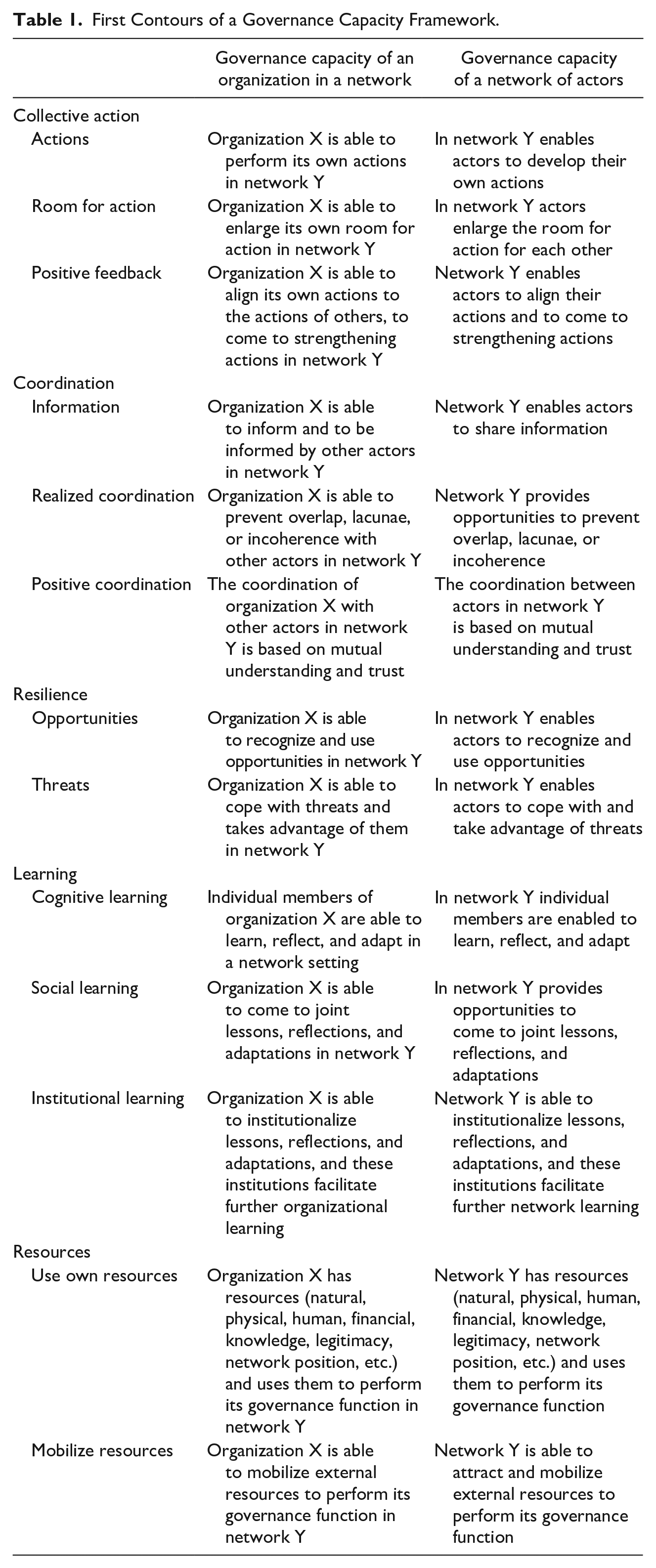
The five elements of governance capacity presented above are summarized in a framework (see Table 1). This framework can function as a starting point for studying governance capacity and the mechanisms that influence it. In governance practice, the framework can have a reflexive function; it can facilitate learning among actors within a governance context by collectively diagnosing what constitutes their ability to come to collective action. The way in which the framework is applied (in terms of data collecting, interpreting and using the results, and visualization) has to fit in this reflexive function; only when the framework is applied in dialog with involved actors (as a way of deliberative analysis), can it foster dialog, reflection, and, thus, capacity-building.
First Contours of a Governance Capacity Framework.
Reflections
The literature review which resulted in a conceptual framework, has a double value. First of all, the study leads to a more comprehensive understanding of what the concept of governance capacity entails. Different streams of literature were combined, all dealing with the question of what enables collective action in governance contexts. This integrative approach fits well with the complex and multi-faceted character of governance in which different steering modes become intermingled. Many actors contribute to collective issues and, accordingly, governance capacity is not only about internal resources of governmental organizations, but also about their coordinative, mobilizing, and adaptive capacities with which they mobilize the resources of other actors, aiming for a complementary collection of productive means.
Secondly, the construction of a framework is a first step in analyzing and reflecting upon the governance capacity of organizations and networks. The process of applying insights from the literature review in concrete attempts to analyze the governance capacity in focus groups, helped us to translate the theoretical concepts into items that make sense in the eyes of participants in day-to-day network situations. With this study, we do not suggest a next definition in the historical debate on governance, but we aimed to contribute to a better understanding of governance capacity.
The resulting framework of governance capacity also leads us to some critical reflections. While developing this integrated understanding of governance capacity, the meaning of capacity as a potential received less attention. In the analyzed literature, the idea of capacity as a potential was often not mentioned. Nevertheless, we are convinced that it is helpful to emphasize the fact that a certain capacity has to be used or deployed and that only the availability of this capacity is not enough to come to concerted action.
This relates to another difficult question, which is about the object of governance capacity. As stated previously, governance capacity is a property of governance networks and the organizations in these networks. In the dichotomy between being and doing, structure and agency, governance capacity adheres more to the latter than to the first (Wachhaus, 2014). On an analytical level, a distinction between capacity as a reservoir and what actors actually do, enables us to closely examine what is or can be deployed to steer or govern, apart from the question who is deploying this, in what way and with what effect. As such, governance capacity is not restricted to clearly defined entities but shared among public, private, and societal forces in their pursuit of public values.
Moreover, governance networks are constantly in motion. Actors join and leave. Interaction patterns evolve dynamically as do the structures that are in place to guide these interactions. This implies that governance capacity is constantly in flux and raises the question of how governance capacity can be monitored over longer periods of time rather than being assessed by a single snapshot. Based upon the framework presented in this article, it is a promising next step to add the temporal dimension to the analysis of governance capacity, in order to capture and understand the processes of erosion, consolidation, and building of capacity.
The focus of the framework is to understand governance capacity. Essential for further research is to gain insight into the mechanisms and interventions that help to strengthen governance capacity. For instance, which kinds of interventions enlarge governance capacity? How can capacity-building be set in motion? And what kind of collaborative arrangements could be designed to consolidate governance capacity? The framework is a first step in analyzing governance capacity and with it, a first step in studying the mechanisms and interventions that strengthen governance capacity.
Footnotes
Appendix 1
Appendix 2
Declaration of Conflicting Interests
The author(s) declared no potential conflicts of interest with respect to the research, authorship, and/or publication of this article.
Funding
The author(s) received no financial support for the research, authorship, and/or publication of this article.
