




Abstract
Brexit leads to uncertainties about how policies will be ‘rescaled’ from the European Union back to the United Kingdom and its devolved governments. Interviews with key Scottish Government officials show how the UK’s withdrawal from the Common Fisheries Policy presents mixed challenges for the Scottish policy system to absorb policy change at analytical, administrative, political, and communicative levels. Our analysis finds that absorbable areas concern fisheries management, operations, and analysis. Yet there are capacity areas that will require greater investment at political, communicative, and relational levels. This article makes an important contribution to research on the multi-level governance capacities for accommodating Brexit in UK policy-making. In doing so, our contribution applies the governance capacities literature to a new field of scholarship in relation to Brexit studies.
Introduction
The United Kingdom’s (UK) withdrawal from the European Union (EU) has brought the issue of governmental capacities into sharp focus. Capacities are fundamental to the maintenance of governmental business (Matthews, 2012; Lodge and Wegrich, 2014; Egeberg and Trondal, 2018; El-Taliawi and Van Der Wal, 2019).They matter for public policy and administration because ‘having a capable public sector that is able to optimally align resources with actions and actually implement designed policies is … a crucial factor in any state’s quality of government’ (El-Taliawi and Van Der Wal, 2019: 2). Over the last few decades, UK governance has been marked by Europeanisation and hollowing out processes, which have gradually eroded the centre’s capacities in policy-making (e.g. Connolly, 2014; Knill et al., 2001). The context of austerity since 2010 has seen the size of the UK civil service reduce and the governance challenges posed by Brexit raise further questions about governmental capacities. Recent research focussing on the impact of Brexit on environmental policy found capacity to be a key variable insofar as a lack of capacity restricts the UK’s ability to diverge from EU policy in the short term (Burns et al., 2019). Further complications emerge by the fact that post-Brexit capacities challenge many competencies that are formally devolved, meaning that capacities will need to be developed across multiple levels of governance.
The central question underpinning this article is: What are the implications of Brexit for the governance capacities of Scottish fisheries from a devolved perspective? We address this post-Brexit capacities question by examining the repatriation of fisheries policy from the EU. Specifically, it explores the governance capacities within one of the UK’s four fisheries administrations: Marine Scotland. Fisheries represent the ideal case to assess post-Brexit governance and capacities within the UK’s multi-level setting. First, fisheries policy is an exclusive EU competence so it has been subject to significant Europeanisation, and much of the existing policy-making capacities are located at the EU level. Second, although being relatively small in the context of the UK’s overall economy, fisheries was politicised during the UK referendum campaign. High expectations have been set regarding the future of fisheries governance once the UK leaves the EU. Third, fisheries policy is a formally devolved competence, but cannot operate in isolation from other competencies reserved by the UK government, including international relations and trade. This highlights the importance of developing multi-level governance capacities.
The article makes distinct contributions to hitherto disconnected streams of literature. From a public policy and administration perspective, it offers an applied empirical application of capacities research in contemporary governance. Our approach, therefore, is to understand the applied aspects of capacities by formulating an analytical framework for making sense of multi-layered capacities in the context of Brexit. Whereas existing research has focused predominantly on the policy uncertainties and a range of more political and democratic questions (see the following Brexit special issues: Bailey and Budd, 2019; Wincott et al., 2017), this article offers an assessment surrounding the public administration and delivery aspects of Brexit. In addition, the article contributes to a growing body of marine social science research by highlighting how issues of governance and public administration, are central to the delivery of fisheries and wider marine policies. Our argument, based on our findings, is that Brexit has brought to light the fact that capacity types are dependent on each other within a multi-level governance environment. However, political capacities are the ‘overarching’ capacities that require continual evaluation in the context of Brexit in order for other policy-specific capacities to be developed.
This article is structured as follows. First, we discuss the research methods for our study. Second, an overview of Brexit and the UK governance of fisheries is provided in order to contextualise our governance capacity framework for the case study analysis. This is followed by an empirical analysis of governance capacities. Overall, the article demonstrates how leaving the EU’s Common Fisheries Policy (CFP) (essentially what ‘post-Brexit’ means for the UK governance of fisheries) presents mixed challenges for the Scottish policy system in terms of absorbing capacities at various levels.
Research methods
The article is informed by six in-depth semi-structured qualitative interviews with key Scottish Government officials within Marine Scotland. The policy remit of the respondents spanned intergovernmental relations, industry engagement, enforcement, scientific analysis and strategic planning. Two interviewees had previous experience of working as part of negotiation teams in relation to EU quota allocations. The interviewees had technocratic expertise across key capacity domains. The interviews took place in the office premises of Marine Scotland in Edinburgh. Marine Scotland is the civil service directorate within the Scottish Government responsible for leading the protection of Scottish coastal waters and seas. Each interview lasted approximately 1 hour.
A capacities framework, based on the analysis of the policy capacities literature, was used to undertake a thematic qualitative analysis of the interview data. The research adopts the case study method to investigate the case of UK fisheries governance to understand and interpret the perspectives of policy actors alongside key policy documentation. This approach allowed us to deploy analytical themes (in this case capacity types) as blueprints to examine the qualitative data.
The interviews produced extensive qualitative data and thick descriptions of contextual factors to explain the work, priorities and challenges of the governance of fisheries. The interview data were grouped into following themes: analytical capacities, administrative capacities and political capacities. Contextual governance was also used. This was a broader theme broken down into intergovernmental relations, stakeholder engagement and external relations as sub-themes and, where relevant, linked to the main non-contextual themes noted above.
UK fisheries policy, Brexit and addressing gaps in the literature
Fisheries policy is a devolved competence and while it operated under an EU-wide framework through the CFP, it is the responsibility of the devolved administrations in Northern Ireland, Scotland, and Wales (and the UK central government in and for England) to implement. UK fisheries policy is a ‘stand out’ case for Brexit policy analysis given that 92% of fishers voted to leave the EU (McAngus, 2018; McAngus and Usherwood, 2016). The policy challenges for the UK government, therefore, have gravitated around the need to develop an approach which addresses the concerns of those who voted to leave, balances the needs of the wider fisheries industry, and meets the government’s commitments in the 25-year environment plan to deliver a ‘green Brexit’ (all while respecting the devolution settlement). As part of the withdrawal agreement, the UK government has agreed to a transition arrangement, which means the UK will align with the CFP (including the quota system) until the end of 2020, in part to provide the UK with the space to develop its own fisheries policy.
The UK Government’s Fisheries White Paper suggests that post-Brexit policy should be based on a UK-led governance approach via a ‘common framework’, whereby the devolved administrations have the autonomy to implement fisheries management approaches tailored to their own contexts while adhering to an overarching common approach (Defra, 2018: 11). Furthermore, while fisheries policy is devolved, key related areas such as formal international relations and trade negotiations are not. Consequently, the UK government will have to manage its relationships with the devolved administrations in Northern Ireland, Scotland, and Wales (Huggins et al., 2018: 1).
Several studies have addressed fisheries governance in the UK. For example, there have been studies which have explored the socio-economic impact of CFP reform on fishing communities (e.g. Brookfield et al., 2005) and studies across the disciplines of anthropology, social geography, and sociology that have provided in-depth analysis of the social, cultural, and gender dynamics at play in fishing communities across the world (e.g. Ross, 2013; Williams, 2008).Previous research has also considered the empowerment of fisheries communities (e.g. Acheson, 1981; Urquhart and Acott, 2014). However, questions about governance capacities have yet to receive sufficient attention. It is important to address this because the realignment of policy competences resulting from Brexit stimulates debates about the extent and mechanisms by which competences are (re)distributed which, in turn, lead to further questions about the organisational and policy capacities to absorb change. The task of reforming institutional arrangements is, in no small part, about identifying the areas where capacities need to be developed in light of shifts in policy responsibilities.
The organisational and political capacities literature provides important analytical lenses for understanding capacity development in the public sector and the challenges of doing so (Dunlop, 2015; Wu et al., 2015). Farazmand (2009: 1016) notes that ‘nothing gets done without administrative capacity’ and that capacity is the ‘core of government’. In public administration terms, capacities are the institutional energy which, if managed properly, play a necessary part avoiding policy failure (Dunlop, 2017; Howlett, 2012).
This case study is frontloaded by a three-pillared framework: analytical, bureaucratic/adaptive, and political/relational, focusing mainly on Scotland. Most of the UK’s fishing activity is located in Scotland and, consequently, Scottish institutions face a wide range of capacity challenges arising from the repatriation of fisheries policy.
Governance capacities: A framework for analysis
Studies of institutionalism show that periods of stability, which are then punctuated by path altering critical junctures (e.g. March and Olsen, 1989; Streeck and Thelen, 2005), result in public services needing to implement adaptive strategies for renewing pre-existing arrangements and organisational behaviours. In such circumstances, policy-makers need to understand the limitations in which established bureaucratic patterns impact on institutions and their capacities to absorb change. The capacities literature in the public policy and administration discipline address the themes of competencies and capabilities (e.g. Dunleavy and Hood, 1994; Farazmand, 2009; Lodge and Wegrich, 2014; Newman et al., 2017; Wu et al., 2015), but tend to gravitate their insights around a series of capacity types categorised as following: Analytical capacities: Public agencies require the ability to access and apply scientific and technical knowledge, including the analytical techniques and approaches for identifying data and evidence to shape decision-making (Wu et al., 2015: 168–169). This is based on the need to make sense of public understandings of what policy priorities should be, as well as engaging with stakeholders in order to inform decision-making processes (Dunlop, 2015, 2017). This type also includes capacities for monitoring and evaluating scientific data (e.g. through compliance and performance measurement-based activities), and having the appropriate institutional structures and personnel in place for managing these functions to inform policy formulation and implementation processes. Such capacities are generally held internally within government but can also be ‘imported’ via external epistemic actors. Bureaucratic/administrative capacities: This refers to key structural, informational organisational, managerial aspects including functions of an administrative nature e.g. levels of staffing, resource management, financial and training (Dunlop, 2015: 267; Dunlop, 2017: 27; Farazmand, 2009: 1017; Wu et al., 2015: 169). Moreover, this includes the systems to facilitate organisational partnership-working and collaboration, both internally across bureaucratic structures and externally between agencies within areas in which organisations have direct influence. There are, however, links between analytical and bureaucratic capacities given that neither capacity type is likely be effective in feeding into policy decision-making on their own (Newman et al. 2017). Political capacities: Dunlop (2017: 32) notes that ‘communicative capacity concerns the capacity to develop and maintain a policy paradigm that commands approval and legitimacy in wider society’. The ability to shape multi-level political outcomes depends on the institution or agency having political reflexivity to navigate and negotiate policy terrains in order to anticipate events and to influence political outcomes (Dunlop, 2015: 266; Farazmand, 2009: 1016; Wu et al., 2015: 169–170). The capacities to scrutinise legislation within parliamentary settings becomes important in this context. Inextricably linked to political capacities are also relational capacities. Relational capacities refer to resourcing policy efforts to politically navigate multi-level relations, including manoeuvring through intergovernmental channels. For example, international policy negotiations that might once have been undertaken with the EU institutions will change the channels in which such deliberations take place. This places the government departments responsible for a number of policy areas (e.g. trade, health security, economic policy) in a position whereby they need to develop strategies for engaging with other international organisations in order to negotiate through different policy spaces. In this respect, relational capacities also refer to the levels of agility that an organisation, or a unit within an organisation, has when it comes to drawing in, and cutting loose, actors involved in decision-making processes e.g. the use of stakeholder groups (such as industry) by government in the processes of policy formulation. This links with communicative capacities given that communicating the risks of different policy options is, in many senses, a political process.
The next section of the article addresses fisheries policy more specifically in the context of Brexit.
Fisheries policy in the context of Brexit
The UK’s withdrawal from the EU represents the most significant governance change that the fisheries industry has ever seen. Although the fishing industry represents a very modest part of the UK’s economy (around 0.05% of GVA), it is deeply important for many coastal communities as it is of major importance for cultural identities (McAngus et al., 2018a). In Scotland, the fishing industry is a significant employer across the catching, processing and aquaculture sectors. This is multiplied by the secondary employment relating to the sector, including ship repair, equipment supplies, marketing and transport (Royal Society, 2004). While Scottish vessels only account for 34% of the UK fishing fleet, they represent 55% of total UK vessel capacity (Marine Management Organisation, 2018).
Brexit means that the UK, and its devolved administrations, must develop a future vision for the industry. In doing so, the UK government needs to balance the interests of the catching sector and ensure the sustainability of fisheries, in addition to meeting obligations to neighbouring coastal states under the UN Convention on the Law of the Sea (UNCLOS). One of the reasons why the catching sector largely supported Brexit was because of the unpopularity of the EU’s CFP i.e. the perception that the policy had damaged the industry and local communities traditionally dependent on fishing. The catching sector generally seeks more control over the seas and, at the same time, has been dissatisfied with the quota system that underpins the CFP. Yet those catching shellfish species, which are not subject to EU quotas, are more concerned about the impact on fresh exports, given most of the catch is exported to the EU. The seafood processing sector is similarly concerned about market access, the potential for high tariffs on processed seafood and any barriers that might impact on the transportation and quality of products if the UK is no longer part of the Single Market and Customs Union (see House of Commons (2018) for a balanced overview of the key issues).
The politics of fisheries is such that the industry felt that they have been ‘sold out’ and ‘let down’ (BBC, 2018) by the UK government’s agreement following the referendum to agree a transition arrangement with the EU (and essentially stay in the CFP) until the end of 2020. In Scotland, where increased powers for the governance of fisheries are likely to reside post-Brexit, 62% of Scottish people maintain that Scotland should have policy competence over fisheries post-Brexit (Curtice, 2018), yet 80% of Scottish fishers tend not to trust the Scottish Government (McAngus, 2018). This can be partly explained by the fact that Conservative leaning fishers in Scotland tend to disapprove of the Scottish National Party (SNP)-led Scottish Government’s position of being anti-Brexit (and thus being more comfortable with remaining in the CFP). After the transition period, the UK will have full sovereignty over its waters, known as its exclusive economic zone (EEZ) (see Figure 1) and would enter talks with other coastal states in order to discuss reciprocal access to stocks in each other’s EEZs.
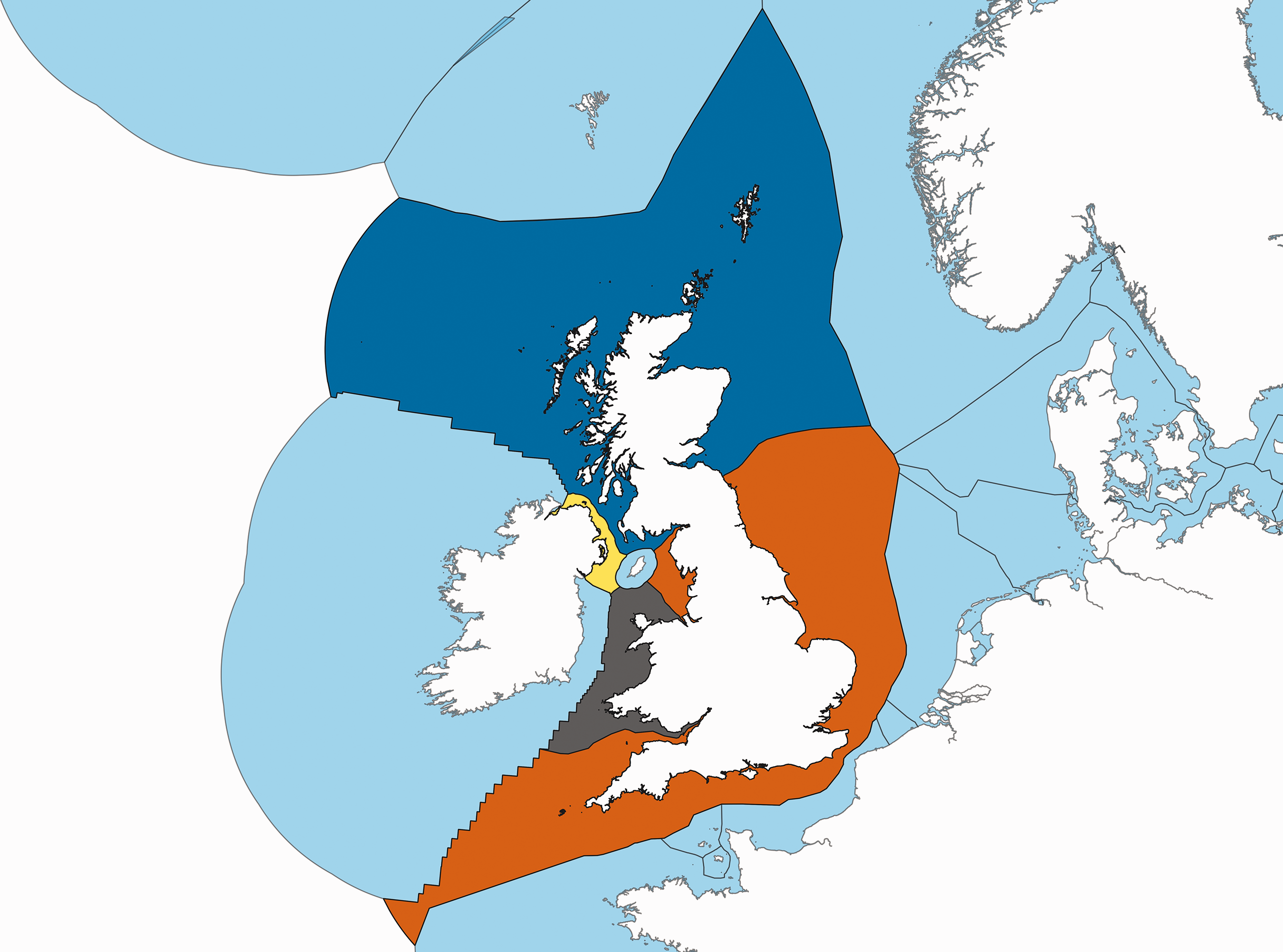
UK’s exclusive economic zone.
The UK government has proposed that the post-Brexit context will respect the role of the devolved administrations in managing their fisheries while, where necessary, maintaining the overall coherence of the UK’s fisheries policy, particularly to ensure compliance with international obligations (Defra, 2018: 11). However, this remains a matter of significant debate between the Scottish and UK administrations given UK government’s overall position on Clause 11 of the EU Withdrawal Bill (which subsequently received Royal Assent on 26 June 2018). Originally, the principle underpinning the EU Withdrawal legislation was that the control of areas where EU and devolved law overlap would pass by default to the devolved administrations. However, the UK government amended their position on this to allow UK ministers to make regulations in order to block the ability of the devolved administrations to change the law in specified areas – including fisheries (Institute for Government, 2018). The UK Government felt it was necessary to ensure common frameworks in order to avoid internal policy differentiation and potential unfair competition. The amendment to the clause means the UK government would retain control until agreement is reached about what to put in place of EU law. The EU Withdrawal Act did not receive Scottish parliamentary consent given that the Scottish Government’s position that the Act threatens the Sewel convention (i.e. that Westminster would not normally legislate with on devolved matters in Scotland without the consent of the Scottish parliament). Moreover, the Scottish Government regarded the Act to be unacceptable for the devolution settlement given that the Scottish electorate voted overwhelmingly to remain within the EU (BBC, 2016). The Welsh Assembly gave consent to the Act and the devolved administration in Northern Ireland was only starting to sit again after a period of suspension in early 2020.
The UK Government presented its Fisheries Bill to Parliament in January 2020 (with an earlier Fisheries Bill having been presented in late 2018, but falling when Parliament was prorogued for the December 2019 General Election). The Fisheries Bill is rather vague on the issue of UK-devolved relationships after Brexit. However, the Bill does contain a proposal whereby ‘joint fisheries statements’ would be made, assumedly, by devolved and UK ministers which would act as statements of agreement between the different levels on matters of fisheries policy. The detail on how these would work in practice is not yet known and there is a clear move by the UK Government to leave as much ambiguity on this matter as possible in order to allow for more concrete relationships to develop once Common Frameworks have been agreed.
The CFP has four main policy areas: Fisheries management – ensuring the long-term viability of fish stocks like cod, tuna, and prawns in EU waters. International policy and co-operation – working with non-EU countries and international organisations to manage shared fisheries, including Norway, Iceland, and the Faroe Islands. Market and trade policy – creating fair competition in the market and setting standards on seafood products sold within the EU to protect consumers, such as requirements for clear product labels. Funding – money to support the fishing industry transitioning to more sustainable fishing practices and assist coastal communities in diversifying their economies.
The UK has chosen to spend €19.3m of its EU funding on improving sustainability in the sector during 2014–2020. (Institute for Government, 2018).
The proposed UK common framework will not just have a bearing on operational governance of fisheries but also the ramping up of policy activities that will be necessary for ‘the UK to negotiate, enter into and implement new trade arrangements and international treaties’ (Defra, 2018). There has been broad agreement from the UK government and the devolved administrations on the need for some form of common framework for post-Brexit fisheries policy, but the Scottish Government’s position has been the need for the UK government to both respect and understand the devolution settlement. However, a senior official in Marine Scotland noted that: Our big concern over the way the withdrawal Bill is constructed is that essentially control over fisheries goes back to Westminster…If you talk to DEFRA, they don’t see it like that, possibly ‘cause they’re panicking but also there’s such a lack of understanding of the devolution settlement. For example people talk about devolution of justice. Justice was never, you know, the legal system was never combined, that was very clear. And actually fisheries, it’s really interesting looking at it, you’ve got that 1882 Fisheries Board Act…So if you respect the devolution settlement, it’s very clear in the devolution settlement fisheries is fully devolved issues, Scotland manages fisheries within the Scottish zone, that’s 200 miles, and Scottish vessels where they fish. There are a few reserved aspects, the allocation of quota and international negotiations. (MS Interview A, 2018) the UK will need to develop activities in its own waters e.g. fleet capacity, infrastructure, aqua-culture, innovation. Many of these are covered by the CFP so the UK will need to define how they will go on their own and define an approach to UK fisheries policy. (CPMR Interview, 2018)
The next section of the article draws out what Brexit will mean for capacity types from the perspective of officials within the devolved administrations.
Governance capacities post-Common Fisheries Policy: Research findings
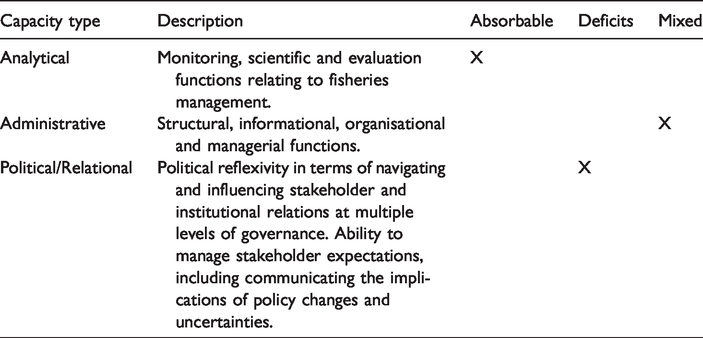
Further to the categories of governance capacities drawn from the public policy and administration literature earlier in this article, this section discusses the extent to which capacities will be absorbable (or otherwise) for the governance of fisheries post-CFP. The data shows how capacity types are multi-layered. Although institutional change perspectives consider layering in the context of organisational functions (see Capano, 2019; Streeck and Thelen, 2005), the analyses of layering are less evident when it comes to understanding how macro-political changes (such as Brexit) lead to the recalibration of governance capacities.
Analytical capacities
Analytical capacities in fisheries governance encompass three main dimensions: scientific, monitoring/compliance, and innovation. Our interviews with Marine Scotland indicate that the need to develop analytical capacities is mixed across these areas. First, scientific capacities refer to how scientific data about types of fisheries stock levels serve to inform policy discussions in relation to quotas and wider aspects to fisheries management and compliance. The scientific elements involve both the intelligence and evidence pertaining to the ways to manage stocks sustainability, which draws on wider research networks beyond government (e.g. with research institutes) and, furthermore, how science is incorporated within the work of policy teams within government. It also refers to the capacity of organisations to produce and supply the necessary data for international monitoring. In terms of the former, our research suggests that in Scottish public policy there are well developed research networks available to support the use of scientific evidence at the interface between research institutes and Marine Scotland. For example, a senior official who works to engage with the research community on fisheries management noted that: I think we already do quite well with our scientific community up here, we have this mass network which Marine Scotland Science are plugged into and we work closely with SAMS in Oban, the marine institute there and with St Andrews, so we’ve already got pretty good connections and a good network of marine science in Scotland, I think we’re more joined up than most places. (MS Interview E, 2018) I think Scotland has maintained the skill set and the expertise in the area because politically it is much higher up the food chain, and also Scotland generally I think with such a prevalent oil and gas industry and with a real focus on renewables, I think a lot of the research and expertise required to manage Scotland’s seas are there. So I don’t think there’s necessarily that deficit in the same way that you might find down south. (MS Interview D, 2018)
The infrastructure for monitoring the position of fishing vessels at sea, however, was not considered to be a ‘new territory’. Interviewees generally agreed that more capacities will be needed for for monitoring vessels but this will be determined by the nature of the new relationships with the EU and other coastal states. (MS Interview A, 2018). The main reason why monitoring was cited as an area which can absorb changes in governance arrangements was due to the view that Scotland has shown its ability to innovate in terms of adapting the mechanisms by which data are gathered to support aspects of fisheries management. For instance, the Cod Recovery Plan, which was a stakeholder-led approach to ensure that North Sea cod was sustainable following threatened stock levels, ‘pioneered the use of selective nets or real time closures to gain back additional effort, allowing to fish longer’ (MS interviewee, C). The interviewee also noted that Marine Scotland ‘pioneered cameras on boats within the EU for a while as part of the process’. Brexit would, however, change the ‘permission channels’ through which innovation takes place in the sense that the use of cameras on boats had to be negotiated with the EU, ‘assuming we take the devolution settlement as it is’, (MS Interview C, 2018). The fact that the UK will no longer be a member of the CFP will allow scope for more innovation out-with the extant EU regulatory framework. Examples of innovation highlighted by Marine Scotland include seeking to improve upon aspects such as technical conservation and the construction of nets and mesh sizes (MS Interview C, 2018).
Bureaucratic/administrative capacities
Administrative capacities in the fisheries policy sector refer to the structures of operational processes which concern the everyday management of fisheries, including access to, and the use of, resources. With this in mind, the dominant narrative to emerge from the interviews was that the structures of fisheries management will ‘evolve’. As one interviewee articulated it, ‘I don’t think it’s going to be root and branch changing of the way we do quota or anything like that, but we won’t be in the CFP’ (MS Interview A, 2018). The keenness of the interviewee to avoid indicating that administrative structures will be subject to anywhere near paradigm-altering reform reflects the fact that it is unclear as to which parts of the CFP to retain, alter or reject in the post-Brexit context. This is on the basis that the CFP has represented the dominant governing framework for decades, plus budgetary constraints do not enhance the feasibility for substantial operational reconfigurations (MS Interview A, 2018). This points to perhaps a realistic take on the propensity for administrative structures to change, which, as institutionalist scholars have noted, are slow and rarely radical but can be evolutionary with transformative results (Streeck and Thelen, 2005). In terms of areas of administrative capacity that might require adaptation, Marine Scotland highlighted the importance of having more flexible arrangements to adapt to geographical contexts in Scotland and, moreover, in terms of reducing waste and discards (MS Interview A, 2018).
It was noted earlier in this article that the UK Government’s Fisheries White Paper proposes a UK-led governance approach to fisheries policy via a common framework, with devolved administrations having the autonomy to implement fisheries management approaches that respects their own contexts (Defra, 2018: 11). The issue of common frameworks bring into question administrative capacities depending on what it ultimately means in practice and whether it will change existing intergovernmental arrangements for the management of quota, license holding and issuing catch certifications. The UK Government, as the allocating authority for UK fish quotas, allocates UK fish quotas among the devolved administrations to the Fixed Quota Allocation (FQA) units associated with the licences administered by each devolved authority. The devolved administrations then allocate quota to its fishers, with the Scottish Government tending to allocate quota in line with the FQA approach (Defra, 2018). If the common framework approach is adopted then it will require future evaluation, which will further impact on administrative capacities. Yet, the management of inspection, much of which is administered by the EU by virtue of the CFP, is subject to greater crystallisation in the minds of policy officials from a capacity point of view. The concerns of policy officials are mainly with regards to the inspection of illegal, unreported and unregulated (IUU) fishing: Where we will have capacity issues is in relation to those things that we need not do now because we are a member of the EU, particularly in relation to IUU fishing, where at present EU vessels landing into EU ports, which is all of ours, don’t have to provide a catch certificate to show that they are a properly regulated vessel because they are what they are. That is something which is potentially a significant burden on us in the future. (MS Interview A, 2018)
Political capacities
Moreover, and as noted earlier, political capacities can include the capacities for parliamentary oversight. Officials indicated that they already have considerable experiences of committee appearances and that when international negotiations start ‘there might be a little bit more but I don’t think it will be huge’ (MS Interview B, 2018). Rather, the main aspects of capacities by Scottish government officials refer to international policy engagement. The desire of Scottish government officials is to ensure that the Scottish share of quotas, as a non-EU coastal state, should be maximised, on the basis of committing to the maximum sustainable yield (MSY), which is a key aspect of the CFP.
1
An official noted that: We would seek to maximise the Scottish share in stocks of interest and maximise access to quota through coastal states arrangements if that’s how it transpires. But we do that firmly within the context of a commitment to MSY and harvesting the idea to be wholly committed to pursuing MSY within the context of socioeconomic pressures, but these are stocks of economic priority to us. (MS Interview B, 2018) At a policy level it will be a ramping up of people to be able to operate at coastal state status, even if we’re not the lead Scotland is de facto leading in areas, we’ll now have to start sending experienced, relatively senior people to RFMO [regional fisheries management organisation] meetings that we don’t normally go to, to countries that we’ve never been to before but all of a sudden we now have an interest. (MS Interview B, 2018) We are still going to have international negotiations, we’re going to have to establish ourselves as a new player and that comes some ways into the capacity side of things, you know, we are part of the negotiations, attend negotiations. Scotland often takes quite a lead role but we’re doing that in the context of the EU so there’s quite a lot of learning to be done there, how to conduct yourself as a coastal state. (MS Interview C, 2018) We will need to fill that gap…We’ll be running our own kind of coastal state operations so that would involve more manpower. Our scientists will have to represent UK in a number of scientific bodies, where before of course it was any EU scientist could represent the whole of the European Union so there will be a demand on that. (MS Interview E, 2018)
For Scottish government, a key area of development in terms of stakeholder/NGO engagement capacities is to ensure that the institutional structures in government allow for the creation of flexible delegation structures suitable for both NGOs and government at different points in policy cycles. This requires stakeholder groups (such as the Scottish Fisherman’s Federation (SFF) and other fishing associations) to be comfortable with having ‘twin identities’ (i.e. having both insider status and outsider status) depending on the policy context. This is by no means feasible or necessarily desirable by stakeholders who will need to manage their own agendas carefully as representatives of their members: We’ve got to create a structure with industry, they’ll be part of the delegation but they won’t be in the heads of delegation, so you’ll have some industry, then you’ll have industry sitting outside again, you know, so there’s quite a challenge around that…But I will need bodies. (MS Interview B, 2018)
While other non-EU coastal states (such as Norway and the Faroe Islands) have managed to develop good working relationships with industry, this is the result of long-standing relations between government and industry, reflecting strong levels of trust (Huggins et al., 2018; McAngus et al., 2018b). Trust levels between the SFF and the SNP government in Scotland have been subject to considerable strain since the Brexit referendum due to the SNP’s position of wanting to remain a member of the EU. This has not been popular with the SFF due to their position that the CFP has impacted negatively on Scottish fishers and coastal communities (SFF, 2019). In this respect, the need to develop political/relational capacities also indicates a requirement for Scottish Government to review their communicative capacities for managing stakeholder expectations. This will be key to achieving the vision outlined by the official quoted above in securing a two-tier structure for stakeholder engagement as part of future governance arrangements. Capacities will be required to communicate the implications of different policy options and in terms of managing stakeholder expectations. Managing expectations with industry and those working in the catching sector is an area of government business that will need to be continually developed. An official highlighted that there can be ‘naivety’ within the catching sector about what Brexit means (i.e. the idea that there will not be a sharing of stocks or other bilateral agreements with the EU and other non-EU coastal states post-Brexit): Some fishermen genuinely believe there will be no foreign fishing vessels and all that fish, 60%, you know, we’ve got the stats, we catch 40% of the fish that was available, 60% goes to foreigners, so a lot of them are thinking about new vessels or upgrading or wanting/looking to increase capacity because…they think the good days are about to arrive back… So there is a naivety and an expectation which is very high. (MS Interview E, 2018)
The management of industry expectations is not only about matters concerning access to waters and quotas, there is the added dimension of Brexit presenting opportunities to refocus fisheries governance in Scotland towards community-based fisheries: I think also the community inshore folk are seeing Brexit as an opportunity for us to put communities at the head of policy as well. So their expectations are that there’ll be a huge change in our policy direction towards more community based fisheries… We will have a management of expectations and there’ll be a political expectation I think as well. (MS Interview D, 2018)
Capacity types.
Conclusion
This study has shown how capacities are vitally important to the architecture of post-Brexit governance, and the variability of the level capacity absorption is acutely important for policy planning. What is also clear from this research is that, conceptually, political and communicative capacity types are inextricably linked. The study develops, empirically, what El-Taliawi and Van Der Wal (2019: 11) have recently concluded by reviewing the work of others – that ‘administrative capacity intertwines and interplays with other capacity dimensions, including policy and state capacity, components should not be addressed individually or in isolation’. By focusing on the applied aspects of capacity and implementation, our study has found that Marine Scotland’s capacity to cope with the outcomes of Brexit is uneven. In some ways, Marine Scotland is well placed to cope with the additional pressures that leaving the CFP will bring. The organisation has a long history of fisheries management and has a strong bureaucratic core upon which capacity can be built without requiring significant reform. Capacities regarding the organisation’s networking capabilities, for example, are well embedded. However, extra capacity for scientific monitoring and the policing of IUU vessels are examples of areas where extra capacity, particularly in terms of staffing, will be needed. For political capacities, for example, there are aspects of this capacity type where capacity is sorely needed, whereas in others far less so.
Broader learning from this study is that constitutional arrangements are acutely important for examining the deficiencies (or otherwise) in governance capacities. Scotland elucidates a case whereby the elements of devolved public policy tend to be absorbable but the skills and organisational readiness for understanding policy engagement with stakeholders around international negotiations (political capacities) require careful evaluation and investment. From the point of view of policy-makers, ensuring that political capacities are in place is key given that the impetus to increase (be it fine-tuning or more) other governance capacities falls from this dimension. This study finds that despite that the legacy of being part of the CFP for over four decades will continue to affect fisheries policy decision-making and governance. Leaving the CFP does not represent ‘day zero’ – our empirical evidence suggests that a ‘Scottish approach’ to fisheries management, separate from the CFP, will be an incremental process. Interconnectedness with the EU, as well as the path dependent nature of policy decisions, means that leaving the CFP will not necessarily be the radical overhaul that many in the catching sector expect, at least not in the short term.
The Brexit process has produced a number of machinations and uncertainties but what is clear is that the governance of fisheries is one area that will be held up by the British government, symbolically and practically, as a public policy that represents the UK being a ‘third country’ outside the jurisdiction of the CFP. We have highlighted that under the devolution settlement, alongside the UK government’s commitment to common frameworks, there will be areas of capacities that require development by authorities. The case of Scotland provides evidence that many aspects of fisheries governance are absorbable, and these tend to be areas concerning fisheries management and of an operational and analytical nature. This is because the foundational bureaucratic infrastructure is in place, which is a reflection of the long-standing devolution of fisheries management. Dissimilar to these areas of capacity are those that will require greater capacity and investment at more of a political, communicative and relational level (these areas are more exposed capacity areas). More broadly, we call for a research agenda for the analysis of governance capacities in order to understand the implications of policy authority shifting back from the EU. In terms of future research, capacity-focused research should consider the changing mechanisms and institutional regimes of governance when making connections with debates about the ‘processes of European disintegration’ (Rosamond, 2016).
Footnotes
Declaration of conflicting interests
The author(s) declared no potential conflicts of interest with respect to the research, authorship, and/or publication of this article.
Funding
This work was supported by the Economic and Social Research Council (ESRC), Grant Number ES/R001952/1.
