



Abstract
Business-backed think tanks are often presented as representing the interests of economic elites. This article provides a more nuanced argument by using field theory to present the co-evolutionary dynamics between economic elites and other social forces. Three Canadian think tanks are examined to illustrate how different social forces can converge around business-backed think tanks, and how governance contexts and institutions shape these relationships. The paper also reflects on the kinds of learning these think tanks can enable depending on the kinds of actors that converge around them and on the forms of power that these actors represent.
Actors and institutions and the forms of power and knowledge they produce constantly shape how governance systems mediate policy learning and the kinds of discourses and knowledge that will be considered salient and authoritative in decision-making. One enduring question regarding this relationship between social orders and knowledge is the extent to which the holders of economic power shape the supply of dominant policy advice in modern capitalist democracies. A related albeit narrower question is whether policy analysis units like think tanks represent business interests (Alam, 2021; Hauck & Resende, 2021; Plehwe, 2021; Salas-Porras, 2021).
Although they are broadly understood to be organizations specialized in the production and dissemination of knowledge and expert discourse on public policy, think tanks maintain strong ties with various clients, donors, and allies, and their views on policy are often congruent or aligned with the policy goals, preoccupations, and desiderata of those that make up their support network (Landry, 2020; Medvetz, 2012b; Plehwe, 2014; Stahl, 2016). Among these alignments, the relationship between think tanks and business donors and allies is often portrayed as particularly important, especially when these organizations advance research and outreach programs that appear to endorse the views and interests of their corporate benefactors, such as in the case of climate skepticism (Dunlap & Jacques, 2013; Jacques et al., 2008; Plehwe, 2014).
The relationship between think tanks and economic and political elites have garnered attention for some time (e.g., Carroll & Shaw, 2001; Domhoff & Dye, 1987; Peschek, 1987; Salas-Porras & Murray, 2017a; Saloma, 1984). Neo-Gramscian theories of class hegemony and elitist theories of power inspired by Marxism often suggest a thorough integration of economic interests and the positions worked out by political and intellectual elites. Theoretical and commonsense perspectives on think tanks have at times reduced these organizations to instruments of the ruling class—adopting roles of coordination and propaganda (Domhoff & Dye, 1987). This view may improve upon depictions of think tanks as autonomous agents of civil society (e.g., Newsom, 1996; Polsby, 1983). However, it has been criticized for portraying elites as overly cohesive (Fischer, 1993, p. 34), and it precludes a thorough analysis of the relative autonomy of political and intellectual power from the infrastructure of economic relations (see Bourdieu, 1985). Experts, scholars, and intellectuals have various interests but they are in many ways different from the interests of material gain or political power inherent to other spheres of life (Bourdieu, 1984, 2000).
A framework designed to assess the co-evolution of elite social systems (as opposed to their assimilation) could help grasp the complex interrelationships between think tanks and their support networks in a way that acknowledges the interdependencies between the holders of power and the holders of knowledge, but also their relative autonomy and diversity—that is to say their inclusion in distinct social systems that can (by the very fact that they are distinct) co-evolve. Whereby co-evolution refers to the processes of adaptation or change that two or more systems mutually undergo as they influence each other (Assche et al., 2017), accounts of the co-evolution of policy actors, institutions, knowledge systems, and power can provide crucial insight into how knowledge and social orders are “co-produced” (Jasanoff, 2004). Furthermore, these relationships between elites can be conditioned by national contexts and institutional configurations—that is, distinct knowledge regimes (see Campbell & Pedersen, 2011, 2014) that shape the relations between institutions and actors, and the types of learning they enable.
This paper explores the ways in which think tanks with ties to business communities are enmeshed in the co-evolution of knowledge and power in the Canadian knowledge regime through the lens of Pierre Bourdieu’s Field Theory (see Bourdieu & Wacquant, 2013). Field Theory is a useful tool for addressing the co-evolution of social systems or fields (e.g., science, religion, politics, business, etc.), while its application to the Canadian knowledge regime is helpful because the country’s relatively autonomous bureaucratic field (compared to its American neighbor) is well suited to illustrate how think tanks integrate distinct niches with unique co-evolutionary dynamics.
The first section of this paper will show how an assessment of the co-evolution of elite social systems, informed by Field Theory and the knowledge regime framework, can reframe important assumptions regarding the relationship between think tanks and economic elites. The second section examines a sample of three Canadian think tanks (the CD Howe Institute, the Fraser Institute and the Conference Board of Canada). By relating the composition of each think tank’s support network to their role and policy preoccupations, this study attempts to map out the channels and institutions by which think tanks participate in the co-evolution of elite perspectives in Canada. The results allow us to make a number of observations concerning the variegated organization of intellectuals, political, bureaucratic, and economic elites around Canadian business-backed think tanks and the types of learning and unequal degrees of proximity to the bureaucratic and political fields that these organizations can maintain in accordance with their modality of integration to the Canadian knowledge regime.
Think Tanks and the Co-evolution of Policy Elites
Co-evolutionary explanations can take many forms depending on the theory and discipline to which they belong (Assche et al., 2017). At stake, in this case, is our ability to account for the ways that elites interact and evolve together through the workings of think tanks. Medvetz’s (2012b) application of Field Theory to the study of these organizations is meant to do just that.
Field Theory posits that modern societies are comprised in part of fields: systems of relations that govern practices and direct them toward the production and reproduction of specific forms of capital (i.e., material and symbolic resources born out of social relations). The various species of capital that are tied to specific fields (e.g., scientific capital, religious capital, political capital, financial capital, etc.) are in fact manifestations of at least four generic types: cultural, economic and social capital and a more derived symbolic capital (Bourdieu, 2011). Capital, and the related concept of field, are based on a relational conception of power, such that distinct forms of capital (e.g., scientific, religious, political, economic, etc.) correspond to distinct permutations of power defined by their relations to the agents that control these forms of power and the principles on which they are based. Agents (or actors)—individuals, groups, and organizations—populate fields and social space in general by occupying different positions corresponding to the volume and composition of the species of capital they control (Bourdieu, 1989). The structure of the power relations within a field delineates dominant and subordinate positions (i.e., in terms of one’s control over the field’s most valued species of capital) and often autonomous and heteronomous ones (i.e., in terms of internal or external sources of power). Fields and positions are analogous to spheres of legitimacy and power that give meaning to practices and forms of competition that are not all reducible to the stakes of the economic field nor to the interests and positions therein (Bourdieu, 1985).
According to Medvetz (2012b) American think tanks have converged in their struggle for cultural and policy influence to the point of forming a special kind of interstitial field nested at the junctures of more established institutional fields: academia, politics, the bureaucracy, the economy, and media. Policy experts and think tanks themselves must engage in a delicate balancing act to accumulate and actualize resources from these neighboring fields such as credibility, recognition, access, relevance, funds, and exposure (Medvetz, 2010). Think tanks are thus privileged in mediating the circulation of people and capital between these fields (Medvetz, 2012a), but they also prioritize certain relations and resources over others and thus occupy distinct positions stemming from their relative proximity to each field (Medvetz, 2012b). The different types of think tanks found in existing typologies—for example, academic think tanks, government think tanks, contract research organizations, party think tanks, vanity think tanks, advocacy think tanks, etc. (Abelson, 2018; Baier & Bakvis, 2010; McGann, 2007; Weaver, 1989)—can thus be described with a theoretical grounding that specifies the positions corresponding to their support networks, strategies, modes of intervention, and principles of legitimacy (Landry, 2020; McLevey, 2015).
This framing helps clarify the ambiguities surrounding the relationship between think tanks and their benefactors. By balancing resources from multiple fields, think tanks possess a form of autonomy that can best be described paradoxically as a kind of “hyper-dependence” (Medvetz, 2013, p. 575), whereby being too political, too servile or too promotional is a risk that is countered by one’s dependence on scholarly credibility and claim to independence (Medvetz, 2015). Instead of responding exclusively to economic interests, think tanks form relations with multiple fields and exhibit different priorities and respond to different strategic pressures depending on the situation and on their relative proximity to these fields. As a result, a think tank primarily conditioned by the political field, for example, will be left less impacted by the state of competition in the academic field and vice-versa.
These parameters account for the “selectively triggered responses” (Assche et al., 2017, p. 221) that impel think tanks and policy experts to co-evolve with neighboring social forces. Like mass in a gravitational field, capital distorts social space and inflects certain behaviors, strategies, and trajectories. However, these inflections are sensitive to the positions of individual actors as well as to their habitus—that is, their abilities, attitudes, schemes of perception and dispositions (including embodied capital) acquired through socialization and experience sometimes in distinct fields (Hilgers & Mangez, 2015; Wacquant, 2016). Habitus highlight (probabilistic) affinities and predispositions for the valuation of certain practices and the accumulation of the species of capital that these practices actualize. In other words, actors carry with them a host of symbolic and material baggage that, at once, allows them to act in social space and conditions their perspectives, commitments and preoccupations. Policy experts thus tend to specialize in actualizing specific parts of the think tank world’s skill set; emphasizing academic, political, economic or media knowhow especially when their individual trajectories and job descriptions align (Medvetz, 2012b). Likewise, think tanks with a certain mix of capital and composed of a certain set of actors with particular dispositions and resources will react to a selection of evolutionary pressures that are relevant to that organization’s position in social space. By extension, the cluster of habitus comprised in a think tank can be tailored to the kinds of policy learning its broader community of allies and audiences expects it to foster. Both policy actors and their trajectories of learning are conditioned by structured and partially embodied social relations that underpin a relational conception of power.
In many ways, individual think tanks are themselves the products of inter-field coordination. One important mechanism for this is Bourdieu’s concept of homology, which describes “a resemblance within a difference” (Bourdieu & Wacquant, 2013, p. 106), or structural affinities between actors that share certain dispositions or occupy similar positions in their respective fields (see Hilgers & Mangez, 2015). Homologies can drive actors to develop strategies that involve alliances and dependencies relative to actors from other fields. Accordingly, think tanks tend to emerge “when historical circumstances favor the convergence of resources from particular groups in light of what they come to understand to be a priority for elite discussion, policy analysis, public education, etc.” (Landry, 2020, p. 4). Put differently, think tanks arise from foundational alliances that are derived from co-evolutionary dynamics that they can, in turn, help entrench, leading to further co-evolution.
As the study below will attempt to illustrate, think tanks should not immediately be dismissed as “organic intellectuals,” whose perspectives are essentially a function of more “fundamental” (economic) classes like labor and capital (Gramsci, 1971). Rather, they can be analyzed as manifestations (or even relays) of co-evolutionary dynamics that lead certain types of intellectual, political, bureaucratic, and economic elites to combine their resources and dispositions. This means that the different types of think tanks mentioned above correspond to specific institutional niches, most notably ties to specific fields, that are not made equally available in all governance contexts and enable different kinds of learning arrangements therein.
Although think tanks seek to hold the mantle of being agents of learning through expertise—a role that implies an attempt to harness a degree of “cognitive authority” (Turner, 2001)—their engagement can in fact catalyze other forms of learning, such as leaning from comparison, experience, or deliberation (Van Assche et al., 2020). In some instances, the strategies of think tanks to promote learning will be limited to what Schmidt (2008, p. 305) calls “communicative discourse between political actors and the public,” which can include opportunities for leaning through expertise, comparison, or experience. In other instances, their position will warrant their involvement in “coordinative discourse among policy actors” (Schmidt, 2008, p. 305), which implies different degrees of inclusion for deliberative learning practices. Sometimes both strategies are pursued.
The kinds of leaning promotion strategies think tanks do pursue is conditioned by their positions in the institutional arrangements of different governance contexts. Competitive knowledge regimes (see below) can provide greater opportunity to integrate niches that foster “value homophily” between the members of discursive coalitions, allowing for the proliferation of advocacy think tanks that aim to talk to supporters and talk over adversaries. Conversely, cooperative or politically tempered knowledge regimes can solidify the gate-keeping practices of so-called “serious” policy elites organized around ideals of “status homophily,” providing protected niches for insider think tanks able to integrate arenas of coordinative discourse (see Ruser, 2018). Think tanks operating in the Canadian knowledge regime—with its liberal economy and relatively closed, politically tempered state—can approach either type of niche, but integrating one often excludes them from the other (Landry, 2021b).
Canada’s knowledge regime shares important features with the British one, the latter featuring a “small publicly and privately funded research unit sector in civil society” and a “moderately adversarial, partisan, and competitive knowledge-production process”(Campbell & Pedersen, 2011, p. 186). Research has highlighted a dual process of politicization and externalization of policy advice in Westminster-style advisory systems in recent years, countering long standing norms of bureaucratic neutrality and insularity (see Craft & Halligan, 2017; Craft & Howlett, 2013; Halligan, 2010). As such, scholarly, advocacy and state research units are somewhat more evenly balanced in Canada than they were in the past. However, the Canadian knowledge regime continues to contrast with the “large, privately funded research unit sector in civil society” and “highly adversarial, partisan, and competitive knowledge production process” found in the United States (Campbell & Pedersen, 2011, p. 186). Canadian institutions rely on the confidence of the House of Commons and on strong party discipline to form government. As a result, cabinets and parties are less likely to seek external advice coming from think tanks. Central agencies and an overtly independent civil service are primarily responsible for providing policy advice to government (Abelson, 2018; Abelson & Carberry, 1998; Béland, 2009; Howlett & Lindquist, 2007).
These properties of the Canadian governance context help explain why think tanks with ties to various interests must adhere to the “instrumental and pragmatic orientation” of the Westminster tradition (Craft & Halligan, 2017, p. 51) when they engage in network governance and consultation in league with the Canadian state, and why they tend to maintain relations with other actors that adhere to dominant, and state-sanctioned definitions of universal values, or neutral and reasonable policy stances. Accordingly, think tanks with ties to the Canadian state and to normal governance, often move in tandem with shifts in predominant policy paradigms (Landry, 2021a).
These properties also help explain why Canadian advocacy think tanks are generally selected and self-selected out of these networks (Bakvis, 2000) and rarely receive state funding (McLevey, 2014). However, Canadian advocacy think tanks are also obstructed from engaging in formal politics. Compounding the effects of party discipline and of an independent public service that does not rely on America’s “revolving door” recruitment model, Canada’s relatively short election campaigns and the rules regarding the political activities of charitable organizations constrain the involvement of advocacy think tanks in Canadian politics (Abelson, 2018). As a result, ties between political parties and advocacy think tanks in Canada are mostly informal if any. Advocacy think tanks tend to find their purpose in a broader war of ideas even as this precludes their involvement with state institutions, something more technocratic think tanks are better equipped to do.
It can be expected that business-backed think tanks will have to compose with these constraints imposed by the Canadian state and that other actors and forms of power also play a role in shaping the policy orientations and learning strategies of these organizations. As the following analysis of business-backed Canadian think tanks will try to show, it is the convergence and co-evolution of different types of social power, not just corporate power, that allows these think tanks to operate and plug into the policy process. Yet power, nonetheless, is what drives this co-production of knowledge, just as power shapes the avenues for learning in a given policy system.
Study Design
The think tanks in this study were selected because they maintain strong ties with Canada’s business community and dissimilar ties to other constituencies. While the Conference Board of Canada and the Fraser Institute are opposites in their relationship to the state, the CD Howe Institute sits somewhere in between. All of them are actively supported by economic actors. Our analysis of these think tanks is based on the following factors: (a) the historical evolution of these organizations; (b) the composition of their respective communities; (c) the trajectories and social positions of their staff and Fellows; and (d) their role and policy preoccupations.
Historical developments were extracted from the secondary literature as well as from commemorative work published by think tanks themselves. The goal was to identify the foundational alliances behind the formation of each think tank and how these evolved over time. Descriptions of support networks are based on the composition of each think tank’s board of directors. Board members were classified by identifying the sector pertaining to their primary institutional affiliation often with the help of think tank websites, LinkedIn pages, and Bloomberg company profiles. Staff were analyzed by looking at previous employment and education, while Fellows were given a profile based on their occupation or background, thus relaying the types of human resources that converge around each think tank. Data on staff was gathered over a period of time. The Conference Board sample includes people working there between 2019 and 2021, the CD Howe sample 2020–2021, and the Fraser Institute sample 2018–2021. This provides a broader picture of their hiring ecology. Finally, the role and policy preoccupations of each think tank were analyzed by examining their activities and areas of research. The relationships between these layers of data serve to highlight interdependencies between actors and institutions that structure path dependencies and goal dependencies in the relations between knowledge and power in the Canadian knowledge regime.
Results
Foundational Alliances and Support Networks
The foundational alliance behind the creation of each think tank and the evolution of these alliances underscore the co-evolutionary dynamics that created and now sustain these organizations. These evolving alliances can explain the differences between the Conference Board of Canada, the CD Howe Institute, and the Fraser Institute.
The Conference Board of Canada was created in 1954 as an offshoot of the National Industrial Conference Board (NICB) in the United States. Founded in 1916, the NICB was the brainchild of professionals and industrialists invested in defining and promoting the interests of employers in the early 20th century. This alliance between what Gitelman (1984b, p. 154) calls “professional militants” and employers can be traced to a growing sense of challenge and unease regarding the business community’s status in American political life. These professional militants found ways to advance their careers in corporate America as they carved out a niche for themselves as both advisors to business interests and advocates for employers, all the while proposing pragmatic industrial reforms set up as alternatives to union-led initiatives. They gradually distilled the NICB into an organization producing research and coordinating the perspectives of business associations on industrial organization and public policy (Gitelman, 1984a, 1984b). Its reform-minded and pragmatic anti-unionism did not alleviate its reputation as a mouthpiece for corporate interests (Smith, 1991), but it eventually became known for its more “moderate-conservative” policy positions in the postwar era (Burris, 1992, p. 118). It also shed its role as a business lobby to prioritize membership-focused information services on corporate management alongside commissioned studies on national policy. This is the organization that eventually exported an offshoot to Montreal in the 1950s to serve Canadian firms and American companies with interests in Canada. Later, in the 1970s, the Conference Board of Canada expanded and moved its offices to Ottawa. It also modernized its policy analysis capacity and information services and gradually diversified its membership base (Lindquist, 1989).
The compositions of the Conference Board of Canada’s Board of Directors (n = 13) and membership organizations (n = 605) are, taken together, somewhat typical of mainstream think tanks in Canada. Funded by a mixture of private and public money, these think tanks tend to maintain ties bridging corporations, the state, universities, the non-profit sector and a modicum of indigenous and labor interests. Indeed, while the think tank’s board is mostly comprised of individuals attached to dominant institutions (54% private sector, 31% public or parastatal, 8% academic), its membership organizations include a handful of middle powers including a few indigenous organizations and a labor union. Equally like other mainstream think tanks in Ontario with ties to the bureaucratic field, the most common subsector for the members of its Board of Directors is professional services (31%). Moreover, while private and public or parastatal organizations form the lion’s share of its membership base, the most common subsector in the Conference Board’s list of member organizations, is higher education and research (14%), including not just universities, technical colleges, and business schools, but also government organizations that operate in that area.
The CD Howe Institute was created in 1958 to act as a kind of research-oriented secretariat for the Canadian-American Committee—a body of professionals and representatives of business, labor and agricultural created in 1957 to study matters of economic integration and the cross-border implications of economic policy (Lindquist, 1989). The CD Howe Institute, called the Private Planning Association of Canada (PPAC) at the time, then expanded these functions to councils fulfilling a similar role within Canada (Canada Trade Committee) and the North Atlantic (British-North American Committee). In its early years, the PPAC was closely aligned with a liberal pragmatic continentalism—accepting broadly Keynesian state intervention and planning while favoring a prudent expansion of continental trade (Ernst, 1992). Some years later, organizational competition with the Economic Council of Canada (1963–1993) and the Conference Board of Canada led the PPAC to merge with the CD Howe Memorial Foundation to become a policy research organization forging a niche in more “short-term” economic analysis of “international trade policy and major federal budgetary issues” (Lindquist, 1989, p. 353). This merger, which occurred in 1973, allowed the PPAC to become the CD Howe Research Institute.
Although it continues to be known for pragmatism as opposed to ideological fervor (Thunert, 2003), the CD Howe Institute also underwent important changes as it sought to navigate the more politically fraught decades of the late 20th century. While Keynesian macroeconomic policies were being challenged (and replaced) by economists and policymakers in the 1970s, the leadership of the CD Howe Institute was slow to wholeheartedly adopt monetarist alternatives to Keynesian policy objectives (Ernst, 1992). They also continued to engage with labor representatives and associations in their support network until the early 1980s when a spat on the topic of oil price controls between the CD Howe Institute’s new leadership and its labor constituents led to labor groups abandoning the Institute (Lindquist, 1989, p. 172). The Institute followed the business community and the economic profession toward increasingly pro-market positions in the 1980s (Ernst, 1992), but it continued to align its recommendations with relatively moderate politically realizable objectives and proposals in the 1990s and beyond (Dobuzinskis, 1996).
The result of these transformations is an organizational support network purged of its labor constituents and largely aligned with “money capital,” but also amiable to maintaining “liminal ties” with the state (Landry, 2021b, p. 245). Its Board of Directors (n = 28) is comprised principally of individuals affiliated with the private sector (75%), while 64% of its Board members are in finance and investment subsectors (investments, holdings, asset management, banking, investment banking, insurance, and real-estate development). This as opposed to 23% in financial subsectors for the Conference Board. Meanwhile, its list of member organizations (n = 254) is still dominated by the private sector in general (59%) and by private financial subsectors (26%) in particular. Financial subsectors are less important among its membership than they are on its board, but these subsectors still bridge multiple institutional contexts. The majority of its public or parastatal member organizations are tied to financial subsectors (6% out of 10%), while a third of the associations (6% out of 17%) represent these sectors. Overall, the intuitional network is characterized by a very strong showing by corporate interests with non-negligible ties to the state and a few residual ties to universities, foundations, and NGOs.
The case of the CD Howe Institute strikes a useful contrast with that of The Fraser Institute. This more militant counterpart of the CD Howe Institute on the pro-business wing of the political spectrum was created in 1974 thanks to the meeting of economists and industrialists sharing various concerns, including the visibility of more radical left-wing political movements, the election of progressive provincial governments, and a general ethos of interventionism among liberal elites (Abelson, 2016; Dobuzinskis, 1996; Fraser Institute, 1999). It also benefited from the support of the international neoliberal movement. Figureheads of this movement like Antony Fisher and the Mount Pelerin Society were crucial allies, and free market economists like Milton Friedman, Friedrich Hayek, George Stigler and James Buchanan were either early contributors or members of its Editorial Advisory Board (Fraser Institute, 1999). For many, the institute represented the “vanguard” of neoliberalism in Canada by exercising influence on the overall legitimacy of pro-market, “minimal state” ideas through advocacy and broad dissemination rather than policy access per se (Carroll & Shaw, 2001). Its policy prescriptions and arguments have been remarkably consistent over the years (McLevey, 2015), and its visibility, credibility, and support from the business community was helped along by increase skepticism toward state interventionism among employers, economists, journalists, and politicians in the 1980s (Carroll & Shaw, 2001; Ernst, 1992).
The Fraser Institute’s support network is still representative of these founding alliances. Though it does not function on a membership basis, most of its finances come from private donors including foundations and foreign sources (McLevey, 2014). Its board (n = 46) is mostly composed of members affiliated to private companies (91%), while 63% of its board are in financial subsectors (and in asset management, holdings, investments, and real estate rather than banking or insurance). That the Fraser Institute’s Board rests firmly in the area of “ownership power” suggests that individuals associated with large institutional actors are less inclined to join. However, it is the relative absence of public sector actors and its historical ties to neoliberal intellectuals and patrons that best illustrate the selection (and self-selection) mechanisms at play at the edges of the Fraser Institute’s network. As think tank’s forge a role and a reputation, they also send signals about who they are and who will likely find a home as well as like-minded allies in their network (Landry, 2021a; Lindquist, 1989).
Backgrounds of Staff and Fellows
Affinities between certain groups are also visible at the level of the support networks that make up each think tank’s productive community of research staff and Fellows. At one level, their disciplinary backgrounds (of the highest achieved diploma) provide some insight into the kinds of skills the think tanks seek and attract. The Conference Board’s research staff is by far the most diverse. Nonetheless, the research staff of both the Conference Board (n = 79) and the C.D. Howe Institute (n = 10) are comprised predominantly of economists (43% and 70% respectively), typically with master’s degrees. Current and former Fraser Institute staff in the sample (n = 23) have a higher rate of graduates in politics or public policy (48% for 35% in economics), but reverses that trend with a high number of economics professors in its sizeable (n = 71) network of Fellows. Those two disciplinary clusters remain the most important disciplines throughout. However, the CD Howe Institute puts an unusual amount of emphasis on law among its Fellows (13% of 124 individuals).
At another level, the work history of staff (in terms of experience reported in various sectors) sheds light on the kinds of organizations that hire individuals with similar profiles and dispositions as those found in the three think tanks and thus paint the contours of their respective hiring ecology. The Conference Board’s expansive staff is again the most diverse and bridges multiple mainstream organizational niches, namely NGOs, centrist think tanks, and universities. All three think tanks have hired individuals with private sector experience (between 30% for the Fraser Institute and 50% for CD Howe), while the public sector stands out as an important fixture for the research staff of both the Conference Board (42%) and the CD Howe Institute (80%). The Fraser Institute’s hiring ecology, meanwhile, is more closed off and political with 35% having worked at right-wing think tanks, while the measure of this ecology jumps to 65% if you include direct hires to the Fraser Institute after university—sometimes following an internship at the organization.
Lastly, the profiles of each organization’s Fellows illustrate the kind of knowledge production community they are trying to build. As mentioned earlier, the Fraser Institute expands its network into the economics discipline by associating itself with university professors, but its fellows also features a number of professionals (five consultants and two physicians), and an important number of policy researchers (15%) working out of various organizations. This makeup solidifies the Fraser Institute’s profile as invested in policy capacity independent from government, and many of its Fellows have ties to right-wing and libertarian organizations. The composition of predominant profiles among the Fellows of the CD Howe Institute is quite different. Other than professors (36%), it features an important number of present and former executives (22%) from private firms, NGOs, crown corporations, and parastatal organizations, as well as an array of professionals and consultants (15%). Many of its Fellows are former civil servants (17%). The most important differentiator with the Fraser Institute is not just the absence of obvious strong ties to fixtures of libertarianism, but also the central importance of state organisms. Another organizing factor is that many of these ties to government stem from past appointments in the financial and macroeconomic wings of the state, including the Bank of Canada and the Department of Finance. The Conference Board does not have a network of Fellows.
Role and Policy Preoccupations
The relationship between the above communities and the activities and policy preoccupations of think tanks is where their role as an organization becomes most apparent. The Conference Board of Canada, for starters, is broadly described as an information services organization peddling economic projections and principles of organizational “best practice” to its members (Abelson, 2016, 2018; Lindquist, 1989). Its policy research capacity is a related but secondary role. Much like another Ontario think tank, the Public Policy Forum, the Conference Board forges its role through “a kind of state-sanctioned diversity” (Landry, 2020, p. 375), whereby its many high-profile members can meet and discuss issues as far ranging as macroeconomic trends and projections, the impacts of economic policy, innovation and technology development and implementation, labor market transformations, skills development, labor relations and human resources management, workplace inclusivity and diversity, immigration policy, health policy and healthcare optimization, northern and indigenous development and reconciliation, and sustainable practices and infrastructure. These concerns are broadly aligned with the current concerns of mainstream Canadian institutions, and the Conference Board integrates the Canadian polity through these institutions and powers. Its policy interventions are thus principally aligned with the mission of being useful to its community and its clients according to shared goals and assumptions, while its learning strategies expand into deliberative practices within this community.
The CD Howe Institute has managed to capture the backing of corporate actors by developing and facilitating a reciprocal and pragmatic relationship with the State. Its involvement on issues pertaining to macroeconomic and fiscal policy, financial and industrial regulation, pensions and savings, innovation and growth, and commerce and competition reinforces this association, as does the congruence between these policy sectors and its network of Fellows with strategic ties to the financial armature of the state and disciplines like economics, law, and business. However, it is also invested in a variety of other policy sectors, with interventions in health and healthcare, demographics and immigration, labor markets and education, energy and natural resources, and accountability and governance. Some of its activities are geared toward the production and dissemination of policy discourse, while others are designed to facilitate communication and discussion between businesspeople, stakeholders, decision makers, and academics. Just as its policy stances are considered to be aligned with a pragmatic pro-business position (Thunert, 2003), its role includes the catering of a pragmatic and mutual rapport between the private sector’s sovereignty over the economy and the government’s interventions therein. However, it also engages in discussions over avenues for reform within policy subsectors with a willingness to improve the effectiveness and efficient delivery of government services.
The Fraser Institute’s network of conservative policy scholars and economists combined with a network of private backers and international libertarian organizations aligns with its own activities and policy preoccupations. This more militant think tank produces and disseminates policy ideas, holds educational workshops and events, and recurrently produces so-called freedom indexes and school rankings to explore themes of central importance to those who would like market-based choices to govern a greater portion of public life. These themes include taxation, government spending, school choice, private healthcare options, job creation, competitiveness, and individual and economic freedom, and they intervene in a very diverse set of policy subsectors along these lines. Despite its high profile, however, the composition of its community features few traces of engagement with the state or civil servants. Rather, its policy interventions align with its role as an organization devoted to the war of ideas where the stake is to move the window of reasonable public positions toward one’s preferred ideological stance.
Discussion
On the surface the above observations might align with Marxist and neo-Gramscian accounts of the relationship between corporate interests and the engines of so-called civil society. The evolution of predominant policy paradigms among business aligned think tanks can serve to highlight elements of class coordination, while diversity in the cohesion and radicalness of their ideas can be explained as a by-product of different niches in the ecology of corporate actors and the organizations that serve them (Carroll & Shaw, 2001; Peetz, 2017). However, if “capital is not homogenous” (Salas-Porras & Murray, 2017b, p. 4) it is not just variations in the “fractions of [economic] capital” (Salas-Porras & Murray, 2017b, p. 4) that are observable in these niches. The state, for starters, is seen as playing an important role in moderating the construction of distinct niches and of civil society actors themselves (see Pal, 1993). Economic and management paradigms also impact think tanks by importing at least partially autonomous influences from academia and the world of ideas. Likewise, other actors like indigenous groups and NGOs remain more marginal but still exercise an influence by grafting their policy preoccupations to mainstream think tanks with ties to corporate Canada.
Even more to the point, the role of neoliberal intellectuals in the history and identity of the Fraser Institute illustrates how political and intellectual movements have a structuring impact on militant think tanks that is not reducible to the composition of its business backers.
One may argue that the difference between these think tanks is a matter of strategy and not substance. But while there is a sense that militant think tanks can expand the realm of acceptable ideas, while more mainstream think tanks can work more collaboratively to allow more moderate forms of these ideas to influence policy, there is little indication that the identities of those that make up these think tanks are interchangeable, nor that these efforts are necessarily coordinated.
The contribution of a co-evolutionary lens informed by field theory is to show how the niches of constituents and ideas forged by think tanks evolved from historically situated confluences of actors and institutions who are relatively autonomous from each other in so much as they operate in different fields. Think tanks thus emerge not just as central to the circulation of resources, people and ideas between fields (Medvetz, 2012b), but also as key anchors for their continued co-evolution, convergence, and coordination. That is to say, think tanks don’t represent class interests as much as they represent confluences of co-evolving forms of power. In this regard, they continue to illustrate how leaning is a situated practice nested in relations of power (Hillier, 2011) – see Table 1.
Overview of Think Tank Niches and Learning Strategies.
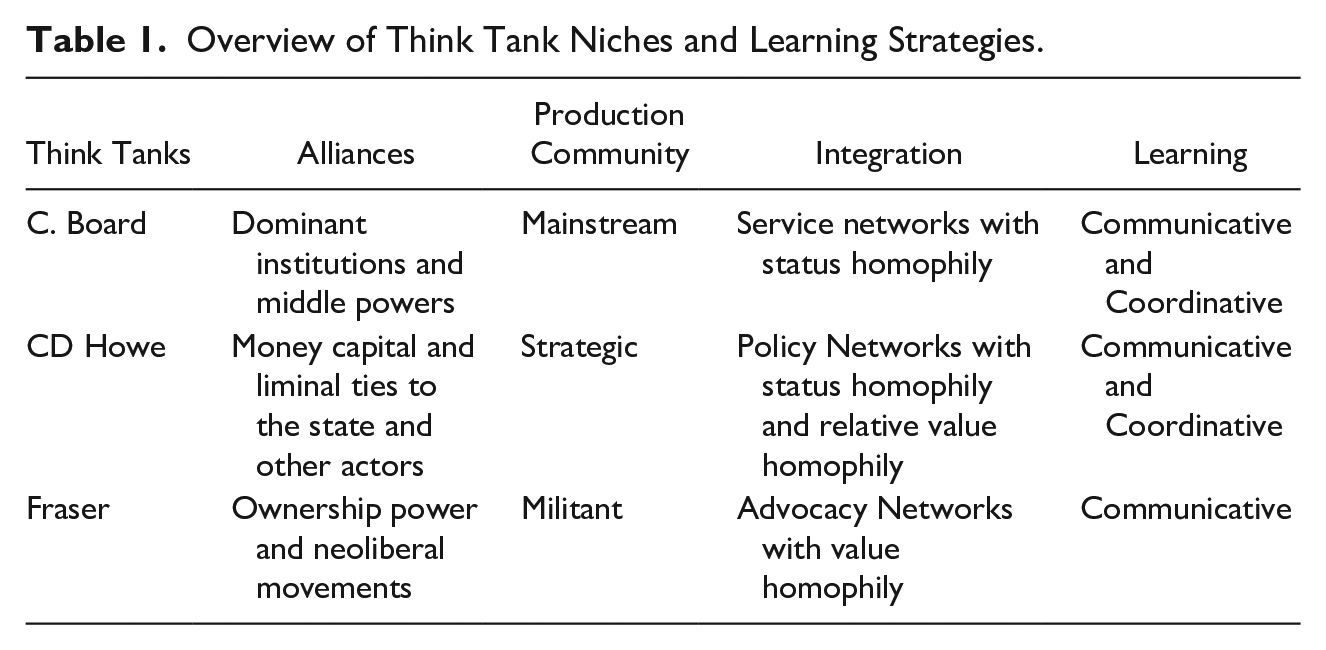
In light of the relational conception of power provided by Field Theory, these confluences of powers raise some questions regarding key themes in co-evolutionary frameworks about constraints on how systems can learn and evolve, namely interdependence, path dependence, and goal dependence (Assche et al., 2017). Whereby these organizations allow holders of cultural, political, and economic power to converge, they also highlight the interdependencies that limit the range of acceptable stances for any given think tank. Likewise, a think tank’s identity, branding, and network constitute important ingredients for goal dependencies in their policy stance as they cater to specific problems and specific constituencies.
For advocacy think tanks, like the Fraser Institute, this means privileging the promotion of forms of learning that can be relayed through communicative discourse (expertise, comparison, and perhaps reflexivity or experience), while relying on a system of ideas that is heavily conditioned by the value homophily of those that produce, administer, finance, and consume most of their products. The Fraser Institute draws from a predictable pool of ideas to enable its own learning, all the while attempting to bring governance systems closer to its ideals. And while an armature of economic forces and international networks sustains its engagements, these engagements are more directly constrained by the instruments of knowledge and expression possessed by those that are selected and self-selected into the Institute’s community and hiring ecology.
Unlike think tanks that rely on standards of ideological purity, more technocratic business-backed think tanks, like the CD Howe Institute and the Conference Board of Canada, will sometimes pivot (with different degrees of flexibility or inertia) in order to respond to changes in predominant preoccupations and ideas, notably as economic orthodoxy, state objectives, and the business community’s understanding of its interests evolve (sometimes in tandem) overtime. In this way, however, they are beholden to the path dependencies and rigidities of dominant institutions and to their relative openness to the preoccupations of middle powers like labor associations, indigenous groups, and mainstream nongovernment organizations. This means that the learning they engage in and the learning they promote are tied to the networks they sustain and to the dominant positions within major fields that the actors within these networks occupy.
The broader appeal of organizations like the Conference Board of Canada and the CD Howe Institute and their relation to the state may provide opportunities to expand leaning strategies to deliberative practices or coordinative discourse. However, their communities are also clearly structured around a sliding scale of status homophily, whereby access is given a minimum cost of entry in terms of cultural capital (expertise), social capital (points of contact and priviledged networks), economic capital (budgets), and symbolic capital (credibility and legitimacy). Additionally, the case of the CD Howe Institute illustrates how value homophily (albeit to a lesser extent than in the case of the Fraser Institute) can condition learning around the objectives of certain arms of the state and their respective constituencies—in this case the financial armatures of government, mainstream economic scholarship, corporate law, and Canada’s economic and financial elite.
As policy actors, think tanks illustrate the power dynamics involved in impelling policy systems to engage in certain types of learning. By positioning themselves as supplying learning through “experts and expert knowledge” they engage in forms of competition between “knowledge brokers” that can favor different policy outlooks and distinct types of expertise (Van Assche et al., 2020, p. 14); and while learning from other places (comparison) and learning from the past (reflexivity) can contribute to how think tanks construct this expertise, the niches in which they package these forms of learning into communicative discourse contain a limited horizon of interests, career trajectories, policy perspectives, and values. Likewise, the niches from which they can contribute to “dialectical learning” (Van Assche et al., 2020, p. 14), structure their access to specific policy networks and the types of preoccupations that can be heard therein. These niches of knowledge production and channels of participation manifest differently in different knowledge regimes precisely because they are conditioned by predominant social forces. These forces condition the kinds of leaning that are even possible in a governance context, because they govern who can contribute to a policy system’s learning endeavors and in what ways.
Within these parameters “minor policy change might be obtained through policy-oriented learning” (Lindquist, 2021, p. 105), but the niches that think tanks integrate can also impose limitations on how major policy transformations, and even some minor ones, are in fact imagined when conditions that are ripe for change arise. Moreover, trends such as the tremendous growth of research production and the evolution of its consumption and dissemination in a digital environment could exacerbate these limitations by hampering “deliberation and learning across advocacy coalitions” and by shifting efforts toward “fueling the efforts of like-minded entities,” while catering to “a narrower set of donors” (Lindquist, 2021, p. 112). If the response of think tanks to these trends are in effect locked in by the co-evolving social forces that converge around them, it is indeed possible that “think tanks continue to reflect, drive and further complicate an already complicated and contested policy environment” (Lindquist, 2021, p. 112).
Conclusion
If think tanks occupy niches that are better described as a confluence of forms of powers, the types of learning they aim to facilitate are heavily conditioned by the niches that the power structures of a knowledge regime enable. Depending on how they plug into these niches, business-backed think tanks typically act as defenders of policy paradigms, as purveyors of normal problem solving within dominant paradigms, or as crisis managers and facilitators of pragmatic reform. None of these roles are reducible to the idea of serving corporate interests, but they are nonetheless constrained by the social forces that enable them, among which business interests feature prominently. One implication for policy learning for think tanks might be that they equip themselves with skills to reflexively acknowledge these power relations. The goal would be to adopt more recent policy analytical styles still underutilized by think tanks—to understand policy knowledge production and policy making not simply as a process of advancing preferred solutions or efficient programs but also, and more broadly, as an effort to mediate, equalize, harmonize, and sometimes challenge social forces. In Canada, where the state plays an important role in policy capacity, the public service may be uniquely positioned to foster diverse niches for policy actors and bridge their respective limitations.
Footnotes
Declaration of Conflicting Interests
The author declared no potential conflicts of interest with respect to the research, authorship, and/or publication of this article.
Funding
The author(s) disclosed receipt of the following financial support for the research, authorship, and/or publication of this article: The author was supported by a Social Sciences and Humanities Research Council Postdoctoral Fellowship.
