




Abstract
From the unique perspective of perceptions of the frontline craft, this study examines value convergence between policy makers, managers, and street-level professionals (N = 55). Toxic stereotyping between staff levels, exacerbated by restrictive organizational conditions, are shown to overshadow positive value convergence from socialization processes. In this Dutch prison study, public officials are consistently biased to believe that the management above them prioritizes targets (values that support the organization) over content (values that serve prison inmates). This explains how perceived role and value differences impact the actualization of shared values in public service delivery much more negatively than the actual differences.
Introduction
A growing body of literature is taking what Beck Jørgensen and Rutgers (2015) call a “Public Values Perspective (PVP),” outlining the public values that uniquely characterize the public sector. Taking a generalist view of the public official, many of these studies map the role and relevance of values in public governance on an aggregate level (Beck Jørgensen & Bozeman, 2007; Huberts & Van der Wal, 2014; Perry et al., 2014; Wang & Wang, 2020). Values are commonly understood as “qualities that are appreciated for contributing to or constituting what is good, right, beautiful, or worthy of praise and admiration” (De Graaf, 2003, p. 22), with public values referring to desired and praiseworthy public sector conduct, processes, and outcomes (Beck Jørgensen & Bozeman, 2007). Fewer studies address how such rather general and abstract values apply to professional ideals and practices of good work at implementation level and how, within specific domains of public service delivery, such values are similarly or differently perceived and expressed from policy level down to shop floor (Paanakker, 2019, 2020).
To address this gap, we examine how values relate to and can be seen from the perspective of frontline “craft.” That is, we examine perceptions of craftsmanship to see which values they describe, with craftsmanship referring to the application of the concrete skills, knowledge and practices that, according to public officials, are needed to deliver good work in street-level public service delivery. As such, we inductively derive value patterns from the key qualities that public officials deem relevant in the context of frontline work and its objective (in this case, the concrete public service delivered; Paanakker, 2019, 2020), and we conduct explorative research into whether and how public officials who operate at different hierarchical levels, but in the same public sector domain, have a shared notion of frontline craft and the values that attach to it. To examine convergence or divergence in the values that describe such street-level craftsmanship, this article selects the Dutch prison sector as a case study and discusses the central research question:
In doing so, this article aims to advance public values research in two ways. First, it aims to scrutinize the level of value convergence from the perspective of professional sectors. The observation that values are likely to be perceived very differently in different cultural and organizational settings, situations, or periods over time, is widely shared (Haque, 2011; Rutgers, 2015; West & Davis, 2011). Recent studies also provide empirical substantiation of such differences in value interpretation (L. B. Andersen et al., 2012; Reynaers & Paanakker, 2016), but focus primarily on value differences between organizations or between individuals (Van Steden et al., 2015; Van Thiel & van Der Wal, 2010; Yang, 2016). As yet, studying how values work “along the lines of the confined and decisive professional logics of bounded policy domains” (Paanakker & Reynaers, 2020, p. 252) is less prominent in public value scholarship. The question of value divergence between policy makers, managers, and professionals working in the same policy domain remains underresearched.
For that purpose, the degree of value convergence or divergence is conceptualized, in this study, as the degree to which values are similarly or differently identified, understood, and/or expressed from policy level down to shop floor. This includes three specific dimensions: value identification (which values are seen to matter to craft), value understanding (the perception of how values ought to be expressed in concrete craftsmanship behaviors), and value prioritization or enactment in practice (which values are actually (seen to be) emphasized in practice, and how). From the sliding scale implied in its definition, it follows that strong value convergence refers to the perceived similarity of value approaches to frontline craftsmanship held by the policy advisors, organizational managers, and street-level professionals in the sector. Strong value divergence refers to the misfit or incongruence between such values approaches of policy advisors, organizational managers, and street-level professionals.
The second contribution of this article is to sharpen the focus on the role of public values in the concrete work context of frontline public service delivery. It situates the public values debate in street-level discourse by examining the values that describe each level’s perception of what frontline craftsmanship is about. We explicitly do not aim to build a conclusive theory of what street-level craftsmanship is or ought to be. Our aim lies in more modestly offering an explorative examination of how various actors themselves, whether at policy-making, management, or street-level, hold similar or different value perceptions to craftsmanship in frontline public service delivery, and why (not).
In so doing, this article builds on recent scholarly work that revives the study of craftsmanship in the public domain. Implicated in this perspective is that many of the values realized in street-level professions are not solely dictated by formal education and standardization, theoretical specialization, and top-down norm enforcement (Paanakker, 2019), like literature on professionalism tends to suggest (Freidson, 2001; Noordegraaf, 2007). Rather, adopting a craft perspective to street-level values is about acknowledgment that good work is versatile rather than fixed, and builds strongly not only on theoretical but also on practical, experiential knowledge that is learned on the job (Rhodes, 2015; Van Steden, 2020; Paanakker, 2019). Regarding the public office as a craft honors the skilled intuition, continuous reflection, and often implicit, unarticulated and action-oriented knowledge that quality of work in public service delivery alludes to (Polanyi, 2009; Sennett, 2008; Van Steden, 2020). This is why, through respondents’ concrete descriptions of the skills, knowledge, and practices associated with frontline craft, we consider values from the bottom-up as constructed and expressed by respondents themselves.
With a total of 55 in-depth interviews with policy makers, managing directors, middle managers, and street-level prison officers in the Dutch prison sector, this study offers a unique insight into differences and similarities in value perceptions of craftsmanship from the policy-making level to street-level execution. The Dutch prison sector provides an exemplary case study because street-level prison work in the Netherlands qualifies as a craft pur sang: Unlike in many other countries, the position of prison officers is not one of minimal commitment to providing basic security. Dutch prison officers perform a variety of highly complex tasks in terms of social safety and detainee care, welfare, mentoring, and reintegration, and obtain a high level of professionalism and discretion in their work (Molleman, 2014). Moreover, as it implements a comprehensive new policy program while closing down facilities and applying other severe austerity measures, the Dutch prison system provides an interesting context of organizational change, in which (the renegotiation of) values of good work explicitly surface (Stewart, 2006).
In the sections to come, we discuss competing expectations of convergence and divergence based on a literature review of value understandings and group dynamics (specifically, literature on professional socialization, role differences, and normative isomorphism). From empirical findings of perceived rather than actual divergence between staff levels, further insights are derived on conflicting value sets, transpositional bias, toxic stereotyping, and the exacerbating influence of cutbacks and reforms, the latter found to cause the glorification of quantifiable managerialism and the externalization of content—at the expense of street-level values.
Value Understandings and Dissemination
To study how different public sector levels may perceive frontline values similarly or differently, it is key to assess how values disseminate throughout a given group of actors. Insightful studies include studies on value attainment and value dilemmas in specific sectors such as hospitals and public transport (e.g., De Graaf et al., 2016; Jaspers & Steen, 2019; Oldenhof et al., 2014; Reynaers & Paanakker, 2016; Steenhuisen, 2009). The latter set of studies show the unique mix of values that play a role in specific professions and how the meaning of values of a more general nature is transformed to fit the specific professional context. Reynaers and Paanakker (2016), for instance, demonstrate how role differences may be determinative for value understanding: Their study in the prison sector outlines how public procurers and private operators, due to the nature of their function, may interpret and act upon identical values very differently (p. 13). How, then, may organizational roles within the public sector hierarchy impact on value perceptions of frontline craftsmanship? Two different views that argue quite the opposite may be distinguished.
Organizational Role Differences Minimize Value Convergence?
The first perspective of relevance is the vision of role theory, which would indicate stark differences between the role, norms, and values of different groups throughout the organizational hierarchy. Traditionally, bureaucracies comprise operators, managers, and executives: “those whose work actually justifies the existence of a given organization,” those “who coordinate the work of operators to achieve organizational goals” and those “responsible for maintaining their organizations” (Wilson, 1989 in Frederickson et al., 2012, p. 53). Evidently, such different organizational roles bring along different tasks and expectations—observable role conflict is therefore to some extent inevitable (Tummers et al., 2012). But this also gives rise to different work logics.
From a classic perspective, managers operate on a different level in terms of content and scale—the manager steers and organizes the provision of services; the professional delivers those services (Evans, 2011; Freidson, 2001). With the purpose of “managerializing” the work practices of the professional, the manager is there to monitor, regulate, and steer professional activities by spreading quantifiable standards and corporate models (Noordegraaf, 2007; Noordegraaf & Schinkel, 2011). In this view, the performance-driven manager is classified as relatively alien to the content-driven rationale of the professional (Van Bockel & Noordegraaf, 2006). The higher the level of management and the greater the number of roles a manager takes on “the greater the tendency to seek generalizations, overall solutions, programmed solutions, one-size-fits-all answers” and “to search for one generalizable efficiency—often a short-term efficiency at that” (Frederickson et al., 2012, p. 108). This suggests that managers and professionals may place different emphases on values at street level or may pursue different values altogether.
Such classic conceptions of the distinction between the manager and the professional are increasingly called into question, as the art of management has undergone a serious professionalization process and “manager” seems to have become an occupational category of its own (Noordegraaf & Schinkel, 2011, p. 115). Conversely, professionals throughout the public sector seem to move more easily into (and out of) management positions and tasks, creating fuzzy distinctions between the hybrid professional, on one hand, and the professional manager on the other hand (Noordegraaf, 2007, 2016; Noordegraaf & Schinkel, 2011; Van Bockel & Noordegraaf, 2006).
Nevertheless, different organizational logics seem to persist in practice due to different types of work activities. One could even argue that the amalgamation of the professional and the managerial role further complicates organizational unity and unequivocal role differentiation, and exacerbates the complexities of the inherent underlying differences that have never really disappeared. Perhaps not surprisingly, for some line managers their role overload negatively impacts their view of values and the conflicts between them: In a study in the health care sector, Oldenhof et al. (2014) found that “middle managers appear to experience value conflicts more intensely and more concretely than executives do” (p. 57).
In addition, Frederickson et al. (2012) describe how role differences can spur perceived differences rather than actual differences, and this can have grave impact on organizational functioning: “role theorists have consistently demonstrated that role occupants [. . .] tend to misperceive the role expectations of others [which] results in excessive managerial caution and organizational inertia” (p. 108). Misperceiving the role expectations of others, specifically of other staff levels in the organizational hierarchy, may lead to a misunderstanding of their value focus in street-level craftsmanship. These insights raise the question whether, as a result of role differences in the institutional hierarchy, different levels of actors have strongly diverging value perceptions of street-level craftsmanship.
Professional Socialization Optimizes Value Convergence?
Alternatively, studies on professional socialization tend to argue the opposite and claim that professionals are bound by shared norms that are decisive “steerers” of professional conceptions of craftsmanship and how this should be achieved. Bureaucrats are said to adhere to professional norms when making their decisions and developing their attitudes toward policies (S. C. Andersen & Jakobsen, 2016; Teodoro, 2014). According to L. B. Andersen (2009), the sociology of professions starts with the necessity of professional convergence because this will guarantee professional behavior in line with the established professional quality standards: “the existence (and enforcement) of formal and informal professional norms is an important part of being a profession” (p. 82) as it “will lead professionals from the same occupation to behave and perform similarly, regardless of their sector and incentives” (L. B. Andersen, 2009, p. 80). Extensive professional socialization may create homogenization effects that cause normative isomorphism within and among professional organizations and converge organizational values and behaviors (Teodoro, 2014).
Another converging effect stems from the organizational consolidation of professional norms. When professional norms become heavily institutionalized, this may cause managers and professionals alike to develop a shared organizational identity (L. B. Andersen & Pedersen, 2012). This would suggest many similarities in craftsmanship views throughout a given institutional hierarchy, especially considering the blurring of responsibilities when street-level professionals move into positions of (middle or even higher) management.
Scholarly studies on organizational values indicate how this logic of professional convergence may be extended beyond the norms—and the skills, knowledge, and practices associated with those norms—to include associated values. Organizational values have an important role not only in internal integration, but also in external representation and performance (Schein, 1985; Weiner, 1988), for instance, in the interaction with clients or citizens. Through processes of attraction, selection, and socialization, employees adjust to and are actively integrated by organizations, revealing a tendency to unify the preferences and motivations of employees throughout the organization and to align employee values with organizational goals (Kjeldsen, 2014; Moyson et al., 2018). Such value alignment holds important implications for the organization’s strength and effectiveness (Jensen et al., 2018). According to Paarlberg and Perry (2007), Values provide a common understanding of the correct way of thinking and acting on strategic issues and opportunities facing organizations [. . .]. Individual values that are congruent with an organization’s values may strengthen an employee’s identification with the organization and ultimately provide employees’ meaning, direction, and a sense of what is distinctive about the organization [. . .]. (p. 390)
In their empirical study on organizational value management, these authors found that formal management systems are important instruments for fostering value alignment in organizations (Paarlberg & Perry, 2007). Interestingly, they, too, emphasize the role of middle managers—not as sources of hybridity and conflict, but in terms of the key role they embody in using such formal management systems to integrate the organization’s strategic practices with employee values (Paarlberg & Perry, 2007, p. 387).
In sum, theory on professional socialization implies that value perceptions of street-level craftsmanship are likely to be convergent. The assumption based on these insights would be that professionals do not only work within the same type of public service delivery and for the same type of beneficiaries, but are also actively socialized to adopt the same client logic, ideals, and values. This would translate to the way they perceive frontline craft, irrespective of the exact position they hold. As such, it raises the question whether, as a result of professional socialization, different levels in the institutional hierarchy are prompted to adopt highly similar value perceptions of street-level craftsmanship.
Values Under Pressure in the Dutch Penal Sector
This section briefly explains the public setting in which the research took place and the role of values therein. In the Netherlands, the prison sector’s mission of “providing a safe and humane detention in which, together with chain partners and detainees, we work towards reintegration back into society” (Dutch Correctional Agency, 2009a, p. 10) articulates the three core values of humanity, security, and reintegration. In many Western contexts, these three values are believed to represent the essence of detention, with the critical observation that, in practice, they exemplify a precarious balance as they can conflict in many respects (DiIulio, 1987; Liebling & Arnold, 2004; Molleman, 2014).
To better embody its mission, the policy department of the prison sector rolled out a new policy program (called the Prison System Modernization Program) from 2010 onward. The Modernization Program centered on the behavioral motivation and rehabilitation of the detainee, greater self-efficacy for the detainee in the system, and stronger collaboration with chain partners with the aim of reducing recidivism (Dutch Correctional Agency, 2009b). At street level, this program spurred a new way of service delivery for penal facilities and their staff to implement, with more focus on employee–detainee interaction, psychological motivation, and multidisciplinary consultation and monitoring.
At the same time, the prison sector committed itself to an elaborate set of austerity and organizational reform measures to improve efficiency—yet another value—mostly to meet capacity issues due to a declining demand for cell capacity and a restrictive political-financial mandate. This included the phased shutting down of penal facilities, increased staff mobility, and cutting management layers (Dutch Correctional Agency, 2009a).
The prison reform was truly kicking in and austerity measures were in full force when data for this study were collected in 2014 and 2015. By then, there was criticism, and stories of disappointment, work overload, exodus of staff, and the critical financial status of the sector were permeating to the outside world, including their potential deleterious side effects for the sector’s unanimity and for public service delivery on the ground (Inspectorate of Justice and Security, 2017; OmroepWest, 2016; Roerdink, 2017). Previous empirical research on Dutch prisons has pointed out that street-level prison officers struggle with this in their everyday work, revealing a potential mismatch between espoused policy values and the values expressed in organizational practice (Paanakker, 2019).
Research Method and Data Collection
Data collection consisted of a 2-month period of participatory observation (spread over 75 hr), in two penal facilities and across 11 different departments, an analysis of relevant policy documents, and a total of 55 in-depth semi-structured interviews. Interviews were conducted on four different staff levels: (a) prison officers (N = 32), (b) middle managers (N = 9) who head one or two detainee departments and the corresponding prison officer staff, (c) higher management (N = 8) consisting of managing directors (the number represents the entire staff of managing directors and deputy directors of each facility), and (d) policy advisors (N = 6) working at “headquarters” at the Ministry of Justice and Security. The two facilities differed in geography and size (northwest and southeast, urban and rural, and large and small) and detention phase (detainees awaiting the case on their verdict and convicted detainees), but attended to the same detainee population (adult males) and employed prison officers with identical task descriptions and work conditions. Both facilities were under the same pressure to implement the new program and its policy tools, and to realize drastic employee and budget cuts—with a highly similar impact on prison personnel in terms of staff mobility, uncertain future job prospects, and negativity and frustration among staff. As the analysis produced no significant differences in the outcomes of the two facilities, we do not distinguish between cases when reporting the findings.
From the participatory observation, a diversified and seemingly representative pool of respondents in terms of age, gender, length of service, and attitude to the job (for instance, pessimistic or optimistic, repressive or emphatic) was arrived at. For instance, among the interviewed prison officers and middle managers (N = 41), 33 were male and eight female, aged between 30 and 65 years, with an average age of 44 years, and had an average of 19 years of prison service (ranging from less than 5 years to more than 30 years, with many having worked there their entire employable lives). Managing directors and policy advisors had comparable age ranges, but one third was female, and among policy advisors considerably less years of service in the sector. Although men, and particularly middle-aged men, are overrepresented, this represents prison staff population in the Netherlands accurately, as well as the populations at both facilities.
As part of a larger project on public craftsmanship, interviews lasted approximately 1 hr and were recorded and transcribed verbatim (411,954 words). The analysis in this article is of two straightforward questions from the larger interview set: (a) When does a prison officer do their job well and what objectives should prison officers pursue in their daily work? (b) In your opinion, what do middle managers/prison managers/policy advisors judge is good work by prison officers? The first question was put to all respondents. Depending on the respondent, the second question was slightly adapted to make inquiries into the views of the other groups—for example, policy advisors were asked to reflect on the craftsmanship views of middle managers, prison managers, and prison officers, respectively. To avoid value bias and to prevent too high a level of abstraction for respondents, specific values were not asked for and the word “values” was excluded from interview questions all together. Instead, we collected detailed stories on what frontline craft is about, as expressed and understood by respondents themselves. From the bottom-up analysis of the concrete skills, knowledge, and practices that respondents attach to frontline craft, we inductively inferred value patterns, and compared them between respondent group(s) on the types of ideal values identified (value identification), the meaning attached to these values (value understanding), and what emphasis was put on these values in practice, and how (value prioritization or enactment).
Hence, values were coded into the data in the analysis stage. The data analysis consisted of a systematic content analysis through software-supported (MAXQDA) coding: a process of attaching distinct labels to data segments to organize, classify, and conceptualize the interview material (Miles & Huberman, 1994). Using two-stage coding to build categories from the bottom-up, in the first stage, the initially open codes were combined in data segments with similar content to produce mutually exclusive codes and create a methodological hierarchical coding system (Friese, 2012, pp. 130–131) that reflects the heterogeneity and variance of the concrete skills, knowledge, and practices that respondents attach to the penal craft on the ground. Examples of such concrete qualities include “treating and approaching detainees with empathy (being sympathetic to moods and behavior resulting from stress and personal problems)” and “changing mind-set and behavior of detainee during detention,” or concrete characterizations of craft restrictions, such as “cutbacks” and “number obsession and a focus on box ticking.”
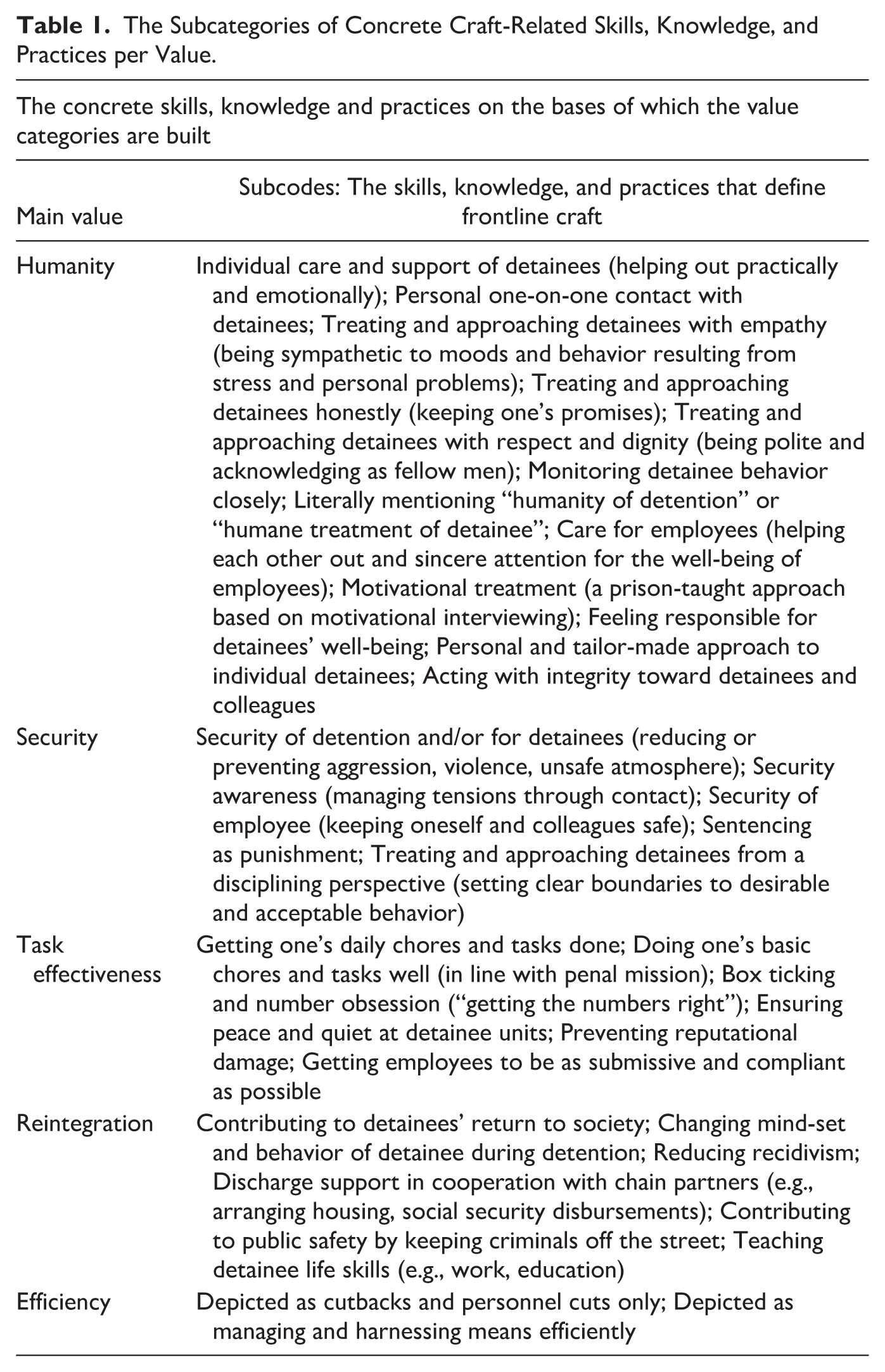
In the second stage, common denominators were sought by renaming, modifying, and integrating sub-labels into larger overarching coding categories (Friese, 2012, pp. 130–131). In this step of the analysis, the concrete aspects of craftsmanship, as mentioned by respondents, were inductively aggregated and classified into the overarching value category they described—for instance, “treating detainees with empathy” was categorized under the value “humanity” and “cut backs” under the value “efficiency.” Table 1 provides a complete overview of the main value codes and the subcategories of corresponding skills, knowledge, and practices they cover, and shows how the value categories were built. Respondents mentioned these more abstract value labels frequently themselves as well, with the exception of “task effectiveness,” a value that the analysis below designates as an important complementary street-level value. Finally, “[g]oing back and forth between data and codes” (Weiss, 1994, p. 156), this validated version was applied to the data set at large (to both interviews and policy documents) and allowed the subtleties of craftsmanship conceptions and the values they represent to be grasped and a comparison between different staff levels made.
The Subcategories of Concrete Craft-Related Skills, Knowledge, and Practices per Value.
Findings
In line with the twofold research question, actual values (respondents’ own value perceptions of what constitutes the penal craft) are reported first, followed by the mutual perceptions of each other’s views on the penal craft. This section presents a weighted analysis of how respondents judge the importance and centrality of specific values to frontline craft, and shows how the divergence is not in the actual value perceptions, but in the mutual perceptions, and is specifically strong with respect to what other levels are stereotypically seen to focus and steer on (i.e., more in value prioritization and enactment than in value identification and understanding).
Intergroup Differences on Values of Craftsmanship
The picture of the skills, knowledge, and practices needed at street level, painted by the different groups of prison sector staff, is quite uniform and represent four key values: Their work ought to revolve around safeguarding and expressing (a) humanity and (b) task effectiveness, and then (c) security, and, to a significantly lesser extent, (d) reintegration. As Table 2 shows, the value patterns are highly similar for each group. From this set of four key values, a few important observations can be inferred.
Views on Street-Level Craftsmanship Compared (N = 55).
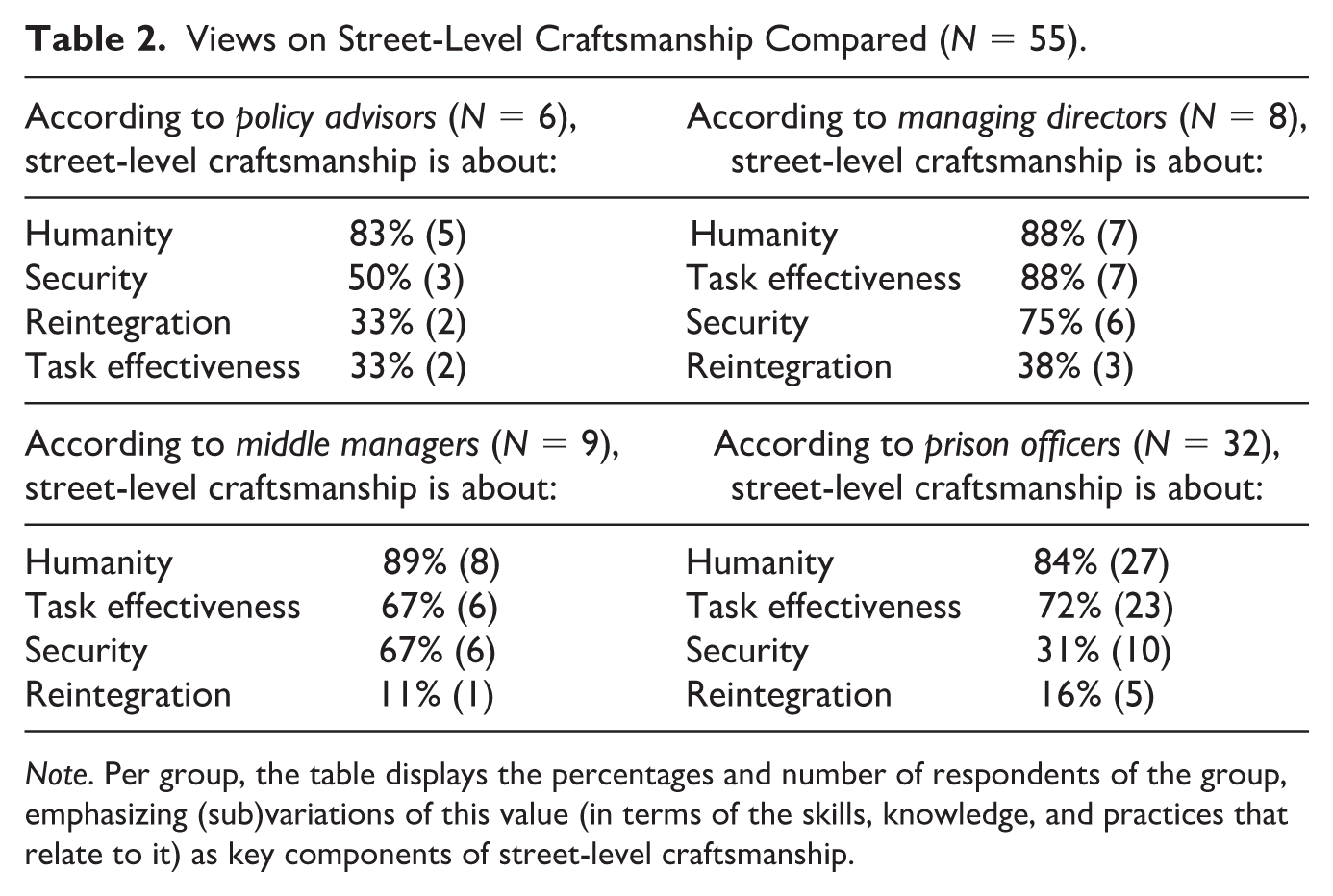
Note. Per group, the table displays the percentages and number of respondents of the group, emphasizing (sub)variations of this value (in terms of the skills, knowledge, and practices that relate to it) as key components of street-level craftsmanship.
First, the comparison of value patterns demonstrates a strong level of convergence on value identification, or the types of values that are seen to matter to craft. The image of penal craftsmanship at street level mirrors well the three core policy values of humanity, security, and reintegration that represent the sector’s mission. All groups consistently attribute aspects related to these values to good craftsmanship on the shop floor although it should be noted they do so in varying degrees: a vast majority of 47 out of 55 respondents (85%) see humanity as a prime value, security is perceived to be key by 25 respondents (45%) and occupies an overall third place, and reintegration is emphasized only by 11 respondents (20%).
Second, the interpretations of the skills, knowledge, and practices that underlie these three values are highly similar, and show a very compact internal convergence per value. This demonstrates that there is also a strong degree of convergence on value understanding. For instance, humanity is predominantly composed of providing individual care and support to detainees (helping them out practically and emotionally) and other craft-related skills and practices such as treating detainees with respect and empathy. Security is uniformly understood as the key notion that detention should be executed safely: it should be aimed at maximizing “hard” safety and security for both employees and detainees by minimizing occurrences of aggression, violence, and crime within the penal facility. But many also add the importance of “soft” security in disciplining detainees into appropriate, respectable, and polite behavior, as well as the usefulness of maintaining good relationships with detainees to detect tensions and manage them accordingly. Reintegration is convergently regarded as contributing to the detainee’s return to society by changing the mind-set and behavior of the detainee during detention (to stimulate them to obtain a life[style] free of criminal activity). Although reintegration is an important policy value, surprisingly few respondents include in their explanation of craftsmanship at street level what is, compared with the other core values, the more abstract nature of reintegration efforts.
Third, “task effectiveness” was added as a complementary value category to capture the skills, knowledge, and practices describing the extent to which street-level professionals can perform their daily administrative and organizational tasks. Whereas task effectiveness is not a policy value that institutional documents center on, as evidenced by the absence of anything of a similar notion in prison policy documents in document analysis, it emerges as a clear value in street-level practice. Altogether, craftsmanship aspects related to task effectiveness were emphasized by 69% of respondents (38 out of 55). It represents the second most important value of the penal craft—though not for policy advisors who highlight it much less. Interpretations differ slightly from (a) “ensuring daily peace and quiet at detainee units” (a well-structured day without unnecessary unrest, distraction, or time constraints, including the absence of safety incidents and clashes between or with detainees), to (b) “getting one’s daily chores and tasks done” (crossing the daily activities of detainee care off their list), and (c) “doing one’s tasks well” (prison officers acting in line with the overall prison objectives of the penal mission). However, they do show a pattern of consistent variations within the different groups. Managing directors of the facilities as well as policy advisors place more emphasis on acting in line with the penal mission, whereas middle managers and prison officers stress “getting one’s daily chores and tasks done” and “ensuring daily peace and quiet at detainee units.”
Despite some differences in emphasis within or between values, the views of the different groups are remarkably consistent when comparing them with each other on an aggregate level: respondents alike conjointly put forward a compact set of no more than four values they feel constitute the street-level penal craft.
Fourth, and conversely, the interviews reveal that the seeming value convergence is, however, more powerfully explained by the fact that it has a theoretical character only: Ideologically, staff agree on the normative meaning of penal values, but different levels view the attainment of these values in real-life practice quite differently. This indicates a shared value identification and understanding, and, in theory, perhaps even a shared value prioritization, but diverging value enactment in practice. Both by managers and street-level prison officers, the way values are translated to practice is supported to a much lesser extent: The big complaint you always hear from prison officers: people at headquarters are just randomly making things up. And that is not in tune with what we do in practice. (Respondent 7, managing director) . . . that is a paper reality only and in practice I feel it does not work that way. [. . .] The implementation [. . .] only manifests itself in performance indicators. We have to comply with those norms, because that thing is for that bag of money. (Respondent 53, prison officer)
Mutual Perceptions and Stereotyping With Respect to Values of Craftsmanship
In contrast to the seeming relative convergence of the actual views of the different groups, the mutual perceptions of each other are characterized by divergence, conflict, and stereotyping. The divergence is most powerfully explained by a very strong perceived divergence on value prioritization and enactment, but distinct differences can also be detected in the types (identification) and meaning (understanding) of values that are attributed to other staff levels than one’s own. Interestingly, street-level prison officers are most positively evaluated: Respondents from other staff levels think that the perceptions of prison officers best resemble their own views on craftsmanship (as previously defined in the set of four values that respondents ascribe to). Policy advisors are seen to have the most deviant street-level beliefs.
When comparing the aggregated scores per value—that is, including how much emphasis respondents put on the (sub)variations of craft-defining skills, knowledge, and practices that underpin these values—in respondents’ own value perceptions vis-à-vis their value perceptions of each other, quite different value patterns emerge. As Table 3 shows, humanity drops significantly in the list of important values and is now analyzed to rank in third place. Other striking changes are that “efficiency” enters the value patterns as a new, fifth, value, and that task effectiveness is seen as the prime value focus of other levels emphasized with a truly major distance to the other values in the ranking. Altogether, respondents mention concrete categories of skills, knowledge, and practices that relate to task effectiveness 187 times. In comparison, (sub)variations of humanity, or efficiency, are mentioned 55 and 18 times, respectively (see Table 3). As Table 4 shows, this value pattern is confirmed when breaking the value patterns down per respondent group.
Comparing Aggregated Scores of Own Views and Mutual Views per Value (N = 55).
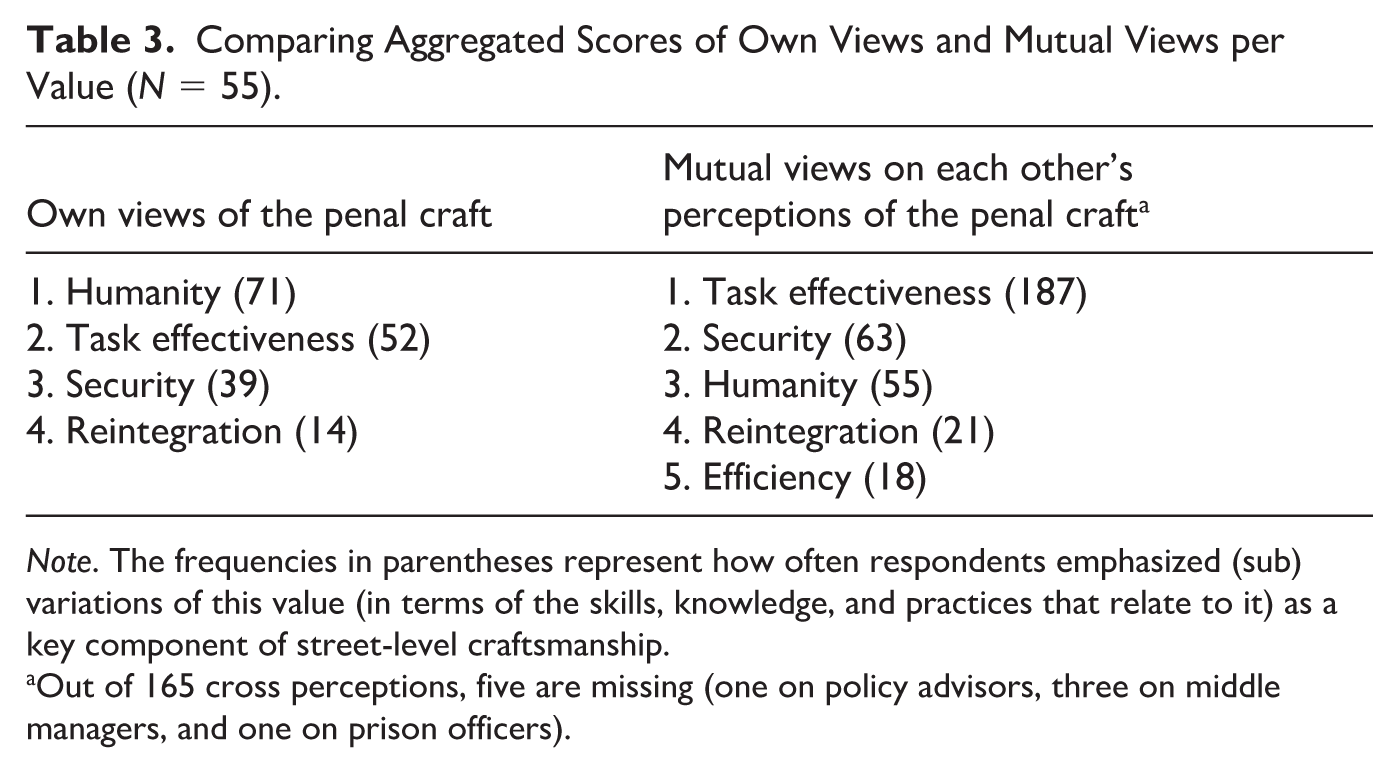
Note. The frequencies in parentheses represent how often respondents emphasized (sub)variations of this value (in terms of the skills, knowledge, and practices that relate to it) as a key component of street-level craftsmanship.
Out of 165 cross perceptions, five are missing (one on policy advisors, three on middle managers, and one on prison officers).
Mutual Perceptions on Street-Level Craftsmanship: Comparing How the Different Staff Levels View Each Other (N = 55). a
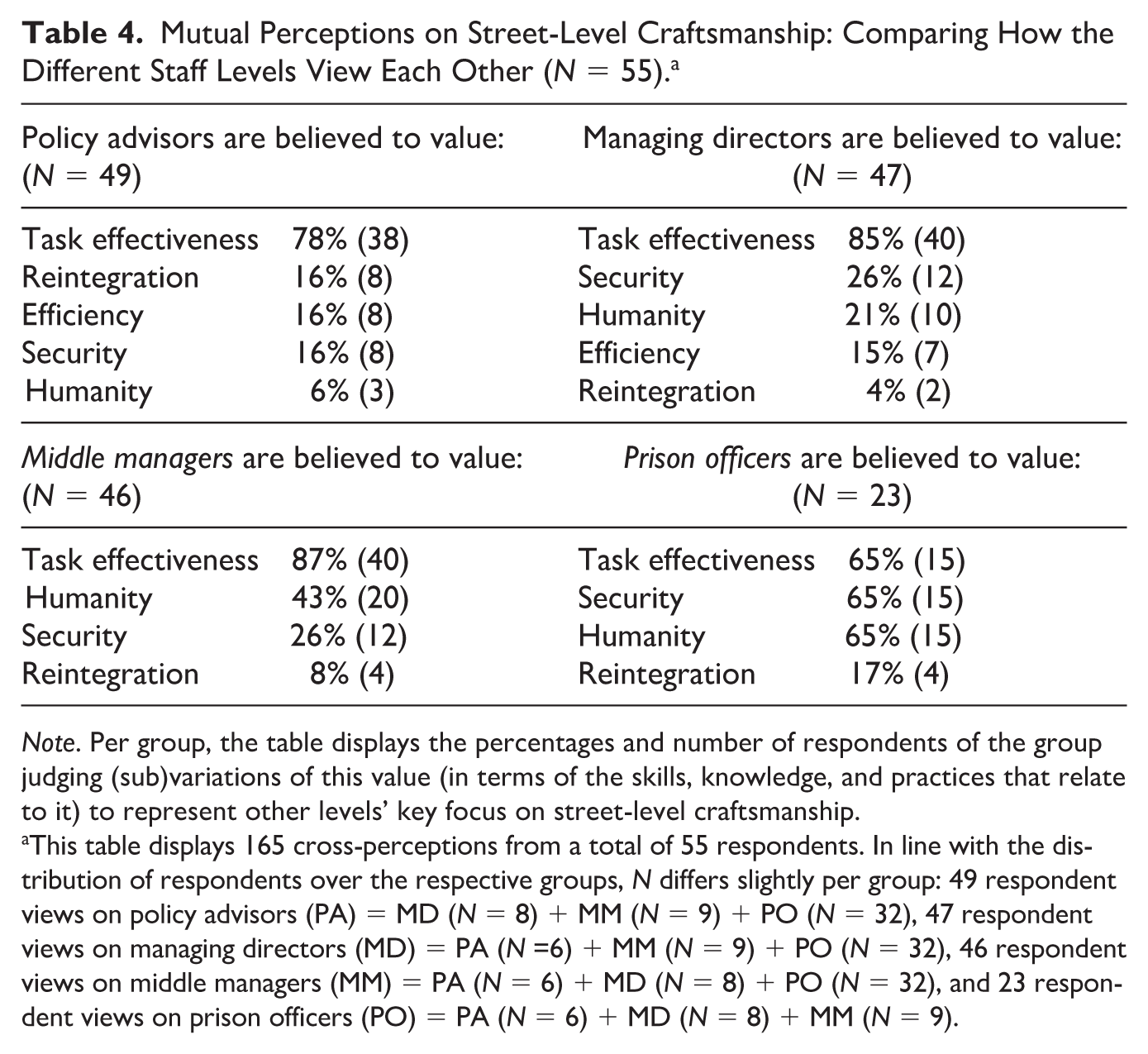
Note. Per group, the table displays the percentages and number of respondents of the group judging (sub)variations of this value (in terms of the skills, knowledge, and practices that relate to it) to represent other levels’ key focus on street-level craftsmanship.
This table displays 165 cross-perceptions from a total of 55 respondents. In line with the distribution of respondents over the respective groups, N differs slightly per group: 49 respondent views on policy advisors (PA) = MD (N = 8) + MM (N = 9) + PO (N = 32), 47 respondent views on managing directors (MD) = PA (N =6) + MM (N = 9) + PO (N = 32), 46 respondent views on middle managers (MM) = PA (N = 6) + MD (N = 8) + PO (N = 32), and 23 respondent views on prison officers (PO) = PA (N = 6) + MD (N = 8) + MM (N = 9).
The high frequencies for task effectiveness also reveal, for this particular value, a high degree of divergence on value understanding: the different, and heavily clashing, interpretations that different groups use to create rigid stereotypes of each other, which alter the meaning of this value. In the mutual perceptions on managers, task effectiveness harbors truly different additional meanings of box ticking, reputation management, and organizational paralyses that change the connotation of the value altogether into an exceptionally negative one. The principal focus of managers, whether at policy level, director level, or middle management level, is thought to lie on one of these negative conceptions of task effectiveness, and excessively so, at the direct expense of other values that relate to craftsmanship (see Table 4).
When looking at mutual perceptions, in general, managers are not judged favorably, specifically not on their value prioritization and enactment. Regardless of the hierarchical layer they occupy, prison employees are consistently biased to believe that management above them prioritizes targets over content. This image of task effectiveness in the interpretation of “getting the numbers right” is seen to create a mentality of box ticking and number obsession, and is further intensified when moving up the hierarchy. Through the way they manage their personnel in practice, with a perceived overemphasis on trivial check lists, quantifiable targets, and other performance indicators that barely scratch the surface of good work, managers create the impression that they care much less about humanity, security, and reintegration.
Positioned at the top of the hierarchy, the most negative stereotyping is directed against policy advisors at headquarters. According to the other levels, policy makers have an understanding of frontline craft that focuses mainly on a negative form of task effectiveness (according to 78% of respondents), and to a lesser extent efficiency (16%), at the expense of their focus on reintegration (16%), security (16%), and humanity (only 6%). Specifically, 59% of respondents feel that policy advisors impose an interpretation of task effectiveness as box ticking and number obsession, and 33% feel it is headquarters’ primary focus to “prevent reputational damage” by averting negative media attention, with no consideration of the quality of the tasks or services involved: Everything, in the end, is about the numbers. (Respondent 19, middle manager) At headquarters, the focus on numbers is now so strong that [. . .] the type of content of the Modernization Program is suppressed. (Respondent 7, managing director) Not too many incidents [and media coverage], because that is what stresses them out. (Respondent 14, managing director)
Just like headquarters, managing directors and middle managers are judged to have an overemphasis on task effectiveness in their value prioritization and enactment (by 85% and 87%, respectively). However, respondents do not merely ascribe negative interpretations of task effectiveness to these management layers: one fifth perceive managing directors to value craftsmanship that focuses on “getting daily tasks done,” and one third perceive middle managers to have this as their focus. Compared with policy advisors, they are also perceived to put more emphasis on humanity and security, and middle managers yet more favorably than managing directors (see Table 4). Yet, the negative perceptions clearly outweigh these cautiously positive interpretations.
A total of 53% of respondents perceive managing directors to primarily focus on task effectiveness as “box ticking and number obsession,” and 50% attribute this focus to middle managers: “it is about managing by distance and: you better provide the numbers” (Respondent 23, middle manager). Moreover, with regard to these two groups of organizational managers, just more than one third of respondents describe another negative type of task effectiveness that emerges and which was coded as “getting employees to behave as submissively and compliantly as possible.” It exemplifies a manifestation of organizational paralysis that demands employees to “above all, not step out of line” (Respondent 44, prison officer) or “always be the best boy in the class” (Respondent 52, prison officer). In a most minimal interpretation of craftsmanship, these respondents felt in-house management greatly appreciates, and often over appreciates, employees to be endlessly loyal and obedient, even when raising their voices was felt to be justified and in the interest of maintaining the quality of the craft or of the provision of detention itself: They are only happy when you never fall sick, do not think independently but just do as you are told and don’t by any means stand out because you cause trouble. (Respondent 37, prison officer about their managing directors)
The specifications of the value of efficiency, too, reveal an image of suggestive stereotyping of colleagues higher up the hierarchy. Interestingly, efficiency is considered a concern of higher management only, outside the sphere of influence or sphere of interest of street-level prison officers and middle managers, and in a predominantly negative fashion. To the 16% of respondents who mention efficiency, policy advisors and managing directors use the reform agenda of the Modernization Program as a fig leaf for the implementation of cutbacks and personnel cuts. It is seen as an instrument of headquarters and managing directors of facilities to push through austerity measures that lower costs ruthlessly—at the expense of other street-level values: “I think they couldn’t care less, really, I think headquarters is like ‘well if we do not get too much shit from the executive people, it is all fine by us’ [. . .] and then in the cheapest possible way.” (Respondent 47, prison officer)
The fieldwork clearly indicated that this negative stereotyping is a function of the difficult circumstances of the sector at large, both financially and in terms of the continuous reforms. In the looming fear of losing their job, of being transferred, or of having to change the nature of work routines, employees, from managing directors to prison officers, tend to project their dissatisfaction on the layer above them. Respondents devote a considerable amount of time to talking about failing management and the perverse effects of the cutbacks and reforms, and it is often the first issue they put forward when discussing the craftsmanship views of their superiors. In addition, the mocking tone when speaking of superiors and their lack of commitment to the penal mission, and to the advancement of key prison values in particular, suggests a built-in inclination to shift the blame of failing reform efforts upward. These attribution effects to higher levels span the entire executive branch, from managing directors toward the ministerial policy advisors above them, but particularly from prison officers toward the middle managers, managing directors and policy advisors above them, and middle managers toward the managing directors and policy advisors above them. Suspicion is high, and the practice of questioning the genuine intentions of superiors omnipresent. The larger the hierarchical gap, the more the suspicion proliferates.
Discussion
Our findings indicate that, in theory, different staff levels have a relatively shared ideological notion of the values that matter in street-level craftsmanship: Respondents throughout the prison hierarchy identify the same set of very specific and profession-bound core values to be important. It also shows a considerable match between the values that express the policy and the street-level values deemed important for good public service delivery. This substantive convergence on value identification and value understanding seems to result from a specific type of professional socialization: through institutional measures, employees adjust to and are actively integrated by organizations. Institutionalized socialization is discernible in the convergent identification, understanding, and in the actual views also for a large share in the prioritization of humanity, security, and reintegration, indicating that prison sector staff are strongly and professionally socialized into the prime policy values of penal craftsmanship. In addition to the extensive in-house training that penal staff receive, the overwhelming flow of information stemming from the Modernization Program reforms may very well have played a role too. Prison employees at all levels received training, information charts, policy reports, and dealt with plentiful new tools and instruments geared toward further institutionalization of these values in the organization. This confirms theories of organizational value management (Paarlberg & Perry, 2007) and organizational socialization (L. B. Andersen & Pedersen, 2012; Moyson et al., 2018; Teodoro, 2014): these logics remedy professional socialization between different staff levels and optimize value convergence on street-level craftsmanship throughout the institutional hierarchy.
Importantly, however, the normative impact of the socialization effect should not be blindly attributed to formal institutionalization only. As this study shows, normative isomorphism on value identification and interpretation is likely to stem to a large extent also from noninstitutionalized socialization through close interaction in informal professional practices and behaviors. For instance, street-level task effectiveness—not an official policy value and not found in any formal institutional document or steering mechanism—was identified as an important shared value of practice. Moreover, the research shows that all observed values very accurately describe the concrete street-level skills, knowledge, and practices prison officers deal with on a daily basis, and have dealt with throughout their careers. The core values de facto translate existing practices of street-level craftsmanship into the abstract principles these practices embody, and as such are also developed and advanced from the bottom-up just as much as they are enforced top-down. Clearly, street-level professionals leave a strong mark on the normative consideration of good work in their domain. As “conservers of institutional norms and practices” (Maynard-Moody & Musheno, 2012, p. S16), street-level professionals are seen as craftsmen who make, repair, and actively craft policy through specific, profession-bound sets of values that have a strong homogenizing effect—not only among themselves, but also higher up the hierarchy.
There is notably a less collaborative notion of how to practically attain the abstract values of the penal craft—that is, less agreement in terms of managers’ value prioritization and enactment in practice. Articulating good work at street level reveals tensions between aspirational ideals and organizational practice, between the lifeworld of intrinsic motivations and the systemic world of instrumental measurement, with divergent ideas on how to put sufficient emphasis on and how to transform the ideological foundations of values to practice (Paanakker, 2019). Values that serve the inmates are lost in values that serve the organization.
In terms of causes, role differences start to play a part. A strong stereotyping of role differences is observed that leads to stronger perceived than actual value divergence throughout the institutional hierarchy, specifically with respect to value prioritization and enactment, but in the case of task effectiveness also with respect to value understanding, and in the case of efficiency also with respect to value identification. The dominant agenda of reform measures (perceptions of overcomplicated and performance measurement–induced policy changes) and austerity (perceptions of uncaring cutbacks and financial and personnel management) was found to exacerbate role and value differences between different staff levels and, consequently, mutual misperceptions on how to foster good work at the frontline. In the perception of all levels of the executive branch, this agenda leads to the unjustifiable glorification of quantifiable managerialism by their superiors. It creates a dynamic of personal survival in the job that is best served by plainly and numerically meeting the performance targets set by the echelons of higher management. This externalizes content and makes it inferior and subordinate to measurable output, something that has little to do with honoring key public service values and delivering good work. It also supports emerging literature that indicates that intense reform sequences (Wynen et al., 2019) and regulatory policy changes “constraining the work conditions of frontline public service providers can indeed produce lasting negative motivational effects” (Jensen et al., 2019, p. 1).
Value divergence is not perceived to constitute inevitable and instrumental role differences that benefit organizational structure and productivity: It is perceived as an undesirable reality that functions to undermine rather than support good frontline work. Perceived differences impact mutual understanding, cooperation, and partnership much more negatively than the actual differences. The conclusion that the executive worker, as well as executive work itself, suffers from experienced value divergence suggests that value convergence is an asset to harmonious and productive organizations. Based on our case study, we expect higher convergence on frontline values of good work, especially with respect to value attainment, to better facilitate cooperation on public service value realization on the ground, to promote job satisfaction and reduce work stress, to mitigate street-level alienation from policy, and to encourage the quality of public service delivery.
Further examination is needed of these expected effects on public service delivery, and of the role that (different types of) public managers play in reducing or sustaining value misperceptions and successful or failed value attainment in public organizations. And, even if misperceptions are partially imaginary, what coping strategies for different types of value divergence do professionals develop? To learn whether other public domains suffer similar dynamics from value divergence, and under what conditions, future qualitative studies into other professional occupations and policy fields are encouraged.
Conclusion
Throughout the prison hierarchy, the context of austerity and performance-induced reform was found to accentuate role and value differences between different groups in the organizational hierarchy, and to exacerbate transpositional stereotyping into a deeply rooted toxic organizational dynamic. These perceived differences overshadow the actual convergence in displayed views of craftsmanship achieved by institutional and noninstitutional professional socialization. Primarily, respondents appear to be systematically biased to believe that management above them prioritizes targets over content, and measurable output and efficiency (those values that support the organization) over intrinsic values of good work (those that serve prison inmates).
Clearly, defining what craftsmanship is, is a shared process of discovering how different staff levels in the organizational hierarchy view themselves as well as each other. Failure to recognize and institutionalize this creates harmful stereotyping throughout the policy domain, preventing key values from being expressed in street-level practice. Such shared deliberation is best facilitated when ongoing informal socialization processes at street level are the starting point for a common set of core values along the policy chain and, also, for the careful common coordination of how to implement these ideas in individual public organizations.
Despite theory on hybrid professionals or professional managers, this case study shows a clear dichotomy between the perceived managerial logic that accompanies cutback management and neoliberalist reform, and the professional logic that favors quality improvement of service delivery on the shop floor. The key to truly realizing values of craftsmanship at the street level, is overcoming perceived role differences by closing the perceived value gap between management and the shop floor and restoring mutual exchange and trust in value understandings.
Footnotes
Declaration of Conflicting Interests
The author(s) declared no potential conflicts of interest with respect to the research, authorship, and/or publication of this article.
Funding
The author(s) received no financial support for the research, authorship, and/or publication of this article.
