




Abstract
Public craftsmanship, as the normative prescription of a myriad of public values, is receiving renewed attention. This study aims at empirical insight into how such abstract principles acquire practical meaning in specific professional settings, and how they are practically facilitated on the shop floor. We use an explorative case study among Dutch prison professionals (N = 32) to contrast perceptions of ideal values and practices with perceptions of institutional facilitation at street level. In the case of prison officers, the institutional context of the prison was found to substantially restrain rather than support the ideals that professionals attach to good street-level craftsmanship. The study’s theoretical contribution is to show craftsmanship as uniquely localizing the normative underpinnings of good work. Empirically, the findings show how an unyielding neoliberalist administrative practice can hamper the potential of public craftsmanship and is likely to have negative impact on staff commitment and successful public service delivery. We end with implications for the further examination and development of public craftsmanship in public administration theory and practice.
Recent debates have reinvigorated discussion on “the art of the public profession” as a craft, and normative prescriptions of a myriad of public values that relate to general public sector work and behavior have been put forward (Kunneman, 2012; Rhodes, 2015; ‘t Hart, 2014). Yet it remains unclear how such abstract principles relate to good working practice within specific professional settings and how much leeway they are institutionally afforded in concrete street-level practice. Through empirical assessment, we seek to explore and further develop the meaning and potential of public craftsmanship in public administration theory and practice and to gain more insight in the street-level application of public values to real-life practices. We understand public craftsmanship to encompass the skills and values that represent an internalized motivation and competence for quality-driven work: the desire, skill, and commitment “to do a job well for its own sake” (Sennett, 2008, p. 9) that serves particularly well to reflect street-level professionals and the tangible nature of the tasks they perform, but also their experiential knowledge, and the malleable nature of their service delivery.
Empirical research on how public craftsmanship can be understood, in particular from a values perspective, is lagging behind. But street-level professionals absorb and transmit values on a daily basis. They do so in a continuous interplay with the organizational system they are embedded in and influenced by (Noordegraaf, 2007), also proactively influencing it themselves: the way values manifest themselves in street-level craftsmanship and how these professionals handle their work shapes the bureaucratic reality of policy implementation (cf. Caswell, Kupka, Larsen, & Van Berkel, 2017; Hupe, Hill, & Buffat, 2016; Lipsky, 2010; Stewart, 2006; Tummers, Bekkers, Vink, & Musheno, 2015). Through their management of values, we claim that, in street-level contexts, public professionals are craftsmen who make, repair, and actively craft policy.
Studying the decisive influence of the institutional environment as well as the importance of values, that, in this context, may or may not be at stake in professional conduct or craftsmanship is of particular importance. The public profession is becoming increasingly complex in an era of globalization, digitalization, changing work standards, and technologies, fragmented division of professional labor, managerialism-induced regulations and reforms, distrust and polarization, and an ever more demanding and assertive citizenry (Noordegraaf, 2016; Pollitt & Bouckaert, 2011; Van de Walle, 2011). While some argue the pervasive nature of new public management reforms is primarily to blame, others question the assumption that public professionals are merely voiceless victims (Boin, James, & Lodge, 2006; Van Loon & Noordegraaf, 2014). According to Trommel (2018), for instance, professionals seem to be absorbed by the target-oriented governance systems they themselves coproduce and sustain, working less from an intrinsic motivation of dedication and compassion. Likewise, Noordegraaf (2007) argues that contemporary knowledge societies are “full of barriers” to strong professionalism and professional autonomies but stresses that the neoliberal climates that are often blamed for this are just one factor among many (p. 763). Professionals may experience this institutional complexity impairing craftsmanship values in practice.
The important question arises as to how conducive to expressing their craftsmanship values—or how restraining of it—the institutional context of the organization appears to be to these professionals, but also of what public craftsmanship means to professionals in specific public settings in the first place? Are these understandings convergent in terms of the values they describe, or are they rather very diffuse? The main research question for this study is as follows:
We address this question by contrasting perceptions of ideals (analyzing the underlying values that attach to professionals’ subjective perception of good working practice) with perceptions of institutional facilitation (comparing these ideals with the values they see expressed daily in their organizations by means of the institutional paradigms, policies, tools, instruments, and management behavior they encounter). Other than theory on person-organization fit (Moynihan & Pandey, 2007), we do not focus on how organizations attempt to align newcomers with their goals, and how this functions as a possible outcome of the organizational socialization process (Moyson, Raaphorst, Groeneveld, & Van de Walle, 2018; Peng, Pandey, & Pandey, 2015). Rather, we look at value congruence the other way around: the extent to which public professionals perceive their professional context to correspond to their ideal, rather than how they match or can align themselves with the ideals of the organization and its institutional context.
To gain more insight on this topic, we use an exploratory case study among professionals in the Dutch prison sector that exemplifies the dynamic of complex craftsmanship development in an equally complex context of institutional pressures. In the Netherlands, prison officers perform a variety of complex practical and psychological tasks on rehabilitation, detainee care and support, and (social) safety control, and must balance inherently conflicting values in their daily work with detainees. This requires unique hard and soft skills, acquired through training but also largely on the job, that they exercise with a high degree of discretionary authority in a rather contrarian institutional structure of hierarchical decision making and a powerful chain of command. Furthermore, it is a sector in which craftsmanship may be under more and more pressure because of large-scale cut backs and reforms that arguably lead to a hollowing out of the profession (Inspectorate of Justice and Security, 2017) and cause prison officers to strike (OmroepWest, 2016; Roerdink, 2017).
Ideals of Public Craftsmanship: Values and Skills
We lay the foundation for public craftsmanship in a reconciliation of the literature on professionalism with that on public values, arguing they have some clear but unexplored intersections on what the nature of such “good work” is. From scholarly debates on professionalism we borrow the focus on skills and practices, and we take the focus on values from public values research. We examine public craftsmanship ideals as the underlying values that attach to professionals’ subjective perception of good working skills and practices.
If we regard professionalism from the perspective of craftsmanship, classic professionalism focuses a-normatively more on the skill (what professionals do) than on the related values of good work (the more abstract end goals professionals want to achieve). The literature on professionalism in the public sector is rich and continues to expand (Freidson, 2001; Noordegraaf, 2016). The idea is that processes of “controlled content,” for instance by means of formally organized selection, monitoring, education, and training, “structure and regulate occupational practices” (Noordegraaf, 2007, p. 762) in a way that strengthens the quality of the profession and of its service delivery. Such classic conceptions of professionalism “as the occupational level of specialized, theoretical knowledge combined with the existence of firm intra-occupational norms” (Andersen & Pedersen, 2012, p. 46) may create an external locus of control for professional skill development. It may reinforce instrumental conceptions of professionals as a homogenizing force of technical-rational intra-occupational socialization, where the development of skills is seen as part of an isomorphic process that leads to the institutionalization of perhaps internalized (Teodoro, 2014), but by any means enforced professional norms and behaviors. As Rhodes (2015) states, “Indeed, existing lists of skills are about which skills the public servant ought to have in the era of NPM, not descriptions of the skills that public servants deploy in their everyday lives” (p. 642). Hence, much of the work on professionalism focuses more on the tangible formalized skills—especially on the externally manufactured and monitored ones—than on the subjective and normative underpinnings of those skills.
In contrast, public values research may attract criticism for being too abstract when considered from a craftsmanship framework. In attempting to get to grips with what qualifies governance as “good,” public values debates center on which general public values matter and which general public values officials adhere to, which value bases determine officials’ public sector motivation, and how officials deal with dilemmas induced by conflicting values (cf. Andersen, Beck Jørgensen, Kjeldsen, Pedersen, & Vrangbæk, 2012; De Graaf & Meijer, 2018; Kjeldsen, 2014). Few studies link this focus on the “good” to street-level practitioners in terms of what the skills and practices of good work actually look like in administrative practice. Our study is thus a first step in mapping the values that underpin conceptions of public craftsmanship, and the way they relate to concrete professional practices, skills, and institutional constraints in the organization.
In this narrower context of public craftsmanship, we define values as the key qualities that public professionals esteem in the context of, and toward, the object of their work, for example, education or, in this study, detention. Such qualities may pertain to personal skills, or to the qualities of individuals in the realization of public craftsmanship, for instance, treating detainees with respect, or to institutional practices, qualities of the governance process by means of which public craftsmanship can prosper, for instance, providing a safe work environment for employees in penal facilities. Public craftsmanship, then, is understood to encompass the skills and practices as well as the values that represent an internalized motivation and competence for quality-driven work: the desire, skill, and commitment “to do a job well for its own sake” (Sennett, 2008, p. 9).
There are two reasons that combining skills and practices, on the one hand, and values on the other, into one perspective of craftsmanship may enrich our understanding of the complexities, the importance, and the uniqueness of the public function at the frontline. Craftsmanship values are different from professional values and also have a different focus from public values. First, they shift the focus to a different type of expertise, and second, they shift the focus to street-level administration and hands-on work.
Shifting the Focus to a Different Type of Expertise
Other than professional values, craftsmanship values express a different type of expertise—one that serves particularly well to reflect the experiential knowledge of street-level professionals and the malleable nature of their service delivery. To call something a craft rather than a profession is to accept the importance of a different type of knowledge and way of acquiring expertise. Classic professionalism focuses on (the control of) good work by means of formal education, theoretical specialization, and top-down norm enforcement. By contrast, much of the specialized knowledge public administrators need is tacit, nonsystematized, and versatile (Barnard, 1938; Polanyi, 2009; Rhodes, 2015). According to Rhodes (2015), in many occupational settings, the work of the public administrator is better understood as a malleable art: a profession that is learned on the job, for a large part informally and through experiential knowledge (p. 642). A good craftsman, Sennett (2008) argues, is always “judging while doing” (p. 296): they “equally make and repair” and “in turning outward, they hold themselves to account and can also see what the work means to others” (pp. 248-249). As such, craftsmanship offers a language through which to appreciate the complexities and uniqueness of the public profession: It “has no one best way” and, next to on the basis of formal knowledge, skills are often developed on the ground by “passing on practical beliefs and practices” (Rhodes, 2015, p. 642). It constitutes an emphasis on practical beliefs and practices rather than theoretical guidelines, and, through trial and error, on a continual quest to find contextualized and tailor-made “best ways” rather than on protocolled work (“muddling through” in the words of Lindblom (1959), or “artistic, intuitive processes” in the words of Schön (1983, p. 49).
This means we understand public craftsmanship to represent professional work that is versatile rather than fixed, building not just on theoretical (transfer of) knowledge in the formal sense, but—importantly—also on practical and experiential (transfer of) knowledge in the informal sense. In addition, this differing emphasis is particularly representative of the often-tangible nature of the work of professionals at the street level and brings us to the next point.
Shifting the Focus to Street Level and Hands on Work
Distinct from public values, craftsmanship values have a different focal point and shift the focus to administrative practice. This serves particularly well to reflect street-level professionals and the tangible nature of the tasks they perform. Much of the study of public values theoretically and empirically constitutes a focus on values in the wider public sector, or among administrators in the higher echelons of policy development or management (cf. Andersen et al., 2012; Beck Jørgensen & Bozeman, 2007; De Graaf & Paanakker, 2015; Holmberg, Rothstein, & Nasiritousi, 2009; Huberts, 2014; Reynaers & Paanakker, 2016; Van der Wal, 2016; Van der Wal & Yang, 2015; Yang & Van der Wal, 2014). Broad values such as desired accountability, lawfulness, or effectiveness are understood to pertain to general public sector conduct, processes, and outcomes (or in Bozeman’s, 2007, words, to “the principles on which governments and policies should be based”; p. 13) and are supposed to guide public decision making in all its aspects. 1 The limited amount of studies on the public office as a craft agree in the scope and definition of public values. For instance, Rhodes (2015) discusses generic values such as stewardship and political nous that ought to guide top administrators’ behavior (pp. 642-644), and, among public managers, ‘t Hart (2014) contends that generic values such as transparency, accessibility, and reliability are key values of the craftsmen of the future (pp. 36-37). Unlike values of such general nature, the conception of public craftsmanship that we propose opens up space to pinpoint values in specific professional and occupational spaces. Moreover, it indicates values that are descriptive of the hands-on work delivered at street level.
In doing so, our perspective also shifts the focus to individual professionals: to the way individual professionals frame and interpret relevant values in good work. As such, it constitutes one way of reducing the conceptual confusion that is paramount in public values research (Beck Jørgensen & Rutgers, 2015; Van der Wal, 2011), and, as values only acquire meaning in the specific context in which they are found and used (Andersen et al., 2012; Rutgers, 2015; Yang, 2016), powerfully aids understanding of the irrefutably normative nature and contextual relevance.
A Common Understanding of Penal Craftsmanship Values or Not?
When theorizing on the degree of street-level consensus on craftsmanship and on a conducive institutional environment for craftsmanship in the organization, we need to consider what is known on professional convergence in general, and on the uniformity of penal values in particular.
Conceiving values from a value pluralism perspective indicates that dealing with values in volatile and overcrowded policy spaces is demanding and not straightforward (Spicer, 2010; Thacher & Rein, 2004). Yet, it is often assumed to represent the daily reality of on-the-ground decision making (Koppenjan, Charles, & Ryan, 2008; Oldenhof, Postma, & Putters, 2014; Steenhuisen, 2009). In the prison context, the practical difficulty of doing justice to a multitude of values is widely recognized. Prison officers’ work is characterized by a balancing of multiple and often conflicting values (Liebling & Arnold, 2004) that challenges the unambiguous execution of good craftsmanship. According to Spicer (2009), value balancing is especially relevant in contexts “where practitioners are often called upon to grapple with and make judgements about value conflicts, [. . .] and where their actions are often, either explicitly or implicitly, coercive in character and affect a large number of people” (p. 539)—prison officers’ work preeminently represents such a context.
In penal literature, the most commonly mentioned values said to be inextricably allied to detention are the values of security, humanity, and rehabilitation (DiIulio, 1987; Foucault, 1977; Molleman, 2014). These three goals or values are also explicitly incorporated in the mission statement of the Dutch prison system that reads: “We ensure a safe and humane detention and work with our adjacent organizations and the inmate, towards reintegration” (Dutch Correctional Agency, 2009b). Prison officers are expected to endorse these values, but the values are inherently different in many respects (Boin et al., 2006). For instance, striking a balance between the repressive nature of security and the relational nature of humanity demands different tactics when translated to craftsmanship: “Being a good prison officer involves being good at not using force but still getting things done, and being prepared to use the various power bases officers can draw on when necessary” (Liebling, Price, & Shefer, 2010, p. 205). This value complexity may threaten a common understanding of public craftsmanship among prison officers.
This potential problem for a uniform framework of craftsmanship values is partially obviated by the socialization effect of professional logics: professionals conform to identical and highly institutionalized professional norms (Andersen & Pedersen, 2012) that generate normative isomorphist processes through professional selection and socialization (Teodoro, 2014). As such, the definition of the skills involved in good work is shaped and controlled by and within the professional group itself: “Because the services that professionals deliver often require specialized knowledge, the profession benefits from everyone adhering to the same norms, and therefore steers the behavior of the professional through education, socialization, and internal regulation” (Van Loon & Noordegraaf, 2014, p. 208). In the public sector, Freidson explains, this pertains to the expectation of professionals becoming socialized to “an ideology that asserts greater commitment to doing good work than to economic gain” (2001, p. 127). The converging effect is likely not only to pertain to skills and norms, but, importantly, also to values. As Paarlberg and Perry (2007) indicate, values, too, serve as a homogenizing framework and “provide a common understanding of the correct way of thinking and acting” within organizations (p. 39).
Examining Institutional Facilitation in the Organization
Even if conceptions of craftsmanship are uniform within street-level occupations, this does not mean those ideal conceptions are institutionally facilitated in the organization in an equally uniform sense. Moreover, because the terms of imprisonment are susceptible to political or societal swings, in practice the aims, tasks, demands, and context of prison work are subject to frequent renegotiation of values. Within the framework of craftsmanship, this means prison officers can be faced with a highly volatile administrative practice (Liebling et al., 2010). This signals how complex institutional environments may constrain value attainment, and hence, public craftsmanship, but this we still know little about.
The institutional facilitation of public craftsmanship in the organization, which constitutes the second part of our research question, remains underresearched. The values public professionals aspire to may be at odds with their perceptions of what actually plays a role at street level in the complex bureaucratic reality that is restrained by moral complexity, lack of time, resources, political will, or bureaucratic inaptitude. Different institutional paradigms, policies, tools, instruments, behaviors, and management dynamics, acknowledged by the local dynamics in the organization, may or may not facilitate craftsmanship on the shop floor. It simply is a given that “all good things cannot be pursued at once” (Grindle, 2004, p. 525). Numerous studies reveal that frontline public professionals may sense a lack of their own involvement and significance, and how, at the implementation stage, they experience alienation from its guiding policies (Tummers, 2013). This may result in, or contribute to, decreased willingness to implement policies, to stress and low job satisfaction, and to coping strategies such as routinization behavior, emotional detachment from clients, rule breaking, or work-related cynicism and complaining (Evans, 2013; Lipsky, 2010; Tummers et al., 2015; Tummers & Den Dulk, 2013). Such issues suggest little room for street-level ideals in practice and even show the institutional context in the organization functioning to undermine craftsmanship.
Research Methods and Analysis
Research Methods, Object, and Respondent Characteristics
To empirically assess street-level perceptions of craftsmanship and its institutional facilitation in the prison, this study uses a qualitative approach by means of two case studies among prison officers. To obtain “rich descriptions and explanations for processes in identifiable local contexts” (Miles & Huberman, 1994, p. 1), in-depth semistructured interviews were conducted with 32 respondents in two penal facilities in the Netherlands, in 2014 and 2015 (N = 18 and N = 14, respectively). Both groups work within the same overarching penal policy programs and policies, share identical job descriptions, and attend to very similar target groups of adult male detainees.
In addition, we used participatory observation and, for 2 months, accompanied prison officers on their day, evening, and weekend shifts. As well as giving a far better understanding of prison dynamics, factors, and terminology, this allowed for the selection of a diversified and seemingly representative pool of respondents in terms of age, gender, length of service, and attitude to the job (for instance, pessimistic or optimistic, repressive or emphatic): 25 male and seven female prison officers, between 30 and 65 years old, and with a length of service ranging from 5 to more than 30 years (see Table 1). Although men, and particularly middle-aged men, are overrepresented, this represents prison officer population in the Netherlands accurately, as well as the populations at both facilities.
Respondent Characteristics.
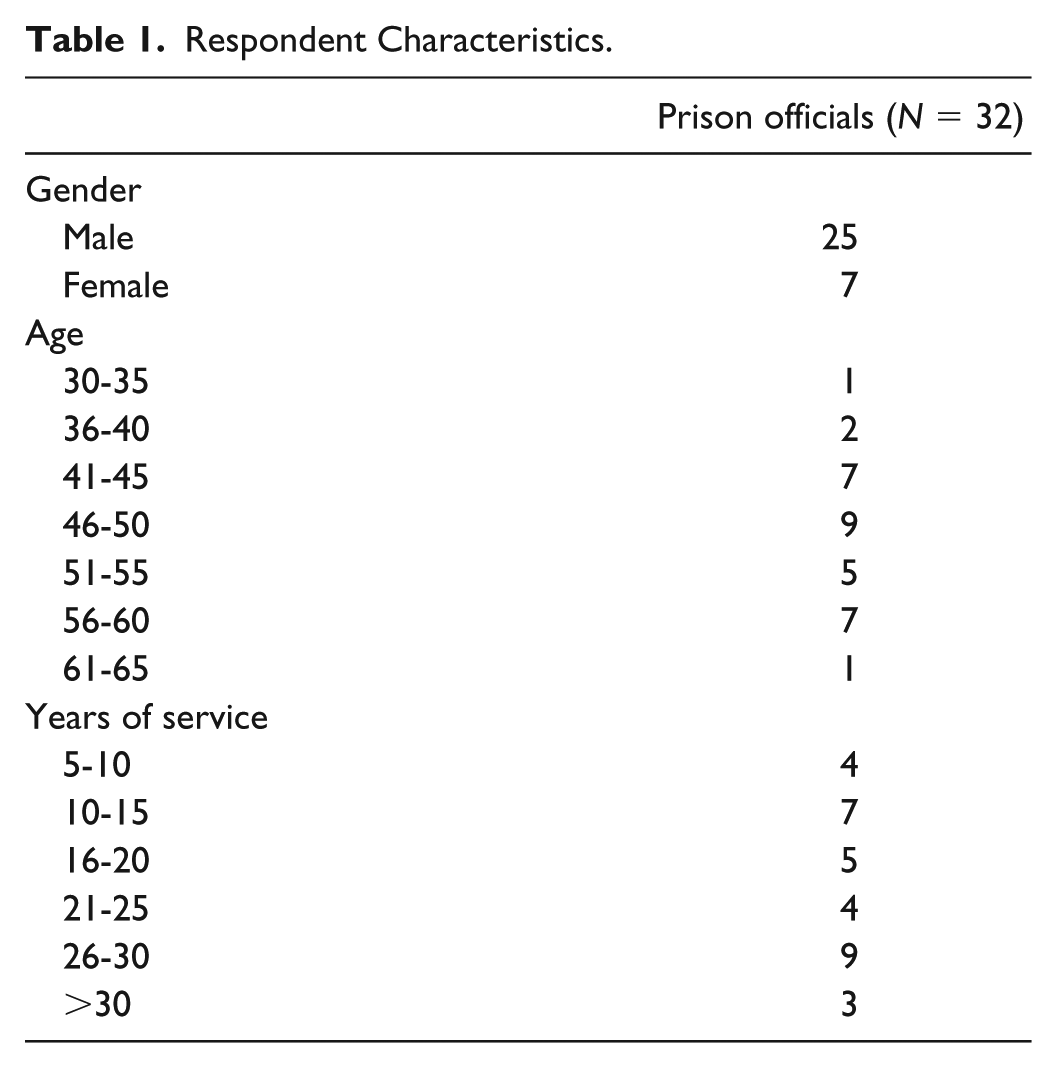
As professionals working at street level, prison officers are a suitable representation of the type of craftsmen we set out to research. Typical of street-level work, the work of prison officers entails the shaping of prison policies through the frequency, nature, and effectuated impact of their interaction with detainees. In the Netherlands, prison officers are granted substantial professional decision-making authority “in the support, motivation, and stimulation of detainees, in the intervention in aggressive behaviors and crisis situations, in the individual support of detainees as mentor, in the informing of detainees, and in the drafting of detainee (behavioral) reports” (Dutch Correctional Agency, 2009a).
This also signals the unique and complex professional skill sets that Dutch prison officers, as true craftsmen, acquire, partially through their common professional (in house) training and partially learnt on the job. This unique skill set sets them apart from the security guards who are prison officers in many other countries. In the Netherlands, however, the core staff in prisons consists of two distinct groups of personnel: security guards who control all movements into, within, and out of the penal facility; and prison officers who are assigned and trained to undertake a range of responsibilities in detainee care, providing motivation, and facilitating and fostering behavioral change among detainees, which includes core competencies such as “sensitivity” to (their own role in) other people’s feelings and needs, and “professional integrity” (Dutch Correctional Agency, 2009a). Prison officers furthermore share a professional code of conduct—prescribing desired professional behaviors, and giving detailed guidance on work-related dilemmas and risks, for example, dealing with contraband, the appropriate use of force, prohibited forms of contact with detainees and their families, and their reporting obligations (Dutch Correctional Agency, 2016). The detailed job descriptions that the Dutch Correctional Agency issues show how prison officers thus develop a very specific and much broader professional expertise (see Box 1).
Box 1. Professional tasks required of a prison officer (Dutch Correctional Agency 2009a)
The work of prison officers involves:
(1) intake and information, for instance contributing to advice on detainee placement plans;
(2) guarding and security, for instance ensuring compliance to safety regulations;
(3) support, for instance promoting a good living and working climate, as well as self-awareness and responsibility among detainees;
(4) care, such as providing basic social and psychological care and referring detainees to appropriate medical or psychiatric specialists; and
(5) reporting and information transfer, for instance drafting behavioral reports; or, in the case of a senior position, promoting expertise, and supervision.
Interview Questions
In the absence of an objective measure for determining “the amount” of craftsmanship, interviewees were asked for their subjective perceptions of good craftsmanship. As the word “values” proved too vague a concept for respondents, and to avoid any bias toward certain types of values, respondents were purposefully asked concrete questions such as “what does a good prison official look like?” to bring to the surface ideal qualities of public craftsmanship, or “what does the current penal vision constitute in practice?” to disclose perceptions of (room for) public craftsmanship in the institutional environment of the organization. Several control questions were asked to eliminate socially desirable answers, for example, descriptions of the job of prison officer, and questions about perceptions of ideal penal policy, about treatment styles toward detainees, and about when they felt they were doing their job well and what they disliked about their job in practice. Respondents were entirely free to elaborate and to raise topics themselves in response to, and in addition to, the questions. Interviews lasted approximately 1 hr and were recorded and transcribed verbatim (234,869 words).
Data Analysis
The data analysis consisted of a systematic content analysis through software-supported (MAXQDA) coding: a process of attaching distinct labels to data segments to organize, classify, and conceptualize the interview material (Friese, 2012; Miles & Huberman, 1994). In the belief that “a properly developed code is more than just a descriptive label” (Friese, 2012, p. 94), the coding system was developed largely inductively, using two-stage coding to build categories from the bottom up (see Bazeley, 2007; Friese, 2012; Kuş Saillard, 2011). During the first stage, open coding was applied to the data to explore and create subcategories of qualities that provide “a good description of heterogeneity and variance in the data material” (Friese, 2012, p. 113). This includes uniting data segments with similar content into mutually exclusive codes to create a methodological hierarchical coding system that reflects the data in all its facets (Friese, 2012, pp. 130-131). The next step was to find common denominators by renaming, modifying, and integrating sublabels into larger overarching coding categories (Friese, 2012, pp. 130-131). “Going back and forth between data and codes” (Weiss, 1994, p. 156), this validated version was applied to the data set at large and allowed for grasping the subtleties of perceptions of craftsmanship, for comparing these across respondents, and for comparing ideal conceptions with conceptions of organizational facilitation. For the sake of providing a manageable overview, the analysis presented includes only qualities that were mentioned by at least five respondents.
Concretely, this means that qualities as mentioned by respondents were inductively aggregated and classified into five main categories of values and one category of practical impediments that exhaustively capture and include (the common characteristics of) the qualities of craftsmanship mentioned by respondents: humanity, security, reintegration, efficiency, task effectiveness, and task negativity. The nature of their content will be detailed in the results section that follows.
Findings
Prison Officers’ Ideal Conceptions of Craftsmanship
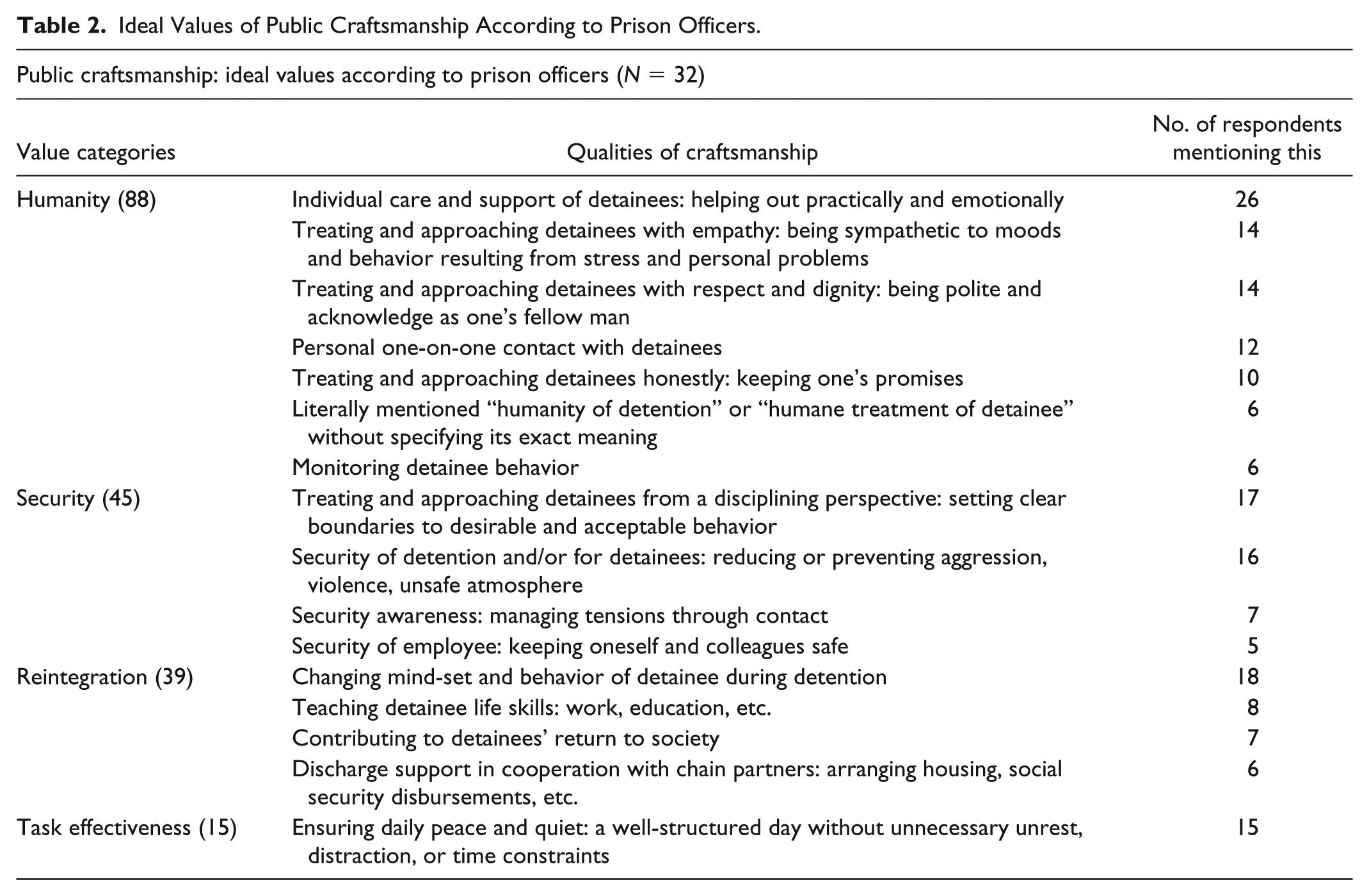
Table 2 lists the key qualities that respondents associate with their ideal conception of craftsmanship in prison work for both cases collectively, because, interestingly, cross-case comparison did not render any significant differences between the two cases. These qualities represent ideal type characterizations of very tangible and profession-bound norms and guidelines for action. They constitute a set of professional activities unique to detainee care, or, in the language of craftsmanship, a required set of unique skills and practices to deliver good penal work. They should not be mistaken for nonexistent or untenable ideals that have little to do with actual practice: participatory observation confirmed that the ideals mentioned are closely aligned with the practical activities prison officers perform on a daily basis.
Ideal Values of Public Craftsmanship According to Prison Officers.
Some variance can be detected in the diversity of qualities and in the different combinations that prison officers mention: Neither all name all the qualities, nor are they each mentioned to the same extent. From observation, it was also learned that, broadly speaking, there are two different types of prison officers: the “soft” ones that prioritize empathy, respect, close contact, and understanding in their work with detainees, and the so-called “hardliners” who work from the conviction that authority, repression, disciplining, and distance is key. This distinction, and the usefulness of having the two groups on the shop floor, was also confirmed in the interviews with respondents. Of course, this results in different types of and emphases in craftsmanship.
However, the data display remarkable consistency when aggregating these concrete qualities to the more abstract values they describe. Again, different respondents place different emphases, but on the aggregated level, this renders a highly convergent image of prison officers subscribing to a common core of four key values: public craftsmanship in the prison sector is about safeguarding the central values of humanity, security, reintegration efforts, and task effectiveness (variations of these values were mentioned 88, 45, 39, and 15 times, respectively). Interestingly, these four core values are surprisingly commonly understood, both within and across both cases, and signal an exceptionally high convergence of street-level perceptions of penal craftsmanship.
First, as demonstrated by Table 2, humanity orientations represent the most important pillar of craftsmanship, according to respondents. They refer to how detainees should be treated. This category fosters the idea of a prison officer who is there to cater to the needs of detainees, with a detention climate and staff approach that first and foremost sees the person behind the detainee, and involves treating detainees with empathy, respect and dignity, honesty, and maintaining personal one-on-one contact with detainees—mentioned by 14, 14, 10, and 12 prison officers, respectively. To a large extent, this humane approach is also institutionalized, for instance, through training on detainee treatment styles, and reflected in daily practice in, for example, the official mentoring role each prison officer has with a couple of detainees. Safeguarding humanity was reported to have important spill-over effects to the other key values that typify craftsmanship.
Second, security orientations contain the key notion that detention should first and foremost be executed safely and should be aimed at maximizing safety and security for both employees and detainees and at minimizing occurrences of aggression, violence, and crime within the penal facility. Besides the need for a balanced approach to detainees, which may include a more strict and severe disciplining treatment style on occasions (mentioned by 17 respondents), respondents mainly report the importance of relational security. Knowing their detainees well enables the prison officer to detect and anticipate potentially divergent behaviors: “contact is our first safety line” (Respondent 27).
Third, respondents put equal emphasis on reintegration efforts as a key quality of penal craftsmanship. Reintegration orientations are depicted as a direct investment in stimulating detainees’ rehabilitation so as to obtain a life(style) free of criminal activity in the long term. Prison officers feel that craftsmanship in their work aims at bringing about behavioral change through interaction with detainees (mentioned by 18 respondents), and there are already many institutionalized ways in which they are required to foster this, for instance, by stimulating detainees to take in-house rehabilitation courses and psychological assessments. Others stress that more should be done, for instance, by teaching detainees life skills (mentioned by 8) or by organizing better discharge support in cooperation with chain partners (mentioned by 6). In the words of one prison officer: “I believe just punishing is of no use. [. . .] I believe that just locking up, that’s not it. You have to do something with them” (Respondent 11). This pedagogical conviction is strongly related to the humane and disciplining treatment styles that were put forward. It was only coded under “reintegration” when respondents explicitly signaled that prison work should be about teaching, coaching, or even developing detainees to become better citizens.
Clearly, the three values that the sector officially recognizes as key penal values are convergently internalized at street level. However, prison officers seem especially informally rather than formally socialized into these official values: They accentuate how, in their own behavior, they intuitively seek to enact and advance the informal skills and practices attached to them, rather than mentioning or appreciating the formal tools and mechanisms that the sector has set up to express these values.
Next to the informal interpretation and expression of the formally advocated values, an interesting additional value of street-level sense-making was identified: the fourth and final cluster of task effectiveness represents a much smaller cluster, which is mainly explained by the far fewer variations that this cluster contains. Yet, 15 out of 32 respondents signal this as an important element of penal craftsmanship. Task effectiveness orientations relate directly to an enabling environment and can be defined as being granted the time and means to conduct everyday business effectively.
Prison Officers’ Perception of the Institutional Facilitation of Craftsmanship
When reflecting on how conducive street-level practice is to craftsmanship, prison officers paint a grim picture. Very little of what they regard as ideal can be seen in the institutional conditions they observe in practice: although we found many examples of institutional measures that facilitate these values, respondents perceive room for reintegration, humanity, and security to be almost negligible (see Table 3). Security is exempted from the table altogether, and almost the only mention of humanity was in the context of creating more autonomy for detainees by shifting responsibilities to them, which some respondents consider a very negative institutional policy because they feel it decreases security or fear it will gradually put prison officers out of business. The few respondents that acknowledge the theoretical aims of the system with respect to reintegration efforts often say that they witness little facilitation of it in reality: There IS a clear vision within the Dutch Custodial Agency and we all know what we are here for, but [. . .] that is a paper reality and in practice [. . .], on cooperation on resocialization, I don’t see it getting off the ground. (Respondent 30)
Accommodation of Craftsmanship in Institutional Practice According to Prison Officers.
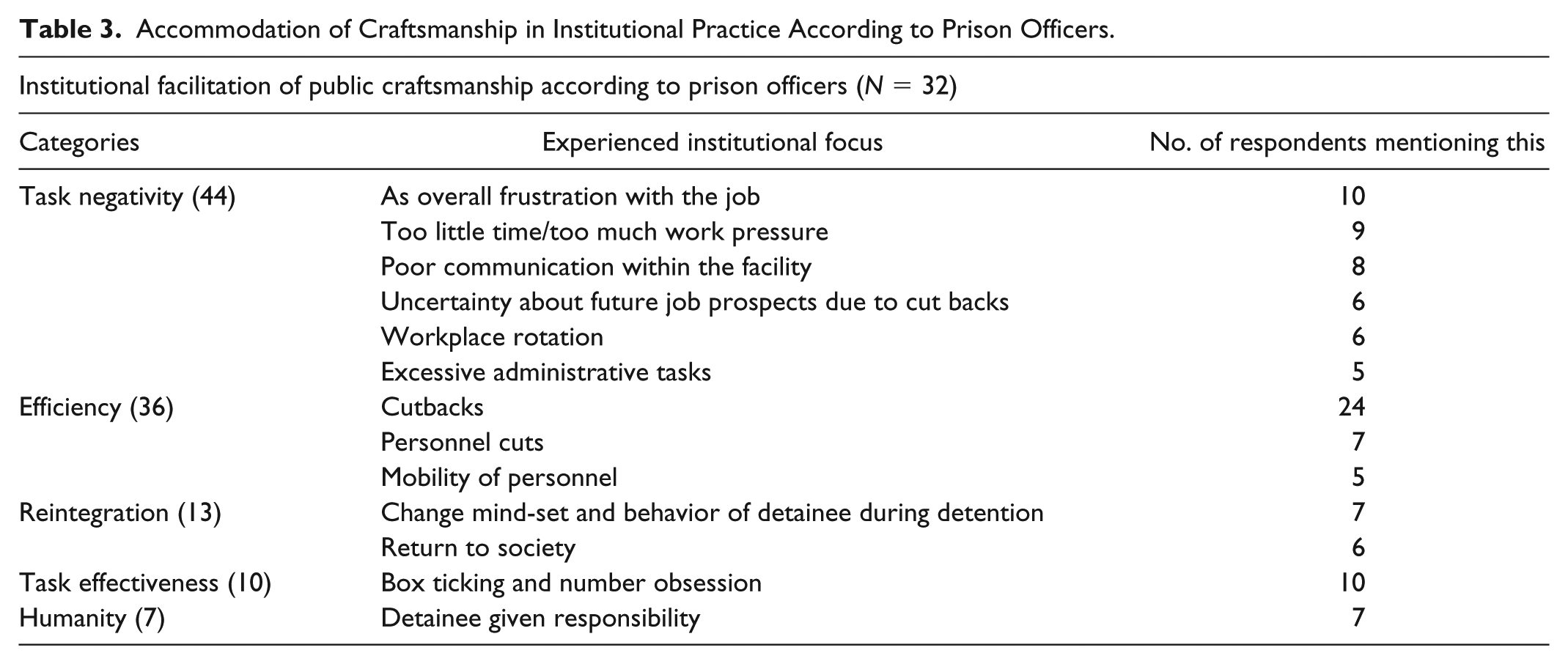
What remains is an analysis of a penal institutional climate that is quite negatively informed by “task negativity,” efficiency measures, and a strongly negative and judgmental conception of task effectiveness as box ticking and number obsession (see Figure 1). In the perception of respondents, these are clear facilitation problems that have a mitigating influence on thriving craftsmanship.
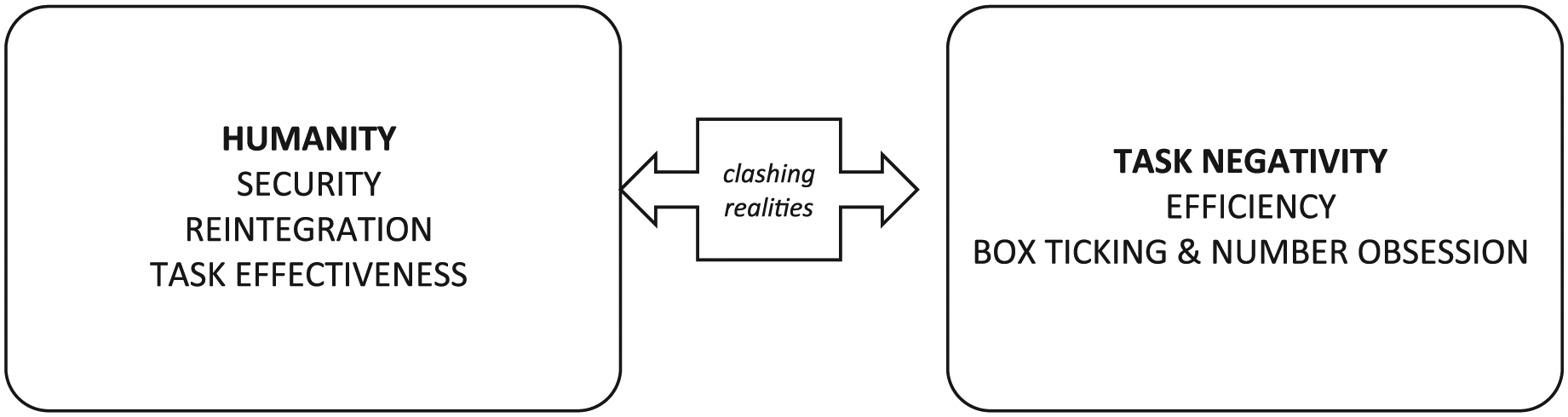
Prison Officers’ Ideal Conceptions of Craftsmanship Versus Prison Officers’ Perceptions of the Institutional Facilitation of Craftsmanship in the Organization.
Rather than a value, the largest cluster “task negativity” represents practical impediments and facilitation problems: a range of (practical or moral) obstacles that prevent craftsmanship from reaching its full potential and characterize the current penal vision in terms of negative attitudes toward the actual institutional context. It includes overall frustration with the job (10), too much work pressure (mentioned by nine respondents from one facility only), poor communication within the facility and between prison officers on the floor (nine), uncertainty among employees about future job prospects due to cutbacks (six), workplace rotation due to shortage of staff (six), and excessive administrative tasks (five). No less than 26 out of 32 respondents indicate task negativity as a core component of the institutional context of street-level practice. Together, they mention some form of task negativity 44 times.
The second most frequently mentioned institutional restriction on street-level practice is a major focus on efficiency in the current prison vision. Over two thirds of respondents consider some sort of negative efficiency measure to be the key focus in the current penal climate. Prison officers explain how they feel the system is predominantly aimed at cutbacks (mentioned by 24 respondents), including severe personnel cuts (mentioned by seven), or the moving around of personnel over different departments and facilities (mentioned by another seven). Moreover, 14 of them insist it is undoubtedly the number one focus. Respondents were very clear in their condemnation of what are, in their view, excessive cutbacks: “Everything’s got to be cheaper and shorter and quicker with less personnel. As little expenses as possible. It is a blow of demotivation” (Respondent 13).
Finally, the meaning of task effectiveness is completely altered: as an ideal value of craftsmanship it referred to getting tasks done in a structured and well-paced environment, but in the context of institutional facilitation, respondents perceive only a negative form of task effectiveness. They explain how a rigid performance measurement system shifts the focus to “box ticking only”: Targets have to be achieved for their own sake, with the content and quality of the action required to meet the target mattering less. One third of respondents stress that they see their managers as suffering from goal displacement rhetoric and number obsession, demanding unrealistically high numerical targets, for cell inspections or the frequency of mentor conversations and the number of topics addressed during those talks, for example. Prison officers say they feel forced into producing false and meaningless reports: It is a purely quantitative measurement, it has nothing to do with quality. [. . .] What we are pushed towards by our managers is primarily that we achieve the number, because that is what they are judged on, and then I think: well, that is of no use at all. I’d rather have one good cell inspection than 20 phonies. (Respondent 30) They only check: is there a report [on how the detainee is doing]? Yes, on to the next detainee. So they are only ticking boxes. [. . .] Not that there’s anything in there, but they count as being drafted, all blank documents. That is our reality. (Respondent 14)
Overall, existing formally developed institutional measures to aid the manifestation of key penal values are not considered as playing any significant role in the expression of the craftsmanship ideals that prison officers subscribe to. Perception of the facilitation of penal craftsmanship in institutional practice characterizes the current policy vision negatively, together with the corresponding institutional context of the organization. The dominant perception is that the presence of a vast range of institutional impediments together forms a highly restraining environment for the advancement of penal craftsmanship.
Discussion
Extending the importance of these findings beyond the prison context and taking into account their limitations, several valuable lessons for the advancement of public values research and praxis can be taken from the above analysis and can further our understanding of what public craftsmanship is about.
First, conceptualizing public craftsmanship as the way concrete professional skills and institutional practices tie in with overarching values proves to be a useful and parsimonious tool in bringing to the surface the values that matter to frontline officials in street-level practice. This also reveals how, through lived experiences, those values acquire practical meaning in specific professional settings. Methodologically, such bottom-up examination of “doing the job well” enacts the observation that aspirational values associated with “doing good” are always contextual (Rutgers, 2015). It offers a built-in contextuality that allows respondents to speak in their own professional jargon and helps them to more easily articulate what matters to them normatively. Of course, some values such as humanity and security may be transferrable to other service sectors with a comparable service type, such as field military personnel, street-level police officers or paramedics, but the distinct skills and practices described to enact these values will differ significantly from the reality and logic of the penal system. For public values research, it clearly indicates the added value of a craftsmanship perspective and underlines the importance of examining values, and value attainment, in the context of the workplace and through the eyes of the people on the shop floor.
This was exemplified in finding that the values respondents mention in this study differ quite significantly from the values that public values literature generally puts forward in that they are very specifically tailored to the unique tasks professionals perform for the specific type of beneficiaries they serve. Nevertheless, and paying due regard to their own unique prioritizations and compilations, they reveal themselves in a surprisingly convergent way, and offer scant acknowledgment of existing institutionalized means in favor of personal professional realization and interpretation. This indicates some interesting areas for further research into the commonality of street-level understandings of craftsmanship values in specific professions:
Second, the findings call for greater attention to be paid in public values research to practical institutional contexts and their impediments. The “full” manifestation of a value depends on the combination of qualities of persons and qualities of the governance processes. In our study, for instance, reintegration is about prison officers seeking to change behavior in one-on-one interaction with detainees but is also about institutional facilitation of chain partner cooperation and detainee skills training. Future research across different service sectors and service types will be needed to account for variance in organizational and institutional culture and in institutional facilitation. But there is often a clash in reconciling intrinsic motivations and values with systems that are geared toward instrumental outcomes, a clash that public professionals across service domains in the public sector potentially recognize and share.
Here, the craftsmanship perspective clarifies the nature and context of value interdependency and conflict. With value pluralism and value balancing in street-level penal craftsmanship having essential importance, the classic prison dichotomy of humanity versus security was less evident. This is due to positive interdependency and the spillover effects of values, and was represented only in minor disputes that prison workers settled among themselves. Conflicting values were found to include more complex contradictions such as efficiency undermining security, or compliance with performance measurement regimes demoralizing reintegration and humanity efforts, suggesting that the greatest conflict is not between different coexisting values but between ideal conceptions of craftsmanship and the perceived institutional reality on the floor.
Respondents perceive an institutional reality of unwavering neoliberalist management and performance measurement as undermining their craftsmanship severely and directly. This seems to confirm Sennett’s (2008) notion that the work of craftsmen “can never be completely perfected and is often impaired by social and economic conditions: ‘schools may fail to provide the tools to do good work, and workplaces may not truly value the aspiration for quality’” (p. 9). And even at a time when new public management is said to be in decline (Dunleavy, Margetts, Bastow, & Tinkler, 2005; Pollitt, 2015), it supports the fear that managerialism in professional contexts, be it in prisons or in other public domains, creates many barriers to good craftsmanship. Professional realities cannot be reduced to standardized protocols, and the classic narrative of New Public Management might demand an alternative (De Vries & Nemec, 2013; Overeem & Tholen, 2011). To respondents, such neoliberal performance rhetoric, in which ‘professionals have become part of large-scale organizational systems, with cost control; targets; indicators; quality models; and market mechanisms, prices, and competition’ (Noordegraaf, 2007, p. 763), in practice leaves little room for street-level ideals. Public craftsmanship might provide a new narrative that does better justice to the need to establish a dialogue between the systemic environment of numerical control and the lifeworld of intrinsic values. From this analysis, we derive three further propositions:
Of course, doubts can be raised about the tenability, veracity, or even righteousness of relying on street-level perceptions and how accurately they describe street-level reality. For instance, public professionals may exaggerate the presence and impact of the neoliberalist focus and can be blind to rival explanations of the forces that may be reconfiguring professional work (Noordegraaf, 2016). Furthermore, public professionals can develop negative and self-serving craftsmanship conceptions whose pursuit may harm the public good or professional ethic altogether (Adams & Balfour, 2009; Noordegraaf, 2007). However, even if public professionals’ subjectivization of “good work,” and the environment conducive to it, contradicts political or societal expectations, or constitutes a perceived administrative reality only, it nonetheless directly and drastically informs how they think and how they deliver their public function. As such, it is a reality to be taken seriously into account.
Conclusion
This study provides valuable insights about a potentially high commonality in the conception of craftsmanship at street level and about how street-level professionals are likely to suffer from a discrepancy between ideal craftsmanship and real-life institutional conditions. In this case study on prison officers, it was shown that their ideal craftsmanship aims at fostering humanity, security, reintegration, and to a lesser extent task effectiveness, and has very little to do with the shop floor environment as they perceive it, where rigid performance management, excessive efficiency measures, and practical impediments predominate. The findings show how this mismatch between the lifeworld of intrinsic values and a contrarian systemic environment of unwavering numerical control and performance rhetoric can function to create negativity in staff and thwarts policy implementation.
This article has generated a set of propositions for future research into the conception of public craftsmanship and its facilitation at street level. With this research still in its early stages, future studies must examine these dynamics of craftsmanship, and their impact on street-level practice in terms of policy execution, value adherence, and the job experience of public personnel, in a range of frontline public professions, and must raise the level of generality in these findings across different service types and service sectors.
We conclude that public craftsmanship is sustained by the successful synchronization of specific qualities in individual craftsmen (personal qualities) and institutional governance settings structured to facilitate such personal skills on the shop floor (institutional qualities). When, for instance, external political or financial pressures make institutional synchronization unfeasible or undesirable, professionals should be equipped to voice their concerns, to understand how policy programs and tools (set out to) tie in with their craftsmanship values, and to learn how they can mold their professional practice to uphold craftsmanship values as well as possible. Here, policymakers and public managers have an important role to play in value acknowledgment and communication. Equipping public professionals to critically assess how and why (as well as why not) they can embed their personal qualities in a sometimes-thorny institutional context will aid the creation of a conducive environment in which they can deliver on their shared values of craftsmanship.
Footnotes
Declaration of Conflicting Interests
The author(s) declared no potential conflicts of interest with respect to the research, authorship, and/or publication of this article.
Funding
The author(s) received no financial support for the research, authorship, and/or publication of this article.
