




Abstract
While partisan selective exposure has been robustly observed in controlled settings, its cross-national differences have been understudied. Many earlier studies were conducted in the United States (US); however, partisan selective exposure is weak outside the US. This study measured browsing behavior using comparable mock news sites in the US, Japan, and Hong Kong to probe the antecedents of cross-national differences in partisan selective exposure. Two observational studies showed that partisan selective exposure is robustly detected in the US but weak or almost absent in Hong Kong and Japan, and that affective polarization toward political out-groups partially explains the cross-national differences observed between the US and Japan, as well as between Hong Kong and Japan. Perceived media credibility and dialectical self did not explain cross-national differences. The universality of partisan selective exposure and its mechanisms are discussed.
Keywords
Partisan selective exposure has attracted scholarly interest over the past two decades (Stroud, 2017). High-choice media environments make it easier for people to selectively consume information consistent with their prior attitudes (Garrett, 2009a; Iyengar & Hahn, 2009; Stroud, 2010) and, to a lesser extent, avoid incongruent information (Garrett, 2009b; Knobloch-Westerwick & Meng, 2009). Moreover, the proliferation of partisan media and social media further affords partisan selective exposure, potentially resulting in the polarization of political attitudes and deteriorating feelings toward political out-groups (Garrett et al., 2014; Levendusky, 2013; Stroud, 2010). Thus, partisan selective exposure has been scrutinized as a cause of affective polarization and political gridlock in the United States (US) and elsewhere.
While behavioral data tracking everyday media use do not necessarily demonstrate significant partisan selective exposure (Gentzkow & Shapiro, 2011; Nelson & Webster, 2017; Prior, 2013), it has been consistently observed in more controlled settings (Iyengar & Hahn, 2009; Knobloch-Westerwick & Meng, 2009; Knobloch-Westerwick et al., 2015, 2019). However, it should be noted that much of the previous research on partisan selective exposure was conducted in the US, where certain characteristics promote partisan selective exposure, including a stable two-party system, prevalent partisan media, and political polarization at both the elite and popular levels. Thus, the generalizability of partisan selective exposure observed in the US should be carefully examined by cross-national studies.
Some cross-national studies have found that partisan selective exposure outside is weaker than within the US (Goldman & Mutz, 2011; Skovsgaard et al., 2016; Knobloch-Westerwick et al., 2015, 2019). These cross-national differences raise questions about the universality of partisan selective exposure and its mechanisms. Although universal psychological mechanisms like cognitive dissonance, which is defined as the psychological discomfort arising from simultaneously holding conflicting cognitive elements, are often assumed to be the cause of partisan selective exposure (Stroud, 2017; Wojcieszak, 2019), if partisan selective exposure is a phenomenon peculiar to the US, these universal psychological mechanisms would be less plausible explanations.
Against this backdrop, the current research comprised two studies dissecting the nature of partisan selective exposure across diverse national contexts. Study 1 was designed to assess and compare the extent to which individuals in the US, Japan, and Hong Kong exhibit partisan selective exposure. It used comparable mock news websites to measure participants’ selections between news that aligns with or contradicts their pre-held political attitudes. Building upon these insights, Study 2 examined the factors that may account for the differences observed across nations, focusing on the mediating roles of affective polarization, perceived media credibility, and the cultural construct of the dialectical self. These studies offer a nuanced, insightful investigation of how and why partisan selective exposure varies across nations.
Weak Partisan Selective Exposure in Non-US Contexts
Selective exposure is the tendency to consume more proattitudinal information than counterattitudinal information. In particular, partisan selective exposure refers to the selective consumption of political information consistent with one’s partisanship. Although the existing literature reports partisan selective exposure in non-US contexts (Castro-Herrero et al., 2018; Goldman & Mutz, 2011; Knobloch-Westerwick et al., 2015, 2019; Kobayashi & Ikeda, 2009; Steppat et al., 2021), it also reports significant cross-country differences with respect to the magnitude of partisan selective exposure.
For example, Knobloch-Westerwick et al. (2015) obtained behavioral data on selective exposure using a mock news site (similar to the approach herein) to find that selective exposure is observed in Germany but is weaker than in the US. When they added Japan, Knobloch-Westerwick et al. (2019) observed similar levels of selective exposure in Japan and Germany, both of which were less than in the US. Using a similar design, Steppat et al. (2021) reported a weaker degree of selective exposure in Italy and Poland compared with the US, which they attributed to different contextual factors, such as political polarization and fragmented media use. What is consistent in these cross-national studies is that partisan selective exposure is observed to be most prominent in the US. Thus, we aimed first to replicate this result, as it is a prerequisite for our subsequent hypotheses concerning cross-national differences in partisan selective exposure.
Herein, we conducted comparative studies in the US, Japan, and Hong Kong. The US–Japan comparison has not only been used in previous selective exposure studies (Kobayashi & Ikeda, 2009; Knobloch-Westerwick et al., 2019) but it is also used frequently in cultural psychology as an East–West comparison (Markus & Kitayama, 1991). Furthermore, Hong Kong provides an interesting third point of comparison. Like the US, Hong Kong is highly politically polarized, particularly since the massive anti-government movement began in 2019. However, Hong Kong also differs from both the US and Japan as a nondemocracy without fair, competitive elections. Furthermore, while similar to Japan in that it is located in East Asia, Hong Kong’s unique colonial history has given it culturally mixed Western and Eastern characteristics (Hong et al., 2000), providing a middle ground for examining cultural factors.
H1: Partisan selective exposure is more strongly observed in the US than in Japan or Hong Kong.
Study 1
Methods
Mock News Website
To test H1, we created mock news websites to gauge the browsing behavior of those in the US, Japan, and Hong Kong. Each mock website presented eight news headlines with the first few words of the leading paragraph (see Figure 1, left panel for the US version). The four top headlines were political news, while the rest were nonpolitical news, including entertainment and sports. 1 The four political headlines were about each region’s political leader: President Donald Trump in the US, Prime Minister Shinzo Abe in Japan, and Chief Executive Carrie Lam in Hong Kong. Among the four headlines, two were positive about the leader and the other two were negative. All headlines are presented in Supplementary Material SI1.
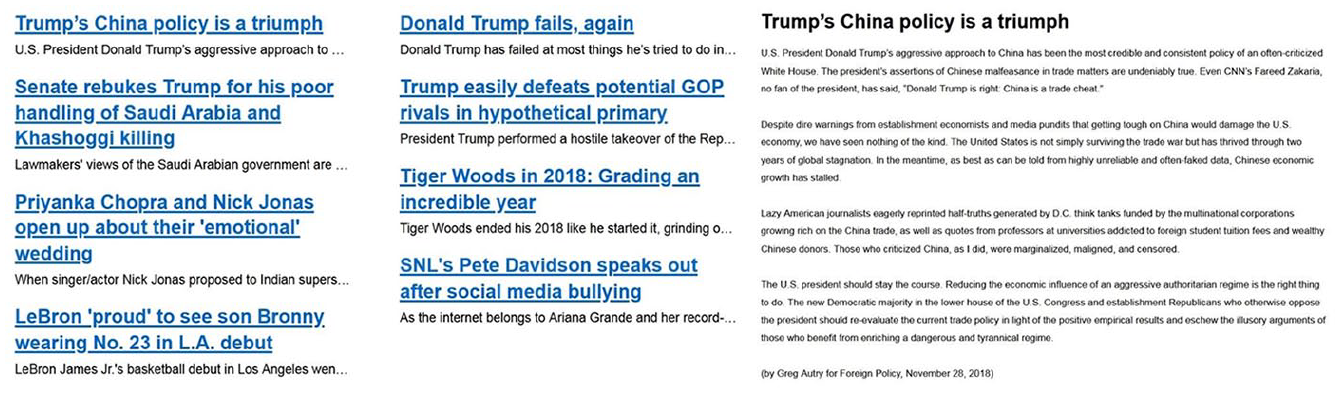
Mock news website (US).
The respondents could freely choose which headline(s) to read. They were directed to the article’s main body when they clicked a headline (see Figure 1, right panel for an example of a pro-Trump article). Participants were also free to go back and forth between the headlines and article pages for 90 seconds and could click the same headline multiple times. After 90 seconds, participants were automatically directed to the next page. Because 90 seconds was not long enough to read all eight articles, participants could only select a limited number of them. The headlines participants clicked on and the duration they spent viewing each article was unobtrusively recorded. The participants were randomly assigned to one of three groups, among which one group was presented with only four nonpolitical headlines; we excluded this group from the following analyses. The other two groups were presented the same eight headlines, but with counterbalanced positions of positive and negative political leader headlines. Note that this study was observational, not experimental. Although the participants were randomly assigned to groups to counterbalance the positions of headlines, the effect of the positions was not the study focus.
Participants
The US sample was collected via Amazon Mechanical Turk in January 2019 (N = 613). Women accounted for 46.7%, and the age range was from 20 to 69 years (M = 36.7, SD = 10.2). The sample from Japan was collected via CrowdWorks and Lancers in December 2018 (N = 613), both of which are crowdsourcing services similar to Amazon Mechanical Turk. Women accounted for 48.8%, and the age range was from 18 to 69 years (M = 39.9, SD = 10.4). The sample from Hong Kong was collected via Survey Sampling International in April 2019 (N = 604). Women accounted for 54.5%, and the age range was from 18 to 69 years (M = 39.4, SD = 11.6). Gender and age distributions among the populations and samples are presented in Supplementary Material SI2.
Measurements
Political Leader Approval
Political leader approval was measured by the single item, “Do you approve or disapprove of the way [Donald Trump/Shinzo Abe/Carrie Lam] is handling his/her job as [President/Prime Minister/Chief Executive]?” Responses were gauged using a four-point Likert scale ranging from “strongly disapprove” to “strongly approve,” on which participants were categorized as either “approve” or “disapprove.” In their respective regions, 43.6% approved of Trump, 48.5% approved of Abe, and 44.7% approved of Lam.
Number of Selected Pro- or Counterattitudinal Headlines
Using their recorded browsing behavior and political leader approval/disapproval, the number of selected pro- or counterattitudinal headlines was measured, with a range of 0 to 2. For example, if a pro-Trump participant in the US sample selected two Trump headlines that were positive, their proattitudinal headline selection was coded as 2. If an anti-Abe participant in Japan selected one positive headline about Abe, their counterattitudinal headline selection was coded as 1. The mean number of clicked proattitudinal headlines was 1.00 (SD = 0.80) for Japan, 0.92 (SD = 0.86) for Hong Kong, and 0.86 (SD = 0.72) for the US. Similarly, the mean number of clicked counterattitudinal headlines was 0.97 (SD = 0.79) for Japan, 0.82 (SD = 0.86) for Hong Kong, and 0.58 (SD = 0.70) for the US.
Time Spent on Pro- or Counterattitudinal Articles
Similar to the number of selected pro- or counterattitudinal headlines, using their recorded browsing behavior and political leader approval or disapproval, time spent on pro- or counterattitudinal articles was gauged, with a range of 0 to 90 seconds. The mean time spent reading proattitudinal articles was 18.75 seconds (SD = 20.21) for Japan, 14.70 seconds (SD = 20.76) for Hong Kong, and 26.32 seconds (SD = 31.25) for the US. Similarly, the mean time spent reading counterattitudinal articles was 17.73 seconds (SD = 19.58) for Japan, 10.83 seconds (SD = 18.83) for Hong Kong, and 16.45 seconds (SD = 30.09) for the US.
Selective Exposure (Number of Clicked Headlines)
The number of clicked counterattitudinal headlines was subtracted from that for proattitudinal headlines to measure selective exposure (number of clicked headlines). This mean value was 0.03 (SD = 0.75) for Japan, 0.10 (SD = 0.78) for Hong Kong, and 0.28 (SD = 0.91) for the US.
Selective Exposure (Time Spent Reading Articles)
The time spent reading counterattitudinal articles was subtracted from that for proattitudinal headlines to measure selective exposure (time spent reading articles). This mean value was 1.02 (SD = 26.28) for Japan, 3.87 (SD = 27.79) for Hong Kong, and 9.87 (SD = 46.13) for the US.
Results
The left panel of Figure 2 shows the number of selected pro- or counterattitudinal headlines in each region. US participants clearly engaged in partisan selective exposure: their number of clicked proattitudinal headlines was larger than that of counterattitudinal headlines by 0.28 (t(612) = 7.60, p < .001). Hong Kong participants also showed partisan selective exposure, but the difference between the number of clicked proattitudinal and counterattitudinal headlines was less pronounced compared with the US sample (diff = 0.10, t(603) = 3.20, p = .001). However, the Japanese sample did not show partisan selective exposure: their mean number of clicked proattitudinal headlines was larger than that of counterattitudinal headlines by only 0.03, which was not statistically significant (t(612) = 1.03, p = .31). The right panel of Figure 2 shows time spent on pro- or counterattitudinal articles in each region, consistent with the results from the number of clicked headlines: partisan selective exposure was robust in the US sample but not in the Japanese sample, and the Hong Kong sample fell between. These results support H1.
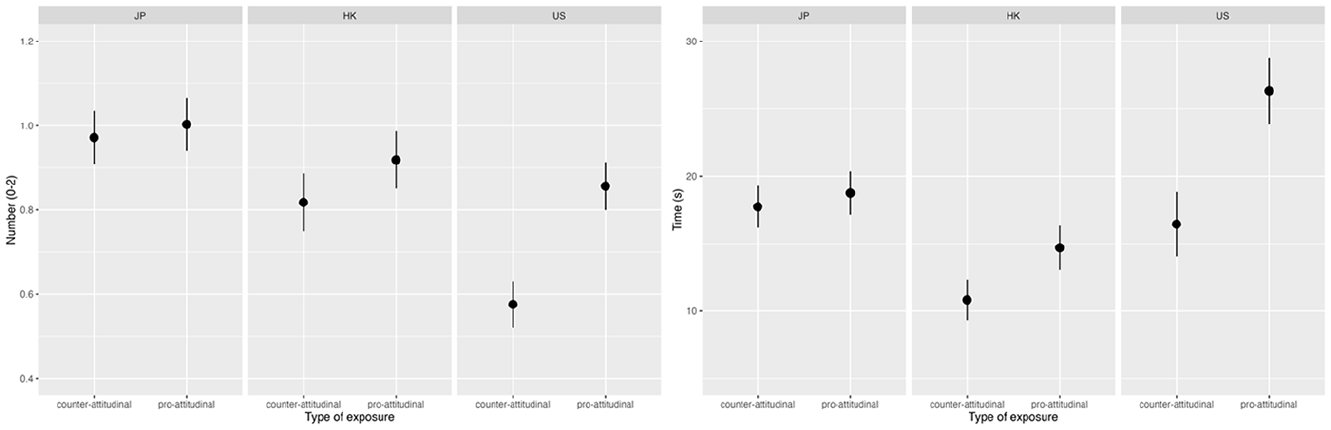
Partisan selective exposure in the US, Japan, and Hong Kong (Study 1).
To more formally test H1, we conducted regression analyses, regressing the two measures of selective exposure on region (with the US as the reference category), gender (with male as the reference category), age, education, and political interest. Political interest was gauged using a single item: “Regardless of whether or not there is an upcoming election, some people show continuous interest in politics, and others don’t. How regularly do you pay attention to the political situation?” The responses were measured on a four-point scale from “Never” to “Almost always” and were rescaled to range from 0 to 1. The results, presented in Table 1, indicate that when selective exposure is measured by the number of clicked headlines, both Japan and Hong Kong exhibit significantly lower levels of selective exposure compared with the US. However, the difference between Japan and Hong Kong did not reach statistical significance. Similar results were observed when selective exposure was measured by the time spent reading articles, with no significant difference between Japan and Hong Kong. These findings provide clear-cut support for H1. 2
Ordinary Least Squares Estimates Predicting Selective Exposure (Study 1).
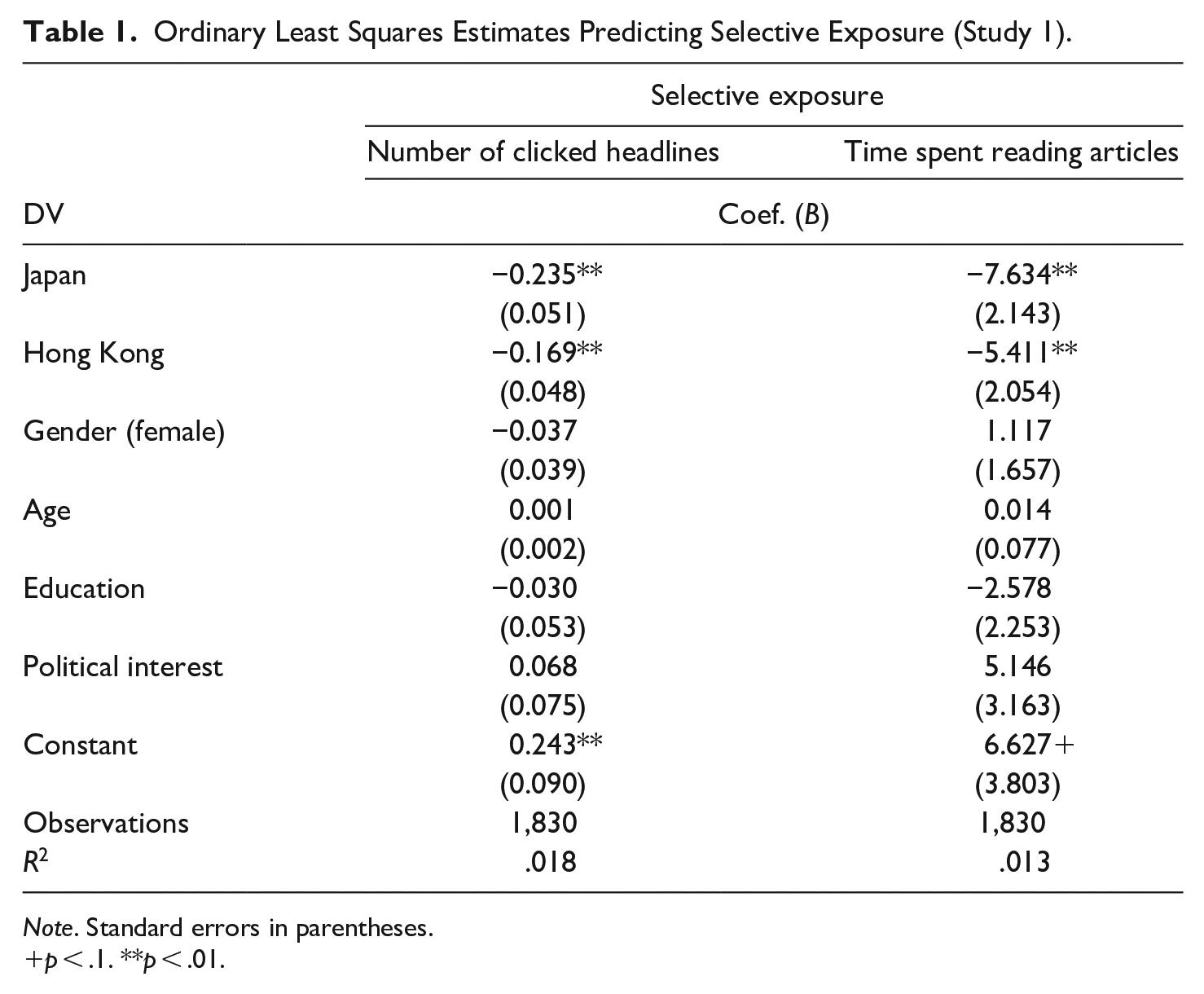
Note. Standard errors in parentheses.
p < .1. **p < .01.
Discussion
Partisan selective exposure was robustly observed in the US but not in Japan. The sample from Hong Kong showed significant selective exposure, but at a magnitude smaller than in the US. The finding that partisan selective exposure is weaker outside the US is consistent with previous cross-national studies (Knobloch-Westerwick et al., 2019), which has profound implications for the generalizability of US-based selective exposure findings. The US has unique political, institutional, and cultural characteristics, including a stable two-party system, a liberal media system, wide availability of partisan media, and increasing political polarization. Single-country studies cannot shed light on whether partisan selective exposure is generalizable beyond these US-specific factors.
Although Study 1 established that partisan selective exposure is robust in the US and weaker in Hong Kong and Japan, this study could not identify antecedents of this cross-national heterogeneity as it did not measure potential mediators. In addition, the selection of the headlines and articles was admittedly arbitrary. Thus, characteristics other than tone (i.e., positive or negative about the political leader), like perceived credibility, may not have been controlled adequately. Study 2 investigated the mechanisms behind the cross-national differences in partisan selective exposure by measuring potential mediators and selecting news articles more systematically through a pilot study.
Mechanisms Behind Cross-National Differences
Why does the strength of partisan selective exposure differ across countries? Earlier research focused on institutional factors, like media-party parallelism (MPP), which is defined as the degree of alignment between media outlets and political parties within a society, and the presence of public broadcasting services (PBS) (Goldman & Mutz, 2011; Knobloch-Westerwick et al., 2019). However, factors other than institutional ones, such as political polarization and cultural self-construal, may also contribute to cross-national differences. This study focused on affective polarization as an indicator of political polarization, perceived media credibility as an individual-level proxy of an institutional factor, and dialectical self as a cultural factor, aiming to explore the mechanisms underlying cross-national differences in selective exposure.
Affective Polarization as an Antecedent of Selective Exposure
Most previous studies of the media effects paradigm conceptualize political polarization as a consequence of selective exposure (e.g., Lelkes et al., 2015; Levendusky, 2013; Garrett et al., 2014; Stroud, 2007; Taber & Lodge, 2006). In particular, affective polarization, which refers to the gap in favorable and unfavorable feelings toward political in-groups and out-groups, is increasing, especially in the US, and its association with selective exposure is garnering scholarly attention. Cocooning within proattitudinal information through selective exposure deprives people of the opportunity to “hear the other side,” presumably exacerbating negative feelings toward political out-groups. However, the relation between selective exposure and affective polarization is plausibly bidirectional.
For example, Slater (2007, 2015) proposes a spiral model whereby identity drives selective exposure (Knobloch-Westerwick & Hastall, 2010), and selective exposure, in turn, reinforces identity (Barnidge et al., 2020). Therefore, selective exposure to like-minded information both intensifies affective polarization and leads affectively polarized citizens to more actively avoid counterattitudinal information, due to strong negative emotions when exposed to favorable information about political out-groups. Conversely, articles favorable to political in-groups constitute emotionally congruent information for affectively polarized citizens; thus, they are more likely to actively seek out such information.
As an illustration, Stroud (2010) conducted a study that assumed a bidirectional causal relation between selective exposure and polarization. Since both cognitive mechanisms (e.g., certainty, confidence) (Ziemke, 1980) and affective attachment to partisan in-groups and animosity toward out-groups promote selective exposure, one would expect that affectively polarized individuals engage in more selective exposure. Although Stroud’s (2010) findings lent more support to selective exposure’s effect on polarization than vice versa, they are limited as far as selective exposure was measured with self-reported habitual media use. Herein, we revisit the effect of affective polarization on selective exposure by obtaining behavioral news browsing data using a mock news site.
If affective polarization is an antecedent of partisan selective exposure, country differences in the extent of affective polarization will produce cross-national differences in selective exposure. Specifically, in major cross-national research on affective polarization, Japan consistently demonstrates lower levels compared with the US (Boxell et al., 2020; Wagner, 2021). While Hong Kong was not included in those studies, it is expected to fall somewhere between Japan and the US. However, as is discussed below, political upheaval during the study period may have temporarily elevated affective polarization there to a level near, or even higher than, in the US.
Following Iyengar et al. (2012), this study gauged the difference in feeling thermometer scores toward members of the political in-group and out-group as the measurement of affective polarization (Iyengar et al., 2012).
H2: Cross-national difference in partisan selective exposure is explained by affective polarization.
Institutional Influence Through Perceived Media Credibility
Previous studies have relied on institutional factors such as media-party parallelism (MPP) and, relatedly, the availability of PBS to explain cross-national differences in partisan selective exposure (Goldman & Mutz, 2011; Knobloch-Westerwick et al., 2019). In particular, MPP serves as a crucial indicator of the media system’s influence on partisan selective exposure (Horwitz & Nir, 2015; van Kempen, 2007). MPP is defined as the alignment between media and political parties, reflecting the degree of overlap and polarization in a country’s media and party systems (Seymour-Ure, 1974; van Kempen, 2007).
First, since MPP is a macro-level indicator at the national level, it is necessary to represent MPP at the individual level for empirical tests. We employ perceived media credibility as a representation of MPP at the individual level. This is because countries with high MPP tend to exhibit low journalistic professionalism and high political bias in news reporting. Brüggemann et al. (2014), through their national-level analysis of 17 European countries and the US, refined the findings of Hallin and Mancini (2004) by identifying that countries with high political parallelism—a concept closely aligned to MPP—tend to have a stronger political bias in media and press markets that is not inclusive, catering only to a smaller number of partisan readers. Additionally, political parallelism is negatively correlated with journalistic professionalism (r = −.87), suggesting that countries with high MPP have lower-quality news. As a consequence, it is predicted that the perceived credibility of media in general tends to be lower in countries with high MPP where the quality of news is lower and the political bias of the press is higher.
Goldman and Mutz (2011) demonstrated that the level of press-party parallelism in Japan is lower than in the US, with Hong Kong positioned in between. However, these differences are less pronounced in terms of television-party parallelism. More recently, Kobayashi et al. (2019) analyzed patterns of media account followers on Twitter, concluding that partisan divisions in Japan are minimal. This aligns with de Albuquerque’s (2013) observation of low political parallelism in Japan. In contrast, news source choices in the US vary significantly based on partisanship (Pew Research Center, 2020), suggesting a difference in media-party parallelism between these countries. As anticipated, these differences in the levels of MPP are reflected in the individual-level perceived media credibility. According to Wave 7 data from the World Values Survey (Haerpfer et al., 2022), the proportion of people who have “A great deal” or “Quite a lot” of confidence in the press is 69.33% in Japan, 51.92% in Hong Kong, and 30.08% in the US. The same pattern can be seen for confidence in television.
Second, there is empirical support for the notion that perceived media credibility mitigates selective exposure (Barnidge et al., 2020; Kim, 2011; Knobloch-Westerwick et al., 2019; Morris, 2007). Through the analysis of data from the US, Japan, and Germany, Knobloch-Westerwick et al. (2019) demonstrated that individuals distrustful of media in general exhibit clear selective exposure, while those who trust media do not engage in significant selective exposure. More importantly, Barnidge et al. (2020) analyzed online survey data from the US and found that selective exposure is negatively associated with perceived media bias about self-selected media but positively associated with perceived media bias about “the media” in general. As we use the perceived media credibility of “the media” in general as the representation of MPP, the latter finding particularly supports the claim that perceived media credibility mitigates selective exposure. Therefore, we hypothesize that:
H3: Cross-national difference in partisan selective exposure is explained by perceived media credibility.
Dialectical Self That Suppresses Selective Exposure
An oft-cited mechanism of partisan selective exposure is cognitive dissonance (Stroud, 2017; Wojcieszak, 2019). Cognitive dissonance is a well-established psychological phenomenon for which a neurophysiological basis has been described (Harmon-Jones & Mills, 2019), suggesting its universality. However, recent developments in cultural psychology have revealed cultural contingencies of cognitive dissonance (Heine & Lehman, 1997; Hoshino-Browne et al., 2005). Notably, in his classic cognitive dissonance study, Festinger (1957) predicted that culture would “define what is consonant and what is not” (14).
The cultural psychological concept specifically relevant to selective exposure is the dialectical self, defined as the “cognitive tendency toward acceptance of contradiction” (Peng & Nisbett, 1999, pp. 741–742). Individuals with higher dialectical self levels demonstrate proficiency in reconciling two contradictory stances and comprehending parts of a subject within the context of its entirety (Peng & Nisbett, 1999; Spencer-Rodgers et al., 2009).
Dialectical self is purported to be more prevalent in East Asia than in North America. According to Peng and Nisbett (1999), the characteristics of Western thinking include the analytical pursuit of a single truth, a construction of counterarguments, and a preference for consistency. As a result, when there is an apparent contradiction between two opposing perspectives, the simple heuristic for Westerners is that one must be right and the other must be wrong. In contrast, the heuristic that Easterners use to deal with apparent contradictions is the belief that both perspectives could be correct, and that the truth lies somewhere in between, which is a type of dialectical thinking. As an illustration, Peng and Nisbett (1999) experimentally demonstrated that US participants’ perceived credibility of two conflicting pieces of information was polarized because they thought that only one of them should be true, whereas the Chinese participants perceived moderated credibility of both pieces of information, suggesting that they had reconciled the conflict by compromise.
In a situation where both pro- and counterattitudinal news is presented, North Americans will selectively consume proattitudinal news because they will perceive a prominent gap in credibility between the two. East Asians, however, will not actively select news based on partisanship because the perceived credibility of the proattitudinal and counterattitudinal news will be moderated through dialectical thinking. Thus, we hypothesize that:
H4: Cross-national difference in partisan selective exposure is explained by dialectical self.
Study 2
Methods
Study 2 was designed to test H2, H3, and H4, and to replicate the findings of Study 1 regarding H1. The design of Study 2 was identical to that of Study 1, with three exceptions. First, data collection in Hong Kong was conducted during a large-scale anti-government protest, when Chief Executive Carrie Lam’s popularity was extremely low. In this context, finding roughly equal numbers of Lam supporters and nonsupporters was nearly impossible. Therefore, we switched from Carrie Lam to Jasper Tsang, who served as President of the Legislative Council from 2008 to 2016. Though a prominent pro-establishment figure, Tsang enjoys relatively high prestige even among pro-democracy citizens. Therefore, we were able to collect sufficient responses from both Tsang supporters and nonsupporters. Second, we ran a pilot study to select headlines and articles more systematically than we had in Study 1. Third, we excluded the condition in which only nonpolitical headlines were presented; that is, all participants were presented with eight headlines, four of which were political headlines about the leader (as in Study 1, positive and negative headline positions were counterbalanced). Note that like Study 1, Study 2 was observational and not experimental.
Headline Selection
Although Study 1 revealed significant partisan selective exposure in the US, this may have been due to unobserved confounding factors inherent in the headlines. For example, positivity and negativity toward the leaders might have been confounded by perceived credibility and information value. Therefore, we fielded a headline selection pilot study to more stringently control other relevant factors. The pilot study was conducted to narrow down a larger collection of 16 to 18 headlines per country to four headlines per country. Cluster analysis confirmed that the chosen headlines are consistent in tone across countries, although there were slight variations in perceived credibility, information value, and interestingness. Full details are in Supplementary Material SI4.
Participants
The US sample was collected via Dynata in March 2020 (N = 1,007). Women accounted for 53.0%, and the age range was from 18 to 69 years (M = 44.5, SD = 14.6). The sample from Japan was collected via CrowdWorks from February to March 2020 (N = 1,023). Women accounted for 49.1%, and the age range was from 18 to 69 years (M = 39.1, SD = 9.9). The sample from Hong Kong was collected via Dynata in March 2020 (N = 1,031). Women accounted for 49.6%, and the age range was from 18 to 69 years (M = 39.3, SD = 12.0). The distributions of gender and age among the populations and samples are reported in Supplementary Material SI5.
Measurements
Political leader approval, numbers of selected pro- or counterattitudinal headlines, time spent on pro- or counterattitudinal articles, and selective exposure (measured by the number of clicked headlines and time spent reading articles) were gauged in the same way as in Study 1. Among the respective samples, 44.8% approved of Trump, 42.6% approved of Abe, and 55.0% approved of Tsang.
The mean number of clicked proattitudinal headlines was 0.92 (SD = 0.75) for Japan, 0.90 (SD = 0.87) for Hong Kong, and 0.86 (SD = 0.79) for the US. Similarly, the mean number of clicked counterattitudinal headlines was 0.89 (SD = 0.77) for Japan, 0.90 (SD = 0.86) for Hong Kong, and 0.55 (SD = 0.73) for the US. The mean time spent reading proattitudinal articles was 20.18 seconds (SD = 22.55) for Japan, 12.38 seconds(SD = 19.21) for Hong Kong, and 20.45 seconds (SD = 24.42) for the US. Similarly, the mean time spent reading counterattitudinal articles was 18.94 seconds(SD = 21.76) for Japan, 12.64 seconds (SD = 19.62) for Hong Kong, and 9.81 seconds (SD = 18.36) for the US.
The mean value of selective exposure, measured by the number of clicked headlines, was 0.03 (SD = 0.81) for Japan, −0.00 (SD = 0.69) for Hong Kong, and 0.31 (SD = 0.84) for the US. Similarly, the mean selective exposure value, measured by the time spent reading articles, was 1.23 (SD = 34.41) for Japan, −0.26 (SD = 26.47) for Hong Kong, and 10.63 (SD = 32.50) for the US.
To test H2, H3, and H4, we measured the following mediators before the mock news website was presented.
Affective Polarization
To test H2, affective polarization was measured by the absolute difference between the feeling thermometer scores of political in-group and out-group members. For instance, in the US, participants were asked: “Now, we would like to ask you about your feelings toward individuals who support the Republican Party or the Democratic Party. On a scale from 0 to 100 (0 = very unfavorable to 100 = very favorable), how do you feel toward individuals who support the [Republican Party/Democratic Party]?” The responses were measured using slide bars that ranged from 0 to 100. The absolute difference in feeling thermometer scores for political in-group and out-group was divided by 100. Specifically, in the US, it was gauged as the difference between feelings toward Republicans and Democrats (range: 0–1, M = 0.38, SD = 0.35). In Japan, given the multi-party system, affective polarization was measured as the difference between feelings toward those who support Abe and those who oppose him (range: 0–1, M = 0.24, SD = 0.25). In Hong Kong, affective polarization was quantified as the difference between feelings toward those who support the pro-establishment (pro-government) position and those who support the pro-democracy position (range: 0–1, M = 0.47, SD = 0.33). Note that the affective polarization in Hong Kong is higher than it is in the US. This reflects the fact that in March 2020, when the Hong Kong data were collected, there was still a strong influence of the previous year’s massive anti-government protests, and thus intense conflict between pro-establishment and pro-democracy groups.
Perceived Media Credibility
Consistent with Tsfati and Cappella (2003), perceived media credibility was measured to test H3 with four semantic differential scales in response to the prompt, “In general, media coverage in [the US/Japan/Hong Kong]: ‘Is fair’ vs. ‘Is biased’; ‘Tells the whole story’ vs. ‘Is incomplete’; ‘Is accurate’ vs. ‘Is inaccurate’; and ‘Can be trusted’ vs. ‘Is untrustworthy’.” These four items, measured on a five-point scale, were averaged so that higher values indicated greater perceived credibility, and then normalized to range from 0 to 1 (US: M = 0.48, SD = 0.28, α = .92; Japan: M = 0.37, SD = 0.20, α = .88; Hong Kong: M = 0.48, SD = 0.23, α = .89).
These findings are inconsistent with the suppositions above in that Japan, where MPP is lower, showed lower credibility compared with the US. In March 2020, media credibility in Japan may have temporarily decreased due to chaotic COVID-19 reporting (e.g., toilet paper shortage rumors, which led to panic buying and social anxiety). The mass media inaccurately reported on supply issues, and one survey showed television to be the primary rumor source (Miyamoto, 2021). This period of intense public criticism of the media for fueling social anxiety and spreading misinformation likely resulted in a temporary dip in credibility.
Dialectical Self
To test H4, dialectical self was measured with 20 items developed by Spencer-Rodgers et al. (2015), including, “When I hear two sides of an argument, I often agree with both,” “When two sides disagree, the truth is always somewhere in the middle,” and “I sometimes believe two things that contradict each other.” All items were measured with a five-point Likert scale. These 20 items were averaged, and then normalized to range from 0 to 1 (US: M = 0.44, SD = 0.10, α = .81; Japan: M = 0.56, SD = 0.10, α = .75; Hong Kong: M = 0.50, SD = 0.06, α = .81).
Results
First, we replicated the test of H1 to determine whether partisan selective exposure is higher in the US than in Japan or Hong Kong. Figure 3 shows that the pattern from Study 1 was replicated by Study 2. The US sample showed strong selective exposure for the number of clicked headlines and the time spent reading articles, while the Japanese and Hong Kong samples did not. The Hong Kong sample showed significant selective exposure in Study 1 but not in Study 2, arguably because of the change in political leaders from Carrie Lam to Jasper Tsang. 3 The successful replication of H1 suggests that partisan selective exposure is particularly strong in the US, reiterating the question of why there are cross-national differences.
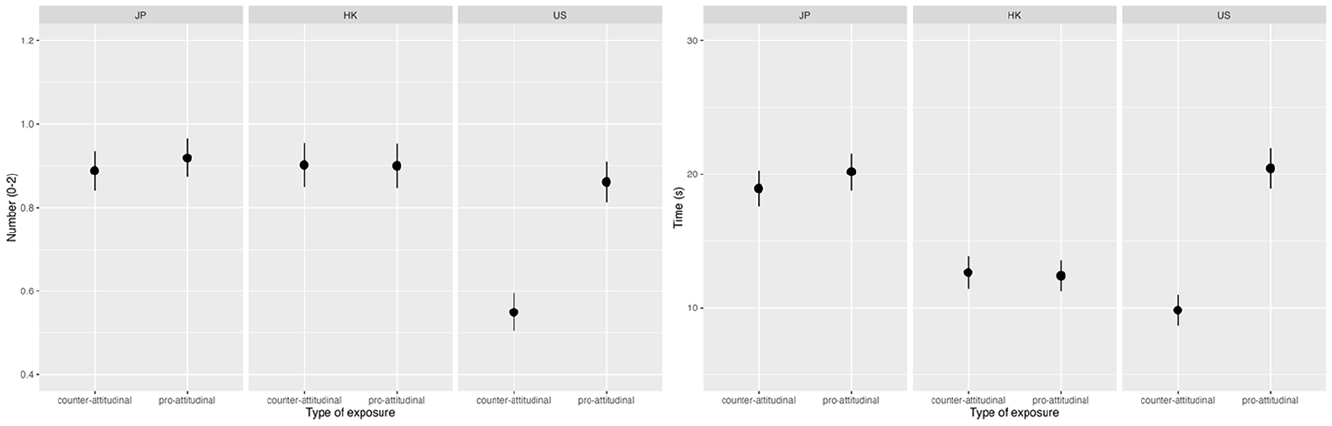
Partisan selective exposure in the US, Japan, and Hong Kong (Study 2).
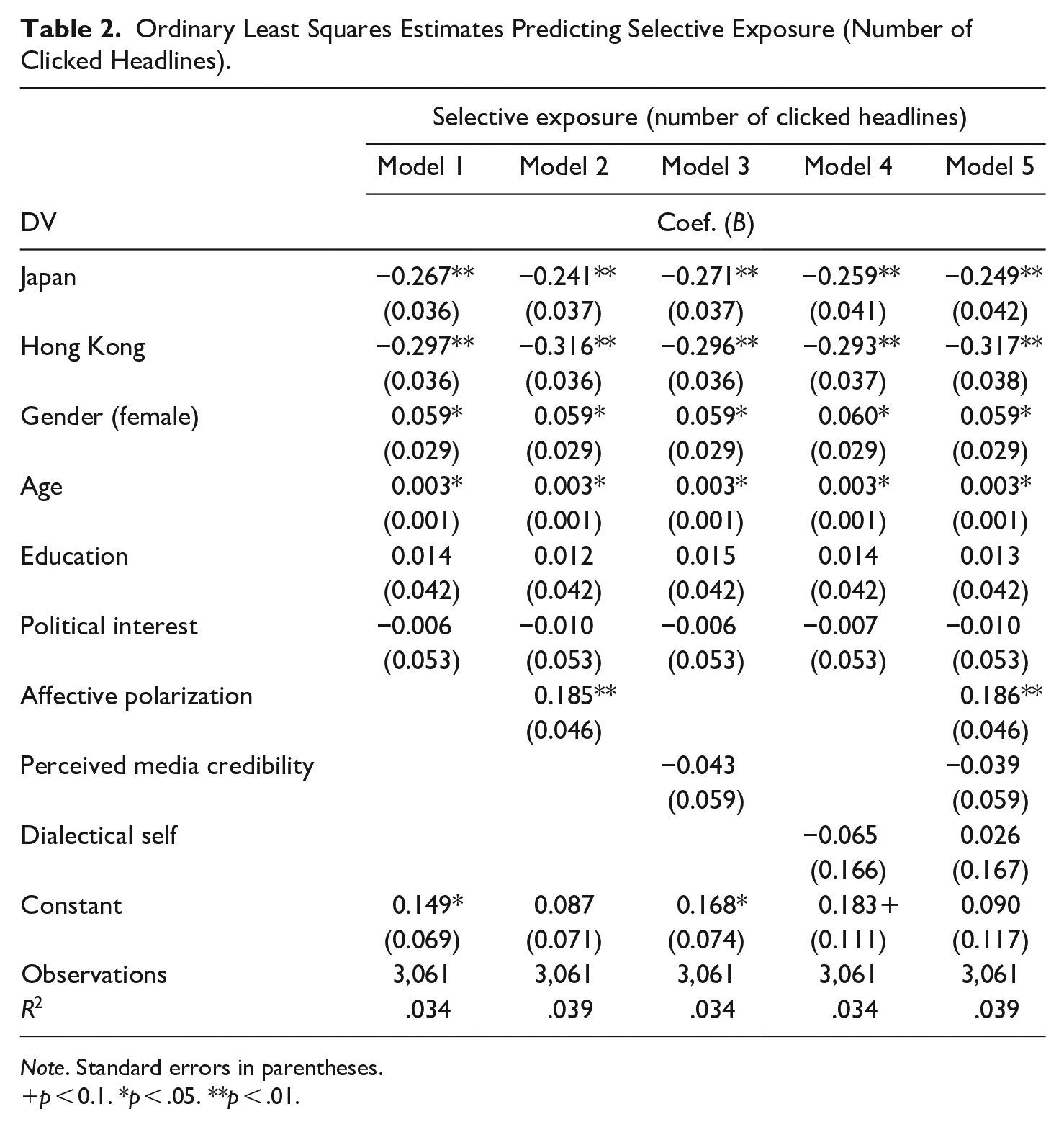
Next, to test H2, H3, and H4, we first estimated regression models to probe the effects of mediating variables on selective exposure (Table 2). Specifically, we first regressed selective exposure (number of clicked headlines) on the region (reference: US), gender (reference: female), age, education, and political interest, confirming that selective exposure is significantly weaker in Japan and Hong Kong than it is in the US (Model 1). 4 The difference between Japan and Hong Kong was not statistically significant. We then added affective polarization as an independent variable (Model 2), showing its positive effects on selective exposure. In contrast, perceived media credibility was not significantly associated with selective exposure (Model 3). Nor did dialectical self show a significant association with selective exposure (Model 4). When all variables were included in Model 5, only affective polarization remained statistically significant.
Ordinary Least Squares Estimates Predicting Selective Exposure (Number of Clicked Headlines).
Note. Standard errors in parentheses.
p < 0.1. *p < .05. **p < .01.
Perceived media credibility showed a significant negative association with selective exposure when the dependent variable was measured as time spent reading articles (see Supplementary Material SI7). However, as shown in the mediation analyses below, this did not explain the cross-national differences in selective exposure.
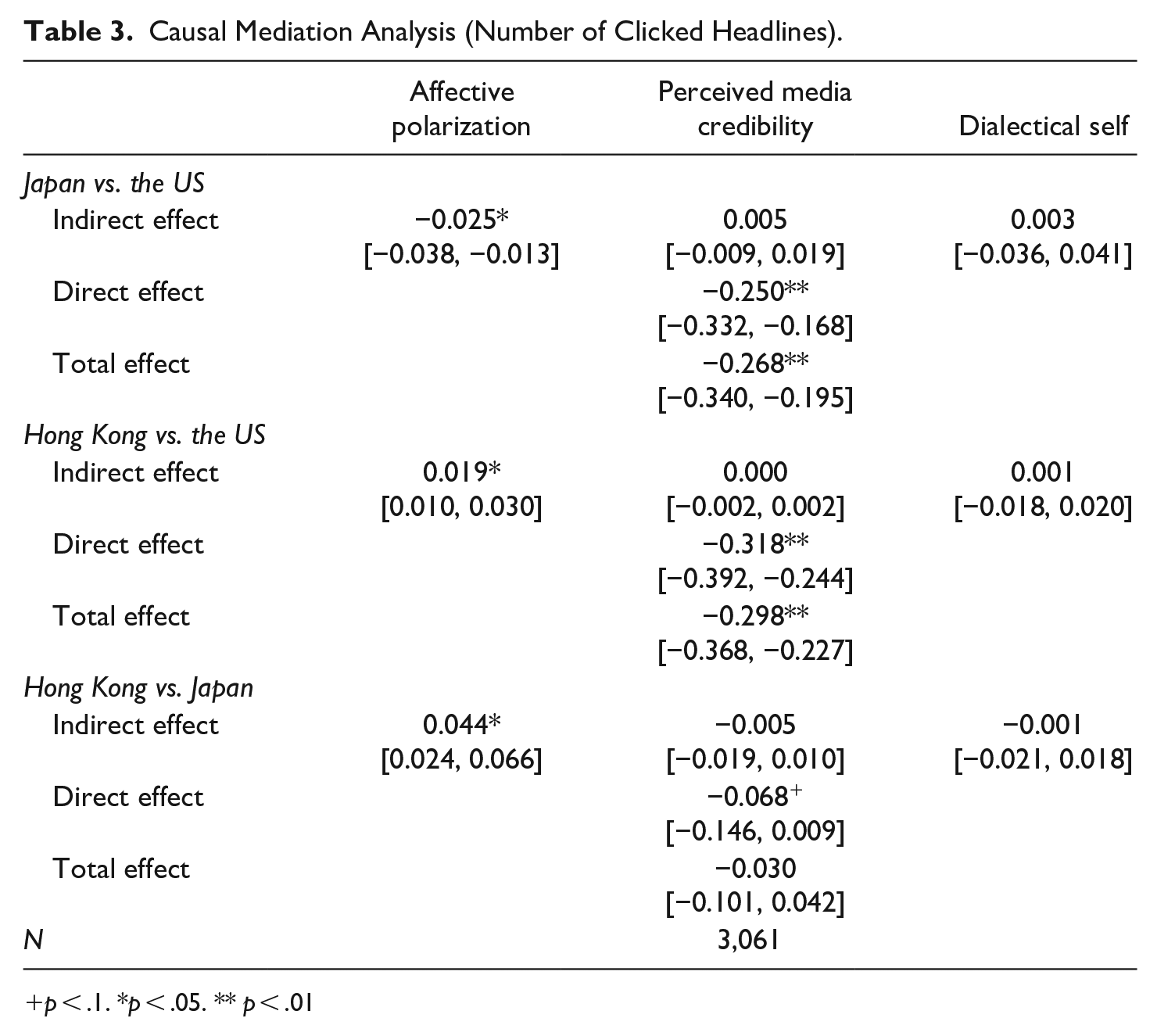
To formally test the mediation by political polarization, media credibility, and culture, we estimated the indirect effects of region on selective exposure using Model 4 of the PROCESS macro (Hayes, 2022). Specifically, we set region as the independent variable with three levels (Japan, Hong Kong, and the US as reference) and selective exposure as the outcome. Three mediators were simultaneously included, and the standard errors of their indirect effects were estimated with bootstrapping. The number of bootstrap iterations was set to 5,000. The full mediation analysis results are reported in Table 3.
Causal Mediation Analysis (Number of Clicked Headlines).
p < .1. *p < .05. ** p < .01
The upper section of Table 3 compares Japan and the US, the middle section compares Hong Kong and the US, and the lower section compares Hong Kong and Japan. In each case, the total effect indicates the difference in selective exposure between the respective regions. For example, because Japan has a lower level of selective exposure compared with the US, the total effect is significantly negative. The total effect is divided into three indirect effects and a direct effect. The direct effect represents cross-national differences in selective exposure that are not mediated by the three mediating variables.
With selective exposure (i.e., number of clicked headlines) as the dependent variable and the contrast between Japan and the US as the treatment, affective polarization (Indirect effect = −0.025, 95% CI [−0.038, −0.013]) showed significant mediation effects because the confidence interval does not include zero. Similarly, with the contrast between Hong Kong and the US as the treatment, affective polarization (Indirect effect = 0.019, 95% CI [0.010, 0.030]) showed a significant mediation effect. These results support H2. Note that the indirect effect of affective polarization in Hong Kong vs. the US is positive because the level of affective polarization was higher in Hong Kong than in the US as of 2019. The indirect effect through affective polarization is also significant in the comparison between Hong Kong and Japan (Indirect effect = 0.044, 95% CI [0.024, 0.066]). These results show that significant proportions of cross-national differences in selective exposure are mediated by affective political polarization.
In contrast, perceived media credibility did not show a significant indirect effect for comparisons between Japan versus the US (Indirect effect = 0.005, 95% CI [−0.009, 0.019]), Hong Kong versus the US (Indirect effect = 0.000, 95% CI [−0.002, 0.002]), or Hong Kong versus Japan (Indirect effect = −0.005, 95% CI [−0.019, 0.010]). Hence, H3 is not supported. Similarly, for the cultural mediator, dialectical self did not show a significant indirect effect for the comparisons between Japan versus the US (Indirect effect = 0.003, 95% CI [−0.036, 0.041]), Hong Kong versus the US (Indirect effect = 0.001, 95% CI [−0.018, 0.020]), or Hong Kong versus Japan (Indirect effect = −0.001, 95% CI [−0.021, 0.018]). Thus, H4 is not supported.
In sum, only affective polarization consistently and significantly explained the cross-national differences in partisan selective exposure. These findings remained largely consistent when selective exposure, measured by the time spent reading articles, was set as the dependent variable (see Supplementary Material SI8). 5 That is, the cross-national differences in selective exposure measured in time spent reading articles are mediated significantly, albeit partially, by affective polarization. However, mediation by perceived media credibility and dialectical self was not consistently statistically significant. Note that the direct effects of region remained highly significant, suggesting there remain unaccounted-for factors contributing to the uniquely high level of selective exposure in the US.
Discussion
Unlike Study 1, the headlines for Study 2 were carefully selected so that their tone, information value, credibility, and interestingness were equivalent across the three regions. This systematic selection negates the interpretation that different levels of partisan selective exposure across the regions were due to arbitrary headline selection. Even when headlines are systematically selected, the uniquely large selective exposure within the US sample is replicated. In contrast, the samples from Japan and Hong Kong did not show selective exposure.
The tests of H2, H3, and H4 suggest that affective polarization partially but significantly explains the cross-national differences in partisan selective exposure. However, perceived media credibility and dialectical self did not consistently explain the cross-national differences. We discuss the theoretical implications of these results in the general discussion below.
General Discussion
As partisan media flourishes and social media use for news becomes prevalent, the issue of partisan exposure has attracted scholarly interest. In particular, partisan selective exposure in the US has been identified as an antecedent of political polarization (Levendusky, 2013), and its causes and consequences have been intensively studied. In contrast, less attention has been paid to the generalizability of partisan selective exposure beyond the US. Several studies have reported that partisan selective exposure is less prominent in non-US contexts (Goldman & Mutz, 2011; Knobloch-Westerwick et al., 2015, 2019; Steppat et al., 2021). However, little is known about the reasons for these cross-national differences. Although cognitive dissonance and perceived media credibility have been cited as causes of partisan selective exposure (Metzger et al., 2020; Wojcieszak, 2019), it is unclear how these factors relate to cross-national differences. This study makes the following two contributions to fill these gaps in the literature.
First, we reliably demonstrated the cross-national differences in selective exposure by using comparative mock news sites in the US, Japan, and Hong Kong. That is, selective exposure was robustly and consistently found in the US but weakly in Hong Kong and almost entirely absent in Japan, suggesting that partisan selective exposure may not be a universal phenomenon. Second, this study attempted to explain cross-national differences in selective exposure by focusing on political polarization, media credibility, and culture. The results suggest that different levels of affective polarization explain cross-national differences, albeit not entirely. Perceived media credibility and dialectical self did not consistently explain the cross-national differences.
Much of the previous US-based research has examined the effects of selective exposure on polarization. Although this causality is contested (Iyengar et al., 2019; Nyhan et al., 2023; Wojcieszak et al., 2021), the primary causal direction is assumed to be new media environments enabling partisan selective exposure, which accelerates polarization. However, the results herein suggest that polarization’s effect on selective exposure should also be examined. Polarization in the US has been driven by factors unique to the US, such as partisan sorting (Mason, 2016). Many of these factors are not found in other countries, creating cross-national differences in polarization. A necessary perspective is that the high level of affective polarization in the US is both a consequence and a cause of selective exposure, as suggested in Slater’s (2007, 2015) spiral model. Study 2, which maintained the equivalence of headlines across the three regions, suggested that partisan selective exposure in the US is particularly characterized by a tendency to avoid counterattitudinal news (Figure 3). With severe affective polarization, anticipated cognitive dissonance caused by counterattitudinal information would be particularly high, making avoidance of it more likely, leading to sizable selective exposure in the US.
Perceived media credibility did not explain selective exposure and its cross-national differences. Previous studies argue that the level of MPP affects individual-level media credibility, which in turn influences selective exposure (Goldman & Mutz, 2011; Knobloch-Westerwick et al., 2019). In the US, the large availability of partisan media increases MPP, and intense competition in the liberal media system leads to declining news quality (Ladd, 2011). The logic is that macro-level institutional factors reduce individuals’ trust in the mainstream media, resulting in biased exposure to proattitudinal media and articles. However, the limitation of this argument is that the process by which macro-level institutional factors are translated into individual-level psychological variables is unclear. Since perceived media credibility at the individual level is affected by factors other than institutional factors, the conceptual validity of substituting individual variables for institutional factors should be examined more carefully.
Dialectical self, contrary to expectation, did not have a direct effect on selective exposure and did not explain the cross-national differences in selective exposure. Earlier studies detected cultural differences in responses to contradictory information between Americans and Chinese when identical statements were used with these groups (Peng & Nisbett, 1999). The headlines in Study 2 were carefully selected for their equivalence across the three regions, yet differences in issues remained. For example, in Study 2, three of the four headlines in the US were about the economy, while only one headline in Japan was about the economy. 6 Cultural differences in cognitive dissonance may not be reliably detected without using strictly identical headlines and articles. 7
These results have both theoretical and practical implications. Previous partisan selective exposure research has primarily focused on universal psychological mechanisms as explanatory factors. For example, explanations of selective exposure based on cognitive dissonance or perceived information credibility assume that these are universal psychological processes. However, if universal mechanisms were the sole cause, differences in selective exposure levels between countries would be minimal. Because we demonstrate that there are significant and consistent differences in selective exposure levels across regions, universal mechanisms cannot solely explain these differences. Therefore, theoretical models of selective exposure need to incorporate context-specific factors beyond universal psychology.
Our unique cross-national design, which compared the highly affectively polarized US to less polarized Japan, revealed that the level of affective polarization partially explains cross-national variability in selective exposure. This finding holds practical implications for mitigating the insularity of news consumption. If selective exposure were solely driven by universal psychological mechanisms, mitigating its effects would be challenging. However, if there are bidirectional causal relations between affective polarization and selective exposure, as Slater (2007, 2015) suggested, then efforts to reduce polarization may decrease information segregation (e.g., Wojcieszak & Warner, 2020).
Several issues remain to be addressed. First, selective exposure was operationalized herein as approval or disapproval of political leaders, and thus did not address other forms of selective exposure. For instance, prior research has measured selective exposure based on attitudes toward specific issues using mock news websites (e.g., Knobloch-Westerwick & Johnson, 2014). In countries such as the US, where partisan sorting has advanced and the correlation between issue attitudes and ideology has strengthened, there is a higher likelihood of alignment between leader-based selective exposure and issue-based selective exposure. However, this remains unknown in other contexts. Ensuring issue equivalency in cross-national comparisons would become challenging due to variations in the types and salience of such issues across countries. As such, measuring selective exposure based on (dis)approval of political leaders enhances comparability. 8 Additionally, only four headlines were included herein; careful consideration should be given to the consistency of results when different headlines are used. However, despite using different headlines in Studies 1 and 2, and different leaders in the case of Hong Kong, the results were consistent across the two studies. This supports the generalizability of the findings and suggests that this study has higher external validity than do those relying solely on a single mock news site.
Second, in cross-national research, there is inherent variability in the levels of selective exposure due to factors like data collection timing and context (e.g., region, leader, topic), which may have limited external validity herein. The slight variation in results when different leaders were used in Hong Kong in Studies 1 and 2 suggests the potential for such variability. 9 While the overall patterns were remarkably consistent across Studies 1 and 2, the presence of uncontrollable potential confounders (e.g., political situations, election cycles) remains a study limitation. Using global topics (e.g., Russia’s invasion of Ukraine, attitudes toward democracy) would enhance cross-national comparability; however, achieving complete comparability is extremely challenging due to the varying salience and distribution of opinions on these topics across countries. 10
Third, Study 2 demonstrated that affective polarization partially explains levels of selective exposure across countries, but significant unexplained variation remains (Table 3). As an illustration, Table 3 shows a significant positive indirect effect of affective polarization in the comparison between Hong Kong and the US. This result is due to two factors: the heightened affective polarization in Hong Kong in March 2020, which surpassed that in the US, influenced by the previous year’s protests, and the positive correlation between affective polarization and selective exposure. Although the US is globally recognized for its high levels of affective polarization (Garzia et al., 2023), the indirect effect indicates that when polarization is even higher (as it was in Hong Kong in March 2020), this further enhances selective exposure. This suggests that the results for Hong Kong vs. the US are not an anomaly, and that the mediating mechanism is consistently supported. Nevertheless, in the comparison between Hong Kong and the US, the direct effect shows a highly significant negative impact, indicating that even after controlling for the mediating effect of affective polarization, which suppresses the gap in selective exposure between those countries, selective exposure remains significantly stronger in the US than in Hong Kong. This strongly suggests the presence of variables beyond the three mediating factors examined herein, which may explain variance in selective exposure level. For instance, individuals who frequently watch PBS, which tends to present diverse perspectives impartially, may exhibit reduced resistance to reading counterattitudinal articles, potentially suppressing selective exposure. Given the varying prevalence of PBS across countries, the frequency of viewing those services may explain cross-country differences in selective exposure. Indeed, Japan has a well-established public broadcasting service (NHK), whereas the presence of PBS in the US is low and Hong Kong’s RTHK may be seen as an intermediary presence. Furthermore, in addition to the dialectical self, other dimensions of culture may have mediating effects. For example, in countries with high uncertainty avoidance, individuals may be more inclined to seek knowledge of opposing opinions to alleviate the uncertainty that arises from knowing only one side of a conflicting viewpoint. This inclination can result in a lower level of selective exposure. Identifying such unobserved mediating variables represents an avenue for future research.
Finally, these study data are based on a nonprobability sample, which may limit external validity. However, this does not necessarily undermine the findings’ credibility. First, the finding that selective exposure is prevalent in the US but largely absent in Japan and Hong Kong remained unchanged even after analyzing post-stratification weights (see details in Supplementary Material SI13). Second, differences between nonprobability and probability samples are often minor, particularly in the relations between variables. For example, Sanders et al. (2007) found nearly identical relations between variables in probability and online nonprobability samples. Berrens et al. (2003) reported similar relations between variables after controlling for demographics in RDD telephone and online surveys. Mullinix et al. (2015) found highly consistent results in over 20 experiments comparing online probability and MTurk samples. While replication with a probability sample is needed, using mock news websites is challenging with traditional survey methods. Online probability samples, such as from GfK, are available in the US but not in Japan or Hong Kong. Despite the need for careful consideration of external validity, the literature suggests minimal bias, and the consistency between Studies 1 and 2 supports the reliability of our findings.
In conclusion, this study detected cross-national differences in partisan selective exposure across two studies. Partisan selective exposure was robustly observed in the US, weakly observed in Hong Kong, and barely observed in Japan. Examining the effects of political polarization, media credibility, and cultural factors as potential causes of cross-national differences, we found that affective polarization partially explains the cross-national difference. However, the cross-national difference is not fully explained by these three factors, suggesting the existence of other unobserved variables. The cross-national difference in partisan selective exposure has not been well studied, and most studies still rely on single-country data. The fact that partisan selective exposure was particularly strong among the US sample calls for studies on the universality of its causes and mechanisms.
Supplemental Material
sj-docx-1-crx-10.1177_00936502241289109 – Supplemental material for Is Partisan Selective Exposure an American Peculiarity? A Comparative Study of News Browsing Behaviors in the United States, Japan, and Hong Kong
Supplemental material, sj-docx-1-crx-10.1177_00936502241289109 for Is Partisan Selective Exposure an American Peculiarity? A Comparative Study of News Browsing Behaviors in the United States, Japan, and Hong Kong by Tetsuro Kobayashi, Zhifan Zhang and Ling Liu in Communication Research
Footnotes
Declaration of Conflicting Interests
The authors declared no potential conflicts of interest with respect to the research, authorship, and/or publication of this article.
Funding
The authors disclosed receipt of the following financial support for the research, authorship, and/or publication of this article: This work was financially supported by Hong Kong Research Grants Council (RGC) General Research Funds (GRF) (No. 11612418).

Supplemental Material
Supplemental material for this article is available online.