




Abstract
The emergent body of scholarship on social media influencers (SMIs) highlights their potential to yield positive brand advertising outcomes. However, the literature is undermined by the lack of clarity regarding how SMIs conceptually compare to celebrity endorsers and their impact on advertising outcomes. The study aims to clarify these differences via a meta-analysis of 39 experimental studies (total sample size = 13,766) of SMI effects from 2010 through March 2024. Findings reveal that SMIs are more effective than brand-only advertising and that there is no significant difference between SMIs and celebrity endorsers. Taking these factors into consideration, the effects are moderated by perceived credibility and influencer types, indicating that mega-influencers are relatively more persuasive, while nano-influencers are less persuasive compared to celebrities, respectively. Findings imply that there is a “sweet spot” wherein SMIs are most effective and distinct from celebrity endorsers, providing support for more nuanced conceptualizations of SMIs and calling for future research to explore additional enhancing and attenuating factors.
For decades, marketers have partnered with celebrity endorsers to promote their brands, products, and services. Transferring celebrities’ positive images and characteristics allows brands to build and strengthen their identity, build relationships with consumers, and increase advertising effectiveness (Bergkvist & Zhou, 2016; Ju & Lou, 2022). From the early days of radio to print publications and television screens, celebrities increased brands’ awareness and relevance (Rahman, 2018) by leveraging their social capital and encouraging audience members to develop parasocial relationships with media persona (Tran et al., 2019). With the rise of social media, celebrity endorsers have been able to capitalize on their existing fame and reach to amass larger social media presence, which is used to generate lucrative brand partnerships (Campbell & Farrell, 2020). Indeed, Influencer Marketing Hub reports that brands pay celebrities with more than 7 million followers about $150,000 per post (Pawar, 2022).
The diffusion of social media also presented the advertising industry with a major disruption and an opportunity to focus on a new type of fame in the form of social media influencers (SMIs; Gross & von Wangenheim, 2022). SMIs are “ordinary” users who are especially adept at creating and disseminating product-related content, which often endows them with credibility and a sizable following (Campbell & Farrell, 2020; Himelboim & Golan, 2019; Khamis et al., 2017). Seen as peers, followers view SMIs as relatable, trustworthy, and collaborative sources (Brooks et al., 2021; De Veirman et al., 2017; A. L. Lee & Eastin, 2021). As such, some marketers are moving away from celebrity endorsers to more relatable influencers (Santora, 2023); as evidenced by recent reports estimating that the global influencer marketing industry reached $16 billion in value in 2022 (Geyser, 2023).
Despite this substantial growth of SMI endorsement and an explosion of academic research on influencer marketing (see Rosengren & Campbell, 2021), there is little agreement in the literature regarding the differentiation of SMIs and celebrity endorsers in terms of their definition or persuasive influence. Indeed, while some scholars draw a clear conceptual distinction between celebrities and SMIs as distinct endorser types (Gräve & Bartsch, 2022; Schouten et al., 2020), others argue that celebrity endorsers represent a special case of SMI (Campbell & Farrell, 2020). Moreover, it is generally thought that insights from celebrity endorsement literature apply to SMIs as well (Rosengren & Campbell, 2021). Yet, empirical evidence to support this assertion is limited, as noted by Gräve and Bartsch (2022). SMIs may differ substantially from celebrity endorsers due to the varying origin of their status (for additional support, see Brooks et al., 2021; Rundin & Colliander, 2021).
Moreover, influencers have been conceptualized both as consumer-brand hybrids (Britt et al., 2020; A. L. Lee & Eastin, 2021) and as online celebrities (Campbell & Farrell, 2020; Djafarova & Rushworth, 2017), raising pertinent questions regarding possible differences and overlaps between SMIs, brands, and celebrities in terms of their persuasive potential. For instance, the consumer-brand hybrid argument in literature contends that consumers gradually turn to SMIs as they become more credible, authentic, and relatable. In turn, as their follower counts grow, SMIs draw commercial interest, morphing into brands themselves (A. L. Lee & Eastin, 2021). Notably, some scholars argue that SMIs that amass vast follower counts obtain celebrity status (Campbell & Farrell, 2020); yet Brooks et al. (2021) contend that influencers act differently than celebrities due to the social dynamics associated with the acquisition of their status regardless of their level of fame and, therefore, are conceptually distinct from celebrity endorsers.
This lack of conceptual clarity regarding the differences between celebrity endorsers and SMIs is a key limitation of the growing body of scholarship on influencer marketing. To better explicate the differences between celebrities and SMIs as endorsers and infuse this growing literature with empirical foundations, the present study examines four fundamental questions at the heart of the issue. First, is there a persuasive advantage to SMIs compared to brand-only advertising? Second, is there a persuasive advantage to SMIs compared to celebrity endorsers? Third, does the number of SMI followers influence the effectiveness of persuasive messaging compared to that of celebrities? Finally, considering the arguments that consumers turn to SMIs as their credibility grows, is the impact of SMIs contingent upon their level of perceived credibility?
In line with previous research in advertising (see Bergkvist & Eisend, 2022; Eisend & Tarrahi, 2016), a meta-analytic synthesis is well positioned to provide conceptual and empirical clarity. Specifically, the current study aims to clarify the conceptual and empirical inconsistencies in the literature regarding the differences between SMIs and celebrity endorsers. Taking a meta-analytical approach examining experimental SMI studies from 2010 through December 2021, this study parses differences in persuasive effects of SMIs, celebrity endorsers, and brands-only advertising, as well as the potential moderating role played by influencer type and perceived credibility. As such, this work directly contributes to the burgeoning literature on SMIs by quantifying their main effects and boundary conditions. For practitioners, the present synthesis calls attention to SMI life cycle management and finding the “sweet spot” wherein SMIs may become advantageous over celebrity endorsers.
Social Media Influencers: Consumers, Brands, Celebrities, or Just Influencers
Confusion over characterizing the ambiguous nature of the influencers has created considerable difficulty in developing influencer-specific theory (Rosengren & Campbell, 2021). Indeed, a review of published research reveals a struggle to adequately explain SMIs as scholars attempt to conceptualize influencers as ordinary consumers (McQuarrie et al., 2013), brands in and of themselves (A. L. Lee & Eastin, 2021), and celebrities (Campbell & Farrell, 2020; Djafarova & Rushworth, 2017). SMIs are often defined as “people who have built a reputation for their knowledge and expertise on a specific topic . . . [posting regularly] about that topic on their preferred social media channels . . . [generating] large followings of enthusiastic, engaged people who pay close attention to their views” (Geyser, 2022). Consequently, SMIs are generally perceived more as peer consumers than brands or celebrities since they originated as consumers interested in particular products (Freberg et al., 2011). Perceived lack of commercial interest, relatability, and ability to build relationships with SMIs make them effective communicators of brand communication (De Veirman et al., 2017; Lou, 2022; Schouten et al., 2020). However, marketers are actively moving away from mega- and macro-influencers to micro-influencers with smaller followings because SMIs are seen as less relatable and more commercial with larger numbers of followers (Britt et al., 2020). The implication is that SMIs, at some point, become less consumer-like and more brand-like.
Based on a social exchange theory (SET) view of consumer engagement, influencers acquire followers and build relationships through ongoing positive interactions (Araujo et al., 2020; Holiday et al., 2023). By continuously posting and interactively discussing valued product-related and/or brand-related content, SMIs build trust and cultivate emotion-laden relationships within their networks. Hollebeek et al. (2014) further note that this consumer engagement leads to positive brand outcomes (e.g., positive word-of-mouth, purchase intention) and influencer outcomes (e.g., increased attractiveness and likeability).
However, as more followers are amassed, commercial and social benefits become available to SMIs, and they begin to self-brand and craft visible identities (Erz & Heeris Christensen, 2018; A. L. Lee & Eastin, 2021). As a result, SMIs become brands themselves. Unlike peers posting product-related content without perceived commercial intent, brands are overt in their commercial intent (Hayes & Krugman, 2019). This is, of course, antithetical to consumers’ initial motivations in following the SMI, calling into question whether SMIs can generate positive outcomes for brands once they achieve brand status. While scholars have suggested that the relationships built through consumer engagement may allow SMIs to remain effective (Britt et al., 2020; Gräve & Bartsch, 2022), research has yet to directly and empirically examine the proposed transition of SMIs from consumer to the brand.
However, one approach to parsing similarities and differences between SMIs and brands is to examine how each impacts persuasion-related outcomes. Unfortunately, the mounting body of experimental evidence of the effects of SMIs does not supply an easy answer to the question of whether this novel form of media personae can indeed influence consumers differently or better than brands. For instance, Balaban and Racz (2020) compared the effects of Instagram posts promoting Pantene shampoo from a popular Romanian beauty influencer (335k followers) and the brand’s social media account, showing that the latter had a larger influence on brand attitudes. S. V. Jin and Muqaddam (2019) assessed the differential effects of brands versus influencers in the product placements context, reporting that influencers produced higher corporate credibility and attitude toward brand posts than communication directly from the brand. Conversely, focusing on the context of sustainability, Kapoor et al. (2021; Study 3) found that individuals reported a higher likelihood to book a hotel after they were exposed to social media messages that included only the brand (Hotel Green Leaf), compared to messages that also integrated an SMI. Moreover, a considerable number of studies find no significant difference between SMIs and brands regarding persuasion-related outcomes (Folkvord & de Bruijne, 2020). Thus, findings to date provide little clarity, prompting the following question:
RQ1a. What is the average influence of SMIs on persuasion-related outcomes compared to brand-only advertising?
Another popular conceptual approach to SMIs compares celebrity endorsements with influencer endorsements (Rosengren & Campbell, 2021). Bergkvist and Zhou (2016) define celebrity endorsement as “an agreement between an individual who enjoys public recognition (a celebrity) and an entity (e.g., a brand) to use the celebrity for the purpose of promoting the entity” (p. 3). For decades, advertising and marketing scholars investigated key issues related to celebrity endorsement in advertising campaigns focusing on various aspects, including source effects (Amos et al., 2008; Erdogan, 1999), celebrity persuasion (Bergkvist & Zhou, 2016; Friedman & Friedman, 1979; Klucharev et al., 2008), and advertising outcomes (J. Kim et al., 2017; Osei-Frimpong et al., 2019).
Persuasion research and source theory are widely drawn upon to theorize celebrity endorsement effects (Bergkvist & Zhou, 2016; Erdogan, 1999; Osei-Frimpong et al., 2019). Persuasion theory explains that celebrities’ source credibility and attractiveness positively impact brand message receptivity leading to attitude and perception change (e.g., attitude toward the brand; Solomon, 2014). Because consumers can identify celebrities as aspirational leaders, social influence from celebrities is often accepted, resulting in behavioral and intention change (e.g., purchase intention; S. A. A. Jin & Phua, 2014). Celebrity source credibility is largely drawn from their fame.
Rosengren and Campbell (2021) recently argued that findings from this literature are largely applicable to SMIs. Indeed, Campbell and Farrell (2020) classify existing celebrities who use their fame on social media as the highest level of influencer, while mega-influencers are online celebrities that amass celebrity status only within their social media following based on their influencer activities (see also Brooks et al., 2021; Djafarova & Rushworth, 2017). Nevertheless, this contention ignores key differences in how influencers and celebrities gain their respective status.
Consistent with Campbell and Farrell’s (2020) typology, Khamis et al. (2017) suggested that SMIs differ from celebrities in the manner through which they became famous, with the latter gaining their fame solely via social media platforms. Brooks et al.’s (2021) work on influencer celebrification notes that the differences in how SMIs gain celebrity status alter how they collaborate with brands and consumers compared to traditional celebrities. As previously discussed, SMIs build their networks by engaging with followers (Britt et al., 2020; Gräve & Bartsch, 2022). Thus, their consumer influence is derived from being seen as approachable, authentic, and relatable (e.g., De Veirman et al., 2017). By contrast, celebrity endorsers transfer their existing fame to social media, which arguably can make them feel less relatable (Chia & Poo, 2009; Gräve & Bartsch, 2022).
Interestingly, the experimental evidence regarding the impact of SMIs compared to traditional celebrities exhibits many inconsistencies and contradictions in the broader SMIs literature. For instance, some studies find that mainstream celebrities exert more influence on purchasing outcomes compared to SMIs (e.g., Agnihotri & Bhattacharya, 2021; Djafarova & Rushworth, 2017; Schouten et al., 2020), whereas others reveal that consumers are more likely to be influenced by SMI posts compared to celebrities who advertise the same product (e.g., Wang & Lee, 2021), while the third line of evidence does not find any significant differences between the two types of sources (e.g., Schouten et al., 2020).
All in all, contradictory and inconsistent findings across the considerable and growing body of SMI literature suggest that meta-analytical synthesis could assist in disentangling the complicated relationship between SMIs and celebrity endorsers. To this end, the following research question explores possible differences in effects on persuasion-related outcomes between SMIs and celebrity endorsers:
RQ1b. What is the average influence of SMIs on persuasion-related outcomes compared to celebrity endorsement ads?
Do Size and Perceived Credibility Matter?
Beyond questions regarding their general appeal and influence, several key features are likely to serve as boundary conditions for SMI’s influence. Inherent to influencer development is growth in follower count. Although SMIs are often described as a monolithic group, they differ considerably based on the size of their following. Types of influencers are commonly delineated based on five levels of follower count: celebrity influencers (previously famous with > 1 million followers), mega-influencers (social media famous with > 1 million followers), macro-influencers (100k–1m), micro-influencers (10k–100k), and nano-influencers (<10k) (Campbell & Farrell, 2020). Aside from simple extensive reach, follower count impacts the nature of the potential value influencers offer advertisers. As Campbell and Farrell (2020) argue in their typology of SMIs, a high follower count is likely associated with influencer cultural capital and perceived expertise, whereas small-scale influencers are thought to be more accessible and authentic. Indeed, recent empirical research has shown that influencers’ roles in their online social networks and communication characteristics change with follower counts (Britt et al., 2020). Although mega-influencers resemble traditional celebrities in popularity, there is some preliminary evidence to suggest that involvement is more likely to be initiated with nano-influencers who feel more like down-to-earth regular people (Brewster & Lyu, 2020). For example, Britt et al. (2020) reported that micro-influencers played a more central role in their social media conversations than mega-influencers engaging in more two-way dialogue; however, mega-influencers garnered high reach and attracted more emotion-laden communication.
In recent years, there has been more evidence pointing to the impact of smaller rather than larger influencers (Britt et al., 2020; Himelboim & Golan, 2019; Park et al., 2021). These findings make intuitive sense since nano-influencers may feel more exclusive, approachable, and even similar to those with a larger social media following. Notably, social media offers the possibility of two-way communication with mediated personae, especially nano- and micro-influencers (Lou, 2022). Hence, even if audiences do not directly engage in a conversation with SMIs as one would with a close friend, the possibility of a direct line of communication theoretically increases their influence.
Commercial benefits (e.g., brand sponsorship), however, may come as follower counts grow, introducing commercial interest and the transition from consumer to brand and, in extreme cases, social influencer celebrity (mega-influencer) (Britt et al., 2020; A. L. Lee & Eastin, 2021). Examining SMI Instagram posts from a SET perspective, Holiday et al. (2023), for instance, report that the ability to leverage emotion to promote brands more effectively comes with larger follower sizes; even when becoming more commercial and less authentic, influencers with larger followings are able to leverage trust built over time through ongoing interaction to effectively drive consumer engagement behavior. If marketers are to devise and implement influencer advertising strategies properly, then it is critical to understand how SMIs function at various stages of their evolution. Thus, the following research question explores potential differences in the effects of SMIs, brand advertising, and celebrity endorsers based on influencer type (mega, macro, micro, and nano):
RQ2. Is the effect of exposure to SMIs-endorsed ads (vs celebrity-endorsed ads) on persuasion-related outcomes moderated by SMI type?
Of course, the influencer type is not the sole potential moderator of the effects exerted by SMIs on their audiences. One of the most commonly recognized conduits of persuasion is perceived source credibility (Boerman & Van Reijmersdal, 2020; Schouten et al., 2020). Generally, researchers have equated influencer perceived credibility to that of celebrity influencers (Lou & Yuan, 2019; Munnukka et al., 2016; Rosengren & Campbell, 2021), but this conceptualization may not be appropriate.
In celebrity endorsement research, perceived credibility is often treated as a bi-dimensional variable comprised of expertise and trustworthiness (Bergkvist & Zhou, 2016). Expertise refers to the extent of the endorser’s knowledge in a particular domain (Wiedmann & Von Mettenheim, 2020), whereas trustworthiness describes the levels of honesty, integrity, and believability that consumers ascribe to the endorser (S. A. A. Jin & Phua, 2014). The general assumption is that celebrities with high perceived credibility have positive effects on brand evaluations, and the same assumption is typically applied to influencers’ credibility (Munnukka et al., 2016).
Findings to date do not show a clear picture of perceived credibility and its effect on influencer persuasion-related outcomes. As discussed earlier, SMI’s development and status conferral are fundamentally different from those of traditional celebrities (Brooks et al., 2021), and thus, their credibility is established and likely leveraged differently as well. Munnukka et al. (2016) report that, indeed, perceived credibility affects trust in influencer brand posts and their effectiveness; however, the research also found that influencer trustworthiness and similarity weigh much more than influencer credibility. Meanwhile, Bergkvist and Zhou (2016) report that endorser expertise has been shown to impact brand outcomes more consistently than trustworthiness.
These findings raise important conceptual and practical questions about how perceived credibility may influence SMI advertising outcomes compared to celebrity endorsements. Thus, a better understanding of the role played by perceived credibility in SMI-endorsed advertising may go a long way in distilling potential empirical differences between SMIs and celebrities (Breves et al., 2019). Thus, the following research question is posed:
RQ3. Is the effect of exposure to SMIs-endorsed ads (vs celebrity-endorsed ads) on persuasion-related outcomes moderated by perceived credibility?
Method
Relevant studies were obtained using the following procedures: (a) Eight electronic databases (i.e., Business Source Complete, Communication and Mass Media Complete, Google Scholar, JSTOR, ProQuest, PsychINFO, PubMed, and Web of Science) were searched from September 2020 to November 2020, with the following Boolean search strings “influencer AND (social media OR Instagram OR Facebook OR Twitter OR YouTube OR TikTok OR Blog).” The choice of the specific search terms was based on two principles. First, we wanted to cast a broad net, which will not limit the results of the “social media influencer” string. Second, given the relevancy of terms such as “TikTok influencer” or “Facebook influencer,” we included optional references to key social media platforms. The search results were restricted to studies published after 2010. The same search strategy was repeated in December 2021 and March 2024 to identify additional articles; (b) the proceedings of the Conference of the American Academy of Advertising were searched to identify any studies that may relate to SMIs; (c) reference lists of included studies were manually searched; and (d) nine experts in the field of SMIs and advertising were contacted to identify omissions and share unpublished data. Our decision to begin data collection in 2010 for this study was informed by the rapid growth of the marketing industry driven by SMIs during the early 2010s, largely attributed to the emergence of social media platforms such as Twitter and Instagram (Chandan, 2023). Particularly, the popularity and growth of SMIs have surged, prompting brands to integrate them into their marketing strategies (Brenner, 2021).
This search strategy generated 571 (after removal of duplicates) research reports, which were then assessed for eligibility against the following inclusion criteria: (a) studies had to include an experimental comparison between exposure to SMIs that were promoting a brand and an equivalent brand-only condition or a similar comparison between exposure to SMIs and celebrities; (b) study material had to explicitly name an SMI as the source of information; and (c) studies had to measure the influence of exposure to the SMI on either attitudinal (e.g., attitude toward the brand, attitude toward product) or behavioral intention (e.g., purchase intent) outcomes associated with the advertised brand. When studies failed to report appropriate statistics (e.g., t-values, means, standard deviations, counts, frequencies, zero-order correlations, exact p-values), relevant information was successfully obtained from the corresponding authors (k = 5).
All research reports were independently reviewed by two coders for potential inclusion in the meta-analysis, and disagreements were resolved through discussion. By adhering to this screening process, the final corpus included 23 studies that compared SMIs with celebrities, documenting results from 15 research reports, with a total sample size of 5,401 (M = 234.83, Med = 198, SD = 155.13). Regarding the comparison between exposure to SMIs and brand-only posts, the synthesis included 17 studies from 17 distinct reports, with a sample size of 8,385 (M = 493.24, Med = 181, SD = 1,279.77) (see Figure 1 for a PRISMA [Preferred Reporting Items for Systematic Reviews and Meta-Analyses] flow diagram).
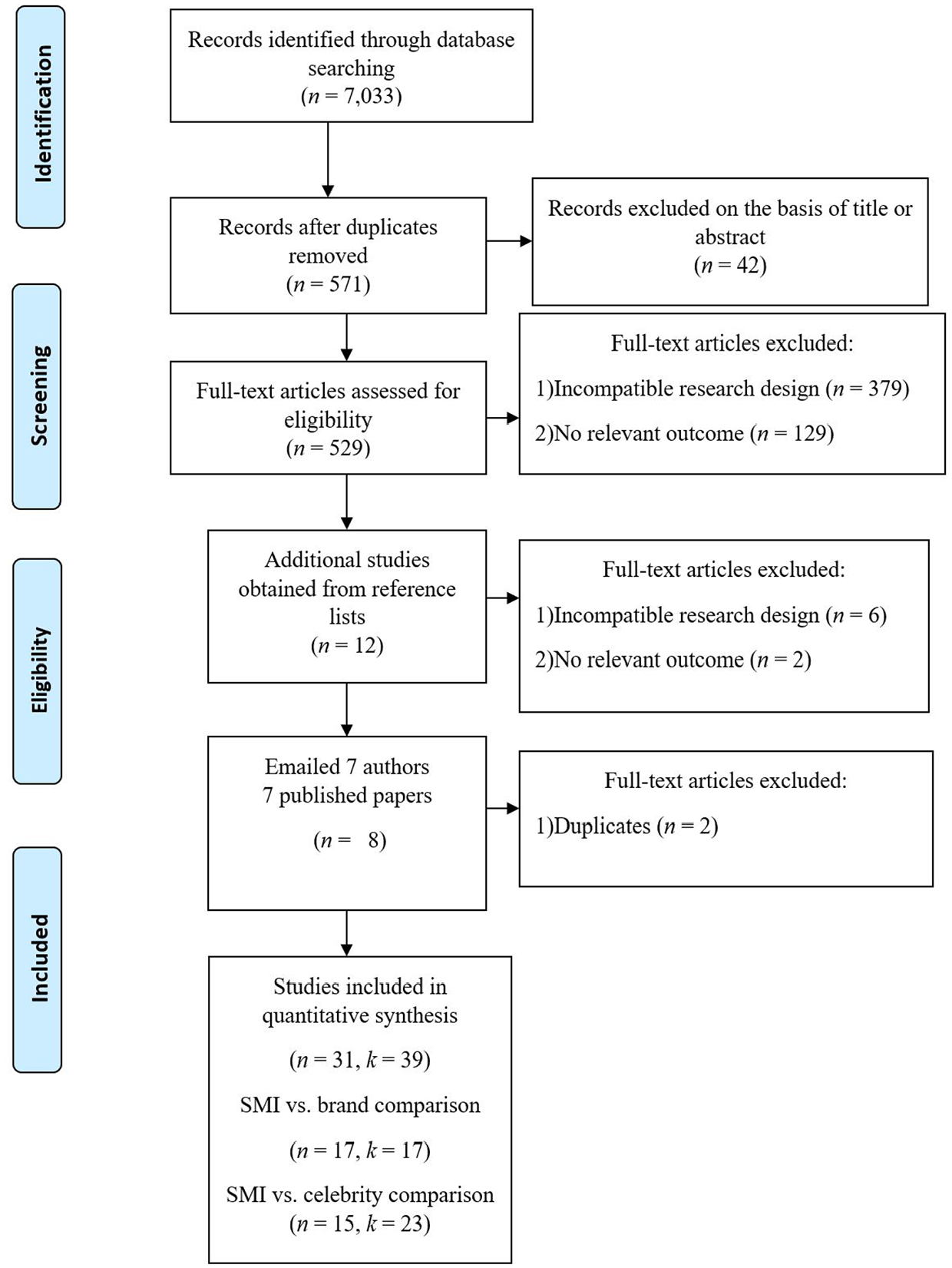
Flow diagram for identifying experimental studies reporting on effects of social media influencers.
Data Retrieval and Analytical Approach
Effect sizes (Cohen’s d) were assessed via the Comprehensive Meta-Analysis Software (CMA v.4; Borenstein, 2022). This study reports on uncorrected effect sizes based on the assumption of random effects (Hedges & Vevea, 1998). Whereas fixed effects assume that there is a common main effect that is “true” for all reports, random effects make no such assumption, suggesting that effects are relevant beyond the specific populations from which they were drawn (Hedges & Vevea, 1998). Based on Borenstein et al.’s (2009) approach to random effects, the combined random effect is computed by assigning more weight to the studies that carry more information, using the inverse of the variance rather than the sample size (the inverse variance is proportional to the sample size, but it provides a more nuanced measurement). Each main effect was subsequently assessed for level of heterogeneity, using a common rule of thumb, where 0%–40% indicates negligible heterogeneity, 30%–60% represent moderate heterogeneity, 50%–90% signal substantial heterogeneity, and 75%–100% may reflect considerable heterogeneity (Higgins & Thompson, 2002).
Coding of Effects and Moderators
Each study was coded for the SMI comparison condition (celebrity/brand-only), the persuasion-related outcomes (attitude/intent/behavior), the influencer type (nano or micro [<100k]/macro or mega [>100k]; Campbell & Farrell, 2020), and the perceived credibility of the endorser (calculated as the standardized difference in perceived credibility between the SMI and the celebrity conditions; M = 0.16, SD = 0.72). Using a subset of studies that did not meet all the inclusion criteria, two independent coders were trained to code until a satisfactory level of agreement was reached (kalpha > .80). Then, rather than assessing intercoder agreement on a subset of the corpus, reliability was calculated based on the entire dataset, resulting in agreement ranging from .86 (persuasion outcomes) to 1.00 (SMI comparison condition).
A single effect size of exposure to SMI on persuasion-related outcomes was calculated per sample. Reported effects from primary studies were transformed to Cohen’s d, allowing easy interpretation of directionality and magnitude. Following recommendations by Borenstein et al. (2009), in cases where studies reported on several relevant outcomes (k = 5), all relevant effect sizes were recorded and then averaged into a single persuasion index. This decision was guided by previous meta-analytic evidence suggesting the invariance of attitudes, intent, and behavioral outcomes (O’Keefe, 2015). In other words, there is strong evidence to support the claim that if message X has a stronger influence on attitudes compared to message Y, it will also have a stronger effect on behavioral intent and actual behavior (for data supporting the invariance of attitudes, intentions, and behaviors based on 29 meta-analyses, see O’Keefe, 2015). Analyses were done separately for each experimental comparison (SMI vs brand-only and SMI vs celebrity), resulting in two meta-analyses that are independent of one another (for an example of this approach, see Walter & Tukachinsky, 2020). Table 1 summarizes the coding of cases included in the meta-analysis and Supplemental Appendix A presents the PRISMA checklist (Liberati et al., 2009).
List of Studies Included in Meta-Analysis.

Calculated as the standardized difference (Cohen’s d) in perceived credibility between SMIs and celebrity endorsers.
Comparison of SMIs and celebrity advertising.
Comparison of SMIs and brand-only advertising.
Results
Compared to brand-only advertising (RQ1a), the mean effect of exposure to SMIs on persuasion-related outcomes was positive, weak, and significant (d = 0.16, 95% confidence interval [CI] = [0.05, 0.27], p = .004, k = 17), with substantial heterogeneity, Q(16) = 43.68, I2 = 63.37%, p < .001 (see Figure 2 for a forest plot that includes the retrieved effect size, p-values, and 95% CI for each study). Moreover, compared to celebrity endorsement ads (RQ1b), the mean effect of exposure to SMIs on persuasion-related outcomes was positive, weak, and nonsignificant (d = 0.07, 95% CI = [−0.16, 0.30], p = .303, k = 23), with considerable heterogeneity, Q(22) = 380.69, I2 = 94.22%, p < .001 (see Figure 3 for a forest plot that includes the retrieved effect size, p-values, and 95% CI for each study). Given the apparent outlier of Wang and Lee (2021), the one-study-removed sensitivity analysis was conducted, indicating a weaker, albeit still nonsignificant effect once the study was removed (d = 0.02, 95% CI = [−0.15, 0.19], p = .844). Thus, given the relatively minor influence of this outlier on the pooled effect, we decided to leave it in the corpus.

Forest plot for the effects of SMI-endorsed (vs brand-only) advertising on persuasion.

Forest plot for the effects of SMI-endorsed (vs celebrity-endorsed) advertising on persuasion.
When examining the difference between SMI and celebrity endorsements by influencer type (RQ2), the moderation analysis retrieved a significant difference, Q(1) = 10.59, p = .001, such that celebrity endorsements were much more effective when compared against nano-influencers (d = −0.46, 95% CI = [−0.85, −0.06], p = .024, k = 4), whereas mega-influencer endorsements were significantly more persuasive than celebrity endorsements (d = 0.33, 95% CI = [0.07, 0.59], p = .012, k = 9).
RQ3 inquired about a potential relationship between perceived credibility and SMIs effects compared to celebrity endorsement ads. This question was examined via a meta-regression by including the standardized difference in perceived credibility between the SMI and the celebrity experimental conditions as a predictor of SMI (vs celebrity) effects on persuasion-related outcomes. Based on the meta-regression, Qb(1) = 9.39, p = .002; k = 7, there was a significant positive effect of SMI (vs celebrity) perceived credibility on persuasion-related outcomes; b = 0.22, Z = 3.06, SE = 0.07, p = .002 (see Table 2). As the plotted regression line demonstrates (see Figure 4), there was a linear relationship between perceived credibility and persuasive effects, such that SMIs were more persuasive, compared to celebrities, when they were perceived as more credible (Supplemental Appendix B outlines effect sizes for each included study together with a 95% CI relative to the estimated regression line).
Meta Regression for the Effects of Exposure to SMIs (vs Celebrity) on Persuasion by Perceived Credibility.

Note. Perceived credibility was calculated as the standardized difference between the SMI and the celebrity conditions regarding perceptions of credibility associated with the source of the message (Cohen’s d).

The influence of SMIs perceived credibility on persuasion.
Robustness Checks
A publication bias refers to the possibility of a systematic underrepresentation of nonsignificant or counterintuitive findings in the corpus (Rothstein et al., 2005). In line with recent recommendations (for a discussion of the relative benefits and limitations of each publication bias index, see van Aert et al., 2019), a combination of publication bias tests was included in the analyses. Namely, each publication bias index tests different assumptions that link effect sizes to systematic under- or over-representation of studies. First, Begg and Mazumdar rank correlation test that estimated the relationship between the standardized effects and their variance (Begg & Mazumdar, 1994) did not support the existence of a publication bias (Tau = .04, p = .837). Furthermore, Figure 5 demonstrates a relatively symmetric funnel without a clear indication of over or underrepresentation of studies with larger or smaller standard errors as a function of the study’s effect size. Likewise, Egger’s regression intercept estimate did not point to possible publication bias related to asymmetry (t = 1.34, p = .201) (Egger et al., 1997). Finally, Duval and Tweedie’s (2000) method of trim and fill was utilized to gauge whether any studies needed to be removed to address the asymmetry. Based on the trim and fill assessment in a comprehensive meta-analysis, no studies had to be trimmed, and the average effect remained the same. In total, this combination of different publication bias indices did not point to a file-drawer problem; however, given the relatively small sample size, it is important to stay alert.

Funnel plot for the assessment of publication bias.
In addition, a p-curve analysis gauged the evidential value of the comparison between exposure to SMIs and brand-only advertising (Simonsohn et al., 2015). This procedure assumes that if the evidence is strong, the distribution of significant p-values (in our case, all the p-values were significant) should display a right skew with observations gathering at the lower end of the distributions (i.e., smaller p-values). If the evidence is inconclusive, on the other hand, the distribution of the p-values should be uniform. In the present case, conditions were met, indicating evidential value (see Figure 6 for the p-curve). Specifically, testing the distribution of significant p-values for right skew, the analysis supported the evidential value; Z = −1.6, p = .055. The analysis also assesses whether the p-curve is significantly flatter than the one expected if the studies were powered at 33%. When testing for the 33% power, the results were nonsignificant; Z = 0.02, p = .507. In total and acknowledging the limitations of publication bias assessments and p-curve analyses, this combination of different data quality indices suggests that the results are robust and there is evidential value.
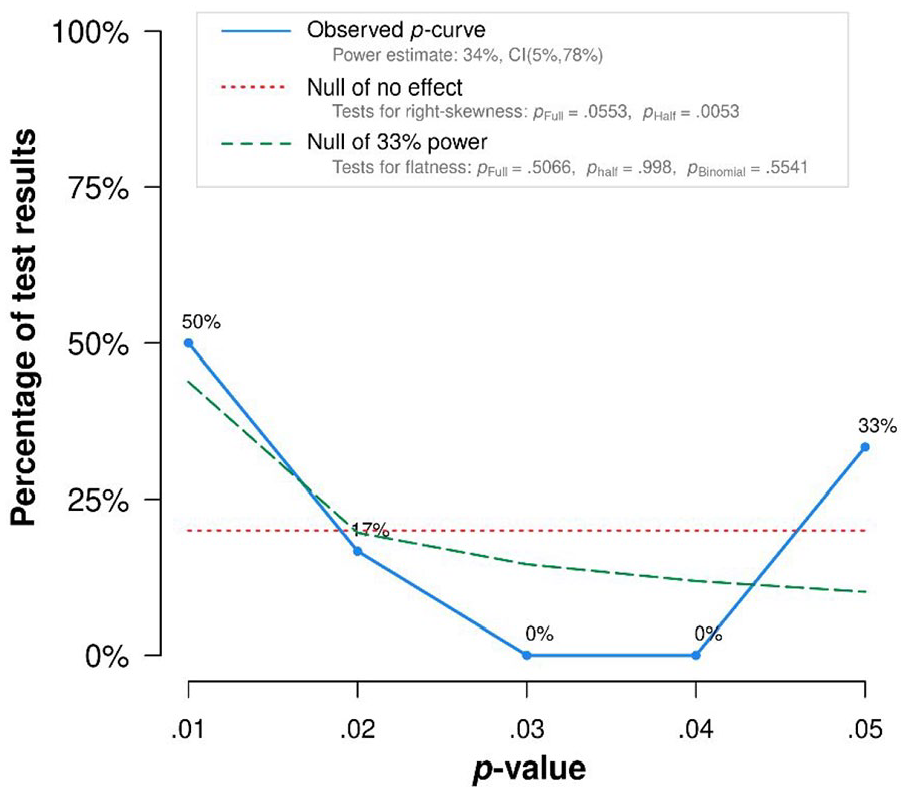
p-Curve analysis results.
Discussion
The current study aimed to address conceptual and practical gaps in an emergent body of advertising scholarship, recognizing the lack of clarity between SMIs and traditional celebrity endorsers with regard to their persuasive effects. To this end, the meta-analysis provides a synthesis of experimental designs that juxtaposed the persuasive effects of SMIs and celebrities to outline differences and similarities between these two dominant types of endorsers. Moreover, by focusing on key characteristics such as influencer type and perceived credibility, the meta-analysis attempts to move beyond bottom-line effects and focus on possible contingencies that may help explain the influence of SMIs.
Conflicting narratives have emerged in delineating the differences between SMIs and celebrity endorsers to date. The results of the current study indicate a middle ground between the arguments regarding conceptual similarities and differences. To start, the results of the meta-analyses shed light on why brands and organizations may benefit from partnering with SMIs. When compared to brand-only ads, ads that use SMIs appear to be more persuasive. Much like celebrity endorsers who have transferred their attributes to the partner brand via paid endorsements (Lou & Yuan, 2019), SMIs seem to play a similar role by imbuing the product with their credibility and status. Critically, although the pooled effect of SMIs compared to brand-only advertising was weak to moderate, it was significant, and there was no evidence that exposure to ads endorsed by SMIs could backfire.
Furthermore, the results of the meta-analysis also support the potential power of SMIs, by providing a direct comparison of the effects of celebrity and SMI endorsements. Namely, the analysis that synthesized all the available experiments that systematically manipulated the source of the ad did not retrieve a significant difference between celebrity- and SMIs-endorsed messages. Arguably, this validates the often—stated but seldom—tested claim that SMIs could be just as effective as celebrities in promoting products and brands (e.g., Rosengren & Campbell, 2021). Importantly, a closer look at the distribution of effect sizes from primary studies reveals the high level of heterogeneity, showing that there is an almost equal number of studies that point to scenarios where celebrities are more influential than SMIs, as studies show the opposite pattern. This begs the question: When or under which conditions can SMIs be more influential than celebrities?
Perhaps the most obvious characteristic that could moderate the influence of SMIs is their influencer type, as delineated by follower count (Campbell & Farrell, 2020). Simply put, there are reasons to suspect that mega-influencers are not substantively different from celebrities in their reach (Campbell & Farrell, 2020; Lou & Yuan, 2019). As such, the primary difference between them is not to be conceptualized by the follower count but rather by how they gained their fame (Brooks et al., 2021; Khamis et al., 2017). Of course, not all influencers fall into the mega-influencer category. The results of our analysis indicate that influencer type does matter when it comes to influencers. Our moderation analysis reveals that nano-influencers exhibit significantly lower persuasiveness compared to celebrity endorsers, whereas mega-influencers demonstrate significantly higher persuasiveness than celebrities. This finding echoes Britt et al.’s (2020) computational analysis, which indicated that while central to their networks, influencers with fewer followers tend to lack trust and emotional attachment within their follower networks, compared to mega-influencers. Similarly, Holiday et al. (2023) illustrated that influencer emotion is less impactful at lower follower counts and that promoting brands via emotion with followers produces negative persuasion-related outcomes. More broadly, this finding provides further credence to the narrative that influencers morph from peers to brands, gradually coming to epitomize the power of celebrity in the era of social media (Britt et al., 2020; A. L. Lee & Eastin, 2021). The significant impact of mega-influencers, compared to celebrities, indicates that once SMIs have sizable followers, their potency to elicit persuasion becomes increasingly pronounced. Audiences may perceive mega-influencers as having a greater level of specialization and fostering a more intimate connection, especially when contrasted with traditional celebrities who may seem more psychologically distant. As evidenced in prior research (Ryding et al., 2023), audiences exhibit a preference for macro-influencers due to the perceived similarities and relatability they find with these influencers, in contrast to celebrities or nano-influencers.
Interestingly, the differences between nano- and micro-influencers versus mega-influencers and celebrities may also be a function of perceived credibility. Namely, there are some reasons to suspect that the perceived credibility of SMIs could be more meaningful to persuasion than that of celebrities due, in part, to the unique relationship that SMIs may develop with their followers (Britt et al., 2020; Lou, 2022; Schouten et al., 2020). This argument points to a conceptual difference between SMIs and celebrity endorsers based on a relational dimension. The results of our meta-analysis illustrate that SMIs, when perceived as credible, are more persuasive than celebrity endorsers. Taken together, the suggestion is that a “sweet spot” may exist wherein SMIs amass a following large enough to have an advertising impact similar to celebrities while still maintaining the perceived credibility associated with being a relatable online persona rather than a brand. This is congruent with Holiday et al.’s (2023) contention that the emotional attachment and trust built between SMIs and followers in the relationship development process allows SMIs to maintain effectiveness even as commercial intent is known and authenticity wanes. Arguably, this points to a theoretical middle ground between conceptualizations of SMIs as online endorsers. It is important to note, however, that these inferences remain somewhat speculative at the moment, and more research is needed to determine the interplay between SMIs, persuasion, credibility, and parasocial relationships. Currently, the experimental literature comparing SMIs and celebrities has not accumulated a sufficient number of studies that measure all these variables to produce meaningful conclusions.
Theoretical Implications
Several theoretical implications emerge from three distinct findings: (1) SMIs are more effective than celebrity endorsers when perceived as credible, (2) mega-influencers are more effective than nano-influencers, and (3) the impact of mega-influencers and celebrity endorsers are not meaningfully different. These findings offer several contributions to the existing scholarship on SMIs, enhancing our understanding beyond the general consensus that they are effective at engaging audiences (e.g., Pöyry et al., 2019). However, as our meta-analysis showed, the effectiveness of influencers needs to be understood in much more nuanced ways, as it is governed by their intrinsic features (i.e., the number of followers) and perceptions of audiences toward them (i.e., perceived credibility). More specifically, pertaining to theoretical frameworks, our findings enrich discussions on both the traditional source credibility theory, emphasizing the influence of persuasion-related outcomes on perceived credibility (Ohanian, 1990). While this study did not ascertain various dimensions such as expertise or attractiveness that might impact the perceived credibility of SMIs—a limitation this study acknowledges—the acquisition of perceived credibility from audiences appears to be important for SMIs.
Furthermore, these discussions lend support to SET’s viewpoint on influencer network development, elucidating how influencers enhance their following while nurturing credibility and fostering trusted relationships within their influencer communities (Himelboim & Golan, 2022; Holiday et al., 2023). SET notes that the strength of emotion-laden, trust-based relationships established over time shields SMIs from the adverse effects of perceived commercial intent, thereby enabling them to maintain perceived credibility (Britt et al., 2020; Gräve & Bartsch, 2022; Holiday et al., 2023). Particularly, while prior research within this framework has presented conflicting results, indicating that micro-influencers (as opposed to mega-influencers) may be more effective due to their ability to cultivate closer interpersonal connections with their followers (Park et al., 2021), our findings provide additional support for the social exchange conceptualization. The persuasive impact of influencers evolves as their networks expand, and perceived credibility appears to rise up to a certain threshold as relationships are reinforced through consumer engagement.
To that point, this study offers some clarity regarding the debate over influencers as consumer-brand hybrids versus simply online celebrity endorsers. Although the relationship could not be directly tested, seemingly there is a “sweet spot” wherein SMI networks are large enough to rival the reach of celebrity endorsers and mega-influencers while retaining perceived credibility, making them more persuasive than the latter. The suggestion is that both arguments are valid to some extent. Bergkvist and Zhou’s (2016) examination of source theory–based celebrity endorsement literature suggests that endorser trust loses effectiveness due to consumers’ awareness of commercial intent. Once amassing a considerable following, SMIs begin receiving commercial benefits and overtly crafting their own brand (Erz & Heeris Christensen, 2018; A. L. Lee & Eastin, 2021); this is antithetical to the initial advantages that SMIs offer consumers. Findings imply that SMIs are consumer-brand hybrids and distinct from celebrity endorsers up until the point that they are perceived as brands, at which point their impact is similar to celebrity endorsers. Therefore, the social exchange conceptualization of influencer development is appropriate; however, celebrity endorsement conceptualizations and findings can likely be applied to mega-influencers.
Managerial Implications
From a managerial point of view, a substantial body of literature on celebrity endorsement indicates that brand partnerships with endorsers yield positive benefits in terms of brand awareness, brand evaluations, and purchase intention (Bergkvist & Zhou, 2016). As illustrated by our meta-analysis, there is no persuasive difference between celebrity endorsers and mega-influencers at least when examining their bottom-line effects. As such, brands ought not to differentiate between them in devising brand partnership strategies.
Another important lesson from our findings is that influencers have a greater impact than celebrity endorsers when perceived as credible. An important nuance, however, is that SMIs may lose that advantage when becoming too large. The implication is that there is likely a life cycle for SMI effectiveness that brands must manage. Brands must identify influencers in a “sweet spot” wherein their networks are large enough to provide maximum reach while still being perceived as credible by followers and actively cultivate the next wave of influencers to replace SMIs that outgrow their advantages (Britt et al., 2020).
Limitations
As with every meta-analysis, the present inquiry is limited to the available primary studies. In the case of experimental studies that compare the persuasive effects of SMIs and celebrities, the literature is growing exponentially, but there is still much to be understood. For instance, the current state of the literature does not offer a statistically meaningful assessment of the potential role of key moderators and mediators such as parasocial relationships, emotional attachments, perceived expertise, product category, advertising type, and social media platform. Likewise, given the paucity of experimental research that includes a direct comparison between the persuasive power of SMIs and celebrities, as well as brand-only campaigns, this project is best understood as a combination of two separate meta-analyses. A more parsimonious approach, however, would have combined the primary studies into a single corpus, but this was impossible in the present case due to the limited overlap between both types of comparisons (only a single study in our corpus included allowed us to compare exposure to SMIs with exposure to celebrities and brand-only ads). Relatedly, it is important to acknowledge that some of the moderation analyses, including the meta-regression, rely on a relatively small number of studies. While this limitation may threaten the validity of the statistical inferences, it is also worthwhile mentioning that the retrieved effect in the meta-regression is quite strong and highly significant. Thus, more research is needed to strengthen these inferences. To this end, this meta-analysis offers a potential roadmap that helps to identify gaps in the literature that could be addressed in future studies.
Moreover, the present synthesis is also limited by its unique focus on empirical studies that allow for the causal inference of the effects of SMI endorsement on persuasion. Although the choice to focus on studies that manipulate the source while keeping everything else constant was guided by the need to gauge the causal influence of SMIs, it is important to acknowledge that this decision led to the omission of large portions of the SMI literature. Specifically, studies that offer numerous insights into effective ways to identify SMIs in social networks (Himelboim & Golan, 2019), correlational analyses that tie exposure to SMIs with a variety of consumer outcomes (e.g., Ki et al., 2020), and content analyses of SMIs led marketing remain beyond the scope of the present synthesis. In addition, considering the variety of definitions concerning SMIs, we included only those studies that explicitly named either a real or a fictitious SMI in their research materials. While this approach may have excluded studies on other types of SMI beyond our search terms, for the purpose of consistency, we decided to rely on the conceptualization provided in the primary studies rather than trying to impose our own definition on research that has not explicitly mentioned SMIs. Finally, our focus has been narrowed to the advertising and marketing domains, where we have explored the effects of SMIs compared to brand-only postings. Therefore, future research endeavors should broaden their scope, exploring additional factors such as emerging platforms and diverse content formats that could exert influence across various domains.
Future Directions
Our research findings offer potential directions for future research in evaluating the efficacy of SMIs. First, an opportunity may exist to extend the scope of the source credibility theory (Ohanian, 1990), emphasizing how the credibility of SMIs influences persuasion. Given that source credibility encompasses dimensions like expertise, attractiveness, and trustworthiness (AlFarraj et al., 2021), future research can delve into precisely which facets of source credibility might enhance the effects of SMIs on persuasion outcomes, compared to celebrities.
Next, our findings paired with Holiday et al.’s (2023) findings suggest a “sweet spot” wherein SMIs can leverage both perceived credibility associated with being less commercial and the notoriety associated with large followings. Future research, however, should seek to pinpoint and characterize the “sweet spot.” Better understanding the life cycles of SMIs and the associated changes in persuasion can provide key insights for brands, influencers, and consumers.
Moreover, considering the importance of interactivity in fostering relationships between SMIs and their followers (Yuan & Lou, 2020), despite the potential significance of interactivity quality (Ooi et al., 2023), future research can refine our understanding of the effects of SMIs by delineating the specific boundaries under which SMIs can effectively persuade. Such an approach may further have the potential to enhance the SET within the realm of influencer network development.
All in all, as SMIs continue to play an ever-growing role both in popular culture and in consumer engagement strategy, it is important to stop and consider the strength of empirical evidence surrounding the persuasive potential of this new category of endorsers. For SMIs, while increasing their follower count can be a significant goal, it is crucial for them to recognize that enhancing perceived credibility is equally important.
Supplemental Material
sj-doc-1-sms-10.1177_20563051241269269 – Supplemental material for Do Influencers Influence? A Meta-Analytic Comparison of Celebrities and Social Media Influencers Effects
Supplemental material, sj-doc-1-sms-10.1177_20563051241269269 for Do Influencers Influence? A Meta-Analytic Comparison of Celebrities and Social Media Influencers Effects by Jiyoung Lee, Nathan Walter, Jameson L. Hayes and Guy J. Golan in Social Media + Society
Supplemental Material
sj-docx-2-sms-10.1177_20563051241269269 – Supplemental material for Do Influencers Influence? A Meta-Analytic Comparison of Celebrities and Social Media Influencers Effects
Supplemental material, sj-docx-2-sms-10.1177_20563051241269269 for Do Influencers Influence? A Meta-Analytic Comparison of Celebrities and Social Media Influencers Effects by Jiyoung Lee, Nathan Walter, Jameson L. Hayes and Guy J. Golan in Social Media + Society
Footnotes
Declaration of Conflicting Interests
The author(s) declared no potential conflicts of interest with respect to the research, authorship, and/or publication of this article.
Funding
The author(s) disclosed receipt of the following financial support for the research, authorship, and/or publication of this article: This work was supported by the Ministry of Education of the Republic of Korea and the National Research Foundation of Korea (NRF-2021S1A5C2A02088387).

Supplemental Material
Supplemental material for this article is available online.
Author biographies
References
Supplementary Material
Please find the following supplemental material available below.
For Open Access articles published under a Creative Commons License, all supplemental material carries the same license as the article it is associated with.
For non-Open Access articles published, all supplemental material carries a non-exclusive license, and permission requests for re-use of supplemental material or any part of supplemental material shall be sent directly to the copyright owner as specified in the copyright notice associated with the article.
