



Abstract
The Internet and social media create an environment in which individuals can selectively approach information supporting their political worldviews while also being incidentally exposed to socially shared information that challenges their beliefs. These competing information consumption patterns may help explain whether and how digital media contribute to affective polarization (i.e. affect-based division between political groups). This study examines how pro-attitudinal selective exposure and counter-attitudinal incidental exposure in tandem influence political emotions. Using data from 2, two-wave panel surveys conducted during the 2016 and 2020 US presidential elections, our findings demonstrate that seeking consonant political information is consistently associated with anger toward political opponents and enthusiasm toward like-minded partisans. In contrast, despite the purported democratic benefits endowed on political disagreement, cross-cutting incidental exposure does not temper political emotional responses associated with pro-attitudinal selective exposure. However, we find little evidence that unexpected exposure to disagreeable information backfires either.
Keywords
The contemporary political environment in the United States is one that is characterized by severe polarization, as Americans express high levels of dislike and distrust of members of the opposed political party (Finkel et al., 2020; Iyengar et al., 2019). Much of this animosity between parties is highly emotional such that observed polarization is often based in affect (Iyengar et al., 2012). While several factors—including changing attachments to party identities and growing racial divides—are known to facilitate affective polarization (Boxell et al., 2020; Iyengar et al., 2019), online media consumption patterns also have potential to encourage or limit these emotional divides.
Yet the question of whether and how news and information exposure online relate to affective polarization remains an open one. On one hand, the contemporary online media environment provides enhanced selectivity to like-minded news and political information, as greater capacity of user control allows individuals to customize information diets in accordance with their prior beliefs (Bakshy et al., 2015). Although empirical findings suggest that the vast majority of news consumers do not surround themselves with only like-minded information (Garrett, 2009), there is some evidence that increased media choice and access to partisan content has contributed to polarization in the United States (Garrett et al., 2014; Lelkes et al., 2017; Levendusky, 2013; Stroud, 2010). However, on the other hand, the Internet and social media also create more opportunities for incidental exposure to socially shared information (Fletcher and Nielsen, 2017; Gil de Zúñiga et al., 2017). Thanks to the demographic and ideological heterogeneity of online social networks and the weakened social boundaries online (Barnidge, 2016; Goel et al., 2010), these incidental encounters often expose people to differing political perspectives that they do not intentionally seek out initially (Lu and Lee, 2019a).
In theory, long-standing normative expectations suggest that encountering opposing views should moderate political attitudes (Mutz, 2006). If true, incidental exposure to political disagreement online has the potential to temper political emotions and affective polarization, including emotions that are elicited by self-selection into like-minded political content. Yet, there is evidence that exposure to disagreement is not always beneficial; disagreement can backfire and increase attitude polarization (Bail et al., 2018; Kim, 2015), but it is unclear whether such processes extend to incidental exposure to disagreement and emotional polarization. Thus, an important theoretical question remains unanswered: does incidental exposure to attitude-challenging information exacerbate political feelings associated with pro-attitudinal selective exposure or does it have a tempering effect, thereby reducing emotional strife between political opponents?
To address this gap in the literature, the current study provides some of the first empirical evidence aimed at evaluating how selective and incidental exposure patterns work in tandem to influence affective polarization, including an investigation of the normative claims regarding the benefits of incidental exposure to political disagreement online. Affective polarization refers to the animosity between parties or political groups and, specifically in the US context, the tendency for people who identify as Democrats or Republicans to view opposing partisans negatively and co-partisans positively (Iyengar et al., 2019). Most research on affective polarization looks at the valence and/or strength of feelings about out-parties. We opt to focus here on discrete emotions instead, specifically anger toward the presidential candidate one opposes and enthusiasm toward the candidate one supports. We do so because anger and enthusiasm are two emotions that characterize the current political environment in the United States (MacKuen et al., 2010; Mason, 2016). They are known to drive political behaviors (see MacKuen et al., 2010), but have received less attention in the context of affective polarization. According to affective intelligence theory, anger and enthusiasm can propel individuals to rely on predispositions in making political decisions and limit their willingness to compromise (Marcus et al., 2000), which can deepen existing political fissures and worsen polarization. To answer these questions, we use data from 2, two-wave panel surveys of diverse samples of American adults conducted during the 2016 and 2020 US presidential elections, which provide unique contexts to examine relationships between online information exposure and emotional polarization.
Pro-attitudinal selective exposure and affective polarization
People often prefer news sources aligned with their ideological orientations (Garrett, 2009; Stroud, 2008). The Internet can enhance this tendency by providing opportunity for more pro-attitudinal exposure through both enhanced selectivity and social networks (Bakshy et al., 2015). While the majority of people do not consistently engage in partisan selective exposure online (Guess, 2021; Nelson and Webster, 2017), those who do often exhibit more partisan attitudes and beliefs (Levendusky, 2013). Thus, one potential consequence of this enhanced selectivity is the polarization of political attitudes and feelings.
During US presidential election campaign seasons, there is commonly an avalanche of negative political advertisements and hostile news reports (Sood and Iyengar, 2016). People who rely on congenial news sources are often exposed to messages criticizing and denigrating political opponents, which reinforces partisans’ biased views of their opponents (Iyengar et al., 2012). People also tend to perceive these like-minded partisan messages as credible and impartial and hence believe the opposing side to be undesirable (Stroud et al., 2014). In addition, the public hostility displayed by political leaders online, together with the emotion-laden language commonly used in partisan disputes, can trigger emotional responses in audiences (MacKuen et al., 2010; Weeks et al., 2019). Taken together, exposure to like-minded content and negativity during elections can build resentment and negative emotions toward political opponents.
Moreover, media selection and social identities are mutually reinforcing; repeated exposure to one-sided partisan views can boost one’s political self-concept and further strengthen partisan identity (Knobloch-Westerwick and Meng, 2011; Slater, 2007). Social identities are powerful cues for beliefs and actions that lead to in-group favoritism and out-group antipathy (Tajfel, 1982). For example, Wojcieszak and Garrett (2018) demonstrate that priming national identities among immigration opponents leads them to attribute more negative traits to immigrants, report colder feelings toward them, and prefer greater social distance. Iyengar et al. (2012) find that when partisanship is a salient marker of group identities, negative affect for political opponents tends to be the greatest. Accordingly, we could expect selective exposure to polarize group-based affect.
Indeed, Garrett et al. (2014) find that the more extensively people rely on news sites that align with their party leanings, the more polarized they are in their feelings toward the presidential candidates they oppose. Such exposure can also trigger discrete emotions like anger and enthusiasm. According to affective intelligence theory, anger arises when a person’s goal, identity, or worldview is threatened, whereas enthusiasm is often aroused by reassurance (Marcus et al., 2000). Existing research shows that selective exposure to like-minded and partisan news is associated with more anger toward political opponents (Hasell and Weeks, 2016; Lu and Lee, 2019b). At the same time, exposure to pro-attitudinal political content can also arouse enthusiasm, as it exposes people to information favoring their preferred candidate and promoting the in-party’s political agenda (Iyengar et al., 2012; Weeks et al., 2019). Such exposure can heighten anticipation of potential victory and these familiar or rewarding situations can elicit positive, high arousal emotions like enthusiasm (MacKuen et al., 2010; Mason, 2016).
Overall, there is compelling evidence that pro-attitudinal selective exposure can lead to the divergence of partisan emotions, specifically, enthusiasm toward in-parties and anger toward out-parties (and their members). We thus propose the following hypotheses:
H1a. Pro-attitudinal selective exposure is positively associated with enthusiasm toward the presidential candidate one supports.
H1b. Pro-attitudinal selective exposure is positively associated with anger toward the presidential candidate one opposes.
The role of counter-attitudinal incidental exposure
Although social media platforms afford greater user control and customization, news consumption on these platforms is often an incidental experience (Fletcher and Nielsen, 2017). For example, a Pew Research survey showed that 78% of US adult users reported seeing news they did not intentionally seek out while on Facebook for other, non-news related reasons (Mitchell et al., 2013). In essence, incidental exposure is often seen as a byproduct that occurs in an unintentional manner when engaging in other non-news activities online (Tewksbury et al., 2001). Since social media are predominantly used for relational purposes, people incidentally come into contact with news and other political information while interacting with those in their online networks (Gil de Zúñiga et al., 2017). While most research highlights the lack of intention or motivation at the point of news contact as a defining feature of incidental exposure, others point out that mere encounter without active engagement with the information is also a distinct characteristic (Sude et al., 2019). Wieland and Kleinen-von Königslöw (2020) further argue that unintended news contact on social media occurs in a continuous, habitual scrolling of passing-by news posts. Hence, it is likely to trigger automatic and heuristic processing that can contribute toward polarization, although attentive, systematic processing of news content is also a possible, albeit less likely path (Wieland and Kleinen-von Königslöw, 2020).
Recent advancement in the field highlights that although unintentional, incidental exposure is not always entirely accidental. Rather, it is sometimes dependent on a user’s active customization of the information environment and algorithmic inference and prediction based on the user’s past behaviors and connections (Kümpel, 2020; Thorson, 2020). Engagement with news and having a politically active social graph contributes to a user’s algorithmic identity being classified as interested in politics, which increases the likelihood of the user encountering political posts incidentally (Thorson et al., 2021). While those interested in politics may attract more political content in their newsfeeds (Thorson et al., 2021), empirical evidence suggests that the political content is generally diverse despite homophilous affiliation and algorithmic curation (Bakshy et al., 2015; Barnidge, 2016). Thanks to the expansion of new, weak, and diverse ties, a substantial fraction of online social contacts holds differing political views. For example, Goel et al. (2010) find that while close friends disagree almost 30% of the time, acquaintances may disagree on almost 40% of the issues. As a result, people often come across a diverse range of information and perspectives online (Lu and Lee, 2019a), and it is not uncommon to stumble upon disagreeable or objectionable views during a controversial political event (John and Gal, 2018). In this study, we conceptualize incidental exposure as unintended encounter of information that one does not actively seek out initially, and focus on incidental exposure to political disagreement, namely, cross-cutting incidental exposure.
Given the possibility of cross-cutting incidental exposure online, it is important to understand its influence on affective polarization. In particular, does it serve as a source of moderation or exacerbate the polarizing emotions associated with pro-attitudinal selective exposure? Existing research to date on exposure to disagreement has presented mixed findings. When presented with counter-attitudinal information, people generally update their views in the direction of the information, which suggests that cross-cutting exposure does not cause backlash (Guess and Coppock, 2020). Encountering political disagreement in interpersonal discussion networks weakens attitude polarization that is associated with selective exposure (Kim, 2015). In addition, both interparty contact and counter-attitudinal news exposure on social media can diminish affective polarization (Beam et al., 2018; Wojcieszak and Warner, 2020). In contrast, Garrett et al. (2014) demonstrates that although contact with opponents can moderate political feelings, using cross-cutting partisan news sources can further strengthen the positive relationship between pro-party news consumption and affective polarization.
We argue that the mixed findings in the literature may be related to the fact that cross-cutting exposure is often operationalized as active use or intentional seeking of news sources or content inconsistent with one’s partisan leaning. This approach may capture the group of people who have high need for cognition and evaluation and are explicitly driven by instrumental news use motives (e.g. surveillance, social utility; David, 2009), or those who actively seek out opposing views to defend or strengthen their own (Valentino et al., 2009). We instead emphasize the non-intentionality of incidental contact with counter-attitudinal information in this study. While acknowledging that those interested in politics may be more likely to encounter news and politics on social media (Kümpel, 2020; Thorson et al., 2021), we also argue that these incidental contacts are not directed by specific goals or driven by particular psychological needs that dictate the subsequent information processing. Although whether and how a user processes the information after an unintended contact may still be influenced by various factors including the person’s underlying goals and interest (Kümpel, 2020; Wieland and Kleinen-von Königslöw, 2020), existing research also shows that coming across article previews in news feeds can provide some awareness of the covered political stories irrespective of political interest (Bode, 2016). More importantly, the information exposure and subsequent engagement happens in a non-political context that can make people more receptive to disagreement and facilitate deliberation (Wojcieszak and Mutz, 2009). In light of this, in the following sections we develop a pair of competing hypotheses about whether incidental exposure to counter-attitudinal information weakens or enhances selective exposure’s effect on emotional polarization.
Counter-attitudinal incidental exposure as a source of emotional moderation
There are three main reasons to expect that stumbling upon attitude-discrepant content on the Internet and social media could attenuate the relationship between selective exposure and political emotions. First, network disagreement can induce so-called “cross-pressures” (Mutz, 2002b), which can function as a force of moderation. That is, exposure to competing viewpoints in their social networks makes people feel ambivalent about their own stances. Importantly, network disagreement also induces social anxiety. To preserve social harmony, people often refrain from taking actions and moderate their views (Mutz, 2002a, 2006).
Second, counter-attitudinal incidental exposure may be able to balance slanted views resulting from selective exposure. Existing studies conducted in the context of interpersonal communication have presented some evidence in support of the beneficial outcomes of diverse exposure. Cross-cutting interaction can make people more aware and tolerant of the legitimate rationales for oppositional views and encountering disagreement during political discussion with acquaintances can improve one’s ability to generate reasons to support both their own opinions and the opposing viewpoints (Mutz, 2002a; Price et al., 2002). This is arguably because of expectation and composition effects. That is, when anticipating future communication with others, people are motivated to draw upon cognitive resources to process counter-attitudinal information to elaborate their own opinions (Pingree, 2007). This intrapersonal elaboration process is able to facilitate political learning and improve political knowledge, especially when involving communication within a diverse network (Eveland, 2004). In addition, when facing disagreement in their discussion networks, people tend to perceive a mixed opinion climate (Wojcieszak and Price, 2009), which may be able to lessen attachment to their political views.
Of course, one may argue that to reap these benefits, it is important that people do not counter-argue disagreeable political content (Dilliplane, 2011). Accordingly, we emphasize the serendipitous nature of the cross-cutting incidental experiences in online social networks. Wojcieszak and Mutz (2009) find that deliberation across lines of political differences primarily occurs in non-political online spaces like interest groups, where politics or controversial public issues come up inadvertently. This may be because in a relaxed and invitational apolitical environment, people are more likely to process information with an open mind-set. Existing research based on interview data also suggests that people generally report positive feelings about incidental exposure to online news, such as joy and excitement associated with discovering something new (Yadamsuren and Erdelez, 2010). It is thus plausible that, since people use social media primarily for relational purposes (Ellison et al., 2011), the non-political social environment where incidental exposure occurs may help deter strong emotional and defensive reactions.
To summarize, encountering network disagreement can induce cross-pressures that refrain people from taking sides and encourage cognitive elaboration that regulates feelings. This can be further facilitated by the non-political context where incidental exposure occurs. Indeed, research shows that political disagreement encountered during discussion depolarizes emotional reactions; it reduces negative emotions toward out-party candidate and decreases positive emotions toward in-party candidate (Parsons, 2010). Based on this line of reasoning, counter-attitudinal incidental exposure may counteract selective exposure in its effect on affective polarization. Accordingly, we propose the following hypotheses:
H2a. Counter-attitudinal incidental exposure weakens the relationship between pro-attitudinal selective exposure and anger toward the presidential candidate one opposes.
H2b. Counter-attitudinal incidental exposure weakens the relationship between pro-attitudinal selective exposure and enthusiasm toward the presidential candidate one supports.
Counter-attitudinal incidental exposure as an amplifier
Alternatively, unwanted dissonance from counter-attitudinal incidental exposure could backfire by triggering biased information processing and social categorization (Bail et al., 2018). This could instead further reinforce the affective polarizing effect of selective exposure.
For disagreeable information to encourage complex and moderate opinions, people need to make conscious effort to engage with the differences. However, such “slow thinking” does not seem to be a common component of people’s daily online practices. Instead, they are often driven by dispositions and a habitual mode of thinking (Cho et al., 2018). Incidental exposure in particular occurs in a continuous, habitual scrolling of passing-by news posts, hence likely to trigger automatic and heuristic processing (Wieland and Kleinen-von Königslöw, 2020). This may be particular salient during electoral campaigns that are already emotionally charged and polarizing (Sood and Iyengar, 2016). Besides, the vast torrent of political information in this period can also overload individuals’ cognitive capacities and deplete the mental resources required to counter biases (Kahneman, 2011). It is thus likely that in such an environment, people are prone to rely on their prior attitudes in processing new information (Bail et al., 2018).
This biased information processing can amplify the polarizing effect of selective exposure. Motivated reasoning theory suggests that people counter-argue against new information that contradicts their prior beliefs to explain it away (Taber and Lodge, 2006). Weeks et al. (2017) find that after stumbling upon challenging political views on social media, people tend to deliberately seek out confirming information, arguably to discount the arguments opposed to their positions. When exposed to counter-attitudinal information online, partisans will often counter-argue in a way that increases perceived distances between groups and encourages polarization (Bail et al., 2018). This type of information evaluation can in fact help maintain and reinforce existing affect, even in the face of disconfirming evidences (Redlawsk, 2002).
Moreover, incidental cross-cutting exposure may trigger social categorization, particularly in the context of a contentious political contest. Stroud et al (2014) find that people categorize news media sharing their political perspectives as in-group members. Heatherly et al. (2016) suggest that individuals extend their dislike of the opposing political party to out-party members within their online social networks as well. When encountering unexpected objectionable views from their social contacts, people often report the feelings of shock and betrayal, which motivates them to cut the ties (John and Gal, 2018). Others suggest that such disagreements can be perceived as hostile, which may induce anger or a sense of injustice that motivate people to take actions to protect the cause they believe in Wojcieszak (2011). We can thus expect the social categorization process associated with negative emotions to further reinforce individuals’ existing political attitudes and feelings and widen the emotional distance between opposing parties. We propose the following two hypotheses:
H3a. Counter-attitudinal incidental exposure strengthens the relationship between pro-attitudinal selective exposure and anger toward the presidential candidate one opposes.
H3b. Counter-attitudinal incidental exposure strengthens the relationship between pro-attitudinal selective exposure and enthusiasm toward the presidential candidate one supports.
Method
Samples
To test these hypotheses, we relied on data from two, two-wave panel surveys of diverse samples of American adults collected during the 2016 and 2020 US presidential elections. We contracted the survey research company YouGov to collect the data in both years and the samples were drawn from their panel of American adult respondents. YouGov used a matching technique to produce samples that closely resemble the American population on gender, age, race, and education. The frames were constructed by stratified sampling from the American Community Surveys (ACS) 1-year sample with selection within strata by weighted sampling with replacements. Complete details about the sampling methodology are found in Appendix 1 in the Supplemental Materials. While not a probability-based sample, respondents very closely resemble the demographic characteristics of the adult American population when compared to the US Census Bureau’s 2016 and 2019 ACS (see Appendix 1 in the Supplemental Materials).
Data for the first wave (W1) of the 2016 survey were collected in late September of that year, during the height of the US presidential election. A total of 6213 panel members received invitations to take the survey and 1800 individuals completed it (29% completion rate). Data for the second wave (W2) were collected during the final 6 days before the election in early November. Of the 1,800 participants, 1293 from W1 completed the second wave as well (71.83% retention rate). As a data quality check, we included an attention check in W1. Three hundred sixty-six participants failed that check and their data were excluded from the analyses below, leaving 1434 respondents in W1 and 1056 in W2. Wave 1 data for the 2020 survey were collected in late September and early October 2020. A total of 5382 panel members were invited to take part and 2153 individuals completed the survey (40% completion rate). Three hundred fifty-three respondents who completed the study in W1 were removed by YouGov to meet quota sampling and ensure the sample accurately reflects the American population. This resulted in a sample of 1800 respondents. 1 A total of 1265 respondents provided data in the second wave of the survey (70.28% retention rate), which was fielded in the week immediately following the November 3, 2020 election.
Measures
Descriptive statistics and all exact question wording for all variables can be found in Appendix 2 in the Supplemental Materials.
Pro-attitudinal selective exposure
Pro-attitudinal selective exposure was measured in W2 as the degree to which respondents actively sought out information consistent with their prior political views. In 2016, respondents were asked how often they had intentionally sought information that was (1) positive about a political candidate or view they supported and (2) negative about a political candidate or view they opposed. In 2020, a single item measured pro-attitudinal selective exposure by asking how frequently respondents intentionally sought news or information about the election that supported their preferred presidential candidate or criticized the other candidate.
Counter-attitudinal incidental exposure
Existing survey studies (e.g. Heiss and Matthes, 2019; Valeriani and Vaccari, 2016) commonly operationalize incidental exposure as the degree to which respondents accidentally encounter political posts online or in their social media newsfeeds they did not seek out or expect to see. Following this work, we measured counter-attitudinal incidental exposure in 2016 W2 by asking respondents how often they had accidentally encountered information that was (1) negative about a political candidate or view they supported and (2) positive about a political candidate or view they opposed. In 2020 W2, a single item measured the degree to which respondents accidentally encountered election news or information online that criticized their preferred candidate or supported the other candidate.
We took several steps to establish the discriminant validity and concurrent validity of the information exposure measures. The findings provide empirical evidence of the validity of the incidental exposure items and indicate that our measure of incidental exposure is distinct from selective exposure (see Appendix 3 in the Supplementary Materials).
Political emotions
In both 2016 and 2020, the emotion variables were measured in W1 and W2 in three steps. First, in 2016, we measured respondents’ voting preferences with two questions. Respondents were asked how likely it was that they would vote in the presidential election. Those who reported that they would probably or definitely vote (73.6%, N = 1056) were further probed with the question, “If the election were held today, which candidate would you support for President?” For Hillary Clinton, 43.6% (N = 460) reported a preference, whereas 37.3% (N = 394) supported Donald Trump. The rest reported support for another candidate or were undecided (19.2%, N = 202) and were excluded from further analysis. In 2020, we asked respondents whom they planned to vote for in the presidential election. Individuals who were unsure about their vote choice or who did not plan to vote were asked a follow up question that measured which candidate they were leaning toward voting for (or who they would chose if they were to vote). Combining these two items resulted in 966 respondents who (53.7%) supported Joe Biden and 655 (36.4%) who supported Trump. One hundred seventy-nine respondents (9.9%) either supported a third-party candidate or did not offer a candidate preference and were dropped from analyses.
Second, in each year, we measured the extent to which respondents felt enthusiastic and angry toward the two major candidates, respectively. Enthusiasm was measured using three items that assessed the extent to which each candidate made them feel hopeful, enthusiastic, and proud, respectively. Similarly, anger was measured with two items by asking respondents how much the candidates made them feel angry and mad, respectively. Means and reliability statistics for emotional responses to the candidates in both 2016 and 2020 are reported in Tables A2-2 and A2-3 in the Supplemental Materials.
Finally, we matched voter preference with the emotion scores. By doing so, we computed the two variables: enthusiasm toward the candidate one supports and anger toward the candidate one opposes for both surveys. The two types of political emotions are moderately correlated in both years (2016: W1, r = .30, p < .001; W2, r = .30, p < .001; 2020: W1, r = .20, p < .001; W2, r = .29, p < .001). They are also relatively stable in terms of individual responses in each wave (2016: enthusiasm, r = .83, p < .001; anger, r = .61, p < .001; 2020: enthusiasm, r = .79, p < .001; anger, r = .68, p < .001).
Control variables
In addition to basic demographics (i.e. age, education, and gender), we also controlled for political interest, political efficacy, partisan strength, and news consumption 2 measured in W1. Partisan strength was computed by folding the party identification variable. In addition, we also controlled for pro-attitudinal incidental exposure and counter-attitudinal selective exposure measured in W2. The zero-order correlations of all the variables are reported in Tables 1 and 2 (Pearson’s correlation coefficients, two-tailed).
Zero-order correlation (2016 data).
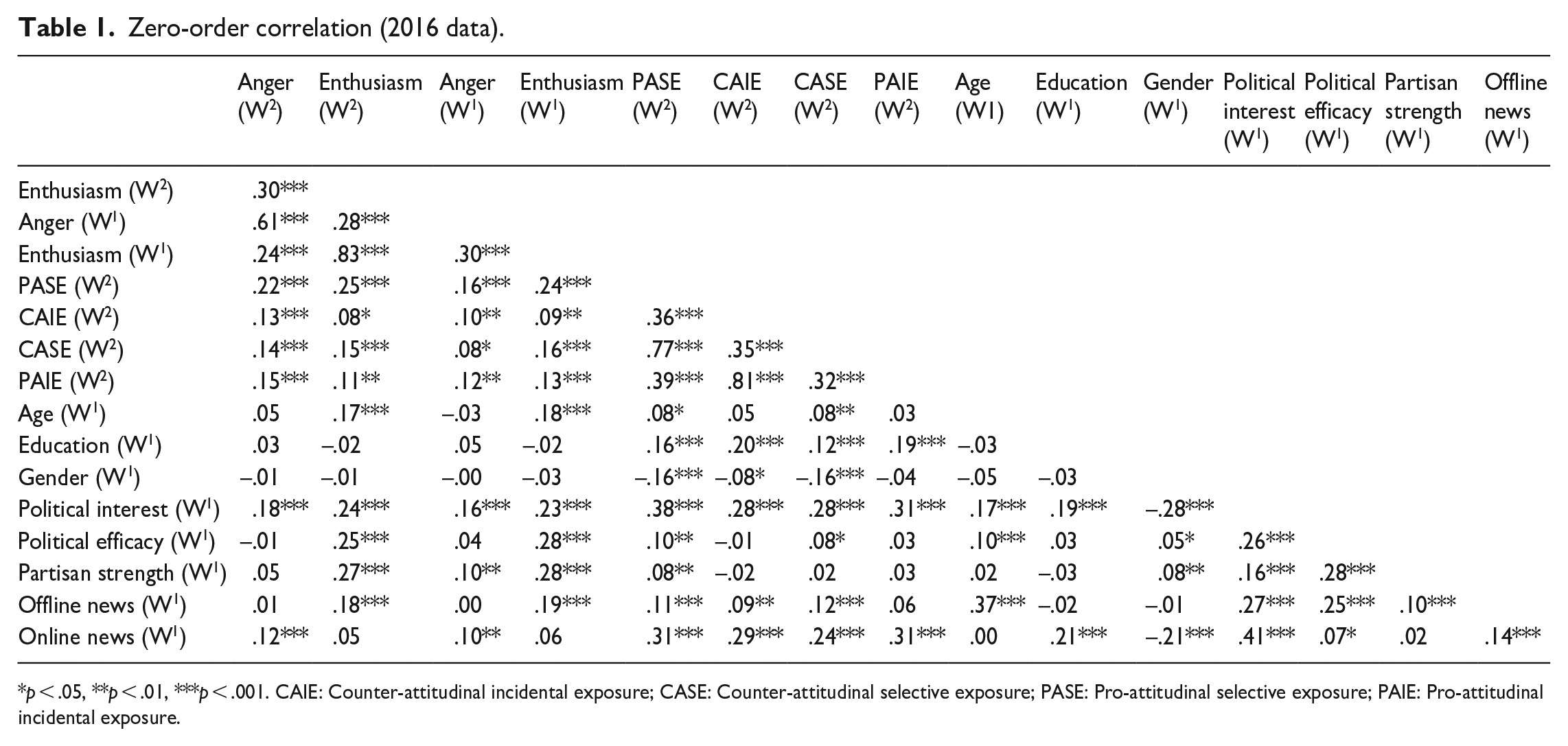
p < .05, **p < .01, ***p < .001. CAIE: Counter-attitudinal incidental exposure; CASE: Counter-attitudinal selective exposure; PASE: Pro-attitudinal selective exposure; PAIE: Pro-attitudinal incidental exposure.
Zero-order correlation (2020 data).
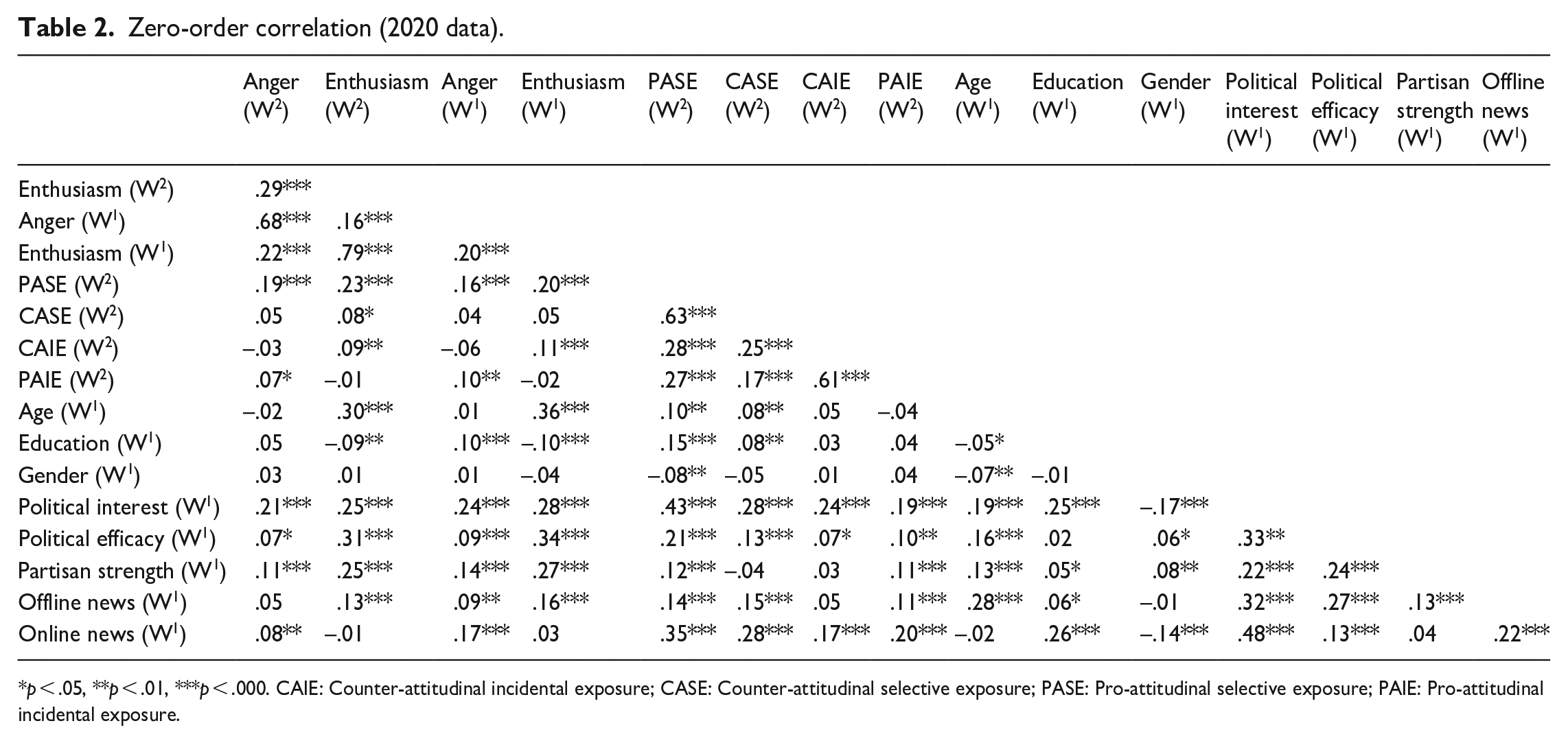
p < .05, **p < .01, ***p < .000. CAIE: Counter-attitudinal incidental exposure; CASE: Counter-attitudinal selective exposure; PASE: Pro-attitudinal selective exposure; PAIE: Pro-attitudinal incidental exposure.
Results
To test our hypotheses, we took advantage of the two-wave panel designs to analyze whether information exposure patterns are associated with changes in political emotions between waves. Specifically, we employed the static score or conditional change panel model by controlling for the lagged endogenous variable (political emotions measured at W1) in the ordinary least squares (OLS) regressions, given that individuals’ prior emotions toward political candidates may exert casual effect on their current emotional responses (Finkel, 1995). This allows us to estimate the residual variances of political emotions that can be explained by information exposure. Moreover, in terms of the specification of lag structure in the panel analysis, we opted for the “synchronous” or “cotemporal” effect, considering that the time lag necessary for information exposure to influence emotions is likely to be short relative to the time elapsed between the two waves (1 month; Finkel, 1995). That is, we regressed the outcome variables—political emotions—measured at W2 on the information exposure patterns measured at W2, while controlling for the political emotion variables measured at W1. This approach allows us to model the influence of information exposure on the changes in emotions between waves, which presents better evidence for causal inference than is possible to acquire from cross-sectional data.
We first examined the hypotheses that pro-attitudinal selective exposure online is associated with increases in anger toward the candidate one opposes (H1a) and enthusiasm toward the candidate one supports (H1b). Results of the lagged OLS regression models using the 2016 and 2020 data are reported in Tables 3 and 4. They confirm that seeking like-minded political information is significantly related to the emergence of political emotions over time. However, the effect sizes are small. Specifically, pro-attitudinal selective exposure (W2) is positively associated with anger felt toward the presidential candidate one opposes (W2), although the relationship is only marginally statistically significant (two-tailed) in the 2016 survey (2016: b = .06, SE = .03, β = .08, p = .06; 2020: b = .08, SE = .03, β = .10, p < .01), even after controlling for anger measured in W1 (as well as other political, news consumption, and demographic variables). Similarly, pro-attitudinal selective exposure (W2) is also a significant predictor of enthusiasm toward the presidential candidate one supports (W2) (2016: b = .07, SE = .02, β = .10, p < .01; 2020: b = .07, SE = .02, β = .08, p < .01). 3 H1a and H1b are thus supported. In contrast, counter-attitudinal incidental exposure, together with counter-attitudinal selective exposure and pro-attitudinal incidental exposure, is not significantly associated with anger or enthusiasm.
Summary of OLS regressions predicting anger toward the political candidate one opposes.
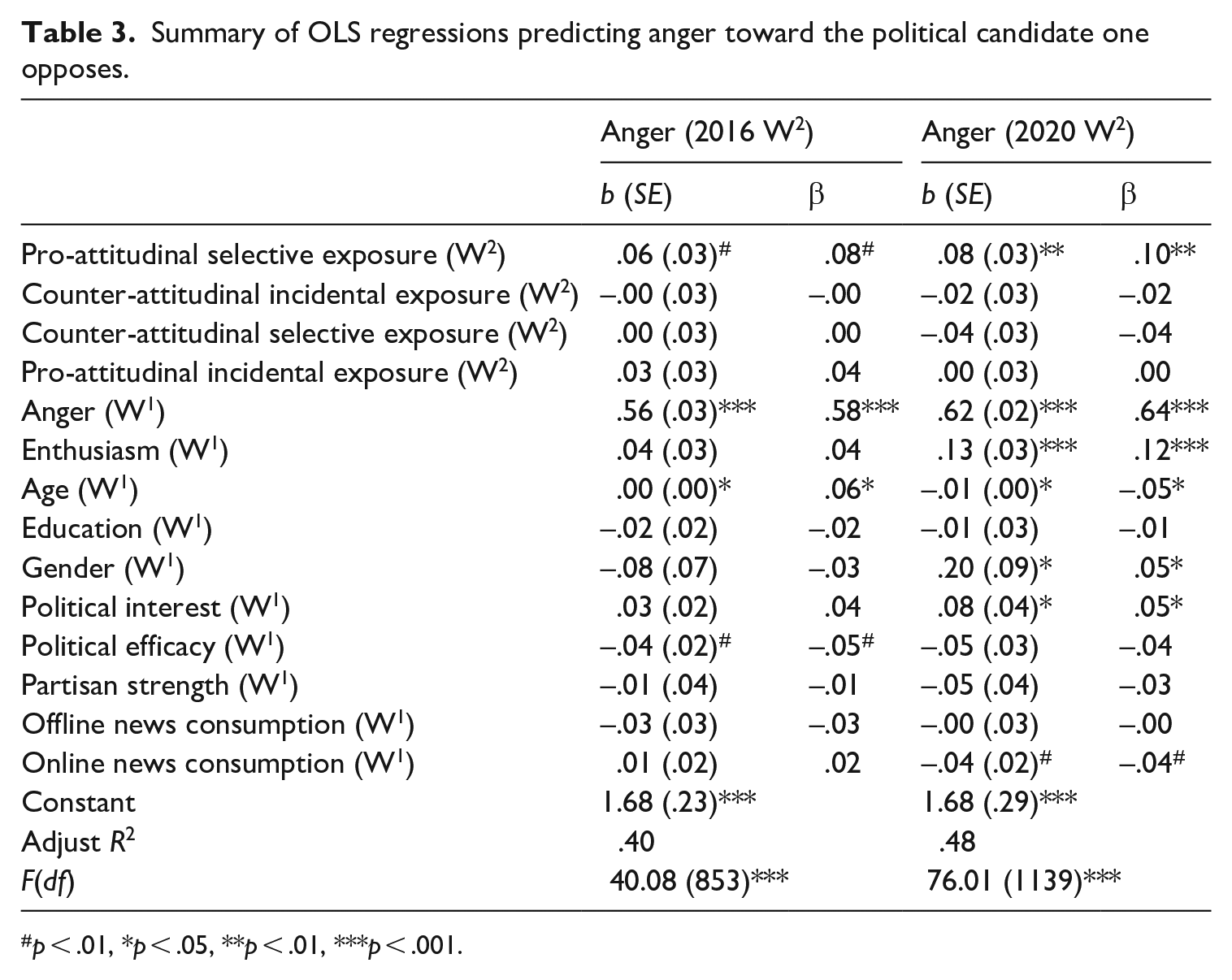
p < .01, *p < .05, **p < .01, ***p < .001.
Summary of OLS regressions predicting enthusiasm toward the political candidate one supports.
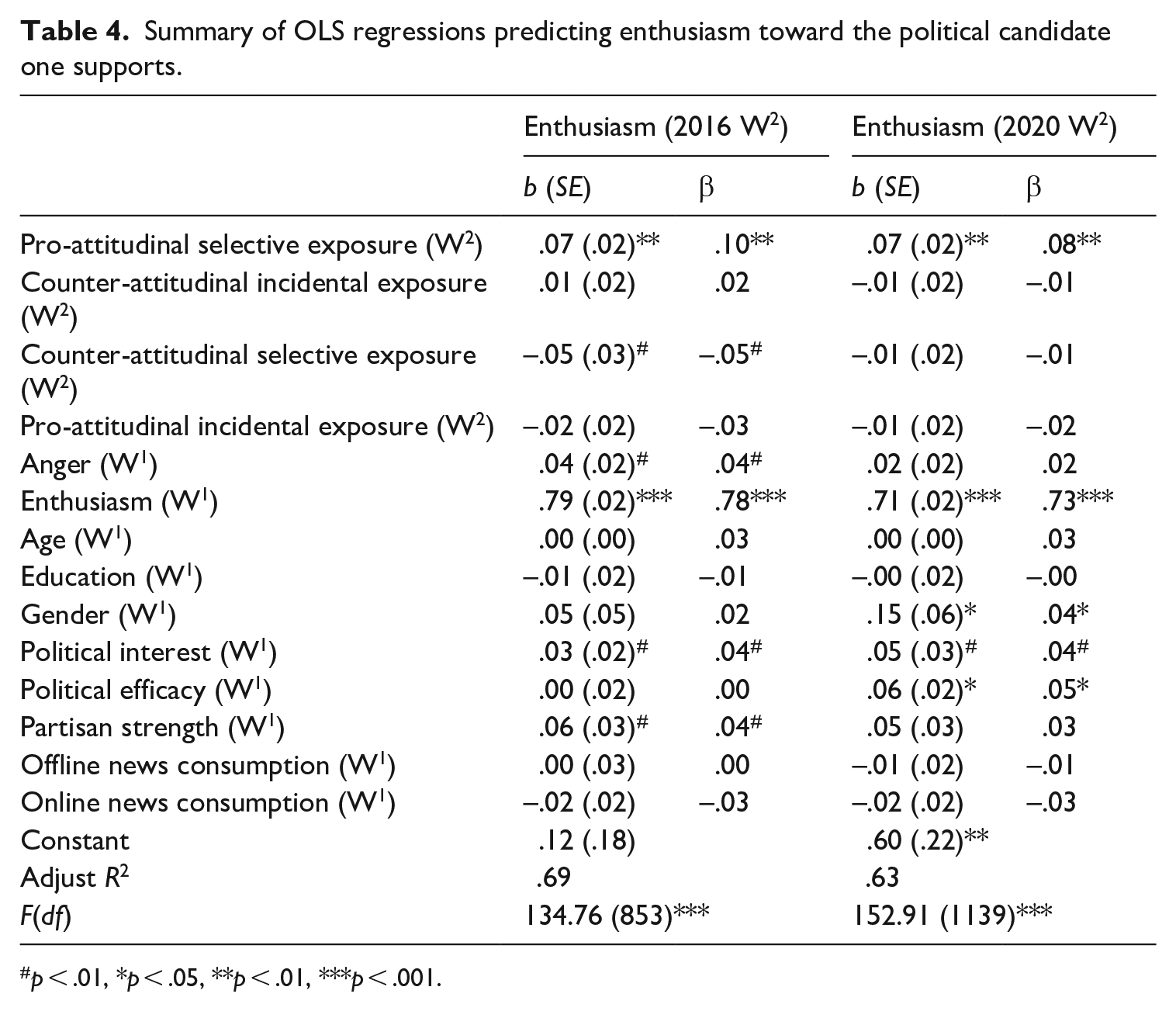
p < .01, *p < .05, **p < .01, ***p < .001.
Furthermore, we proposed competing hypotheses that incidentally stumbling upon attitude-incongruent information on social media may weaken (H2a and H2b) or strengthen (H3a and H3b) the positive relationship between pro-attitudinal selective exposure and the two political emotions. To test these interaction hypotheses, we conducted OLS regressions with two-way interactions using PROCESS (Hayes, 2013). The model used pro-attitudinal selective exposure (W2) as the independent variable, anger toward the opposing candidate and enthusiasm toward the supporting candidate (W2) as the two dependent variables, respectively, and counter-attitudinal incidental exposure (W2) as the moderator, while controlling for the prior levels of anger and enthusiasm (W1) and other control variables. As listed in Table 5, the interaction term is not statistically significant for anger in both datasets (2016: b = −.00, SE = .01, p = .64; 2020: b = .00, SE = .01, p = .62). Both H2a and H3a are thus rejected, suggesting that unsolicited cross-cutting content online does not intensify or attenuate the relationship between selective exposure and political emotions. When it comes to enthusiasm toward the candidate one supports (H2b and H3b), analysis with the 2016 data shows that counter-attitudinal incidental exposure (W2) strengthens the positive relationship between pro-attitudinal selective exposure (W2) and enthusiasm (W2) (b = .02, SE = .01, p < .01). However, we did not observe a significant interaction effect with the 2020 data (b = −.00, SE = .01, p = .57). 4
Summary of OLS regressions predicting political emotions with interaction terms.
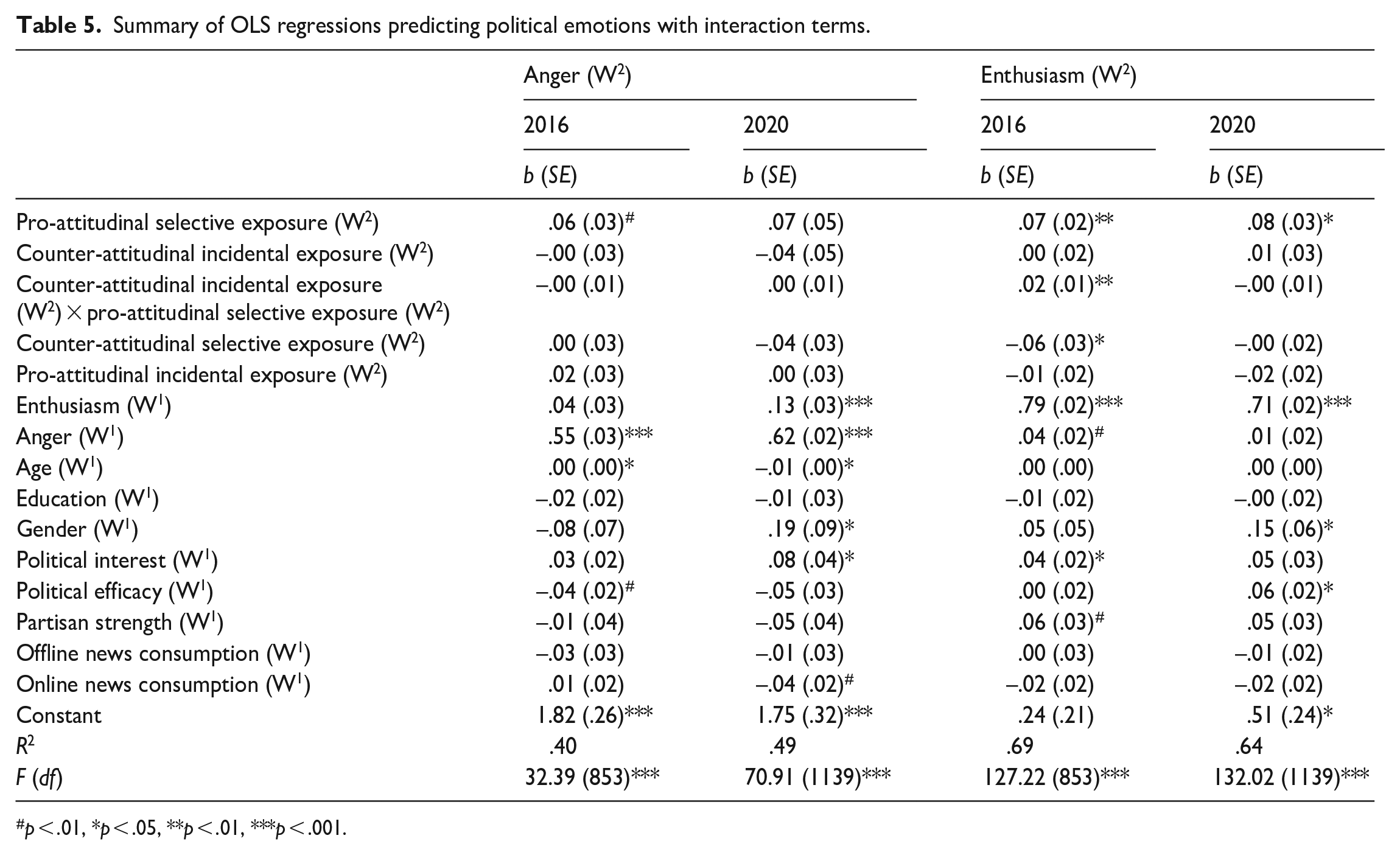
p < .01, *p < .05, **p < .01, ***p < .001.
Discussion and conclusion
The Internet and social media are conducive to an environment where individuals can selectively approach information supporting their political worldviews while being incidentally exposed to socially shared information that challenge their beliefs. As social media have become a major venue for news consumption, these competing information consumption patterns can have profound implications for individuals’ political attitudes and emotions. This study advances understanding of the consequences of these exposure patterns by examining how pro-attitudinal selective exposure and cross-cutting incidental exposure in tandem affect political emotions during two presidential election periods. Our results suggest that selective approach toward congenial content remains a strong driver of political emotions. But more importantly, we seek to empirically test the normative claim that encountering attitude-discrepant information online may have depolarizing potential. We find that it does not moderate the positive relationship between pro-attitudinal selective exposure and political emotions, nor does it influence political emotions directly. The null results we find here present some important and insightful evidence that despite the many democratic benefits endowed on political disagreement, exposure to counter-attitudinal information that one does not actively seek does little to temper political emotional responses. At the same time, we find no evidence that unexpected exposure to disagreeable information backfires either. Our findings offer some important theoretical contributions.
According to existing literature, political disagreement may be able to moderate attitudes and feelings through two routes, namely, cognitive elaboration and social buffering. However, our findings suggest that incidental exposure to counter-attitudinal information may not have the theorized positive effect. This is in contrast to other work that finds that counter-attitudinal exposure is negatively associated with affective polarization (Beam et al., 2018; Garrett et al., 2014; Wojcieszak and Warner, 2020). The current study departs from this prior work in two notable ways. First, although earlier work employed multi-wave panel survey conducted in the context of the US presidential elections, Garrett et al.’s (2014) data are from 2012, which had a different political climate compared to the 2016 and 2020 US presidential elections. The 2016 and 2020 presidential elections took place amid unprecedented hostility between Republicans and Democrats, with between-party animus reaching levels unseen in prior elections (even in 2012; Finkel et al., 2020).
Second, this study examined the experience of incidentally encountering disagreeable information, whereas Garrett et al. (2014) focused on the active seeking of information from the other side. Deliberate choice of disagreeable information is likely to come with cognitive engagement with the differences. Previous research shows that engagement with differences during political discussion can encourage people to think more deliberately about their and others’ political preferences, which improves understanding and tolerance of the opposing arguments (Mutz, 2002b; Price et al., 2002). However, this effect may be limited, given that most people do not actively search for news on social media (Gil de Zúñiga et al., 2017). In comparison, incidental exposure is not driven by explicit goals and coming in contact with people holding disagreeing views is common on social media (Fletcher and Nielsen, 2017; Lu and Lee, 2019a). And yet, the mere contact may not be sufficient to moderate emotional responses, even though recent research suggests that the politically interested are more likely to be exposed to news and politics incidentally (Thorson et al., 2021). This is arguably because incidental exposure to political disagreement may not be able to promote the kind of “slow thinking” that provides people the cognitive tools to engage in rational reflection and rein back their emotional intuitive reactions. Moreover, our findings also offer some hint that the social context in which people incidentally come into contact with disagreement on social media may not be sufficient to encourage more moderate positions. This may be because political disagreement people encounter on social media is more likely to come from weak than strong ties (Morey et al., 2012). And yet, weak ties also lack the mutual trust and intimacy that facilitates the discussion of disagreement (Morey et al., 2012), as well as the relational bond that causes the cross-pressures in the first place (Mutz, 2002b). This highlights one weakness of weak ties; although they are the main sources of novel and diverse perspectives, the diversity they provide may not be effective in tempering political emotions.
At the same time, consistent with prior work that fails to find an attitudinal backlash of counter-attitudinal information (Guess and Coppock, 2020), we also find that incidental exposure to disagreeable political information generally does not further polarize political emotions that arise from selective exposure (with the exception of enthusiasm in 2016). 5 It is arguably because, contrary to social categorization theory, people may not categorize their online social contacts as members of the out-group based on their opposing political views. Incidental contact with cross-cutting views may not provoke motivated reasoning either, insofar as it does not typically polarize emotions. Arguably, this may be because people generally do not actively process disagreeable information they come across and hence are immune to its effect on their political emotions. This is plausible given that selective exposure facilitates anger, an emotion that elicits simpler cognitive processing and less attention to available information (Hasell and Weeks, 2016; MacKuen et al., 2010). Alternatively, the apolitical setting where incidental encounters usually occur may be able to reduce people’s defensive mind-set in evaluating new information, and yet the effect may not be strong enough to be depolarizing.
We highlight that the null findings presented in this study need to be interpreted within the US context. Existing research suggests that the clear-cut, polarized two-party political system and the competitive, partisan media market in the United States make it easier for people to select information congruent with their prior beliefs and fosters the habit of confirmation bias (Knobloch-Westerwick et al., 2015). The emotional rancor between supporters of the parties during these two elections also reached levels unseen in other presidential elections in the late 20th and early 21st centuries (Finkel et al., 2020). In comparison, countries with multiparty coalitional systems and a strong public broadcasting sector provide a broader spectrum of political information and viewpoints, which can discourage confirmation bias and make people more accustomed to cross-cutting views (Knobloch-Westerwick et al., 2015). It is thus plausible that in the latter context, cross-cutting incidental exposure may have a moderating effect that we did not observe in this study.
This study benefits from two surveys with two-wave panel designs that incorporate autoregressive analyses, allowing us to estimate the residual variances of the political emotions that can be explained by the mixed patterns of information exposure. Compared to cross-sectional studies, we are better able to infer causal relations. Despite this strength and the consistency of findings across the two election contexts, the study does have limitations. First, although we argue that based on existing literature cognitive engagement and social buffering or categorization may be the underlying mechanisms, our data does not allow us to test them directly. Future research could unravel the process by investigating whether and how people respond to and engage with unexpected disagreement cognitively and socially. Second, we conducted the surveys in the context of two already emotionally charged and polarizing US presidential elections (Finkel et al., 2020). Although it can make people more reactive toward political information, people also become more affectively polarized as Election Day approached. Hence, we cannot exclude the possibility that the election itself may present a confounding variable in our findings. We also note that given how emotionally charged the elections were, the research context may hinder the effect of information exposure on political emotions due to the ceiling effect. 6 Future research could use an experimental design to test our hypotheses to exclude this possibility. It will also be important to test these relationships in other countries and political contexts. Third, our exposure items rely on self-reports, which can introduce biased measurement (see Prior, 2009). Behavioral tracking measures are better able to capture exposure to content, but are not able to clearly distinguish whether that exposure is purposeful or incidental. Despite their flaws, surveys remain a useful tool for measuring the various routes to political information exposure. While we provide multiple validations of these measures (see Appendix 3 in the Supplemental Material), future work should attempt to replicate the current study using alternative measures of selective and incidental exposure.
Overall, this study contributes to our understanding of how the increased incidental exposure in a media environment characterized by enhanced selectivity may influence the polarization of partisan emotions. It suggests that incidental exposure may play a limited role in the process. In particular, we highlight the empirical reality that incidental exposure to political disagreement may not be able to function as a balancing force to individuals’ selectivity bias; it does not live up to the normative expectation to moderate political feelings. At the same time, we also caution against the dire warning that exposing people to unwanted dissonance will backfire driving emotions to further diverge over politics.
Supplemental Material
sj-docx-1-nms-10.1177_14614448211061336 – Supplemental material for Implications of online incidental and selective exposure for political emotions: Affective polarization during elections
Supplemental material, sj-docx-1-nms-10.1177_14614448211061336 for Implications of online incidental and selective exposure for political emotions: Affective polarization during elections by Qinfeng Zhu, Brian E Weeks and Nojin Kwak in New Media & Society
Footnotes
Author Note
Nojin Kwak is also affiliated to University at Buffalo, USA.
Funding
The author(s) disclosed receipt of the following financial support for the research, authorship, and/or publication of this article: This work was funded by the Marsh Research Award from the Department of Communication and Media at the University of Michigan.

Data availability
The data underlying this article will be shared on reasonable request to the corresponding author.
Supplemental material
Supplemental material for this article is available online.
Notes
Author biographies
References
Supplementary Material
Please find the following supplemental material available below.
For Open Access articles published under a Creative Commons License, all supplemental material carries the same license as the article it is associated with.
For non-Open Access articles published, all supplemental material carries a non-exclusive license, and permission requests for re-use of supplemental material or any part of supplemental material shall be sent directly to the copyright owner as specified in the copyright notice associated with the article.
