




Abstract
Do existing social inequalities translate into social media privacy management? This study examined racial/ethnic differences in privacy concerns and privacy management behaviors on social media to evaluate empirical evidence for an online privacy divide in the U.S. In addition, we tested two prominent theoretical perspectives–resource-based and identity-based explanations–for such divides. Results from an online survey (N = 1,401) revealed that compared to White social media users, Latinx and Asian users reported higher horizontal and vertical privacy concerns, Latinx users employed horizontal privacy management strategies more frequently, Black users reported higher horizontal and vertical privacy self-efficacy, and Latinx users reported higher vertical privacy self-efficacy. While unequal distribution of resources (i.e., socioeconomic status) explained some differences among Asian (vs. White) participants, identity-based factor (i.e., perceived discrimination) served to motivate cautious privacy management among Black participants. Theoretical contributions to the privacy and marginalization literature are discussed. Practical implications are provided.
Keywords
As social media bring social, psychological, and material benefits to users (Büchi, 2024; Büchi & Hargittai, 2022), they pose challenges to people’s privacy. While extant research primarily treats online privacy at the individual level, a nascent research stream has started to recognize how individuals’ socioeconomic status, historical experience, and learned cultural norms may shape privacy perceptions and behaviors at a group level based on, for example, racial and ethnic identity (Epstein & Quinn, 2020; Madden, 2017). Indeed, results from a handful of studies are starting to reveal preliminary evidence for a potential online privacy divide, suggesting that differences in one’s socioeconomic/demographic background may translate into differences in online privacy outcomes, such as privacy concerns and privacy management behaviors (see Dodel, 2023 for a review). Section 1 of the online supplementary material (OSM) reviews 21 exemplary studies (including their tested sociodemographic predictors, privacy outcomes, and result highlights) that explicitly tested the online privacy divide. In particular, people of color in the U.S., such as Latinx and Black people, are found to report higher privacy concerns (Madden, 2017), lower confidence in the safety of personal information online (Cohn et al., 2020), and lower online privacy literacy (Epstein & Quinn, 2020), among other privacy outcomes. 1
Despite this preliminary evidence, critical theoretical issues remain unaddressed regarding why such differences may be observed among racial/ethnic groups. On the one hand, racially/ethnically marginalized groups, including Latinx and Black people, tend to possess lower socioeconomic status (SES) and fewer resources such as access to technology and skills training (Madden, 2017; Shrider et al., 2021), which may cause them to lag behind in developing online privacy awareness and skills (Li et al., 2018). This suggests inequalities in resources are the driving force of the divide. On the other hand, discrimination and victimization experiences may cultivate a lack of trust and identity threat, which may alert marginalized groups to actively engage in privacy management (Marwick et al., 2017; Vitak et al., 2018). This alludes to motivations based on one’s identity for privacy management. The central goals of this study are to test racial/ethnic divides in privacy concerns and privacy management behaviors on social media, and to investigate the resource-based and identity-based theoretical accounts for such divides.
Studying online privacy through the lens of race/ethnicity has important societal implications as well. Evidence documents that digital technologies can exacerbate existing social inequalities (see McDonald & Forte, 2022 for a review). For instance, biased algorithmic decision-making can disproportionately discriminate against people of color in settings such as employment, housing, and social welfare. Online platforms that require identifiable information such as real name, email address, and photo ID also pose unique privacy risks to people of color, and can lead to online harassment, targeted scams, and even safety concerns (Madden, 2017). Thus understanding whether and how different racial/ethnic groups enact protective strategies against such risks becomes especially timely. Other research has found that racial/ethnic minorities tend to strategically leverage the Internet to contest the status quo and to compensate for the lack of resources, such as through online political expression (Lane et al., 2022) and social capital building (Gonzales, 2017). Lack of built-in privacy protection mechanisms on social media combined with pervasive privacy threats may deter people of color from active participation online, thus limiting their ability to reap such benefits that would otherwise be hard to achieve offline.
Conceptualizing Privacy in Social Media
Privacy can be broadly conceptualized on informational, social, psychological, and physical dimensions (see Burgoon, 1982) and is primarily understood as the ownership of or right to control personal information during interpersonal interactions (Altman, 1975; Petronio, 2002). In online contexts, people may strategically manage their privacy vis-à-vis different individuals within online social networks. Yet in the digital media environment, there are other, often invisible, audiences for personal information, such as governments, companies, or marketers that collect user data for various purposes. As such, social media users face daunting privacy challenges posed by vastly different types of audiences and information monitoring.
The integrated model of online privacy addresses the coexistence of different types of audiences by conceptualizing online privacy on two dimensions (Bazarova & Masur, 2020). The horizontal dimension of privacy highlights individuals’ control of and access to personal information during peer-to-peer online interactions and the negotiation of privacy boundaries between information co-owners, taking the impact of technological affordances (e.g., visibility and anonymity) into consideration. Privacy threats on the horizontal dimension may encompass online stalking and harassment by other individuals, spreading rumors, and unwanted sharing of personal information (Masur & Trepte, 2021). The vertical dimension of privacy involves privacy threats from social media companies, advertisers, government agencies, and other institutions that collect user data and conduct mass surveillance for commercial and/or administrative interests (Büchi et al., 2021). Algorithms and machine learning that automatically profile users based on their digital trace data add additional threats to users’ privacy along the vertical dimension (Madden et al., 2017). This study adopts this two-dimensional conceptualization to recognize the privacy practices that different racial/ethnic groups may develop vis-à-vis different types of audiences for personal information. 2
Race/Ethnicity, Privacy, and Marginalization on Social Media
For people to navigate different types of privacy threats on social media, they must have access to resources (e.g., knowledge or training, technical support from their own network) to develop privacy management skills (Li et al., 2018). However, that access can vary due to differences in one’s racial/ethnic background, among other factors (Madden, 2017). Indeed, race and ethnicity are at the intersection of many social vulnerabilities and are complexly entangled with socioeconomic status, gender and sex identity, and other markers of marginalization (McDonald & Forte, 2022). As such, it can be challenging to completely parse out the impact of race/ethnicity on privacy from other forms of social vulnerabilities. With that caveat, though previous qualitative research hints that race/ethnicity alone may shape online self-disclosure and impression management (e.g., Pitcan et al., 2018), such a relationship has rarely been quantitatively verified and explained (Sannon & Forte, 2022).
In 2020, notwithstanding within-group differences, the poverty rates in the U.S. of Hispanic (17.0%) and Black (19.5%) people were double that of non-Hispanic White (8.2%) and Asian (8.1%) people (Shrider et al., 2021). In 2021, only 28.1% of Black and 20.6% of Hispanic people reported having a Bachelor’s degree or higher, compared to 41.9% of non-Hispanic White and 61% of Asian people (U.S. Census Bureau, 2022). A lack of economic and educational resources may inequitably inhibit Latinx and Black people from accessing training and tools that would help navigate online privacy successfully. Indeed, individuals who lack such resources are found to have lower online privacy literacy, which refers to people’s understanding of the privacy practices of, and threats posed by, individuals, institutions, and online service providers (Epstein & Quinn, 2020).
In addition to resources, race/ethnicity also entails cultural identity, power, and experiences that may shape the way people respond to privacy incursions online (Harris, 1995; Sannon & Forte, 2022). People of color in the U.S., including Latinx, Black, and Asian people, are more likely to experience discrimination in a variety of contexts, such as social interaction, employment, and policing (Pager & Shepherd, 2008), and report lower levels of trust (Taylor et al., 2007). For example, fear of being unfairly targeted by law enforcement led Black and Latinx individuals to report higher privacy concerns and feelings of vulnerability than White individuals (Auxier et al., 2019; Madden, 2017).
Accordingly, we conceptualize race/ethnicity as not only an indicator of access to socioeconomic resources (e.g., education, income, skills training), but also as a socially constructed identity that dictates power differences between groups (Harris, 1995). We further investigate two broad theoretical accountings–resource-based vs. identity-based explanations–in racial/ethnic divides in privacy concerns and privacy management behaviors on social media in the U.S. Nevertheless, despite similarities and differences between racial/ethnic groups in socioeconomic resources and discrimination at an aggregate level, each group and their subgroups share very different paths and trajectories of marginalization, due to, for example, different histories of racism, recency of immigration, language and cultural background, and lived experiences.
The Online Privacy Divide
Despite preliminary evidence on the online privacy divide (e.g., Büchi et al., 2021; Madden, 2017; see also Section 1 of the OSM for an overview), and the central role that race/ethnicity plays in understanding privacy and marginalization (McDonald & Forte, 2022), a recent literature review pointed out that race has received scant attention in this literature (Sannon & Forte, 2022). Further, very few studies have empirically tested the online privacy divide explicitly on both the horizontal and vertical dimensions (Epstein & Quinn, 2020 is one exception), and most extant research examines internet privacy rather than social media privacy specifically.
Compared to other online contexts such as e-commerce, social media provide a unique situation in which individuals must simultaneously navigate both horizontal and vertical privacy, given the dynamics of information flow between different types of audiences. For example, when posting on Facebook, people may need to consider not only who in their friend networks may see their post, but also whether personal information contained in their post may be algorithmically added to their “digital trace profile” used for marketing or other purposes. To fill these gaps, we look at the relationships between race/ethnicity and two privacy outcomes in social media: privacy concerns and privacy management behaviors.
Privacy Concerns on Social Media
Privacy concerns can be conceptualized as the degree to which social media users are concerned about the collection and use of their personal information by other users (i.e., horizontal concerns) and by institutions (i.e., vertical concerns) (Cho et al., 2010; Ellison et al., 2011; Hong & Thong, 2013; Masur & Trepte, 2021). Past research (discussed below) has pointed out that marginalized groups express higher levels of privacy concerns online, perhaps because they are more likely to have become victims of online scams, abusive content, and blackmail. Latinx and Black people, in particular, express strong concerns about privacy violations by U.S. state and local government institutions and law enforcement (Auxier et al., 2019), being targeted via online harassment (Madden, 2017), and consequences of privacy breaches (Cohn et al., 2020). Although not explicitly studied, these concerns can be mapped to both the horizontal and vertical dimensions of privacy. Qualitative studies corroborate this pattern, finding that marginalized individuals expressed high (horizontal) privacy concerns about personal photos being stolen on social media (Bastick & Mallet-Garcia, 2022) and (vertical) concerns about policing surveillance as a result of structural racism (Marwick et al., 2017). Thus, H1 aims to see if such divides in privacy concerns can be replicated in the context of social media privacy on both privacy dimensions:
H1: Latinx and Black people will report higher (a) horizontal and (b) vertical privacy concerns on social media than White people.
Privacy Management Behaviors on Social Media
Privacy management behaviors can be understood as the use of strategies to protect one’s privacy on social media (Baruh et al., 2017; Child & Starcher, 2016; Christofides et al., 2009; Dienlin & Metzger, 2016; Petronio, 2002). Horizontal privacy management strategies are used to protect against user-to-user privacy incursions (e.g., limiting the visibility of certain posts to certain other individual social media users), while vertical strategies involve defending privacy invasions by institutional actors such as the government and corporations (e.g., turning off the personalized advertisements setting) (Epstein & Quinn, 2020). Research on U.S. racial/ethnic divides in privacy management behaviors reveals mixed findings. Survey data show that Latinx and Black people protect their privacy (e.g., blocking cookies, using anonymous browsers) less frequently than their White counterparts on the internet (e.g., Madden, 2017; Park, 2013), perhaps due to a relative lack of resources and technical skills. Yet qualitative research suggests that the lack of trust and past discrimination experiences (discussed below) may create high privacy concerns and motivate marginalized groups to take protective actions (e.g., keeping a low social media profile, abstaining entirely from social media) (Marwick et al., 2017; Vitak et al., 2018).
Yet, to our knowledge, only Epstein and Quinn (2020) have explicitly compared sociodemographic differences in privacy management behaviors based on the horizontal/vertical distinction. Although they found no differences by race/ethnicity, the extremely small sample sizes for people of color in their study do not allow for a meaningful comparison (i.e., Black, n = 59; Hispanic/Latinx, n = 53; Asian, n = 32; White, n = 564). And their measures of vertical privacy management strategies examined internet privacy broadly (e.g., use of proxy servers, encryption) that are less commonly used in social media. Therefore, a larger and more balanced sample of racial/ethnic groups, and measures tailored toward social media privacy, are warranted to draw confident conclusions about possible racial/ethnic divides in privacy management behaviors. Given the inconsistent evidence from the reviewed above, we ask:
RQ1: What are the relationships between race/ethnicity and the frequency of using (a) horizontal and (b) vertical privacy management strategies on social media?
Theoretical Perspectives Explaining Racial/Ethnic Privacy Divides
The competing results found in previous research suggest a need to better understand the theoretical underpinnings of potential racial/ethnic divides in online privacy. Below, we examine two sets of explanations–one accounting for inequalities in resources and one rooted in racially/ethnically marginalized groups’ lived experiences and identities (see Figure 1 for the hypothesized model).
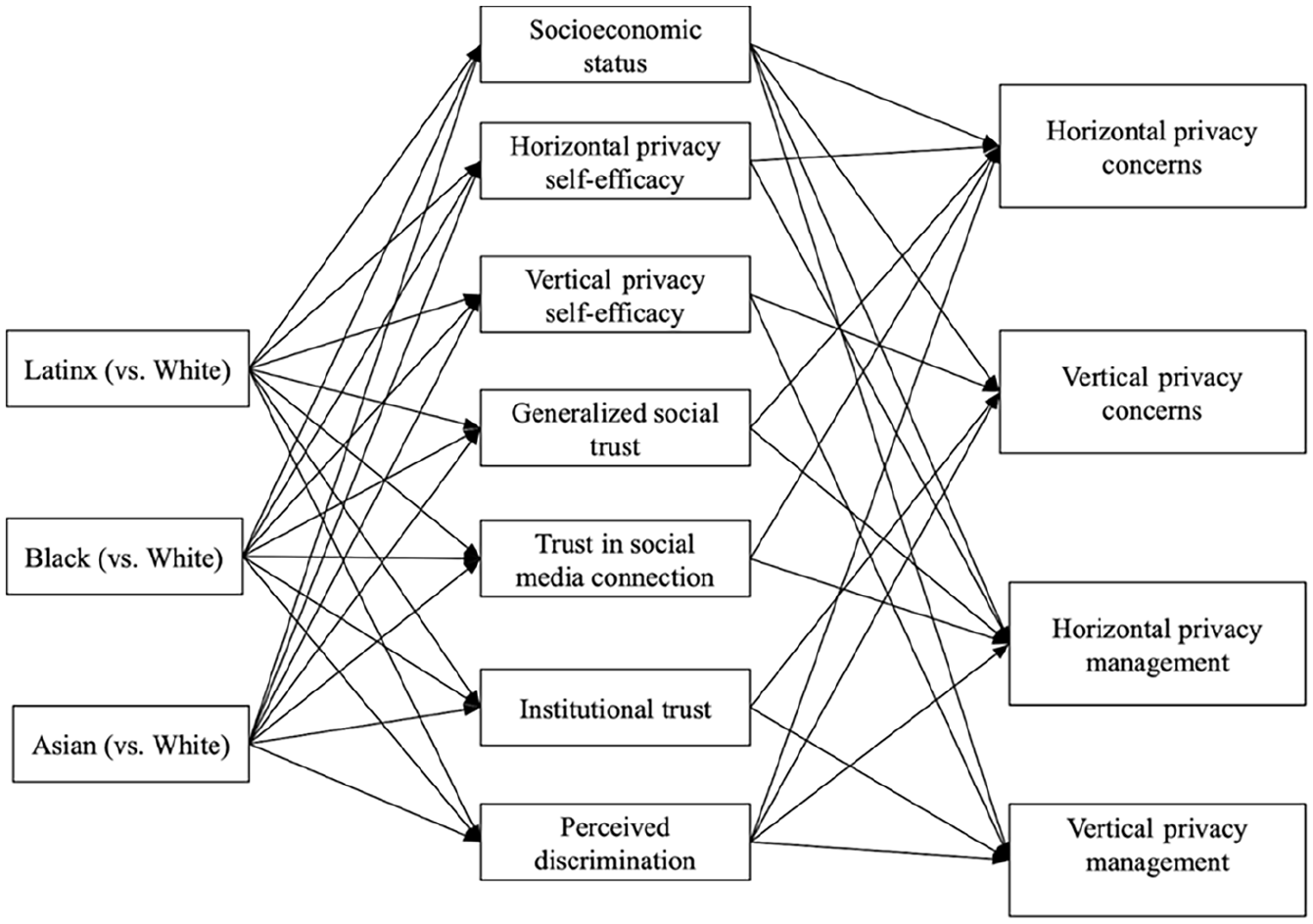
Hypothesized mediation path model of resource and identity explanations for racial/ethnic divides in social media privacy concerns and privacy management behaviors.
Resource-Based Explanations
Socioeconomic Status (SES)
To understand why resource inequalities may lead to racial/ethnic divides in social media privacy, the digital divide literature provides a well-established theoretical foundation. This literature suggests that SES differences (e.g., in education and income) are important factors that can impact unequal distributions of information technology access and skills (see van Dijk, 2020), which may translate into corresponding inequalities in people’s privacy experiences and skills online (Büchi et al., 2021; Epstein & Quinn, 2020). Van Dijk’s (2020) resources and appropriation theory, for example, points out that both personal categories (e.g., age, sex/gender, race/ethnicity) and positional categories (e.g., education, labor, social network) affect various resources (i.e., social, mental, temporal, material, cultural), which in turn impact technology access (e.g., technology ownership and usage, digital skills), and online participation outcomes. In other words, inequalities in positional categories can affect a variety of essential resources to privacy management, which include not only knowledge, money, and time, but also access to privacy-related training, the ability to afford software that better protects online privacy, and social networks that can offer technical support.
Indeed, less educated individuals were found to have lower privacy concerns (Männiste & Masso, 2018), feel less confident about the safety of personal information online (Cohn et al., 2020), and were less likely to engage in preventive privacy behaviors (Dodel & Mesch, 2018). Less affluent individuals were less confident about understanding privacy policies and managing privacy settings (Madden et al., 2017). Those who did not have private internet access also reported lower digital privacy skills than those who did (Li et al., 2018). As mentioned above, Latinx and Black people tend to report lower SES than White and Asian people in the U.S. on average (Shrider et al., 2021; U.S. Census Bureau, 2022). The research on SES inequalities therefore suggests that SES may serve as a mediator, such that on average Latinx and Black (vs. White) people may report lower SES, which then predicts lower privacy concerns and less use of privacy management strategies.
H2: Socioeconomic status (SES) will mediate the relationships between race/ethnicity and (a) privacy concerns and (b) the frequency of using privacy management strategies on both horizontal and vertical dimensions of privacy on social media.
Privacy Self-Efficacy
Another resource-related factor is privacy self-efficacy, which is the confidence in one’s own ability to enact behaviors to protect online privacy (Dienlin & Metzger, 2016). Privacy self-efficacy can serve as a resource proxy for privacy-related knowledge, literacy, and skills, as it indicates users’ subjective evaluation of their ability to handle privacy risks (Epstein & Quinn, 2020). Indeed, less privacy-efficacious individuals report lower online privacy concerns (Epstein & Quinn, 2020) and less privacy protection (van Ooijen et al., 2024), suggesting that they may be less knowledgeable about the collection and processing of personal information online, and less aware of potential risks and consequences to online privacy than people with higher privacy self-efficacy. Hoffmann and Lutz (2021) argue that the effect of sociodemographic factors (e.g., race) on user behaviors tends to be mediated by cognitive dispositions such as self-efficacy. Applied to online privacy, race reflects contextual influences in cultural and economic differences that can directly shape privacy self-efficacy. Indeed, marginalized groups, especially foreign-born Hispanic and low-income people reported low efficacy in utilizing various privacy protection mechanisms such as avoiding online scams, choosing strong passwords, and understanding privacy policies (Madden, 2017; Vitak et al., 2018). Cohn et al. (2020) similarly found that Black and Hispanic (vs. White) adults were less confident about the safety of their personal information collected online. This research suggests that compared to White people, Latinx and Black people might report lower privacy self-efficacy, which in turn may be correlated with lower privacy concerns and less frequent use of privacy management strategies.
H3: Privacy self-efficacy will mediate the relationships between race/ethnicity and (a) privacy concerns and (b) the frequency of using privacy management strategies on both horizontal and vertical dimensions of privacy on social media.
Identity-Based Explanations
Despite the dominance of resource-based explanations in this nascent scholarship, a handful of qualitative studies offer a different picture, finding that marginalized groups have a high awareness of privacy risks and are very active in protecting their privacy online (Marwick et al., 2017; Vitak et al., 2018). Marwick et al. (2017) found that low-income immigrants and people of color refrained from many online activities to minimize privacy threats posed by employers and government surveillance. Participants attributed this decision to their traumatizing physical surveillance, police harassment, and an overall lack of trust in other people and institutions. Vitak et al. (2018) similarly found that individuals in high-poverty/low-education communities tended to distrust and even fear digital technologies, and were likely to reject online job applications and banking services to prevent online privacy violations. These studies suggest an identity-based explanation, such that marginalized groups may be highly concerned and proactive about privacy protection due to their lived experiences. While such experiences are complicated and multifaced, we examine two prominent identity factors suggested by the literature—trust and perceived discrimination.
Trust
A lower level of trust may highlight perceived privacy risks and in turn prompt cautious online privacy management. Latinx and Black people report lower levels of generalized social trust (Taylor et al., 2007), trust in law enforcement (Madden, 2017), and trust toward doctors and healthcare institutions (Williamson, 2021), as they disproportionately experience discrimination in social interactions and in institutional settings such as housing, employment, healthcare, and policing (Pager & Shepherd, 2008). In contrast, White people report higher trust in institutions (Blankenship et al., 2021). The mediating role of trust in explaining online privacy attitudes and behaviors is well-established in the literature (e.g., Joinson et al., 2010; Liu & Tao, 2022). Here, we focus on three types of trust. Generalized social trust refers to the perception that most people we have no previous information about can be trusted (Dinesen, 2012). Trust in social media connections reflects trust attitudes toward one’s online network on social media platforms (Tompos & Khair, 2023). Lack of generalized social trust and trust in social media connections may create privacy concerns about other individuals (e.g., family, employers, doxxers) violating privacy on the horizontal dimension. Institutional trust can be understood as an individual’s expectation and confidence that a given institution will produce positive outcomes toward oneself or others (Levi & Stoker, 2000), which may impact vertical privacy protection (e.g., the government, law enforcement, and corporations).
Research indicates that people of color who have low levels of generalized social trust and trust in online connections might engage in fewer online networking activities to minimize the privacy risks on the horizontal dimension. For example, due to a lack of trust in other web users, Latinx and Black people and low-income individuals tend to hesitate to seek out strangers in online communities for informational and emotional support (Hui et al., 2023), and may intentionally not post social media content that can be later identified by unintended users (Marwick et al., 2017). Likewise, on the vertical privacy dimension, Black patients are reluctant to share personal medical information with health providers online (Graham & Smith, 2018), suggesting a lack of trust in the institution that handles their information online. Fear of surveillance stemming from interpersonal experiences and media coverage also prompted low-income Latinx parents to enact privacy monitoring strategies (e.g., installing content-blocking systems, reviewing browser caches) to prevent their children from oversharing online (Katz & Gonzalez, 2016). Based on these findings, it may be that Latinx and Black social media users are less trusting of other people and institutions than are White users, which then correlates with higher privacy concerns and more use of privacy management strategies on both the horizontal and vertical dimensions of privacy. We thus hypothesize the following:
H4: Generalized social trust will mediate the relationships between race/ethnicity and (a) horizontal privacy concerns and (b) the frequency of using horizontal privacy management strategies on social media.
H5: Trust in social media connections will mediate the relationships between race/ethnicity and (a) horizontal privacy concerns and (b) the frequency of using horizontal privacy management strategies on social media.
H6: Institutional trust will mediate the relationships between race/ethnicity and (a) vertical privacy concerns and (b) the frequency of using vertical privacy management strategies on social media.
Perceived Discrimination
Marginalization can be understood as disadvantaged groups’ experiences of being excluded from opportunities and resources in society (Gatzweiler & Baumüller, 2014). It manifests in individuals’ subjective perceptions and experiences of discriminatory instances directly through interpersonal interactions or indirectly through other social contexts that highlight group-based stereotypes (Saleem & Ramasubramanian, 2019). Brehm and Rahn (1997) state that being a member of a marginalized group increases the likelihood of witnessing instances of discrimination and prejudice, which may lead to higher suspiciousness of one’s surroundings and the motives of others. Therefore, perceived discrimination may serve as another identity-based mediating factor that prompts people of color to be cautious about their privacy on social media.
Social identity theory (SIT; Tajfel & Turner, 1979) argues that individuals categorize themselves, and behave accordingly, based on group memberships and identity. Discriminatory instances toward marginalized groups may constitute an identity threat and consequently trigger behavioral responses, including avoidance, through which marginalized individuals disengage from a threatening situation and seek to minimize future risks (Miller & Kaiser, 2001). Indeed, Saleem and Ramasubramanian (2019) found that Muslim American students who perceived their religious group as being discriminated against were more likely to avoid future interpersonal interactions with non-Muslim individuals.
On social media, users may engage in selective avoidance, which refers to the practice of isolating oneself from conflicting perspectives by filtering out undesirable information and severing social connections that convey such information (Zhu et al., 2017). Underlying this phenomenon is a potential desire to protect the safety of one’s personal information and identity in response to discriminatory instances. Research shows that when individuals perceive a threat to their ingroup identity on social media, they are more likely to engage in avoidance strategies (e.g., unfriending or blocking connections, filtering out certain posts) as a preventative measure that aims to construct safe spaces and promote security against potential loss (Kim et al., 2022; Zhu et al., 2017). Wang et al. (2024) further demonstrated that selective avoidance can be a reaction to institutional surveillance and that surveillance anxiety (operationalized as vertical privacy concerns) positively predicted selective avoidance on social media in a U.S. sample. Indeed, existing evidence documents that due to fear of surveillance, arrest, and expulsion, Hong Kong and Palestinian citizens engage in a variety of selective avoidance strategies on social media to regain power and agency (John & Agbarya, 2021; Zhu et al., 2017).
The research above suggests that in response to perceived ingroup discrimination on social media, people may engage in avoidance strategies, and that the underlying self-protection mechanism may extend to online privacy management. Yet few studies have explicitly considered how perceived discrimination shapes racially/ethnically marginalized groups’ privacy outcomes. The mediating role of perceived discrimination as an identity factor in explaining online behavior has been supported in other contexts, such as social media engagement (Saleem et al., 2023) and political expression (Lane et al., 2022). It is possible that people of color are more likely to report higher perceived discrimination, which in turn is associated with higher concerns about privacy being violated by outgroup members and a higher likelihood of engaging in privacy management. Therefore, we pose the following hypothesis:
H7: Perceived discrimination will mediate the relationships between race/ethnicity and (a) privacy concerns and (b) the frequency of using privacy management strategies on both horizontal and vertical dimensions of privacy on social media.
Finally, Asian American people as a racial group have received scant attention in the online privacy literature, yet this group has unique characteristics that may impact members’ privacy perceptions and behavior. Resource-wise, Asian people in the U.S. on average tend to be socioeconomically advantaged, as their income level is comparable to White people and higher than Latinx and Black people, and they report a larger share of having a college degree than all three other racial/ethnic groups (Shrider et al., 2021; U.S. Census Bureau, 2022). Identity-wise, on the one hand, both Asian and White people report higher trust in institutions such as law enforcement and courts than Latinx and Black people (Blankenship et al., 2021). On the other hand, Asian people experience discrimination in housing, college admissions, police encounters, and other situations (NPR, Robert Wood Johnson Foundation, & Harvard T.H. Cahn Scholl of Public Health, 2017). Recent anti-Asian and xenophobia sentiments during the COVID-19 pandemic further exacerbate such discriminatory experiences among the Asian population in the U.S. (Asian Pacific Policy and Planning Council, 2020; Pew Research Center, 2020). Given the unique social standing of the U.S. Asian population, and little empirical evidence on this racial group, we pose the following research question to examine whether the results of the above hypotheses and research question differ for Asian people:
RQ2: What are the relationships between being Asian and privacy concerns, the frequency of using privacy management strategies on social media on the horizontal and vertical dimensions, and how do SES, privacy self-efficacy, trust, and perceived discrimination mediate such relationships?
Method
Recruitment and Sample
Upon IRB approval, an online survey was administered between February and April 2023 through Qualtrics XM’s Research Panel. 3 The incentives were based on the sources from which participants were recruited and could include airline mileage, points at retail outlets, or cash and gift cards. Given the comparative aims of this research, purposive sampling was employed to recruit an approximately equal number of participants from the four racial/ethnic groups of interest. The final dataset included a total of 1,401 responses with the following groups: 26.1% Black, African, or African American (n = 365), 23.8% Hispanic, Latina/Latino, Latine, or Latinx (n = 333), 26.3% White (n = 368), and 23.9% East, South East, and South Asian (n = 335). Across the entire sample, 60.5% (n = 848) were female, 39.0% (n = 547) were male, and .4% (n = 6) were non-binary. The average age was 41.35 years old (SD = 16.44, range = 18–101), the median education was an Associate degree in college (2 years) (range = less than a high school degree to professional degree), and the average annual income was between $55,000 and $60,000 (range = under $5,000 to $200,000 and over).
Measures
Key privacy variables were operationalized and question stems were developed based on the horizontal/vertical distinction of privacy. For example, the horizontal privacy measures were preceded by question stems that asked participants to think about friends, family members, coworkers, employers, strangers, and other individual social media users that may have access to their personal information on social media, whereas the vertical privacy measures question stems prompted participants to think about government agencies, social media companies, advertisers, corporations, and other organizations as the potential audiences for their personal information. Section 2 of the OSM provides all item wording, scale means, and standard deviations. Section 3 of the OSM summarizes the results of a confirmatory factor analysis (CFA) of the privacy outcome variables to empirically validate the horizontal/vertical distinction.
Privacy Concerns
Participants reported their privacy concerns on a 7-point Likert scale ranging from 1 = strongly disagree to 7 = strongly agree. Ten horizontal concern items were initially adapted from existing scales (Krasnova et al., 2009), and nine were used as a result of the CFA (see OSM), such as “I am concerned that I don’t have control over what other users do with information I post on social media” (α = .89, ω = .89). Seven vertical concern items were initially adapted from prior research (Auxier et al., 2019; Dinev et al., 2008; Krasnova et al., 2009), and six were used (α = .89, ω = .89), such as “It bothers me that the information in my social media profile may be used to display personalized advertising to me.”
Privacy Management Behaviors
Participants indicated the frequency of using privacy strategies on a 5-point Likert scale ranging from 1 = never to 5 = always. Eight horizontal strategies were adapted from Wang and Metzger (2023), such as blocking certain contacts or creating a fake account (α = .88, ω = .88). Most existing scales on vertical strategies focus on internet privacy (e.g., use VPN, delete cookies) that are not applicable to the social media context. Inspired by prior instruments (Hoy & Milne, 2010; Min, 2019) and qualitative findings (Marwick et al., 2017; Walker & Hargittai, 2021), the current scale includes seven vertical strategies that help shed light on marginalized individuals’ privacy management on social media (e.g., “Avoid posting information that may be seen as problematic by government agencies or law enforcement if they monitor my social media accounts”; α = .85, ω = .85).
Sociodemographic Variables
Participants reported their racial/ethnic identity. 4 The SES variable was constructed by combining participants’ educational attainment and household income. The two variables were standardized (i.e., converted to z-scores), averaged, rescaled to a range of 0 to 1, and labeled as SES. Age and gender/sex identity were measured as control variables.
Privacy Self-Efficacy
Privacy self-efficacy was measured on a 7-point Likert scale (1 = strongly disagree, 7 = strongly agree) to assess participants’ sense of control over personal information on social media. Horizontal privacy self-efficacy included four items adapted from Dienlin and Metzger (2016), such as “I feel confident in my ability to protect my privacy from other users by using social media’s privacy settings” (α = .89, ω = .89). Vertical privacy self-efficacy included five items adapted from Madden (2017) and Auxier et al. (2019), such as “I feel confident in my ability to use social media without having my online behaviors tracked by advertisers or government surveillance” (α = .90, ω = .90).
Trust
Generalized social trust was measured by adapting Rosenberg’s (1956) misanthropy scale by asking participants to indicate how much they agree with six statements that describe the trustworthiness of most people (e.g., “Most people can be trusted”) on a 7-point scale (1 = strongly disagree; 7 = strongly agree) (α = .77, ω = .73). 5 Trust in social media connections was measured by asking participants’ trust attitudes toward friends, followers, and other connections on their social media accounts on a 7-point scale (1 = do not trust at all, 7 = trust completely). Institutional trust was measured by averaging the degree to which participants trusted a battery of 13 institutions (e.g., the US judicial system, police and other law enforcement agencies, social media companies) on a 7-point scale (1 = do not trust at all, 7 = trust completely) (Betts, 2020; Madden, 2017) (α = .93, ω = .93).
Perceived Discrimination
Adapted from Williams et al. (1997) and Pascoe et al. (2011), perceived discrimination assessed how often participants felt they experienced different forms of discrimination because of their race or racism toward them on a 6-point Likert scale (1 = never, 6 = almost every day). Example items are “You are treated with less courtesy than other people are” and “People ignore you or act as if you are not there” (α = .94, ω = .94).
Data Analysis
To test our proposed model, a path analysis was conducted in Mplus (Version 8.10; Muthén & Muthén, 1998–2024). This technique allowed us to simultaneously account for multiple exogenous and endogenous variables and their shared variances. All constructs were treated as observed variables and analyzed by means and standard deviations in the full path model, given power considerations. Race/ethnicity was coded as three dummy variables with White being the reference group. Age and gender/sex identity (reference group: Male) were included as control variables. Maximum likelihood estimation with bias-corrected 95% confidence intervals (CI) and a bootstrap sample of 5,000 were used to test for mediation (Hayes, 2009). Table 1 presents the bivariate correlations of all variables included in the model.
Bivariate Correlations for Key Measures.
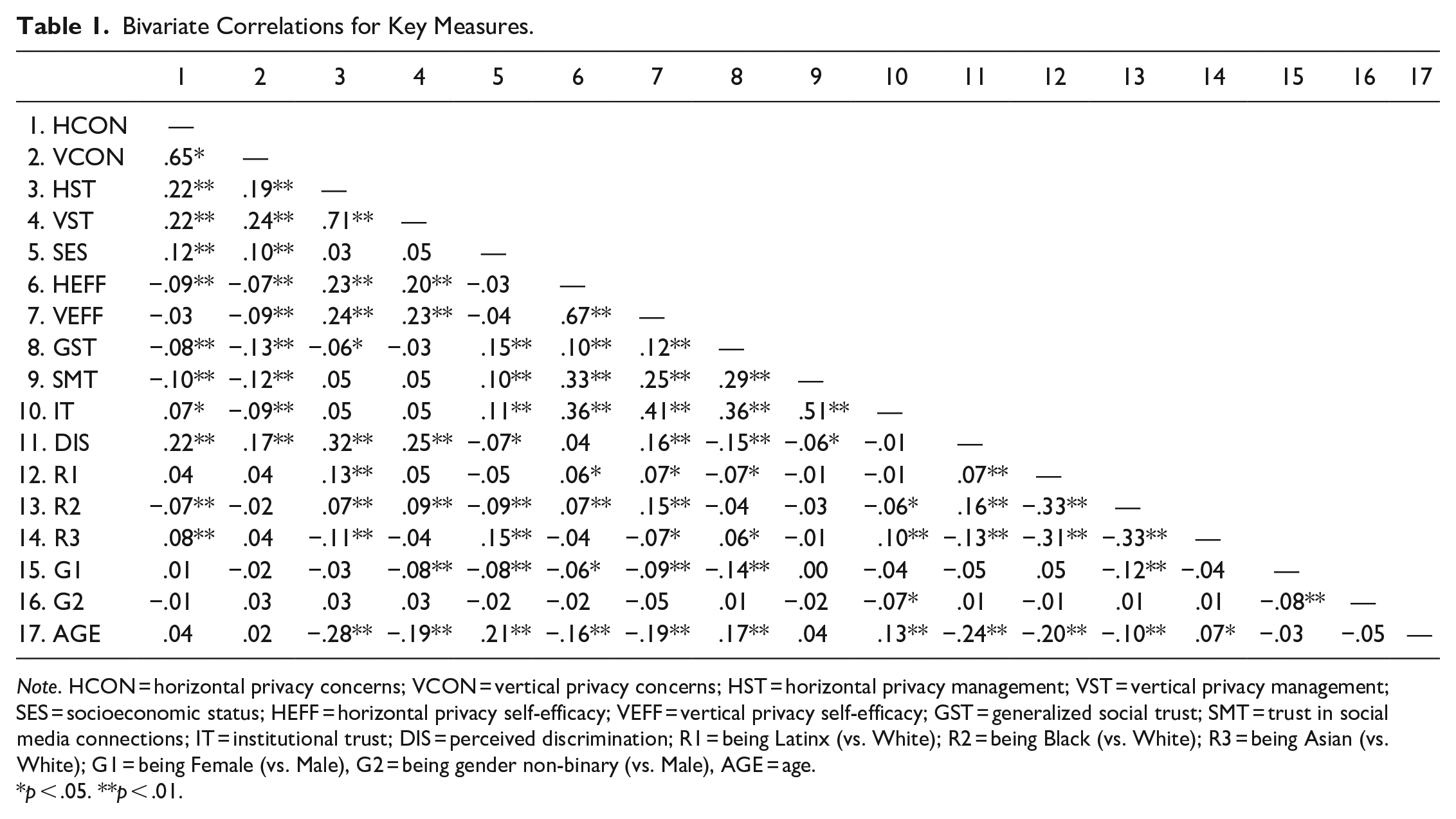
Note. HCON = horizontal privacy concerns; VCON = vertical privacy concerns; HST = horizontal privacy management; VST = vertical privacy management; SES = socioeconomic status; HEFF = horizontal privacy self-efficacy; VEFF = vertical privacy self-efficacy; GST = generalized social trust; SMT = trust in social media connections; IT = institutional trust; DIS = perceived discrimination; R1 = being Latinx (vs. White); R2 = being Black (vs. White); R3 = being Asian (vs. White); G1 = being Female (vs. Male), G2 = being gender non-binary (vs. Male), AGE = age.
p < .05. **p < .01.
Results
Path Model
After conducting preliminary analyses with the initial path model, modification indices were requested and suggested the inclusion of correlated errors among some of the mediators. These modifications indeed made substantive theoretical sense. Kline (2023) suggests that models can be trimmed or built based on strong theoretical and/or empirical evidence. As such, although not initially hypothesized, correlation errors between mediators that were theoretically plausible were added to the path model (i.e., vertical privacy self-efficacy with horizontal privacy self-efficacy, institutional trust with trust in social media connections, institutional trust with generalized social trust, institutional trust with vertical privacy self-efficacy, institutional trust with horizontal privacy self-efficacy, trust in social media connections with horizontal privacy self-efficacy, and trust in social media connections with generalized social trust).
Multiple criteria were employed to evaluate model fit, including the chi-square test of model fit, Comparative Fit Index (CFI), Tucker Lewis Index (TLI), the root mean square error of approximation (RMSEA), and the standardized root mean square residual fit index (SRMR) (Browne & Cudeck, 1993; Hu & Bentler, 1999). The final path model demonstrated overall adequate fit, χ² (24) = 263.76, p < .001, RMSEA [90% CI] = .08, [.08, .09], CFI = .95, and SRMR = .04, except TLI = .77. Nevertheless, because the model is overall well-fit and theoretically justified, we chose to proceed yet interpret the results with caution.
Testing the Online Privacy Divide Across Racial/Ethnic Groups
Racial/ethnic differences in privacy concerns (H1) and the use of privacy management strategies (RQ1) on both the horizontal and vertical dimensions of privacy were first examined. RQ2 was answered by including Asian (vs. White) participants in all path analyses. Table 2 shows all path coefficients. Results showed that both Latinx and Asian participants reported higher privacy concerns on both dimensions than White participants. No difference was found between Black and White participants, thus partially supporting H1. Answering RQ1, Latinx participants reported using horizontal privacy strategies more frequently than White participants. These findings support the notion that at least some people of color are more concerned and proactive about privacy on social media.
Path Coefficients for the Hypothesized Model.
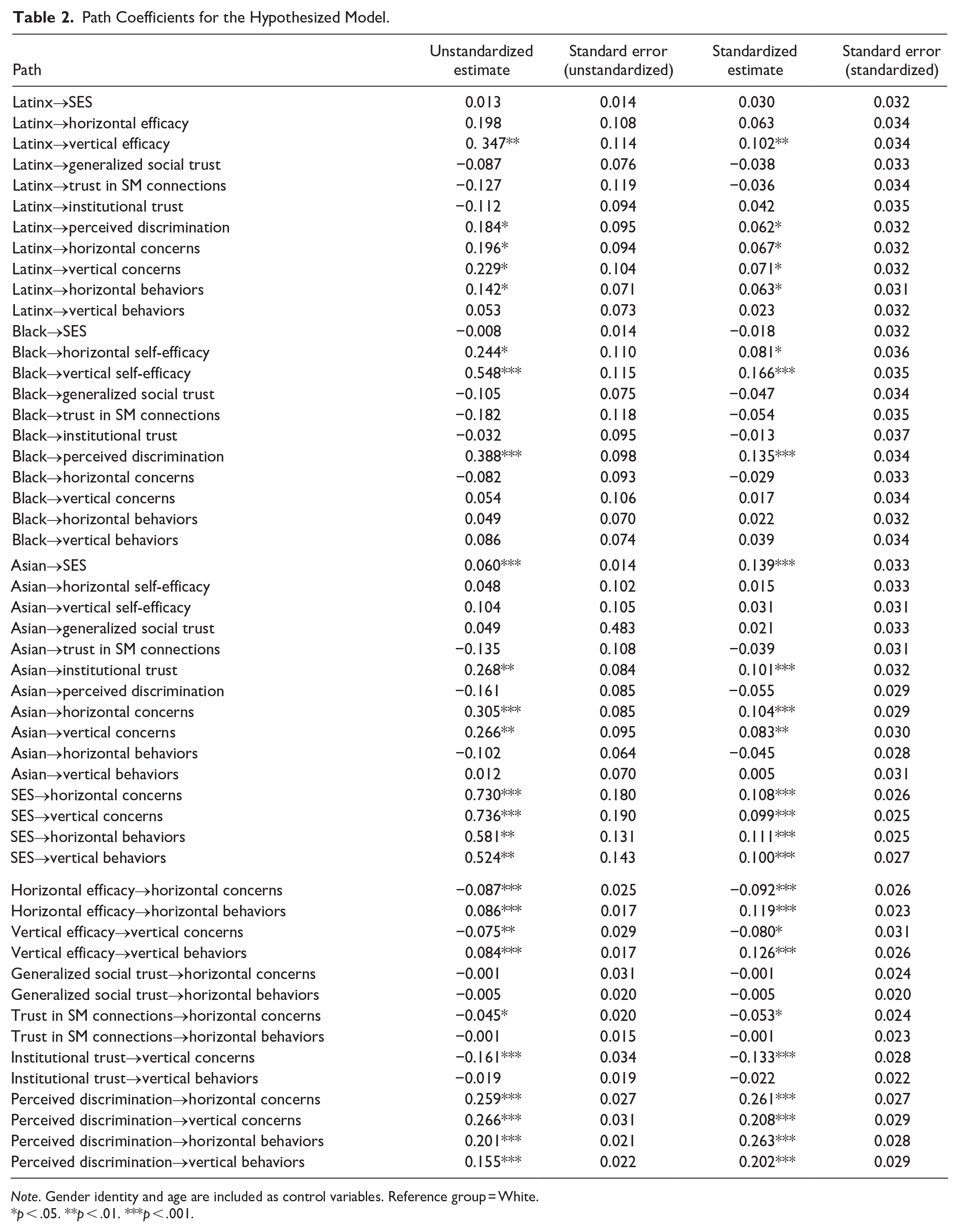
Note. Gender identity and age are included as control variables. Reference group = White.
p < .05. **p < .01. ***p < .001.
Testing the Resource Versus Identity-Based Explanations
Examining the resource versus identity-based explanations, H2 through H7 predicted that SES, privacy self-efficacy, trust, and perceived discrimination would mediate the relationships between race/ethnicity and privacy concerns and privacy management behaviors on the horizontal and vertical privacy dimensions. Table 3 shows the results of all mediating paths.
Results of Mediation Analyses.
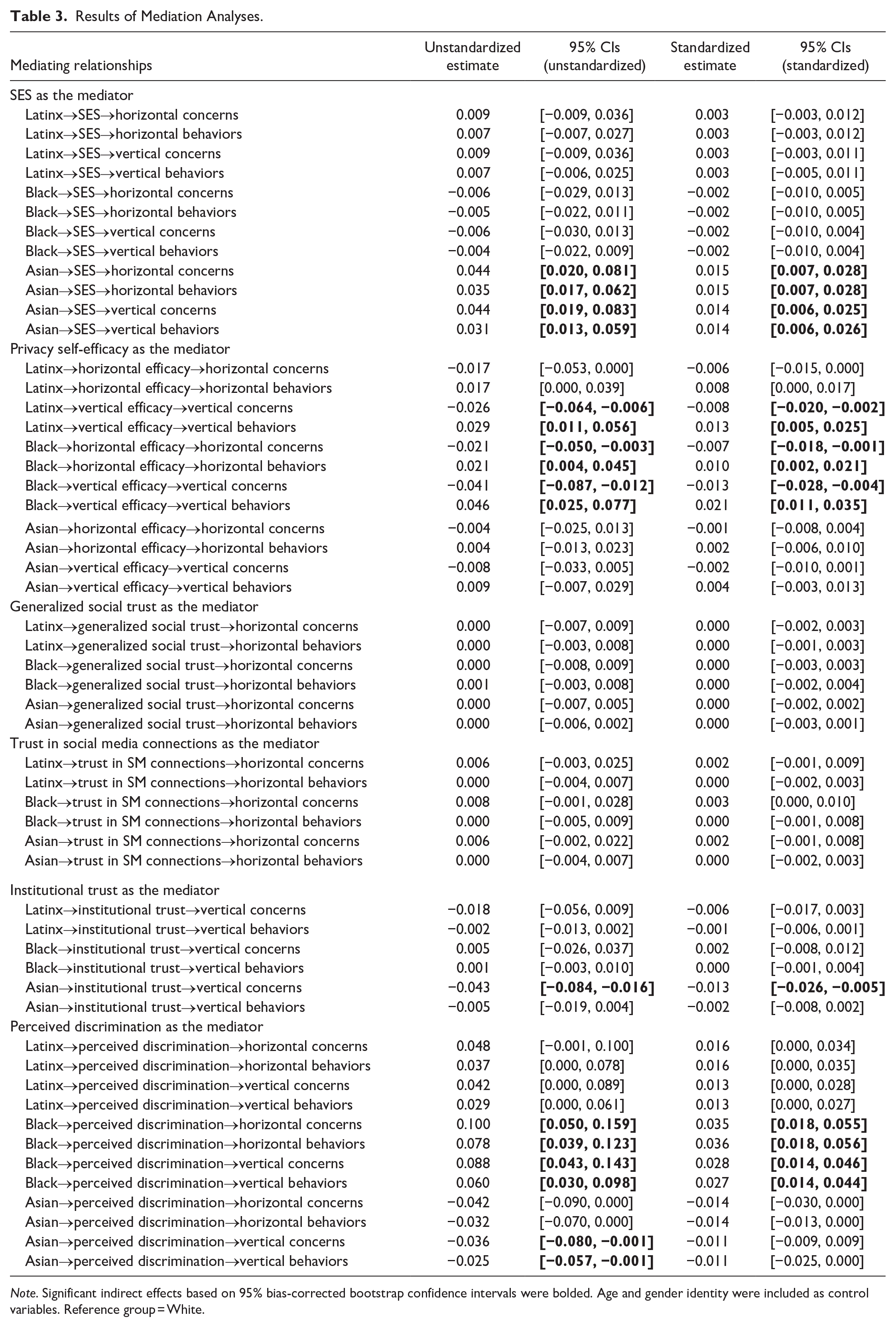
Note. Significant indirect effects based on 95% bias-corrected bootstrap confidence intervals were bolded. Age and gender identity were included as control variables. Reference group = White.
Resource-Based Explanation
H2 hypothesized that Latinx and Black people’s relatively low SES would predict (a) lower privacy concerns and (b) less frequent use of privacy management strategies than White people on both privacy dimensions. Results showed that Asian participants in our sample reported higher SES than White participants. In turn, SES was positively related to privacy concerns and privacy management behaviors on both privacy dimensions. Mediation analyses found a positive indirect relationship for Asian (vs. White) participants, such that their relatively high SES positively predicted privacy concerns and privacy management behaviors on both privacy dimensions. No indirect effects were found for Latinx or Black participants, thus rejecting H2.
H3 hypothesized that Latinx and Black people would report lower privacy self-efficacy than their White counterparts, which would predict (a) lower privacy concerns and (b) less frequent use of privacy management strategies on both privacy dimensions. Contrary to the prediction, results showed that compared to White participants, Black participants reported higher privacy self-efficacy on both dimensions, and Latinx participants reported higher vertical privacy self-efficacy. In turn, privacy self-efficacy was negatively related to privacy concerns and positively related to privacy management behaviors. Mediation analyses revealed several significant indirect effects, such that Black participants’ relatively high privacy self-efficacy negatively predicted vertical concerns and positively predicted the use of horizontal and vertical privacy strategies. Similarly, Latinx participants reported higher vertical privacy self-efficacy than White participants, which positively predicted vertical privacy management behaviors. These results indicate that privacy self-efficacy is indeed an important mediator between race/ethnicity and privacy attitudes and behavior, but it functions in the opposite way than what was predicted. H3 was not supported.
Identity-Based Explanation
In accordance with the identity-based explanation, we hypothesized that generalized social trust (H4), trust in social media connections (H5), and institutional trust (H6) would mediate the relationships between race/ethnicity and (a) privacy concerns and (b) the use of privacy strategies on their respective privacy dimensions, such that Latinx and Black participants would report lower levels of trust than their White counterparts, which would then predict higher privacy concerns and more frequent use of privacy management strategies.
Mediation analyses revealed a significant indirect relationship between race/ethnicity and vertical concerns via institutional trust for Asian participants, but not for Latinx or Black participants, thus H4 through H6 were unsupported. The results showed that Asian participants reported higher institutional trust than White participants, which then predicted lower vertical privacy concerns. Further, trust in social media connections was negatively correlated with horizontal privacy concerns, and institutional trust was negatively correlated with vertical concerns.
Finally, H7 hypothesized that perceived discrimination would mediate the relationships between race/ethnicity and (a) privacy concerns and (b) the use of privacy strategies on the horizontal and vertical dimensions. Results showed that Latinx and Black (vs. White) participants reported higher perceived discrimination. In turn, perceived discrimination positively predicted privacy concerns and privacy management behaviors on both privacy dimensions. Mediation analyses revealed significant indirect relationships between being Black and privacy concerns and management behaviors on both dimensions. These results indicate that perceived discrimination is indeed an important and consistent identity-based mediator between race/ethnicity and privacy outcomes, especially among Black individuals. Therefore, H7 was partially supported.
Summary
Compared to White participants, Latinx and Asian participants reported higher privacy concerns on both dimensions, and Latinx participants protected their horizontal privacy more frequently. These findings provide empirical support for a racial/ethnic divide in social media privacy in the U.S., such that after controlling for other sociodemographic factors, some people of color are more proactive about their online privacy. Turning to theoretical accounts for such divides, the resource-based explanation was partially supported by examining SES as a mediator between race/ethnicity and privacy, though only among Asian (vs. White) participants. Privacy self-efficacy was demonstrated to be an important mediating factor, though results did not support the resource-based assumption, finding instead that people of color have higher privacy self-efficacy. The identity-based explanations were partially rejected by the finding of no difference in trust between either Latinx or Black and White participants, but partially supported by perceived discrimination as a mediator for privacy concerns and behavior among Black participants.
Discussion
Questions have been raised regarding whether an online privacy divide exists between people from different social backgrounds (e.g., Epstein & Quinn, 2020), particularly racial/ethnic groups (Sannon & Forte, 2022). This study attempts to answer this question by examining such divides between four racial/ethnic groups in the U.S. in privacy concerns and privacy management behaviors on social media, and further, by testing mechanisms that may drive such divides.
One notable finding is that people of color are more concerned and proactive about their social media privacy. This finding challenges the assumptions of prior studies based on the resource inequalities perspective that marginalized groups are less able to protect their online privacy due to a lack of resources and skills (Li et al., 2018; Madden, 2017). Rather, it quantitatively supports qualitative findings that marginalized groups more actively employ strategies to protect their online privacy, perhaps because of greater privacy threat perceptions (Marwick et al., 2017; Vitak et al., 2018).
In explaining why such racial/ethnic divides might have been observed, we found partial evidence for both resource- and identity-based explanations. While Asian participants’ relatively high SES might have led them to be more concerned about and protective of privacy, neither Latinx nor Black participants had lower SES than White participants in our sample, and thus SES did not explain any observed differences in the privacy outcomes among these groups. The lack of empirical support among Latinx and Black groups emphasizes the need to look beyond SES-based explanations when studying privacy management on social media.
Results on privacy self-efficacy provide some interesting patterns. Contrary to the resource-based prediction, both Latinx and Black participants reported higher privacy self-efficacy, which then predicted lower concerns and more frequent privacy management on some privacy dimensions. It is possible that privacy self-efficacy plays a positive resistance resource role (as argued by Yao et al., 2007) that facilitates goal achievement in privacy management among Latinx and Black people. This may be explained by Marwick et al.’s (2017) qualitative finding that marginalized individuals expressed a strong sense of individual responsibility over their online privacy, due to the way they were socialized. Another possible explanation is that our participants may have different experiences with social media than those in earlier studies. Recent data show that Latinx and Black people are using social media more frequently than White people (Pew Research Center, 2024), which may make them feel more familiar and comfortable with managing their social media privacy, thus reporting higher privacy self-efficacy. Additionally, our adapted measures of privacy self-efficacy focus on the overarching feeling of control, which is arguably different from confidence in specific privacy management strategies and actual privacy skills and literacy that have been used in past research. Thus a more complex, factor-based digital privacy skills measure (e.g., van Deursen et al., 2016), or an item-response, knowledge-based approach (e.g., Purington Drake et al., 2023) might help uncover more nuance.
The mediating role of trust is less prominent in our sample. Consistent with previous research finding that Asian people tend to report higher trust in institutions such as law enforcement and courts (Blankenship et al., 2021), our study further demonstrates that such high institutional trust likely helped reduce Asian people’s vertical privacy concerns, partially supporting the role of trust as an identity-based explanation, at least for this subgroup. No differences, however, were found among the other groups. This is surprising given that Latinx and Black people tend to be less trusting (Taylor et al., 2007). One speculation is that our conceptual focus was on the generalized sense of trust in the offline context (e.g., “Most people can be trusted”), which is arguably different from trusting an unknown user or an institution in the social media environment, or trusting specifically in their motivation and likelihood to protect one’s privacy online. For example, Latinx and Black individuals may generally trust government agencies, but distrust their intention to collect and analyze users’ data on social media for various purposes. Future research should test whether other types of online trust, such as trust in eHealth or e-government systems, can explain people of color’s online privacy attitudes and behavior. Nonetheless, more research is needed to further disentangle the implications of this finding.
Finally, while virtually no studies have considered perceived discrimination as an identity-based explanation for the racial/ethnic privacy divide, our data demonstrate that perceived discrimination triggered the protection mechanism that heightened Black participants’ privacy concerns and motivated their privacy management behaviors, even after accounting for differences in resources. This result is consistent with findings of previous social identity and selective avoidance research, for example, that Muslim American students who perceive themselves as being discriminated against tend to avoid the non-Muslim student majority (Saleem & Ramasubramanian, 2019), and that social media users engage in selective avoidance due to fear of surveillance (Zhu et al., 2017). Our finding theoretically contributes to this literature by demonstrating that the psychological mechanism that underlies selective avoidance to protect one’s safety and avoid danger in response to perceived discrimination may well extend to online privacy protection among people of color. This result may also speak to research on the chilling effects of digital dataveillance (Büchi et al., 2022), or digital media users’ self-censorship in digital communication behavior due to the feeling of being subject to “the automated, continuous, and unspecific collection, retention, and analysis of digital traces by state and corporate actors” (p. 1).
Nonetheless, our study adds new insights to research on the racial/ethnic privacy divide where the resource-based narrative has dominated, by highlighting that Black people’s lived experiences at the group level can shape their privacy attitudes and behavior on social media, above and beyond what resource inequalities can explain. Our hope is that these results will inspire a fruitful line of research on how group-based psychological processes may underlie online privacy attitudes and behavior. For example, ingroup identification, or the extent to which an individual feels their sense of self is defined by their ingroup identity (Tajfel & Turner, 1979), may moderate the impact of perceived discrimination on privacy behavioral responses to identity threat, as those who strongly identify as a member of a racial/ethnic minority may feel more motivated to protect their privacy.
Future research may also consider the role of social media in shaping identity-based privacy behavior. As group identity can be more or less salient depending on the context in which self-categorization occurs (Tajfel & Turner, 1979), certain social media contexts, such as topics on Black Lives Matter and undocumented immigration, may activate users’ racial/ethnic identity, thus influencing their privacy management and self-disclosure. Combined, social media affordances such as anonymity and visibility (see Trepte, 2021) may facilitate or inhibit self-categorization, which may further impact self-disclosure.
Theoretical and Practical Contributions
Results of this study make several important theoretical contributions. We fill the gap discussed by Sannon and Forte (2022) by taking the first step to situate race/ethnicity as a driving force of online privacy experiences and to test different theoretical explanations that could account for existing inconsistencies in the literature. While we found a small piece of evidence for the resource-based explanation, the identity-based explanation highlights the need to theorize social inequalities in online privacy beyond individual differences in SES and its associated resources in this literature. As our finding indicates, Black people’s lived experiences (e.g., structural racism) appeared to manifest in their privacy attitudes and behavior through perceived discrimination. This opens up questions regarding what unique cultural, structural, and communicative experiences of discrimination shape the way racially/ethnically marginalized groups evaluate online privacy risks and enact protective strategies, which are largely ignored in the current theoretical landscape. As such, we echo critical perspectives that advocate for centering vulnerability and social inequalities in privacy theorizing, and for understanding how discriminatory experiences create challenges for the most vulnerable population in the face of privacy threats (McDonald & Forte, 2020, 2022). Doing so would require problematizing the practice of simply pointing out what underserved groups lack (i.e., resources) without recognizing what creates the barriers in the first place (e.g., discrimination experiences) (McDonald & Forte, 2020). In addition, qualitative research already hints that certain group-based privacy norms exist within marginalized communities (e.g., being careful, everyday surveillance, blaming the victim; Marwick et al., 2017). Thus, social identity perspectives, as we argued, may be useful in understanding how social influences of online privacy at the group level, such as ingroup members’ normative perceptions and practices (Hogg & Reid, 2006), influence the way marginalized individuals interpret identity threat and approach privacy protection online.
This study also elaborates the conceptual and operational nuances of online privacy in several ways. First, drawing from the integrated online model of privacy (Bazarova & Masur, 2020), this study is the first to conceptualize all privacy variables based on the horizontal/vertical distinction, and to test explanatory mechanisms accordingly to recognize how social media users may respond to privacy issues differently depending on the potential audiences for their information. For instance, although privacy self-efficacy mediated the relationship between being Latinx and privacy management on the vertical dimension, this was not the case on the horizontal dimension. Recognizing the multidimensional nature of online privacy facilitates refined conceptualization and measure of privacy variables and provides a possible solution to reconcile inconsistent empirical evidence in the literature (e.g., the existence of the privacy paradox) (Masur, 2023).
Second, Chen and Li (2022) criticized that most digital skill measures are not specifically designed for marginalized groups, and may not capture the unique nuances of skill inequalities in such groups. By including different types of strategies inspired by qualitative research (e.g., Marwick et al., 2017), our results hint that marginalized groups may employ a wider array of privacy management strategies than what previous measures could capture. We therefore join Chen and Li in noting that most existing measures of online privacy management tend to prioritize the technical aspects of privacy protection (e.g., VPN, encryption, anti-tracking software) that already have an embedded privilege. Social aspects of privacy management that rely on the understanding and appreciation of information sharing and social dynamics, and that require less technical skills, should be recognized (see Walker & Hargittai, 2021). Another potentially relevant conceptualization of privacy management is the approaching versus avoiding distinction (Raman & Pashupati, 2004; Stubenvoll et al., 2024). Though outside of the scope of the current study, it is possible that people with vulnerable identities more often employ avoiding strategies especially when identity threat is triggered (see also Marwick et al., 2017). These strategies, which again require less technical skills, might include avoiding self-disclosure, opting out of social media platforms, or self-censoring, as many marginalized individuals cannot afford the potential cost of privacy loss (McDonald & Forte, 2020).
Nevertheless, future research is warranted to empirically test these speculations, and more dedicated effort is needed to develop and validate more tailored, group-based measures of privacy management. Qualitative research will be instrumental in further disentangling the interplay between privacy and marginalization and in identifying the nuanced ways in which marginalized groups engage in counter-normative privacy protection practices.
Practically, findings of the present study reveal the need for continued efforts for privacy education. As digital participation almost becomes a default for many aspects of contemporary society, it is critical to cultivate user awareness of potential risks and benefits to online privacy and self-disclosure that can help users evaluate the rewards and drawbacks of online participation and make informed decisions, especially if marginalized users tend to withdraw from technology use as a means to protect their privacy. Educational programs should recognize the unique challenges marginalized groups face and incorporate culturally-grounded and/or community co-design approaches to develop tailored privacy skill training programs and build digital resilience among marginalized groups.
Limitations and Future Research
While providing meaningful insights, this study is limited in its sole focus on race/ethnicity despite its intertwined nature with other markers of marginalization, such as age, gender/sex identity, and disability. For example, the privacy concerns and privacy management behaviors of a Black woman might not only differ from those of a Black man but also from those of a White woman. Within each racial/ethnic community we studied, there may also be vast differences in socioeconomic status, discrimination experiences, and privacy outcomes between people with different immigrant backgrounds and cultures (e.g., Cuban vs. Venezuelan immigrants within the Latinx community). Indeed, findings appear to indicate that the role of race/ethnicity in privacy is much more complex than some popular accounts may imply, and that key privacy outcomes such as privacy concerns and behavior are influenced by a wide array of factors that do not neatly map onto the concept of race/ethnicity. Intersectional theory will be instrumental in guiding a more nuanced understanding of the dynamic between having multiple vulnerable identities and having to oppress dominant voices and systemic discrimination (Choo & Ferree, 2010; Crenshaw, 1989; Collins, 2022; McDonald & Forte, 2020). One recent example application is the intersectional analysis of agency constraints that contribute to inequalities in privacy cynicism (Hoffmann et al., 2024). As such, future research must start to appreciate how structural constraints at the interpersonal, cultural, technological, economic, and political levels as well as their intersections shape online privacy attitudes and behavior.
Purposive sampling was utilized to achieve the comparative goals of this research, thus results may not be generalizable to the U.S. population. In Section 4 of the OSM, we map the education and income distributions by race/ethnicity in our data (collected in 2023) onto the 2022 census data to illustrate potential deviations of our non-representative sample on these parameters. Additionally, our sample only consists of four racial/ethnic groups in the U.S. As communication research tends to employ participants in Western, educated, industrialized, rich, and democratic contexts, future studies should investigate other racial/ethnic groups in the U.S., such as Arabs, Muslims, Hindus, Jews, Pacific Islanders, Indigenous/Native Americans, and in other cultural contexts (e.g., the Global South) in which racial/ethnic dynamics and privacy may be experienced differently.
We chose to focus on privacy in social media because it creates an interesting context in which users need to simultaneously tackle both horizontal and vertical privacy challenges. As privacy is context-dependent, privacy decisions are shaped by (1) the context that informs the privacy norms, (2) the actors involved in the disclosure, (3) attributes of information being disclosed, and (4) transmission principles that govern information flow (Nissenbaum, 2010). Future research should thus replicate our findings in other online contexts such as e-commerce, e-health, mobile dating, and digital government services to further understand privacy attitudes and behavior among marginalized groups.
While this study takes a first step in exploring racial/ethnic divides in privacy concerns and privacy management behaviors, it leaves the relationship between privacy concerns and privacy management behaviors itself untested. Further research should fill this gap, perhaps by leveraging the extended model of the privacy calculus (Dienlin & Metzger, 2016), to uncover whether the predictive power of privacy concerns, perceived benefits, and privacy self-efficacy on privacy management behaviors is contingent upon education, race, and/or other markers of marginalization. In addition, potential divides in prominent psychological factors that impact privacy decisions, such as privacy cynicism, should be incorporated to further elaborate the boundary conditions of the online privacy divide construct.
Finally, analytically, future research should strive to treat the mediating and outcome variables (e.g., privacy concerns) as latent constructs to account for measurement errors. Longitudinal and experimental research is also needed to account for the temporal precedence of the explanatory mechanisms we tested in this study (e.g., Does perceived discrimination cause higher privacy concerns and more frequent privacy protection?). Mixture modeling techniques will also be helpful in uncovering latent classes or profiles that highlight the heterogeneity of marginalized groups’ privacy protection experiences. Our hope is that this preliminary study sparks further research to better understand how marginalization experiences affect privacy attitudes and behavior in digital media environments.
Supplemental Material
sj-docx-1-crx-10.1177_00936502241273157 – Supplemental material for The Online Privacy Divide: Testing Resource and Identity Explanations for Racial/Ethnic Differences in Privacy Concerns and Privacy Management Behaviors on Social Media
Supplemental material, sj-docx-1-crx-10.1177_00936502241273157 for The Online Privacy Divide: Testing Resource and Identity Explanations for Racial/Ethnic Differences in Privacy Concerns and Privacy Management Behaviors on Social Media by Laurent H. Wang and Miriam J. Metzger in Communication Research
Footnotes
Acknowledgements
The authors would like to extend their gratitude to the four anonymous reviewers and Drs. Amy Gonzales and Ron Rice for their invaluable input into early versions of this manuscript, and to Drs. Karen Nylund-Gibson and Nancy Collins for their helpful feedback on the data analysis.
Declaration of Conflicting Interests
The authors declared no potential conflicts of interest with respect to the research, authorship, and/or publication of this article.
Funding
The authors disclosed receipt of the following financial support for the research, authorship, and/or publication of this article: The data reported herein were collected under the support of the Academic Senate Faculty Research Grant at UCSB.
Data Availability Statement
The data reported in this study is available upon request from the corresponding author.

Supplemental Material
Supplemental material for this article is available online.
Notes
Author Biographies
References
Supplementary Material
Please find the following supplemental material available below.
For Open Access articles published under a Creative Commons License, all supplemental material carries the same license as the article it is associated with.
For non-Open Access articles published, all supplemental material carries a non-exclusive license, and permission requests for re-use of supplemental material or any part of supplemental material shall be sent directly to the copyright owner as specified in the copyright notice associated with the article.
