



Abstract
This study examines how threat appraisal and self-efficacy affect parents’ coping with personalized social media advertising (PSMA) targeting children. A survey of 576 parents of young social media users aged 10 to 17 in Australia reveals that parents are more likely to explain PSMA to their children (individual coping) and support external socialization agents’ initiatives to address the potential risks of PSMA (social coping) when they perceive social media platforms’ data collection practices as significantly harmful. While the extent to which parents believe that their children are vulnerable to harm is positively associated with social coping, it does not influence individual coping. The results also show that parents’ confidence in their ability to carry out parental mediation is positively related to both individual and social coping. However, parents’ confidence in their general parenting ability does not impact PSMA coping strategies.
Keywords
Introduction
Children are avid social media users. According to a Gallup survey, children aged 13 to 17 in the United States spend about 5 hours per day on social media apps (Rothwell, 2023). In Australia, where the present study was conducted, children aged 12 to 17 engage with an average of four different social media services (eSafety Commissioner, 2021). Given the significant time spent on social media and the variety of platforms used, children are exposed to a substantial amount of advertising, including data-driven personalized ads tailored to individual users (Williams et al., 2021).
Personalized advertising on social media is created based on various types of user data, including personal information provided during profile setup, device and network connection data detected by social media service providers, and clickstream data generated by users’ online activities both within and outside the platforms (Holvoet et al., 2021). Because personalized advertising is created using detailed user data, social media users may find these ads more relevant and useful compared with non-personalized advertising. However, the personalization process often requires invasive and constant access to extensive user data, raising concerns about users’ digital privacy (Williams et al., 2021).
Children are considered particularly vulnerable to these privacy risks as they often share a wide range of personal information online without fully understanding the consequences (Zarouali et al., 2017). They generally lack a sophisticated understanding of data privacy and feel uncertain about how to protect their information (Humphry et al., 2023), as they are still developing media literacy needed to navigate covert tactics like data-driven personalized advertising (Brinson et al., 2024). To address these concerns, many countries have enacted laws and industry regulations to protect young consumers from advertisers’ privacy invasions. However, these often do not fully safeguard children, focusing more on younger children and leaving older children at risk (Holvoet et al., 2021). In Australia, while existing laws and industry codes of ethics strictly regulate advertising content aimed at children, they do not adequately address data collection and targeting practices used for personalization (Children & Media Australia, 2024).
This regulatory gap underscores the need for additional protective measures. In this context, parents, as primary socialization agents, are expected to play a crucial role in shielding children from negative advertising influences, including privacy intrusions (Hudders and Cauberghe, 2018). Many advertising policies also emphasize the role of parents in protecting children from advertising (Vijayalakshmi et al., 2018). While much research has examined how parents mediate children’s media use, there is limited investigation into their perceptions and interventions specifically related to data-driven personalized advertising. Understanding parents’ perceptions and coping strategies regarding personalized ads targeting children is essential for informing future policy development and promoting socially responsible advertising practices.
This study aims to fill the current research gap by examining parents’ perceptions of personalized social media advertising (PSMA) targeting children and its impact on their coping strategies. It investigates parents’ views on the harmfulness of data collection and tracking by social media platforms for ad personalization (perceived severity), the likelihood of negative consequences (perceived vulnerability), and their confidence in general parenting skills (parenting self-efficacy) and ability to discuss PSMA-related issues with their children (parental mediation self-efficacy). The study also explores how these factors are associated with parents’ communication-based active mediation (individual coping) and support for regulatory and educational initiatives (social coping), addressing the need to better understand diverse prevention methods for managing media-related challenges (Vijayalakshmi et al., 2018).
This study draws on Protective Motivation Theory (PMT), the Influence of Presumed Influence (IPI) model, and self-efficacy research to explore parental risk perceptions and coping strategies in response to PSMA targeting children. PMT (Rogers, 1983) provides a useful framework for examining how threat and coping appraisals motivate protective behaviors, such as parental intervention in children’s media use (Hwang et al., 2017). IPI (Gunther and Storey, 2003) further elucidates how parental coping strategies are influenced by perceptions of media effects on their children. Recognizing that individuals can have varying levels of self-efficacy across different domains (Holloway et al., 2016), this study investigates both general parenting self-efficacy and mediation-specific self-efficacy to deepen our understanding of their roles in shaping individual and social coping responses.
Theoretical background and hypothesis development
Parental coping strategies
In this study, the term “children” is broadly defined, referring to anyone below the age of 18 (minor), which includes young children below the age of 13 and adolescents aged 13 to 17, who tend to be more vulnerable to diverse media influences, including personalized advertising, as compared with adult consumers.
Most prior research on parental coping with children’s media use has focused on parental mediation, which refers to strategies parents use to supervise and guide their children’s media consumption to maximize positive media impacts while mitigating risks (Wang et al., 2023). Extensive research highlights the pivotal role of parental mediation in shaping children’s media-related attitudes and behaviors. In the realm of social media, for example, studies have shown that parental mediation enhances children’s awareness of privacy risks associated with TikTok use (Kang and Shin, 2024), reduces adverse effects of influencer-generated content (Martín-Cárdaba et al., 2024), and lowers the risk of cyberbullying (Wright, 2018).
While various forms of parental mediation have been investigated across different media contexts, this study focuses on communication-based parental mediation, also known as active mediation, as it is particularly relevant to the current research context. Chen and Shi’s (2019) meta-analysis highlights that, although restrictive mediation (controlling and limiting children’s media use) is generally more effective in reducing media use time, active mediation, along with co-use (parents and children using media together), is more effective in mitigating media-related risks for both young children and adolescents. In the context of children’s interactions with PSMA, which involve potential privacy risks, active mediation is especially pertinent. By fostering open conversations about media issues, active mediation encourages critical thinking and helps children develop healthy skepticism (Chen and Shi, 2019). Furthermore, as children increasingly use personal and portable media outside the home, close parental monitoring, restrictive approaches, and co-use become less feasible, especially for older children engaging with dynamic media content. In such situations, active mediation presents a more practical and sustainable approach than other forms of mediation (Shin, 2017).
While prior research has extensively focused on parental mediation of children’s media use, studies specifically addressing parental intervention in children’s exposure to and interactions with advertising have been limited. Nonetheless, a small but growing body of research on parental advertising mediation has also identified active mediation as one of the key intervention strategies, defined as parents explaining and discussing the nature of advertising and advertising-related issues with children (Shin, 2017). This line of research documents the positive effects of active mediation, including reduced negative impacts of television advertising on children (Buijzen and Valkenburg, 2005) and greater avoidance of social media newsfeed advertising among teenagers (Youn and Shin, 2019).
Overall, the literature suggests that parental communication on media-related issues positively impacts children. However, several research gaps remain. First, compared with the extensive literature on parental mediation of children’s media use, research on parental mediation of advertising, particularly emerging forms like PSMA, is limited in quantity and scope. As a result, we know little about the factors influencing parents’ involvement in protecting youths from data-driven ad personalization on social media. Second, prior studies have predominantly focused on intervention practices directed at one’s own children, which are considered individual coping strategies. From a consumer socialization perspective (John, 1999), other external entities, such as regulatory bodies, school education, and corporate actions, also play crucial roles in creating a safe environment for young consumers. Parents may turn to these external social forces to cope with potential media threats, including data-driven personalized advertising (Vijayalakshmi et al., 2018), especially when individual efforts fall short (Chen et al., 2022). However, little is known regarding the extent to which parents rely on these social forces and the influencing factors.
Adopting Youn and Shin’s (2019) conceptualization of “social coping,” which originally assessed teen media users’ turning to “institution-based approaches at the societal level” (p. 35) to mitigate risks from online advertising, this study views parents’ support for ad-related regulations, education, and industry actions as a form of social coping, as opposed to individual coping strategies practiced through parental mediation. Given parents’ historically negative views of advertising targeting children (Kowalczyk and Royne, 2016) and growing concerns over data-driven personalization (Children & Media Australia, 2024), parents may feel that individual mediation alone is insufficient, and they may be motivated to adopt multiple protective measures to alleviate the burden of individual responsibility (Hoffner and Buchanan, 2002). Thus, this study investigates parents’ engagement in both individual and social coping strategies in response to children’s exposure to PSMA and the role of PSMA-related risk perceptions.
Risk perceptions as antecedents of coping strategies: promotion motivation perspective
Parental coping with children’s media use can be understood as a protective behavior aimed at shielding children from potentially harmful media influences (Holvoet et al., 2022). Protection Motivation Theory (PMT) provides a useful framework for explaining what triggers individuals to engage in protective behaviors. According to PMT, the intention to engage in protective behavior in a risky situation is driven by threat appraisal and coping appraisal. In threat appraisal, individuals evaluate the severity of a risk (perceived severity), defined as “the depth and breadth of the negative consequences of the threat” (Shillair et al., 2015: 200), as well as their vulnerability to the threat (perceived vulnerability), which refers to the likelihood of experiencing negative consequences. Individuals are more likely to take protective actions when both perceived severity and vulnerability are high (Rogers, 1983).
Coping appraisal, on the other hand, involves evaluating one’s ability to manage the threat (efficacy perceptions). PMT identifies two types of efficacy that motivate protective behaviors: response efficacy (i.e. the belief that a protective action will effectively reduce a threat) and self-efficacy (i.e. confidence in one’s ability to perform the protective action) (Rogers, 1983). While both forms of efficacy are integral to PMT, this study focuses on self-efficacy because it directly relates to an individual’s capacity to act, even in the face of obstacles (Bigsby and Albarracin, 2022). For instance, parents may believe their media interventions are effective (high response efficacy), yet they may still fail to act if they lack the confidence or skills to manage their children’s media use (low self-efficacy). This is particularly relevant in the context of personalized advertising targeting children, which requires parents to understand and navigate a complex and unfamiliar digital realm (Brinson et al., 2024). In such situations, the more immediate and critical question parents are likely to ask is, “Can I influence my child?” (self-efficacy), rather than “Will mediation strategies work?” (response efficacy).
As noted by Hwang et al. (2017), most prior studies used PMT to understand individuals’ motivation to protect themselves. However, several studies have extended PMT to examine how parents’ risk perceptions pertinent to their children’s media use influence parental mediation practices. Hwang et al. (2017) applied PMT to explore factors influencing parental mediation of children’s smartphone use, finding that parental mediation was predicted by perceived severity of children’s smartphone addiction and self-efficacy in their protective behaviors. In the context of television viewing, Nathanson et al. (2002) demonstrated that threat perception and self-efficacy motivated parents to mediate children’s exposure to harmful content. More recently, Holvoet et al. (2022) used PMT to predict parental mediation of teens’ exposure to personalized advertising in general (not PSMA in particular). They found that concerns about data collection practices, which were used as a proxy measure for threat appraisal, and parental mediation self-efficacy both positively influenced parental mediation. Overall, prior research suggests that PMT can be meaningfully extended to explain protection motivation directed to others (e.g. children) even though the theory has predominantly been used to understand self-directed behaviors.
Threat appraisal and presumed influence
The aforementioned studies applying PMT to parental mediation contexts imply that individuals’ threat appraisal pertinent to others can lead them to engage in protection behaviors for those others. This aligns with the IPI perspective, which posits that our attitudes and behaviors are motivated by our perceptions of media influence on others (Gunther and Storey, 2003). Specifically, those who believe that media content will influence others will adjust their attitudes and behaviors accordingly. Following the IPI perspective, parents are more likely to engage in coping strategies regarding their children’s media use when they perceive negative media influence on their children (Brinson et al., 2024). In fact, extensive research on parental mediation has demonstrated a positive association between parents’ negative views and concerns about media platforms or content and their engagement in individual coping strategies, which include high levels of active and restrictive mediation concerning children’s interactions with advertising (Holvoet et al., 2022), digital media use (Shin and Lwin, 2022), and streaming platform use (Moss and Waddell, 2023).
Although research on parental social coping is limited, several studies have shown a positive relationship between parents’ perceptions of negative media influences on children and their support for broader societal protections. For instance, Chen et al. (2022) found that parents were more likely to support school-based education programs when they perceived telecommunication fraud as a significant threat to children. Hoffner and Buchanan (2002) provided nuanced insights into how parents’ perceptions of media influence on their own children versus other children influenced their support for censorship. They found that while support for censorship was positively associated with the perceived effects of television violence on both their children and other children, parents were particularly inclined to advocate for censorship when concerned about their own children. This suggests that, although parents’ support for censorship or other societal protections may stem from a desire to protect children in general and society as a whole, it is also motivated by a personal need to reduce the burden of closely supervising their own children’s media use.
To the best of my knowledge, no published research has directly examined the relationship between the two types of threat appraisal (perceived severity and vulnerability) and parental individual and social coping in response to PSMA. Although Holvoet et al. (2022) applied PMT to predict parental mediation of personalized advertising targeting teenagers, their study used privacy concerns as a proxy for threat appraisal, rather than directly incorporating the two specific threat appraisal variables outlined in PMT. Furthermore, unlike the present study, which focuses specifically on personalized advertising on social media targeting both children and teenagers and considers both individual and social coping strategies of parents, Holvoet et al.’s research examined teenagers’ exposure to personalized advertising more generally, without specifying the ad context or addressing social coping. Nonetheless, prior studies, including Holvoet et al. (2022), support the broad notion that parental threat appraisal plays an important role in shaping their coping responses to media targeting children. Therefore, I pose the following hypothesis:
Self-efficacy in two domains
Self-efficacy, while a key component of PMT, is also integral to several major social science theories, including Social Cognitive Theory (Bandura, 1997), Health Belief Model (Jones et al., 2015), and Theory of Planned Behavior (Ajzen, 1991). These theories highlight the importance of perceived competence in behavioral intentions and performance. Initially conceptualized by Bandura within Social Cognitive Theory (Bandura, 1997), self-efficacy has been found to play a crucial role in how people approach tasks and challenges across various domains, including health behaviors, academic achievement, and parenting, as supported by meta-analytic evidence (Wittkowski et al., 2017).
Regarding the role of self-efficacy in parenting, research suggests that parents’ confidence in their ability to parent successfully, referred to as parenting self-efficacy, is positively associated with effective parenting practices, leading to positive child outcomes (Wittkowski et al., 2017). Since parenting self-efficacy can manifest through diverse parenting practices (Jones and Prinz, 2005), it is expected to influence how parents cope with varying challenges their children encounter, including media-related risks. Several studies have examined the role of parenting self-efficacy in parental mediation, demonstrating its positive association with active mediation of children’s exposure to television, Internet, and mobile advertising (Shin, 2017), as well as their use of digital devices more broadly (Shin and Lwin, 2022) and smartphones specifically (Shin, 2018). Notably, Shin (2018) found that those with high parenting self-efficacy were more likely to actively mediate their children’s smartphone use, even when they lacked confidence in their smartphone skills. This suggests that parents who feel capable of influencing their children in general are more likely to address media-related issues, even when facing challenges posed by technologies.
Other studies have focused on self-efficacy in parental mediation (parental mediation self-efficacy), defined as “parents’ competencies in their ability to exercise control over parental mediation practices” (Shin, 2018: 468). These studies found positive associations between parental mediation self-efficacy and their mediation of children’s Internet use (Glatz et al., 2018), smartphone use (Hwang et al., 2017), and exposure to personalized advertising (Holvoet et al., 2022). Acknowledging that self-efficacy can be domain-specific (i.e. one can have high self-efficacy in one domain but low self-efficacy in another domain), Shin (2018) examined both parenting self-efficacy and parental mediation self-efficacy, showing that both were positively associated with active mediation of smartphone use.
Overall, prior research on self-efficacy in general, and parenting or mediation self-efficacy in particular, suggests that parents who are confident in their parenting and parental mediation skills are more likely to engage in individual coping by implementing parental mediation strategies. However, it is unclear how parents’ self-efficacy relates to their social coping due to limited empirical research. Competing possibilities exist: on one hand, high self-efficacy parents may not rely much on external agents, believing their children are sufficiently under their control (Vijayalakshmi et al., 2018). On the other hand, since parents with high self-efficacy are more likely to be proactive about child rearing (Glatz and Buchanan, 2015), they may actively engage in social coping by supporting external socialization agents’ involvement in ad-related regulations and education. Accordingly, this study poses a hypothesis regarding the relationship between self-efficacy and individual coping, but a research question regarding its association with social coping:
Method
Participants and procedure
Major social media platforms require users to be at least 13 years old. However, the present study focuses on parents of social media users aged 10 to 17, which includes an “underage” group (below 13). Age requirements are often loosely enforced, as most platforms rely on users to self-report their age without robust verification systems. This allows underage users to easily bypass age restrictions, resulting in prevalent underage use (Armstrong, 2024). According to Ofcom (2022), six in ten children aged 8 to 11 in the United Kingdom have at least one social media profile, with the majority setting up their accounts themselves. Similar findings have been reported in Australia (eSafety Commissioner, 2021), the United States (Thorn, 2021), and countries in Asia (Sachitanad, 2021). The study’s inclusion of the underage group is intended to reflect the real-world situation.
An online survey was conducted with individuals who self-identified as parents or primary caregivers of young social media users aged 10 to 17. Respondents were recruited from Qualtrics’ online panel of adults residing in Australia. Eligible participants were randomly assigned to one of two conditions: one condition asked them to think about their youngest child, while the other asked them to think about their oldest when answering survey questions, if they had more than one child aged 10 to 17 using social media. Respondents received a financial incentive worth AUD 2-4 for their survey participation.
The quality of responses was monitored and managed collaboratively by Qualtrics and the author throughout the data collection process. Respondents who did not meet the recruitment criteria or failed quality checks—such as providing overly speedy responses, uniform answers, or incomplete data—were excluded. A total of 1525 invitations were distributed, 833 participants accessed the survey, and 232 were screened out, resulting in 601 completed responses. After additional quality checks, 25 responses were removed, yielding a final sample size of 576. The sample size (N = 576) was considered sufficient to include parents/primary caregivers from diverse demographic backgrounds, capturing a broad range of perspectives on PSMA targeting children. It also ensured adequate statistical power and reliable parameter estimates for hypothesis testing (Memon et al., 2020).
The final sample consisted of more females (69.6%) than males (30.0%). Thirty-five percent of the participants were parents of underage social media users (aged 10–12). The median household income fell in the $75,000 to $99,000 range, and 37.5% held a bachelor’s degree or higher. This is similar to the Australian population in terms of income (Australian Bureau of Statistics, 2023a) but slightly higher than the national average education level (32% holding a bachelor’s degree or above) (Australian Bureau of Statistics, 2023b). The demographic profile of respondents is presented in Table 1.
Demographic Profile of Participants (N = 576).
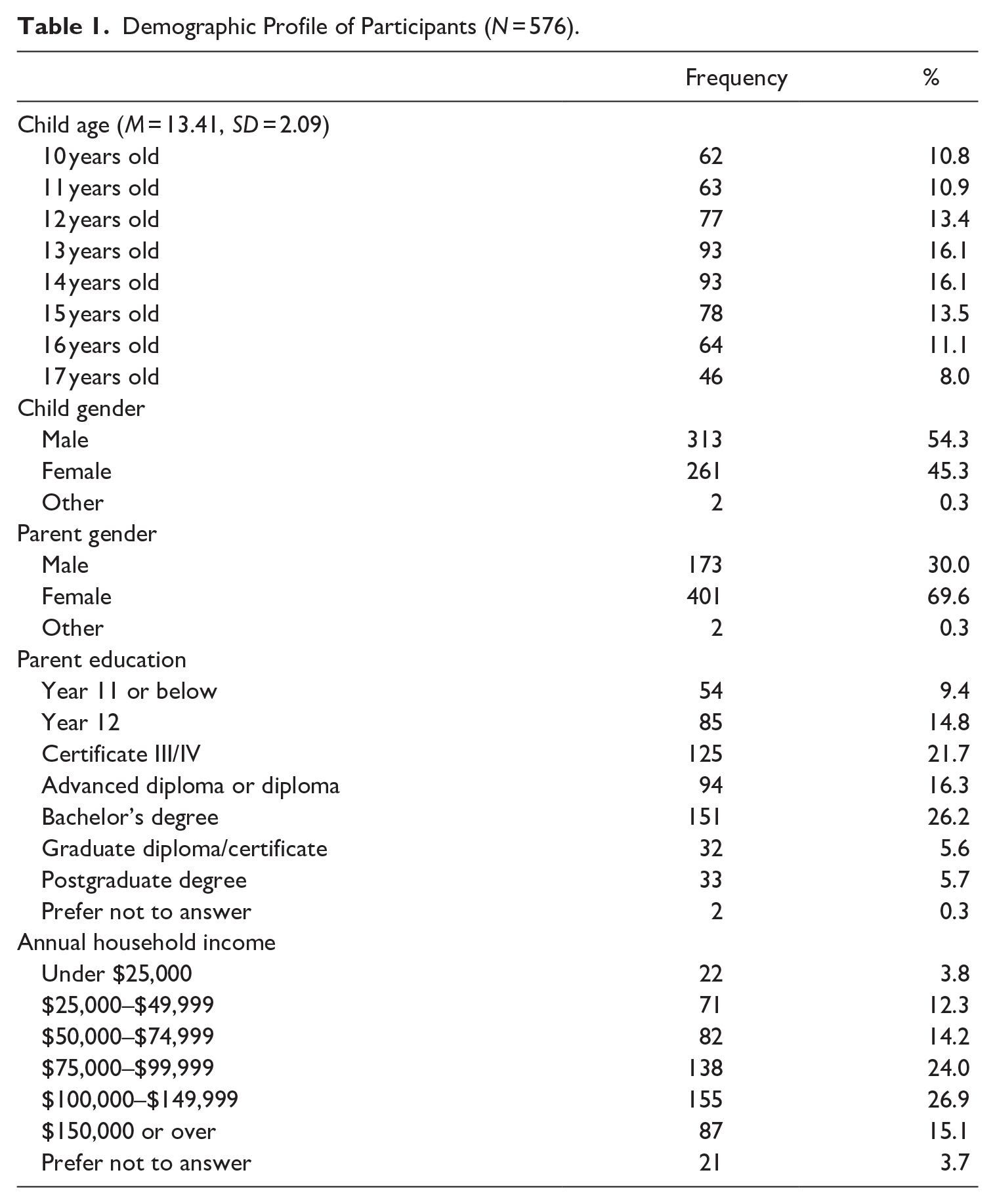
When asked to select all social media platforms that their children used regularly, respondents reported an average of 3.6 different social media services (SD = 1.46). Approximately seven in ten respondents stated that their children used YouTube (74.1%) and TikTok (71.5%) regularly. Other social media platforms frequently used by respondents’ children include Facebook (63.9%), Instagram (59.4%), and Snapchat (59.1%). Twitter/X (23.4%) and Reddit (10.1%) were less commonly used.
Measures
Before answering questions about PSMA, respondents were provided with the definition of PSMA, that is, customized promotional messages that are delivered to social media users based on users’ demographic information, locations, interests, and/or online behaviors within or outside the social media platforms. The survey measured individual and social coping, threat appraisal (perceived severity and vulnerability), and two types of self-efficacy.
Individual coping was measured by asking respondents how often they talk to their children about the nature of PSMA, using five active mediation items adapted from Shin and Lwin (2022). Responses were recorded on a 7-point scale ranging from “never” (1) to “all the time” (7). Social coping was assessed by asking respondents to indicate the extent to which they support government regulation, educational programs, and company initiatives regarding PSMA targeting children. This was measured using three items derived from Youn and Shin (2019), with responses anchored from “strongly disagree” (1) to “strongly agree” (7).
Perceived severity was assessed by asking respondents to rate how problematic they perceive social media platforms’ data practices targeting their children for ad personalization purposes to be. This was measured using three items adapted from Hwang et al. (2017) on a 7-point Likert-type scale ranging from “strongly disagree” (1) to “strongly agree” (7). Perceived vulnerability was measured by asking respondents to indicate the degree to which they believe their children are vulnerable to these data practices. This was assessed using three items adapted from Boerman et al. (2021), rated on a 7-point Likert-type scale from “strongly disagree” (1) to “strongly agree” (7).
Parenting self-efficacy was measured using four items adapted from Shin (2017), rated on a 7-point Likert-type scale from “strongly disagree” (1) to “strongly agree” (7). Parental mediation self-efficacy was assessed by asking respondents to rate their confidence in engaging in five active mediation practices regarding PSMA, using a 7-point scale ranging from “not at all confident” (1) to “extremely confident” (7).
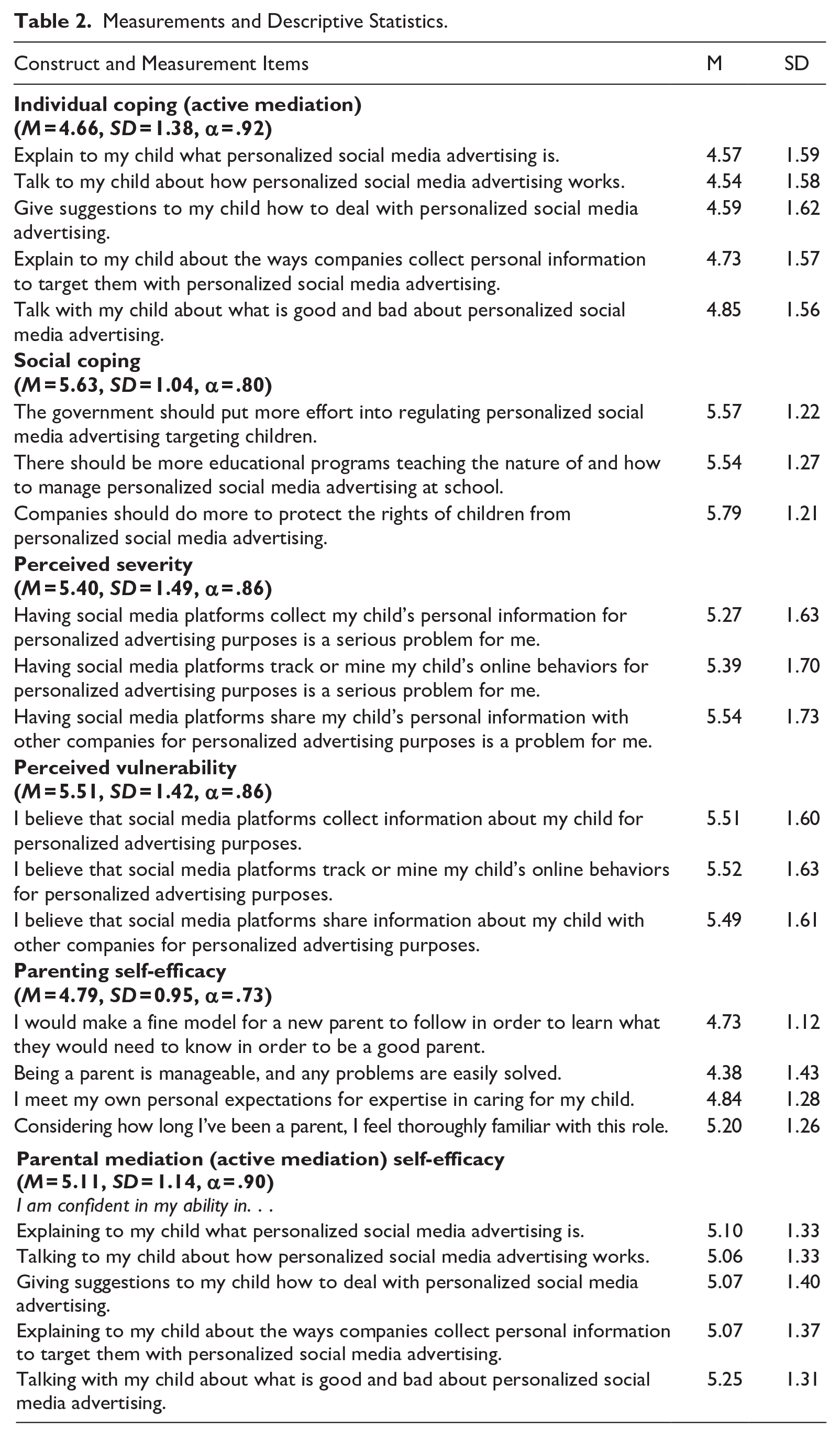
Table 2 displays the measurement items and descriptive statistics. Table 3 presents the correlation matrix of the constructs.
Measurements and Descriptive Statistics.
Correlation Matrix of Constructs.
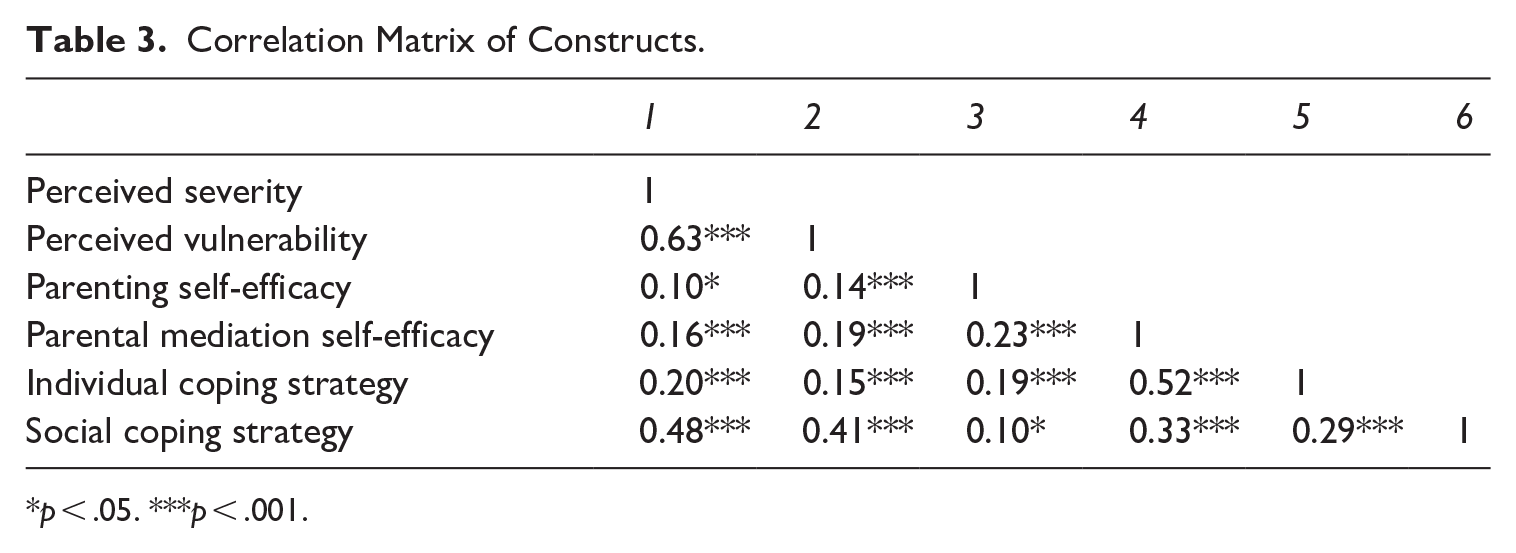
p < .05. ***p < .001.
Results
As this study includes parents of underage social media users (below 13), two groups of parents—those with younger children (aged 10–12) and those with older children (aged 13–17) were compared for the key variables before testing the hypotheses and research question. A series of independent-sample t tests revealed that parents of older children were more likely to believe that their children were vulnerable to social media platforms’ data practices for ad personalization purposes (M = 5.64, SD = 1.36) compared with parents of younger children (M = 5.26, SD = 1.51) (t = 3.04, p < .01). However, the two groups did not differ significantly in all other variables. Thus, hypothesis testing was conducted with the total sample of survey participants, combining two groups of the parents and controlling for children’s age and other demographic variables.
To test the hypotheses and research question, two separate hierarchical regression analyses were performed with the composite scores for the individual and social coping strategies as the dependent variables. The hierarchical regression approach was deemed appropriate for hypothesis testing, as it allowed for controlling the influence of background variables while examining the unique contributions of each predictor. For each regression analysis, child and parent background variables were entered in the first block as control variables, and the threat appraisal and self-efficacy variables were entered in the second block. Variance inflation factor (VIF) values ranged from 1.05 to 1.73, indicating minimal multicollinearity. Table 4 presents the regression analysis results.
Hierarchical Regressions for Predicting Coping Strategies.
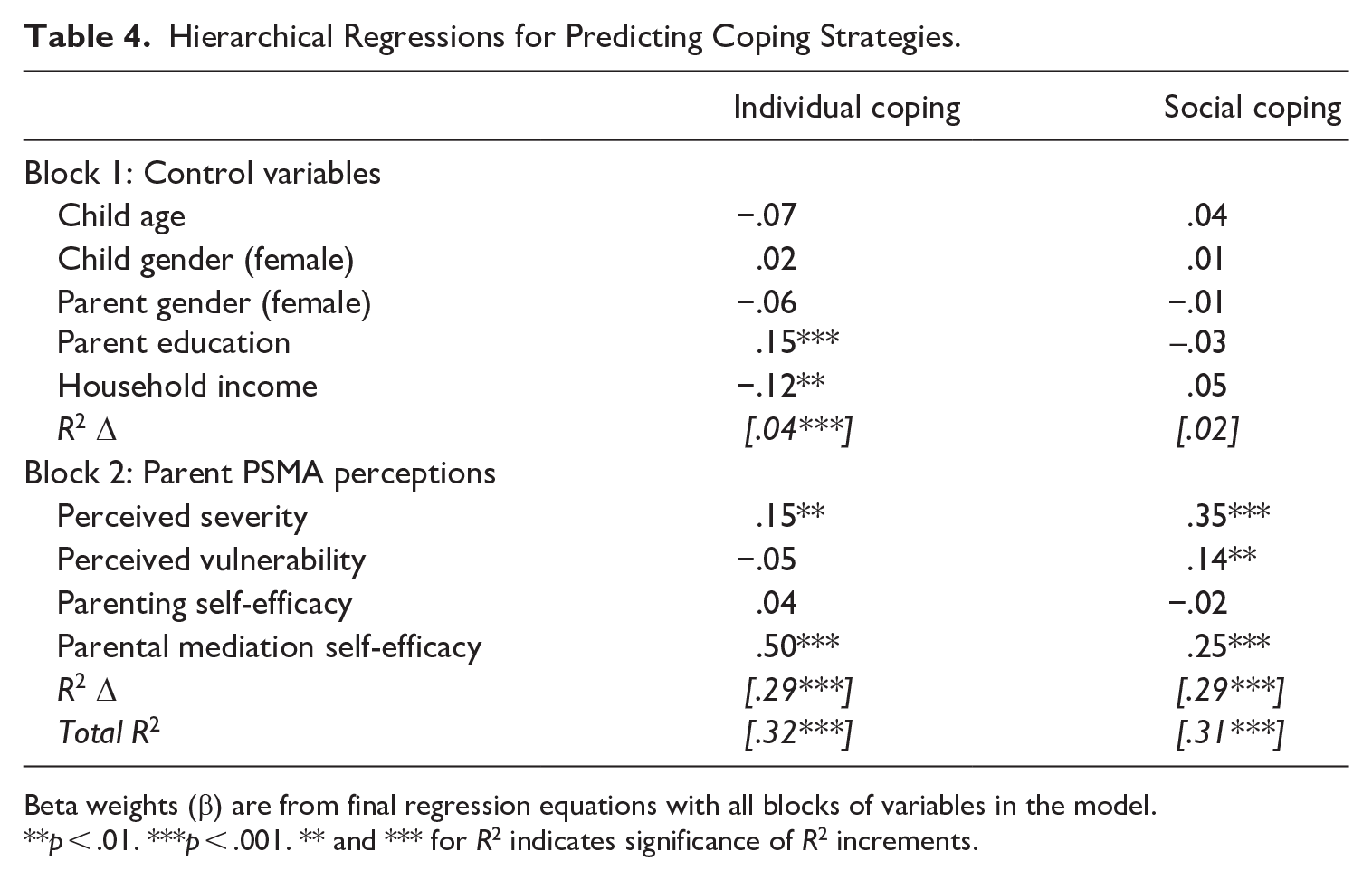
Beta weights (β) are from final regression equations with all blocks of variables in the model.
**p < .01. ***p < .001. ** and *** for R2 indicates significance of R2 increments.
H1 predicted positive associations between the two threat appraisal variables (perceived severity and vulnerability) and parental coping strategies. Results show that perceived severity is positively associated with both individual (β = .15, p < .01) and social coping (β = .35, p < .001). While perceived vulnerability is significantly related to social coping (β = .14, p < .01), it is not associated with individual coping (β = –.05, p = .29). Thus, H1 is fully supported for social coping and partially supported for individual coping. H2 posited that self-efficacy variables (parenting and parental mediation self-efficacy) would be positively associated with individual coping. While parental mediation self-efficacy is a positive and strong predictor of individual coping (β = .50, p < .001), parental self-efficacy is not significantly related (β = .04, p = .29), providing partial support for H2. RQ1 asked how self-efficacy variables would be related to social coping. Similar to individual coping, social coping is predicted by mediation-specific self-efficacy (β = .25, p < .001), but not by general parenting self-efficacy (β = –.02, p = .59).
Among control variables, parent education and household income are significantly associated with individual coping. Parents with high education (β = .15, p < .001) with lower household income (β = –.12, p < .01) are more likely to engage in active mediation. However, none of the child or parent background characteristics are significantly related to social coping.
Discussion
Drawing on Protection Motivation Theory (PMT), Influence of Presumed Influence (IPI), and self-efficacy literature, this study examined parents’ reactions to personalized social media advertising (PSMA) targeting children. Specifically, it investigated threat appraisal (perceived severity and vulnerability regarding social media platforms’ data practices for ad personalization) and efficacy perceptions (self-efficacy in parenting and parental mediation) as antecedents of active parental mediation (individual coping) and support for external agents’ involvement in PSMA-related initiatives (social coping).
Theoretical implications
The findings indicate that both threat appraisal and efficacy perceptions are associated with parental coping strategies for PSMA, leading support to PMT. However, the relationships between the threat-efficacy variables and coping strategies differ by coping type. Specifically, parents are more likely to engage in individual coping when they are confident in their ability to do so (parental mediation self-efficacy) and perceive social media data practices as harmful (perceived severity). Contrary to PMT, the degree to which parents believe their children are vulnerable to these data practices (perceived vulnerability) is not significantly related to individual coping. However, perceived vulnerability, along with perceived severity and parental mediation self-efficacy, predicts social coping.
Role of threat appraisal
The findings on threat appraisal underscore the complexity of parental coping strategies in the context of PSMA. Prior research has consistently shown that parents’ negative views and concerns about their children’s media consumption are positively associated with parental mediation (Wang et al., 2023). However, little is known about how these negative views and concerns affect parental social coping for PSMA. The present study confirms that threat perceptions related to others’ media use—specifically, their children’s—are associated with both individual and social coping, offering support for IPI. At the same time, the findings reveal that the role of presumed influence is contingent upon behavioral domains (i.e. individual vs. social coping).
Applying PMT to parental presumed influence of PSMA on their children, perceived severity reflects how serious parents believe the threat of PSMA is, while perceived vulnerability captures the likelihood of that threat affecting their children. The findings suggest that parents are more likely to engage in individual coping when they perceive PSMA-related threats as severe enough to warrant personal intervention. However, perceived vulnerability, which captures the probability of exposure to risks (Rogers, 1983), may not provide sufficient motivation for parents to take individual action. Furthermore, Milne et al. (2000) argue that when a threat is perceived as severe and the required response is complex, the motivational role of vulnerability may diminish. In the PSMA context, even if parents perceive their child to be highly vulnerable, the complexity of managing this risk through individual mediation may lead them to view personal action as insufficient or ineffective. While this could explain why perceived vulnerability fails to predict individual coping in this study, further research is needed to explore how the complexity of a risk influences the relationship between vulnerability perceptions related to close others (e.g. one’s own children) and individual actions intended to protect them.
In contrast, social coping is predicted by both severity and vulnerability perceptions. In other words, parents are inclined to engage in social coping not only when they perceive PSMA practices as harmful (severity) but also when they believe their children are particularly susceptible to such practices (vulnerability). Parents who perceive their children as highly vulnerable may feel that parental mediation alone is inadequate. Given the complex and covert nature of PSMA, especially its embedded data collection and tracking practices, these parents may struggle to identify effective individual responses, potentially experiencing privacy cynicism, or a sense of uncertainty and powerlessness in managing digital privacy risks (Hoffmann et al., 2016). Such challenges may prompt them to seek broader, collective solutions by expressing strong support for actions taken by third parties. This aligns with findings from Chen et al. (2022) and Vijayalakshmi et al. (2018), who note that parents often employ multiple protective measures and turn to external socialization agents when individual efforts fall short.
This study also reveals that the importance of threat appraisal in parental social coping is more pronounced when compared with efficacy perceptions in individual coping. Specifically, in predicting individual coping, parental mediation self-efficacy emerges as the strongest predictor (β = .50, p < .001), followed by perceived severity (β = .15, p < .01). For social coping, while parental mediation self-efficacy remains significant (β = .25, p < .001), its magnitude decreases. Conversely, threat appraisal variables account for greater variance in social coping (βseverity = .35, p < .001; βvulnerability = .14, p < .01). This further reinforces the idea that parents with high threat perceptions regarding PSMA may feel that parental mediation alone does not sufficiently protect their children from PSMA. As a result, they may believe that third parties should act to better protect children from the potential harms of PSMA.
Role of self-efficacy
This study reveals distinct roles of parental mediation self-efficacy and parenting self-efficacy. The results show that parental mediation self-efficacy predicts both individual and social coping strategies. While the positive association between parental mediation self-efficacy and individual coping aligns with prior research (Glatz et al., 2018; Holvoet et al., 2022; Hwang et al., 2017; Shin, 2018), this study advances knowledge by highlighting its role in a broader range of intervention strategies, including social coping.
Given limited prior research, this study explored two competing possibilities about self-efficacy and social coping: parents with high self-efficacy may not need social coping due to confidence in their individual coping abilities, or they may engage in both due to a general proactive orientation. The findings appear to support the latter, shedding light on the role of self-efficacy in promoting various coping strategies. Although parents with high parental mediation self-efficacy are motivated to help their children understand the nature of PSMA through active mediation, they also seem to recognize the necessity of other agents creating a healthier advertising environment for children.
Although parenting self-efficacy was found to be positively correlated with coping strategies in the zero-order correlation analysis (Table 3), it did not emerge as a significant predictor of coping strategies in the regression analyses when other threat and coping appraisal variables, as well as child–parent background variables, were accounted for (Table 4). This finding contrasts with prior research demonstrating a strong positive association between parenting self-efficacy and parental mediation in regression analyses (e.g. Shin, 2017; Shin, 2018; Shin and Lwin, 2022). The discrepancy between the current and prior research can be explained by the specificity and unique characteristics of PSMA targeting children. Prior studies focused on children’s use of smartphones (Shin, 2018) and digital media more broadly (Shin and Lwin, 2022), and exposure to television, Internet and mobile advertising (Shin, 2017). These media are often part of parents’ daily media routines, allowing confident parents to engage in active mediation even without advanced media competency (Shin, 2018). However, research suggests that parents are often unaware of subtle and covert forms of advertising like personalized ads (Brinson et al., 2024). Intervening in data-driven PSMA targeting children likely requires specific knowledge and substantial effort. In this context, general parenting skills alone may not be sufficient to motivate high-level, specific domain coping responses.
The differing roles of the two types of self-efficacy confirm that self-efficacy is domain specific (Holloway et al., 2016). While parents confident in their parenting skills may also feel confident in parental mediation skills, this likely depends on the type of media messages and technologies involved. In this study, parenting self-efficacy and parental mediation self-efficacy are positively associated, but the correlation (r = .23) is rather weak, supporting the domain distinction observed in prior parental mediation research (Shin, 2018).
Practical implications
The study provides several practical implications. Parents in this study expressed strong support for the involvement of external agents in addressing PSMA targeting children, as indicated by the average social coping score of 5.63 out of 7 (vs. 4.66 for individual coping: see Table 2). This underscores the pressing need for institutions to collaborate in supporting parents’ efforts to protect children from data-driven advertising practices.
Given the important role of parental mediation self-efficacy in coping strategies, public awareness campaigns and educational programs should prioritize enhancing parents’ confidence and skills in managing their children’s social media use and understanding data privacy issues in PSMA. Policymakers can support these efforts by funding and promoting educational initiatives and ensuring that media educators have the necessary resources to inform parents about personalized advertising and data privacy. Educators can then leverage these resources to implement effective interventions through school-based workshops and outreach programs.
Since parents may not fully understand the scope and mechanics of PSMA, educational efforts should go beyond general digital literacy to offer concrete, accessible guidance. This includes hands-on demonstrations using real-world examples of data-driven advertising, step-by-step instructions on adjusting privacy settings across diverse social media platforms, training on using parental controls, and strategies for initiating informed discussions with children about PSMA. In addition, since threat appraisal is likely to motivate parents to take an active role in their coping strategies, educational campaigns and programs should emphasize the unique and specific risks pertinent to PSMA while reinforcing the importance of both active mediation and broader social coping strategies.
Finally, as perceived vulnerability is a key factor promoting parents to seek external coping measures, advertisers and tech companies should respond to parental concerns by increasing transparency around data practices. This includes clearly communicating how children are targeted, what data are collected, and for what purposes. Industry stakeholders should work collaboratively with policymakers, educators, and parents to develop accessible disclosures and user-friendly privacy tools. Strengthening transparency and cooperation between parents and external agents can empower families to make informed decisions and contribute to a safer digital environment for children.
Limitations and suggestions for future research
This study is based on a cross-sectional survey of parents residing in a single country. Therefore, caution should be exercised when inferring causal relationships among the examined variables and applying the study’s findings to other cultural contexts. Future research could consider longitudinal studies across varying cultural contexts. For example, comparing countries with stricter versus more lenient regulations on data-driven advertising and digital privacy would provide insights into how regulatory environments affect parents’ risk perceptions and coping strategies regarding children’s exposure to PSMA.
The specificity of PSMA, characterized by its complex mechanisms and limited relevance of general parenting self-efficacy, may limit the generalizability of this study’s findings to broader media contexts. Nonetheless, the insights from this study seem to be highly applicable to emerging and dynamic media contexts, such as algorithm-driven video-sharing platforms and generative artificial intelligence (AI) technologies. These contexts present similar challenges, where parents often lack concrete knowledge and experience frustration in navigating rapidly evolving systems (Taylor and Brisini, 2024). Future research should examine whether similar dynamics occur in these and other contexts to expand the theoretical understanding of the differing roles of self-efficacy in shaping parental coping strategies.
The measurement for parental social coping was adapted from prior research on teens’ social coping with social media newsfeed advertising (Youn and Shin, 2019) due to the lack of established scales specifically assessing parental social coping. Thus, the current study’s measurement for social coping requires further investigation to assess its validity and reliability in other media contexts. Future research should carefully examine and refine the social coping construct used in this study, potentially by expanding it to include such behaviors as reliance on peer support networks.
Although this study is grounded in PMT, it did not test all constructs of the theory, such as response efficacy. This decision was based on the assumption that parents had not yet formed clear beliefs about the effectiveness of their protective behaviors in this relatively unfamiliar and complex domain. However, as data-driven media and advertising practices continue to expand, parents may begin to develop stronger efficacy beliefs, which could influence both individual and social coping strategies. For example, parents with high response efficacy, believing that their actions can effectively reduce risk, may become less reliant on external interventions. In addition, while this study examined self-efficacy in individual coping (parental mediation), it did not assess self-efficacy for social coping. Thus, the finding that parental mediation self-efficacy is more strongly associated with individual than social coping is not surprising. Research in other domains, such as climate action, suggests that individuals with high self-efficacy in collective action are more likely to support policy initiatives or contact political actors (Lam, 2015; Mackay et al., 2025). Applying this to PSMA, it is plausible that parents who feel confident in enlisting external agents (i.e. high social coping self-efficacy) and who believe such efforts are effective (i.e. high social coping response efficacy) are more likely to engage in social coping. Future research should examine these omitted constructs to further validate the utility of PMT in explaining various coping strategies adopted by parents.
Following the traditional approach to PMT (Floyd et al., 2000; Milne et al., 2000; Rogers, 1983), this study examined threat appraisal (perceived severity and vulnerability) and coping appraisal (self-efficacy) variables as parallel and direct predictors of parental coping strategies. However, some studies in the privacy and information security domains (e.g. Chang et al., 2022; Mamonov and Benbunan-Fich, 2018) have explored self-efficacy as a moderator affecting the relationship between threat appraisal and protective behaviors. Although such approaches often lack clear theoretical justification, they highlight the potential complexity of self-efficacy’s role. Future research could explore the dual role of self-efficacy as both a direct predictor and a moderator, which could enhance the theoretical understanding of its function in PMT-based models.
Finally, this study did not explore factors affecting parental risk perceptions of PSMA. Future research should investigate these factors to provide a more comprehensive understanding of what influences parents’ threat and coping appraisals. For example, as discussed earlier, the nature of a risk could be examined as a factor affecting the dynamics of threat appraisal variables. In terms of coping appraisal, prior research suggests that parents with higher digital and advertising literacy are more actively involved in parental mediation (Ahn, 2022; Shin and Lwin, 2022). Building on this, future studies could explore parents’ general self-efficacy related to PSMA, that is, how knowledgeable and confident they feel in managing personal data and responding to PSMA, as a potential predictor of their coping strategies. In addition, given that perceptions of media effects on others often depend on the perceived social distance, as proposed in the social distance corollary (Tsfati and Cohen, 2004), and that the quality of parent–child relationships varies, as documented in parenting style research (Darling and Steinberg, 1993), future research could examine how perceived closeness to one’s child affects parental risk perceptions and subsequent coping strategies.
Conclusion
Research on the parental roles in children’s media use has predominantly focused on individual coping through parental mediation. However, challenges posed by contemporary media increasingly necessitate support from external socialization agents, such as governments, schools, and corporations. This study contributes to the literature by exploring both individual and social coping strategies that parents adopt to address PSMA targeting children. The findings confirm the applicability of PMT in explaining protective behaviors not only for oneself but also for others, such as children. By incorporating IPI, this study also highlights the critical role of parental perspectives in shaping coping strategies aimed at protecting children. This integration broadens the scope of IPI, underlining its relevance to both parental mediation and advocacy contexts. Finally, the study underscores the importance of distinguishing between general parenting self-efficacy and parental mediation self-efficacy, emphasizing the crucial role of media-specific self-efficacy in predicting parental interventions in media environments that demand specialized knowledge and sustained effort.
Footnotes
Funding
The author(s) disclosed receipt of the following financial support for the research, authorship, and/or publication of this article: This study was funded by the University of Melbourne.
