



Abstract
Guided by communication privacy management theory, this study tested network size, network diversity, privacy concerns, and privacy management practices in and between Facebook and Snapchat for social media natives. A cross-sectional survey of 273 college students (predominately Caucasian, female, 18- to 20 years old) showed that audiences were larger and more diverse in Facebook than Snapchat. Snapchat users with larger friend lists and lower privacy concerns reported more shared boundary ownership, whereas those with more diverse networks reportedly used more open friending practices to expand their connections. Higher privacy concerns were related to more restrictive privacy management practices in both mediums, and participants were overall more open on Snapchat than on Facebook. Theoretical and practical implications were presented in efforts to inform future research.
Keywords
In the past decade, Internet use has shifted from more consumption of information to producing and sharing one’s own information, due in part to the nearly ubiquitous availability and use of various social media. In 2005, 5% of American adults used social media; by the end of 2016, that number increased to 69% (Pew Research Center, 2017). Although Facebook has remained the most popular social networking site across age groups, other social media platforms such as Snapchat, Instagram, and Twitter have risen in popularity among young adults (Lenhart et al., 2015; Pew Research Center, 2017). By design, social media encourage users to disclose private information. Petronio (2002) defines private information as information that users believe they own and needs to be protected. Furthermore, technological features such as tagging others increase opportunities to blur boundaries between who should have access to private information and who should not.
Privacy management may differ across age groups, especially in online spaces where some are residents and others are visitors (White & Le Cornu, 2011). Digital natives—the residents in this metaphor—are individuals whose childhoods were surrounded by advancing technologies, screens, pushing of buttons, and social networking sites (Taipale, 2016). Although we know that digital natives differ from digital immigrants (born before 1980) in their social media adoption and use (Kezer, Sevi, Cemalcilar, & Baruh, 2016; Parida, Mostaghel, & Oghazi, 2016), one may expect further differences between segments of digital natives. For example, Taipale (2016) argued that digital natives born in the 1990s and 2000s are “more engaged with the social functions of the Internet” (p. 82). For the purposes of this study, this group is referred to as social media natives because social networking sites and other social media were available during their formative pre-teen years. In that these young adults and teens are natives of social media, it is important to study their privacy management practices as a distinct group rather than assuming their experiences are identical to others. Furthermore, the first 2 years of young adults’ college experiences are marked by changes in privacy rules and boundaries as they adjust to shifting roles within their families and increased exposure to new and different people (see Chickering & Reisser, 1993). During this time of “emerging adulthood,” 18- to 24-year-olds grapple with the reality of being between adolescence and adulthood, “trying out adult roles but not yet immersed in them, on the way to adulthood but not there yet” (Arnett, 2012, p. 242). This time of liminality in a young adult’s life may prove to be fertile ground for studying privacy management and online life.
For young adults, the social media spectrum may be visualized with Facebook on one end and Snapchat on the other 1 ; their widespread use and structural differences provide a suitable environment for investigating the differing effects of the audience, persistence, and privacy concerns on privacy management practices. Of online social media natives, 88% use Facebook regularly (Greenwood, Perrin, & Duggan, 2016), despite the myth claiming teens and younger adults have “moved on” from the social media giant. Snapchat, an auto-delete messaging application with social media capabilities, is becoming increasingly popular among social media natives, with 78% adoption (Smith & Anderson, 2018). Both social media platforms are multimodal, offering profile information, semi-public spaces for self-presentation (timeline in Facebook, stories in Snapchat), and private messaging. There are built-in mechanisms for expanding one’s network through discovery and recommended connections. These complex social media spaces provide users with many avenues for self-expression, which brings with it many opportunities for privacy turbulence (Waddell, 2016).
Social media natives are more likely to use multiple social media applications than older digital natives and digital immigrants (Lenhart et al., 2015), providing additional tools for privacy management. For example, a young adult may use Facebook for a broad audience to highlight accomplishments and travels and use Snapchat for more playful self-presentation among peers. However, researchers often examine just one social media application when studying online privacy and disclosure, which does not fully tap into the users’ lived experiences of managing privacy across multiple platforms. It is necessary to examine similarities and differences across these sites to better understand the characteristics that are important when making decisions about privacy.
The goal of this study is to apply Petronio’s (2002, 2013) communication privacy management (CPM) theory by examining network characteristics, privacy concerns, and privacy management in and between Facebook and Snapchat for young college students. It is expected that this project will extend CPM by incorporating attributes of the audience into the model, as well as through the refinement of quantitative measures relevant to the theory. Though CPM frames privacy management as a dyadic process within a more complex system, this exploratory study examines just one side of privacy management with the expectation that future research should take a more comprehensive approach to further uncover the dynamics of online privacy management.
CPM Theory
Social media users must continually make decisions about how to manage their privacy: whether to share or withhold private information, how much detail they should include, and what social media channel they should use to disclose that information are among the many decisions that users must make when managing their privacy in social media. CPM is a useful tool to frame the study of privacy management in social media use, given the dynamic and multifaceted nature of disclosure in social media. Social media platforms can be considered “collective information management systems” where connected individuals co-own private information (Y. H. Choi & Bazarova, 2015, p. 492), analogous to CPM’s privacy management system (Petronio, 2013). Within these systems, users manage their privacy, making decisions about what information to share, to whom, and how in attempts to manage the evolving dialectical tension of revelation and concealment (Petronio, 2002). While disclosure decisions are made within relationships and the larger social context, early iterations of CPM (Petronio, 1991, 2002) provided a framework for micro-level predictions about disclosure from the perspective of the discloser. CPM’s heuristic quality provides a rich landscape available for scholars to tease out aspects of the privacy management system (see Petronio, 2004).
CPM theory uses a dialectical approach to examine how people utilize rules to manage their needs to reveal and conceal private information within a CPM system, where shared information becomes co-owned by the audience (Petronio, 2002, 2013). Adhering to a systems approach, the CPM system is composed of three interdependent elements: privacy ownership, privacy control, and privacy turbulence (Petronio, 2013).
Privacy ownership uses a boundary metaphor to describe the way that individuals determine where to draw the line between private and public information, including how to negotiate collective boundaries (Petronio, 2013). When applied to social media, individuals make decisions about how tightly they might control their boundaries, and who to allow into their friend or follower network as potential co-owners of their private information. In Snapchat, this includes choosing a specific message recipient to bring into the collective privacy boundary (Velten, Arif, & Moehring, 2017). Privacy control is then actively managing access to that information through the development and continual adjustment of privacy rules (Petronio, 2013). This can mean using tools within social media to hide certain information, setting an account to public or private, and/or using rules to determine appropriate content to post. Finally, privacy turbulence is an event or scenario that causes one to create or change rules and expectations regarding privacy (Petronio, 2013), such as having an account hacked or getting into trouble at work or school because of something that was posted on social media. There are a variety of triggers, such as relational, impression management, and identity safety, that require a subsequent revision to privacy rules and “scrubbing” online content (Child, Petronio, Agyeman-Budu, & Westermann, 2011). In Snapchat, when messages that would otherwise disappear are “screenshot” and saved by the recipient, turbulence can ensue (Velten et al., 2017)
When considering these three privacy management processes together, open management practices are those that promote greater connection and transparency with others, deemed as thin, permeable boundaries in CPM (Child, Pearson, & Petronio, 2009). There is a growing body of literature examining privacy concerns and negotiation in the social uses of the Internet, especially regarding social media. Although not all of the research is grounded in CPM, it offers insight related to the effects of audience size and makeup on social media usage, and how privacy concerns affect users. However, a closer examination of the differences between Facebook and Snapchat will lend itself to drawing predictions among and between the two platforms.
Facebook and Snapchat
Facebook and Snapchat are two popular social media applications that have potentially important structural and functional differences that may affect privacy. Facebook and Snapchat may be used by young adults to reach different types of audiences. Facebook provides connections to large and diverse networks (Y. H. Choi & Bazarova, 2015), larger than the audiences young adults have reported in Snapchat (Utz, Muscanell, & Khalid, 2015). Though Facebook linkages are called “friends,” research has shown that young adults connect, and subsequently co-own private information with many types of people through Facebook, including professors (Sheldon, 2016), parents (Child & Westermann, 2013), managers and supervisors (Karl & Peluchette, 2011), and even people they dislike (Vendemia, High, & DeAndrea, 2017). This diverse network is what lands Facebook into news headlines as having a bigger population than the United States, China, and Brazil combined (CBS, 2017).
Additional research has shown that social media natives are more attracted to synchronous tools, such as Snapchat (Taipale, 2016). There is a sizable difference in the age of Snapchat users: 78% of teens and young adults use Snapchat, yet only 26% of online adults aged 30 to 49 years and less than 10% of those 50 years and above report use (Smith & Anderson, 2018). One might expect that Snapchat users’ connections are more homogeneous, given the overall younger age of Snapchat users. Two hypotheses are proposed to test differences in audience makeup:
Privacy Management Practices
Social media natives must negotiate their privacy boundaries online through the use of various privacy rules and strategies. Privacy management is a construct originally developed and tested by Child et al. (2009) to assess the three CPM systems previously discussed. While decisions about privacy are internal processes, privacy management practices allow researchers to observe and quantify how public and open social media users are when managing disclosures shared within their social media accounts (Child, Haridakis, & Petronio, 2012). Boundary permeability involves using privacy rules to exercise less restriction over private information (Petronio, 2002). Social media users may employ more permeable boundaries when they open up and disclose more personal information (Child et al., 2009). They tend to share freely and frequently in social media about a variety of topics. Boundary linkages involve expanding audiences to allow greater access to information that is shared (Child et al., 2009). For example, social media users may be willing to accept friend requests, even from those they do not know well. Boundary ownership captures the importance of co-owners, or audience members, and their independent control over private information that is shared with them. Social media users who have more open boundary ownership are more willing to post freely and be less strict about what audience members do with that information (Child et al., 2009).
The social and technological affordances of Facebook and Snapchat should affect privacy management practices. For example, content in Facebook is high in scalability, where content can be made visible to larger audiences than perhaps intended (boyd, 2011). Facebook affords persistence in its content as well, where information is automatically archived (boyd, 2011). Subsequently, the context collapse associated with Facebook presents unique challenges, especially for those with self-presentation goals (Jensen & Sørensen, 2013; Rui & Stefanone, 2013; Vitak, 2012). As a result, one might expect social media natives to be more closed and restrictive in their privacy management practices.
In contrast to Facebook, which is often used to archive photos and other private information (Zhao et al., 2013), Snapchat is temporary by design. Snaps sent to individuals or groups disappear seconds after they are sent, and those posted to one’s story are typically shown for just 24 hr, something social media natives reportedly enjoy and see as an important part of Snapchat’s use (Bayer, Ellison, Schoenebeck, & Falk, 2016). Waddell (2016) called this affordance recordability, and in his study, this affordance of Snapchat was linked to increased perceptions of privacy. T. R. Choi and Sung (2018) found that the low visibility afforded by Snapchat resulted in less privacy concern and more open self-expression.
Another feature of Snapchat is more perceived control over the audience of content, as well as the audience’s interpretation of the content. Because Snapchat informs users when their private messages have been “screenshot” and saved by recipients, the scalability may be less than Facebook. Although this level of control cannot be guaranteed given the varied ways one might subvert this privacy feature, the perception of control is still present. Despite the private and more controlled nature of snaps, stories are available to all friends in the network and individual snaps can be made into public stories to increase scalability. Content is more easily editable in Snapchat compared with Facebook, given the photo-editing tools embedded within the technology itself. Through cropping, filters, and text merged into one snap, Snapchat users have more perceived control over how their messages will be received (T. R. Choi & Sung, 2018). As a result of their perceived privacy control, social media natives may feel freer to share private information (T. R. Choi & Sung, 2018). For example, young adults often post more playful selfies on Snapchat (Katz & Crocker, 2015), perhaps experimenting with multiple identities within this lower-stakes medium. The expected difference in privacy management practices will be tested with the following hypothesis:
Effects of the Audience
Recent research has shown that the size and diversity of the audience affects privacy concerns and the management of that privacy. Privacy concerns differ across social media platforms (e.g., Y. H. Choi & Bazarova, 2015; Katz & Crocker, 2015; Quinn, 2014). Because people typically maintain larger and more diverse audiences on Facebook than other social media platforms, they often experience more concern for privacy when using Facebook (Y. H. Choi & Bazarova, 2015). In addition, audiences in Facebook are generally more uncertain: content can easily be shared, individuals can be tagged in unwanted content, and tagging others may open broader potential audiences, resulting in more concern for privacy (Y. H. Choi & Bazarova, 2015). Persistence of content is another predictor of privacy concern; those social media with information that is automatically archived (i.e., Facebook) bring with them more privacy concern (see boyd, 2011). However, research has found that Snapchat users are less concerned with privacy because the content is ephemeral in nature (Katz & Crocker, 2015). Given the expected differences in audience composition and the technological affordances of Facebook and Snapchat, a hypothesis was posed to test differences in privacy concern:
Network size also affects privacy management practices. Social media users with larger networks post and disclose more in social media than those with smaller networks (Jin, 2013; Rui & Stefanone, 2013; Vitak, 2012). When individuals have a larger audience, they automatically have more opportunities to exchange information and socialize with their audiences. These types of disclosures could be more personal, allowing users to build social capital through expansive networks and narrow the social distance between themselves and the audience (Y. H. Choi & Bazarova, 2015), thus using more open privacy management practices. A hypothesis is posited to test this expected difference:
The diversity of one’s network affects social media use as well. Hogan’s (2010) lowest common denominator approach argues that social media users must consider a potential hidden or invisible audience when choosing what to post (see also Marwick & boyd, 2010). This hidden audience could include a parent, teacher, boss, or stranger who might potentially see that user’s post. When considering all of the potential audience members, social media users may adjust the intimacy of the post according to the lowest common denominator, leading to less intimate disclosures within diverse networks (Hogan, 2010; cf. Marder, Joinson, Shankar, & Thirlaway, 2016). With the imagined audience in mind, social media natives may then adjust their disclosures according to the corresponding privacy management practices (see Litt, 2012). Existing research lends support for this approach within Facebook (Jensen & Sørensen, 2013; Rui & Stefanone, 2013), though to date, it has not been sufficiently tested in Snapchat. However, given the expected differences between Facebook and Snapchat audiences, the following hypothesis was posed:
Model Testing
Taken together, one would expect network composition and privacy concerns to drive privacy management practices. When studying privacy concerns on Facebook specifically, individuals who reported high concern with their privacy on Facebook disclosed less information (Vitak, 2012), which could be considered more closed privacy management. Differing privacy concerns subsequently led to the active negotiation of privacy control (Vitak, Blasiola, Patil, & Litt, 2015). For example, Ongun and Demirag (2014) found that young adults are more likely than their elders to utilize Facebook tools, such as blocking, to manage privacy. Young adults who expressed concern for privacy in Vitak et al.’s (2015) Facebook study reported using a variety of privacy management tools, including self-censorship. Given the complex nature of audience characteristics and privacy concern in managing one’s privacy, a model is proposed in Figure 1 to extend CPM. This model will be tested via a research question:

Proposed conceptual model of privacy management in Facebook and Snapchat.
Methods
Informed by qualitative data collected during a preliminary study, the researcher conducted a cross-sectional, within-subjects study design using self-report instruments. 2 The six study hypotheses are presented to test relationships among study variables, whereas the research question brings all study variables together in a model that is offered to extend CPM in a way that accounts for channel differences and effects of audience makeup.
Participants
The researcher recruited study participants using a research pool comprising students in the basic communication course at a large Midwestern university. College students are appropriate for this study, as they are experiencing social and emotional changes during the transition to college and are active social media users. Specifically, young adults aged 18 to 20 years were solicited to better capture the especially volatile times of one’s early college life (Chickering & Reisser, 1993) when privacy management on social media may be more salient. Students were invited to participate as one way to earn required research credit for the course. Criteria for participation included the participant being 18 to 20 years of age and using both Facebook and Snapchat on average at least once per week. Age was restricted to ensure participants represented social media natives. The final sample of 273 people was predominantly female (n = 189, 69.2%) and Caucasian (n = 246, 90.1%), aged on average 18.68 (SD = 0.75) years. Participants reported significantly more daily use of Snapchat (M = 3.11 hr, SD = 3.54) than of Facebook (M = 2.02 hr, SD = 2.51), t(272) = 5.62, p < .001.
Procedures
After providing informed consent, participants completed questionnaires facilitated online through Qualtrics. Measures of social media use (time and frequency) and social media affinity were collected first. Network size and diversity, privacy management practices, and privacy concerns for Facebook were collected next, followed by the same measures adapted for Snapchat. Finally, participants reported age, sex, and race/ethnicity.
Measures
All continuous measures in this study were found to be reliable. Table 1 reports means, standard deviations, and reliability estimates for study variables.
Means, Standard Deviations, and Cronbach’s Alphas for All Variables.

Note. Privacy concern and privacy management practices were measured on a 1-7 scale. Social media affinity was measured on a 1-5 scale. Network diversity could range from 0 to 25.
Variables measured by one item each.
Reliability estimates were not computed, given the nature of the measure as cumulative rather than latent.
p < .001.
Network Size
Network size is a measure of the total number of individuals who are connected to the participant. For Facebook, participants were asked to log into their Facebook page (or mobile application) and report the actual number of connections in their Facebook friend list. At the time of data collection, there was no simple way to determine the actual number of Snapchat connections, so participants were asked to access Snapchat on their devices and give their best estimate of their total number of Snapchat connections.
Network Diversity
Network diversity is a measure of the total relationship types that are represented in one’s social media connections. In line with existing research (Y. H. Choi & Bazarova, 2015; Manago, Taylor, & Greenfield, 2012), participants were asked to check off each of 25 categories, such as parent, best friend, classmate, and co-worker, that were represented in their Facebook and Snapchat networks, separately. There was an option for “other,” with a request to describe so that the researcher could determine whether this was a new category or one that could be folded into an existing category. Network diversity was computed by summing all present categories, with higher scores represented more diversity in the potential audience for social media activity.
Privacy Concerns
Vitak’s (2012) three-item Facebook posting concerns measure was used to assess Facebook privacy concerns. It was also adapted for Snapchat to measure concerns when using that medium. Higher scores represented more concern about privacy relative to posting in Facebook and Snapchat, respectively.
Privacy Management Practices
To measure participants’ behaviors relative to privacy management within social media, they completed two scales, one for Facebook and one for Snapchat. The author modified Child et al.’s (2009) blogging privacy management measure, updating it for newer features of the social media platforms of interest in this study. Originally comprising 18 items written for Facebook, the researcher added two items to the Facebook measure and four to the Snapchat measure to capture newer capabilities of social media since the measure was first created. For example, items added to the Facebook measure include “I use hashtags so that my posts are visible to a larger audience” and “I check into locations (restaurants, museums, airports, etc.) to increase my visibility.” A bit more liberty was taken when adjusting the measure to Snapchat, as the medium has some features and terminology that are different from Facebook. For example, rather than “posts,” participants were asked to consider their “snaps and stories.” Given the technological features of Snapchat, such as geotagging and filters, the six items from Child et al.’s (2009) boundary linkages subscale were significantly reworded. For example, the original item “I allow access of my blog through any of these: directories, key word searches, or weblog rings” was revised as “I use geofilters so that my snaps are visible to a larger audience.” Items added include “I often send snaps to larger causes that may feature my post to a more public audience” and “I import friends through my contact list,” among others. (See Tables 2 and 3 to examine items new to the scales.)
Factor Loadings for Final Three-Factor Solution of Facebook Privacy Management Practices.

Newly created item for the purposes of this study.
Factor Loadings for Final Five-Factor Solution of Snapchat Privacy Management Practices.
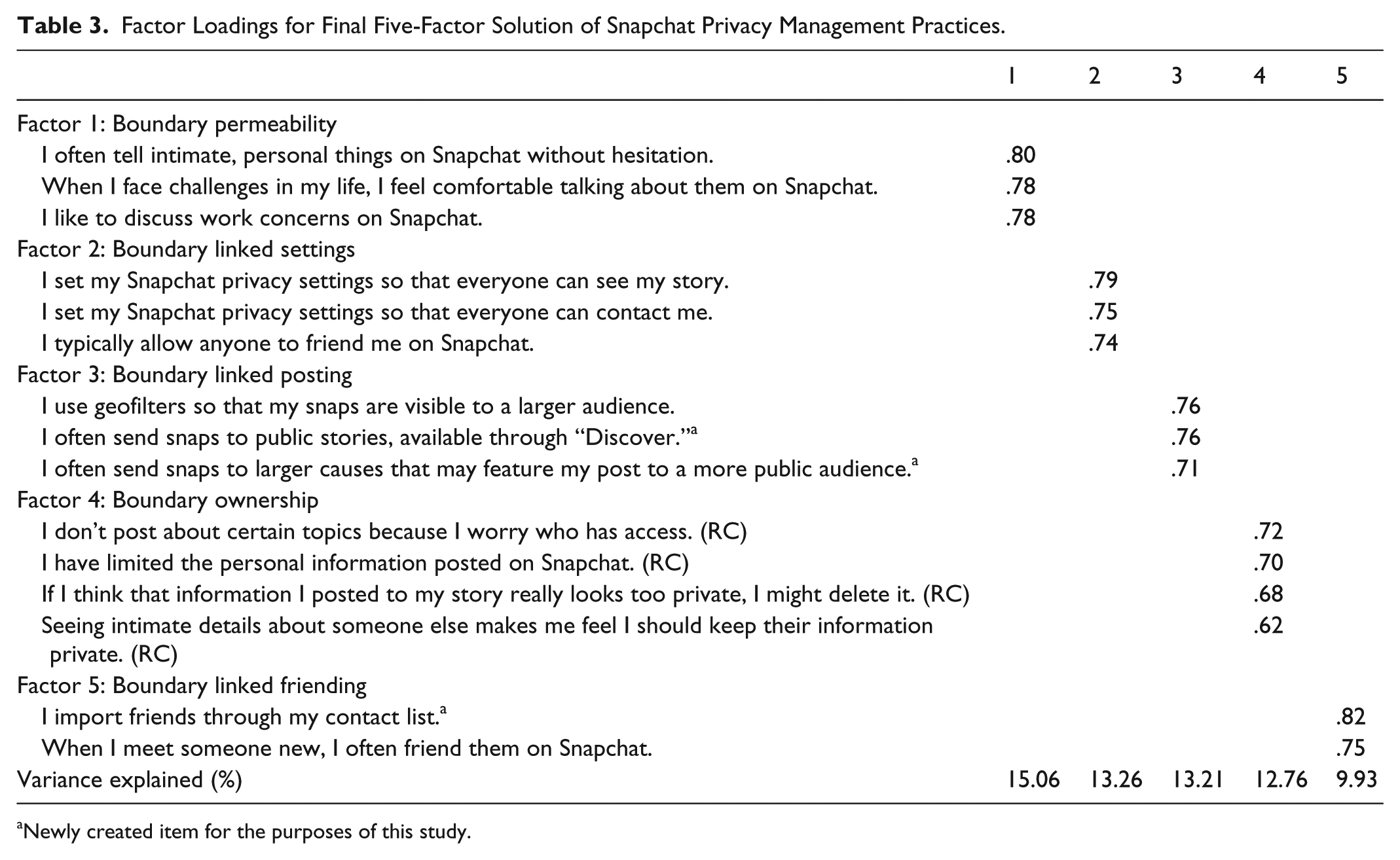
Newly created item for the purposes of this study.
Although originally designed as a multidimensional scale measuring privacy boundary permeability, linkages, and ownership (Child et al., 2009), newer research by Child and colleagues has treated the scale as a unidimensional measure (e.g., Child, Duck, Andrews, Butauski, & Petronio, 2015; Child et al., 2012), with higher scores indicating overall more open, public management of social media disclosure. For the purposes of this study, the unidimensional score was used when comparing privacy management between Facebook and Snapchat. When examining relationships among variables within each social medium, scores on the underlying dimensions will be used to help uncover relationships at work within Facebook and Snapchat.
A three-stage exploratory factor analysis with Varimax rotation was conducted on both the Facebook and Snapchat privacy management measures to reveal latent factors. Varimax rotation, a common and accepted method of orthogonal rotation, was used to increase the interpretability of factors (see Abdi, 2003). Analyses revealed a three-factor solution for Facebook, including 10 items and accounting for 60.47% of the variance (see Table 2). Scores were computed by averaging each participant’s responses on the items loaded on each factor.
Factor 1, boundary linkages, included four items from the dimension of the same name in Child et al.’s (2009) measure. These items measure privacy management practices intended to increase Facebook connections. Factor 2, boundary permeability, included three of the items from the original subscale measuring openness of information posted on Facebook. The third factor, boundary ownership, included three reverse-coded items from the original subscale, measuring a willingness to post openly regardless of what others may do with that information.
A similar process was used to reveal the latent factors in Snapchat privacy management practices. Analyses revealed a five-factor, 15-item solution, explaining 64.21% of the variance (see Table 3). The first factor, boundary permeability, included three items from the a priori measure that tap into the willingness to share intimate information on Snapchat. The fourth factor, boundary ownership, contained four reverse-coded items from the dimension of the same name in Child et al.’s (2009) measure. These items measured sharing information with less concern over co-ownership.
Factors 2, 3, and 5 represent three dimensions of boundary linkages from the a priori measure. Factor 2, boundary linked settings, included three items that measure the use of privacy settings and rules to link with others. Three items comprised boundary linked posting, which measures the practice of sending snaps to expand linkages. Factor 5, boundary linked friending, contained two items measuring the practice of connecting with others through one’s contact list (available from other applications). Scores were computed for each dimension of privacy management. The subscales had acceptable reliability estimates, with the exception of boundary ownership for both Facebook and Snapchat. Given their theoretical significance in CPM and the history of Child et al.’s (2009) privacy management measure, these subscales were retained in the present study.
Control Variables
Age, sex, and social media affinity were added as controls in the total model testing, as they were not central to the scope of the present study but have been found to affect online privacy management (e.g., Hichang, Rivera-Sánchez, & Sun, 2009; Taraszow, Aristodemou, Shitta, Laouris, & Arsoy, 2010), as well as social media motives and use (Ellison, Steinfeld, & Lampe, 2007; Papacharissi & Mendelson, 2011). Age and sex were measured with one item each. Social media affinity, or positive attitudes about social media, was measured with six attitudinal items from Ellison et al.’s (2007) Facebook intensity scale, adapted for general social media use.
Results
Network Size and Diversity
The first hypothesis predicted that network size would be larger on Facebook than Snapchat. A paired-samples t-test supported H1, t(238) = 15.38, p < .001. Participants reported significantly more connections on Facebook (M = 538.37, SD = 431.68) than on Snapchat (M = 119.43, SD = 86.74).
The second hypothesis predicted that network diversity would be larger on Facebook than Snapchat, which was also supported by a paired-samples t-test, t(272) = 12.11, p < .001. Participants’ Facebook friend lists were more diverse in relationship types (M = 16.04, SD = 4.60) than their Snapchat networks (M = 12.99, SD = 4.17).
Hypothesis 3, testing differences between Facebook and Snapchat on overall privacy management practices, was also supported by a paired-samples t-test, t(272) = 13.33, p < .001. Specifically, participants reported more overall openness in their Snapchat privacy management practices (M = 3.29, SD = 0.77) than on Facebook (M = 2.75, SD = 0.70).
Hypothesis 4 predicted a higher concern for privacy in Facebook than in Snapchat. A paired-samples t-test supported this hypothesis, t(272) = 10.62, p < 001. Participants reported more privacy concern in their Facebook use (M = 5.09, SD = 1.59) than Snapchat (M = 4.11, SD = 1.72).
Hypothesis 5 predicted a positive relationship between network size and open privacy management practices, such that larger networks in Facebook and Snapchat will result in more open privacy management practices on those social media channels, respectively. To test these relationships, bivariate correlations were computed between network size and privacy management practices (overall), as well as the dimensions of privacy management revealed in the factor analyses, reported above. There were no significant correlations for Facebook. However, there were significant, positive correlations between Snapchat network size and overall privacy management practices (r = .18, p < .01), boundary linked friending (r = .20, p < .01), boundary ownership (r = .15, p < .05), and boundary linked posting (r = .17, p < .01). Therefore, H5 was partially supported for Snapchat only.
The sixth hypothesis predicted a negative relationship between network diversity and open privacy management practices in Facebook and Snapchat. Bivariate correlations were computed, and again, no significant correlations emerged for Facebook; however, results for Snapchat were opposite of the expected relationship. Snapchat network diversity was positively correlated with overall privacy management practices (r = .15, p < .05), boundary linked friending (r = .32, p < .001), and boundary linked posting (r = .15, p < .05). Surprisingly, Snapchat users with more diverse friend networks reported more open privacy management practices; therefore, H6 was not supported for Facebook or Snapchat.
Model Testing
After examining the relationships among foundational concepts in the model, a research question was posed to explore the overall effects of study variables on privacy management practices. Path analysis through regression was conducted to explore direct and indirect predictors of privacy management practices. First, privacy concern was regressed on network size and diversity for Facebook and Snapchat separately. Then, hierarchical linear regressions were conducted separately for each of the eight dimensions of privacy management practices in Facebook (three outcome variables) and Snapchat (five outcome variables). This statistical test requires the researcher to enter variables into the model in ways expected by the theoretical model (see Figure 1) to reveal the relative contribution of each set of variables to the outcome variable (in this case, privacy management practices). Control variables—age, sex, and social media affinity—were entered into block 1, followed by network size and diversity in block 2. Finally, privacy concerns were entered in block 3. Results are presented below separately for Facebook (see Figure 2) and Snapchat (see Figure 3).

Model of significant indirect and direct predictors of Facebook privacy management practices.

Model of significant indirect and direct predictors of Snapchat privacy management practices.
Linear regression testing the effects of Facebook network size and diversity on privacy concern was not significant, F(2, 248) = 1.22, p = .30. Testing for direct effects, the total model accounted for a relatively small, but significant amount of variance in boundary permeability, R2 = .06, F(6, 240) = 2.44, p < .05. Network diversity was the only significant predictor in the final model; participants with more diverse Facebook networks were more willing to post frequently and openly, above and beyond the effects of control variables, network size, and privacy concern (see Table 4). Boundary linking was not explained by the total model, R2 = .04, F(6, 240) = 1.59, ns.
Regressing Facebook Privacy Management on Network and Privacy Concerns.

p < .05. **p < .01. ***p < .001.
However, the total model explained 31% of the variance in boundary ownership, F(6, 240) = 17.68, p < .001. In this model, privacy concerns were inversely related to boundary ownership. As participants’ concerns for privacy in Facebook increased, they were more restrictive of audience members’ co-ownership (see Table 4).
Snapchat
As was the case for Facebook, indirect predictors were explored by first running a series of linear regressions with Snapchat network size and diversity as predictors of privacy concern. Predictor variables accounted for just 2.7% of the variance in privacy concern, though the effect was significant overall, F(2, 255) = 3.53. p < .05. Network diversity emerged as a significant predictor of privacy concern opposite of what was expected, β = –.18, p < .05, such that participants reporting more diverse networks in Snapchat also had lower concern for privacy. Testing for direct effects, the total model was not significant for boundary permeability, F(6, 247) = 1.84, ns, or boundary linked posting, F(6, 247) = 1.86, ns. However, it accounted for a significant amount of variance in boundary ownership, F(6, 247) = 14.30, p < .001, boundary linked settings, F(6, 247) = 3.56, p < .01, and boundary linked friending, F(6, 247) = 8.37, p < .001. Study variables were significant individual predictors in the final models (see Table 5). Namely, participants with larger networks and less privacy concerns reported more shared boundary ownership on Snapchat. Those who reported more diversity in their Snapchat networks also showed more open friending practices, expanding their boundary linkages.
Regressing Snapchat Privacy Management on Network and Privacy Concerns.
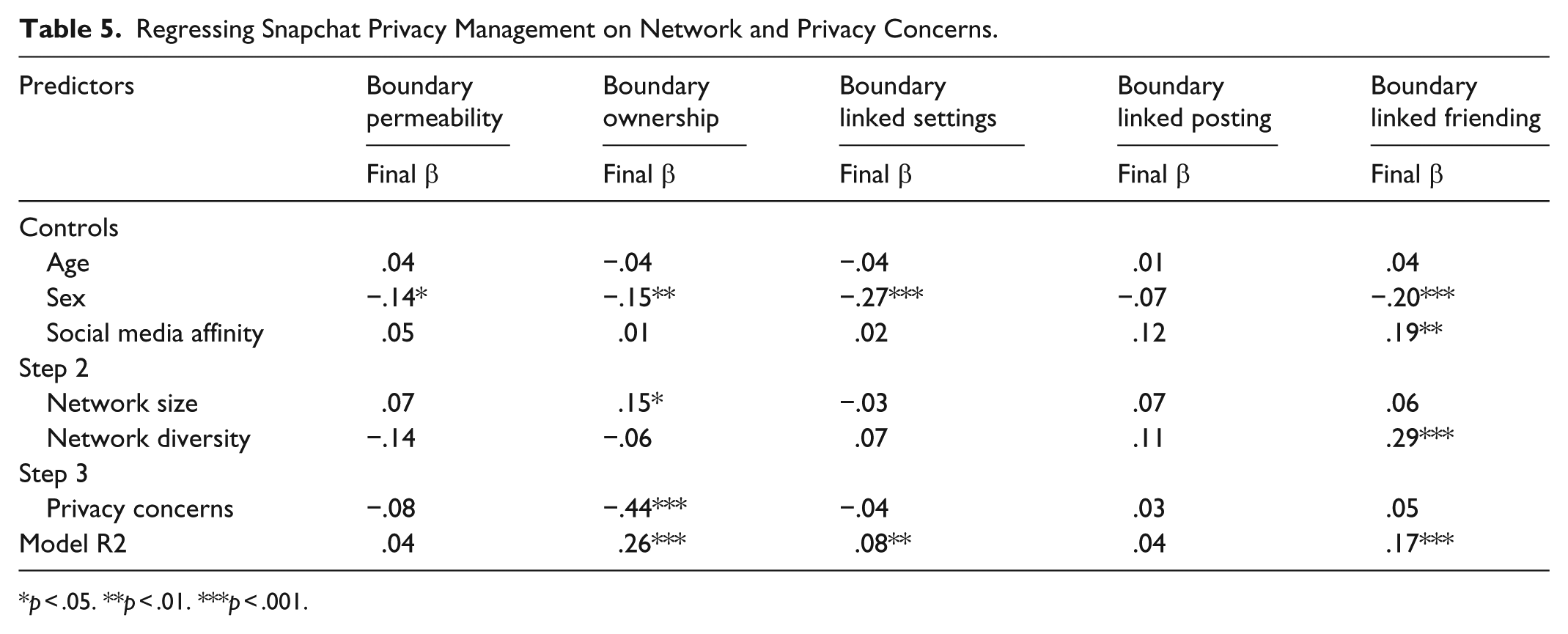
p < .05. **p < .01. ***p < .001.
Post Hoc Analyses
Given the surprising effect of network diversity in Snapchat, as well as the overall lack of impact of network diversity in Facebook, a series of post hoc analyses were conducted. The researcher determined that a very social user might have a high network diversity score, yet those connections might all be peers and therefore the user may potentially be less concerned for privacy than if non-peer family were connected. Therefore, network diversity was transformed into a dichotomous variable. Participants who indicated that a parent and/or grandparent was in their Facebook network were coded as 1, and 0 if both were absent from their Facebook network. The same process was followed for Snapchat network diversity. Almost 92% (n = 251) of participants reported parents or grandparents in their Facebook network, but only 31.5% (n = 86) in Snapchat.
Identical regressions analyses were conducted on Facebook and Snapchat privacy management practices, using the dichotomous peer only/non-peer family network diversity variable. No substantive changes were found in the effects of Facebook network size, network diversity, and privacy concerns on privacy management. However, analyses revealed interesting findings for Snapchat. Although the network diversity variable did not emerge as an individual predictor, that change in the model did strengthen the effect of network size. Larger Snapchat networks resulted in more open privacy management practices, above and beyond the effects of having a parent and/or grandparent as a friend (boundary linked posting final β = .13, p < .05, friending final β = .20, p < .001).
Discussion
The purpose of this study was to compare social media natives’ networks, privacy concerns, and privacy management practices between two popular social media platforms and to examine the effects of the audience makeup and privacy concerns on privacy management practices within Facebook and Snapchat. Using CPM as a theoretical framework, analyses of self-reports from 273 young adults within their early years of college revealed significant findings in and between Facebook and Snapchat. As expected, network size and diversity were larger on Facebook than Snapchat, as were privacy concerns. Participants reported more open privacy management practices on Snapchat than on Facebook, which aligns with previous research (Y. H. Choi & Bazarova, 2015). However, there is still a lot of unexplained variance in the tested model, indicating that there are one or more variables missing or unaccounted for. For example, motivations for using each medium are likely to explain posting behaviors (Hollenbaugh & Ferris, 2014), and personality variables such as openness, neuroticism, and self-monitoring may play a role in privacy management online (Vitak et al., 2015).
This study contributes to the growing body of literature on CPM in social media in various ways. First, the characteristics of the audience (network size and diversity) were integrated into the privacy management processes. Privacy ownership, control, and turbulence must be understood within the social context that surrounds them. In Facebook and Snapchat, and ostensibly other social media platforms as well, users must consider the potential audience when making disclosure decisions. The present study did not fully confirm that social media natives would be most concerned for privacy and restrictive with smaller and more diverse audiences, yet it is clear that those network characteristics did affect privacy management. Though a post may be seen by any of the connections in one’s friend list, research shows that people typically imagine a segment of that audience by considering the technological cues and social context (boyd, 2007; Litt, 2012; Marwick & boyd, 2010; Vitak et al., 2015). Perhaps, the imagined audience should be measured as a dynamic variable that may alter from post to post, whereas the actual size and diversity of the network (i.e., invisible audience) may represent a more stable context cue. This study intended to connect the literature on audience effects in social media within the CPM framework to continue building knowledge of online privacy management. Future researchers should explore the complex relationships between privacy, imagined audience, actual audience, and invisible audience, including whether or not privacy rules are enacted as a result of audience characteristics.
Another important contribution this study makes is the further refinement of quantitative measures that may be useful in future CPM research. The theory has primarily been tested qualitatively (e.g., Velten et al., 2017), but quantitative measure such as those modified and developed for this study will help advance the theory empirically. Early research on social media privacy centered primarily on Facebook, and the measure aligned with Petronio’s (2002) three boundary coordination processes (see Child et al., 2009). In the present study, the measure revealed the same three factors for participants’ Facebook use, but was different for Snapchat. Although boundary permeability and boundary ownership were found in Snapchat, the subscale for boundary linkages was split among three ways of linking—boundary linked settings, posting, and friending. Study participants reported using distinct means of connecting with others through Snapchat than older, more traditional social media might allow, which may help extend the CPM framework to newer social media platforms.
Unlike previous research, this study found no significant relationship between network size and privacy management in Facebook, and contrary to the lowest common denominator effect, more diversity in one’s Facebook network resulted in more open boundary permeability. Although this finding was unexpected, it is important to note that the mean score for boundary permeability was still quite low (M = 2.34, SD = 1.11, on a 7-point scale). One might conclude, then, that study participants maintained large and diverse friend lists but were overall more restrictive in their privacy management practices. Alternately, perhaps instead of the lowest common denominator effect, participants may be utilizing Marder et al.’s (2016) strongest audience effect, whereby social media users cater to their audiences with the highest combined standards and value to drive decision-making.
When examining the relationship between network characteristics and privacy within Snapchat, the results are a bit more complicated. As expected, participants with larger Snapchat friend lists reported more open privacy management practices. In post hoc tests, when controlling for the presence of parents or grandparents in the friends list, that relationship was even more apparent. For social media natives, non-peer family members may be especially influential when making decisions about privacy (e.g., Child & Westermann, 2013; Livingstone, 2008). That may especially be the case for students in their first couple of years of college, who are perhaps living alone for the first time and able to redefine their identities apart from family. Future researchers should continue to consider the important variable of not only network diversity but also the impact that non-peer family have on social media privacy. Privacy concern mediated the relationship between network diversity and boundary ownership, though not in the expected direction. Instead, social media natives in this study who had more diverse friend lists on Snapchat had less concern for privacy, and therefore more open boundary management. Testing for technological affordances, such as the perceived ephemeral nature of Snapchat, as well as parsing out the various uses of this multimodal social media platform, may help clarify these effects. For example, past research has shown that Snapchat use yields more bonding social capital, benefits such as emotional support and trust that results from strong relationships, than Facebook (Phua, Jin, & Kim, 2017). Engaging in more open privacy management could drive close relationship maintenance in Snapchat.
The impact of control variables in the model was outside the scope of this study; regardless, there was a clear significant difference between men and women in their privacy management for both social media. Men were significantly more open than women across various dimensions of privacy management practices in both Facebook and Snapchat. Women tend to be more disclosive across contexts than men (Dindia & Allen, 1992), so much so that this expectation is couched within a privacy rule posited in the theory (Petronio, 2002), but preliminary focus group data gathered in the early stages of this study demonstrated that there is a strong theme among young women needing to protect themselves from online “creeps” who may wish to do them harm. Perhaps, social media norms have emerged which lead to more protective behaviors for young women. Existing research has shown that young women are less likely than young men to disclose contact information (i.e., address and phone number) on Facebook (Taraszow et al., 2010; Tufekci, 2008). However, this research is somewhat outdated, and future research is needed to parse out such sex differences among social media natives, in particular. Perhaps, young women perceive there to be more risk associated with online private disclosure than men, which would result in different privacy management practices. Social media natives likely have received lessons and warnings regarding privacy on social media during their formative “tween” years (aged 10-14 years), which made them more aware of the need for privacy on social media and helped them to actively manage privacy (Davis & James, 2013). This sex difference could be explained if those lessons were primarily directed at girls and young women.
Limitations
There are several study limitations that may have affected results. In addition to the fairly homogeneous sample, conclusions rely upon participants’ reported behavior, which is somewhat less reliable than observed social media use. However, we can at least glean knowledge of their attitudes and perceptions through this study. Future research will need to test social media natives’ actual privacy management behaviors in the social web.
In addition, a longitudinal approach would allow scholars to better capture the factors that shape young adults’ privacy concerns and privacy management practices in social media. Social learning theory could be used to examine how past boundary turbulence of the self or others might shape future actions. Perhaps, since Snapchat is relatively new and tends to have a younger audience, social media natives may have fewer cautionary tales regarding Snapchat than they have of Facebook, leading to less privacy concern and more open privacy management in Snapchat.
Although this study provides more understanding of young adults and their privacy concern and privacy management techniques in Facebook and Snapchat, further research is necessary to determine what, if any, substantive differences there are between social media natives and other digital generations. Social media natives use more of the social functions of the Internet (Taipale, 2016) and engage in more social media applications than their elders (Lenhart et al., 2015), but it is unclear whether they differ in privacy management strategies. One might expect social media natives to be more savvy with regard to privacy and social media; they may use more advanced vetting procedures when considering follow requests. Perhaps, they more seamlessly move from one social media platform to the next and employ a different set of individually established privacy rules with ease. Differences such as these may be teased out, using CPM as a guiding theoretical perspective, to better understand how different generations manage their privacy on social media.
Finally, there is a need to further study the technological affordances of social media and incorporate those within privacy models to draw conclusions that could be more generalizable across specific platforms and throughout advances in social media. This study presents a glimpse of Facebook and Snapchat in hopes of fueling further developments toward that end. CPM provides many avenues for future research that will continue to reveal the interplay between privacy and access for social media natives.
Footnotes
Acknowledgements
The author would like to thank undergraduate student Katie L. Reed for her contributions to early phases of this project, as well as Zizi Papacharissi and the anonymous reviewers for their thorough and helpful critique of earlier versions of this manuscript.
Declaration of Conflicting Interests
The author(s) declared no potential conflicts of interest with respect to the research, authorship, and/or publication of this article.
Funding
The author(s) received no financial support for the research, authorship, and/or publication of this article.
