




Abstract
The article examines whether and how the ever-evolving practice of using social media to screen job applicants may undermine people’s trust in the organizations that are engaging in this practice. Using a survey of 429 participants, we assess whether their comfort level with cybervetting can be explained by the factors outlined by Petronio’s communication privacy management theory: culture, gender, motivation, and risk-benefit ratio. We find that respondents from India are significantly more comfortable with social media screening than those living in the United States. We did not find any gender-based differences in individuals’ comfort with social media screening, which suggests that there may be some consistent set of norms, expectations, or “privacy rules” that apply in the context of employment seeking—irrespective of gender. As a theoretical contribution, we apply the communication privacy management theory to analyze information that is publicly available, which offers a unique extension of the theory that focuses on private information. Importantly, the research suggests that privacy boundaries are not only important when it comes to private information, but also with information that is publicly available on social media. The research identifies that just because social media data are public, does not mean people do not have context-specific and data-specific expectations of privacy.
Keywords
Introduction
In recent years, there has been a growing concern of how social media platforms are being used by so-called “bad actors” for misinformation and disinformation campaigns and how these platforms may be creating echo chambers and silos in our society. Another trend of critical importance that has received little attention in academic research is how third parties (mis)use the public’s social media data—especially when such data are publicly available and do not require users’ consent to be mined. This practice is problematic because even if social media posts are public, people may still have context-specific expectations of privacy (Dubois et al., 2020; Jacobson et al., 2020; Jacobson & Gruzd, 2020; Nissenbaum, 2018; Quinn & Papacharissi, 2018), which gives rise to “fuzzy boundaries” of privacy management (Child & Starcher, 2016).
The issue of trust is particularly pronounced when considering the increased use of publicly available social media data by organizations for cybervetting. Cybervetting, also known as social media screening, refers to the use of social media to attract, recruit, and screen qualified job applicants. According to a recent survey of hiring managers, the number of organizations in the United States that use social media to screen job applicants has increased from 11% in 2006 to 70% in 2018 (CareerBuilder, 2018). When researching job applicants on social media, organizations seek to validate candidates’ qualifications, assess whether candidates present themselves professionally, and ensure that candidates are not posting any abusive or harassing content (CareerBuilder, 2018). Cybervetting is perceived as providing an opportunity for employers to obtain “trustworthy information” (Berkelaar, 2014). Not only is the availability of social media data attractive to organizations, there is also early evidence to suggest that these data can be a proxy to assess job candidates’ personality traits (Stoughton et al., 2013), as well as to predict key metrics, including academic ability and job performance (Kluemper et al., 2012).
As downsizing spread in the 1980s, employees engaged in a positive self-presentation activity and reframed their value explicitly in their resumes; consequently, employers began to distrust the information that prospective employees shared (Barrick et al., 2009; Berkelaar, 2014). Hedenus et al. (2019) found that cybervetting helps employers determine whether the candidate is trustworthy. For example, employers assess a job candidate’s online connections to see if there are any mutual connections to assess trustworthiness (Berkelaar & Buzzanell, 2015). Although cybervetting is useful for hiring organizations, this practice is often not disclosed to job applicants, which could lead to diminished trust.
We surveyed 429 participants to analyze their comfort with cybervetting from job seekers’ perspectives. While much of the organizational and communication research has approached social media screening from the perspective of employers, there are some exceptions; for example, Root and McKay (2014) analyzed job seekers’ awareness of this hiring practice and found that as many as 80% of respondents believed that employers are checking job applicants’ social media activities, which points to widespread awareness of social media screening. We expand this line of research beyond investigating whether people are aware of this hiring practice by measuring how comfortable job applicants are with this practice and what factors contribute to their attitudes. Specifically, we examine five factors shown to guide people’s privacy rules, as proposed by the communication privacy management (CPM) theory: culture, gender, motivation, risk-benefit ratio, and context (Petronio, 2002). We find that individuals have context and data-specific privacy boundaries even when the information is publicly available. At a practical level, the research provides a granular understanding of job seekers’ attitudes about social media screening by delineating different factors influencing their perception. The findings assist organizations and hiring managers to develop best practices that are aligned with job applicants’ expectations. At a theoretical level, we apply the CPM theory and evaluate its applicability when using publicly available information, rather the private information.
Literature Review
Social Media Screening Practices
There are unique opportunities and challenges for organizations seeking to leverage social media for hiring, yet “social media data are vast, noisy, distributed, unstructured, and dynamic” (Gundecha & Liu, 2012, p. 4). Previous research in this area has primarily focused on whether and how organizations and recruiters use social media for hiring purposes—or so-called “cybervetting”—which has become the norm, rather than the exception (Berkelaar & Buzzanell, 2015; Ghoshray, 2013; Jeske & Shultz, 2019). In a small-scale study with a focus on LinkedIn use, Zide et al. (2014) found that recruiters usually used the site to look for applicants’ “employment history, education, years of experience, and how the applicant presents him or herself on the site” (p. 589). A total of 60% of the participants indicated that they consider how well-connected the applicants are in the hiring process. Ollington et al. (2013) identified the following four distinct mechanisms recruiters use on various social networking sites: (1) connecting job seekers through secondary connections and establishing themselves as highly connected nodes in online social networks, (2) building their own online brand, (3) offering job seekers access to specialized online resources that are normally only available to recruiters, and finally, (4) acquiring accurate data about job seekers. And while employers’ use of social media can positively influence corporate reputation and indirectly increase job applicants’ intention to apply for a job with an organization (Sivertzen et al., 2013), there are some potential risks and challenges associated with using social media for attracting, recruiting, and screening job applicants, including negative biases toward minorities (Ruggs et al., 2016), legal concerns (Schmidt & O’Connor, 2016), misrepresentation, and misattribution of job applicants (Frantz et al., 2016).
Studies of Prospective Employees
Previous research that examines job applicants’ perspectives is limited, but often explores job seekers’ self-disclosure practices on social media by examining factors that influence what job seekers share, delete, or decide not to share on social media. Research in this area is often focused on inappropriate self-disclosure on social media, which include posting informal selfies or tagged photos, commenting on controversial topics, or “participation in activities which are in violation of university or workplace policy” (Peluchette & Karl, 2008, p. 418). El Ouirdi et al. (2015) examined the relationship between self-disclosure and the following factors: (1) the motivation to maintain a professional online image, (2) social media self-efficacy, and (3) the perceived effectiveness of social media in the job search context. One particularly interesting finding was that social media self-efficacy was found to be positively associated with job seekers’ self-disclosure of both inappropriate and career-oriented content, which the authors attributed to the increased use of social media and loss of inhibition. Zide et al. (2014) studied the relationship between the information LinkedIn users share and their occupation for three occupation groups: HR, sales/marketing, and industrial-organizational psychologists (I-O psychologists). Unsurprisingly, the authors found that sales/marketing professionals were the most “networking-savvy” of the three groups, and therefore, have an advantage. Similarly, Wu (2013) evidenced that social media can be used to positively impact an employee’s network position.
Another line of research examines prospective employees’ awareness of social media screening practices by organizations and recruiters. Root and McKay (2014) found that students are becoming increasingly aware of this practice—80% of respondents felt that prospective employers were likely to check their social media profiles. The authors found that students were generally comfortable with the practice as they tended to disagree with the statement: “it is wrong for anyone to consider what they have posted on the internet when applying for a job.” Stoughton et al. (2015) came to a somewhat different conclusion in their research: the practice of screening applicants on social media increased students’ sense of an invasion of privacy—regardless of whether a student was offered a job in their experimental study or not. In another study, Berkelaar (2014) found that applicants would like organizations to be transparent about cybervetting, and participants also expressed a feeling of resignation about this practice. Accordingly, there are inconsistent findings as to the public’s perception and comfort with the practice of social media screening.
To investigate possible reasons behind these somewhat divergent findings, our research extends the previous literature in several ways. Similar to Root and McKay (2014), we examine the relationship between different types of social media data and the practice of screening job applicants using social media. But instead of asking what information prospective employees think is important to employers, we ask participants what information would be acceptable for potential employers to access. We also go beyond studying readily-accessible data and metadata to include more complex data types that can and are used by companies, such as sentiment and social network-related information. Related work (Osatuyi, 2015; Wang et al., 2011) examined social media users’ privacy attitudes, but without providing any particular context in terms of who is accessing users’ social media data and for what purposes. We address this limitation by focusing on the use of social media data by organizations in the context of screening job applicants—as privacy needs to be considered in a context (Nissenbaum, 2009). Finally, as most previous studies surveyed job seekers or students, we use a more diverse population of social media, including job seekers and non-job seekers.
Theoretical Framework
The CPM theory introduced by Petronio (2002) explores how people regulate information they consider to be private, which provides a framework to reconcile the tension between revealing and concealing information. The theory contends that privacy management is dialectic in that people need to disclose private information in order to fulfill social functions and needs, while also concealing information in order to maintain their privacy. The dialectic refers to the push and pull that people experience when deciding to conceal or disclose information as privacy boundaries are negotiated (Baruh et al., 2017). People make purposeful decisions based on the desire to disclose and the desire to protect their personal privacy; the disclosure choices are as important as non-disclosure decisions (Serewicz & Petronio, 2007).
CPM is built on Altman and Taylor’s (1973) social penetration theory, which argues that people use self-disclosure as a way to build relationships, but also recognizes that there are both costs and rewards to disclosure. Building on this theory, Petronio (2002) notes that individuals desire privacy, yet also want to self-disclose to build relationships. While the theory grew out of interpersonal and family research, it has also been successfully applied to the disclosure of private information in other contexts, including online information privacy. For example, Waters and Ackerman (2011) relied on CPM to ask what are the benefits and consequences of disclosure, and is there a difference in online disclosure between men and women. Others use CPM to explore topics such as people’s private disclosures in the workplace (Smith & Brunner, 2017), privacy management of bloggers (Child et al., 2012), boundary turbulence on Facebook (DeGroot & Vik, 2017), privacy controls on Facebook (Cavusoglu et al., 2016), and college students’ voluntary disclosure on Facebook (Waters & Ackerman, 2011).
CPM outlines that people develop privacy rules, which, in the context of our research, can be defined as strategies that individuals use to decide what, when, and where to post on social media. According to CPM, the privacy rules are based on the following five factors (Child et al., 2012; Petronio, 2002): (1) Culture: every culture has a particular set of privacy values; (2) Gender: gender differences contribute to people’s privacy rules; (3) Motivations: motivations and needs influence when people tend to be more open or private; (4) Risk-benefit ratio: people calculate the risks and benefits of disclosing information; and (5) Context: people feel the need to disclose information based on the specific situation. In our study, we ground the five factors as follows:
Culture
We compare survey data between people from two different cultures: India (113 people) and the United States (319 people). It is well researched and widely understood that the United States is a highly individualistic society, versus India which is a collectivist society (Kumaraguru et al., 2005). As the privacy literature shows that cultural and regulatory differences (Bellman et al., 2004) influence information privacy concerns, we ask,
RQ1: Do people living in India react to cybervetting differently than those in the United States?
Because privacy attitudes of knowledge workers (Patil et al., 2010) and social media users (Wang et al., 2011) in India tend to be lower than those in the United States, we hypothesize,
Hypothesis 1: Social media users in India are more comfortable with cybervetting than users in the United States.
In the context of our research, we use cybervetting to refer to the practice of screening job applicants on social media, specifically using publicly available data.
Gender
We compare the comfort levels of social media screening between men and women. 1 Previous work suggests that women have a higher level of privacy concerns in comparison to men in the context of internet and social media use (Bartel Sheehan, 1999; Cho & Hung, 2011; Youn & Hall, 2008). Thus, we ask,
RQ2: Do women react to cybervetting differently than men?
In the context of internet and social media use, previous work suggested that women tend to have a higher level of privacy concerns than men (Bartel Sheehan, 1999; Cho & Hung, 2011; Youn & Hall, 2008). Thus, our second hypothesis is the following:
Hypothesis 2: Women are less comfortable with cybervetting than men.
Motivations
We compare the comfort levels of job seekers and non-job seekers as they have different motivations and needs for sharing information on social media. As most literature has either focused on people who are actively seeking employment or students who presumably will soon seek employment, we contribute to this research area by comparing attitudes between likely job seekers and those who are not seeking employment. Thus, we ask,
RQ3: Do job seekers react to cybervetting differently than non-job seekers?
We expect that job applicants may be engaged in selective self-presentation to present themselves in a professional manner and improve their online image (Batenburg & Bartels, 2017; Roulin, 2014). Therefore, our next hypothesis is,
Hypothesis 3: Job seekers are more comfortable with cybervetting than non-job seekers.
Risk-Benefit Ratio
To provide nuance to understand how people assess the risk-benefit ratio, we ask participants a series of questions to measure their general privacy concerns related to the handling of their social media data. Under this factor, we examine whether there is an association between users’ privacy concerns (more broadly) and their comfort level with a specific practice (organizations’ use of publicly available social media data to screen job applicants). We ask,
RQ4: Is there a relationship between users’ privacy concerns on social media and their attitude toward cybervetting?
Following early work on cybervetting that showed that job applicants’ privacy concerns negatively impact their overall fairness perception of the search process as well as their attraction toward the hiring organization (Bauer et al., 2006; Madera, 2012; Stoughton et al., 2015), we propose the following hypothesis:
Hypothesis 4: Social media users who have higher privacy concerns are less comfortable with cybervetting.
In accordance with CPM, people will assess both the risks and benefits associated with this particular use of social media data. Thus, if we discover that users’ higher privacy concerns are associated with a lower comfort level with the above-mentioned practice, then this may suggest that privacy risks outweigh perceived benefits. But if benefits outweigh risks, we may discover that there is no relationship between general privacy concerns and the comfort level with the practice (so-called “privacy paradox”).
Context
Context matters as people’s beliefs, concerns, and practices are contextually situated (Nissenbaum, 2009, 2018). As such, it is important that the study is grounded in the specific context of organizations using publicly available social media data to screen job applications. To bolster the internal validity of the research, we maintain one context; as such, there is no research question associated with this factor.
Method
Recruitment through Amazon Mechanical Turk
We collected data using Amazon Mechanical Turk (AMT). AMT is a crowdsourcing service organized like a marketplace where requesters can post an online task, such as a survey, and individuals anywhere in the world (called “turkers”) can complete this task for compensation (Mason & Suri, 2012). Research indicates that turkers perform tasks primarily to supplement their income (61%) and for personal enjoyment (41%; Paolacci et al., 2010). AMT’s pool of potential participants has been relatively stable over time and includes a sample comparable to standard internet samples (Buhrmester et al., 2011) and other more traditional samples (Goodman et al., 2013). In a study that evaluated the internal and external validity of AMT-based samples, Berinsky et al. (2012) found that AMT samples were more representative of the US population than in-person “convenience” samples, but less representative than internet-based panels or national probability samples. The researchers also concluded that turkers tend to be older (Mage = 32.3, SE = 0.5) than student samples (Mage = 20.3, SE = 8.2), but younger than adult samples (Mage = 45.5, SE = 0.9). AMT has implemented a number of mechanisms to ensure the high-quality pool of respondents; for example, every time a turker completes a given task, a requester has an opportunity to review their work and either approve or reject it. Thus, each turker is assigned an overall approval rating of their tasks, which, in turn, can be used to exclude turkers whose approval rate is less than a specified threshold. Previous work has also evaluated the quality of data collected through AMT and confirmed comparable quality to collecting data by more traditional means. Rand (2012) found that turkers complete the demographic questions truthfully, and a study by Hauser and Schwarz (2016) revealed that turkers were more attentive to the instructions than a comparable sample of college students.
Prior to beginning our study, Research Ethics approval was obtained from two universities. The survey was open for 3 days between December 22 and 25, 2016. Turkers were paid US$1 per response. The average survey completion time was just under 10 minutes, which represents a compensation rate of US$6/hour and is generally higher than what was reported in other studies using AMT (Berinsky et al., 2012; Wang et al., 2011). 2 To ensure high quality of our data collection, we specified that only turkers with an overall approval rate of 75% or higher were eligible to participate in the survey. We also inserted a “trap question” as an attention check to ensure that participants were carefully reading the questions. In total, we received 506 responses. We further cleaned our dataset by excluding 33 responses that did not answer the trap question correctly, 18 responses that were completed in less than 3 min, and one response where the participant did not have any social media accounts (an outlier). In total, the dataset comprised 454 responses.
Considering that our sample primarily consisted of people from the United States and India, we excluded participants from other countries so that we could focus on comparing populations from two different countries. We also excluded three participants who elected not to specify their gender. At the end of the sample selection procedure, 429 responses remained in the final dataset that was used for analysis.
Survey Design and Measurement Model
The survey consisted of three sections. Section 1 asked 17 questions to measure users’ Concern for Social Media Information Privacy (CFSMIP) by Osatuyi (2015), which built on a widely accepted construct of Concern for Information Privacy (CFIP) by Stewart and Segars (2002). CFSMIP measures an individual’s concerns for information privacy in response to an organization’s use or potential use of their personal information across the following four dimensions: collection (COL), errors (ERR), secondary use (SUS), and unauthorized access (UAC). Even though there are a number of alternative approaches to measure privacy concerns on social media (e.g., Dinev et al., 2013; Krasnova et al., 2009; Malhotra et al., 2004), we chose to use CFIP, and specifically its social media version—CFSMIP—because of its emphasis on the organizational use of data which fits well with the focus of this research on employers’ use (as opposed to personal use) of social media data (Gruzd & Hernández-García, 2018). The CFSMIP-related questions were general in nature and were not limited to the hiring context (see Table 1).
Social Media Information Privacy Construct—CFSMIP (adopted from Osatuyi, 2015; Stewart & Segars, 2002).

Section 1 also included the trap question, “Please select ‘strongly agree’ as your answer choice.” Before proceeding to Section 2, all participants read a textual brief about the practice of using social media data to screen prospective employees and some common ways organizations may use such information. In Section 2, participants scored their comfort level (on a scale of 1–7; 1-“very uncomfortable” to 7-“very comfortable”) with a potential employer viewing their publicly accessible information from social media. This question was repeated nine times, each with one of the nine sample information types, selected from the following three broad categories: (1) Raw Data & Metadata: readily available information, (2) Analytics: information that requires some processing, and (3) Social Networks: information related to users’ online social network (see Table 2). The information type questions were presented in random order to avoid bias. To account for further potential biases in how participants perceive different representations of information types, we randomly assigned them to one of two groups: Group A saw a visual representation of the information type and Group B saw a textual description of the same information type.
Categories of Information Types.

The survey instrument was developed and evaluated over a 1-year period to ensure that all text and visual elements were clearly visible and able to be properly interpreted by participants. For example, we used neutral colors whenever possible to avoid a potential color bias in visualizations. Furthermore, we displayed two versions of each visualization depicting different possible outcomes to emphasize that the shown visualizations were only for demonstration purposes. For example, when showing a hypothetical result of sentiment analysis (see Figure 1), one visualization showed the majority of posts were positive (displayed on the left), while the other visualization showed the majority of posts were neutral and a significant proportion of negative posts (displayed on the right).
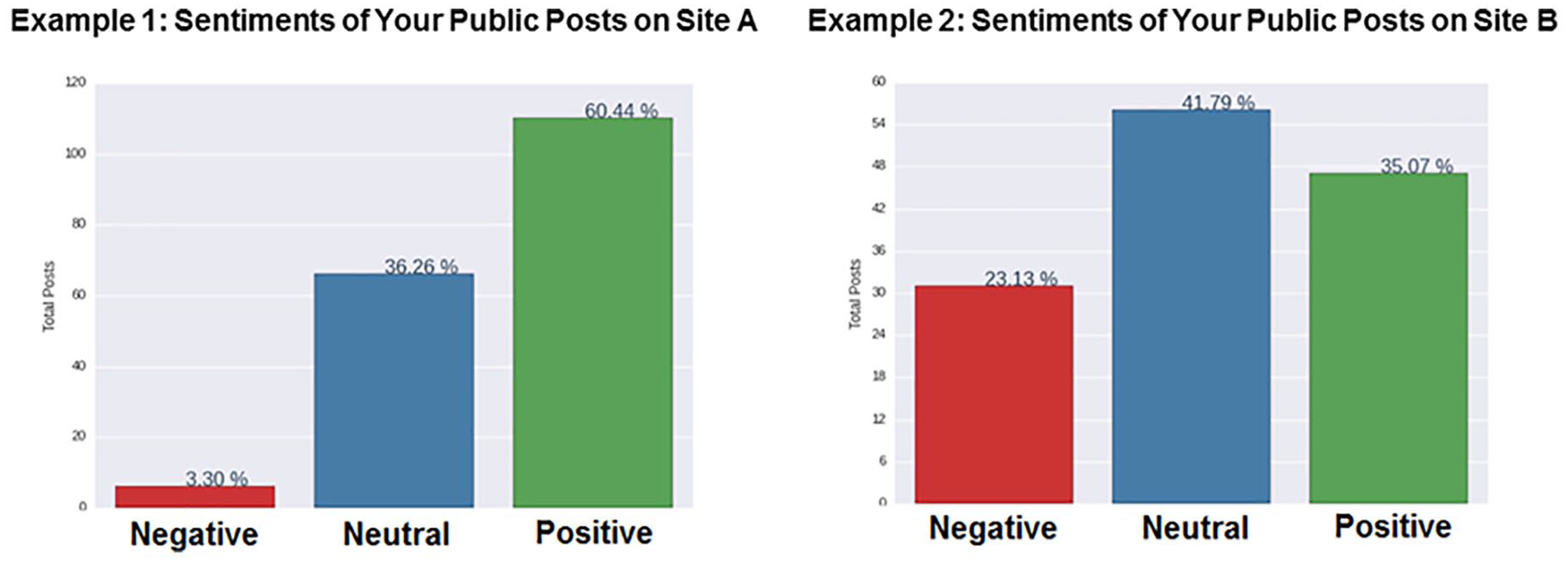
Sample visualization of sentiment.
In the final section of the survey, participants were asked about their overall social media use (i.e., what platforms they used and their frequency of use), as well as general demographic data (i.e., age, country, and education level). We also asked questions about participants’ awareness of cases of social media misuse and whether they have been a victim of a data privacy violation.
Statistical Tests
To analyze the data, we used the Automatic Linear Modeling (LINEAR) implemented in the software package SPSS, version 24 (Yang, 2013). The model building method was “Best Subsets” using the Adjusted R Square criterion to select the best performing model. Unlike the stepwise method, the best subset method considers all possible regression models based on available predictors (Oshima & Dell-Ross, 2016); thus, avoiding a potential bias by not deciding on the order of variable entry into the model (Huberty, 1989). One of the advantages of using LINEAR is that it automatically trims outliers by setting them to a cut-off value of three standard deviations from the mean. Furthermore, LINEAR has been shown to be more robust against Type I and II errors relative to more traditional linear regression modeling (Yang, 2013).
For the purposes of the study, the following variables were used as independent variables: Country: India (1) or the United States (0); Gender: female (1) or male (0); Job seeking status: ranging from 1-“very unlikely” to 7-“very likely” (“How likely are you to seek employment within the next 6 months?”); COL: privacy concerns related to data collection by social media sites; SUS-UAC: privacy concerns related to the secondary use and unauthorized access of social media data; and ERR: privacy concerns related to social media sites and organizations storing inaccurate information about users. Each privacy-related factor was calculated as the mean of its corresponding 7-point Likert-type scale questions.
Even though SUS and UAC were originally envisioned as two separate constructs (Stewart & Segars, 2002), in the social media context, using an exploratory factor analysis, we discovered that SUS and UAC load on a single dimension, which is similar to what Osatuyi (2015) found in their dataset as well.
The dependent variable (HRComf) was calculated as the mean of the comfort level questions (7-point Likert-type scale) asked in relation to the seven different information types: Posts, Photos, Geolocation, Sentiment, Top Posters, Followers, and Communication Network. To eliminate a potential bias, two information types (Frequent Words and Post Frequency) were excluded from the composite comfort score as there was a difference in how participants evaluated these two information types depending on whether the questions were displayed with or without the accompanying visual representations (see Gruzd et al., 2017a, 2017b). Since there were no groupings in responses among different information types, we concluded that the seven information types can be used to create a unidimensional, composite comfort level score using the mean function.
The reliability and validity of the four constructs (COL, ERR, SUS-UAC, and HRComf) were assessed using four common tests: Cronbach’s Alpha, rho A, Composite Reliability, and Average Variance Extracted (AVE). All values are within their recommended thresholds (Hair et al., 2017; Henseler et al., 2016) and confirm the adequacy of the measurement instrument (see Table 3).
Constructs’ Reliability and Validity.

COL: collection; ERR: errors; SUS-UAC: secondary use-unauthorized access.
A P-P plot and a distribution of residuals for the dependent variable (HRComf) supports the normality assumption of the residuals. Finally, we confirmed that there is no multicollinearity among the independent variables (all variance inflation factors (VIFs) <1.5, with the recommended threshold of 3).
Results
Participants’ Demographics
Our sample is well balanced in terms of gender and job seeking status. Consistent with other AMT-based samples (Berinsky et al., 2012; Paolacci et al., 2010; Wang et al., 2011), our sample is skewed toward younger (but older than student samples; age group 25–34), more educated, social media users who use at least 1 of the 11 popular social media sites. The only major difference between our sample and those reported in other AMT-based studies is that we had a higher proportion of male participants—especially in the sample from India (see Table 4).
Participant Background.

Automatic Linear Modeling
The resulting model (see Table 5) explains 17% of the total variance of the comfort level with employers’ use of social media to screen job applicants. 3 The model shows that the country and privacy concerns factors are the strongest predictors of comfort level. In particular, the comfort score was higher for respondents from India, supporting that one’s culture plays a role in the social media screening context (RQ1). However, neither gender (RQ2) nor one’s job seeking status (RQ3) was included in the best performing model. The results for RQ4 were mixed. In this section, we review each of our research questions in turn.
Result of Automatic Linear Analysis.

COL: collection; ERR: errors; SUS-UAC: secondary use-unauthorized access.
Only statistically significant coefficients are included in the table (p ⩽ .05).
RQ1 (Culture): Do People Living in India React to Cybervetting Differently Than Those in the United States?
We found that living in India is positively and significantly associated with being more comfortable with the practice of screening job applicants. Thus, Hypothesis 1 is supported. This finding could be as a result of the cultural and/or regulatory differences in the United States and India (Bellman et al., 2004), and also because in India “the social and family structures place much less importance on privacy” (Ion et al., 2011, p. 12).
RQ2 (Gender): Do Women React to Cybervetting Differently Than Men?
Even though some previous work has suggested that women have a higher level of privacy concerns than men in the context of internet and social media use (Bartel Sheehan, 1999; Cho & Hung, 2011; Youn & Hall, 2008), our research evidences no significant relationship between one’s gender and the comfort level with social media screening. Hence, Hypothesis 2 is not supported. This may be because we investigated the comfort level in the specific context of screening job applicants using social media. In this context, there may be some “universal” expectations and concerns regardless of one’s gender. In a related study of employed and non-employed Italian job seekers, the researchers also found no gender-based difference between professional online image concerns and inappropriate self-disclosure (El Ouirdi et al., 2015). They proposed that this could be because career-oriented items in their study “included an implicit minimum disclosure threshold on social media, and that it is widely common to disclose this amount of information by default without necessarily being on the job market” (El Ouirdi et al., 2015, p. 9).
RQ3 (Motivation): Do Job Seekers React to Cybervetting Differently Than Non-Job Seekers?
This question focuses on whether there is a difference in reaction between job seekers and those who are not currently seeking or planning to seek employment in the near future to the practice of screening job applicants. The result shows that the likelihood of being on the job market is not associated with people’s attitude toward social media screening; in other words, being a job seeker does not necessarily make one more or less comfortable with the practice. Therefore, Hypothesis 3 is not supported. The result emphasizes the need for employers and recruiters, who rely on social media to screen job applicants, to be aware that the practice may “reduce the attractiveness of an organization during various phases of the selection process, especially if the applicant pool at large knows or suspects that the organization engages in such screening” (Stoughton et al., 2015, p. 86).
RQ4 (Risk-Benefit Ratio): Is There a Relationship Between Users’ Privacy Concerns on Social Media and Their Attitude Toward Cybervetting?
The answer to this question is “yes,” but the sign of the relationship depends on the specific privacy concern. The comfort score in our model is negatively associated with two of three privacy-related factors: COL and SUS-UAC. This finding suggests that higher concerns with social media sites collecting personal information and possibly using/sharing such information without users’ consent are both associated with a lower comfort level with organizations using social media data to screen job applicants—even if the social media data are publicly available.
At the same time, the comfort score is positively associated with the ERR privacy factor, which can be interpreted as people who are more comfortable with the use of social media to screen job applicants are also more concerned if social media sites store erroneous information about them. People could perceive that having incorrect information about themselves stored publicly on social media could negatively impact their prospect of being successful in the social media screening process. This suggests that the ERR factor in this social media screening context may be more related to one’s image management concerns than privacy-related concerns.
In sum, Hypothesis 4 is generally supported, except when it comes to the ERR factor. This result may suggest the presence of a phenomenon called “digital resignation” (Turow et al., 2015). Digital resignation refers to the situation where people are generally concerned about privacy, but they also reluctantly recognize that companies would still engage in this practice regardless of their concerns—especially when it comes to using publicly available social media data. Thus, social media users may want to ensure that information collected about them from social media is at least accurate, as misleading erroneous representations of oneself may negatively impact an employer’s hiring decision (e.g., if the data point to an applicant’s lack of influence on social media). A similar concern of misrepresentation and misattribution of job applicants was identified by Frantz et al. (2016). The result indicates that this concern is especially important for people who are more comfortable with social media screening.
Conclusion
The hiring process requires trust from all stakeholders, yet employers have grown to distrust information that were conventionally sourced (Berkelaar, 2014). In a social media age, employers are now turning to cybervetting and the role of trust between these organizations and job seekers is being renegotiated. Our research investigates how job seekers and non-job seekers perceive the practice of prospective employers using publicly accessible social media data to screen job applicants. The results of the research can be broadly divided into the following two areas: (1) theoretical implications for privacy research and social media research and (2) practical implications for the human resources sector.
Theoretical Implications
CPM predicts that the five factors of culture, gender, motivation, risk-benefit ratio, and context would be influential in privacy considerations. We tested these factors within the context of organizations using social media for screening and found that culture and risk-benefit ratio (assessed through three dimensions of privacy concerns) have shown to be associated with one’s concerns related to social media screening, but neither gender nor motivation (operationalized as one’s job seeking status) were associated with concern with cybervetting.
As a contribution to the literature, we have extended the application of the CPM theory beyond the management of private information to analyze “private” information that is public. The results confirm that the “fuzzy boundaries” (Child & Starcher, 2016) of privacy management become even fuzzier with regard to private information that is publicly available—as is the case with social media. Importantly, our findings support the notion that privacy boundaries are not only important when it comes to private information, but also with information that is publicly available on social media.
A limitation of the study is the use of the study participants’ geographic location as a proxy to overall cultural context they live in when testing RQ1. Since identifying the United States as an individualist culture and India as a collectivist culture is a simplification of cultural context, future research could incorporate Hofstede’s cultural dimensions and related scales (Eringa et al., 2015; Hofstede & Bond, 1984) to enable a more accurate assessment of cultural values and differences at the individual level.
Another limitation of the research is that we did not collect information about uses and gratification factors that influence one’s social media use more broadly, as these have also been shown to influence one’s self-disclosure on social media (Bauer & Schiffinger, 2015) and may also influence one’s attitude toward the studied practice. For example, people who are seeking employment opportunities and also are using social media to create a professional online presence may be highly comfortable with prospective employers accessing their publicly available social media data for job screening purposes. In our case, we only captured the first part of this condition: whether someone is likely to seek employment or not.
Implications for Organizational Human Resources
Both inside and outside of organizations, social media has had a transformative impact; however, we have “barely scratched the surface of what is coming and what is possible” (Aral et al., 2013, p. 3). In just a few years, the scholarly community has begun to dig deep into the impact of organizations using social media for purposes such as hiring. In addition to the data management issues, the organizational practice of prospective employers using social media to research, screen, and vet job applicants without their explicit consent also raises equity and trust issues. While social media can be used to verify information on a person’s resume, the practice also affords prospective employers an unprecedented opportunity to examine the personal lives of job applicants. Accordingly, in an attempt to bolster HR transparency in 2017, the European Union made a decision that requires companies to publicly identify and warn applicants if their job screening process involves social media screening (Schrieberg, 2017). Many states in the United States have also banned employers from asking job applicants for access to their social media accounts (Wright, 2014). This decision is aligned with the finding that people tend to have less privacy concerns when companies explicitly ask for permission to use their information (Nowak & Phelps, 1995).
Beyond the disclosure of information, the CPM theory outlines that when an individual shares private information with others, the receiver of that information takes on the responsibility of guarding that information (Petronio, 2002). Shifted to public social media, we contend that third parties who use social media data need to be held to a similar standard to guard the information. This is supported by the presence of a negative and significant association between privacy concerns related to SUS-UAC of social media data by third parties and people’s comfort with screening job applicants on social media. This is also supported by the finding that a person’s job seeking status does not necessarily make them more comfortable with cybervetting.
One of the strongest results in our research was that respondents from India were significantly more comfortable with the practice of social media screening than those living in the United States; the finding is aligned with some previous work on cultural and regulatory differences between the two countries (Kumaraguru et al., 2005). Finally, we did not find any differences in responses based on gender, which suggests that in the context of employment seeking, there may be some consistent set of norms, expectations, or “privacy rules” that apply—irrespective of one’s gender.
The results of the study can help organizations develop best practices when relying on social media for screening purposes by providing a nuanced understanding of people’s comfort with the practice. For example, organizations that conduct hiring in different countries or recruit people with different cultural or ethnic backgrounds should recognize that some cultures may be more or less comfortable with organizations using social media screening. Overall, the significance of the research is that it identifies that just because social media data are public, does not mean people do not have context-specific and data-specific expectations of privacy.
Footnotes
Acknowledgements
The authors would also like to thank Philip Mai for his help and feedback during the preparation of this article. Earlier iterations of this work have been presented at the 2017 Americas Conference on Information Systems and the 2017 Canadian Association for Information Science Conference.
Declaration of Conflicting Interests
The author(s) declared no potential conflicts of interest with respect to the research, authorship, and/or publication of this article.
Funding
The author(s) disclosed receipt of the following financial support for the research, authorship, and/or publication of this article: This research is supported in part through a 5-year initiative on “Social Media Data Stewardship” funded by the Canada Research Chairs program (2015–2020; Principal Investigator: Gruzd, A) and the Ted Rogers School of Management at Ryerson University.
