




Abstract
Can news avoidance be considered a stable personal “trait,” adhering to a specific group of consistent news avoiders, or is it rather a volatile “state” reflecting temporal variations in audience practices? Based on a five-wave panel survey collected in Sweden during the coronavirus pandemic, we show that selective avoidance of news about the pandemic varies both between persons, representing consistency, and within persons, representing temporality. Drawing on the information utility model, we additionally show that both dimensions are related to audience preferences, specifically news interest, news media trust, and societal concerns. These results illustrate that the practice of selective news avoidance is not restricted to a specific group of people with limited news use but also represents a more fluid audience behavior of adjusting news consumption patterns in response to individual and contextual changes. However, as the correlates of the two dimensions are similar, the results stress the polarizing potential of news avoidance in democracy.
Despite the supply of news being higher than ever before, a substantial and potentially increasing number of people avoid news in general (e.g., Gorski & Thomas, 2022; Karlsen et al., 2020) or news on specific topics (e.g., Ohme et al., 2022; Tunney et al., 2021). As news exposure is known to have positive influences on political knowledge and participation (e.g., Andersen et al., 2021), news avoidance is often seen as a problem for democracies (Van Aelst et al., 2017). Ultimately, however, the effects and democratic implications depend on the nature of news avoidance (Damstra et al., 2023; Palmer et al., 2023; Skovsgaard & Andersen, 2022). If it is a stable audience behavior, characterizing a specific group of consistent news avoiders, these citizens will potentially be permanently disadvantaged in politics. But if news avoidance instead is a more fluid and fluctuating audience behavior that individuals can drop in and out of in response to specific situations, this audience behavior might be less of a democratic problem. Indeed, it may even have some positive side effects, for instance, on mood and mental well-being (de Bruin et al., 2021; Vandenplas et al., 2021; Woodstock, 2014; Ytre-Arne & Moe, 2021).
These two dimensions of news avoidance are of course not mutually exclusive. News avoidance may consist of both a stable “trait” component and a volatile “state” component. However, existing quantitative research primarily treats news avoidance as a stable behavior. Based on cross-sectional measures of news media use, some studies, for example, identify a group of news avoiders and explore individual-level factors explaining why these individuals fall into this category, such as gender, education, political interest, and media trust (e.g., Edgerly, 2022; Ksiazek et al., 2010; Strömbäck, 2017; Trilling & Schönbach, 2013). A few studies explore long-term trends in news avoidance, but also draw on cross-sectional data to do so (e.g., Blekesaune et al., 2012; Karlsen et al., 2020; Strömbäck et al., 2013). Such studies provide valuable insights but cannot—due to the lack of panel data—capture within-person fluctuations in an individual’s level of news avoidance over time (for an exception, see de Bruin et al., 2021).
Qualitative studies, however, illustrate that fluctuating contextual factors can lead individuals to increase and decrease their news avoidance, reflecting a situational “state” dimension. For instance, one study demonstrates that some people temporarily signed out from the news because coverage of the Trump presidency had a negative impact on their emotions (M. C. Wagner & Boczkowski, 2021), and several studies describe how people tuned out from the news during the coronavirus (COVID-19) pandemic (Broersma & Swart, 2022; Groot Kormelink & Klein Gunnewiek, 2022; Vandenplas et al., 2021; Ytre-Arne & Moe, 2021).
In this study, we aim at gaining a better understanding of the underlying nature of news avoidance by examining the consistency and temporality of selectively avoiding news about the coronavirus pandemic and the audience preferences that relate to these two dimensions. To do so, we discuss the dimensionality of news avoidance and introduce the information utility model (Atkin, 1973) to understand and explain the stable and fluctuating dimensions of this audience behavior. We highlight news interest, news media trust, and societal concerns as examples of audience preferences that are likely to influence these two dimensions. Empirically, we rely on a unique five-wave panel survey collected in Sweden during the coronavirus pandemic. This context can be considered a most-likely case for identifying the “state” component of selective news avoidance as it maximizes the potential within-person variation in audience behavior in response to major societal changes. As the same respondents repeatedly participated in the survey, we can use this data to disentangle the stable and more fluctuating components of news avoidance by separating between-person differences and within-person variation and analyze how audience preferences affect these two components, respectively. Arguably, the coronavirus pandemic constitutes a special case, and in the concluding section we therefore discuss the generalizability of our results to more general practices of news avoidance.
Dimensionality in News Avoidance
While a growing body of research shows interest for news avoidance, the definition of the concept is still characterized by ambiguity. To conceptualize news avoidance and review potential drivers of this audience behavior, Skovsgaard and Andersen (2020) distinguish between unintentional and intentional news avoidance. Unintentional news avoidance is explained by the changing opportunity structures for news exposure created by the rapidly growing supply of media content, in particular the proliferation of internet access, making it easier for individuals to meet their content preferences (Gorski & Thomas, 2022). If preferences for other content are higher than news preferences, news is likely to lose the intense competition for attention (Prior, 2007). In contrast, intentional news avoidance is explained by a specific discontent with the news that increases the inclination to actively avoid news. Prominent explanations are a lack of trust in the news (e.g., Edgerly, 2022; Palmer et al., 2020), the negative focus of news coverage (e.g., Toff & Palmer, 2019; M. C. Wagner & Boczkowski, 2021; Woodstock, 2014), and a feeling of news overload (e.g., Song et al., 2017).
In their conceptualization, Skovsgaard and Andersen (2020) focus on consistent and stable news avoidance that is restricted to slowly evolving long-term changes. However, the explanatory variables presented also exhibit short-term fluctuations likely to generate short-term fluctuations in news avoidance within the same individuals over shorter time spans. For example, some people experience an increase in political interest during election times (Larsen, 2022), which is likely to affect their news consumption (Andersen et al., 2021). For others, politics can be emotionally draining, leading them to periodically tune out from news (M. C. Wagner & Boczkowski, 2021). This combination of long-term stability and short-term fluctuations dovetails with Peters and Schrøder’s (2018) conceptual work on how news habits are formed and how they change. One of their central points is that while parts of audiences’ news consumption patterns are highly stable, other parts can be considered highly fluctuating. In line with this thinking, recent qualitative studies on news avoidance during the coronavirus pandemic have illustrated how deliberate practices of news avoidance were used to strategically regulate news consumption habits in a period of intense news coverage (Broersma & Swart, 2022; Groot Kormelink & Klein Gunnewiek, 2022; Vandenplas et al., 2021; Ytre-Arne & Moe, 2021).
Acknowledging this point, Skovsgaard and Andersen (2022) have highlighted that while avoiding news can be a stable behavior leading to consistent news avoidance, it can also be a more volatile behavior based on short-term changes within the individual or in the broader context. These changes can lead to occasional news avoidance when people actively avoid news for a shorter time span, or selective news avoidance when people avoid specific types of news while still consuming other types. As demonstrated by Palmer et al. (2023), these practices of news avoidance do not necessarily lead to low levels of general news consumption (see also Damstra et al., 2023). Rather, they can be seen as intentional audience behaviors with the aim of striking the optimal balance between being informed and protecting one’s mood and mental well-being (Aharoni et al., 2021; de Bruin et al., 2021; Tunney et al., 2021; Vandenplas et al., 2021; Ytre-Arne & Moe, 2021).
These insights illustrate that a full understanding of the news avoidance concept cannot focus exclusively on a group of consistent news avoiders. Instead, a distinction must be made between the stable “trait” behavior of consistent news avoiders and the more fluctuating “state” behavior of temporal news avoidance. Importantly, however, while clear in theory and applicable to the statistical modelling we apply in our analysis, this distinction is best understood as a continuum where everyday practices of news consumption lie somewhere in between. In addition, a distinction must be made between avoiding news in general and selectively avoiding specific types of news, such as certain topics (Ohme et al., 2022). As mentioned, we focus on the consistency and temporality in selective avoidance of news about the coronavirus pandemic.
An Information Utility Approach to News Avoidance
The information utility model (Atkin, 1973) provides potential explanations for consistency as well as temporality in news avoidance. The model explains choices to consume or avoid news through the concept of informational utility and has been used in studies of attention to election news (Hmielowski et al., 2020), decisions to watch televised debates (M. Wagner, 2017), and news sharing behavior (Bobkowski, 2015). The basic proposition of the model is that the higher the perceived utility of news stories, the more likely it is that an individual will consume this information. The perceived utility of news is only one side of the coin, however, and the projected costs for consuming or avoiding news are also factored into selection or non-selection decisions (Atkin, 1973). In other words, if the perceived utility of news exceeds the projected costs, the likelihood that news will be selected increases.
In Atkin’s conceptualization, information utility is based on an individual’s uncertainty concerning how to understand, form attitudes about, and act on an issue. When issues emerge or develop, new potential uncertainties for an individual arise. For instance, when a financial crisis emerges, most people are likely to feel uncertain about their own and their country’s situation and seek information on the potential causes and consequences to understand, react to, and form attitudes on the crisis. Thus, uncertainties create information needs and make news content particularly relevant insofar that it helps reduce these uncertainties. Of course, some people are more willing to accept a higher degree of uncertainty than others, for instance, about issues that they are not interested in or do not find relevant. For example, uncertainty on how to understand and respond to volatility in interest rates on house mortgages during an emerging financial crisis is likely to be less acceptable for (soon to be) house owners than for other people not owning or planning to buy a house. Different criterion states for certainty thereby create variability in information needs across as well as within individuals (Atkin, 1973).
The expected utility of a news story is weighed against projected costs of obtaining it, and in the information utility model these costs have two components: expenditures and liabilities. Expenditures refer to how prominent and accessible information is and how easy it is to decode. The more prominent and accessible the information is, and the easier it is to decode, the less the cost of being exposed to it. Individual resources, such as money, time, energy, and mental attributes, likewise play a role in this calculus. Through the liability concept, the information utility model also includes an emotional component. If a media message is expected to create aversive emotional arousal or is expected to increase rather than reduce uncertainty, these considerations will be factored into the calculus as a cost that makes avoidance of the information more likely (Atkin, 1973).
Treating the emotional perspective exclusively on the cost-side of the utility calculus, however, comes with the risk of disregarding how emotions can play a more complex role and, in some instances, even potentially serve as a positive factor for news selection. For example, while anticipated anxiety can lead some people to avoid the news to mitigate this negative emotion (Toff & Nielsen, 2022), other studies demonstrate that anxiety can lead to more active information seeking to reduce uncertainty (Albertson & Gadarian, 2015; Hmielowski et al., 2020; Marcus & Mackuen, 1993). As such, emotions cannot exclusively be considered a potential cost in the utility model but should also be considered a potential driver of news use to reduce uncertainty.
Another potential limitation of the information utility model is that it does not account for media consumption habits, which have been shown to be an important factor in more stable audience behaviors (e.g., Andersen et al., 2022; LaRose, 2010), including studies on news avoidance (Broersma & Swart, 2022; Palmer & Toff, 2020). While some habits are goal-dependent and fit well with the utility perspective, others are more context-dependent and less connected to the utility of the news consumed or avoided (LaRose, 2010).
Even if the utility model more efficiently capture volatility than stability in news consumption patterns, it provides a useful framework for understanding and exploring news avoidance in cases with high uncertainty, such as the coronavirus pandemic. In such instances, individuals will seek out news when the utility exceeds expenditures and liabilities. In reverse, when the expected costs exceed the expected utility, news is likely to be avoided. Important to note, however, is that news with very low utility and even liabilities will sometimes still be consumed because the effort needed to avoid this information would be greater than the expected negative effects of consuming it. Typically, such a situation will occur when an issue dominates the media agenda to a degree that makes it hard to completely avoid news about the issue.
News Avoidance During the Coronavirus Pandemic
In the spring of 2020, the outbreak of the coronavirus pandemic created a high degree of uncertainty, and the rapid spread of the virus around the globe created an immediate relevance to people’s everyday lives. Seen from the perspective of the information utility model (Atkin, 1973), news coverage of the crisis can therefore be expected to have commanded substantial utility as it helped people understand the challenges of the crisis, informed them how to act, and provided them with the foundation for forming opinions in the crisis. At the same time, massive news coverage of the crisis made news more readily available and lowered the cost of being exposed to news on the crisis (Van Aelst et al., 2021).
While this combination of high utility caused by high uncertainty and high availability of news on the pandemic would lead to an expectation of low levels of news avoidance, it is also likely that the utility of the news coverage will be reduced over the course of the crisis. As more and more became known about the emerging virus, the initial uncertainty among citizens dropped, and as immediacy is central in the journalistic ideology (Deuze, 2005), the news media paid less, albeit still substantial, attention to the pandemic (see also Figure 1) as the novelty of the virus waned, making it less of an effort to avoid the news. Adding to that, the accumulation of news triggering anxiety and fear makes it increasingly likely that people avoid news because it affects their mood and mental well-being negatively (de Bruin et al., 2021; Toff & Nielsen, 2022). For example, Groot Kormelink and Klein Gunnewiek (2022) found that some of the young Dutch people interviewed in their study responded to the sustained wall-to-wall coverage of the coronavirus pandemic by tuning out of the news because it evoked negative feelings and put them in a bad mood. Similar results were found by Ytre-Arne & Moe (2021) in Norway and by Vandenplas et al. (2021) in Belgium.
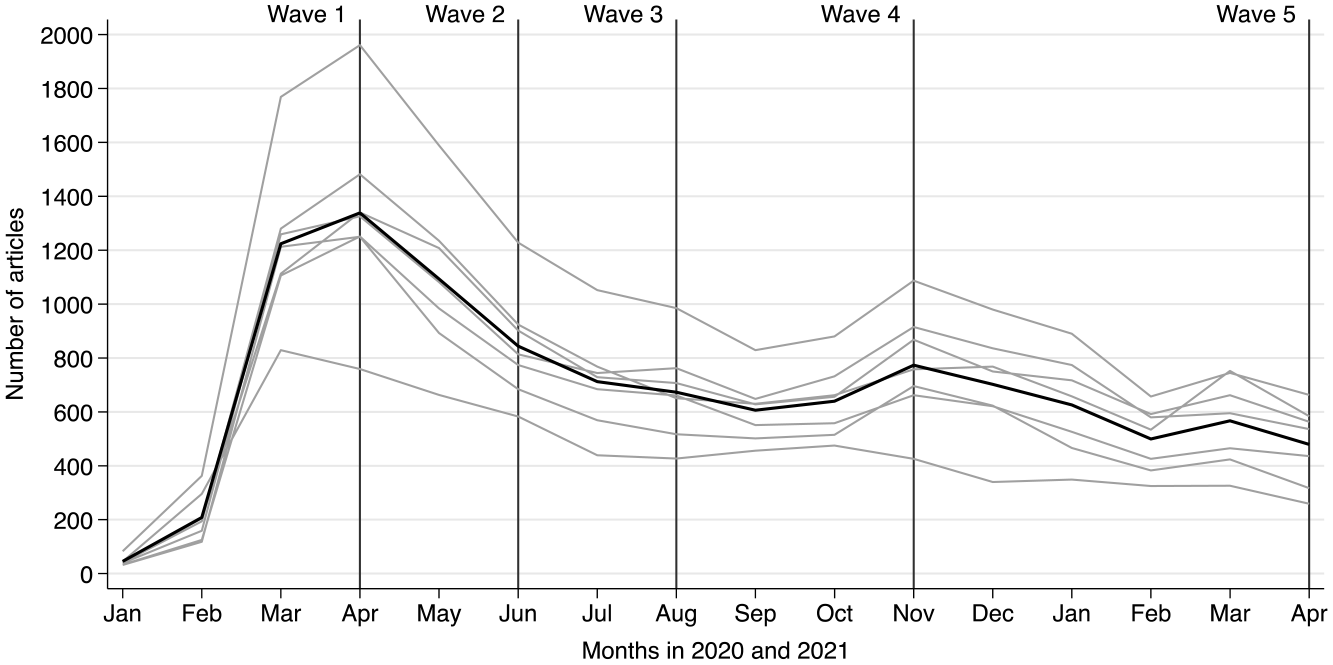
Amount of news coverage about the coronavirus over time.
While a group of consistent news avoiders may have avoided news about the coronavirus from the outset of the pandemic, others may have joined them down the road. For the latter group, the combination of decreasing uncertainty that reduces information needs and utility of news and the potentially increasing emotional strain of consuming news is likely to have made them gradually tune out from the news. While these developments might emerge in small leaps rather than smooth linear fashion, for instance in connection with approval and proliferation of vaccines, better knowledge of treatment, and new variants of the virus, the general direction of these developments lead us to the following expectation:
H1: Avoidance of news about the coronavirus increased over time.
In the case that news avoidance increased during the coronavirus pandemic it will be an indication of a “state” component, with news consumption patterns changing within individuals over time. However, we are also interested in knowing the extent to which news avoidance can be seen as a “trait” or a “state.” Thus, we also have the following research question:
RQ1: How much of the variance in avoidance of news about the coronavirus is between and within individuals, respectively?
Drivers of News Avoidance
While different individual-level drivers of news avoidance have been highlighted in the literature, news interest and media trust stand out as the most prominent (e.g., Edgerly, 2022; Toff & Kalogeropoulos, 2020; Toff & Nielsen, 2018). In addition to these prominent antecedents of news avoidance, we also examine the role of societal concerns, which is more context dependent. Below we theorize the relationship between these three variables and the consistency and temporality of news avoidance.
News Interest
Departing from the information utility model (Atkin, 1973), individuals with high news interest will be more motivated to seek out information to eliminate uncertainty about how to understand and react to current affairs than people with low news interest. In other words, news has a higher utility for people with a high news interest than for the ones who are less interested in news. In this context, news interest can reflect both a general interest in politics and a situational interest in a specific issue, such as the coronavirus pandemic. A general political interest is one of the strongest negative predictors of news avoidance (Edgerly, 2022; Strömbäck et al., 2013; Toff & Kalogeropoulos, 2020). While political interest has been shown to be highly stable in adult life (Prior, 2018), news interest in specific issues is likely to be more volatile and situational.
In this way, news interest in the coronavirus pandemic is likely to, on the one hand, reflect a stable political interest and serve as an explanation for the between-person variation in news avoidance representing the stable “trait” component. On the other hand, news interest in the coronavirus pandemic is also situational. First, as the immediacy of the political decisions varies across the crisis, news interest can also be expected to fluctuate because the utility of news content varies with the immediacy of the political decisions. Second, while some might gain news interest during the crisis due to the political stakes being high, others might exhibit waning news interest in the pandemic because they become disillusioned by increasing political conflict in times characterized by wide-ranging political decisions. To the extent that news interest in the coronavirus pandemic reflects a more situational and volatile interest, it can therefore also be expected to explain the within-person variation in news avoidance representing the more fluid “state” component of news avoidance. These considerations lead us to the following expectations:
H2: News interest is negatively related to avoidance of news about the coronavirus (a) between and (b) within individuals.
Trust in the News Media
Individuals’ trust in the news media also has a potential impact on the anticipated utility of news. In general, news media trust refers to “the relationship between citizens (the trustors) and the news media (the trustees), where citizens, however tacit or habitual, in situations of uncertainty expect that interactions with the news media will lead to gains rather than losses” (Strömbäck et al., 2020, p. 142). Thus, trust is a key component if news is to reduce an individual’s uncertainty about an issue. If one does not trust the information provided by the news media, it will unlikely update that individual’s understanding of past, current, and future events and how to respond to them.
People’s inclination to turn to the news media for information depends—at least partly—on the extent to which they believe that the news media will provide information that is relevant and credible (Prochazka & Schweiger, 2019). Previous research has shown that there is a relationship between news media trust and news media use, and that lower levels of trust in news media are associated with less use of legacy news media and greater use of nonmainstream media (Andersen et al., 2023; Fletcher & Park, 2017; Strömbäck et al., 2020; Tsfati, 2010). Likewise, studies of news avoidance also find that low trust in the news media is a prominent cause of tuning out (Edgerly, 2022; Toff & Kalogeropoulos, 2020; Toff & Nielsen, 2018; Van Aelst et al., 2021).
Trust in news media varies across different people and can thus be expected to explain between-person variation in news avoidance. While trust in the news media is likely to be rather stable over time, the reporting of the coronavirus pandemic with an emphasis on negative consequences, strict government-initiated restrictions, and political conflict can also be expected to have generated variations in news media trust over the course of the pandemic. These variations in trust affect the utility of news, with the likely result that people whose news media trust decreases will tend to avoid the news more. These considerations lead us to the expectations that:
H3: Trust in the news media is negatively related to avoidance of news about the coronavirus (a) between and (b) within individuals.
Societal Concerns
Research have shown that information utility varies with the perceived magnitude of threats and opportunities, the perceived likelihood of their materialization, and the perceived immediacy of their materialization (e.g., Knobloch-Westerwick et al., 2005). Thus, the utility of news can be expected to have varied considerably over the course of the coronavirus pandemic as uncertainty about short and long-term consequences of the crisis changed. Such considerations can be captured by societal perceptions: do people see the coronavirus as a vital societal problem or not? Individuals seeing the pandemic as a big problem will most likely be more concerned and hence more prone to seek out news to reduce uncertainty about how to understand, think, and act on these concerns, while a person who do not see the pandemic as a big problem will most likely be less concerned and hence more prone to avoid the news. This expectation is in line with studies on risk information seeking and avoidance showing that people are more motivated to seek out information when they perceive the consequences to be serious (Gutteling & de Vries, 2017), and it dovetails with studies showing that anxiety leads to increased information seeking to cope with and reduce the anxiety (Albertson & Gadarian, 2015; Hmielowski et al., 2020; Marcus & Mackuen, 1993).
A perception of the coronavirus pandemic as a big problem may also lead people to avoid news, however. For news to command utility, the exposure benefits must exceed the liabilities or the costs of consuming them. If news increases uncertainty or if it leads to aversive emotional arousal, the benefits may not—helpful as it might be in terms of improving the comprehension of or attitude formation on an issue—exceed the costs (Atkin, 1973). This expectation aligns with the finding that anticipated anxiety leads some people to avoid the news, especially if they also find the utility of news to be low (Toff & Nielsen, 2022). News coverage of the coronavirus pandemic was massive (see Figure 1), and it was almost impossible to follow the news without being confronted with the pandemic (Ytre-Arne & Moe, 2021). Such wall-to-wall coverage of a threatening pandemic can lead to information overload and fatigue (Chen & Chen, 2020), which is related to news avoidance (Song et al., 2017; Vandenplas et al., 2021). This pattern may be most pronounced among people who perceive the coronavirus to be a big problem as they will have a harder time coping with all the available negative information, compared to people who see the coronavirus as a less of a problem.
Societal concerns are likely to be different for different individuals from the outset and throughout the coronavirus pandemic. Thus, they can be expected to explain between-person variation in news avoidance. However, societal concerns can also be expected to have varied considerably over the course of the crisis as more information became available, as the number of coronavirus related deaths and hospitalizations changed, or as the outlook for the economy changed. Thus, we can expect societal concerns to explain both between-person and within-person variations in news avoidance. However, the directions of these relationships are unclear. Therefore, we finally posit the following research questions:
RQ2: How do societal concerns affect avoidance of news about the coronavirus (a) between and (b) within individuals?
Methods
The study is based on a five-wave panel study from Sweden, allowing us to track changes in news avoidance, news interest, news media trust, and societal concerns during the coronavirus pandemic. As for most other countries around the world, 2020 and 2021 became years dominated by the coronavirus, leaving Swedish citizens uncertain about the scope and consequences of the situation. Sweden is part of the Democratic Corporatist Model of media systems (Humprecht et al., 2022) and often labelled a so-called “media welfare state” (Syvertsen et al., 2014). The Swedish media environment is dominated by strong public service broadcasters and a high newspaper circulation. Compared to other countries, the Reuters Digital News Report suggests that news media trust in Sweden is neither very high nor low, with 50 percent thinking they can trust most news most of the time (Newman et al., 2022). In relation to news avoidance, 22 percent report actively avoiding the news “sometimes” or “often,” which is, comparatively, in the lower end (Newman et al., 2019).
Data
The five-wave panel survey was collected over a one-year period in the time following the outbreak of the coronavirus in Sweden. The panel survey was conducted in collaboration with the Laboratory of Opinion Research (LORE) at the University of Gothenburg using a probability sample of 4,000 people from their panel of 75,000 people. A probability-recruited sample, pre-stratified on gender, age, and education, was used to obtain a sample reflecting the Swedish population aged 19–84. The first survey wave was fielded from 14 April to 7 May 2020 with 2,486 people participating (AAPOR RR5: 59,7%), the second survey wave was fielded from 9 June to 1 July 2020 with 2,219 people participating (AAPOR RR5: 55,7%), the third survey was fielded from 17 August to 9 September 2020 with 2,131 people participating (AAPOR RR5: 53,3%), the fourth wave was fielded from 26 October to 16 November 2020 with 1,994 people participating (AAPOR RR5: 51,9%), and the fifth wave was fielded from 14 April to 10 May 2021 with 1,748 people participating (AAPOR RR5: 47,9%).
To provide some context for the data collection, Figure 1 illustrates how the amount of news coverage about the coronavirus in seven of the most prominent Swedish news media developed over time and when the survey waves were fielded. After a sharp increase from February 2020, the amount of coverage peaked in April 2020 and then slowly decreased again. The first survey wave was fielded as the coverage peaked, while subsequent survey waves were fielded as the amount of coverage gradually decreased. Thus, while the opportunities for being exposed to news coverage about the coronavirus decreased over survey waves, the cost of being exposed to it increased as information became less prominent.
Measures
To measure news avoidance, we rely on two survey items from each wave. Presented with a response scale ranging from 1 (“Not true at all”) to 5 (“Completely true”), the respondents were asked to what extent the following statements applied to them: “I try to avoid news about corona” and “I follow news about corona as much as I can.” As such, these items reflect an intentional and active form of selective news avoidance and seeking (Skovsgaard & Andersen, 2020, 2022). For some of the following analysis, the latter item was reversed, and the two items are combined to an index ranging from 1 to 5 for each survey wave (see descriptive statistics of all variables in the Appendix, Table A1). As mentioned above, such audience practices are not necessarily related to very low consumption or non-use of news in general. Rather, they should be seen as practices that audience can engage in to varying degrees.
News interest was measured in each wave with the survey item “I’m not interested in news about the coronavirus” (reversed), likewise on a scale from 1 (“Not true at all”) to 5 (“Completely true”). For some of the following analysis, this item was recoded to range from 0 to 1.
News media trust was also measured in each survey wave using the question “How much trust do you have in how the following actors handle the outbreak of the coronavirus?” and the item “The news media.” The response scale ranged from 1 (“Very low trust”) to 7 (“Very high trust”). For some of the following analysis, this item was likewise recoded to range from 0 to 1.
Societal concerns were captured by measuring perceptions of how Sweden managed the coronavirus pandemic. On a response scale ranging from 1 (“Not true at all”) to 7 (“Completely true”) the respondents were asked “There are various claims about the coronavirus in the public debate. How well do the following match your own opinion?” followed by the items “Sweden has managed the coronavirus better than most other countries in the EU” (reversed), “Sweden has managed the coronavirus worse than our Nordic neighbors,” and “Sweden has been well prepared to deal with the coronavirus” (reversed). These three items were combined to an index and rescaled to range from 0 to 1 for each survey wave.
We further include news consumption, personal experience, interpersonal talk, and ideology as control variables. News consumption was measured by asking the respondents how often during the last month they had used the main news outlets in Sweden (Ekot on Sveriges Radio, Aktuellt/Rapport on Sveriges Television, TV4 Nyheterna, Aftonbladet, Expressen, Dagens Nyheter, Svenska Dagbladet, and Dagens Industri). The response scale ranged from 1 (“Daily”) to 6 (“Never”). For each wave, answers were reversed and combined to and index reflecting the highest response given across these news outlets. Personal experience was measured with the question: “If you look at your own situation, how much impact has the coronavirus had so far on. . .” followed by the three items “Your everyday life,” “Your economy,” and “Your work situation.” The response scale ranged from 1 (“Very little impact”) to 7 (“Very big impact”), and the three items were combined to an index and rescaled to range from 0 to 1 for each survey wave. Interpersonal talk was measured by asking the respondents how often during the last month they had talked about the coronavirus with (1) someone in their family, (2) friends or acquaintances, and (3) strangers. The response scale ranged from 1 (“Daily”) to 6 (“Never”), and the three items were therefore reversed and combined to an index ranging from 0 to 1 for each survey wave. Ideology was also measured in each wave on a scale from 0 (“Far left”) to 10 (“Far right”), which was likewise rescaled from 0 to 1.
In addition, we also include controls for gender (1 = female), different age groups (under 30, 30–39, 40–49, 50–59, 60–69, and 70 or above), and education. Education was measured on a nine-point scale from 1 (“No education”) to 9 (“Degree from postgraduate education”). Both age and education were also rescaled from 0 to 1.
Analysis
In the following section, we first examine how news avoidance develops over time—both in general and across relevant subgroups. Next, to distinguish between the consistent “trait” and the temporal “state” dimensions of news avoidance and examine how news interest, news media trust, and societal concerns relate to them, we rely on a random-effects within-between (REWB) model, which “distinguishes between stable between-person differences and within-person effects” (Scharkow et al., 2020, p. 2761). The starting point is a random effects panel model. The between-within decomposition is accomplished by including both each respondent’s deviation from their cluster-specific mean
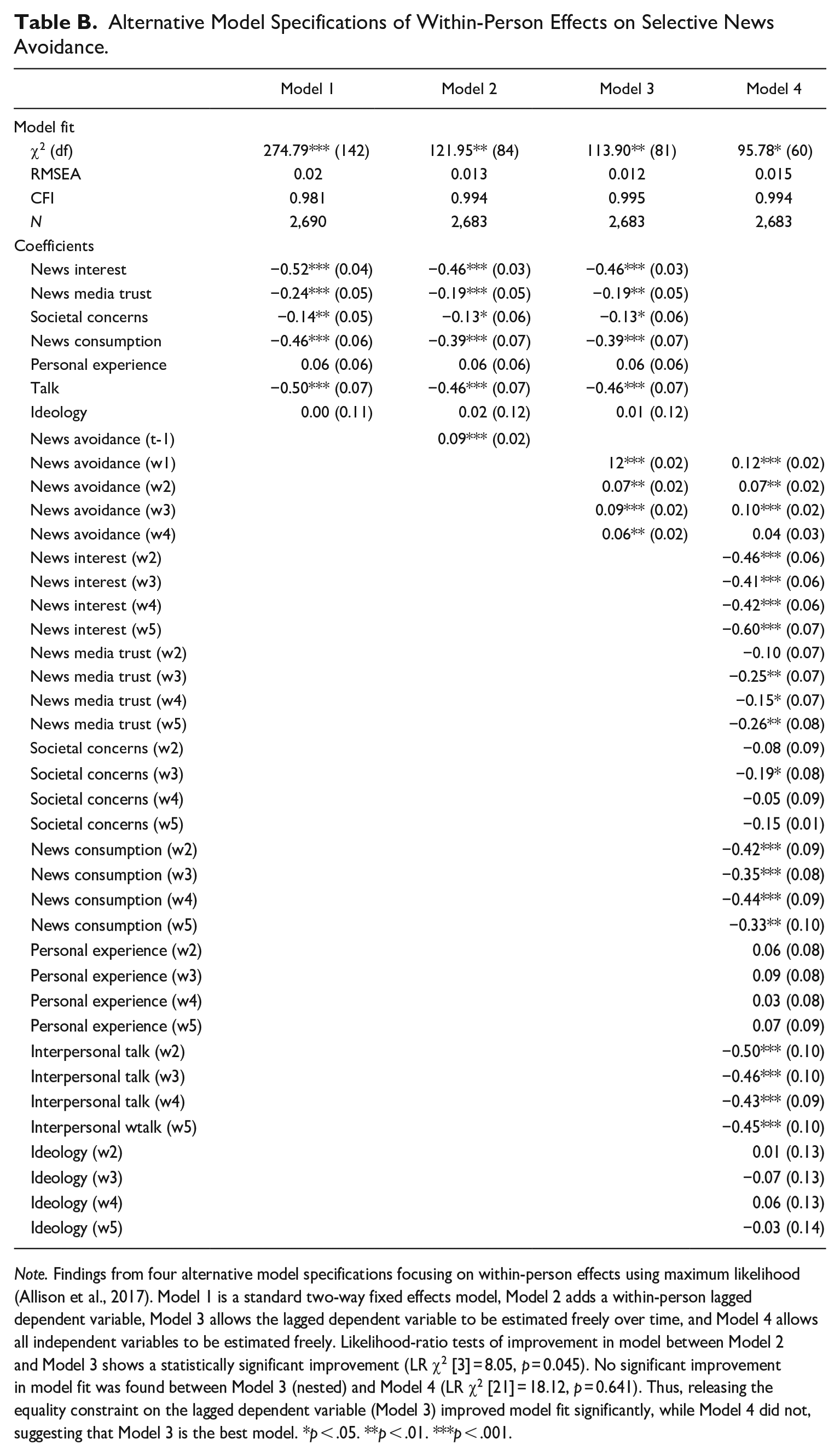
To assess the sensitivity of our findings from this model, we also tested a number of alternative dynamic panel model specifications of within-person effects, where we include (1) a lagged dependent variable, (2) allow the effect of the lagged dependent variable to vary freely over time, and (3) allow the effect of all predictor variables to vary freely over time—thus allowing these variables to have different within-person effects during the pandemic. These models were estimated with the xtdpdml command in Stata (Allison et al., 2017) and are presented in the Appendix, Table B. Although relaxing some assumptions improves model fit, the main findings as we present them below are robust across these alternative models.
Results
Figure 2 illustrates response distributions among the respondents who participated in all five survey waves for the two items tapping news avoidance practices. Vertical lines illustrate mean values. Starting with the left-side panels, we see a change in the mean from 1.60 in wave 1 to 1.71 in wave 5 (p < .001) for the statement “I try to avoid news about corona.” Although significant, the change is quite small, which is also reflected in the underlying response distributions. In the first survey wave, 64.8% indicated that the statement was “Not correct at all,” while only 1.1% indicated that it was “Completely true.” In the fifth survey wave, the shares only changed a bit to 60.5% and 1.9%, respectively. Turning to the right-side panels, we see a change in the mean from 3.83 in wave 1 to 3.39 in wave 5 (p < .001) for the statement “I follow news about corona as much as I can.” The change for this item is larger, which is also reflected in the underlying distributions. In the first survey wave, 6.5% indicated that the statement was “Not correct at all,” while 39% indicated that it was “Completely true.” In the fifth survey wave, the shares changed to 12.3% and 25.3%, respectively. Due to panel attrition, these numbers should not be seen as representative for the Swedish population. Rather, they should be seen as conservative estimates of news avoidance, as news avoiders are probably more likely to drop out of the survey due to low interest. Nevertheless, they illustrate that avoidance of news about the coronavirus increased during the pandemic, supporting H1.
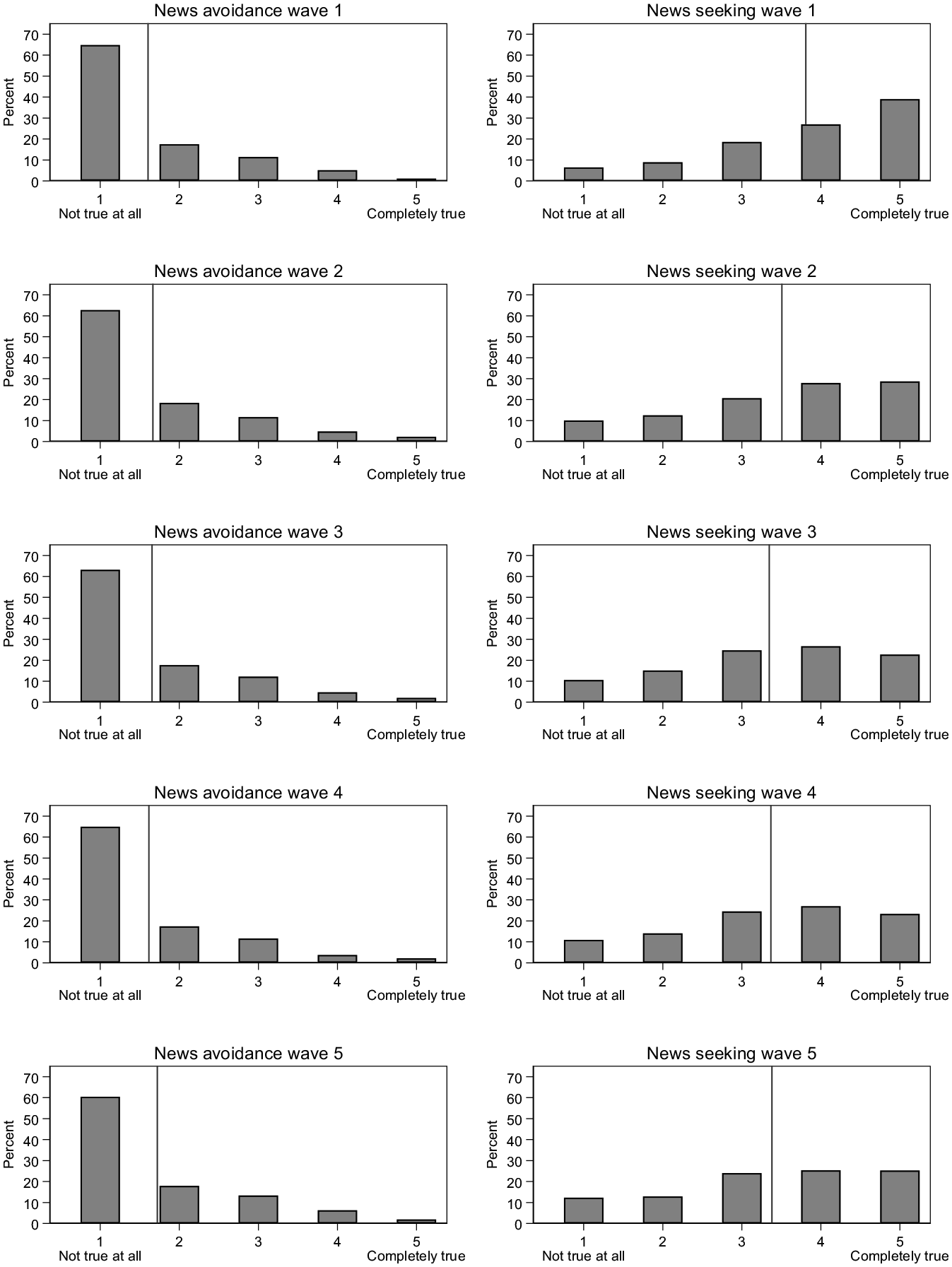
Selective news avoidance and seeking across survey waves.
While this increase indicates that news avoidance to some extent has a temporal component, we also calculate the intraclass correlation for an empty multilevel model to get an estimate of the variance found within and between persons, respectively. The model has an intraclass correlation of .61, indicating that 61% of the variation in news avoidance is between persons, reflecting the “trait” component, while 39% of the variation is found within persons, indicating the ‘state’ component. This result confirms that news avoidance indeed has both a “trait” and a “state” component, but that the “trait” dimension is dominant, answering RQ1.
To get a first impression of the roles played by news interest, news media trust, and societal concerns, Figure 3 illustrates mean values of news avoidance over the five survey waves across low, medium, and high values of these variables. It is clear how people with a low news interest and news media trust to a higher extent try to avoid news, while people with a high news interest and news media trust to a higher extent try to follow news as much they can. Societal concerns, on the other hand, do not seem to play a large role in avoidance of news about the coronavirus, with no apparent differences in average news avoidance across levels of social concerns.
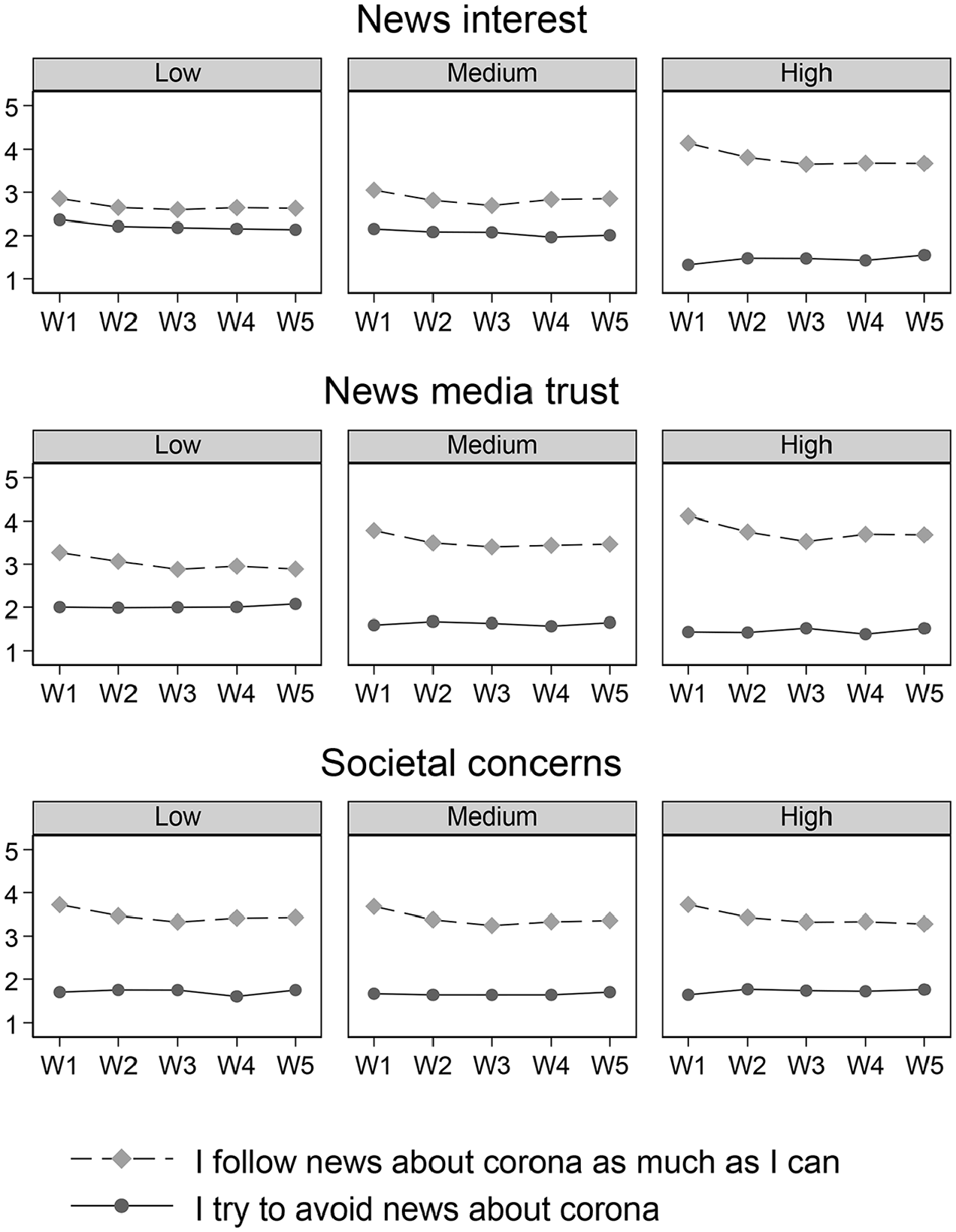
Development in selective news avoidance and seeking over time across news interest, news media trust, and societal concerns.
To test how these variables relate to the “state” and “trait” dimension of news avoidance, respectively, we turn to the REWB model to separate the stable between-person and dynamic within-person predictors. The coefficients from the REWB model are illustrated in Figure 4. As all independent variables are recoded from 0 to 1, the coefficients illustrate maximal effects, that is, what happens when we move from one end of the scale to the other. Thereby, it is also possible to compare the effect sizes. We are presenting the results for unbalanced data to utilize as much information as possible. If we run the models on balanced data (i.e., only respondents who answered all relevant questions in all waves), the results are very similar.
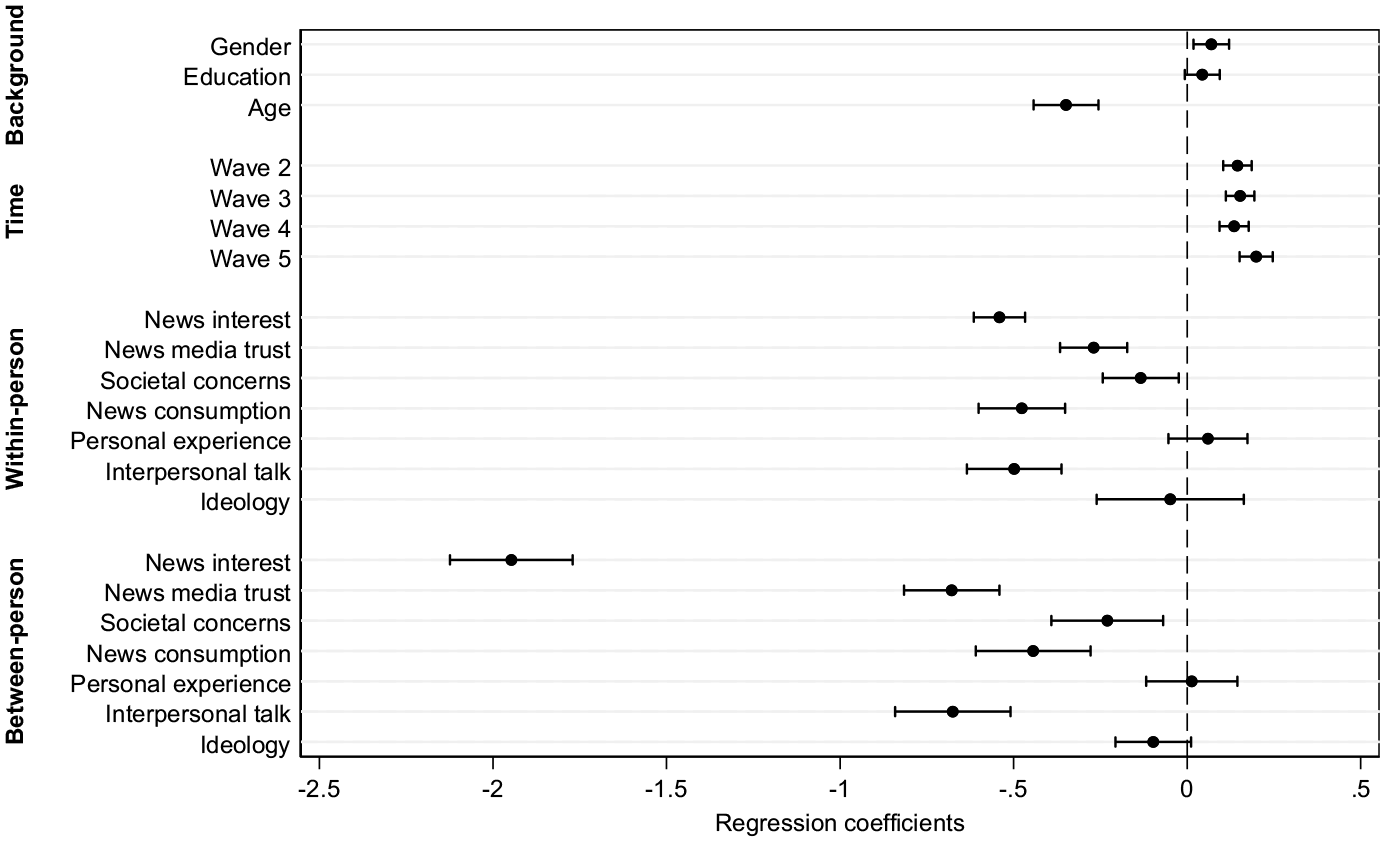
Within-Person and between-Person effects on selective news avoidance.
Regarding the development in news avoidance over time, the coefficients of the individual waves (W2: b = .15, W3: b = .15, W4: b = .14, W5: b = .20, all p < .001) illustrate how news avoidance increased over time compared to the first survey wave, again supporting H1.
The between-person effects represent stable influences that differ between individuals and, therefore, relate to the “trait” component of news avoidance. In respect to these between-person effects, the results show that news interest (b = −1.95, p < .001), news media trust (b = −.68, p < .001), and societal concerns (b = −.23, p < .01) affect differences in news avoidance between people. Thus, people are more likely to be news avoiders if they have a lower news interest, a lower news media trust, and a perception that the coronavirus is not a big societal problem, supporting H2a and H3a and answering RQ2a. These results fit the utility perspective on news avoidance. People who found news on the coronavirus pandemic more interesting, who trusted the news media more and were more inclined to perceive the coronavirus pandemic as big societal problem got more utility from news consumption and were, as a result hereof, less likely to avoid news on the pandemic.
The within-person effects represent influences that vary over time and, therefore, relate to the “state” component of news avoidance. Here, the results likewise show that news interest (b = −.54, p < .001), news media trust (b = −.27, p < .001), and societal concerns (b = −.13, p < .05) all have a negative effect on changes in news avoidance, supporting H2b and H3b and answering RQ2b. Thus, on an individual level, declining interest in news, declining trust in the news media, and a change in perception toward the coronavirus not being a big societal problem led to more news avoidance over time. In an information utility perspective, these effects are in line with the proposition that when news interest, trust in the news media, and the perceived magnitude of societal problems created by the pandemic are reduced, the utility of the news declines and in turn increases the likelihood that an individual avoids news about the coronavirus.
Regarding the control variables, we see that news consumption has a negative effect on news avoidance—both between (b = −.44, p < .001) and within-persons (b = −.48, p < .001). Thus, lower levels of and declining news consumption is related to more avoidance of news about the coronavirus. Likewise, interpersonal talk has a negative effect on news avoidance—both between (b = −.68, p < .001) and within-persons (b = −.50, p < .001). Thus, the more people talked about the coronavirus with others, the less likely they were to avoid news about the virus, and if people increased their talks with others about the virus, they became less likely to avoid news about this topic. Political ideology and personal experience have no effect on news avoidance. Lastly, females (b = .07, p < .01) and younger people (b = −.46, p < .001) were more likely to avoid news about the coronavirus, while education is unrelated to news avoidance (b = .04, p = .136).
Returning to the negative association between news consumption and news avoidance, this relationship deserves more attention. Figure 5 illustrates the bivariate relationship between practices of avoiding and seeking out news on the coronavirus and overall frequency of news consumption using data from the fifth survey wave. Keeping in mind that panel attrition has likely biased the sample toward more interested people, we see that the variables are clearly related, with more avoidance practices being related to less news consumption, and more seeking practices being related to more news consumption. But, importantly, even people who find it completely true that they avoid news about the coronavirus pandemic are consuming news from one or several news sources approximately 3–4 days a week.
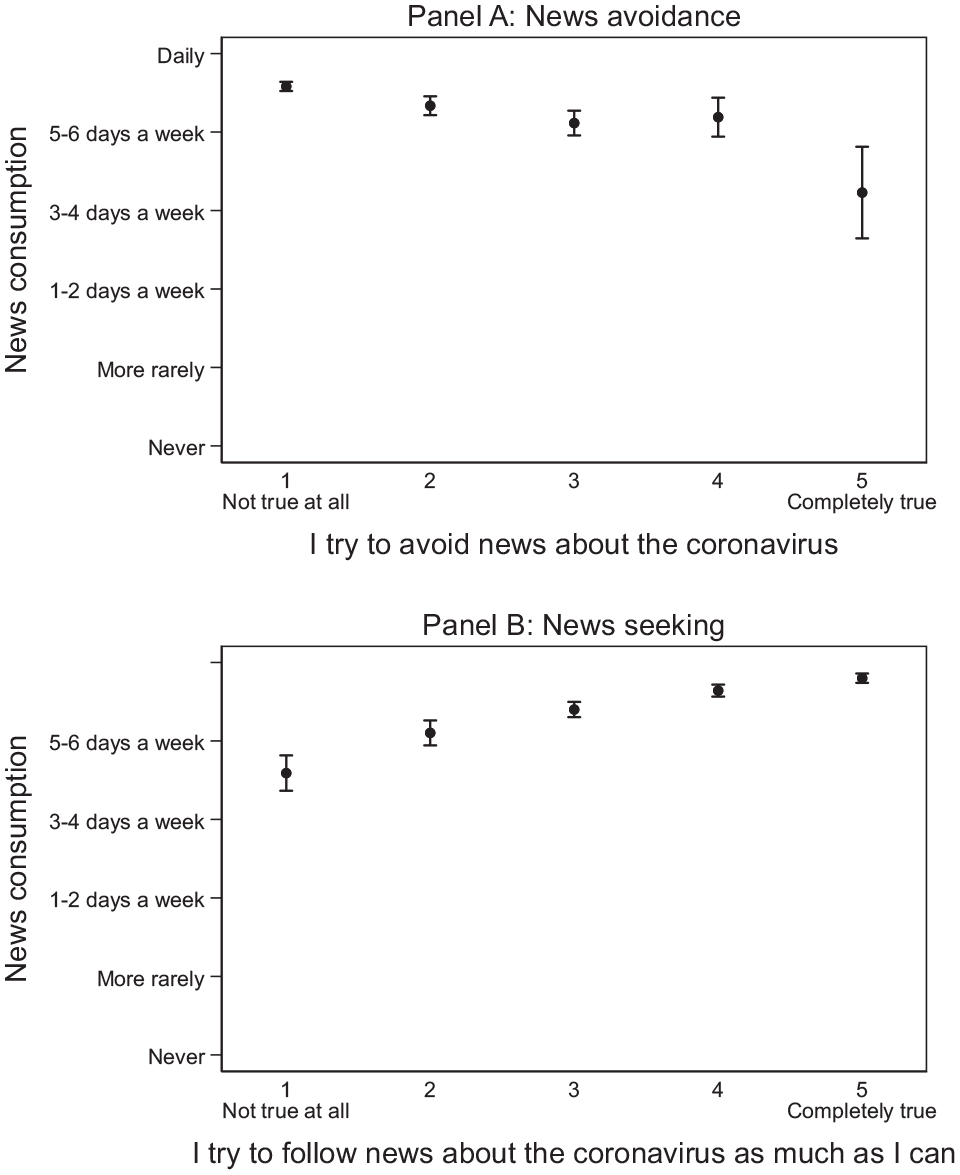
Relationships between selective news avoidance and news consumption.
Discussion and Conclusion
The effects and democratic implications of news avoidance ultimately depend on its nature (Damstra et al., 2023; Skovsgaard & Andersen, 2022). In so far as news avoidance can be considered as a stable ‘trait’ that characterizes a specific group of citizens, these people risk being permanently disconnected from news and in consequence disadvantaged in democracy. If news avoidance instead can be considered as a more temporary “state” that fluctuates over time, with people tuning out of news every now and then, it might be less of a democratic problem (Ytre-Arne & Moe, 2021). Instead, in this case news avoidance may even have some positive side effects, as such audience behavior can be used to regulate mood and mental well-being (de Bruin et al., 2021).
Examining selective avoidance of news about the coronavirus utilizing a unique five-wave panel survey collected in Sweden during the pandemic, this study has demonstrated three important findings: (1) avoidance of news about the coronavirus increased over time, (2) such selective news avoidance has both a “trait” and a “state” dimension, but the “trait” dimension is dominant, and (3) the correlates of these two dimensions appear to be very similar. These results have both important theoretical and societal implications, which we discuss below.
In relation to the theoretical implications, the results bring us one step closer understanding the complex nature of news avoidance. As such, the study has demonstrated empirically what previous conceptual work has suggested (Skovsgaard & Andersen, 2022): that news avoidance has both a stable “trait” dimension, representing a group of consistent news avoiders, and a more fluid “state” dimension, representing strategic news consumption practices that vary over time. In the context of the coronavirus pandemic, our analysis suggests that approximately 60% of the variation in selective news avoidance can be considered a “trait,” while 40% of the variation can be considered a “state.” Although selective news avoidance in general increased during the coronavirus pandemic (see also de Bruin et al., 2021)—a most-likely case for fluctuations in news consumption—the “trait” component of news avoidance remains dominant. As such, people indeed engage in strategic practices of news avoidance to regulate their news habits in response to personal or contextual changes (Ytre-Arne & Moe, 2021), but most often news avoidance is a consistent audience behavior.
Further, our study highlights the relevance of analyzing drivers of news avoidance from an information utility perspective (Atkin, 1973) to understand and explain the stable and fluctuating dimensions of this audience behavior. Our analysis has demonstrated that news interest, news media trust, and societal concerns are associated with both differences in selective news avoidance between persons, representing consistency, and variations within persons, representing temporality. Thus, people with a lower or declining interest in news, a lower or declining trust in the news media, and an (increasing) perception that the coronavirus pandemic is not a big problem are both more likely to be consistent news avoiders and more likely to increase their news avoidance over time, as their utility of consuming news does not outweigh their costs of doing so. Especially in relation to societal concerns, we see that perceiving the coronavirus pandemic as a big problem decreases rather than increases news avoidance. Thus, in line with studies on risk information seeking and avoidance (Gutteling & de Vries, 2017), such a societal concern seems to have motivated people to seek out news, rather than leading to an emotionally draining condition causing them to tune out (Vandenplas et al., 2021).
In relation to the societal implications, our study raises several concerns. First, as selective news avoidance predominately seems to be a “trait,” characterizing a consistent group of news avoiders, our findings underline the democratic consequences of this audience behavior, as these people will be less likely to engage in politics (Andersen et al., 2021). Given that an increasing number of people avoid news (Gorski & Thomas, 2022), this audience behavior is likely to result in increasing knowledge and participation gaps polarizing the electorate (see Damstra et al., 2023; Van Aelst et al., 2017). Here, however, it is important to keep in mind that even people who completely agree that they try to avoid news about the coronavirus pandemic on average consume a considerable amount of news (see also Palmer et al., 2023). As such, practices of selective news avoidance may not be as significant a democratic problem as one would intuitively imagine.
Second, although occasional and selective news avoidance can also result in problematic democratic outcomes, previous studies have highlighted the potential benefits of this behavior, as such strategic audience practices can improve mood and mental well-being (de Bruin et al., 2021; Ytre-Arne & Moe, 2021). However, our study shows that the correlates of the “trait” and “state” dimensions of news avoidance are very similar. In other words, the audience preferences related to temporal selective news avoidance are very similar to audience preferences related to consistent selective news avoidance. Thus, strategic practices of news avoidance to regulate one’s news habits may be a first step of consistently tuning out from the news. This risk highlights the delicate balance between seeking and avoiding news to stay informed while protecting one’s mood and mental well-being (de Bruin et al., 2021; Tunney et al., 2021; Vandenplas et al., 2021). We encourage future research to explore when temporal news avoidance turns into consistent news avoidance, and what constitutes an optimal, healthy news diet in a world of information overload.
Our study is of course not without limitations. Most importantly, we only examine selective news avoidance in relation to the specific issue of the coronavirus pandemic. Without doubt, this case is very special and naturally raises questions about the generalizability of the results to avoidance of other topics and news in general. Recently, many studies have examined news avoidance in the context of the coronavirus pandemic (e.g., Broersma & Swart, 2022; Groot Kormelink & Klein Gunnewiek, 2022; Vandenplas et al., 2021; Ytre-Arne & Moe, 2021), and understanding information seeking and avoidance in such crisis situations has its own merits. Our results are most likely transferable to other crises situations, but the extent to which general news avoidance can be seen as a “trait” or “state” remains an open question. We therefore urge future studies to examine the consistency and temporality of avoidance of news in general. Also speaking to the generalizability of the results, we study selective news avoidance in a single country, namely Sweden. With its public service media and high levels of news consumption, this country can be seen as a least-likely case for news avoidance, and countries with more liberal or polarized media systems face higher levels of news avoidance (Toff & Kalogeropoulos, 2020). On the other hand, the type of selective news avoidance that we study also requires at least some exposure to news for one to subsequently try to avoid it. From this perspective, high news consumption lays a foundation for more people starting to engage in avoidance practices.
Although we rely on a unique five-wave panel study, the data collection did not begin before the pandemic had become an extremely salient issue. As such, by then some people have likely already started adjusting their news habits by engaging in avoidance practices. Thereby, we potentially overestimate the “trait” component of selective news avoidance. Further, we only include a limited number of explanatory variables. Studies on news avoidance have highlighted how other explanatory factors, such as a perception that the news coverage is too negative (e.g., Toff & Palmer, 2019; M. C. Wagner & Boczkowski, 2021; Woodstock, 2014), a feeling of news overload (e.g., Song et al., 2017), and social and civic duty norms (Palmer & Toff, 2020). Especially, we are limited by not having measures of emotional responses to news—something highlighted by other studies as important drivers for news avoidance (e.g., Groot Kormelink & Klein Gunnewiek, 2022; Tunney et al., 2021; M. C. Wagner & Boczkowski, 2021). Future studies are therefore encouraged to examine more closely the role of these factors and their impact on the consistency and temporality of news avoidance, respectively. Related, we study how selective news avoidance depends on news interest, news media trust, and societal concerns. However, these variables are also likely to be influenced by news consumption. Future studies are encouraged to examine such reciprocal relationships between audience preferences and practices of news avoidance.
Despite these limitations our study has highlighted how selective news avoidance can be considered both a habitual audience behavior, resembling a “trait” characterizing a specific group of consistent news avoiders, and a more fluid and temporal “state” reflecting strategic news consumption practices in response to specific situations. With these results, the study provides new insights to the complex nature of news avoidance and its democratic implications.
Footnotes
Appendix
Alternative Model Specifications of Within-Person Effects on Selective News Avoidance.
| Model 1 | Model 2 | Model 3 | Model 4 | |
|---|---|---|---|---|
| Model fit | ||||
| χ2 (df) | 274.79*** (142) | 121.95** (84) | 113.90** (81) | 95.78* (60) |
| RMSEA | 0.02 | 0.013 | 0.012 | 0.015 |
| CFI | 0.981 | 0.994 | 0.995 | 0.994 |
| N | 2,690 | 2,683 | 2,683 | 2,683 |
| Coefficients | ||||
| News interest | −0.52*** (0.04) | −0.46*** (0.03) | −0.46*** (0.03) | |
| News media trust | −0.24*** (0.05) | −0.19*** (0.05) | −0.19** (0.05) | |
| Societal concerns | −0.14** (0.05) | −0.13* (0.06) | −0.13* (0.06) | |
| News consumption | −0.46*** (0.06) | −0.39*** (0.07) | −0.39*** (0.07) | |
| Personal experience | 0.06 (0.06) | 0.06 (0.06) | 0.06 (0.06) | |
| Talk | −0.50*** (0.07) | −0.46*** (0.07) | −0.46*** (0.07) | |
| Ideology | 0.00 (0.11) | 0.02 (0.12) | 0.01 (0.12) | |
| News avoidance (t-1) | 0.09*** (0.02) | |||
| News avoidance (w1) | 12*** (0.02) | 0.12*** (0.02) | ||
| News avoidance (w2) | 0.07** (0.02) | 0.07** (0.02) | ||
| News avoidance (w3) | 0.09*** (0.02) | 0.10*** (0.02) | ||
| News avoidance (w4) | 0.06** (0.02) | 0.04 (0.03) | ||
| News interest (w2) | −0.46*** (0.06) | |||
| News interest (w3) | −0.41*** (0.06) | |||
| News interest (w4) | −0.42*** (0.06) | |||
| News interest (w5) | −0.60*** (0.07) | |||
| News media trust (w2) | −0.10 (0.07) | |||
| News media trust (w3) | −0.25** (0.07) | |||
| News media trust (w4) | −0.15* (0.07) | |||
| News media trust (w5) | −0.26** (0.08) | |||
| Societal concerns (w2) | −0.08 (0.09) | |||
| Societal concerns (w3) | −0.19* (0.08) | |||
| Societal concerns (w4) | −0.05 (0.09) | |||
| Societal concerns (w5) | −0.15 (0.01) | |||
| News consumption (w2) | −0.42*** (0.09) | |||
| News consumption (w3) | −0.35*** (0.08) | |||
| News consumption (w4) | −0.44*** (0.09) | |||
| News consumption (w5) | −0.33** (0.10) | |||
| Personal experience (w2) | 0.06 (0.08) | |||
| Personal experience (w3) | 0.09 (0.08) | |||
| Personal experience (w4) | 0.03 (0.08) | |||
| Personal experience (w5) | 0.07 (0.09) | |||
| Interpersonal talk (w2) | −0.50*** (0.10) | |||
| Interpersonal talk (w3) | −0.46*** (0.10) | |||
| Interpersonal talk (w4) | −0.43*** (0.09) | |||
| Interpersonal wtalk (w5) | −0.45*** (0.10) | |||
| Ideology (w2) | 0.01 (0.13) | |||
| Ideology (w3) | −0.07 (0.13) | |||
| Ideology (w4) | 0.06 (0.13) | |||
| Ideology (w5) | −0.03 (0.14) | |||
Note. Findings from four alternative model specifications focusing on within-person effects using maximum likelihood (Allison et al., 2017). Model 1 is a standard two-way fixed effects model, Model 2 adds a within-person lagged dependent variable, Model 3 allows the lagged dependent variable to be estimated freely over time, and Model 4 allows all independent variables to be estimated freely. Likelihood-ratio tests of improvement in model between Model 2 and Model 3 shows a statistically significant improvement (LR χ2 [3] = 8.05, p = 0.045). No significant improvement in model fit was found between Model 3 (nested) and Model 4 (LR χ2 [21] = 18.12, p = 0.641). Thus, releasing the equality constraint on the lagged dependent variable (Model 3) improved model fit significantly, while Model 4 did not, suggesting that Model 3 is the best model. *p < .05. **p < .01. ***p < .001.
Declaration of Conflicting Interests
The authors declared no potential conflicts of interest with respect to the research, authorship, and/or publication of this article.
Funding
The authors disclosed receipt of the following financial support for the research, authorship, and/or publication of this article: This work was supported by the European Research Council (ERC) under the European Union’s Horizon 2020 under grant agreement no. 804662. Any opinions, findings, and conclusions or recommendations expressed in this article are those of the author(s) and do not necessarily reflect the views of the ERC.
