




Abstract
Today’s media environment provides people ample opportunities for constructing news habits fitting their preferences, but our knowledge about the dynamics of such news habits is limited. Using a four-wave panel survey from Sweden and taking a news repertoires approach, the study identifies four groups of news users labeled Public service-oriented traditionalists, Minimalists, Engaged pluralists, and Quality-oriented explorers, which are each related to news interest, trust in mainstream news media, and socio-demographic factors in distinct ways. The news repertoires are highly stable, even during profound contextual change, showing that people most often maintain their news habits and only seldom reform them.
Keywords
As the most important information source for many, the news media influence people’s worldviews and democratic engagement (Eveland & Scheufele, 2000; Morgan & Shanahan, 2010). As such, people’s news habits are central to understand their beliefs and behaviors. Over the past decades, however, the media environment has gone through fundamental changes with important implications for people’s news habits. New technological inventions, such as personal computers, smartphones, the internet, and social media, have provided the foundation for a media environment saturated with information. At the same time, people’s trust in mainstream news media is declining in many countries (Hanitzsch et al., 2018), and so-called alternative news media are on the rise (Holt et al., 2019). These developments have raised concerns, as audience fragmentation, news inequalities, and reliance on alternative information sources potentially lead to a weakened democracy where a shared belief of reality may erode and gaps in engagement may increase (Van Aelst et al., 2017).
As such, it is important to understand the nature of people’s news habits. Therefore, the aim of this study is to examine how people’s news habits look in today’s complex media environment, how stable these habits are, and what the underlying drivers of these habits and their stability may be. With many new opportunities for selecting different media sources, especially online, peoples’ preferences have become increasingly important in determining their news media consumption (Napoli, 2011). If people are not interested in the news or do not trust the mainstream news media, they can easily turn their backs to the news media completely (Prior, 2007) or seek out news in correspondence with their attitudes (Stroud, 2008). As pointed out above, this development may have crucial societal implications. After all, as Stroud (2008) notes, “[d]ifferent patterns of news exposure may lead people to develop different impressions of what is happening in the world around them” (p. 342).
To examine the dynamics of people’s news habits in today’s complex media environment, we take a news repertoires approach (see, for example, Edgerly, 2015; Mangold & Bachl, 2018; Strömbäck et al., 2018; Yuan, 2011) and examine people’s patterns of news consumption across media, including traditional mainstream news media, like TV, radio, and newspapers, as well as new information sources, such as social media and alternative news sites. Although news consumption is often seen as rather habitual (LaRose, 2010), such news repertoires are also likely to be reformed, especially when facing profound contextual changes (Peters & Schrøder, 2018). However, no previous studies have empirically examined the extent to which news repertoires are maintained and reformed over time. Therefore, we examine which news repertoires can be identified in today’s media environment and how stable these repertoires are. In addition, we have limited knowledge of why people end up with the news repertoires they do. Thus, we also examine the key covariates related to these news repertoires and the potential change between them, focusing on the roles played by news interest and trust in mainstream news media in addition to socio-demographic factors. Such news attitudes are likely to play important roles in people’s news consumption patterns in a media environment with abundant content supply from both mainstream and alternative media sources.
Examining how news repertoires unfold and develop over time requires longitudinal data on the level of individual media users. Therefore, the study is based on a large four-wave panel survey from Sweden collected over a 2-year period from 2018 to 2020. As the panel survey was collected partly during the coronavirus (COVID-19) pandemic, we are able to examine how the “external shock” created by this societal crisis affects news repertoires and their stability. Based on these data, the study brings new insights into the possible drivers behind people’s news habits, and if, when, and to what extent they change them.
News Repertoires in a Complex Media Environment
Over the last decades, the media landscape has changed fundamentally. With personal computers, smartphones, the internet, and social media joining older media platforms, people now have access to endless amounts of media sources and content. News is available nonstop in many different forms, ranging from the traditional printed newspapers, TV newscasts, and radio news, to mainstream and alternative news outlets online or on social media sites, making news consumption increasingly multiplatform (Diehl et al., 2019). With abundant media choice, people’s demands have become increasingly important in determining their news media consumption (Napoli, 2011). As highlighted by uses and gratifications theory, media use is, therefore, likely to be instrumental in nature, as people can more easily expose themselves to news sources that match their preferences (Ruggiero, 2000). In addition, news media producers are increasingly using audience metrics and algorithms to implicitly cater to the specific preferences of the audience, personalizing news consumption further (Bodó, 2019; Ferrer-Conill & Tandoc, 2018).
Importantly, however, although media users have gained more autonomy in choosing their news sources, they have not gained more time to use this autonomy. Therefore, as highlighted by media attention theory (LaRose & Eastin, 2004), people are not always calculating in their media use and tend to fall back on certain habits protecting them from being overwhelmed (LaRose, 2010), making news use more ritual than instrumental (Ruggiero, 2000). Instead of constantly making active choices, people lapse into habitual patterns of media consumption to conserve mental resources (LaRose & Eastin, 2004). As such, “Media consumption,” as Taneja et al. (2012) write, “seems to have become an anywhere, anytime proposition. Yet, no one person uses all these media. Instead, people cope with the abundance of choice by relying upon relatively small subsets, or ‘repertoires’ of their preferred media” (p. 952). Importantly, however, such ritual media use is likely to be the product of instrumental media use in the formation face of such habits (LaRose, 2010).
The repertoires approach focuses on the combination of different media sources that constitute people’s media habits rather than their exposure to single sources one by one (Edgerly, 2015; Mangold & Bachl, 2018). Thereby, the repertoires approach acknowledges that people’s news consumption is inherently cross-media (Schrøder, 2011), as most people mix different media to form their individual news diets (Strömbäck et al., 2018). By moving from a media-centric focus to a user-centered perspective, the repertoires approach shows how people “integrate multiple media platforms to form personal news repertoires for their news gratifications” (Yuan, 2011, p. 999). The approach was first introduced by Heeter (1985) to describe cross-channel patterns of television use. Subsequently, the repertoires approach has successfully been used to examine people’s news consumption (Bos et al., 2016; Edgerly, 2015; Hasebrink & Popp, 2006; Trilling & Schönbach, 2013; Yuan, 2011) and its relation to political knowledge (Lee & Yang, 2014), political participation (Edgerly et al., 2018; Ksiazek et al., 2019; Strömbäck et al., 2018), media trust (Mourão et al., 2018), and opinion leadership (Mangold & Bachl, 2018).
Although these studies of news repertoires are based on data from different contexts, they show striking similarities. In general, studies have usually identified a group of so-called “news omnivores” or “heavy users” who uses a wide range of the available news sources. Likewise, studies have in general identified a group of “news avoiders,” “minimalists,” or “occasional users,” who has a low overall use of news. Studies based on countries with strong public service broadcasters have also identified a repertoire of “public news consumers” (Bos et al., 2016; Mangold & Bachl, 2018; Strömbäck et al., 2018), while studies from the United States identified liberal and conservative news repertoires (Edgerly, 2015; Ksiazek et al., 2019). As such, there seems to be a distinction between “how often and how many” and “what.” These consistent patterns illustrate how news habits to some extent seem to cut across different media systems.
In recent years, people are increasingly getting news from social media (Pew Research Center, 2019) and alternative news media. Alternative news media refer to online websites, often with a clear political or ideological profile, that position themselves as correctives of the mainstream news media and are also seen by the audience in this way (Holt et al., 2019). On social media and alternative news sites, news dissemination is no longer only undertaken by journalists, but also by algorithms and non-professionals (Thorson & Wells, 2016). Thereby, these new information sources provide people with options of finding different views of the world than the ones presented in mainstream media. While research shows that people indeed get information from both alternative news media (Leung & Lee, 2014; Tsfati & Peri, 2006) and social media, either as a deliberate way of accessing traditional news or as an incidental by-product (Bergström & Belfrage, 2018; Boczkowski et al., 2018; Edgerly, 2017), existing research on news repertoires has only included such media to a limited extent (see Edgerly et al., 2018; Strömbäck et al., 2018). With the increasing complexity of the media environment, including alternative news sites and social media, it is, therefore, relevant to examine which news repertoires can be identified, shedding light on how people integrate new information sources with more traditional ones. Our first research question therefore is:
Maintenance and Reformation
Studies on news repertoires are usually explorative, examining which news repertoires can be identified at a given point in time. This approach is natural, given that news repertoires may differ across space and time and thus have to be identified inductively. Therefore, our knowledge about the dynamics of news repertoires is very limited, mainly due to the fact that longitudinal data have not been utilized much in this area of research. This limitation makes it difficult to assess the nature of news repertoires over time: To which extent do people maintain or reform their news habits?
In general, news consumption, as well as media consumption more broadly, is seen as rather stable, as it—when first established—to a large extent is guided by structural factors and habits (LaRose, 2010; Taneja et al., 2012). LaRose (2010) defines media habits as “a form of automaticity in media consumption that develops as people repeat media consumption behaviour in stable circumstances” (p. 194). In other words, people tend to use the same media repeatedly, often tied to contextual factors and daily routines, such as patterns of work, leisure, and commuting (LaRose, 2010; Taneja et al., 2012).
Wood et al. (2002) estimate more than half of all media behaviors to be habitual, but LaRose (2010) argues that this is likely to be an underestimation. In line with this understanding, Taneja et al. (2012) show how the same media repertoires could be identified among the same respondents with a 5-months interval. Therefore, they conclude that “despite the increased prevalence of anytime, anywhere digital platforms, daily routines and the media structures that support them still play an important role in shaping patterns of media use” (p. 965). However, Taneja et al. (2012) did not examine whether or not people stayed with the same media repertoire or changed to another media repertoire from the first to the second observation.
Once established, habits can be hard to change. But why do people change their news repertoires, if they do so? According to theoretical work by Peters and Schrøder (2018), new information sources are added to a news repertoire when a person becomes aware of a new media source—typically from producers or via peer groups—selects it on a trial basis, and then either integrates it into their routine practices or lets it slip back into the sea of non-relevant media. (p. 1082)
As such, change in news repertoires is due to the subjectively experienced “worthwhileness” of different alternatives. Peters and Schrøder (2018) further argue that change in news repertoires can be caused by a change in supply or a change in demand. Reformation of news repertoires due to supply change is often caused by new technological inventions resulting in new media platforms and news outlets (see also Ha et al., 2018). In consequence, changing news habits is something that always has existed, as the media environment has evolved, but also something that is especially likely to occur in today’s media environment, with more opportunities for finding content that matches one’s preferences than ever before.
Change in news repertoires due to changing demands can be caused by shifting news preferences, which we will elaborate on below, or life circumstances. In this regard, extraordinary contextual changes, such as a societal crisis, may affect people’s news habits, as their everyday routines are challenged. During societal crises, the need for information increases, which may destabilize and broaden news habits, leading to homogenization of consumption patterns (Westlund & Ghersetti, 2015). In this information-seeking process, people tend to tune to legacy media (Ghersetti, 2018), and especially people with a minimal news use may broaden their news consumption patterns (Westlund & Ghersetti, 2015). As such, the frequency of news consumption seems to change. However, extant research has not yet examined the impact of such an “external shock” on news repertoires.
Due to the lack of empirical studies, the extent to which news repertoires change is thus an open question. With the emergence of new platforms and sources for news, people might shift paths and establish new habits, or they might stick to their usual repertoire. Further, contextual changes, such as a societal crisis, might lead people to change news habits, or they might stick to their routines. Therefore, our second research question is:
Underlying Drivers
As indicated above, researchers have debated the extent to which news consumption is guided by active decisions or nonconscious habits. Although media consumption is to a high degree guided by habits, conscious thought processes are also likely to play a role, especially when people acquire new consumption behaviors (LaRose, 2010). Before media consumption becomes habitual, it initially starts out being goal directed. Thus, media habits have both conscious and automatic origins. According to uses and gratifications theory, people select among different (news) media sources to best satisfy their social and psychological needs (Katz et al., 1973; Ruggiero, 2000). Thereby, media use is seen as a deliberate behavior where people’s preferences play an important role in their consumption patterns. From this perspective, people should, thus, form news habits that correspond with their preferences. The question is which preferences are likely to influence people’s news repertoires then? We argue that two of the most important drivers for news consumption in today’s complex media environment are whether people have an interest in news and whether they trust mainstream news media.
Interest in news has become increasingly important for people’s news consumption, as today’s high-choice media environment provides people with more opportunities for finding content that matches their preferences (Lecheler & de Vreese, 2017; Strömbäck et al., 2013). Decades ago, in the so-called low-choice media environment, people often consumed news inadvertently in the lack of more preferable content. Although inadvertent exposure also exists today (Andersen et al., 2019), especially on social media sites (Bergström & Belfrage, 2018; Goyanes, 2020), media use is increasingly guided by people’s content preferences, as algorithms also benefit those most interested in politics (Kümpel, 2020; Thorson et al., 2021). Generally, if people have a high interest in news, they can easily follow news constantly relying on both traditional sources, such as newspapers, radio, and TV, and new sources, such as social media and alternative news sites, although there may be differences across media types (Boulianne, 2011). In contrast, if people do not like the news or feel overloaded by them, they can easily choose among a more or less endless amount of other content, including sports, movies, and other entertainment, or tune out completely (Prior, 2007).
With the rise of alternative news media, trust in mainstream news media has also become an important factor for people’s news use (Strömbäck et al., 2020). Mainstream news media should here be understood as traditional legacy newspapers, TV news, and radio news—both in their traditional offline formats and online. Assuming that people act in a rational manner, it can be expected that people will consume and pay more attention to news outlets they trust and vice versa for news outlets they do not trust (Tsfati & Cappella, 2003). In line with this expectation, previous studies have shown that people with low trust in mainstream news media often seek out alternative sources of information (Fletcher & Park, 2017; Jackob, 2010; Tsfati, 2010; Tsfati & Cappella, 2003) and have less probability of having a news repertoire based on mainstream news outlets (Mourão et al., 2018; Yuan, 2011). Using social media as the main source of news is also related to lower media trust (Kalogeropoulos et al., 2019). This is especially relevant, given that trust in the news media is declining in many countries (Hanitzsch et al., 2018).
From a uses and gratifications perspective, people will thus form a news repertoire that corresponds with their interest in news and trust in mainstream news media. In general, if people have a high interest in news, they should be more likely to seek out more news, ending up with a news repertoire similar to the “omnivores” repertoire identified in previous research. If people have a low interest in news, they should be more likely to turn their attention to other media content, ending up with something like a “minimalists” repertoire (Edgerly et al., 2018). Likewise, people with higher trust in mainstream news media can be expected to form news repertoires based on traditional news sources, while people with low trust in mainstream news media can be expected to form news repertoires based on alternative news sources (Mourão et al., 2018). How these news attitudes relate to different specific news repertoires is in the end an open empirical question, however, depending on the news repertoires identified.
In addition to news attitudes, basic socio-demographic factors, such as gender, age, and education, are also likely to affect people’s news repertoires. Previous studies have, for example, highlighted how older and higher educated people are more likely to have an “omnivore” or public service oriented news repertoire, while younger people are more likely to have a “minimalist” or social media-based news repertoire (Bos et al., 2016; Edgerly, 2015; Mangold & Bachl, 2018; Strömbäck et al., 2018; Trilling & Schönbach, 2013). Some studies also find that lower educated people are more likely to have a “minimalist” news repertoire (Bos et al., 2016; Mangold & Bachl, 2018), while others find higher educated people to be more likely to have a “minimalist” news repertoire (Strömbäck et al., 2018). Again, such relationships will depend on the composition of the identified news repertoires. Thus, we finally pose the following research question:
Method
The study relies on a four-wave panel survey from Sweden. Sweden is a typical example of the Democratic Corporatist Model of media systems (Hallin & Mancini, 2004) or a so-called “Media Welfare State” (Syvertsen et al., 2014), which traditionally has been characterized by high newspaper circulation and strong public service broadcasting institutions. These characteristics are shared by a number of other Northern European countries (Brüggemann et al., 2014) and were stable for decades (Djerf-Pierre & Shehata, 2017). Like many other western countries, however, Sweden has also experienced a shift from traditional, analog news consumption to digital news consumption, where social media plays a key role (Weibull et al., 2018). As illustrative examples, regular newspaper readership (at least 3 days/week) has declined from over 80% in the beginning of the century to 34% in 2019 (Andersson, 2020), while 50% are now getting news from social media on a weekly basis (Newman et al., 2020). In addition, a number of both right-wing and left-wing alternative news sites, such as ETC, Fria Tider, Nyheter Idag, and Samhällsnytt, have emerged online, providing alternative worldviews compared with traditional news media (Holt, 2018). According to available numbers, these sites are used by approximately 10% of the population on a weekly basis (Newman et al., 2020).
Despite these changes in the media system, the support for public service media is still strong, although there is a growing political debate about its performance, role, and mission in society (Nord, 2020). Further, approximately 40% think they can trust most news most of the time, which comparatively seen is neither very high nor very low (Newman et al., 2020). However, especially among very politically right-leaning people media trust has declined in recent years (Strömbäck & Karlsson, 2017). Taken together, this context provides a very good opportunity to explore how people are constructing their news repertoires in a complex and changing media environment, including both old and new information sources. In addition, as mentioned earlier, the news repertoires identified in existing research show many similarities. One of these studies was likewise conducted in Sweden (Strömbäck et al., 2018), telling us that results found here are likely to be relevant in other contexts as well.
Data
The four-wave panel survey was conducted in collaboration with the Laboratory of Opinion Research at the University of Gothenburg, using a probability-based sample of web survey participants. 1 In total, 3,397 respondents, stratified on gender, age, education, and political interest, were invited to participate in the first survey wave of which 2,291 responded (AAPOR Response Rate 5: 67%). 2 The first wave was carried out between March 22, 2018 and April 16, 2018, the second wave between December 10, 2018 and January 8, 2019, the third survey wave between October 7, 2019 and October 28, 2019, and the fourth wave between June 3, 2020 and June 24, 2020, which was during the coronavirus pandemic. In total, 1,880 participated in wave 2 (AAPOR Response Rate 5: 59%), 1,819 in wave 3 (63%), and 1,567 in wave 4 (58%). For our analysis, we primarily rely on the 1,507 respondents who participated in all four survey waves and have at least one observation on any of the variables used in the estimation model aimed to capture news repertoires. In addition, missingness is not allowed for the observed covariates, as outcomes are modeled conditional on covariates, which have no distributional assumption allowing for modeling of missingness in the main model of latent classes.
Measures
News consumption was measured with items tapping use of traditional news media, use of social media for news, and use of alternative news media. Use of traditional news media was measured with a 6-point scale from 1 (“Daily”) to 6 (“Never”) (reversed) for the question “How often do you consume news from the following news media (on their traditional platforms or online)?” followed by a list of the most prominent mainstream media, including Sveriges Radio (public service), Sveriges Television (public service), TV4 Nyheterna (commercial), Dagens Nyheter (broadsheet), Svenska Dagbladet (broadsheet), Aftonbladet (tabloid), and Expressen (tabloid). Although the use of traditional news sources was measured as exposure to specific outlets, use of alternative news media and social media was measured on a general level, as the many available sources make it difficult to capture exposure to specific platforms or outlets. The use of alternative news media was measured with a 6-point scale from 1 (“Daily”) to 6 (“Never”) (reversed) for whether the respondents use online news sites to get “News about social issues not reported by traditional media” and “News that gives a different picture of societal issues than traditional media.” News consumption on social media was measured with a 5-point scale from 1 (“Not correct at all”) to 5 (“Completely agree”) to the two statements “I use social media to get news tips” and “I rely mainly on social media to get news.” All items for news use were measured in all four survey waves to follow changes over time. To facilitate the use of our statistical models, all the items were collapsed to 3-point scales.
Interest in news was measured with a 5-point scale from 1 (“Not correct at all”) to 5 (“Completely agree”) to the four items “I’m not interested in news about politics and society” (reversed), “I follow news about politics and society every day,” “I usually try to avoid news about politics and society” (reversed), and “I try to follow news about politics and society as much as I can.” These four items were combined to an index. Likewise, trust in mainstream news media was measured with a 5-point scale from 1 (“Not correct at all”) to 5 (“Completely agree”) to four items about traditional news media in Sweden: “Does not tell the truth about important social issues” (reversed), “Lets all important voices be heard in the public debate,” “Provides a one-sided view of important social issues” (reversed), and “Provides best and most credible information on politics and society.” These four items were also combined to an index. As news preference is related to political interest (Strömbäck et al., 2013) and trust in traditional news is closely related to trust in politicians (Hanitzsch et al., 2018), we also include controls for these two concepts. Political interest was measured on a 4-point scale from 1 (“Very interested”) to 4 (“Not at all interested”) (reversed) and political trust was measured on a 4-point scale from 1 (“Very high”) to 4 (“Very low”) (reversed).
In terms of socio-demographic factors, the study includes measures for gender (1 = females), different age groups (under 30, 30–39, 40–49, 50–59, 60–69, and over 70), and education. Education was measured on a 5-point scale from 1 (“Elementary school or lower”) to 5 (“College 3 years or more”). Descriptive statistics on all measures, including reliability tests, are available in the Online Appendix, Tables 1–6.
Analytic Approach
The currently most adequate analytic approaches to identify news repertoires are latent class analysis (LCA) for cross-sectional data (McCutcheon, 1987) and latent transition analysis (LTA), extending LCA for longitudinal data (Collins & Lanza, 2009; Muthén & Muthén, 2000). Both approaches rely on a Hidden Markov model assuming an underlying unobserved process whose behavior influences sorting in and switching between latent classes. This observation-centered approach estimates multi-categorical latent variables (in our study, the different types of news repertoires and a variable of repertoire stability) from manifest indicators (in our study the individual response pattern of news consumption).
For each individual, posterior class membership probabilities are estimated; that is the probability that an individual adheres to each type of the news repertoires. This estimation is based on a “measurement model” depicting the composition of each news repertoire by item-response probabilities. The class-conditional indicator probabilities quantify how likely each response pattern is to occur depending on the latent news repertoire type. Class-conditional probabilities can, therefore, be used to describe which response patterns are typical for the different types of news repertoires as item–response probabilities.
To further examine how dynamic these news repertoires are over time, the approach estimates a “transition model” by variation in all possible patterns in individual class assignment probabilities over waves forming a transition probability matrix. Differences between individuals that keep their news repertoire over time with stable class assignments and individuals who change between repertoires are identified by a mover/stayer specification capturing differences using an additional latent variable.
Covariate relations are primarily investigated by modeling conditional class probabilities of covariates of interest in relation to the latent variables (repertoires, mover/stayer) depicting probability of latent variable classification given covariate level. Given the model complexity, concerns of sample size are especially salient in regards to time-varying covariates as their external relationship with the class estimation model does not enable modeling of missingness using full information maximum likelihood (FIML) estimation. LTA, therefore, requires the respondents to record full information on covariates. In our case, the time-varying interest in news and trust in mainstream news media severely diminish the sample size of our model. Addressing this, we aim to maximize sample size while minimizing insignificant covariate outcomes. The LTA model covariates therefore include gender, age, education, and time-varying interest in news (covariance coverage available in the Online Appendix, Table 7), while time-varying trust in mainstream media is secondarily investigated in a subsequent multinomial logit regression. The LTA analysis was conducted under FIML estimation in Mplus 8.4.
Results
The first step in our analysis is to decide on the number of latent classes, i.e., news repertoires. Evaluation was performed on multiple configurations of the dataset, under listwise deletion (complete cases), FIML estimation of missing at random, and recoded versus nonrecoded variations of the dataset. To identify the most optimal solution, a range of possible solutions (up to 10 classes) were assessed for each survey wave, primarily using Bayesian information criteria (BIC) and Lo–Mendell–Rubin (LMR) likelihood ratio test (Lo et al., 2001), as well as sample size adjusted versions of both, indicating if a stepwise increase in class significantly improve model fit or not. 3 Across data specifications and waves, BIC mostly indicated four or five classes as the best solutions, while the LMR and adjusted LMR test (Tofighi & Enders, 2006) mostly suggested three to four classes (see Figure 1 in the Online Appendix). Thus, we estimated separate LTA models with the number of classes set from three to six, of which the four-class model specification delivered the most consistent theoretically interpretable results. As a consequence of model fit statistics and interpretability, the four-class solution was therefore chosen as the best compromise of parsimony and complexity with a focus on confidence of the estimations. Longitudinal model fit was estimated by measurement invariance first on Waves 1 through 3 and second including all four waves, due to the presence of an “external shock” in the last wave collected during the coronavirus pandemic. Measurements were constrained or not over waves, evaluated both on cross-sectional and full model specifications. In addition, second-order effects were evaluated (details available in the Online Appendix under “Model specification and evaluation”).
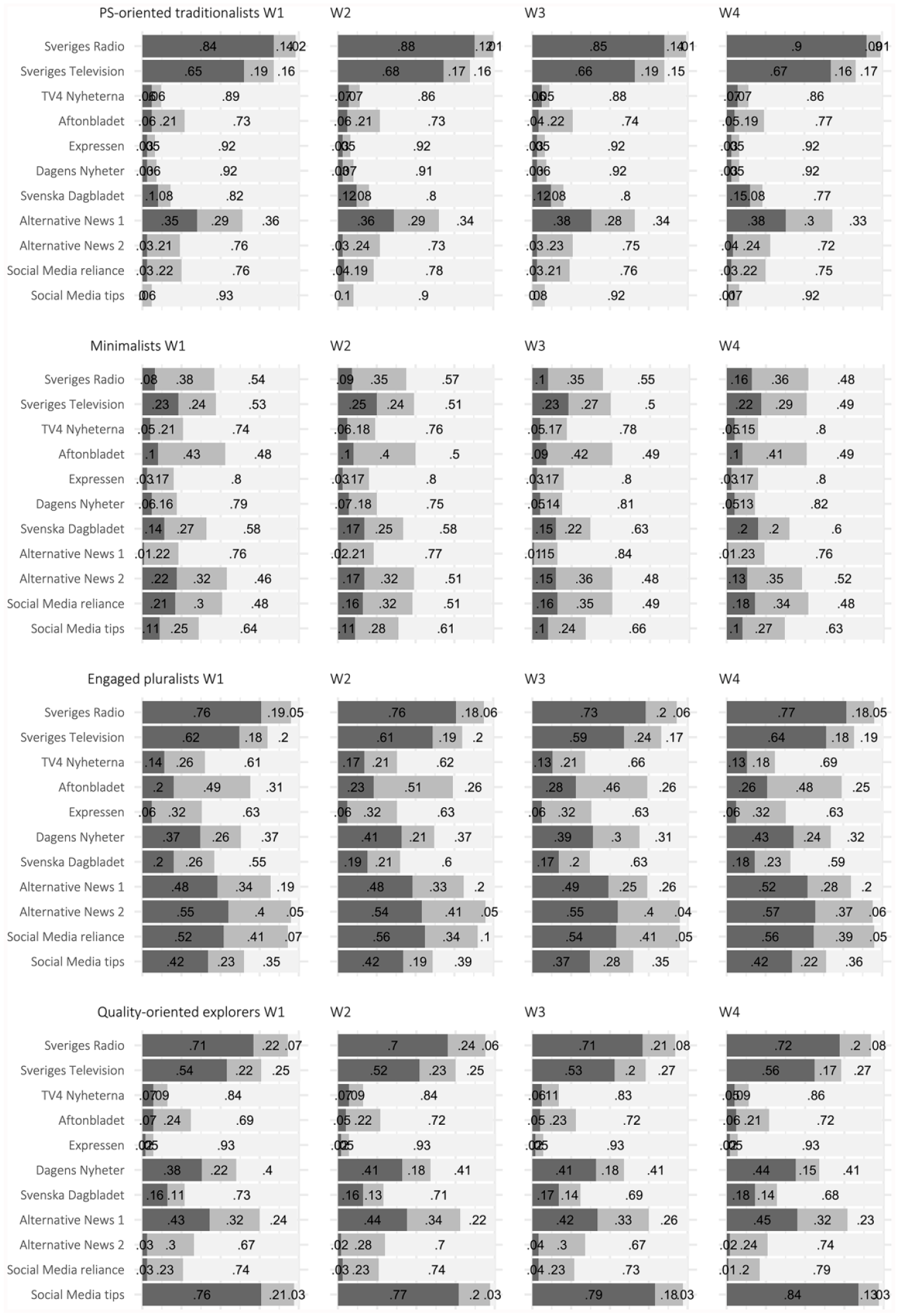
Measurement model: Item-response probabilities.
Figure 1 illustrates the results from the measurement model with item–response probability for each of the four identified news repertoires across the four survey waves. Each category is expressed in item–response probabilities. Out of the 528 estimated distributions, only 44 individual response categories were found to be insignificant (the same 11 categories repeated per wave). The insignificant measurements are found in item–response categories with low probabilities and/or lacking adequate observations and can therefore be expected. 4
We now take a closer look at each repertoire and name them based on consumption patterns. The first news repertoire can be labeled public service (PS)-oriented traditionalists, as people with this type of news repertoire are especially characterized by their high use of public service radio and TV news and low use of other news sources. Even with today’s abundance of news sources, these people stick to the traditional public service media outlets.
The second news repertoire can be labeled Minimalists. People with this news repertoire have a general low use of all news sources. Thereby, these people mainly use the opportunities available in today’s media environment to seek out other content than news or are in general not using media much.
The third news repertoire can be labeled Engaged pluralists, as people with this repertoire have a general high consumption of news across most traditional news sources, but also a very high use of alternative news outlets and a strong reliance on social media. These people exploit the endless number of choices in today’s media environment to seek out news very often and from many different mainstream sources, but they also take the opportunities to use new media sources to get alternative views of the world than the one found in mainstream news media. Had we not taken account of such alternative news sources; these people could be seen as so-called “omnivores” with their general high consumption of traditional news outlets.
The last news repertoire can be labeled Quality-oriented explorers. People with this news repertoire have a high consumption of public service TV and radio news as well as the broadsheet newspaper Dagens Nyheter, but they are also characterized by getting news tips from social media and using online news sites to get news about social issues not reported by traditional media. Thus, these people also make use of new information sources to get alternative worldviews than the ones presented in mainstream news media. In contrast to the Engaged pluralists, the Quality-oriented explorers do, however, not prioritize alternative and social media to the same extent, and they do not consume much news from tabloids.
In relation to the fourth survey wave, collected during the coronavirus pandemic, consumption patterns of news outlets most indicative of the news repertoires are more defined, with a higher news use by all classes compared with preceding waves in the measurement model. Also, and more significantly, we see a substantial difference in the entropy metric for the fourth wave compared with preceding waves (see Online Appendix, Figure 1), indicating more separation between classes, i.e., “more of the same” in the case of the four news repertoires. However, it also more specifically indicates that there is less additional variation at a higher dimensional level in the fourth wave, i.e., less between-group variation that we do not capture with a four-class solution in this probabilistic framework.
Answering
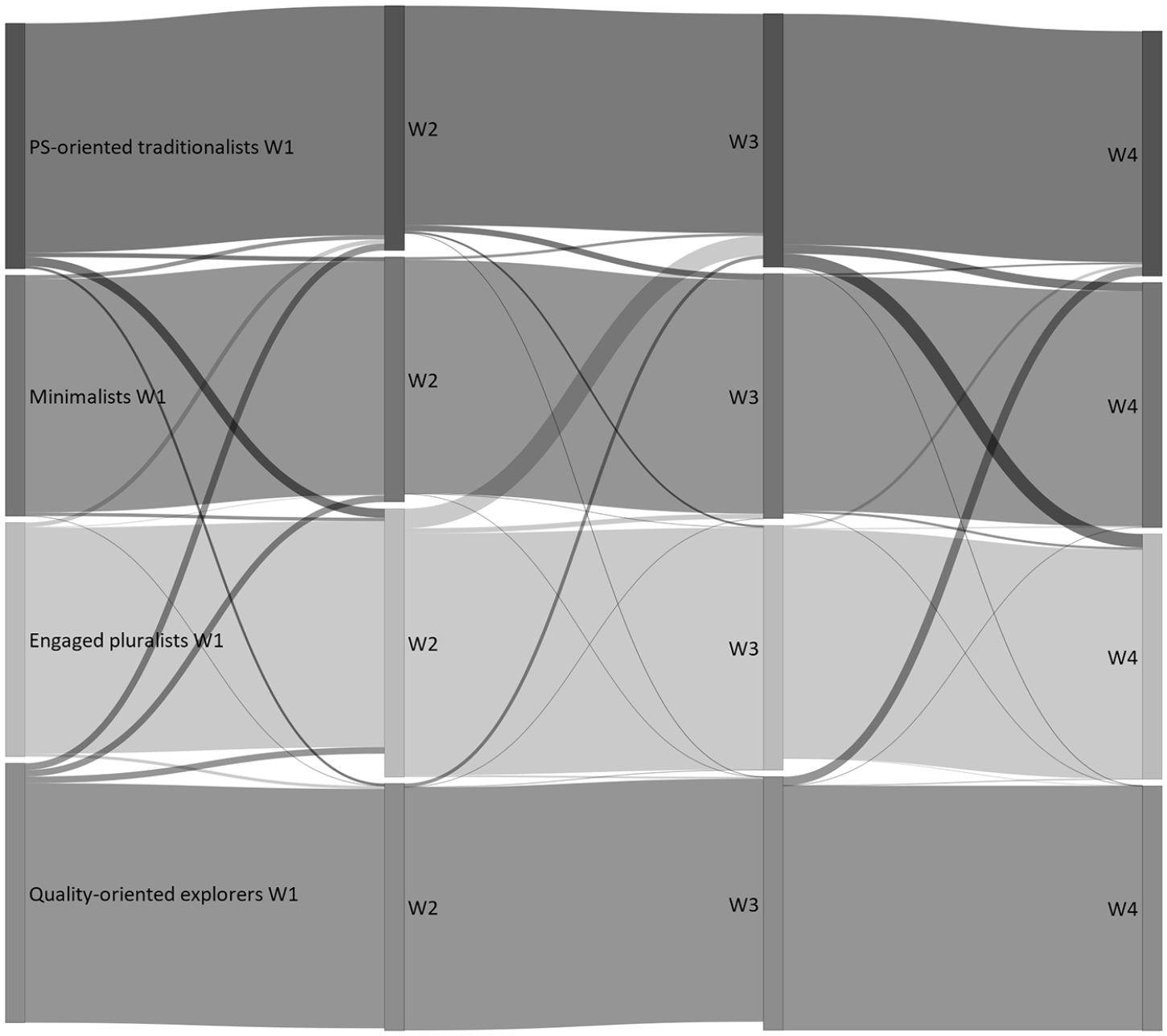
Transition model for news repertoires.
In general, we find the news repertoires to be very stable over the four survey waves. The probabilities vary from .834 probability for stability to less than .001 probability to change, with Engaged pluralists being most unstable and Minimalists being most stable over time and least likely to transition to another repertoire. The most probable transitions were identified between Engaged pluralists and PS-oriented traditionalists and between Engaged pluralists and Quality-oriented explorers. Specific probabilities, class counts, and proportions for stable classes are available in the Online Appendix, Tables 8 and 9. To explore the stability of news repertoires in further detail, we define an additional latent variable in a mover/stayer specification, differentiating between those with fully stable class assignments and those who change their news usage over time. In Table 1, this dichotomy is investigated on the basis of posterior probabilities and most likely modal class assignment as well as class assignment conditional on covariates.
Mover/Stayer Model for News Repertoires.
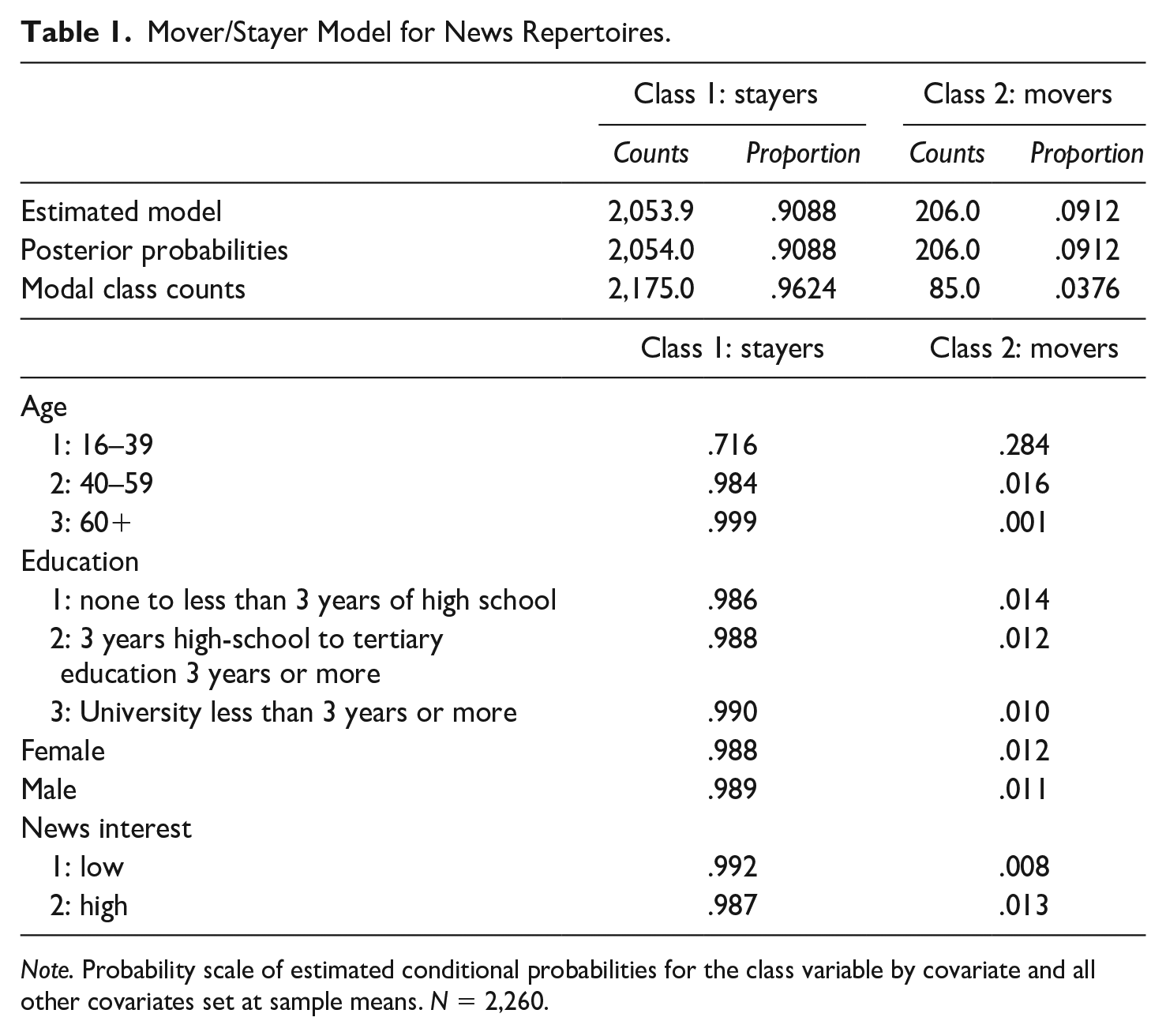
Note. Probability scale of estimated conditional probabilities for the class variable by covariate and all other covariates set at sample means. N = 2,260.
This additional latent mover/stayer variable, covering those that change or not in their media repertoire over time, suggests 90% as stayers and 10% as movers based on estimated variation and posterior probabilities. An alternative model specification, allowing full measurement variance over waves, shows only minor differences in the measurement model over time. Specifically, the fourth wave indicates slightly more cohesive classes, where indicators related to class labeling receive slightly higher probabilities, although only around 1% to 2% at most.
5
Answering
In the interest of clarity, specific response conditions can be calculated based on the results in Table 1 to further illustrate relationships between stability and covariates. Primarily, there is a substantial conditionality of age with a markedly higher probability of .284 for an individual being classified as a mover if belonging to the lowest age category. In the same way, belonging to the highest age category is the most salient indicator of predicted stability over time, along with high levels of education and low interest. As an example of an extreme likely mover, a young, lower educated, female with a higher interest in news has a probability of .352 for being a mover. The most stable is the old, higher educated male with lower news interest at a probability of 1.000, that is less than 0.001 probability of not being classified as a stayer in our data. This most likely stayer group only slightly changes to .999 probability if gender is female, interest is higher, or education is changed to lowest category. Instead, it is again only when age is changed that the estimated conditional probabilities have a substantial variation to .991 for the middle category and .812 for the lowest age category. Less extreme comparisons can be found in the model results, yet with such stable repertoires, it is not surprising that most covariates only have minor influences.
In the last step, we examine how the identified news repertoires relate to socio-demographic factors, news interest, and trust in mainstream news media. Results in Table 2 again include the class-conditional probabilities given a covariate response, while all other covariates are held at sample means. From the conditional probabilities, specific response conditions can be calculated to illustrate the relationships. For instance, if an individual is male with low interest in news, low education, and a high age, the probability of adherence to PS-oriented traditionalists is high at .475, while it is lower for Engaged pluralists at .300. But if age is changed to the youngest group, probability of the PS-oriented traditionalists changes to .069, while the probability of adherence to Minimalists increases to .723 from .071, showing the immense impact of age on news repertoires. For the Minimalists, interest in news also has a substantive influence. For young, female, and low-educated individuals, the Minimalists repertoire dominates at a probability of .457 increasing to .606 if news interest is low, and respectively .571 to .723 if gender is changed to male. Even young highly educated individuals with a high news interest have a higher probability of being Minimalists with .516 and again slightly higher for males with .627.
Covariates of News Repertoires.
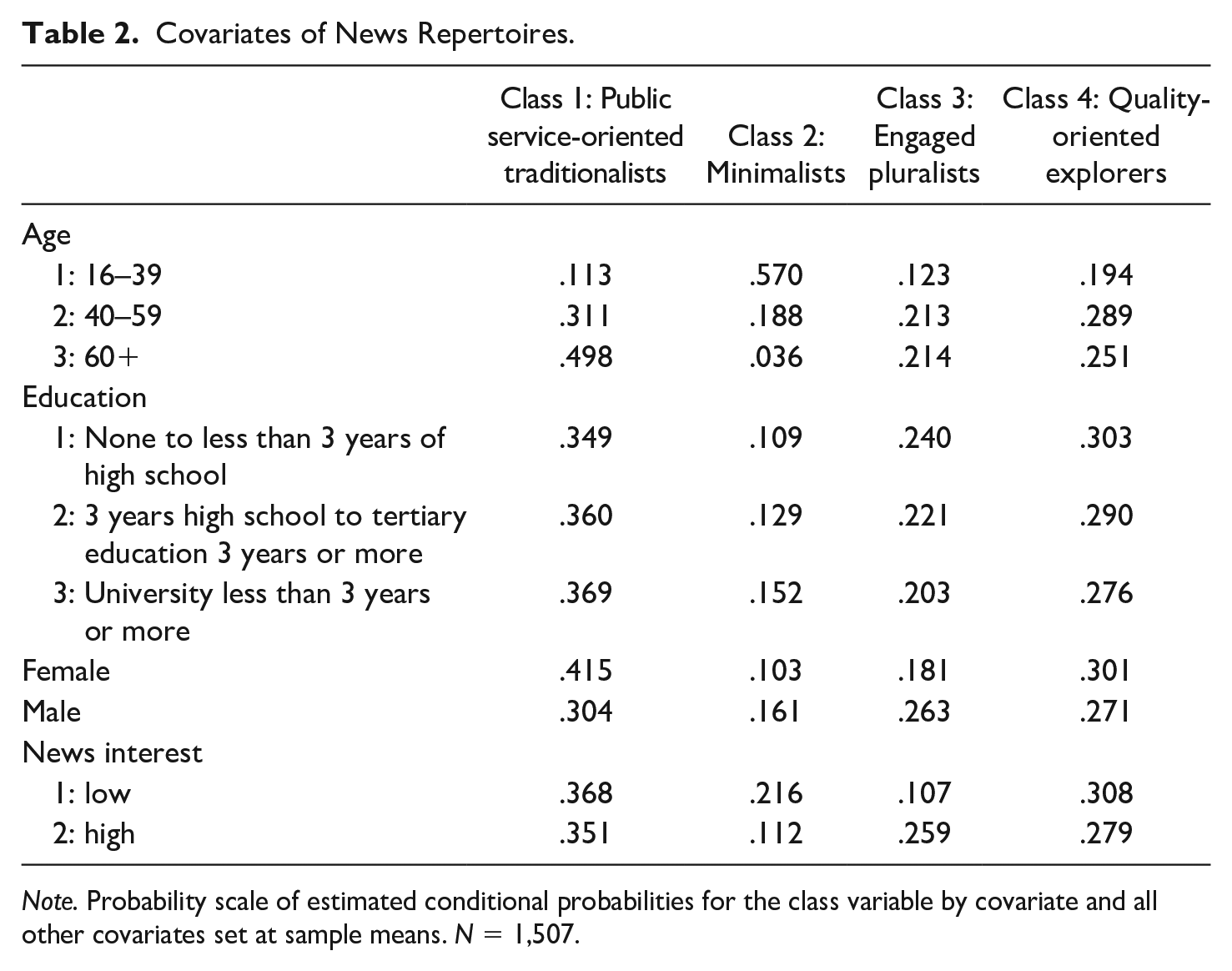
Note. Probability scale of estimated conditional probabilities for the class variable by covariate and all other covariates set at sample means. N = 1,507.
Investigating time-varying trust in mainstream news media, political trust, and political interest in the main model significantly reduced the sample size and these variables displayed less influence than remaining covariates. Therefore, it was necessary to first leave out these variables. Instead, as the analysis revealed that the news repertoires are well represented and stable over time by the employed model specification, we use the most likely latent class pattern (modal class assignment based on posterior probabilities) in a multinomial logistic regression model to investigate remaining covariates of interest. 6 Figure 3 illustrates the probabilities for being in the four news repertoires for different levels of trust in mainstream news media. Variations over trust indicate that the probability of being classified as Engaged pluralist or Minimalist is larger for respondents with a lower trust in mainstream news media, while respondents classified as either Quality-oriented explorer or PS-oriented traditionalist more commonly report a higher trust in mainstream news media.
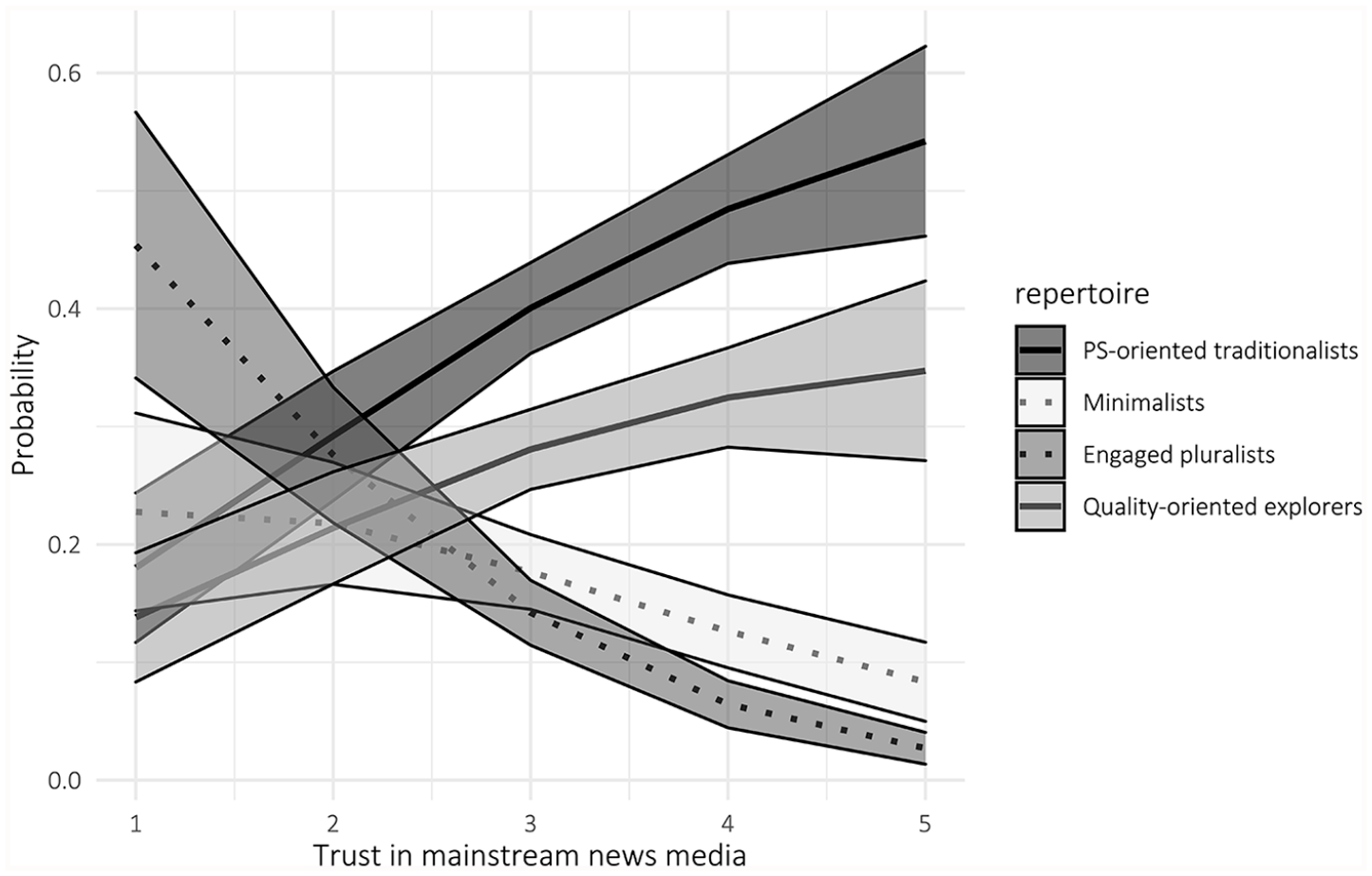
Probability of maintaining news repertoires by trust in mainstream news.
In sum, the analysis of covariates shows how news interest, trust in mainstream news media, and socio-demographic factors—especially age—are related to the identified news repertoires and their stability in distinct ways, answering
Discussion and Conclusion
While previous research on news repertoires has provided valuable insights into the general characteristics of people’s news habits, little has been known about the dynamics of such news repertoires. Drawing on longitudinal panel data, this study has, therefore, examined how news repertoires are maintained and reformed over time in today’s complex media environment, where social media and alternative news sites have joined traditional news outlets in the competition for audiences’ attention. Using LTA, we identified four news repertoires: PS-oriented traditionalists, Minimalists, Engaged pluralists, and Quality-oriented explorers. These news repertoires align with previous research but also provide new insights. Specifically, our inclusion of alternative news outlets is visible in the news repertoires of Engaged pluralists and Quality-oriented explorers, which shows how some people have adopted such information sources to their news habits. The Engaged pluralists are similar to the so-called “omnivores” identified in previous research, but they also seek out information from alternative news sites, while the Quality-oriented explorers mainly rely on public service outlets and broadsheet newspapers, but also get information from alternative news sites.
In terms of the underlying drivers of the identified news repertoires, our analysis showed that news interest and trust in mainstream news media indeed are key correlates for the identified news repertoires. Likewise, age also plays a central role. While younger people with a lower news interest and a lower trust in mainstream news media are likely to be Minimalists, people with higher news interest and lower trust in mainstream news media are likely to be Engaged pluralists. Older people with a higher news interest and a higher trust in mainstream news media are likely either to be Quality-oriented explorers or PS-oriented traditionalists. From a uses and gratifications perspective, these results show that people’s preferences indeed play important roles in their news habits. Especially interesting is how a high interest in news but a low trust in mainstream news media seemingly leads the Engaged pluralists to adopt alternative news sources to their news repertoires. However, they do not seem to abandon mainstream news media altogether, most likely because of their high news interest. As such, they still rely on the mainstream news media, even though they do not trust them.
Our analyses also showed that the news repertoires are highly stable over time. Thereby, people’s news consumption patterns seem to be ritualized to a very high extent. Even a societal crisis, such as the coronavirus pandemic, does not seem to change most people’s demand for news to an extent, where their most likely news repertoire changes. Instead, our results indicate that news repertoires became more clearly separated during the coronavirus pandemic. We see indications of this pattern with substantially higher levels on the entropy metric in the fourth survey wave. Considering the basis for our statistical model, we can also suggest a likely reason for this result. Given the power of our data and the separation between class solutions, we are able to identify four main news repertoires. However, we also understand that these are the most likely ones to stay the same over time. Many patterns of news consumption exist that are outside of the statistical power available to us for identification and thus are unseen in our analyses. Such additional repertoires may be more detailed, hierarchically subordinate, less cohesive, or otherwise limited alternative patterns. Considering the momentous shock of the coronavirus pandemic to news consumption patterns, some of these additional news repertoires may have shrunken or succumb in response. As such, the clearer separation of the four identified news repertoires can be seen as expected, given that news consumption patterns are more homogeneous during crises (Westlund & Ghersetti, 2015).
With these results, our study has brought empirical knowledge to the theoretical argument that news repertoires “do not exist in a state of inertia: they can and do change. However, they tend to become automated and habituated over time” (Peters & Schrøder, 2018, p. 1083). News repertoires indeed change, but it is the exception rather than the rule. The high stability in news repertoires over time further indicates that when people find the news habit that fit their preferences, they stick with it. Thereby, an initial instrumental media use is likely to become ritualized (LaRose & Eastin, 2004; Ruggiero, 2000). This finding further highlights the continued relevance of previous cross-sectional research that has not been able to conduct longitudinal analyses. Especially younger people do, however, have a higher likelihood of reforming their news repertoires. This makes sense, as younger people’s news habits are likely to be less ritualized than older people’s news habits.
Our examination of the maintenance and reformation of news repertoires provides a unique contribution to audience research within journalism and mass communication, as no previous studies have empirically examined the dynamics of news repertoires by following changes over time. The study also contributes by highlighting the important role played by social media and alternative news sites in some news repertoires. Consumption of social media and alternative news sites is important to understand for current debates on echo chambers and misinformation (e.g., Van Aelst et al., 2017), as such information sources present other views of the world than the ones found in mainstream news media. In this regard, our analysis suggests that even though some people consume news from alternative media, this is unlikely to be done in total isolation from traditional news sources. Instead, people who use alternative news outlets combine old and new information sources in their news diets. Lastly, the study also contributes by highlighting the large group of people who remain Minimalists throughout the study, indicating that they seldom use the media to get news. Such news consumption pattern raises a concern of these people’s ability to engage in society in a meaningful way, as they are likely to lack the relevant information to do so.
Even though we rely on high-quality panel data and apply state-of-the-art analytic methods, our study is of course not without limitations. In relation to our survey measures, we rely on self-reports, which can lead to overestimations of news consumption. However, this limitation comes as a necessity, as it is almost impossible to obtain unobtrusive measures of media consumption across different media. The survey approach also comes with the risk that the identified news repertoires are the product of the relatively simple measures. Thus, future research on news repertoires should carefully consider how news consumption is best measured in an increasingly individualized and fragmented media environment, while still being able to examine cross-platform consumption patterns. Here, it is especially relevant to consider how brief encounters with news, for example, via news apps or on social media, can be measured and included in news repertoires research; while our study has demonstrated a high degree of stability in news repertoires when measured on a daily basis, news repertoires may be less stable if measured more frequently, for example on an hourly basis. Also related to the measures, consumption of alternative news and news on social media was measured with statements, while consumption of mainstream news media was measured as the frequency of exposure to specific outlets. To overcome this limitation, future studies on news repertoires are urged to use similar questions and scales for all news sources.
In terms of our sample, the panel design comes with a risk of bias toward more news-oriented repertoires and greater stability, as attrition might lead lower interested and less stable individuals to drop out of the survey at a higher rate. Furthermore, the data come from Sweden where the government took a different approach in handling the coronavirus pandemic than many other countries, focusing on voluntary social distancing rather than forced lockdowns. As such, the Swedish society remained more open during the pandemic than many other societies. This approach might influence the extent to which people reform their news repertoire in response to the external shock generated by the pandemic, as people’s daily routines remained the same to a higher extent than in other countries. Still, however, the magnitude of this crisis was completely unprecedented in comparison to previous experiences—also in Sweden. Finally, the time period of investigation spans 2 years. Although this is a long time period that also included the profound contextual change of the coronavirus pandemic, it may not be long enough to detect changes in news repertoires. In addition, there was no big change in media technology during the studied period. Previous research has demonstrated how changes in media technology, such as the emergence of social media, can change people’s news habits (Ha et al., 2018). Thus, future studies are urged to examine changes in news repertoires over an even longer period.
Despite these limitations, our study has provided valuable insights by showing how people cope with today’s abundance of available news sources by constructing their own, highly stable news repertoires, reflecting their attitudes toward news. By doing so, the study illustrates how news repertoires are most often maintained and only very seldom reformed.
Supplemental Material
sj-docx-1-jmq-10.1177_10776990211019750 – Supplemental material for Maintenance and Reformation of News Repertoires: A Latent Transition Analysis
Supplemental material, sj-docx-1-jmq-10.1177_10776990211019750 for Maintenance and Reformation of News Repertoires: A Latent Transition Analysis by Kim Andersen, Johannes Johansson, Bengt Johansson and Adam Shehata in Journalism & Mass Communication Quarterly
Footnotes
Declaration of Conflicting Interests
The author(s) declared no potential conflicts of interest with respect to the research, authorship, and/or publication of this article.
Funding
The author(s) disclosed receipt of the following financial support for the research, authorship, and/or publication of this article: The study was supported by the Swedish Research Council.

Supplemental Material
Supplemental material for this article is available online.
Notes
Author Biographies
References
Supplementary Material
Please find the following supplemental material available below.
For Open Access articles published under a Creative Commons License, all supplemental material carries the same license as the article it is associated with.
For non-Open Access articles published, all supplemental material carries a non-exclusive license, and permission requests for re-use of supplemental material or any part of supplemental material shall be sent directly to the copyright owner as specified in the copyright notice associated with the article.
