




Abstract
Previous research has mostly ignored that citizens could experience information overload from a single issue extensively covered in the news. Especially when it comes to issues upon which citizens decide directly in a referendum, overload and avoidance would be problematic from a democracy theory perspective. This study investigates overload and avoidance at the issue level based on a three-wave panel survey on a referendum in Switzerland and finds weak information overload at the aggregate level. However, citizens become increasingly overloaded during the period of extensive news coverage which leads to avoidance of news on the issue but not of interpersonal discussions.
Today’s news media environment provides citizens with an abundance of political information (van Aelst et al., 2017). From a democracy theory perspective, citizens should be well informed about current political issues to make informed choices (Aalberg & Curran, 2012; Delli Carpini & Keeter, 1996). This is particularly important during a referendum when citizens accept or reject a specific policy (Stucki et al., 2018) rather than vote on political representatives. Thus, citizens’ knowledge about the policy issue has direct effects on their voting decision. It is assumed that intensive information about the referendum has a positive impact on voters; high amounts of information lead to stable attitudes and competent vote choices (Dvořák, 2013; Hobolt, 2005; Leduc, 2002). In referendums, voters are often more volatile than during elections, and their voting choices are often influenced by short-term political factors and based less on party affiliation than during elections (Leduc, 2002; Marcinkowski & Donk, 2012). The news media plays a central role by covering the latest developments and presenting the arguments of different actors involved (de Vreese & Semetko, 2006; Schmitt-Beck, 2000). Thus, referendums can be accompanied by high-intensity campaigns with high amounts of media coverage (Kriesi, 2005).
Agenda-setting research assumes that media attention to issues generally guides public attention to these issues and that media coverage positively influences the perceived importance of an issue and the public’s interest in it (e.g., Matthes, 2008; McCombs, 2007). Vice versa, public attention to and interest in issues impact media attention to these issues (Brosius & Kepplinger, 1990). However, for some issues, such as a referendum, media coverage remains extensive for a prolonged period.
While news media coverage is key for an informed voting choice, the question arises as to whether the sheer amount of election or referendum news coverage also has negative effects on news users’ information behavior and opinion formation. The concepts of information overload and news overload deal with the negative effects of high amounts of information on individuals and news users, respectively. Information overload refers to “receiving too much information” (Eppler & Mengis, 2004, p. 326); it occurs if the amount of information exceeds the recipient’s cognitive capacities to process it, leading to negative feelings, such as distress (Eppler & Mengis, 2004; Jackson & Farzaneh, 2012). Correspondingly, news overload refers to feeling overwhelmed with the amount of news available (Goyanes, 2014; Ji et al., 2014). Several studies have shown that news overload causes news avoidance (A. M. Lee et al., 2019; Song et al., 2017). While there may be positive consequences of news avoidance such as increased mental health (de Bruin et al., 2021), news users who experience overload and, consequently, avoid news about the issue, learn less about politics (van Erkel & van Aelst, 2021).
Thus, the question arises as to whether the amount of news available helps or hinders citizens to become informed (Andersen, 2022). Previous research has not yet investigated news overload and avoidance at the level of single political issues in the news. Especially when it comes to direct political decision-making, such as in referendums, how citizens form their opinions about the issue in question is of utmost importance. Against this background, this study addresses the questions to what extent news users feel overloaded by information on a referendum issue which is covered extensively prior to voting day, and whether this leads to avoiding information on that issue.
The vast majority of studies analyzing the effects of news overload have relied on cross-sectional data (S. K. Lee et al., 2016, 2017; Song et al., 2017). However, these studies can only find correlational relationships between overload and news avoidance. In our study, we used a three-wave panel survey to model the effects of news overload on information avoidance within individuals, which allowed for identifying causal effects.
Information and News Overload
The concept of information overload is rooted in information and management sciences, where the effects of information overload on decision quality and performance are of significant interest (Eppler & Mengis, 2004; Hwang & Lin, 1999; Jackson & Farzaneh, 2012; Roetzel, 2018). Information overload occurs if the amount of information exceeds the individual’s cognitive capacities to process it (Eppler & Mengis, 2004; Hwang & Lin, 1999; Lang, 2000). It results in a state of feeling overwhelmed and distressed (Williamson & Eaker, 2012). First, the quantity of received information in a time period is a cause of information overload (Eppler & Mengis, 2004; Jackson & Farzaneh, 2012). Second, individual characteristics, such as general information processing capacity and motivation, are influential (Eppler & Mengis, 2004; Jackson & Farzaneh, 2012). Third, the characteristics of the information affect information overload. Information overload is facilitated by uncertainty, diversity, ambiguity, novelty, complexity, intensity, and the negative quality of the information (Eppler & Mengis, 2004; Jackson & Farzaneh, 2012; Roetzel, 2018; Schneider, 1987).
Regarding the changing news media environment, especially the proliferation of news outlets, communication research has begun to investigate the differential effects of the significant amounts of information distributed by news media to users. Early inquiries into information overload have already taken into account the increased amount of information being produced through computer-mediated communication (Hiltz & Turoff, 1985). The concept of news overload has gained importance over the past decades, as the Internet and social media have multiplied the amount of news everyone is confronted with on a daily basis (A. M. Lee et al., 2019; Park, 2019; Song et al., 2017). News overload is thus a special case of information overload and occurs because of cumulative news exposure (York, 2013). Data from the Reuters Institute Digital News Report from 2019 showed that 28% of the respondents perceived too much news and felt worn out by it (Newman et al., 2019). The Pew Research Center found that 66% were worn out by the amount of news in 2019; in 2016, 59% made the same claim (Gottfried, 2020). It is important to note here that scholarly literature deals with people’s perceptions of news overload and their feeling of being overloaded (e.g., S. K. Lee et al., 2016). Such perceptions can be different from actual overload and can possibly also occur when there is no particularly extensive media coverage.
Extant research has identified several causes for people experiencing news overload. The intensity of news exposure and the amount of news consumed can lead to news overload. York (2013) and Chen and Masullo Chen (2020) showed that increased levels of news exposure are related to higher levels of overload. While some studies found that the use of online news and social media (Chen & Masullo Chen, 2020; S. K. Lee et al., 2016) and specific news formats, for instance, push notifications (Schmitt et al., 2018), positively predict news overload, previous studies yielded different results on the role of traditional news media use. Chen and Masullo Chen (2020) showed that consumption of TV news most strongly correlated with news overload while in Holton and Chyi’s (2012) study TV news consumption was negatively related to news overload. York (2013) found that news enjoyment moderated the effects of news exposure on news overload. Higher levels of news enjoyment reduced the likelihood of news overload in cases of high amounts of news exposure.
Furthermore, individual traits such as age, gender, and income are related to perceptions of information overload (Holton & Chyi, 2012; Ji et al., 2014; Schmitt et al., 2018). Although the influence of individual factors differs among countries, people who are younger, female, less affluent, and less educated generally experience higher levels of news overload (Goyanes, 2014; Ji et al., 2014; S. K. Lee et al., 2016; Schmitt et al., 2018). In addition, people with lower information-seeking self-efficacy (Schmitt et al., 2018) and news efficacy (Park, 2019) are more likely to experience news overload. Also, the topic of news can influence perceptions of news overload, with political news contributing strongest to news overload (A. M. Lee et al., 2019).
The majority of studies on news overload have focused on overload from news in general (Chen & Masullo Chen, 2020; Holton & Chyi, 2012; Song et al., 2017; York, 2013). However, some studies have found and various journalists have noted that overload and fatigue from the amount of news on single issues can emerge in certain instances, such as the presidential election campaign in the United States in 2016 (Gottfried, 2016), the COVID-19 coverage (Bedingfield, 2020; Groot Kormelink & Klein Gunnewiek, 2022), and Brexit (Gurr & Metag, 2022; Newman et al., 2019). Knowledge is lacking on whether news overload at the level of a single issue intensively covered over a prolonged period can emerge. We thus asked the following research questions:
Research question 1
Research question 2
Avoidance as a Consequence of News Overload
Studies on information overload point to consequences of information overload for the individual, namely for their productivity and decision-making abilities (Eppler & Mengis, 2004; Hwang & Lin, 1999). The negative cognitive and affective psychological state of information overload can lead to behavioral countermeasures (Eppler & Mengis, 2004; Schmitt et al., 2018). Some studies on news overload specifically have considered news avoidance as a consequence (S. K. Lee et al., 2017; A. M. Lee et al., 2019; Park, 2019; Song et al., 2017).
Communication research applies different understandings of news avoidance (Gurr & Metag, 2021; Skovsgaard & Andersen, 2020). Avoidance is often conceptualized as limited exposure to news or not selecting news because of a preference for other media content (Karlsen et al., 2020; Ksiazek et al., 2010; Strömbäck, 2017; Trilling & Schoenbach, 2013). This type of news avoidance is unintentional. Studies found a decline in news use in the past decades and observed increasing gaps between news seekers and news avoiders (Aalberg et al., 2013; Shehata et al., 2015; Strömbäck et al., 2013). While some citizens increasingly use news, others increasingly avoid it altogether.
While unintentional news avoidance is not an active decision, intentional news avoidance results from a conscious choice (Skovsgaard & Andersen, 2020). In line with this, information science has described active or intentional information avoidance as an individual’s purposeful decision to stay away from available information (Howell & Shepperd, 2016). According to the Reuters Institute Digital News Report, 32% of the Internet users actively avoided the news at least sometimes in 2019, pointing to an increase since 2017, when 29% said that they had done so (Newman et al., 2019). Disinterest in politics and low levels of news self-efficacy (Edgerly, 2021) are causes of news avoidance.
Previous cross-sectional findings on news overload and avoidance suggested that news overload leads to news avoidance. Park (2019) and S. K. Lee et al. (2016) found that news overload is positively associated with the intention to avoid news. The findings by A. M. Lee et al. (2019) revealed selective scanning as a strategy related to news overload. Selective scanning refers to users selectively choosing information while ignoring information that does not fit their preferences (A. M. Lee et al., 2019). Recently, Groot Kormelink and Klein Gunnewiek (2022) found that news overload from COVID-19 leads young people to withdraw from news about it and de Bruin et al. (2021) found similar evidence for the Dutch population in general. In addition, factors mediating the relationship between news overload and news avoidance have been examined. Park (2019) found that news overload leads to decreased news efficacy, which in turn increases news avoidance on social media. Since extant research shows that feeling overloaded by news in general leads to news avoidance, we assumed that feeling overloaded by news on a specific issue in the news leads to avoiding news on that specific issue. Thus, we proposed the following:
Within news overload research, it has not yet been investigated whether news overload can also lead to avoiding interpersonal communication about news. Interpersonal discussions are social situations that involve other individuals and social norms (Lapinski & Rimal, 2005). Avoiding interpersonal discussions demands greater effort and potentially entails more unpleasant social consequences than avoidance of media content. Nonetheless, research has identified several causes of avoiding interpersonal discussions: dodging dissonance or conflict (Eveland et al., 2011) and anxiety and uncertainty (Duronto et al., 2005). When it comes to political news, individuals avoid talking about public issues because of a lack of interest or knowledge (Wyant et al., 2020). However, research has not yet investigated whether news overload leads to the avoidance of news in interpersonal discussions. Thus, it is also unclear whether feeling overloaded by news on a single issue leads to avoidance of discussions about it. However, this would be problematic because interpersonal discussions are an important source of news and information about politics (Bennet et al., 2000; Boomgaarden, 2014), also during a referendum (de Vreese, 2007). This uncertainty led to our third research question (RQ):
Research question 3
We investigated how feeling overloaded from extensive news coverage of a specific political issue leads to avoidance of information on that issue. More precisely, we focused on a referendum issue, where informed citizens are particularly important from a normative perspective.
Method
This study analyzed information overload and avoidance for the referendum “For moderate immigration (Limitation Initiative)” put to the vote on September 27, 2020, in Switzerland. The initiative aims to end the free movement of persons with the European Union (EU) as specifically provided for in the bilateral agreements between Switzerland and the EU. It was launched by the right-wing Swiss People’s Party (SVP) and the “Action for an independent and neutral Switzerland” (AUNS). The limitation initiative received the most media attention on all issues put to the vote on September 27, 2020, in the 12 weeks before the polling day (Udris, 2020a) (see Figure 1).
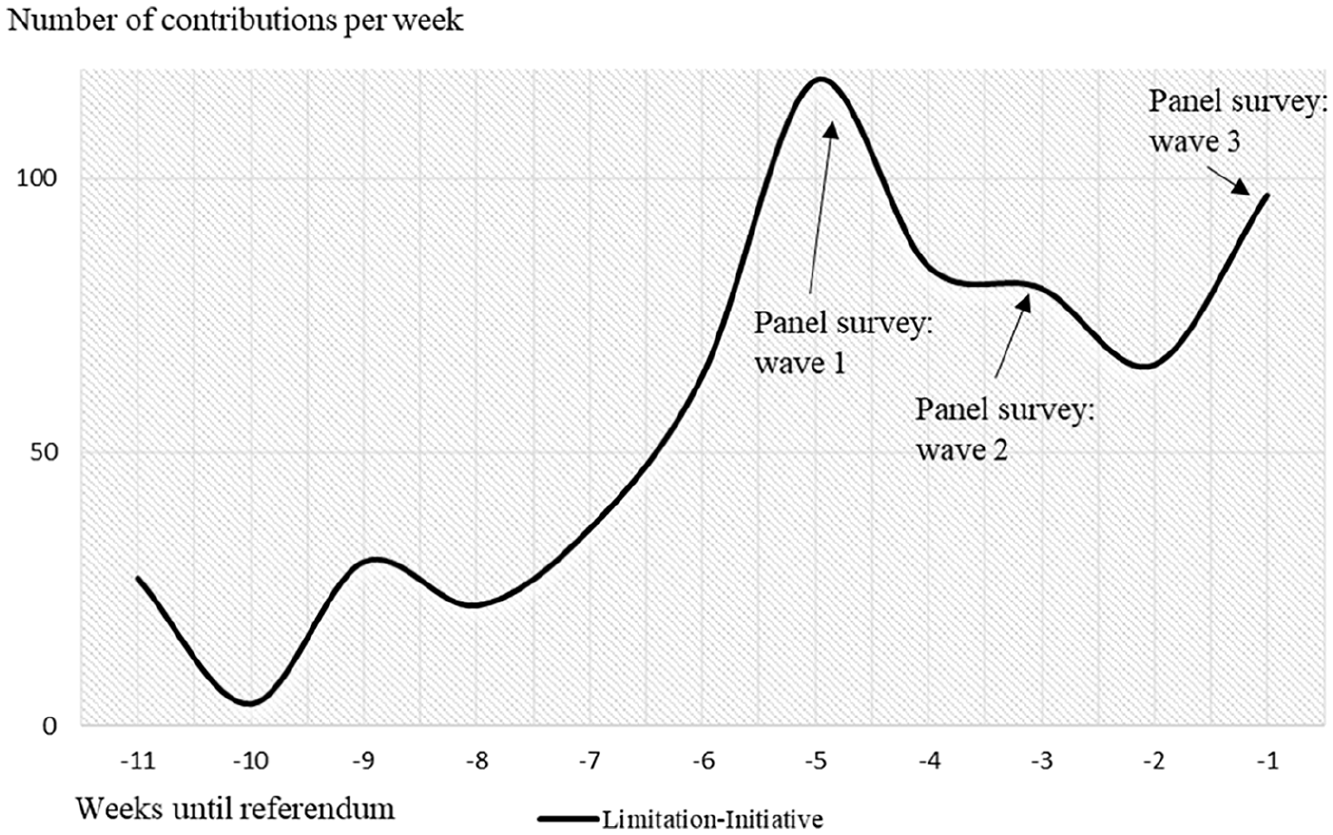
Number of media contributions per week before the referendum.
Since the limitation initiative is an important national issue for Switzerland and has received high amounts of media attention, it is a useful issue to study in terms of potential news overload and avoidance on an issue level. A representative three-wave online panel survey was conducted by a professional market and research institute during the five weeks prior to voting day, which is normally a period of extensive news coverage of an issue.
Quota sampling was applied with respect to age and gender. Wave 1 (n = 1,300, 50% female, Mage = 48, SD = 15.60, 49% higher education) took place from August 20–31, 2020; Wave 2 (n = 973, 48% female, Mage = 49, SD = 15.88, 49% higher education) from September 3–14, 2020; and Wave 3 (n = 783, 46% female, Mage = 49, SD = 15.91, 50% higher education) from September 17–28, 2020.
Measures
Previous studies on news overload and avoidance have applied different measures of avoidance, that is, the intention to avoid news (S. K. Lee et al., 2016, 2017; Park, 2019; Song et al., 2017), selective scanning (A. M. Lee et al., 2019), and selective exposure to particular news outlets (S. K. Lee et al., 2016, 2017). However, these measures do not align with the understanding of intentional news avoidance as an intentional behavior (see Skovsgaard & Andersen, 2020).
Research on media avoidance in other contexts has offered more precise measures of avoidance behavior. First, avoidance can occur during the media selection process, such as ignoring and skipping unwanted content. Findings on advertising avoidance point to avoidance strategies such as ignoring the ads, turning the page, and discarding content (Kim & Sang, 2017; Speck & Elliott, 1997). Second, avoidance occurs during exposure to a selected program or report. There is the possibility that users see a media report and start reading or watching it intentionally or incidentally (Oeldorf-Hirsch, 2018), but then take countermeasures, such as interrupting or terminating the exposure situation, reducing their attention, or doing something else (Schramm & Wirth, 2007, 2008).
We oriented our operationalization of issue-specific news avoidance toward Toff and Kalogeropoulos’s (2020) measure of news avoidance, namely, how frequently respondents were “actively trying to avoid news these days.” We chose five items on avoidance strategies during selection and exposure concerning other media content to measure avoidance more comprehensively with several items. We adapted the items to a single issue. We asked respondents to indicate how often they did the following during the past week. Response alternatives ranged from 1 (never) to 5 (very often): “Concerning an article or report, I . . .”: “did not even read it or look at it, when I noticed it was the limitation initiative issue”; “ignored it and instead I read or looked at something else”; “stopped reading it or looking at it before it was finished”; “kept following it, but I was inwardly disconnected,” and “kept following it while doing something else” (Wave 1: M = 2.32, SD = .90, and α = .83; Wave 2: M = 2.41, SD = .95, and α = .83; Wave 3: M = 2.47, SD = 1.00, and α = .85). For internal consistency measures, see Table 5 in the Supplemental Appendix.
Interpersonal avoidance was measured by one item (Wave 1: M = 2.03 and SD = 1.18; Wave 2: M = 2.03 and SD = 1.20; Wave 3: M = 2.08 and SD = 1.23): “I avoided discussing the issue with others.”
Information overload was measured by four items on a five-point scale from 1 (I totally disagree) to 5 (I totally agree): “I currently feel overloaded by the amount of news available on this issue,” “I receive more information on this issue than I can actually process,” “I am confronted with too much information on this issue,” and “I feel overloaded from the amount of news on this issue,” (Wave 1: M = 2.04, SD = .85, and α = .83; Wave 2: M = 2.19, SD =.91, and α = .86; Wave 3: M = 2.23, SD =.96, and α =.88). These items were oriented toward the news and information overload scales by Song et al. (2017), Williamson and Eaker (2012), and A. M. Lee et al. (2019).
To compare the effects of information overload on avoidance with the effect of alternative predictors of avoiding information on an issue, we included issue-specific control variables in the analysis. 1 Issue importance was measured by two items taken from Matthes (2013) on a five-point scale from 1 (I totally disagree) to 5 (I totally agree) (Wave 1: M = 4.20, SD =.91, and r = .60; Wave 2: M = 4.20, SD =.84, and r = .51; Wave 3: M = 4.19, SD =.88, and r = .64): “I personally think that this issue is important” and “This issue is important to Switzerland.” Interest in the issue was measured by one item (Wave 1: M = 3.72 and SD = 1.16; Wave 2: M = 3.64 and SD = 1.16; Wave 3: M = 3.66 and SD = 1.14) on a scale from 1 (not interested at all) to 5 (very interested): “How interested are you in the limitation initiative issue?” Self-perceived knowledge about the issue was measured by two items on a five-point scale from 1 (I totally disagree) to 5 (I totally agree) (Wave 1: M = 3.52, SD = 1.09, and r = .77; Wave 2: M = 3.67, SD = 1.02, and r = .74; Wave 3: M = 3.85, SD = .92, and r = .72): “I know the main arguments of the various parties involved in this issue” and “I know the main facts about this issue” (Geiss, 2015). A negative attitude toward the issue was measured by four items (Wave 1: M = 3.61, SD = 1.18, and α = .87; Wave 2: M = 3.57, SD = 1.17, and α = .86; Wave 3: M = 3.61, SD = 1.78, and α = .88): “If the free movement of people were to cease to exist, the Swiss would finally be able to decide for themselves again who comes to Switzerland. (recoded),” “Limited immigration would enable Swiss children to have a better education (recoded),” “The elimination of the free movement of persons would have negative effects on the Swiss economy,” and “The adoption of the limitation initiative would jeopardize good relations with the EU.” Response alternatives ranged from 1 (I totally disagree) to 5 (I totally agree).
Finally, we included general predictors of news exposure as control variables, which could influence exposure to and avoidance of news about a specific issue. The perceived duty to stay informed was measured by three items during Wave 2 (M = 3.39, SD = .50, and α = .69): “It is important to be informed about news and current events,” “We all have a duty to keep ourselves informed about news and current events,” and “So many other people follow the news and keep informed about it that it doesn’t matter much whether I do or not (recoded),” which were taken from Poindexter and McCombs (2001). Response alternatives ranged from 1 (I totally disagree) to 5 (I totally agree). News enjoyment was measured during Wave 3 by one item: “Keeping up with the news is not my idea of fun (recoded)” on a scale from 1 (I totally disagree) to 5 (I totally agree) (Wave 3: M = 2.91 and SD = 1.26). Political interest was measured by the question of how interested respondents were in information about what was going on in politics and public affairs during Wave 1 on a five-point scale from 1 (not interested at all) to 5 (very interested) (Wave 1: M = 3.48 and SD = 1.03) (for descriptive statistics and overtime changes per wave, see Table 3 in the Supplemental Appendix). In addition, age, gender, and education were included.
Data Analysis
A balanced (i.e., complete) sample of respondents who participated in all panel waves (n = 723; Mage = 49.49, 46% female, 52% tertiary education) was used for the analyses, while dropouts were excluded. This sample differed only slightly from the original sample. To avoid a further decrease in the number of observations in addition to the panel dropout, we conducted a within-mean imputation at the wave level. The available variables of a scale were used to replace every missing value with the individual mean of the available variables from the same scale in the same wave (Graham, 2012). The remaining missing values were replaced by the sample means. 2
To answer
Results
Random Effects Within-Between Regression Model Predicting Avoidance of Media Information.
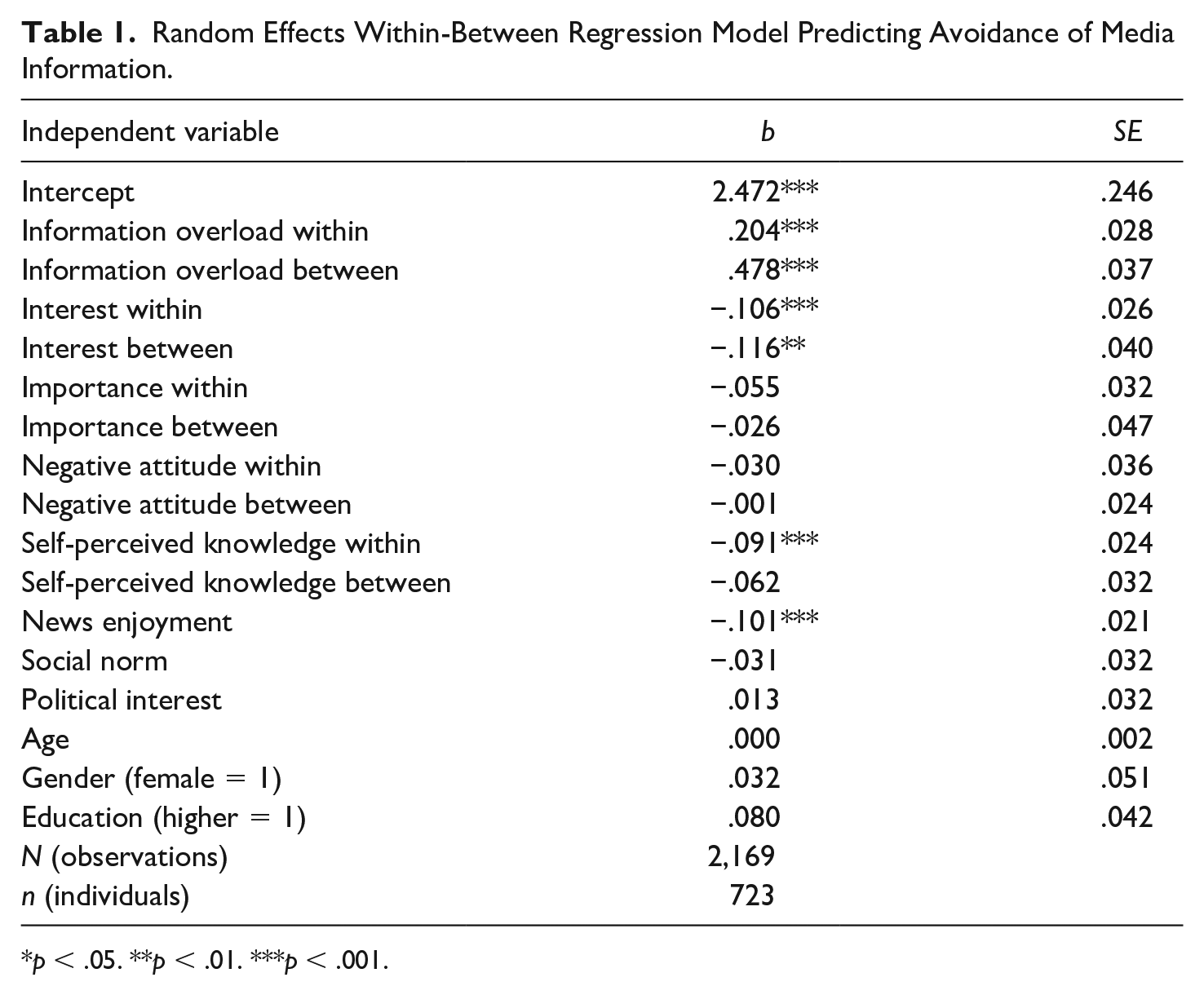
p < .05. **p < .01. ***p < .001.
Random Effects Within-Between Regression Model Predicting Interpersonal Avoidance.
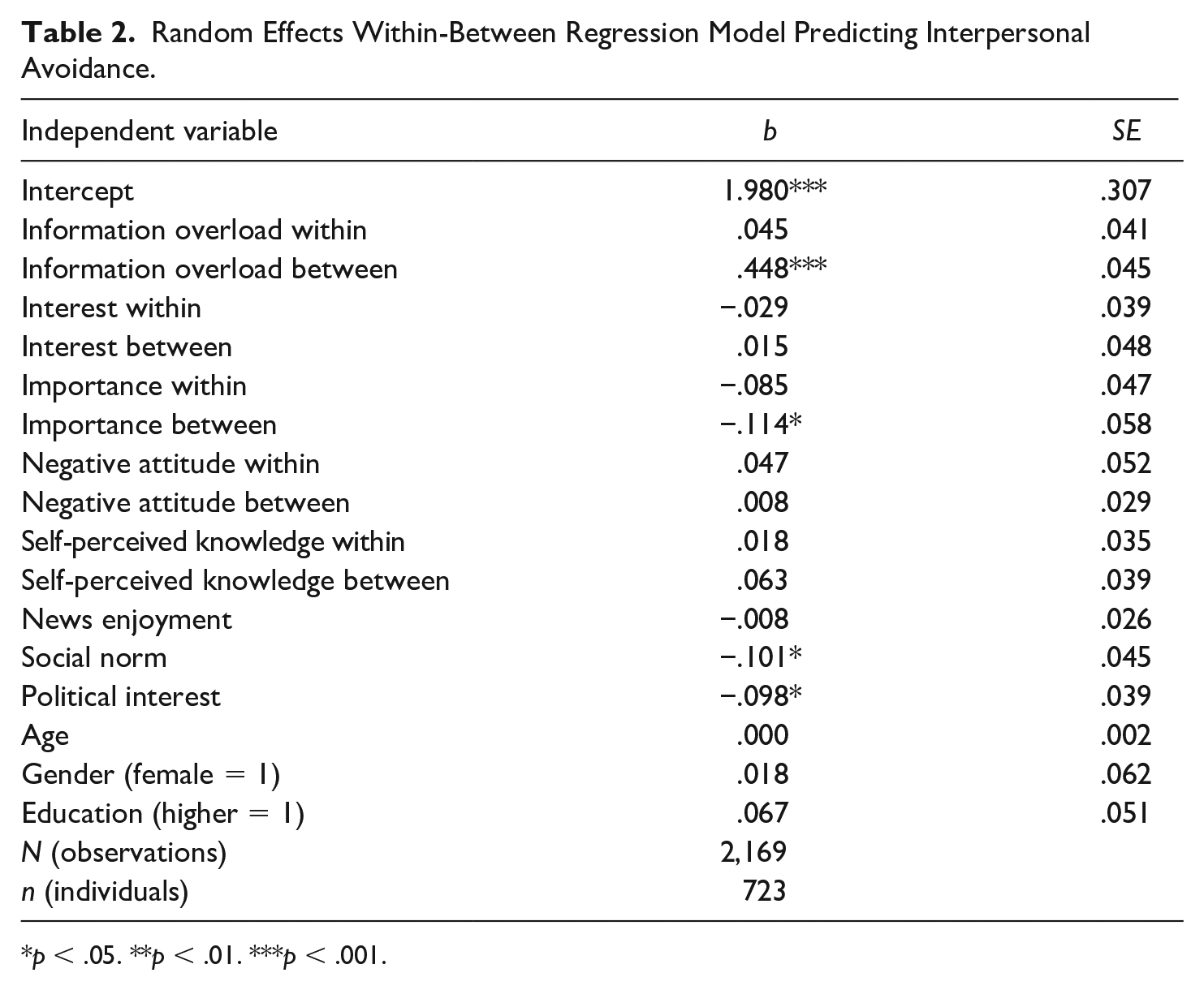
p < .05. **p < .01. ***p < .001.
Discussion
Over the past few decades, news use has declined, and news avoiders have become increasingly more common (Aalberg et al., 2013; Newman et al., 2019; Strömbäck et al., 2013). Feeling overwhelmed by the amount of news these days—news overload—is discussed as an explanation for news avoidance (Skovsgaard & Andersen, 2020; Villi et al., 2022). While previous studies have addressed the idea that news users become overloaded by news and, consequently, avoid news altogether (A. M. Lee et al., 2019; Song et al., 2017), they have so far largely ignored whether news users experience overload from news about a single issue and avoid information about that issue (a an exception see de Bruin et al., 2021). This study investigated to what extent news users experience overload from news about a referendum issue in Switzerland and how this leads to the avoidance of information about that issue.
First, the findings showed that the Swiss population was, on average, not or only partly overloaded from information about the referendum issue. However, information overload increased significantly during the sixth and fifth weeks prior to voting day, when the issue’s news coverage increased sharply and reached its peak (Udris, 2020a). This period resembles the phases of growth of coverage and boom in the issue attention cycle (Waldherr, 2014). Although the average overload perception was not that high, this observation suggested that news users felt more overloaded by the amount of information about the issue the more extensive the news coverage became closer to voting day.
Second, the results from multilevel regressions based on three-wave panel data revealed that increasingly perceived news overload from the issue led to increasing avoidance of news about the issue. Issue-specific information overload was the strongest within-person predictor of avoidance of news about the issue. This supports the assumption that, first, news overload, and, second, the effects of news overload on news avoidance also occur at an issue level. Thus, the question of what amount of news available in today’s media environment helps citizens to become informed (Andersen, 2022) is also relevant at the level of single issues in the news. When considering the between effects, this study showed that even if information overload is not that high on average in the population, citizens who feel more overloaded than others are more prone to avoidance of information on the issue, which makes this correlation all the more relevant. The findings align with previous cross-sectional findings on the effects of general news overload on news avoidance. What is more, they add to previous cross-sectional findings by demonstrating a causal effect of overload on avoidance within individuals, based on longitudinal data.
In high-choice media environments, users can easily be selective; personal preferences are the central driver of media selection (Prior, 2007). According to this study, when overloaded with news about a single issue, news users avoid news about it. They potentially turn to other issues in the news or to other media content more generally, such as entertainment. Issue-specific news overload thus contributes to selective news exposure.
Third, this study found that when individuals’ overload from the issue increases, they do not increasingly avoid conversations with others about the issue. This suggests that avoidance because of overload perceptions is reserved for information provided by the news media. In fact, individuals might encounter the issue less in conversations than in the news. In addition, they are not confronted with high amounts of written or visual information in interpersonal conversations. Thus, information overload might result less from interpersonal conversations and trigger the avoidance of conversations less strongly than in news exposure situations. Furthermore, overloaded individuals could possibly benefit from interpersonal conversations to become informed about the issue (Bandura, 2001) as an alternative to news and, therefore, not avoid them despite information overload.
Especially when it comes to direct democracy, citizens should be well informed about different positions and current events regarding the policy in question (Stucki et al., 2018). The results from this study indicated that high amounts of referendum campaign coverage did not only have positive effects, as assumed by previous research (Dvořák, 2013; Hobolt, 2005; Leduc, 2002), but also detrimental effects on citizens. Even though the amount of coverage on this issue was high, studies on media coverage on other referendum issues show that other issues are covered even more, but many are also covered less (e.g., Udris, 2020b). This demonstrates that journalists have to navigate between their duty to inform and citizens’ potential overload perceptions.
Thus, both the characteristics of campaign coverage, such as strategic framing (Elenbaas & de Vreese, 2008; Schuck et al., 2013; Shehata, 2014) and the amount of news coverage, can affect citizens’ perceptions and behavior regarding the issue not only positively but also negatively. However, while from a normative democratic perspective news avoidance is conceptualized as negative, there is also scholarly debate on potential positive consequences of news avoidance such as increased mental well-being (de Bruin et al., 2021). News avoidance can thus serve as a coping strategy (Goyanes et al., 2021).
Interpersonal discussions are another relevant source of political information (Eveland, 2004; Scheufele, 2000). Since information overload from the referendum issue did not lead individuals to avoid conversations about it, they could still have become informed by others during conversations. Further research could investigate the interplay between the avoidance of news about an issue and the reception of information on that issue through interpersonal discussions.
It is important to note that we—like most of the scholarly literature on news and information overload—investigated perceived overload. However, it is an open question to what degree such perceived overload is also actual overload, that is, an actual overexertion of processing capacities, or whether perceived overload rather serves as self-rationalization for people’s little interest in an issue or their selective exposure to and motivated reasoning of information on this issue. It is possible that people are not actually overloaded by the amount of information but use it as an excuse for not wanting to deal with information that do not fit their ideological stance.
Limitations and Outlook
The findings from this study are limited primarily because issue-specific information overload and avoidance were investigated for only one issue. Future research should study both the emergence of issue-specific information overload over time and its effects on different avoidance forms for issues that differ from the referendum issue to increase the findings’ generalizability. Questions have arisen as to whether information overload and its effects on avoidance are weaker or stronger for international issues or more obtrusive issues than the referendum issue in this study. In addition, potential contextual effects should be considered. News avoidance depends on country-specific factors, such as levels of press freedom and political stability (Toff & Kalogeropoulos, 2020; Villi et al., 2022). Thus, the effects of information overload on avoidance also likely differ between information environments.
Our measurement of interpersonal avoidance is a methodological limitation. Several forms of interpersonal avoidance, such as changing the topic or terminating conversations, should be considered in future studies. Also, a linkage analysis of media content and survey data could have reduced the problem of self-assessment.
A three-wave panel survey is a better approach to information overload that emerges as a result of cumulative news exposure than cross-sectional or two-wave panel surveys, which allow neither for tracking change nor for calculating causal effects (Johnson, 2005). More measurements, however, could better determine the development of information overload over time and detect potential thresholds of information overload (Jackson & Farzaneh, 2012).
Since individuals who feel overloaded are more prone to avoid information on an issue, it would be important to tease out further what makes people more likely to feel overloaded. Since studies have mostly looked at news consumption as well as traits such as age, gender, and income and their influence on general news overload (Chen & Masullo Chen, 2020; Schmitt et al., 2018; York, 2013), one could assume that variables which served as control variables for effects on avoidance could be predictors of issue-specific information overload. The correlation matrix in the Supplemental Appendix (Table 6) shows that news enjoyment, issue interest, political interest, and education are negatively while age, issue importance, negative attitudes toward the issue, issue knowledge, and social norms are positively correlated with information overload. Which of these variables, however, exactly predict overload needs to be studied. One could ask, for example, whether perceived overload is a result of having adequate knowledge, for example, received through information seeking (Li & Zheng, 2022), or whether it is a cause for insufficient knowledge. Also, psychological research on the optimal level of complexity of a stimulus to avoid boredom or feelings of overload (e.g., Silvia, 2008) suggests that the perceived complexity of a news item could predict overload perceptions. While the focus of this study was on the influence of issue-specific overload on issue-specific avoidance, future research should analyze predictors of overload on an issue level further.
The findings from this study call for research on whether issue-specific overload and avoidance lead to general news overload and avoidance in the long term. For instance, repeated issue avoidance due to overload could lead to general news avoidance over time. As an example, Brexit and COVID-19 have been discussed as causes of increasing news avoidance in the United Kingdom (Kalogeropoulos et al., 2020; Newman et al., 2019). Villi et al. (2022) found that exposure to extensively covered issues and the resultant overload perceptions drive general news avoidance. These long-term effects would make the study of issue-specific overload even more important.
From a policy perspective, it would be important to consider the effects of information overload and information avoidance on voting behavior. Particularly during referenda, where voting behavior is more volatile it is crucial to investigate how these mechanisms affect voting behavior. For instance, it could be possible that citizens who feel overloaded and avoid information are more prone to oppose a proposition and to retain the status quo, thus reinforcing the status quo effect often visible in direct democratic systems (Christin et al., 2002).
Conclusion
This study investigated to what extent citizens experience overload from a single issue extensively covered in the news and how this leads them to avoid the issue. Findings revealed that information overload from the issue in question was not very high at the aggregate level, but increased over the period of extensive news coverage. Information overload from the issue led individuals to avoid news on the issue, while avoidance of interpersonal discussions was not a consequence of increased overload. Thus, this study contributes to the study of news exposure in today’s news environment by providing new insights into issue-specific news overload and avoidance.
Supplemental Material
sj-docx-1-jmq-10.1177_10776990221127380 – Supplemental material for Too Much Information? A Longitudinal Analysis of Information Overload and Avoidance of Referendum Information Prior to Voting Day
Supplemental material, sj-docx-1-jmq-10.1177_10776990221127380 for Too Much Information? A Longitudinal Analysis of Information Overload and Avoidance of Referendum Information Prior to Voting Day by Julia Metag and Gwendolin Gurr in Journalism & Mass Communication Quarterly
Footnotes
Declaration of Conflicting Interests
The author(s) declared no potential conflicts of interest with respect to the research, authorship, and/or publication of this article.
Funding
The author(s) disclosed receipt of the following financial support for the research, authorship, and/or publication of this article: This study was funded by the Schweizerischer Nationalfonds zur Förderung der Wissenschaftlichen Forschung (Swiss National Science Foundation), grant no. 100017_176356.

Supplemental Material
Supplemental material for this article is available online.
Notes
Author Biographies
References
Supplementary Material
Please find the following supplemental material available below.
For Open Access articles published under a Creative Commons License, all supplemental material carries the same license as the article it is associated with.
For non-Open Access articles published, all supplemental material carries a non-exclusive license, and permission requests for re-use of supplemental material or any part of supplemental material shall be sent directly to the copyright owner as specified in the copyright notice associated with the article.
