



Abstract
Using a collaborative autoethnographic approach, we discuss body mapping as an embodied pedagogical practice for teaching sexuality. Body mapping centers stigmatized bodies through guided visual, oral, and textual self-representation. We begin by discussing embodied pedagogies and the bind of representation (ideas grounded in the work of feminists of color) in teaching and learning about sexuality. We then consider three body mapping experiences: in a sexuality education graduate seminar (seminar mapping), as a remote synchronous practice (remote mapping), and as a solo practice (solo mapping). We explore challenges in representation, embodied difference, and the im/possibility of mapping the sexual. Finally, we consider the implications and applications of body-mapping exercises for sexualities classrooms.
Sexuality classrooms can be charged spaces for sociology educators and graduate students alike. Sex and sexuality continue to be stigmatized topics in teaching, research, and public debate, and those who study sex and sexuality are subject to stigma and institutional bias (Irvine 2014, 2018). As Janice Irvine notes (2014:641), obstacles to graduate study range “from active hostility to an absence of training and structural support to passive disparagement of the field.” Some respond by leaving the subfield or discipline altogether, and those who remain face institutional pressure to downplay the “dirtiness” of their interests (Irvine 2014).
In the sociology of sexuality classroom, educators may be tempted to rely on curricular and pedagogical practices that decenter sexuality. These strategies ease the navigation of not only hostile or dismissive departmental and disciplinary contexts but also shifting norms and expectations in the wake of the #MeToo movement and a growing refusal to be complicit in institutional cultures of sexual harassment. However, other responses are available. Sociology of sexuality educators and students can turn to embodied pedagogies that recognize bodies as sites of learning and insight in the teaching of sexuality (Chenhall et al. 2013).
Embodied pedagogies represent what bell hooks (1994: 193) calls “a pedagogy that dares to subvert the mind/body split and allow us to be whole in the classroom, and as a consequence wholehearted.” Knowledge is thus situated in knowers’ specific bodies, and this attention to the specificity of bodily experience highlights the ways social categories of difference (race, gender, sexuality, size, age, ability, and others), along with structures of desire and violence, inflect sexuality and inscribe the body (Ferguson 2020; Pausé 2016). The value and stakes of teaching and learning about sexuality are clarified.
As an example of embodied pedagogy, the exercise of body mapping facilitates the drawing of connections between bodies and experiences and understandings of sexuality. This teaching tool welcomes and addresses bodies that are routinely stigmatized or rendered invisible (de Jager et al. 2016), promising to make their corporeality—outline, shape, and size—visible. The text that populates the map might include narratives written directly on the rendering of the body (Gubrium and Shafer 2014) or a legend explicating representational decisions (Gastaldo et al. 2012). The exercise usually involves participants offering brief spoken or written accounts of the map; maps may be displayed publicly or remain private, tucked away in a participant’s notebook or discarded on the way out of class (Bisaillon 2019; Orchard 2017).
This article emerges from a Spring 2019 graduate seminar on the sociology of sexuality education in which we pursued embodied teaching and learning and engaged in body mapping. After discussing embodied pedagogies and the recognition of embodied difference, we describe our collaborative autoethnographic method, detailing our positions as authors of body maps and our approach to collaboration and coauthorship that resists conventional sociological writing. We next explore the seminar, remote, and solo mapping we performed and consider themes that emerged: the challenges of representation, embodied difference, and the im/possibility of mapping the sexual. We conclude by considering the implications and applications of a practice that invites students and educators to recognize binds of representation, welcomes the erotic as a source of insight, and recognizes sexuality as it is lived.
Embodied Pedagogies and The Bind of Representation
Body mapping emerges from pedagogical and epistemological movements to value and practice expanded forms of knowing and knowledge production (hooks 1994). Embodied pedagogies, one of these expanded ways, promise to highlight the body as an embodied text and foster a sense of mutuality as participants share, view, and respond to one another with greater specificity and materiality. Through strategies like role-playing (MacNevin 2004), performance (Wilcox 2009), and body mapping, educators and students gain “embodied knowledge,” or insights into their own and others’ sensory and sensual experiences of and feelings about theories and concepts at a classroom’s core (Nguyen and Larson 2015; Smith et al. 2017). As participants inhabit social stratification, power, and social inequalities, seemingly abstract concepts like “desire,” “trauma,” or “learning” are rendered visible.
Embodied pedagogies invite educators and students to contend with the ways that particular bodies generate particular ways and experiences of knowing. Such an invitation is crucial to feminist, queer, and critical race and disability theorists and educators who contest the conventional notion that those whose bodies do not adhere to established norms—for example, white, cisgender, not fat, and without visible disabilities—do not fit more broadly (Nowakowski, Sumerau, and Mathers 2016). Embodied pedagogies also resist what Cathy Cohen (2010:128) has described as “a traditional reading of queer theory, one committed to a subjectless, white sexual practice, and post-identity analysis.” By centering the sensory and sensual experience and consequences of systemic violence and transformation, embodied approaches subvert efforts to erase the intersections of sexuality, race, gender, class, size, and ability.
Fundamental concerns in the sociology of sexualities shift when educators and students pursue embodied understandings of sexuality as the product of social processes and thus subject to ongoing negotiation and contestation (Miller 2016). The erotic becomes not simply a visceral experience of pleasure but instead, as Jafari Allen (2012:327) describes, a “deepening and enlivening” of people’s experiences of themselves (see also Lorde 1984). Erotic experiences are not simply pleasurable. Erotic understandings of our sexual selves are “not only realized by confrontations with extrinsic power or structure but also, more pointedly, are made through and form one part of a complex process constituted by embodied experiences, which include gender, race, color, and nationality” (Allen 2012:326). Embodied pedagogies welcome complex, ambivalent, erotic representations and experiences of sexuality (Nash 2017) and refuse to collude in muting sexuality’s intersections with race, gender, class, and other axes of difference.
Such ambivalence is crucial to recognizing, as Jennifer C. Nash (2017:262) describes, the ways “minoritarian subjects are both constrained and potentially liberated by representation.” Nash draws on the work of Celine Parreñas Shimizu (2007:52), who describes a “bind of representation” that defines Asian/American women actors’ efforts to “insert themselves within the limited terms of legibility available to them.” According to Shimizu, Asian/American women cannot be imagined “outside of perverse sexuality or non-normative sexuality” (p. 26); the task becomes to depict themselves in relation to that perversity and nonnormativity and to “[recognize] the engagement with persistent exclusions and inclusions . . . as an ongoing struggle” (p. 52). The bind becomes the condition of, not the obstacle to, representation.
For Shimizu and Nash, representation of Asian/American and black bodies in film, sexuality education, and elsewhere becomes “a conversation from which lessons about power can be extracted and within which small freedoms of the spectator-individual can be exercised even if within constraints” (Shimizu 2007:55). The depiction and recognition of one’s own and others’ marginalized positions in the sexualities classroom may yield pleasure, but “that pleasure is a position of ambivalence, [one that] can electrify and wound simultaneously, [one that] can excite and harm, [one that] can arouse and injure” (Nash 2017:270–71). Some of that injury lies in the ways erotic knowledge affords both access to greater pleasure and insight into the absence of such pleasure and joy. As Audre Lorde (1984:57) writes, That deep and irreplaceable knowledge of my capacity for joy comes to demand from all of my life that it be lived within the knowledge that such satisfaction is possible. . . . Our erotic knowledge empowers us, becomes a lens through which we scrutinize all aspects of our existence, forcing us to evaluate those aspects honestly in terms of their relative meaning within our lives.
We might then understand the erotic to be a yearning—for pleasure, satisfaction, freedom, protection, and entitlement—and the obstacles to that yearning’s satisfaction.
Body mapping makes such joy and yearning visible. Aline C. Gubrium and Miriam B. Shafer (2014) describe the practice as one of “emplacement,” or locating one’s body in conditions and structures, to emphasize how embodied experiences occur within historical, spatial, and social context (see also Pink 2011). They argue, “Sexuality education can be more promising when driven by a sensory approach, to consider sexuality as it is lived” (Gubrium and Shafer 2014:659). Embodied lessons animate tensions between calls to representation and the burdens of intelligibility, between creating safer spaces and acknowledging the impossibility of absolute safety, between trusting and protecting students. In a sexuality seminar committed to embodied knowledge, students’ and educators’ bodies become, quite visibly, on the line. Of course, they always were; through body mapping, the stakes of teaching, learning, and representing sexualities are only clarified.
Collaborative Autoethnography
We adopted a collaborative autoethnographic approach to writing about these stakes (Chang, Ngunjiri, and Hernandez 2013). Autoethnography challenges conventional practices of academic writing through an explicit recognition of the researcher’s personal experiences (Buggs 2016; Denzin 2014). Collaborative autoethnography extends autoethnography’s centering of the personal through polyvocal representation of individual narratives inside social contexts (Boylorn and Orbe 2014). Our collaborative autoethnographic approach, in which we worked concurrently, rendered visible the impossibility of what Chang et al. (2013) call “full” collaboration. Rather than becoming a weakness, this approach has allowed us to keep the social conditions in which we teach and learn—including the varying binds of representation—in sight.
Jessica initiated and facilitated the overall writing process. After presenting early thoughts on body mapping at a symposium on teaching in Fall 2019, Jessica shared the presentation with the seminar participants and invited all students to review the presentation. Stephanie, Bex, and era responded, and when the call for papers for this special issue of Teaching Sociology was released, Jessica invited them to coauthor an article on body mapping. Stephanie, Bex, and era are pursuing or plan to pursue further graduate study; they perhaps felt more inclined to continue thinking about body mapping with the professor of this now-concluded class. Although the racial and gender composition of the group reflects that of the original seminar (see description in the following), we also expect that students’ response to Jessica’s call reflects racialized and gendered dynamics inherent in classroom and scholarly interactions, especially those led by a white cis-gender woman. In our writing, we have worked to consider the experiences of all the seminar students; we also shared this manuscript with our former classmates.
In Summer 2020, Jessica invited Patricia, who had been assigned to work as her research assistant, to join the writing team. The five coauthors worked across three time zones during the 2020 COVID-19 pandemic, ongoing anti-black racism, and resurgence of the Black Lives Matter movement. With the Teaching Sociology deadline in sight, we met online weekly (nine times) to discuss the manuscript, relevant readings, and the body mapping exercise. Most coauthors first engaged in body mapping during the Spring 2019 graduate seminar; we also completed two additional body maps—one while synchronously online (a body map we call remote) and one asynchronously on our own (a map we call solo). Between meetings, we explored body mapping through freewriting and reflexive writing (Elbow 1998; Luttrell 2010) that we saved to an online document and discussed, modified, and organized by theme.
In the spirit of collaborative autoethnography and body mapping, and in hopes of highlighting the challenges and possibilities in our collaboration, we offer biographies next.
Bex is a white, nonbinary, sexuality and gynecology educator and sociologist. She studies embodied education in the form of gynecological teaching associates, or folks like her who teach pelvic and breast exams in health care schools by offering their own bodies as sites of practice and learning. After earning her MA in sexuality studies at San Francisco State University (SF State), Bex entered the University of Oregon sociology doctoral program. Following a memorable interaction years ago while teaching a Grade 7 sex ed class, Bex grew out the naturally occurring goatee of dark hairs on her chin and upper lip. She now wears and discusses her facial hair openly and has been known to incorporate it into her pedagogy.
era is a white, transgender writer, educator, performer, and space creator. While completing her MA at SF State in education, era led a peer-educator program for queer and trans youth grounded in sexual health and violence prevention education hosted by a local nonprofit organization in Oakland. era came to the seminar seeking conversation about educational implications of critical sex/uality and gender theory; the seminar’s pedagogy mirrored her commitment to creating a space for people to safely struggle with and against educator/student dichotomies through, among other things, conversations that bring mutual vulnerability to the fore. Now living in Austin, Texas, era works as a health education content coordinator for a gender-affirming surgery practice.
Stephanie is an aspiring sexual psychologist completing her MA at SF State. Her research considers African American women and their sexual risk behaviors in relation to peer and parental influence and approval; her broader work includes mentoring black women about childhood sexual trauma, African American men who have sex with men, and black families with queer youth coming out. Stephanie writes from the perspective of a black female living in a fat, disabled, nonheterosexual body. This focus on African American sexuality and Stephanie’s position as the only black student in the classroom and the only black coauthor meant she felt both a heightened vulnerability and an emboldened desire to perform well.
Jessica first studied sexuality education debates and practices while in her 20s and a PhD student at the University of North Carolina. She came out as a lesbian in Chapel Hill, in the same queer feminist community that her undergraduate students inhabited. Jessica spent her 30s and 40s as a queer white university professor teaching in sociology and sexuality studies at SF State—part of an urban queer world that brushed up against her students’ world but largely stood apart. Now in her 50s, Jessica teaches at the University of Toronto Scarborough. Aging has made her cisgender body and lesbian sexuality feel distant from those of her students but no less queer.
Patricia first met Jessica when assigned to be her summer research assistant in Spring 2020. Patricia is a white settler, cishet qualitative sociologist. Although one of her PhD specializations at the University of Toronto is the sociology of gender, Patricia’s background is not in the sociology of sexuality. She was raised on Syilx territory and now works and lives in Tkaronto. When Jessica invited Patricia to join the writing team, she was excited but nervous about joining a group with the history the other authors describe. But the other authors extended an invitation to a truly virtual outsider—a person they have only met online.
Body Mapping: Seminar, Remote, and Solo
Our first mapping occurred in a Spring 2019 meeting of a graduate seminar at SF State on sexuality, education, and policy. The nine students were MA candidates in education, kinesiology, public health, and sexuality studies. Most had some experience as sexuality educators; few had taken an explicitly sociological approach to the study of sexuality before this seminar. Three were people of color, and five identified as sexual or gender queers.
The course began with Dorothy Allison’s (1996) Two or Three Things I Know for Sure. Rather than directly address sexuality education or policy, Allison’s memoir considers life in her family as a lesbian woman and writer, the entanglement of violence and desire, surprising places of learning, and the elusiveness and appeal of knowing with certainty. Jessica assigned the book in hopes of foregrounding, first, the impossible task of knowing sexuality and, second, the importance of narrative and literary writing to sociological inquiry. Rooted in the experiences of a white lesbian, Two or Three Things I Know for Sure foregrounds experiences of trauma, poverty, and kink. Allison’s memoir launched a semester-long call to value the experiences, histories, and intellectual commitments we brought to the classroom.
Subsequent readings afforded an understanding of sex education’s role in colonial and white supremacist projects (Zimmerman 2015), the racializing and normative power of “sexual health” (Barcelos 2014; Kim 2010; Metzl 2010), and the intellectual power of the erotic (Lorde 1984). We understood ourselves to be not only studying but also practicing sex education each week, and we strove for a curriculum and pedagogy that reflected Audre Lorde’s insights into erotic knowledge. We read memoirs, academic articles, and monographs. We moved furniture around the room to encourage conversation. Students worked in groups and as a full seminar, read aloud and commented on freewriting and course paper drafts, and constructed timelines out of construction paper to clarify historical arguments. As in most courses, students embraced these practices to varying degrees; the authors of this article embraced them enthusiastically.
Toward the end of the semester, readings and discussion turned to possibilities, including those outlined in Gubrium and Shafer’s (2014) discussion of a holistic and “sensual” approach to sexual health education. Gubrium and Shafer strive to promote the health of parenting young women and to “reposition . . . young parenting women as sexual subjects” (p. 649). The authors offer body mapping as one strategy toward this repositioning. In the exercise, parenting young women trace life-size outlines of their bodies and then respond, directly on those body drawings and in writing, to Gubrium and Shafer’s questions about, for example, the social and emotional weight the young women carry, where they come from, and where they are going (see Figure 1). Gubrium and Shafer encourage participants to shape the exercise to their needs—for example, to decide “which histories or experiences are given ‘voice,’ and the trail of cultural, material, and physical evidence that has resulted from particular social and structural constraints” (p. 621). This flexibility is characteristic of body mapping generally.
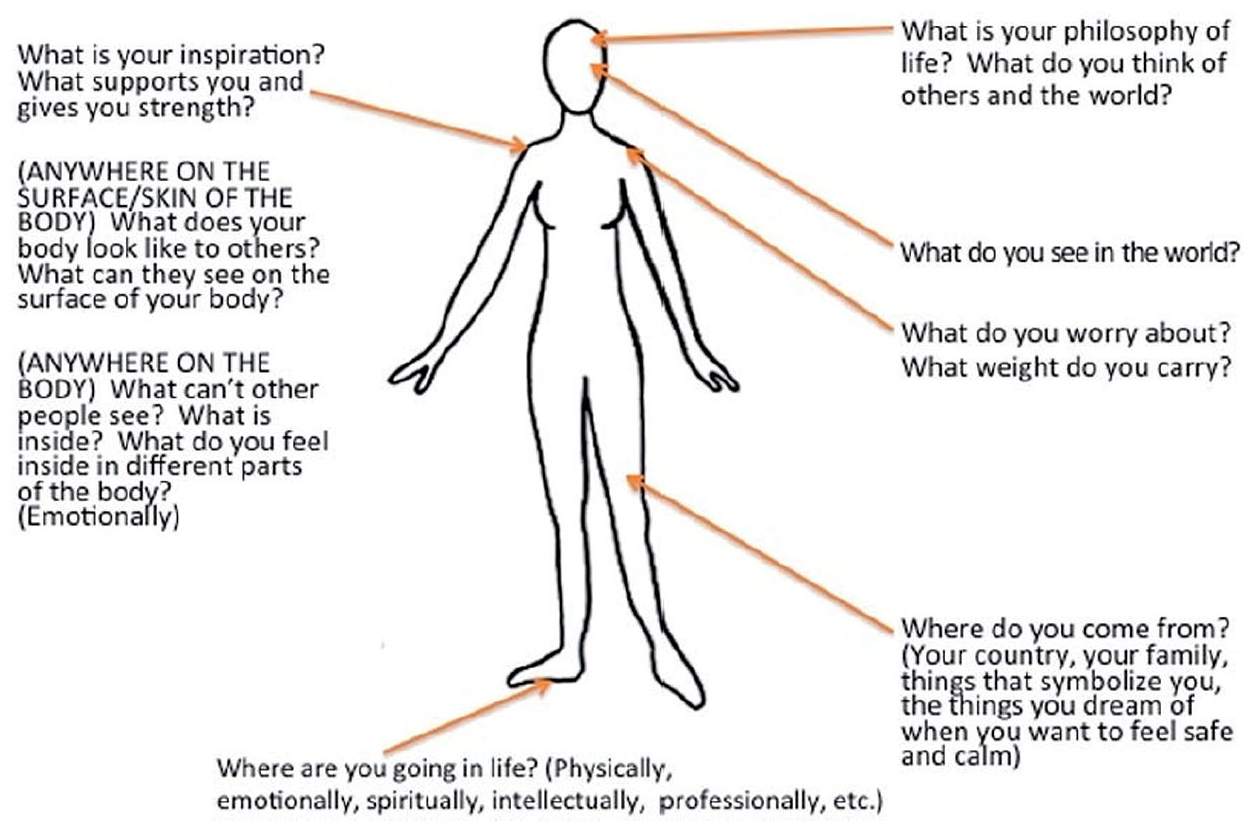
Body mapping, as depicted in Gubrium and Shafer (2014:656).
Jessica opened that day’s discussion by inviting the class to consider mapping our own bodies. Our seminar had become a space of creative and frank teaching and learning. What would we need to feel comfortable in a body mapping exercise? What trust was required to allow the necessary touch and witnessing? One student pointed to the risks and pleasures of embodied engagement with a scholarly text, in a seminar, and with colleagues and peers. Discussion continued: How might it feel—physically, emotionally—to see one’s own and others’ bodies outlined on a piece of paper? We considered how the challenges the exercise poses might vary for racialized bodies, bodies differently gendered or sexed, bodies that lived with disability, or bodies that had experienced trauma. We considered what it would mean for someone already scrutinized for racialized, gendered, and other differences to lie on their back—not only while peers observe their body being traced but also while a classmate traced and likely touched their body. We noted the physical ability and ease required to get down on the classroom floor at all.
As a class, we decided to try body mapping but to adjust the exercise to address these challenges: We would inhabit the ambivalence that emerged from having explored the available possibilities and find a way to map our bodies and sexualities as we live them. Having identified concerns about, in particular, the visceral experience of tracing our black, fat, trans, queer, traumatized, and aging bodies, an initial challenge in each mapping was how to depict our forms. In the end, we decided not to trace our bodies on the floor and instead to adopt alternative means for representing our bodies: For example, we traced a hand, drew stick figures, or sketched a self-portrait based on a smartphone picture. An ongoing challenge was responding to the vulnerability the exercise incited; we opted to, for example, not depict some aspects of our bodies or not record entirely frank answers to Gubrium and Shafer’s (2014) questions.
A year later, the coauthors convened to revisit our seminar maps. Our experience was no longer defined by the structure of a graduate seminar; the conventions and hierarchies of graduate seminars and student/educator relationships lingered, but we strove to build new relationships as colleagues. We worked remotely and during a global pandemic in Canada and the United States; in Western, Central, and Eastern time zones; from different university campuses; and inside our homes. In 2019, the seminar felt hopeful as we neared the end of an inspiring school year; some students were graduating, and others were beginning thesis research; Bex, era, and Jessica were about to move to new cities. Online in 2020, we felt the fatigue of months of pandemic quarantine. We all felt the strain of anti-black racism and police violence, and we felt called to the priorities of the Black Lives Matter movement; we also understood that Stephanie felt the strain and danger especially acutely. Our maps were less optimistic, and some of us struggled to settle into our bodies.
In these altered conditions, we practiced body mapping twice. First, during remote mapping, we spent 30 minutes together in an online meeting creating and reflecting on new body maps; about seven minutes were devoted to mapping itself, and the remaining time went to discussion. The following week, we each created a new solo body map offline, on our own time and at our own pace. We spent time in subsequent online meetings reflecting on the experiences and conditions of body mapping in these three moments. Online or in person, collective or alone, mapping our bodies, responding to Gubrium and Shafer’s (2014) questions, and discussing the maps left us feeling raw—exposed, if only to ourselves, and aware of the historical and immediate conditions that made a discussion of our bodies and sexualities feel pressing, invigorating, and challenging. We continued the practice of asking unsettling questions that disrupted us as educators and students and injecting our voices into academic discussion and writing—much as we do in this article.
Challenges of Representation
As Shimizu (2007) and Nash (2017) anticipate, even with a wider range of options, the challenges and binds of representation remained, no matter how much we explored them and no matter whether we opted to outline our hands, selfies, or full bodies. During the seminar mapping, Stephanie grappled with the racialized bind Nash describes as she felt both a sense of deep pride and disgust at the prospect of opening up her obese body to classmates for critique. Choosing an image was no less fraught than answering Gubrium and Shafer’s (2014) prompts as Stephanie’s apprehension about how others receive her body warred with her embrace of it.
Also during the seminar mapping, era and Bex strained against the constraint that they could produce only a single representation of their bodies. As era notes, she experiences her body as having multiple guises: “As a drag performer, professional educator, and student, I don many costumes.” era did not trust a single depiction could represent all of these possibilities. Bex too found the singularity challenging: “I felt frustrated by each effort to portray my many-gendered body on paper.” After first drawing free-handed, abandoning that effort, next tracing a selfie off her phone, and finding that similarly unsatisfying, Bex took a different tack: I settled on tracing the outline of my own left hand, imagining it a nod to Gubrium and Shafer’s technique of tracing a peer’s body onto a piece of butcher paper. As my pencil moved down the sensitive webbing between each finger, I imagined someone moving a marker down the side of my abdomen.
Having discussed other options, including a full body tracing, Bex kept other visceral possibilities in mind as she rendered her hand—and her many-gendered body through that hand.
Whether completed in person or online, the quiet and private moment of representing one’s body remained social. During the seminar mapping, Bex noted, “I felt aware of the bodies around me, each person working on their own introspections.” Patricia found the newness of relations challenging when she first approached the remote mapping exercise: I am the only one on this writing team who was not in the original seminar. . . . I was nervous and excited in the week leading up to our first body mapping exercise. I started to think about the prompts, how I might answer them in my own body map. I speculated about where our group discussion would go. I wondered what it would feel like to do this in the presence of relative strangers.
Patricia participated in the remote exercise despite her trepidation, suggesting that long-term relationships may be an asset, but not a necessity, in body mapping.
Jessica chose an image in her seminar mapping that reached beyond the sexualities classroom to relationships that she knew received her aging body well: I traced a selfie I had taken earlier that week in front of a full-length mirror; the image was one in a series of photographs I’d taken that semester in front of that mirror to send to my girlfriend who lived three time zones away. I know I liked that image and its history. I placed tracing paper over my phone screen, drew the outline of my body—middle-aged, soft, and turned toward what I hoped was a flattering angle.
The source and audience of the images produced in body mapping include those inside the seminar as well as chosen and intimate relations (e.g., girlfriends) and a surveilling public that might, in this case, judge harshly a softening middle-aged woman. The particularities of our lived experiences meant that mapping our bodies and sexualities raised distinct challenges.
Embodied Difference
Surveillance and aging are gendered concerns, and, not surprisingly, gender shaped most experiences of body mapping. However, as our gender experiences and identities vary, so too do the ways gender shaped our mapping experience. Bex noted the demure feminine stance of the seemingly generic figure Gubrium and Shafer (2014) presented in their article: “feminine, posed, toe pointing delicately downward—[that figure] did not match how I saw myself.” The handprint Bex traced during the seminar mapping strained beyond the strictures of gendered bodily expression and experience: “My handprint had no gender; though part of my body, my hand was distanced from it.” However, even in allowing Bex to reach beyond a gendered body, the handprint highlighted the persistence and power of others’ gendering: In recent years, I notice less when strangers stare at my gender presentation. This exercise re-heightened my awareness of how others might see me, and that awareness was uncomfortable. I might know myself like the back of my own hand, but can I ever know myself as I look to others, as a complete person, a queer freak, a body moving defiantly through this world with both breasts and facial hair?
While Jessica moved cautiously in the face of the ageist surveillance, Bex found others’ reading of her body an invigorating call to defiance, queerness, and wholeness—that is, to the “deepening and enlivening” of erotic knowledge.
Patricia found the time allowed for the remote mapping insufficient to achieve a visceral understanding. During the solo mapping, with no time constraint, Patricia found room to consider her gendered and racialized experience of her body: I could reflect on the prompts and their connections to my body. I could think about the ways in which I have denied my body’s presence. The ways in which, as a white cishet woman, I have had the privilege to do that, the ways in which I have been rewarded for doing that, the situations in which I could not do that.
Patricia recognized through her mapping how infrequently she is called to the emplacement of embodied knowledge. Privilege has protected her from the requirement of embodiment; it has also precluded embodiment’s pleasures.
By contrast, Stephanie recalled that “the seminar session in Spring 2019 was hopeful, optimistic, and the emphasis on love, futurity, and pleasure in my Blackness across my answers suggested I was striving to improve my outlook on life and health.” By Spring 2020, when the team gathered online, conditions had changed. As Stephanie recounted, the remote and solo mapping coincided with the COVID-19 pandemic and Black Lives Matter protests: “My map was marked by anxiety, uncertainty, and a fear of poverty and failure. We allowed ourselves seven minutes to complete our maps. Racial unrest highlighted my Black body’s lack of safety and the threat posed by white supremacy.” The solo session shifted Stephanie’s focus from trauma to inspiration, and during that mapping, she charted her “desire to be happy, successful, and find love.” Introspection facilitated an emotional shift. Without the presence and expectations of white colleagues, Stephanie could concentrate on each prompt with a fulsome understanding of what she hoped to express about and in her body.
Im/Possibility of Mapping the Sexual
Violence, resistance, loss, histories, and ambitions threaded through bodies and maps; they also drew our attention to particular body parts. Recalling the seminar mapping, Stephanie recounted, I paid great reverent attention to my lips and derriere—highly valued physical traits in African American culture. I locate a great sense of sensuality in my smile and desirability in my buttocks. As I mapped my body in image and words, I crafted extensive descriptions of my posterior’s shape, size, beauty, and appeal.
The erotic became a lived experience as Stephanie traced her own body and sexuality. Running her hand down the length of her body, Stephanie symbolically traced the outline of her fatness and her blackness to determine the outlines of her experience.
Even these visceral experiences shifted as our bodies and sexualities shifted over time. Reflecting on her experience after completing the third solo map, Stephanie wrote the emplacement of her body in each of the three mapping sessions starkly contrasted with how I saw the world—and my body’s security in that world. . . . In the first session, I felt a yearning to lose weight; in the second, I felt an acute fear of death and inhumanity; later, on my own, I accepted the full weight of my weight and re-established the centrality of my Blackness.
era noted a similar distinctness of her body maps when she wrote that immediately after the first seminar mapping, I remember fixating on the unknownness of my future. At the end of the semester, I planned to move away from California for the first time, graduate with a new degree, and leave my job of four years which, I would later come to appreciate, had become a large part of my identity. I was literally going places, and I thought about what it meant to take my body with me.
The moment in which we mapped determined the body we would map—poised for greatness, warding off violence, facing deep uncertainty; as we moved through space and time, so too did our maps’ emplacement.
In the end, initial concerns about the impossible task of creating a single representation of our multiple embodied selves gave way to recognizing the limits to any knowledge we might ever display through our maps. As era noted, Often, the power of embodiment lies in the process rather than the finished products. The joy, the nerves, the newness, the bizarre; it was the feelings that moved through our process that became the subject of dialogue. Because of the sharedness of the experience, we were able to reach a point of mutual vulnerability and understanding. This mutuality soon became our aim—not the map, not the particularities of the map, but the particularities of the mapping.
As Bex wrote, “Sharing in the experience of body mapping felt more important to me than the specifics of which I wrote. To . . . discuss the vulnerable and tender parts of being human felt important.” To apply those discussions to our own bodies felt transformative—in each mapping exercise and, now, in writing this article.
Implications and Applications
Like this article, the discussion that followed each body mapping focused on the mapping experience, not the content of our maps. In many ways, this was enough. Most practically, we met the course objective of asking sociological questions about the conditions of teaching, learning, and knowing about sexuality in the public school classroom and university seminar; we also gained insight into a promising pedagogical technique in sexuality education.
Discussion was enough in a grander sense as well. Reflecting on the body mapping experience allowed us to ground our sociological study of sexuality in an empathetic and embodied understanding. As we practiced body mapping and then reflected on the practice, we occupied, witnessed, and named the bind of representation that shapes efforts to depict one’s sexuality. As we crafted responses to Gubrium and Shafer’s (2014) prompts and listened to colleagues reflect on their own, we depicted and narrated the erotic and gained insights into the many ways sexualities are constituted by a range of biographical, social, and historical conditions. The structural privileges associated with whiteness were named, as were the violence and trauma of racism. We confronted the risks and affordances of embodied teaching and learning about sexuality.
When we began mapping our bodies, the stakes had not yet been revealed. Much was unclear: We were unsure how many personal details we or our colleagues would reveal, and we did not anticipate how much the team would forego close readings of the maps in favor of exploring the experience. Nor did we expect to work together online a year later, without physical proximity. Our response to Gubrium and Shafer’s (2014) call to sensual education suggests body mapping is a profoundly adaptable practice that may travel from community-based workshops to graduate seminars to undergraduate classrooms. Our success mapping in person and online suggests the exercise may provide educators and students a powerful path to embodied knowledge even when physical proximity is impossible.
With careful attention to the potential vulnerabilities the practice highlights in the classroom, body mapping can be adapted to community- and school-based instruction, courses in which students have come to know one another well and those in which they have recently met, in-person and online teaching and learning, and a range of available time. The insights available in different educational contexts or with different groups of students may vary, but certain conditions may facilitate a body mapping experience that welcomes embodied knowledge and erotic understanding and recognizes the rawness and ambivalence that the exercise invites. One condition lies in body mapping serving as a tool for embodied learning but not assessment. In addition, although some body mapping practices involve sharing maps, we encourage educators not to insist on such display. The knowledge that we would not need to reveal our maps or submit them for evaluation allowed us to inhabit the exercise more freely.
Our experience suggests that another condition is the willingness to reconsider the usual educator-student relationship. Educators come to courses on the sociology of sexualities with strategies for navigating institutional bias: plans to avoid embodied knowledge of sexuality and to opt instead for abstraction and strategies for occupying a room and managing the personal stakes of an academic discussion. The benefits of respecting those restrictions are clear: A disembodied seminar room affords some comfort and control, offers participants some protection from sexual harassment, and socializes students and educators into the norms of a profession. For educators of color, those with disabilities, those at the early stages of their careers, and others, these benefits are especially valuable. Jessica’s whiteness, age, tenure, and other social privilege surely enfranchised her to pursue embodied knowledge in the graduate seminar. However, while we want to remain conscious of the structural advantages that supported our work together, we want also to remember that to disavow embodied knowledge is also to refuse the specificities of racialized, gender/queer, and other historically marginalized sexualities and bodies.
In the end, if interrogated, even the decision not to pursue body mapping could be generative in a sexualities classroom. Educators and students might begin with the questions with which we began our body mapping practices: What would we need to find value or feel comfortable in this exercise? What consequences can we imagine to seeing one’s own and others’ bodies outlined on a piece of paper? What conditions are required to allow the necessary touch and witnessing? What about our curriculum and pedagogy precludes this sort of engagement? Answers to these questions promise insight into what it means to teach and learn about sexuality—fundamental concerns in the sociology of sexualities.
Conclusion
Body mapping called our sexuality seminar and this writing team into new relationships with readings, the classroom, and one another. Rendered on paper—as a carefully traced handprint, a hasty sketch, or a faithful depiction of a sensual self—sexuality occupied the room (actual and virtual) in its fullness, bringing with it the ambivalence of embodied knowledge and challenging norms of classrooms and sociology education. Our varying status as marginalized people—differently racialized, gendered, abled, aged—was palpable and left some of us feeling raw. We managed these feelings by foregoing life-sized outlines and naming and discussing the constraints on our mapping; nevertheless, the vulnerability remained.
Ultimately, allowing students and educators flexibility in how they represent themselves not only creates space for vital sociological reflection but also lays the bare the binds of representation with which students and educators of color; queer, trans, and nonbinary people; fat people; and others contend. Body mapping invites these bodies and all of their particularities into the classroom and then points to the conditions that facilitate or obstruct their entry. Embodied pedagogy—whether it generates the visceral experience of one’s body being traced or the quiet consideration of one’s emplacement—represents a step toward the ambivalent erotics of embodied knowledge. When much teaching and learning about sexuality and the sociology of sexualities affirms a divide between embodiment and understanding, body mapping invites students and educators to recognize binds of representation, welcome the erotic as a source of insight, and recognize sexuality as it is lived.
Footnotes
Acknowledgements
We thank our colleagues in the San Francisco State University seminar, “Sexuality, Education, and Policy,” for critical discussion and collaboration across the Spring 2019 semester. We also thank the reviewers for the feedback on this article and the editors for their inspired and inspiring work on this special issue. Fields and Roach thank the University of Toronto Sociology Department for supporting Patricia’s initial work as on this article. We thank Fields’s writing group (Chloë Brushwood Rose, Jen Gilbert, and Sue Winton) and Dr. Mauro Sifuentes for feedback on early versions of this article.
Editor’s Note
The reviewers for this manuscript were, in alphabetical order, Shantel Gabrieal Buggs and Jesús Gregorio Smith.