



Abstract
Applying a critical lens to self-determination theory, this study examines which organizational and individual characteristics in local government impact burnout, looking specifically at differences across diverse groups. This study uses survey data from a sample of more than 2,500 local government employees from a large city in California. Factor analyses and multivariate regressions are used to empirically examine the impact of multiple organizational characteristics and individual differences on employee burnout. Findings show perceptions of fairness, autonomy, influence, cultural competence, ethnic and gender representation, and time engaging residents differ in their impact on burnout across different groups, leaving some minoritized groups more vulnerable to burnout. Findings also indicate how self-efficacy and prosocial motivation have varying effects across sociodemographic groups. For some groups, burnout can manifest as an increase in emotional exhaustion, while other groups experience depersonalization and the loss of personal accomplishment. Research on this issue can help inform more equitable and culturally appropriate organizational practices that can improve climate of inclusion, employee well-being, and public service outcomes. This analysis contributes to diversity management and representative bureaucracy research—important areas of study as the public sector consider an increasingly diverse future workforce.
Introduction
Public organizations and the populations they serve are becoming more diverse, particularly in large metropolitan areas. Theories of representative bureaucracy argue that a public workforce that reflects the demographic diversity of the community being served will be better equipped to advance the needs of the public with more culturally sensitive policies and programs (Ding et al., 2021; Riccucci, 2021). Recruiting and retaining a diverse workforce require an examination of the power dynamics and structural inequities within organizations that could lead to different experiences within and between social groups in the workplace (N. M. Humphrey, 2022). With a diverse public workforce, there is increasing urgency to deconstruct and address racial, gender, and generational disparities in public employee well-being, namely burnout, especially as it relates to power and resource asymmetry associated with organizational and positional characteristics (Barboza-Wilkes et al., 2023; Riccucci, 2021).
This study builds on self-determination theory (SDT; Deci et al., 2017; Deci & Ryan, 2008) to understand the different ways in which individual- and organization-level factors may shape well-being and burnout across social groups. Through a structural analysis by race, gender, and generation, this study extrapolates key individual and organizational characteristics believed to be consequential for employee well-being from diversity management scholarship. In doing so, this study aims to advance theories of representative bureaucracy by showcasing the contextually relevant variables for supporting different social identity groups within the workforce. Given the large and representative sample of local government workers in this study, the practical implications will tactically guide practitioners responsible for overseeing a diverse public workforce.
Work by Barboza-Wilkes et al. (2023) reveals employees across gender, racial, and generational identities experience burnout in fundamentally different ways and at different rates; however, little is known about the mechanisms and organizational characteristics that contribute to or moderate those differences. Employee burnout has been linked to serious consequences for retention as those who are experiencing burnout and workplace stress are much more likely to become disengaged and turnover, especially those without the proper support (Alarcon, 2011; Linos et al., 2022). Burnout and turnover have been focal points for the public sector as failures to retain employees have consequences on the efficiency and effectiveness of its services, including increasing costs for recruitment and training, disruptive leadership and managerial changes, and lost productivity (Blaique et al., 2022; Hoang et al., 2022). The aging and increasingly diverse population across cities present challenges for the public sector as local governments struggle to retain career bureaucrats with institutional knowledge and a workforce that is more reflective of the population it serves (Portillo et al., 2022). Of concern, there continues to be (a) significant rates of turnover and turnover intention among younger and early-to-mid-career public sector workers compared with older and more tenured public sector employees (Cho & Lewis, 2012; Ertas, 2015; Viechnicki, 2015) and (b) an underrepresentation of racially minoritized groups and gender minorities, particularly in upwardly mobile and decision-making positions (Gardner, 2013; Nelson & Piatak, 2021).
This study begins to explore how organizational and individual characteristics are disparately influential in predicting burnout for different groups of employees based on their social identities, a gap in the existing literature. Extrapolating how workplace and job design characteristics impact groups differently will provide key insights into how organizations can be more strategic in shaping organizational characteristics to mitigate burnout equitably across groups. Studies have examined the impact of workplace context on employee outcomes and burnout experiences (Battaglio et al., 2022) but less on how the impact of these characteristics may differ across social groups. To begin, a review of the extant literature on burnout in public organizations is presented and followed by a synthesis of the theoretical framework of SDT to support the study’s methodological approach in estimating the relationship between organizational and individual characteristics and burnout. This article then concludes with discussions on the results and the motivating factors for a multidimensional approach to researching burnout to advance diversity management practices and promote representative bureaucracy.
Understanding Burnout Through SDT
Maslach, Leiter, and Schaufeli (2008) describe burnout as a multidimensional stress response that stems from chronic interpersonal stressors in the workplace, with distinct dimensions: (a) emotional exhaustion, (b) detachment and depersonalization, and (c) reduced personal accomplishment or efficacy. Emotional exhaustion results from the overextension and depletion of emotional resources, whereas depersonalization and interpersonal distancing occur as a detached response to decreased emotional or cognitive involvement in work (Maslach et al., 2008). Reduced personal accomplishment and self-efficacy reflect a lack of personal achievement and feelings of incompetence with respect to work tasks (Maslach et al., 2008). In general, burnout leads to adverse outcomes for employees, including reduced well-being and risk of resignation, which consequently impact the organization’s functionality (Linos et al., 2022). Within public sector contexts, research (e.g., Barboza-Wilkes et al., 2023; Le & Barboza-Wilkes, 2022; Linos et al., 2022) on burnout explores similar relationships among emotional exhaustion, depersonalization, and loss of personal accomplishment but focuses on additional drivers specific to public service, such as prosocial motivation and experiences engaging directly with residents through public service provisions. The detrimental consequences of a public workforce experiencing burnout are well documented (Linos et al., 2022), including disruptions to public services and threats to representative bureaucracy, but less work has been done to identify ways to address and reduce burnout in the public sector. Understanding how organizational risk factors may vary as a function of individual differences and social identities can help identify opportunities for appropriate and group-specific interventions to improve the well-being and engagement of the workforce.
In a meta-analytic review, Lee and Ashforth (1996) discuss how job-level characteristics like role conflict, role stress, stressful events, workload, work pressure, and role ambiguity correlate with emotional exhaustion and depersonalization but less so with personal accomplishment. To a lesser extent, the three dimensions of burnout were shown to correlate negatively with measures of belonging, such as social support, team cohesion, and participation/skill utilization (Lee & Ashforth, 1996). More recently, Wang, Seibert, and Boles (2011) find that job context, including frequent contact with customers, lack of autonomy, and lack of social belonging, contributes significantly to burnout.
In developing a model that predicts how workplace contexts shape vulnerability to burnout, this study draws from SDT (Battaglio et al., 2022; Deci et al., 2017), which identifies organizational characteristics affecting employees’ basic psychological needs for well-being and effective functioning in social settings: (a) competence, (b) autonomy, and (c) relatedness or belongingness. Deci et al. (2017) describe highly effective organizations as promoting both high-quality performance and employee well-being, arguing the latter can contribute to organizational outcomes, financial success, and customer satisfaction and loyalty. Roberson, Ryan, and Ragins (2017) posit positive workplace climates and interpersonal relationships that provide support, validation, and understanding help marginalized employees better cope with stress.
SDT research suggests supportive climates that promote individual need satisfaction foster organizational commitment, prosocial and organizational citizenship behaviors, job satisfaction, performance, and overall psychological well-being (Gagné & Deci, 2005; Roberson et al., 2017). Recently, public administration scholars have integrated concepts like public service motivation into SDT to understand employee engagement and job satisfaction (Battaglio et al., 2022). Building on the interests in SDT within public administration scholarship, this study expands on the contours of competence, autonomy, and relatedness.
Competence/Self-Efficacy
Within SDT, competence is a form of self-efficacy that reflects one’s beliefs and convictions in one’s own effectiveness to successfully complete tasks (Bandura, 1977; Gagné & Deci, 2005). Self-efficacy shapes behaviors and can reduce stress and facilitate greater motivation in challenging, novel, and threatening circumstances (Bandura, 1977, 1986, 2012). Individuals with high self-efficacy are able to persist and complete challenging tasks requiring effort (Bandura, 1986, 2012). High self-efficacy is shaped by autonomy over tasks, which helps to overcome environmental stressors and challenges (Grandey et al., 2013). More recent literature suggests that self-efficacy mitigates burnout induced by emotionally taxing interactions (Jeung et al., 2018); however, self-efficacy reflects perceptions rather than objective measures of self-competence (Bandura, 1997; A. Grandey et al., 2013). Without access to performance data, self-efficacy is a close proxy for competence that is often self-reported.
Job Autonomy and Prosocial Motivation
Workplace autonomy can refer to both job-related decision authority and autonomous or intrinsic motivation to engage in work. As a form of job control, autonomy reflects an employee’s ability to fulfill job responsibilities aligning with their values and identities. Evidence shows when an individual has control over whether they engage in their work in a manner more consistent with their values, they experience less emotional exhaustion (Bono & Vey, 2005; R. H. Humphrey et al., 2015). SDT research suggests supportive climates that encourage autonomy promote individual need satisfaction and foster organizational commitment, prosocial behaviors, job satisfaction, performance, and overall psychological well-being (Gagné & Deci, 2005).
SDT places motivation on a continuum ranging from amotivation to intrinsic motivation, which is self-determined. Autonomous motivation is intrinsically derived motivation, meaning no external incentives or sanctions are needed to motivate the work, and has been linked in public service to the notion of prosociality (Gagné & Deci, 2005; Grant & Berg, 2011). At the organizational level, job characteristics and work climates differ in the extent to which their practices are autonomy-supportive, controlling, or amotivating; and individuals differ in the extent to which they hold an autonomous or controlled trait-like orientation (Gagné & Deci, 2005). Public service motivation incorporates two enduring principles: (a) an “other orientation” that contrasts with self-interest theories and (b) a sense of “publicness” that emphasizes public institutions’ communal nature and missions to serve (Perry, 2021). Prosocial identity describes the intrinsic desire to help and contribute; when people see their identity as positively influencing others, they are more engaged in their work (Grant, 2007). Dutton, Roberts, and Bednar (2010) argue positive work-related identities are linked to (a) greater work engagement, (b) enhanced psychological functioning, (c) positive emotions and feelings, and (d) improved social functioning.
Relatedness/Belonging and Climate of Inclusion
Relatedness is the need to feel connected to others through interpersonal relationships with peers and is associated with feelings of inclusion and belonging in the organizational setting (Deci et al., 2017). Diversity management scholarship consistently finds that a climate of inclusion yields positive outcomes, including positive emotions derived from interpersonal relationships, especially in increasingly diverse organizations susceptible to relationship and task conflict (Deci & Ryan, 2008; Mor Barak et al., 2016; Nishii, 2013). Nishii (2013) introduces the construct of a climate of inclusion that “involves eliminating relational sources of bias by ensuring that identity group status is unrelated to access to resources, creating expectations and opportunities for heterogeneous individuals to establish personalized cross-cutting ties, and integrating ideas across boundaries in joint problem solving” (p. 1754). Nishii (2013) identifies three dimensions that constitute climate for inclusion: (a) fairness, (b) integration of differences, and (c) inclusion in decision-making. Fairness refers to a “foundation of fairly implemented employment practices and diversity-specific practices that help to eliminate bias” (Nishii, 2013, p. 1756). The integration of differences reflects the expectations on how employees can engage themselves, their core values, and identities in the workplace without enduring unfair consequences and biases (Nishii, 2013). Inclusion in decision-making allows for diverse perspectives of employees to be meaningfully sought and included, even if their input may question dominant assumptions or disrupt the status quo (Nishii, 2013).
Research by Ramarajan (2009) shows that suppressing, rather than revealing, aspects of one’s identity can lead to biased interactions with coworkers who are unable to recognize one another as they are, which thwarts group members’ ability to engage in healthy and honest task-related debates without misinterpretation or conflict on task-based disagreements. Nishii (2013) shows that inclusive climates lead to decreasing interpersonal bias, resulting in reduced conflict, lower levels of turnover, and improved unit-level satisfaction.
Taken together, SDT suggests that employees who feel confident in their ability to do their job, have a sense of autonomy, are prosocially motivated, and work in an environment characterized by inclusive decision-making should experience less burnout. However, little is known about how these individual and organizational characteristics might vary across race, gender, and generations. Exploring these differences will provide more culturally attuned workforce development strategies that will acknowledge the different lived experiences, workplace needs, and individual priorities for employees to avoid and/or address burnout.
Hypotheses: Anticipating Differences Across Social Groups
Public organizations, which have historically maintained older workforces, are under increasing pressure to recruit and retain a younger and more diverse set of employees to respond to the demands of a changing society (van Harten & Rodrigues, 2021). Organizational and management practices that were previously developed for a stable and older workforce should be interrogated to see if they apply uniformly across a more diverse and changing workforce.
This study explores the differential impact of organizational characteristics and individual differences on burnout for public sector employees more reflective of today’s population and workforce by examining whether these organizational and individual factors have differing effects on emotional exhaustion, depersonalization, and loss of personal accomplishment across genders, race/ethnicities, and generations. Given differences across social groups regarding access to resources, lived experiences, and treatment in public organizations, there are likely varying effects by size and directionality on how individual and organizational characteristics related to SDT shape burnout experiences.
Barboza-Wilkes et al. (2023) argue through conservation of resources theory (Hobfoll et al., 2018) that sociodemographic groups differ in their cultural resources and perceptions of belonging in the workplace, creating unique cleavages of vulnerability to specific forms of burnout within and between groups. Individuals have finite psychological, emotional, and physical resources, and the resources used for completing one task limit what is expendable toward other undertakings that demand similar resources (Hobfoll, 1989, 2002; Hobfoll et al., 2018). Resource loss is consequential for both their instrumental value (e.g., money, social support, and credit) and symbolic value (e.g., self-esteem, close attachments, health, and inner peace; Hobfoll, 1989, 2002). When resources are threatened or lost, anxiety and distress follow (Hobfoll, 2002). Psychological and emotional resources are depleted when managing inequitable treatment in the workplace; the unequal treatment of women and racially minoritized employees has been linked to their declining work satisfaction and career outcomes as it relates to mentoring, performance evaluations, promotion opportunities, turnover intentions, and income (Nkomo & Cox, 1990; Zanoni et al., 2010).
Generally, these outcomes are associated with discrimination and prejudice, but overlook structural, context-specific factors. The underlying mechanisms of gender and racial/ethnic inequality in the labor market are debated but are broadly associated with (a) individual differences in skills and preferences, (b) labor market differences, and (c) discrimination (Browne & Misra, 2003). Though gender, race, and other markers of differences shape employers’ actions related to hiring, training, promotions, and wages, interpersonal relationships and interactions with coworkers and customers may additionally contribute to discriminatory environments and feelings of burnout (Browne & Misra, 2003).
Employees with higher status have greater control, autonomy, and influence over workplace behaviors and emotions, while “lower status workers are subject to greater emotional exploitation and control, and have to do more, frequently uncompensated, emotional labor” (Wilkins & Pace, 2014, p. 396). This is particularly true of service work in organizations that adopt a philosophy of “the customer is always right” or “service with a smile,” leading employees to endure taxing and verbally abusive encounters with little recourse to assert emotional boundaries. Emotional labor is defined as the process of manipulating the expression or experience of emotions to meet the expectations of the organization, and is linked to burnout through the experiences of dissonance or inauthentic emotion regulation (Davis et al., 2022; Grandey et al., 2013; Le & Barboza-Wilkes, 2022). Taxing encounters with residents result in emotional labor that contributes to burnout in the form of emotional exhaustion (Le & Barboza-Wilkes, 2022). Alternatively, the relational job design literature suggests that frequent contact with beneficiaries (e.g., residents) could increase employees’ affective commitment to residents and their perceptions of the impact of their work (Grant, 2007), suggesting an increase in their sense of personal connection with residents and personal accomplishment. As emotional labor is often unacknowledged in service work, “it is often both unrecognized and unremunerated, especially when done by people (in most studies, women) who are assumed to be ‘naturally’ emotionally suited for particular kinds of work” (Wilkins & Pace, 2014, p. 397).
Workgroup identification is “an individual’s perception of oneness with the workgroup, along with the tendency to internalize the group’s successes and failures” (Stewart & Garcia-Prieto, 2008, p. 657). Research on workgroup dynamics asserts that “workgroup identification has been positively associated with greater commitment to the group, cohesion and altruism, and negatively associated with social loafing and other dysfunctional behavior” (Stewart & Garcia-Prieto, 2008, p. 658). However, forming a strong workgroup identity has been found to be more difficult for individuals in demographically diverse groups, including racially dissimilar groups with potentially conflicting communication behavior and workgroup identification (Stewart & Garcia-Prieto, 2008). A climate of trust and mutual respect fosters feelings of confidence in and appreciation for others, which increases feelings of autonomy and efficacy; and when trust is high, individuals are more likely to cooperate with others (Spreitzer et al., 2005).
Job autonomy is influential in driving interpersonal behaviors and a major factor for whether jobs were described as exhausting or satisfying (Rafaeli & Sutton, 1989; Wharton, 1993). Individuals with high job control are able to exercise discretion in effortful interpersonal interactions, adapting organizational expectations to their individual style, thereby reducing dissonance (Guy et al., 2008). Research on emotional labor finds a negative relationship between perceived autonomy and emotional dissonance, an outcome of interpersonal work consistently associated with burnout (Bono & Vey, 2005; R. H. Humphrey et al., 2015; Wang et al., 2011). Alarcon (2011) finds the dimensions of emotional exhaustion, cynicism, and reduced personal accomplishment are negatively associated with control and autonomy. Autonomy and control often are more challenging to achieve for employees who feel pressure to manage their own impressions on others to counterbalance negative gender or racial/ethnic stereotypes. Consistent with the belief that individuals who focus on impression management have a higher propensity to regulate their behaviors to conform to expectations and norms, Diefendorff, Croyle, and Gosserand (2005) find self-monitoring significantly shapes dissonance and stress. Stewart and Garcia-Prieto (2008) suggest “that early in workgroup formation, demographically dissimilar workgroups are more likely to experience challenges due to individuals’ negative perceptions of different others” (p. 659). Thus, women and people of color may likely feel more constrained with respect to their behavioral choices on the job, and subsequently more vulnerable to burnout.
Importantly, Chattopadhyay, Tluchowska, and George (2004) argue that the likelihood of employees identifying with certain sociodemographic groups, such as gender and race, in diverse workgroups varies depending on their status within the organizational hierarchy because group membership can strategically confer status depending on the context. Results from Barboza-Wilkes et al.’s (2023) study of burnout in local government show that identities of gender, race, and generation are associated with distinct differences in emotional exhaustion, depersonalization, and loss of personal accomplishment, and advocate for research examining the disparate ways organizational-level factors shape the resources needed to mitigate burnout as a multidimensional construct.
Data
Assisted by the personnel department of a large city in California, the research team electronically distributed surveys to the entirety of the city’s government workforce in May 2018. More than 6,000 employees responded, with approximately 2,500 responding to all of the items relevant to this study’s models. The full workforce population for the city is 71% men, 28% women, and 1% nonbinary or other. In terms of race/ethnicity, the population is 38% Hispanic/Latinx, 29% White, 16% Black, 11% Asian, and <1% American Indian or Alaskan Native (AIAN). This study is unable to determine the generation distribution of the full workforce given data limitations. As shown in Table 1, the sample is 49.9% men, 48.6% women, and 1.5% nonbinary or other. In terms of race/ethnicity, the sample is 31.4% White, 11.4% Black, 11.6% Hispanic/Latinx, 15.8% Asian, 1.5% Native Hawaiian or Pacific Islander (NHPI), 1.2% AIAN, and 27.2% Mixed/Other. Importantly, the survey allowed respondents to indicate Mixed/Other identities which make it difficult to compare with the population demographics, where that level of self-identification was not available through the personnel department data. By generation, the sample skews older: 32.9% Baby Boomers, 43.0% Generation X (Gen X), 23.8% Millennials, and .3% Generation Z (Gen Z).
Descriptive Characteristics of Sample.
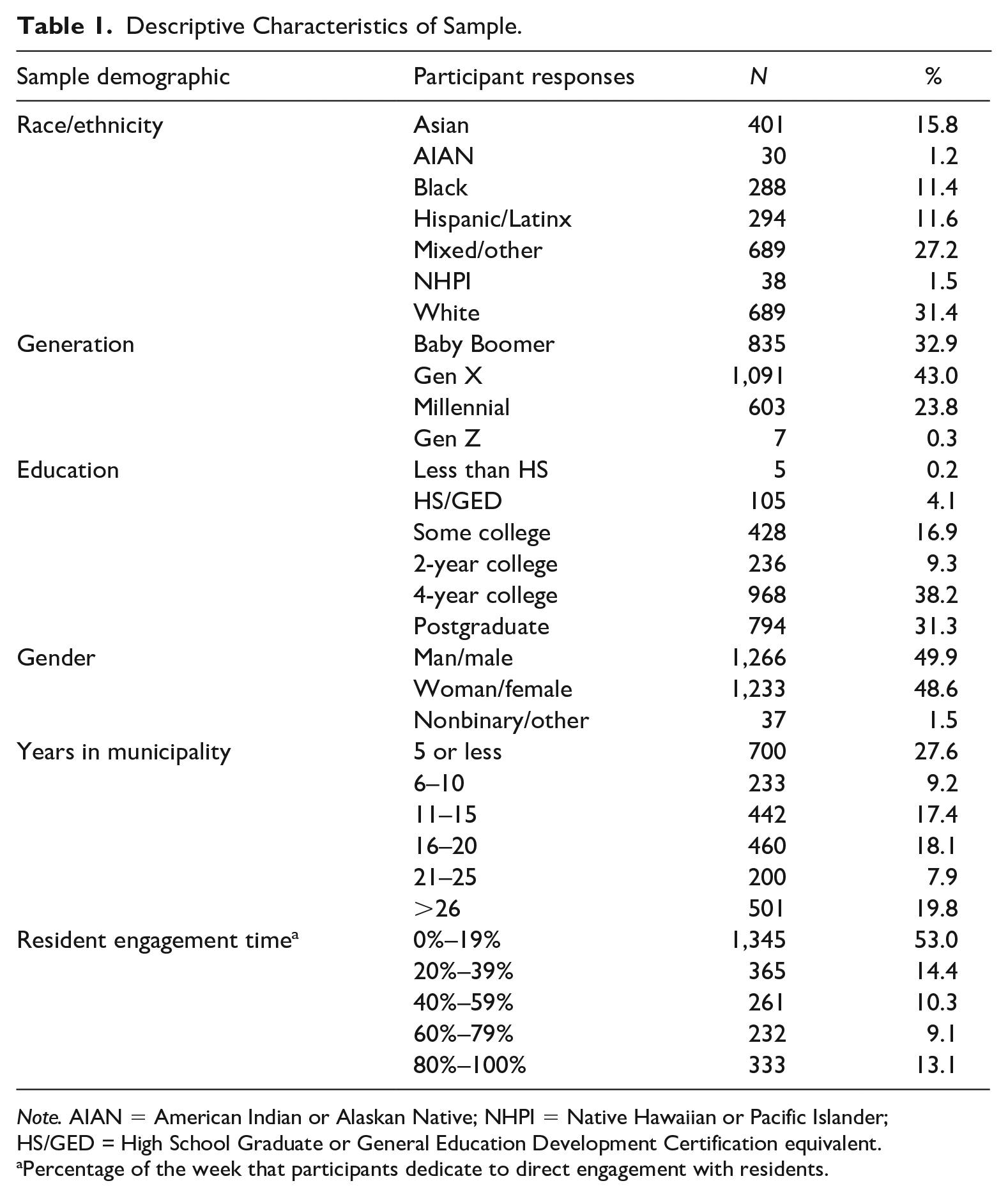
Note. AIAN = American Indian or Alaskan Native; NHPI = Native Hawaiian or Pacific Islander; HS/GED = High School Graduate or General Education Development Certification equivalent.
Percentage of the week that participants dedicate to direct engagement with residents.
Method
This study utilizes ordinary least squares models to estimate participants’ vulnerabilities to burnout and its different dimensions, isolating the statistical relationship with variables of interest guided by SDT: autonomy, fairness, influence, cultural competency, ethnic representation, gender representation, self-efficacy, prosocial motivation, and resident engagement time. Gender, race/ethnicity, and generation interaction terms are created and integrated into separate models with each variable of interest to determine how burnout is disparately shaped across social groups.
Measures of Burnout
To measure participants’ experiences with burnout and perceptions of certain organizational characteristics, this study integrates factor scores into the series of multivariate regression models. Factor analysis identifies and examines underlying patterns across complex multivariate data, including survey questions and items. This process condenses data from several variables into a single composite or factor score determined by observed patterns and maximum common variance shared by sets of items. Factor scores allow variation to be accounted for on a parsimonious scale with one latent variable that underlies multiple variables or items. Eigenvalues are used to measure the variance observed by the combination of items. Theories in burnout literature (e.g., Deci et al., 2017; Nishii, 2013) are relied on to determine the strategy in factoring and grouping latent variables. Table 2 shows which survey items are grouped together to create the different measures of burnout and perceived organizational and individual characteristics.
Factor Variables and Respective Survey Items.
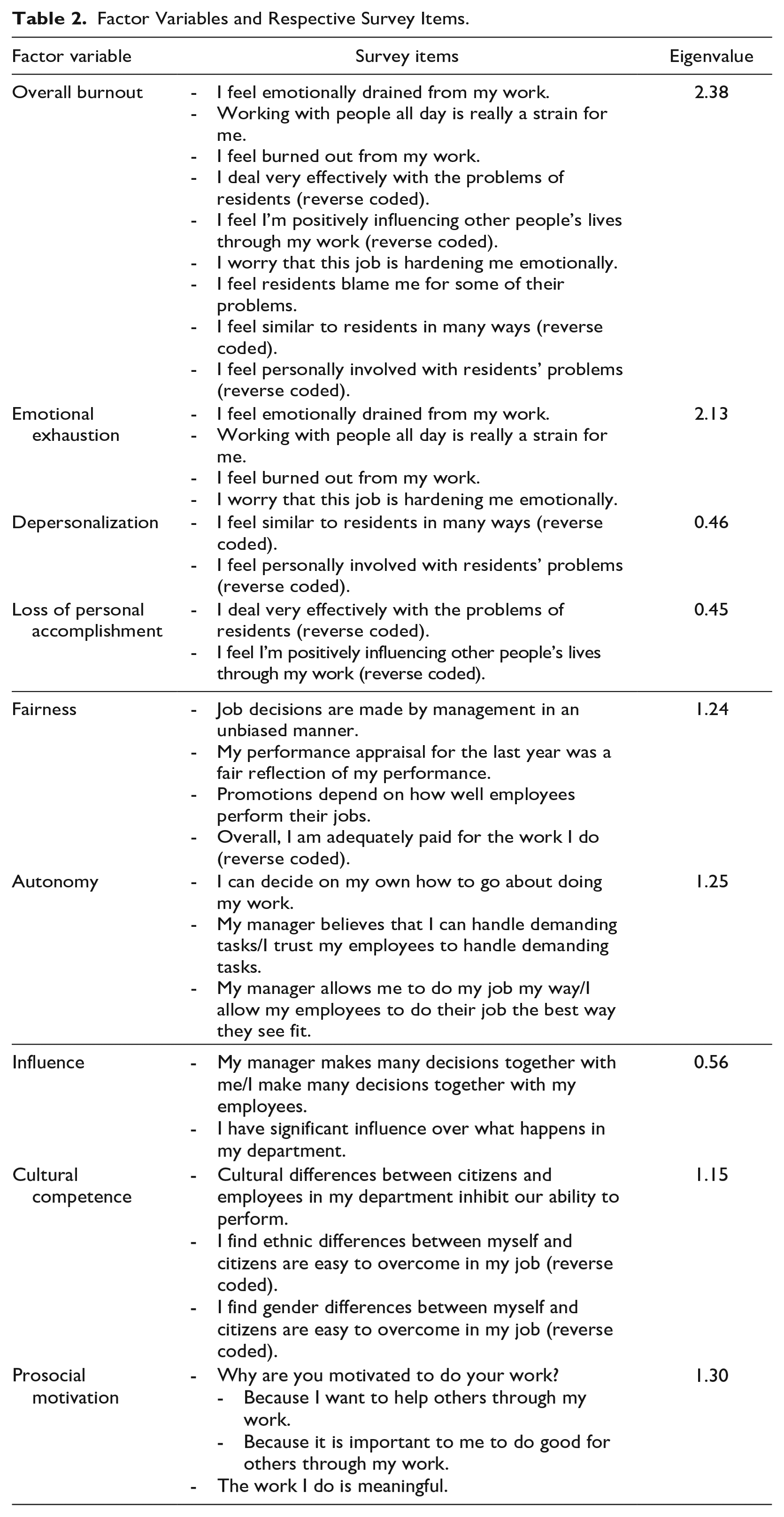
This study examines burnout as the outcome of interest in aggregate and as separate discrete dimensions to disentangle the nuanced effects of perceived organizational characteristics from SDT on burnout. Following Barboza-Wilkes et al. (2023), the overall burnout factor combines eight survey items (eigenvalue = 2.38) on emotional exhaustion, depersonalization, and loss of personal accomplishment. The emotional exhaustion factor is a composite score of four items (eigenvalue = 2.13) related to emotional experience (e.g., “I feel emotionally drained from my work”; “Working with people all day is really a strain for me”; “I worry that this job is hardening me emotionally.”). The depersonalization factor is a composite score of two items (eigenvalue = 0.46) that measure the extent to which employees feel dissimilar or disconnected from the residents they serve. The nuanced distinction between generalized depersonalization (“I feel similar to residents in many ways.”) and task-based depersonalization (“I feel personally involved with residents.”) yields a factor with lower variance compared with the other factor scores in this analysis. Despite the low eigenvalue, this factor is included as burnout literature suggests depersonalization reflects (a) a psychological dissimilarity from others and (b) a detached response consequential of lowered emotional or cognitive involvement in work (Maslach et al., 2008). Loss of personal accomplishment is a factor of two items (eigenvalue = 0.45) that measure participants’ perceived efficacy in serving the public and whether they have a positive influence on people’s lives through their work. The two items used to determine sense of personal accomplishment measure distinct dimensions of job-related confidence. The first item (“I deal very effectively with the problems of residents.”) references a sense of self-efficacy in managing the problems of residents, whereas the second item (“I feel I’m positively influencing other people’s lives through my work.”) addresses a broader sense of having a positive impact on others with their work. Taken together, these two items address a sense of impact important in developing a sense of personal accomplishment through work centering residents and the public.
Measures of Organizational Characteristics
In alignment with SDT, the empirical models in this study include a series of perceived organizational characteristics that influence the basic psychological needs for autonomy, competence, and relatedness. Working from Nishii’s (2013) framework for a climate of inclusion, multiple items that measure perceived bias in management practices to assess respondents’ perception of fairness of organizational practices, including performance assessments and compensation, are factored. Items on autonomy and influence are factored to measure inclusion in decision-making and organizational change. To estimate cultural competence, the empirical models include the degree to which participants feel cultural, ethnic, and gender differences between residents and members of their department impede their ability to effectively perform and fulfill their work responsibilities. The empirical models additionally include a variable for the self-reported amount of time spent engaging with residents to account for the need for relatedness in external relationships. To measure the psychological need for relatedness, variables that measure employees’ perception of how represented their ethnic and gender backgrounds are within their department are included. These factors show the extent to which perceived organizational-level characteristics impact employees’ experiences with burnout.
Measures of Individual Characteristics
The empirical models in this study include a series of individual-level characteristics outlined in SDT that fulfill the basic psychological need of competence. Grant (2007) developed a model of relational job design that examines how jobs motivate employees to make a positive (prosocial) difference in other people’s lives, and how such prosocial motivation shapes employees’ confidence, actions, and job outcomes. The models examine and control for individual differences in prosocial motivation, self-efficacy, and job and pay satisfaction. The prosocial motivation factor comprises items that measure the extent employees find their work to be meaningful and their motivation to help others. The models control for respondents’ confidence in their ability to do their job (i.e., perceived self-efficacy), respondents’ educational attainment, the number of years they have worked in the municipality, race/ethnicity, gender identity, and which generation they belong to. Respondents born in or between 1940 and 1964 are coded as Baby Boomers; respondents born in or between 1965 and 1980 are coded as Gen X; respondents born in or between 1981 and 1996 are coded as Millennials; and respondents born in or after 1997 are coded as Gen Z.
Results
Aggregated SDT Analysis
At the individual level, as shown in Table 3, this study finds prosocial motivation is negatively associated with overall burnout, emotional exhaustion, depersonalization, and a loss of personal accomplishment. In other words, the greater the prosocial motivation, the lesser the burnout. Results show no statistically significant relationship between self-efficacy and any dimensions of burnout.
Coefficients for Aggregated SDT Analysis of Burnout Dimensions.
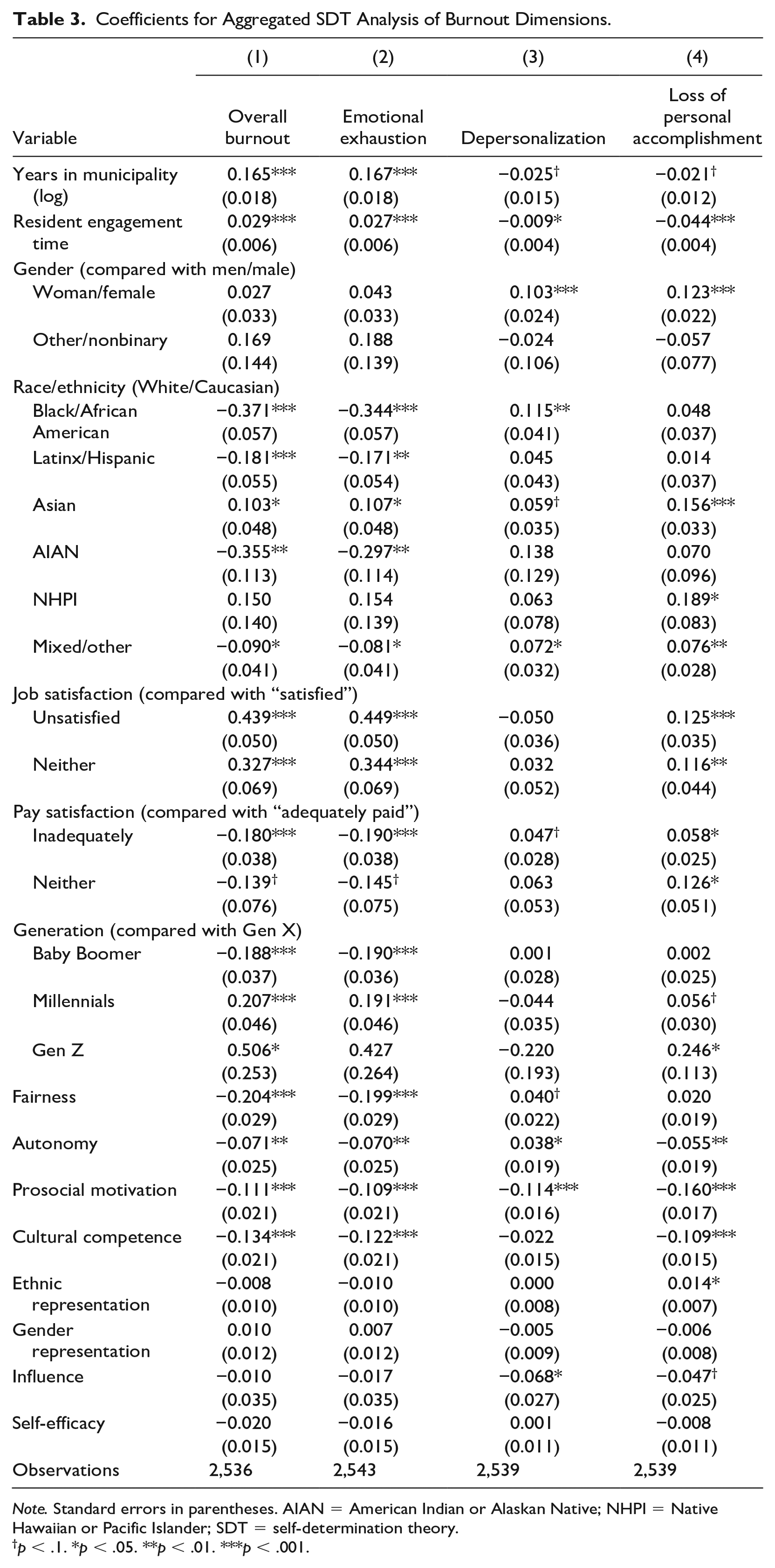
Note. Standard errors in parentheses. AIAN = American Indian or Alaskan Native; NHPI = Native Hawaiian or Pacific Islander; SDT = self-determination theory.
p < .1. *p < .05. **p < .01. ***p < .001.
In examining individual perceptions of organizational characteristics, the baseline model examines factor variables measuring employees’ perceived: (a) fairness, (b) job autonomy, (c) influence, (d) cultural competence, (e) own ethnic representation, and (f) own gender representation. Results show that perceived fairness is negatively associated with overall burnout and emotional exhaustion, whereas job autonomy is negatively associated with overall burnout, emotional exhaustion, and loss of personal accomplishment but positively associated with depersonalization. In contrast, perceived influence is negatively associated with depersonalization and has neither statistical relationship with emotional exhaustion nor loss of personal accomplishment. Perceived cultural competence shows to be negatively associated with overall burnout, emotional exhaustion, and loss of personal accomplishment. Curiously, results also indicate that one’s own ethnic representation is positively associated with loss of personal accomplishment. Findings show no relationship between one’s own gender representation and burnout.
This study also examines the relational demands of the job to determine whether jobs designed with more time spent directly engaging residents will have varying effects on the different dimensions of burnout. Results show that increased engagement time with residents is positively associated with overall burnout and emotional exhaustion, but negatively associated with depersonalization and loss of personal accomplishment.
SDT Analysis Deconstructed by Social Identity
The results of subsequent models, which interact the different sociodemographic variables with SDT measures, show how different social groups’ burnout experiences are impacted differently by organizational context and relational job design. The average marginal effects (AMEs), which is the average value of all participants’ marginal effects with their observed levels of covariates, of each SDT measure on the different dimensions of burnout are presented by gender, generation, and race/ethnicity. See Table 4 for a summary of the directionality of each relationship.
Summary of Average Marginal Effect of Predictors on Burnout Dimensions by Gender, Generation, and Race/Ethnicity.
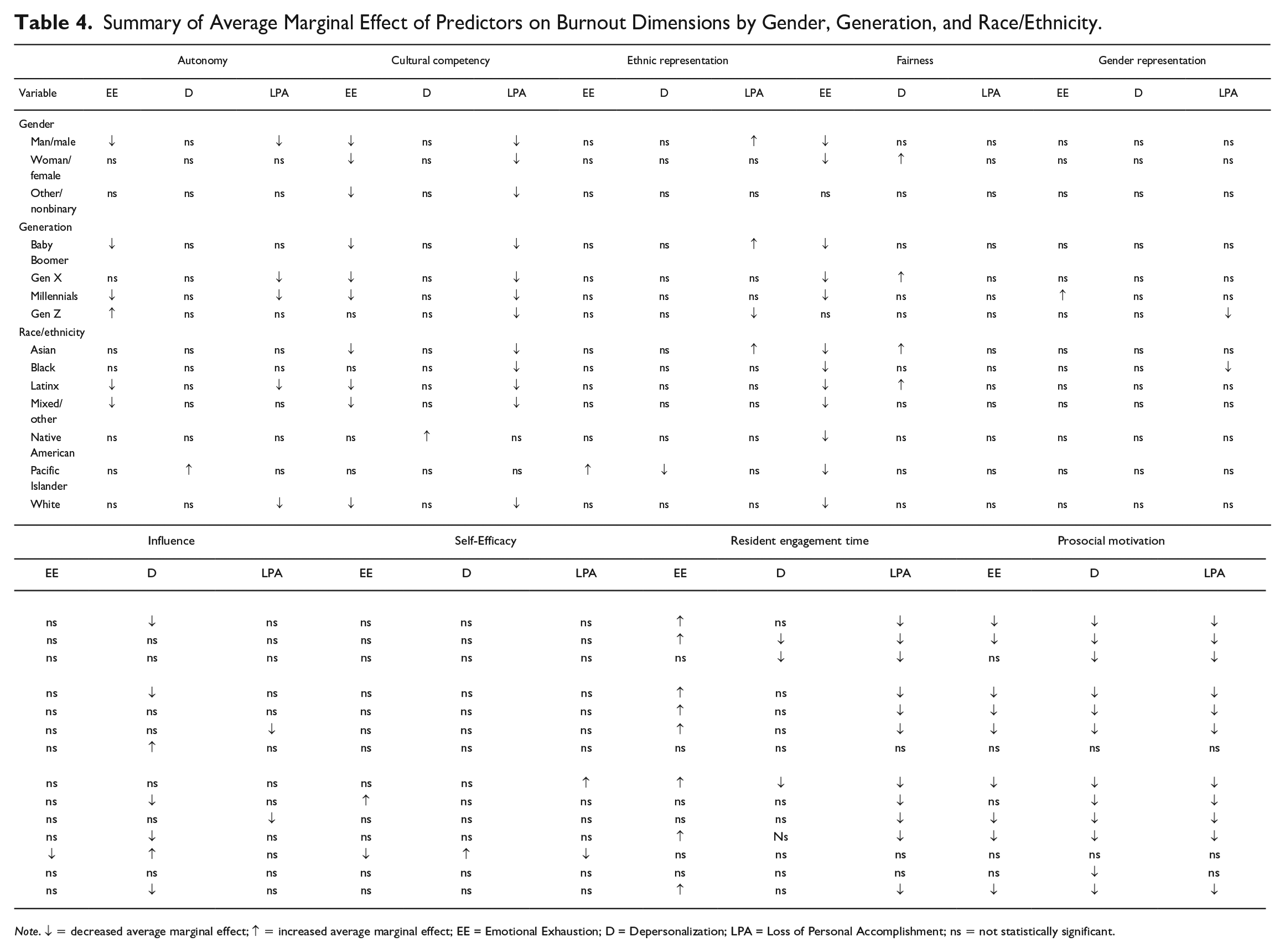
Note. ↓ = decreased average marginal effect; ↑ = increased average marginal effect; EE = Emotional Exhaustion; D = Depersonalization; LPA = Loss of Personal Accomplishment; ns = not statistically significant.
Prosocial Motivation
Aggregated, prosocial motivation is associated with reduced emotional exhaustion, depersonalization, and loss of personal accomplishment. Results show similar patterns when disaggregated by gender, generation, and race/ethnicity, with varying magnitudes (see Table A1 in the Supplemental Appendix). The AME of a one-unit increase in prosocial motivation is a 0.122 decrease for men and a 0.112 decrease for women but not statistically significant for other/nonbinary. Prosocial motivation reduces depersonalization and loss of personal accomplishment across genders. The largest AME of prosocial motivation on depersonalization is a 0.326 decrease for other/nonbinary groups, followed by a 0.111 decrease for men and a 0.107 decrease for women. Similarly, other/nonbinary participants see the largest AME of prosocial motivation on the loss of personal accomplishment with a 0.294 decrease, compared with a 0.175 decrease for men and a 0.149 decrease for women.
By generation, Millennials see the largest AME of prosocial motivation on emotional exhaustion, whereas Baby Boomers see the largest effect for depersonalization and Gen X participants see a higher AME for loss of personal accomplishment. The AME of a one-unit increase in prosocial motivation is a 0.214 decrease in emotional exhaustion for Millennials, compared with a 0.093 decrease for Baby Boomers and a 0.092 decrease for Gen X. For depersonalization, the AME of a one-unit increase in prosocial motivation is associated with a 0.132 decrease for Baby Boomers, followed by a 0.118 decrease for Millennials and a 0.110 decrease for Gen X. Greater prosocial motivation is associated with reduced loss of personal accomplishment, with results showing a decrease of 0.198 for Gen X, 0.149 for Millennials, and 0.144 for Baby Boomers. Findings show no statistically significant relationship between prosocial motivation and burnout for Gen Z.
For most racial/ethnic groups, prosocial motivation reduces burnout in some form. The AME of a one-unit increase in prosocial motivation is a 0.194 decrease in emotional exhaustion for Latinx, followed by a 0.148 decrease for Mixed/Other, 0.122 decrease for Asian, and a 0.091 decrease for White. Increased prosocial motivation is associated with decreased depersonalization, with results showing a decrease of 0.206 for NHPI, a 0.145 decrease for White, a 0.133 decrease for Latinx, a 0.128 decrease for Black, and a 0.112 decrease for Mixed/Other. The AME on the loss of personal accomplishment is largest for White participants with a decrease of 0.216, compared with a decrease of 0.193 for Latinx, a 0.189 decrease for Mixed/Other, a 0.140 decrease for Asian, and a 0.079 decrease for Black. Results show no statistically significant relationship between prosocial motivation and burnout for AIAN.
Self-Efficacy
In general, reported self-efficacy has no statistical relationship with any of the burnout dimensions. Similarly, as shown in Table A2 in the Supplemental Appendix, there is no statistically significant relationship when examining the AME by gender and generation. However, by race/ethnicity, results show contrasting effects. The AME of a one-unit increase in self-efficacy is associated with a 1.094 decrease for AIAN participants but a 0.484 increase in emotional exhaustion for Black participants. For loss of personal accomplishment, results show the AME of a one-unit increase in self-efficacy is a 0.601 decrease in loss of personal accomplishment for AIAN participants but a 0.496 increase for Asian participants. The only group whose experience of depersonalization is impacted by reported self-efficacy is AIAN, with a 0.497 increase.
Fairness
Aggregated, perceived fairness is negatively associated with emotional exhaustion and has no statistical relationship with depersonalization and loss of personal accomplishment. By gender, as shown in Table A3 in the Supplemental Appendix, perceived fairness has a larger marginal effect for women’s emotional exhaustion and depersonalization. The AME of a one-unit increase in perceived fairness is a 0.224 decrease in emotional exhaustion and a 0.057 increase in depersonalization. For men, greater perceived fairness is associated with a 0.186 decrease in their emotional exhaustion. Results show no statistical relationship for loss of personal accomplishment.
Perceived fairness has the largest marginal effect on emotional exhaustion for Millennials. The AME of a one-unit increase in perceived fairness is a 0.232 decrease in emotion burnout for Millennials, compared with 0.202 and 0.181 decreases for Gen X and Baby Boomers, respectively. For Gen X, a one-unit increase in perceived fairness is a 0.073 increase in depersonalization.
By race/ethnicity, perceived fairness has a statistically significant relationship on emotional exhaustion across all groups. The AME of a one-unit increase in perceived fairness is a 0.517 decrease in emotional exhaustion for NHPI participants—the largest effect across race/ethnicity, followed by AIAN (−0.284), Black (−0.269), Latinx (−0.237), Mixed/Other (−0.205), White (−0.168), and Asian (−0.127) participants. In contrast, there is a positive association between perceived fairness and depersonalization for Latinx (0.096) and Asian (0.076) participants, and no statistical relationship when examining loss of personal accomplishment by race/ethnicity.
Autonomy
Aggregated, findings show that perceived autonomy is negatively associated with emotional exhaustion and loss of personal accomplishment but positively associated with depersonalization. In other words, all else equal, participants who report higher autonomy report lower emotional exhaustion and loss of personal accomplishment but greater depersonalization. Across gender, as shown in Table A4 in the Supplemental Appendix, men’s burnout experiences are impacted most by perceived autonomy. For men, the AME of a one-unit increase in autonomy is a 0.109 decrease in emotional exhaustion and a 0.079 decrease in loss of personal accomplishment. Results show no statistical relationship between autonomy and burnout for women and those identifying as other/nonbinary.
Across generations, autonomy has varying effects. For Baby Boomers and Millennials, the AME of a one-unit increase in autonomy are 0.079 decrease and 0.108 decrease, respectively, in emotional exhaustion, whereas it is a 0.362 increase for Gen Z participants. There is no statistical relationship between autonomy and depersonalization across generations. The AME of a one-unit increase in autonomy are 0.084 decrease and 0.088 decrease in loss of personal accomplishment for Gen X and Millennials, respectively. Results show autonomy is associated with reduced emotional exhaustion for Baby Boomers and Millennials and increased emotional exhaustion for Gen Z. Autonomy is associated with lower loss of personal accomplishment for Gen Z and Millennials.
Perceived autonomy also has varying effects across race/ethnicity. For Latinx and Mixed/Other participants, the AMEs of a one-unit increase in autonomy are 0.150 decrease and 0.098 decrease in emotional exhaustion, respectively. When examining the impact of autonomy on depersonalization across race/ethnicity, results show a statistical relationship only for NHPI, with a 0.174 increase in depersonalization for a one-unit increase in autonomy. Results also show that the AMEs of a one-unit increase in autonomy are 0.062 decrease and 0.123 decrease in loss of personal accomplishment for White and Latinx participants, respectively. Results show that, on average, increased autonomy leads to lower emotional exhaustion for Latinx and Mixed/Other respondents and lower loss of personal accomplishment for Latinx and White respondents, but higher autonomy seems to also be associated with higher depersonalization for NHPI.
Influence
Aggregated, perceived influence is negatively associated with depersonalization but has no statistical relationship with emotional exhaustion and loss of personal accomplishment. By gender, as shown in Table A6 in the Supplemental Appendix, results show the only statistical relationship is for men, where a one-unit increase in influence is a 0.082 decrease in depersonalization.
In examining generational differences, influence has varying effects across groups. Though the AME of a one-unit increase in influence is a 0.082 decrease in depersonalization for Baby Boomers, it yields a 0.613 increase for Gen Z participants. For Millennials, the increase in influence is associated with a 0.111 decrease in loss of personal accomplishment. Results show no statistical relationship between influence and the burnout dimensions for Gen X participants.
Across race/ethnicity, influence has different impacts on each group. For AIAN participants, the AME of a one-unit increase in influence is a 0.251 decrease in emotional exhaustion and a 0.334 increase in depersonalization. In contrast, some groups see a decrease in depersonalization associated with an increase in influence, specifically Black (0.123), Mixed/Other (0.085), and White (0.084). For Latinx participants, the AME of a one-unit increase in influence is a 0.151 decrease in loss of personal accomplishment. Results show no statistical relationship between influence and any burnout dimension for Asian and NHPI participants.
Cultural Competence
Aggregated, perceived cultural competence is negatively associated with emotional exhaustion and loss of personal accomplishment but has no statistical relationship with depersonalization. This same pattern emerges by gender, as shown in Table A7 in the Supplemental Appendix. Cultural competence has a larger effect for other/nonbinary participants, with a one-unit increase in cultural competence associated with 0.447 decrease and 0.236 decrease in emotional exhaustion and loss of personal accomplishment, respectively. In comparison, the AMEs of a one-unit increase in cultural competence are 0.126 decrease and 0.101 decrease in emotional exhaustion for men and women, respectively, and 0.124 decrease and 0.091 decrease in loss of personal accomplishment.
Across generations, cultural competence generally reduces emotional exhaustion and loss of personal accomplishment. Baby Boomers experience larger decreases in emotional exhaustion and loss of personal accomplishment with higher reported cultural competence. For Baby Boomers, the AMEs of a one-unit increase in cultural competence are 0.157 decrease and 0.128 decrease in emotional exhaustion and loss of personal accomplishment, respectively; Gen X and Millennials see 0.118 decrease and 0.084 decrease in emotional exhaustion and 0.111 decrease and 0.081 decrease in loss of personal accomplishment, respectively. Though a one-unit increase in cultural competence is a 0.330 decrease in loss of personal accomplishment for Gen Z, it is a 0.591 increase in emotional exhaustion.
By race/ethnicity, respondents’ cultural competency is negatively associated with emotional exhaustion and loss of personal accomplishment. Asian and White participants see the largest effect of cultural competency on emotional exhaustion, whereas Black and Latinx participants experience the largest effect of cultural competency on loss of personal accomplishment. The AMEs of a one-unit increase in cultural competence are 0.179, 0.129, 0.108, and 0.087 decreases in emotional exhaustion for White, Asian, Latinx, and Mixed/Other participants, respectively. For loss of personal accomplishment, the AMEs of a one-unit increase in cultural competency are 0.138, 0.130, 0.116, 0.115, and 0.081 decreases for Black, Latinx, White, Mixed/Other, and Asian participants, respectively. Curiously, the AME of cultural competency on loss of personal accomplishment for AIAN participants is a 0.318 increase.
Ethnic Representation
Aggregated, one’s own ethnic representation is positively associated with loss of personal accomplishment but has no statistical relationship with emotional exhaustion and depersonalization. Across genders and burnout dimension, as shown in Table A8 in the Supplemental Appendix, the only statistical relationship we find is for men: the AME of a one-unit increase in ethnic representation is a 0.023 increase in loss of personal accomplishment. Similarly, across generations, the only statistically significant relationship is for loss of personal accomplishment. The results show that the AME of a one-unit increase in perceived ethnic representation is a 0.030 increase in loss of personal accomplishment for Baby Boomers and a 0.110 decrease for Gen Z.
When extrapolated by race/ethnicity, the only statistical impacts of ethnic representation on emotional exhaustion and depersonalization are for NHPI participants, where the AME of a one-unit increase in perceived ethnic representation is associated with a 0.188 increase in emotional exhaustion and a 0.119 decrease in depersonalization. For loss of personal accomplishment, results show a statistical relationship for only Asian participants with a 0.038 increase for each one-unit increase in ethnic representation.
Gender Representation
Aggregated, perceived gender representation has no statistical relationship with burnout. Curiously, as shown in Table A9 in the Supplemental Appendix, there are also no statistical relationships when disaggregated by gender. By generation, the AME of a one-unit increase in perceived gender representation is a 0.043 increase in emotional exhaustion for Millennials and a 0.167 decrease in loss of personal accomplishment for Gen Z. By race/ethnicity, a one-unit increase in perceived gender representation is a 0.041 increase in loss of personal accomplishment for Black participants, with no statistical finding for other racial/ethnic groups.
Resident Engagement Time
Aggregated, the percent of a participant’s work week engaging directly with residents is positively associated with emotional exhaustion but is negatively associated with depersonalization and loss of personal accomplishment. Results, as shown in Table A10 in the Supplemental Appendix, indicate similar patterns when disaggregating by gender, generation, and race/ethnicity, with varying magnitudes of effect. The AMEs of a one-unit increase (e.g., 0%–9% to 10%–19%) in resident engagement time are 0.029 increase and 0.024 increase in emotional exhaustion for women and men, respectively. In contrast, resident engagement time is associated with 0.014 decrease and 0.070 decrease in depersonalization for women and other/nonbinary, respectively. Residential engagement reduces loss of personal accomplishment across genders, with other/nonbinary seeing the largest AME at 0.096, followed by decrease of 0.050 for women and a decrease for men.
By generation, resident engagement time is associated with a 0.042 increase in emotional exhaustion for Millennials, a 0.025 increase for Baby Boomers, and a 0.020 increase for Gen X participants. However, resident engagement time is also negatively associated with loss of personal accomplishment. Results show that the AME of a one-unit increase in resident engagement time in a work week is associated with 0.046, 0.045, and 0.043 decreases in loss of personal accomplishment for Millennials, Baby Boomers, and Gen X participants, respectively. Results show no statistical relationship between resident engagement time and burnout for Gen Z.
Asian participants see the greatest AME of resident engagement time on all three burnout dimensions. The AME of a one-unit increase in resident engagement time is a 0.041 increase in emotional exhaustion, compared with a 0.033 increase for Mixed/Other, 0.029 increase for White, and no statistical findings for Black, Latinx, AIAN, and NHPI. For depersonalization, there are statistically significant results only for Asians, where an increase in resident engagement time is a 0.020 decrease in depersonalization. Residential engagement time is broadly associated with decreased loss of personal accomplishment across race/ethnicity. The largest AME impact of resident engagement time on the loss of personal accomplishment is a 0.053 decrease for Asians, followed by decreases for White (0.051), Latinx (0.048), Black (0.043), and Mixed/Other (0.034). There is no statistical relationship between resident engagement time and burnout for AIAN and NHPI.
Discussion
Gender Differences
In a workforce population that is 70% men, it was surprising to find no relationship between perceived gender representation with burnout across genders. This could be a function of differing perceptions of representation being misaligned with actual representation, and it may also point to the need to understand mechanisms within and characteristics of organizations beyond the proportions of genders in the workforce to explain burnout differences. Findings show workplace context and individual differences impact burnout experiences differently across genders. Results provide insights for management and organizations as they develop strategies that consider gender differences related to psychological needs impacting motivation, growth, and development. This study finds greater prosocial motivation is associated with lower emotional exhaustion for men and women, with comparable marginal effects. Notably, those more prosocially motivated tend to show less depersonalization and loss of personal accomplishment across all genders with marginal effects for other/nonbinary participants approximately three times and two times, respectively, that of men and women. These results confirm the importance of prosocial motivation in moderating burnout, though other/nonbinary participants seem to be particularly impacted.
In promoting motivation in the workforce, SDT shows that organizations need to ensure employees’ needs for autonomy, competence, and relatedness are met (Deci & Ryan, 2008). Perceived fairness in management and internal processes for promotion and compensation shape motivation (Olafsen et al., 2015) and impact genders differently (Ng & Sears, 2010). Though fairness is associated with lower emotional exhaustion for men and women, it has a positive impact on women’s experience with depersonalization. This positive association is puzzling as previous work argues that greater fairness would increase prosocial motivation and organizational citizenship behaviors and, thus, reduced depersonalization (Kaplan et al., 2009). One possible explanation is that women have learned to use interpersonal distancing as a mechanism for dealing with gendered mistreatment from residents. Research has shown that women are more likely than men to receive harsh treatment, sexist comments, and a general lack of respect in their interactions with the public; and depersonalizing those interactions through emotional labor may be an adaptive coping mechanism (Guy et al., 2008; Healy et al., 2011; Le & Barboza-Wilkes, 2022; Meier et al., 2006).
Generally, women have been found to have lower autonomy in the workplace than their male counterparts (Petrie & Roman, 2004), but this study finds men may be more sensitive to perceived autonomy. Findings show men who experience more autonomy (i.e., the feeling of having a choice and being in control of one’s behaviors and goals) report less emotional exhaustion and greater personal accomplishment, whereas there is no statistical relationship for women and nonbinary respondents. Research by Leavitt, Zhu, (Lei) Klotz, and Kouchaki (2022) provides evidence that men demonstrate greater workplace deviance and reduced organizational citizenship behavior when they experience less autonomy, suggesting gendered differences in how autonomy shapes workplace behaviors. Findings similarly signal that perceived autonomy is more consequential for men compared with other genders, and its absence suggests an increase in burnout.
Like autonomy, perceived influence has a relationship with burnout only for men. This study finds men feel greater connections with residents and their problems as they have more influence and buy-in on decisions impacting their departments. Greater influence seems to be associated with common characteristics of the servant leader “who does not use [their] power to get things done but who tries to persuade and convince staff” and is “motivated by something more important than the need for power, namely the need to serve” (van Dierendonck, 2011, p. 1231). Cai, Wang, Yao, Li, and Men (2022) find servant leadership also facilitates extra-role customer service, contributing to reduced depersonalization. This connection between influence and the need to serve moderates experiences with depersonalization, particularly for men, likely because leadership characteristics are mostly associated with male socialization and masculinity, while femininity is often associated with service (Eicher-Catt, 2005; Reynolds, 2016). Gender connotations and stereotypes of what leadership and service paradoxically entail, thus, help to explain why men’s experiences with depersonalization may be shaped by their perceived influence, whereas women are on average not impacted even with greater influence.
Greater cultural competency has been linked to reduced burnout as it helps to facilitate difficult interpersonal relationships that often require emotional labor (Imose & Finkelstein, 2018). Across all genders, cultural competency seems to have positive outcomes in the form of less emotional exhaustion and increased feelings of accomplishment, though the impact shows to be greater for other/nonbinary participants. Lower cultural competency makes it more challenging to engage with residents from different backgrounds, thus leading to greater emotional exhaustion and subsequently depersonalization and loss of personal accomplishment. For women and other/nonbinary participants, they may face internal and external marginalization in the forms of sexism and discrimination, contributing to their unseen emotional labor and experiences with burnout (Barboza-Wilkes, 2022). For other/nonbinary, working in organizations that still operate within the gender binary can create heightened feelings of exclusion, making their sensitivity to cultural competency more acute. It is likely that feeling a sense of efficacy navigating interpersonal differences, especially gender differences, will be most impactful among employees who frequently navigate institutions where their gender identity is underrepresented.
The paradox of residential engagement is that though it facilitates greater connections with residents and a sense of prosocial accomplishment, it comes at the cost of more emotionally taxing interpersonal interactions with residents. However, the costs and benefits of residential engagement time are slightly gendered and likely associated with socially gendered skills (e.g., emotional intelligence) when engaging with the public, especially in challenging encounters (Eshuis et al., 2022). Time engaging with residents leads to greater emotional exhaustion for men and women, whereas it reduces depersonalization for women and other/nonbinary participants and increases a sense of personal accomplishment for all genders. These findings suggest public service work, while emotionally taxing given the stakes in people’s lives, is still rewarding as employees form connections with the community in alignment with their prosocial values.
Generational Differences
Workplace context and individual differences impact burnout outcomes differently across generations, with younger participants typically benefiting more from having their psychological needs for autonomy, competence, and relatedness met. However, interesting divergent effects show how age plays an important moderating role in determining how burnout may need to be addressed differently across generations. Prosocial motivation is associated with lower burnout for Baby Boomers, Gen X, and Millennials but not for Gen Z participants. When disaggregated by generation, the relationship between increased prosocial motivation and less depersonalization is strongest among Baby Boomers. By contrast, Gen X experience the strongest sense of personal accomplishment and Millennials report the least emotional exhaustion when prosocial motivation is high. This aligns with research on public service motivation that finds younger workers have “distinct behaviors, values, and attitudes as compared to previous generations” (Ertas, 2016, p. 518). Baby Boomers and Gen X are more motivated by intrinsic values than younger cohorts (Twenge et al., 2010), whereas Millennials seek “extrinsic rewards (e.g., pay and job security) and lifestyle (e.g., work-life balance) preferences” (Ng et al., 2016, p. 420).
Generally, perceived fairness contributes to increased prosocial motivation and helps to moderate burnout. Findings show this impact to be true primarily for emotional exhaustion when examining marginal effects by generation. With greater fairness, emotional exhaustion decreases for all generations but Gen Z, with the strongest relationship for Millennials. Curiously, for Gen X, fairness is associated with greater depersonalization. This may be related to Gen X participants being more likely to be in managerial positions where their work is less public-facing and, thus, are more likely to report higher fairness in internal processes but still feel disconnected from the public compared with street-level bureaucrats. The inability to control for positional hierarchy across departments is a limitation that will need to be further studied in future research.
Workplace autonomy has important generational differences on burnout, namely the conflicting effect it has on emotional exhaustion. Perceived autonomy is associated with reduced emotional exhaustion for Baby Boomers and Millennials, but it is associated with increased emotional exhaustion for Gen Z participants. Additional responsibilities that come with greater autonomy likely yield more emotional burdens for younger participants who may fear making the wrong decisions and lack the experience and tools to cope with stress, leading to greater anxiety, depression, and frustration (Schroth, 2019). Similarly, more work experience and age may also moderate how autonomy leads to increased feelings of personal accomplishment, as this study finds for Gen X and Millennials. Autonomy is an important tool to engage employees and to reduce burnout; however, organizations should ensure the resources to foster healthy expectations of autonomy among younger employees if they hope to prevent emotional exhaustion.
Like autonomy, perceived influence exacerbates burnout for Gen Z, while it is associated with lower burnout for Baby Boomers and Millennials. As Gen Z participants experience greater influence, they experience greater depersonalization. This pattern is likely related to the small Gen Z sample in the data who also may be in decision-making roles not engaged directly with residents compared with street-level bureaucrats. By contrast, Baby Boomers with more influence in departmental decisions experience lower depersonalization, perhaps due to higher levels of intrinsic motivation among this group (Twenge et al., 2010). Results show Millennials with greater influence report greater feelings of personal accomplishment, likely linked to the higher value they place on having strategic influence that is often challenged by bureaucratic red tape (AbouAssi et al., 2021; Hansen, 2014). As AbouAssi et al. (2021) argue, millennials discouraged by their environment are less likely to feel able to affect their organizations’ environment due to the nature of the public sector. They simply leave the sector altogether to ensure that their dissatisfaction is substantially and immediately addressed, coupled with their belief in their ability to make a difference, engage in public service, and achieve their goals. (p. 238)
Findings on cultural competence present interesting generational differences, where greater perceived cultural competence is associated with lower burnout for Baby Boomers, Gen X, and Millennials but greater burnout for Gen Z participants. The positive relationship between cultural competence and burnout for Gen Z participants is primarily driven by emotional exhaustion. On average, Gen Z participants are simultaneously experiencing greater sense of personal accomplishment with more cultural competence. In comparison, other generations show decreased emotional exhaustion and greater feelings of personal accomplishment, with Baby Boomers having the largest marginal effects. These conflicting results may be related to different standards of cultural competence and emotional maturity (Magano et al., 2020). Gen Z may also be engaging in more stress-inducing strategies to overcome cultural differences with residents and to overcompensate for their lack of experience, which may result in emotional exhaustion consequential of emotion regulation strategies like surface acting (Rafiq et al., 2020). Surface acting is linked to emotional exhaustion (e.g., Bono & Vey, 2005; Grandey, 2003), and future research should examine how the impact and frequency of surface acting may vary by generation.
Engaging residents is generally associated with greater burnout across generations but Gen Z, which shows no statistical relationship. This relationship, however, is primarily driven by greater emotional exhaustion as these participants simultaneously report a greater sense of personal accomplishment. Like the findings by gender, these results suggest organizations that deal with residents, clients, and customers must have the resources to mitigate emotional exhaustion and allow workers to recover emotionally. These resources could look different for each generation depending on their priorities, values, and behaviors; thus, organizations must be proactive in understanding their employees’ needs.
Racial/Ethnic Differences
Surprisingly, there is statistical evidence of a relationship between whether participants felt their race/ethnicity was well-represented in their department and burnout only for Asian and NHPI participants. More specifically, findings show that greater racial/ethnic representation is associated with greater loss of personal accomplishment for Asians and greater emotional exhaustion but lower depersonalization for NHPI. Again, this points to the need to better understand how organizational characteristics impact different groups of employees.
Findings show workplace context and individual differences impact racial/ethnic groups differently, with some showing greater reductions in burnout when their psychological needs of autonomy, competence, and relatedness are met. Prosocial motivation is associated with reduced burnout across all three dimensions for White, Latinx, Asian, and Mixed/Other participants. However, with greater prosocial motivation, Black participants only show a reduction in depersonalization and increased personal accomplishment, and NHPI participants only show a reduction in depersonalization. There is no statistical relationship between prosocial motivation and burnout for AIAN participants. Results show how the moderating effects of prosocial motivation on burnout are racialized and likely associated with experiences specific to racial/ethnic groups, such as the unseen emotional labor Black employees have to endure due to anti-Black discrimination (Barboza-Wilkes, 2022; Grandey et al., 2019). Future research should explore why certain racial/ethnic groups do not experience reduced emotional exhaustion with greater motivation, as earlier studies have found (e.g., Halbesleben & Bowler, 2007). If certain groups continue to disproportionately experience the consequences of emotional labor despite organizational efforts to improve prosocial motivation, public agencies will find it more challenging to retain minoritized groups and to achieve representative bureaucracy.
Though, in aggregate, there is no statistical relationship between self-efficacy and burnout, results show racial/ethnic differences when disaggregated. Namely, findings show that increased self-efficacy for Black participants is linked to greater emotional exhaustion, whereas self-efficacy is associated with greater losses of personal accomplishment for Asian participants. For AIAN, self-efficacy is related to reduced emotional exhaustion and loss of personal accomplishment but greater depersonalization. These racialized differences may be a result of several factors not accounted for in the empirical models, including unseen emotional labor that is undertaken by Black managers (Barboza-Wilkes, 2022; Grandey et al., 2019) and cynicism and reduced feelings of personal accomplishment experienced by Asian public sector workers facing racist stereotypes and treatment as perpetually foreign and model minorities (Le & Barboza-Wilkes, 2022). These differences across racial/ethnic groups further substantiate the importance of disaggregating burnout experiences and how it is shaped differently by workplace context for different groups.
Across all racial/ethnic groups, perceived fairness is associated with reduced emotional exhaustion with the strongest impact experienced by NHPI participants. Curiously, fairness is also linked with greater depersonalization for Latinx and Asian participants. There may be group-specific experiences and exogenous events that exacerbate feelings of dissimilarity with residents, including discrimination, stereotypes, and collective trauma disproportionately impacting Latinx and Asian communities (e.g., anti-immigrant violence and anti-Asian hate; Chavez-Dueñas et al., 2019; Cheng, 2020; Le & Barboza-Wilkes, 2022). These factors may influence how some groups are treated by residents and how they see residents. Importantly, experiences with discrimination and traumatic events may vary across localities with varied racialized histories (e.g., local policies, demographics) and should be further studied to extrapolate more nuanced and relevant place-based trends. What is also possible and not controlled for in the empirical models is the impact of ambition on representative bureaucracy. Carroll (2017) finds in their research on school principals that ambitious Latinx bureaucrats with greater influence and autonomy in their organizations are less engaged with outcomes for the population they serve (i.e., students), likely because of “the pressure to appear unbiased and politically appealing . . . for administrators seeking promotion” (p. 224). The research finds this effect only for Latinx participants and argues it may be because they “spend less time engaged with the community in exchange for behaviors that will gain them promotion” (Carroll, 2017, p. 224). These findings suggest navigating organizational practices and perception of workplace context is racialized and shaped by one’s positionality within the organization and within society, consequently leading to depersonalization and passive representation without active representation.
With greater perceived autonomy, White and Latinx participants experience greater senses of personal accomplishment and Latinx and Mixed/Other participants report lower emotional exhaustion. Perceived influence is associated with lower depersonalization for Black, Mixed/Other, and White participants, lower emotional exhaustion for AIAN participants, and a greater sense of personal accomplishment for Latinx participants. Results show how, for some groups, autonomy and influence can have complimentary benefits in reducing different dimensions of burnout. Interestingly, autonomy is associated with greater depersonalization for NHPI and influence is positively associated with depersonalization for AIAN. Again, the empirical models did not control for participant positions in the organization’s hierarchy, which would have helped extrapolate whether those in more influential positions are by design disengaged with residents. However, it is also possible that because NHPI and AIAN are underrepresented among residents that are served, these groups feel systematically dissimilar to the residents and their problems, particularly when they have greater autonomy in their positions.
Cultural competency is associated with reduced emotional exhaustion for White, Latinx, Asian, and Mixed/Other participants, whereas it is linked to a sense of personal accomplishment for White, Black, Latinx, Asian, and Mixed/Other participants. Curiously, increased cultural competence is associated with greater depersonalization for AIAN participants. As mentioned previously, this increase in depersonalization may be a result of how AIAN and problems specific to AIAN communities are underrepresented among residents engaging with bureaucrats. Even with the competence to deal effectively with other racial/ethnic communities, AIAN participants may still experience some degree of depersonalization.
Though cultural competency generally leads to lower burnout, there are still emotional costs when engaging directly with residents. Results show that greater engagement time with residents is associated with greater emotional exhaustion for White, Asian, and Mixed/Other participants but is also linked to a greater sense of personal accomplishment for White, Black, Latinx, Asian, and Mixed/Other participants. More residential engagement time is associated with reduced depersonalization only for Asians. Organizations should be intentional in providing culturally inclusive resources to help employees mitigate the emotional exhaustion that comes from interactions with residents. This will help ensure employees continue to feel they can deal with residents’ problems effectively and positively influence other people’s lives through their work.
Limitations
Due to data limitations, this study is unable to control for job and task differences, including position within the organization’s job hierarchy and career trajectory. These additional differences in relational job design and ambition would help to capture variations in job experiences, resources, and demands that moderate burnout. In addition, this study is unable to account and control for external differences that could potentially influence burnout experiences within the organization, such as experiences with discrimination and collective trauma outside of work exacerbated by the COVID-19 pandemic (e.g., anti-Asian violence; Le & Barboza-Wilkes, 2022). This limitation is less of a concern, however, as this study is able to capture group-specific forms of discrimination and trauma by controlling for social identities (e.g., race/ethnicity). Despite these limitations, this analysis begins to fill the gap in the extant literature on how characteristics related to SDT (e.g., autonomy, competence, and relatedness) have differing effects on emotional exhaustion, depersonalization, and loss of personal accomplishment across social identities.
Conclusion
This study reinforces the need to look at self-determination and the different ways in which individual- and organization-level factors may shape emotional exhaustion, depersonalization, and loss of personal accomplishment differently across social groups. For practitioners, as public organizations become more diverse, there is increasing urgency to deconstruct and address the existing racial, gender, and generational disparities in public employee well-being that are influenced by differences in power associated with organizational and individual characteristics. Public organizations can strategize and tailor solutions to improve the well-being of diverse employees by identifying the specific mechanisms that impact the varied manifestations of burnout across groups. Maslach et al. (2008) argue burnout interventions must be oriented to go beyond simply reducing the harms of burnout to fostering the conditions for engagement and empowerment. How to meet employees’ psychological needs for self-determination may vary across organizations and social groups (e.g., increasing autonomy may be beneficial for some groups while harmful to others who do not have the necessary support). Taking these findings as universal across all members of different gender, generational, and racial/ethnic groups should be taken with caution as there are bound to be localized differences and heterogeneity within groups. In general, organizations can improve employee well-being by meeting employees’ psychological needs as it relates to designing jobs that maximize autonomy within limits, refining processes to prioritize the inclusion of diverse perspectives, and fostering a climate of respect and appreciation of differences that together contribute to a sense of competence and connection for individual contributors. As discussed, however, employees in different organizations may have different needs for self-determination based on their social identities and positionality. This study highlights that differences across groups are likely, but more specific recommendations for interventions should be made based on contextual nuances. To begin, perspectives and employees representative of the organization’s diverse experiences are needed in assessing current workplace conditions to formulate and implement appropriate strategies to improve well-being, as different needs for autonomy, competence, and relatedness will likely vary in different regional and organizational contexts. As the Office of the Surgeon General (2022) so aptly stated in its Framework for Workplace Mental Health & Well-Being report, “the most important asset in any organization is its people. By choosing to center their voices, we can ensure that everyone has a platform to thrive” (p. 31).
With respect to theory, this research furthers the literature on diversity management by assessing the racialized, gendered, and generational effects of organizational climate and context on local government employees’ burnout experiences, contributing to strategies and approaches that promote representative bureaucracy by sustaining a diverse workforce. Future work exploring the relationship between SDT and burnout should take a more intersectional approach to examine more nuanced effects of organizational characteristics on burnout. The scope of this study lays the foundation for more nuanced analyses that extrapolate how intersectional identities are differently affected by workplace context, including how employees of multiple marginalized identities (e.g., young women of color) may face multiplicative barriers in fulfilling their psychological needs for autonomy, competence, and belonging in the organization, thus leading to disproportionate vulnerabilities to burnout and turnover. An intersectional analysis of burnout and how it is shaped by organizational characteristics will advance diversity management and offer further insight on strategies to improve equity, employee well-being, and representative bureaucracy within local government.
Supplemental Material
sj-docx-1-ppm-10.1177_00910260231191274 – Supplemental material for How Self-Determination Moderates Burnout in Public Organizations Across Gender, Race, and Generation
Supplemental material, sj-docx-1-ppm-10.1177_00910260231191274 for How Self-Determination Moderates Burnout in Public Organizations Across Gender, Race, and Generation by Thai V. Le and Cynthia Barboza-Wilkes in Public Personnel Management
Footnotes
Declaration of Conflicting Interests
The author(s) declared no potential conflicts of interest with respect to the research, authorship, and/or publication of this article.
Funding
The author(s) received no financial support for the research, authorship, and/or publication of this article.

Supplemental Material
Supplemental material for this article is available online.
Author Biographies
References
Supplementary Material
Please find the following supplemental material available below.
For Open Access articles published under a Creative Commons License, all supplemental material carries the same license as the article it is associated with.
For non-Open Access articles published, all supplemental material carries a non-exclusive license, and permission requests for re-use of supplemental material or any part of supplemental material shall be sent directly to the copyright owner as specified in the copyright notice associated with the article.
