




Abstract
This article explores employee engagement by linking stress, motivation, and employee engagement theory and testing this across 30 countries and eight public sector occupations. First, it is argued that work stress will be negatively related to engagement. Self-determination theory is then used as a basis for exploring the positive link between basic needs satisfaction (BNS) and engagement. It argued that BNS will moderate the relationship between stress and engagement due to the impact that BNS has on coping strategies. These claims are tested using the 2015 wave of the European Working Conditions Survey. Results show stress and engagement are negatively related, whereas BNS and engagement are positively related. Moderation analyses revealed that the detrimental relationship between stress and engagement is lessened for individuals who have strong interpersonal relations at work. This suggests that social relationships play an important role in managing stressful work environments.
Keywords
Introduction
The desire to foster employee engagement (herein, “engagement”) is a core interest of public administrations around the world, because of its connection to performance outcomes (Hameduddin & Fernandez, 2019; Lavigna, 2015; Organisation for Economic Co-operation and Development (OECD, 2016). Engagement refers to the all-encompassing feeling of being involved in one’s work (Kahn, 1990) and has been the focus of scholarly literature for over three decades. More recently, Vigoda-Gadot et al. (2012) have argued that engagement studies within the public sector may offer an opportunity to bridge the protracted divide between the rational and affective public servant as engagement takes into consideration both performance-oriented outcomes and a sense of meaning and dedication. However, very little public administration literature has focused on this area of study, despite the interest of practitioners (Hameduddin & Fernandez, 2019). Even rarer are studies that examine this from a cross-national and cross-occupational perspective. This opens the opportunity for public management literature to expand as a discipline, incorporate new concepts into its repertoire, forge new links between existing theoretical understandings, and test these links using a large sample of public servants.
A variety of antecedents have been linked to engagement. These include job characteristics such as skill variety, task identity, and task significance, as well as feedback, supervisor support, rewards, and organizational justice (Saks, 2006, 2019). However, what is less understood is the relationship between negative antecedents on engagement (e.g., stress), as these tend to be associated with burnout research. However, burnout and engagement are only moderately correlated (Schaufeli et al., 2008; Taris et al., 2017), which means that likely also have different relationships to antecedent variables.
As a result of recent fiscal crises, and a rapid state of change in reform initiatives around the work (Kettl, 2005), public organizations find themselves in a constant state of change related to budgetary pressures, personnel reductions, and work intensification, which has led to increased employee stress (Hammerschmid et al., 2016; Kinman & Jones, 2005; Noblet & Rodwell, 2009). This leaves one to question the extent to which stress is associated with lower engagement, and more importantly, what can organizations do to mitigate this. One approach is to examine different job characteristics.
According to the Job Demands Resources Model (JDR), job characteristics that lead to high levels of engagement are enhanced by job resources and deflated by job demands. Therefore, a stressful work environment can be considered a specific type of work demand that places a burden on employees (Van den Broeck et al., 2008). However, according to JDR, job resources can have the opposite effect. Within the context of this research, self-determination theory’s concept of basic needs satisfaction (BNS) introduced as a bundle of job resources that may enhance engagement. According to JDR theory, the actual satisfaction of basic needs can be considered job resources (Bakker & Demerouti, 2007), which leads to higher job engagement because resources activate and energize motivational processes, which are the sources of engagement (Bakker & Demerouti, 2007; Loughlin & Murray, 2013). By using BNS theory, the underlying psychological mechanisms that link to engagement are examined, which can be used to develop targeted intervention strategies (Meyer & Gagné, 2008, p. 61).
The theory of BNS is an important concept to introduce to the engagement literature because it is universal, has been tested using a variety of different methods, and can be applied in a variety of different environmental settings. It is also parsimonious in its psychological link to autonomous, or engaged, behavior (Meyer & Gagné, 2008). This is relevant for the development of the JDR theory because it offers a means of grouping job resources under the umbrella of the three basic needs outlined by self-determination theory and introduces more parsimony into the theory. Overall, it is argued that although stress may hinder the engagement processes, and BNS enhances it, BNS can act as a buffer for the effects of stress. This responds to calls for the introduction of motivation theory into the theory of engagement (Meyer & Gagné, 2008), and the need to study the relationships that a variety of engagement antecedents have with one another (Bakker & Demerouti, 2017).
This article, therefore, contributes to the literature in four ways. First, it contributes to the theoretical development of engagement by integrating the tenants of motivation theory into understanding engagement, which offers a universal and tangible means in which to improve employee outcomes. Second, it tests these claims from a cross-national perspective, providing much needed cross-country analysis of work-related issues. Third, by using a variety of different organizational and contextual factors, this research addresses calls to better integrate levels of analysis in public administration (Roberts, 2020). Finally, by examining stress and organizational support mechanisms, this research responds to the literature that has called on further examination of how institutional and contextual factors are related to engagement (Truss et al., 2013).
From a practitioner perspective, this research sheds light on questions related to the likelihood of employees disengaging from their work under stressful work conditions. If this is the case, the intervention strategies to reduce a loss of engagement would be more cost-effective than the costs of providing care for employees with burnout (i.e., absenteeism, lower productivity). It is also practically significant as supporting workplace needs may improve the experience of public servants by mitigating how they handle stress and developing targeted interventions that support competence, autonomy, and relatedness, with the purpose of enhancing engagement. These insights may also be useful for the design of administrative reforms related to increasing engagement, such as those in the United States, Canada, and New Zealand (see Hameduddin & Fernandez, 2019, for a discussion on this).
This article begins by examining the concept of engagement, stress, and BNS. A series of hypotheses are then presented. The hypotheses are tested using a series of multilevel regression models (MLM) with a data set representing 30 different countries and eight different occupations. Following this, the results are presented and discussed.
Theoretical Background
Engagement
Schaufeli et al. (2002) define work engagement as “. . . a positive, fulfilling, work-related state of mind that is characterized by vigor, dedication, and absorption” (p. 74). Vigor refers to high energy levels and resilience while working, and dedication refers to having strong feelings of involvement, pride, and a sense of challenge. Absorption is the sense of “time flying” due to full concentration in one’s work (pp. 74–75).
The JDR is the most commonly used theoretical framework in engagement studies (Crawford et al., 2010). According to JDR theory, all job characteristics can be classified as demands that deplete energy, or resources that support energy (Bakker & Demerouti, 2007). Job demands take away energy from employees, and when perceived as a hindrance, they lower engagement by thwarting growth and goal attainment (Van den Broeck et al., 2010). By contrast, job resources provide support and energy for employees to encourage the persistence necessary to become engaged (Demerouti et al., 2001). The extensive research that uses the JDR model of work engagement has shown that job resources are associated with high levels of engagement (Biggs et al., 2014; Hakanen et al., 2006; Hu et al., 2011). By contrast, job demands are associated with lower levels of engagement (Crawford et al., 2010; Hakanen et al., 2006; Taipale et al., 2011).
Stress
Many different definitions and research approaches have been used to examine the concept of stress. One approach examines stress as an external pressure placed upon a person, whereas other approaches examine stress as understood as a physiological response (Bradley & Sutherland, 1995). This article examines stress in its cumulative form by focusing on stress as an external pressure. It is therefore defined as the aversive or negative feelings that employees have toward their work as a result of job strain (Hart & Cooper, 2001; Jex et al., 1992). Cumulative stress comes from the continued accumulation of stressful situations and the residual effects that stem from the work environment (Shupe & McGrath, 2012). Although the presence of small amounts of temporary stress in may not necessarily lead to negative outcomes (N. Podsakoff et al., 2007), cumulative work stress can lead to negative outcomes, which can be directly linked to public sector performance, and other “maladaptive” outcomes such as absenteeism (Bradley & Sutherland, 1995). Scholars have shown that public sector organizations perceive higher stress compared with their private sector counterparts (Hamann & Foster, 2014). Political and administrative changes associated with new public management such as performance-based reforms, cutbacks, red tape, work intensification due to budgetary constraints, and tighter deadlines have all been associated with creating cultures of higher stress in public organizations (Carter et al., 2013; Giauque et al., 2013; Noblet & Rodwell, 2009).
The theory of conservation of resources (COR) defines stressful conditions as situations where individuals are threatened by the real loss of personal resources and fail to regain job resources (Hobfoll & Shirom, 2001). Building on JDR theory, employees begin to compensate highly stressful jobs with more psychological effort, which in turn reduces their resources. This leads to lower levels of engagement. According to Van den Broeck et al. (2008), a stressful work environment can be considered a specific type of work demand that is directly related to reduced levels of engagement (Van den Broeck et al., 2008). As a result, stress elicits negative responses that make employees disengage from their work because their focus is now on managing the stress rather than their ability to “engage” in their present work. It is therefore hypothesized that
Basic Needs Satisfaction
Self-determination theory (SDT) identifies three basic needs that are considered to be universal and essential psychological nutrients to support a person’s ability and desire to engage with their environment (Ryan & Deci, 2004). A lack of BNS results in a lack of engagement, or disinterest of an individual to their surroundings, just as a lack of BNS in motivation theory can lead to lower levels of autonomous motivation (and even no motivation at all). The basic needs are autonomy, or a sense of action from one’s own interest and own sense of volition, competence, or a person’s sense of “confidence and effectance in action” (Ryan & Deci, 2004, p. 7), and relatedness, or a sense of connection to others in a social environment (Ryan & Deci, 2004).
Although BNS has been used to link job resources and engagement (see Van den Broeck et al., 2008), under the framework of JDR theory, the actual satisfaction of basic needs should be considered as essential job resources in their own right (Bakker & Demerouti, 2007). However, this has yet to be fully tested. Nonetheless, although not explicitly linking BNS to JDR theory, with Bakker and Demerouti (2007) and Hakanen and Roodt’s (2010) demands and resource classifications, autonomy can be classified as a resource related to the organization of work, and tasks. Competence can be classified as a task-related resource, whereas relatedness can be classified as an interpersonal or social relations resource. BNS as job resources leads to higher engagement because resources activate and energize motivational processes, which are the sources of engagement (Bakker & Demerouti, 2007; Loughlin & Murray, 2013). This is because when basic needs are satisfied, they support “optimal” positive psychological energy for a person to become involved and interested in their work tasks (Ryan & Deci, 2000).
Autonomy, which refers to the feelings of volition and the ability to express values and opinions, is an important job resource in the engagement literature (Taipale et al., 2011). According to Bakker and Demerouti (2007), the sense of volition is what creates a job resource and activates the personal freedoms that are necessary to become engaged in one’s work with the vigor, dedication, and absorption outlined as the basis of engagement. Empirical studies have supported this Hypothesis (Liu et al., 2011; Taipale et al., 2011). As a result of this, it is hypothesized that
Although autonomy is considered to be a resource in engagement literature, the relationship between competence and engagement can be understood using theories of self-efficacy (Bandura, 1988). Self-efficacy is the feeling and belief that one is able to accomplish a task (Wright, 2004). This is through a sense of skills mastery, the sense of competence, or the belief that a person’s own mastery of skills can be applied to their work to be successful (Bandura, 1988). Therefore, competence is an important driver of engagement because if a person feels that their skills and abilities will lead them to achieve their work goals, they are more likely to focus their attention to the future outcomes of their work and therein, divert their energies toward the activities required to achieve these goals (Bandura & Cervone, 1983). If they have low feelings of competence, they are more likely to avoid the task altogether or not engage in the task as meaningfully (Bandura, 1988). Environments that do not allow individuals to put their skills into practice can be equally problematic for self-efficacy and competence development (Bandura, 1988). Because competence allows for the development of mastery of skills, it can also be classified as a resource at the task level (Bakker & Demerouti, 2007). As a result of this, competence can be considered a job resource that is necessary for a person to feel engaged with the work that they do. As a result, it is hypothesized that
A sense of relatedness can be seen as an antecedent to engagement because social interactions allow employees to foster connections with others, which leads to a sense of belonging and acceptance (Ryan & Deci, 2004). The JDR model classifies social support and social interactions as its own category of resources because social support can assist with goal achievement and personal development and growth (Bakker & Demerouti, 2007). The importance of social relationships also forms the basis of the social exchange theory of engagement outlined by Saks (2006). Relatedness is a source of energy for a person, which, in turn, supports the psychological processes of vigor and dedication required for high engagement. A sense of relatedness toward others at work can also be considered as additional resources that a person can use when necessary (Johnson & Hall, 1988). Scholars have also found an empirical link between social support and engagement (Simbula, 2010). As a result of this, it is hypothesized that
The Buffering Role of BNS on Stress
Within the engagement literature, job resources become even more important for individuals when they are faced with job demands, such as stress (Bakker et al., 2007). As such, the potential interactive relationship between BNS and stress should be explored. According to self-determination theory, the concept of self-regulation predicts that individual variation of stress responses depends on the extent to which basic needs are satisfied or not (Weinstein & Ryan, 2011). The more self-regulated (higher BNS), the less that stress affects an individual’s well-being. Because there is variability in how employees react and cope with stress, environmental resources could be used as a coping mechanism for individuals to use to adapt to stressful environments (Weinstein et al., 2009; Weinstein & Ryan, 2011).
The satisfaction of BNS can also be used as a defensive response that helps to regulate and maintain positive outcomes in the event of a negative situation. In doing so, they play a role in reducing the intensity of negative outcomes (Weinstein & Hodgins, 2009). For example, scholars have shown that both job control and social support from peers and supervisors can have a positive impact on managing stress (Hamann & Foster, 2014; Karasek & Theorell, 1990; Noblet & Rodwell, 2009). This is in line with COR theory that argues that during periods of intensity, resources can become salient and valuable for a person (Hobfoll et al., 2018) As such, BNS can moderate the stress employees experience because it allows individuals to develop coping mechanisms to handle the intensity of work stress more effectively. In many models of work stress, autonomy is an important factor in handling stress. Having the competence to be able to complete one’s work may help an employee to cope with stress because competence increases their self-efficacy and the ability to handle increased pressure associated with stress. Finally, social support can buffer the negative impacts of job stress because they can be seen as a source of support (Bakker, 2015; Maslach, 2012).
These relationships can be understood using two different moderation hypotheses. The first is the buffering Hypothesis (see, for example, Cohen & Wills, 1985; Peirce et al., 1996). This Hypothesis argues that the negative link between stress and engagement is weaker for employees who have more resources at their disposal. They can use these resources to buffer the negative effects of stress. This is in line with the COR theory, as individuals with more resources are less susceptible to resource loss (Hobfoll, 2011). A second Hypothesis is the coping Hypothesis wherein job resources allow for employees to cope in stressful environments because resources like BNS become more salient and important for a person and can be used to cope with the given demanding situation (Hakanen & Roodt, 2010). As a result, it is hypothesized that
Method
Data Description
The data used for this analysis come from the 2015 wave of the European Working Conditions Survey (EWCS) conducted by Eurofound (2015). This survey was chosen due to its sampling rigor, its comprehensive assessment of work-related attitudes, and the availability to conduct cross-country and cross-occupational analyses.
The survey is collected through a random representative sampling procedure of all persons of working age and stratified by region and degree of urbanization. The survey is conducted via face-to-face interviews. Each interviewer was restricted to 20 random interviews. All sample questions underwent a rigorous pretesting validation to minimize social desirability biases, ensure that all questions were clear, and all response formats reflected actual response variations in the population. This also assists with the reduction of threats related to common method bias (CMB; P. Podsakoff et al., 2012). The translations of each survey were undertaken to ensure semantic, normative, and objective equivalence between countries. The countries included in this analysis are the EU28, plus Norway and Switzerland. Using respondents who indicated that they worked in the public sector, the final sample size is approximately 4,403 respondents. For more information regarding the sampling protocol, please see Eurofound (2016b).
Measures
Please see Table 1 for the precise item and scale wordings and Table 2 for validation and descriptive statistics for each of the included measures.
Detailed Item Measures.
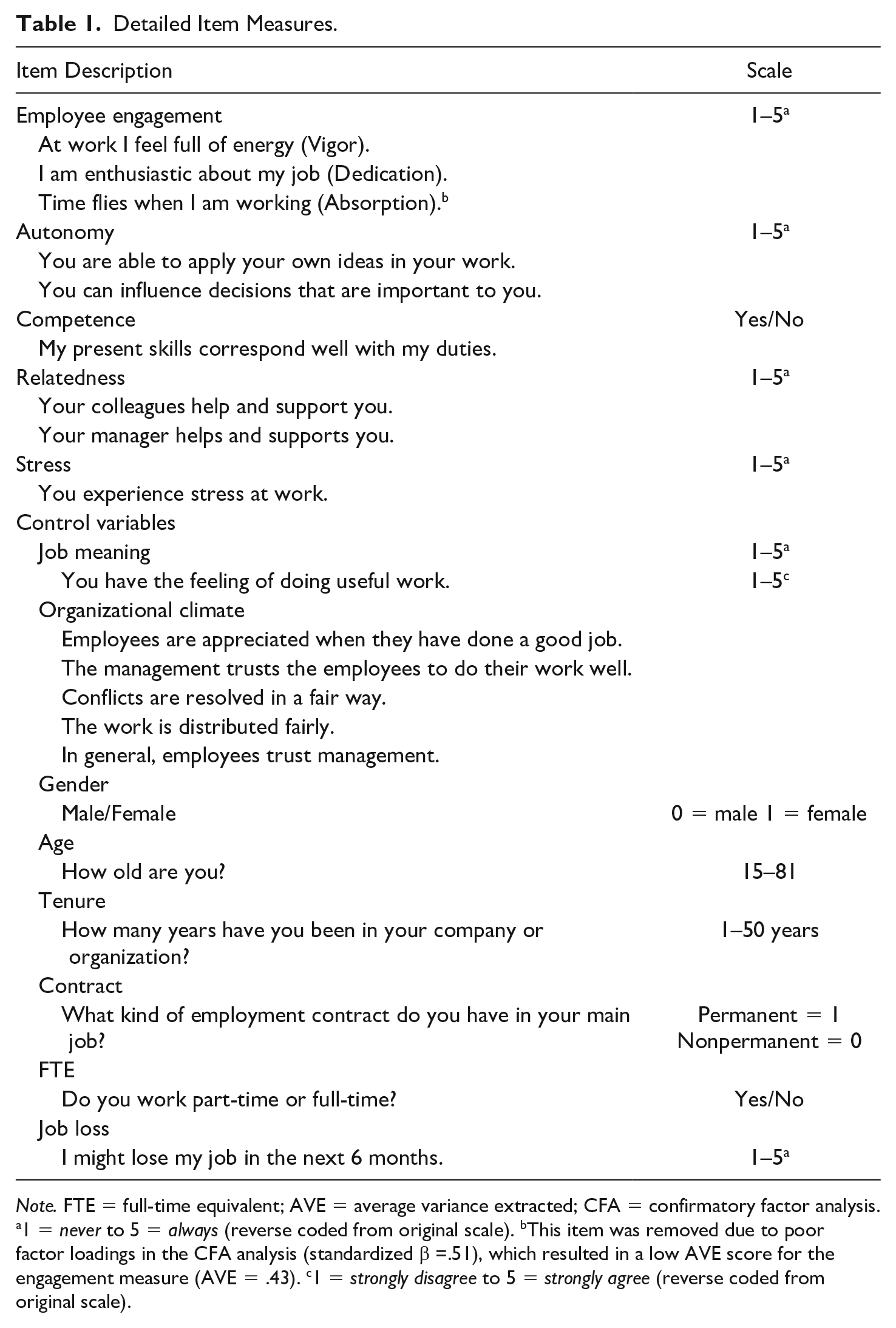
Note. FTE = full-time equivalent; AVE = average variance extracted; CFA = confirmatory factor analysis.
1 = never to 5 = always (reverse coded from original scale). bThis item was removed due to poor factor loadings in the CFA analysis (standardized β =.51), which resulted in a low AVE score for the engagement measure (AVE = .43). c1 = strongly disagree to 5 = strongly agree (reverse coded from original scale).
Descriptive Statistics.
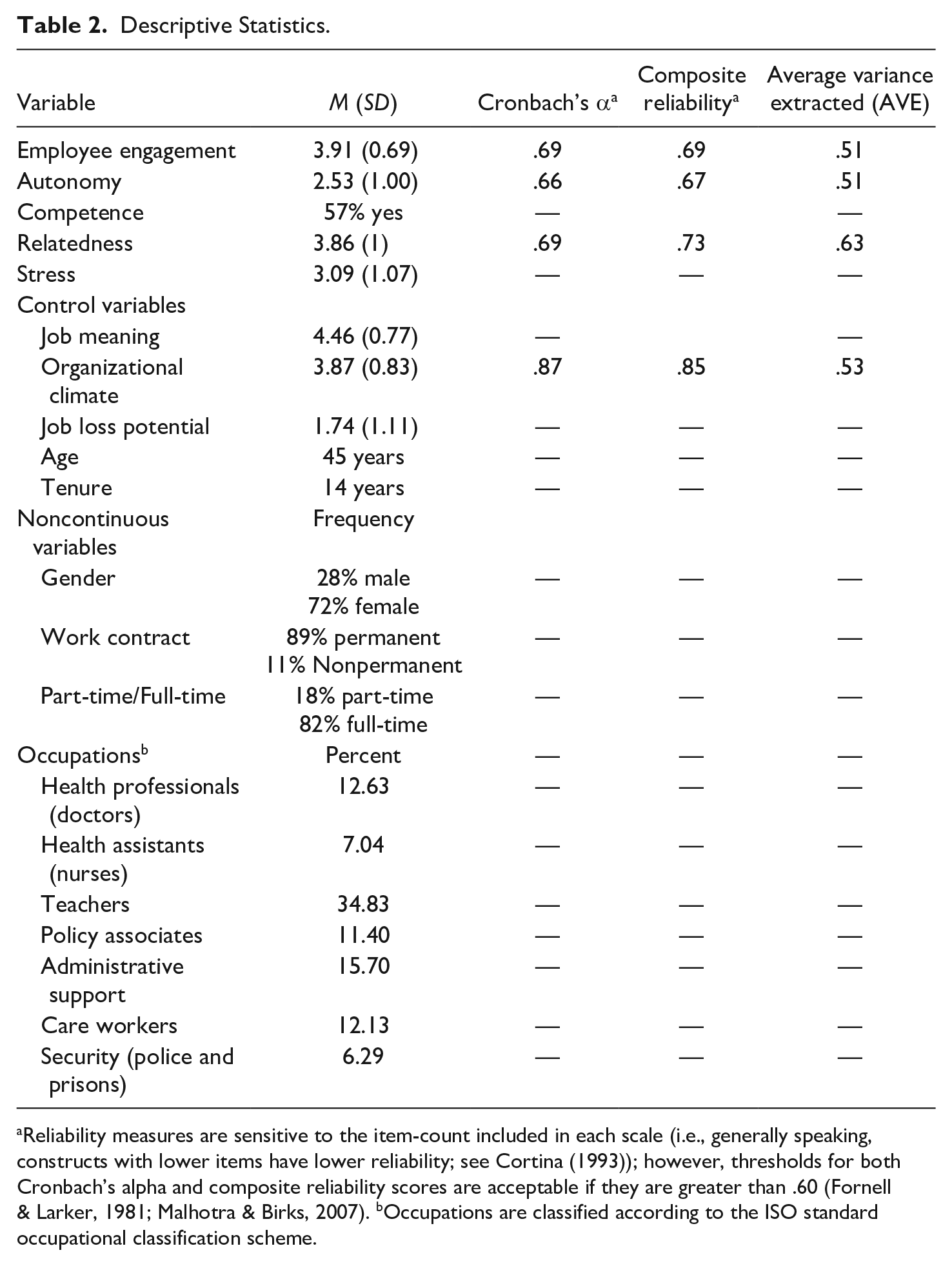
Reliability measures are sensitive to the item-count included in each scale (i.e., generally speaking, constructs with lower items have lower reliability; see Cortina (1993)); however, thresholds for both Cronbach’s alpha and composite reliability scores are acceptable if they are greater than .60 (Fornell & Larker, 1981; Malhotra & Birks, 2007). bOccupations are classified according to the ISO standard occupational classification scheme.
Engagement
As with most cross-national data sets, the EWCS makes limited use of preexisting measures. However, in the 2015 wave, an “ultra-short” three-item version of the Utrecht Work Engagement Scale was included to capture the three specific facets of engagement: vigor, dedication, and absorption (Schaufeli et al., 2019 see Table 1). The three items were scored from 1 (always) to 5 (never). Following Jin and Mcdonald (2017) a one-dimensional engagement score was created from their aggregation.
Using a principal components factor analysis, results show that all three items load strongly onto one factor with an Eigenvalue of over 1 and factor loading scores above .72. Initial internal reliability statistics show an adequate fit (Cronbach’s α =.69). However, a confirmatory factor analysis (CFA) revealed that the “absorption” item did not achieve the required 50% threshold for the average variance extraction (AVE = .46). It was removed from the engagement measure. In doing so, the AVE rose to acceptable levels (AVE =.53), whereas the reliability declined (α = .69, composite reliability [CR] = .69), but remained within adequate thresholds (Malhota & Birks, 2007). Survey measures that use metaphors can have lower psychometric properties due to different interpretations (Vigoda-Gadot et al., 2012). In addition, Cronbach’s alpha scores tend to be lower for scales that have a low number of items (Cortina, 1993). The approach to use only two dimensions of engagement is also supported in the literature that indicates that vigor and dedication are the core components of engagement (González-Romá et al., 2006; Leon et al., 2015).
Stress
Work stress was measured using one item, asking whether the respondent experiences stress in their work (1 = always, 5 = never). This cumulative approach measures the perception of stress rather than objective stress. This approach was taken because individuals perceive environmental stimuli differently (Spector, 2012). The measure was also selected to capture chronic stress rather than acute stress, as the two forms of stress can lead to different outcomes (Carayon, 1995; Day & Livingstone, 2001).
BNS
Autonomy was assessed by using two items that measured the extent to which an employee could apply their own ideas to their work and influence decisions (α =.66, CR = .67, AVE = .51). Relatedness was measured using two items to capture both colleague relationships and supervisor–employee relationships (α = .69, CR = .73, AVE = .63). Both achieved adequate reliability and validity scores. Competence was measured by asking the respondents whether they feel they have the necessary skills and qualifications to complete their work (1 = need further training to cope with duties [low competence satisfaction due to low qualification], 2 = present skills correspond to duties [optimal competence satisfaction, optimal qualification], and 3 = I have the skills to cope with more demanding duties [over competence satisfaction due to overqualification]). Because “optimal” competence (H2) is associated with better outcomes compared with over and under qualification (Erdogan & Bauer, 2009; Sim & Lee, 2018), a dummy variable was created, where 1 = present skills correspond to duties and 0 = rest.
Control Variables
Several control variables were also included in the model. First, a sense of meaning was included given the large body of scholarly research on the topic of meaning in public sector work, and public service motivation (Lavigna, 2015; Ritz et al., 2016). Second, perceptions of organizational climate were controlled for, as it also has an impact on employee outcomes (Ko & Hur, 2014). Five items were combined to measure this. CFA showed that all five questions loaded strongly together and had good reliability and validity results (α =.87, CR = .85, AVE = .53).
Third, individual occupations were controlled for in the model because engagement might differ as a function of occupational logics (Bakker et al., 2000; Morris & Feldman, 1996). Occupations were preclassified based on the international standard of classification of occupations (ISCO; see Eurofound, 2016a, for more information). Seven groups representing different types of common public sector occupations were created. They were as follows: health professionals (e.g., doctors), health workers (e.g., nurses), teachers, care workers (e.g., child and senior care), policy officers, administrative support, and security positions (e.g., police, prison guards, security guards, firefighters). Finally, gender, age, tenure, employment status (permanent vs. nonpermanent), working hours (part-time vs. full-time), and perceptions of future job loss were also controlled for. All items are presented in Tables 1 and 2.
Measurement Validation
The validity of all latent measures containing two or more factors was psychometrically examined using a series of CFA tests. The result showed a good fit with the data, χ2= 370.37(38), root mean square error approximation (RMSEA) = .045, comparative fit index (CFI) = .98, standardized root mean square residual (SRMR) = .02, Tucker–Lewis index (TLI) = .97. Although the chi-square is positive, it is not a good indicator of fit given the model’s large sample size (Hair et al., 2009). Composite reliability scores were all above .65 showing evidence of good reliability, and the AVE scores were all above .50 providing evidence of good convergent validity. Finally, the squared correlations of each of the latent variables were all smaller than their AVE levels, which provide evidence of discriminant validity.
Alternative models were tested using chi-square difference tests. First, the BNS measures were collapsed into one factor. In the second model, stemming from Kahn’s (1990) engagement work focusing on job meaning, the item related to “meaning” was included in the engagement factor. A third model collapsed the relatedness measure of basic needs with the organizational climate measure. A fourth model collapsed all the basic needs’ measures with organizational climate. Each of these alternative specifications showed a worse model fit with the data. Finally, the variables were assessed via a correlation matrix to assess the preliminary strength of relationships between variables, all were below .50.
Two approaches were undertaken to test for the presence of CMB within the model. First, Harman’s single factor test revealed no single factor that accounts for more than 50% of the variance in the model. Second, a common latent factor test was conducted. Although the results did improve the model fit, χ2 = 215.52(27), the changes to the fit statistics were marginal (ΔRMSEA = .00, ΔCFI = .01, ΔSRMR = .02, ΔTLI = .001) and well below the .05 cut off score suggested by Bagozzi and Yi (1990). This would suggest that the effects of CMB are minimal in this model but should not be overlooked. Finally, interaction effects, which are less prone to CMB, reduce the probability of bias (Gardner et al., 1998; Siemsen et al., 2010). Finally, item-to-item correlations between each of the variables were assessed. As all fall below the .70 threshold, it is less likely that inflated relationships do exist in the data (George & Pandey, 2017).
Results
In order to test the outlined Hypothesis, a series of MLMs were used. This controls for country-level context within the data. This is an appropriate approach to take when there are more than 15 groups (in this case, countries), as the estimates are less likely to be biased (Stegmueller, 2013). Both the Snijders/Bosker and the Bryk/Raudenbusch R2 values are reported for each of the models at Level 1 (individual) and Level 2 (country level). The log-likelihood (LL) function, the Akaike information criterion (AIC), and Bayesian information criterion (BIC) for each of the models were also reported (lower levels indicate a better fit; Robson & Pevalin, 2016). These can be found in Table 3. There was no evidence of multicollinearity as all variance inflation factors were below 3. Because all European countries were included in the sampling strategy, equal probability sampling is assumed across countries. However, within each country, sample stratification occurred based on region and urbanization levels (Eurofound, 2016b, p. 6). To account for the inverse probability within the sample, and potential nonresponse bias, following Carle (2009), the model included poststratification weights (scaled to size due to large cluster sizes).
Regression Table.
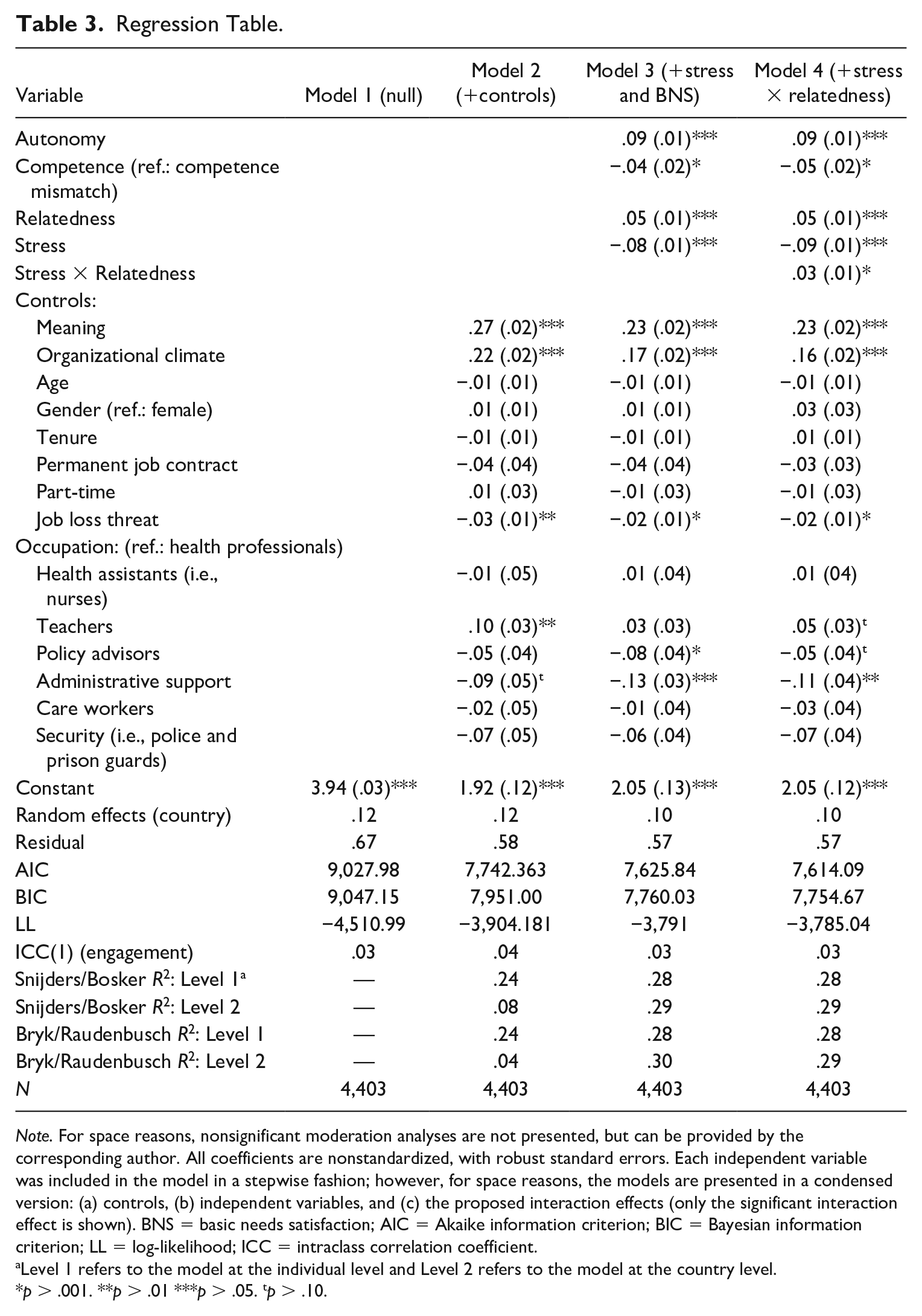
Note. For space reasons, nonsignificant moderation analyses are not presented, but can be provided by the corresponding author. All coefficients are nonstandardized, with robust standard errors. Each independent variable was included in the model in a stepwise fashion; however, for space reasons, the models are presented in a condensed version: (a) controls, (b) independent variables, and (c) the proposed interaction effects (only the significant interaction effect is shown). BNS = basic needs satisfaction; AIC = Akaike information criterion; BIC = Bayesian information criterion; LL = log-likelihood; ICC = intraclass correlation coefficient.
Level 1 refers to the model at the individual level and Level 2 refers to the model at the country level.
p > .001. **p > .01 ***p > .05. tp > .10.
In order to test the intended hypotheses, two preliminary models were examined. The first model assessed the country-level variation in engagement (the null model). Test comparisons with a linear regression model were significant, indicating that the MLM was a superior modeling approach. Model 2 included the control variables. The LL tests indicate a significant improvement to the model, as do the AIC and BIC levels.
Model 3 added the measures for BNS and stress. The results show stress has a negative relationship with engagement (confirming H1), whereas autonomy has a positive relationship with engagement (confirming H2a). Having optimal levels of competence is associated with less engagement compared with low or high levels of competence, rejecting H2b. A robustness check was conducted by creating a three-category dummy variable from the original competence item (Group 1 = Low competence due to low skills [low qualification], Group 2 = Optimal competence [optimal qualification], and Group 3 = Low competence due to too high skills [overqualification]). Results show no statistical differences between Groups 1 and 2. However, those who are considered “overqualified” are more engaged than those with optimal competence. Finally, a sense of relatedness is associated with higher engagement (confirming H2c).
Examining the control variables, thinking one’s job is meaningful and a positive organizational climate are very significant. Furthermore, policy officers and administrative support personnel have lower levels of engagement compared with health professionals, whereas teachers have higher levels of engagement compared with health professionals. There were no differences in engagement between security-related professions, care workers, and health professionals. Age, gender, tenure, a permanent job, and working hours had no significant relationship with engagement. However, the threat of job loss was associated with lower levels of engagement. The final Level 1 R2 accounted for .28 of the model’s variance (on both measures), and Level 2 R2 accounted for .29 (on both measures) of the model’s variance.
Model 4 included the interaction effect. Each moderated variable was mean-centered prior to the analysis. No significant interaction between autonomy or competence and stress was present. However, there was a small significant interaction effect between relatedness and stress, partially confirming Hypothesis 3 (see Figure 1). In general, the moderation analysis shows that individuals with higher levels of relatedness have, in general, higher levels of engagement regardless of the level of stress they feel at work. Following Dawson (2014), a simple slope test was calculated to assess the relationship between stress and engagement at 1 SD above and below the mean of relatedness. The results of the simple slope test show that the negative relationship between high stress and engagement is lessened for individuals who have high levels of relatedness at work (p > .001). This suggests that the relatedness needs buffer, to some extent, the effects of stress in the workplace. The LL tests showed a significant improvement to the model, as did the LL, AIC, and BIC levels. Both Level 1 and Level 2 variance that is accounted for by this interaction is small, indicating a small effect size.
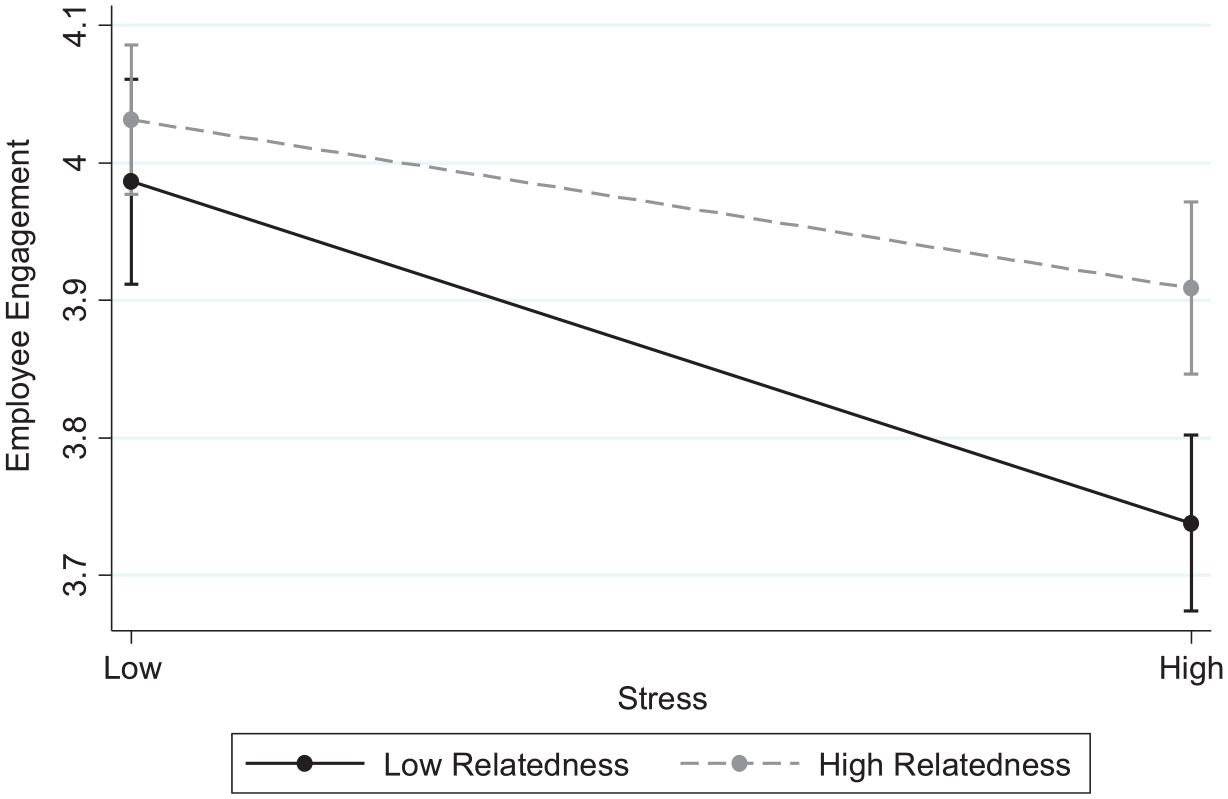
Predictive margins with 95% CIs.
Following LeBreton and Senter (2008), the model’s ICC(1) (intraclass correlation coefficient) score was used to examine the effect size of country on individual engagement scores (this can also be referred to as the variance partition component). The final ICC(1) score was .03, which is a small effect size. This suggests that macro-level differences between countries are less influential on engagement compared with organizational or work-related factors.
Finally, two additional alternative model specifications were performed. First, although the focus of this article was to explore engagement within the public sector, due to the current debate regarding the specificity of public sector engagement (Levitats & Vigoda-Gadot, 2020), an alternative model was run including respondents from the public, private, nonprofit, and joint private–public organizations. The results were very similar, and controlling for sector, they show no differences between the four groups in terms of their engagement levels. Second, a model including the absorption item in the engagement scale was conducted. The results showed very little differences between the two-item and the three-item scale.
Discussion
This article explores the relationship between work stress and engagement, two concepts that are rarely studied together, yet are both prominent issues facing public organizations. Results show that that work stress has a negative relationship to engagement even in the presence of BNS job resources. This article also connects universal motivation theory to engagement theory by showing how BNS can be applied to engagement and demonstrating that BNS in the workplace is associated with higher engagement and minimizes the negative relationship between stress and engagement. This addresses recent calls for integrating motivation theory with JDR theory (Bakker & Demerouti, 2017). Finally, the universality of these claims is tested by using a cross-country sample and across a variety of occupations. This is important for the development of engagement theory in a public context and provides clear and practical insights for public practitioners. As a result of this, four contributions are made to the literature.
First, results indicate that work stress and engagement are negatively related, which provides evidence to show that stress does not just lead to detrimental outcomes on an individual level such as burnout, it also reduces positive work outcomes which is just as problematic. These findings are important for public sector research given the contradiction between the necessity to employ both budget reducing work intensification reforms that increase work stress, and the same time a new interest in developing a highly engaged workforce. The two are not necessarily compatible. As a result, practitioners must be mindful of this constraint when implementing reform-related policies that place large amounts of stress onto employees. This is particularly important for practitioners who simultaneously support and promote organizational reforms aimed at enhancing engagement in and of itself. The U.S. Federal Government’s Office of Personnel Management (OPM) engagement promotion reforms are a case in point. Although recent research has shown that this particular administrative reform has shown to be positively related to performance-related outcomes (Hameduddin & Fernandez, 2019), engagement efforts may be undermined by reforms aimed at budget reduction and cutbacks that introduce a level of instability into public organizations.
Related to this, the findings of this article also support research that has shown that higher levels of stress can contribute to reduced efficiencies and effectiveness of public personnel and public sector organizations (Mchugh et al., 1994). An interesting line of new research should, therefore, examine whether work stress reduces positive work outcomes faster, compared with more negative outcomes such as burnout. If the effect of stress is first seen on positive, rather than negative outcomes, then intervention strategies can and should commence at an earlier stage before the effect of stress becomes too costly to the organization. For example, managers could be better trained in identifying when an individual becomes less interested in their work, is more irritable and less dedicated to their work, and provide strategies such as increased interpersonal contact, to help counter this.
Second, results show that the satisfaction of autonomy and relatedness is strongly and positively related to engagement. This supports the universality and importance of BNS for positive psychological outcomes and links well with the proposition from Meyer and Gagné (2008) who argue that SDT theory can be used as a means of understanding engagement. The results also add to the JDR theory by demonstrating that autonomy and relatedness can be treated as universal and essential job resources, just as they are considered universal and essential components in motivation theory. Future research could test this by applying dominance testing of BNS as resources vis-à-vis other job resources identified in the literature that may be closely linked, for example, the relationship between autonomy and job crafting (Tims et al., 2013). This could be a way of introducing parsimony in the engagement literature, which has been criticized for its gamut of conceptualizations of engagement (Akingbola & van den Berg, 2019; Levitats & Vigoda-Gadot, 2020).
The fact that over competence was more strongly related to engagement may be because the negative effect of overqualification depends on the workgroup itself. For example, when overqualified employees work with other overqualified employees, there are actually positive outcomes (Alfes, 2013). A second interpretation is that employees invest in engagement only when they feel they can “add value” and make a difference (Kahn, 2010), regardless of the fact that they may feel overqualified in the work that they do. This would suggest that practitioners should ensure that employees know the value of their work and that adequate job level competencies are essential for ensuring that employees remain dedicated to their jobs.
Third, although stress and BNS showed opposite relationships with engagement, when tested as a moderation effect, only the basic need for relatedness was important in reducing the negative effect of stress. Indeed, employees who feel that they have support from their colleagues and supervisors can use this support by reaching out to them in times of stress. This is in line with the COR theory in that certain types of resources become salient in response to stress. Because human beings are naturally social creatures and rely upon social bonds for their own well being and survival, in times of stress, they can capitalize on these assets (Hobfoll et al., 2018). These results are also in line with the stress-buffering Hypothesis because social relationships can foster comradery and understanding among individuals who all face the same type of stress. This adds to the management and leadership literature highlighting the important role that supervisors play in their subordinates’ work experiences. This is consistent across a wide variety of countries and occupations suggesting a universal nature of this type of support (see, for example, Gould-Williams & Davies, 2005).
The reason why autonomy and competence do not moderate the relationship between stress and engagement may be because having overall job autonomy may not actually reduce the effects of stress if the source of the stress is beyond the autonomy a person feels that they have in their job (Spector, 2012). Along similar lines, feeling competent in one’s ability to succeed may not allow one to better manage a stressful work environment necessary to remain engaged in one’s work. A third possibility could be that both autonomy and competence are psychological needs that come from within a person’s own psyche, and in times of stress, they are unable to activate these innate resources. By contrast, relatedness needs are based on support from others, and in times of stress, a person may not need to exert as much psychological effort in activating the use of these resources. Future research directions should explore this effect more deeply.
Fourth, in examining the institutional and organizational context, the results show that the mean engagement scores are similar across countries. This suggests that engagement may be a universal employee outcome that is stable across countries. The fact that engagement may be universal also suggests that research using single-country studies can inform researchers and practitioners about overall engagement theory development and applications to public organizations. Results, however, do show differences in mean engagement scores between public sector occupations. For example, traditional back professions such as administrative workers and policy advisors appear to have lower levels of engagement compared with health professionals (i.e., doctors). This may be a function of the institutional logics that differ between public sector occupations. For example, researchers have already classified public sector employee outcomes based on occupational and institutional differences such as “people changing vs. people processing” (Van Loon et al., 2013), or the typology of civil service positions developed by Anderfuhren-Biget et al. (2013). The results from this study, therefore, underscore that researchers must contextualize their work when studying a specific subset of public sector occupations and workers (compared with countries). This is particularly important as practical implications are likely to differ between occupations too. Future research should disentangle the reasons why public sector occupational outcomes differ as this has important implications for managing different types of public sector employees and understanding how to develop universal research findings that use specific types of public sector workers. This is critical in furthering the theoretical development of engagement research. Finally, the alternative model specifications show that there are no differences between sectors. This would suggest that practical insights from engagement research in other disciplines are likely to be highly relevant but also questions the influence of a unique form of public sector engagement outlined in recent public administration literature (Levitats & Vigoda-Gadot, 2020).
Several practical implications stem from this research. First, to create and sustain an engaged workforce, managers must focus on stress reduction techniques. In cases of high stress, these approaches should incorporate some form of social interactions among employees to support relationship development and satisfy “relatedness” needs. On and off-site team building exercises may also provide an important opportunity to support relationship building. These could range from more informal collective gatherings (such as social hours), or more formal retreats.
Second, a renewed focus on increasing engagement in the public sector should especially focus on policy and administrative workers because they have the lowest levels of engagement among the eight different occupations assessed. To do so, managers should focus on building and maintaining work environments that support BNS. Autonomy can be accomplished by directly involving employees in work allocation processes or encouraging an open environment for opinion sharing. Competence can be supported through targeted work assignments and access to adequate training opportunities for skills development. Relatedness can be developed by encouraging open upward and downward communications between managers and their staff or by providing opportunities for employees to socially interact with one another through formal and informal channels.
Despite these interesting findings, several limitations should be acknowledged. First, because the data used for this study come from a single source, there is a threat of CMB. This is minimized by the rigorous sample methodology of the EWCS, moderation analyses, and the post hoc testing undertaken in this research (P. Podsakoff et al., 2012); however, the bias may still be present. Second, although established theories were used to propose causality, actual causal relationships cannot be established with these data. Future research should build on these findings and test the role of BNS and stress in a lagged survey designed, or by using field experiments that manipulate different levels of BNS support to see their impact on engagement. Third, although the data set is both comprehensive and cross-national, psychometrically tested measurement scales were not used. However, the exploratory nature of this article, and the fact that the findings are in line with others in the field, suggests that the measures used in this study are still valid and informative. In addition, researchers recommend the use of single items when sampling a diverse population, and when constructs are more concrete and defined as one-dimensional (Fuchs & Diamantopoulos, 2009). Fourth, the engagement three-factor score did not achieve adequate psychometric properties to be included. However, this is likely because the measure is too short, and thus validity assessment techniques are too conservative (Cortina, 1993). Fifth, this research does not specifically conduct cross-country analysis of engagement. Although the variation with countries is low, future research could examine whether other macro-level factors influence engagement processes of employees. Within the public sector, this could include change of government, unemployment rates, or macro-level government fiscal or monetary reform packages. Finally, it is acknowledged that measuring the concept of competence may be affected by the Dunning–Kruger effect, wherein individuals with low competence lack the abilities to sufficiently judge this ignorance (Dunning, 2011). However, given that the questions asked about a person’s skills match to their job, and thus, measured competence indirectly, the effect is likely to be minimal.
Conclusion
Understanding the relationship between stress and engagement is important given the large changes that have occurred across public sector organizations due to public sector reforms and recent cutback management strategies. This has often led to increased workloads and renewed budgetary pressures for employees themselves, which has led to increased stress. This study shows that stress has a negative relationship with engagement and that basic needs of autonomy, competence, and relatedness are positively related to engagement as they provide the basic “nutrients” that a person needs to thrive in a work environment. In addition, creating work environments that support interpersonal relationship building (or “relatedness”) is a way to better manage stress.
Footnotes
Declaration of Conflicting Interests
The author(s) declared no potential conflicts of interest with respect to the research, authorship, and/or publication of this article.
Funding
The author(s) received no financial support for the research, authorship, and/or publication of this article.
