




Abstract
Public sector employers increasingly promote inclusive workplaces, but the impact of such policies on employees’ perceptions of employer attractiveness has rarely been studied. A deeper understanding of how inclusive workplaces relate to employer attractiveness, and how this relationship differs between employment sectors, may inform recruitment policies and retention management. This study tackles this issue and provides a large-scale analysis of an online employer review platform, covering more than 16,000 Germany-based organizations as rated and recommended (or not) by more than 715,000 current and former employees. More specifically, it builds on person–organization fit theory and analyzes how employee referrals are associated with ratings in three dimensions of inclusive workplaces (i.e., inclusion of women, elderly, and disabled). The results show that inclusive workplaces are positively and significantly related to employer attractiveness, both on aggregate and across the three dimensions. The overall relationship is stronger in the case of public employers when compared with private employers, while there are no sector differences in the relationship when comparing public and nonprofit employers. The findings suggest that inclusive workplaces are advantageous in terms of employer attractiveness, not just for the beneficiaries of such policies, but even more so in the public sector.
Introduction
Public employers increasingly engage in and employ inclusive workplace practices and policies, for a variety of reasons (e.g., Atkinson et al., 2022; Groeneveld & Verbeek, 2012; Jansen et al., 2021). On the one hand, inclusiveness at the workplace is a “moral case” (Jansen et al., 2021; Johns et al., 2012), as it corresponds to public organizations’ moral claims in vision and mission statements, and it helps them to “walk the talk” of social equality, justice, and responsibility (Groeneveld & Verbeek, 2012; McDougall, 1996; Verbeek, 2011). On the other hand, inclusive workplaces are also a “business case” (Jansen et al., 2021; Johns et al., 2012) because they may enable the effective provision of public services with an increasingly diverse and dynamic workforce (Atkinson et al., 2022). The issue of if and how such policies hinder or foster the attractiveness of public employers still awaits further exploration from this latter, more functional perspective. Although evidence is not univocal (Ng & Burke, 2005; Williams & Bauer, 1994), a number of studies in the general human resource management (HRM) literature have shown that diversity and inclusiveness signals in the recruitment process do attract minority applicants to organizations (Avery & McKay, 2006). However, little is still known about the ways in which inclusive workplace policies resonate in terms of employer attractiveness in the general workforce beyond target groups with characteristics specific to minorities or otherwise disadvantaged people (Madera et al., 2018; Williams & Bauer, 1994).
Given the growing attention that public management scholars and practitioners devote to the employer attractiveness of public organizations (e.g., Asseburg et al., 2018; Cordes & Vogel, 2023; Keppeler & Papenfuß, 2021; Ritz et al., 2022), it is interesting to analyze how inclusive workplace policies generally relate to employer attractiveness, and also how this relationship may differ between the public, private, and nonprofit sectors. Many Western countries have rapidly aging and shrinking workforces (OECD, 2021), as a result of which public employers increasingly compete with private and nonprofit employers for the recruitment and retention of talent. Scholars and practitioners alike are therefore challenged to develop a better understanding of the competitive advantages and disadvantages of public vis-à-vis private and nonprofit employers (e.g., Cordes & Vogel, 2023; Fowler & Birdsall, 2020; Ritz et al., 2022). Inclusive workplace policies may lead to such a competitive difference, as they are likely to align in different ways with the values and claims of public, private, and nonprofit organizations. However, research has paid most attention to inclusive workplace policies in each individual sector (e.g., Avery & McKay, 2006; Groeneveld, 2011; Ng et al., 2012), while only a few scholars have provided comparisons between different sectors (Groeneveld & Verbeek, 2012; Jansen et al., 2021). Accordingly, there is no conclusive evidence as to how these policies differently relate to employees’ perceived attractiveness to public, private, and nonprofit employers.
To address these gaps in the literature, this study poses the following research question: How do inclusive workplace policies relate to employer attractiveness, and how does this relationship differ between the public, private, and nonprofit sectors? To provide an answer, data from the largest German-speaking employer review platform (i.e., https://www.kununu.com) was analyzed. More specifically, reviews by 717,476 current or former employees of 16,086 Germany-based organizations, rating the employers across a variety of criteria, and subsequently either recommending them to other users or not, were examined. The rating criteria include those reflecting inclusive workplace policies, more precisely attitudes toward elderly employees, gender equality, and handicapped accessibility. Indeed, an increasing number of job seekers consult such platforms to gather firsthand information about potentially attractive organizations (Melián-González & Bulchand-Gidumal, 2016). Research in HRM, therefore, considers online word-of-mouth (WOM) as an increasingly important factor in organizational attraction and job choice decisions (Evertz et al., 2019).
This study makes three contributions to the public administration literature: First, it broadens the stream of literature on inclusiveness in the public sector, an issue that has recently gained momentum in public management scholarship (e.g., Alang et al., 2022; Groeneveld & Verbeek, 2012; Moon, 2018). This analysis specifically contributes to the still small body of previous research on the impacts that inclusive workplace policies and practices may have on public sector organizations. This perspective is important because inclusive workplace initiatives compete for public managers’ and policy-makers’ limited attention and scarce resources. More insight into the positive or negative consequences of inclusive workplaces will help scholars and practitioners to assess the extent to which inclusiveness is not only a “moral case” but also a “business case.”
Second, this research combines inclusiveness with scholarship on employer attractiveness in the public sector, another urgent concern of public management research and practice (e.g., Cordes & Vogel, 2023; Fowler & Birdsall, 2020; Keppeler & Papenfuß, 2021). Neither the level nor the drivers of employer attractiveness in the public sector are clear from previous scholarship. Another piece is added to this puzzle by focusing on the ways in which inclusive workplaces contribute to employer attractiveness, and how that may differ in the public, private, and nonprofit sectors. Third, and relatedly, the study contributes to the long-standing debate concerning the reasons why people want to work in any of the sectors and which attributes they appreciate in their employers (e.g., Asseburg et al., 2020; Lewis & Frank, 2002; Lyons et al., 2006). However, the existing literature does not cover all stages of the HR cycle to the same extent. The HR cycle is divided into a pre-entry stage (i.e., recruitment and selection) and a post-entry stage (i.e., appraisal, development, retention, release) (Ripoll & Ritz, 2021). While most previous studies focus on the pre-entry stage (Korac et al., 2019), this investigation hones in on more experienced employees in the post-entry stage. The “war for talents” makes the retention of such experienced employees an important yet often neglected challenge that public sector HR professionals face.
The remainder of this article is structured as follows: The next section is a review of the extant literature, and an introduction to the relevant theory and hypotheses about the ways in which inclusive workplace policies relate to employer attractiveness in the public, private, and nonprofit sectors. This endeavor is guided by the HRM literature, and more precisely by person–organization (P-O) fit theory (Chatman, 1989; Kristof, 1996), which has also frequently been applied in public management scholarship (Christensen & Wightman, 2021). The third section presents the data and methods used. This study is among the first to use data from an online employer review platform to inform public management research (Luoma-aho et al., 2021; Vogel & Satzger, 2022). While such user-generated data may suffer from definite limitations, they also offer many clear advantages. Users evaluate their employers on their own initiative and in awareness of the long-lasting consequences that their ratings and recommendations may have for the employer’s reputation, potentially yielding different results than a more artificial survey or experiment would. This makes employee referrals on online platforms both a behavioral and a consequential measure of employer attractiveness.
The results of regression analyses are presented in the fourth section. Employee ratings on inclusiveness criteria are shown to be positively and significantly related to employer attractiveness in terms of recommendation rates. This finding holds true for both the aggregate and across the three covered dimensions of inclusive workplaces (i.e., inclusion of disabled, elderly, and women). In line with the stated hypotheses, it is evident that the association is stronger for the public than for private employers, while no sector differences occur between public and nonprofit employers. The final section includes a discussion of the theoretical and practical implications of these findings, the limitations of the study, and possible avenues for future research.
Theory and Hypotheses
Inclusive Workplace Policies and Employer Attractiveness
Inclusive workplace policies are instituted by employers to foster equal treatment of employees and ensure that equal opportunities are available to them, regardless of their sex, gender, race, color, ethnic or social origin, religion or belief, political affiliation, membership of a national minority, birth, disability, age, or sexual orientation (Cox, 1993). Such policies may vary extensively in how explicitly they call for inclusiveness in all these dimensions; they may also state in more general terms that nobody is excluded from employment opportunities and career advancement. Organization-level inclusion policies are often required by Equal Employment Opportunity policies at the national or supranational level. An example is the Racial and Employment Equality Directives in European Union (EU) legislation, which aim to advance inclusiveness in the workplace and prohibit direct and indirect discriminatory practices in employment and vocational training (Böök et al., 2023; Chopin & Germaine, 2022). According to the International Labor Organization (ILO), inclusion is achieved when all employees “feel valued for who they are, the skills and experience they bring and the extent to which they have a strong sense of belonging with others at work” (ILO, 2022, p. 28). This goal and corresponding policies, practices, and principles have recently attracted increased attention in public management scholarship (e.g., (Alang et al., 2022; Atkinson et al., 2022; Groeneveld & Verbeek, 2012; Jiang et al., 2022; Moon, 2018). Public organizations should indeed have a serious interest in inclusive workplaces, as equal treatment and social cohesion are core values in the public realm (Jørgensen & Bozeman, 2007).
The interest in inclusive workplace policies in the public sector is not only driven by moral considerations and obligations but also by more functional interests in the attraction, management, and retention of an effective workforce. Inclusive workplaces may have several beneficial outcomes, like heightened levels of employer attractiveness, to the extent that employees are more likely to join and stay with the employer. The attractiveness of public employers is indeed a matter of enduring scholarly interest and practical concern (e.g., Cordes & Vogel, 2023; Keppeler & Papenfuß, 2021; Ritz et al., 2022). Previous scholarship has provided indications that inclusive workplace policies contribute to employer attractiveness and resonate particularly with the targets and beneficiaries of such policies. For example, scholars have demonstrated over the years that employers who signal their engagement with diversity management policies are successful in attracting more female and minority applicants (e.g., Avery, 2003; Lambert et al., 2019; Ng & Burke, 2005; Rau & Hyland, 2003). These are encouraging findings for public HR managers who strive to increase the diversity of the workforce by attracting underrepresented applicants; an implication that also addresses the literature on representative bureaucracy (Bishu & Kennedy, 2020; Groeneveld & van de Walle, 2010).
It is less clear from previous research in HRM, however, if the impact of inclusive workplace policies on employer attractiveness extends beyond the targeted minorities, and remains true for the general workforce. A number of studies have established a positive association between inclusive workplaces and employer attractiveness, regardless of whether employees represent the targeted beneficiary groups or not (e.g., Madera et al., 2018; Williams & Bauer, 1994). Other studies, however, have found no such association (e.g., Lambert, 2015; Rau & Hyland, 2003). Even if findings were univocal, it would still be unclear how they generalize across the various stages of the HR cycle. The vast majority of previous studies was conducted at the pre-entry stage of organizational attraction when potential applicants evaluate job opportunities from various employers and decide whether to apply or not (Lambert, 2015; Madera et al., 2018; Rau & Hyland, 2003). In contrast, scholarship has largely been silent regarding post-entry stages, when employer attractiveness matters for employee retention and referrals. It is therefore fair to conclude that the association between inclusive workplace policies and employer attractiveness still awaits further exploration.
P-O fit theory (Chatman, 1989; Kristof, 1996) provides a theoretical framework for understanding the link between inclusive workplace policies and employer attractiveness (Madera et al., 2018; Ng & Burke, 2005). In the HRM literature, P-O fit refers to the compatibility of individuals and organizations, for instance in terms of the values to which they subscribe (Chatman, 1989; Kristof, 1996). Perceived value congruence fosters feelings of belonging and reduces emotional costs that would emerge if different domains of self were discrepant (Higgins, 1987). Accordingly, job applicants will evaluate the extent to which organizational values are consistent with their own and choose employers who they expect will share their own values (Judge & Bretz, 1992). It has repeatedly been demonstrated that value congruence matters at all stages of the HR cycle, as it is also positively related to employees’ intention to stay at a firm as well as to actual employee retention (Cable & Judge, 1996).
Inclusive workplace policies are likely to increase perceptions of P-O fit and, in turn, employer attractiveness (Madera et al., 2018). Employers who implement such policies show commitment to values like social equity, participation, and cohesion, thus demonstrating care for and appreciation of all employees. While studies on discrimination at the workplace suggest that these social values are not universally shared (e.g., Lee, 2022; Ortega et al., 2012; Yu & Lee, 2021), they are still likely to be shared generally across a broad spectrum of the working population. Most employees will value harmonious workplaces in which they can develop a strong sense of belonging with others in cohesive groups. This assumption is supported by findings that employees place paramount emphasis on social job attributes, such as teamwork and support from leaders and co-workers (e.g., Buelens & van den Broeck, 2007; Ko & Jun, 2015; Vogel & Satzger, 2022). Social exclusion, for whatever reason, will be in conflict with these values and create discomfort, not only among the excluded. While value congruence is likely to be stronger for those who face higher risks of social exclusion and would thus benefit more from inclusive workplaces (Ng & Burke, 2005), it should extend beyond these beneficiaries and remain true for workforces more generally and comprehensively. As a result, it can be expected that value congruence between employees and the employer will be higher when inclusive workplace policies are in place. In turn, perceptions of employer attractiveness among employees will be stronger. The first hypothesis thus reads as follows:
The Moderating Role of the Employment Sector
The association between inclusive workplace policies and employer attractiveness is likely to differ between employment sectors, and this study expects this association to be stronger in the public than in the private sector. The reason is that congruence in inclusiveness values between employees and employers is likely to be achieved at higher levels in the public than in the private sector. Consistent with P-O fit theory, this congruence is driven by both the person and the organization. Scholars have argued that an organization’s efforts to implement inclusive workplace policies differs between public and private employers (Groeneveld & van de Walle, 2010; Johns et al., 2012; Willem et al., 2010). The mission of public employers is to serve societal interests and enhance social equality and justice (Groeneveld & Verbeek, 2012; Verbeek, 2011), and as a result, public organizations initiate inclusive workplace policies with more force and conviction, for moral reasons, than private organizations do (Jansen et al., 2021). Due to stronger political and legal pressure to enhance the representation of minorities, public employers also report inclusive workplace policies more visibly than private employers (Groeneveld & Verbeek, 2012). For the same reason, public employers will be more obligated to align actual practices and principles of inclusion with intended policies, which will further enhance their reputation as inclusive employers. In essence, then, public employers are likely to implement more value-driven policies of inclusiveness, and to align such policies more credibly with their mission, than private employers.
Regarding the person in the P-O fit equation, public employees will also show a stronger commitment to inclusiveness than private employees. The reason is twofold: On the one hand, people with a strong commitment to inclusiveness and associated values are more likely to self-select into public service than into private business. The literature on public service motivation (PSM) provides strong support for this assumption because commitment to the public interest and compassion for others are core dimensions of PSM (Perry & Wise, 1990). Social inclusion is arguably in the public interest and is reflected in compassionate attitudes to and behaviors directed at disadvantaged people. On the other hand, an individual employee’s commitment to inclusiveness values is likely to increase upon employment in the public sector as a consequence of organizational socialization. The stronger institutionalization of inclusive workplace policies in the public sector as compared to the private sector will expose public employees more obviously and consistently to corresponding values. In turn, employees are likely to gradually adopt these values as a matter of habituation and identification. When combined, these processes of selection and socialization will increase the public employee’s commitment to inclusiveness values, and value congruence between employees and employers will settle at higher levels than in the private sector. Following the reasoning above, it can be assumed that the employment sector will moderate the relationship between inclusive workplaces and employer attractiveness. This study hypothesizes the following:
A similar difference in the relevance of inclusive workplaces for employer attractiveness between the public and the nonprofit sectors is not to be assumed, however. Although many differences between public and nonprofit organizations remain, nonprofit organizations are often perceived as “an alternative to the public sector in promoting public interest” (Ng et al., 2012, p. 337). Both public and nonprofit sector employers are, by their very mission, devoted to societal interests and social responsibility (Taylor, 2012), with altruistic work values being similarly important in both sectors (Lyons et al., 2006). Scholarship has corroborated evidence that PSM is not only associated with public sector careers but also with preferences for employment in the nonprofit sector (Ballart & Rico, 2018; Bright, 2016; Clerkin & Coggburn, 2012; Mann, 2006; Rose, 2013; Word & Carpenter, 2013). These insights have led some scholars to suggest “nonprofit service orientation” as a twin concept of PSM (Park & Word, 2012; Word & Carpenter, 2013). Job seekers often choose nonprofit organizations for their value-drivenness in promoting social equity and contributing to the common good, similar to why employees join the public sector (Tomlinson & Schwabenland, 2010). For instance, people who are at risk of discrimination, such as lesbian, gay, bisexual, and transgendered (LGBT) job seekers, are more likely to pursue nonprofit careers than non-stigmatized individuals, as the former group espouses stronger altruistic work values and expects less discriminating workplace policies from nonprofit organizations than from other employers (Ng et al., 2012). This attraction effect through value congruence may be particularly strong in the case of organizations that are dedicated to the promotion of minority rights, a trait that is often applicable to nonprofits. Once members of minority groups are employed, the increasing diversity of the workforce may send trustworthy signals that inclusive workplace policies are in place, leading to a self-reinforcing process that attracts even more members of such groups. The more visible organizational members from minority communities are during the recruitment process, the stronger the similar-to-me effect in the organizational attraction will be (Goldberg, 2003). Hence, value congruence between employees and employers in terms of inclusiveness at the workplace should be at similarly high levels in the public and nonprofit sectors. The hypothesis thus reads as follows:
Figure 1 summarizes the hypothesized relationships.
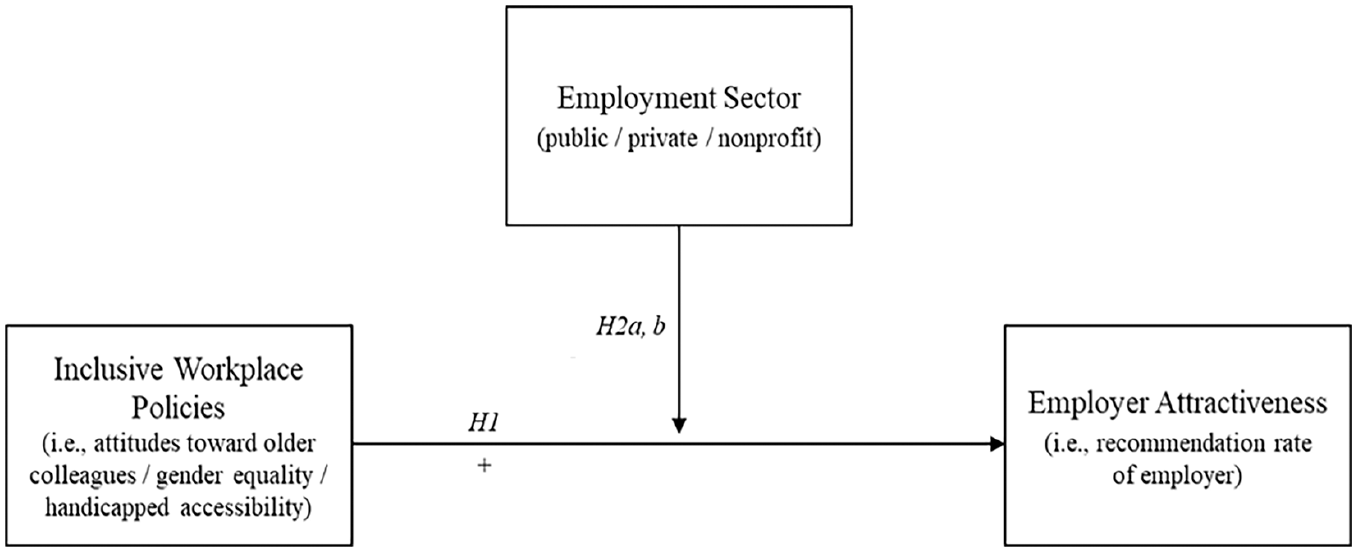
Conceptual Framework.
Data and Method
Sample
The data were sampled in Germany. While this was convenient due to the authors’ privileged access to the field, Germany is also an interesting and appropriate choice for the research objectives. As a member of the EU, Germany is subject to the Racial and Employment Equality Directives, which require that people are treated equally in all areas of employment and vocational training regardless of their racial and ethnic origin, religion or belief, disability, age, and sexual orientation (Chopin & Germaine, 2022). The German General Act on Equal Treatment translates these directives into national law and defines the legal consequences of discrimination in the spheres of labor and civil law. Along with the promulgation of this act, an independent Federal Anti-Discrimination Agency was founded in 2006. This body promotes equal treatment at work by offering legal advice to people who have experienced or observed discrimination. Accordingly, public, private, and nonprofit organizations in Germany operate in a regulatory environment that makes inclusive workplace policies a matter of serious political and practical concern. This salience is cause for confidence that Germany presents a particularly well-suited case for studying variations in the association between inclusive workplace policies and employer attractiveness.
Data were extracted from the largest German-speaking online employer review platform (i.e., https://www.kununu.com/), which has been operating in Germany since 2007. On this platform, both current and former employees anonymously share their work experiences in an organization and recommend, or do not recommend, the employer to other users and visitors. The reviews are obtained in both structured and semi-structured form, along with a final recommendation decision. In the structured part, users rate their employer on a five-star scale across several criteria and are asked to confirm access to a variety of fringe benefits. This rating system offers a more complex and multi-faceted approach, including some dimensions of inclusive workplace policies, than other online employer review platforms (e.g., https://www.glassdoor.com).
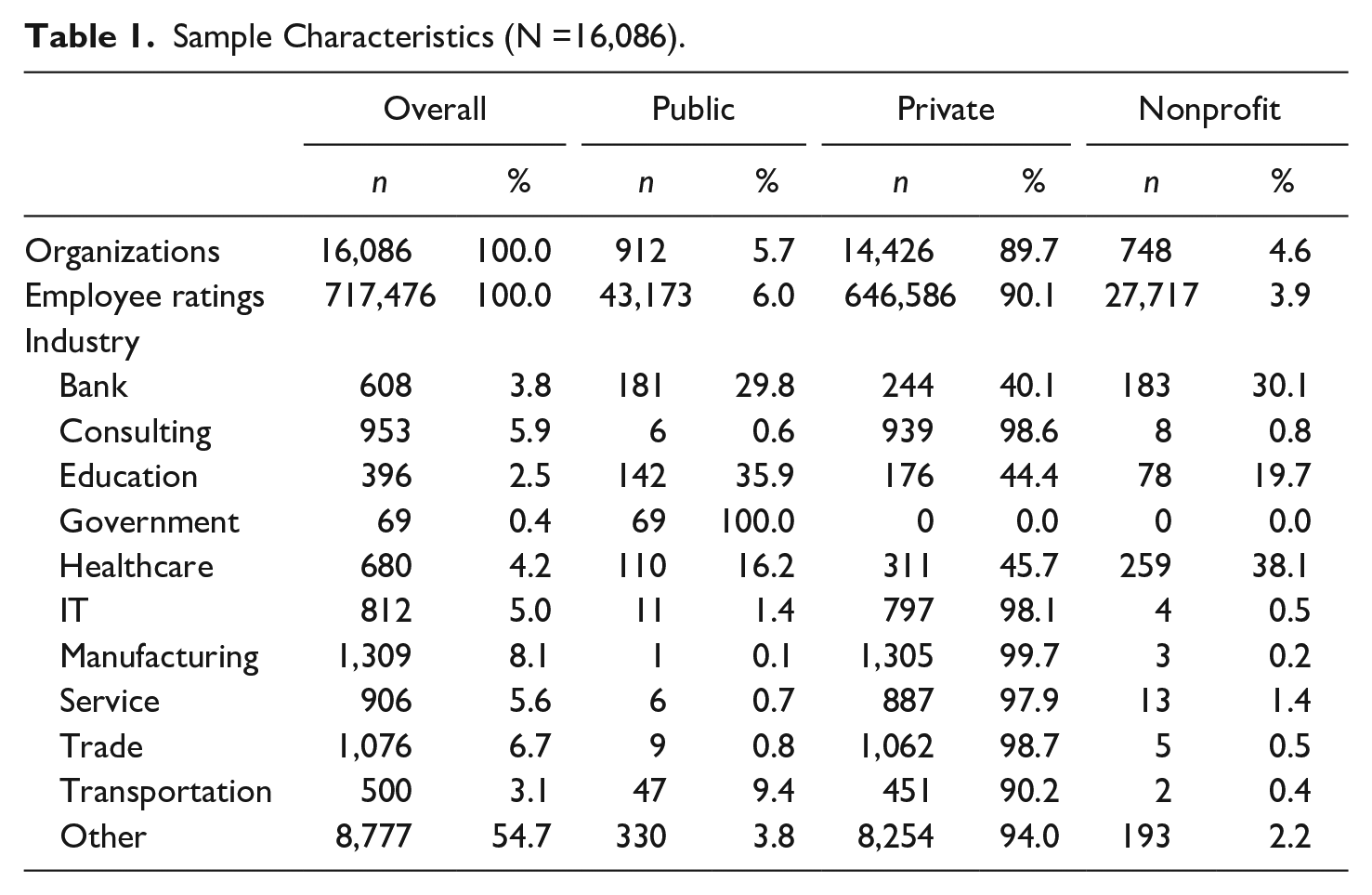
A web-crawling procedure extracted ratings for all employers with 10 or more reviews from the platform. This threshold was applied because it is to be expected that the reliability of employee ratings and recommendations increases with the number of ratings. As the content on the platform is user-generated, the downloaded data contained some “noise,” which required a thorough cleaning process. Duplicates (i.e., organizations with two or more entries on the platform) were aggregated, and “nested” organizations (e.g., subsidiaries and corporate parents) were merged. A new category was introduced to distinguish between public, private, and nonprofit organizations, and all organizations were re-coded in terms of their ownership (Bozeman, 1987). The final sample comprised 16,086 Germany-based organizations rated by 717,476 employees. The average number of reviews per organization was 44.60 (SD = 256.19). Table 1 displays further sample characteristics.
Sample Characteristics (N =16,086).
Measurements
Dependent Variable
Employer attractiveness was measured using an employer’s recommendation rate. At the end of the rating process, users were asked to recommend the assessed employer (i.e., “Would you recommend this employer to a friend?”), with a dichotomous response option (“yes”/“no”). The recommendation rate indicates the percentage of users who recommended the employer (i.e., responded with “yes”) within the last 24 months, relative to all users who responded to this question in this period. The variable is thus an organizational-level variable scaled from 0 to 1.
Independent Variables
Diverse and inclusive workplace policies were measured by calculating a composite index across three items adopted from the review platform. Attitudes toward older colleagues refers to whether older employees are recruited and long-serving colleagues are valued and promoted in the organization. Gender equality relates to whether women have the same opportunities for career growth as men and are equally appreciated as co-workers, and whether women re-entering the organization experience no disadvantages. Handicapped accessibility reflects the extent to which disabled people have barrier-free access to their workplaces. While the first two items (i.e., attitudes toward older colleagues and gender equality) were measured on a five-star scale, ranging from 1 star (very bad) to 5 stars (very good), the third item (i.e., handicapped accessibility) was included in the list of fringe benefits. In this part of the rating procedure, users are asked to confirm whether the employer offers such benefits or not. For reasons of comparability with the other items, the original variable (i.e., percentage of users who confirmed handicapped accessibility) was transformed to a scale ranging from 1 to 5. Finally, the arithmetic mean across the three items was calculated. The composite measure showed satisfactory reliability (i.e., α = .74). Three sector dummies were also created to distinguish between public, private, and nonprofit employers.
Control Variable
As the users provide their ratings anonymously, as per platform policy, no information was available about their socio-demographic characteristics. However, the study did control for the number of employee ratings for each organization, and this number should be a proxy for organizational size. Controlling for the size of an employer is important, because public employers are often large organizations, and the employee experience may not only vary according to the sectoral affiliation but also to the size of the employer.
Statistical Analysis
Before proceeding to the main analysis, the data were checked for nonlinear relationships between the predictors and the dependent variable. Linear relationships provided a better, or only marginally worse, fit with the data so the study continued with a linear regression approach. However, ordinary least squares (OLS) regression is not a suitable estimation approach because the dependent variable (i.e., employer attractiveness in terms of the recommendation rate) is proportional, thus scaled from 0 to 1. A suggestion in the literature that generalized linear models with logit link and binomial distribution is more appropriate in such cases (Papke & Wooldridge, 1996) was thus followed.
Results
Descriptive Findings
Table 2 presents the means, standard deviations, and correlations of the study variables. Table 3 shows the mean ratings for employer attractiveness and inclusive workplace policies of public, private, and nonprofit employers. As Levene’s tests indicated that variances were not equal across sectors, Kruskal–Wallis tests were applied to determine sector differences in employee ratings. The results show that the ratings indeed differ between the sectors, yet at varying levels of statistical significance. Differences in the overall recommendation rate are only marginally significant (p = .083), with public employers (66%) slightly more likely to be recommended than private (63%) and nonprofit employers (64%). Strong differences occur in the aggregate measure of inclusive workplace policies (p < .001), with public employers (M = 3.34) receiving significantly higher ratings than private (M = 3.22) and nonprofit employers (M = 3.26). Attitudes toward older colleagues differ only in negligible magnitude (p = .091), as public (M = 3.86), private (M = 3.81) and nonprofit employers (M = 3.78) receive very similar ratings. In contrast, gender equality differs considerably more (p = .003) between the public (M = 3.79), private (M = 3.70), and nonprofit sectors (M = 3.74). The largest differences occur in handicapped accessibility (p < .001), for which public employers (M = 2.35) receive much higher ratings than private (M = 1.80) and nonprofit employers (M = 2.14).
Descriptive Statistics and Correlations of Study Variables.
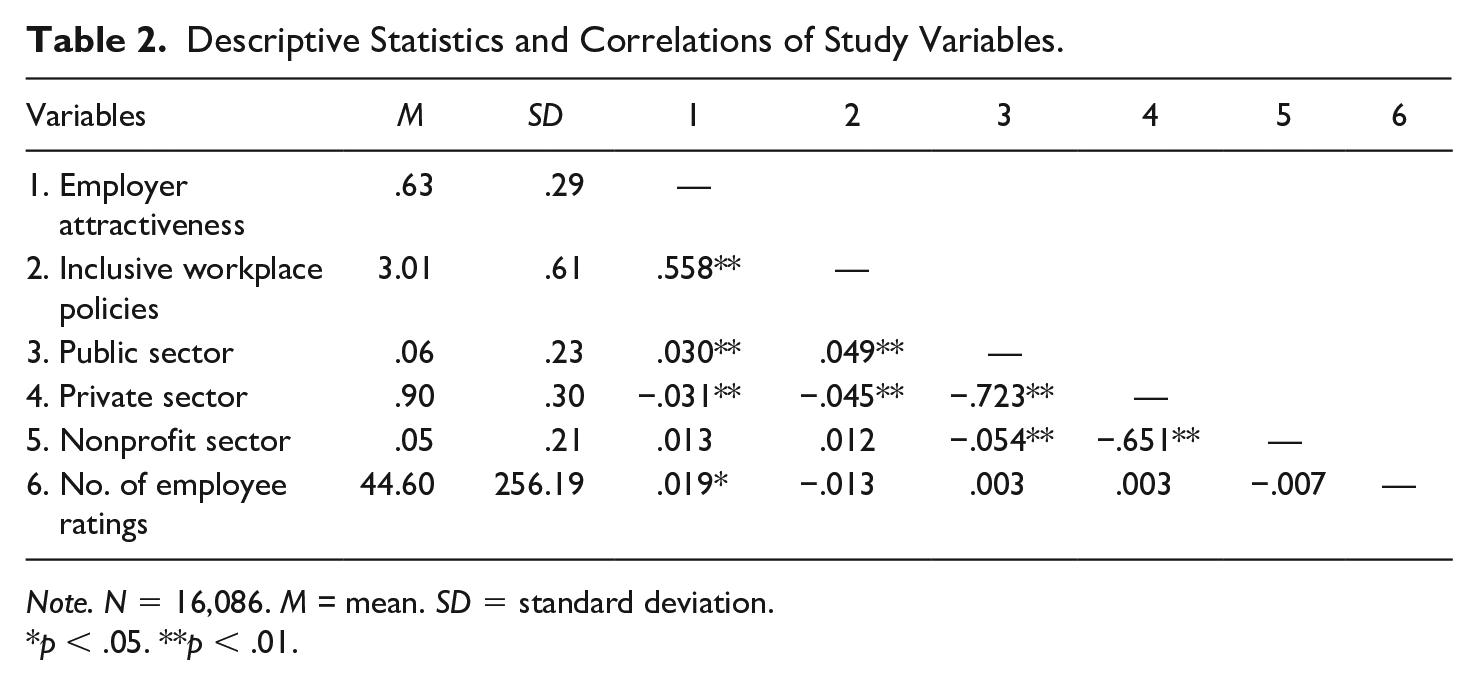
Note. N = 16,086. M = mean. SD = standard deviation.
p < .05. **p < .01.
Sector Differences in Employer Attractiveness and Inclusive Workplace Policies.
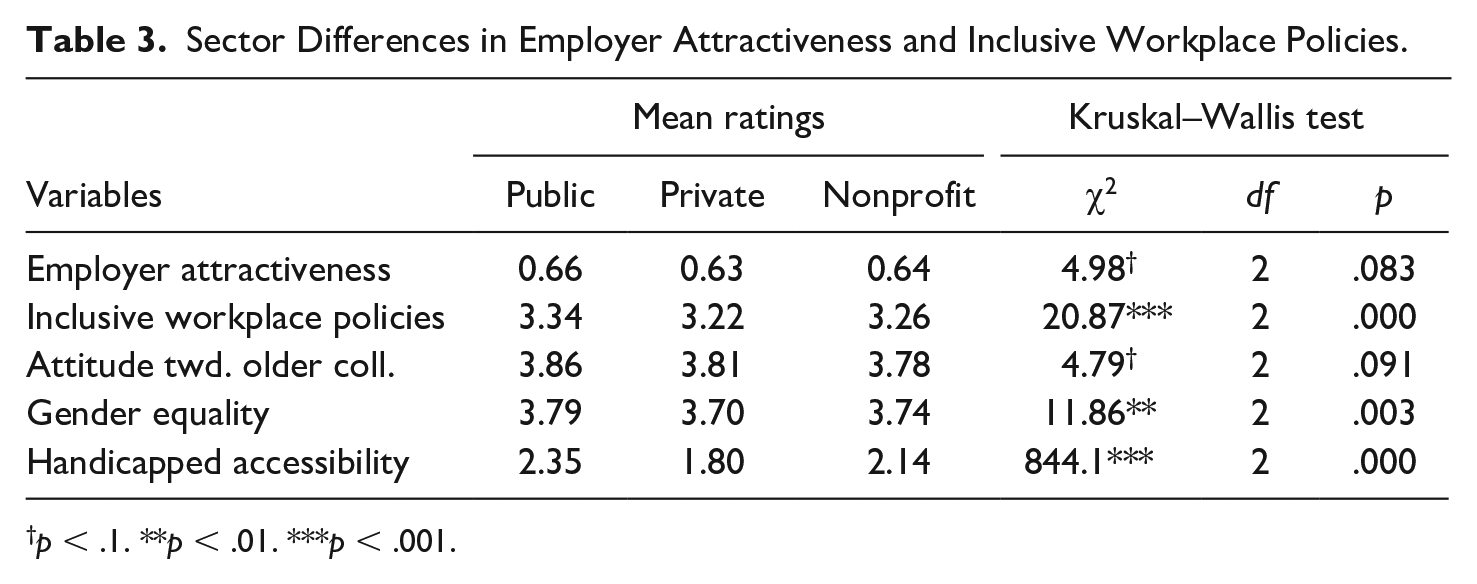
p < .1. **p < .01. ***p < .001.
Hypotheses Testing
Table 4 presents the regression results, with Model 1 examining the direct effects of inclusive workplace policies. H1 states that such policies are positively related to employer attractiveness. The findings strongly support this assumption, as the direct effect is positive at a high level of statistical significance (b = 1.366, p < .001). Model 2 additionally considers interactions between inclusive workplace policies and the employment sector (i.e., public, private, and nonprofit). H2a suggests that the association between inclusive workplace policies and employer attractiveness is stronger in the public than in the private sector, whereas H2b states that no such differences occur when public employers are compared with nonprofit ones. The employment sector enters the model as dummy variables for the private and nonprofit sectors, with the public sector serving as the reference category. The results show that, in the private sector, inclusive workplace policies indeed matter less for employer attractiveness than in the public sector (b = −0.172, p = .018), as predicted by the hypothesis. Accordingly, H2a is supported. There are no differences in the strength of the relationship between inclusive workplace policies and employer attractiveness for public and nonprofit employers (b = −0.160, p = .182). H2b is therefore also accepted. Both models control for the number of employee reviews, but this variable is not significantly related to employer attractiveness.
Regression Results (Generalized Linear Models; DV: Employer Attractiveness).
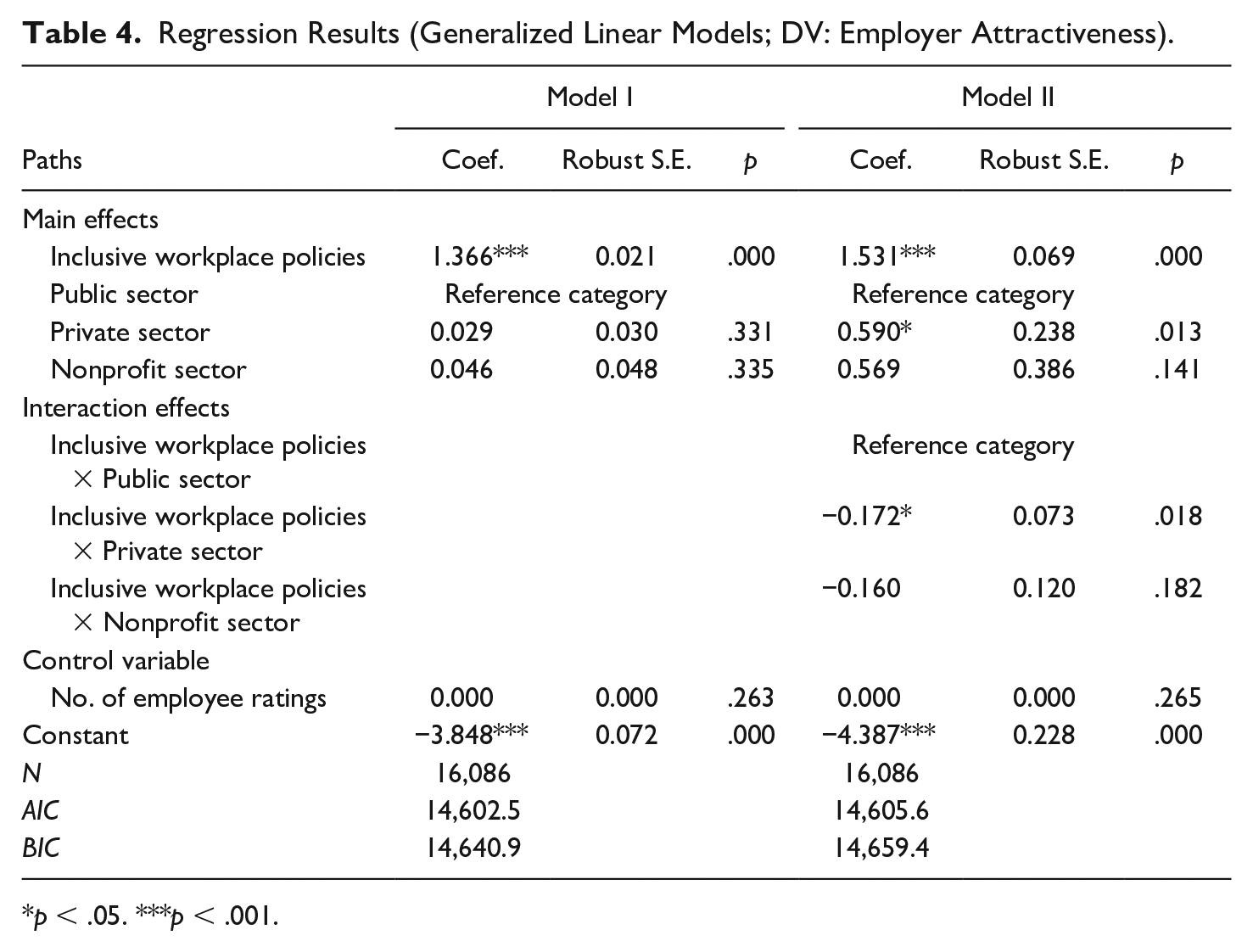
p < .05. ***p < .001.
Figure 2 illustrates the interaction between inclusive workplace policies and employer attractiveness. To add more nuance to the findings, the figure includes the interaction effect for the aggregate measure of inclusive workplace policies, as derived from model 2 (Table 4), as well as for the three subdimensions (i.e., attitudes toward older colleagues, gender equality, and handicapped accessibility). These finer-grained results derive from additional regression models provided in Supplemental Appendix 1 (available online). The results reveal the overall moderation effect of the employment sector also more specifically for gender equality and handicapped accessibility. The relationship between these workplace policies and employer attractiveness is not only stronger in the public than in the private sector (gender equality: b = −0.255, p = .017; handicapped accessibility: b = −0.144, p = .013) but also in comparison between the public and the nonprofit sector (gender equality: b = −0.364, p = .036; handicapped accessibility: b = −0.188, p = .019). Contrary to the general tendency, however, the interaction is reversed for attitudes toward older colleagues: The association with employer attractiveness is weaker (rather than stronger) in the public compared with the private (b = 0.239, p = .034) and nonprofit sectors (b = 0.334, p = .055).
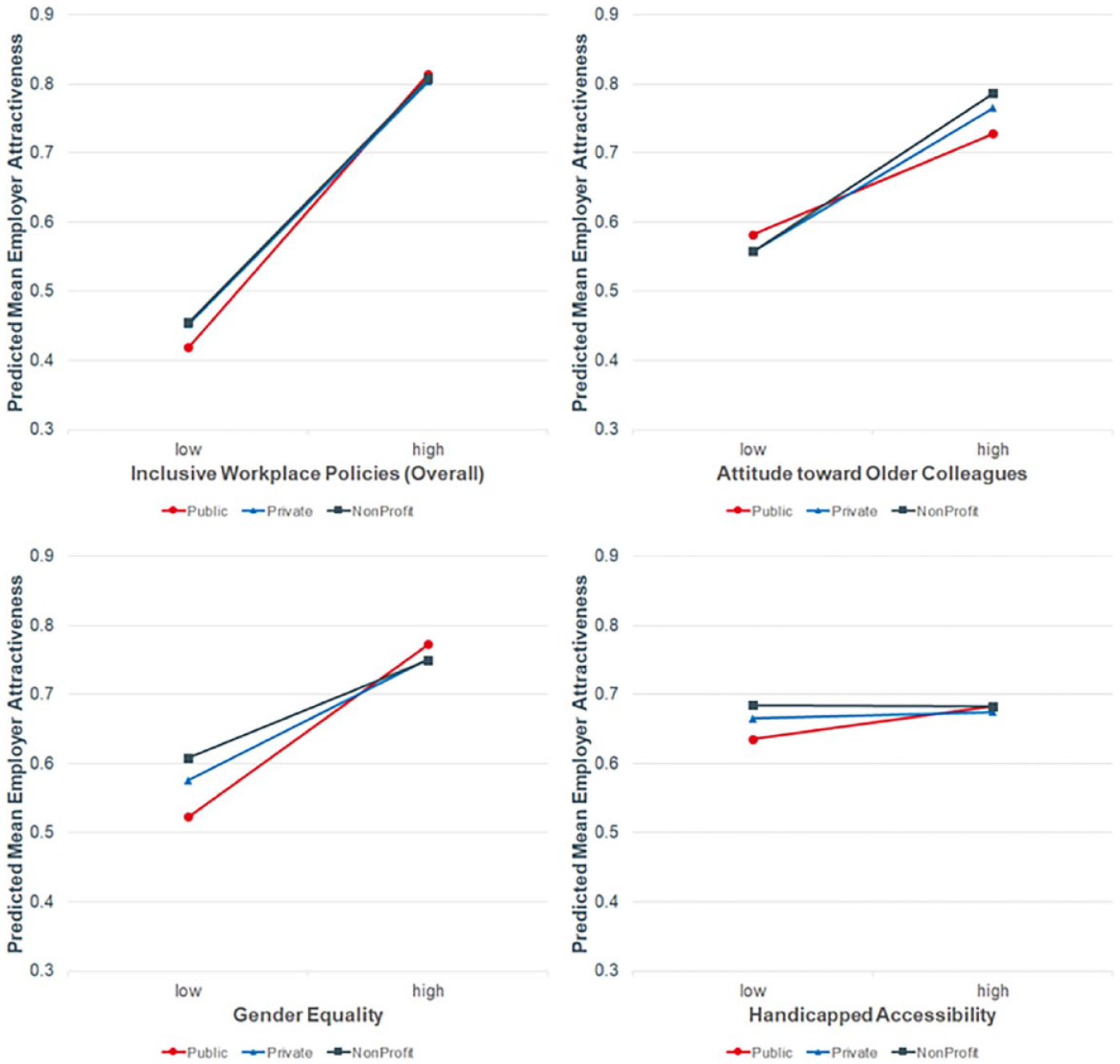
Interactions Between Inclusive Workplace Policies and Employment Sector (Predicted Margins).
Discussion and Conclusion
Public employers have increasingly engaged in inclusive workplace policies and practices (e.g., Alang et al., 2022; Atkinson et al., 2022; Groeneveld & Verbeek, 2012; Jiang et al., 2022; Moon, 2018), but previous research has not clarified if and how such investments pay off in terms of employer attractiveness. This study uses a unique dataset from an employer review platform to provide evidence that the provision of inclusive workplaces is indeed positively and significantly related to employer attractiveness, as employees who rate their employer favorably on inclusiveness criteria are substantially more likely to recommend their workplace to others than employees who provide worse ratings. This general result remains across all three employment sectors as well as across all three dimensions of inclusiveness that were covered in the rating criteria (i.e., inclusion of disabled, elderly, and women). The findings suggest that inclusive workplace policies constitute a “business case” (Johns et al., 2012) also with regard to employer attractiveness. Given that employers in many Western societies find it increasingly difficult to attract and retain a qualified workforce (OECD, 2021), these research results may suggest an important additional reason for employers to engage in and signal inclusive workplaces.
This conclusion is shown to be even more crucial for the public than for private and nonprofit employers. Public organizations are particularly challenged to be attractive employers because they increasingly compete for labor with private employers. Researchers have repeatedly suggested that public employers perform poorly in this competition, falling short of private employers (e.g., Bright & Graham, 2015; Fowler & Birdsall, 2020; Lewis & Frank, 2002). Consequently, it is worth repeating that the recommendation rates of employers are highest for the public sector (although this difference occurs only at a low level of statistical significance; Table 3). At the same time, moderation analysis shows that the association between inclusive workplaces and employer attractiveness is significantly stronger in the public than in the private sector. This implies that public employers will benefit even more from engagement in inclusive workplace policies than private employers because such policies translate more strongly into employer attractiveness. Inclusive workplaces may therefore help public employers to further differentiate themselves from private employers in labor markets. Corresponding branding strategies are worth considering even more, as inclusive workplace policies align with other goals of public organizations, such as the representativeness of the workforce (Groeneveld & Verbeek, 2012).
Upon further inspection, the moderating effect of the employment sector replicates in two of the inclusiveness dimensions (i.e., gender equality and handicapped accessibility). In the third dimension (i.e., attitudes toward older colleagues), however, the analysis reveals the reverse effect, so that ratings are less strongly associated with recommendations of public employers compared with private ones. An interpretation of this finding is open to speculation, given that discrimination against elderly people has not, to best of our knowledge, yet been researched at public sector workplaces or compared across multiple employment sectors. While the ratings of attitudes toward older colleagues do not differ between the sectors in meaningful magnitudes (Table 3), official statistics suggest that in Germany, the share of employees aged 55 or older is substantially higher in the public sector than in the general working population (DGB, 2020). The stronger representation of older employees in public service may make baby boomers a more “natural” part of the workforce (IPMA-HR, 2016). Therefore, they represent a better-integrated part of the workforce so that positive attitudes to the elderly become more taken for granted beyond full awareness and acknowledgment. In turn, and somewhat paradoxically, this aspect may lose relevance in employer referrals because it may no longer be salient to the employees to the same extent as in the private sector. This interpretation, however, needs empirical substantiation in further research.
The results also contribute to the literature on sector preferences in employment decisions. The PSM movement has suggested that people join public employers for the pro-social employment attributes they offer (Asseburg et al., 2020; Korac et al., 2019; Perry & Wise, 1990). Although PSM refers to employees’ outward orientation to citizens and society at large, it is a pro-social motivation that will not stop at caring and helping behaviors toward co-workers within the organization (Homberg et al., 2019; Ingrams, 2020). Arguably, inclusive workplace practices are pro-social behaviors aimed at potentially disadvantaged colleagues so that these results are largely in line with the foundational assumptions of PSM. They also echo empirical evidence that social support and cohesion at the workplace matter more for the public than for private sector employees (e.g., (Buelens & van den Broeck, 2007; Ko & Jun, 2015; Vogel & Satzger, 2022). This investigation suggests that such preferences extend beyond the pre-entry stage and persist at the retention stage, thus surviving potential “reality shocks” during the course of socialization into public service (Kjeldsen & Jacobsen, 2013; Schott et al., 2019).
Practical Implications
This study encourages public sector employers to initiate inclusive workplace policies if their goal is to increase their attractiveness in the labor market and to capitalize on differences with competitors, notably those from the private sector. Internal and external employer branding strategies could achieve this by sending signals of inclusiveness to current and prospective employees, thus building an image of a caring employer who engages in equal treatment and offers equal opportunities in the workplace. Although public employers are likely to be credible senders of such messages because the content resonates with their organizational mission, relevant certificates and awards may be further means of employer branding, providing visible signals for targeted communication with potential recruits. The millennial generation, which has increasingly demanded diversity, equity, and inclusion policies from their employers (Ng et al., 2010), is especially likely to respond favorably to such signals. In the face of future waves of employees leaving the public service due to retirement (OECD, 2021), the millennial target group is particularly attractive to employers. It is important that public employers should align actual practices of inclusiveness with their intended policies to satisfy the internal targets of their employer branding. This study has built on referrals from current and former employees who are likely not only to rate official workplace policies but also, and even more so, the practices and principles that flow from these policies and are enacted, or not, on a daily basis. Walking the inclusive workplace policies talk is thus recommended to avoid disconfirmation of expectations and to foster employee retention. Retention at post-entry stages of the HR cycle is all the more important, as it feeds back to the pre-entry stages given that WOM is an important recruitment channel (Evertz et al., 2019; Melián-González & Bulchand-Gidumal, 2016).
Limitations
While this study provides a number of advantages, there are also some limitations to bear in mind when interpreting the results. First, online employer review platforms were not originally designed for scholarly purposes. They, therefore, provide only a limited amount of useful measures, which can be a threat to the internal validity of the research. The study was also limited to three items reflecting different dimensions of inclusiveness at the workplace. While these items include dimensions that have so far rarely been studied in the field of public management (i.e., inclusion of elderly and disabled people), inclusiveness at the workplace has many more facets that were not covered. Moreover, due to the platform’s rigorous policy of anonymity, we could not identify any information that could have been used as socio-demographic control variables, such as the raters’ personal age, gender, and occupation characteristics. This made it impossible to test the sample for the representativeness of the general workforce in Germany.
Second, while online reviewer platforms should be advantageous data sources in terms of external validity because they engage real employees in real evaluations of their employers, they lack the more controlled environment characteristic of scholarly surveys and experiments, resulting in some “noise” in the data. For example, benevolent fake reviews, which have been initiated based on employers’ strategic considerations, may be an issue given that employers become increasingly aware of the importance of electronic WOM in recruitment. However, rating platforms should still be a credible source of firsthand information about employers, simply because the vast majority of employees have no particular interest in promoting their employer (van Hoye & Lievens, 2007). Besides, as the main research focus has been on sector differences, remaining noise in the data should be an issue only to the extent to which it is not distributed randomly across the sectors. It should also be noted that potential response biases are not limited to user-generated data on online platforms but may also affect conventional questionnaires in survey designs.
Third, a German-speaking platform was used and data were collected only for organizations that are based in Germany. This particular setting has to be taken into account when considering the generalizability of the findings. Preferences for and conditions of employment in the public, private, and nonprofit sectors vary along a broad range of national and administrative cultures and systems (Pollitt & Bouckaert, 2017; van der Meer et al., 2015). The same applies to inclusive workplace policies, which are subject to political and legal regulations that differ across countries (Groeneveld & Verbeek, 2012). In Germany, inclusive workplace policies are more strongly institutionalized in the public than in the private sector. For example, some legal requirements, such as the obligation to employ people with disabilities, are contingent on the number of employees. Since public organizations are most often large entities, those legal obligations almost always apply to them, whereas they may not pertain to private organizations. Moreover, employers can voluntarily go beyond the General Act on Equal Treatment and establish additional measures, which public employers do more obviously and visibly than private employers. For instance, almost all job advertisements in the public sector include a disclaimer that priority will be given to the underrepresented gender in cases where applicants are equally qualified, while this is not true for the private sector. The stronger coercive and normative pressure to adopt inclusive workplace policies in the public compared with the private sector may explain our findings to some extent, because the more salient such policies are, the more they may be appreciated in employer ratings. Accordingly, this study’s findings may not simply be generalized to countries whose inclusion policies and employment systems differ profoundly from those in Germany.
Concluding Remarks
Despite these limitations, this study contributes to the emerging literature on inclusive workplace policies in the public service by adding a large-scale analysis of their association with employer attractiveness. The ways in which such policies resonate in the general working population has increasingly been an open issue, because inclusion policies are subject to controversial societal debates that unfold in response to race-related mega-threats (e.g., Corrington et al., 2022; Leigh & Melwani, 2019). The results suggest that, despite enduring resistance to inclusive societies and the media attention that its opponents sometimes receive, employees generally appreciate inclusive workplaces and respond with favorable evaluations of and referrals for their employers. Creating inclusive workplaces and facilitating employer attractiveness are two major challenges that public organizations are currently facing, and there is no lack of good reasons for public managers to invest considerable attention and resources to counter these challenges. This research establishes a link between both issues and aligns them, as the results suggest that inclusive workplace policies can be a lever to increase employer attractiveness.
Future research to elaborate on this link between inclusiveness and attractiveness of public organizations, for example, by addressing a broader range of inclusiveness dimensions, is cordially encouraged. The detailed findings show that the moderating effect of each employment sector may indeed vary not only in strength but also in sign across different dimensions of inclusiveness. A similar promising avenue for future research would be to combine cross-sectoral with cross-cultural comparisons and to conduct similar studies in various countries. Some online review platforms operate internationally in several languages and may provide comparative data, as long as the rating criteria reflect workplace inclusiveness to a sufficient extent. Even more theoretical and practical insights could be gained if ratings and recommendations could be matched with information regarding the raters’ personal characteristics: age, sex, race, and ethnicity may all have different implications for different dimensions of inclusiveness. For instance, female employees are likely to find equal opportunity policies more important than their male counterparts (UN Women Data Hub, 2023). It would be instructive, for the sake of tailoring HR strategies to specific target groups, to better understand how employees’ personal characteristics influence their perception of the different dimensions of inclusive workplace practices and polices and, subsequently, their employer recommendation. However, confidentiality policies of the platform providers usually erect high barriers that researchers have to conquer to access users’ personalized information. Finally, disentangling the impact of official workplace policies and actual practices, and the degree of match or mismatch between both, will deepen the understanding of how inclusion at the workplace contributes to employer attractiveness along the HR cycle.
Supplemental Material
sj-docx-1-ppm-10.1177_00910260231187536 – Supplemental material for Do Inclusive Workplace Policies Foster Employer Attractiveness? Comparative Evidence From an Online Employer Review Platform
Supplemental material, sj-docx-1-ppm-10.1177_00910260231187536 for Do Inclusive Workplace Policies Foster Employer Attractiveness? Comparative Evidence From an Online Employer Review Platform by Melissa Satzger and Rick Vogel in Public Personnel Management
Footnotes
Declaration of Conflicting Interests
The author(s) declared no potential conflicts of interest with respect to the research, authorship, and/or publication of this article.
Funding
The author(s) received no financial support for the research, authorship, and/or publication of this article.

Supplemental Material
Supplemental material for this article is available online.
Author Biographies
References
Supplementary Material
Please find the following supplemental material available below.
For Open Access articles published under a Creative Commons License, all supplemental material carries the same license as the article it is associated with.
For non-Open Access articles published, all supplemental material carries a non-exclusive license, and permission requests for re-use of supplemental material or any part of supplemental material shall be sent directly to the copyright owner as specified in the copyright notice associated with the article.
