




Abstract
Sector preferences in job choice have rarely been tested empirically across different administrative systems. We address this gap and apply a between-subject experimental design to examine the attractiveness of public, private, and nonprofit employers in two countries in different administrative traditions. Respondents (n = 362) from an Anglo-Saxon (i.e., the U.S.) and continental European country (i.e., Germany) were exposed to job advertisements that only differed in the employer’s sector affiliation, with other job attributes, such as payment and working hours, held constant. Contrary to expectations, and consistently across the two country samples, respondents evaluated public sector jobs more positively compared to vacancies in the private sector. In contrast, we found no such comparative advantage of public over nonprofit employers. By providing counterevidence to the prevalence of negative attitudes toward public organizations, our study warns against overgeneralizing previous findings on negativity biases to the context of employer attractiveness.
Keywords
Introduction
When young and highly qualified people enter the job market—do they have a preference for or against public sector employers, all else being equal? Or does the sector affiliation of their future employers not matter at all in their job choice? This is an important issue in times of rapidly aging societies (Gagnon, 2014), and the attraction of talent to public sector careers is particularly urgent. Public organizations increasingly compete with employers from other sectors for highly educated staff (Bright & Graham, 2015; Fowler & Birdsall, 2020). At the same time, many scholars and practitioners are concerned about how well—or how badly—public employers perform in this “war for talent.” The National Commission on the Public Service (2003) came to the conclusion that “too few of our most talented citizens are seeking careers in government” (p. iv). As Linos (2018, p. 67) states, “the number of people interested in government jobs has steadily declined” since then. Fowler and Birdsall (2020, p. 532) hence put forward the question: “Why are the best and brightest eschewing the public sector for employment in private and nonprofit sectors?”
Despite considerable scholarly interest in public sector attraction and recruitment (Korac et al., 2019; Piatak et al., 2021), it is surprisingly difficult to identify from previous research if the public sector attracts or repels young people starting their careers. A considerable body of literature examines how particular motivational dispositions or preferences for employment attributes drive attraction to public organizations, but most studies in this stream do not consider choices between employment opportunities in different sectors. Other studies compare organizational characteristics or more direct employment incentives across sectors but do not allow for inference on sorting effects because responses of potential applicants remain unobserved. Only few studies examine whether job seekers respond to recruitment signals from different sectors of employment and whether they have a preference for or against the public sector vis-à-vis other sectors (Fowler & Birdsall, 2020; Rose, 2013). While these studies allow for the tentative conclusion that public sector employers often have a competitive disadvantage compared to employers from other sectors (notably the private sector), it is difficult to generalize this finding because the few available results were gathered in different settings and did not arrive at univocal conclusions.
An important source of variation in the attractiveness of employers from different sectors is the country context (Van de Walle et al., 2015). Generalizing findings from one country to another is risky at best because administrative cultures, public employment systems, and general attitudes toward the public sector differ profoundly between countries (Kuhlmann & Wollmann, 2019; Painter & Peters, 2010; Pollitt & Bouckaert, 2017). For example, in Anglo-Saxon countries, the share of people working in the public sector is lower and skepticism toward government more wide-spread than in many continental European welfare states, where people place more trust in government and attribute more responsibility to the public sector (Esping-Andersen, 2013; Kuhlmann & Wollmann, 2019). Such structural and cultural differences suggest considering the country context when comparing employer attractiveness across sectors. This comparative view broadly resonates with the claim that “context matters” in public management (Meier et al., 2017); a claim that has received too little attention in empirical research so far.
We address these gaps and examine how young and highly educated people in Germany and the U.S. perceive the attractiveness of employers across different sectors. How does perceived employer attractiveness of public sector employers differ in this target group compared to private and nonprofit employers? And do these differences, if they exist, hold for Germany and the U.S. in the same pattern? We focus on these countries because they are almost archetypical representatives of different administrative traditions. While the U.S. is a prime example of the Anglo-Saxon public interest culture with wide-spread skepticism toward government, Germany is a representative of the continental European rule-of-law culture with a more etatist tradition (Kuhlmann & Wollmann, 2019). However, in both countries, as in many OECD countries, the workforce is shrinking due to higher life expectancies and aging populations (Gagnon, 2014; Linos, 2018).
We address our research questions in a between-subjects experimental study with students in the U.S. and Germany across a broad range of subjects within the social sciences (n = 362). Respondents were randomly assigned to job advertisements that differed only in the sector of employment (public, private, nonprofit), holding all other job characteristics constant across the experimental groups. Contrary to expectations, results show that respondents evaluate the same jobs more positively when offered by a public, rather than a private, employer, while no such comparative advantage of public over nonprofit employers exists. This finding is consistent across the U.S. and German subsamples, suggesting that—at the time of data collection amid the COVID-19 pandemic—in neither of the countries young professionals who enter the job market hold a negativity bias toward public sector employers. With these results, our study contributes to the literature in three ways. First, we expand the still small body of cross-sectoral research on employer attractiveness by providing new and counter-intuitive evidence on the position of public employers in the competition for young talents. Second, we also consider the country context and provide one of the few cross-country comparisons of sorting effects between different employment sectors. Third, and in more practical terms, our study responds to calls for more research on employer branding of public organizations (Keppeler & Papenfuß, 2021; Ritz & Waldner, 2011; Van der Wal & Oosterbaan, 2013), as the results have important implications for Human Resources (HR) managers who design and implement recruitment strategies in the public sector.
Literature Review and Hypotheses
As it is increasingly difficult to fill vacancies in the public sector, recruitment and employer branding are a growing challenge for public organizations (Asseburg et al., 2020; Keppeler & Papenfuß, 2021). A considerable body of research in public administration scholarship and beyond has addressed the employer attractiveness of public sector organizations. This literature, however, provides surprisingly little evidence as to whether job seekers discriminate for or against the public sector when they have the choice, which frequently applies to young talents with multiple job offers from different sectors of employment. A first stream of research examines individual preferences for employment in the public sector (Korac et al., 2019). This literature has covered a broad range of employment characteristics, providing insights into how preferences for such characteristics translate into attraction to public sector employers. For example, a plethora of studies on public service motivation (PSM) has demonstrated that PSM drives job seekers toward employment in the public sector (Asseburg & Homberg, 2020). Building on this insight, further studies have focused on how public employers can send specific recruitment messages to address target populations with high levels of PSM (e.g., Asseburg et al., 2018; Linos, 2018; Vandenabeele & Jager, 2020; Weske et al., 2020). Other studies have focused on more tangible employment characteristics that address extrinsic motivations, such as job security, economic concerns, and career advancement (e.g., Lewis & Frank, 2002; Su & Bozeman, 2009). However, if studies focus on job seekers’ attraction to employers from one sector only, they have little informative value regarding choices between employers from different sectors.
A second stream of research includes between-sector studies and compares organizational characteristics and employment incentives across these sectors. Studies in this stream, however, do not observe if and how job seekers receive and respond to these signals. A large number of studies, notably from economics, use large-scale employment data and examine wage differentials between public and private sectors, with inconclusive evidence (e.g., Choi & Garen, 2021; Murphy et al., 2020; Sławińska, 2021). Other studies investigate how organizational characteristics, and employees’ perceptions thereof, differ across sectors. For example, public managers have shorter working hours than nonprofit managers (Feeney & Bozeman, 2009) but perceive higher levels of organizational red tape and lower levels of personnel flexibility (Feeney & Rainey, 2010). Still other studies ask for more direct employment incentives, such as performance pay, promotion opportunity, and job security; they find cross-sectoral differences in workers’ or managers’ perceptions of these incentives (Borzaga & Tortia, 2006; LeRoux & Feeney, 2013). These results are consistent with findings that employees’ value preferences, work motivations, and job satisfaction differ between the sectors (Heywood et al., 2002; Lee & Wilkins, 2011; Van der Wal et al., 2008). However, all of these results imply the studied characteristics and incentives neither have actually triggered sorting effects among those who already work in different sectors (Willems, 2014) nor that they will trigger such effects among future applicants. As long as application intentions and job choices remain unstated or unobserved, little is known about preferences for or against public sector employers vis-à-vis competitors from other sectors.
A third stream of research is more informative with regard to sector preferences among job seekers, as these studies measure such preferences in the presence of employment opportunities in multiple sectors. This, however, applies only to a relatively small number of studies, and evidence is still unclear. Lee and Choi (2016) report that a majority of respondents in a mixed sample of undergraduate college students at five South Korean universities would opt for the public sector if they had the choice between different sectors of employment. Van der Wal and Oosterbaan (2013) report that MBA and MPA students in the Netherlands are almost tied in their sector preferences, with a slight majority preferring the private over the public sector. Van de Walle et al. (2015), building on population data from the International Social Survey Programme (ISSP), show that in most OECD countries, only a minority of employees would work for the government or the civil service if they had the choice between sectors. Fowler and Birdsall (2020) demonstrate that law school graduates in the U.S. have a predisposition in job choice toward the private and nonprofit sector; a finding that corresponds to earlier evidence presented by Erlanger et al. (1996). Pedersen (2013) finds a similar distribution among bachelor and master students of economics, political science, and law at two Danish universities who were asked for their sector preferences after graduation, all job characteristics being equal. Santinha et al. (2021) report that a clear majority of students across a broad range of subjects at a Portuguese university prefer employment in the private sector over the public and nonprofit sector when asked for their future career intentions.
The literature reviewed above suggests scholarship on job seekers’ preferences and choices among employment opportunities in different sectors is limited when it comes to observing these preferences and choices in a comparative design. The research allows the tentative assumption that potential applicants will be less attracted to public sector employers than to employers from the private and nonprofit sector. This assumption builds on the premise that the sector of employment serves as a simple cue in recruitment signals that is relevant to potential applicants. Research suggests job seekers indeed use the signals received in the pre-entry stage of recruitment to make inferences about the job and the employer, which have an impact on their job choice (Harold et al., 2014).
Hypotheses
Recent research on negative stereotypes about public services and employees provide further support for a competitive disadvantage of public employers in labor markets. Scholarship in this stream has detected a negativity bias in people’s thinking about the performance of governmental organizations, which persists even at the presence of counterevidence and distorts evaluations to the disadvantage of the public sector (Andersen & Hjortskov, 2016; Hvidman & Andersen, 2016; Marvel, 2015, 2016). Hvidman and Andersen (2016) found the word “public” is a semantic cue that triggers negative attributions to organizations, such as higher levels of bureaucracy and lower levels of efficiency and effectiveness. These findings resonate with research on prevailing negative associations with public employees, culminating in the stereotype of the lazy bureaucrat (Van de Walle, 2004). Research in HRM provides long-standing evidence that recruitment outcomes are contingent on the public image of organizations (e.g., Cable & Turban, 2003; Lemmink et al., 2003; Lievens & Slaughter, 2016). Particularly in the early stages of recruitment, candidates infer employer attractiveness not only from manifest information about the advertised job but also from more subtle images about the organization itself (Chapman et al., 2005), suggesting that the general image spills over to the image of the same organization as an employer (Younis & Hammad, 2021). While none of the reviewed studies provides an exhaustive justification for our first pair of hypotheses when considered separately, they show a tendency when arranged into a puzzle. We conclude from this reasoning and supporting evidence:
H1a-b: Potential applicants will be less attracted to public sector organizations than to employers from (a) the private and (b) the nonprofit sector.
An important source of variation in preferences for employers from different sectors is the national context, as countries differ in administrative systems and cultures, in general work values and more specific attitudes toward public employers, and in the structure and dynamics of labor markets. Indeed, while Van de Walle et al. (2015) show that the general population in a majority of OECD countries would choose the private over the public sector, there is also a number of countries in which the opposite holds true. Accordingly, the strength of attraction to public sector employment may also differ substantially between the two countries under study (i.e., Germany and the U.S.).
Since neither theory nor empirical research provides univocal and comprehensive arguments of why public sector attraction is clearly stronger in either Germany or the U.S., we develop competing hypotheses. The first line of reasoning draws on research on PSM and concludes that the public sector is more attractive in the U.S. than in Germany. As reviewed above, scholarship has repeatedly and largely consistently identified PSM as a major driver toward employment in the public sector (Asseburg & Homberg, 2020). Vandenabeele and Van de Walle (2008) constructed a PSM measure from the 2005 wave of the ISSP survey (ISSP Research Group, 2013) and show that PSM is substantially higher in the U.S. than in Germany. 1 This is broadly in line with two further and more recent cross-country studies: Both the Global Preferences Survey (GPS; Falk et al., 2016, 2018) 2 and the sixth wave of the World Values Survey (WVS; Inglehart et al., 2014) 3 provide compelling evidence that altruism is more prevalent in the U.S. than in Germany. This cumulative evidence implies that PSM and related values are more widespread in the U.S. than in Germany, which suggests the perceived attractiveness of a public employer should be higher in the U.S compared to Germany. Following this reasoning, we suggest:
H2a: Country context moderates the association between sector affiliation and employer attractiveness, such that the perceived attractiveness of a public employer is higher in the U.S. than in Germany.
There is also evidence that run counter to this hypothesis, suggesting that attraction to public sector jobs tends to be stronger in Germany than in the U.S. First, and most directly, the comparative study of Van de Walle et al. (2015) shows that the share of people who would prefer the public over the private sector for employment is substantially higher in Germany than in the U.S. The authors used data from the 2005 wave of the International Social Survey Programme on work orientations (ISSP Research Group, 2013). While in Germany, 46.8% of the labor force had a preference for public sector employment, this share was only 30.8% in the U.S. 4
Second, and consistent with these survey results, the general image of the public service is likely to be more positive in Germany than in the U.S. At the absence of more proximate indicators, the confidence in the public service in the general population may reflect this tendency. In the most recent wave of the WVS (Haerpfer et al., 2020), participants were asked to indicate their confidence in various societal institutions, including the public service. Results confirm that confidence in the public service is higher in Germany than in the U.S. 5 Similar results were obtained in large-scale surveys on people’s trust in government (ISSP Research Group, 2018; OECD, 2019). While neither confidence nor trust in government and public service are perfect indicators, they may serve as proxies for the general image of the public sector in the population. The survey results support the notion of cultural differences between the Anglo-Saxon and continental European administrative tradition (Kuhlmann & Wollmann, 2019). Skepticism toward the state and government is much more prevalent, and deeply rooted, in the former than in the latter. If the attractiveness of public organizations as employers interferes with the general image of the public sector, as we have argued above, public sector organizations should be more attractive for job seekers in Germany than in the U.S.
Third, monetary incentives for public sector employment are likely to be stronger in Germany than in the U.S. Although there is considerable economic research on wage differentials between public and private sectors, data is rare when it comes to compare such pay gaps in Germany and the U.S. on the same methodological basis. Therefore, Van de Walle et al. (2015) calculated their own index of wage differentials in 26 OECD countries, controlling for age, education, and gender. They found Germany is among the countries with the highest public sector wage premiums, whereas public sector wages in the U.S. are slightly below the average of private sector wages. This finding is consistent with other OECD data on public employment and pay (OECD, 2017). 6 In sum, the available data suggests that the public sector, compared to other sectors, provides stronger monetary incentives for employment in Germany than in the U.S. Our alternative hypothesis thus reads as follows:
H2b: Country context moderates the association between sector affiliation and employer attractiveness such that the perceived attractiveness of a public employer is higher in Germany than in the U.S.
Data and Methods
Sample
We collected data in the U.S. and Germany from June to October 2020. We commissioned a professional panel provider with the collection of data in the U.S. while the German data was collected by the research laboratory of a large German university. All respondents were graduate or undergraduate students who were enrolled in a study program falling into one of three categories of the OECD classification of tertiary education (OECD, 2020): social sciences, journalism and information; business, administration and law; information and communication technologies (ICT). University graduates represent a preferred target group of public sector recruiting and their behavior has been frequently studied (Asseburg et al., 2018; Bright & Graham, 2015; Christensen & Wright, 2018; Fowler & Birdsall, 2020; Ritz & Waldner, 2011). The final sample included 362 responses (nU.S. = 208, nGermany = 154). Table 1 displays the sample characteristics. The external validity of our study should be further increased by the fact that 66.6% of the participants responded that they were either currently looking for a job or will be looking for a job within the near future.
Sample Characteristics.
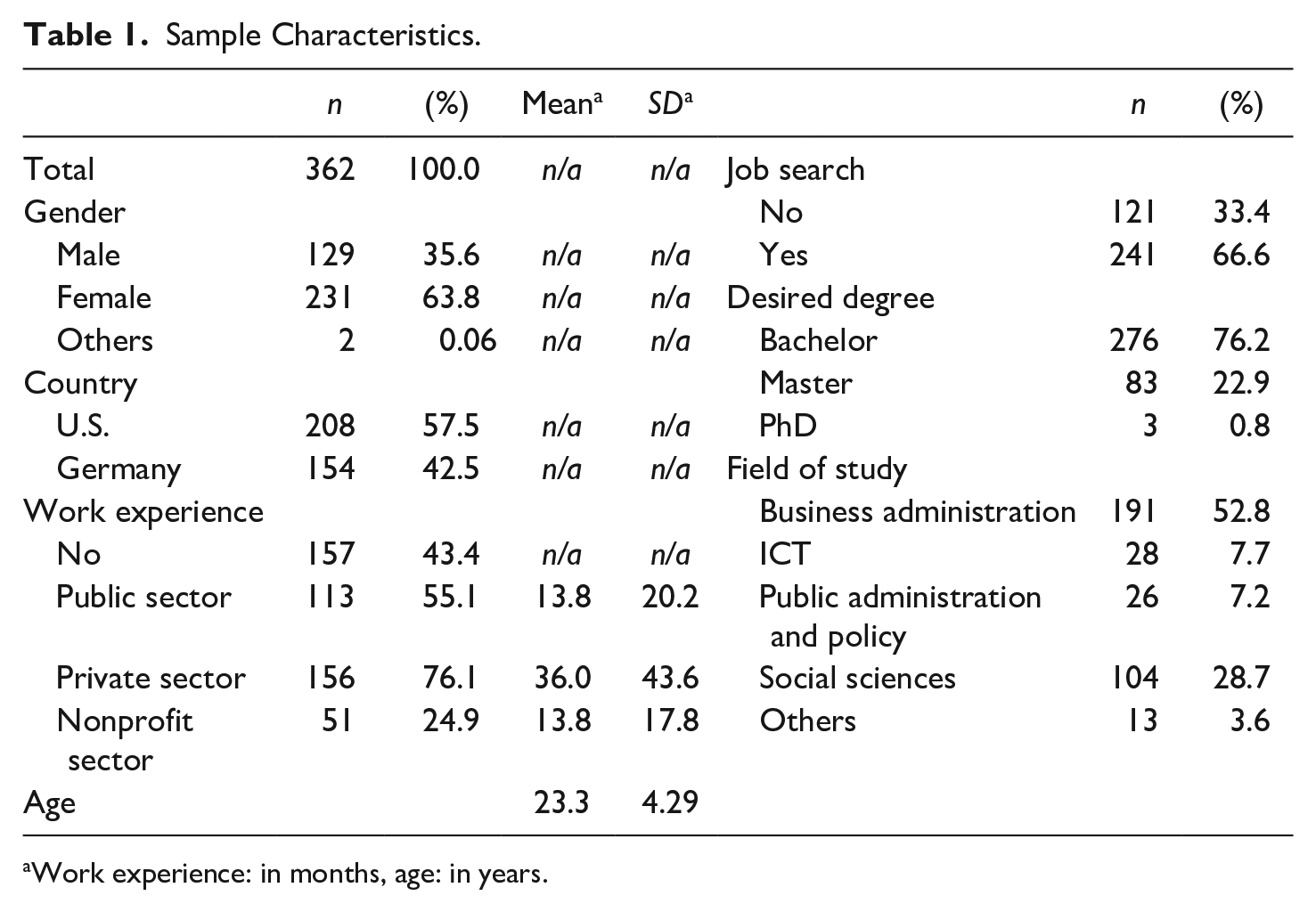
Work experience: in months, age: in years.
Procedure
We conducted a between-subjects randomized survey experiment in which respondents were exposed to job advertisements for university graduates. We thus join recent contributions to public management scholarship in using job advertisements as experimental stimuli (e.g., Asseburg et al., 2018; Cantarelli et al., 2020; Weske et al., 2020). Job advertising through online and print channels is a pervasive instrument to direct attention to a vacancy (Walker & Hinojosa, 2014). Job advertisements are often the first point of contact between potential applicants and employers, sending signals about the vacancy and the employer in order to inform job seekers, to create favorable attitudes, and to elicit intentions to apply (Rynes et al., 1991; Waldner, 2012).
We manipulated the content of the job advertisements and varied the sectoral affiliation of the employer across three conditions (i.e., public, private, nonprofit). Respondents were randomly assigned to one of three groups: 105 participants received the public job advertisement, 120 the nonprofit job advertisement and 128 the private sector job advertisement. We adopted the manipulations from a recent study by Weske et al. (2020). For example, the description in the public treatment was: “Our primary goal is to contribute to the common good by serving the diverse needs of society and fulfilling the government’s agenda. In doing so, we pay particular attention to act without prejudices toward any individual interests and to follow existing laws.” The English vignettes are provided in Appendix I. The type and amount of information was approximately the same in all experimental groups, as previous research found information volume and specificity is related to organizational attraction (Feldman et al., 2006). All other elements in the job advertisements, including job characteristics, such as responsibilities, salary, and working hours, were held constant across the experimental conditions. Since our aim was to address a wide range of respondents, the job descriptions were kept as neutral as possible and neither included an exact job title nor the location of the organization. After reading the job advertisements, participants were asked to fill in a questionnaire. This survey included the measurements of our dependent and control variables.
Measures
Survey items were adopted from validated psychometric instruments. The original English items were translated into German and back-translated into English to eliminate mistakes and ensure reliability (Mullen, 1995). The full item list in English and German is provided in Appendix II.
Dependent variable
Using the scale of Highhouse et al. (2003), we measured organizational attraction (α = .89) in three dimensions: general attractiveness, intention to pursue employment with the organization, and prestige. Sample items are “This organization is attractive to me as a place for employment” (general attractiveness), “I would accept a job offer from this organization” (intention to pursue), and “This is a reputable organization to work for” (prestige). Participants responded on a 7-point Likert scale ranging from 1 = “strongly disagree” to 7 = “strongly agree.”
Independent variables
Among the independent variables are the experimental manipulations (public, private, nonprofit) as outlined above. These variables are dummy-coded, with the private sector affiliation as a dummy category. As we hypothesize country differences in the attraction to employment sectors, we created a country dummy to distinguish between the German and the U.S. sample.
Control variables
We collected several socio-demographic characteristics of the respondents, as previous studies in the field of employer attractiveness have frequently also controlled for these demographics. Among these controls were age, gender (male, female, others), desired degree (bachelor, master, PhD), and field of study. As for the field of study, we clustered the responses to an open question about the respondents’ study programs in order to arrive at a classification that is more fine-grained than the OECD system and fits the purpose of our study better. Finally, we accounted for five groups: (1) business administration, (2) public administration and policy, (3) social sciences, (4) information and communication technology, and (5) others. We included this control variable because previous research has found that sector preferences in job choices differ across study programs (Pedersen, 2013). We also asked respondents for their work experience within the particular sectors, and whether they are or will be looking for a job in the near future or were not searching for a job at the time of the survey (job search).
Manipulation Check
We included an instructional manipulation check at the end of the questionnaire to ensure the scenario was properly understood and the experimental manipulation was effective (Shadish et al., 2015). Participants had to indicate which sector corresponded to the job advertisement they had previously been shown. If respondents failed the manipulation check by providing a wrong answer, they were excluded from the survey.
Results
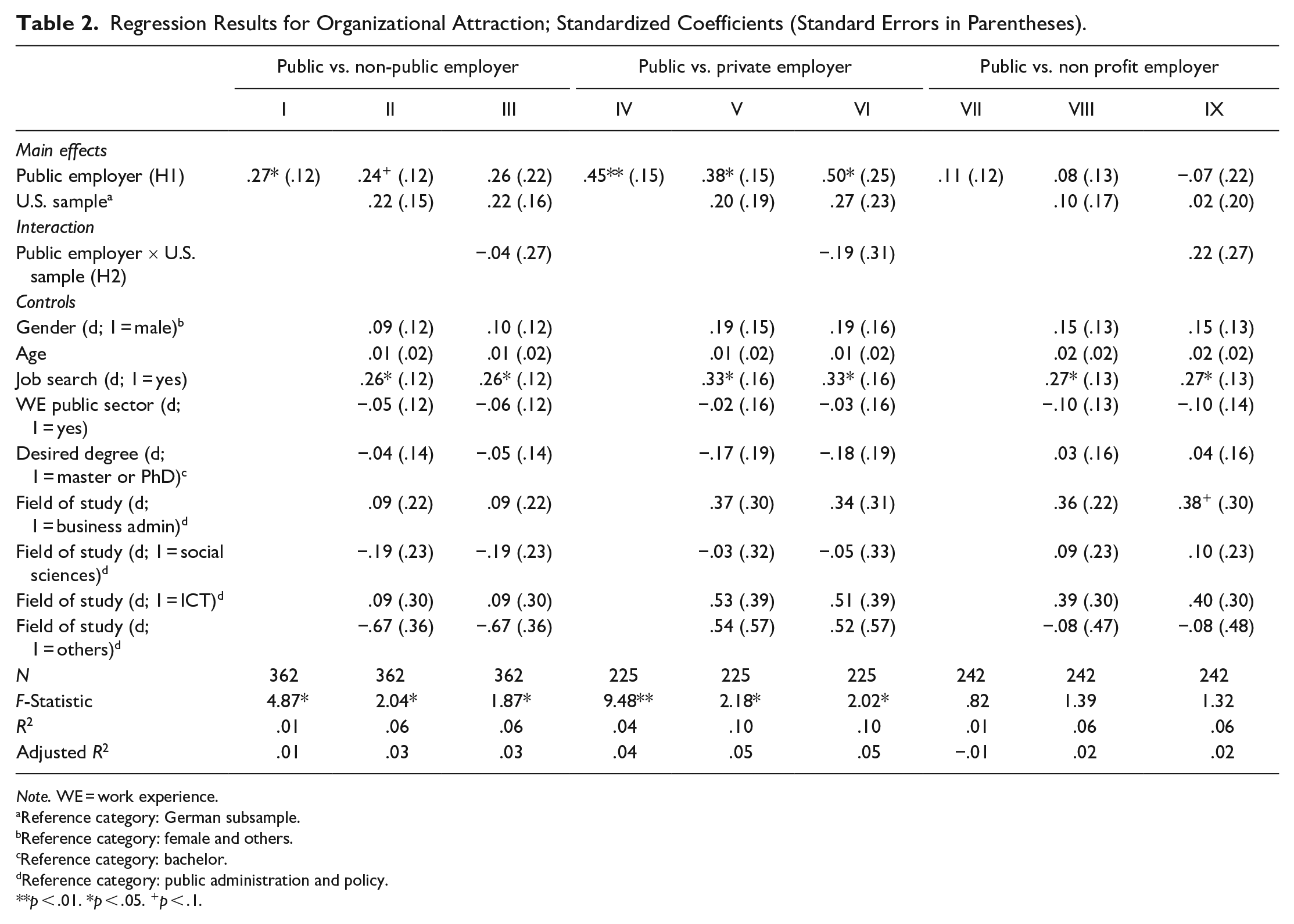
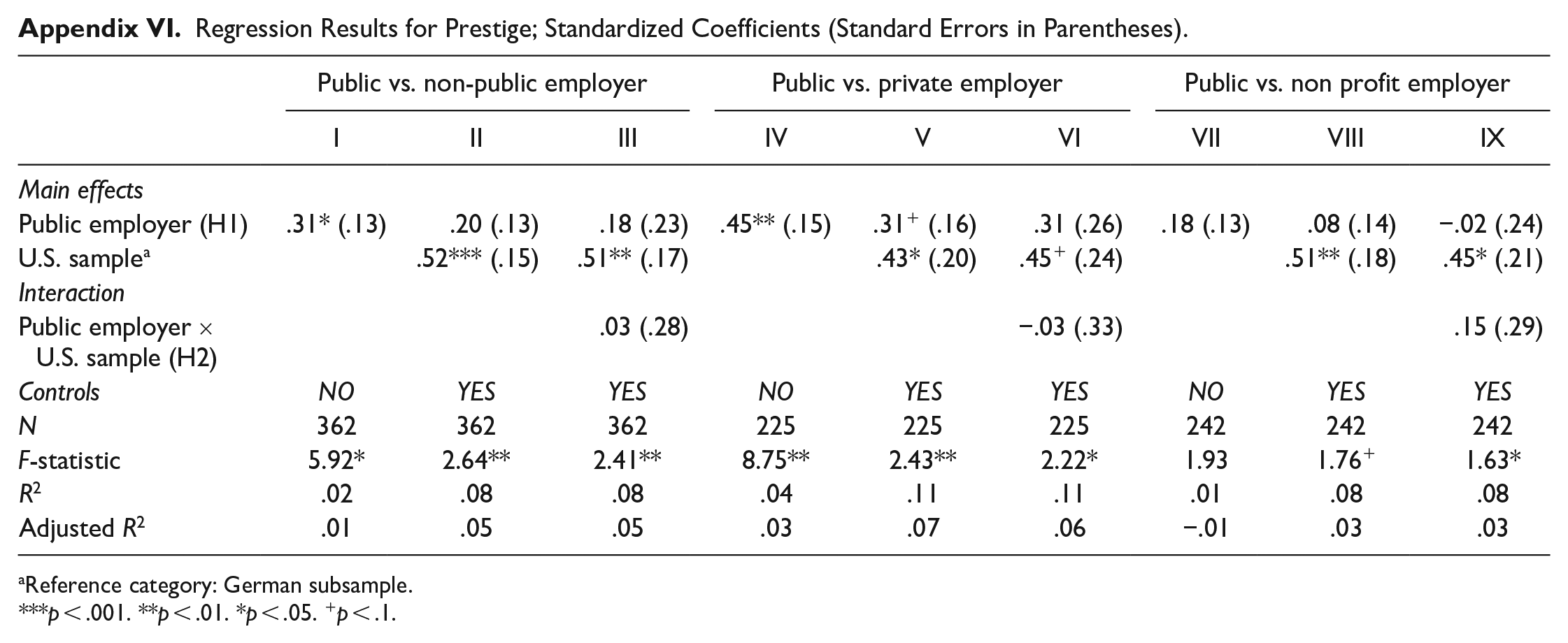
Appendix III shows means, standard deviations, and intercorrelations of all study variables. The results of linear regression analyses are displayed in Table 2, with organizational attraction as dependent variable. The main predictors, and interactions thereof, stepwise enter the models as dummy variables, indicating to which job advertisements respondents were exposed and whether they were sampled in Germany or in the U.S. Models I–III compare the public sector treatment to a joint reference category of both the private and nonprofit sector treatments. Models IV–VI show the public sector treatment in comparison to the private sector treatment, whereas Models VII–IX do the same for the nonprofit sector treatment as reference category. Appendices IV–VI include the same models with the three subdimensions of organizational attractiveness (i.e., general attractiveness, intention to pursue a career, and prestige) as dependent variables.
Regression Results for Organizational Attraction; Standardized Coefficients (Standard Errors in Parentheses).
Note. WE = work experience.
Reference category: German subsample.
Reference category: female and others.
Reference category: bachelor.
Reference category: public administration and policy.
p < .01. *p < .05. +p < .1.
Hypothesis 1 states that potential applicants will feel less attracted to an employer in the public sector than to an employer in the private (H1a) and nonprofit sector (H1b). Contrary to this expectation, we find the opposite of the hypothesized effect for the public-private comparison. All else being equal, in comparison to the private sector reference category, respondents in the public sector treatment show higher levels of organizational attraction (Model IV: b = 0.45, p < .01). Similarly, the public sector job has a positive treatment effect on organizational attraction compared to the nonprofit sector treatment, but this effect is insignificant (Model VII: b = 0.11, n.s.). When pooling the private and nonprofit sector treatments to a joint reference category, the public sector treatment still has a positive and significant effect on organizational attraction (Model I: b = 0.27, p < .05). We thus do not find support for Hypotheses 1a and 1b.
Hypotheses 2a and 2b suggest that country (i.e., U.S. vs. Germany) moderates the association between sector affiliation and employer attractiveness, with competing expectations regarding the direction of this moderation effect. Yet, we do not find such interaction effects (Table 2). Neither German nor U.S. respondents feel significantly more or less attracted to public organizations, no matter what the reference category is (Model III: b = −0.04, n.s.; Model VI: b = −0.19, n.s.; Model IX: b = 0.22, n.s.). Therefore, we reject Hypotheses 2a and 2b.
We included control variables in some models. Only one of the controls shows an impact on organizational attraction at conventional levels of statistical significance: Respondents who were searching for a job at the time of the survey consistently report higher levels of organizational attractiveness across all model specifications (e.g., Model III: b = 0.26, p < .05). The latter effect further supports the external validity of our survey experiment, as vacancies should attract more attention among job seekers than among non-job seekers.
Discussion
As the workforce is shrinking in most Western countries (Gagnon, 2014), the public sector increasingly competes with private and nonprofit employers for young and highly educated staff. While there is considerable research on the employer attractiveness of public organizations, evidence from comparative research remains scarce because many previous studies either have had an exclusive focus on the public sector or have not observed job seekers’ attitudinal, intentional, or behavioral responses to employment signals from different sectors. The remaining studies are few in number, suggesting public employers often take second place to private companies in the war for talent. The present study has added to this stream of research and conducted cross-sector and cross-country comparisons in order to determine whether potential applicants evaluate the same advertised job differently, depending on the sector affiliation of the employer. Although or just because we do not find our hypotheses confirmed, our study has a number of important implications.
Most importantly, our results do not confirm the cursory wisdom that public employers suffer from lower employer attractiveness and that potential applicants prefer private and nonprofit employers instead. Quite the contrary, our respondents felt more attracted to public organizations and also rated their prestige as higher than the prestige of private employers. This finding is contradictory to a number of studies that found the opposite effect (Erlanger et al., 1996; Fowler & Birdsall, 2020; Pedersen, 2013; Santinha et al., 2021; Van de Walle et al., 2015). It should be noted, however, that these studies differ strongly in the sampled target groups of public sector recruitment. In a similar vein, our focus was on a particular age group with high levels of education in a particular field of studies (i.e., social sciences). The range of public sector professions is broad, and sector incentives for employment, such as pay gaps, differ substantially across these professions. Furthermore, much has been written on shifting work values of young generations entering labor markets in general and public sector careers in particular (AbouAssi et al., 2019; Ng & Gossett, 2013). As preferred job characteristics differ between generations, implications for employer branding derived from this study are limited to a young generation. Less recent studies (Erlanger et al., 1996; Pedersen, 2013; Van de Walle et al., 2015) may have yielded other results because work values among young people may have shifted since then. Given the growing emphasis on job security and work-life balance, the public sector may be back in fashion.
It follows that public sector attraction is a scholarly and practical puzzle with many pieces. In addition to national differences between administrative systems, employer attractiveness of public organizations is likely to interfere with both professional and generational aspects. These and other contingencies should be a warning against overgeneralizations: If negative attitudes toward public services and employees exist, which the literature suggests (Hvidman & Andersen, 2016; Marvel, 2015, 2016; Van de Walle, 2004), we do not find evidence that they are reflected in evaluations of employer attractiveness. This is despite the fact that we sampled among students with no or rather little work experience (see Table 1), who tend to have a cliché picture of the public sector compared to people with more work experience (Van der Wal & Oosterbaan, 2013). Reputational judgments about public organizations are multifaceted and may not at all be negative (Willems, 2020).
A further surprising result of our study is that we found no country differences in public sector attraction between German and U.S. respondents. Since our hypotheses development could not build on univocal and comprehensive evidence as to whether public sector attraction is higher in either of these countries, it is possible that opposing mechanisms cancel each other out at an aggregate level. For example, the public sector wage premium tends to be higher in Germany than in the U.S. (OECD, 2019; Van de Walle et al., 2015), whereas PSM and associated values are more salient in the U.S. than in Germany (Falk et al., 2018; Haerpfer et al., 2020; Vandenabeele & Van de Walle, 2008).
Practical Implications
In practical terms, our study puts forward considerations of employer branding in the public sector (Ritz & Waldner, 2011; Van der Wal & Oosterbaan, 2013; Weske et al., 2020). HR managers in the public sector may consider emphasizing, rather than avoiding, signals in employer branding and other recruitment activities that highlight public sector characteristics. This is in contrast to recommendations by Van de Walle (2004) and Willems (2020), who suggest focusing on professions in order to avoid the activation of negative stereotypes in more abstract judgments about the public sector. We find that the signal of “publicness” may not at all be disadvantageous in employer branding and recruitment messaging. For instance, employer brands may highlight the fulfillment of government’s agenda and broader contributions to society. Many federal agencies and local governments in both countries have begun to use social media for this purpose, addressing and promoting a sense of mission in an engaging and often humorous way. While previous research has repeatedly made this suggestion for the specific target group of highly public-service motivated candidates (e.g., Asseburg et al., 2018; Linos, 2018; Vandenabeele & Jager, 2020), our results suggest that public sector cues resonate more broadly across young generations.
The results also raise considerations of job design in the public sector. In our experimental treatment, we held all job-related employment attributes, such as responsibilities, pay, working hours, and fringe benefits, constant across job advertisements from the three sectors. However, HR managers and policy makers should ask whether this comparability corresponds to reality because job characteristics, and perceptions thereof, usually vary with the employment sector (Ballart & Rico, 2018; LeRoux & Feeney, 2013). The advantage of a positive employer image of public organizations may be lost if instrumental job attributes are less attractive than in other sectors, the more so as research has demonstrated that person-job fit matters more to career choices than person-organization fit (Asseburg et al., 2018). However, job design in public employment systems is often less flexible than in the private and nonprofit sector (LeRoux & Feeney, 2013), not least because public personnel policies are frequently restricted by bureaucratic rules and red tape (Hattke et al., 2018). We therefore encourage public managers and policymakers to increase flexibility in job design and, where possible, to design work environments in the public sector as attractively as work environments in the private and nonprofit sector.
Limitations and Future Research
As any research, our study is not without limitations. First, our dependent variables reflect attitudes and intentions rather than behaviors. We cannot conclude that the attitudinal and intentional effects in early-stage recruitment will translate into actual applications and acceptances of job offers at later stages (Harold et al., 2014). However, previous research suggests that increased organizational attraction leads to an increasing rate of applications (Gomes & Neves, 2011). In future research, scholars may consider field experiments (Hansen & Tummers, 2020) as an attractive design to observe more consequential outcomes of recruitment (Keppeler & Papenfuß, 2021; Linos, 2018). Therefore, we encourage researchers to further move beyond traditional survey methods.
Second, and related to the previous point, experimental settings do not necessarily reflect attraction ratings in a real job search context (Chapman et al., 2005; Levitt & List, 2007). Sector affiliation may relate to judgments about employment conditions, such as payment, job security, and working hours. Even though we held these aspects constant in our experimental setting, the sector affiliation may still trigger assumptions about employment conditions in respondents. We did not find negative attitudes toward public employers in the controlled laboratory setting, but we cannot guarantee that they do not prevail in applicants’ natural environment. This applies all the more to our study as we used broad and unspecific job descriptions that were not targeted toward the specific area of expertise or interest of the respondents as experimental stimuli. As the public sector is vast and varied (Vandenabeele & Van de Walle, 2008), our results may be altered if the stimuli referred to more particular jobs in specific subfields.
Third, we collected data during a period when many countries were hit by the COVID-19 pandemic. As the pandemic poses major challenges for economies, including labor markets, it is likely to elevate concerns of job security in the working population. Unfortunately, we were not able to collect data before and after the pandemic hit. We assume that during times of high uncertainty on the labor market, job security becomes more important. Prior research has shown that preferences for job security are major drivers toward public sector employment (Asseburg & Homberg, 2020; Korac et al., 2019; Lewis & Frank, 2002). Hence, future studies should consider concerns for job security as a potential moderator.
Fourth, we focused on two countries from different administrative cultures, but the generalizability of our findings is likely to be limited because sector preferences in job choices may vary at a much broader cultural range. We suggest that future studies pursuing a comparative approach should include countries beyond the Western world. A related issue is that public sector attraction may not only differ between but also within countries. For example, Feeney (2007) shows that public sector perceptions vary substantially within the U.S, as institutional settings differ across the states. As cross-country comparisons do not account for variety within groups, future research would benefit from comparative studies with more diverse and fine-grained datasets.
Fifth, we sampled respondents only in the target group of students from particular fields of study. Previous research has yielded other results in other fields of study (Fowler & Birdsall, 2020; Van der Wal & Oosterbaan, 2013). Future research may thus vary the experimental stimuli across a broader range of professions and collect data from more diverse target populations, including those with more work experience.
Conclusion
Despite these limitations, our study expands the literature on public sector recruiting and beyond. Given that a qualified workforce is the most important resource of the public service, a more comprehensive understanding of public employers’ attractiveness for potential applicants vis-à-vis competitors from the private and nonprofit sector is required to develop employer brands and recruitment strategies. We explored employment sector choice in Germany and the U.S. Our results contradict the popular wisdom that public employers suffer from negative employer attractiveness and suggest that the public sector is not doing so badly after all.
Footnotes
Appendix
Regression Results for Prestige; Standardized Coefficients (Standard Errors in Parentheses).
| Public vs. non-public employer |
Public vs. private employer |
Public vs. non profit employer |
|||||||
|---|---|---|---|---|---|---|---|---|---|
| I | II | III | IV | V | VI | VII | VIII | IX | |
| Main effects | |||||||||
| Public employer (H1) | .31* (.13) | .20 (.13) | .18 (.23) | .45** (.15) | .31 + (.16) | .31 (.26) | .18 (.13) | .08 (.14) | −.02 (.24) |
| U.S. sample a | .52*** (.15) | .51** (.17) | .43* (.20) | .45 + (.24) | .51** (.18) | .45* (.21) | |||
| Interaction | |||||||||
| Public employer × U.S. sample (H2) | .03 (.28) | −.03 (.33) | .15 (.29) | ||||||
| Controls | NO | YES | YES | NO | YES | YES | NO | YES | YES |
| N | 362 | 362 | 362 | 225 | 225 | 225 | 242 | 242 | 242 |
| F-statistic | 5.92* | 2.64** | 2.41** | 8.75** | 2.43** | 2.22* | 1.93 | 1.76 + | 1.63* |
| R 2 | .02 | .08 | .08 | .04 | .11 | .11 | .01 | .08 | .08 |
| Adjusted R2 | .01 | .05 | .05 | .03 | .07 | .06 | −.01 | .03 | .03 |
Reference category: German subsample.
p < .001. **p < .01. *p < .05. +p < .1.
Declaration of Conflicting Interests
The author(s) declared no potential conflicts of interest with respect to the research, authorship, and/or publication of this article.
Funding
The author(s) received no financial support for the research, authorship, and/or publication of this article.
