




Abstract
Employees’ attraction to public or private employers is an issue of enduring practical concern and scholarly debate, with inconclusive evidence of both the levels and the drivers of employer attractiveness. This study builds on online reviews of more than 5,000 U.S.-based organizations by more than 200,000 current and former employees, using their recommendations as a behavioral and consequential measure of employer attractiveness. Results of a relative weight analysis show that public employees place less importance on altruistic and intrinsic attributes compared to their counterparts in the private sector when they recommend or do not recommend their employers, but more importance on social attributes; while no sector differences emerge for extrinsic and prestige attributes. These patterns remain stable when we focus on an industry with little occupational variation across the sectors. As some of these results contradict previous scholarship, they suggest that employer attractiveness at the post-entry stages of the human resource cycle, when preferences may change as a consequence of employee expectations and experience, is a puzzle that deserves more scholarly and practical attention.
Keywords
Introduction
In the midst of the “war for talents,” attracting highly qualified employees is crucial for many organizations in fast-aging societies with shrinking workforces (Leisink & Steijn, 2008). Consequently, public sector employers increasingly find themselves in fierce competition with employers from the private sector. How well they perform in this competition, however, is far from clear, although a considerable volume of research has been done to explore the attractiveness of public employers compared to private ones. While a majority of studies find the public sector to be less attractive for job seekers than the private sector, feeding concerns about the competitiveness of public employers on labor markets (e.g., Bright & Graham, 2015; Fowler & Birdsall, 2020; Lewis & Frank, 2002; Ng & McGinnis Johnson, 2020; Pedersen, 2013; Pepermans & Peiffer, 2022; Santinha et al., 2021), a still notable body of research finds the opposite (e.g., Cordes & Vogel, 2023; Lee & Choi, 2016; Ng & Gossett, 2013; Weske et al., 2020).
Scholarship is not only inconclusive regarding whether public employers perform better or worse than private employers in terms of attractiveness, but also about the reasons why employees find employment in either of the sectors more or less attractive, even though considerable research has been conducted on the drivers of employer attractiveness (Fowler & Birdsall, 2020; Lee & Choi, 2016; Lewis & Frank, 2002; Ng et al., 2016; Vandenabeele & Jager, 2020; Wright & Christensen, 2010). Many studies focus on a small range of or even single attributes of employment in the two sectors, thus not accounting for the fact that employees choose their employer in multi-incentive settings in which they trade off many criteria simultaneously (Asseburg et al., 2020; Perry & Vandenabeele, 2015). This narrow perspective often goes along with a focus on how individuals with particular characteristics, such as public service motivation (PSM; Perry & Wise, 1990), respond to the studied employment attributes. However, few conclusions can be drawn about how employment attributes are more generally associated with employer attractiveness, since it is unclear how widespread these characteristics are in the general working population. Finally, the more directly previous research has addressed this association, the less variety is reflected in the sampling. Almost all of these studies have built on samples of students, graduates, and young professionals (e.g., Fowler & Birdsall, 2020; Ko & Jun, 2015; Ng & Gossett, 2013), while far less is known about how public and private employers resonate among more experienced employees, and the reasons why (Ritz et al., 2023).
This study addresses these limitations and contrasts with previous research by examining how experienced employees in the public and private sector have actually and upon their own initiative evaluated their employers along a broad range of employment attributes. We explore how the attractiveness of public and private employers differ, what employment attributes drive employer attractiveness, and how the importance of these drivers differs between the public and the private sector. We refer to employment attributes as characteristics of the working environment that an organization offers upon employment (Asseburg et al., 2020; Ployhart & Kim, 2014). We prefer the broader notion of employment attributes, rather than job attributes, because such attributes are not necessarily associated only with a particular job, but more generally with the membership of an organization. With this research focus, our study is based on data from an online employer review platform, building on reviews of 5,087 U.S.-based organizations by 202,943 current or former employees who rated their employers along several criteria, and recommended (or not) these organizations to other platform users. As job seekers increasingly consult such platforms to gather first-hand information about potential employers (Melián-González & Bulchand-Gidumal, 2016; Schaarschmidt et al., 2021), scholarship in human resource management (HRM) has acknowledged online word-of-mouth (WOM) as an important factor in organizational attraction and job choice decisions (Evertz et al., 2019). To the best of our knowledge, we are among the first to use online employer reviews to inform public administration (PA) scholarship (Luoma-aho et al., 2021; Satzger & Vogel, 2023).
Our study provides new evidence of the competitive advantages and disadvantages of public employers relative to employers from the private sector. Public administration scholarship urgently needs more insights into both the levels and drivers of employer attractiveness in the public sector compared to that of the private sector. It is difficult to inform the development or adjustment of employer branding strategies without more comprehensive information about the extent to which people find employment with a public or private employer attractive, and which attributes contribute to that attractiveness. We contribute to this stream of literature in three ways. First, we draw conclusions from real evaluations of real organizations operating in the U.S. This should foster the external validity of our study as compared to the attitudinal measures frequently used in academic surveys and scenario experiments. Second, whereas previous research is preoccupied with initial or early-career employment decisions, our focus is on evaluations by more experienced employees. Employer attractiveness matters along all stages of the HR cycle, as employers are challenged both to recruit and to retain talent. Third, we examine a broader range of employment attributes than many previous studies, and determine their relative importance within the multiple criteria that may matter for employer attractiveness (Asseburg et al., 2020; Perry & Vandenabeele, 2015; Ripoll et al., 2023). This more comprehensive perspective will help to put into perspective the findings from studies with a narrower focus on a few or even single attributes and corresponding characteristics of job seekers.
Literature Review and Hypotheses
Literature Review
Several study streams in previous research have touched upon the attractiveness of public vis-à-vis private employers (Cordes & Vogel, 2023; Fowler & Birdsall, 2020; Pepermans & Peiffer, 2022; Ritz et al., 2023). We focus our brief review on studies whose designs have a comparative element, so that participants evaluate or choose between employment in the public or private sector. More research is available on how employment attributes drive employer attractiveness within either of the sectors. However, results from single-sector studies may also hold true for employment in other sectors, because people may have similar attitudes toward employers regardless of the sector affiliation, and employers from different sectors may offer employment with similar attributes. Multi-sector studies are thus more concise when exploring how employer attractiveness varies with sector affiliation and further employment attributes.
Our review is structured along the framework in Figure 1. Available scholarship differs in the extent to which it directly evaluates the two dimensions of interest (i.e., employment attributes and employer attractiveness). Only a few studies examine both respondents’ preferences regarding particular employment attributes and their attraction to public or private employers, respectively. However, the body of relevant literature goes beyond these studies, because other research allows inferences from closely related observations in either or both dimensions. Below, we summarize each of the quadrants in the framework and exemplarily quote representative studies. Single studies may be assigned to more than one quadrant, as they may build on both direct assessments and related observations.
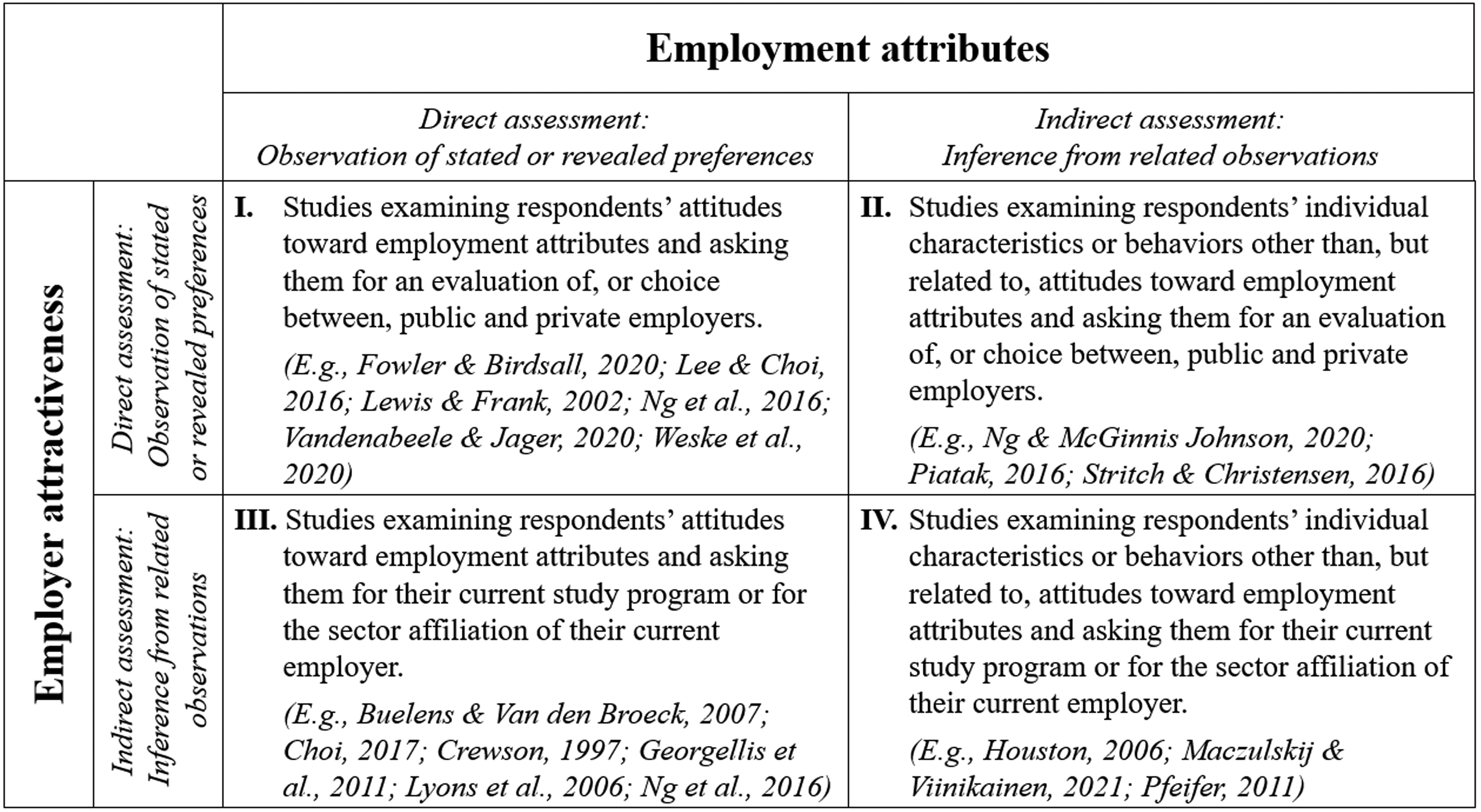
Multi-sector research on employment attributes and employer attractiveness.
Research in the first quadrant asks respondents about their attitudes to employment attributes, and uses measures or indicators of how much they feel attracted to public or private employers, respectively. For instance, Ng and Gossett (2013) demonstrate that Canadian students who prefer public service careers simultaneously place significantly more emphasis on work-life balance than students who would instead choose jobs in the private sector. Fowler and Birdsall (2020) find that, if law students in the U.S. choose the public over the private sector, they do so primarily for intrinsic motivators, such as the desire to improve society and to help others. Ritz et al. (2023) show that respondents from the working population in German-speaking Switzerland perceive signals of public values as more attractive when sent from a private, rather than a public, employer. These and other studies form a body of literature that provides direct insights in the employment attributes that people find attractive in public and private sector employers.
Researchers who contribute to the second quadrant of the framework also explore stated or revealed preferences for or against public vis-à-vis private employers (Figure 1). However, they focus on individual differences, such as personal characteristics, attitudes, and motivations, over and above preferences for particular employment attributes. For example, the study by Pedersen (2013), using a sample of Danish students, confirms that people feel more attracted to the public sector the stronger their public interest is. This finding suggests that employment attributes addressing PSM (i.e., pro-social attributes; Asseburg et al., 2020) may make a difference in employer attractiveness of public versus private organizations. Weske et al. (2020) find that students with high levels of extrinsic motivation report stronger attraction to an employer when it is affiliated with the private, rather than the public, sector. This result facilitates the conclusion that preferences for extrinsic employment attributes, such as salary and benefits, have a sorting effect in favor of the private sector. Similarly, Ng and McGinnis Johnson (2020) find that students who have an education debt from a student loan are slightly more likely to prefer private over public sector careers in their initial job choices. A reasonable explanation for this finding is that these students place a stronger emphasis on high salaries, which they may more readily expect from private business than from the government. Hence, in the absence of more direct observations, scholarship in the second quadrant allows inferences, because some unobserved employment attributes arguably correspond to, and address, the observed characteristics, attitudes, and motivations of current and prospective employees in the public and private sector.
Scholarship in the third quadrant examines preferences for or against employment attributes, but does not directly assess employer attractiveness (Figure 1). Rather, inferences can be made from the fact that respondents already work in the public or private sector, or have enrolled in study programs that prepare for such careers. For example, Ng et al. (2016) show that MBA students in Botswana have stronger preferences for extrinsic rewards than MPA students. Consistent with this finding, Choi (2017) demonstrates in a longitudinal cohort study in the U.S. that employees in the public sector place less emphasis on monetary rewards than private company employees. Crewson (1997), also building on national surveys in the U.S., finds that public employees value the opportunity to help others through their work more than private employees do. These and other studies in this stream facilitate conclusions about the association between employment attributes and employer attractiveness, provided that those employment attributes to which current or prospective employees in the public and private sector place importance are the same that have attracted them to, and make them stay with, their employers.
Finally, studies in the fourth quadrant focus neither on employment attributes nor on employer attractiveness directly (Figure 1). As they yield implications only from related observations in both dimensions, even more assumptions are required to draw conclusions regarding the reasons why employees choose a public or private employer. For example, the literature provides ample evidence that public employees are more risk-averse than private employees (e.g., Pfeifer, 2011). A potential implication of this finding is that public employees will appreciate their employer for rewards, such as job security and stability, that address their risk aversions. Other scholarship shows that public employees are more likely to engage in charitable activities than for-profit employees (Houston, 2006). This observation may lend further support to the assumption that pro-social employment attributes are likely to attract people to jobs in the public rather than the private sector. Still other research provides evidence that the personality trait of sociability is more prevalent among public employees than among private employees (Maczulskij & Viinikainen, 2021). A reasonable conclusion drawn from this finding is that public employees will respond more favorably to employment attributes such as teamwork and social support. Obviously, research in the fourth quadrant is least relevant to the issue of how employer attractiveness and employment attributes relate to each other, because it requires the most caution when inferences are made. However, it can still provide supporting arguments where more direct observations of employment attributes and employer attractiveness are sparse or lacking at all.
To conclude, considerable scholarship in public management is devoted to the issue of employment attributes that account for differences in the perceived attractiveness of public and private employers. Across the quadrants of our framework, however, current scholarship is subject to at least four limitations. First, few studies build on observational evidence for both employment attributes and employer attractiveness, whereas most research becomes relevant only when inferences are drawn from related observations in either or both of these dimensions. Such inferences, although sometimes obvious, require assumptions to be made and therefore cannot fully be a substitute for more direct evidence. Second, the most relevant scholarship (i.e., studies in the first quadrant) predominantly builds on samples of students, graduates, and young professionals, thus addressing the recruitment stage of the HR cycle, but largely neglect later stages in which employer attractiveness matters for employee retention and referral. While research in other quadrants uses samples from more experienced employees, this research severely suffers from the first limitation because it is only relevant if the current sector affiliation is accepted as a proxy for employer attractiveness – a particularly questionable assumption (Cordes & Vogel, 2023; Lewis & Frank, 2002). Third, research often has a narrow focus on only a few employment attributes that are poorly aligned across studies, thus only creating weak momentum for the accumulation and consolidation of research knowledge. Scholars thus still do not fully account for the multi-incentive settings in which people evaluate prospective and current employers across different sectors (Asseburg et al., 2020; Perry & Vandenabeele, 2015; Ripoll et al., 2023). Fourth, and related to the previous limitation, researchers often focus on individuals’ particular characteristics and preferences, and how they are associated with the perceived attractiveness of public and private employers. However, it remains an open question how prevalent these characteristics and preferences are in the working population, so much so that it is unclear how public and private employers resonate with employees beyond specific target groups due to the employment attributes they offer.
Hypotheses
To address these limitations of previous scholarship, we develop and test five comparative hypotheses on the importance that public and private employees place on various employment attributes when they evaluate employers in terms of attractiveness. Many typologies of employment attributes, or closely related constructs, are available from the literature, with considerable variety in the covered range of attributes, and notable agreement only in the duality of extrinsic and intrinsic attributes (e.g., Asseburg et al., 2020; Lyons et al., 2006; Vandenabeele et al., 2004). We apply the fivefold typology of work values suggested by Lyons et al. (2006), because this framework covers a broad range of related employment attributes and has successfully been applied in PA scholarship (e.g., Bao & Zhong, 2021; Korac et al., 2019; Ng et al., 2012). Work values and employment attributes are two sides of the same coin. Whereas Lyons et al. (2006) focus on work values on the part of individuals, we focus on the employment attributes offered by the employer and addressing these values. Five clusters of employment attributes emerge from this framework: altruistic, extrinsic, intrinsic, prestige, and social.
Altruistic Employment Attributes
Altruistic attributes refer to those aspects of employment that address employees’ desire to help others and to benefit society (Lyons et al., 2006). We expect altruistic employment attributes to be more important for public than for private employees when they evaluate employers. A plethora of research has been conducted on PSM, with the foundational premise and tenet that people with high levels of PSM will find employment in the public sector more attractive than less public-service motivated people. Although evidence is still mixed (Ritz et al., 2023; Vandenabeele & Jager, 2020; Weske et al., 2020), a meta-analysis and systematic literature reviews tend to support this assumption (Asseburg & Homberg, 2020; Korac et al., 2019; Ritz et al., 2016). Most of this scholarship, however, has been conducted for the pre-entry level of organizational attraction, and it is not clear how these results generalize to later stages of the HR cycle, when employees have accumulated work experiences with their employer. Inferences may be made from findings that current or prospective employees in the public sector have a stronger desire to help others (e.g., Crewson, 1997; Houston, 2011; Korac et al., 2020) and are more committed to social responsibility, diversity, and equality than private sector employees (Ko & Han, 2013; Lewis & Frank, 2002). Similarly, other studies find that law students, for whom improving society is important, are more likely to prefer public over private sector careers (Fowler & Birdsall, 2020; Ko & Jun, 2015). We therefore join theory and research on PSM in assuming that altruistic employment attributes will drive the attractiveness of public employers more than the attractiveness of private employers. Our first hypothesis thus reads as follows:
Hypothesis 1 (H1): Altruistic employment attributes are more important for public than for private employees when they evaluate employer attractiveness.
Extrinsic Employment Attributes
Extrinsic employment attributes pertain to the material aspects of work, such as pay, benefits, working hours, and job security (Lyons et al., 2006). Overall, we do not expect differences in the extent to which public and private employees consider extrinsic attributes in their evaluation of employers, because previous literature reports countervailing evidence. On the one hand, there is a vast volume of evidence that preferences for high salaries are associated with attraction to, or employment in, the private sector (Buelens & van den Broeck, 2007; Bullock et al., 2015; Choi, 2017; Houston, 2011; Kjeldsen & Jacobsen, 2013; Ng et al., 2016; Ng & McGinnis Johnson, 2020; Winter & Thaler, 2016). These findings are consistent with studies that establish a link between people's extrinsic motivation and their attraction to the private, rather than the public, sector (Weske et al., 2020). On the other hand, there is also convincing evidence that preferences for job security will drive attraction to the public sector (Houston, 2011; Ko & Jun, 2015; Korac et al., 2020; Lee & Choi, 2016; Lewis & Frank, 2002; Ritz & Waldner, 2011; Vandenabeele, 2008). These results broadly resonate with findings that employees working in the public sector are more risk-averse than those in the private sector (e.g., Pfeifer, 2011). Accordingly, extrinsic attributes include employment characteristics that relate in opposite directions to the attractiveness of public and private employers (Lyons et al., 2006). As these effects may cancel each other out at an aggregate level, we state:
Hypothesis 2 (H2): Extrinsic employment attributes are equally important for public and private employees when they evaluate employer attractiveness.
Intrinsic Employment Attributes
Intrinsic employment attributes relate to the nature of work itself, such as inherently interesting and challenging tasks (Lyons et al., 2006), and address employees’ strive for autonomy and self-actualization (Deci & Ryan, 2000). We do not expect intrinsic attributes to play different roles in public and private employees’ judgments about employer attractiveness, as previous literature is ambiguous in this regard. On the one hand, a few studies show that employees with a preference for, or employment in, the private sector value intrinsic employment attributes more than their public sector counterparts (Buelens & van den Broeck, 2007; Jin, 2013a, 2013b; Karl & Sutton, 1998; van de Walle et al., 2015). However, other studies find the opposite (Georgellis et al., 2011; Houston, 2011); and still other studies find no association between intrinsic attributes and preferences for, or affiliation with, either of the sectors (Asseburg & Homberg, 2020; Ng et al., 2016; Winter & Thaler, 2016). Given this inconclusive state of the art, and the absence of theoretical arguments for a clearly directed hypothesis, we suggest:
Hypothesis 3 (H3): Intrinsic employment attributes are equally important for public and private employees when they evaluate employer attractiveness.
Prestige Employment Attributes
Employment attributes relating to prestige are those that enhance the status, influence, and power of employees (Lyons et al., 2006). We expect such attributes to matter more for the attractiveness of private employers than public employers. Although evidence is not unequivocal (Asseburg & Homberg, 2020; Karl & Sutton, 1998), a majority of studies shows that preferences for prestige attributes are indeed negatively associated with attraction to, or employment in, the public sector (for a review, see Korac et al., 2019). Most evidently, this association has been demonstrated for career advancement and promotion opportunities (Crewson, 1997; Frank & Lewis, 2004; Houston, 2011; Khojasteh, 1993; Ko & Jun, 2015; Korac et al., 2020; Lyons et al., 2006; Vandenabeele, 2008). Scholarship on an anti-public-sector bias facilitates the same conclusion. This stream of research posits that the general population often holds negatively biased images of the public service and its professions (Hvidman & Andersen, 2016; Marvel, 2016). If this bias holds true for the general image of public employees, employment in the public sector will be less prestigious than employment in the private sector, and employment attributes other than prestige will account more for the attractiveness of public organizations as employers. Hence, we state:
Hypothesis 4 (H4): Prestige employment attributes are less important for public than for private employees when they evaluate employer attractiveness.
Social Employment Attributes
Finally, social attributes are those characteristics of employment that address employees’ desire for high-quality relations with coworkers and supervisors at the workplace (Lyons et al., 2006). We assume that public employees will deem social attributes as more important for employer attractiveness than private employees will do. Scholarship on PSM strongly suggests that the motivation to help others is unlikely to be channeled only toward citizens, but includes coworkers and supervisors as well. The compassion dimension, specifically, suggests that public-service motivated employees show concern for people in their social environment, no matter whether they are internal or external stakeholders. Research has indeed yielded evidence that PSM is positively related to pro-social behaviors, such as taking charge (Homberg et al., 2019) and organizational citizenship behavior (Ingrams, 2020), within the organization. As a consequence, the quality of social relations at the workplace will improve. Given general norms of reciprocity, public employees will expect the same behaviors from their coworkers and supervisors, so that the importance of social attributes will increase. Empirical evidence from previous research tends to further substantiate this assumption. For example, public employees have a stronger motivation to work in a supportive environment (Buelens & van den Broeck, 2007), place more importance on sympathetic help from coworkers (Karl & Sutton, 1998), and focus more on colleagues and supervisors (Posner & Schmidt, 1996) than private employees. These results are consistent with the finding that sociability is positively related to public sector employment (Maczulskij & Viinikainen, 2021). Moreover, students for whom friendly coworkers are important feel more attracted to the public than to the private sector (Ko & Jun, 2015). Based on this theoretical reasoning and supporting evidence, we suggest:
Hypothesis 5 (H5): Social employment attributes are more important for public than for private employees when they evaluate employer attractiveness.
Data and Method
In the following section, we present our study sample, introduce the measurements, and elaborate on the statistical procedure. As the analysis of user-generated data from an online review platform is novel to the field of PA (Luoma-aho et al., 2021; Satzger & Vogel, 2023), we present our reflections on the strengths and weaknesses of such data early on in this section, rather than reserving them for the limitations section. It is important to keep in mind both the benefits and the limitations of online reviews when interpreting the results.
Sample
We used data from Kununu (i.e., https://www.kununu.com/), an online employer review platform that operated in the USA between 2017 and 2020. The platform provides both current and former employees the opportunity to anonymously share their work experiences with a particular organization and to recommend, or not, the employer to other users and site visitors. The reviews were requested in both structured and semi-structured form, with a final recommendation decision. In the structured part, users rated their employer across 18 criteria on a five-star scale. Compared to other online employer review platforms (such as “glassdoor”), this rating system is more complex and multi-faceted, so that employment attributes are covered at a broader range and in more detail.
In 2019, we used a web scraping procedure and extracted employer ratings from the Kununu website. Web scraping facilitates the rapid collection and efficient processing of extensive data volumes from online sources to assess behavioral data, such that the use of web-scraped data has been increasing in recent years (e.g., Hesse & Boenigk, 2023; Siciliano et al., 2021). Using the rvest package in the statistical language R (Wickham, 2022), we sent HTTP requests to target the website and parsed the HTML content in order to extract and store the relevant numeric data (Bradley & James, 2019).
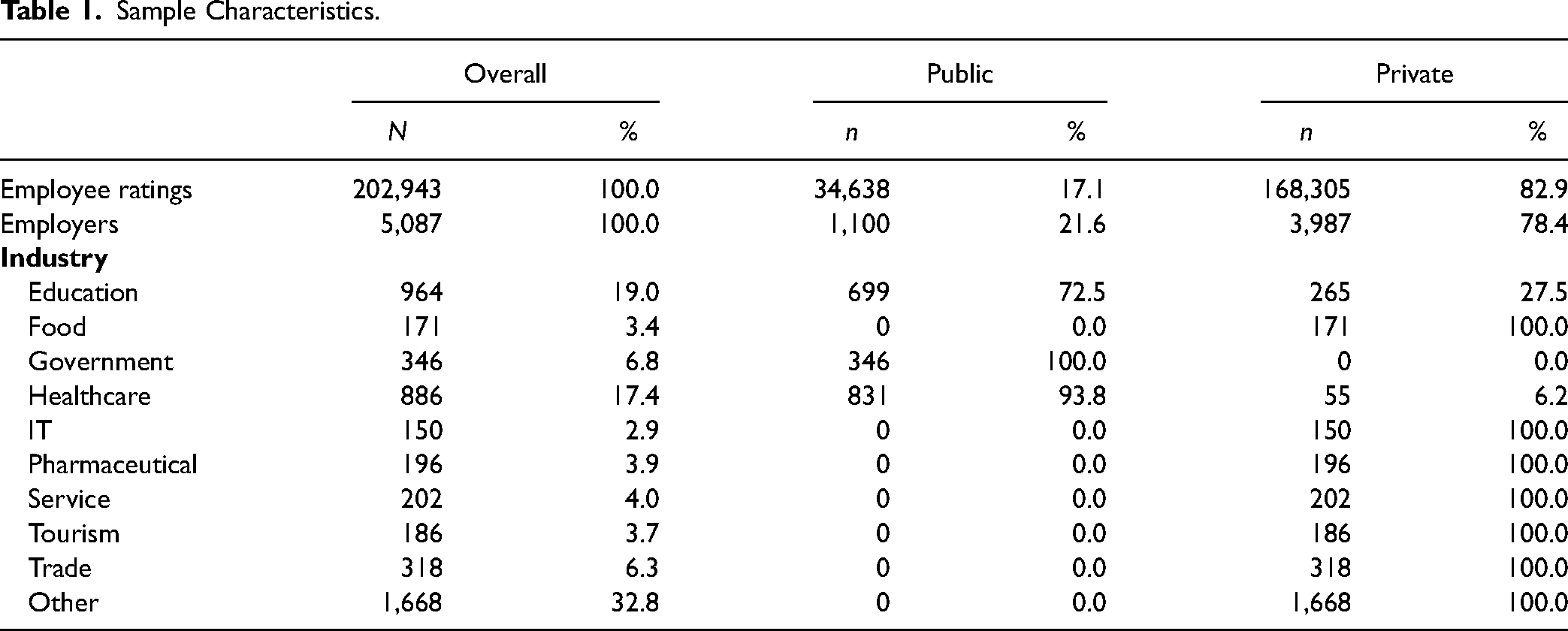
We extracted ratings for employers with 10 or more reviews from the platform. We applied this threshold because we expect the reliability of ratings and recommendations concerning a particular organization to increase with the number of reviews. As the content on the platform was user-generated, the downloaded data included some “noise,” which made a thorough cleansing process necessary. In particular, we merged duplicates (i.e., organizations with two or more entries on the platform) and “nested” organizations (e.g., subsidiaries and corporate parents). We further paid attention to the industry classification of organizations. The platform provided a “government” category, but this category was not a clear indication of publicness, because many public organizations operate in, and were assigned to, other industries (such as education and healthcare). We therefore introduced a new category to distinguish between public and private organizations, and re-coded all organizations in terms of their ownership (Bozeman, 1987). The final sample included 5,087 U.S.-based organizations rated by 202,943 employees. The average number of reviews per organization was 39.6 (SD = 93.7). Table 1 presents further sample characteristics.
Sample Characteristics.
Strengths and Weaknesses
A growing number of studies have used online employer reviews as a data source for empirical research in human resource management (e.g., Evertz et al., 2019; Könsgen et al., 2018; Saini & Jawahar, 2019), with first spill-overs to the field of PA (Luoma-aho et al., 2021; Satzger & Vogel, 2023). Such data offer considerable advantages: The platforms provide “big data” from a large number of users who evaluate employment policies and practices as implemented in real organizations. This should increase the external validity compared to evaluations of hypothetical employers by a small number of participants in scenario experiments (Cordes & Vogel, 2023; Ritz et al., 2023). The users have also actually and voluntarily recommended, or not recommended, their employer, rather than just stated intentions to do so. Recommendations given on an online platform thus do not suffer from the well-reported intention-behavior gap (Sheeran & Webb, 2016), which leads to gross overestimations of actual behavior if inferred from stated intentions. Online recommendations are also more consequential than survey responses, because the users should be well aware that their decision will have an impact on the overall recommendation rate of the employer. This information is freely and conveniently available not only to registered users of the platform, but to all users of the World Wide Web. An increasing number of job seekers consult these platforms at some stage of the job search and application process (Evertz et al., 2019).
These strengths come at the expense of some weaknesses, which are just as important to keep in mind. First, since the reviews and recommendations are anonymous as per platform policy, no information is available on the users’ personal characteristics, such as age, gender, occupation, etc. The providers usually hesitate to share such data, because anonymity and data security are important reputational assets of rating platforms. In the absence of any personalized information, it is neither possibleto analyze how public and private employers resonate in specific segments of the labor market, nor to test the representativeness for the working population in the U.S. Second, and related to the previous point, little is known about the self-selection of users to employer review platforms. Related research on online product reviews provides evidence for an underreporting bias, to the extent that users with extremely positive or negative ratings are more likely to write reviews than users with moderate ratings (Hu et al., 2017). This, and other self-selection biases, may apply to employer reviews as well. Third, we cannot exclude the possibility that our data is contaminated with fake reviews. Since many organizations have become aware of the importance of employee referrals on online platforms, they may have begun to manage their accounts, for example by inviting employees to write benevolent reviews. However, organization-independent sources, such as employer review platforms, are still considered to be a credible source, because the majority of users should have no vested interest in promoting their employer (van Hoye & Lievens, 2007).
These potential drawbacks of user-generated employer reviews should be evaluated both in comparison to data from other sources and in light of the research questions to be addressed. Some of the issues raised above are not exclusive to online reviews, but are generally applicable to all questionnaire designs in the social sciences. For example, survey data may also be prone to self-selection and response biases. It is also important to keep in mind that our research questions and hypotheses focus on sector differences. The potential “noise” in online reviews compromises this goal only to the extent to which it is not randomly distributed across the sectors. There is, however, little evidence for the assumption that biased or untrue reviews occur substantially more frequently in either of the sectors. For instance, no differences in honest behaviors between public and private employees have been found (Sulitzeanu-Kenan et al., 2022), and therefore it is reasonable to assume that fake reviews are randomly distributed across the public and private sector. To conclude: while it is important to be cognizant of the potential weaknesses of user-generated online reviews, they also offer some strengths that support the goals of this study.
Measurements
Dependent Variable
We used the recommendation rate as a measure of employer attractiveness. At the end of the rating procedure, users were asked for a recommendation of the employer (i.e., “Would you recommend this employer to a friend?”), with a dichotomous response option (“yes”/“no”). The recommendation rate reflects the percentage of users who recommended the employer (i.e., responded with “yes”) among all users who provided a response to this question. The variable is thus scaled from 0 to 1 and resides at the level of the organization. As per platform policy, the recommendation rate is based on reviews from only the last 24 months.
Independent Variables
The independent variables are the five categories of employment attributes, as adopted from Lyons et al. (2006), and introduced in the theoretical framework above. This typology of work values and corresponding rewards has been used frequently in PA scholarship (e.g., Bao & Zhong, 2021; Korac et al., 2019; Ng et al., 2012). Each of the five attribute categories (i.e., altruistic, extrinsic, intrinsic, prestige, social) was measured with two to five original items from the platform's rating categories. Employees provided these ratings on a five-star scale, ranging from 1 star (very bad) to 5 stars (very good). We used the aggregated ratings at the organizational level and calculated mean indices across the items. All measures showed satisfactory to excellent reliability. A list of all items is provided in Appendix A.
Altruistic attributes (α = 0.93) were measured with four items, reflecting both the organization's benevolent contributions to the external environment (i.e., environmental friendliness) and internal organizational policies toward fairness and impartiality (e.g., handicapped accessibility). These attributes correspond to the items of the altruistic work values category examined in Lyons et al.’s (2006) study (e.g., doing work that makes a helpful contribution to society; working in a setting where policies and programs are administered with fairness and impartiality). Extrinsic attributes (α = 0.93) comprised five items, each of which refers to a particular aspect of working conditions and compensation (e.g., job security, work-life balance, compensation), reflecting Lyons et al.’s (2006) items for extrinsic work values (e.g., having the assurance of job security; doing work that affords you a good salary). Intrinsic attributes (α = 0.72) were measured with two items relating to higher-order needs of autonomy and competence (i.e., challenging work and freedom to work independently), consistent with Lyons et al.’s (2006) original measurement of intrinsic work values (e.g., working on tasks and projects that challenge your abilities). Prestige attributes (α = 0.93) were reflected in two items that address employees’ pride in the employer (i.e., company image) and the opportunities to advance to higher-level positions (i.e., career development). These attributes correspond to the prestige work values (e.g., having the opportunity for advancement in your career) as assessed by Lyons et al. (2006). Finally, four items were used to assess social attributes, including the quality of social relations with coworkers (e.g., teamwork) and leaders (i.e., support from management). These items reflect Lyons et al.’s (2006) original items for social work values (e.g., working with agreeable and friendly coworkers with whom you could form friendships). The Cronbach's Alpha was exceptionally high (α = 0.97), which may indicate redundancies among the items. However, given that we used a pre-existing rating scale designed for non-scholarly purposes, the parsimony of the scale was not a matter of concern (Wieland et al., 2017). We hence decided to keep all items reflecting social attributes as provided by the rating platform.
Statistical Analysis
Before proceeding to our main analysis, we checked our data set for a variety of assumptions. We first tested for non-linear relationships between the predictors and the dependent variable, but found linear relationships to provide a better, or only marginally worse, fit with the data. We therefore continued with a linear regression approach. However, ordinary least squares (OLS) regression is not an appropriate estimation approach in cases of a proportion as dependent variable, which applies to the employer recommendation rate. We followed recommendations in the literature (Papke & Wooldridge, 1996), according to which generalized linear models (GLM) with logit link and the family of binomial distributions account better for fractional outcomes.
We then inspected correlations among predictor variables and indeed encountered issues of multicollinearity, as variance inflation factors (VIF) exceeded conventional thresholds in the case of two predictor variables (i.e., VIFmax = 12.4). Another manifestation of this problem was the results of an exploratory factor analysis, which yielded only one factor on which the predictor variables loaded. Given that multicollinearity may lead to inflated estimates and standard errors, we refrained from multiple regression analysis. Relative weight analysis (RWA; Johnson, 2000) provides a useful alternative, as this technique is not prone to multicollinearity issues. RWA determines the importance of predictor variables by partitioning the explained variance among the predictors–a goal which is in line with the focus of this study. The method has recently gained popularity, with public policy being among the fields of application (Goldberg et al., 2021).
RWA is a regression-based technique that calculates the importance (i.e., relative weights) of predictors in a series of estimations in which the predictors enter the equation separately (Johnson, 2000; Tonidandel & LeBreton, 2011; Tonidandel et al., 2009). The contribution of each predictor is then determined through comparisons of marginal changes in the overall model fit, most commonly in the R²-statistic. Accordingly, RWA decomposes the total variance explained into weights that reflect the individual contributions of predictor variables, and thus allow for a ranking of these predictors in terms of their relative importance (Tonidandel et al., 2009). The relative weights are expressed as proportion of variance explained by each predictor, and are thus easy to understand intuitively. We ran RWA on the basis of GLMs as specified above (i.e., binomial family, logit link) using Stata version 16.1 with the domin package (Luchman, 2021).
Results
We provide descriptive statistics, correlations, and reliabilities of all study variables in Table 2. The mean employer recommendation score for public employers is 0.797 (SD = 0.155), whereas for private employers, the mean employer recommendation averages 0.674 (SD = 0.218). Across the entire sample, employees recommend their employers with an average score of 0.701 (SD = 0.212). These descriptive results indicate differences in employer recommendations between public and private sectors, with public employers receiving higher average recommendations compared to their private counterparts. The standard deviations provide insight into the variation of both recommendation rates and employment attribute ratings, indicating a relatively lower variation for public employers and a wider range for private employers. The greater variation in industries within the private sector as shown in Table 1 may contribute to the higher standard deviations observed among private employers.
Descriptive Statistics, Correlations, and Reliabilities of Study Variables (n = 5,087). a
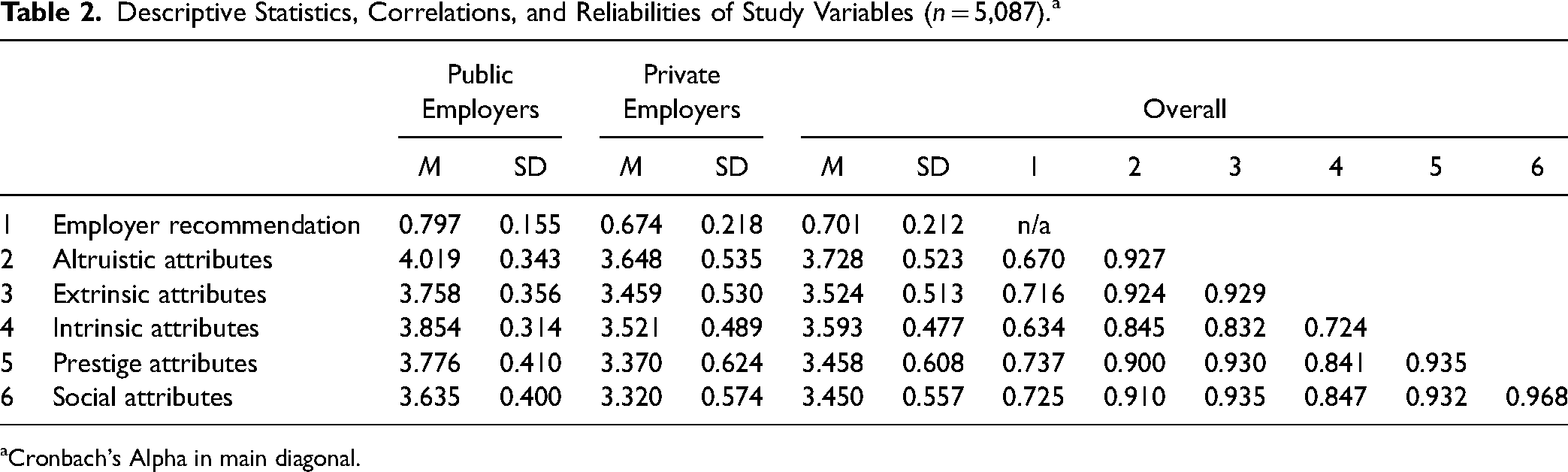
Cronbach's Alpha in main diagonal.
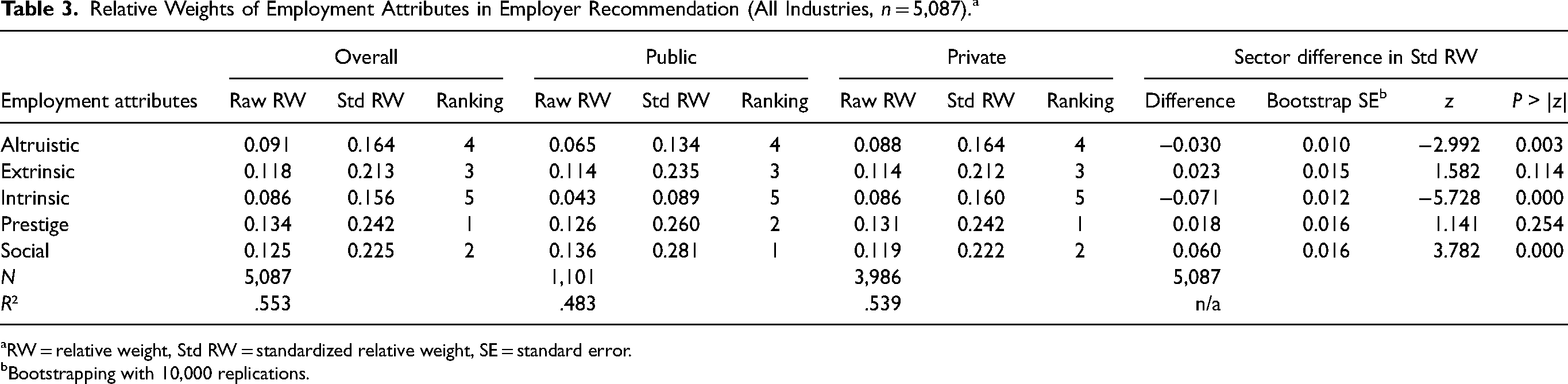
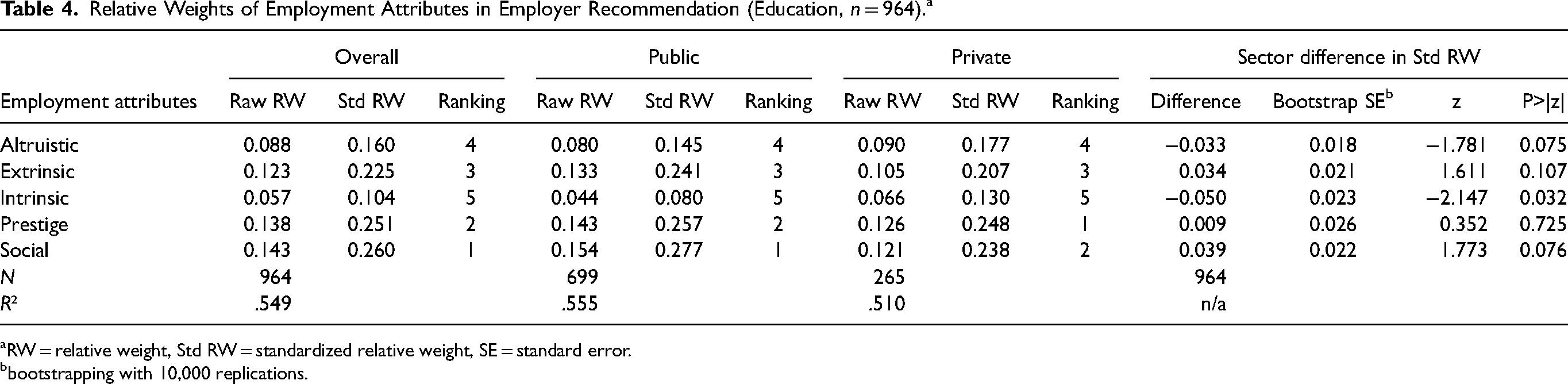
Tables 3 and 4 present the results of RWA with the raw and standardized (i.e., rescaled) weights, the rank of the employment attributes, and statistical tests of sector differences in the standardized weights. We ran this analysis on the full sample of all organizations across all industries (Table 3) and, for reasons explained below, on the subsample of educational organizations (Table 4). Figure 2 additionally provides a visualization of the results. The upper half of the diagram shows the mean user ratings of the employment attributes on the platform's five-star scale. Consistently across the two samples and all attributes, user ratings are significantly higher for public than for private employers. This difference also applies to the recommendation rate, which averages 79.7% in the public sector and 67.4% in the private sector (t = –17.512, p < .001).
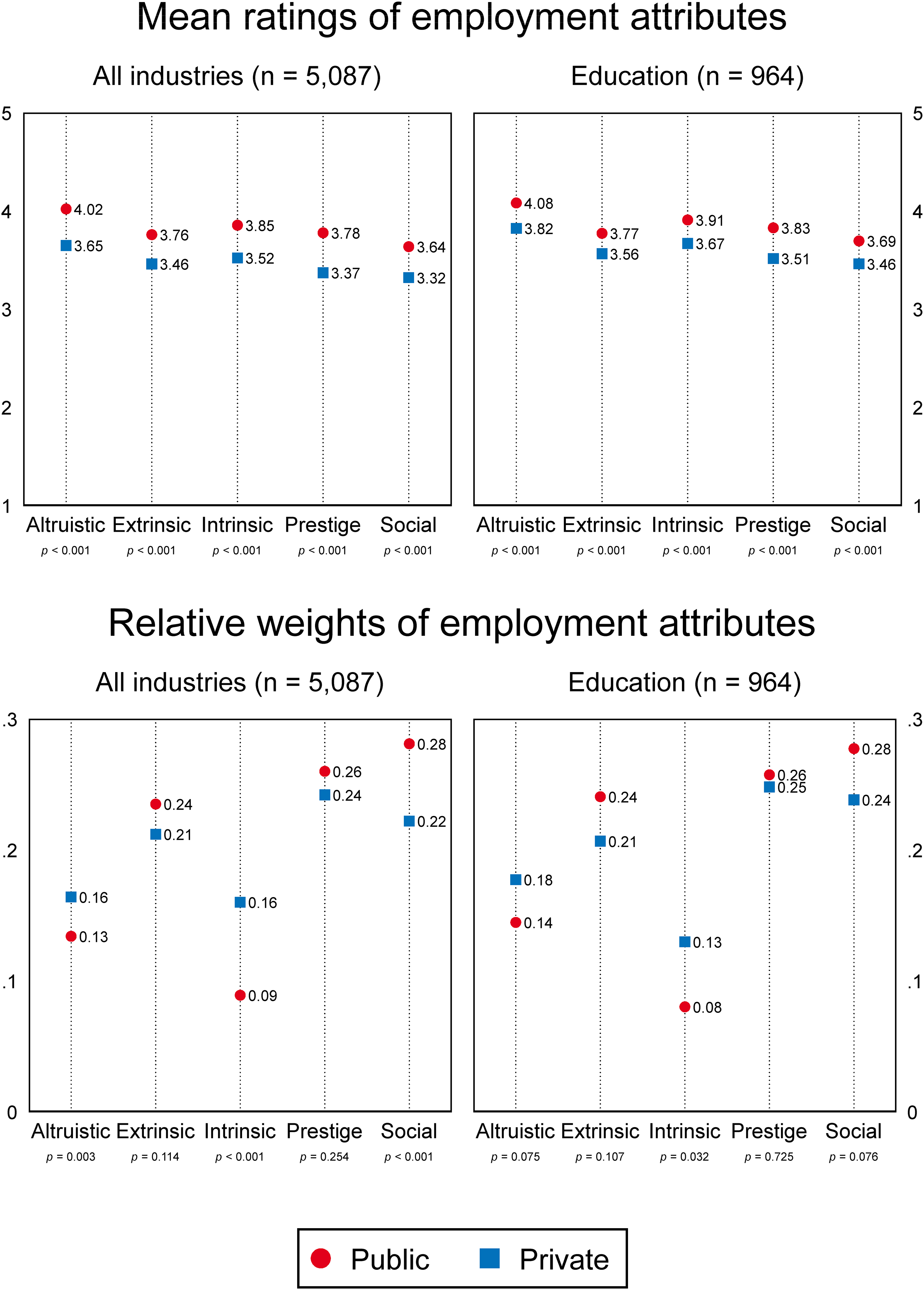
Mean ratings and relative weights of employment attributes.a
Relative Weights of Employment Attributes in Employer Recommendation (All Industries, n = 5,087). a
RW = relative weight, Std RW = standardized relative weight, SE = standard error.
Bootstrapping with 10,000 replications.
Relative Weights of Employment Attributes in Employer Recommendation (Education, n = 964). a
RW = relative weight, Std RW = standardized relative weight, SE = standard error.
bootstrapping with 10,000 replications.
The results show that all employment attributes are, to some extent, important for employer attractiveness, but that the relative weights of attributes differ among each other and between sectors. In the public sector, social attributes are most important (Std RW = 28.1%), followed by prestige attributes (26.0%) and extrinsic attributes (23.5%). Both altruistic (13.4%) and intrinsic attributes (8.9%) have considerably lower weights in the formation of employer attractiveness. The ranking of employment attributes is similar in the private sector, but here, prestige attributes (24.2%) matter more than social attributes (22.2%). The remainder of the employment attributes rank in the same order as those in the public sector, with extrinsic attributes (21.2%) being more important than both altruistic (16.4%) and intrinsic attributes (16.0%).
H1 suggests that altruistic employment attributes are more important for employer attractiveness in the public than in the private sector. However, the relative weight of altruistic attributes is higher in the private than in the public sector, and this difference is statistically significant (p = .003). Accordingly, H1 must be rejected. H2 states that extrinsic attributes are equally important for public and private employees when they evaluate the attractiveness of their employers. This hypothesis is supported by the findings, as the relative weights of these attributes do not differ between the sectors in a statistically significant magnitude (p = 0.114). H3 assumes that no sector differences will occur in the importance of intrinsic attributes either. Contrary to this assumption, the findings indicate strong sector differences in the relative weights of intrinsic attributes (p < 0.001), with a lower weight in the public than in the private sector. Hence, H3 finds no support. H4 suggests that prestige attributes will be less important in the public than in the private sector. However, the relative weights of these attributes do not differ between the sectors in a statistically meaningful magnitude (p = .254). Accordingly, H4 finds no support. Finally, H5 expects social attributes to matter more in the public than in the private sector. This hypothesis is strongly supported by the findings, as the relative weights of social attributes indeed differ between the sectors in the proposed direction and in a statistically significant magnitude (p < .001).
So far, the analyses have built on the full sample of all organizations across all industries. This broad focus implies that we have compared organizations that do not only differ in ownership (i.e., public vs. private), but also differ strongly in the employees’ professions and work (Lyons et al., 2006). While some professions may occur in both the public and the private sector, other professions and related jobs clearly dominate in, or are even unique to, the public sector. This makes it difficult to assess whether the detected patterns emerge from the sectoral affiliation of the employer or are confounded with differences in jobs and professional values. Therefore, we pay additional attention to subfields in which both public and private organizations operate, but where less variation in the type of work and in professional backgrounds of employees occurs. This should apply to the fields of education and healthcare. While the subsample of healthcare organizations is too imbalanced to warrant meaningful post-hoc analyses (i.e., npublic = 55, nprivate = 831), the subsample of educational organizations is more suitable (i.e., npublic = 699, nprivate = 265).
Table 4 shows the RWA results for the subsample of educational organizations (n = 964). The findings are broadly consistent with the results for the aggregated sample of organizations from all industries (Table 3), as the relative weights of the employment attributes differ between the sectors in the same direction. The differences, however, occur at lower levels of statistical significance due to the smaller sample size. While both altruistic (p = .075) and intrinsic attributes (p = .032) are less important, social attributes are more important in the public than in the private sector (p = .076). This pattern makes us confident that the detected sector differences are not substantially confounded by the type of work that the users of the review platform perform.
Discussion and Conclusion
Public employers increasingly compete with private employers for labor, particularly in societies with shrinking workforces (Bright & Graham, 2015; Fowler & Birdsall, 2020; Linos, 2018). To address this challenge, consolidated knowledge about the levels and drivers of employer attractiveness across sectors is urgently needed, but previous scholarship has been inconclusive about both. Our study has built on ratings and recommendations of U.S.-based organizations available from online employer reviews, thereby shifting attention from the recruitment stage at the front end of the HR cycle to the retention phase at later stages of the cycle. The overall results suggest that there are indeed sector differences in the employment attributes according to which employees recommend their employers to others. However, some of the differences run contrary to our expectations. These deviant findings suggest that the link between employment attributes and employer attractiveness may vary along the HR cycle and is therefore more complex than previous scholarship has revealed.
Most strikingly, altruistic employment attributes are less important for public than for private employees when they decide whether or not to recommend their employer. This is contrary to what is suggested by long-standing scholarship on PSM and supporting evidence (e.g., Asseburg & Homberg, 2020; Perry & Wise, 1990; Ritz et al., 2016). There are two possible explanations for this finding, which both have implications for PSM scholarship. First, PSM may evolve differently over the course of employment in public and private sectors, respectively. A vast majority of PSM studies has focused on the pre-entry stage of the HR cycle and suggested that public employers send stronger altruistic signals than private employers and thus attract more applicants who are driven by PSM. However, the significance of altruistic attributes may decrease with decreasing levels of PSM in the course of employment at the post-entry stage. Indeed, previous research has shown that PSM-related values tend to decrease with job tenure in the public sector (Moynihan & Pandey, 2007; Vogel & Kroll, 2016), and have attributed this decline to a “reality shock” experienced by employees upon entering the labor market (Kjeldsen & Jacobsen, 2013). This dissatisfaction of expectations may be stronger in the public than in the private sector because newcomers to the public sector are likely to have higher levels of PSM and stronger expectations of altruistic employment attributes. In contrast, private sector employment may bear a lower risk of dissatisfaction because recruits should bring lower levels of PSM to their jobs and expect less altruistic attributes from their employer. Consequently, the significance of altruistic attributes may remain unaltered as job tenure of private sector employees increases, while it erodes among public employees as a result of dissatisfaction of expectations.
Second, and contrary to the first explanation, the satisfaction, rather than dissatisfaction, of expectations may account for our findings. Arguably, the degree to which altruistic employment attributes are institutionalized should be higher in the public than in the private sector, because public organizations are by their very mission devoted and committed to corresponding goals and values (Rainey, 2014). As a consequence, and somewhat paradoxically, altruistic attributes may lose importance for public employees because the corresponding needs and motivations are satisfied, such that employees take these attributes for granted beyond full awareness and appreciation. In contrast, altruistic attributes may conform less to the institutionalized expectations of private employees, to the extent that these attributes maintain their salience and are considered of greater importance in employer recommendations. Both lines of reasoning suggest that PSM scholarship is challenged to better account for expectation-satisfaction and expectation-dissatisfaction mechanisms in the course of membership in public organizations. These socialization and adaptation mechanisms may play a significant role in shaping employees’ PSM over the course of employment and may also affect how this motivation translates into the perceived significance of altruistic employment attributes. Further research along these lines will provide more insight into PSM as a dynamic, rather than static, construct with the potential to evolve and to change over time.
We expected no sector differences in the relative importance of extrinsic and intrinsic employment attributes. Although the results confirm this assumption for extrinsic attributes, we find that intrinsic attributes matter significantly less for public than for private sector employees. This finding lends support to some previous studies (Buelens & van den Broeck, 2007; Karl & Sutton, 1998; van de Walle et al., 2015) while contradicting others (Asseburg & Homberg, 2020; Georgellis et al., 2011; Houston, 2011; Ng et al., 2016). A possible interpretation may arise from the two intrinsic aspects that are covered by our measure: challenging work and freedom to work independently. Challenging work may appear more attractive to high-performing employees because they are more likely to pass the challenges successfully than employees who perform at lower levels, where work challenges may be more of a demand than a resource. Previous research has shown that performance is negatively related to preferences for, or employment in, the public sector (e.g., Fowler & Birdsall, 2020), so that the importance of challenging work for employer attractiveness may decrease in the public sector. Freedom to work independently is arguably limited by the presence of rules and regulations, which is a feature of public bureaucracies and part of their public image (Boyne, 2002; Nutt, 2006). Accordingly, employees who self-select for public service may expect more rules and regulations to be in place, and mind them less than private sector employees, even at the expense of freedom and autonomy at work. This view is supported by Jin (2013a), who finds that preferences for working independently are indeed negatively associated with career ambitions in the public sector.
Whereas we expected prestige attributes to be more important for private than for public employees, our results reveal no sector differences for these attributes. This finding resonates broadly with evidence that public employers are not less prestigious than private employers (Cordes & Vogel, 2023; Ng & Gossett, 2013). It is worth repeating here that public employers have consistently earned higher ratings than private employers across all employment attributes, and they are also substantially more likely to be recommended to others. This observation provides strong counterevidence to often-voiced concerns that public employers lack in employer attractiveness compared to private organizations (Bright & Graham, 2015; Fowler & Birdsall, 2020; Lewis & Frank, 2002). We do not conclude here, however, that the attraction and retention of employees should not be a matter of concern for public management scholars and practitioners. What our results do suggest is that, in general, public employers are less competitively disadvantaged compared to private employers than often assumed. It should be noted here that we cannot control for potential differences in aspiration levels of public and private employees. Now-classic scholarship in PA (Simon, 1947) suggests that private employees are more likely to be “maximizers” than public employees, while the latter are more likely to be “satisficers” than the former (Weißmüller et al., 2023). Accordingly, public employees may rate the same employment attributes less critically than private employees.
Finally, our study shows that social employment attributes have a greater weight in the public than in the private sector. Given our assumptions, this difference does not come as a surprise, but the level of importance is noteworthy. Among all attributes, social employment attributes (i.e., organizational culture, communication, teamwork, support; Appendix A) are most important for the recommendation of public employers. Somewhat ironically, previous scholarship has focused the least attention on the most important employment attributes, given that only a few studies have so far considered social attributes (Buelens & van den Broeck, 2007; Karl & Sutton, 1998; Ko & Jun, 2015; Posner & Schmidt, 1996). A possible explanation for this neglect is that this research has been preoccupied with the pre-entry level of organizational attraction, where social attributes may not be as important as at the post-entry level. The reason is that high-quality social relations at the workplace build a bond among employees that is difficult to anticipate beforehand, due to its strong affective component. The emotional worth of such relations, and the associated need of relatedness (Deci & Ryan, 2000), may become salient only upon an employee's own experience during the course of employment. In the public sector, the experience of social employment attributes may result in a more positive surprise than in the private sector, because public employers are often large and bureaucratic organizations with well-known potential for alienating and dehumanizing employees (e.g., Aiken & Hage, 1966; DeHart-Davis & Pandey, 2005; Vogel et al., 2022). The contrasting experience of high-quality relations and support at public sector workplaces may further elevate the salience and appreciation of such employment attributes.
Practical Implications
HR managers in the public sector have good reason to be conscious of the employment attributes that employees evaluate outside of their control on organization-independent platforms (Evertz et al., 2019). Monitoring such platforms closely and on a regular basis will provide important information on how effective HR policies are and where to improve them. It follows that the targets of employer branding are not only new recruits, but also long-serving employees, whose word-of-mouth evaluations increasingly affect employer attractiveness. The good news for HR managers is that, in these terms, the employer image of public organizations is not as bad as swan songs sometimes suggest. In fact, on average, ratings and recommendations of public organizations are substantially and consistently better than those of private employers. Public HR managers can strategically build on this information in their internal and external employer branding strategies. This applies even more, since our results have revealed prestige attributes to be the second-most important employment attributes in the prediction of employer attractiveness at the retention stage. Bringing the employer's reputation to the attention of employees may initiate self-reinforcing processes, because it may further elevate employees’ pride in working in the public service and, in turn, boost their ratings and recommendations of their employers. The most important employment attributes, however, are social attributes. Accordingly, HR policies should take particular care with the social aspects of work design and personal development. Accordingly, developing the organizational culture, introducing team-based work designs, engaging in team-building activities, offering internal communication trainings, training leaders in supportive and empowering leadership styles, and considering sociability in personnel selection are all likely to pay off in terms of employer attractiveness.
Limitations
Beyond the potential drawbacks of user-generated data from online review platforms, which we outlined in the method section, this study has further limitations that need to be acknowledged. First, an obvious problem in using data sources that were not originally designed for the purpose of an academic study lies in matching the constructs of interest with the available items. While we selected Kununu for the variety of items along which users rate their employers, so that we were able to measure each of the five attribute categories with multiple items, some categories could have been reflected even more broadly in our measurements. For example, we measured intrinsic attributes in two core aspects (i.e., challenging work and working independently), but previous research has operationalized intrinsic rewards at a broader range (Korac et al., 2019). Future research could arrive at more comprehensive measurements by combining aggregated ratings of the same employers on various review platforms.
Second, and related to the previous point, the use of pre-existing items from a platform designed for non-academic purposes implies that the corresponding measurements have not undergone rigorous procedures of scale development and validation. Indeed, high intercorrelations among constructs gave us reason to refrain from regression analysis and to be among the first in PA scholarship to apply RWA instead; an analytic procedure that is robust against issues of multicollinearity (Johnson, 2000). However, concerns about discriminant validity of the constructs, as considered in conventional scale development and validation under more controlled conditions, remain (Rönkkö & Cho, 2022). We therefore welcome future studies that address our research questions in samples of experienced employees but apply scales decidedly developed for scholarly purposes (e.g., Lyons et al., 2006) and not suffering from high correlations to the same extent as the more blurry data from online platforms. Comparisons of the results would be intriguing not just for validating our specific findings but also regarding the more general usefulness of online rating platforms for future research.
Third, given that our dependent variable (i.e., employer recommendation rate) resides at the level of the organization, we decided to use measures of the independent variables (i.e., attribute ratings) that are mean-aggregated at the same level. While this aggregation approach is ubiquitous in the social sciences, it has the disadvantage of not accounting for individual-level variation within the groups (i.e., organizations; Bennink et al., 2013; Croon & van Veldhoven, 2007). If researchers had access to individual-level ratings and recommendations of employers on online platforms, the information to be fed into further analyses would be even richer.
Concluding Remarks
Despite these limitations, our study provides a fresh look at an enduring debate and concern in public management. Some of our results are contrary to scholarly and popular wisdom about the levels and drivers of employer attractiveness across the public and private sector. In contrast to the plethora of survey and experimental designs, we have not used intentional measures of employer attractiveness, but analyzed evaluations of real organizations that have actually been provided on an online platform by experienced employees. Results for this post-entry stage differ to some extent from that suggested by scholarship with a predominant focus on the pre-entry stage of organizational attraction. Social employment attributes are the most important drivers of employer attractiveness in the public sector but have attracted the least attention in previous scholarship, whereas almost the opposite applies to altruistic attributes. Whereas some studies have yielded evidence that the importance of employment attributes varies along the HR cycle (e.g., Kjeldsen & Jacobsen, 2013), it is still largely unclear how their weights differ between the pre- and post-entry stages, and what expectational and experiential processes account for these differences. This puzzle remains to be solved by future research.
Footnotes
Appendix
Descriptive Statistics for All Items (n = 5,087).a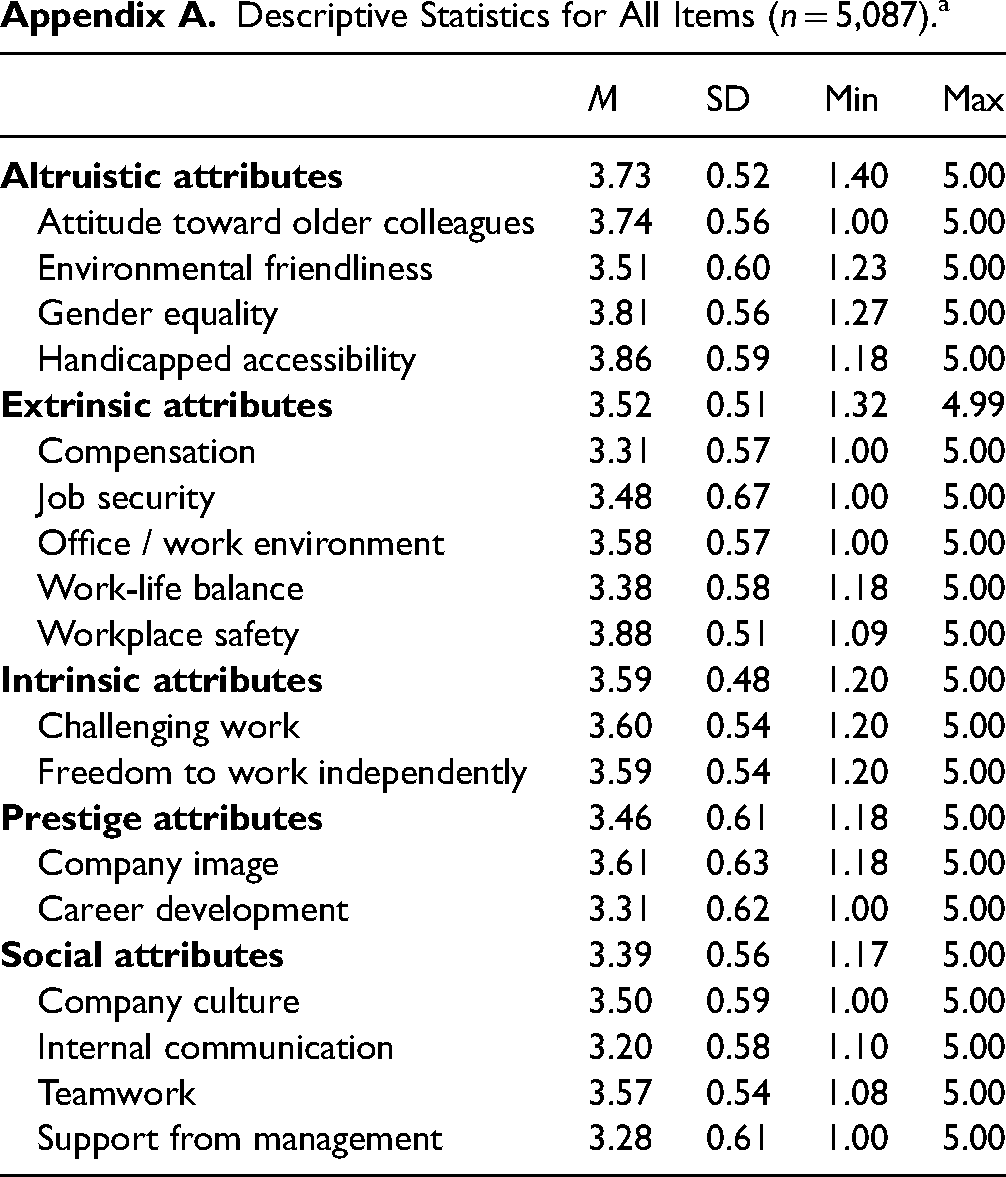
M
SD
Min
Max
3.73
0.52
1.40
5.00
Attitude toward older colleagues
3.74
0.56
1.00
5.00
Environmental friendliness
3.51
0.60
1.23
5.00
Gender equality
3.81
0.56
1.27
5.00
Handicapped accessibility
3.86
0.59
1.18
5.00
3.52
0.51
1.32
4.99
Compensation
3.31
0.57
1.00
5.00
Job security
3.48
0.67
1.00
5.00
Office / work environment
3.58
0.57
1.00
5.00
Work-life balance
3.38
0.58
1.18
5.00
Workplace safety
3.88
0.51
1.09
5.00
3.59
0.48
1.20
5.00
Challenging work
3.60
0.54
1.20
5.00
Freedom to work independently
3.59
0.54
1.20
5.00
3.46
0.61
1.18
5.00
Company image
3.61
0.63
1.18
5.00
Career development
3.31
0.62
1.00
5.00
3.39
0.56
1.17
5.00
Company culture
3.50
0.59
1.00
5.00
Internal communication
3.20
0.58
1.10
5.00
Teamwork
3.57
0.54
1.08
5.00
Support from management
3.28
0.61
1.00
5.00
Declaration of Conflicting Interests
The authors declared no potential conflicts of interest with respect to the research, authorship, and/or publication of this article.
Funding
The authors received no financial support for the research, authorship, and/or publication of this article.
