




Abstract
This paper presents an investigation of the extent to which Heine’s (2003) mechanisms of grammaticalization—erosion (phonetic reduction), decategorialization (loss of morpho-syntactic properties), desemanticization (semantic bleaching) and extension (context expansion)—are evident in the variation of negative question tags in three varieties of British English spoken in Glasgow, Tyneside, and Salford. The study considers the variation in terms of three types of variant—full (e.g., isn’t it), reduced (e.g., int it), and coalesced (e.g., innit)—which each represent a stage in the erosion process. Quantitative variationist analysis of informal conversational data shows that erosion of negative tags occurs to different degrees in each of the three communities. The locality with the least tag erosion—Tyneside—displays particularly strong social stratification in the variation that suggests a change in progress led by younger men. However, there is little to no evidence of decategorialization in the negative tags, nor does variation in tag meaning correlate with phonetic form in a consistent manner. The results therefore suggest that erosion and desemanticization/extension do not occur in lockstep as these constructions grammaticalize, while decategorialization occurs at a later stage in the change.
1. Introduction
Grammaticalization refers to a specific kind of linguistic change “whereby particular items become more grammatical through time” (Hopper & Traugott 2003:2). As outlined by Heine (2003), grammaticalization is characterized by four key mechanisms: “erosion” (phonetic reduction), “decategorialization” (loss of morpho-syntactic properties), “desemanticization” (semantic bleaching), and “extension” (context expansion). This paper aims to evaluate the extent to which these four mechanisms apply to negative tag variation in different varieties of British English.
Negative tags, the variable of interest, consist of yes-no questions that feature a negatively-marked auxiliary (with n’t) and a subject (personal pronoun or there) which is attached to a clause (Quirk, Greenbaum, Leech & Svartvik 1985:810). In Standard English, the tag auxiliary agrees with the verb in the clause it is appended to, called the “anchor” or “anchor clause” (Tottie & Hoffmann 2006, 2009; Pichler 2013), in person, number, and gender. There is usually polarity reversal between the anchor and tag, such that negative tags are typically attached to affirmative statements. In this study, the variable is analyzed in terms of three categories of variants which I refer to as “full,” “reduced,” and “coalesced.” Full tag variants have canonical realizations, as shown in (1), (2), and (3). (1) That’s stupid, isn’t it? (NKOF3, Glasgow)
1
(2) It depends where you go though, doesn’t it? (AA/613, Tyneside) (3) You’ve seen the logo, haven’t you? (Paul, Salford)
Isn’t, doesn’t, and haven’t tags (in 1-3) are given here as examples because they represent highly frequent verb types, but other forms are included in the study, as discussed in section 4. Although different, “fuller” forms also exist (e.g., is it not?), these differ in their syntax and are rare in vernacular speech compared to counterparts with n’t (e.g., isn’t it), so they do not feature in this analysis.
2
Reduced variants are those where the full forms have undergone attrition, namely the loss of medial consonants and/or vowel reduction, as in (4), (5), and (6). (4) There’s a song about it, int there? (James, Salford) (5) He likes his horse-riding, dunt he? (Sasha, Salford) (6) […] somebody’s got to do it, hant they? (00-G1-m03, Glasgow)
Coalesced tags, shown in (7), (8), and (9), represent a further stage of phonological erosion where the verb and pronoun have become fused and pronounced as a single unit. (7) It’s unbelievable, innit? (PM/85, Tyneside) (8) Makes a pure mad noise, dunnit? (3M6, Glasgow) (9) Well I’ve always had English Bulls me, hanna? (Moira, Salford)
The three types of variants—full, reduced, and coalesced—are used here to represent three stages in a gradual process of reduction, where coalesced variants are the most recent development relative to the others (Krug 1998; Andersen 2001; Pichler 2013).
The paper proceeds by considering previous accounts of negative tag variation in English (section 2) and the mechanisms of grammaticalization and their relevance to negative tag variation (section 3). Details of the data and methods used in the current study are given in section 4. Section 5 presents the results of the quantitative variationist analysis. Section 6 presents discussion of the findings and is followed by the conclusion in section 7.
2. Background
The English negative tag that has been subject to the most sociolinguistic attention to date is innit. Pichler’s (2013) investigation of negative tag variation in Berwick-upon-Tweed is one of few studies to examine variation in the tag system more widely, beyond that form. Other studies that have taken a similarly broader look at negative tag variation have focused on varieties of English spoken in the Southeast of England (Kimps, Davidse & Cornillie 2014; Kimps 2018; Pichler 2021a), national varieties represented by largescale corpora such as the BNC (Krug 1998) or BNC-2014 (Axelsson 2018), or national varieties compared, such as British versus American English (Nässlin 1984; Tottie & Hoffmann 2006). Regional comparisons of negative tag variation within British English are lacking, yet such an approach—taken up in the present investigation—offers the opportunity to understand whether all mechanisms of grammaticalization operate consistently on negative tag variation cross-dialectally when the varieties themselves might be at different stages of a change. Analyzing the negative tag system as a whole also allows for consideration of whether trends previously identified for innit similarly hold for other phonetically reduced and/or coalesced forms.
In terms of Heine’s (2003) mechanisms of grammaticalization, innit represents the phonetic reduction and fusion of two separate linguistic items (isn't + it or ain't + it—see section 3) and therefore has undergone erosion. The form has also become semantically bleached and pragmatically extended, now used for a wide range of functions beyond what would be expected of a typical interrogative. Furthermore, it is sometimes used as a non-paradigmatic (invariant) tag that lacks agreement with the clause to which it attaches, as found in the speech of young Londoners (Andersen 2001; Palacios Martínez 2015; Pichler 2021a) and varieties including Welsh Englishes (Paulasto 2016) and Singaporean and Indian Englishes (Hussain & Mahmood 2014). In her analysis of innit in Multicultural London English, Pichler (2016:65) also finds examples of innit in new syntactic environments. These include the left periphery of a clause (as in 10) and other contexts where negative tags would not be generated in Standard English, such as (11), where innit follows a fixed phrase (I know) that is used to express agreement with the previous speaker (both examples are cited from Pichler [2016:65]). (10) Ahmed: I’ve eh: <innit, they’re> supposed to give you a fine or something. Like, eighty pound or a hundred pound or something. (11) Katie: Every time her phone rings, ‘hello mum.’ Laura: I know, innit.
It appears that innit has grammaticalized further in London than in many other British Englishes (see also Pichler 2021a). In most British Englishes, innit behaves largely in line with the syntactic rules of Standard English, i.e., it occurs in the right periphery of the clause and has a tendency to agree in person and number with the clause subject (see Cheshire, Kerswill & Williams [2005] on Reading, Milton Keynes, and Hull; Pichler & Torgersen [2009] and Pichler [2013] on Berwick-upon-Tweed). Innit’s purported origins in London (see Krug 1998; Cheshire, Kerswill & Williams 2005) might explain why it appears to have grammaticalized furthest there, though the form could have developed independently in different places at different times as a result of natural processes of phonological reduction (Pichler 2013:211).
Innit arose through the speech of younger people, who lead in its use (Krug 1998; Andersen 2001; Pichler & Torgersen 2009; Palacios Martínez 2015; Pichler 2016, 2021a). Although Torgersen, Gabrielatos, Hoffmann, and Fox (2011) suggest that the frequency of innit has since stabilized somewhat in London, Pichler (2016, 2021a) shows that innit’s expansion to new syntactic contexts and new discourse-pragmatic functions in London speech is led by young people (particularly non-Anglo speakers and in multi-ethnic London boroughs). There is a further social association between innit and men’s speech (Torgersen, Gabrielatos, Hoffmann & Fox 2011:108; Pichler 2013), though recent research suggests this is no longer significant in London (Pichler 2021a). Although innit was used slightly more often by girls than boys in the Bergen Corpus of London Teenage Language (COLT; Stenström & Breivik 1993), the fact that only men in the highest social class groups used it led Andersen (2001) to suggest that they are the leaders of linguistic change for this form. These trends for innit run contrary to the more typical sociolinguistic observation that women tend to lead change, at least change from below (Labov 2001:321), but it is not such a surprising finding given that the form is non-standard and stigmatized (Algeo 1988:181; Pichler 2013:209). Innit might have covert prestige for men (Pichler 2013:209), considering the links commonly drawn between the use of non-standard/stigmatized variants and male speech (Chambers & Trudgill 1998:61).
The development of innit and the variation in its use might represent part of a more general change going on within the negative tag systems of different dialects of English, as it is one of several negative tags where the auxiliary and pronoun are coalesced—see, for example, dunnit (‘doesn’t it’) and wannit (‘wasn’t it’). Using corpus-based quantitative variationist techniques, the present study examines how the erosion of tags correlates with other mechanisms of grammaticalization. The investigation uses data from three corpora which represent urban vernaculars spoken in Glasgow (Scotland), Tyneside (Northeast England), and Salford (Greater Manchester) respectively. The recording samples extracted from these corpora have previously been used in analyses of other types of variation in negation: not-/no-negation and negative concord (Childs 2017a) and never (Childs 2021). In Childs (2019), I also undertook an analysis of interviewer effects on the Tyneside negative tag variation which confirmed that negative tag variation in Tyneside English was subject to interviewer effects, but that these applied in addition to other constraints and did not change the significance or ranking of internal and external factors. This paper presents a separate investigation of negative tag variation in the three aforementioned varieties, instead focusing on the mechanisms of grammaticalization that are apparent in the data, which are discussed in the next section.
3. Mechanisms of Grammaticalization and their Relevance to Negative Tag Variation
Heine’s (2003) four mechanisms of grammaticalization—erosion (phonetic reduction), decategorialization (loss of morpho-syntactic properties), desemanticization (semantic bleaching), and extension (context expansion)—are considered in turn in this section. In addition to Heine (2003), other sets of grammaticalization “principles” have been proposed (Hopper 1991; Lehmann 2015). Many of these overlap with Heine’s (2003), but others are not readily applicable to the grammaticalization of discourse-pragmatic phenomena. For example, Lehmann’s (2015) “fixation” criterion, whereby an item becomes fixed in its syntactic environment, does not apply to the development of discourse markers. Heine’s (2003) mechanisms, on the other hand, have regularly been used to analyze the degree to which discourse-pragmatic phenomena are grammaticalizing (see, e.g., Cheshire 2007; Tagliamonte & Denis 2010; Denis 2017; Pichler 2021a), which is why they have been adopted as a framework for analysis here. The presence of one of these mechanisms alone does not entail that there is grammaticalization, as they are common processes in linguistic change more generally, but the interaction of factors together provides evidence of grammaticalization (Heine 2003:579). Older and newer forms and meanings co-exist during the grammaticalization process (“layering”), and changes might not progress to completion, which adds to the variability observed (Hopper 1991:22; Traugott & Dasher 2001:281).
Erosion, or phonological attrition (Lehmann 2015), describes “loss in phonetic substance” (Heine 2003:579). This can lead to loss of segments and, potentially, coalescence—an “increase in bondedness” (Lehmann 2015:157). Innit has experienced both the loss of segments and coalescence, having derived from either isn’t it or ain’t it through broad pathways like those hypothesized in (12) and (13), from Anderson (2001:106), with additional intermediate steps and layering. (12) isn’t it [ (13) ain’t it [e
The first pathway, shown in (12), is considered the more likely of the two, because innit is used in place of isn’t it in tags more than any other auxiliary and pronoun combination, and both variants tend to be favored in the same syntactic environments (Andersen 2001:200; Pichler 2013:198-199; Palacios Martínez 2015:7-8). The second pathway, in (13), is more complex, as the origin of ain’t itself is unclear (Jespersen 1940:433), even if am not is “[t]he most probable ancestor” (Cheshire 1981:367). Ain’t can be equivalent to Standard English haven’t, hasn’t, (am) not, aren’t, and isn’t (Cheshire 1981:366) and can be derived from each of these historically through various sound changes (Anderwald 2002:118). Whichever possible pathway represents the development of innit, when full and more reduced forms are in variation with one another, “it is a reasonable hypothesis that the reduced form is the later form” (Hopper & Traugott 2003:125). As such, this paper considers the reduction of isn’t it to int it to represent a step on the cline of grammaticalization, followed by a further step whereby int it is fused as innit. Similar trajectories are likely for other reduced and coalesced forms (e.g., doesn’t it > dunt it > dunnit), as discussed in section 4.
The second mechanism of grammaticalization, decategorialization, describes a “loss in morphosyntactic properties characteristic of the source forms” (Heine 2003:579). For example, verbs might lose their tense, agreement, or aspect marking (Hopper 1991:106; Hopper & Traugott 2003:108). Independent words might become clitics or affixes (Heine 2003:579). Some accounts of grammaticalization view decategorialization as necessarily leading to increased fixation of an item (Lehmann 2015), while others argue that the process can result in increased optionality. As discourse markers develop, for example, they become more flexible in their distribution and gain wider structural scope (Traugott 2003:643). Under the “narrow” view of grammaticalization (see Breban & Hancil [2018] and Heine [2018a] for discussion), the development of discourse markers can be said to involve a separate process to grammaticalization—pragmaticalization (Erman & Kotsinas 1993; Aijmer 1997). However, under the “wide” view of grammaticalization in which fixation is not an essential criterion, grammaticalization does capture the development of discourse markers, as they go through similar sets of changes as other grammaticalizing items (Traugott 1995; Brinton 2001:149; Brinton & Traugott 2005:140).
With respect to negative tags, the forms themselves become increasingly bonded over time (e.g., innit becomes less easily decomposable into is + n’t + it) even if their clausal position or scope changes. Innit’s behavior is therefore consistent with Heine’s (2003:579) definition of decategorialization above as well as Hopper’s (1991:106) description of the process as resulting in items becoming “less prototypical in their distribution.”
Desemanticization, also called “bleaching” or “semantic reduction,” describes a form’s loss of semantic meaning (Heine 2003:579; Lehmann 2015:134). Lexical meaning can become bleached, or, if the form has multiple grammatical functions, one of those functions can be lost (Heine 2003:579). This semantic weakening can be driven by an initial increase in the frequency of a construction which causes its use to become habituated (Bybee 2003:605). Negative tags can become semantically bleached if they lose their canonical interrogative meaning whereby an answer is expected in response to a question (“conducive” functions) and subsequently become associated with alternative functions where an answer is not required (“non-conducive” functions) (Cheshire 1981, 1982; Pichler 2013, 2021a).
Finally, extension is the mechanism whereby “a linguistic item can be used in new contexts where it could not be used previously,” which refers to the extension of pragmatic meaning (Heine 2003:580). Therefore, although semantic bleaching can occur, there is pragmatic enrichment. Common trajectories of extension are for constructions with more concrete meanings to develop more abstract meanings, or for those with propositional meanings to develop attitudinal functions (Heine 2003:580; Traugott 2003:633). As desemanticization and extension both involve changes in meaning, these two mechanisms will be considered together in the analysis of negative tag variation.
Having considered the four mechanisms of grammaticalization separately—erosion, decategorialization, desemanticization, and extension—a question that emerges is whether there is any tendency for one or more mechanisms to occur before others. Under Bybee, Perkins, and Pagliuca’s (1994) “parallel reduction hypothesis,” as the frequency of a construction increases and its use becomes more habitual, desemanticization occurs and this directly causes erosion. There is no delay in the onset of erosion, but the two “go hand in hand” (Lehmann 2015:135; Dehé & Stathi 2016). Others agree that desemanticization occurs prior to and causes erosion (and decategorialization) but argue that there is more of a delay between the initial change in meaning and the effects of the other mechanisms (Haspelmath 1999:1062; Detges & Waltereit 2002:172; Heine 2003:583; Zilles 2005; Heine 2018b: 34). As Kuteva et al. (2019:4) explain, “new grammatical meanings arise, and it usually takes quite some time before any corresponding morphological, syntactic, and/or phonetic changes can be observed.” Functional ambiguity can lead to the development of new meanings, which eventually leads to reanalysis: “speakers extend the use of old constructions (and words) to novel contexts […] [s]tructural re-adjustment, re-analysis and simplification eventually follow” (Givón [1979] 2018:20).
Whether these initial changes in meaning are semantic or pragmatic has been debated. Pragmatic extension might coincide with desemanticization (Kuteva et al. 2019:4), but others argue that extension occurs first while semantic bleaching is a gradual process that occurs “most clearly only in the later stages of grammaticalization” (Traugott & König 1991:190; see also Hopper & Traugott 2003:98). Pragmatic meaning can eventually become semantically specified (Traugott & König 1991; Traugott & Dasher 2001:279; Traugott 2003; Hopper & Traugott 2003:94; Waltereit 2012). Grammaticalization itself has in fact been referred to as “the result of the continual negotiation of meaning that speakers and hearers engage in” (Hopper & Traugott 2003:98). Similarly, for Himmelmann (2004:33), “semantic-pragmatic context expansion is the core defining feature of grammaticization processes.”
4. Data and Methods
4.1. Data
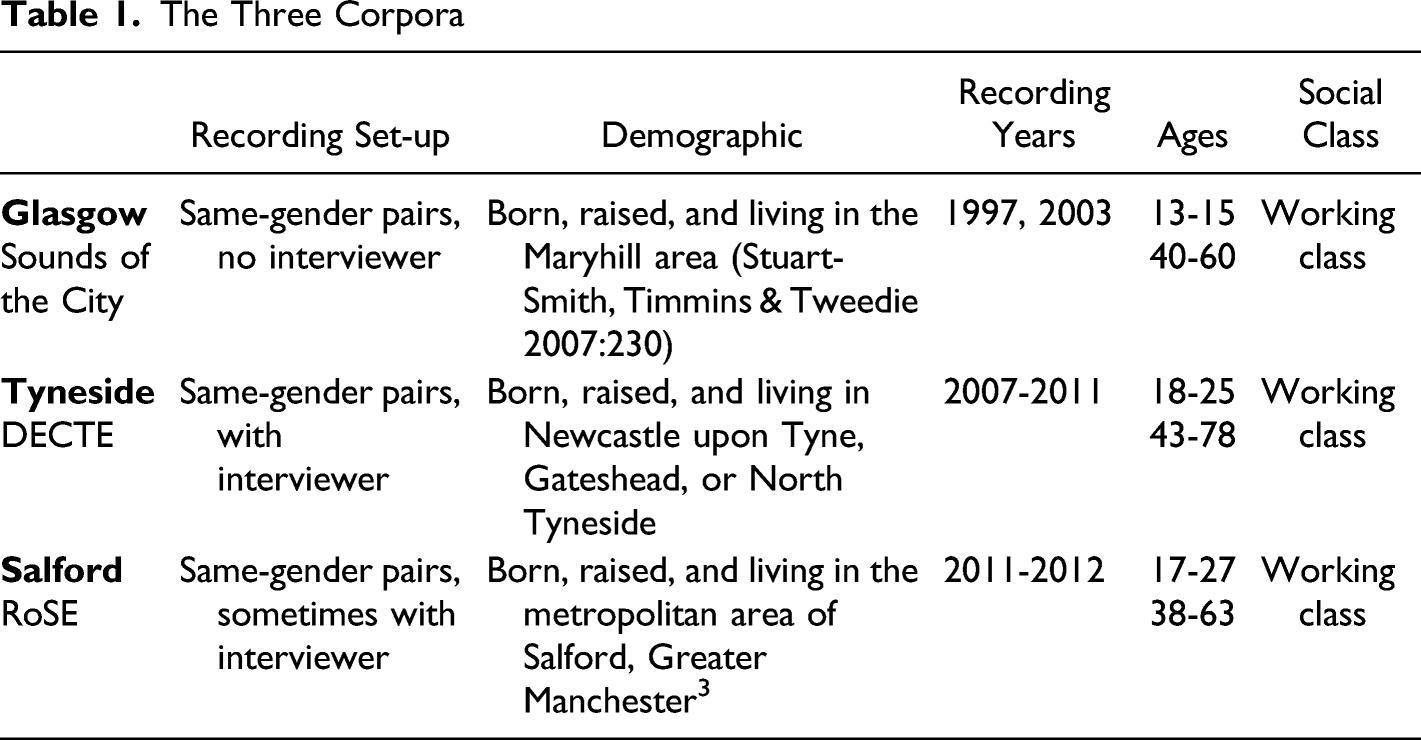
The Three Corpora
Final Sample
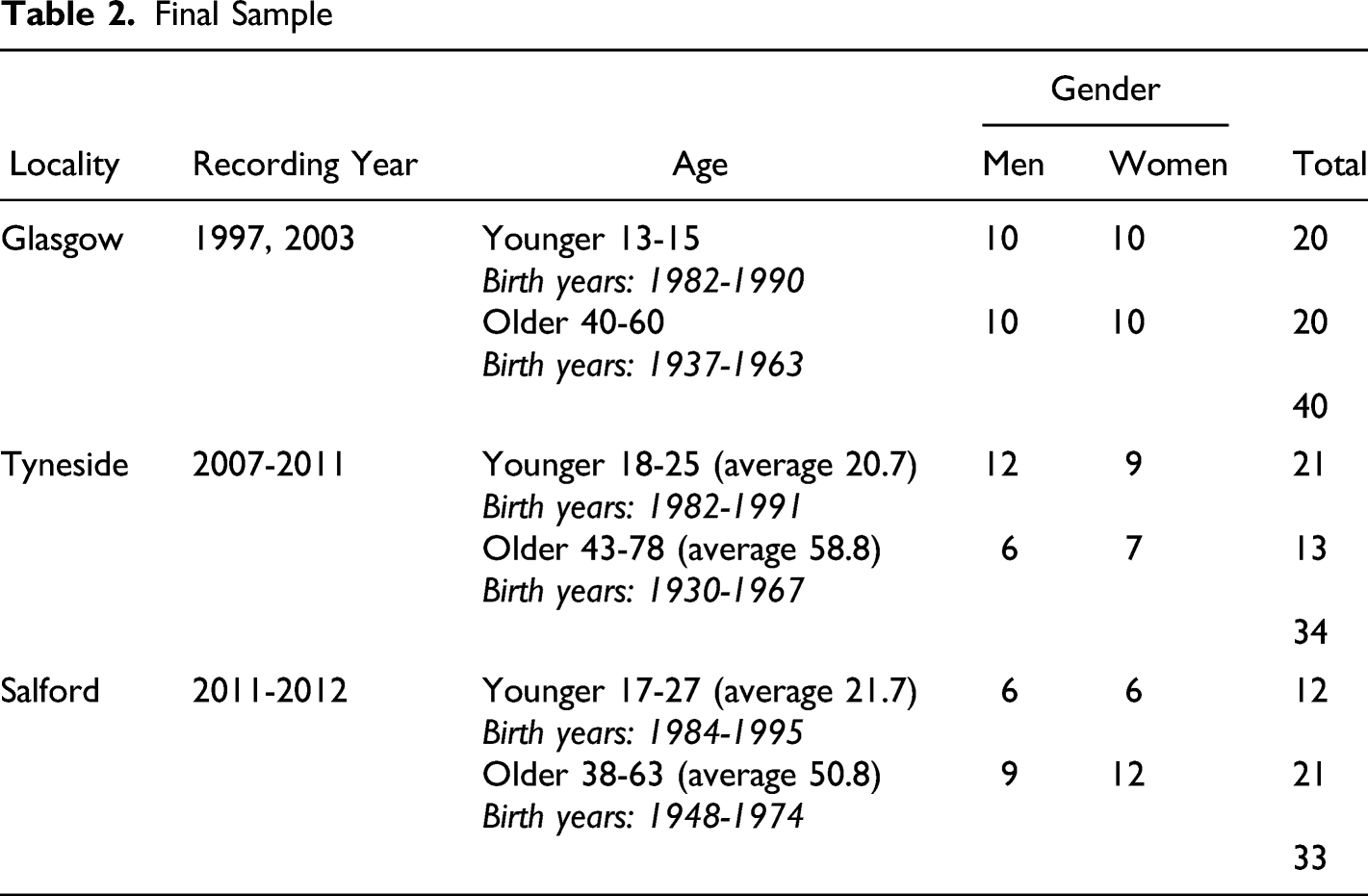
Recording dates vary across the corpora but the birth years show that the speakers are from roughly the same generations across the communities. Although the age ranges differ slightly between the three samples, there is a clear distinction between the “younger” and “older” categories that will be used in the analyses. These categories also have similar average ages where this can be calculated (i.e., in Tyneside and Salford, as specific ages are given in the metadata). The sample also exceeds recommendations for at least five speakers per cell (Meyerhoff, Schleef & MacKenzie 2015:22). From this sample, negative tags within the variable context were extracted, following the procedures outlined in section 4.2.
4.2. Methods
The analysis concerns negative tags that consist of a negative auxiliary and personal pronoun (or there) attached to an affirmative anchor clause, as in (14). Tags with an affirmative anchor clause and affirmative tag are outside the variable context. Negative tags with a negative anchor were excluded because they were infrequent (N = 5) and were distinct from those with positive anchors in that they included tags with no or not placed after the pronoun (does he no, have they not, aren’t they not) in addition to don’t they and innit. Invariant lexical tags (such as no?) are also excluded. (14) It’s lush, isn’t it? (MP/158, Tyneside)
The negative tags were extracted from the Glasgow, Tyneside, and Salford transcripts using AntConc concordance software (Anthony 2011) using search terms that would capture the full range of forms. As the pronunciation of the tags is the basis for determining the variants, each token was listened to individually and coded. Tokens outside the variable context were removed from the sample. All of the examples in my data are attached to the right periphery of declarative clauses. There were no left-periphery (i.e., non-canonical) tags of the kind found in Multicultural London English (see section 2). Isolated follow-up questions like those in (15) were excluded as they are not tagged onto an anchor clause by the same speaker but refer back to a proposition expressed by the previous speaker (Andersen 2001). (15) Fieldworker: I find it really miserable com [pared to everything else. JK: [Isn’t it? Uh-huh. (Tyneside)
Tokens that were ambiguous, unfinished, in false starts, or used in reported speech were also excluded from the sample, as were tags that were used after a long pause after the anchor (N = 13) since these appear to be afterthoughts (Andersen 2001:136) or might represent full interrogatives rather than tags.
4.2.1. The Variants
Inventory of Negative Tags in the Data
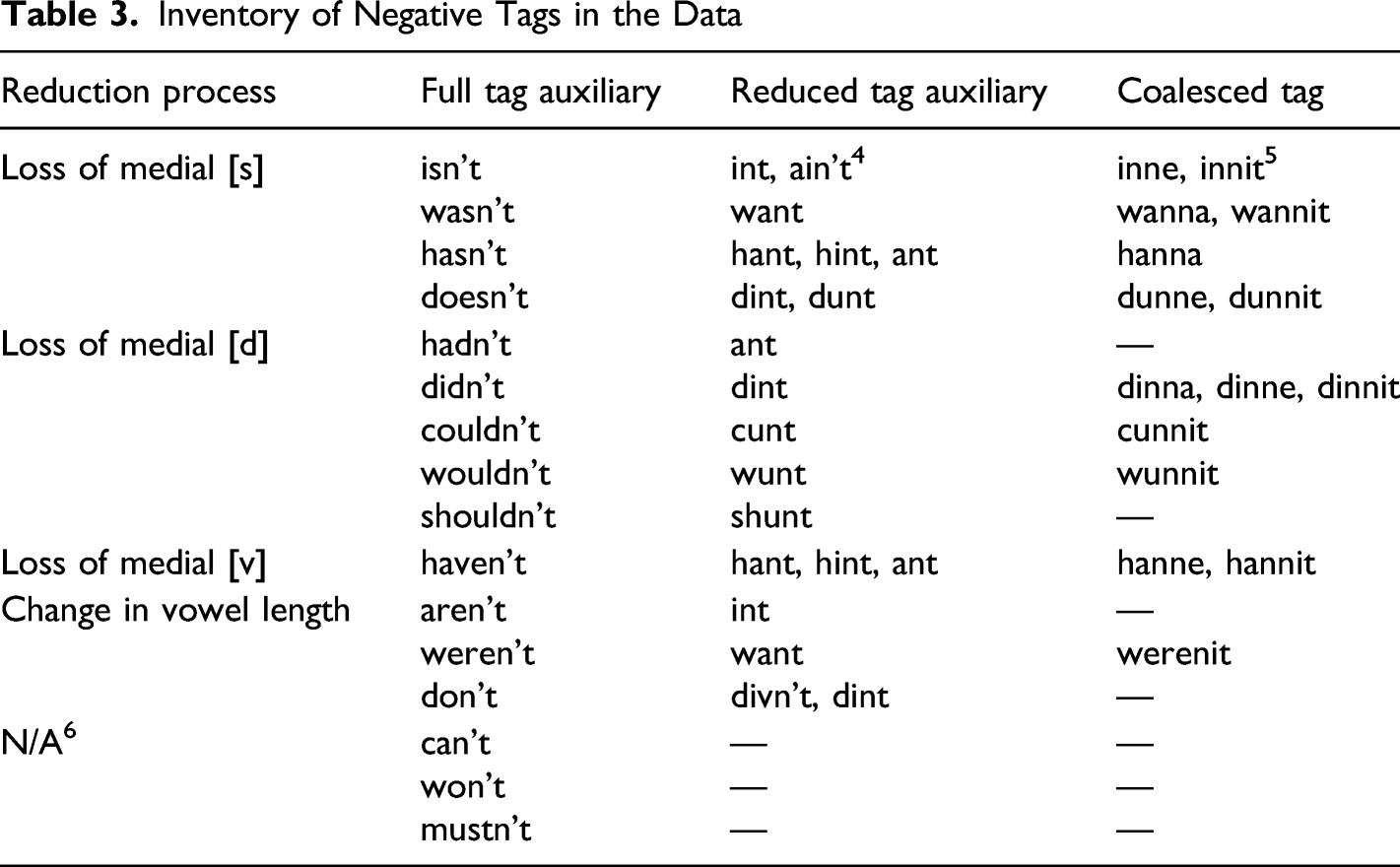
The realization of the final /t/ in the full and reduced auxiliaries can vary, but this does not affect the categorization of tokens into variant types (see Cheshire [1981:370] and Pichler [2013:183], who took a similar approach). It is the loss of auxiliary-medial consonants and/or changes in vowel length from the full forms that leads to the categorization of tokens as “reduced.” Full tags that contain auxiliaries with medial consonants, specifically consonants that are the final segment of the auxiliary stem (before n’t), become reduced tags when those consonants are lost. For example, di[d] + n’t becomes dint. Other tags have experienced further reduction, such as /h/-dropping—e.g., hasn’t and hadn’t become ant. Three auxiliaries—aren’t, weren’t, and don’t—typically have no stem-final consonants to lose (unless pronounced with /r/, which is not the case in this data), but have long vowels in their full variants (aren’t [ɑ:nt], weren’t [wə:nt], and don’t [dɔ:nt]) which become short vowels in their reduced alternatives. The form divn’t ([d
Like the reduced variants, the coalesced variants in Table 3 have experienced loss of medial consonants and/or change in vowel length from the full forms. The distinction between reduced and coalesced variants is that the latter involve fusion of the auxiliary and pronoun into “a single morphemic unit” (Andersen 2001:98). The proposal that coalesced variants are derived from related reduced variants is consistent with the proposed trajectories for innit in the literature (Andersen 2001; Pichler 2013) and the understanding that, if related forms with different amounts of reduction are in variation, the most reduced form is likely to be the most recent (Hopper & Traugott 2003:125).
Any tags where the phonetic realization was unclear were excluded from the analysis (N = 45), leaving a sample of 196 tags in Glasgow, 271 in Tyneside, and 567 in Salford.
4.2.2. Coding
The 1034 negative tag tokens within the variable context were coded for various factors that were deemed likely to affect the choice of variant and which will facilitate the analysis of how grammaticalization mechanisms operate in the negative tag systems of different English dialects. The first of these coded factors is paradigmaticity, which refers to the extent to which a tag agrees in person, number, and gender features with the anchor clause subject (Andersen 2001; Pichler 2013). Lack of agreement between the tag and the anchor clause can indicate decategorialization as it shows “invariabilization,” whereby a form becomes less restricted in its syntactic distribution within a paradigm (Andersen 2001:98). Non-paradigmatic innit, shown in (16), is common in London teenagers’ speech (Andersen 2001; Cheshire, Kerswill & Williams 2005; Torgersen, Gabrielatos, Hoffmann & Fox 2011; Pichler 2021a). (16) I was talking to you earlier on innit (COLT; Stenström 1997:141)
The majority of innit’s occurrences (56 percent) in COLT are in non-paradigmatic contexts, whereas in the BNC/London corpus of adult conversation, it is only used paradigmatically (Andersen 2001:108-109). The prevalence of non-paradigmatic innit in London might reflect its origins in the speech of ethnic minority groups (Andersen 2001:114) and/or has been accelerated by language contact in multi-ethnic London boroughs (Pichler 2021a). Non-paradigmatic tags are much less common in many other dialects of British English (Cheshire, Kerswill & Williams 2005:156; Pichler 2013:198-199).
Tags which fully agree with the verb and pronoun in the anchor clause were coded as “paradigmatic” (17); those which agree with either the verb or pronoun but not both were coded as “semi-paradigmatic” (18); and those which do not agree in either respect were coded as “non-paradigmatic” (19). (17) It’s a well-run country, innit? (PS/243, Tyneside) (18) You wonder how they can afford it, can’t you? (NKOF1, Glasgow) (19) No, they put a stop to everything int it? (Gail, Salford)
To code for paradigmaticity, it was necessary to see whether each tag token was the same as—or could have derived from (through reduction/fusion)—the Standard English tag that would be expected to occur, on the basis of the anchor clause. Where there were ambiguities, the paradigmaticity of the token was coded as “indiscernible.” Sentences containing certain constructions, like the semi-modals
The second coded factor was pragmatic function. As noted in section 3, the pragmatic function of tags has sometimes been analyzed in terms of “conduciveness.” Conducive tags are intended to elicit a response (especially agreement) from the interlocutor, whereas non-conducive tags do not invite a response (see Cheshire [1981], who uses the terms “conventional” and “non-conventional” to describe the same distinction). Prior studies have shown that phonetically reduced tag forms, such as int and innit, are favored for non-conducive functions (Cheshire 1981, 1982; Pichler 2013, 2021a). The same is true of the equivalent of innit in Brazilian Portuguese, the reduced form né (Carvalho & Kern 2019). These observations align with the trajectory in which further eroded forms are more advanced along the cline of grammaticalization and have changed their function in the process.
Grammaticalization more generally is also often associated with the development of subjective meanings, i.e., those involving “the speaker and the speaker’s beliefs and attitudes,” and the potential subsequent development of intersubjective meanings, i.e., those involving “the addressee and the addressee’s face” (Traugott 2010:30). However, these processes of subjectification and intersubjectification are not involved in all cases of grammaticalization (Traugott 2010:40), nor is subjectification unique to grammaticalization (Brinton & Traugott 2005:109). Epistemic (information-seeking) tags—which could potentially be the earliest functions of tags (Tottie & Hoffmann 2009:154)—are said to have been intersubjective originally and therefore have not undergone intersubjectification (Traugott 2012:11). Epistemic tags can alternatively be considered simultaneously subjective and intersubjective because they involve the expression of speaker uncertainty coupled with an assumption that the hearer will be able to verify the proposition expressed (Andersen 2001:121). Indeed, “the subjective and intersubjective meanings conveyed by TQs [tag questions] are very often inextricably intertwined” (Kimps 2018:34). For these reasons, this paper follows Kimps (2018) in not categorizing specific functions as subjective or intersubjective. 7
The tokens were coded by listening to each one in context, as intonation contributes to tag function (O’Connor 1955; Millar & Brown 1979; Cheshire 1981; Holmes 1982; Nässlin 1984; Algeo 1990; Kimps 2007, 2018; Kimps, Davidse & Cornillie 2014; Gómez González & Dehé 2020). For example, tags with falling intonation frequently signal a greater degree of speaker certainty in the proposition than those with rising intonation (Holmes 1982:50; Quirk, Greenbaum, Leech & Svartvik 1985:811). However, this is not a categorical relationship, nor are intonation and discourse functions independent of one another (Cruttenden 2001:71). Prosody, lexical meaning, syntactic environment, and the utterance context can all contribute to function (Wiltschko, Denis & D’Arcy 2018). The varieties of English studied also exhibit different intonation patterns themselves. 8 For these reasons, intonation was not coded separately from function.
Summary of Negative Tag Functions
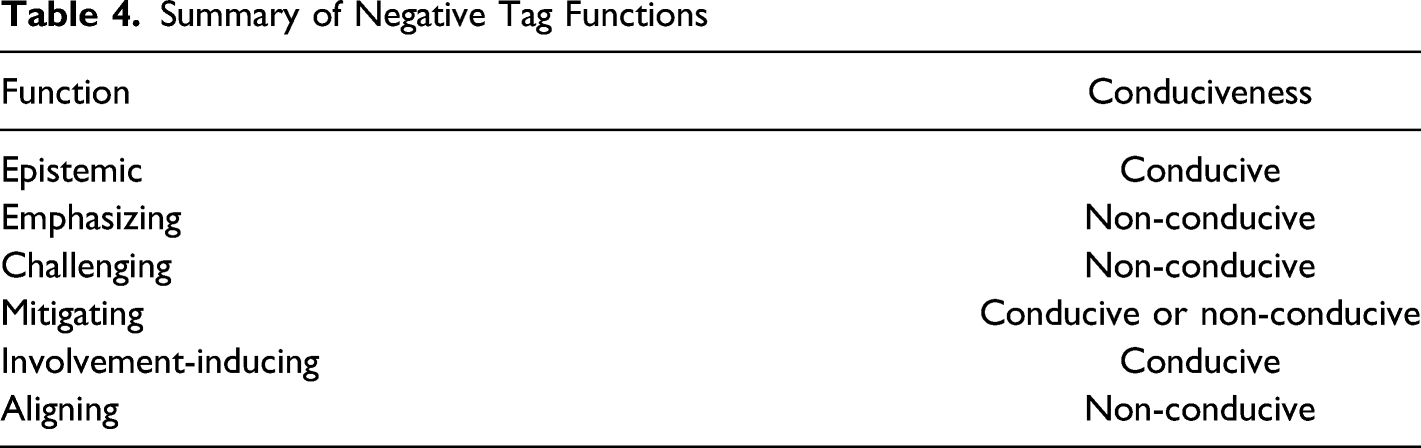
Epistemic tags are used to “reduce speakers’ commitment to their propositions and seek verification of these propositions from addressees” (Pichler 2013:187). These tags therefore function as information-seeking devices. This function is consistently attested in previous literature, albeit with varying labels (Millar & Brown 1979; Cheshire 1981; Algeo 1990; Tottie & Hoffmann 2006, 2009). Example (20) shows the use of an epistemic tag—in this case, innit. Speaker 00-G1-m04 introduces someone named Bolan, to which 00-G1-m03 suggests “Aye, Sam Bolan, innit?,” seeking verification. (20) 00-G1-m04: Know that wee Bolan? 00-G1-m03: Aye, Sam Bolan, innit? 00-G1-m04: Jim 00-G1-m03: Jim (Glasgow)
Emphasizing tags are sometimes called “attitudinal” (Tottie & Hoffmann 2006; Pichler 2013) or “punctuational” (Algeo 1990), but the term “emphasizing” is adopted here to capture the fact that speakers use these tags to emphasize a point. Emphasizing tags are “self-centred” (Algeo 1990:446); they are non-conducive as they do not elicit a response from the interlocutor (Coates 1996:194; Tottie & Hoffmann 2006:300). The speaker is fully committed to their proposition, and these tags are not considered rude or antagonistic (Algeo 1990:446; Pichler 2013:189). Example (21) illustrates the use of an emphasizing tag, where Janet is talking about how her dog previously had fleas and she takes precautions to prevent that happening again. Moira replies that she has always owned English Bull Terriers (a type of dog that has short hair and does not require much grooming, unlike Janet’s dog). The tag hanna (‘haven’t I’) emphasizes Moira’s point, and she is fully committed to her statement. (21) Janet: So now, what I do (.) I put Frontline on him before he goes (.) I put Frontline on him the day before (..) so he’s covered when he goes and has his hair cut. Moira: Well I’ve always had English Bulls, me, hanna? (Salford)
Like emphasizing tags, challenging tags stress a particular viewpoint, but they differ in one key respect: challenging tags are impatient or even aggressive (Millar & Brown 1979:43; Algeo 1990:448). Although Pichler (2013:193) found no challenging tags in her data, they have been attested in other studies (Algeo 1988, 1990; Tottie & Hoffmann 2006). In (22), Sasha states that dominoes players use “them little metal things” to keep score— not “matches” as her mother Charlotte suggests. Sasha uses don’t they to assert her certainty in her proposition, expressing frustration that her mother should really have known this fact. Charlotte’s response is said with increased pitch to convey annoyance at Sasha’s previous challenge. (22) Sasha: So yeah. So (.) cos- cos- eighteen (.) is what the ends add up to, and that’s divisible by three (.) and it’s divisible six times by three, [you score six points, and then that’s put on your (.) crib-board. Charlotte: [Yeah. Crib-board. Right. Do they still have matches in them then? Sasha: No they have them little metal things, don’t they? Charlotte: I don’t know, I’ve not seen one. (Salford)
Mitigating tags, sometimes called “softening” tags (Holmes 1984; Tottie & Hoffmann 2009), “soften the negative force of interactionally dispreferred moves” (Pichler 2013:189) and are therefore negative politeness devices (Holmes 1982:58, 1984:54). In (23), Emily states that the best way for her to learn a language would be to go abroad, but Sally disagrees. Sally’s use of the tag don’t you acts as a mitigation device, reducing the negative force of her disagreement. This particular example is non-conducive as Sally does not pause after the tag and thus prevents her interlocutors from responding immediately. As such, the tag aims to end the topic and “signal that the co-conversationalist’s preceding proposition is in some way wrong or inappropriate” (Pichler 2013:190). However, mitigating tags can also be conducive in certain contexts, in which case they “challenge addressees to justify the proposition the speaker disagrees with” (Pichler 2013:189-190). (23) Emily: I did that Languages For All which was awful, cos I didn’t wanna, I wasn’t really ready to do it anyway (.) but like, none of it went in (.) and then I thought the only way I could actually do this is to do it practically and actually go there. Because she- Fieldworker: Yeah. Sally: Yeah but that way you only learn s- conversational French don’t you and you don’t learn the grammar and the syntax and- Emily: cos we had (…) no you need to do it both ways (.) that’s why, that’s why Kim and- Fieldworker: Oh, that’s how you pick it up though isn’t it? (Salford)
Involvement-inducing tags—sometimes called “facilitating” or “facilitative” (Holmes 1982, 1984; Coates 1996:193; Tottie & Hoffmann 2006, 2009)—are used when a speaker is committed to the truth of their proposition but uses the tag to elicit a response from their interlocutor. Example (24) illustrates this function: 00-G2-m01 uses the tag isn’t she to seek agreement from 00-G2-m02 that someone named Barbara is nice. (24) 00-G2-m01: She’s nice, wee Barbara and all isn’t she? 00-G2-m02: She’s a lovely lassie. (Glasgow)
Aligning tags—which are described in Holmes (1982) as “responsive” tags and in Pichler (2013) as “alignment signals”—do not elicit a response but are positive politeness devices that signal agreement with the previous speaker. Example (25) shows how 3M6 uses dunt it (‘doesn’t it’) with the alignment function to agree with 3M5’s proposition. (25) 3M5: Feels like as if you’ve nae room in here, dunnit? 3M6: It does, dunt it, man, pure heavy wee place. 3M5: Wee box, man. (Glasgow)
Coding for these functions and their conduciveness will enable a comparison of tag uses between localities as well as an investigation of whether erosion of tag form correlates with functional change.
Finally, the negative tag tokens were coded for the three external factors: locality, gender, and age. Locality was, as before, coded as Tyneside, Glasgow, or Salford. Gender was coded as “men” versus “women.” Age was coded according to the two age groups of “younger” versus “older,” as described in section 4.1. The inclusion of gender and age allows for an investigation of whether differences in the frequencies of variant types might be indicative of linguistic change in progress. Age-related differences are analyzed using the “apparent time” construct (Bailey, Wikle, Tillery & Sand 1991), under which the language of older speakers is considered to represent an older point in time (when those speakers first acquired their dialect) compared to younger speakers. By comparing the language use of different age groups, we can make inferences about linguistic change (or stability) over time.
5. Results of Quantitative Analysis
Having outlined the coding of internal and external factors, this section turns to the quantitative analysis, firstly presenting distributional results which provide insight into the four mechanisms of grammaticalization and their relevance to negative tag variation: erosion (section 5.1), decategorialization (section 5.2), and desemanticization and extension (section 5.3). The relative impact of factors on the variation will be examined in mixed-effects logistic regression models in section 5.5.
5.1. Erosion: Phonetic Reduction
Figure 1 shows the distribution of full, reduced, and coalesced tags according to locality, which is statistically significant (χ2 = 158.68; d.f. = 4; p < 0.001). Under the temporal continuum whereby full tag variants are the oldest forms, followed by reduced variants, then coalesced variants, the results in Figure 1 suggest that Tyneside is the least advanced of the three communities in terms of negative tag erosion. In Tyneside, there is a clear preference for full tags (70.4 percent), with lower rates of reduced (7 percent) and coalesced variants (22.6 percent). Glasgow and Salford pattern most alike, with almost the same relative frequency of coalesced forms. Salford has relatively equal rates of use for full and reduced variants, but in Glasgow the balance is tipped in favor of reduced forms (46.3 percent) compared to full forms (21.3 percent). The community with the least tag erosion—Tyneside—also has the sharpest social stratification of variation according to age and gender, as we will see in section 5.4, suggesting an ongoing change. Overall Distribution of Negative Tag Variants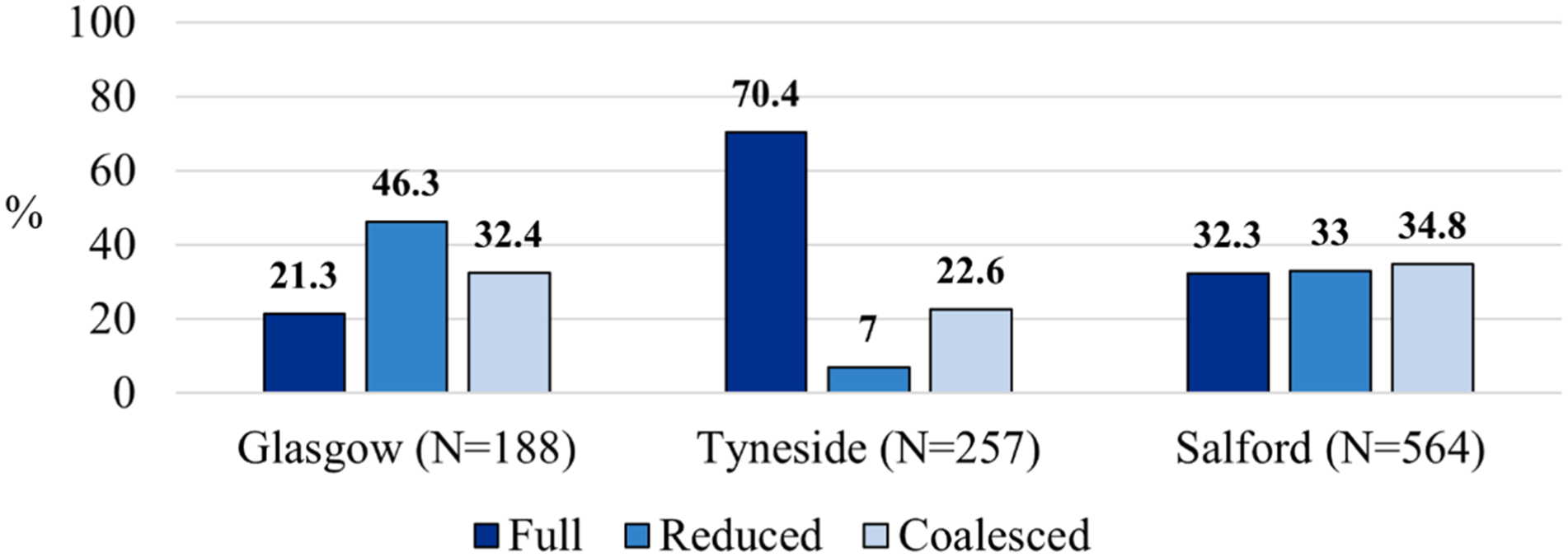
Attestation of Variant Types for Each Auxiliary
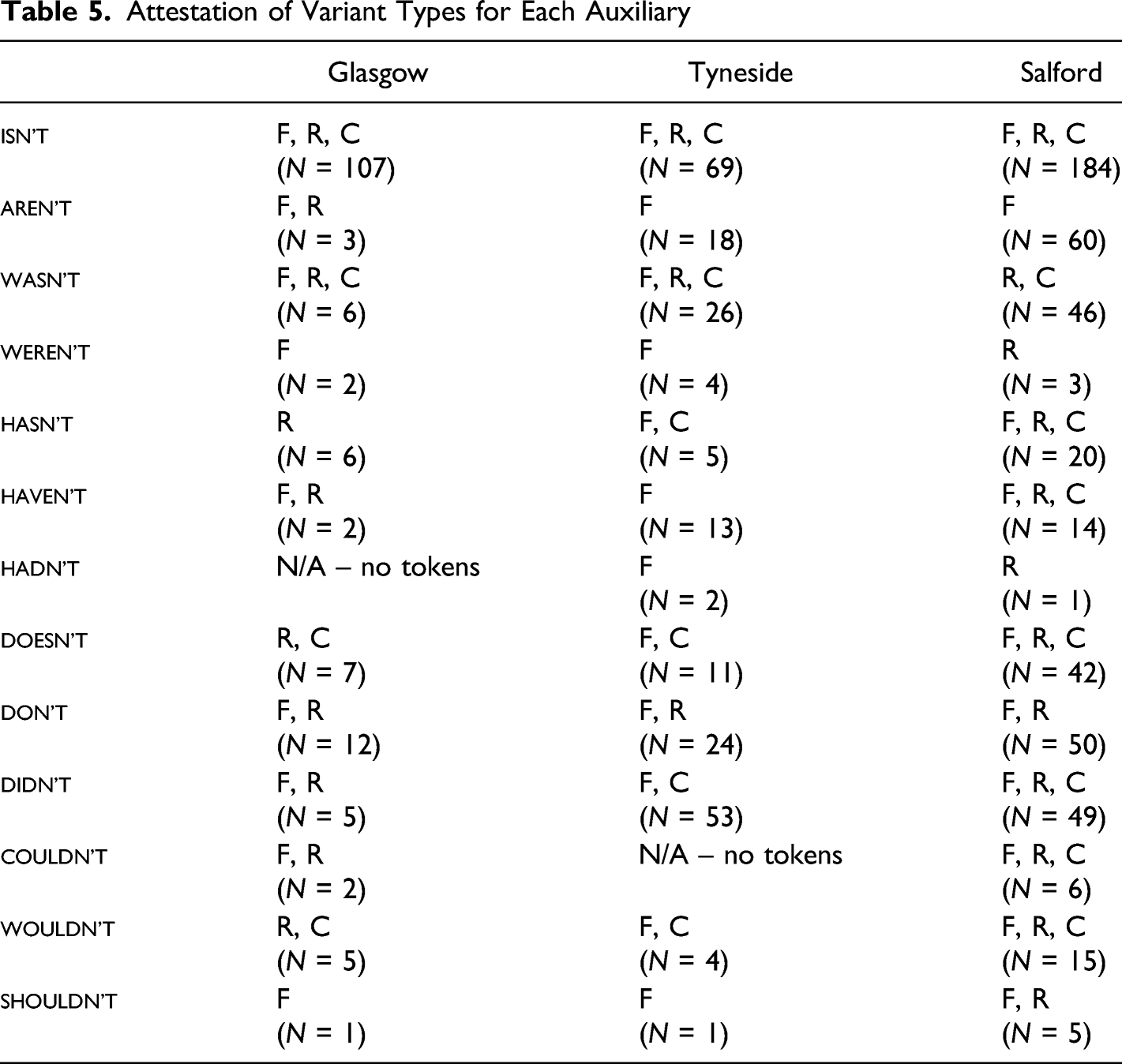
“F,” “R,” and “C” represent the three variant types—full, reduced, and coalesced—and, if present in a cell, indicate that the variant type was found in the sample at least once for a given auxiliary. The cells with “n/a – no tokens” represent cases where a particular tag auxiliary was not found in the data. The tags
Although certain auxiliary and pronoun combinations do not allow coalescence (see section 4.2.2), full and reduced variants have potential to occur in all environments. However, as Table 5 shows, reduced variants are not consistently attested for every auxiliary in every community. High frequency leads to greater erosion (Bybee & Hopper 2001; Bybee 2003; Krug 2003), and the most frequent tag in the data is
Table 5 also reveals an implicational hierarchy in Glasgow and Salford in which coalesced forms only occur where reduced variants are also attested—a pattern that aligns with the expectation that reduced and coalesced forms will layer as the reduced variants become further reduced and fused over time (Andersen 2001:105-106). However, in Tyneside there is no such tendency: both full and coalesced variants are attested for certain auxiliaries where there are no instances of reduced variants. Full forms are attested for every auxiliary (excluding contexts with no tokens at all) in Tyneside, but reduced forms only occur in three contexts overall, compared to six for coalesced forms. Recall also from Figure 1 that speakers in Tyneside used reduced tag variants the least of the three variant types—and less so than speakers in the other two communities—at a rate of only 7 percent. Therefore, the main distinction in the Tyneside English negative tag system is between full and coalesced variants. The reason behind this lack of reduced variants in Tyneside is not entirely clear, but it is possible that an additional phonological process is involved. 9 For example, /t/-glottaling can occur in tags (e.g., isn[ʔ] it) in Tyneside English, as Docherty, Foulkes, Milroy, Milroy, and Walshaw (1997) observe. As noted in section 4, tag variants classified as reduced could have various realizations of final /t/, as it is the loss of auxiliary-medial consonants and/or a difference in vowel quality that distinguishes full and reduced variants. However, the transition from reduced to coalesced forms must necessarily—at some point—involve the loss of the final /t/ of the auxiliary (int it becomes innit; dunt he becomes dunne, etc.). It is therefore conceivable that in Tyneside English, where both glottaling and glottal reinforcement are prominent features of the accent (Milroy, Milroy, Hartley & Walshaw 1994), reduced variants might become coalesced at higher rates. This is beyond the scope of the present study but remains a tentative hypothesis for future research.
5.2. Decategorialization: Paradigmaticity
Having established that tag erosion occurs to some degree in all three varieties of English studied, the next analysis concerns paradigmaticity as a measure of decategorialization. Tags that fail to agree with their anchor clause either entirely (non-paradigmatic tags) or partly (semi-paradigmatic tags) can be considered to have weaker ties to the anchor than those which do agree (paradigmatic tags). Tags where paradigmaticity was ambiguous (see section 4.22) were excluded from this analysis (N = 43).
As Figure 2 shows, paradigmatic tags comprise the vast majority of uses in all three dialects, at rates of over 90 percent per community. Furthermore, as noted in section 4, when the data was first extracted and sorted, there were no examples of tags in non-canonical structural positions, in contrast to Multicultural London English (Pichler 2016). The tags in these Scottish and Northern English varieties have therefore not expanded their semantic-syntactic environments far beyond the canonical ones. Relative Frequency of Paradigmatic, Semi-Paradigmatic, and Non-Paradigmatic Negative Tags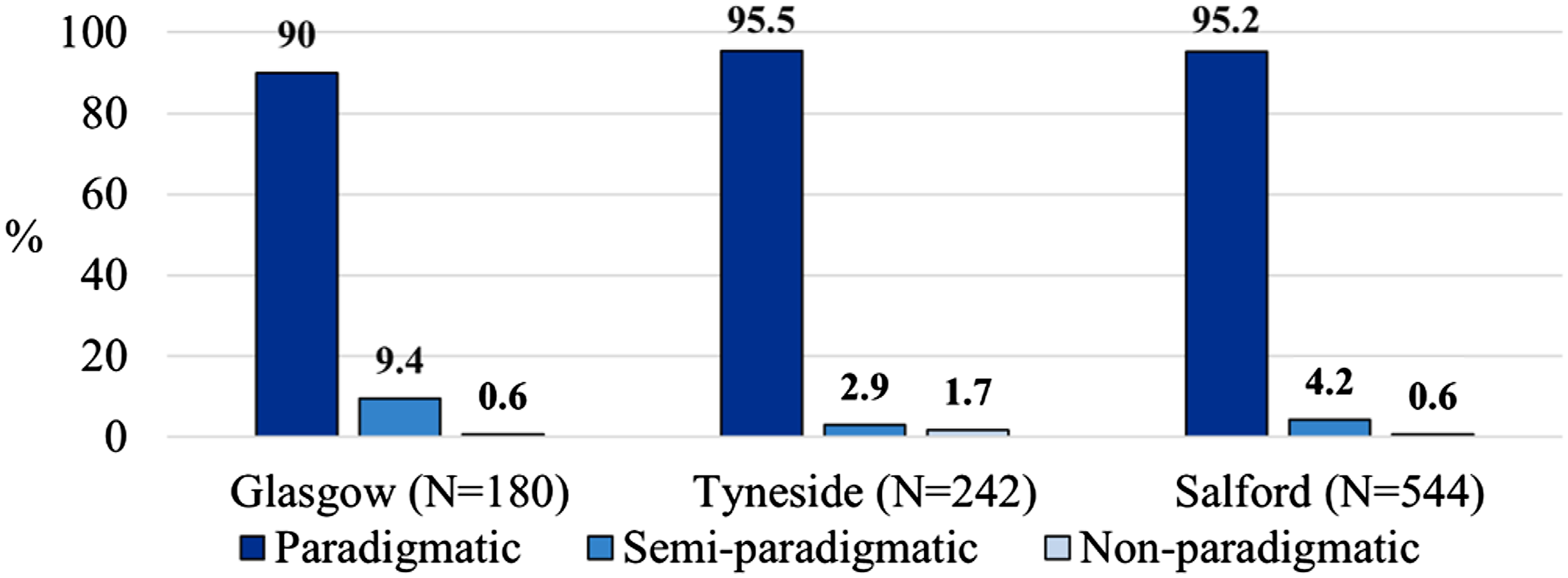
The semi-/non-paradigmatic tags found in each of the three datasets could simply be performance errors (see Algeo 1988:179) or they might represent the early stages of tag decategorialization. Examining the semi-/non-paradigmatic tokens reveals that many different tag forms appear in these contexts. Innit—which one might expect to be the most decategorialized based on prior studies—appears only once in these semi-/non-paradigmatic contexts (out of 37 tokens of innit in Tyneside and 125 tokens in Salford) or twice (out of 50 tokens in Glasgow) per community. Once again, this contrasts with London, where non-paradigmatic innit represented 56 percent of all innit tokens in COLT (Andersen 2001:108) and semi-/non-paradigmatic innit is used to a significant extent by young speakers (Pichler 2021a).
One pattern that does emerge is a propensity for semi-/non-paradigmatic contexts in Glasgow to feature
In many other cases where tags do not agree with the anchor clause, there is often an available interpretation in which the tag has been appended to the underlying proposition rather than what was explicitly said. For example, the tag wasn’t it in (26) scopes over the bracketed portion of the utterance. The underlying proposition is given in quotation marks, and it is clear that wasn’t it would be canonically derived from that proposition, which highlights that non-paradigmatic tags do not occur randomly but are linguistically constrained (see Coupland 1988:36; Krug 1998).
(26) Yeah they changed [the comprehensive system] wasn’t it? (MD/59)
‘It was the comprehensive system that they changed, wasn’t it?’
In summary, the evidence of decategorialization of negative tags in Glasgow, Tyneside, and Salford is minimal. Semi-/non-paradigmatic tags are in the minority, and many of these examples can be explained by general leveling of the verb paradigm or attaching the tag to the underlying proposition. These could reflect early decategorialization, but these tendencies are not unique to grammaticalization. The tags also retain their standard syntactic position and agree with their anchor clause the majority of the time.
5.3. Desemanticization and Extension: Pragmatic Function
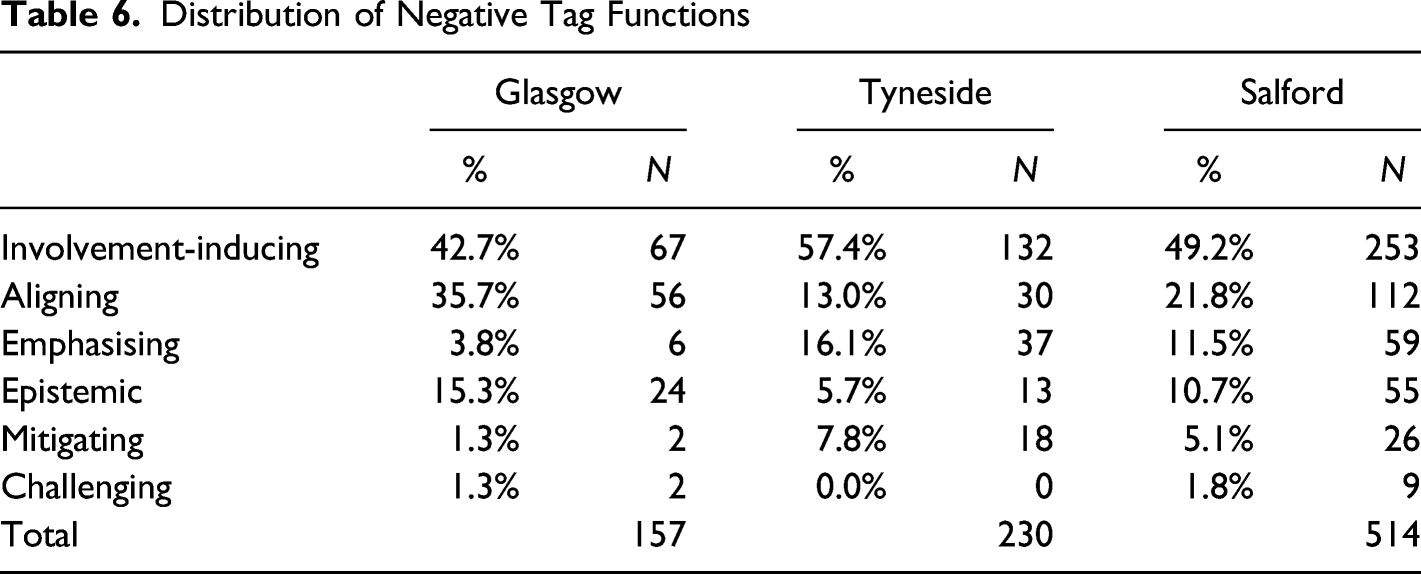
Distribution of Negative Tag Functions
Distribution of Negative Tag Variants According to Conduciveness
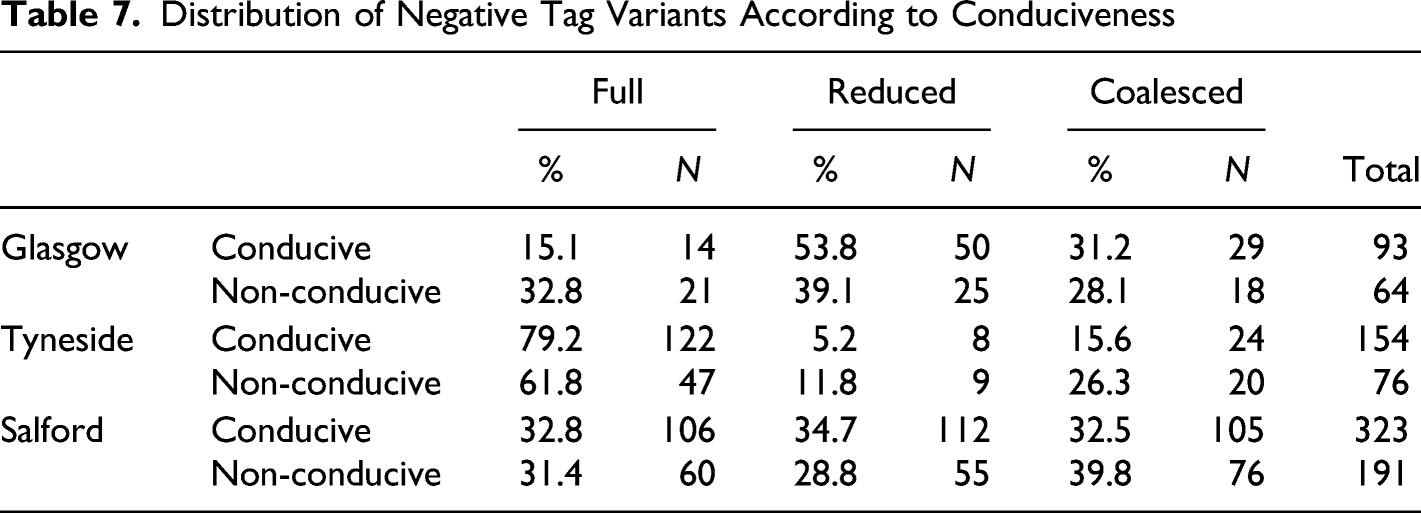
These results more broadly show that erosion does not necessarily covary with desemanticization/extension, and, if these mechanisms are related, their effects do not necessarily result in the same patterns of variation emerging in different dialects of English. Just as “meanings in the indexical field can be repackaged and combined in unique ways to create distinct local identities” (Moore & Podesva 2009:477), as also demonstrated in studies of teenagers’ tag use in Reading (Cheshire 1981, 1982) and London (Pichler 2021b), it appears that discourse-pragmatic functions too can be “repackaged” with linguistic forms in different ways depending on the community.
5.4. Social Factors
The final distributional analyses examine how negative tag variation patterns between speakers of different genders and ages. All three localities show a significant effect of gender on the variation (Glasgow: χ2 = 9.995, d.f. = 2, p < 0.01; Tyneside: χ2 = 34.007, d.f. = 2, p < 0.001; Salford: χ2 = 18.915, d.f. = 2, p < 0.001), with remarkably consistent trends across the localities, as shown in Figure 3: women tend to use more full and reduced variants, while men use coalesced forms to a greater extent than women. The only exception is with respect to reduced variants in Tyneside, where these particular variants are low frequency overall with little difference between the genders. When the tag innit is separated out from other coalesced variants, it comprises a higher proportion of tags for men versus women in all three localities. The social trends from these localities align with previous accounts of men leading in the use of innit in other varieties of British English (Andersen 2001; Torgersen, Gabrielatos, Hoffmann & Fox 2011; Pichler 2013). Distribution of Negative Tag Variants According to Speaker Gender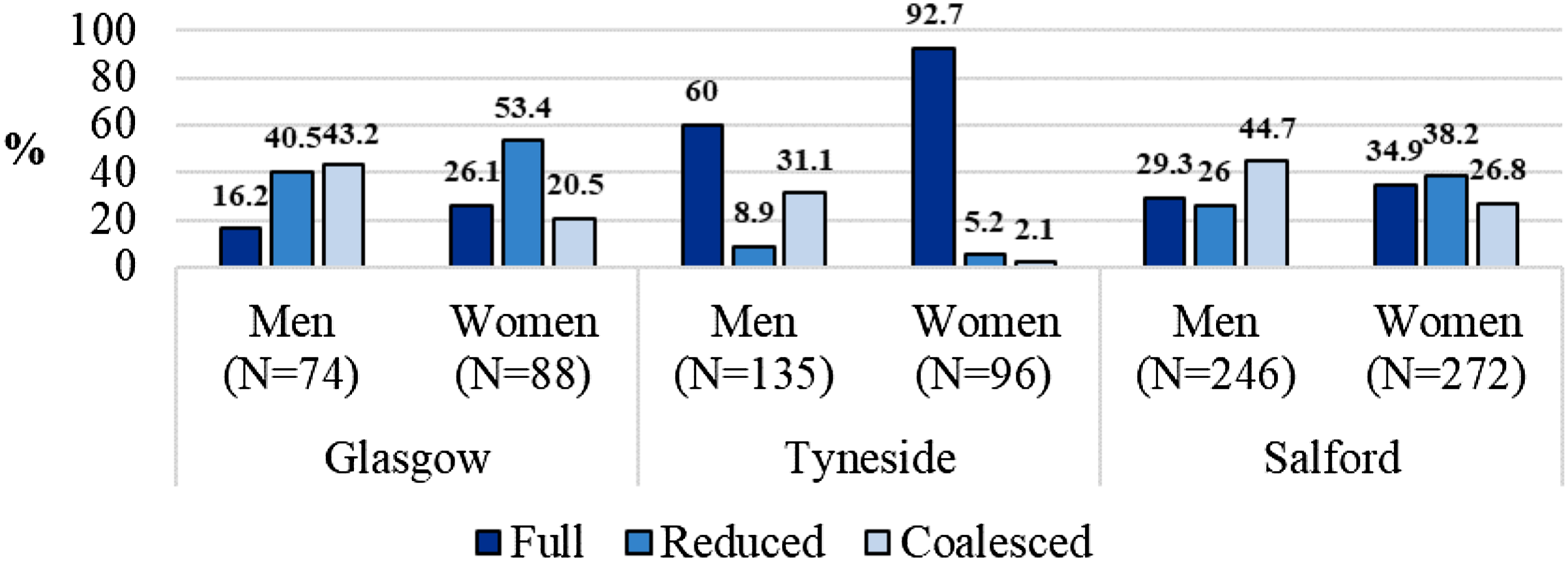
What can account for men’s lead in the use of coalesced variants? Coalesced variants are likely to be the most salient, as they represent the fusion of two separate grammatical items in addition to having been reduced phonetically. The stigma attached to innit might be found for coalesced variants more generally, at least to some extent, especially given that forms like gimme (‘give me’) and wanna (‘want to’) are also stigmatized (O’Grady 2013:52). Coalesced variants might have covert prestige for men, as suggested for innit (Pichler 2013:209). Women’s comparatively higher rates of full and reduced variants likely reflects a gravitation towards forms that are less stigmatized.
The consideration of age-based negative tag variation in Figure 4 provides further insight into potential change in progress. There are significant associations between variant type and age in Glasgow (χ2 = 12.01, d.f. = 2, p < 0.01) and Tyneside (χ2 = 30.14, d.f. = 2, p < 0.001) but not Salford (χ2 = 4.14, d.f. = 2, p > 0.05). The social stratification in Tyneside is indicative of an ongoing change from below (Labov 2006:206-207) in which reduced and coalesced tag variants are becoming more frequent from the older to younger generation. Older Tyneside English speakers are much more conservative than the younger speakers, using full tags near-categorically at a rate of 95 percent, while younger speakers lead in the use of reduced and—most clearly—coalesced variants. The form innit constitutes 17.2 percent of the young people’s tokens but is not attested in the older speakers’ data; older Tyneside speakers actually barely use coalesced variants at all (N = 1). Distribution of Negative Tag Variants According to Speaker Age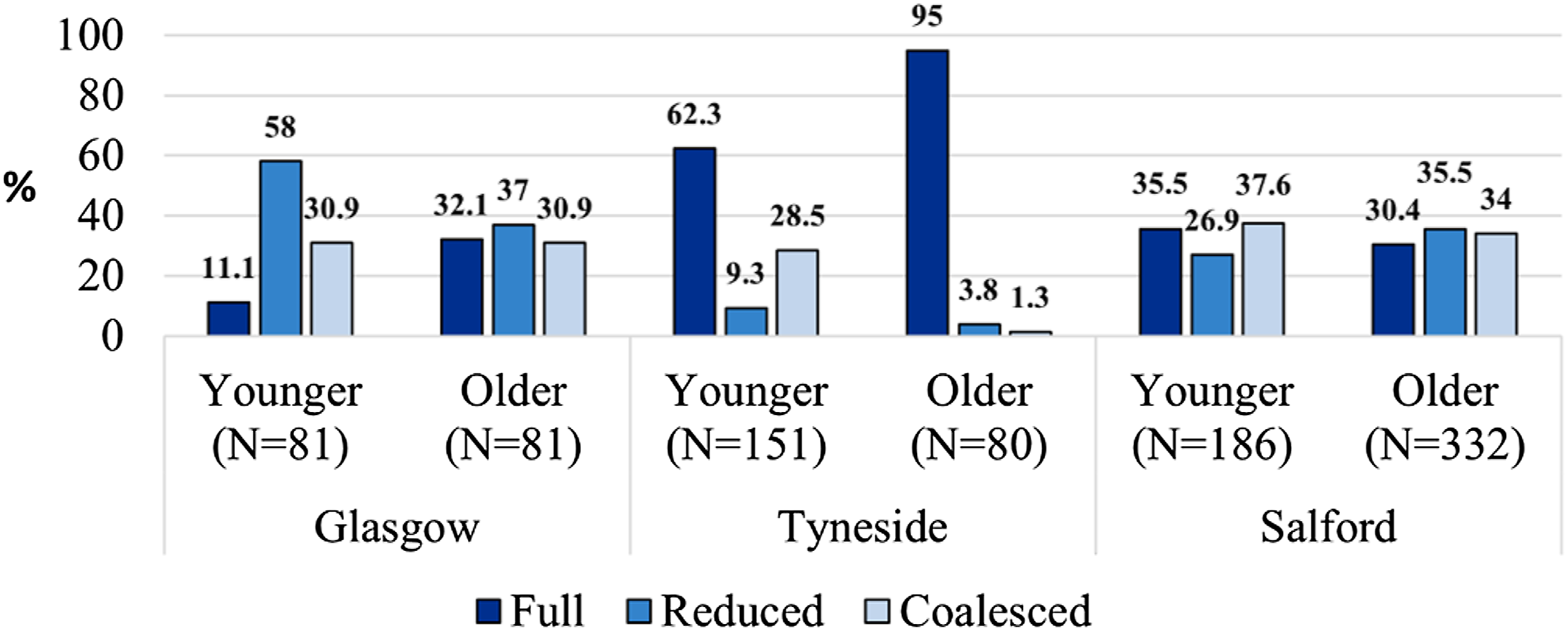
In Glasgow, where the distribution is also significant, the distinction between younger and older speakers is in their rates of full and reduced forms, with increased tag reduction among younger speakers. Coalesced variants are used at equal rates between the two groups. Even though Salford has the highest rates of reduced/coalesced variants of the three communities (see section 5.1), there are no significant age-related patterns in the variation, suggesting stable variation—any ongoing change appears to have slowed (or ceased) in this locality.
Analyzing the variation according to age and gender together, as shown in Figure 5, reveals that young men in particular are the leaders of the change in progress in Tyneside. The vast majority of coalesced tags in the Tyneside sample are in the speech of young men, who also have by far the lowest rate of full tags. The other three social groups in Tyneside have strikingly similar profiles, strongly preferring full tag variants. In Glasgow and Salford, the variation is less sharply stratified, but the link between coalesced variants and men’s speech (albeit more generally—not just with respect to younger speakers) as noted earlier persists. In Glasgow, coalesced variants are used to the greatest extent by older men. The Salford data meanwhile shows a more equal distribution of variants between the social groups which once again emphasizes the stability of the variation in that community. Distribution of Negative Tag Variants According to Speaker Gender and Age Across the Three Communities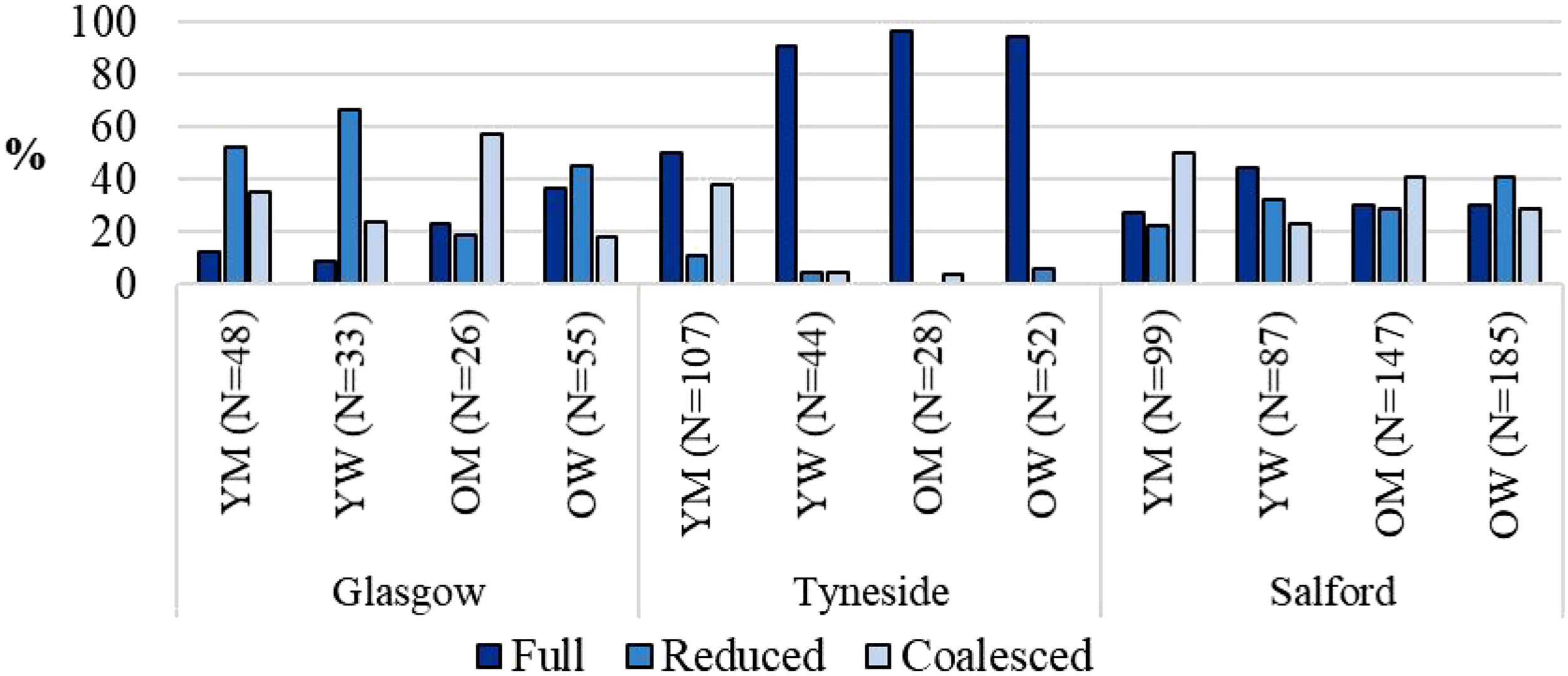
In summary, the social distribution of negative tag variation includes a significant effect of gender in all three localities such that full forms (and, in Glasgow/Salford, reduced forms) are used at higher frequencies by women while coalesced forms (including innit) are used to a greater extent by men. In Tyneside, young men appear to be driving a trend towards the use of more eroded forms, in an ongoing change from below. On the other hand, younger women and older men and women all strongly retain the use of full variants at rates of over 90 percent. Age is similarly significant in Glasgow, where there is a trend away from full forms and a movement towards greater use of reduced forms between older and younger speakers, but coalesced variants are equally frequent in both groups. In contrast, age is not significant in Salford, where the distribution of variants is more similar between younger and older speakers.
These findings suggest that the community with the least advanced degree of erosion (see section 5.1)—Tyneside—is at an earlier stage in a change in progress towards greater erosion of negative tags. The Glasgow data offers some indication of a potential change in progress, but the way in which younger and older speakers both use coalesced variants to the same extent suggests that erosion of phonetic form has led to additional layering of older and newer forms in that community. The significance of gender in Salford points to tags retaining their ability to act as sociolinguistic indicators, but the lack of age-based differentiation—along with the advanced degree of erosion in this community (see section 5.1)—suggests that any change here is more advanced and stable than in the other two localities.
5.5. Mixed-Effects Logistic Regression
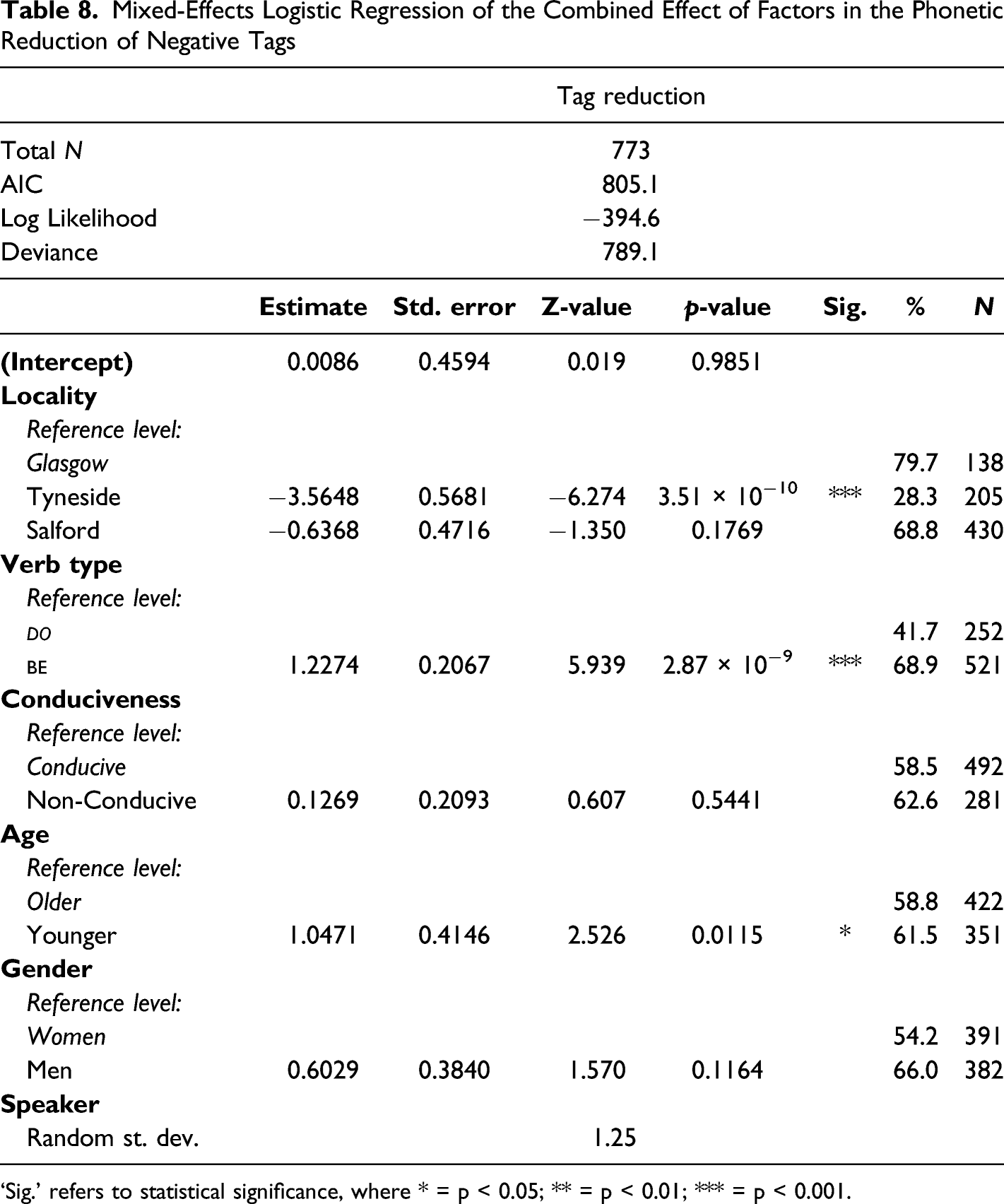
Mixed-effects logistic regression modeling was undertaken to establish the relative impact and significance of the factors analyzed so far, using R (R Core Team 2020) and the lme4 package (Bates, Maechler, Bolker & Walker 2015). As this requires the dependent variable to be binary, the tokens were re-categorized as either “full” or “phonetically reduced”—the latter collapses reduced and coalesced variants together. The analysis includes only paradigmatic tags with
Mixed-Effects Logistic Regression of the Combined Effect of Factors in the Phonetic Reduction of Negative Tags
‘Sig.’ refers to statistical significance, where * = p < 0.05; ** = p < 0.01; *** = p < 0.001.
Table 8 shows that
A second model (not presented here) which included the same factors but modeled the dependent variable in terms of the use of coalesced variants versus full/reduced variants combined (in contrast to reduced/coalesced variants versus full, as in Table 8) showed that
Mixed-Effects Logistic Regression of the Combined Effect of Factors in the Phonetic Reduction of Negative Tags in Tyneside versus Salford
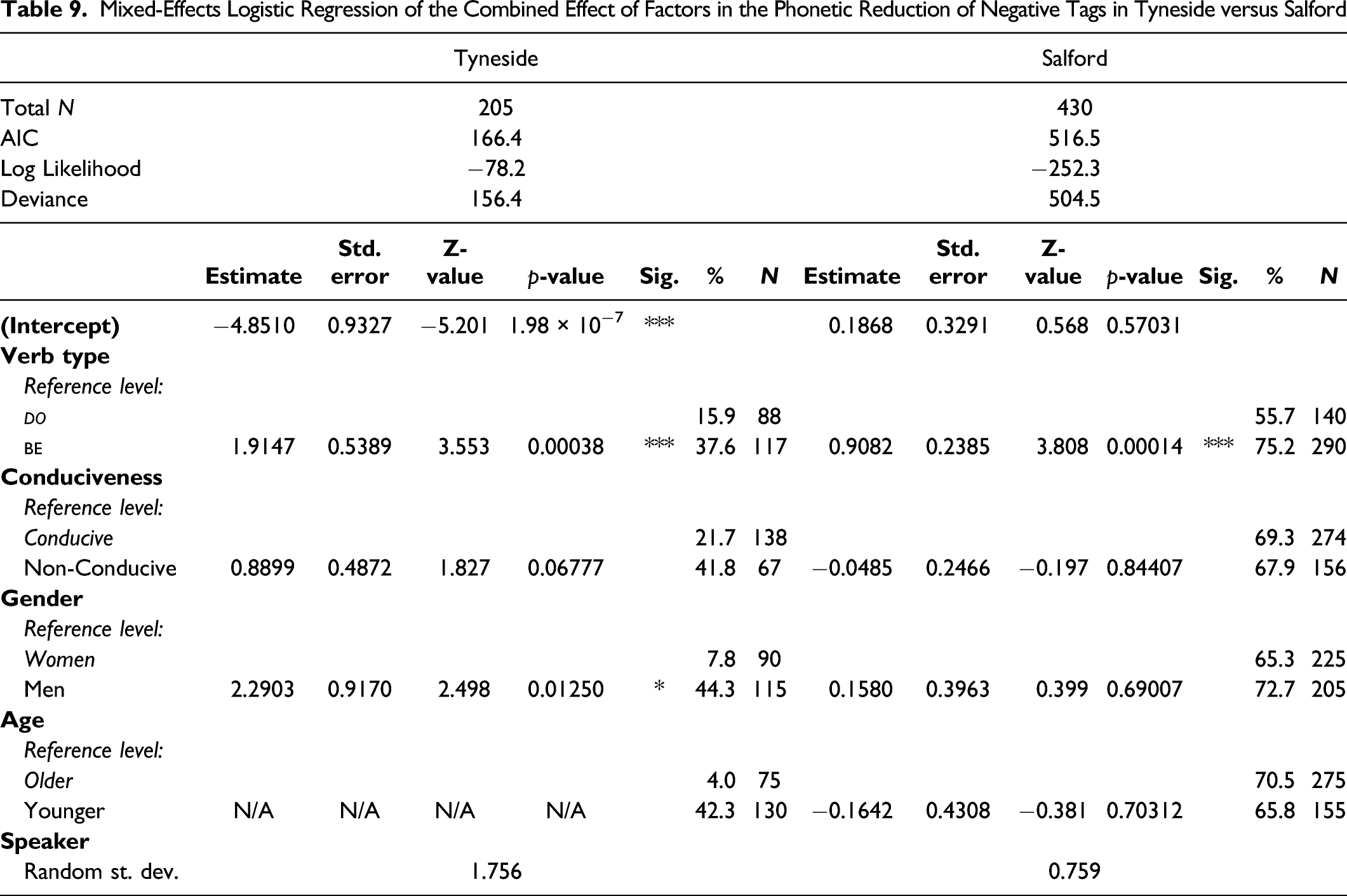
Verb type remains a significant constraint on negative tag variation in both Tyneside and Salford when modelled separately, as Table 9 shows. C
6. Discussion
This section evaluates the extent to which negative tags in Glasgow, Tyneside, and Salford are grammaticalizing, with reference to Heine’s (2003) four mechanisms of grammaticalization.
Erosion is evident in the negative tag variation across all three localities but has progressed to a greater extent in Glasgow and Salford than in Tyneside. The mixed-effects logistic regression modeling highlighted the distinctive profile of Tyneside English compared to the other two varieties in terms of its lesser degree of erosion, but the variety is also distinct with regard to the distribution of variants: coalesced forms are more frequent than reduced forms and are attested in environments even where reduced counterparts are not found. The lack of an implicational hierarchy in Tyneside, under which one would expect coalesced forms to be attested where reduced forms are also found (which is the case for Glasgow and Salford), might be a product of other phonological properties of Tyneside English such as its distinctive patterns of /t/-glottaling and glottal reinforcement (Milroy, Milroy, Hartley & Walshaw 1994; Docherty, Foulkes, Milroy, Milroy & Walshaw 1997). Though this must remain a tentative hypothesis for now, the degree to which these processes occur—and the constraints on their occurrence—might contribute to more rapid coalescence of tag auxiliaries and pronouns. Frequency also appears to play a role in facilitating erosion, as the most frequent tags in the data—
The second mechanism of grammaticalization considered—decategorialization—was analyzed in terms of paradigmaticity, which is the degree to which tags agree in person, number, and gender features with their anchor clause. Overall, there is little evidence of decategorialization in the negative tag data. The majority of tags (>90 percent in each community) occur in paradigmatic contexts. Even though the tags which occur in semi-/non-paradigmatic environments might represent the start of a decategorialization process in which the forms are losing their agreement-marking properties, these examples can largely be explained by other means. Many of the semi-/non-paradigmatic tags reflect leveling of the verb paradigm (particularly with respect to was/were variation), which—as noted earlier—is a common tendency within negative polarity tags across different varieties of English (Tagliamonte 1998; Cheshire & Fox 2009; Moore 2010). Furthermore, many other examples of semi-/non-paradigmatic tags appear to “attach” to the underlying proposition of the utterance rather than what was explicitly said. These examples were relatively infrequent, and all tags extracted occurred in canonical syntactic positions. Given these observations, it appears more constructive to think of the semi-/non-paradigmatic examples in this data as representing semantic flexibility rather than structural decategorialization. English subject-verb agreement—of relevance to paradigmaticity—indeed involves both morpho-syntactic and semantic properties (Francis & Yuasa 2008:47). There is no evidence of structural reanalysis, as the construction did not behave in a way which suggests the assignment of a new grammatical structure (Lehmann 2004). The tags in all three communities maintain their core syntax but have widened their semantic reference in a way that has yet to be fully conventionalized. These properties are in line with Francis and Yuasa’s (2008) cross-linguistic observations that semantic change alone is sufficient to cause changes in a grammaticalizing item’s distribution and typically precedes any syntactic change.
As tags grammaticalize, we can expect them to develop new pragmatic functions (undergo extension) and become semantically bleached (undergo desemanticization). In particular, prior studies have observed a link between phonetically reduced tag forms and non-conducive meanings (Cheshire 1981, 1982; Pichler 2013, 2021a). Although the distributional analyses indicated that this same link was evident in Tyneside English, the opposite tendency was significant in Glasgow. However, conduciveness lost significance as a factor in the mixed-effects logistic regression models for all communities combined (and in the models for Tyneside and Salford separately—the two communities that could be modeled as such) once it was taken into account alongside other factors. Form-function correlates found in one community are therefore not necessarily relevant for another. Even invariant tags such as eh and yeah have different functions in different Englishes around the world (Columbus 2010), which further emphasizes the potential for alternative mappings of form and function. Erosion and extension similarly do not have to occur in tandem, as this study has shown. Unpacking the interaction between form and function in the grammaticalization of negative tags is therefore highly complex. It is also likely that conduciveness “is enlisted in constructing many other kinds of social meanings” that can differ at a local level (Moore & Podesva 2009:477), which third-wave sociolinguistic approaches to tag variation can uncover.
Overall, negative tag variation displays the effects of some grammaticalization mechanisms in Glasgow, Tyneside, and Salford, but not all. Tag erosion is clearly taking place in all three varieties studied, but there is little to no evidence of decategorialization. In terms of potential desemanticization and extension, negative tags are used for a wide range of functions—not just the information-seeking function that had been posited as a potential original meaning of tags (see Tottie & Hoffmann 2009:154), but also other, non-conducive functions. This suggests that there has been some semantic bleaching of tags over time (see Cheshire 1981, 1982; Pichler 2013, 2021a). However, as noted earlier, the non-conducive functions do not correlate in a clear and consistent manner with the erosion of tag form in the three varieties. These results therefore do not support the parallel reduction hypothesis (Bybee, Perkins & Pagliuca 1994), under which erosion and change in meaning occur in lockstep, but are instead more in line with the hypothesis that the meaning of a construction changes first, whereas erosion (and decategorialization) happens later (Heine 2003:583; Zilles 2005; Kuteva et al. 2019:4). This latter hypothesis makes no predictions about a categorical association between form and meaning. Indeed, others have indicated that form and meaning do not necessarily change together (Vincent & Börjars 2010:296; Hengeveld 2017).
If not all mechanisms of grammaticalization are evident for a given phenomenon, should one go as far as to say that grammaticalization is not taking place? Conclusions of this nature have been drawn with respect to variation in English general extenders (Tagliamonte & Denis 2010; Pichler & Levey 2011; Denis 2017), contradicting earlier hypotheses that these were grammaticalizing constructions (Cheshire 2007). A key difference between negative tags and general extenders is with respect to erosion: the shorter variants of certain general extenders (e.g., and stuff compared to and stuff like that) arise due to a separate process of morphological clipping rather than phonological erosion (Denis 2017), whereas for negative tags the diachronic erosion of full variants to coalesced alternatives is a phonological process (see section 3). The negative tag data certainly offers concrete evidence of erosion. Evidence of desemanticization and extension is weaker, but present in the sense that the tags are used for both conducive and non-conducive functions. There is, on the other hand, little evidence of decategorialization. Accounts of innit in London show a high frequency of non-paradigmatic uses (Andersen 2001; Pichler 2021a) and placement of the tag in non-canonical syntactic environments such as the left periphery (Pichler 2016), which mark out Multicultural London English and the speech of young Londoners more generally as highly distinct from the varieties considered in this study. However, the fact that the tags in Glasgow, Tyneside, and Salford are experiencing erosion, semantic bleaching, and pragmatic extension leads me to suggest that grammaticalization is likely still underway in these varieties but in a much slower and more modest way, acknowledging that grammaticalization is “always a question of degree, not an absolute” (Hopper 1991:33). After all, we know that not all mechanisms apply simultaneously. It therefore does not seem prudent to “throw the baby out with the bathwater” at this stage and say that grammaticalization is not happening when the non-paradigmatic tokens could represent tag forms’ first steps towards increased flexibility in their semantic and syntactic distribution. Only time will tell as to whether this is in fact the case.
One thing we can say for certain is that London is much further advanced in the grammaticalization of negative tags than Glasgow, Tyneside, and Salford. In the 2011 Census, London was the most ethnically diverse region in England (Office for National Statistics 2018) and had the highest percentage of people (12 percent) reporting a language other than English as their main language, whereas the Northeast of England had the lowest (3 percent), with the Northwest not far behind (5 percent) (Office for National Statistics 2013). Pichler (2021a) argues that language contact between multilingual speakers in London has facilitated innit’s expansion into non-canonical contexts. She shows that invariant tags are a feature of most of the L1 languages and non-British varieties of English spoken in multi-ethnic boroughs of London. Pichler (2021a) therefore proposes that speakers were able to map their L1 and L2 English tag use with the use of innit in vernacular English in the community, boosting its frequency and expanding the range of linguistic contexts in which it can be used. This can lead us to say that, while innit has come to be a pragmatic marker in the speech of young Londoners, it is still very much a negative tag in Glasgow, Tyneside, and Salford.
Despite the grammaticalization process being less far advanced in the communities analyzed in this paper, there is evidence of change in progress in Tyneside English, where the variation is sharply stratified. Younger men use more phonetically reduced variants, while older speakers retain full variants at near-categorical levels. Innit’s status as a social indicator or marker—particularly associated with men (Torgersen, Gabrielatos, Hoffmann & Fox 2011:108; Pichler 2013) and younger people (Krug 1998; Andersen 2001; Pichler & Torgersen 2009; Palacios Martínez 2015; Pichler 2016, 2021a)—is matched here for coalesced variants overall, which are potential markers of covert prestige. Age was also relevant in the distributional analysis in Glasgow, with full variants more frequently used among older versus younger speakers, but the rate of coalesced variants was equal between both groups. In contrast, Salford’s distributional analysis suggested that gender was relevant, but this lost significance in the community’s mixed-effects model. Age similarly was not significant. The Salford findings suggest that erosion has progressed further than in Tyneside to the extent that it no longer displays any significant social stratification.
7. Conclusion
Through a variationist sociolinguistic comparison of negative tag variation in three British communities (Glasgow, Tyneside, and Salford), this paper has evaluated the extent to which Heine’s (2003) key characteristics of grammaticalization apply to this variation cross-dialectally. Prior studies of English negative tag variation have tended to focus on innit and its alternatives, or the wider tag system within a single variety of English, whereas the present paper has analyzed the tag system as a whole in multiple varieties of English to provide a new perspective on the variation. This comparative approach enabled an evaluation of the extent to which the same grammaticalization mechanisms arise cross-dialectally and lead to the same effects in all varieties, and whether tendencies observed elsewhere for innit are found more generally in negative tag variation.
The negative tags variable was analyzed in terms of three types of variants which each represent a step in the erosion process—full (e.g., isn’t it), reduced (e.g., int it), and coalesced (e.g., innit). Quantitative variationist analysis of corpus data has shown that erosion of negative tags is widespread in the varieties studied but to different degrees, with Glasgow and Salford furthest ahead. The social stratification of the variation is clearest where the change appears to have progressed the least, i.e., Tyneside—with the data suggesting a change in progress led by young men—whereas in the community where the change appears to be furthest advanced, i.e., Salford, there is little to no significant social differentiation.
Although some tags are used in semi-/non-paradigmatic environments, i.e., contexts where they do not agree with the anchor clause, these are relatively infrequent. Their occurrence can be explained with appeal to more general tendencies of verb paradigm leveling and semantic flexibility in tag usage (e.g., attaching to an underlying proposition rather than the words explicitly said) rather than structural decategorialization. Although a diverse range of tag functions are found in the data, the patterning of function with the erosion of form is inconsistent cross-dialectally, with no clear evidence to support Bybee, Perkins, and Pagliuca’s (1994) parallel reduction hypothesis under which erosion and desemanticization/extension would be expected to occur hand-in-hand.
Overall, this study has demonstrated how comparing the effects of different mechanisms of grammaticalization on the same domain of variation across dialects of English provides insight into the varieties’ respective stages in linguistic change. Erosion is a measure of the diachronic passage of time as tags become reduced and fused, while the social stratification of this variation tells us who is leading such a change—or, in the case of Salford, that a change appears to have stabilized. Erosion of negative tags does not, however, covary in a consistent manner with desemanticization/extension, while decategorialization appears to take place much later than any changes in form or meaning during the grammaticalization process. Future work could see the extension of this analysis to invariant tags (e.g., nice day, yeah?) to see whether grammaticalization mechanisms apply differently (due to invariant tags’ different syntactic compositionality) or similarly (because of their function as tags), which could provide an explanation as to why certain forms become superseded within the tag system. Direct comparisons of discourse-pragmatic variation across other dialects of English, e.g., those that have emerged through significant language contact (such as Multicultural London English) and those which have not, would also further our understanding of the cross-varietal operation of grammaticalization mechanisms.
Footnotes
Acknowledgments
The paper is developed from a chapter of my doctoral thesis ( ). I am grateful to Karen Corrigan, Anders Holmberg, and Heike Pichler for their valuable feedback as my doctoral supervisors, as well as Geoff Poole and David Britain as my examiners. I would also like to thank Jane Stuart-Smith, Heike Pichler, and the DECTE team for allowing me to use their corpora in this study. I am also grateful to the journal editors and two anonymous reviewers for their comments.
Declaration of Conflicting Interests
The author(s) declared no potential conflicts of interest with respect to the research, authorship, and/or publication of this article.
Funding
The author(s) disclosed receipt of the following financial support for the research, authorship, and/or publication of this article: This research was supported by the Economic and Social Research Council (ESRC) North East Doctoral Training Centre.