




Abstract
Even though intensifiers have received a good deal of attention over the past few decades, downtoners, comprising diminishers and minimizers, have remained by and large a neglected category (but cf. Brinton, this issue). Among downtoners, the adverb little or a little stands out as the most frequent item. It is multifunctional and serves as a diminishing and minimizing intensifier and also in non-degree uses as a quantifier, frequentative, and durative. Therefore, the present paper is devoted to the structural and functional profile of (a) little in Late Modern English speech-related data. The data source is the socio-pragmatically annotated Old Bailey Corpus (OBC, version 2.0), which allows, among other things, the investigation of the usage of the item among different speaker groups. Our research charts the semantic and formal uses of adverbial little. Downtoner uses outnumber non-degree uses in the data, and diminishing uses are more common than minimizing uses. The formal realization is predominantly a little, with very rare determinerless or modified instances, such as very little. Little modifies a wide range of “targets,” but most frequently adjectives and prepositional phrases, focusing on human states and circumstantial detail. With regard to variation and change, adverbial little declines in use over the 200 years and is used more commonly by speakers from the lower social ranks and by the lay, non-professional participants in the courtroom.
Keywords
1. Introduction
Intensifiers have received considerable attention in both synchronic and diachronic research (e.g., Peters 1993; Nevalainen 2008; Tagliamonte 2008; Méndez-Naya & Pahta 2010; Wagner 2017), but most of this attention has focused on amplifiers and to a lesser extent on approximators and compromisers (in Quirk, Greenbaum, Leech & Svartvik’s [1985] terminology). Diminishers and minimizers, in contrast, have been much neglected (Rissanen 2008:345, but see, e.g., Claridge & Kytö 2014a, 2014b). As intensifiers have been shown to be an area both of vibrant change and of interesting sociolinguistic distributions (e.g., Macaulay 2002), it can be assumed that the downtoner area will reveal enlightening trends as well. Our preliminary research (Claridge, Jonsson & Kytö 2017) has shown downtoners to be overall less common than amplifiers (see also D’Arcy [2015:462-466] on New Zealand English by informants with birth dates from 1851 to 1980), but (a) little to be the single most dominant item by far in the group. The formal realization of the item in our data has predominantly been a little, with very rare determinerless or modified instances, e.g., very little. As the adverb (a) little is multifunctional, serving both as a diminishing and minimizing intensifier as well as in non-degree uses as a quantifier, frequentative, and durative (Quirk, Greenbaum, Leech & Svartvik 1985:602), it merits an in-depth look in terms of its linguistic distribution, socio-pragmatic embedding, and its potentially changing fate over time.
The trial data of the Old Bailey Courthouse in London presents a suitable environment for this undertaking, as it offers ample discourse opportunities for downtoning and hedging, assembles speakers from many walks of life, and spans almost two hundred years of the Late Modern English period. In view of the paucity of research on (a) little, apart from information in grammars (Quirk, Greenbaum, Leech & Svartvik 1985; Huddleston & Pullum 2002) and older research (e.g., Bolinger 1972), we intend to give a comprehensive survey of its intensifying and related uses and distribution here. At suitable points, we will also include comparative views of amplifiers, which are part of our bigger project concerning intensifiers (Claridge, Jonsson & Kytö 2020, forthcoming). Thus, we intend to answer the following questions:
a) What proportion of (adverbial) (a) little instances serve as downtoners?
b) What is the distribution of forms, i.e., with or without the article, and does this distribution correlate with semantic and functional categories?
c) What items does (a) little modify (e.g., verbs, adjectives, or adverbs) and to what extent?
d) What is the distribution across speakers with regard to their gender, social class, and speaker roles in the courtroom?
e) Is there change regarding any of the above aspects?
The paper is structured as follows. After a discussion of the available research on (a) little (section 2), we present the data and methodology of the present study (section 3). This is followed by an overview of our linguistic findings (sections 4 and 5) and by the socio-pragmatic picture (section 6).
2. (A) Little and Its Uses
(A) little may be an adjective, adverb, determiner, noun, or pronoun (cf. OED, s.v. little; Quirk, Greenbaum, Leech & Svartvik 1985), but the adverbial use is in focus in this study. As an adverb, it belongs to the group of intensifiers and more precisely to downtoners (in contrast to amplifiers), according to the classification of Quirk, Greenbaum, Leech, and Svartvik (1985:445, 589-590), which we follow here. Downtoners are further subdivided into minimizers (e.g., little, barely, and hardly), diminishers (e.g., a little, slightly, and faintly), and moderators (e.g., fairly, relatively, and comparatively), 1 and amplifiers into maximizers (e.g., completely, entirely, and perfectly) and boosters (e.g., greatly, highly, and so) (Quirk, Greenbaum, Leech & Svartvik 1985:589-590). Downtoners in general have a “lowering effect, usually scaling down from an assumed norm” (Quirk, Greenbaum, Leech & Svartvik 1985:445). Minimizers indicate the lowest degree of the scale and have been called “negative maximizers” (Quirk, Greenbaum, Leech & Svartvik 1985:597). Diminishers indicate a low degree of the scale, roughly “to a small extent” (Quirk, Greenbaum, Leech & Svartvik 1985:597). In Huddleston and Pullum’s terminology (2002:721), these are minimal and paucal degree adjuncts, respectively. While Quirk, Greenbaum, Leech, and Svartvik (1985:598) distinguish between the diminisher a little and the minimizer little (similarly Bolinger 1972:234; cf. 1 and 2 below), both of them are contained in the paucal group by Huddleston and Pullum (2002:723). Huddleston and Pullum nevertheless characterize little as indicating a lower degree than a little and as behaving as a negative (cf. also Bolinger 1972:123), both of which are in line with Quirk, Greenbaum, Leech, and Svartvik’s (1985) minimizer classification. According to Bolinger (1972:50), a little implies “more than expected,” thus conveying perhaps some surprise on the part of speaker in (1), a diminisher use; 2 minimizer little in (2) then expresses “the lower end of the scale” (Bolinger 1972:17, 50-51).
(1) It made me a little
(2) I little
Johnson’s Dictionary (1755:s.v. little adv.) can attest to contemporary awareness of these downtoning uses of little. In the entry, he lists the meanings “1 In a small degree; [...] 3 In some degree, but not great; 4 Not much,” where his examples point to diminisher and minimizer uses in the case of 3 and 4, respectively.
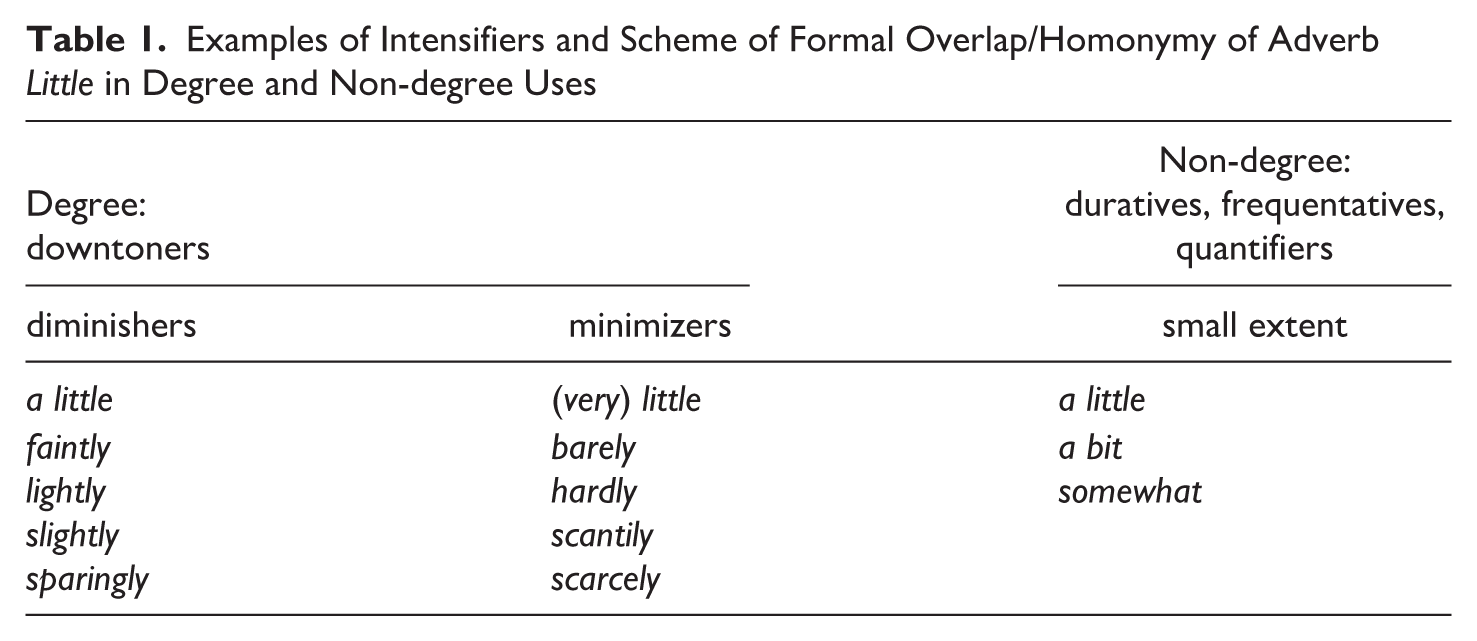
Many downtoners have alternative non-degree uses as indicators of quantity or duration and frequency in time, and may thus also be ambiguous between those and intensifying downtoner meanings, e.g., “They scarcely listened to him” indicating either degree or infrequency (Quirk, Greenbaum, Leech & Svartvik 1985:602-603). 3 Huddleston and Pullum (2002:720) characterize this area as “a blending of degree with frequency and duration.” Non-degree uses with little are illustrated in (3) and (4), both indicating duration. Quirk, Greenbaum, Leech, and Svartvik (1985:603) suggest that a duration subjunct can answer a “how long question,” e.g., “How long did you wait/stay?” in (3) and (4). Furthermore, items like wait and stay are not gradable (and thus not amenable to degree modification), which is different from (5). While the overall meaning in (5) is also a temporal one, the preposition after is gradable (cf. Quirk, Greenbaum, Leech & Svartvik 1985:713) and thus very little functions as a degree-modifying downtoner (minimizer) in (5). Table 1 shows the place of little in its areas of usage. We discuss and illustrate the degree (i.e., downtoner) and the non-degree (i.e., durative) uses of little further in section 4, and pay attention to their paraphrases and status vis-à-vis gradability; no non-degree frequency uses of the adverb little were recorded in our data.
(3) I
(4) I
(5) It was very little
Examples of Intensifiers and Scheme of Formal Overlap/Homonymy of Adverb Little in Degree and Non-degree Uses
All of these uses of little are long-standing in English according to OED (s.v. little) evidence, being attested from Old English or at the latest from Middle English.
As seen in (1)-(5), the item occurs in two formal realizations, with or without the indefinite article, and with optional premodification. 4 Unlike many other intensifiers it freely allows premodification of itself. In fact, it is said to even require a modifier (usually very) when in clause-final position (Huddleston & Pullum 2002:723); as (5) shows, the modifier very is found also in other syntactic positions. This leads to such a frequent co-occurrence of little and very that the combination was included in Table 1. How far the forms and modifications clearly correlate with minimizing and diminishing uses as indicated in the table will remain to be seen, but it is our hypothesis that they do. Little furthermore also frequently functions as a modifier within another degree construction, namely a little bit. Bolinger (1972:50-51) attributes a restricted collocability to the diminisher little, namely with comparatives, three positive-degree adjectives (aware, conscious, different), past participles, and verbs of the know class.
Sociolinguistic aspects of intensifiers have usually been investigated only for amplifiers, and it is doubtful whether findings in this respect could be extended to downtoners. Hessner and Gawlitzek (2017:416-417) indeed show with BNC2014 data that, while there is a significant lead among women for amplifier use, this is not the case for downtoners; here men are in the lead, except for in the 70+ age group where women are the predominant users (cf. D’Arcy 2015:464-465). With regard to individual downtoners, their results show women to use two items more frequently (a bit, nearly), whereas men dominate with five items (barely, fairly, hardly, partly, slightly) (Hessner & Gawlitzek 2017:412-413). 5 Although the frequency difference for bit between men and women is statistically significant, the usage patterns for this form are nevertheless highly similar for both genders (Hessner & Gawlitzek 2017:418). The authors (Hessner & Gawlitzek 2017:421-422) link the preference among women for bit to a stronger preponderance for hedging. A register/genre perspective is provided by Mauranen (2004:193), who found the mitigators somewhat, just, and a little bit to be more frequent in academic than in everyday speech (based on the MICASE and BNC corpora).
Hedging or mitigating can thus also be relevant for a little. Hedging may be a primarily semantic or pragmatic operation, i.e., affecting the propositional content (“bushes” for Caffi 1999:888) or relating to speaker/addressee attitudes. Hyland (1996:439, 450) places downtoners more on the semantic level by categorizing them as content-oriented attribute hedges that indicate how precisely or accurately the modified term describes the phenomenon. In Mauranen’s (2004:176) terms, they are primarily epistemic hedges, in contrast to her primarily strategic hedges, which reduce the overall strength of an utterance and are interactively motivated. Mauranen (2004:191-192) found a little bit to occur mostly as a strategic hedge, mitigating mainly aspects that are considered negative or problematic. 6 Hübler (1983:70-73), similarly to Hyland (1996), attributes the function of internal grading to little, i.e., its lowering the value of the predicate by weakening the degree of intensity. In other words, “what is lowered then by internally detensifying adverbs of degree is the point at which a predication in terms of x is justified” (Hübler 1983:76), and thus downtoning a proposition makes it more indeterminate and its denial more difficult. Based on this fact, a little can be used for understatement (Hübler 1983:89). In speech act research, downtoners like a bit have also been called “understaters,” i.e., items which minimize part of the proposition (e.g., Blum-Kulka & Olshtain 1984:204). Inasmuch as (a) little has indeed a hedgy potential, regardless of type, it is clearly useful for speakers in the courtroom, in particular for witnesses who may be uncertain about some aspects or defendants who may want to downgrade responsibility.
3. Data and Methodology
The material for our investigation is the Old Bailey Corpus, version(OBC) 2.0, which is a corpus of circa 24.4 million words drawn from trial transcripts from London’s central criminal court, also known as the Old Bailey (Huber 2007; Huber, Nissel & Puga 2016). These trial transcripts were published in The Proceedings of the Old Bailey (1674-1913), originally a commercial enterprise intended to offer sensationalist news about selected cases of interest to a wide audience. In the course of the eighteenth century, The Proceedings changed in nature and was increasingly considered a legal record of what took place in the court (for the publishing history of The Proceedings, see Emsley, Hitchcock & Shoemaker 2020a). While the transcripts are, at least at the beginning of their 239-year history, a topically selective and often abbreviated representation of events, they have nevertheless been considered to be free from “fabrication or invention of content” (Shoemaker 2008:560, citing Langbein 2003:185). As for the language, an increase in the use of shorthand from the 1720s onward allowed scribes to record speech “verbatim,” as far as is possible within the limitations set by the spoken versus the written modes. Over the eighteenth century, the City of London and Lord Mayor increasingly exercised control over the contents of The Proceedings and could also regulate the use of language, e.g., by censoring instances of words or formulations considered obscene (Widlitzki & Huber 2016). The dialogic stretches and crime narratives in the records appear speech-like in character, and scribes occasionally even attempted to convey features of non-standard or regional varieties of English (mainly lexis and pronunciation) when taking down speakers’ utterances. This, among other features, has been taken to point to the linguistic faithfulness of the records (Huber 2007:3; Widlitzki 2018:61; for a discussion of the OBC as a record of spoken interaction in the court, see Widlitzki 2018:57-66). The OBC thus documents spoken English in the courtroom situation from 1720 through 1913 as recorded in shorthand on a “verbatim” basis by courtroom scribes. The transcripts have been viewed as near as we can get to the spoken language of the time which preceded the advent of the magnetic tape recorder (Huber 2007; for the issues involved in using such records for linguistic study, see Kytö & Walker 2003).
While the courtroom setting invites a certain degree of formality and factual precision, the everyday events and criminal acts under examination typically evoke colloquial phrasing and uninhibited language. Brief turns of examinations and responses intertwine with testimonies in an interactive, conversational manner that reflects or seeks to elicit personal experience and the immediacy of recollected situations, events, and acts. All the while, speakers are solicitous about their credibility and may strategically opt to play down circumstances or their part in affairs by using adverbs such as (a/very) little.
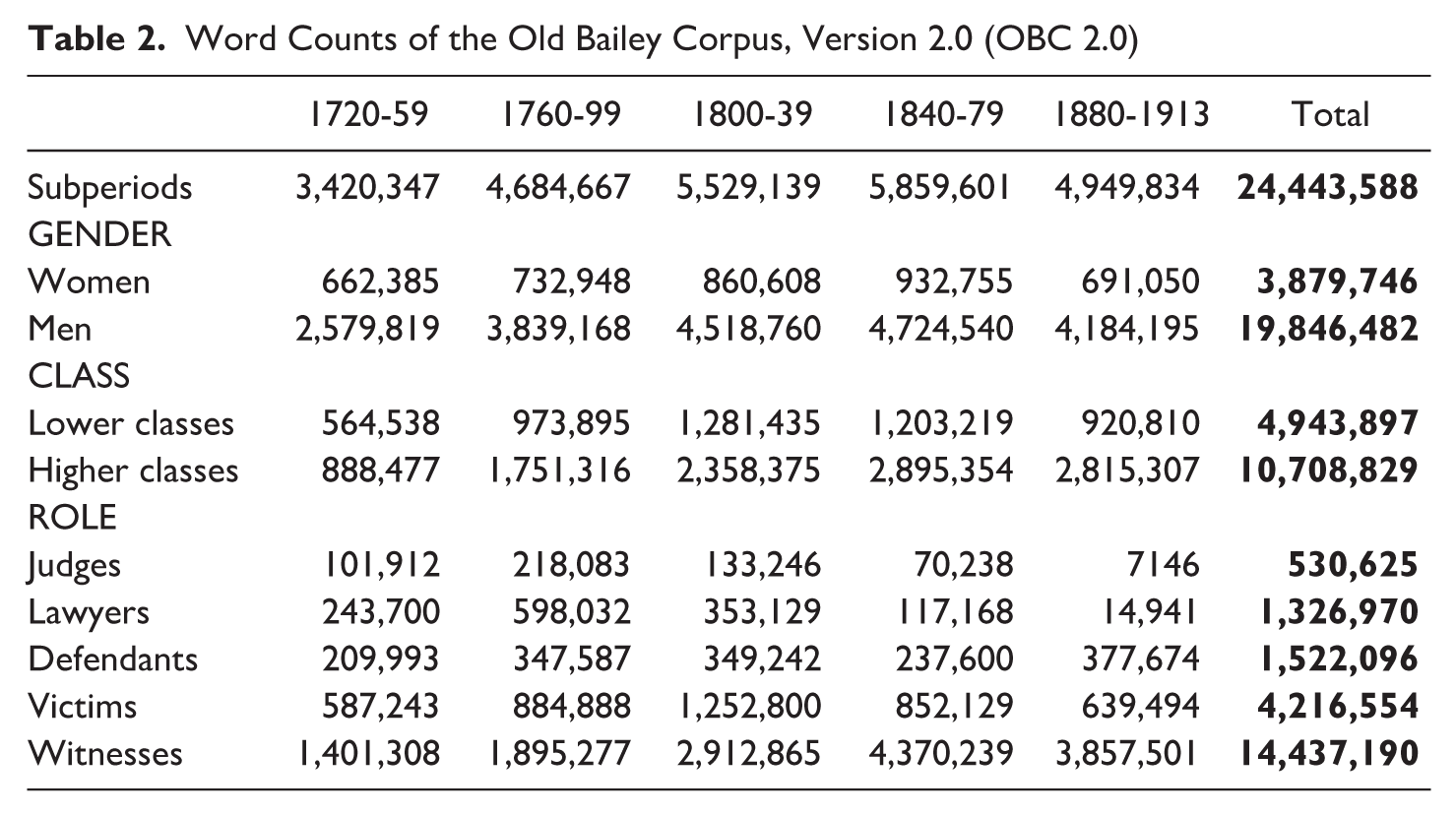
We divided the corpus texts into five periods of approximately forty years each to trace developments over time. The corpus is coded for speakers’ gender, social class (in the HISCLASS higher- and lower-class system), 7 and role in the courtroom (whether a victim, witness, defendant, lawyer, or judge). 8 Table 2 presents a summary of the word counts of the corpus. Men’s voices dominate in the courtroom, with men producing nearly twenty million of the 24.4 million words, whereas women’s voices are represented by approximately four million words. Among the speaker roles, witnesses are the main informants, followed by victims and defendants, while the professionals, lawyers and judges, contributed slightly less. Judges are only poorly represented as of the 1840s onward, and the same holds for lawyers in the last subperiod.
Word Counts of the Old Bailey Corpus, Version 2.0 (OBC 2.0)
For the present investigation, we used the annotated version of the corpus and its concomitant concordancer. Our searches for little (including all spelling variants provided by the OED and all grammatical tags provided in the OBC) yielded 18,684 hits. In our screening for adverb uses, we excluded adjectival little irrespective of tag, 9 and typical uses indicating quantity, size, and age, as in, e.g., “She said but little,” where little acts as an object indicating quantity; the latter were usually adjectival or nominal. We also excluded 256 cases where little modifies a bit (of), functioning within that downtoner (cf. Claridge & Kytö 2014a). Finally, we set aside 222 instances of adjectival little functioning in composite predicates as they notionally modify the verb phrase and could be of interest for a later study. Two such cases are have very little doubt and took a little walk. Regarding non-degree uses (see Table 1), we have specifically included durative uses of little as we found semantic overlap to be pronounced between degree and this non-degree category (see 1-2 and 3-4). The adverbs indicating duration are fairly abstract and subjective, similar to degree modifiers, and denote extensible qualities (see the degree-duration blends mentioned in section 2). Both degree and non-degree uses of little downtone the meaning and the force of the message. Our data contained no instances of adverb little with purely frequentative meaning.
To investigate the usage patterns of little in relation to speakers’ role in the courtroom, their social class, and gender, we have taken advantage of the coding of these socio-pragmatic parameters in the OBC. As it is our aim to assess the variation across time and as a function of the socio-pragmatic parameters, we have applied a multiple regression model to the data, more specifically a negative binomial regression model (Hilbe 2011). The model incorporates simultaneously the four parameters, also known as predictors—time, role, class, and gender—allowing us to estimate the unique contribution of each predictor while holding the other predictors constant. This enables us to attribute differences in isolated comparisons more reliably, say, between roles, to the effect of roles themselves and not to the share of variation attributable to speakers’ social class and gender. For the analysis, we used R Studio (R Core Team 2018) and applied Bayesian inference using Stan (Carpenter et al. 2017) via the brms package (Bürkner 2017). All figures and tables present frequencies normalized per 100,000 words unless otherwise indicated.
4. Forms, Frequencies, and Distributions
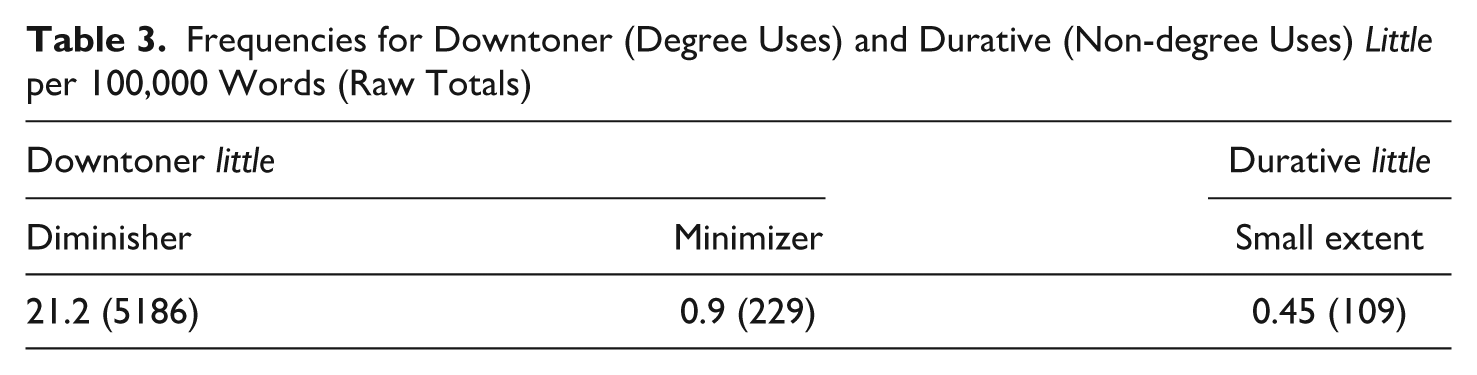
The searches based on the above methodology produced 5524 relevant cases for analysis (less than 30 percent of the total of 18,684 hits), including two examples with the variant spelling a leetle. Approximately 98 percent of the relevant examples have clear degree sense, see (6)-(11), i.e., are downtoners, while 2 percent indicate duration and do not lend themselves to degree readings (see 12-14). In the degree (i.e., downtoner) sense, the “target” of modification is gradable, which means that paraphrasing with “to some extent or degree” is possible. For example, for (7), the paraphrase would be ‘they bugged me to some extent.’ The downtoner is, expectedly, mostly used as a diminisher (5186 tokens; see 6-8), including four tokens of so-called intensificatory tautology (e.g., little tiny diamonds; cf. González-Díaz, this issue), 10 but minimizer uses (229 tokens, see 9-11) were also attested. As a diminisher, the adverb indicates a low degree and is similar to a bit or somewhat in force (as in 6-8). As a minimizer, it indicates a very low degree, approaching nothing at all (as in 9-11; 11 also illustrating modification by so, sometimes paraphrasable by barely or hardly). These downtoner uses, altogether 5415 instances, thus make up 29 percent of all the above-mentioned 18,684 instances of little retrieved in the corpus. The durative exclusively denotes small extent (109 tokens, see 12-14); these uses are ungradable and do not allow paraphrasing with “to some extent or degree.” The frequency distribution is summarized in Table 3.
(6) I can’t say I drunk, I was only a little
(7) They
(8) My Son was a little
(9) [. . .] the brain was healthy and very little
(10) I am little
(11) I
(12) Green went away and
(13) [. . .] he
(14) Son, says she, I am going to the Bank, pray
Frequencies for Downtoner (Degree Uses) and Durative (Non-degree Uses) Little per 100,000 Words (Raw Totals)
Before presenting the details for the downtoner and durative uses of little, an overview is in order of the occurrences and development of both as compared to the boosters and maximizers we have investigated in previous studies (Claridge, Jonsson & Kytö 2020, forthcoming). Figure 1 shows the distribution across the five periods (for maximizers on the basis of data drawn from a former version of the corpus, OBC 1.0 Extended), indicating the proportions and the potential relevance in the courtroom of these categories of adverbs. While there is a decline in the use of little as downtoner and durative, and of the boosters, the development for maximizers is the reverse: maximizers were on the rise.
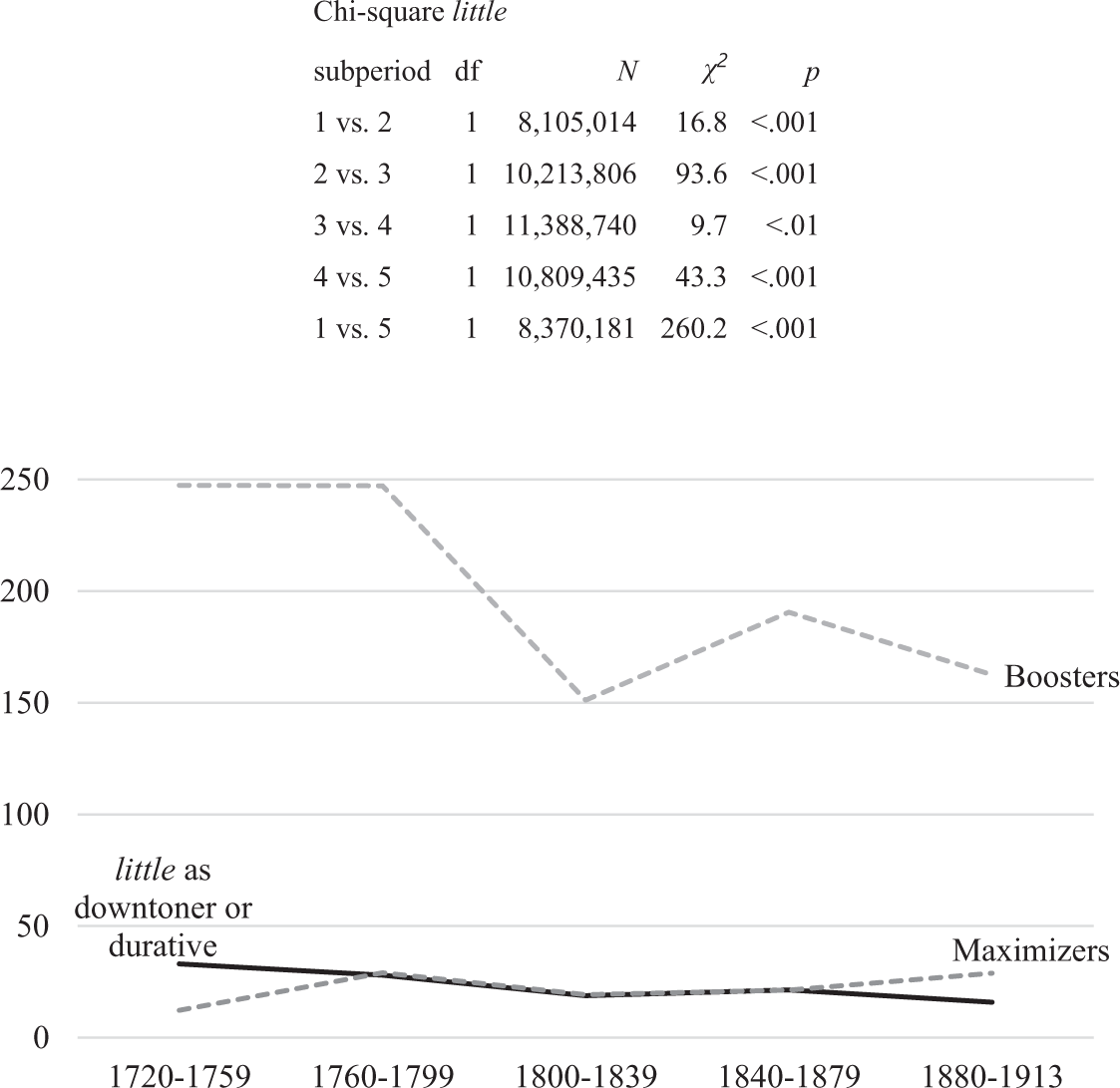
Frequency per 100,000 Words of Little as Downtoner or Durative, Boosters, and Maximizers
Figure 2 shows the development for the downtoner and durative uses of little. While there is an overall decline in both, the downtoner uses were clearly more frequent at the start of our period, declining across the eighteenth century. At the same time, the decrease of the much less frequent durative is more pronounced, its usage waning through the period to a mere fraction (1/15) of original use (1.5 in the first subperiod versus 0.1 in the last subperiod). We have noticed the dip around 1800 visible for the downtoner in Figure 2 also in our research on boosters and maximizers, whereas the dip is not in evidence in the durative. We hypothesize that the dip may be an effect of possible changes in scribes or scribal conventions rather than a matter of real change (although this needs more investigation). As has been shown in previous literature (e.g., Huber 2007; Widlitzki 2018; Emsley, Hitchcock & Shoemaker 2020c), there have been changes in scribal practices across the period covered by the Old Bailey Proceedings, scribes summarizing or omitting to varying degrees what was said in the courtroom. Consequently, a possible explanation could be that scribes, whose own language and language attitudes may have had an impact on the reporting of the language of the courtroom speakers, were the more inclined to leave out material the more bleached it seemed—which applies more to pure degree uses than to durative uses.
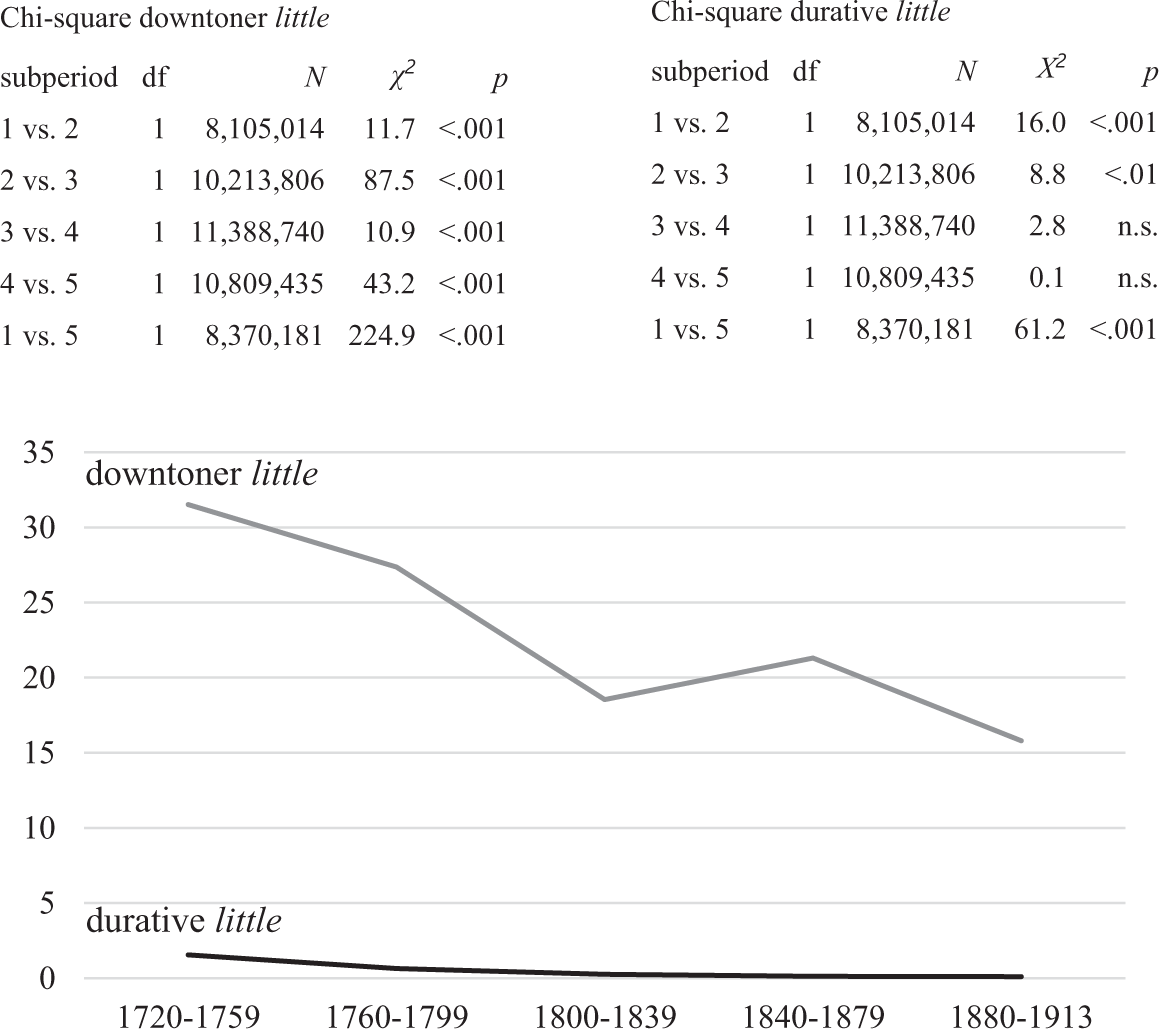
Development of Downtoner and Durative Little in OBC 2.0
The decline of the downtoner may have two explanations. One is that courtroom strategies may have become more assertive (as opposed to hedgy) over time. This would be in line with the rising use of maximizers, but somewhat less so with the decline of boosters. The other reason may lie in increasing diversity in the downtoner area, with other forms encroaching on little. There is some preliminary evidence that downtoners like scarcely, slightly, somewhat, and partially were gaining ground in that period (Claridge, Jonsson & Kytö 2017); the modern close synonym of little, a bit, was certainly grammaticalizing and rising in frequency during the period under consideration here (Claridge & Kytö 2014a).
We will focus now on the realization and the types of the adverb: as seen in Table 3, little as downtoner can be a diminisher or minimizer, while durative little only denotes small extent. The division into diminisher and minimizer correlates largely with the premodification of the adverb, as seen in Tables 1 and 4. While the majority realization of the diminisher is a little, the small-extent durative appears exclusively with the indefinite article.
Premodification of Adverb Little in OBC 2.0, with Majority Realizations in Bold
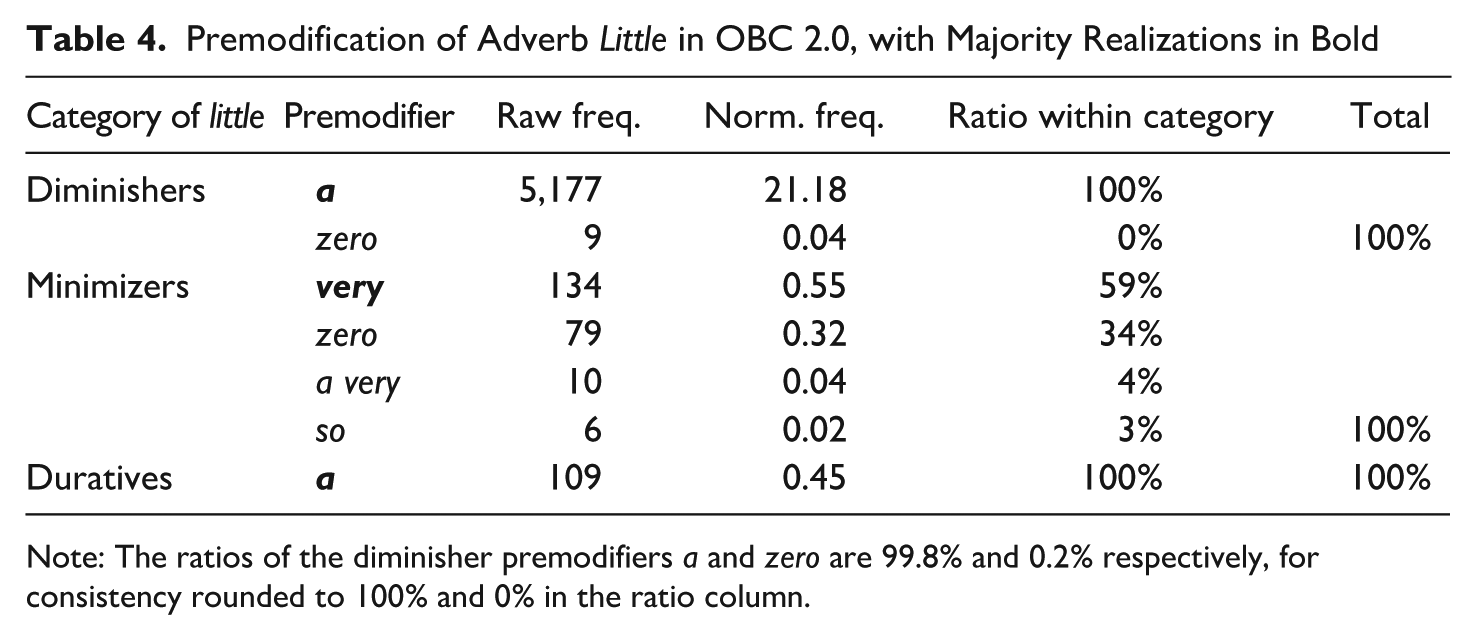
Note: The ratios of the diminisher premodifiers a and zero are 99.8% and 0.2% respectively, for consistency rounded to 100% and 0% in the ratio column.
At the same time, most tokens of little as a minimizer are premodified by very or appear without the article. The category affiliation of the adverb thus generally goes hand in hand with the presence of the indefinite article (diminishers and small-extent duratives) or the premodifier very (minimizers); a few a very little and so little are also found in minimizing uses, as seen in (15) and (16). Example (15) refers to an eye injury caused by an attack on the person with acidic fluid that happened only a week ago, which is indeed the crime on trial here. The victim states that, while his right eye is fine, there is still a small (i.e., diminished) problem in his left eye. The linguistic context of (16) points to minimal acquaintance with the family and thus to the fact that the speaker had hardly been present.
(15) [. . .] my left eye
(16) [. . .] the prisoner’s mother is between fifty and sixty years of age, a little better than fifty I should say, but having been so little at home I knew very little of the family [. . .] (t18451215-332, witness, m, lower)
The bar chart in Figure 3 illustrates clearly that tokens of little with the indefinite article (white), i.e., diminishers and duratives, make up the great majority of the data across all periods, whereas minimizers (constituting the grey and most of the black parts) are a fairly small minority. Examples with other premodification than a (as in 9, 15, and 16) are rare, very being the preferred form for additional intensification. Furthermore, little is frequently sufficient on its own for a minimizing effect: the black bases of bars include little with zero premodification, predominantly minimizers (as in 2, 10). Noticeable for these is a decrease across the five subperiods (chi-square p<.01 for period 1 versus 5). It appears as though minimizer little (as in “I little expected to see it”) becomes rather formal towards the end of the Late Modern English period, as very then increasingly fills the zero slot (as in “I thought it very little good”), the addition of the intensifier very contributing to informality. Zero-premodified little may also potentially be superseded in spoken discourse by other minimizers (such as hardly).
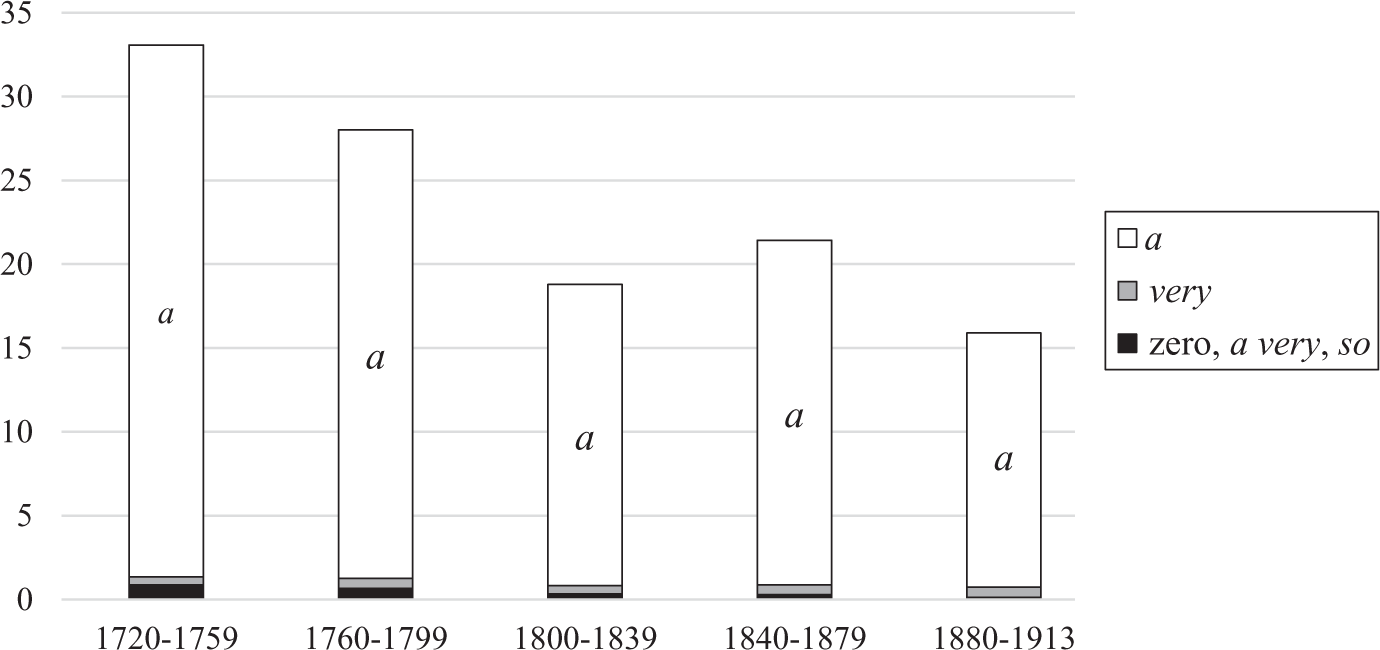
Premodification of Adverb Little as Downtoner or Durative (OBC 2.0, Normalized Frequency)
Summing up, apart from a few stray instances, the diminisher uses occur with the indefinite article a in the OBC, while the minimizer uses appear without the indefinite article or are preceded by very or so; for illustration, see (17) and also (9)-(11).
(17) I was very little
5. Syntactic and Semantic Patterns
5.1. Modification Patterns
Most commonly intensifiers are investigated in the context of adjectival modification (e.g., Tagliamonte 2008). While adjectives are indeed common, perhaps the most common, collocates of intensifying modification, other collocates or “targets,” as we will call them to indicate more abstract word-class or phrasal patterns rather than specific lexical items, occur as well. Target distributions may differ among individual intensifiers and, since Bolinger (1972) assumed the range of little to be restricted (see section 2), it is of interest to take a closer look at its modification patterns. Figure 4 shows its targets of modification to be diverse, including (in decreasing frequency) prepositional phrases, adjectives, verbs, adverbs, and participles.
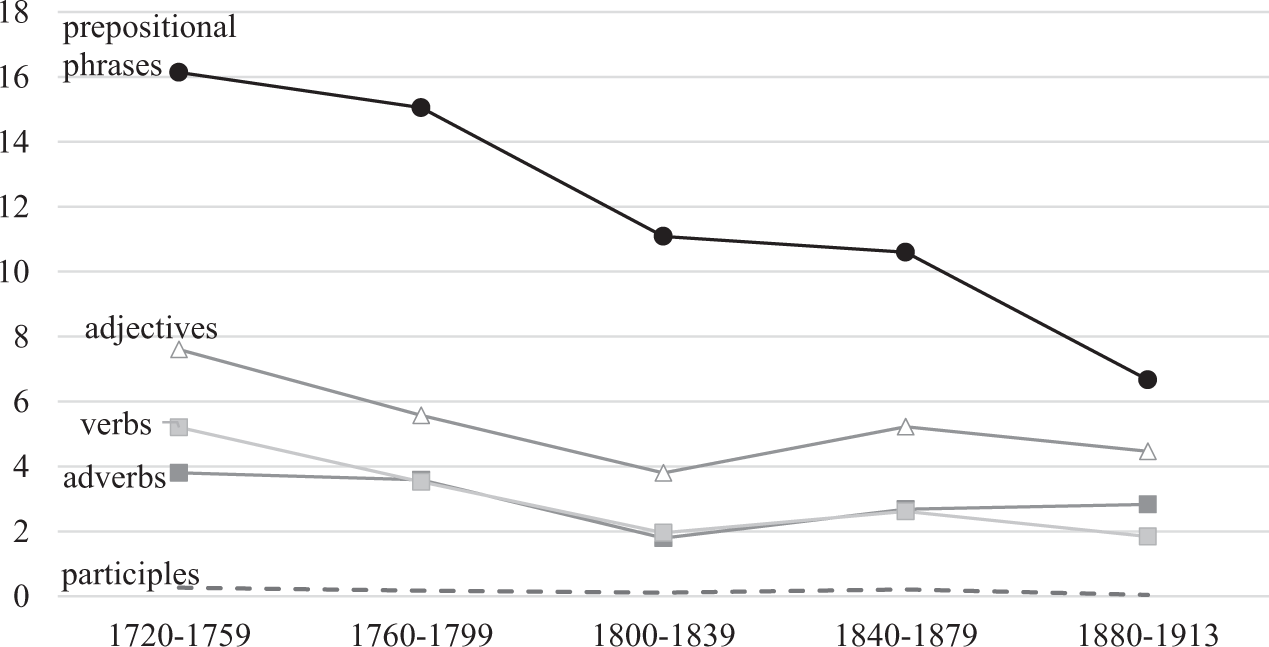
Little as Downtoner or Durative by Target of Modification (OBC 2.0, Normalized Frequency)
Durative uses only play a role for the verbal targets here. The high frequency of prepositional phrases comes as a surprise, as these were not mentioned by Bolinger (1972) at all. Moreover, according to his view, adjectives should be less frequent, while adverbs should be absent or infrequent; finally, participles should be more common. Either Bolinger’s (1972) intuition regarding modification patterns let him down on this account or the profile of little has changed over time, his reference point being mid-twentieth century American English. The courtroom register also has an influence: as prepositional phrases often encode adverbial information, they are useful for imparting circumstantial detail on time, place, manner, etc. in the context of the crime, which witnesses, for example, may have often wanted to hedge. The majority (some 75 percent) of the prepositional phrase targets are indications of time, such as after/before/past ten o’clock; other typical examples are in liquor, off colour, out of order, over a mile, and under price. Quite a few of the latter set have adjectival synonyms, such as intoxicated, broken, cheap, which may further explain their prominent presence. Among the rare participial targets are cases like involved, overdrawn, shaded, and turned. 11
5.2. The Semantic Characteristics of Collocates
The adjectives and verbs merit a closer look in light of Bolinger’s (1972) suggestions. Also, adjectives as the second most prominent group may show what topical areas are prone to downtoning in the courtroom. For the classification of the adjectives, we used Dixon’s (1977; Dixon & Aikhenvald 2004) thirteen semantic categories, which are dimension, age, color, value, physical property, human propensity, speed, position, difficulty, similarity, qualification, quantification, and cardinal numbers. Table 5 shows the results, types and tokens in raw figures as well as examples from the data for each category. Apart from cardinal numbers, all categories are attested in the data. There are five dominant categories (human propensity, quantification, physical property, value, and dimension), which together cover more than 90 percent of the data (the first four cover 88 percent, the first two alone 62 percent). While quantification and physical properties may refer to potentially objective circumstantial details of a case, value is about a speaker’s assessment. Human propensity is important in talking about the persons involved in (criminal) actions, their dispositions, intentions, and actions.
Semantic Classification of Target Adjectives (cf. Dixon 1977; Dixon & Aikhenvald 2004)
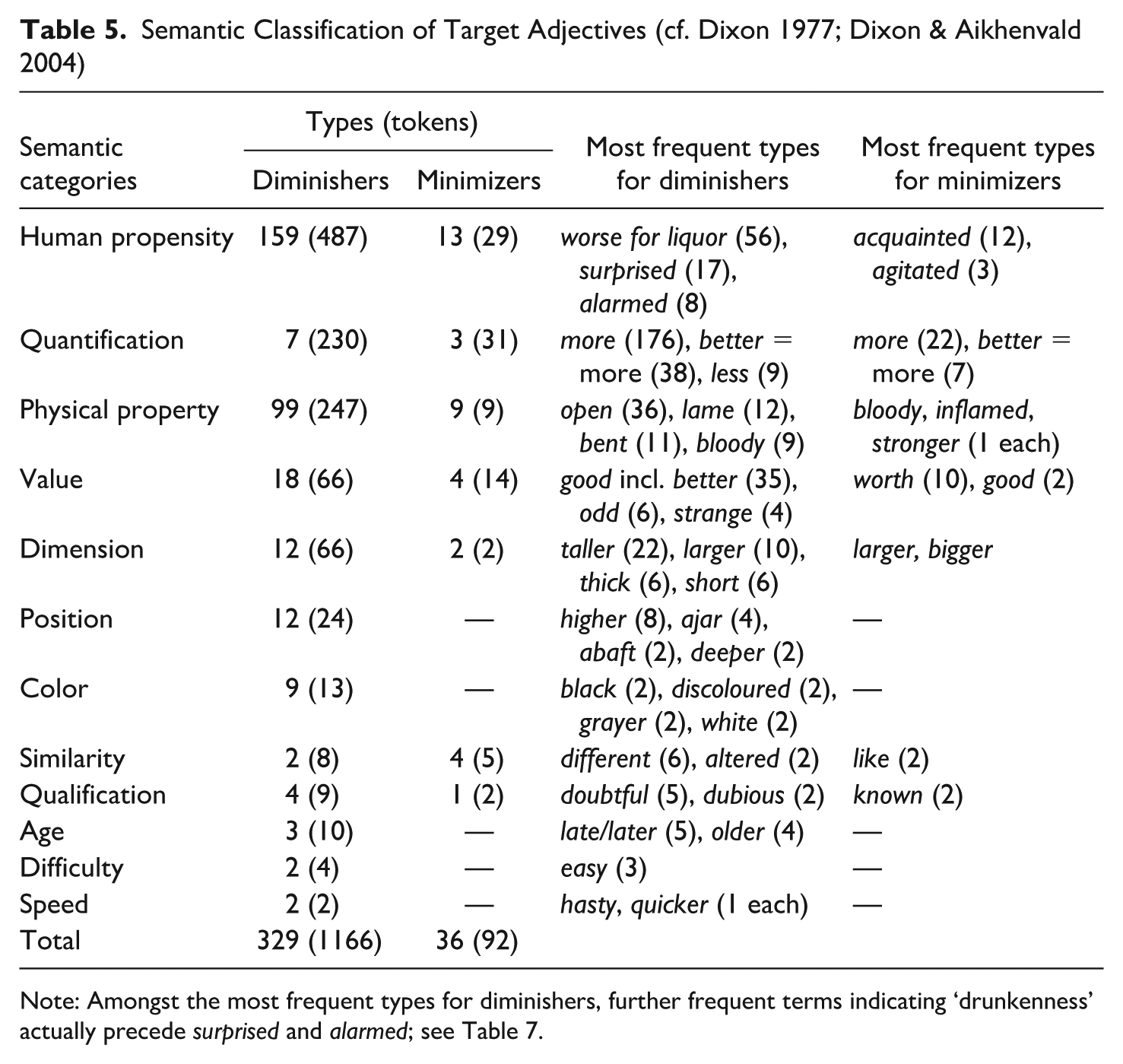
Note: Amongst the most frequent types for diminishers, further frequent terms indicating ‘drunkenness’ actually precede surprised and alarmed; see Table 7.
Human propensity is the most interesting category due to its frequency, courtroom importance, and semantic diversity. It can be further subclassified into mental state, overall physical/inherent constitution, and human behavior (see Table 6). Interestingly, mental state is by far the most modified (74 percent of tokens), as in (18), followed by behavior (19 percent of tokens), as in (19).
(18) [. . .] it struck me that she was a little
(19) [. . .] was Mrs. Dobbs a little
Human Propensity Subclassified
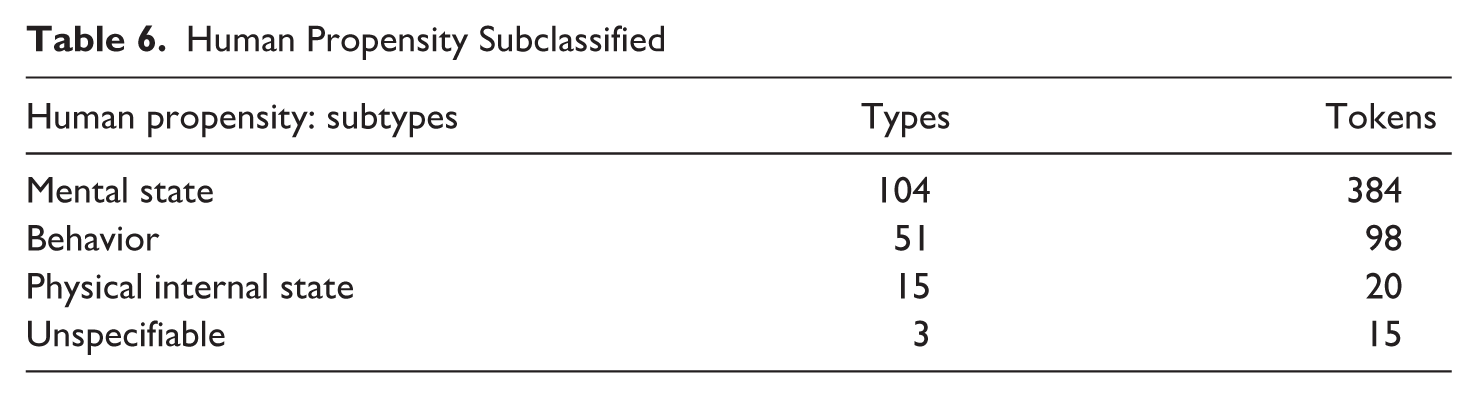
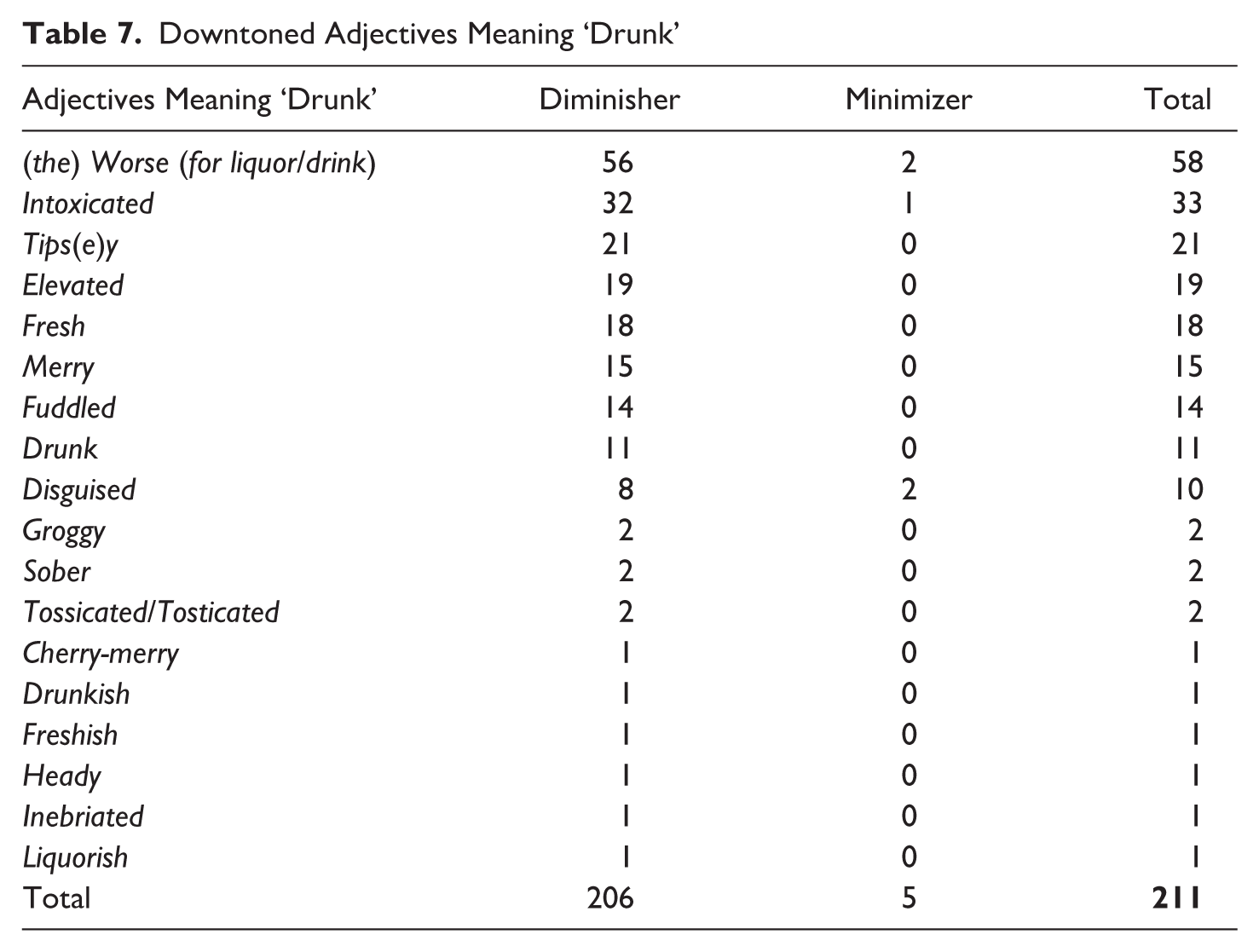
Most prominent among mental states is intoxication, 12 which represents 55 percent of all mental state adjectives and 17 percent of all modified adjectives; Table 7 gives an overview of the instances. A study focusing on drunkenness (Claridge 2019:281-282) found that little is the most common downtoner used in this semantic field, but that amplifying drunkenness is even more common.
Downtoned Adjectives Meaning ‘Drunk’
Human behavior is characterized by downtoned items like boisterous, careless, enraged, idle, obstreperous, quarrelsome, quiet, rough, saucy, and troublesome. What is striking is that most of them are negative in nature, which is not in line with the collocational preferences outlined by Bolinger (1972) and reported in section 2. Internal attributes are also often rather negative (e.g., infirm, sickly, weak, delicate, tired). Of the three common positive-degree adjectival collocates that Bolinger (1972) singles out, different (category: similarity) and aware (mental state) occur, whereas conscious does not. In contrast, comparative adjectives, which he also highlights as important collocates, are indeed frequent across semantic groups, making up 39 percent of all tokens (e.g., bigger, cheaper, closer, finer, happier, louder, paler, wilder).
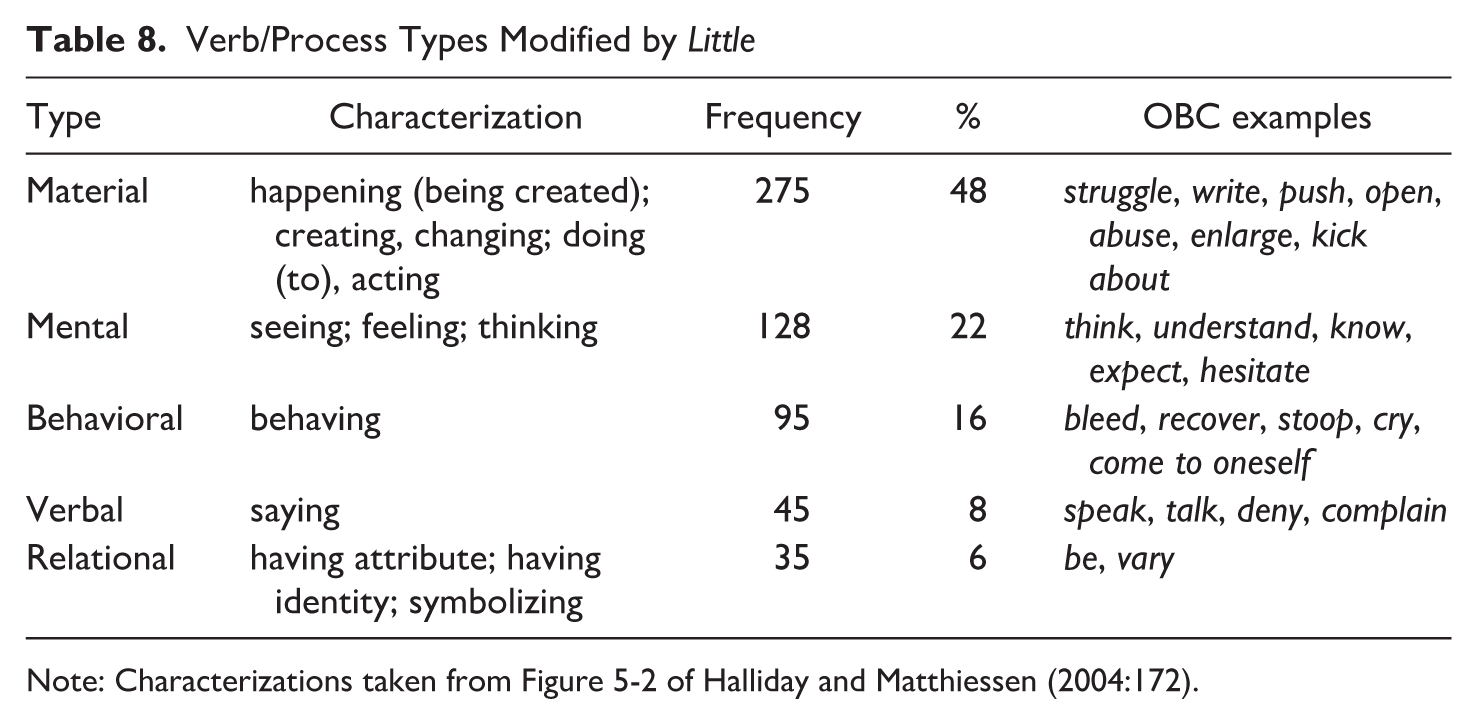
Verbs require a different framework of analysis than adjectives. We employ the classification of process type offered by Halliday and Matthiessen (2004:170-175). A process (type) is realized most importantly by a verb, which determines the participants (complements) and circumstances (adverbials) present in a clause. The six process types are material (actions, happenings, changes in the world; e.g., paint, rain), mental (cognitive and emotional states; e.g., want, think), behavioral (outer reflexes of inner states; e.g., laugh, sleep), verbal (processes of language production; e.g., say, explain), relational (identifying and classifying processes; e.g., be, include, indicate), and existential (being or happening processes; e.g., be, remain, arise). We present the results of the analysis in Table 8. Contrary to Bolinger’s (1972) restriction to verbs of the know class (see section 2), the corresponding group “mental” here is not dominant, but takes only second place with a little over 20 percent of all verbal types.
Verb/Process Types Modified by Little
Note: Characterizations taken from Figure 5-2 of Halliday and Matthiessen (2004:172).
Material processes, accounting for almost 50 percent, are the most frequent class. This highlights the importance of talking about perceivable actions and processes in the context of crimes. The respective positions of human propensity (including mental/internal states and behavior) in Table 5 and material processes in Table 8 may point to a division of labor between adjectives and verbs in crime descriptions.
6. Socio-pragmatic Patterns
In this section, we turn to the distribution of the adverb little across the speakers in the courtroom, in addition to revisiting time, taking advantage of the OBC’s coding of speakers’ functional role (whether they were witnesses, victims, judges, etc.), speakers’ social class (higher or lower class), and their gender. 13
6.1. Regression Analysis: Predictors and Overall Results
To investigate the distribution of little across the groups of speakers, we apply a multiple regression model that simultaneously incorporates all the parameters of interest (time, role, class, and gender) into one analysis. 14 The analysis enables us to assess the unique contribution of each individual parameter (predictor), holding the other parameters (predictors) constant (as advocated by Jenset & McGillivray 2017). This makes the result for one predictor, say, gender, unbiased by any share of variation attributable to the other predictors, speaker role and social class. Thus, the variation between women and men is not biased by, e.g., the fact that there were no women judges or lawyers at the time, nor by any other systematic links, such as defendants more frequently being men or judges and lawyers by definition belonging to the higher classes.
The regression model we employ is negative binomial regression (Hilbe 2011), suitable for word-count data that is distributed unevenly across the parameters, in our case time, role, class, and gender (see Table 2). The analysis only takes into account the speakers for whom all three socio-pragmatic parameters (role, class, gender) have been annotated, which in the case of OBC 2.0 is approximately half of the speakers. The annotation of the corpus poses one further limitation worthy of note, namely that it does not link utterances by the same speaker across trial days or trials, but instead gives speakers new IDs for every trial; thus, our model slightly overestimates the number of speakers in the data. For the latter reason, the statistical uncertainties in connection with our estimates should be seen as lower bounds of the true uncertainties in our substantive conclusions.
Figure 5 presents an overview of the results of the analysis, a summary of how the usage rate of adverb little as a downtoner or durative varies across time and as a function of the socio-pragmatic parameters, the speakers’ role, class, and gender. Each pane in the four-pane panel displays the unique contribution of the predictor (e.g., time), holding the other variables constant, i.e., set to their average values. Please note that the quantities in the figure are model-based estimated rates (per 100,000 words) for each condition, while previous graphs (e.g., Figure 1) have shown normalized frequencies that compound all conditions. The error band/bars in Figure 5 show 50-percent and 95-percent credible intervals, reflecting the statistical uncertainty in the estimates.
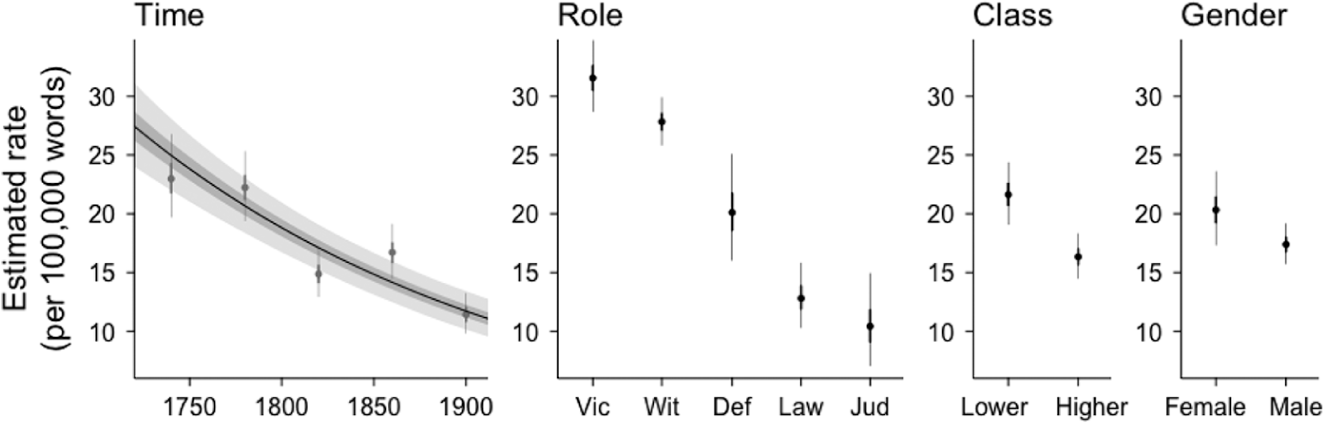
Downtoner and Durative Little Combined: Diachronic and Socio-pragmatic Patterns in its Estimated Usage Rate. Rate Ratios (Highest versus Lowest): Time 2.49, Role 3.05, Class 1.32, Gender 1.17
In an attempt to tease apart potential differences in the usage rates of downtoner and durative little, we also ran separate analyses for these two categories. However, owing to the sparse data for duratives (only 109 examples), the analysis of this category yielded no statistically significant (or interpretable) differences except as regards the variable time, and the results for the dominant category downtoners largely mimic those in Figure 5. For completeness, we offer the results from the separate analyses in an Appendix (Figures A and B) but only comment briefly on their relevance as regards the development across time below. Focusing on little as a downtoner or durative (Figure 5) in the ensuing subsections, we discuss the results for each predictor (time, role, class, gender) in more detail and also bring in some comparisons to our maximizer and booster studies (Claridge, Jonsson & Kytö 2020, forthcoming).
6.2. Time
The leftmost pane in Figure 5 echoes the finding in Figure 1 of a general diachronic decline in the usage rate of little as a downtoner or durative across the period of our study. 15 The average model-based rate drops by more than half from the early eighteenth to the turn of the twentieth century, namely from approximately 27.5 to 11 per 100,000 words. In contrast to previous graphs, the regression analysis here models time as a simple continuous predictor by year, instead of by subperiod, which yields a clearly declining, slightly curved, linear trend. The general diachronic decline applies to all speakers irrespective of role, class, and gender, the details of whom will be explored in the ensuing subsections. The decline of durative little (Appendix Figure B) is actually more pronounced than that of downtoner little (Appendix Figure A), shown by the fact that the estimated usage rate of duratives in 1720 drops by half already before 1800, whereas that of the downtoner only halves by 1900.
To supplement the monotonic, slightly curved, linear trend across time in Figure 5 (and the panels in the Appendix), we indicate by gray point estimates in the time panes the curious non-linear pattern that emerges when breaking down our data into the five subperiods of our study, see Figure 2. The non-linearity for the full regression data, Figure 5, and downtoner little (Appendix Figure A), thus reflects the general pattern seen for downtoners in Figure 2 as a dip in the third subperiod, whereas the dip is not in evidence for duratives (Appendix Figure B). When modelling the rates by year, our data nonetheless suggests an equally steady diachronic decrease for both downtoner and durative little.
6.3. Speaker Role
The second pane in Figure 5 shows how the model-based usage rate of downtoner or durative little varies with the speaker’s role in the courtroom. We can see here that witnesses and victims (at model-based rates of circa 28 and 32 per 100,000 words) use little more than twice as frequently as the professionals, i.e., judges and lawyers (whose model-based rates are circa 11 and 13 per 100,000 words), while defendants cover the middle ground. On average, the rate for the top users, victims, exceeds that of judges by a factor of 3.06, which makes speaker role a key predictor for a speaker’s use of the adverb. The lower estimated rates for the professionals (lawyers and judges) make sense when considering question/answer sequences frequent in the late modern courtroom: to avoid leading questions, the professionals may be more likely to pose fairly neutral questions as in (20) and (21) than to use formulations with a degree modifier. The downtoner is likely to appear in the lay respondents’ reply to produce a hedged affirmative (20) or a formulation that leaves some leeway as to the exact time (21).
(20) Was she in liquor? - I believe she was a little. (t17720219-50, lawyer, m, higher and witness, m, higher)
(21) What time of the night was this? - A little after 9. (t17491209-6, lawyer, m, lower and witness, m, n.a.)
The majority of the examples by lay people involve propositional hedging, e.g., the applicability of drunkenness (see also 6 in section 4), saucy behavior (8), sanguinity (9), or noticing (11) is downplayed. The speakers thus either diminish a potentially negative aspect (drunkenness, sauciness) and/or present themselves as more credible via their careful judgment, as in the case of the expert witness in (9). Thus a strategic aspect is almost always present even in propositional cases. An example like (10) may be mainly strategic, highlighting by way of downgrading the young age of the speaker. Other lay uses may simply reflect the vagueness of everyday spoken language, as is clearly visible in the quoted speech in (14) above, which is also present in many other, especially durative uses. Vagueness with the downtoner frequently reflects temporal intuitions and memories that are not governed by constant recourse to clocks and watches, as multiple hedging in (22) shows.
(22) Mr Serj. Gapper. How long were you there before he was found? - John Egglestone . I was there about a Quarter of an Hour, or a little more. (t17420715-1, witness, m, lower)
Functionally, the recourse to the vague approximator and quantifier (in Channell’s [1994] classification) is to make up for lacking more precise information and to serve as self-protection: the statement may be vague but exactly because of this it is not wrong (Channell 1994:45, 95, 184, 188). The greater use of such vague downtoners by victims and witnesses shows them to be concerned with reporting the temporal circumstances of the crime—and with doing so in a suitably credible way.
Judges and lawyers rarely find reason to be hedgy or imprecise in the manner of lay speakers but more typically echo witnesses in follow-up questions, as in (23) by a judge, following the witness’ statement, or in (24) by a lawyer, who reformulates the witness’ previous vague indication of time, here in an even vaguer manner.
(23) I said I would tell him the whole truth about the things, and a little
(24) A cart came up, about a quarter past three, as near as I can guess [. . .] (t17821016-4, witness, m, higher) - You say it was a little
On the whole, however, professionals were apparently more careful and precise about temporal circumstances of the crime (cf. their lower estimated rates in Figure 5). However, cases where such uses help to, e.g., formulate a leading question also occur, as (25) shows.
(25) MR. BODKIN. Q. If she had kept a little more off, she would have escaped you? A. Eight inches I think would have saved us. (t18410823-2299, lawyer, m, higher)
In contrast to downtoners, maximizers were used more by lawyers and judges, but also by defendants when they defended themselves; note that it was only in the 1820s that “judges began to assign lawyers to speak on behalf of prisoners accused of serious offences” (Emsley, Hitchcock & Shoemaker 2020b). The defendants tend to use stronger expressions and to sound more certain than, for instance, the witnesses. Boosters complicate the picture, as defendants and witnesses use them most, sounding potentially emphatic and certain. Witnesses may simply attempt to strike an appropriate balance between amplifying/certainty on the one hand and downtoning/hedging on the other.
The reported distributions might be looked at with respect to the concepts of “powerless” versus “powerful” language introduced by O’Barr (1982:61-86), where the powerless style is characterized by a high frequency of intensifiers and hedges. While the higher use of hedgy little might characterize witness and victim styles as powerless, the lower use by the professionals is offset by their higher use of intensifying maximizers, thus producing a mixed powerless/powerful picture. This together with problems inherent in O’Barr’s concept (e.g., problematic category definitions, neglect of contextual microfunctions) clearly needs more investigation (cf. Claridge, Jonsson & Kytö forthcoming).
6.4. Social Class
The third pane in Figure 5 presents the model-based estimated rates of little as a downtoner or durative on the basis of speakers’ social class. Speakers of the lower classes use the adverb significantly more (at 22 per 100,000 words) than those of higher classes (at 17 per 100,000 words), as indicated by the lack of overlap in the credible intervals. The rates differ by a factor of about 1.3, revealing social class affiliation of speakers as another key predictor for the use of little.
Interestingly, our finding of greater use in the lower classes is in contrast to studies of amplifiers (Bernaisch 2014; Claridge, Jonsson & Kytö 2020, forthcoming) as well as intensifiers overall (Macaulay 2002; Ito & Tagliamonte 2003), which have found greater use of amplifiers/intensifiers in higher (i.e., middle) classes. Viewed differently, our little data suggests that the higher-ranking speakers in the courtroom, who are greater users of amplifiers (more specifically maximizers; Claridge, Jonsson & Kytö 2020, forthcoming), only show consistency by their lower preference for the opposite, downtoner or durative little. While the higher-class speakers appear to opt for assertive speaking styles in their preference of amplifiers, lower-class speakers opt for potentially less assertive speaking styles as witnessed in their use of little.
Thus, our data indicates that a common sociolinguistic pattern across all intensifiers does not apply—or at least not in the late modern courtroom. Instead, a speaker’s functional role in this situation, as well as their social class affiliation, may be more relevant for their choice of intensifiers and the concomitant speaking style.
6.5. Gender
In the rightmost pane of Figure 5, we can see that women have a higher model-based usage rate of little than men (circa 20 versus circa 17 per 100,000 words), their rates differing by a factor of 1.17. However, owing to the extensive overlap in the credible intervals, the difference between the estimated rates of the genders cannot be considered statistically significant. Examples (26) and (27) show downtoner uses by women.
(26) Q. What sort of a Woman was Mary Maurice, was she short or tall, fat or slender? - Bland. She was of a middling Size, a little inclinable to be Dropsical. (t17420909-37, witness, f, n.a.)
(27) ANN NEGUS. I live in Union-place, Curtain-road. I am very little acquainted with the prisoner—he was at my house on Monday the 30th of November, at a little after seven in the morning [. . .] (t18351214-217, witness, f, n.a.)
Only the temporal use in (27) reflects uncertainty, while (26) reflects more the fuzziness and prototypicality inherent in (describing) reality, see also the use of middling in the same utterance. The first use in (27) may be a factual description, but in the courtroom of course strategically positions the speaker as distant from a potential criminal and also as naturally not very knowledgeable about them.
Previous literature has often associated the use of intensifiers in general with female speakers (e.g., Stoffel 1901:101; Jespersen 1922:249-250), in empirical work more specifically the use of amplifiers (Bernaisch 2014 on OBC material; Fuchs 2017). In our data, no clear association is found between downtoner or durative little with women, nor is our result in line with Hessner and Gawlitzek’s (2017) results reported in section 2, i.e., that men lead in the use of downtoners as a group. While twenty-first century women have a preference for the individual form a bit in their study, this trend does not necessarily hold for its close synonym a little and late modern women. Our own studies have revealed women as prime users of boosters (Claridge, Jonsson & Kytö forthcoming), but men as slightly more frequent users of maximizers (Claridge, Jonsson & Kytö 2020; note that this study of maximizers was based on a somewhat smaller-scale collection of data than our ongoing study of maximizers intended for our forthcoming book). While boosters are not as strong as maximizers, they are much more commonly used, especially by women. On the whole, while the late modern women seem concerned about justifying or reinforcing their statements and testimonies using boosters (e.g., very, so; Claridge, Jonsson & Kytö forthcoming), the men slightly more often than women opt for an assertive, certain-sounding speaking style using maximizers (e.g., completely, totally; Claridge, Jonsson & Kytö 2020), and almost as often as women use the downtoner little. As is shown in (28)-(30), many men’s downtoner uses do not serve to add uncertainty, but rather precision and even a touch of assertiveness.
(28) C. Was the Pistol put into the Ear? - Mr. Wilky. No, but a little
(29) Council. Did the Deceased appear to be out of his Senses? - Mr. Penkethman. No, Sir, I did not take him to be mad, but rather thought he was a little
(30) Couns. You look upon this only as a common Quarrel, don’t you? - Herbert. It was
All three witnesses do not go along with the drift of the question but rather contradict it or stand their own ground. The expert witness in (28), a doctor, disagrees in order to give a more precise and detailed answer, with little adding to the precision. The contradiction takes the form of a downward correction in (29), with both word choice and downtoner contributing to it. Finally, the question in (30) about a quarrel which led to the death of one participant, which was clearly meant to challenge the witness (i.e., ‘you did not/why did you not notice the dangerous quarrel’), is answered in such a way as to assert the normality of what the speaker saw at the time.
7. Conclusion
To briefly sum up: we have found over 5500 instances of interest, among them 5415 unambiguous downtoner uses and 109 durative uses in OBC 2.0. This is a substantial, but not predominant part of all uses of little. Both uses investigated downtone the meaning and the force of the message. Among downtoners, diminishers are more common than minimizers, that is, moderate and thus more hedgy downtoning is preferred over the stronger minimizer type.
The form found is overwhelmingly a little, with both the bare form little and otherwise modified (very, so) being very rare. Complete formal specialization is found only for duratives, which occur exclusively in the form of a little.
The most common targets of downtoning concern content that is very important for criminal cases, namely circumstantial detail often concerning the timing of events (realized by prepositional phrases), and human states and actions in the context of a crime (realized by adjectives). Beyond that, the range is broad, including also verbs, adverbs, and participles. The restrictions mentioned by Bolinger (1972) on modification targets could not be verified or were only present as trends (e.g., the high number of comparatives among adjectives).
We also found that downtoning tends to be used more by speakers we may characterize as “powerless” speakers, namely those who are in an inferior position in society (lower social ranks) and/or in the courtroom (non-legal, lay). Their inferiority and potential vulnerability might thus be linked with downtoning and more hedgy styles. However, we have also seen that little can be used to mark speech acts as more precise, more assertive, and even more confrontational. It is men, in particular, who used little to convey precision and assertiveness rather than vagueness and uncertainty. Thus, the usage pattern of little has presented us with a fairly complex picture.
And finally, we have seen an overarching decline of use. Our hypothesis that this is at least partly due to the rise of other downtoners will need to be investigated in future research. Wierzbicka (2006:28-34) has highlighted the increasing propensity in British English towards understatement from the eighteenth century onwards, which she linked to cultural and scientific developments encouraging both accuracy and moderation. As downtoners are among the linguistic means for expressing understatement, the complete group of downtoners should be found to rise in frequency or at least to stay stable. Should this not be the case, Wierzbicka’s (2006) proposal, which she corroborates with the number of downtoner types available in English (not their token frequency), might need to be re-examined. The overarching cultural trend may be less clear than she assumes or it may manifest itself in different registers and genres to a variable extent. With its competing demands on speakers to appear truthful, clear, and credible, the courtroom context may have inhibited the use of items that, after all, introduce fuzziness.
Footnotes
Appendix
Acknowledgements
We are indebted to Magnus Nissel, who kindly provided us with an OBC2 speaker list, and to Lukas Sönning, whose expert help regarding regression analysis of sociopragmatic data proved invaluable to us. We are also indebted to the valuable comments on our draft versions of the article by the anonymous reviewers and the Editors of the Journal of English Linguistics, Alexandra D’Arcy and Peter J. Grund, as well as Lucia Iglesias, the Editorial Assistant of the journal.
Declaration of Conflicting Interests
The author(s) declared no potential conflicts of interest with respect to the research, authorship, and/or publication of this article.
Funding
The author(s) disclosed receipt of the following financial support for the research, authorship, and/or publication of this article: The research reported here is part of the larger project ‘Changing Intensifiers in Late Modern English, 1700-1900: A Historical Sociopragmatic Analysis’ funded by Riksbankens Jubileumsfond (The Swedish Foundation for Humanities and Social Sciences) in 2016-2018, Project Reference P15-0700:1.
