




Abstract
This paper provides a corpus-based analysis of so-called “hedged performatives,” which, although frequently referred to in the literature, have never been the subject of an in-depth functional study. Using data from the Corpus of Contemporary American English, the focus is on I must/have to say, I must/have to admit, and I must/have to confess, as the hedged performatives which are among the most frequent and score highest in terms of collocational strength. The qualitative analysis identifies two main functions, viz., downtoner and emphasizer. They are shown to derive from the interplay of three co(n)textual parameters: (i) “semantic valency” of the host clause (i.e., positive, negative, or neutral semantic content), (ii) “thematic orientation” of the host clause (i.e., toward the speaker, the addressee, or a third person/the situation), and (iii) conversational “alignment” of the speaker with the interlocutor (i.e., agreement or disagreement). It is further shown that hedged performatives play an important role in rapport management, serving (mainly positive face) politeness strategies, which are captured in terms of face-preservation, face-damage, and face-boost.
1. Introduction
Hedged performatives (HPs) are combinations of a (semi-)modal verb and a performative verb, as illustrated in (1)-(4), and were originally discussed by Fraser (1975).
(1) I have to confess, I don’t watch Downton Abbey. (COCA, SPOK, 2013)
(2) There was a big speech this week by Daniels of Indiana, not Governor Mitch Daniels, but his wife, Cheri Daniels, who spoke to the party. It turns out – and I must say, I didn’t know this – she divorced her husband back in the 90s, left him with their four daughters to marry someone else, then remarried him three years later. (COCA, SPOK, 2011)
(3) I spent four months in Cuba, speaking of health care, I had eye surgery in Cuba, emergency eye surgery, and I must say, I got the best medical care I’ve ever gotten, and I found the Cuban people that I came in contact, both in Havana and Santiago de Cuba, so warm, so cultured, so open and really just alive. (COCA, SPOK, 2015)
(4) Joylene, I have to say, your smile and your happiness is infectious. The smile on your face matches your name. It was great to talk with you. We wish you all the very, very best. Thank you. (COCA, SPOK, 2017)
Even though the concept was introduced by Fraser (1975) more than forty years ago, the use of HPs in English has not been addressed in much detail despite their frequency and pivotal role, particularly in spoken discourse. The present paper tries to fill this gap, analyzing the function of HPs in spoken American English, with the focus on HPs with must and have to. Contrary to what the label “hedged performative” might suggest, it will be shown that HPs do not necessarily function as hedges (downtoners) in discourse. They can, in fact, adopt the opposite function in the sense that, while they may be used as downtoners, as in (1) and (2), they may also serve to emphasize, as in (3) and (4). We show that the factors driving the interpretation derive both from the contents of the host clause (i.e., the clause over which the HP has scope) and from the discursive context. In addition, the highly grammaticalized cases of I must/have to say are shown to have adopted also text structuring functions. In other words, our aim is not to investigate the impact of the modal verb on the illocutionary force of the verb that features in the HP, which is the focal point in Fraser (1975). Rather, we are first and foremost interested in the discursive functions served by the HP as a whole and in context.
There are very few detailed analyses of the communicative functions and use of HPs. Schneider (2010) investigates parenthetical HPs in spoken English, French, Italian, and Spanish. While he mainly offers a critical analysis of the mechanism that Fraser (1975) argues for, he does move beyond the impact of the modal on the illocutionary force and observes, for instance, that an HP may have only a part of the utterance in its scope, that is, it has phrasal rather than clausal scope. In a more recent article, Panther and Thornburg (2019) are, like Fraser (1975), focused on the ways in which the modal verb alters the illocutionary force of the following “performative” verb, with conceptual framing and metonymic inferencing being key in their approach. In research on hedging, the focus has mainly been on the use of HPs in German (e.g., Greifeld 1981; Gloning 1997). The analysis presented in these previous studies can be fine-tuned as they make no clear distinction between the effect of the modal on the performative (i.e., it is hedged) and the role of the HP in interaction (i.e., does it function as a hedging device?). Our view is that it is important to keep these two questions apart in order to get a clearer view of the cognitive and discursive mechanisms involved.
HPs also routinely feature in research on the use of hedges in specific genres such as academic writing or political speeches (e.g., Hinkel 1997; Meyer 1997; Thue Vold 2006; Ponteretto 2018), or in empirical research on modal verbs (e.g., Palmer 1990; Collins 2009; Coates 2014 (1983)), but here they tend to feature merely in a list of forms and no comprehensive or detailed analysis of their use is attempted. Similarly, hedging is described as a negative politeness strategy in Brown and Levinson (1987: 145-172); they specifically note that certain devices hedge illocutionary force. But even though Brown and Levinson’s (1987: 146) seminal book includes a reference to Fraser (1975), the focus is very much on the ways in which questions about the preparatory conditions of requests serve as hedges; there is no particular concern with HPs. In a similar way, HPs commonly feature in overviews that illustrate indirectness, but a detailed analysis is lacking (see, e.g., Blum-Kulka & Olshtain 1984:201; Blum-Kulka 1987:134, 137-139; Leech 2014:165).
To investigate the use of HPs in discourse, the present study is corpus-based, making use of data from the Corpus of Contemporary American English (COCA; Davies 2008-), which provides one of the largest databases of spoken present-day American English. We first embed our study within Fraser’s (1975) work (section 2) and then describe the sample that we have used for our study (section 3). Our main research question is concerned with the functions of HPs in discourse and the factors that contribute to their meaning. Accordingly, the corpus is used for a qualitative investigation only. In section 4 we explain and illustrate the two discursive functions which we argue are served by HPs: downtoner and emphasizer. We show how these functions are shaped by three parameters: semantic valency, thematic orientation, and (dis)alignment. The conspectus in section 4.5 summarizes our findings; it is followed by a conclusion (section 5), which indicates avenues for further research.
2. Background
The idea of hedged performatives was introduced by Lakoff (1972:213) when he observed that performatives may be modified by hedges. It was, however, Fraser (1975), who developed the concept more fully and coined the term. He defines a hedged performative as an utterance in which the illocutionary force, that is, what he calls the performative nature of the utterance, is hedged. While Fraser (1975) allows for flexibility when it comes to the formal realization of what counts as a performative, all of his examples consist of the first person singular pronoun, followed by a “modal or a semi-modal” (Fraser 1975:188) and a performative verb. 1 The modal verbs listed and illustrated in Fraser (1975) range from core modals can, could, might, shall, should, will, would, and must to lexical verbs and periphrastic forms like have to, be able to, and other verbs like wish, want to, would like to, be going to, and intend to. In terms of syntactic structures accommodating HPs, Fraser (1975) includes various structures, such as non-finite complement clauses (e.g., I must advise you to remain quiet) and main clause structures (e.g., I must grant you my entire fortune), but is mainly concerned with HPs having scope over a that-clause as in (1)-(4) above, which are also the focus of the present study. The reason for restricting the scope of the study to just one structural type is to ensure formal homogeneity of the category investigated, which is important given the focus on its discourse function. We refer to the that-clause associated with the HP as the “host clause.”
Fraser’s (1975) aim is to explain why certain utterances are strongly performative, that is, the performative force is clearly communicated and not in doubt, as in (5), while in other cases, the utterance is only weakly performative, that is, the “performative use is quite dubious, and, in some cases, their grammaticality is open to question on the performative reading” (Fraser 1975:188), as in (6).
(5) I must advise you to leave.
(6) I must authorize you to leave.
When the speaker utters (5), strictly speaking, they are saying that they have “the obligation to advise” (Fraser 1975:187), rather than are “advising the hearer to leave” (Fraser 1975:188). However, the utterance is “easily seen as counting as the act denoted by the performative verb in the sentence” (Fraser 1975:188). In other words, its force is very similar to that of I advise you to leave. Things are different in the case of weak performatives, as in (6), which, Fraser (1975) argues, is not a near equivalent of I authorize you to leave.
Let us sketch out Fraser’s (1975) approach to HPs in more detail here, since it forms the backdrop to our own investigation and differs from ours in some significant ways. Fraser (1975) distinguishes eight different positions a speaker may hold toward a proposition. In other words, there are eight basic speech act types. Performative verbs can be classified in terms of the act they express (Fraser 1975:190-193) 2 :
Acts of asserting: “the speaker’s assessment of how the proposition expressed fits into the conversation, and the speaker’s strength of conviction in the truth of the proposition expressed” – e.g., accuse, admit, argue, announce, claim, declare, suggest (63 verbs given by Fraser)
Acts of evaluating: “the speaker’s assessment of the truth of the proposition expressed, and the basis for this judgment” – e.g., analyze, assess, certify, identify, regard, speculate (47 verbs)
Acts of reflecting speaker attitude: “the speaker’s assessment of the appropriateness of the state of affairs resulting from some prior expressed by the proposition” – e.g., accept, agree, blame, commend, deplore, wish (34 verbs)
Acts of stipulating: “the speaker’s desire for the acceptance of the naming convention expressed by the proposition” – e.g., choose, define, nominate, stipulate (24 verbs)
Acts of requesting: “the speaker’s desire for the hearer to bring about the state of affairs expressed in the proposition” – e.g., appeal, ask, demand, implore, pray (24 verbs)
Acts of suggesting: “the speaker’s desire for the hearer to consider the merits of the action expressed in the proposition” – e.g., advise, advocate, propose, suggest, warn (12 verbs)
Acts of exercising authority: “the speaker’s proposal to create a new state of affairs by exercising certain rights or powers” – e.g., abolish, adopt, approve, credit, forbid, permit, reject (55 verbs)
Acts of committing: “the speaker’s proposal to place himself [or herself] under an obligation to bring about the state of affairs expressed in the proposition” – e.g., assume, commit, guarantee, promise, swear, vow (16 verbs)
As noted above, Fraser (1975) distinguishes between weak performatives and strong performatives. A related but not completely identical distinction is that between two types of assertives, I and II. “Assertives I” require “few, if any, conditions on the successful performance of the associated illocutionary act” (Fraser 1975:191), while “Assertives II” “place certain restrictions on the successful performance of the act” (Fraser 1975:191). In the case of Assertives I, including verbs such as comment, announce, say, and tell, the speech act is necessarily performed as soon as the performative verb features in a grammatical sentence. In the case of Assertives II, with verbs such as admit, concede, confess, and maintain, there are additional conditions that have to be met in order for the performative verb to be used felicitously. For instance, concede “entails that the speaker previously refused to assert the proposition” (Fraser 1975:191), and maintain “entails that the speaker has already once asserted the proposition” (Fraser 1975:191).
Fraser’s (1975) account is mainly concerned with the interaction of the modal with the performative verb, for which he posits three inferential (conversational) principles (critically reviewed by Bach & Harnish 1979:211-219). In line with the current thinking at the time, Fraser’s (1975) view of meaning is rather compositional, with the performative verb and the modal each making their own, independent contribution: the performative expresses one of eight possible illocutionary acts (asserting, evaluating, stipulating, etc.) on which the modal acts as a hedge attenuating the illocutionary force of the speech act. Thus, the term “hedged” qualifies “performative” in Fraser (1975). His focus is on the impact of the modal on the illocutionary force (i.e., does the modal hedge the performative?). For instance, the function of must is identified as “reliev[ing] the speaker agent of some of the responsibility for the consequences of whatever he is obliged to do: It is a way of getting off the hook” (Fraser 1975:196).
What Fraser (1975) does not address is the broader hedging potential of an HP as a whole in discourse, that is, does the combination of “I + modal + performative verb” function as a hedge? This is precisely the question explored by the present study, which extends the scope of the investigation beyond the interaction of the modal and the performative verb and focuses on the meaning of what is clearly a construction (Goldberg 1995, 2006; Cappelle, Depraetere & Lesuisse 2019). 3 It follows from such a wider perspective that the term “hedged performative” is problematic as the label can easily be mistaken as indicating that the construction as a whole serves as a hedging device in context. In order to differentiate the two levels of analysis, namely the effect of the modal on the illocutionary force (Fraser’s [1975] focal point of attention) versus the function of the HP in discourse (the focal point of attention of this paper), we will use the term “downtoner” rather than “hedge” when referring to the discursive function of the HP as a whole.
3. Methodology
As the overview in section 2 shows, there is a rather overwhelming set of performative verbs that can be hedged by a relatively large set of modal expressions. The number of possible combinations is indeed very high, given the 275 performative verbs and fourteen modal expressions listed by Fraser (1975). Obviously, not all modal verbs are used to the same extent in HP contexts. For the present corpus study, we decided to examine HPs with the necessity verbs have to and must, with must being “[t]he modal that cooccurs in a strongly performative manner most often and with the largest number of verbs” (Fraser 1975:193). Have to and must are often compared in research on modals, a standard observation being that have to is used to express an “objective necessity” or a “circumstantial necessity” while must is more subjective in the sense that it is the speaker who imposes an obligation (for an overview, see, e.g., Depraetere & Verhulst 2008).
The data for the current study come from the Corpus of Contemporary American English (COCA; Davies 2008-), which comprises a total of 650+ million words and a range of text types, including spoken language, from 1990 to 2019. 4
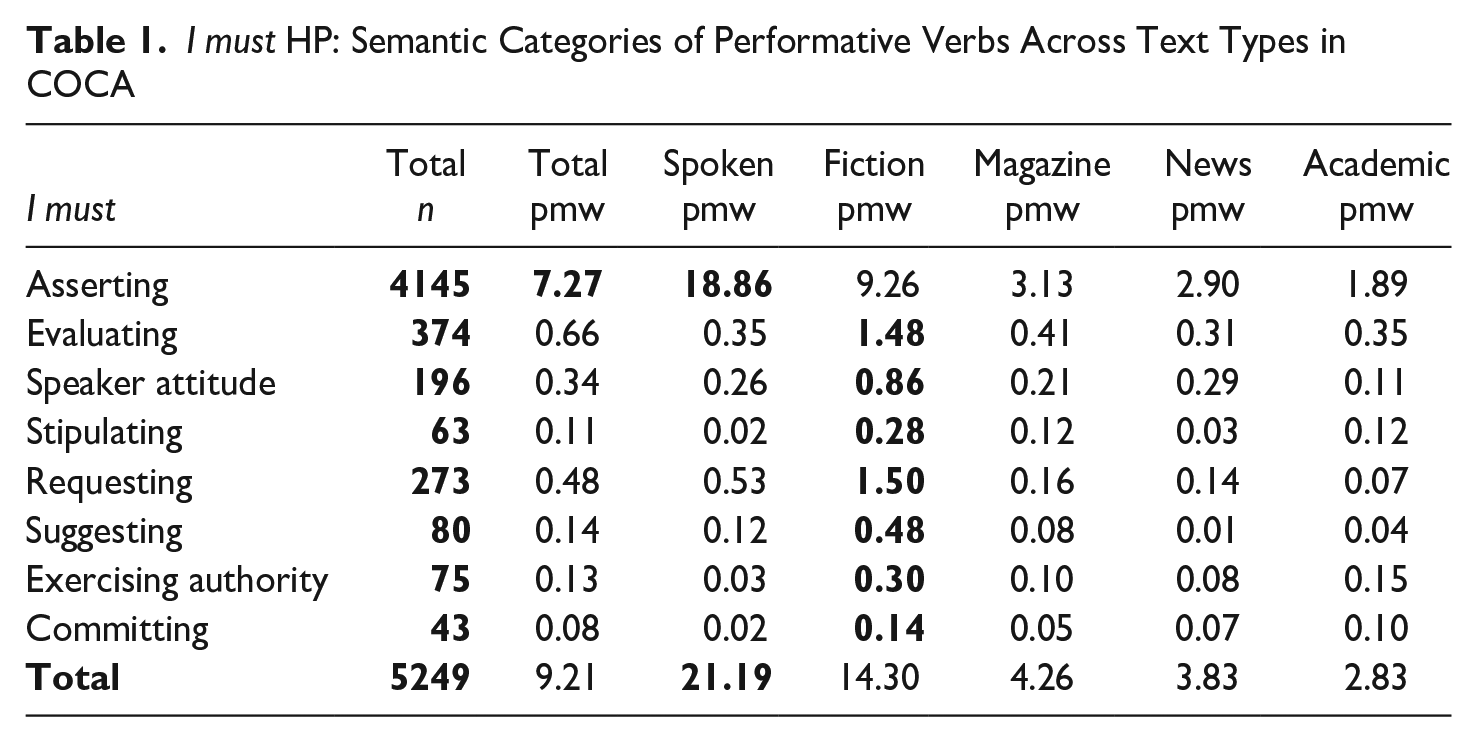
Before focusing on the qualitative functional analysis, this section first presents an overview of the data. The category of performative verbs that co-occurs most frequently with the modal must in COCA is that of assertives, as indicated by the figures in Table 1 (text types with highest frequencies are marked in bold). 5 “Asserting HPs” with must are most frequent in spoken text types, while all the other performative categories show a clear preference for fiction, as in (7). Given the focus on asserting HPs in this paper, other performative categories were not investigated in detail at this stage. A perusal of the data, however, suggests that the high proportion of non-asserting HPs in fiction is linked to their frequent occurrence in dialog, where HPs are being used for re-creating features considered typical of spoken language.
I must HP: Semantic Categories of Performative Verbs Across Text Types in COCA
(7) “Well, you took your almighty time getting here, I must say,” she said. (COCA, FIC, 2015)
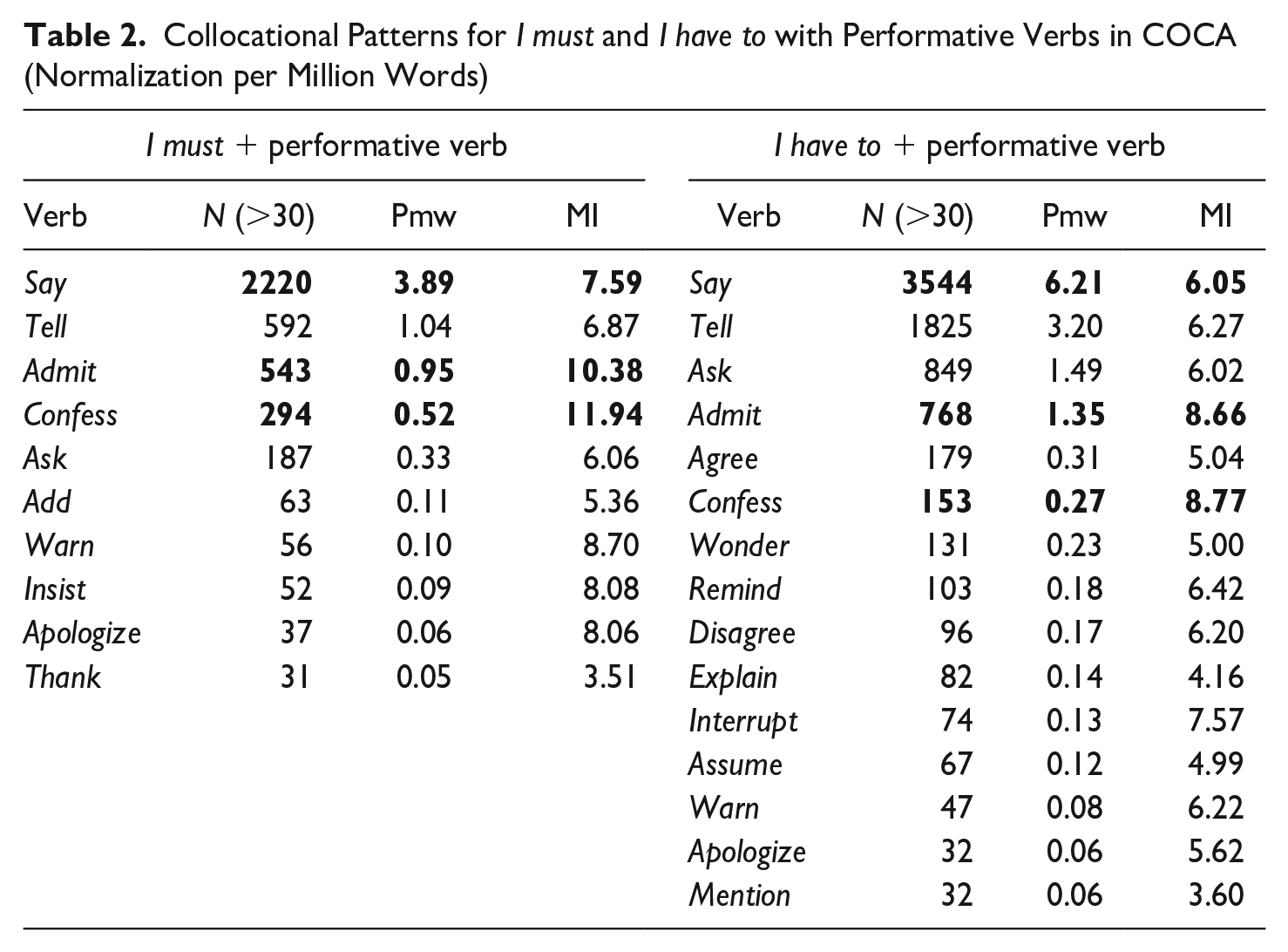
In order to identify the most common combinations of I must/have to with performative verbs, we examined the raw frequencies of verbs, their normalized frequencies (per million words) as well as the collocational strength between the modal and the performative in COCA, as reflected in Mutual Information (MI) scores. The threshold typically proposed for collocations is 3, with MI scores below 3 being considered too low for collocational patterns (e.g., Hunston 2002:71; Xiao & McEnery 2006:105). As shown in Table 2, the performative verbs most frequently collocating with I must in terms of raw frequencies are say, tell, admit, and confess. For the purpose of the present study, we focus on say, admit, and confess (marked in bold in Table 2) on account of their high MI scores (and high frequencies) both with I must and I have to. All three predicates are part of the asserting category, with say belonging to “asserting I” and admit and confess to “asserting II” (see section 2). The verb tell was excluded for the time being because of its ditransitivity, in an attempt to keep the set of HPs investigated as homogenous as possible. The same applies to the verb ask in combination with I have to, which also allows for ditransitive use as well as interrogative complement clauses, for example, I have to ask (you) where you went. It is clear, however, that future investigations will have to widen the scope and include a range of different verb types in order to get a more comprehensive picture. What the figures show is that both patterns (I must + performative verb and I have to + performative verb) are highly productive.
Collocational Patterns for I must and I have to with Performative Verbs in COCA (Normalization per Million Words)
As noted above, asserting HPs are most frequent in spoken texts, and this is particularly true for I must/have to say and to a lesser degree for I must/have to admit and I must/have to confess. For the present study the focus is therefore on the spoken section of COCA. The frequencies of the verb collocations for I must and I have to in COCA Spoken are given in Table 3 (with the included verbs marked in bold).
Frequencies of Collocational Patterns for I must and I have to with Performative Verbs in COCA Spoken
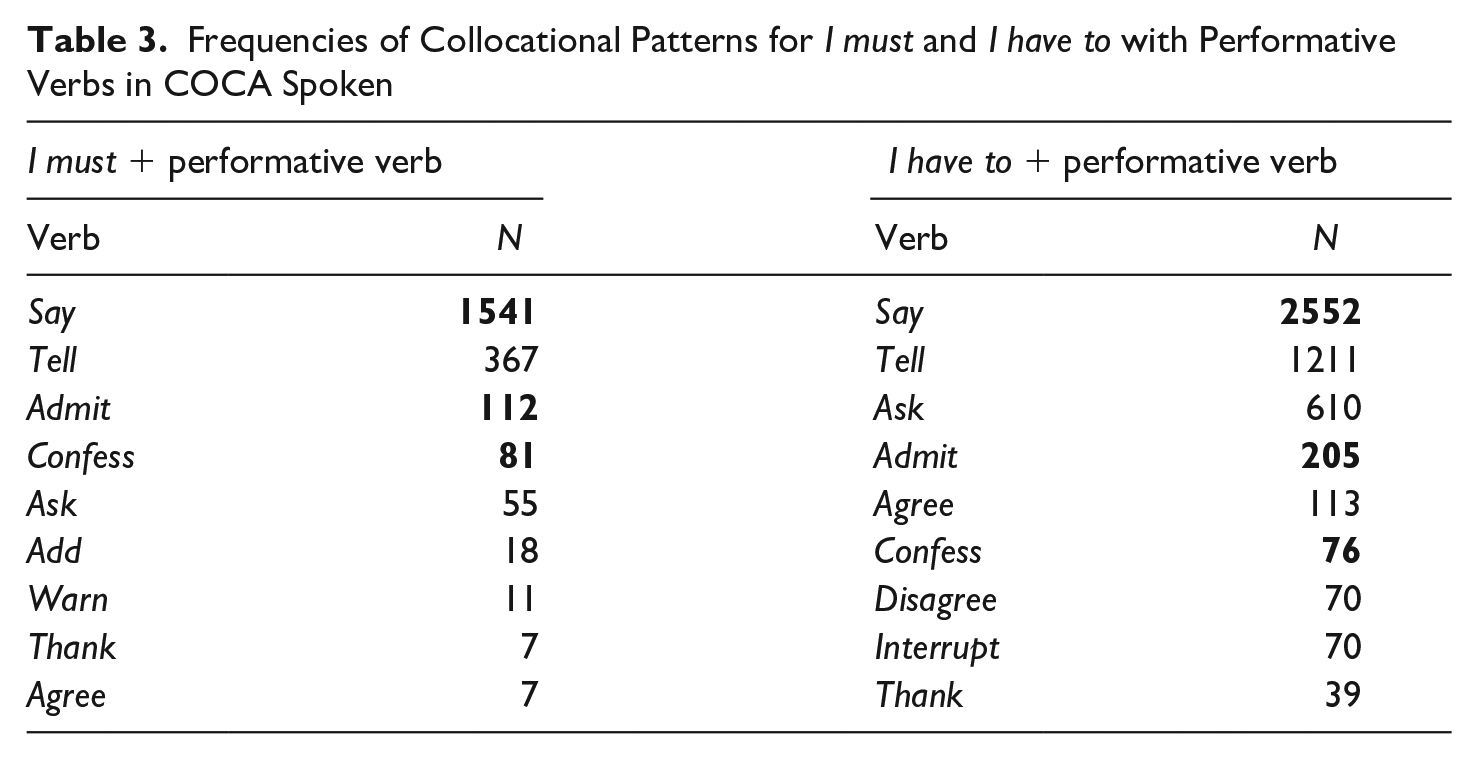
For the detailed qualitative analysis in section 4, all spoken instances of I must/have to admit and I must/have to confess in COCA were taken into account, viz., 112/205 instances of I must/have to admit and 81/76 instances of I must/have to confess (see also Figure 1). For the analysis of I must/have to say, only a random selection of 200 instances were considered. 6 The overwhelming majority of all these cases are clause-initial (in terms of their position with respect to the associated clause, referred to here as “host clause”), typically without an explicit that-complementizer, as detailed in Figures 1 and 2. Clause-final and -medial position are comparatively infrequent. In a small number of cases, the position of the HP could not be unambiguously identified as either clause-initial or clause-final owing to the unavailability of sound files.
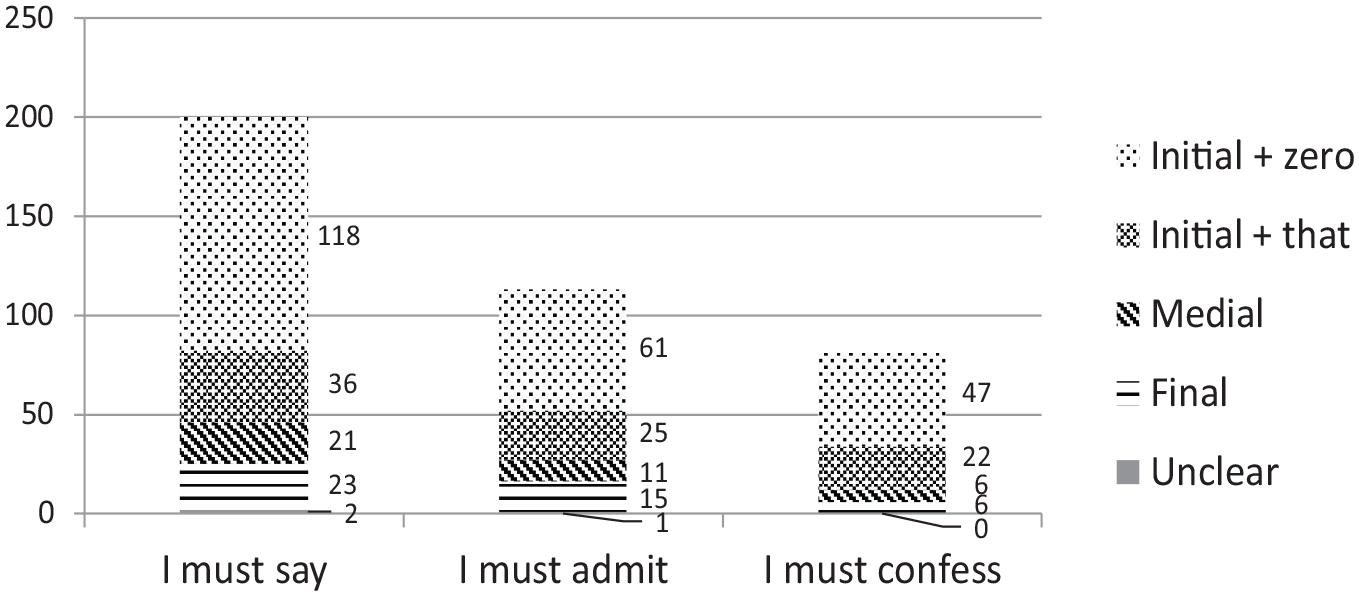
Frequencies of Must HPs Analyzed in Spoken COCA
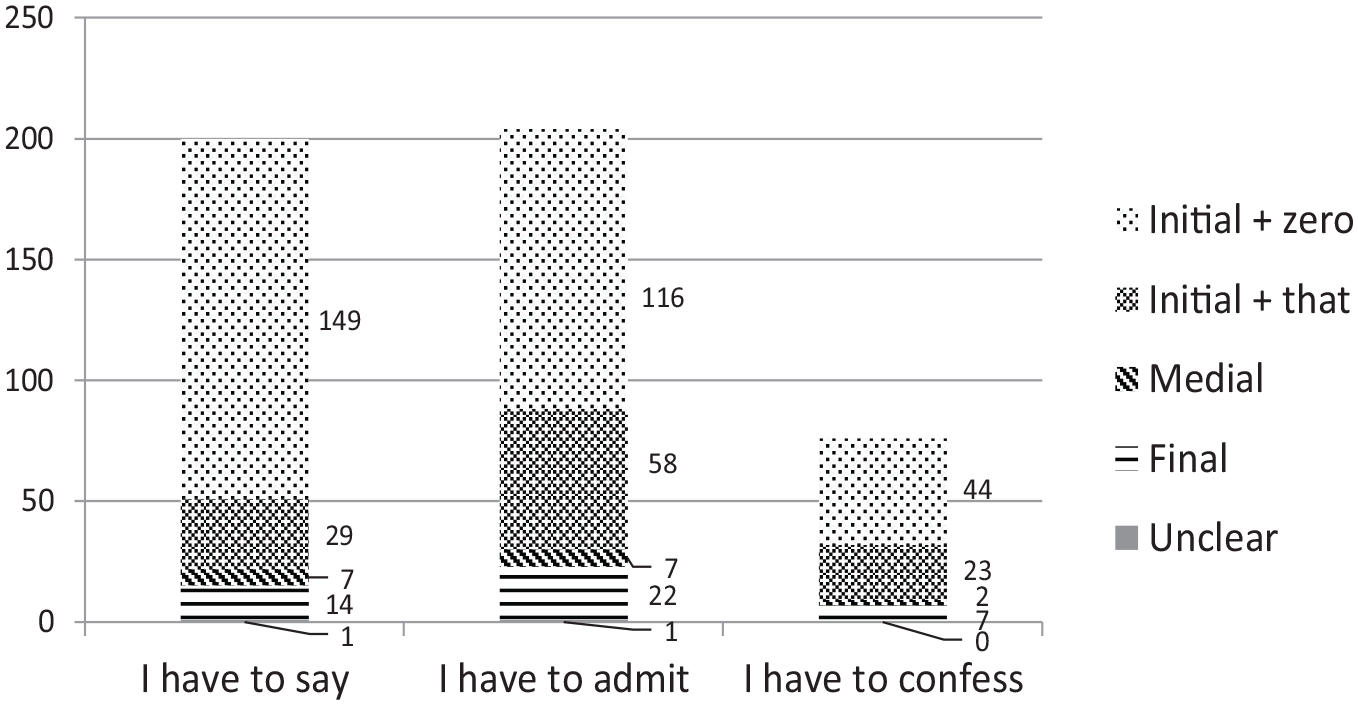
Frequencies of Have to HPs Analyzed in Spoken COCA
While clause-final and clause-medial uses are clear cases of parenthetical comment clauses (Quirk, Greenbaum, Leech & Svartvik 1985:1112-1118), clause-initial position can also be identified as a matrix clause, especially if it involves the use of that. Various views have been expressed on the syntactic status of initial uses in the literature (see, e.g., Brinton 2008:12-14; Kaltenböck 2011:83-88). We disregard questions of syntactic status here and focus on discourse function only. Given the overwhelming frequency of initial uses, no attempt has been made to identify possible functional differences for different positions.
4. Results: Functions of HPs in Discourse
4.1. Downtoners and Emphasizers
Based on the qualitative analysis of the corpus data, we identified the following main functions: (i) downtoner and (ii) emphasizer, which are illustrated in (8) and (9), and (10) and (11), respectively.
(8) And I have to confess that I was a two-pack-a-day candy-cigarette consumer, so. . . (COCA, SPOK, 2018)
(9) PERINO# No, I have to say I was not very good because I didn’t get to grow up there (COCA, SPOK, 2016)
(10) SHANKAR-VEDANTAM# I have to say that your reasoning process was fascinating. (COCA, SPOK, 2016)
(11) It was really a tremendous – I mean, I really – I must say, I really enjoyed Iowa (COCA, SPOK, 2016) 7
The different functions derive from the interplay of three co(n)textual parameters:
(i) the “semantic valency” of the host clause, more specifically whether it expresses positive, negative, or neutral semantic content;
(ii) the “thematic orientation” of the host clause, that is, whether it concerns the speaker, the addressee, or a third person/the situation more generally; and
(iii) the conversational “alignment” of the speaker with the interlocutor, that is, whether they are in agreement or disagreement at the moment of utterance.
Let us briefly illustrate the different parameters with examples (where underlining highlights the host clause). Parameter 1, semantic valency, is determined by looking at the nature of the propositional content of the host clause. While this involves assessing contextual information (context being understood as the linguistic co-text as well as the extra-linguistic context), it is contextual information that impacts on the truth-conditional content of the clause. We therefore consider it to be semantic rather than pragmatic in nature, “pragmatic” in this paper being reserved for non-truth-conditional effects, such as implicatures (for further discussion about the link between contextual information, semantics, and pragmatics, see Depraetere 2019). The semantic valency of the host clause may be positive, as in (12), or negative, as in (13). In examples where it is neither, it was classified as neutral, as in (14). In cases like these, the semantic valency does not have a direct impact on the functional interpretation of the HP.
(12) And I have to say,
(13) TONY-WHEELER#
(14) GAYLE-KING# . . . So how long did this gunfire last in your opinion?
JAUSTINA-SANTOS- (o# Total length – I would say, I mean, obviously it felt like a super long time, but obviously I have to say
Parameter 2, thematic orientation of the host clause, subsumes three different types: (i) speaker orientation (i.e., first person orientation), as in (15), addressee orientation (i.e., second person orientation), as in (16), and third person orientation (which includes reference to a specific situation or event), as in (17).
(15) And I have to confess
(16) SHANKAR-VEDANTAM# I have to say
(17) And I have to say,
The thematic orientation of the host clause typically corresponds with the grammatical form of the subject (or topic), but not necessarily so, as indicated by (18).
(18) OK, Lynn - thanks. I must confess, I’m one of those people endlessly fascinated by what you accomplish in the exit polls. (COCA, SPOK, 1992)
While there is a first person subject in the host clause, it is clear that the speaker’s main aim is not to talk about himself but about the addressee and to complement her on her achievements, which are framed as fascinating.
Parameter 3 captures the degree of alignment of the speaker with the interlocutor. For Du Bois (2007:162) the “stance act of alignment” covers both convergent and divergent alignment. For ease of reference, we refer to the former as simply “alignment,” typically realized in terms of tacit agreement, as in (19), and the latter as “disalignment,” typically realized in terms of explicit disagreement, as in (20). It is clear that alignment and disalignment are not binary notions but rather a matter of degree (e.g., Du Bois 2007: 162; cf. also Ingstrup, Aarikka-Stenroos & Adlin 2021). It can also be assumed that participants in a conversation tend to align with each other, at least minimally in order to maintain “harmonious social relations” (Culpeper 2011:395), with disalignment arising only in specific, emotionally charged situations. What is of particular relevance for the use of HPs is precisely the more extreme end of disalignment, that is, where speakers are overtly confrontational rather than just (politely) disagreeing with each other, as discussed in section 4.3.2. Parameter 3 thus considers the interpersonal relationship between the interlocutors at a given moment and, as such, has to take into account the wider situational context of the utterance.
(19) CARSON-DALY# [. . .] But how do you stay so connected to these people? Your relationship with your fans is really admirable.
HALSEY# Oh, I have to say
(20) SEDAGHATFAR: I have to say you know
The interaction between the three parameters is crucial in determining the discourse functions associated with HPs. For instance, as discussed in more detail in the following sections, the function of downtoner typically results from the combined interaction of negative polarity of the host clause (Parameter 1), speaker-orientation (Parameter 2), and general speaker-addressee alignment (Parameter 3). On the other hand, the emphasis function is associated with positive semantic valency of the host clause (Parameter 1), second or third person orientation (Parameter 2), and speaker-addressee alignment (Parameter 3). The different discourse functions thus result from the interaction of the three co(n)textual parameters and their specific values.
Given our perspective on the functions of HP, it becomes clear that these constructions have an important role to play in rapport management, and serve (mainly positive face) politeness strategies, which we capture in terms of the concepts of “face-preservation,” “face-damage,” and “face-boost.” We also occasionally refer to Leech’s (1983, 2014) Politeness strategy and maxims, as potential tools that can explain the interactional dynamics at work. As shown in the following sections, there is no one-to-one relation between a specific discourse function and a politeness strategy: both downtoners and emphasizers can be face-enhancing as well as face-damaging.
4.2. Downtoner
The discourse function most commonly associated with HPs is that of a “downtoner.” The term downtoner is borrowed from Holmes (1984:346, 359), who uses it for any linguistic device that attenuates illocutionary force. Such attenuation is possible both with negatively affective speech acts (e.g., You’re
The reasons for a speaker wanting to attenuate the force of an utterance with the help of HPs are manifold but ultimately can be linked to the notion of speaker “face,” more precisely the desire to preserve one’s own (the speaker’s) positive face or that of the interlocutor (as discussed in section 4.2.1), or to damage it (as discussed in section 4.2.2).
4.2.1. Downtoners as Face-preserving Devices
One way for the downtoner function to come into effect is through the combination of the contextual parameters of negative semantic valency and speaker orientation of the host clause (see section 4.1). We refer to this as a “negative speaker-oriented downtoner.” These downtoners serve a face-preserving function in discourse. Typical examples are given in (21)-(26).
(21) ROBERTS: I don’t –
(22) DOBBS: And in the interest of full disclosure, I have to confess
(23) But I – Congressman, I have to say
(24) So it is a source of tension, but I try to be a good boy about it to the capabilities that I am able,
(25) Tim, I know that what these gentlemen have been saying to one another means a great deal. I must confess
(26) HOLMES: Yes, I know, I must admit,
In each of these examples, the host clause describes a negative feature of the speaker. By using an HP, the speaker shows awareness of their shortcomings and at the same time attenuates the negative impact the proposition may have on self.
Let us look at how this attenuation effect can be explained for example (21). Without an HP the host clause I have not read the book amounts to a simple statement of fact, signaling full (affective and epistemic) commitment on the part of the speaker to “not having read the book.” By adding the HP I have to admit, on the other hand, the speaker attempts to weaken any potentially negative impact of the propositional content of the host clause on the speaker-hearer relationship. This is done here by the speaker affectively distancing herself from the impact of the propositional content through a fairly complex discursive strategy. First, the content of the host clause is framed as a form of confession (I have to
This is the case, irrespective of whether admit, confess, or say is used, even though, in the case of say, the above-mentioned “showing awareness of a shortcoming” takes the form of a less loaded act of simply “saying” (say). As such, I have to/must say is far more neutral in tone, but its use is still remarkable since “saying” is part and parcel of a conversation and therefore not normally made explicit as a speech act. It is important to add that the HP does not change the speech act of confession, admission, or statement, but we argue that HPs as constructions here signal the speaker’s wish to attenuate the effect of the negative proposition and to tone down a possible blow to their positive face.
Confessions and admissions feature among the face-threatening acts (FTA) that damage the speaker’s positive face in Brown and Levinson’s (1987:68) taxonomy of FTAs. The sample that we have analyzed shows that HPs with confess and admit typically feature in a context in which they function as face-preserving downtoners.
Not all face-preserving downtoners are speaker-oriented, however. The examples that follow illustrate downtoners that are addressee-oriented or third-person-oriented. As in the previous set of examples, the semantic valency is negative, but this time it is a negative trait of the addressee, as in (27)-(29), or some other person or situation that features in the host clause, as in (30)-(32), and the face-mitigating effect is to the benefit of that addressee or third party. We use the notation “negative addressee-oriented downtoner,” and “negative third person-oriented downtoner” to refer to examples of this type.
(27) Colin Powell. You say that he looked down on you as a politico. And I must say,
(28) Senator Feinstein, I have to confess,
(29) BURNETT# OK. You think people are missing the point on this. When – you talk about your endorsement of Hillary Clinton, though. When you look at some of your stances and what you have said in the past, I have to admit,
(30) And I must say
(31) And yet, I must confess, I also see him in the overall ecological picture as a bit of a fruitcake. (COCA, SPOK, 1999)
(32) Historian H.W. Brands has been reviewing some of those documents. What have you discovered? H.W-BRANDS, -HISTOR# I have to say
In (27), the addressee’s positive face is at stake since the interviewer detects a retaliatory attitude toward Colin Powell transpiring from the interviewee’s book. In (28), the speaker pretends he hasn’t understood so as not to expose the addressee in a blunt way to criticism (viz. “you are contradicting yourself here”). In (29), the speaker is similarly voicing criticism about the addressee (“you sound like an opponent of Hilary Clinton’s whereas you should be defending her”), and the HP serves as a face-preserving device that tones down the impact of the proposition on the addressee’s positive face. In (30)-(32), criticism is voiced about someone who does not take part in the conversation: the HP also serves to mitigate the face-damage inflicted by the negative evaluation inherent in the proposition.
Our sample shows that HPs with say typically serve a face-preserving function when they are negative addressee-oriented downtoners or negative third person-oriented downtoners. The strategy that is implemented can be explained along the same lines as that in the case of negative speaker-oriented downtoners: the propositional content clearly damages the addressee’s or a third person’s positive face, but the HP (be it captured in terms of a confession, an admission, or an act of saying), signals emotional distancing from whatever it is that could cause a blow to their positive face. In term of Leech’s (2014) politeness maxims, examples in (27)-(32) testify to the “Approbation Maxim” (“Give high value to O’s qualities”; Leech 2014:93), 8 which is not restricted to complimenting the hearer (see section 4.3.1), but also implies that criticism of the hearer or a third party is “hedged and muted” (Leech 2014:94).
4.2.2. Downtoners as Face-damaging Devices?
Another use of HPs as downtoners is in combination with speaker-oriented host clauses that have positive semantic valency. Unlike in section 4.2.1, the HP is used here as a face-damaging device, as the speaker is “minimizing” the beneficial effects of a positive trait of theirs (at least on a superficial level, as we argue below).
A strategy similar to that described in section 4.2.1. can be observed here. Although say is more neutral than admit, the mechanism at work is the same: the speaker is using an HP to affectively distance themselves from the positive proposition (e.g., I have good hair in example (34) below).
The reason why we argue that these HPs are only superficially face-damaging is as follows: in (33)-(35), the speakers are toning down a positive feature of their own. While this is potentially a case of self-inflicted face loss, such a strategy can also be perceived—and by convention no doubt is perceived—as highlighting the speakers’ modesty and therefore, indirectly, as giving a boost to their positive face.
(33) But, yes, my grandfather would set up the barrels for me, there’s three of them, and on a horse you go around one, around the other, up around the other, and race back.
(35) BILLY-CRUDUP# I’m working with Naomi Watts, another –TAMRON-HALL# You keep great company. BILLY-CRUDUP# I have to say,
The example in (35) is particularly interesting in this respect. Billy Crudup is being complimented (as he has collaborated with top actresses), and he modestly reformulates his skill in terms of fortune, with the compliment being reframed accordingly by the downtoning HP he uses in his response: the HP testifies to a move that is conventionally expected.
Another way of looking at the examples in (33)-(35) is in terms of Leech’s (2014) “Modesty Maxim,” 9 which he considers to be a case of “neg-politeness,” its function being “mitigation, to reduce or lessen possible causes of offense” (Leech 2014:11). In this context, the Modesty Maxim stipulates self-depreciation: “Give a low value to S’s [= speaker’s] qualities” (Leech 2014:94). This, in turn, “minimize[s] praise to S, [and maximize[s] dispraise to S]” (Leech 2014:35). Accordingly, example (35) can be seen as a case of the speaker responding to a compliment by evoking the Modesty Maxim. The same applies to (33) and (34), which are forms of self-compliment.
We found a few similar examples of this kind with admit, but none with confess. Examples with admit, such as in (36), are rather unusual in the sense that an admission usually concerns negative traits, whereas here, the speaker is admitting to a compliment that gave a boost to his positive face (getting a warm feeling after being called “man of the decade”).
(36) KING Ollie North said yesterday, you are ‘the man of the decade’. Now is that- how do you react when you - I’m sure you heard that. How do you react? Pres. REAGAN: Well, now, I have to admit
This example can again be explained along the same lines as those in (33)-(35), the lexical semantics of admit adding a further layer to the equation. By using admit, the speaker shows awareness of the fact that indulging in praise is not the done thing. Interestingly, the choice of admit, just like the downtoning HP it is part of, serves to moderate the praise in this case. While the speaker in this way would seem to bring himself down, the modesty it bears witness to could be said to ultimately boost the speaker’s face, be it again in a conventionally indirect way.
Our choice to classify the downtoners under the heading of face-damaging devices thus needs to be qualified: as we have just explained, the examples in (33)-(35) potentially realize a face-boost.
4.3. Emphasizer
Emphasizing or boosting the illocutionary force of a speech act is, as noted by Holmes (1984:346), “a complementary strategy to that of softening or attenuating its force.” Although boosting and attenuating are typically associated each with their own specific set of lexical items, Holmes (1984:359) points out that both strategies may occasionally be expressed even by one and the same linguistic unit: parentheticals such as I think and I believe may, depending on intonation and context, either boost or attenuate the force of an utterance (see, e.g., Turnbull & Saxton 1994). Another example of such functionally ambivalent structures are HPs. This section illustrates how HPs may serve not only the purpose of downtoning an utterance (as expounded in section 4.2), but also do precisely the opposite, viz., emphasize or boost the proposition of their host clause. What is responsible for this switch in discourse function is a different configuration of the three parameters described in section 4.1: semantic valency, thematic orientation, and conversational alignment. In other words, our analysis shows that HPs are particularly susceptible to the co(n)textual changes captured by these parameters and should therefore be analyzed as semantically underdetermined constructions. Our study is also in line with Muntigl and Turnbull (1998:243), who claim that “[a]n aggravation-mitigation continuum underlies concerns about face, face-work may be directed to own/or to other’s face, and the effects on face of a face-work attempt include not only maintenance and restoration, but also enhancement and damage” (see also Ramada 2020).
4.3.1. Emphasizers as Face-boosters
In examples (37)-(40), the host clause has positive semantic valency and is addressee-oriented. Here the HP functions as an emphasizer (labeled here “positive addressee-oriented emphasizer”) with the purpose of boosting the addressee’s face.
(37) SHANKAR-VEDANTAM# I have to say
(38) TODD# I have to say,
(39) JENNINGS: OK, Lynn - thanks. I must confess, I’m one of those people endlessly fascinated by what you accomplish in the exit polls. (COCA, SPOK, 1992)
(40) SAMANTHA-FIGUEROA-# Is that really your mother? I’m very sorry.
There are numerous instances of I have to say and I must say in the corpus where the speaker highlights a positive trait of an addressee. This observation is particularly interesting in view of the standard assumption (see section 4.2) that HPs serve to hedge (or downtone). One reviewer observes that the sentences with the HP in (37) (and the others in this section) cannot be paraphrased as Your reasoning process was very fascinating/Decidedly, your reasoning process was very fascinating, and therefore questions the interpretation in terms of emphasizers. In our view the more appropriate paraphrase here is I underline that your reasoning process was very fascinating (rather than the one for downtoners I distance myself from the observation that your reasoning process was very fascinating). In other words, the meaning of I have to x and I must x is best captured here by I underline that. . ., which gives prominence to the proposition in the host clause. The emphasizing use here also relates to Leech’s (2014:91) Approbation Maxim of “Give high value to O’s [the hearer’s] qualities,” that is, compliment the hearer.
Examples with admit and confess are scarce and, indeed, rather unusual. We associate admissions with guilt (see section 4.2.2), and, accordingly, with negative semantic valency; in example (41), by contrast, it is clearly a positive feature that is being highlighted.
(41) ASSURAS: Congratulations on the book. And actually, yes,
In this example, the HP with admit serves to emphasize the positive trait even further. The “coffee making” referred to in the host clause exceeds the speaker’s expectations and the surprise foregrounds to an even greater extent the addressee’s merits.
Although no analysis of the intonation of HPs was carried out here, for lack of prosodic information for the COCA data, prosody can be expected to play a role in the interpretation of a HP as an emphasizer. It is thus plausible to assume that the emphatic quality of this type of HP is also expressed prosodically in terms of intensity and pitch range and may possibly even involve a shift of the main accent from the performative verb to the modal, for example, I MUST say.
It is not just praise of the addressee that the HP can emphasize. In (42)-(45), the HPs are again emphasizers used as face-boosters, but this time it is somebody other than the addressee, that is, a third party, that is being praised (this category is labeled “positive third person-oriented emphasizer”).
(42) Well, you know, the hospital, I must say,
(43) And I have to say,
(44) In all fairness, to the court system here, the circus is us, the media, because
(45) LIMBAUGH: Now I don’t know how many of you’ve got it – how many of you think that you do. I’ll tell you what was to me just impressive, and I – I must admit
The lexical semantics of admit again seems at odds with the fact that a positive trait is being highlighted. As a consequence, there is a touch of reluctant concession, whereby the speaker concedes that the addressee has a point about something (see, e.g., Quirk, Greenbaum, Leech & Svartvik 1985: 1114-1115; Wierzbicka 1987). Such an effect does not only arise in examples with admit. In (43), for instance, there is clearly an element of counter-expectation too: “contrary to what you might have expected from me, I want to underscore that she gave the best speech.”
4.3.2. Emphasizers as Face-damaging Devices
Little has been said about the third parameter so far, namely (dis)alignment between speaker and addressee. In the examples discussed so far there is alignment among the discourse participants. In the much less frequent contexts of disalignment between speech participants the function of emphasizer HPs is that of reinforcing the negative semantic valency of the host clause oriented toward the addressee: emphasizers in such contexts inflict face damage. In (46)-(48), the host clause is negative and addressee-oriented. The HP functions as an emphasizer (labeled here “negative addressee-oriented emphasizer”) which serves to underscore the face-threatening act the speaker is performing. It has to be noted though that disalignment is a gradient concept and highly context-dependent. What is required for a HP to “flip” from a potential downtowner to an emphasizer is more than just polite disagreement but a context that is openly confrontational (to the extent of an emotional clash between the interlocutors). While an exact assessment of the situational context of specific corpus examples may be hampered by the limited contextual information provided by corpora, the examples below illustrate how an overall negative attitude toward the interlocutor can recruit the HP into supporting (i.e., further emphasizing) such a negative stance. For example, in (47), the assessment is facilitated by the availability of video footage (as provided by the internet link).
(46) PINKSY [= Dr. Drew]: It is. Yeah. It is - it is upsetting, but again, we - I want to look at this from all angles. Anahita, where does it stop? What if somebody is a - the same color, the same gender, the same whatever, judges have to recuse themselves then?
SEDAGHATFAR: I have to say
(47) NIGEL-FARAGE, - U.K. Independence Party Leader: When I came here 17 years ago and I said that I wanted to lead a campaign to get Britain to leave the European Union, you all laughed at me. Well, I have to say,
(48) HILLARY CLINTON (2016 DEMOCRATIC PRESIDENTIAL NOMINEE): So a man who can be provoked by a tweet should not have his fingers anywhere near the nuclear codes, as far as anyone with any sense about this should be concerned. DONALD TRUMP (2016 REPUBLICAN PRESIDENTIAL NOMINEE):
In each of these cases, the speakers are openly confrontational, challenging their interlocutor and/or highlighting a negative trait of theirs. In (46), the HP underlines to what extent Sedgahatfar is disgusted by his interlocutor’s observations. In (47), likewise, the HP underlines Farage’s triumphant derision of the European Parliament after the Brexit vote. In (48), finally, Trump accuses his opponent of making empty, repetitive statements, again in a context that is inherently one of disalignment.
Face-damage is addressed by Leech (2014:219-232) under the heading of impoliteness; he observes that impoliteness has received considerable attention, not least because it constitutes marked behavior. It is a matter of debate whether impoliteness can be studied in terms of a theory of politeness (see, e.g., Culpeper & Hardaker 2017). Leech’s (2014:221) view is that the Approbation Maxim is violated, for instance, when the speaker gives an “unfavourable review to O’s qualities.” While Leech (2014) argues that impoliteness effects are often (but not exclusively) communicated through implicature, it will be clear that the HPs discussed in this section are “bald-on-record” or “what-is-said” markers that serve to highlight the interlocutor’s negative features.
Examples (49)-(51) are similar: they are equally embedded in a confrontational context in which clearly opposite views are voiced, but this time with a negative trait being associated with a person other than the addressee, that is, a third person or a situation (labeled “negative third person-oriented emphasizer”). In all the examples we are dealing with a face-threatening act being highlighted by the HP.
(49) RUBIO# . . . But I will cancel the executive order as soon as I take in, as soon as I step foot into the oval office.
TRUMP# I have to say
RUBIO# You lied about the polish workers. (COCA, SPOK, 2016) (video available at: https://www.politico.com/blogs/2016-gop-primary-live-updates-and-results/2016/02/statute-limitations-lies-marco-rubio-donald-trump-2016-elections-219821)
(50) # Review of the Timex iControl From WatchReport.com Timex IRONMAN watches have always been designed to make interacting with them while running as simple and natural as possible, so why not extend the functionality of your watch to also control your iPod?. . . # I bought this Timex WS4 about 1 1/2 years ago. I must say
(51) CONAN: I wanted to read these emails. This is from Elizabeth(ph). As a survivor of rape and trained nurse, I have to say
Interestingly, our sample does not contain any examples in which the negative host clause is speaker-oriented. Given the culture in which the corpus is embedded, where blunt self-accusation may be a rare phenomenon, the absence of examples of this type, is not completely unexpected. We will take up this observation in section 4.5.
4.4. A Special Case: I have to/must say
I have to say and I must say take a special place among HPs owing to their vague semantics, involving a verbum dicendi of the most general kind, viz. say, which lacks the specificity of other performative verbs such as confess or admit. Moreover, from a diachronic perspective, I have to say and I must say can be assumed to have advanced furthest on their path of grammaticalization compared to all other HPs (see below) and, as such, have been subject to considerable semantic bleaching or desemanticization with concomitant pragmatic enrichment (e.g., Heine & Kuteva 2007). The result is a semantically vague and malleable marker which lends itself not only to the expression of interpersonal uses as discussed above (viz., downtoner and emphasizer), but also to textual uses, that is, for text organization (on the distinction between textual and interpersonal functions of pragmatic markers see e.g., Brinton 2017:11).
As a text-structuring device, I have to/must say can fulfill a range of different functions. They are used for turn-taking, as in (52), the introduction of a new discourse topic, as in (53), or as a “staller” (e.g., Stenström 1994), for instance for the purpose of holding the floor, as in (54) and (55).
(52) VALASTRO# I must say, as far as, you know,
(53) MATT-LAUER# But would you go up to someone on the street? CARSON-DALY# I would. MATT-LAUER# And say, excuse me, what are you doing? CARSON-DALY# I’d be dying to know. I’d be dying to know. I have to say, you know,
(54) after all of that, in the end, Judy, I have to say, overall, I came away with a feeling from senators that they are moving in a more bipartisan direction than they were a couple weeks ago (COCA, SPOK, 2017)
(55) VARGAS# But the thing, though, is the implication of the language that we have been using and how we talk about people, right? I have to say,
There are various indications that support the assumption of an advanced stage of grammaticalization. One of them is their high frequency (see, e.g., Brinton & Traugott 2005 on frequency as a feature of grammaticalization). I have to say and I must say are the most frequent of all HPs (see Table 2) with the frequency of I have to say rising steadily from the middle of the twentieth century in the Corpus of Historical American English (COHA; post-2021 update; Davies 2010-; 1.79 occurrences pmw in the 1940s to 4.48 pmw in the 2010s). 10
Another indication is the fact that I must say and particularly I have to say occur substantially less frequently with a that-complementizer in initial position (e.g., example 37 above), viz. 18 and 14.5 percent respectively, as opposed to 22.1 and 28.4 percent for I must admit and I have to admit and 27.2 and 30.3 percent for I must confess and I have to confess (see Figures 1 and 2). Although the distinction between matrix clause and comment clause in initial position has been debated (e.g., Kaltenböck 2011:83-88), the lack of an explicit subordinator can be seen as a sign of syntactic independence and thus grammaticalization (or pragmaticalization) into a comment clause or pragmatic marker.
As highly grammaticalized pragmatic markers, which by definition are syntactically independent from their linguistic environment (e.g., Brinton 1996:33-35; Jucker & Ziv 1998:3; Heine & Kaltenböck 2021; Heine, Kaltenböck, Kuteva & Long 2021), I have to say and I must say also easily combine with various main clause types, that is exclamative, imperative, or interrogative host clauses, as illustrated in (56)-(58), respectively.
(56) It was all swept under the rug, and I have to say
(57) I have to say, by the way,
(58) WILLIAMS# Well, I must say,
Finally, their advanced stage of grammaticalization is also signaled by their readiness to collocate with other highly formulaic (i.e., highly grammaticalized) comment clauses such as I mean and you know, as in (59) and (60).
(59) MICHELE-KELEMEN# Well, definitely. I mean, I have to say, you know, foreign countries have always sort of hedged their bets on this – (COCA, SPOK, 2017)
(60) DAVE-DAVIES# You know, I have to say. I mean in the Philadelphia City Council and I bet legislative bodies all over the country, that would just be flat-out illegal. (COCA, SPOK, 2017)
4.5. Conspectus
Our study has shown that the discursive functions of HPs result from the interaction of three different contextual parameters. Table 4 gives an overview of how these functions are related to rapport management strategies, which we have captured in terms of (positive) face-preservation, face-boost, and face-damage. Clearly, there is no one-to-one relation between a specific function and a specific politeness strategy.
Overview of Downtoner HPs and Emphasizer HPs and Their Relation to Face
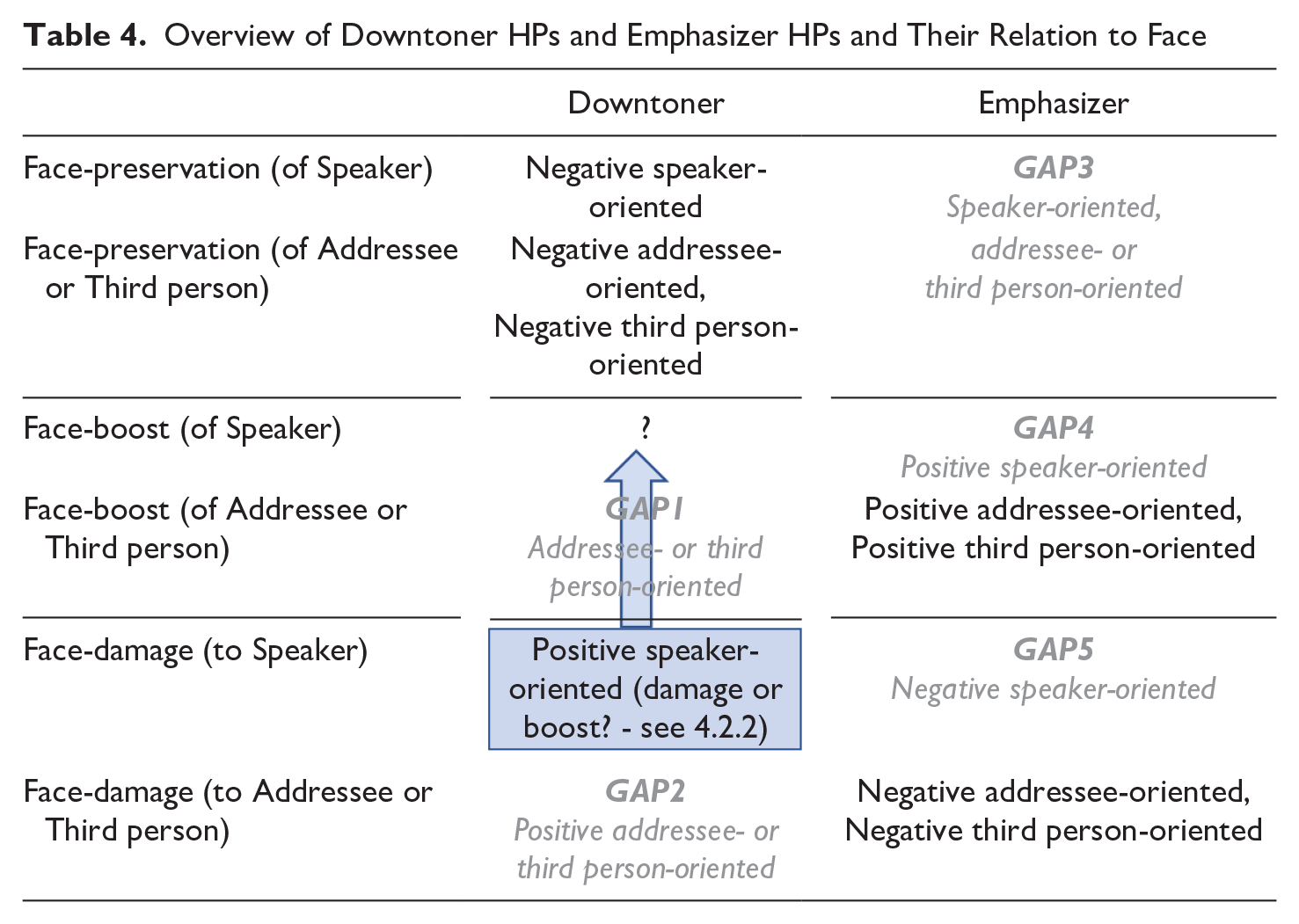
As can be seen from Table 4, there are certain gaps in the cross-cutting matrix, that is, strategies that the HPs do not seem to fulfill, based on the corpus data we analyzed. Thus, with respect to downtoner HPs, we have not identified in the corpus data any instances of downtoners that function as unambiguous face-boosting devices (GAP 1). However, we did argue in section 4.2.2 that, while speakers appear at first sight to be administering a self-inflicted blow to their own face by downtoning positive traits, ultimately, these signs of modesty may well serve as face-boosters. In other words, positive speaker-oriented downtoners could be considered as a kind of face-booster (indicated by the arrow in Table 4). Having said this, no similar mechanism seems to apply to positive addressee-oriented or positive third person-oriented downtoners: we have not found examples in which subduing a positive feature of the addressee or a third person is perceived as beneficial (face-boosting) to the relevant persons (see below, GAP 2).
Let us take a closer look at GAP 1 first. This gap observed with downtoner HPs (viz. addressee-oriented or third person-oriented face-boosting downtoner) intuitively makes sense. When speakers tone down a negative trait of themselves, the addressee, or a third person, they are exclusively mitigating the negative effect and are in this way preserving or re-establishing their own positive face or that of the addressee or the third person (= speaker/addressee-oriented or third person-oriented face-preserving downtoner), rather than boosting it. On the other hand, when speakers tone down a positive trait of themselves/others they are bringing themselves/the other down (= positive speaker-oriented/addressee-oriented/third person-oriented face-damaging downtoner). In principle, there is semantic incompatibility between toning down (a positive trait) in an attempt to give a boost to someone’s face. As we explained in section 4.2.2. though, when the positive feature is speaker-oriented, one could argue that such an act testifies to the speaker’s modesty and therefore indirectly results in a face boost (= positive speaker-oriented face-boosting downtoner).
Another potential gap for the downtoner function of HPs is in connection with positive addressee- or third person-oriented host clauses that inflict face-damage (GAP 2: positive addressee-oriented or third person-oriented face-damaging downtoner). We have not found any such examples in the corpus data, although they may in principle be possible, such as in (61) from the internet.
(61) I mean, I have to admit that she’s brilliant and all, but that in itself is so annoying! (https://www.quotev.com/story/10575842/Iridescence-HP-fanfic-Golden-Trio-Era/6; accessed 10/26/2020).
Here it could be argued that the HP expresses the speaker’s reluctance to admit to the positive trait of the addressee. The key question is, however, whether in such contexts the addressee is brought down (face-damage). It seems unlikely. The addressee’s face appears not to be under attack. While the force of the compliment is reduced, it still stands as a compliment. It is plausible to assume therefore that in many contexts such uses of the HP are interpreted not as downtowners but as emphasizers (i.e., providing face-boost to the addressee), especially with the semantically more general I have to/must say.
In the corpus we examined, emphasizer HPs either serve as face boosters or as face damaging devices. A face boost occurs when a positive trait of the addressee or a third person is highlighted (positive addressee-oriented or third person-oriented face-boosting emphasizer). Conversely, in contexts of confrontational disalignment, face damage occurs when a negative trait of the addressee or a third person is highlighted (negative addressee-oriented or third person-oriented face-damaging emphasizer).
The gaps we observed here are as follows: we did not come across examples of emphasizers that are used for face-preservation (GAP 3: speaker-oriented, addressee-oriented, third person-oriented face preserving emphasizer) or emphasizers that give a boost to the speaker’s face (GAP 4: positive speaker-oriented face-boosting emphasizer). Emphasizers that damage the speaker’s face are also absent from the picture (GAP 5: negative speaker-oriented face-damaging emphasizer).
Despite these gaps for emphasizer HPs in our corpus data, these configurations are not impossible. In fact, contexts with unambiguous cases in which the speaker either praises themselves (GAP 4) or brings themselves down (GAP 5), making use of HP emphasizers, do occur, as illustrated by examples (62) and (63) from the internet.
(62) After being on the show, how would you rate your cooking skills now? A favorite dish that will now be on your list?
Like I have said before, I joined the show to learn how to cook like a pro. I take pride in the prep process, using my new found knife skills and enjoy walking around Whole Foods for hours. I went from never entering my kitchen to spending the majority of my free time in front of the stovetop. I must say,
(63) 27.12.2012 — I admit that at first, I wasn’t very willing to buy and watch the DVD because I’ve never really watched Indian movies before; but I must say
Examples like (62) are certainly less frequent than the other types we have illustrated, and this may well reflect culture-specific practice. Praising oneself is not usually appreciated in many communities, and it is therefore not considered to be beneficial to one’s positive face, but instead highlights that speakers are rather full of themselves. In Leech’s (2014:221) framework, cases of boasting like these would be analyzed as violations of the Maxim of Modesty, “give a favourable/high value to S’s qualities.” The reason why I must say in (62) can still assumed to be an emphasizer (unlike examples such as 33-35, which were classified as downtoners) lies in the exclamative function of the host clause. Indeed, according to Holmes (1982:25), exclamations serve the same function as boosters. As such, the HP simply reinforces the illocutionary force of I am fantastic! The converse, that of straightforward self-inflicted damage, could point to a rather negative self-image and distress. In (63), the speaker underscoring what an idiot she is serves to enhance the quality of Indian movies.
The gaps in the emphasizer paradigm that we observed may well reflect the limits of the sample that we analyzed. As we have shown, it is possible to find examples with HP emphasizers that are used for self-praise or self-denigration, such as (62) and (63) respectively. The absence of examples in which the speaker gives a boost to their positive face in our sample is inevitably genre and community specific, and the examples from the web show that there are environments in which such behavior is authorized and does actually occur.
Finally, the absence of face-preserving emphasizers (GAP 3) stems from semantic incompatibility of the features involved: emphasizing a positive trait inevitably results in a face boost; it is not appropriate to refer to such a context as simply “face-preserving.” Likewise, emphasizing a negative trait constitutes face-damage; once again, capturing such a situation in terms of face-preservation would be misguided.
5. Conclusion
This paper has investigated the discourse functions of hedged performatives, notably I have to/must say, I have to/must admit, and I have to/must confess, which have received very little attention in empirical studies so far. Unlike Fraser’s (1975) original account, the focus here has not been on the impact of the modal on the performative speech act (i.e., does the modal hedge the performative?) but on the discursive function of the HP as a whole, that is, what is the effect of the construction “I + modal verb of necessity + performative verb.” In other words, in what ways does the HP shape the perception of the propositional content of the host clause?
The qualitative analysis of spoken corpus data reveals that, unlike what Fraser’s (1975) terminology might suggest, hedged performatives are not only used as downtoning devices but may also have the opposite effect and function as emphasizers. The study thus shows that pragmatic markers can fulfill opposite functions, depending on how they are used in co(n)text. The functions of downtoner and emphasizer are shown to derive from the interplay of three co(n)textual parameters: (i) “semantic valency” of the host clause (i.e., positive, negative, or neutral semantic content), (ii) “thematic orientation” of the host clause (i.e., toward the speaker, the addressee, or a third person/the situation), and (iii) conversational “alignment” of the speaker with the interlocutor (i.e., agreement or disagreement). It has further been demonstrated that HPs play an important role in rapport management, serving (mainly positive face) politeness strategies, with both categories of HPs being used as face-preserving, face-damaging, and face-boosting devices. For the special case of I have to/must say, which represents a highly grammaticalized and bleached form of HP, we identify additional text-structuring functions, such as being used for turn-taking, stalling or introduction a new discourse topic.
With the main functions having been identified, many further avenues of research open up: of particular interest is the comparison of HPs with non-hedged (i.e., non-modalized) performatives to establish possible differences in function between, say, I have to admit and I admit. Also, a diachronic study into the development of specific HPs is called for to investigate further the process of grammaticalization that gave rise to them. Given the non-compositional approach that we have taken, it will likewise be interesting to examine in more detail how HPs can be modeled within Construction Grammar.
Footnotes
Declaration of Conflicting Interests
The author(s) declared no potential conflicts of interest with respect to the research, authorship, and/or publication of this article.
Funding
The author(s) received no financial support for the research, authorship, and/or publication of this article.
