




Abstract
As European radical right parties grow in influence, and as foreign and security policy becomes more politicised, these parties have increasing potential to shape national debates on international affairs. This paper shows how radical right opposition parties seek to exploit policy dilemmas surrounding military intervention according to the nature of the political opportunity these dilemmas present in specific national settings. Its findings are based on qualitative comparative case studies of Front National, AfD and UKIP responses to intervention debates surrounding the Syrian civil war in France, Germany and the UK. I find that non-intervention is not an absolute value for radical right parties. Whilst liberal-humanitarian interventions are uniformly rejected, interventions on national security grounds, whether to combat Jihadist threats or prevent uncontrolled migration, prompt a range of responses shaped by the domestic political context. Yet even where these parties back intervention in votes, their discourse focuses on fitting the issue to the populist dimensions of their political agenda, especially attacking mainstream rivals for incompetence, duplicity or incoherence, and failing to protect the sovereignty and ethnic integrity of the nation.
Introduction
European radical right parties, rising in electoral strength and influence, have growing potential to impact national debates around foreign and security decisions, particularly regarding military intervention.
Even where these parties face significant barriers to gaining power, their capacity to amplify and exploit public doubts surrounding military commitments could raise the bar for decision makers considering such policies. How these parties respond to intervention debates and decisions is not fully captured by existing studies of the party politics of military intervention, which tend to draw on manifestos, expert surveys or parliamentary voting data. This data can help us broadly position party attitudes but cannot show how parties seek to capitalise on specific policy issues as political opportunities. Indeed, how radical right parties respond to specific foreign policy issues has barely been addressed in comparative case studies, as reflected by calls in the literature for more qualitative research into this party family, including regarding foreign policy. 1
This paper provides a unique, comparative analysis of the responses of three ideologically similar radical right opposition parties – Front National, UKIP and AfD – to debates about intervention in the Syrian civil war, to assess how these responses are shaped by variations in the domestic political context. It thereby contributes to our understanding of the interaction between the nativist and populist political dimensions that combine in many European radical right parties. 2
Even when facing significant barriers to entering government, or in some cases even gaining parliamentary representation, radical right parties and their leaders can shape debates and agendas. 3 During the period covered by this paper, UKIP’s influence peaked as it forced the Conservative party into the Brexit referendum, even whilst barely winning a seat in Westminster. In France, Marine Le Pen made the second round in the 2017 presidential election, giving prominence to her political messages. In Germany, the AfD emerged as a significant party, drawing votes from all parties but especially CSU/CDU, and entering the Bundestag in 2017 as the largest opposition party. 4
Though not to identical extent, Britain, France and Germany each faced decisions on direct participation in, or support for, intervention against Assad largely on ‘inclusive’ liberal-humanitarian grounds; against ISIS primarily on strategic or national security grounds; and was impacted by the outflow of refugees from the Syrian conflict into Europe. Whilst European radical right parties are known to be broadly hostile to military interventions, the response of these parties to these real-world policies is not obvious. First, these issues have the potential to create ideological tensions. Interventions justified on strategic or national security grounds in particular may expose a tension between sovereignist resistance to globalism and committing national resources to multilateral (and US-led) overseas intervention, and nativist commitment to protect the national community from Islamist violence or uncontrolled migration. Second, each party leadership must respond not only to the issue itself, but to how it plays out in domestic politics with respect to public opinion and other parties’ positions. These factors define the nature of the political opportunity, and therefore their calculations not only over whether to support or oppose the intervention, but regarding messages to communicate in relation to the issue. How these radical right parties navigated these issues is the focus of this study.
I first review literature on foreign policy attitudes of radical right parties, including with reference to the populist dimensions of their politics, before drawing out potential dilemmas that intervention in Syria might pose for these parties, and proposing theoretical expectations about how they may respond. I then explain case selection based on the similarity of the parties, before noting a significant variation in domestic context with respect to public support for intervention. I then describe positions taken by the party leadership in each case. I present not simply votes but the arguments and rhetoric of party leaders, based on manifestos, press releases, articles, parliamentary speeches, interviews and social media posts. Due to the difficulty of drawing exact parallels at every time point, I present each case as a narrative highlighting the most significant party responses at key moments, before abstracting a comparative analysis in the discussion. The period covered begins in 2013, when intervention against Assad over chemical weapons was debated, and covers debates around intervention in Iraq and then Syria following the major ISIS expansion in mid-2014, and in the context of the escalating migration and security crises in Europe in 2015. I refer also to subsequent debates, including around intervention against Assad in 2017–2018. I conclude that the manner of these parties’ engagement in the national debate depends on the ‘fit’ between their ideology, and the political opportunity surrounding policy decisions, which is specific to the national context.
The European radical right and foreign policy
Though diverse in origins, European radical right parties claim to speak for the ethnic nation in opposition to those who threaten its welfare, cultural identity, security or sovereignty, including through multiculturalism and immigration. 5 It is widely taken that the three parties in this study have populist characteristics, broadly construed as a form of politics claiming to speak for the people in opposition to a corrupt elite. There are various approaches to conceptualising populism and I do not take a stance here about the most definitive approach, instead drawing insights from different approaches that illuminate relevant aspects of this phenomenon.
According to Mudde’s ideational approach, populism is a ‘thin’ ideology: a set of ideas that considers society to be separated on a moral basis between a ‘pure people’ and a ‘corrupt elite’. This thin ideology can attach to different ‘thick’ ideologies (left or right), and for the populist radical right it combines with a core nativist ideology which defines the authentic pure people as the ethnonational community, and charges the corrupt elite with acting against that community’s interests. 6 I share the view that populist concepts can, at least in some cases, constitute an ideology, in the sense of the ‘pure people’ and ‘corrupt elites’ functioning as part of the sets of ideas about society that shape or map perceptions of the world, and consequently influence political behaviour.
Yet I also find instructive those approaches that emphasise certain kinds of political strategies that characterise populist actors. Weyland argues that populism is characterised by the relationship between an individual ‘personalistic leader’ and their unmediated connection to the mass support they are capable of mobilising. This approach draws our attention to the opportunism of populist leaders as their hallmark, since they take political initiatives when they calculate that they will serve the purpose of mobilising mass support against the elite. 7
Combining these approaches, it might be said that the extent to which populist ideology can be turned to mobilise mass support with respect to a given issue depends on the domestic political context around that issue, including prevailing public opinion. Before considering the implications of that for foreign policy and intervention decisions, I first take account of a growing literature that explores how populism interacts with the nativist ideology of European radical right parties with respect to foreign policy and international politics.
These core nativist values translate typically into a vision of international politics based on ‘ethno-cultural pluralism’, meaning ethnonational communities co-existing in separate national spaces. 8 This is accompanied by a relatively strict sovereignism, meaning a rejection of foreign interference within the borders of the nation-state. 9 Radical right parties typically see foreign policy in terms of the defence of a narrowly defined ‘national interests’. Commitment to sovereignty, and ethno-cultural homogeneity, underpins resistance to processes of globalisation and ‘globalism’ (the establishment of international regimes or supranational institutions that supersede the authority of the state) that blur boundaries between nation-states as well as between domestic and foreign policy. 10 Especially problematic for the radical right within the EU is loss of control over borders, preventing national communities preserving their ethno-cultural identity. The particular concern that ‘Islamization’ – both the presence of large Muslim minorities with non-Western values, and Jihadist violence – threatens Europe’s Christian or ‘Judeo-Christian’ heritage, is a unifying transnational concern for the European radical right. 11
This ideological framework is a fitting partner for populist ideas. European radical right parties typically claim that it is a nefarious agenda of global liberal elites to transfer sovereignty from the people/national communities to global institutions. Moreover, these parties reject the ‘misuse’ of national economic or military resources – frequently advocated by national and international political or bureaucratic elites – to serve ‘foreign interests’. They generally call for any development aid to be directed towards preventing migration, and increased military spending to serve territorial defence. 12
European radical right parties frequently share in a notable common feature of populist foreign policy attitudes globally, which is resistance to international orders or regimes. 13 In West European countries embedded in international institutions and commitments to global governance – including France, Germany and the UK – resistance to the institutions of regional integration and burdens of global governance is part of the radical right’s defence of national sovereignty. 14 Whilst nativism prompts a foreign policy orientated narrowly around the perceived interest of the ethnonational community, defined against non-native others, the populist dimension, as Jenne persuasively argues, prompts a wider ‘systemic revisionism’ in international politics to ‘claw back sovereignty from domestic and foreign elites’. 15 This helps explain why populist radical right parties are hostile to the globalising or culturally homogenising influences they attribute to the EU and the United States (Donald Trump aside), but they show varying degrees of appreciation for Putin’s Russia, which shares their ‘anti-globalist’ agenda.
Drawing on strategic approaches to populism, it is apparent that foreign policies are apt to be exploited in populist ways. Foreign and security issues are typically removed from the daily experience of voters, with executive-centred decision-making often shrouded in diplomatic, bureaucratic or military opacity. The capacity of anti-establishment parties and their charismatic leaders to challenge mainstream accounts and responses to international events has been expanded by hyper-fragmented media. 16 Moreover crises, or the perception of crisis, are tools with which populists in opposition challenge mainstream rivals, especially when current and former parties of government can be blamed collectively. 17 The potency of international politics – particularly the rejection of globalisation and globalism – as a field of political opportunity for the radical right in a Western context has been recognised in the case of Donald Trump. 18
In that context it should be noted that foreign and security policy has increased in salience in democracies, particular military intervention decisions. 19 Military deployments raise issues including normative debates about the use of force; questions of international legality; risks to the forces deployed or civilians on the ground; fear of unintended consequences or blowback; concerns regarding open-ended commitments; the risk of fuelling cycles of violence and more. A significant recent contribution from Wagner uses an international database of parliamentary speeches to show that party affiliation is a significant predicter of attitudes across national boundaries. 20
That said, qualitative studies show how partisan responses are shaped on one side by the specific characteristics of the international situation, and on the other by the domestic political context. 21 Rathbun’s study of debates in Britain, France and Germany around intervention in the Balkans provides relevant insights. It emphasises the extent to which left-right ideological values shape parties’ attitudes towards intervention, but also how these attitudes are shaped by dominant interpretations of key historical legacies, above all World War II, which left an enduring anti-militarist legacy in Germany, in contrast to Britain and France. Rathbun also shows that this pattern is not static, and that major events and geopolitical change can shift the national context. Indeed, since Rathbun’s study, troubled interventions in Iraq, Afghanistan and Libya have left significant new political scars. 22
What then is known about how radical right parties address intervention questions in practice? Chapel Hill survey data, and some analysis of parliamentary voting, affirms that radical right (and radical left) parties are generally unsupportive of peace and security missions. 23 But in many countries, limited radical right parliamentary representation means there are few votes or speeches to analyse, 24 and therefore much of radical right engagement in specific policy debates is missed. Balfour et al suggest, ‘Most right-wing populist parties decide their position on a case-by-case basis, rather than on the basis of a non-interventionist ideology’, 25 but there are few in-depth comparative studies to explore this playing out in practice, particular with respect to confronting Islamist threats, or preventing waves of uncontrolled migration from the Middle East. Moreover, simply recording how a party voted in a particular instance is only part of the story, since the way a party relates to the issue as a political opportunity relates also to the content of their communications.
It should be stressed that some intervention decisions are more complex in terms of radical right politics and ideology than others. Regarding Syria, whilst uniform resistance to liberal-humanitarian intervention against Assad might be expected, intervention against Islamic State is more complex. Radical right parties increasingly converge on the claim that Islamic fundamentalism and Islamic migration represents not only a national security threat, but a civilisational threat to Europe’s ‘Christian’ or ‘Judeo-Christian’ identity. So whilst anti-globalist and sovereignist hostility to US-led intervention might prompt resistance to an American-led ‘global coalition’ against ISIS, nativist or civilizationist preoccupation with radical Islam, coupled with direct security threats from ISIS-inspired terrorism and uncontrolled migration, might prompt support for intervention. This complexity was apparent following 9/11. At that time, anti-Americanism and sovereignism trumped anti-Islamic sentiment for many radical right leaders including Jean-Marie Le Pen, who opposed US ‘imperialist’ wars, including Afghanistan. 26 Lega Nord by contrast supported Italian forces joining the fight against ‘Islamic terrorism’. 27
Especially where the policy issue brings different aspects of the radical right party ideology into tension, it might be expected that the response of radical right parties and their leaders will shaped by the national political context. Considering the strategic dimensions of their populism, it would be expected that these parties’ responses be shaped by their perceptions of the political opportunity, including public opinion and the positions of other parties. 28
In that respect I find helpful Koopmans and Stratham’s concept of a discursive opportunity structure, which is the political-cultural constraints and facilitators of social movement mobilisation, which determines which ideas are ‘sensible’, ‘realistic’ and ‘legitimate’ at a given time. 29 They suggest that radical right frames will have greater resonance the more they correspond with the dominant discourse, and the less these dominant conception are ‘grounded in and legitimised by civic-political elements’.
Building on this logic, radical right anti-interventionism will constitute a greater political opportunity when it aligns with popular sentiment that is diverging from the dominant perspectives of established parties. In other words, the more unpopular the intervention in public opinion and the more widely it is supported by establishment parties, the more it will create a political opportunity for a radical right party. In such conditions it would be expected that a radical right leader would not only oppose, but turn that opposition into a populist opportunity to mobilise support. Therefore, with respect to intervention against Assad justified on humanitarian or inclusivist goals, uniform opposition from radical right parties is to be expected, in line with sovereignist and narrow interest based foreign policy principles. In so far as mainstream parties support such ‘liberal interventions’ in the face of public scepticism, it is also expected that radical right parties will seek to capitalise on a political opportunity.
However, interventions justified on strategic or national interest-based grounds, which invoke tensions between different aspects of these parties’ ideology, and which may be more popular, depending on the national context, I expect to prompt more complex responses. Formal positions and political rhetoric of radical right parties and their leaders will be shaped both by the leaders’ attempts to negotiate the ideological dilemma, but also the national level discursive opportunity structure. The more popular the intervention, the less of a mobilising opportunity it represents for the radical right opposition party. Under such circumstances, it would be expected these parties try and shift the discourse to issues which better align or fit their ideology – both nativist and populist dimensions – with public sentiments.
In the following case studies I describe and then analyse the content of the respective radical right party messages around these issues. In gathering data, I was influenced by the expectation that radical right parties are typically dominated by charismatic leaders whose personality is identified with the party, who define party positioning, and who are the overwhelming voice of the party. 30 This was certainly true of RN and UKIP, dominated by the figures of Marine Le Pen and Nigel Farage. However, AfD is an unusual case due to its origins as an economic protest party that morphed into a radical right party, and the demands of German election laws. It has evolved without a single dominant leader and has been characterised by collective leadership, frequent turnover of leaders, membership participation in decision making, and open rifts. 31
Taking this into account, my approach across all the parties was firstly to identify the most prominent voices engaging with the issue substantively at any given time, as revealed through party press releases and social media channels. In the case of RN and UKIP this was generally the party leader, in the case of AfD a wider array of party figures were involved. In addition, I also looked at national and European parliamentary interventions, which give another important perspective on how the parties engage with the political discourse. This widens the focus also for UKIP and RN beyond the party leader, and I have quoted interventions from other party representatives where it adds to the picture of how the party as a whole approached the issue.
In sum, I theorise that EPRR party leaders or dominant voices will seek to capitalise on the discursive opportunity offered by unpopular intervention decisions as a strategic mobilising opportunity – especially where mainstream parties tend to favour those decisions – exploiting the fact that such decisions involve deploying national resources to serve abstract internationalists aims with questionable implications for narrowly defined national interests. However, more popular intervention decisions, especially those more clearly tied to national security interests, will not offer the same populist mobilising opportunity, and the EPRR party will seek to shift the public focus to issues that better align their ideology with public sentiments, in opposition to the policies of mainstream rivals. The EPRR response depends therefore on the fit between the issue at hand, the party agenda and the discursive opportunity structure specific to the national context.
Case selection: UKIP, FN and AfD
The three parties are chosen because of their similarity (during the period in question) as radical right parties with high public profile, despite low parliamentary representation (save for AfD from late 2017). In each case despite little prospect of entering government, the party was significant in setting agendas, shaping discourse, challenging the legitimacy of mainstream ‘elites’ and impacting their policies. 32
Front National (FN) (renamed in 2017 Rassemblement National), is the prototype European radical right party. When Marine Le Pen (MLP) replaced her father in 2011 she broadened support by detoxifying the party of overt anti-Semitism and racism. However, she maintained broad continuity in the party programme including commitment to the protection of native culture, not least from Islamic immigration; an assertion of ‘patriotism’ and ‘sovereignty’ in opposition to globalisation and globalism; and commitment to independent geopolitical power pursuing French interests. 33 MLP’s 2012 manifesto promised to reverse French participation in NATO’s join command; envisioned a Europe of culturally distinct, sovereign states (excluding Turkey); and proposed a strategic alliance with Russia. The party secured just two National Assembly seats in 2012 and seven in 2017, but it secured first place in the 2014 EP elections and MLP gained 34% in the 2017 presidential second round.
Whilst the AfD was founded in 2012–2013 with a focus on restoring German economic sovereignty, Merkel’s 2015 decision to allow asylum seekers into Germany led to a focus on ethnic and cultural issues. 34 The December 2016 attack on a Berlin Christmas market by a failed Tunisian asylum seeker that killed 11, affirmed the direct threat of Islamist extremism to German security. In its 2016 manifesto AfD declared that an expanding Islamic population was ‘a danger to our state, our society, and our values’. By the 2017 election, immigration had become AfD’s primary source of appeal, 35 carrying it into the Bundestag with 12.6%. Its first foreign policy platform ahead of the 2013 federal election called on Germany to remain within the Western security architecture, but it also called for an independent, interests-based policy and good relations with Russia. 36 The party emphasised the constitutional prohibition on Bundeswehr deployment ‘outside of NATO territory and detached from vital German or European interests’. The document opposed German involvement in Afghanistan. However, it did not rule out acting with European partners where German interests were involved, particularly in preventing uncontrolled migration, hinting: ‘Germany will certainly not be defended in the Hindu Kush [contesting a 2004 remark by then-German Defence Minister Peter Struck justifying German participation in Afghanistan], but there may well be a need to defend it before Benghazi or Tunis’. 37 Recent analysis has highlighted the conspiratorial character of AfD discourse on international affairs with which accuses ‘German elites and foreign others’ of acting to rob the German people of national sovereignty. 38
From its founding in 1993 UKIP was always a coalition of Eurosceptic factions, and never uniformly nativist. Nonetheless, the party’s central messages – leaving the EU, controlling migration and attacking established politicians for not safeguarding national sovereignty and culture – increasingly overlapped with radical right parties across Europe. 39 Britain’s electoral system excluded UKIP from the House of Commons save for two Conservative defectors. Nonetheless, under Nigel Farage’s leadership the party secured 27% in the 2014 European election, 12% of the national vote in the 2015 general election and played a major role in the 2016 Brexit referendum. The party’s 2015 election manifesto reflected the familiar commitment to narrowly defined national interests and resistance to the burdens of global governance, criticising political leaders’ willingness ‘to put our troops in harm’s way at the behest of other country’s political agendas’. It also affirmed that, ‘The rise of Islamic extremism is . . . possibly the most important battle of our generation’.
Given these similarities, broadly similar patterns of response might be expected across the three parties. The intervention policy issues surrounding the Syrian conflict were broadly comparable in each country. Britain, France and Germany are the three most economically and militarily sizeable European NATO members. Each has a legacy of both humanitarian intervention, as in the Balkans, and supporting US-led intervention against global Jihadist threats, as in Afghanistan.
That said, there are also significant variations between each case with respect to public attitudes towards intervention and the positions taken by other parties.
France
French foreign policy is informed by a self-perception of global importance and responsibility for human protection 40 and the capability to independently project diplomatic and military power to defend its values and interests. 41 This is reinforced by the primacy of the president in foreign policy under the Fifth Republic, including powers to authorise military operations, with parliamentary assent only required for extending missions beyond 4 months. 42 Independence from US intervention policy – as boldly illustrated over Iraq – remained a significant value even after President Sarkozy’s 2008 decision to reintegrate France with NATO command. Yet the Iraq decision did not reflect disinterest in intervention per se, as illustrated by broadly supported interventions in Libya in 2011, and against Islamist insurgents in Mali in 2013.
In the Syrian context – despite France being the former mandate power with close relations to the Assad regime – Sarkozy was quick to challenge the regime’s legitimacy as the conflict escalated. In August 2013, following the use of chemical weapons in Ghouta, President Hollande expressed moral indignation and pressed for intervention in concert with the US. However, a survey found 64% of the public were opposed, as were centre right and centrist parties. 43
By contrast, when France announced airstrikes on ISIS in Iraq in September 2014 – joining a US-led coalition responding to a request from the Iraqi government – IFOP surveys showed public support at 69% in September 2014 rising to 76% in September 2015. 44 In September 2015 France widened airstrikes to Syria, and the terror attacks which killed 130 in November led to their intensification, with the government describing itself as at war with a Jihadist army. 45 In 2018 France participated along with the UK in a US-led strike on Assad targets following the use of chemical weapons by the regime. AN and Senate votes on the interventions in Iraq (January 2015) and Syria (November 2015) were overwhelmingly supported by mainstream parties.
Britain
Britain too has a foreign policy outlook influenced by a sense of global responsibility, including Britain’s identity as a special partner to the US advancing liberal values and international order. But in contrast to France, the defining moment in British post-Cold War intervention policy was joining the 2003 US-led Iraq invasion. This decision damaged confidence in decision makers, reduced appetite for intervention and strengthened a convention of seeking prior parliamentary approval for military action, even whilst formally the prime minister retains the ‘royal prerogative’ to authorise the use of force. 46 Libya showed that with UN approval, broad parliamentary support could be secured for humanitarian intervention, but subsequent debates around Syria showed how divisive foreign military intervention had become. The conflict in Syria developed against the backdrop of the debate over EU membership, in which the issue of uncontrolled migration, including from the Islamic world, was prominent. 47
UK parliamentary debates over Syria began in August 2013 when Conservative rebels joined with Labour to vote down David Cameron’s proposal to participate in military action to deter Assad from future chemical weapons use. Whilst the motion fell, prior to the vote no major party ruled out support for military action, even though polling suggested only 24% of the public supported it. 48
By contrast, in September 2014, when Cameron sought House of Commons support to intervene against ISIS in Iraq, the House of Commons approved by 524 votes to 43. Public support for RAF airstrikes against ISIS in Iraq rose from 35% in August 2014 to above 50% through 2015. Support for RAF strikes in Syria was similar. 49 In December 2015 the House of Commons overwhelmingly supported joining the multinational action against ISIS in Syria, but the move was opposed by 66 Labour MPs led by radical left Labour leader Jeremy Corbyn.
Germany
The politics of military intervention in Germany contrasts most sharply from the other cases, being shaped by the country’s dominant tendencies towards anti-militarism, multilateralism and ‘civilian power’, defined against Germany’s history of military atrocity and genocide. 50 That said, since unification successive leaders have sought to normalise Germany’s international role, including through participation in NATO-led interventions. A 1994 constitutional ruling determined that out of area deployments were permissible if part of collective security, enabling participation in the Balkans conflict and later Afghanistan. Recent challenges including Brexit and the Trump presidency have led some to anticipate growing internal and external pressure on Germany to be more assertive in foreign policy. 51 However, most Germans remain resistant to greater responsibility in overseas military operations. Most military deployments require Bundestag authorisation prior to deployment, and this is typically time-limited to 12–14 months. 52 Public support for military deployment was weakened by the evolution of Germany’s role in Afghanistan from peace keeping to counterinsurgency. The Kunduz airstrike in September 2009 – when a German officer directed a US airstrike that killed 90 civilians – was a turning point. The CDU-FDP coalition abstained in the 2011 UNSC vote on intervention in Libya.
In Germany, controversy over responding to Assad’s chemical weapons came in the run up to the September 2013 federal election. Merkel was squeezed between public and opposition scepticism regarding intervention, and US pressure for support. 53 When in September 2014 the US called allies to join its campaign against ISIS, Germany’s grand coalition provided arms to Iraqi-Kurdish Peshmerga but ruled out German airstrikes. The prevailing government approach, captured in a 2014 foreign policy review, inclined to accepting greater international responsibilities, but maintaining a high bar on military deployments. 54 A new international call for German intervention came in November 2015, with France invoking the Lisbon Treaty’s mutual defence clause following ISIS-inspired attacks which killed 130. An October 2015 survey had found 82% opposed military intervention. 55 Merkel’s government proposed a modest deployment of reconnaissance and refuelling aircraft and a single frigate, and a poll found 59% support for this. 56 The deployment secured a Bundestag majority, but was opposed by the Greens, Die Linke and a minority within SPD. 57
In summary, British and French attitudes towards intervention are informed positively by a sense of global responsibility and military reach, though in the British case tempered by the Iraq experience, which has strengthened the House of Commons role in military deployments. German policy elites have shown a growing sense of global responsibility, but the political culture remains deeply affected by anti-militarism informed by German history, with the strongest parliamentary constrains on military action. In that context public support for humanitarian intervention against Assad was low in all three cases. On the question of intervention against ISIS in Syria and Iraq, during 2014–2015 – the critical period when deployments were being voted on in all three states – support was relatively high in France, moderate in the UK and relatively low in Germany (Table 1).
Summary of public attitudes towards intervention in the Syrian-Iraqi arena.
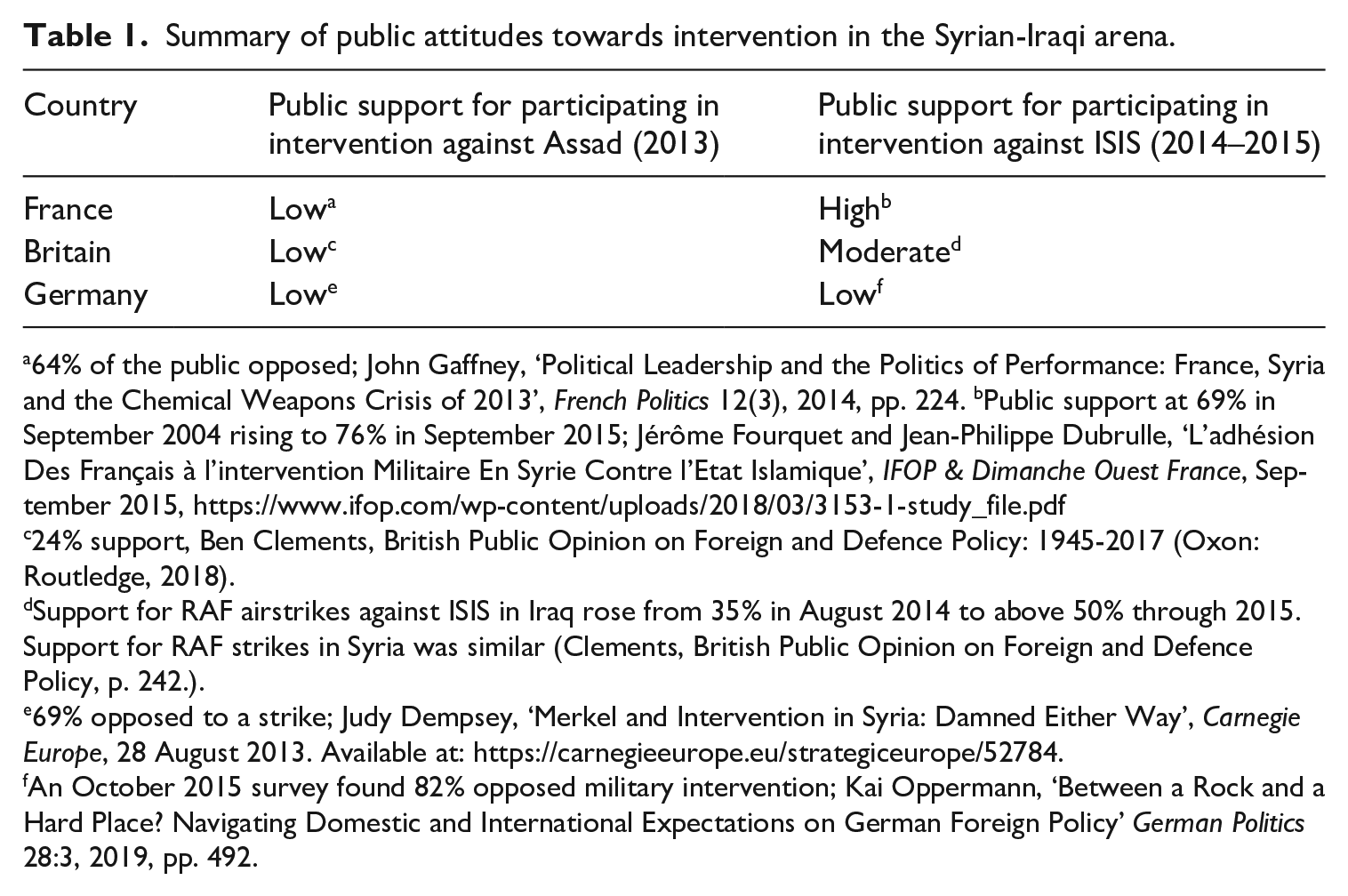
64% of the public opposed; John Gaffney, ‘Political Leadership and the Politics of Performance: France, Syria and the Chemical Weapons Crisis of 2013’, French Politics 12(3), 2014, pp. 224. bPublic support at 69% in September 2004 rising to 76% in September 2015; Jérôme Fourquet and Jean-Philippe Dubrulle, ‘L’adhésion Des Français à l’intervention Militaire En Syrie Contre l’Etat Islamique’, IFOP & Dimanche Ouest France, September 2015, https://www.ifop.com/wp-content/uploads/2018/03/3153-1-study_file.pdf
24% support, Ben Clements, British Public Opinion on Foreign and Defence Policy: 1945-2017 (Oxon: Routledge, 2018).
Support for RAF airstrikes against ISIS in Iraq rose from 35% in August 2014 to above 50% through 2015. Support for RAF strikes in Syria was similar (Clements, British Public Opinion on Foreign and Defence Policy, p. 242.).
69% opposed to a strike; Judy Dempsey, ‘Merkel and Intervention in Syria: Damned Either Way’, Carnegie Europe, 28 August 2013. Available at: https://carnegieeurope.eu/strategiceurope/52784.
An October 2015 survey found 82% opposed military intervention; Kai Oppermann, ‘Between a Rock and a Hard Place? Navigating Domestic and International Expectations on German Foreign Policy’ German Politics 28:3, 2019, pp. 492.
EPRR responses to intervention debates
FN
Whilst Sarkozy was quick to challenge the Assad regime’s legitimacy, during a 2012 presidential debate Marine Le Pen (MLP) equivocated, saying there weren’t ‘only bad guys or good guys’ and ‘I just hope Bashar al-Assad won’t be replaced by Islamist fundamentalists’. 58
In August 2013, whilst President Hollande pressed for intervention against Assad following chemical weapons use, Le Pen rallied supporters with the hashtag #NonÀLaGuerreEnSyrie. She accused Hollande of having, ‘chosen the Islamists’ and declared: ‘Sharia law [and] the persecution of Christians . . . awaits this country if the United States and France intervene’. 59 She voiced suspicions that the government was ‘trying to build evidence’, and declared that the parliament could not legitimise action because it was not representative of ‘the people’. 60 In a YouTube video she accused Hollande of behaving, ‘like a vassal of the United States, like Nicolas Sarkozy’, and demanded that France, ‘speak in accordance with her interests and her interests alone’. 61
At a January 2014 press conference she criticised the anti-Assad policy by characterising it as allying with Saudi Arabia, ‘the nuclear heart of world Islamism’ – in support of its ‘aggressive and pro-war position on Syria and Iran’. 62 This contrasted with the mainstream view of Sunni Gulf monarchies as economic and security partners, and Iran as a destabilising threat.
Over 2014 the growing ISIS threat brought FN principles of non-interference and distance from US policy into tension with containing Islamist extremism. An August 2014 MLP press release reflected this. It blamed UMP and Socialist policies in Libya and Syria for strengthening the ‘l’internationale islamiste’. It called on France to provide ‘logistical assistance and intelligence support’ to ‘governments that are fighting the militaristic-Islamist forces’, whilst maintaining, ‘strict compliance with the principle of non-interference’. 63
When France announced airstrikes on ISIS in Iraq in September 2014 MLP issued a video neither explicitly backing nor condemning the development. Instead she focussed on tackling Jihadism at home, referring to French Muslims joining ISIS. But she also accused Hollande of ‘arming the fundamentalists in Syria . . . the very ones that we say we want to fight today’. She added that ‘The inconsistency continues since our country maintains the best relations in the world with Qatar and Saudi Arabia’, and pledged to ‘restore a free French diplomacy’, and ‘national defence independent of NATO’. 64
FN’s two Assemblée National members voted for deployment in Iraq (January 2015) and Syria (November 2015). But when party representatives mentioned their support it was sotto voce, alongside a more dominant anti-establishment message – for example contrasting French military vigour with EU impotence, 65 or lambasting US and European governments for not realising that defeating ISIS required ‘close cooperation with the Syrian government’. 66
Le Pen’s remarks relating to Syria and Iraq increasingly focused on domestic dimensions of the crisis, such as French Muslims joining ISIS. In October 2014 she called for: ‘immediate suspension of the Schengen Agreement to counter the return of jihadists’. 67 Following terror attacks in Paris in January 2015 the focus of MLP’s response was restoring borders, stopping immigration and stripping nationality from extremists. 68
But she also addressed foreign policy. In a New York Times article she attacked the ‘geopolitical incoherence’ created by intervention in Libya as well as Hollande’s, ‘support for some Syrian fundamentalists, alliances formed with rentier states that finance jihadist fighters, like Qatar and Saudi Arabia’. 69 In a speech to the Oxford Union in September 2015 Le Pen expressed concern for ‘financial links between the French political class and the dictators of these petrol monarchies’. 70
When in September 2015 France widened airstrikes to Syria, MLP did not oppose, but attacked the government for not coordinating its campaign with Assad and the Russians. 71 The 2015 migration crisis and the terror attacks in Paris in November 2015 and Nice the following July, reinforced FN’s strategy of linking the war against ISIS with restoring borders; rolling back European integration; stopping migration; and confronting the cultural and security threat posed by radicalised French Muslims. MLP argued in the EP that the uncontrolled migration was legacy of past Western interventions and the EU’s impotence. 72 She attacked Hollande’s ‘weakness’ in the face of Germany’s ‘irresponsible’ asylum policies, and condemned the EU-wide solution – a deal with Turkey – whilst demanding the reimposition of national borders. 73
She also maintained international dimensions to her response. In Time magazine she wrote: Let’s stop undercutting sovereign states, as Nicolas Sarkozy did disastrously in Libya . . . We need to work with Russia, Syria and Iran as well as other foreign powers including the United States which are fighting radical Islam. Let’s bring to a halt the obsolete cold wars and incestuous relationships with untrustworthy countries—I mean specifically Turkey or Qatar.
74
In an EP speech she derided EU weakness and proposed to create, ‘under the aegis of the United Nations, protected refugee camps in Syria, or in countries close to Syria to settle war refugees in decent conditions’, without clarifying how this was to be achieved. 75
During the US election she endorsed Trump and branded Hillary Clinton a warmonger who ‘supported the war in Iraq, Libya, Syria causing the rise of Islamism’. 76 During her own 2017 election campaign she gave a 9000-word lecture on ‘France’s International Policy’ to Paris’s diplomatic corps. There she affirmed a principle of ‘non-interference’, and that she would deploy the military only ‘for defending our vital interests’, prioritising francophone Africa where military support was justified to confront ‘barbarism’ and ‘terrorism’. She questioned whether ‘our political leaders have put France at the service of other interests’ or sent soldiers to war to distract from domestic failures. She referred repeatedly to mistakes in Iraq, Libya and Syria, lambasting ‘Support for moderate “supposed Islamists” in Syria’ and the closure of France’s embassy in ‘a country that has long retained a French-speaking elite and protected its Christian minorities’. 77 Two months before the 2017 election, MLP visited Lebanon to affirm the ‘special bond’ with France’s former protectorate, and historic role of ‘the protection of Christians in the East’. Meeting Putin in Moscow she called for Franco-Russian cooperation against globalism and Islamic fundamentalism. 78
MLP displayed disappointment when Trump ordered airstrikes on Assad forces following chemical weapons use in April 2017. She was similarly critical of the April 2018 airstrikes on Assad in which France participated, tweeting that, ‘France has again missed the opportunity to appear on the world stage as an independent power in favour of parity in the world’. 79
In sum, MLP did see the support by Hollande in 2013 for intervention against Assad as a mobilising opportunity that aligned her party’s anti-interventionist ideology with public sentiment. By contrast, intervention against ISIS, which grew in popularity in response to growing Jihadist threats, offered no such neat fit. She avoided clear positions either for or against the intervention, preferring instead to pivot to more opportune issues, including border controls, domestic radicalisation or accusing mainstream rivals of incoherence and duplicity in their wider foreign policy agenda.
AfD
Controversy over responding to Assad’s chemical weapons came in the run up to the September 2013 federal election. Chancellor Merkel’s hesitation at a 6 September G20 summit in giving diplomatic support to a tough US response was widely discussed in German media, being described by some as a diplomatic blunder. 80 The emergence of the issue coincided with AfD co-founder Alexander Gauland launching the party’s first foreign policy platform. Gauland’s told journalists unequivocally: ‘A military strike against Syria would be completely wrong’, arguing that, ‘punitive action affects innocent people’. He endorsed Russian-led efforts to draw Syria into the Chemical weapons treaty. 81
As the US built its anti-ISIS coalition in 2014 Germany did not initially deploy forces, and intervention per se was therefore not highly salient. EP speeches by AfD MEP Beatrix von Storch referring to Syria, Iraq or the wider Middle East referred primarily to the need to protect religious minorities and especially Christians.
Over 2014, Muslim immigration gained salience, with AfD leaders participating in rallies against the ‘Islamization of the Occident’ organised by the grassroots ‘Pegida’ movement. References to Syria in AfD discourse increasingly related to concerns over growing Muslim immigration and included pointing to ISIS as an example of Islamic cultural difference. Defending Pegida in December 2014, Gauland said: ‘Many people have a problem with an Islam that sees itself as a state religion, that has not modernized itself like Christianity, and that has been particularly brutal in the religious wars in Iraq and Syria’. 82 During 2015, with migration becoming Germany’s most important challenge, the leadership of Frauke Petry took AfD towards increasingly hard-line positions on Islam and migration.
Yet as Germany weighed its response to France’s invocation of the Lisbon Treaty’s mutual defence clause following the November 2015 Paris attacks, AfD’s November Federal Conference rejected the deployment, calling for partnership between NATO and Russia against Islamic terrorism, and for renewed relations with Syria. 83 Foreign policy spokesman Armin-Paulus Hampel raised additional proposals. He declared that NATO and EU naval forces should be deployed ‘off the North African coast, at the level of the 12-mile zone . . . where the refugee boats can be intercepted and sent back’. More remarkably he said, ‘it is worth considering whether the NATO states should set up protection zones in Syria and Iraq under a UN mandate’, for the narrow purpose of ensuring safety and provisions for people there. He suggested that rather that European countries sending soldiers, ‘those who have done the damage, that is the United States of America, should put things right’. Then he suggested it was ‘worth considering - whether we should not introduce universal conscription for all 18-45 year-old male Iraqis and Syrians and call on and support them to fight in their own fatherland’. 84
Regardless of their plausibility, these proposals reflected a mindset that German engagement should be directed overwhelmingly towards stopping migration and repatriating migrants. Hampel repeatedly returned to the proposal for NATO security zones. He claimed in January 2017 that a Trump proposal for security zones echoed his own, and would save Germany one hundred billion Euros. He welcomed a May 2017 Russian-Turkish-Iranian proposal for de-escalation zones as ‘the right step to give people protection and to alleviate the asylum chaos in Germany’. 85 When in October 2019 defence minister Annegret Kramp Karrenbauer floated with NATO allies the idea of an internationally secured protection zone, coordinated with Russia and Turkey, Hampel described them as ‘a bad copy of the AfD demands on this issue formulated since 2015’. 86
Attacking the US and defending Russia was a consistent theme. Retired Colonel Georg Pazderski, AfD faction leader in the Berlin state parliament and a leading AfD voice on foreign policy, bemoaned a ‘double standard’ in the fight against ISIS whereby, ‘the offensive against the terrorists in Mosul is being celebrated as a major liberation operation by American-Iraqi troops. But the Russian-Syrian offensive against the IS in Aleppo is being brought close to war crimes by our politicians and the media’. 87 Pazderski also exemplified AfD representatives’ routine criticisms of Turkey’s conduct, including its campaign against the Kurds, its ‘blackmail’ of Europe over migration and its own ‘security zones’ which risked being a haven for Islamists. 88
In AfD’s 2017 manifesto, Islam was an overwhelming preoccupation, and the immigration section focussed on blocking ‘a gigantic mass migration’ from Africa and the Middle East. Whilst ‘true refugees should be granted shelter’, once wars end it calls for ‘people claiming asylum in Germany and in the EU’ to ‘return’ to asylum centres established in ‘safe countries in the regions where migration originates from’. It stated that German participation in out of area NATO missions ‘shall, in principle, only be carried out under a UN mandate, and only if German security interests are taken into account’. 89
AfD’s Bundestag entry provided a platform to attack the Grand Coalition on Syria and Iraq. The newly elected faction tabled a resolution declaring that, ‘the war in Syria is almost over’ and calling for ‘negotiations with the Syrian government on a repatriation agreement that would enable, ‘revocation of the right to asylum’. 90 Unsurprisingly, the faction was critical of US-led strikes on Assad forces following chemical weapons use in 2017 and 2018 and attacked political opponents who supported them as warmongers who risked fuelling escalation, contrary to German interest which were to play a ‘balancing’ role. 91
In a series of votes to renew Bundeswehr overseas missions in December 2017, AfD voted in favour of participation in Operation Sea Guardian off the Libyan coast and a small contribution to peace keeping in Darfur on the basis that both were directed at preventing refugee flows. 92 But it opposed renewing German participation in the ant-ISIS coalition claiming that shifting the Bundeswehr from a defensive to an interventionist force had left it ‘exhausted’ and without an exit strategy. 93
Some AfD representatives went further, visiting Syria in 2018 and 2019 to meet with Assad government ministers and show that the country was safe for Syrians to return. 94
In sum, against the backdrop of low support in general for active participation in overseas military campaigns, any consideration of German participation in offensive military action in Syria represented somewhat of an opportunity for AfD to fit their anti-interventionist agenda with the public sentiment. However, since Germany’s mainstream parties were also ambivalent about participation, and Germany’s contribution modest, the mobilising potential of this issue in the German context was limited.
UKIP
When the House of Commons debated military action against Assad in August 2013, public support was low, but no major party unequivocally opposed. Nigel Farage sensed a political opportunity, driving a van around Westminster with the slogan: ‘UKIP says no to war in Syria. Stop defence cuts at home, fighting foreign wars and causing misery abroad’. A statement on their website declared: UKIP is strongly opposed to the government's attempts to once again police the world . . . Any intervention must carry with it a full mandate from the United Nations rather than a desire by Western nations to meddle abroad . . . We know that the rebels contain extremists who support radical Islam.
95
In an EP speech on 11 September 2013 Farage rejected that ‘the rebels are the good guys and Assad’s regime are the bad guys’. He celebrated the House of Commons vote as that of ‘a nation-state democracy’ stopping the UK going to war and giving ‘a chance of peace’. He branded mainstream rivals ‘extreme militarists’. 96
In June 2014 Farage tweeted that the ‘West should declare an end to the era of military intervention abroad’. Yet as public shock at ISIS atrocities grew, UKIP’s anti-interventionism increasingly ran against public opinion and was more muted. In interviews and tweets in August 2014 Farage focused on the threat of radicalisation at home, and pressed for stripping British extremists who joined ISIS of citizenship. 97 Speaking for the party in the EP in September 2014, as the US-led coalition against ISIS was being built, Jonathan Arnott maintained that ‘British soldiers should not be deployed to Iraq and Syria at this stage’ and that ‘we should support moderate countries in the region’. 98 Then in an EP debate on Ukraine, Farage called on Europe to stop provoking Putin when ‘the West now faces the biggest threat and crisis to our way of life’ in the form of ‘Islamic extremism’ and that ‘Vladimir Putin . . . is actually on our side’. 99
Following January 2015 attacks in Paris, Farage sharpened his rhetoric, warning that mass migration had created a ‘fifth column’ within a minority of Muslims in Europe and calling on Europe to be ‘more courageous in standing up for our Judeo-Christian culture’. 100
Yet in its 2015 election manifesto UKIP kept an anti-interventionist line. While pledging to increase defence spending and affirming ‘commitment to NATO’ it insisted that ‘parliamentary democracy should be consulted at every opportunity, before committing any taxpayer resources, or our forces, to combat situations’. It argued that: ‘the fight with and against [Islamist extremist] ideology is not best fought on a battlefield 3000 miles away, but at home, where we have significant problems of radicalisation’.
When in December 2015 the House of Commons voted on joining multinational action against ISIS in Syria, with parliamentary support save for a section of the Corbyn-led Labour party, Farage differentiated himself by maintaining his scepticism. His tweets and remarks in the EP relating to Syria were focussed on attacking the EU over failing to control migration, claiming that most of those coming were economic migrants, with ISIS fighters sheltering among them. 101
But he also challenged military intervention. In a November 2015 article he argued that previous campaigns were ill-planned and destabilising. He wrote that, ‘Nowhere in military history has bombing on its own without ground forces achieved any desired goal’ and that he would ‘back military action when I can see a proper plan with real co-ordination and the active involvement of ground troops from many affected countries’. 102 Farage’s position was not shared universally in UKIP. Its MP Douglas Carswell, who frequently differed with Farage, voted for intervention. However, as UKIP’s most high-profile representative, Farage’s position set the tone.
After the 2016 Brexit referendum Farage stepped back as UKIP leader but the line on intervention remained consistent. The 2017 election manifesto declared that ‘UKIP will avoid allowing Britain to become embroiled in foreign wars’, and that, ‘The threshold for seeking to topple anti-Islamist leaders will therefore remain very high indeed’.
After the US bombed Assad regime targets following chemical weapons use in 2017 and 2018 Farage was critical, and his successor Paul Nuttall published a column castigating the record of Western intervention associated with mainstream parties and warning that ‘A significantly weakened Assad is a gift to ISIS’. 103
In sum, the August 2013 UK debate over participating in military action against Assad’s forces following chemical weapons use was clearly perceived by Farage as a political opportunity. Not only was there a fit between Farage’s anti-interventionism and public sentiment, but no mainstream party leader unequivocally ruled out intervention, and Farage sought to turn this into a mobilising opportunity. Intervention against ISIS created no such clear fit. With the British public more ambivalent than the French, Farage was not dissuaded from publicly expressing his scepticism, but he did so infrequently, and generally tried to focus on more politically opportune issues such as the EU’s handling of migration.
Discussion
Despite variations in origins and political context, UKIP, FN and AfD showed striking similarity in enshrining non-intervention as a broad common principle and in seizing on intervention decisions as a political opportunity to attack mainstream rivals. In the Syrian context, the most consistent position across all cases was opposition to intervention against Assad, for which the justification centred on humanitarian concerns and international norms. According to these parties, such foolhardy motivations have justified foreign policy blunders or masked duplicitous intentions of all mainstream parties, whose actions only increase suffering and instability. In the interpretation of these parties, Assad may be heinous, but he is a sovereign leader whose stability contains Islamist extremism and prevents uncontrolled migration. Though they frequently called for defending the rights of Christian minorities in the Middle East, reflecting the civilisationist dimension of their world view, this did not itself justify military action.
That said, their anti-interventionism was not absolute. All three parties acknowledged, at least in principle, that military deployment could be justified beyond immediate territorial defence – including in the Middle East – in defence of national interests. Both FN and AfD called for multinational security zones that would keep the refugees in the Middle East, though they were ambiguous about the contribution their own state would make. The AfD voted for naval deployments off the Libyan coast and even called for Western-led security zones in Syria, whilst being ambiguous about whether German troops should participate directly.
However, only FN demonstrated clear support for its national forces participating directly in the fight against ISIS in Iraq and Syria, by voting in support of the deployments in the parliament. Farage acknowledged that intervention could be justified in theory but was highly sceptical in practice.
The attitudes of the three parties towards intervention in the Syrian-Iraqi arena in the most intense period of public debate (2014–2015) is summarised in Table 2. It can be inferred from the data that as expected, an interests-based case in the minimum threshold for a radical right party to support military intervention. Yet the variation in terms of which kinds of missions each party was prepared to support also need explaining, where the variations in national political context appears to play a role. Public support for joining the fight against ISIS was clearly highest in France, even before the terror attacks of 2015. The overwhelming public support helps explain FN voting for military intervention against ISIS in 2015, even whilst there was an almost total absence of vocal support in its rhetoric.
Summary of party attitudes towards intervention.
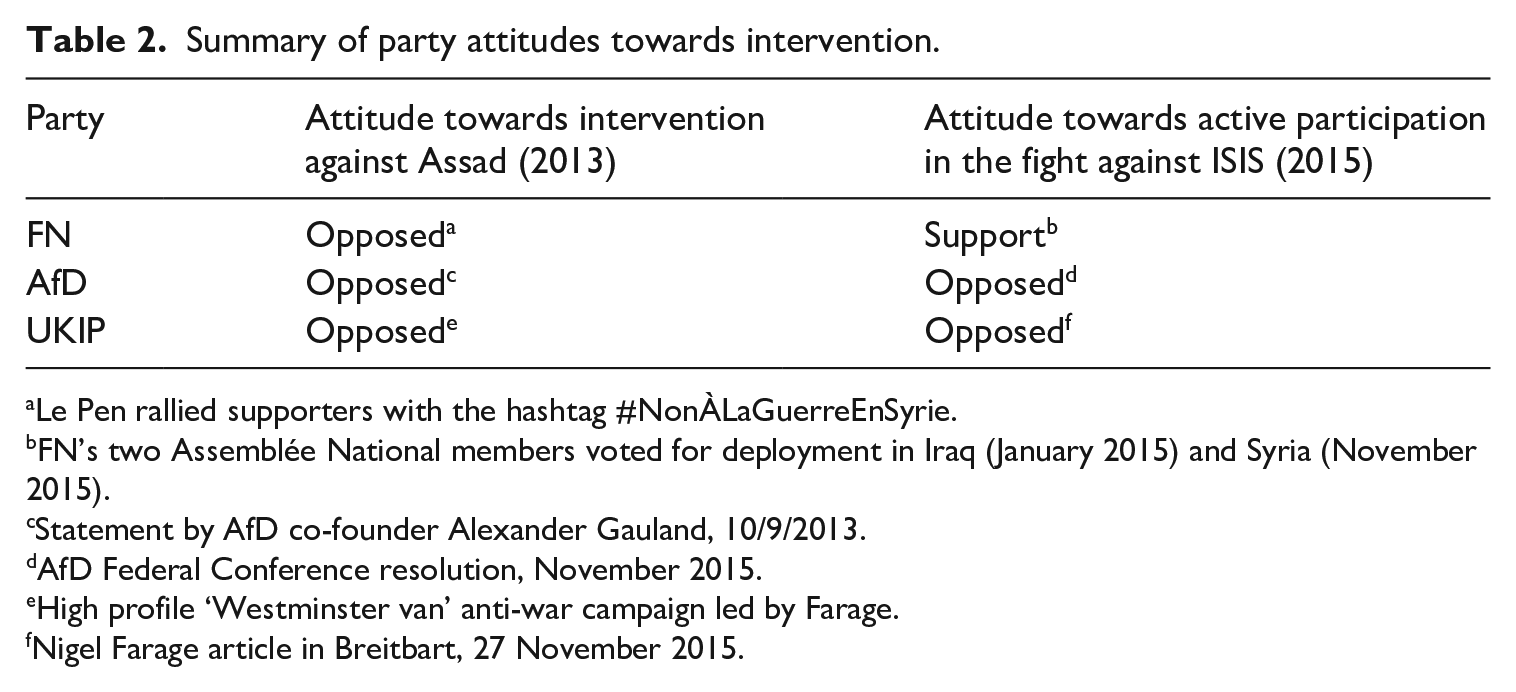
Le Pen rallied supporters with the hashtag #NonÀLaGuerreEnSyrie.
FN’s two Assemblée National members voted for deployment in Iraq (January 2015) and Syria (November 2015).
Statement by AfD co-founder Alexander Gauland, 10/9/2013.
AfD Federal Conference resolution, November 2015.
High profile ‘Westminster van’ anti-war campaign led by Farage.
Nigel Farage article in Breitbart, 27 November 2015.
In the UK, airstrikes in Syria and Iraq enjoyed majority support from September 2014, but less than in France. In a context where public support was less emphatic, Farage was not dissuaded from his personal scepticism regarding intervention in general and when expressing a view on intervention against ISIS he was sceptical. This was reflected in the party’s manifesto. But against the backdrop of majority support, Farage did not make opposition to intervention into a campaign, as he did regarding intervention against Assad in 2013.
In Germany, support for significant German involvement in military intervention was low, and AfD passed a 2015 party resolution against German deployment and voted against it in the Bundestag in 2017. The evidence suggests in sum that, perhaps unsurprisingly, the stronger the public backing for the intervention, the less likely the party was to oppose it. Yet the cases described above make clear that there are differences between formal support as expressed in votes, and public rhetoric and positioning.
The cases highlight that the political opportunity a foreign policy issue presents varies according to political context, and that this in turn influences the content and style of radical right messages. This illustrates the significance of the populist dimension. In this respect it can be inferred that the radical right parties see opportunity when their opposition to intervention fits with the wider public mood and differentiates them from mainstream elites. Hence when no mainstream UK party ruled out intervention against Assad in 2013, despite public opposition, this was ideal for Farage, and he launched a public campaign. FN and AfD were similarly unequivocal in their opposition, though not so theatrical.
When ideologically rooted anti-interventionism and populist political opportunity align this way, then a range of arguments are deployed against intervention: questioning intelligence; morally equivocating between belligerents; suggesting any intervention fuels the spiral of violence; warning of the risk to civilians; even citing lack of UN authorisation. Nor do the radical right hesitate to clothe themselves as peace-loving and their opponents as warmongers.
By contrast, it appears that the more an intervention has public backing, the less incentive there is for the radical right party to take a clear stance either way. When a government policy is popular, supporting it offers them little political benefit, but neither does opposing it. This explains why though FN voted for intervention against ISIS, MLP almost never articulated this. Her discourse reflected most clearly the tension between the principle of ‘non-interference’, and the imperative to support governments fighting Islamists, whether in the Middle East, or in Francophone Africa – a role consummate with MLP’s vision of France as an independent military power. This again points to the significance of the populist dimension. A mainstream or establishment opposition party which votes for an intervention in parliament might be expected to back that with unifying rhetoric seeking to demonstrate statesmanship and national responsibility. Not so for the FN.
Indeed, when intervention against ISIS was salient, all the parties studied, regardless of their voting choices, sought to pivot to attack mainstream rivals on issues at the core of their agendas: the threat to the ethnic identity and security of the nation posed by its loss of control over borders and migration, facilitated by European integration; and domestic Islamic radicalisation. Secondarily, but consistently, they attacked mainstream rivals for broader foreign policy failure and incoherence.
When attacking mainstream foreign policy, the messages are strikingly consistent: a critique of past misconceived interventions associated with all mainstream parties against ‘sovereign states’, which facilitated Islamist expansion; the perception of Russia (and its allies, including Syria and sometimes even Iran) as partners in the fight against the shared (Sunni) Islamist threat; ill-conceived or corrupt elite relations with (Sunni) Muslim states who variously support or enable Islamist extremism, especially Turkey, Qatar and Saudi Arabia; and rejection of an EU-wide solutions to control migration in favour of restoring national borders.
Conclusion
I have argued that whilst there are striking commonalities in broad approaches to foreign policy between all three parties, responses to specific policy questions are shaped by national context. I have shown that formal positions represented by votes and manifesto positions do not tell the whole story, and illustrated two important common features of these parties approaches to foreign policy.
First, these cases highlight how the nature of foreign policy – a particularly opaque field, reliant on expert and often secret information, distant from the experiences of most voters – is apt to provide opportunities for radical right parties to simultaneously advance populist anti-elite and nationalist agendas. All these parties bemoan the misuse of their nations’ depleted militaries on ill-considered missions by corrupt or incompetent decision-makers, who serving foreign agendas leave ‘our boys’ overstretched and under protected with inadequate resources.
Second, the cases highlight how each party looks for a fit between the issue, their core nativist or nationalist agenda, and their populist agenda, appropriate to their domestic setting. A good fit, for instance a humanitarian intervention pursued with low public support, creates an ideal opportunity for radical right parties. Where the fit is poor, such as an intervention directed at a national security threat, which has broad public support, the radical right opposition party looks to change the subject. Either way, the radical right’s reflex is to exploit the opportunity the issue presents to attack the shared assumptions of the elite establishment.
Though this paper has focussed on radical right populists, similar attention is warranted with respect to the radical left, which typically shares overlapping populist characteristics and hostility to global agendas of liberal elites, including US-led Western military interventions. Among populist parties it is reasonable to expect a similar pattern of seeking to capitalise when there is fit between ideology and opportunity. An example of a left populist leader for whom anti-intervention was a significant mobilising opportunity is Jeremy Corbyn. Before his election as leader of the Labour Party, his greatest prominence came as a leader of the ‘Stop the War’ coalition. This movement connected a radical left (and Islamist) organisational base to a broad section of the public opposed to the Iraq War, prosecuted by a Labour government with Conservative backing. The activist networks established through this campaign were the basis for Corbyn’s subsequent Labour leadership campaigns. 104 As Labour leader, Corbyn remained true to his opposition to Western military intervention in opposing the December 2015 House of Commons motion on military action against ISIS in Iraq. This kept faith with the loyal base that had catapulted him to the Labour leadership, but did not strongly resonate with the public mood and divided his own party. Unlike for the parties and leaders analysed in this paper, as leader of the opposition in the UK Parliament faced with a government resolution, the option to take a low profile or change the subject was not available for Corbyn.
The potential for populist parties to make political capital from complex intervention decisions has wider implications for the domestic politics of foreign policy. Though this paper has focussed on the content of radical right messages regarding intervention decisions, the effects of their actions on the political environment – parliamentary debates, public opinion and media discourse – should also be investigated. Some may see the populist challenge to mainstream foreign policy as a threat to the national consensus that underpins effective foreign policy. Others may argue that greater contestation of military decisions challenges an excessive elite consensus in favour of intervention, sometimes in the face of public opinion, which can lead mainstream parties to suppress parliamentary and public debate. 105 Either way, to the extent to which military intervention decisions are backed by mainstream parties, against the backdrop of public scepticism, this creates opportunities on which the radical right, and indeed other anti-establishment parties, can capitalise. This consideration may raise the bar for European leaders weighing future military interventions.
Footnotes
Acknowledgements
I would like to thank all those colleagues who have given advice and feedback on this research project, and especially Prof. Tim Bale and Dr. James Strong of the School of Politics and International Relations at Queen Mary University of London for their support. I would also like to thank Salomé Ietter and Dr. Isabell Dahms for their invaluable assistance in gathering source material.
Funding
The author(s) disclosed receipt of the following financial support for the research, authorship, and/or publication of this article: This work was supported by the European Union’s Horizon 2020 research and innovation programme under the Marie Skłodowska-Curie grant agreement No 845179.
