




Abstract
What impact do populist and radical-right ideas have on a country’s foreign policy? Although research on the nexus of populism and foreign policy has taught us much about populists’ conduct of foreign affairs, we still lack distinctive categories characterising the nature of a populist and radical-right foreign policy. Furthermore, the impact of populist and radical-right parties on foreign policy and the question of how to measure this impact is still unanswered. This article seeks to address this research gap by examining the populist and radical-right Freedom Party’s participation in the Austrian government from 2017 to 2019 and by applying a mixed-methods approach to government programmes and official press releases. Overall, the article makes three contributions to the literature. First, it proposes distinctive categories of a populist and radical-right foreign policy conception. Second, it introduces an approach to measure the impact of this conception on a country’s foreign policy. And finally, it determines this impact on Austria’s foreign policy.
Introduction
In August 2018, the pictures of a waltzing Vladimir Putin, President of the Russian Federation, with Karin Kneissl, back then the foreign minister of the right-wing Austrian government, hit the international press. Critics of Austria’s right-wing government feared that the symbolic genuflection of Austria’s foreign minister could undermine the EU’s foreign policy (BBC News, 2018). Furthermore, it confirmed the fears that the Austrian Freedom Party’s (FPÖ) participation in the right-wing government facilitates the interference of anti-liberal powers like Russia in European affairs (Roonema et al., 2022).
This episode sheds light on the topic of the foreign policy orientation of populist and radical-right parties (PRRPs) and their overall impact on a country’s foreign policy. Research on the nexus of radical-right populism and foreign policy has proliferated in the last couple of years in two different but interrelated strands that develop along two major questions: (1) What is the nature of a populist and radical-right (PRR) foreign policy? (2) Do PRRPs have an impact on a country’s the foreign policy?
Scholars agree that populists, not only in domestic politics but also in the context of foreign policy, share the perception of a growing divide between a corrupt elite pitted against the pure people (Liang, 2007a: 1; Verbeek and Zaslove, 2017: 489; Wehner and Thies, 2020: 7), and that they pursue a revisionist agenda and seek to dismantle the liberal international order (Drezner, 2017: 39; de Sá Guimãraes and Dutra de Oliveira e Silva, 2021: 347; Destradi and Plagemann, 2019: 729). Furthermore, PRRPs are united in their rejection of cultural modernisation, cosmopolitanism, and globalisation (Chryssogelos, 2010: 269; Drezner, 2017: 27–28; Chryssogelos, 2017: 7; Liang, 2007a: 8; Verbeek and Zaslove, 2015: 527). They favour the conception of nativism and conceive political integration and transnational governance as a threat to a nation-state’s identity (Chryssogelos, 2010: 270, 2017: 7; Falkner and Plattner, 2019; Levy, 2015: 5; Liang, 2007a: 8–11; Verbeek and Zaslove, 2015: 525, 2017: 498). However, scholars also argue that PRRPs do ‘not have much of an immediate impact’ (Plagemann and Destradi, 2019: 297) and only ‘limited transformative power’ (Balfour et al., 2016: 49) on foreign policy issues and international affairs.
Although this literature has taught us much on the nexus of radical-right populism and foreign policy, some key issues are still insufficiently researched or not scrutinised at all. First, from a theoretical perspective, we still lack an understanding of the nature of a PRR foreign policy and its influence on country’s foreign conduct. Second, from a methodological perspective, we lack the instruments to measure this impact empirically. Hence, this article seeks to address these research gaps by answering the following research questions. First, what are the distinctive characteristics of a PRRP’s foreign policy conception? Second, how can we measure both the characteristics and their impact on a country’s foreign policy?
Using the case of Austria, I will argue on the following pages that the ideas of PRR actors in government do have a limited but empirically observable impact on Austrian foreign policy. Populist and radical-right conceptions such as a Manichean worldview and the opposition to cultural diversity leave their marks on the country’s foreign policy. However, the impact of these ideas on government programmes is stronger than on the actual conduct of foreign affairs. Furthermore, systemic variables such as the embeddedness in supranational political (i.e. the European Union) or global architectures (i.e. world economy) and national role conceptions do have a mitigating effect on this impact.
To answer the research questions and to support my argument, I present a case study of the foreign policy of the Kurz I cabinet, that is the right-wing coalition government of the Austrian People’s Party (ÖVP) and the populist and radical-right Austrian Freedom Party (FPÖ) that ruled Austria from 18 December 2017 until 28 May 2019. This is an interesting case for three reasons. First, in this government, the PRR FPÖ held the office of the foreign minister. Although it nominated a non-partisan former diplomat (i.e. Karin Kneissl) to the post of foreign minister, the party had a firm grip on the bureaucracy and was able to direct Austria’s foreign policy. Second, according to Beasley and Kaarbo (2014: 77) and Kaarbo and Beasley (2008), junior partners in coalition governments often exert disproportionate influence on a country’s foreign policy. If that is true, the distinctive foreign policy characteristics of a PRRP like the FPÖ should influence Austria’s foreign policy. Finally, the Kurz I cabinet followed the Social Democratic Party (SPÖ)-led government of Kern with the ÖVP as junior partner, and preceded the ÖVP-led Kurz II and Schallenberg/Nehammer coalition governments with the Greens as junior partner. All these cabinets had a similar duration. But while in the Kern cabinet the ÖVP as the junior partner was in charge of the foreign ministry, the same party controlled the ministry as the senior partner in the Kurz II (the ÖVP-Green government) and the Schallenberg/Nehammer cabinets (the continuation of the ÖVP-Green government but without Kurz as chancellor). Hence, this case selection also allows for within-case comparison.
The article uses both government programmes (i.e. the proposed policy ideas put in writing) and official press releases (i.e. an indicator for the policy implementation of these ideas) to grasp the foreign policy characteristics of the respective cabinet and to measure the impact of PRR ideas on the cabinet’s foreign policy. I use qualitative content analysis to scrutinise the government programmes and to describe the overall foreign policy programme of the respective cabinet. I then apply quantitative text analysis (QTA) to the official press releases of the foreign ministry that is officially in charge of directing and conducting foreign policy.
The application of QTA aims at detecting what actors say they are going to do in foreign policy, and how they say it. Concerning the issue of what actors say, I trace the prevalence of topics over time by referring to semi-supervised topic modelling (seededLDA, see Watanabe, 2019; Watanabe and Zhou, 2019). To determine how actors say things and refer to certain topics, I focus on the tone of communication per topic and use sentiment analysis by applying latent-semantic-scaling (LSX, see Watanabe, 2018). The data for this analysis as well as the code to replicate the results are available at AUSSDA (see Eder, 2024).
The article proceeds in four steps. First, I discuss the state of research and argue that measuring the impact of PRR ideas on foreign policy, especially in the case of coalition governments, is still a gap that has to be addressed. Second, I present the research design and elaborate on how qualitative content analysis, semi-supervised topic modelling, and latent-semantic scaling allow me to answer the research questions. Furthermore, I propose categories for analysing the nature of a PRR foreign policy and introduce the data set for analysis. Third, I then present and discuss the results of my analysis before I finally conclude the article by wrapping up my argument and by making suggestions for further research.
State of research
Although some scholars argue that research on the nexus of populism and international relations (IR) in general and foreign policy (FP) in particular, is still in its infancy (e.g. Balfour et al., 2016: 13; Chryssogelos, 2017: 1; Destradi and Plagemann, 2019: 711; Liang, 2007b: 1; Plagemann and Destradi, 2019: 284; Verbeek and Zaslove, 2015: 525; Wojczewski, 2020a: 397, 2020b: 292; Wajner, 2021: 6), this area of research is rapidly growing. The surge of academic interest on populism and IR is closely linked to populist leaders – first and foremost Donald Trump (Wojczewski, 2020b) – and populist parties in government all over the world, entering the international stage. Foreign and domestic politics increasingly become intertwined (Verbeek and Zaslove, 2015: 525) and foreign and security policies have become politicised as any other policy field (Eder et al., 2021; Destradi et al., 2022). Hence, as Chryssogelos (2010: 268) argues, populists ‘cannot afford to ignore foreign policy’ because it provides just another possibility to ‘reposition themselves in their countries’ party competition’ (Chryssogelos, 2017: 8). The media rationale and political opportunities push populist leaders and their parties to enter international affairs as yet an other arena for political contest (Greene, 2022). Furthermore, populist leaders increasingly seek the international arena as a place for constructing a struggle between elites versus the pure people, and thereby obtaining internal and external legitimacy (Wajner, 2022: 1).
Most of the overall literature on populism and international affairs seeks to uncover the basic nexus between populism and foreign policy (Chryssogelos, 2017; Destradi and Plagemann, 2019; Drezner, 2017; Hadiz and Chryssogelos, 2017; Verbeek and Zaslove, 2017; Wehner and Thies, 2020), presenting definitions and defining common characteristics of a populist foreign policy, or seeking to understand the impact of populism on diplomatic language and processes of securitisation (Kurylo, 2020; Magcamit, 2018; Müller and Gebauer, 2021). These studies are primarily single or small-N case studies on cases from Europe, the European Union and Russia (Balfour et al., 2016; Chryssogelos, 2010; Ostermann and Stahl, 2022), the United States (Lacatus, 2021; Wojczewski, 2020b) or the Global South (Destradi and Plagemann, 2019), especially India (Plagemann and Destradi, 2019; Wojczewski, 2020a) and Venezuela (Sagarzazu and Thies, 2019). In the European context, authors primarily focus on the impact of populist and radical-right parties on foreign policy (Falkner and Plattner, 2019; Laruelle, 2015; Levy, 2015; Liang, 2007b; Virchow, 2007).
Within this latter body of literature on PRR foreign policy, there are two strands of research that develop along two major questions. First, what is the nature of a populist and radical-right foreign policy programme? And second, do PRRPs have an impact on foreign policy issues and hence on international affairs?
Authors in the first strand seek to identify a specific foreign policy profile of PRRPs. These parties share many of the foreign policy preferences of populist parties and decision makers in general, such as the perception of a growing divide between a corrupt and anti-democratic elite that constantly drifts apart from the pure people and its general will (Liang, 2007a: 1; Verbeek and Zaslove, 2017: 489; Wehner and Thies, 2020: 7; Hisarlioglu et al., 2022; Wajner, 2022). What distinguishes PRRPs from left-populist groups, however, is their pronounced rejection of modernisation (at least in the sense of societal and cultural developments), cosmopolitanism and hence also globalisation (Chryssogelos, 2010: 269; Drezner, 2017: 27–28; Chryssogelos, 2017: 7; Liang, 2007a: 8; Verbeek and Zaslove, 2015: 527) and international trade (Balfour et al., 2016: 38). Right-wing populism favours nativism and conceives political integration and the establishment of transnational governance structures at the regional and global level as a threat to the nation state and its identity. Hence, they also position themselves as anti-Americanists and anti-European Unionists, both symbols and champions of globalisation and liberalisation (Chryssogelos, 2010: 270, 2017: 7; Falkner and Plattner, 2019; Levy, 2015: 5; Liang, 2007a: 8–11; Verbeek and Zaslove, 2015: 525, 2017: 498).
This strive towards more independence from the United States, coupled with a more authoritarian and conservative, and less liberal and cosmopolitan understanding of politics, naturally aligns PRRPs with Russia that is conceived as a tower of strength and as a champion of the nation-state in international affairs (Chryssogelos, 2010: 268; Laruelle, 2015; Levy, 2015: 6). Furthermore, PRRPs reject policies that aim at supporting and strengthening the international community, or that have a favourable approach towards migration and development aid (Balfour et al., 2016: 36–37, 42; Chryssogelos, 2017: 1; Laruelle, 2015: 17; Müller and Gebauer, 2021; Zakaria, 2016). Thus, PRRPs are united in their ethno-nationalist and cultural conservative conceptions of politics that affects all possible facets of a state’s external relations.
Authors in the second strand seek to find answers to the question of whether populism in general and PRRPs in particular really matter in foreign policy at the end of the day. Do they have a distinctive impact on a country’s foreign policy? There is a solid consensus that although these actors seek to reorganise the international order and establish alternative fora to the dominant liberal institutions (Drezner, 2017: 28, 39), populism overall ‘does not have much of an immediate impact’ (Plagemann and Destradi, 2019: 297) and only ‘limited transformative power’ (Balfour et al., 2016: 49) on foreign policy issues and international affairs. This observation applies to both populism in cases of single party governments (Plagemann and Destradi, 2019) and populism in cases of coalition governments, where ‘pursuing a foreign policy agenda depends on the demands of the other actors in the coalition’ (Verbeek and Zaslove, 2015: 542) as well.
The influence of PRRPs on coalition governments, however, is disputed. Authors focusing on the nexus of coalition governments and foreign policy argue that junior partners with a more extreme foreign policy orientation have a greater influence on a country’s foreign policy (Beasley and Kaarbo, 2014: 77) because the junior partner can ‘hijack’ (Kaarbo and Beasley, 2008) the coalition. This influence of a junior partner on the coalition’s policies even increases on issues, the junior partner is officially in charge of because it holds the respective ministry (Kaarbo, 1996: 509; Oppermann et al., 2017). Following this line of reasoning, coalitions with PRRPs as junior partners should exhibit an overall foreign policy that is more extreme and resembles the policy preferences of the PRRPs member in the coalition and not the preferences of the senior partner. As Akkerman and Roodujn (2015) as well as Schwörer (2022) have demonstrated in their studies, the participation of PRRPs in governments does not have a taming effect on their policy positions, also not in the realm of foreign affairs. Although PRRPs may direct a country’s foreign policy towards a more populist and radical direction, these parties are less likely to initiate military conflicts than parties of the centre or the left of the political spectrum (Haesebrouck and Mello, 2020).
However, only a few studies discuss the question of how to exactly measure the influence of populism and especially PRR ideas on foreign policy. Populism seems to be mostly successful in influencing the tone, style and language, and not so much the content of foreign policy (Bustinduy, 2022). Therefore, populism primarily succeeds in influencing the foreign policy discourse of a country (Jenne, 2021; Sagarzazu and Thies, 2019), often by ‘constructing a collective identity’ (Wojczewski, 2020a: 399), ‘[p]ortraying internal and external Others’ (Löfflmann, 2021), and then, by drawing on securitisation strategies, presenting this identity as threatened by global/liberal dynamics’ (Kurylo, 2020; Magcamit, 2018; Müller and Gebauer, 2021).
This article seeks to make three contributions to the state of research. First, from a theoretical perspective, the article proposes distinctive categories, characterising the nature of a PRR foreign policy. Second, and from a methodological perspective, this paper introduces a method for measuring the impact of PRR ideas on foreign policy. Third and finally, the article applies these theoretical and methodological innovations to a case study of the Austrian Freedom Party’s (FPÖ) participation in a right-wing government in Austria from 2017 until 2019, a case that has hardly been investigated by other authors (Greene, 2021; Müller and Gebauer, 2021). This case is so illustrative because back then, the FPÖ held the office of the foreign ministry and hence, was in a unique position to influence Austria’s foreign policy.
Research design
To answer the research questions, I first propose distinctive categories of a PRR foreign policy conception, then elaborate on the question of how to operationalise the impact of PRR ideas in government on the foreign policy of a state, and finally discuss an approach to measure this impact empirically.
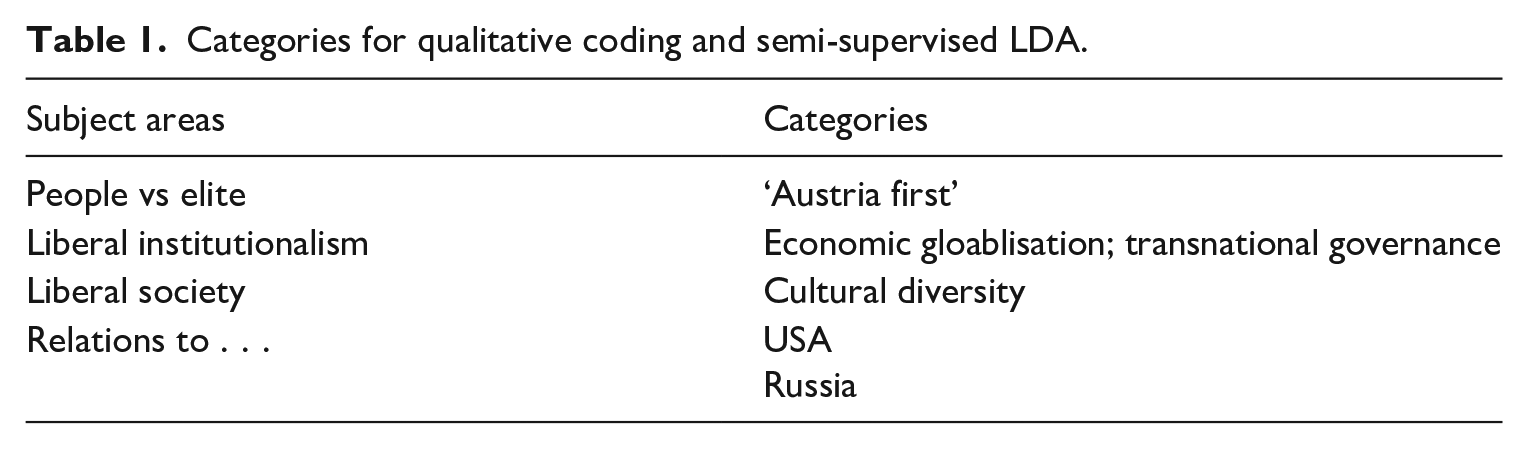
Following the state of research presented before, I propose in the first step four subject areas with overall six categories that characterise a distinctive PRR foreign policy conception. I do so, by building upon the works of Plagemann and Destradi (2019) as well as Ostermann and Stahl (2022). However, I extend Plagemann and Destradi’s framework that focuses on the content of populist foreign policy, but do not present such a detailed approach as Ostermann and Stahl, who add policy fields such as climate change or development aid to their framework of analysis. I derive the first two subject areas from Mudde’s (2004) understanding of populism as a ‘thin-centred ideology’, where actors (1) attempt to move the characterisation of domestic politics as a struggle between the pure people and the corrupt elite to the international level; and (2) oppose liberal institutionalism as a system that benefits these corrupt elites at the cost of the general will. I add two additional subject areas that are derived from the thick ideology of PRRPs discussed before, that is (3) the rejection of modernity and the promotion of cultural revisionism at the international level; and (4) the support of revisionist states like Russia, opposing a liberal and globalised world and rejecting the global leadership role of the United States of America, except for the period of the Trump presidency.
According to Mudde (2004: 543), PRRPs not only conceive domestic politics as a struggle between the pure people and a corrupt elite, but they increasingly seek to move this debate into the international arena. The international order, so the argument goes, benefits the corrupt elite at the cost of the nation-state and its citizens. This elite is seeking to shift decision-making away from national fora to the international level and to international institutions, thereby consolidating their preferred role in the international system. Hence, the study of the policy conception of PRRPs at first has to direct its attention to this subject area and seek to determine whether and to what extent these actors attempt to portray international relations in Manichean ways. I do so by applying the category ‘Austria first’ to determine whether actors seek to frame international relations as a fight between elites versus people.
The second distinctive characteristic is the fundamental opposition to liberal institutionalism as a system that favours the elites at the cost of the nation-state and its citizens (Hadiz and Chryssogelos, 2017; Liang, 2007a). PRRPs oppose both economic globalisation and international trade on the one side, as well as different forms of transnational governance and the deepening of regional and global integration on the other side. Liberalising trade and outsourcing services come at a serious cost for a nation-state’s independence and autonomy, and often impose a high price for the working class. The increase of transnational governance and the deepening of political integration at the regional and global level on the other side shift decision-making away from national fora, significantly reduce the ability of citizens to articulate their policy preferences, and influence the political process in the end. Hence, I divide this subject area into two categories that seek to cover both aspects. The category ‘economic globalisation’ seeks to determine the stance of PRRPs towards the economic side of globalisation, whereas ‘transnational governance’ measures the political element of this conception. The division of this subject area into two categories makes additional sense because not all PRRPs conceive economic globalisation as a threat to their nations. For example, the Indian Bharatiya Janata Party (BJP) of the current Prime Minister Modi, or Jair Bolsonara, former president of Brazil, have a favourable view towards this category, despite their clear PRR orientation.
A third characteristic of a PRR foreign policy is the opposition to cultural diversity as a means to weaken national identities, as well as the opposition to migration and cultural heterogeneity. Instead, PRRPs favour ‘traditional’ family values and dismiss the global LGTB+ movement as an attempt to further weaken national cultures and traditional values (Balfour et al., 2016: 38, 49; Destradi and Plagemann, 2019: 729; Drezner, 2017: 27–28; Plagemann and Destradi, 2019: 285; Verbeek and Zaslove, 2017: 497, 505). I seek to grasp this subject area with the category ‘cultural diversity’.
Finally, PRRPs turn to countries like Russia and endorse populist leaders like Brazil’s Jair Bolsonaro or Hungary’s Victor Orban as champions of a revisionist international agenda, and exhibit a very critical stance towards the United States as the driving force of liberal institutionalism (Balfour et al., 2016: 32). However, with the ascendancy of Donald Trump as the leading populist voice in international affairs, this anti-Americanism should temporarily subside. Again, I divide this subject area into two categories that allow me to grasp both aspects. The category ‘USA’ seeks to capture a PRR party’s stance towards the United States, whereas ‘Russia’ measures the attitudes towards the Russian federation. Similar to the subject area ‘liberal institutionalism’, this distinction allow me to better grasp possible deviations from this general rule. So, for example, whereas Western-European PRRPs typically exhibit a critical stance towards Washington and started to realign with Moscow in the last decade, their East-European counterparts (e.g., the Polish Law & Justice Party) are historically pro-American and anti-Russian.
In the second step, I clarify how PRR foreign policy conceptions impact a country’s conduct of foreign affairs. I refer to Chryssogelos (2021: 2) argument of ‘electoralised international relations’, where changes in parties in government also affect a country’s foreign policy. Chryssogelos (2021: 13) advocates for a ‘turn in the study of party politics of foreign policy from foreign policy outcomes to foreign policy change’. Change, according to him, can happen at the rhetorical-level, in specific policy areas or the in the overall strategic re-orientation of a country (Chryssogelos, 2021: 4). Although Chryssogelos (2021: 14) focuses primarily on the second type of change, that is the ‘tangible and meaningful departure from prior practice’, arguing that overall strategic re-orientation of a countries foreign policy rarely happens, I refer to the first two types of change – rhetorical change and change in specific policy areas (i.e. the policy-level) – to estimate the impact of PRR ideas on a country’s foreign policy.
Hence, it is necessary to clarify in the third step how to measure both types of change at the rhetorical and the policy-level and to determine the necessary sources for this measurement. For analysing the rhetorical-level, I draw on the official government programmes as the written down compromise of parties in government where the ideational impact of PRR ideas should be exhibited. For analysing the policy-level, I turn to the press releases (so-called OTS – Original Text Service) of the Ministry of Foreign Affairs, as the ministry officially in charge of conducting foreign policy. Although press releases are not a factual foreign policy result and have a strong rhetorical dimension, they are an immediate indicator for a specific foreign policy stance and/or action.
I apply a mixed-methods approach for analysing both types of sources. In the case of the government programmes, a qualitative content analysis based on the four subject areas and the six categories (see Table 1) allows me to illustrate the basic orientation of the respective cabinet and to evaluate the impact of PRR ideas on the government’s policy plans. I coded the mentioning of every category per paragraph in these programmes with +1 or −1, depending on the positive or negative sentiments towards this category. A heatmap graph will display the final results, that is, the sum of overall positive and negative references to these categories over time.
Categories for qualitative coding and semi-supervised LDA.
Concerning the press releases, I follow (Laver, Benoit, and Garry, 2003) argument that political texts give us information about the policy preferences of political actors and apply quantitative text analysis to do both detect what actors say and depict how they say it. I first seek to display the prevalence of categories over time and then trace the tone of the actors’ rhetoric within the six categories.
For the identification of the categories and their evolution over time (i.e. the detection of what actors say), I apply probabilistic topic models to the dataset of OTS. Probabilistic topic models are algorithms ‘that analyze the words of original texts to discover the themes that run through them, how these themes are connected to each other, and how they change over time’ (Blei, 2012: 77–78). One popular and powerful implementation of such a probabilistic topic model is the Latent Dirichlet allocation (LDA). LDA conceives documents as a ‘random mixture . . . [of] latent topics, where each topic is characterized by a distribution over words’ (Blei et al., 2003: 996). Hence, LDA seeks to unveil the latent topical structure of texts (the hidden variable) via the conditional distribution of these topics, given the occurrence of words and documents (the observed variables) (Blei, 2012: 79–80).
However, as Watanabe and Zhou (2019: 4) point out, the results of these unsupervised topic models ‘are difficult to interpret from the theoretical point of view’. Hence, the authors propose a semi-supervised LDA model (sLDA) that requires a dictionary comprising categories (i.e. expected topics) that help the LDA model to improve results by incorporating weighted seed words for each topic. These seed words can be derived from theoretical assumptions (knowledge-based seed words) and/or chosen from the most frequent words in a corpus (frequency-based seed words).
The challenge, therefore, is the making of such a dictionary that contains topics with ‘true seed words’ (Watanabe and Zhou, 2019: 6), that is, seed words that match only the right documents and units of analysis. Following Watanabe’s and Zhou’s (2019) instructions for building such a dictionary, I defined six categories in the four subject areas and selected the seed words in these categories according to the discussion of the nexus of PRRPs and foreign policy in the academic literature (i.e. knowledge-based seed words, see the respective dictionary in the Supplementary Materials). To further improve the results, I included four additional topics (i.e. ‘disarmament’, ‘humanitarian aid’, ‘embassy’, and ‘other’) to the dictionary, that have the potential to distort the results because of overlapping issues. Furthermore, I extended the list of seed words after applying LDA to the dataset (frequency-based seed words). By doing so, I am able to disentangle similar topics and thereby increase the coherence of these categories.
For detecting the tone of actors’ rhetoric in these categories (i.e. the depiction of how actors say things), I apply latent semantic scaling (LSX).
LSS [or LSX, FE] is a type of semi-supervised machine learning model that takes a small set of polarity words as ‘seed words’ to assign polarity scores to other words in the corpus; it estimates semantic proximity of words employing word-embedding techniques (Watanabe, 2021: 82).
Similar to sLDA, LSX enables researchers to pre-define a small number of seed-words for a semi-supervised machine learning algorithm with almost no manual coding needed (see the respective dictionaries in the Supplementary Materials). Hence, both methods sound promising for providing the instruments to measure the influence of PRR ideas on a country’s foreign policy.
The press releases dataset comprises a total of 344 press releases/OTS, collected via https://api.ots.at/ . The number of OTS is unevenly distributed over the four cabinets. Most of the OTS were released during the first two cabinets (i.e., 153 OTS during the cabinet Kern, and 141 OTS during the cabinet Kurz I), whereas the other cabinets are characterised by a sharp decline of press releases in the ministry of foreign affairs (i.e., 27 OTS during the cabinet Kurz II, and 23 OTS during the cabinets Schallenberg/Nehammer until 1 August 2022).
I used R and RStudio, a language, environment and graphical interface for statistical computing and graphics; and the tidyverse package (Wickham, 2017) to handle the dataset, to apply the semi-supervised LDA model, and to plot the results. I used quanteda (Benoit et al., 2019), an R package for managing and analysing textual data, in combination with Fit seeded-LDA in R (Watanabe, 2019) and latent semantic scaling (Watanabe, 2022) to build a corpus, apply the semi-supervised topic model on the dataset, and to locate these topics on a uni-dimensional scale (i.e., sentiments). The data as well as the code for replicating results are available at AUSSDA (see Eder, 2024).
Results and discussion
The results of the analysis underline the assumption that PRR ideas do have an impact on Austrian foreign policy, at least on certain topics and to some degree. However, there is a difference between the impact on the rhetorical and the policy level, that is, between the impact on government programmes and the impact on the factual policies measured by the prevalence of topics and the sentiments towards these topics in press releases of the ministry of foreign affairs.
Concerning the rhetorical level, Figure 1 shows three interesting insights. First, PRR ideas influenced the government programme of the Kurz I cabinet (i.e., the ÖVP-FPÖ coalition). Although all government programmes exclusively refer to ‘globalisation’, ‘transnational governance’, ‘USA’, and ‘Russia’ in either a neutral or positive way, ‘people vs. elite’ and ‘cultural diversity’ exhibit a clear, negative connotation.
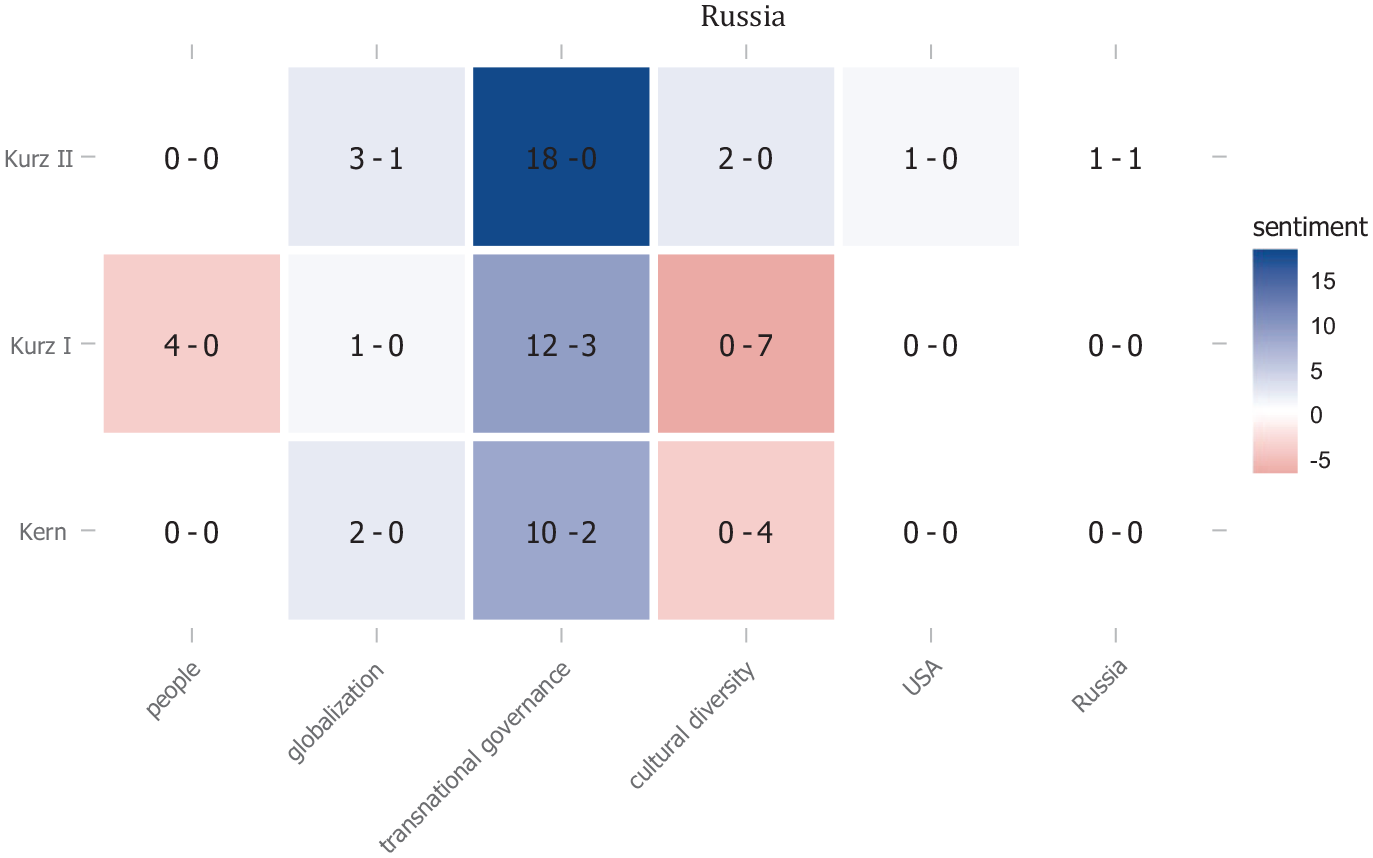
Degree of populism in government programmes.
Second, what is striking is that references to ‘transnational governance’ are overwhelmingly positive with almost no negative mentions at all. The government programme of the cabinet Kern referred to this topic twelve times with only two negative mentions, the programme of the Kurz I cabinet exhibits twelve positive and three negative mentions, and in the programme of the Kurz II cabinet there are 18 positive and no negative mentions (there is no distinctive government programme for the cabinets Schallenberg/Nehammer). This consistently positive connotation of ‘transnational governance’ during the Kurz II cabinet makes absolute sense because of the participation of the Greens as a junior partner in the government.
However, the overall positive reference to this topic in the Kurz I cabinet contradicts the assumption that a PRR foreign policy conceives regional and global integration as a threat to the nation-state and its citizens. Although there are some references in this programme that the direction and intensity of the European integration process have to be reconsidered (a claim that is already observable in the Kern cabinet), the European Union as an actor is generally conceived as a valuable vehicle for achieving national interests and policy goals, especially in the area of migration. Hence, although there is a certain sceptical stance towards the European Union, the benefits of membership still outweigh possible drawbacks. Furthermore, Austria, as a small or medium-sized country and as the home of several international organisations (e.g., the United Nations, the OPEC or the OSCE), is a traditional champion of multilateralism and is convinced that its influence in international affairs is multiplied by transnational governance and not so much impeded by it. Hence, this national role conception of Austria as a pillar of a multilateral global order seems to trump PRR ideas.
Third, PRR ideas most decisively influenced the topic of ‘cultural diversity’. This influence is observable not only in the Kurz I cabinet but already in the Kern cabinet. In both cases the negative connotation of migration and integration do have a significant impact on this topic. Already in the cabinet Kern, the People’s Party with its foreign minister Kurz took a decisive turn towards populist and radical-right ideas and prepared the ground for an election campaign that focused on these issues. Hence, it is not surprising that this topic also ranked high during the cabinet Kurz I, where the Austrian People’s Party and the Austrian Freedom Party both pushed for PRR ideas in this context.
Concerning the policy level, the results are mixed and indicate that variables on the national and systemic level mitigate the effect of PRR ideas on Austrian foreign policy. Overall, the topics are coherent and make sense (see also the Supplementary Materials). There is a clear dominance of ‘transnational governance’ which again makes sense taking in mind Austria’s role and self-conception as a central pillar of a multilateral global order and an honest broker between power centres. The topics of ‘people vs elite’ (rank 7) and ‘diversity’ (rank 8) do not dominate the overall picture but are secondary to issues such as ‘humanitarian aid’ (humaid) or ‘disarmament’ (see also figures in the Supplementary Materials). Hence, one can argue that although these possible PRR topics do appear in the OTS, this mind-set did not hijack Austrian foreign policy.
Figure 2 displays the time series of topics. There is a decisive difference in the number of press releases between the cabinets of Kern and Kurz I on the one side, and the cabinets of Kurz II and Schallenberg/Nehammer on the other side. A possible explanation for this observation is the fact that the foreign ministers in the Kern and Kurz I cabinets came from the junior partner in the coalition whereas the foreign ministers in the Kurz II and Schallenberg/Nehammer cabinets came from the senior partner that also held the office of the chancellor. The position of foreign minister seems to allow parties and their representatives to position themselves strategically in the domestic political competition and to gain media attention. Furthermore, as Beasley and Kaarbo (2014) or Kaarbo and Beasley (2008) argued, junior partners can hijack a coalition's policy direction and have a disproportionate influence on a country’s foreign policy. Hence, it makes sense that this dynamic is visible in the number and intensity of press releases. This explanation is also in line with the decline of press releases in the cabinets Kurz II and Schallenberg/Nehammer. In both cabinets, the foreign minister came from the People’s Party which also was in charge of the chancellery. Hence, the foreign minister does not have an incentive to politicise foreign policy and use the office for gaining public attention. There seems to be a Rollenverzicht – the renunciation of duty – by the foreign minister in favour of the chancellor, who is able to use the international arena as a platform for presenting himself and his conceptions.
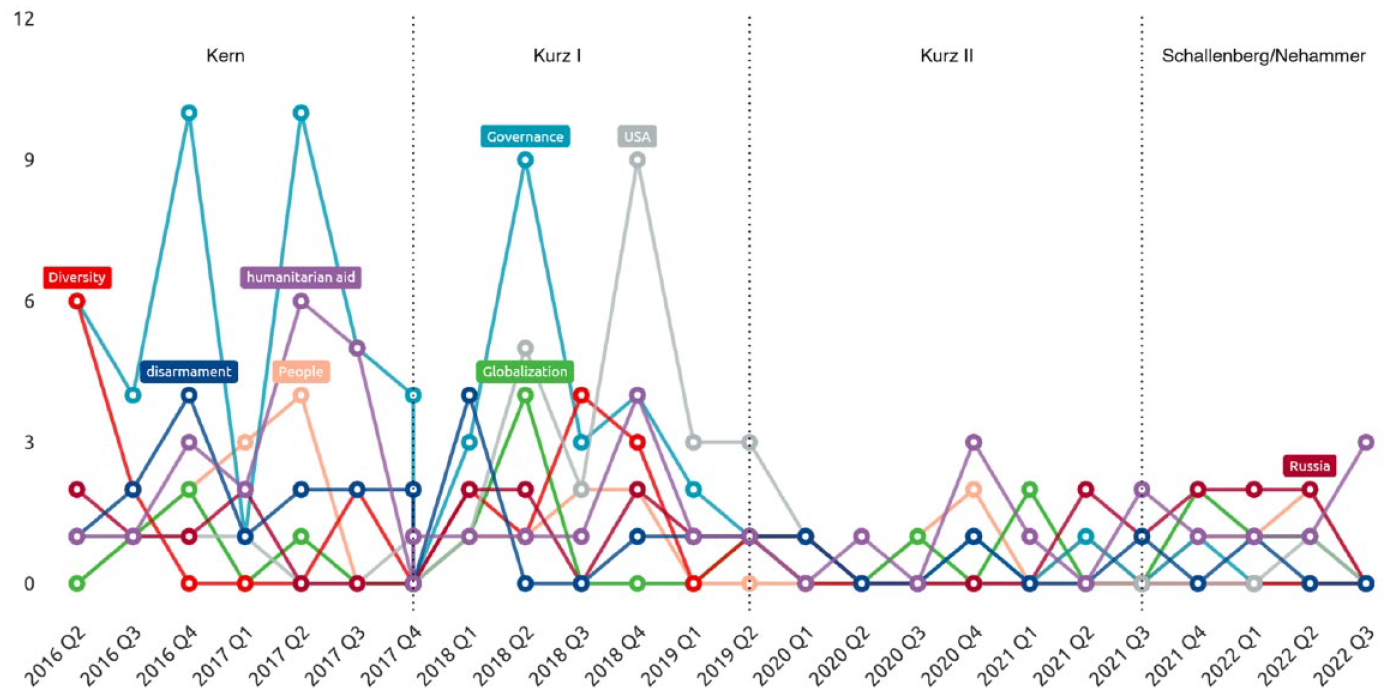
Time series of topics.
Regarding the topics, there are four interesting observations. First, the issue of ‘governance’ is dominant in the first two cabinets which again is the result of Austria’s self-conception as a champion of multilateralism. The prevalence of this topic is also due to the issue of ‘disarmament’ where Austria traditionally plays an important role, especially in the context of the efforts of the international community to adopt the ‘Treaty on the Prohibition of Nuclear Weapons’ (TPNW). In this context, the increase of importance of the topic ‘USA’ during the cabinet Kurz I is also consistent given the fact that Austria during this period increasingly called the United States to either rethink its nuclear policies or to look for a rapprochement to Russia. At least to a certain degree, the PRR ideas in this context seem to make a difference. Austria’s foreign policy in this period tried to act as a bridge builder, asking the U.S. to soften its position towards Russia and thereby promoted – at least indirectly – Russian interests.
This pro-Russian stance is also observable in two other situations. When it comes to human rights abuses and democratic backsliding, Austria did not criticise Russia directly but only mentions negative trends in parts of Russia, like Chechnya, without mentioning Russia, Moscow or Putin directly. Furthermore, Austria indirectly supported a Russian narrative when it repeatedly criticised developments in Ukraine or the Ukrainian political establishment (in terms of democratic developments, civil rights, and freedom of press) but did not refer to Russia in this context or criticised similar developments there. Hence, the influence of PRR ideas on Austria’s foreign policy is more subtle in this context. Although there seems to be some sort of sympathy for Russia, the integration of Austria into the framework of the European Union and its integration into the global political order mitigate this effect.
Second, the topic of ‘diversity’ played a central role at the beginning of the Kern cabinet as well as in the midst of the Kurz I cabinet. In both cases, the press releases exhibited a very critical view towards immigration and call for a more restrictive approach on the national and the European level. What is further interesting is the subtle but effective shift of the narrative between the Kern and Kurz I cabinets. Whereas in the Kern cabinet the People’s Party with its foreign minister Kurz had a very critical stance towards cultural diversity and repeatedly warned of mass migration and its consequences, foreign minister Kneissl of the FPÖ in the Kurz I cabinet was especially concerned about women and children that became victims of backward-looking and patriarchal orientations, resulting from migration and failed integration. So, the FPÖ – aware of its critiques and anxious not to fulfil their prophecies of Austria turning into a PRR pariah – attempted to reframe this issue and politically sell it in a more acceptable way.
Third, except for the second half of the Kern cabinet, the topic of ‘people vs elites’ played only a minor role. Although one can find several references to the European Union, calling for redirecting its course, the overall references towards the European Union and/or the international community are limited. So, at least in the context of Austrian foreign policy, PRRPs do not conceive the international arena as a place for constructing a struggle between elites and the pure people and thereby seek to obtain internal and external legitimacy, as Wajner (2022) argues.
Finally, ‘globalisation’ does not seem to play a major role in the foreign policy strategy of all cabinets. There are two explanations for this observation. First, this issue may be covered not so much by the Ministry of Foreign Affairs but more by the Ministry of the Economy or even by the chancellor himself. In addition, because of the comprehensive integration of the Austrian economy into European and global markets, and because of Austria’s uneven dependency on exports, this issue is not really suited for politicisation and hence of no interest to a PRRP.
Consequently, it is not surprising that the sentiments towards ‘globalisation’ (see Figure 3) only have a limited positive or negative attitude. Moreover, the only time these sentiments are statistically significant is during the early phase of the Kurz I cabinet, and not in the supposed negative but the positive direction.
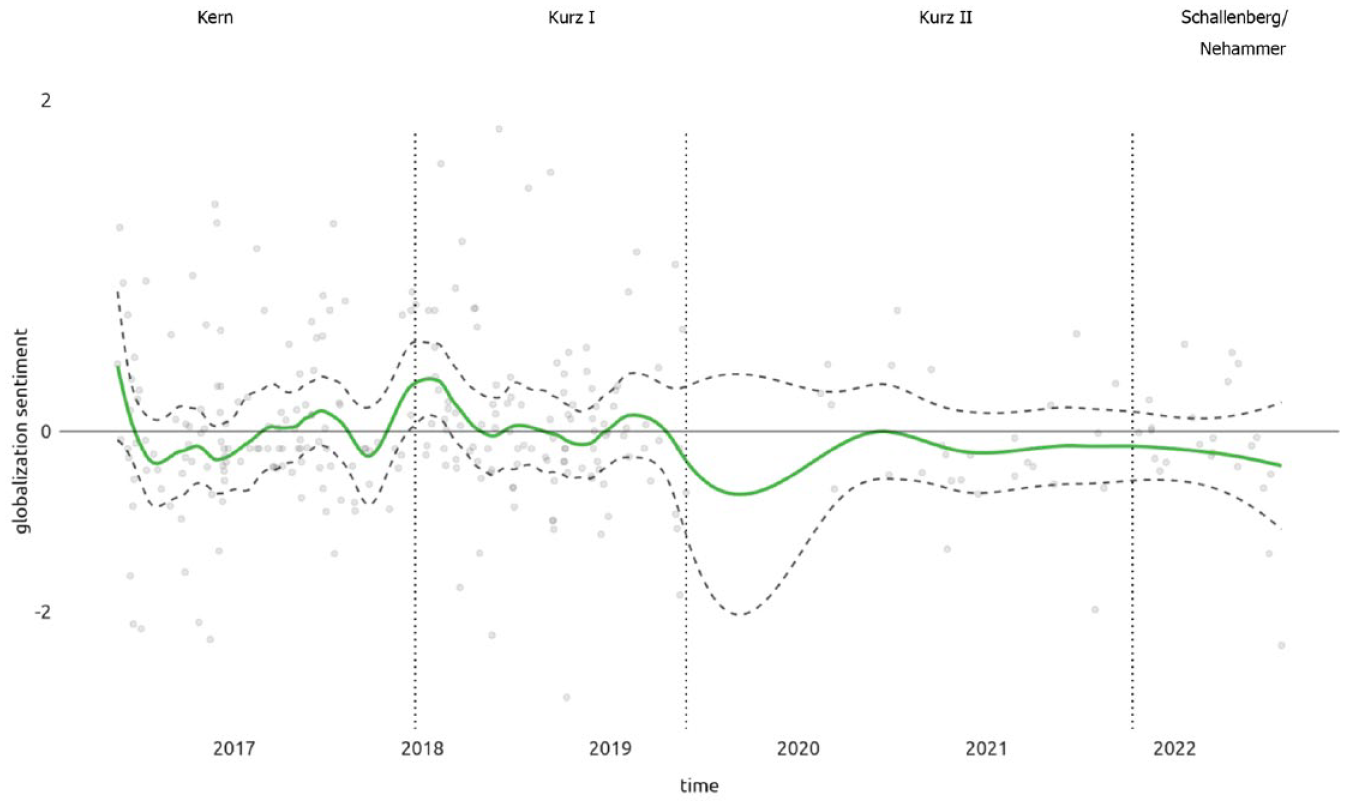
Sentiments in topic ‘globalisation’.
More in line with the assumption of a PRR impact on foreign policy is the sentiment towards ‘governance’ (see Figure 4). During the cabinet Kurz I this sentiment is consistently negative, almost reaching statistically significance amid the term. With the Greens entering government in the Kurz II cabinet and from then onward, the references to this topic overall become positive, whereas the results in the Kern cabinet are mixed. There are phases of positive references (especially when referring to disarmament issues) as well es negative references (when referring to the European Union and the drawbacks of the integration process).
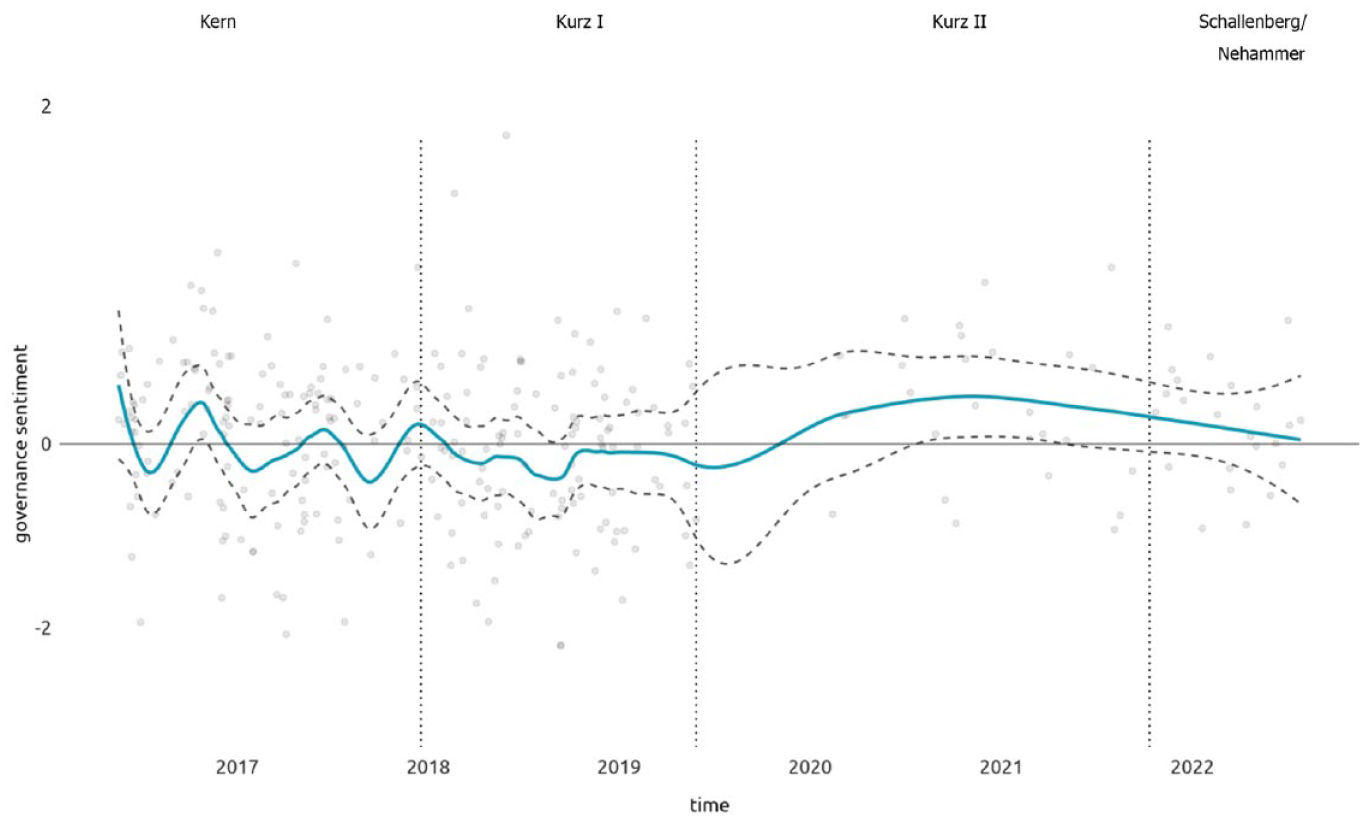
Sentiments in topic ‘governance’.
The sentiment towards ‘people vs elites’ (see Figure 5) exhibits a similar development as ‘governance’. But also in this case, the variations are limited and only reach statistical significance during the Schallenberg/Nehammer cabinet when the People’s Party temporarily increased its EU sceptical stance.
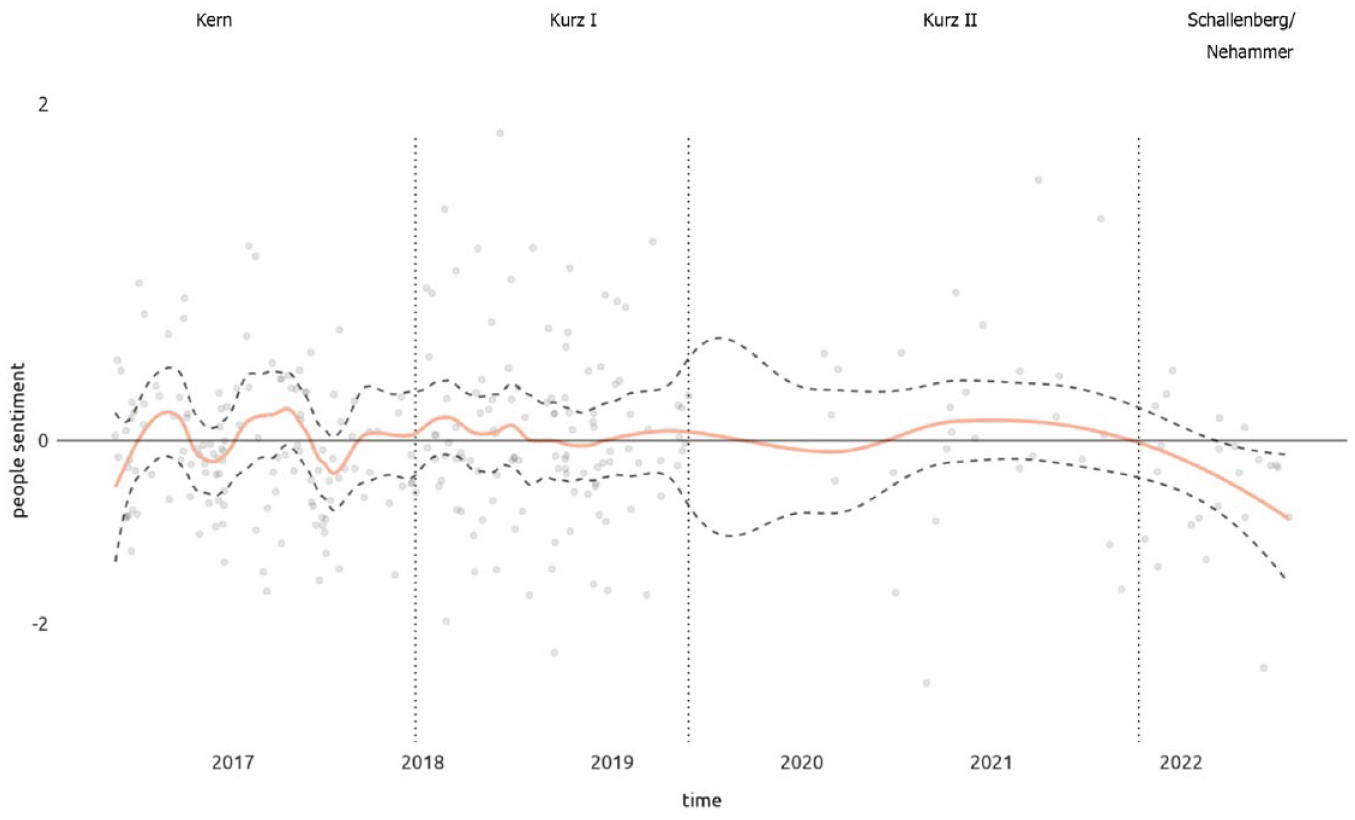
Sentiments in topic ‘people’.
Concerning the attitude towards the ‘USA’ (see Figure 6), it is not possible to identify a clear trend. There are phases of positive as well as negative mentions towards this topic, but without reaching statistical significance at no point in time.
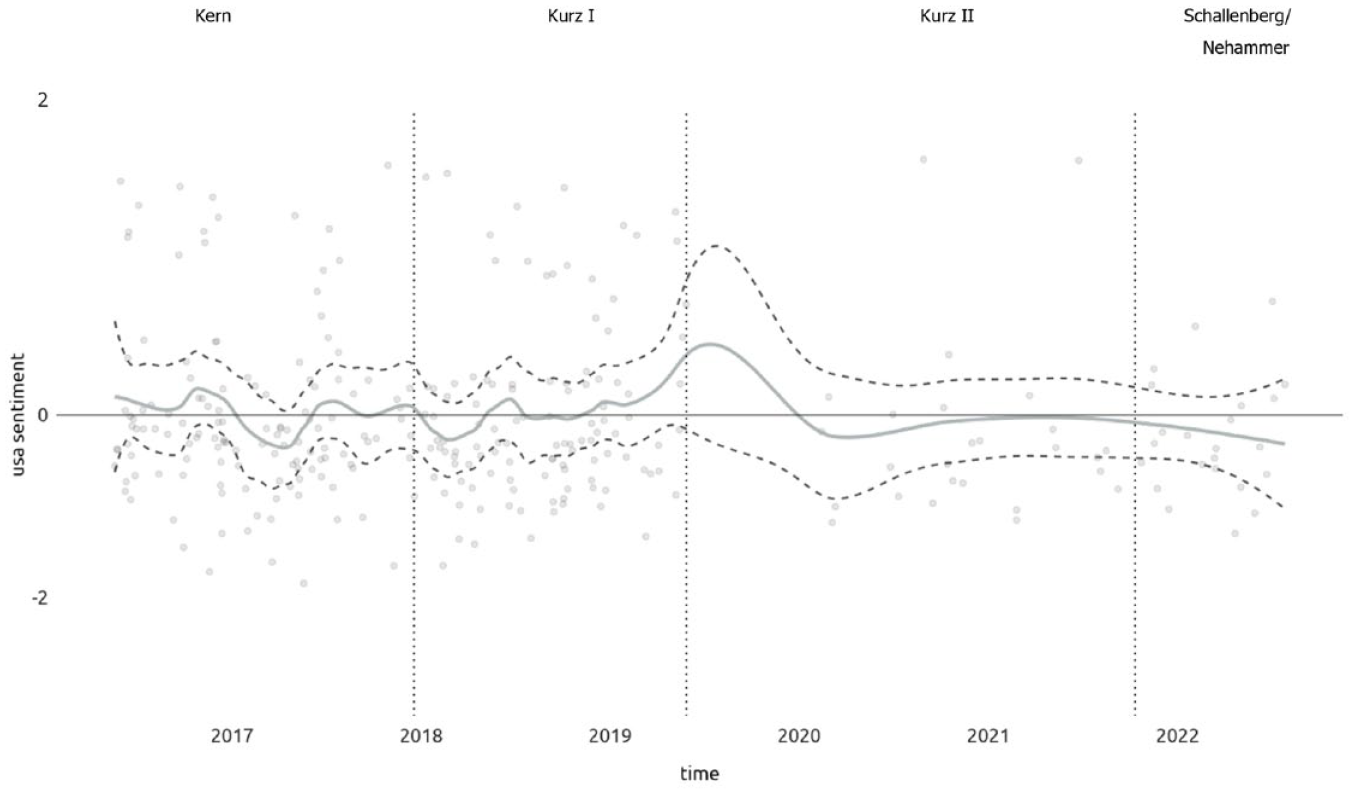
Sentiments in topic ‘USA’.
Much more interesting and partly in line with the assumptions of a PRR impact on foreign policy are the sentiments towards ‘Russia’ (see Figure 7). During the cabinet of Kern, the overall attitude towards Russia is solidly positive, even reaching statistical significance at the end of the term. This observation, however, is not so much the result of the influence of PRR ideas on Austria’s foreign policy but has to do with its energy dependence on Russian oil and gas exports. Austria traditionally has close ties to Russia, and conceives itself as a bridge between the East and West. Hence, it is no surprise that key figures in politics (from left to right), society (artists and celebrities) as well as corporate leaders are closely linked to the Russian political and economic elite. Hence, the statistically significant positive spike during the Kurz I cabinet does not necessarily have to result from PRR ideas but can also be the result of this traditionally Russia-friendly attitude toward Austrian foreign policy. Nevertheless, it is during this cabinet that the critique towards Russia, although very subtle (mentioning only Chechnya and not Russia itself, and accompanied by reassurances that one should not burn bridges), reaches a negative and statistically significant low. This low point is only trumped by the foreign policy orientation of the Schallenberg/Nehammer, when Austria, after Russia’s illegal and unprovoked invasion of Ukraine, fell in line with the official EU position, and condemned the invasion and Russian war crimes.
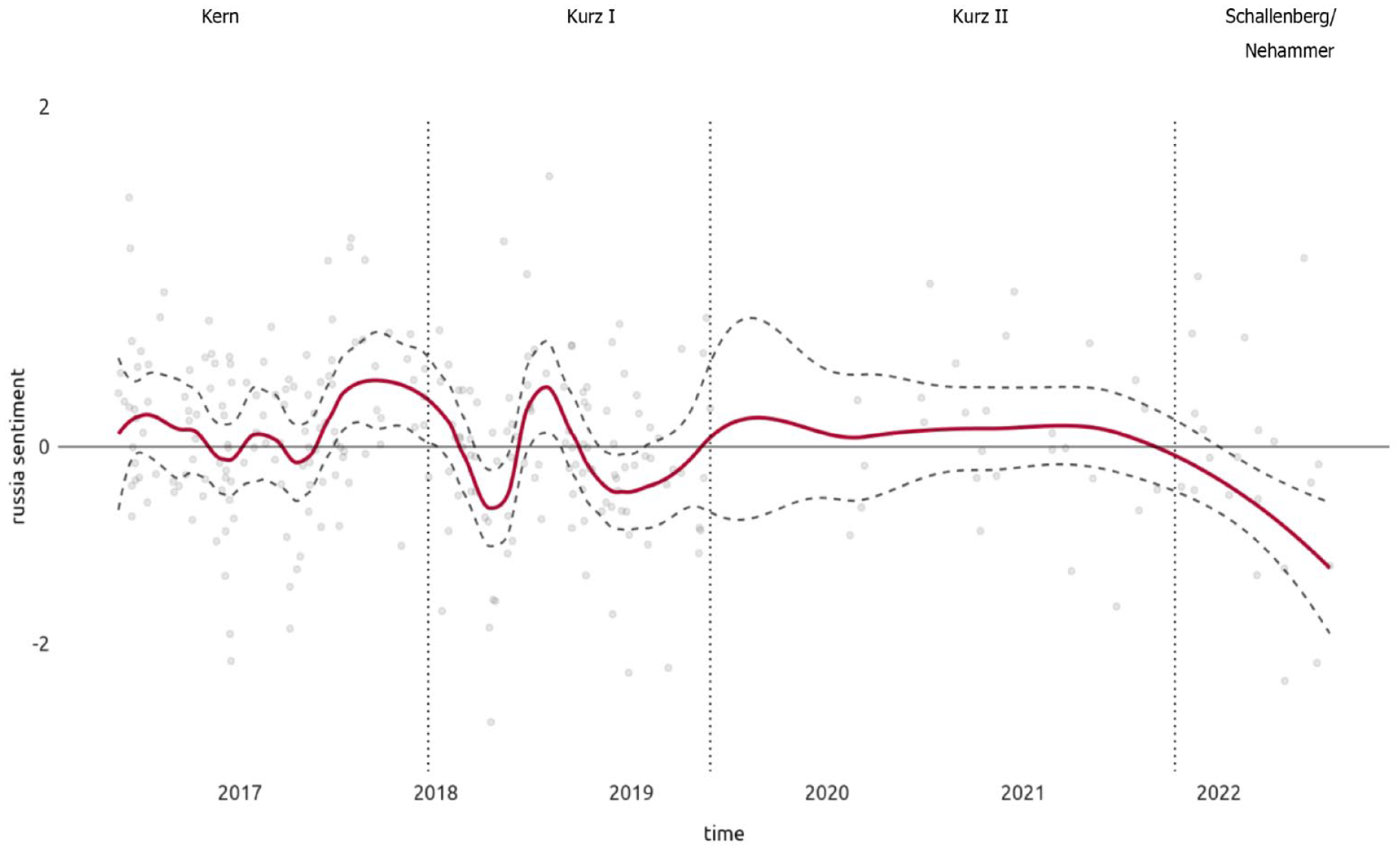
Sentiments in topic ‘Russia’.
Finally, the sentiments towards ‘diversity’ (see Figure 8) reveal some very interesting trends. In consistence with the assumption that Green parties do have a positive attitude towards cultural diversity and issues such as migration and immigration, the sentiments towards this topic clearly turn positive during the cabinet of Kurz II, reaching statistical significance at the end of the term and remaining positive throughout the cabinet Schallenberg/Nehammer. Also in line with the assumptions is the negative trend (although not statistically significant) during the Kern cabinet, when Kurz became foreign minister and shifted his party to the right, occupying central issues of PRRPs. What is surprising, however, are the temporarily positive sentiments towards ‘diversity’ at the beginning of the Kurz I cabinet that only reach a statistically significant low point at the end of the cabinet. Hence, whereas the policy orientation of the cabinet at the end of the term is in line with the assumption of a PRR impact on foreign policy, its positive attitude at the beginning of the term is not. A closer look at the specific content of the press releases in this period shows that the foreign ministry was anxious to underline its commitment to humanitarian aid and its preferred principle of on-site aid. By doing so, the right-wing government tried to forestall the possible critique of the centre-left that the new government had a xenophobic and reactionary attitude. Nevertheless, by no later than the midst of the term, the narrative of the backward-oriented nature and patriarchal attitude of certain migrants began to dominate the foreign policy in this area, bringing the sentiments to a statistically significant low point.
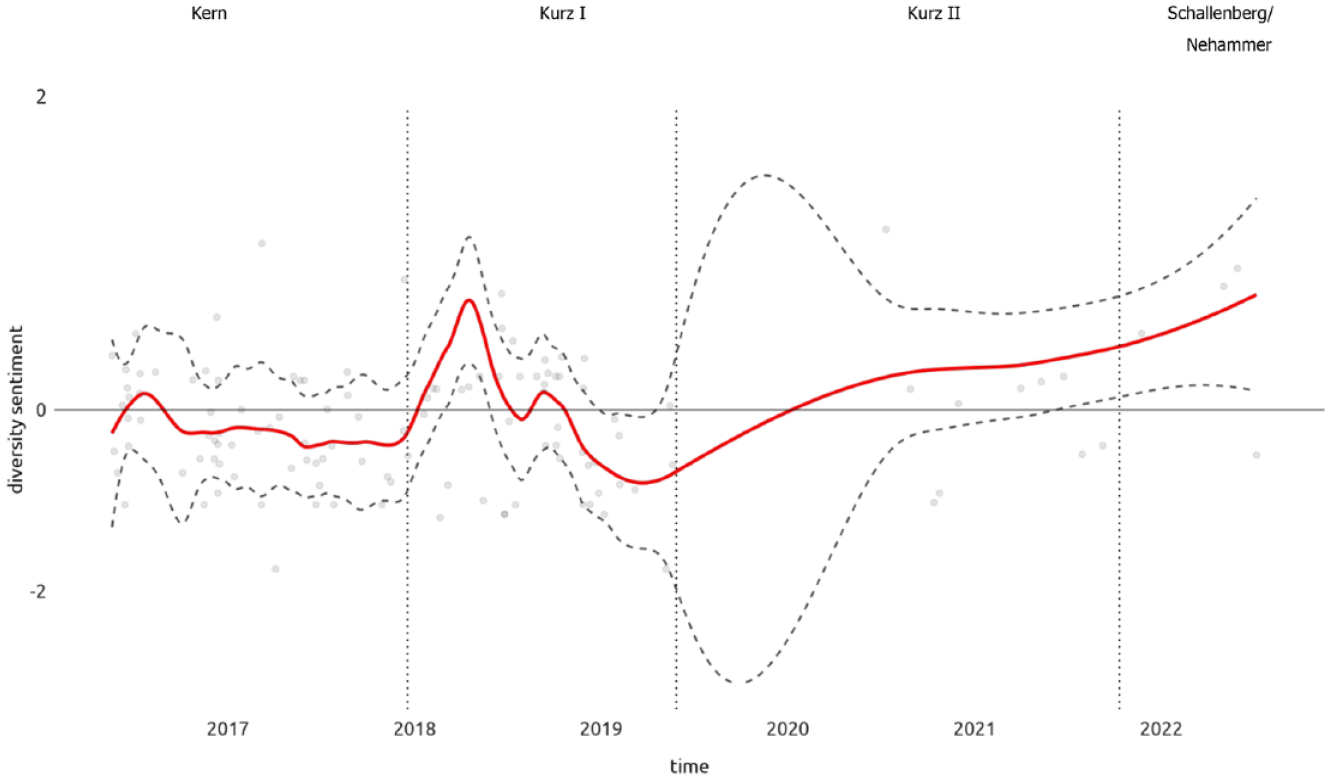
Sentiments in topic ‘diversity’.
Overall, five central insights can be derived from this analysis. First, PRR ideas do not only find its way into foreign policy via PRRPs. Also mainstream, centre-right parties, that seek to politically and electorally profit from PRR policy positions, can be responsible for this development (Abou-Chadi and Krause, 2020; Han, 2015). As (Heinisch et al., 2020) have demonstrated, this is also true in the case of Austria and the right-shift of the Austrian People’s Party under the chairmanship of Kurz. As this analysis demonstrated, this right-shift does not only affect domestic politics but also extends to the realm of foreign policy.
Second, the PRR opposition to transnational governance, economic globalisation and international trade is not really or only limited visible in the Austrian case. This can be explained by several mitigating effects such as Austria’s national role conception as a champion of multilateralism and a bridge-builder between East and West; its heavy reliance on exports and international trade; and its status as a small or medium-sized country, disproportionately profiting from transnational governance structures. Most of the case studies analysing the impact of PRR ideas on foreign policy up to now have either focused on super- or regional powers (Lacatus, 2021; Plagemann and Destradi, 2019; Wojczewski, 2020a, 2020b), or on ‘outsiders’ like Venezuela (Sagarzazu and Thies, 2019), that are not so much responsive to these mitigating effects.
Third, although the reference to ‘people vs elites’ is observable in the government programmes, this policy orientation does not really play a role in press releases and the factual foreign policy. Although both, the mainstream and centre-right ÖVP as well as the PRR FPÖ, sometimes refer to this issue and criticise the direction and intensity of the European integration process, they also positively refer to the EU as a means of satisfying national interests and for achieving goals such as stricter immigration laws and pushing back migration. This observation is in line with Heinisch et al. (2021) argument of ‘equivocal euroscepticism’, when PRRPs have strategic incentives to shift between soft, hard or no euroscepticism.
Fourth, despite the concern of several observers that PRRPs in government are sceptical towards the current global order and generally too Russia-friendly, these facts do not threaten the overall Western orientation of a small or medium-sized central European state like Austria. As already mentioned, the country is deeply integrated into regional and global governance structures and is dependent on regional and global trade. So even the participation of PRRPs in government or the increasing influence of PRR ideas on foreign policy does not threaten its overall foreign policy orientation in the short or medium term.
Finally, and from a methodological perspective, although the combination of qualitative content and quantitative text analysis (combining semi-supervised topic modelling and latent semantic scaling) is a promising approach for analysing (big) data on PRR foreign policy positions, this research design also has its limitations. In contrast to authors like Gründl (2022), who introduced ‘a dictionary-based measurement of populist communication’ that works independently of cases, the dictionaries for this analysis (both for sLDA and LSX) are too case-specific in order to be applied to various other cases (for more details, see Supplementary Materials). The idiosyncrasies of the Austrian foreign policy discourse prevent the construction of a case-independent dictionary that can be used for comparative purposes. Despite this limitation, the approach as such is promising and worth following upon.
Conclusion
This article asked what impact populist and radical-right ideas have on a country’s foreign policy. Examining the PRR Freedom Party’s participation in the Austrian government from 2017 to 2019, and applying qualitative content analysis to government programmes as well as quantitative text analysis to press releases, the article provided several answers to this question.
First, PRR ideas did influence Austrian foreign policy on both the rhetorical and the policy-level. Although the impact on the rhetorical-level was more decisive, PRR conceptions of foreign policy also left their marks in the press releases of the foreign ministry and hence on the foreign policy conduct. Especially in the case of ‘cultural diversity’ PRR ideas in the cabinet make a difference.
Second, what is also striking is the fact that these PRR ideas not only come into a cabinet’s foreign policy by the PRR Freedom Party but also by the centre-right People’s Party, that seeks to electorally profit from these ideas.
Third, the assumption that a PRR foreign policy conception results in an opposition to transnational governance, economic globalisation and international trade, cannot be corroborated with this exploratory case study. In the case of Austria, its national role conception as a bridge-builder in international relations; its heavy reliance on exports and international trade; and its status as a small or medium-sized country, disproportionately profiting from transnational governance structure, mitigate the PRR impact.
Overall, the article made three contributions to the literature. First, it proposed categories to identify PRR characteristics in a country’s foreign policy. Second, it introduced qualitative content analysis and quantitative text analysis as methods for measuring the impact of such a conception on a country’s foreign policy. And finally, it estimated this impact on Austria’s foreign policy over several cabinets, and by doing so, highlighted the benefits and challenges of this research design.
This exploratory study underlined the added value of a mixed-methods research design to establish categories and measure the impact of PRR foreign policy conceptions. Future research should build upon and refine these categories for analysing the degree of PRR influence on a country’s foreign policy. Furthermore, the challenge of constructing case-independent dictionaries for detecting the prevalence of PRR categories and sentiments in the context of foreign policy texts should also be addressed.
Footnotes
Funding
The author(s) received no financial support for the research, authorship, and/or publication of this article.
