




Abstract
About 28% of middle and high school students report the use of e-cigarettes per the 2019 NYTS survey. Social media can seclude a youth into limited set of beliefs, including affirmation for e-cigarette use. Internalizing problems like depression may be due to overuse of social media, and youth with depressive symptoms are more likely to use e-cigarettes to cope. National Youth Tobacco Survey (NYTS) 2023 data was used (n = 18 143) in a cross-sectional design. Ever e-cigarette use was the binary (Y/N) dependent variable. Independent variable, social media use, was categorized as “never,” “nondaily,” “daily.” Mediator variable, presence of recent depression was binary (Y/N). Survey weight adjusted logistic regression and path analysis were employed to identify direct and indirect effects (mediated via recent depression) of social media use on ever e-cigarette use. Social media use (nondaily, aOR = 1.58, P = .032; daily, aOR = 1.91, P < .001; both vs never) and recent depression (yes vs no, aOR = 2.00, P < .001) were independently associated with ever e-cigarette use. In the path analysis, likelihood of social media use (nondaily, aOR = 1.58, P = .037; daily, aOR = 1.88, P < .001; both vs never) and depression (yes vs no, aOR = 1.99, P < .001) being associated with e-cigarette use remained similar to findings of logistic regression. In the mediation analysis, direct effect estimates (nondaily, aOR = 1.52, P = .065; daily, aOR = 1.84, P < .001; both vs never) were consistent with the path analysis results. Compared to direct effect, lower effect size estimates were observed for depression mediated indirect effect (nondaily, aOR = 1.09, P = .057; daily, aOR = 1.10, P < .001; both vs never). We observed that policy changes regarding monitoring of youth’s social media use is needed to prevent youth from e-cigarette use.
Introduction and Background
Smoking is linked to major negative health consequences, including heart disease, high blood pressure and high cholesterol. 1 Deaths related to smoking-induced diseases amounted to 4.1 million in the United States from 1960 to 2020. 2 While some argue that e-cigarettes should be used for harm reduction from combustible smoking, or as smoking cessation aids, noting that they do not emit as many toxic substances as combustible cigarettes, other studies posit that e-cigarettes are introducing nonsmoking youth to alternative tobacco products, normalizing smoking once again and undoing the progress in controlling tobacco that has went on for decades. 3
Since their introduction, e-cigarettes have become extremely popular among youth. Evidence from the National Youth Tobacco Survey indicates that current (ie, past-month) e-cigarette was the most commonly used tobacco product and its use among high school students was 11.3% in 2016. 4 From 2017 to 2018, a substantial increase in current e-cigarette use by middle and high school students occurred leading the Food and Drug Administration Commissioner and the U.S. Surgeon General to declare youth e-cigarette use an epidemic in 2018. 5 Social media represents various online platforms, applications and websites that allow users to share content and communicate with others, often in a large group of people.6,7 Since social media is a platform for users to share content, it can be influence young people at developmental stage of adolescence to adopt new trends including that of e-cigarette usage. 8 Youth are very frequent users of social media, and make up the greatest percentage of users on social media, with 88% of those between 18 and 29 reported to have used it every day. 8
Social media usage can allow the formation of a perception in youth that e-cigarettes are less harmful compared to combustible cigarettes. 9 This belief can originate from social media marketing messages, and a lack of understanding of the risks of e-cigarettes among youth. Additionally, social media can allow youth to know the wide availability of various enticing flavors such as fruit, mint, etc., available for e-cigarettes, which can be attractive for young people. 9 Due to the above belief and attractiveness of e-cigarette flavors, youth’s inhibitions towards trying and using e-cigarettes could become lower. 10 Besides direct advertisements from manufacturers, promotional campaign, sales discounts, endorsement from favorite celebrities and cartoon-based content lures the youth into e-cigarette usage. 10 A bigger challenge is that the efforts to regulate exposure of youth are not consistent or effectively enforced. Despite advertising restrictions, young people still report significant exposure to e-cigarette advertising through social media because a strict enforcement of policies falls short. 11 If this continues, e-cigarette and vape usage will exceed epidemic levels, and it will be difficult to stop. Without intervention, social media usage will only further propel youth into isolated circles of vaping with limited exposure to methods of cessation.
The increasing prevalence of social media usage, where 90% of young adults engaged daily, has impacted the psychological development of young adults. This influence is revealed through thoughts, feelings, attitudes and perceptions of young people, contributing to mental health issues like depression. 7 Depression as a public health concern is prevalent among the youth with considerable associated economic burdens. 6 Concurrently, e-cigarette use has become the most common tobacco product among U.S. youth, with over 1.6 million young people reporting current use. This shift is concerning, as youth who use e-cigarettes have a 4 times higher risk of future combustible cigarette smoking. 7 The financial burden estimated in a 2021 study from mental health illnesses is ~$201 billion. 12
Research has shown the associations between social media usage and mental health symptoms like depression, and depression has been insinuated as the initiator of e-cigarette usage, potentially as a coping mechanism. Research has looked at the concurrent increase in the prevalence of social and a surge in e-cigarette usage, reporting that young people (12-17 years of age) who use e-cigarettes have a 4 times higher risk of ever smoking cigarettes compared with youth that do not use tobacco. 13 Other research has pointed to a circular problem where depression leading to low self-confidence increases the vulnerability to initiate vaping, and long-term nicotine dependence may subsequently aggravate depressive symptoms. 14 Researchers have mainly looked at the independent associations of you suffering from depression, and adopting vaping as a coping mechanism to seek refuge. And these studies have also pointed at the negative effects of dependence on vaping having long-term detrimental consequences making the youth more reliant on vaping. 14 However, a significant gap in the literature remains: while these 3 factors are independently linked, there is a lack of research directly investigating the intervening role of depression in the relationship between social media usage and e-cigarette usage. Understanding this 3-way relationship is critical to developing targeted, effective public health interventions that address the psychosocial pathways to e-cigarette use among young people.
Therefore, the aims of this study are 2-fold: (1) to investigate the association between social media and e-cigarette usage in youth and (2) to examine the intervening role of depression, between social media usage and e-cigarette usage.
Methods
Data Source and Study Sample
We used the National Youth Tobacco Survey (NYTS) 2023 data for this study. NYTS is a nationally representative annual survey of U.S. middle and high school students (grades 6-12) commissioned by the Food and Drug Administration (FDA) and the Centers for Disease Control and Prevention (CDC). NYTS contains survey questions agreed upon by both FDA and CDC, and the data is publicly available in a website maintained by the CDC and is freely downloadable. 15 In 2023, NYTS survey participants responded to an online questionnaire that collected information on a broad array of tobacco related items (ie, use of, exposure to, access to, and knowledge and attitude towards tobacco and smoking, etc.), along with relevant correlates, including socio-demographics, mental health and social media use. NYTS 2023 data was collected between March and June 2023 in 179 middle and high schools in the US and had an overall response rate of 70.9% (out of 31 108 students approached, 22 069 responded). 15 This cross-sectional study was conducted between November 2024 and July 2025.
Inclusion/Exclusion Criteria
Our study sample included the NYTS 2023 respondents who were enrolled in a U.S. middle or high school, were in a grade between 6 and 12, had a non-zero survey weight, had a valid response for the survey question asking about ever use of e-cigarette, and had complete information for all study variables. There were 18 143 respondents in our final analytic sample.
Measures
Dependent Variable
E-cigarette use was the dependent variable in this study. This was determined using the survey question “Have you ever used an e-cigarette, even once or twice?.” Responses were dichotomized as either “yes” or “no.”
Independent Variable
Key independent variable was social media use. NYTS survey questionnaire introduced social media use with the prompt “The next several questions ask about e-cigarettes and social media (such as YouTube, Instagram, Snapchat, Twitter, Facebook, Reddit, TikTok or Twitch)” and then asked the following question “How often do you use social media?.” This survey question had 8 possible response options, which were collapsed into 3 categories (“never,” “nondaily” and “daily”) in our independent variable. The category “never/I don’t use social media” was coded as “never”; “<1 time/week,” “about 1 time/week” and “a few times per week” were coded as “nondaily”; and “<1 hour, daily,” “about 1 to 2 hours, daily” and “about 3 to 4 hours, daily” were coded as “daily.”
Mediator Variable
Depression was the mediator variable. To determine the presence of self-reported depression, we used the survey question inquiring about the frequency of recent depression experience. The following Patient Health Questionnaire-2 (PHQ-2) item was incorporated in NYTS, “During the past 2 weeks, how often have you been bothered by any of the following problems? (feeling down, depressed or hopeless),” which had 4 possible response options, “not at all,” “several days,” “more than half of the days” and “nearly every day.” In PHQ-2 these options are progressively scored as 0, 1, 2 and 3, respectively, and the total score—in combination with another question—is used as a screening tool to determine whether further actions are necessary. Since we only intended to identify presence of any self-reported depressive symptoms, instead of using a scoring system, we dichotomized these responses. A response of “several days,” “more than half of the days” or “nearly every day” was considered presence of self-reported depression and was coded as “yes,” whereas a response of “not at all” was considered absence of self-reported depression and was coded as “no” in our mediator variable.
Covariates
We adjusted all our analyses for pertinent covariates that were selected a priori. School level was a dichotomous variable consisting of 2 categories: middle school and high school. Sex was also dichotomous including the categories female and male. We modified the race/ethnicity variable into 4 categories: non-Hispanic White, non-Hispanic Black, Hispanic and non-Hispanic other. Due to small sample sizes, the non-Hispanic Asian, non-Hispanic American Indian or Alaska Native and non-Hispanic Native Hawaiian or Other Pacific Islander groups were collapsed into the non-Hispanic other category.
Analysis
We employed survey-weighted logistic regression to assess the independent association of social media use and depression with the outcome variable e-cigarette use (Model 1). We conducted an additional survey-weighted logistic regression to assess the moderating effect of depression on social media use. Similar to the base model (Model 1), this additional model (Model 2) included social media use and depression as independent variables and e-cigarette use as the outcome variable, while an interaction term between social media use and depression was added to assess the moderating effect. All adjusted logistic regression analyses were conducted controlling for the covariates school level, sex and race/ethnicity.
To detect whether depression had any mediating effect on the relationship between social media use and e-cigarette use, we employed Baron and Kenny’s method. 16 We first regressed the dependent variable (Y: ever e-cigarette use) on the independent variable (X: social media use). The equation was:

The regression showed statistically significant association between ever e-cigarette use and social media use (ie, a significant coefficient, c1). Then, we regressed the mediator (M: depression) on the independent variable (X: social media use). The equation was:

This regression showed statistically significant association between depression and social media use (ie, a significant coefficient, a1). Since both the c1 and a1 coefficients were significant, following the stated method we then regressed the dependent variable (Y: ever e-cigarette use) on both the independent variable (X: social media use) and the mediator (M: depression). The equation was:

Coefficient b1 on the mediator M in the third regression was significant as well. Although, the coefficient on the independent variable, social media use, in the third equation (c′1) did not become insignificant when the mediator was accounted for, the effect size decreased with the increase in respective P value. Hence, a complete mediation was not indicated according to the Baron and Kenny’s method; however, partial mediation was indicated.
Next, path analysis was conducted to identify the direct and indirect effects (mediated via depression) of social media use on e-cigarette use. We separately estimated the depression mediated indirect effect of social media use on ever e-cigarette use using the “mediate” command in Stata. Both the path analysis and indirect effect estimation were controlled for the same set of covariates that were included in the logistic regression analyses (ie, school level, sex and race/ethnicity). NYTS-provided survey weights were incorporated in all our analyses using the survey specific commands (ie, svyset and svy: prefix) in Stata 18.5. 17
Results
Characteristics of the Study Sample
Among the 18 143 respondents included in our final analytic sample, 8994 were middle school students (41.47%) and 9149 were high school students (58.53%). Majority of the respondents did not have a history of ever using e-cigarettes (85.06%). In terms of social media use, daily use was most common (82.58%), followed by non-daily (9.05%) and never use (8.36%). Depression was reported by 42.26% of the respondents. The sample was almost evenly divided between male (50.24%) and female (49.76%) students. More than half of the respondents were non-Hispanic White (51.14%) and about a quarter were Hispanics (26.85%). Detailed descriptive statistics on the sample is presented in Tables 1 and 2 (all reported percentages are weighted percentage).
Descriptive Characteristics (n = 18 143).

Association of Social Media Use and Depression With Ever E-Cigarette Use—Logistic Regression Results a .
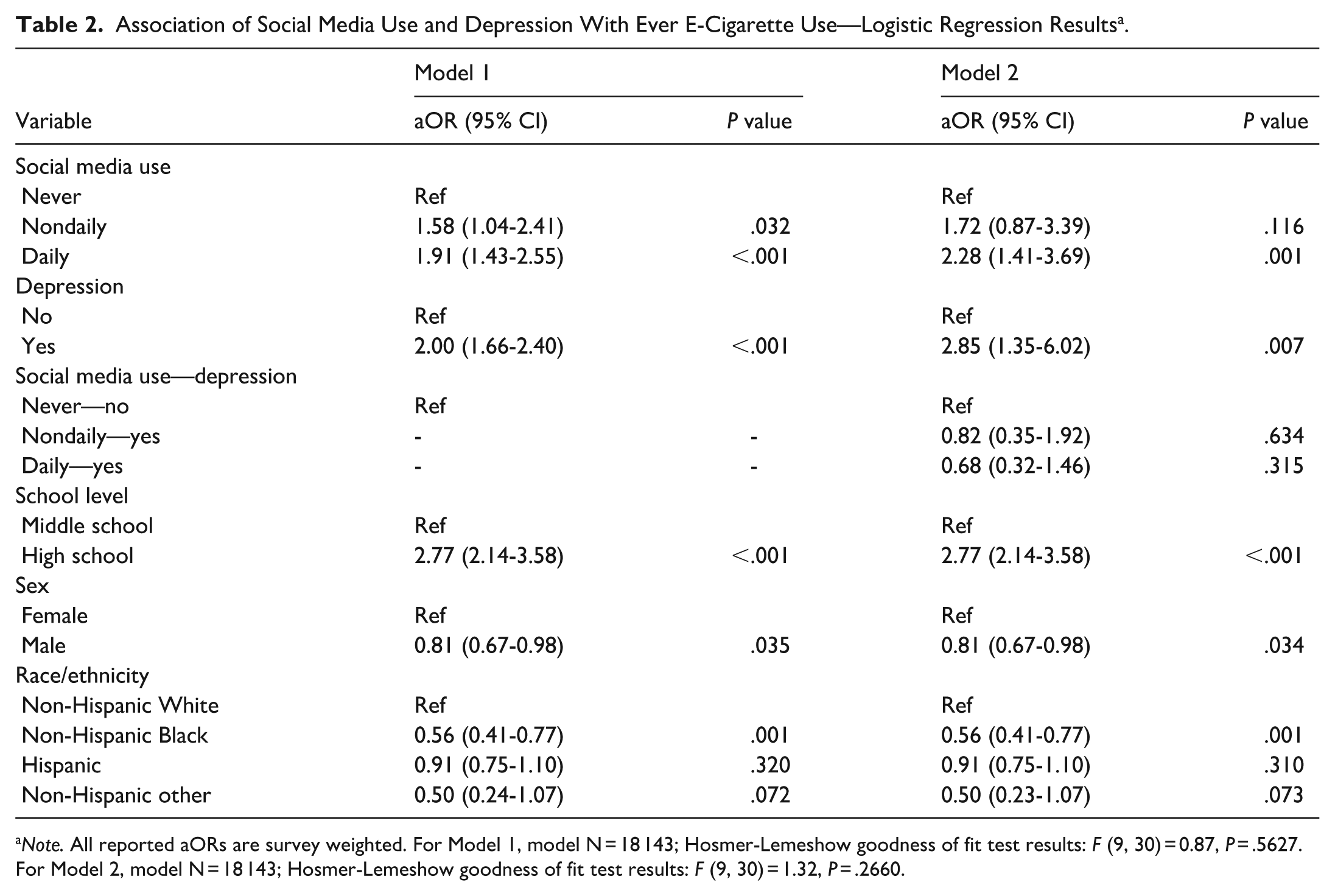
Note. All reported aORs are survey weighted. For Model 1, model N = 18 143; Hosmer-Lemeshow goodness of fit test results: F (9, 30) = 0.87, P = .5627. For Model 2, model N = 18 143; Hosmer-Lemeshow goodness of fit test results: F (9, 30) = 1.32, P = .2660.
Association of Social Media Use and Depression With Ever E-Cigarette Use
In our multivariable analyses, we found that both social media use and depression were independently associated with e-cigarette use. Respondents who reported nondaily and daily social media use had 1.58 (P = .032) and 1.91 (P < .001) times higher odds of e-cigarette use, respectively, compared to those reporting never use of social media (Table 1, Model 1). In our additional regression analysis assessing for moderating effect of depression on social media use (Table 1, Model 2), no statistically significant interaction was observed between these 2 factors.
Mediating Effect of Depression
In the path analysis, likelihood of social media use (nondaily, aOR = 1.58, P = .037; daily, aOR = 1.88, P < .001; both vs never) and depression (yes vs no, aOR = 1.99, P < .001; Figure 1) being associated with e-cigarette use remained similar to the findings of logistic regression (Table 3 and Figure 2). In the mediation analysis, estimated direct effects of social media use on e-cigarette use (nondaily, aOR = 1.52, P = .065; daily, aOR = 1.84, P < .001; both vs never) were similar to the path analysis results. Estimated indirect effects mediated by depression were statistically significant (nondaily, aOR = 1.09, P = .057; daily, aOR = 1.10, P < .001; both vs never), however, effect sizes were substantially lower than the direct effects (Table 4). This indicates minimal mediating effect of depression on social media use in driving e-cigarette use.

Percentage distribution of subgroups across the dependent, independent, mediating and control variables.
Association of Social Media Use With Ever E-Cigarette Use, and the Mediating Effect of Depression—Path Analysis Results a .
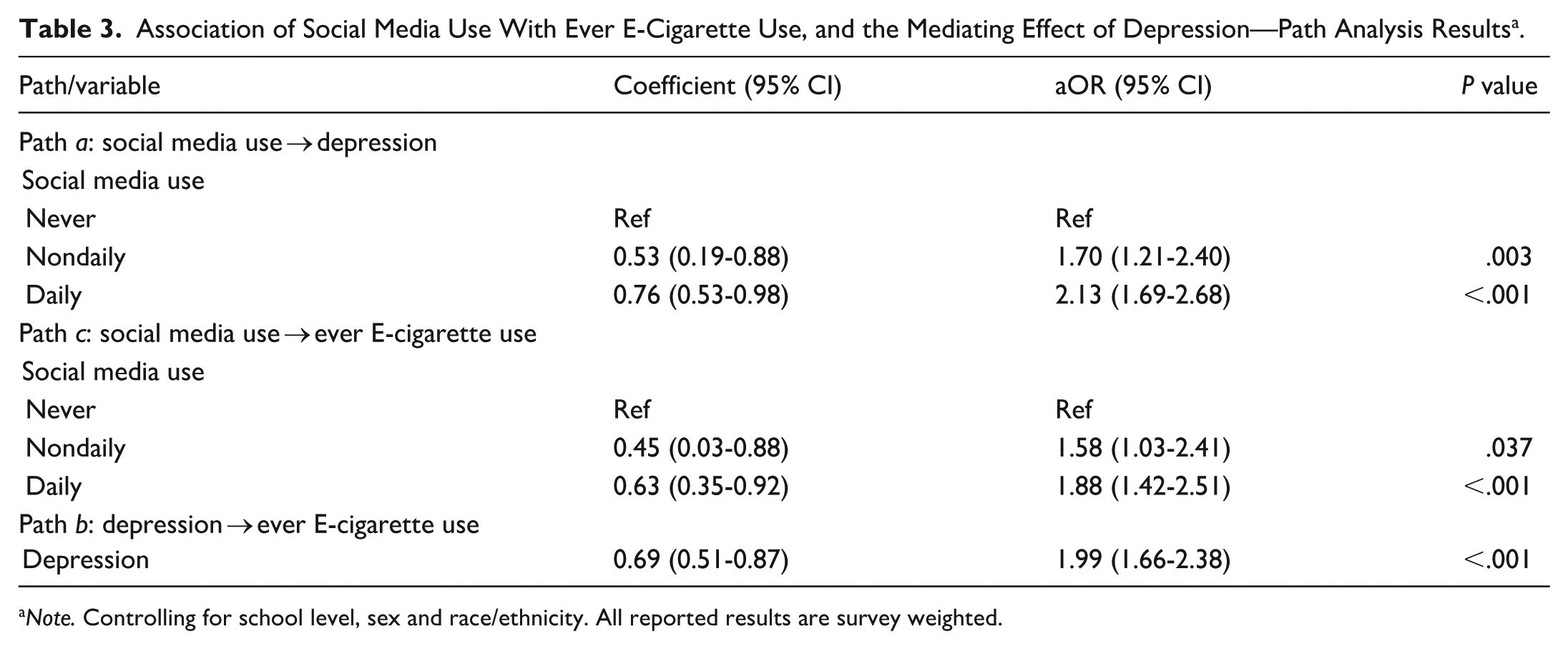
Note. Controlling for school level, sex and race/ethnicity. All reported results are survey weighted.

Path diagram assessing association between social media use and ever e-cigarette use, and the mediating effect of depression, controlling for school level, sex and race/ethnicity. For the listed odds ratios, the reference category is “never” for the variable “social media use,” and “no” for the variable “depression.”
Direct Effect and Depression Mediated Indirect Effect of Social Media Use on Ever E-Cigarette Use—Mediation Analysis Results a .

Note. Estimated with the “mediate” command in Stata, controlling for school level, sex and race/ethnicity. Standard errors were estimated using the Jackknife method, which yielded 95% CI. All reported results are survey weighted; however, primary sampling unit or strata variables were not incorporated in the “mediate” command.
NDE = natural direct effect; NIE = natural indirect effect.
Discussion
The primary aim of the study was to investigate the association between social media usage and e-cigarette usage and if depression plays a mediating role between the above 2. Results show that youth reporting a higher social media usage had a higher likelihood of e-cigarette use. Given that ~60% of the youth in our sample where high school students, it is likely that high school students had convenient access to mobile phones and social media accounts, making it easier to access social media than the youth that are in middle school, especially the ones that are in lower grades in middle school and may not have access to mobile phones. Also, from the descriptive results, ~83% of the respondents reported daily use of social media, therefore the likelihood of youth that report social media usage and tend to get influenced towards e-cigarette usage, naturally becomes higher.
Previous studies buttress the findings in our study. Social media use, even if measured cross-sectionally, has been associated with increased risk of e-cigarettes and cigarettes usage. In fact, a longer use such as >2 hours, of social media exposes the youth to even higher risk of e-cigarette usage. 18 Similarly, another study examined associations between specific social media platforms (Snapchat, Instagram, Facebook) usage and current vaping, and found significant relationships. 19 In alignment with prior findings, youth spending 4 or more hours on social media each day were more likely to report daily e-cigarette use. 20 Large proportions of students who use social media report seeing and engaging with e-cig related content; such exposure correlates with vaping behaviors.21,22 Consistent with these trends, a study done in California found that adolescents who reported higher social media use during the COVID-19 lockdown had greater odds of daily e-cigarette use, suggesting that online exposure may reinforce vaping behaviors. 23
The minimal mediating effects of depression is plausible because depression in our study was not captured based on its severity, frequency or underlying primary or secondary diagnoses associated with depression. However, other studies partially show that internalizing youth’s issues and anxiety and depression may mediate the relationship between social media use and e-cigarette use. 24 Self-reported items may have provided a limited view of the complexity of mental health, potentially underestimating depression’s influence in this context. Other internalizing factors, such as anxiety or stress, may be prominent mediators in the link between social media and e-cigarette behaviors, and the relationship may vary depending on developmental stage or context, suggesting that depression’s role as a mediator could emerge more clearly under different conditions or in more targeted samples.
Youth who used social media non-daily and daily had a higher likelihood of e-cigarette use compared to those who reported never using it. Social media has become a powerful influencer on the youth’s behavior due to constant exposure through smartphones, tablets and other electronic devices. The largely uncensored nature of social media means that e-cigarette content, shared by self-proclaimed influencers or advertisements, can easily reach young, impressionable audiences with minimal barriers, through ads and influencers, tempting them into imitation and trying new products. The constant exposure normalizes these products making them seem widely accepted and even desirable. Youth often reinforce these influences, for example, 1 adolescent who sees an e-cigarette on social media may share the post or bring up the topic with friends, sparking curiosity among peers. The combination of peer networks and influencer culture amplifies the likelihood that youth will encounter and try e-cigarettes (Supplemental Material).
Our study revealed an independent association of depression with e-cigarette usage. Adolescents that struggle from mental health conditions and find it very challenging to get help, try to manage their condition with substances that provide relief and distraction. In addition, stressful life situations such as family issues, debt strain or academic pressures can increase the susceptibility of youth to use e-cigarettes to escape difficult situations. If access to counseling, therapy and medical support is limited, that can make an individual feel stuck and they may have no choice but to rely on other alternatives that are available. In such cases, e-cigarettes can offer readily available solution to counter feelings that are overwhelming. However, e-cigarettes although may provide short-term relief, it may be a risky adaptive trend leading to high risk for addiction. Ultimately, it would adversely affect the physical and mental health of youth.
Healthcare policies and programs may empower youth to critically evaluate vaping content, and keep away from influencer driven messaging. Such policies could encourage youth to disagree with the normalization of e-cigarettes. Social media platforms may limit vaping advertisements that are targeted towards youth, while enabling age verification methods. Parents’ engagement in monitoring the use of social media and in influencing social media platforms to cease excessive vape advertisements is needed. Even if depression was not found to be a full mediating pathway, proper mental health screening and addressing depressive symptoms in youth may decrease their propensity towards vaping. Presence of strong academic performance and motivation towards having better grades may leverage against e-cigarette use. Therefore, tutoring help, mentorship programs, study clubs could yield substantial benefits in reducing the use of social media and thereby e-cigarettes.
Some limitations are worth considering. The cross-sectional nature of NYTS poses generalizability issues. To provide more support for the causal association between social media use and vaping, a longitudinal analysis would be warranted. Qualitative studies of youth, focused group interviews or phenomenological studies would refine the understanding of exposure pathways. Investigating the same relationships that have been demonstrated in this study on the basis of race, gender, social economic status would provide a granular aspect of social media usage’s effect on e-cigarette usage. Studies in the future could examine other predictors that may be associated with e-cigarette usage such as youth’s mental health issues, and family’s socioeconomic status. Studies can also examine the impact of motivation, and academic performance in e-cigarette usage. Inherent limitations of the self-reported survey design, including response biases such as recall bias and social desirability bias, may potentially impact our study findings. However, a previous report demonstrated that the self-reported tobacco use data among the youth are generally consistent with the biomarker data. 25 Another limitation of our study is the potential non-causal nature of the findings due to the cross-sectional design and potential non-temporal relationship between the dependent, mediating and independent variables. Thus, interpretation of depression as an effect-measure modifier rather than a causal mediator may be a more fitting interpretation of relevant findings of our study. 26 Lastly, due to unavailability of socioeconomic status (SES) data in NYTS, we were unable to incorporate SES variables in our analysis, which could have resulted in residual confounding.
Conclusion
Our study provides valuable insights into how social media usage and depression can influence e-cigarette usage. Seeing and consuming social media content repeatedly may drive the susceptible youth to believe that e-cigarette usage is acceptable. Policy changes regarding the monitoring of youth’s social media use and amount of time spent on social media can help to prevent impressionable youth from e-cigarette use and more broadly, substance use. Parents, families and policymakers’ involvement in protecting the youth from being influenced into a limited set of beliefs such as affirmation of e-cigarette use is needed.
Supplemental Material
sj-docx-1-inq-10.1177_00469580261422435 – Supplemental material for Social Media and E-Cigarette Use in Youth: Does Depression Play a Mediating Role?
Supplemental material, sj-docx-1-inq-10.1177_00469580261422435 for Social Media and E-Cigarette Use in Youth: Does Depression Play a Mediating Role? by Soumya Upadhyay, Mohammad Karim and Shivank Chhaya in INQUIRY: The Journal of Health Care Organization, Provision, and Financing
Supplemental Material
sj-docx-2-inq-10.1177_00469580261422435 – Supplemental material for Social Media and E-Cigarette Use in Youth: Does Depression Play a Mediating Role?
Supplemental material, sj-docx-2-inq-10.1177_00469580261422435 for Social Media and E-Cigarette Use in Youth: Does Depression Play a Mediating Role? by Soumya Upadhyay, Mohammad Karim and Shivank Chhaya in INQUIRY: The Journal of Health Care Organization, Provision, and Financing
Footnotes

Ethical Considerations
Was not required because only secondary datasets that are de-identified and publicly available have been used.
Author Contributions
S.U. and S.C. developed the idea, the topic and provided the concept of the paper. S.U., S.C. wrote the abstract. S.C. wrote the introduction under S.U.’s supervision and formatting. M.K. conducted the data analysis, wrote the methods and results. S.U. wrote the background, discussion and conclusion. S.U. supervised the project.
Funding
The publication fees for this article were supported by the UNLV University Libraries Open Article Fund.
Declaration of Conflicting Interests
The authors declared no potential conflicts of interest with respect to the research, authorship and/or publication of this article.
Data Availability Statement
Link to data provided in the manuscript.
Supplemental Material
Supplemental material for this article is available online.
References
Supplementary Material
Please find the following supplemental material available below.
For Open Access articles published under a Creative Commons License, all supplemental material carries the same license as the article it is associated with.
For non-Open Access articles published, all supplemental material carries a non-exclusive license, and permission requests for re-use of supplemental material or any part of supplemental material shall be sent directly to the copyright owner as specified in the copyright notice associated with the article.
