




Abstract
This study examined the perceptions of current smokers on electronic cigarette (EC) use, after exposure to information on EC use and its potential harms from various media and retail outlets. This cross-sectional study is a sub-analysis of the National Study of Electronic Cigarettes Prevalence (N = 4289) using the multi-stage stratified sampling method. Respondents were interviewed face-to-face by a trained data collector using a structured questionnaire printed in both Bahasa Malaysia and English. The analysis included 376 males who smoked conventional cigarettes and/or used ECs and reported ever seeing messages on ECs/vape in various platforms were analyzed using weighted simple and multiple logistic regression. Our findings showed different media types resulted in differing perceptions among smokers towards EC use especially between social media and conventional media. Those exposed to messages promoting EC in social media had higher odds of believing that ECs help people quit smoking (OR: 2.28), the urge to smoke is reduced by ECs (OR: 1.86), ECs are more effective than medication for quitting smoking (OR: 1.96), breathing is improved after using ECs (OR: 2.85), the smell of EC is better than a tobacco cigarette (OR: 2.73), and ECs should be regulated rather than banned completely (OR: 3.08). Vape shops, social, and conventional media provided very different perceptions among smokers towards EC use. Beyond using traditional communication channels, EC promoters have successfully utilized social media to promote ECs among smokers.
Introduction
Globally, studies from population data had established that electronic cigarette (EC) use has increased rapidly and gained popularity in recent years.1,2 A study in China reported an increasing prevalence of EC use among adults in general, 2 whilst another study reported an increase in prevalence among young adults but did not increase among middle-aged and older adults. 3 An upward trend was also indicated in Malaysia.4,5 Malaysia recorded an overall increase in prevalence from .8% in 2011 6 to 3.2% in 2016 7 ; dominated by males with an increase from 1.8% and 6.0% in 2011 6 and 2016, 7 respectively. The 2019 National Health and Morbidity survey further revealed that 21% and 5% of Malaysians were conventional and electronic cigarette users in 2019. 8 The increase in prevalence might be due to prominent promotion through online platforms, in print media, and on television and radio. 9
There are conflicting perceptions of the use of ECs. Some advocate the use of ECs as a tool to assist in quitting tobacco cigarette smoking and perceive ECs as less harmful 10 and less addictive 11 than conventional cigarettes. Several studies reported that ECs can reduce urges to smoke among conventional smokers, 12 but others suggested that they would end up becoming dual users (ie, using both conventional cigarettes and ECs), rather than quitting conventional cigarettes. 13 On the other hand, there are concerns about the use of ECs as a way to renormalize smoking and sensitize individuals from perceiving ECs as a safer alternative, 13 and reduce their motivation to quit smoking completely. This may contribute to nicotine addiction and public confusion 14 while being a gateway to smoking for non-smokers.14-17
Findings from a systematic review and meta-analysis reported that EC users had at least a 3-fold risk of becoming cigarette smokers. 18 It is unclear if ECs promote behaviors and habits that are similar to those found among conventional cigarettes smokers. 19 In addition, there is also concern about the potential harms of inhaling second-hand EC emissions. 20 There are claims that EC use reduced health risks and is relatively less harmful than conventional cigarettes 21 On the other hand, there is growing evidence that more adults perceive ECs as being as harmful as, or more harmful than, conventional cigarettes. 22
There are conflicting views among health professionals about the role of ECs. Some do not recommend using ECs as a smoking cessation aid, despite viewing them as less harmful than conventional cigarettes.23,24 Some medical groups adopt a harm reduction approach, most notably in England, whereby smokers were encouraged to use ECs to assist in quitting smoking if other methods failed.25,26 Such harm reduction messages associated with EC use contributed to the ambiguity surrounding its acceptability.
Both traditional and digital media communication channels had contributed to the increase in the awareness and use of ECs among young adults. 27 In particular, youth and young adults may be most vulnerable to advertisements promoting EC use. 28 Information promoting the use and the potential harms of ECs are disseminated through print as well as interpersonal sources such as EC retail outlet shopkeepers 29 who provide information and assist the clients to decide on e-liquids and devices designed to meet their preferences 30 . Interpersonal communication through exposure to messages on the good and harmful effects of EC use from another person was found to be the highest source of awareness. 30 Studies reported that past-year exposure to tobacco products and EC messages were higher among EC ever-users, current smokers, and those with frequent internet access. 31 Studies also suggested viewing EC advertisements act as a reminder to cigarette smoking and lowers former smokers’ intentions to stop smoking. 32 Promoters have successfully utilized social media to promote ECs33,34 using popular social media platforms to market ECs such as Youtube, Twitter, and Facebook. 35
Despite the interest in the effects of EC marketing and communication, there is a paucity of studies that evaluate how exposure to EC messages in various media platforms affects current smokers’ perception of ECs. 36 The objective of this study was to examine adult male current smokers’ perceptions on EC following exposure to information promoting its use and potential harms derived from the different media types and EC retail outlets.
Materials and Methods
Participants and Study Design
This study was part of a national prevalence survey on EC use among Malaysian adults. 36 Details of the study design, participants, and data collection methods had been published elsewhere. 36 Written consent was obtained from all participants. Ethical approval was obtained from the Medical Research and Ethics Committee of the Ministry of Health Malaysia (NMRR-16-171-28819).
Sample Size and Sample Distribution
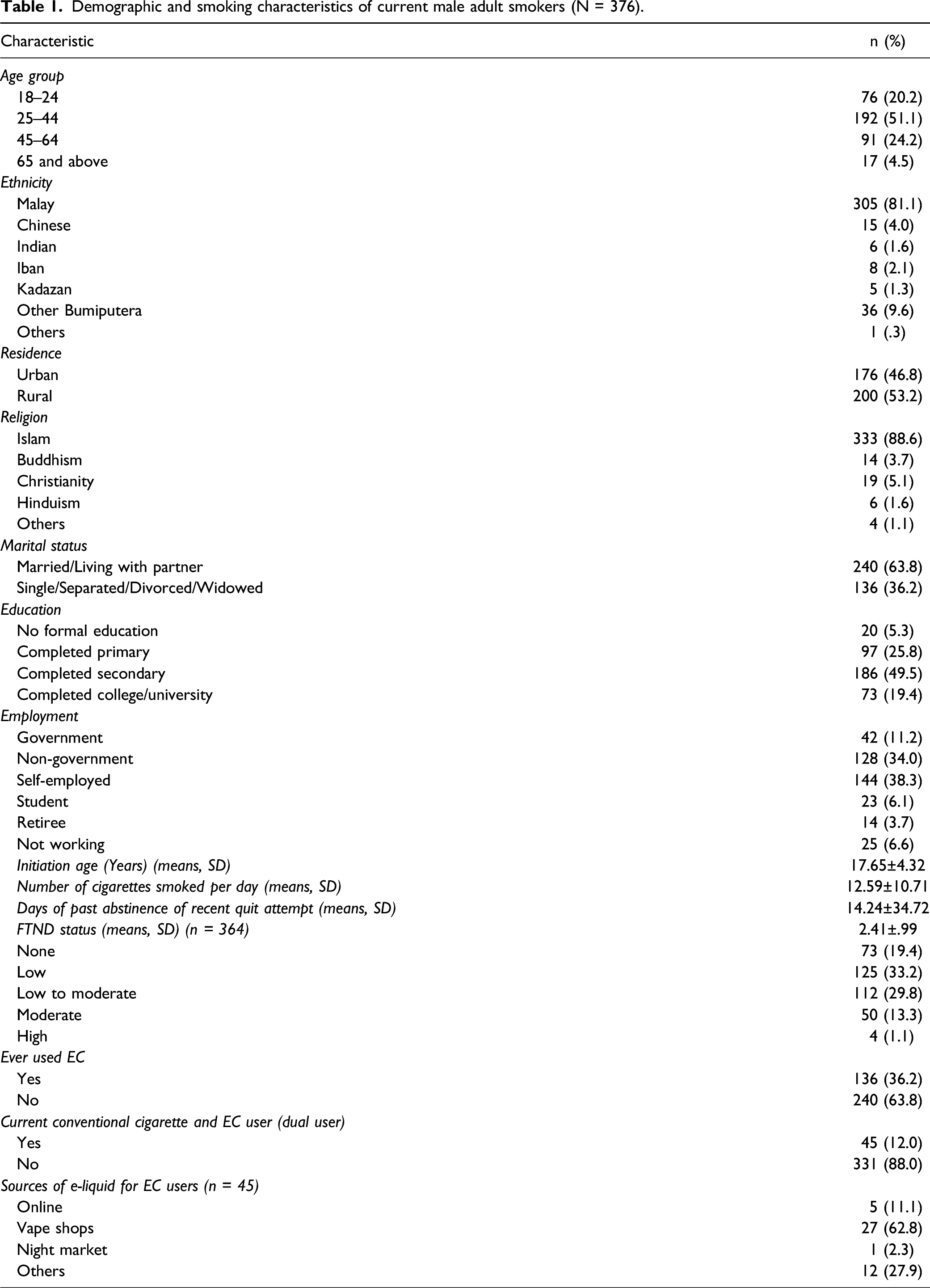
The main household survey received a total of 4288 individuals, weighted to represent 19 million Malaysians. Only adult male conventional cigarette smokers were the focus of this study. This paper is a sub-analysis of the main study 36 which involved 957 respondents (22.5% of the total sample) who were smoking conventional cigarettes with or without EC use. Current dual users were also included. Definitions of conventional cigarette smoking were adopted from the Centres for Disease Control and Prevention, Atlanta, USA. 37 Dual users were defined as those who were currently smoking both conventional cigarettes and EC at the time of the interview. Excluded from further analysis were females, those who used EC only, and participants who did not respond to the questions on media exposure. Hence, only 376 male current conventional cigarette smokers were further analyzed.
Measurements
The perception questions were developed by the tobacco control experts from both academia and the Ministry of Health Malaysia. 3 The questionnaire booklet was printed bilingual (English and Bahasa Malaysia) in the same book. It has 8 sections: Background, Smoking E-Cigarettes/Vape, Smoking Tobacco, Dual Users, Second-hand E-Cigarettes/Vape Vapor, Media, Perception, and E-Liquid Form. 3 The Fagerström Test for Nicotine Dependence (FTND) was used to assess the level of physical nicotine addiction. 38 The original questionnaire consisted of 6 items that measured the quantity of cigarette consumption, and the participants’ level of compulsion to use and dependence on cigarette smoking.
This paper mainly discusses results from the Media and Perception parts of the questionnaire: “In the last 30 days, did you observe any advertisements promoting e-cigarette/vape in the following media/places…?” and “In the last 30 days, did you observe any information about the danger (harm) of smoking e-cigarette/vape in the following media/place...?” The list of media/place was vape shops, TV, radio, posters, newspapers/magazines, and social media.
Respondents who answered “yes” were interviewed on perception statements (20 statements altogether): “Do you agree with the following statements?: I think …. E-cigarettes help people quit smoking tobacco cigarettes” and “People react more positively to e-cigarette users than to tobacco smokers” with responses ranging from “agree,” “don’t agree,” “don’t know,” and “refuse to answer” for each statement. Similarly, the survey measured exposure to messages about potential harms of ECs and perceptions of harm. Each perception statement was treated as a separate dependent variable.
Statistical Analysis
The demographic characteristics and the agreement of the perception items by different exposures through different types of media and EC retail outlets were calculated using frequencies and percentages. Male smokers’/EC users’ exposure to promotional messages about ECs and also information on potential harms of EC use and their associations with perception items were analyzed using weighted simple logistic regression. For each perception (dependent variable), different types of media and EC retail outlets were treated as independent variables. The media/places were as follows: (a) Vape shop, (b) Social media, and (c) Conventional media (which was a combination of TV/radio, posters, and newspapers/magazines. Participants who answered “don’t know” and “refuse to answer” were treated as missing data and were excluded listwise. The regression outcomes were presented in odds ratio and 95% confidence intervals. The odds ratio applies to those who agree with the perception item, with those who disagree as the reference group.
Results
Demographic and smoking characteristics of current male adult smokers (N = 376).
Perceptions of current male adult smokers on e-cigarette use after exposure to messages promoting the use of e-cigarettes and/or the harm of e-cigarette use in the media and vape shop in the past 30 days (n = 376).

Note: EC = Electronic cigarette.
aPromoting = Exposure to messages promoting EC use.
bHarmful = Exposure to harmful messages about EC
The majority of smokers indicated agreement with the perceptions that EC is less satisfying than tobacco smoking, ECs have better smell, EC solutions cause poisoning, and ECs should be regulated rather than banned completely.
Overall, more than half (51.9%) of the participants reported they had received messages promoting EC use from social media, whilst 42.0% exposure to promoting messages in the vape shop. The largest proportion of participants reported receiving messages regarding the harm of EC use was from TV and radio (66%), followed by social media (49.5%), and newspapers/magazines (45.2%). Across all media types, more than half of the participants agreed that the smell of EC is better than a tobacco cigarette, EC solution causes poisoning, and EC use is less satisfying than tobacco smoking.
Based on the results of the simple logistic regression, in terms of exposure to messages in vape shops, those who saw messages promoting EC in the vape shop were less likely to believe EC vapor was more harmful to others compared to tobacco smoke (OR: .45, 95%CI [.27–.77], P < .01). Those exposed to messages highlighting the harm of EC were more likely to perceive that the public would react more positively to EC users than tobacco users (OR: 5.44, 95%CI [1.56–18.9], P < .01).
In terms of exposure to messages in social media, those who recalled they saw messages promoting EC were more likely to believe that EC helped people quit smoking (OR: 2.28, 95%CI [1.21–4.30], P < .05), the urge to smoke was reduced by EC (OR: 1.86, 95%CI [1.11–3.13], P < .05), EC was more effective than medication for quitting smoking (OR: 1.96, 95%CI [1.02–3.76], P < .05), breathing was improved after using EC (OR: 2.85, 95%CI [1.36–5.98], P < .01), the smell of EC was better than a tobacco cigarette (OR: 2.73, 95%CI [1.35–5.54], P < .01), and EC should be regulated rather than banned completely (OR: 3.08, 95%CI [1.75–5.41], P < .001). Those exposed to promoting messages were less likely to endorse EC smoke was more harmful to others compared to tobacco smoke (OR: .46, 95%CI [.27–.79], P < .01) and EC solutions caused poisoning (OR: .44, 95%CI [.26–.77], P < .01). Those who stated they were exposed to messages highlighting the harm of EC were less likely to believe EC vapor was more harmful to others compared to tobacco smoke (OR: .56, 95%CI [.32–.98], P < .01).
In terms of exposure to conventional media, those exposed to harmful messages of EC had lower odds of believing that people react more positively to EC in comparison with conventional cigarettes (OR: .49, 95%CI [.25–.97]) and that EC should be regulated rather than banned (OR: .57, 95%CI [.33–.98]).
Weighted simple and multiple logistic regression§ on the perception of current male adult smokers after exposure to messages promoting the use of e-cigarettes and the harm of e-cigarette use in the media and vape shop in the past 30 days.

Note: EC = Electronic cigarette.
*Significant to P value < .05.
**Significant to P value < .01.
***Significant to P value < .001.
aPromoting = Exposure to messages promoting EC use.
bHarmful = Harmful messages about EC
cConventional media comprised TV, radio, newspapers, magazines, and posters.
dMultiple logistic regression adjusted for the influence of age, education level, and ever using e-cigarettes.
Discussion
Our findings showed different media types resulted in differing perceptions among smokers toward EC use based on their exposure to promoting or harmful messages in vape shops, social media, and conventional media (TV, Radio, Posters, Newspapers, and Magazines). Beyond using traditional communication channels, EC promoters increasingly utilized social media in mobilizing public opinion to promote ECs33,34 with the most frequently used social media platforms to market ECs such as Twitter and Facebook. 35
Social media exposure to EC messages was strongly associated with the perceptions of current male adult smokers, regardless of it being a positive (promoting ECs) or negative perception (information on the dangers of EC use), before controlling for the influence of age, education level, and EC ever-user status. These findings were in agreement with another study that reported social media as an important marketing platform for ECs since the information obtained from this platform was shared and re-shared, influencing decisions of its use. 39 Social media tends to elicit more positive perceptions on EC use compared to other platforms. For example, those exposed to social media promoting messages in this study showed positive perceptions that EC helped them to quit smoking, able to reduce the urges to smoke, was more effective than medication to help in quitting smoking, and improved breathing after EC was used. The results were consistent with a systematic review of perceptions on EC use on social media platforms, whereby the sentiment towards EC use was largely more positive. 40 In addition, social media users are also more likely to perceive the smell of EC is better than cigarettes. This was consistent with a study that indicated younger generations of smokers who tended to use social media preferred flavored ECs compared to generation X consumers. 41
The influence of social media on eliciting positive perceptions on e-cigarettes is worrying as statistics have shown that social media use is increasing among the younger generation, and EC providers may target this younger group as a new market of cigarette consumers. 42 In Malaysia, young adults have been found to have the highest percentage in using the internet (30%) followed by middle-aged adults (25.9%). 43 Social media exposure may lead to positive views on EC use due to the frequency of exposure and has a normalizing effect on EC use perception, as was found in Alpert and colleagues’ study on EC’s influence on young adults. 44 However, as some of the associations became non-significant after adjusting for age, education level, and ever EC use, future studies should pay attention to the influence of these demographic variables when investigating the impact of social media on EC use.
It is interesting to note that exposure to messages on the harm of EC use on conventional and social media was associated with lower perceived social acceptance of EC use. This is an important finding as the use of e-cigarettes has been influenced by social and peer pressure. 45 Health promotion messages on the harm of EC can utilize a negative social acceptance of EC as a stepping stone to preventing EC initiation. On the other hand, those who are exposed to harmful messages in vape shops showed higher odds of believing that people react more positively to EC users than cigarette smokers. Visitors to vape shops may already be using EC and have friends who also use and react positively to EC, and therefore may continue to believe the higher social acceptance of EC regardless of the harmful messages they are exposed to.
Our study also found that after controlling for the influence of age, education level, and ever EC use status, participants exposed to conventional media also had a higher belief that EC is less addictive than conventional cigarettes. This belief may be related to the harm reduction approach to EC use, because if people perceive that EC is less addictive, they may use it as a strategy to quit smoking. A study by Jankowski et al has shown that EC use is more addictive than cigarette smoking. 46 Our findings show that there is a need for public health messages that convey the harm of EC use, including its addictiveness, to infiltrate both conventional and social media so that this perception of relative lack of addictiveness may be debunked.
Studies reported that individuals who were uncertain whether ECs were safer than conventional tobacco were less likely to have tried using ECs. 47 In our study, we are uncertain if current conventional cigarette smokers are at risk of becoming future EC users or if this may reflect a set preference for conventional cigarettes alone with no particular risk of switching. There is a lack of information on identifying which smokers are at risk of switching back to tobacco smoking after using ECs. 48 Past studies reported that a significant minority stopped using ECs because they do not taste like conventional cigarettes,49,50 they are costly 51 or that the users were “just experimenting.” 52 Other studies also indicated that most smokers wanted to quit smoking and that the majority used ECs to assist them. However, they failed to do so and continued to become dual users. 49
Globally, researchers suggested that ECs are less harmful than conventional cigarettes, 53 yet the long-term evidence of the implications to public health is still lacking. However, what we know is that there is a sharp increase in the initiation of EC use among the youth and young adults, 54 whilst another study reported an increase in EC use among adults in general. 2 Therefore, the factors leading to this increase need to be studied more extensively. The findings from this study suggest that those exposed to promoting messages regarding EC use in conventional media minimized its addictiveness, whilst those receiving harmful messages in both social and conventional media believed that EC users were less socially acceptable. The results may inform the formation of regulations which address the use of media in disseminating messages about EC use in Malaysia. Considering that the long-term effects of EC use are still being established, tighter control should be exercised by health authorities on the use of social and conventional media in promoting EC use.
Limitations of the Study
This study has a few limitations. As it was a cross-sectional study, no causal statements can be made about the observed associations. However, we were unable to measure how the effect of cumulative exposure to EC marketing and susceptibility to EC use affected their perception. Future longitudinal study is able to determine this relationship because they offer temporality.55,56 We did not include former smokers, who might have stopped smoking while using ECs. We were also unable to state with certainty whether those aged 18 to 24 years old who had tried or used ECs in the past were current conventional smokers. Another limitation was the exclusion of women from the study. Despite the limitations stated, this was a population-based, nationwide study conducted via face-to-face interviews by trained data collectors.
Conclusion
Our study showed that social media played a pivotal role in catapulting the perception of smokers into believing that ECs were safer alternatives and more effective than medication to help in their smoking cessation. However, there is a need to further study the mediating role of educational level and past EC use in the influence of social media exposure to EC messages on perceptions of EC use. In addition, the influence of conventional media in shaping perceptions toward EC use should not be ignored. Therefore, it is important to focus on the current channels of communication to convey the right information about the use of ECs.
Footnotes
Acknowledgments
We thank the Director General of Health Malaysia for his kind permission to publish this paper. The authors thank fieldworkers for their contributions and survey respondents for their co-operation for making this study possible. Special thanks to Lena Yeap Lay Ling from Stats Consulting Pte. Ltd. for her contribution in the statistical analysis. WLH, CSS, NB and CCMH acknowledges grant support from the Fundamental Research Grant Scheme, Ministry of Higher Education (FRGS/1/2020/SKK06/UKM/02/8).
Declaration of conflicting interests
The author(s) declared no potential conflicts of interest with respect to the research, authorship, and/or publication of this article.
Funding
The author(s) disclosed receipt of the following financial support for the research, authorship, and/or publication of this article: The grant for this project was awarded by National Institute of Health, Ministry of Health Malaysia (NIH/IPH/16-002) & University Kebangsaan Malaysia (FRGS/1/2020/SKK06/UKM/02/8).
Ethical statement
All procedures followed were in accordance with the ethical standards of the responsible committee on human experimentation (institutional and national) and with the Helsinki Declaration of 1975, as revised in 2000. Ethical approval was obtained from the Medical Research and Ethics Committee of the Ministry of Health Malaysia (NMRR-16-171-28819). Informed consent was obtained from all patients for being included in the study
Availability of Data and Materials
Data can be obtained from the corresponding author upon reasonable request.
