




Abstract
Introduction
Social media use and vaping nicotine are highly prevalent in the daily lives of young adults, especially among Mexican-American college students. The excessive and compulsive use of social media platforms, coupled with the urge to stay continuously connected, can lead to problematic social media use. To date, no studies have explored the impact of problematic social media use on the daily patterns of vaping among this vulnerable population.
Methods
In Spring 2023, we employed Ecological Momentary Assessment over a period of 14 days to collect real-time daily data on participants’ social media use and vaping behaviors via a mobile phone–based application. Participants were 51 Mexican-American college students aged 18–25 years, 72.5% female, who were current vapers. We used generalized linear regression models to examine differences in vaping behaviors among participants with and without problematic social media use. All regression models adjusted for age, sex, and SES.
Results
Participants with problematic social media use vaped on an average of 5.9 days compared to 5.7 days reported by those without problematic social media use (p < .05). Problematic social media use is associated with more frequent daily vaping [b = 0.03; 95% CI: 0.02–0.05], increased number of days vaping [b = 0.14; 95% CI: 0.07–0.20], and vaping higher nicotine concentrations [b = 0.08; 95% CI: 0.03–0.14].
Conclusion
Results suggest that problematic social media use significantly increases the risk of daily vaping among Mexican-American college students. Findings highlight the need to strengthen digital resilience and social media literacy to help college students navigate and mitigate the risks of social media.
Keywords
Introduction
As e-cigarette prevalence continues to rise among college students, a growing body of research points to the link between e-cigarette use and social media use within this demographic.1–3 This can be attributed to the aggressive marketing strategies used by e-cigarette retailers. 2 E-cigarettes have been marketed as a safer alternative to combustible cigarettes and as having appealing flavors, such as fruit, candy, and mint/menthol. 4 Moreover, the use of social media platforms (e.g., YouTube, Instagram, X, and TikTok) for these marketing efforts has dramatically increased, particularly among young adults and Hispanics, who represent the largest social media user group in comparison to other age demographics and ethnicities.5,6 The average time spent on social media among Hispanic college students rose from 46 h a month in 2016 to 80 h a month in 2021, highlighting a substantial growth in digital engagement.6,7 It is important to note that at least 93% of college students own smartphones, and they predominantly use these devices, rather desktop or laptop computers, to access social media and do so throughout the day and into the night. 8 Thus, Hispanic college students may be frequently exposed to e-cigarette marketing, whether through social media, direct smartphone advertisements, or both.
With the growing use of social media and smartphones, concerns about their problematic use have emerged. Social media platforms frequently employ features and algorithms to enhance user engagement (e.g., push notifications, automatic video playback, and quantification of popularity “likes”), which can lead to overuse and issues with behavior control.9–11
A recent U.S. Surgeon General (2023) described problematic social media use as the excessive and uncontrollable use of social media platforms, which can disrupt daily activities, and negatively influence mental health and overall well-being.12–15 From the biopsychosocial model perspective, problematic social media use is conceptualized as a behavioral “addiction,” indicating that some users experience symptoms such as salience (spending a lot of time thinking about or planning to use social media), tolerance (the need for increased usage time to achieve the same satisfaction), mood modification (changes in the emotional state due to excessive use, relapse; failure in cutting down the social media usage), withdrawal (negative feelings and psychological symptoms when social media use is restricted), and conflict/social impairment (disruptions in on the user's life due to excessive usage of social media).16–18 Studies suggest that the excessive and problematic use of social media may activate the brain's reward system, and result in brain structure and function changes that are accompanied by problems with inhibitory control, decision-making, and working memory. These changes may manifest addiction-like symptoms similar to those observed in individuals with forms of addictive behavior such as substance use addiction.19,20 Moreover, some studies have shown that individuals with frequent and problematic social media use may experience changes in brain structure akin to those seen in substance use and gambling addictions.21,22
Research has found that problematic social media use is associated with adverse changes in mental health (e.g., anxiety and depression), 12 low academic performance, 14 reduced self-esteem, and social isolation. 15 Moreover, research has linked problematic social media use to an increased risk of using substances, such as nicotine dependency and excessive alcohol use.23–25 The connection between problematic social media use and substance use could be explained by exposure to content or advertisements related to substance use on social media platforms, the influence of online peer networks, and/or the use of substances to cope with the negative feelings associated with problematic social media use.23–25 Additionally, various social media digital use patterns such as screen time, and checking behavior are differentially linked to problematic social media use.26,27 These findings underscore the urgent need for further investigation and intervention to mitigate the adverse effects of problematic social media use. To date, no studies have examined the impact of problematic social media use on the e-cigarette use of Hispanic college students, one of the largest groups of social media users. 5
The tobacco industry has historically focused its marketing efforts on specific minority groups, including Hispanics.1,28 The Hispanic population is the largest and fastest-growing ethnic minority in the United States (U.S.), accounting for 19.1% of the population. 29 Although a diverse cultural group, 58.9% of individuals identifying as Hispanic in the U.S. are of Mexican heritage (i.e., Mexican-American). 29 One limitation of prior research is the study of Hispanics as a single group, as tobacco use behaviors vary by country of origin. 30 For instance, lifetime smoking prevalence is higher among individuals of Mexican heritage (36%) than among those who come from Central (29%) or South America (34%), 28 placing those of Mexican heritage at a higher risk of nicotine dependence and lifelong health problems.31,32
Approximately 50% of adults in the U.S. identifying as Hispanics are under the age of 29 years, which makes them a young and particularly attractive target for e-cigarette marketing. 5 While the prevalence of e-cigarette use among Hispanic young adults is as high as that of their non-Hispanic White peers, many Hispanic young adults initiate e-cigarette use at an earlier age. 33 Moreover, there has been a significant increase in Mexican-American enrollment in colleges over the last 10 years, with the percentage of Mexican-American young adults (ages 18–24 years) enrolled in college increasing from 21% in 2005 to 33% in 2021. 34 Yet there is a notable lack of literature specific to Mexican-Americans, as existing research on tobacco and e-cigarette use tends to generalize across Hispanic people, irrespective of country of origin.
The overall goal of this study is to fill this gap in the literature and examine daily patterns of social media and e-cigarette use behaviors by problematic social media use among Mexican-American college students. We used ecological momentary assessment (EMA) methods to collect repeated real-time data on participants’ social media and e-cigarette use, which enhances validity and reduces recall bias. We hypothesize that problematic social media use will be associated with an increase in the risk of daily social media and e-cigarette usage patterns. Results can help inform the development of public health messaging targeting Mexican-American young adults.
Methods
Procedures
Participants were recruited via email between March 24, 2023, and May 10, 2023, from five public universities in Texas in the United States. We obtained email addresses for all enrolled students at these institutions through Texas Public Information Act requests. An introductory email was sent to random samples of 5000 students at each of the five schools between March 24, 2023, and May 10, 2023, to describe the purpose of the study and invite students to participate. Eligible participants were immediately directed to the online consent form and subsequently completed the baseline survey via Qualtrics. Next, participants were invited to download the EMA app onto their smartphones via an email link or a QR code granting them access to a 14-day EMA study. Detailed study instructions were provided to participants, explaining data collection procedures and offering step-by-step tutorials on how to use the app's features to complete the daily EMAs. The Institutional Review Board at UTHealth Houston (HSC-SPH-19–0796) approved the study protocol. UT Austin approved reliance on UTHealth Houston Institutional Review Board (IRB).
Two types of EMA data were collected over the two-week period: daily diary and event-based assessment. Daily diaries were delivered at 10:00 AM each day on weekdays and 12:00 PM each day on weekends. In both cases, participants had 8 h to complete the survey, with up to three reminders delivered every 2 h. The mobile EMA system alerts participants to complete surveys through an in-app push notification, which rings and vibrates the phone.
Event sampling assessments were initiated by participants and were available via a button on the app's home screen. Participants were instructed to initiate an event-based assessment when they (1) encountered an e-cigarette-related post on social media or (2) used e-cigarettes. All assessments were date and time-stamped.
Participants
Participants consisted of 51 Mexican Americans, aged 18–25 years old recruited from University of Texas (UT) Arlington, UT El Paso, UT Rio Grande Valley, UT San Antonio, and the University of Houston). Participants were eligible to participate in the EMA study if self-identifying as (1) Mexican-American, (2) a degree-seeking college student, (3) between 18 and 25 years old, (4) an active user of at least two social media platforms in the past 30 days, (5) a past-30-day e-cigarette user, and (6) owning a smartphone and willing to download the LifeData RealLife Exp mobile app. Overall, 1116 students completed the eligibility survey, of whom 113 were eligible and 79 completed a baseline survey that collected information on their demographics, social media use, and tobacco use behaviors. Of these 79 eligible participants, 24 did not proceed with the EMA study and 4 were dropped due to inactivity (i.e., did not complete daily assessments). Thus, 51 participants successfully completed the baseline and 14-day EMA study.
Participants were compensated with gift cards ($10–$50) based on the percentage of daily diary assessments completed over the study period, with a minimum requirement of 50% of assessments completed to receive any incentives. Participants received $10, $35, or $50 in e-gift cards for completing at least 7, 10, or 13 or more daily diaries, respectively, over the 14-day period. Participants were not compensated for event-based EMAs so as not to encourage false reporting of e-cigarette use or encounters with e-cigarette-related social media.
Baseline sample characteristics. The final analytic sample comprised 51 current e-cigarette and social media users. Participants were on average 21 years old (SD = 1.73), primarily female (72.5%), born in the U.S. (94.1%), and reported middle SES (74.5%). Most participants (66.7%) reported ever use of cigarettes while one-third (33.3%) of the sample used cigarettes in the past 30 days. The vast majority of the participants (96%) reported that at least some of their friends use e-cigarettes while 12% reported at least one of their parents uses e-cigarettes. The average problematic social media score was 17.1 (SD = 5.6); 13.7% of participants met the cutoff for problematic social media use at baseline (see Table 1).
Sample characteristics at baseline (n = 51).

Measures
Baseline survey measures
Demographic covariates. Based on prior literature, several covariates were included in the analysis to adjust for confounding influences.35–37 These covariates included sociodemographic variables: age in years, biological sex (female or male), country of birth (U.S., Mexico), and socioeconomic status (SES). SES was assessed using the 10-rung social ladder MacArthur Subjective Status Scale (SSS). 38 Participants selected the rung that represents their position in the social hierarchy relative to others in society in terms of income, educational level, and occupation. High numbers indicate higher placement on this social ladder. 39 We divided responses into three groups: low SES (rungs 1–3), middle SES (rungs 4–7), and high SES (rungs 8–10). 3
Problematic social media use was assessed using the 6-item Bergen Social Media Addiction Scale (BSMAS). 16 The items of the scale measure six indicators of addiction proposed by Griffiths, 16 salience, tolerance, mood modification, relapse, withdrawal, and conflict/social impairment. Examples include, “I feel an urge to use social media more and more” and “I spend a lot of time thinking about social media or planning how to use it.” Items are scored using a 5-point Likert scale (1 = very rarely, 5 = very often). Possible total scores can range from 6 to 30 with higher total scores indicating higher levels of problematic social media use (Cronbach's α = 0.87). We used the cutoff of 24 or greater to categorize participants as having problematic social media use, recommended by Ref. 40
Tobacco use items assessed tobacco use history including cigarettes, cigars, hookah, smokeless tobacco, and other types of nicotine (e.g., nicotine patches, gum/lozenges, and gummies), (yes (1), no (0)). Items were adapted from the Population Assessment of Tobacco and Health study 41 to assess both ever/lifetime use and past 30-day use.
EMA daily diary measures
Social media use patterns participants provided detailed information about their daily social media use, including the number of days they used social media, the amount of daily amount of time spent (in hours on these platforms), the social media platforms they used, the nature of their interactions on these platforms, and their exposure to vaping content and/or advertisement (see Supplemental Table 1 (S1)).
E-cigarette use participants provided detailed information about their e-cigarette use behaviors, including frequency of use, device features, nicotine concentration, flavor preferences, co-usage patterns, and social contexts in which they used e-cigarettes (see Supplemental Table 1 (S1)).
EMA event-based measures
Participants initiated an event sampling assessment if/when they used an ENDS product. Participants also were asked to upload a screenshot or photo of their ENDS device.
All daily EMA questions were structured to capture participants’ behaviors and experiences for the previous day, allowing for a comprehensive understanding of their activities over a 24-h period. Participants who remained inactive were dropped from the study. The wording of the e-cigarette and social media daily use questions and response categories are presented in Supplemental Table 1 (S1).
Data analysis
Descriptive statistics of demographic characteristics, tobacco use, and problematic social media use from the baseline survey were calculated. We summarized the EMA daily variables related to e-cigarette and social media use for each participant, then aggregated the data from all participants to derive the overall mean. We used a t-test to compare the means of these variables by problematic social media use (yes or >24 /no or ≤24). We used the event-based assessment data to conduct content analyses to identify the device brand. Finally, separate generalized linear regression models were used to assess associations between problematic social media use and the following outcomes: (1) the number of days used social media, (2) the number of hours used social media per day, (3) the number of days used e-cigarettes, (4) frequency of e-cigarette use per day, and (5) nicotine concentrations. All analyses were conducted using Stata version 14, 25 and the threshold for statistical significance was set to p < .05.
Results
Participation and completion rates. Submission rates were calculated in order to determine the feasibility of EMA as a means of obtaining daily data among Mexican-American college students. Of the total 608 prompts sent to participants over 14 days, we received 583 responses (average response rate = 83.2% [SD = 24.9%, range (7%–100%)], with an 85.5% response rate on weekends compared to 82% on weekdays. Over the 14-day period, most participants (n = 28) completed 13 or more daily diaries and received $50 in e-gift cards (n = 28), 13 participants completed 10 daily diaries and received $35 in e-gift cards, and five completed at least seven and received $10 in e-gift cards.
Daily social media use patterns overall and, by problematic social media. Over the 14 days, 15.7% of participants (n = 8) reported using at least one social media platform every day, while 80% (n = 41) used at least one social media platform for seven days or more. On average, participants used social media platforms on 9.7 (SD = 3.6) days, with no significant differences in use by problematic social media use. Across the overall sample, participants reported spending an average of 4.6 (SD = 1.7) hours per day on social media platforms. Notably, participants with problematic social media use spent significantly more time, on average 5.8 h daily, compared to 4.3 h reported by those without problematic social media use (p < .05). Regarding specific platforms, participants reported Instagram use most often (n = 33, mean = 8.8 days), followed by TikTok (n = 43, mean = 9 days), YouTube (n = 41, Mean = 4.7 days), and Facebook (n = 33, mean = 4.2 days). Thirty-five percent of participants reported primarily using English in their interactions on social media platforms, 28% reported using a mix of approximately half English and half Spanish, and 1% reported primarily using only Spanish (see Supplemental Table 2 (S2)).
Approximately half of the participants (n = 22) reported exposure to e-cigarette-related content and/or advertisements at least once on social media platforms, with an average of 1.3 exposures over the 14-day EMA period. Participants reported that 65.8% of this e-cigarette-related content and/or advertisements originated from users, 18.4% were created by influencers, 7.9% were sponsored by the tobacco industry, and 7.9% were from unidentified sources. Notably, TikTok was the primary social media platform where participants most frequently saw vaping-related advertisements and or content (see Supplemental Table 2 (S2)).
Daily e-cigarette patterns of use by problematic social media use: Only 2.4% of participants (n = 1) reported using e-cigarettes daily, while 39.2% (n = 20) reported using e-cigarettes on seven days or more, and 11.8% (n = 6) reported that they did not use e-cigarettes during the 14-day period. On average, participants used e-cigarettes on 5.7 days over the 14 days (SD = 4.4). Notably, those with problematic social media use used e-cigarettes on an average of 5.9 days compared to 5.7 reported by those without problematic social media (p < .05). Furthermore, participants with problematic social media use used e-cigarettes on an average of 1.3 times per day compared to 1.2 times per day for those without problematic social media use (p < .05) (see Supplemental Table (S2)).
The most common type of e-cigarette device used was the disposable device (n = 37), with an average use of 5.4 (SD = 5.3) days, followed by the prefilled cartridge (n = 14), with an average use of 1.7 (SD = 0.9) days during the study. Results from the content analysis of the event-based assessment show that “Elf Bar” was the most commonly used brand, followed by “Escobar.” Regarding flavored e-liquid use, on average, participants used 1.5 different flavors, with a maximum of four. The most frequently used flavor was fruit (n = 30) followed by menthol (n = 19), and candy (n = 14). The most frequently used nicotine concentration was 5.0–5.9% followed by “I don’t know the concentration.” Most participants (84.3%, n = 43) reported using e-cigarettes with another person, with a higher percentage of use on weekends (39.7%) compared to weekdays (29.5%) (see Supplemental Table (S2)).
Problematic social media use and patterns of social media use. After adjusting for age, sex, and SES, results from the generalized linear revealed that as problematic use increased, so did the number of hours participants spent on social media each day [b = 0.07; 95% confidence interval (CI): 0.04–0.09].
Problematic social media use and the patterns of e-cigarette use. After adjusting for age, sex, and SES, results from the generalized linear models indicated that as problematic social media use increased, so did the number of days e-cigarettes were used [b = 0.14; 95% CI: 0.07–0.20], the frequency of use per day [b = 0.03; 95% CI: 0.02–0.05], and the nicotine concentration used [b = 0.08; 95% CI: 0.03–0.14] (see Table 2).
The associations between social media use, e-cigarette use and problematic social media use (N = 51).
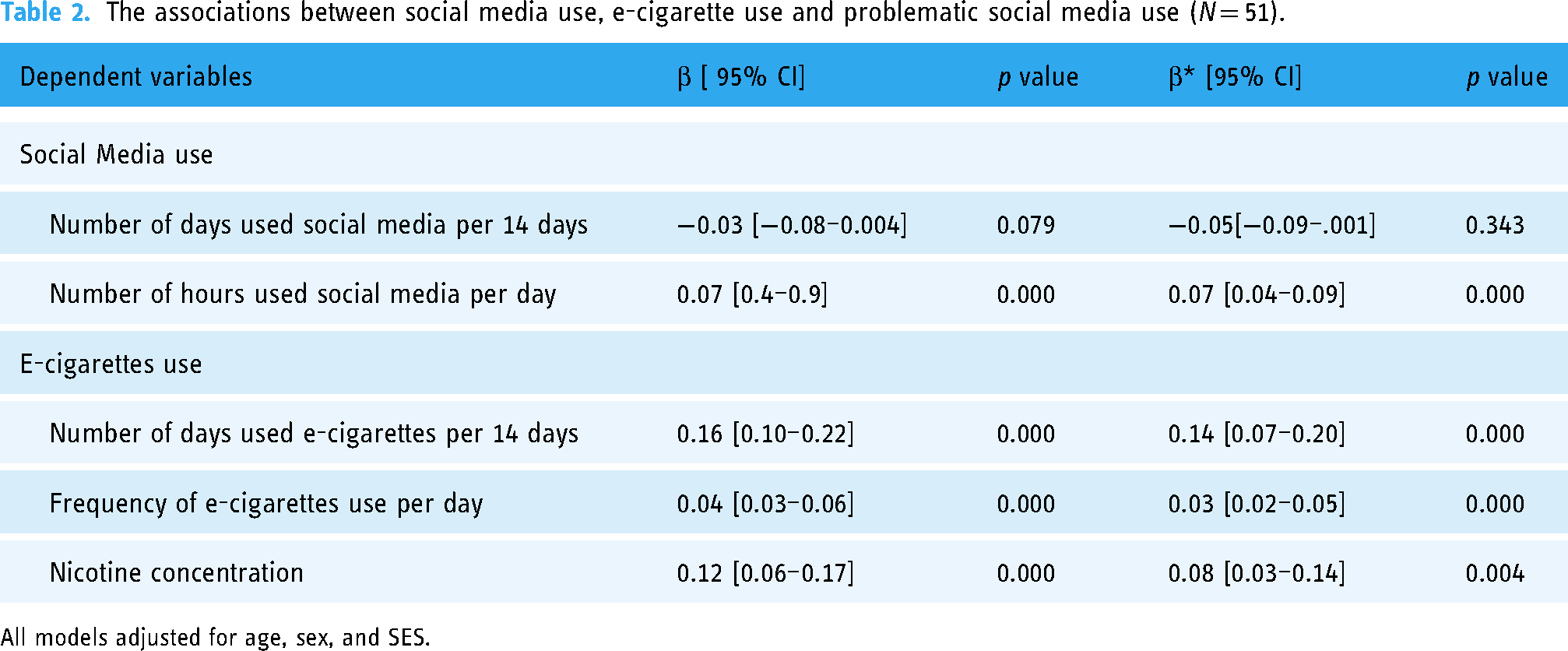
All models adjusted for age, sex, and SES.
Discussion
This study is one of the first EMA studies focused exclusively on Mexican-American college students to examine patterns of social media and e-cigarette use in a real-world context. Overall, findings show high daily social media and e-cigarette use, and that problematic social media use is significantly and positively associated with the daily patterns of e-cigarette use. Participants used e-cigarettes an average of three days a week, with a majority (88%) reporting at least one instance of use during the 14-day EMA period. These findings align with e-cigarette use trends observed among broader populations of young adults and college students.40,41 However, studies on e-cigarette use patterns exclusively among Mexican-American college students are limited.
Findings also show that despite participants with problematic social media use spending more time on social media, they did not have greater exposure to e-cigarette content or advertisements compared to participants without problematic social media use. This finding suggests that increased time spent on social media by participants with problematic social media use is not necessarily related to increased exposure to e-cigarette content or advertisements. Rather, problematic social media use might be a part of a broader risk-taking behavior pattern, 42 which includes experimenting with e-cigarettes and other substances. 43 Consequently, problematic and excessive behaviors in one area, such as social media use, often co-occur with a tendency to engage in other risky behaviors such as e-cigarette use. Such patterns may be attributed to genetic factors, traits such as low resilience and poor impulse control, or changes in brain function that makes them more susceptible to other addictive behaviors such as substance dependence.44,45 Another possible explanation for the insignificant association between time spent on social media by participants with problematic social media use and their exposure to e-cigarette content or advertisements is that social media online activities and content preferences of those with problematic social media use might focus on interactions, such as gaming or watching entertainment, 46 which may not include e-cigarette-related content. Future research in social media and tobacco use is important to provide more insights into the potential pathways from problematic social media use to e-cigarette use.
Further findings show that exposure to e-cigarette advertisements or content on social media platforms among Mexican-American college students is comparable to that observed in EMA studies among general populations of young adults. 47 For instance, a recent EMA study reported that young adult current e-cigarette users were exposed to pro-e-cigarette and anti-e-cigarette content on social media approximately one and three times, respectively, over 21 days. 47 Findings show that Mexican American college students are targeted by e-cigarette advertisements and/or content, however, participants might not recognize exposure to e-cigarette promotions via indirect marketing techniques. These techniques include the subtle incorporation of tobacco-related content in the background, user-generated videos, party scenes, and luxury lifestyles.2,48 Such strategies, which have historically been used by the tobacco industry to market e-cigarettes on popular websites targeting minority groups, including Hispanics, underscore the need for policymakers to enforce more strict advertising policies that explicitly address these subtler forms of advertising. 48
Findings from this study indicate that problematic social media use is associated with more frequent use of e-cigarettes per day, increased number of days using e-cigarettes, and the use of e-cigarettes with higher nicotine concentrations. These associations remained significant after adjusting for the effects of demographic factors. These findings align with and expand prior research documenting the influence of social media use on the patterns of e-cigarette use. For instance, frequent use of TikTok (several times per day compared to once a day or less frequently) was found to be a significant predictor of e-cigarette initiation (ever) and current use among adolescents in bivariate models, and after controlling for covariates. 2 Another study showed that passive and active behaviors on social media increased the likelihood of initiating and sustaining e-cigarette use among adolescents. 49 A possible explanation for these findings is that problematic social media use can create a dopamine-driven feedback loop, where users seek instant gratification through likes, shares, and positive comments. 50 A need for dopamine, a neurotransmitter that is associated with pleasure and reward, could encourage individuals to seek the same stimuli in behaviors, such as e-cigarette use. 50
Alternatively, our findings may be explained by social learning theory, which indicates that youth acquire behaviors through observation and interaction with others. 51 Posts on social media platforms positively portray e-cigarettes, depicting peers and influencers using them in appealing and everyday settings. 52 Such interactions might lead to holding positive expectancies toward e-cigarette use, creating a perception that this behavior is acceptable and worthy of emulation.53,54 For instance, a recent study among adolescents shows that greater social media use in daily life was associated with greater intention to use e-cigarettes, more positive attitudes, and greater perceived normative support. 53 For students experiencing problematic social media use, the desire to conform to these perceived norms can be even stronger. Additionally, previous work shows that problematic social media use is associated with mental health problems, including anxiety or depression due to factors such as cyberbullying, social isolation, perfectionism, and peer pressure.55,56 Some individuals might turn to the use of e-cigarettes as a coping mechanism to alleviate these negative feelings.57,58 For example, a recent study suggests that increased social media use may impact vaping, and nicotine dependency, by first increasing symptoms of anxiety and depression. 59 To our knowledge, the current EMA study is the only study that examines the influence of social media use as a problematic behavior on e-cigarette use. Thus, further research is needed to understand the mechanisms and pathways behind the link between problematic social media use and e-cigarette use, which could be informative for effective intervention, specifically for Mexican-American college students who are vulnerable to both social media and e-cigarette use.
Finally, it is worth noting that it is challenging to determine when social media usage becomes pathological and crosses the line into addiction, especially in the absence of recognized diagnostic criteria in the current versions of the Diagnostic and Statistical Manual of Mental Disorders or International Classification of Diseases. 60 This challenge may be attributed to the fact that behavioral addictions have been less studied than substance addictions, coupled with the limited empirical evidence supporting the notion that social media use is harmful enough to be classified as “addiction” or “pathological.” 61 Yet, this does not rule out the possibility that problematic social media use could be recognized as an addictive behavior or disorder in the future. To move toward such recognition, more behavioral and neurological research is needed to thoroughly understand patterns of overuse and its effects, which would be a crucial step before problematic social media use can be considered for inclusion in future updates of diagnostic guides like the Diagnostic and Statistical Manual of Mental Disorders.13,62 It is also worth noting that it took decades of empirical research before disordered gambling was officially recognized as an addiction in the DSM-5.60,63
Strengths and Limitations
Our study is not without limitations. First, the sample was limited to current e-cigarette users who were primarily female, thus, the results should be generalized with caution to other populations. Second, the daily EMA questions regarding exposure to e-cigarette content or advertisements did not capture detailed information about the nature of this content. For example, the questions did not distinguish whether the content was pro- or anti-e-cigarettes. Additionally, the questions were not designed to differentiate between exposure to direct and indirect marketing strategies related to e-cigarettes. Third, the general use of the BSMAS measure does not differentiate between the varying levels of addiction and psychological effects associated with different social media applications.64–66 Fourth, objectively measured social media use may not accurately reflect behavioral or psychological variables, nor indicate problematic use. 67 This suggests that even objective data might not fully capture social media's impact on mental health and behavior. Finally, the cutoff point score (>24) for the Bergen Social Media Addiction Scale (BSMAS) was derived from a sample of Chinese adolescents and may not be generalizable to a sample of Mexican-American college students.
Despite these and other potential limitations, our study has strengths. The response rate was high, and the retention rate is consistent with previous work among Mexican-American youth when examining tobacco use behaviors. 68 The results further suggest that remote data collection via an EMA app is a feasible and appropriate way to collect data about daily e-cigarette use and social media behaviors among Mexican-American college students. Moreover, EMA enhances validity and reduces recall bias by obtaining data from participants on a daily basis compared to retrospective studies with large gaps between assessments. For example, a recent study that aimed to characterize the difference between retrospective and real-time EMA measurements of the frequency of e-cigarettes used by young adults found that the number of reports of e-cigarette use per day via EMA was 8.5 times greater than that obtained from retrospective reports. 69 Such disparities/underreporting emphasize the importance of integrating EMA or real-time methods to gain deeper insights into the behaviors and attitudes of this demographic, to develop effective interventions.
Understanding the daily patterns of e-cigarette and social media use among Mexican-American college students is important for developing impactful intervention strategies. Our findings provide insights for designing interventions on the most impactful platforms and social settings for their dissemination. For example, disseminating anti-e-cigarette messages through platforms predominantly used by Mexican-American college students such as Instagram and TikTok could significantly enhance it is efficacy. Moreover, given the link between problematic social media use and e-cigarette use, health professionals should ensure accessible resources for those experiencing problematic social media use, are comparable to those available for other types of excessive or compulsive behaviors. This could include counseling services and awareness campaigns about the signs and the potential consequences of problematic social media use. Policymakers should also advocate for the development, and implementation of digital and media literacy in colleges. Such initiatives can strengthen digital resilience and improve students’ abilities to recognize, manage, and recover from excessive and compulsive social media use. 13
Supplemental Material
sj-docx-1-dhj-10.1177_20552076241283246 - Supplemental material for Problematic social media use and vaping among Mexican-American college students
Supplemental material, sj-docx-1-dhj-10.1177_20552076241283246 for Problematic social media use and vaping among Mexican-American college students by Bara S. Bataineh, Emily T. Hébert, Alexandra Loukas, Melissa B. Harrell, Qinghua Yang, Dhiraj Murthy, Seth Schwartz, Sungwon Jung and Anna V. Wilkinson in DIGITAL HEALTH
Footnotes
Acknowledgement
Research reported in this publication was supported by the National Institutes of Health under award number R01MD017280 to AL and AVW.
Authors’ Note
All authors contributed to and have approved the final manuscript.
Contributorship
Bara S. Bataineh: Conceptualization, Methodology, Formal Analysis, and Writing Original draft. Qinghua Yang, Dhiraj Murthy, and Seth Schwartz, and Sungwon Jung: Conceptualization, Methodology, Reviewing and Editing. Emily T. Hébert, Melissa B. Harrell, Alexandra Loukas, Anna V. Wilkinson: Conceptualization, Methodology, Writing-Reviewing, Editing, and Supervision.
Data availability
The data supporting this research are available from Anna V. Wilkinson and Alexandra Loukas on reasonable request.
Declaration of conflicting interests
The author declared the following potential conflicts of interest with respect to the research, authorship, and/or publication of this article: Dr Harrell serves as a consultant in litigation involving the vaping industry.
Funding
The authors disclosed receipt of the following financial support for the research, authorship, and/or publication of this article: Research reported in this publication was supported by the National Institutes of Health under award number R01MD017280. The funding body had no role in the design and conduct of the study. The content is solely the responsibility of the authors and does not necessarily represent the official views of the NIH.
Guarantor
AL and AVW.

Supplemental material
Supplemental material for this article is available online.
References
Supplementary Material
Please find the following supplemental material available below.
For Open Access articles published under a Creative Commons License, all supplemental material carries the same license as the article it is associated with.
For non-Open Access articles published, all supplemental material carries a non-exclusive license, and permission requests for re-use of supplemental material or any part of supplemental material shall be sent directly to the copyright owner as specified in the copyright notice associated with the article.
