




Abstract
This study examines the impact of physical and mental health conditions of officer of the watch (OOW) on marine accidents such as collisions and groundings. The research highlights the critical role of psychosocial factors, especially stress, burnout, and mobbing, in the occurrence of accidents. A Fuzzy Bayesian Network (FBN) based model was developed to quantitatively assess the effects of mental and physical health factors on marine accidents. Expert opinions were integrated into the model by converting linguistic uncertainties into probabilistic values using fuzzy logic. The subjective probabilities were elicited from 3 domain experts with backgrounds in maritime accidents, seafarers’ mental and physical health, and human factors. The results indicate that mental health-related issues increase the risk of accidents approximately 2.5 times more than physical health problems. Factors such as stress, burnout, and mental fatigue significantly impair decision-making, situational awareness, and communication. In contrast, the impact of physical fatigue due to long working hours, shift-based operational schedules, and lack of sleep was found to be moderate. The study demonstrates that physical measures alone are insufficient for maritime safety; a holistic approach that includes psychological support, workload management, and mental health assessments is necessary. The proposed FBN model realistically captures the complex effects of human factors, offering innovative contributions to accident prevention strategies.
Highlights
● Mental health issues pose approximately 2.5 times higher risk for collision and grounding accidents compared to physical health problems.
● The combined effects of stress, mobbing, and mental fatigue significantly increase accident risk by causing communication and coordination failures and loss of situational awareness.
● The developed fuzzy logic-based Bayesian Network model provides maritime stakeholders with a tool for developing accident prevention strategies and potential fleet-level applications.
Introduction
The maritime industry continues to be one of the primary modes of transportation in the globalizing economy of the 21st century, with approximately 90% of international trade carried out by sea. 1 However, the sector’s requirement for 24/7 continuous operations places a heavy physical and mental burden on seafarers leading various health problems. In particular, fatigue and mental health disorders are among the main issues that threaten the individual well-being of seafarers and directly affect operational safety. 2
Health is not merely the absence of disease or infirmity; it is a state of complete physical, mental, and social well-being. 3 In line with this definition, the health of individuals working in high-risk professions such as maritime is not only a personal concern but also of strategic importance for sectoral safety. The well-being of seafarers is a key determinant in maintaining operational skills such as attention, decision-making, communication, and reflexes. Mental health is defined as the ability of an individual to cope with stress, remain productive, and contribute to society. 4 The preservation of mental health in the maritime sector is crucial not only for the individual’s well-being but also for vital functions such as ship management, emergency response, and team coordination.
The physical and mental health conditions of seafarers are shaped by various risk factors inherent to the nature of the maritime profession. Elements such as social isolation, separation from family, excessive workload, irregular sleep patterns, shift-based operational schedules, noise, vibration, weather conditions, and piracy threats lead to both physical and mental fatigue in individuals.5 -7 In particular, extended periods without shore leave, social isolation, and uncertainty contribute to the widespread occurrence of mental health problems among seafarers, such as depression, anxiety, burnout syndrome, and post-traumatic stress disorder (PTSD).8,9 During the COVID-19 pandemic, these effects became even more pronounced, as practices such as delayed crew changes and extended periods onboard deepened mental problems.10,11 In terms of physical health, irregular nutrition, lack of adequate exercise opportunities, sleep disorders, musculoskeletal disorders, and cardiovascular problems are prominent.12,13 These conditions gradually lead to both workforce loss and safety risks.
One of the most common factors causing deterioration in physical and mental health is fatigue and sleepiness.14,15 Although these 2 terms are often confused with each other, they represent distinct physiological conditions. Sleepiness is related to the desire to fall asleep, while fatigue is a general state of exhaustion that develops after prolonged mental or physical effort.6,16 According to the International Maritime Organization (IMO), fatigue is characterized by a decrease in an individual’s physical, mental, or emotional capacity and negatively affects critical functions such as attention, decision-making, and reaction time. 17 In the maritime sector, this situation is an inevitable risk factor, particularly for crew working in shift systems. Although there are comprehensive international legal regulations in place aimed at reducing fatigue, the literature highlights ongoing challenges in their implementation and enforcement. In particular, Section A VIII/1 of the International Convention on Standards of Training, Certification and Watchkeeping for Seafarers (STCW) Code stipulates that seafarers must not work more than 14 h in any 24-h period and no more than 72 h in any 7-day period. Moreover, a minimum of 10 h of rest must be provided within every 24-h period, which may be divided into no more than 2 periods, one of which shall be at least 6 h long. 18 Similarly, the Maritime Labour Convention (MLC) 2006 sets forth comparable requirements concerning work and rest hours, aiming to protect the health, safety and well-being of seafarers. 19 A decrease in both sleep duration and quality can impair physical endurance as well as mental balance, leading to more serious health problems. 20 Evidence also suggests that, despite legal requirements, working and rest hours are not properly recorded on some vessels.5,6,21 This practice hinders the systematic monitoring of fatigue and prevents the development of analyses that bridge the gap between health and safety. In this context, the Guidelines on the Medical Examination of Seafarers, jointly published by the IMO and ILO, should also be considered as they emphasize the necessity of regular medical assessments to ensure that seafarers are physically and mentally fit for duty, particularly in cases where fatigue may jeopardize operational safety. 22
Occupational fatigue, as defined by the IMO 12 refers to a state of physical and/or mental impairment due to factors such as inadequate sleep, prolonged wakefulness, circadian disruption, and various forms of exertion, which may impair strength, decision-making, reaction time, and balance. In the maritime context, working on a ship exacerbates this through exposure to noise, vibration, irregular shifts, and challenging environmental conditions. 14 In contrast, mental fatigue arises from sustained cognitive activity and is characterized by a decreased ability to maintain optimal cognitive performance, manifesting as reduced attention, slower reaction times, and diminished motivation.2,9 While occupational fatigue may encompass mental fatigue, the 2 represent distinct dimensions one wider in scope (general exhaustion), the other more narrowly related to cognitive function and mental workload.
Physical and mental health problems not only reduce an individual’s overall functionality but also rank among the primary causes of accidents in maritime operations. Research indicates that 75% to 96% of marine accidents are attributed to human error.23 -26 An important piece of data highlighting the economic and operational dimensions of this issue is presented in a comprehensive review conducted by Allianz Global Corporate & Specialty, which analyzed nearly 15 000 marine liability insurance claims reported between 2011 and 2016. This review revealed that about 75% of the total claim value was attributed to human error, corresponding to a financial loss exceeding 1.6 billion US dollars. 27 These findings clearly demonstrate that human errors have serious impacts not only on safety but also on economic and operational outcomes.
A crew member with impaired health may exhibit behaviors such as slowed reflexes, lack of concentration, loss of motivation, and poor decision-making under stress.28,29 The failure to report or the tendency to ignore health-related issues can lead to a chain of errors and serious accidents. A reduced number of crew members also makes the health-safety relationship more vulnerable. Operations carried out with reduced crew increase individual workload and trigger both physical and mental fatigue, thereby raising the risk of errors. 5 However, studies that directly reveal the relationship between health status and accident risk are limited. Most research focuses on a single dimension, and the lack of systematic data makes it difficult to establish clear cause-and-effect relationships.
This study aims to examine the impact of Wellbeing’ physical and mental health conditions on operational safety and accident risk. In the existing literature, these 2 domains “health and safety” are often addressed separately, making it difficult to holistically understand the structural risks within the maritime sector. In this study, the term “marine accidents” refers specifically to 2 critical types of navigational incidents: collisions and groundings. These types of accidents were selected due to their strong association with human error and their significant representation in maritime safety reports. The study seeks to contribute to the development of health-centered policies and practices both to improve individual well-being and to reduce marine accidents. In this respect, it is expected to provide a scientific foundation for fostering a sustainable safety culture in the maritime industry.
Literature Review
Allianz’s 30 reported that between 2013 and 2022, a total of 27 477 marine accidents occurred worldwide, of which 807 resulted in ship losses. The material and morale losses caused by such marine accidents create significant impacts in the sector. Maritime safety, which is a critical issue in terms of human life, property, and environmental sustainability, always remains a top priority due to the complex and risky nature of maritime transportation.
The maritime industry presents a high-risk working environment for both physical and mental health due to isolation, adverse environmental conditions, and non-standard working hours. 2 Seafarers are exposed to adverse physical conditions for extended periods, including high noise levels, vibrations, extreme temperatures, cold winds, and variable humidity; while carrying out physically demanding tasks without adequate rest.9,31 These factors increases various health risks, such as injuries, illnesses, and mental health problems, negatively affecting the overall well-being of the crew. 31 Furthermore, factors such as social isolation, being away from family, sleep deprivation, and limited leisure activities further exacerbate the psychosocial vulnerability of seafarers. 32 In this context, improving working conditions, strengthening social support systems, and the development of strategies aimed at promoting mental health are pivotal in enhancing the overall health and well-being of crew. 33
Multinational crews play a vital role in the maritime industry and bring both advantages and challenges. 34 However, cultural distance between seafarers is a major determinant of stress and has been shown to hinder communication and relationship-building on board. 35 In addition, recent reviews assessing stress in seafaring have identified factors such as social isolation, poor sleep, fatigue, limited recreational opportunities, and multicultural crew composition as key sources of psychosocial strain. 36 These conditions, when combined, may contribute to increased vulnerability to mental health problems in multinational maritime environments, where cultural differences can complicate help-seeking behavior, emotional expression, and access to support systems.
The physical and mental health of seafarers is a topic extensively addressed in the literature. However, the number of studies that directly investigate the impact of health-related deficiencies on marine accidents remains limited. Key studies related to this subject and their details are summarized in Table 1.
Key Literature on Physical and Mental Health Issues.

The existing literature underscores that, owing to the distinctive conditions and challenges inherent in the maritime sector, it differs markedly from land-based occupations. The working environment aboard vessels requires substantial mental and physical exertion. Occupational fatigue, prevalent within the maritime workforce, poses significant threats not only to the physical and mental well-being of crew members but also constitutes a critical risk factor contributing to the occurrence of severe accidents and fatal events. The goal of safe and accident-free maritime transportation is a shared interest among all stakeholders in the industry, and one of the most effective means to achieve this objective is through a detailed analysis of the factors contributing to marine accidents. Accordingly, numerous modeling approaches aimed at identifying or predicting human error have been comparatively examined in the literature. As presented in Table 1, researchers such as Galieriková, 37 Hasanspahić et al, 40 and Maternová et al 43 have employed the Human Factors Analysis and Classification System (HFACS) to systematically analyze human factors in marine accidents. While the Human Factors Analysis and Classification System (HFACS) is effective in categorizing human error types post-incident, it is largely descriptive and lacks the ability to predict or quantify risk under uncertain conditions. Uğurlu et al 44 utilized a dynamic Bayesian network based on statistical analysis to model bullying behaviors in the maritime context. Dynamic Bayesian Networks provide a probabilistic structure and time-dependent modeling, but they often require large historical datasets, which are not always accessible or reliable in the maritime domain. On the other hand, Oraith et al 41 applied the Analytic Hierarchy Process (AHP) to quantitatively assess and prioritize the causes of human error in pilotage-related accidents. The AHP enables prioritization of factors through pairwise comparisons; however, it is highly dependent on subjective judgments and does not capture the probabilistic nature of human error interactions. Furthermore, several studies, including those by Nittari et al, 2 Ishak et al, 38 Rajapakse and Emad, 42 and Kim et al 45 have employed survey-based data collection methods combined with thematic analysis to explore the causal relationships between psychological, physiological, and environmental variables and the likelihood of accidents. Survey-based approaches combined with thematic analysis offer rich qualitative insights, yet they lack the formal structure needed for causal inference or risk quantification in complex operational settings.
Several systematic reviews have examined the physical and mental health of seafarers; however, these studies primarily emphasize the identification of general health risk factors and the development of recommendations to enhance seafarer well-being.2,9 In contrast, there appears to be a significant lack of meta-analytical research that quantitatively investigates the specific relationship between health-related conditions and the incidence of maritime accidents. This gap underscores the importance of adopting data-driven approaches capable of capturing the complexity of such relationships and modeling them within a causal framework.
Although numerous studies have examined the influence of human factors on maritime accidents, most of these investigations address physical and mental health conditions separately and within a limited scope. Existing models often consider human error in a general context, without sufficiently exploring the indirect effects of seafarers’ mental health issues on accident occurrence in detail. Therefore, there is a need for comprehensive research that evaluates both physical and mental health factors holistically and with more precise methodologies. In this study, both physical and mental health aspects were jointly analyzed and quantitatively modeled using fuzzy logic and Bayesian network approaches.
This study aims to move beyond the frequently addressed physical and mental health issues in the literature by comprehensively analyzing the causal relationship between these health conditions and marine accidents. Unlike existing research, this study adopts a holistic approach to evaluate the physical and mental factors underlying collision and grounding incidents, employing a Fuzzy Bayesian Network methodology supported by expert opinions. By critically reviewing the strengths and limitations of previous models, this study positions its methodological approach as a balanced solution that addresses both the qualitative complexity and the quantitative uncertainty inherent in maritime accident analysis. Thus, the study presents a novel approach that systematically examines the impact of human factors on accidents while integrating both quantitative and qualitative data. The findings are expected to contribute to the development of safety policies within the maritime sector and to offer more effective solutions for accident prevention.
Method
In this study, the relationship between the physical and mental health conditions of officer of the watch (OOW) and marine accidents was examined. The scope of the research was limited to collision and grounding accidents, as these are particularly associated with physical and mental health factors. A fuzzy logic-based Bayesian Network model was developed to explain the occurrence of such accidents. This network structure enables the analysis of causal and logical relationships among the components of seafarers’ physical and mental health. The study was conducted between November 2024 and April 2025. As an academic research project, it did not involve any experimental applications, fieldwork, biomedical interventions, or observation-based data collection methods that would require ethical approval. Instead, the study was carried out based on a comprehensive literature review, expert opinions, and secondary data sources. To analyze the impact of physical and mental health issues on collision and grounding accidents, a fuzzy logic-based Bayesian Network model was developed. Expert evaluations were utilized to determine the conditional probability values within the model, and all procedures were conducted in accordance with ethical research standards. The study comprises 5 main steps, which are outlined below.
Step 1: Definition of Variables in the Bayesian Network Structure
In the first step, factors that may influence the occurrence of collision and grounding accidents due to physical and mental health problems were identified based on a comprehensive literature review, marine accident data, and expert opinions in the field. These identified factors form the foundation of the Bayesian network model developed in the study. The expert group included in the study consists of 3 individuals with the necessary background in marine accidents, physical health, and mental health concepts. Detailed information about the experts is provided in Step 3. The nodes included in the network structure and their corresponding descriptions are presented below.
Definition of Key Variables (Nodes) in the FBN Model
Workload: In short sea shipping, frequent port calls and the task distribution based on different ranks increase the workload; in addition, inspections carried out by classification societies and official authorities, along with the preparation processes for these inspections, further intensify this burden.5,6,46,47 The negative state of the workload node is defined as “excessive,” while the positive state is considered “normal.” Three parent nodes have been identified as influencing the formation of workload: rank, type of voyage, and pressures originating from the company and port authorities.
Physical fatigue: Among the most prominent risk factors affecting fatigue are job stress, shift-based operational schedules, and physical workload. Additionally, the relationship between sleep quality and duration, and fatigue is consistently supported in the literature.4,48 The physical fatigue node is characterized by a negative state designated as “yes” and a positive state designated as “no.” There are 2 parent nodes that influence the development of physical fatigue: workload and sleep quality.
Sleep quality: The comfort of living and working spaces plays a critical role in reducing fatigue and significantly affects sleep quality; while increased leisure time and sleep duration during long voyages contribute positively, environmental factors such as noise, vibration, motion, and light can disrupt sleep patterns and increase fatigue.17,49,50 In this study, the negative state of the sleep quality node is defined as “bad,” while the positive state is “good.” Additionally, there are 3 parent nodes affecting the formation of sleep quality: ergonomic design, type of voyage, and noise and vibration.
Physical health: Insufficient sleep period and quality are among the most common causes of fatigue, and the negative effects of insufficient sleep period on health have been experimentally demonstrated.14,51 Illness significantly reduces the quality of life of seafarers, while factors such as nutrition, working conditions, and living conditions negatively affect the overall health of seafarers and increase the risk of many chronic diseases.14,27,52 Additionally, alcohol and tobacco use emerge as significant sources of health problems within the maritime industry.53,54 The negative state of the physical health node is labeled as “bad,” while the positive state is labeled as “good.” There are 4 parent nodes influencing the formation of workload: physical fatigue, illness, nutrition, and alcohol and drugs.
Stress: In the maritime industry, prolonged working hours, shift-based operational schedules, vessel movements, as well as exposure to noise and vibration constitute significant physical stressors that adversely affect sleep quality. The resulting disruption in restorative sleep contributes to elevated levels of psychosocial stress among seafarers.8,52 Factors such as insufficient participation in decision-making processes, external control pressures, and excessive workload further exacerbate the stress in question.23,54 In port operations, unpredictable shifts, increased inspection pressure, and high maneuvering intensity contribute to elevated stress and fatigue among seafarers. Additionally, negative social interactions on board, such as mobbing, not only increase stress levels but also adversely affect job performance.44,55 The stress node exhibits a negative state denoted as “yes” and a positive state denoted as “no.” There are 4 parent nodes influencing the formation of stress: internal and external audits, noise and vibration, company and port pressure, and mobbing.
Morale: When describing crew performance on board, emphasis is often placed on concepts such as family bonds, happiness, togetherness, morale, motivation, and satisfaction. 56 However, seafarers often go through an emotionally challenging period due to being away from their families and social circles during the onboard contract period; this situation can lead to a decline in morale, reduced performance, and an increased risk of occupational accidents. 57 Factors such as the lack of adequate social support mechanisms onboard, the absence of activities to occupy leisure time, and insensitivity to cultural differences can further exacerbate these negative effects. 58 Moreover, stressors encountered in the work environment negatively affect seafarers morale, increasing the tendency to resign and creating a basis for adverse behaviors such as excessive alcohol consumption or conflicts with colleagues. 59 The negative state of the morale node is defined as “bad,” while the positive state is defined as “good.” Four parent nodes influence the formation of morale: Onboard relations, family issues, social facilities, and stress.
Social isolation: Extended durations of deployment at sea contribute to the physical detachment of seafarers from the external world, a condition that significantly undermines seafarers’ morale and exacerbates experiences of social isolation. 60 The reduction in crew numbers and extended durations away from family members contribute to isolated working conditions, particularly on deep-sea merchant vessels. Furthermore, factors such as limited shore leave allowances as regulated by the MLC 2006, lack of access to the internet, and inadequate recreational facilities constitute major factors exacerbating stress levels and feelings of isolation among seafarers.61,62 The social isolation node has a negative state labeled as “no” and a positive state labeled as “yes.” There are 3 parent nodes influencing the formation of social isolation: Morale, family issues, and social facilities.
Mobbing: Various factors contribute to the emergence of mobbing and harassment in the workplace. Among these, the inadequacy of managerial skills is considered a particularly prominent factor in preventing such negative behaviors. 55 The existing literature demonstrates a consensus on the critical role of effective management practices in mitigating workplace mobbing and harassment. Furthermore, the dynamics of interpersonal relationships among seafarers are identified as a significant determinant influencing the occurrence of such negative behaviors. 44 The mobbing node’s negative state is labeled as “yes,” and its positive state is labeled as “no.” There are 2 parent nodes influencing the formation of mobbing: Onboard relations and management, leadership, and guidance.
Mental fatigue: Mental fatigue arises as a result of excessive workload, prolonged working hours, emotional exhaustion, and chronic mental stress.6,16 In the maritime industry, fatigue is influenced not only by working conditions but also by various individual and environmental factors such as age, health status, perceived stress levels, safety behaviors, and the number of crew onboard. 63 The mental fatigue node has a negative state of “yes” and a positive state of “no.” There are 2 parent nodes influencing the formation of mental fatigue: Mobbing and stress.
Burnout: Burnout is a prevalent issue observed among seafarers that significantly impacts their professional performance. Prolonged work in confined and isolated environments, combined with limited social interaction, can trigger this condition. 64 Stressors specific to life onboard vessels, over time, contribute to emotional exhaustion and are closely associated with psychosocial issues such as work-family conflict. 65 Research indicates that occupational stress and physical fatigue significantly contribute to the increase of burnout.8,66 Moreover, workplace mobbing not only adversely affects mental health but also significantly increases the risk of anxiety, depression, sleep disorders, and burnout.8,64 -67 The burnout node has a negative state “yes” and a positive state “no.” There are 4 parent nodes influencing the formation of burnout: Social isolation, stress, mental fatigue, and mobbing.
Mental health: The mental health of crew working in the maritime industry is influenced by various psychosocial risk factors. Fatigue is associated not only with work performance but also with mental illnesses and even severe health outcomes such as suicide.21,29 Burnout can gradually evolve into harmful coping strategies, which in turn create a basis for the development of mental health problems. 65 The guide prepared by the International Seafarers’ Welfare and Assistance Network (ISWAN) identifies stress, anxiety, fatigue, mobbing, destructive thoughts and behaviors, as well as alcohol and drug abuse as common causes of mental health issues observed among seafarers. 68 Exposure to mobbing is associated with increased alcohol and drug use, which can further exacerbate both physical and mental health outcomes.50,69 As a structural measure to address these issues, ensuring adequate nutritional conditions for ship crew is emphasized as an important factor in supporting their mental well-being. 9 The mental health node has a negative state of “bad” and a positive state of “good.” Additionally, there are 5 parent nodes influencing the formation of mental health: Mental fatigue, burnout, stress, nutrition, and alcohol and drug use.
Situational awareness: The importance of situational awareness is frequently emphasized by marine accident investigators.23 -25,70 This concept is closely related to individual human factors such as fatigue, stress, health status, communication, and alcohol consumption. 71 Moreover, the vast majority of negative factors affecting situational awareness are of psychological in origin. The situational awareness node has a negative state of “lack” and a positive state of “sufficient.” There are 3 parent nodes influencing the formation of situational awareness: Communication and coordination, physical health, and mental health.
Communication and coordination: The professional knowledge and maritime experience of managers play a crucial role in protecting the mental health of crew serving onboard. In particular, the relationships established directly with supervisors can positively influence the psychological well-being of crew. 72 In this context, manager-employee relationships based on trust, sensitivity, and mutual respect constitute fundamental elements of a healthy work environment. It has been observed that in situations where managerial support is strong, negative outcomes such as loss of energy, physical exhaustion, and behavioral imbalances are less prevalent among employees. 73 The expression of negativity regarding the communication and coordination node is “inadequate,” while the positive expression is “adequate.” There are 2 parent nodes that influence the formation of communication and coordination: Physical health and mental health.
Operational condition: In the occurrence of grounding, and collision/allision accidents on ships, operational conditions play a complementary role in the unsafe act resulting in an accident.24,74 Operational conditions are divided into 2 categories: internal conditions, which can be partially controlled by ship operators, and external conditions, which cannot be controlled. Among the operational conditions, internal factors such as engine failure, rudder failure, and bow thruster malfunction are among the most influential elements. In addition, external conditions such as adverse weather and sea conditions also have a significant impact on the occurrence of such accidents. 23 The negative expression regarding the operational condition node is “unsuitable,” while the positive expression is “suitable.” There are 2 parent nodes that influence the formation of the operational condition: Internal condition and external condition.
Human error: A major cause of human errors leading to collision accidents is the lack of communication and coordination in bridge resource management. 25 Poor leadership, insufficient task knowledge, and ineffective communication are cited as fundamental causes of human errors and accidents.24,74 Additionally, lack of leadership is associated with poor interpersonal relations and teamwork, which contributes to an increase in human errors onboard. Furthermore, studies show that more than 60% of human errors are related to situational awareness. 24 The negative expression for the human error node is “yes,” while the positive expression is “no.” The formation of human error is influenced by 3 parent nodes: Communication and coordination, management and leadership, and situational awareness.
Marine accident: The vast majority of collision and grounding accidents originate from human errors; 77% of collision accident causes and 81% of grounding accident causes are associated with human error.23,24 The negative expression for the marine accident node is “yes,” while the positive expression is “no.” The formation of marine accident is influenced by 2 parent nodes: Human error and operational condition. In this study, collision and grounding accidents are modeled under a single “marine accident” outcome, based on the assumption that these 2 types of accidents share similar human factor-related causes. This similarity is supported by common human errors such as decision-making failures, communication issues, and skill-based deficiencies observed in both accident types.
Step 2: Establishing the Bayesian Network Structure
In the first step of the study, the nodes to be included in the network structure were determined. In the second step, expert opinions were utilized to construct a Bayesian Network structure that reflects how factors related to physical and mental health influence the occurrence of marine accidents. This developed network structure enables the prediction of collision and grounding accidents attributable to physical and mental health under varying conditions.
The Bayesian Network is used as an effective tool for modeling systems that involve uncertainty and complexity. It is a graphical model that visualizes and analyzes probabilistic relationships among variables. 75 These structures typically consist of 2 fundamental components: first, the graphical structure comprising nodes and edges; and second, the component in which the variables are quantitatively represented through conditional probability tables. 76 Nodes in Bayesian Networks are classified into 4 categories: Root nodes, parent nodes, child nodes, and outcome nodes.77,78 Each node represents a random variable. The arrows indicate causal or conditional dependency relationships between the variables. Each node contains a probability distribution conditioned on its parent nodes. When data is entered into the network (eg, when some variables are observed), the probabilities of other variables are updated using Bayes’ Theorem. This updating process is referred to as inference. The objective is to estimate the probabilities of unknown variables based on the observed data. In this study, the FBN-based prediction model, which summarizes the impact of physical and mental health issues on the occurrence of collision and grounding accidents, is presented in Figure 1.
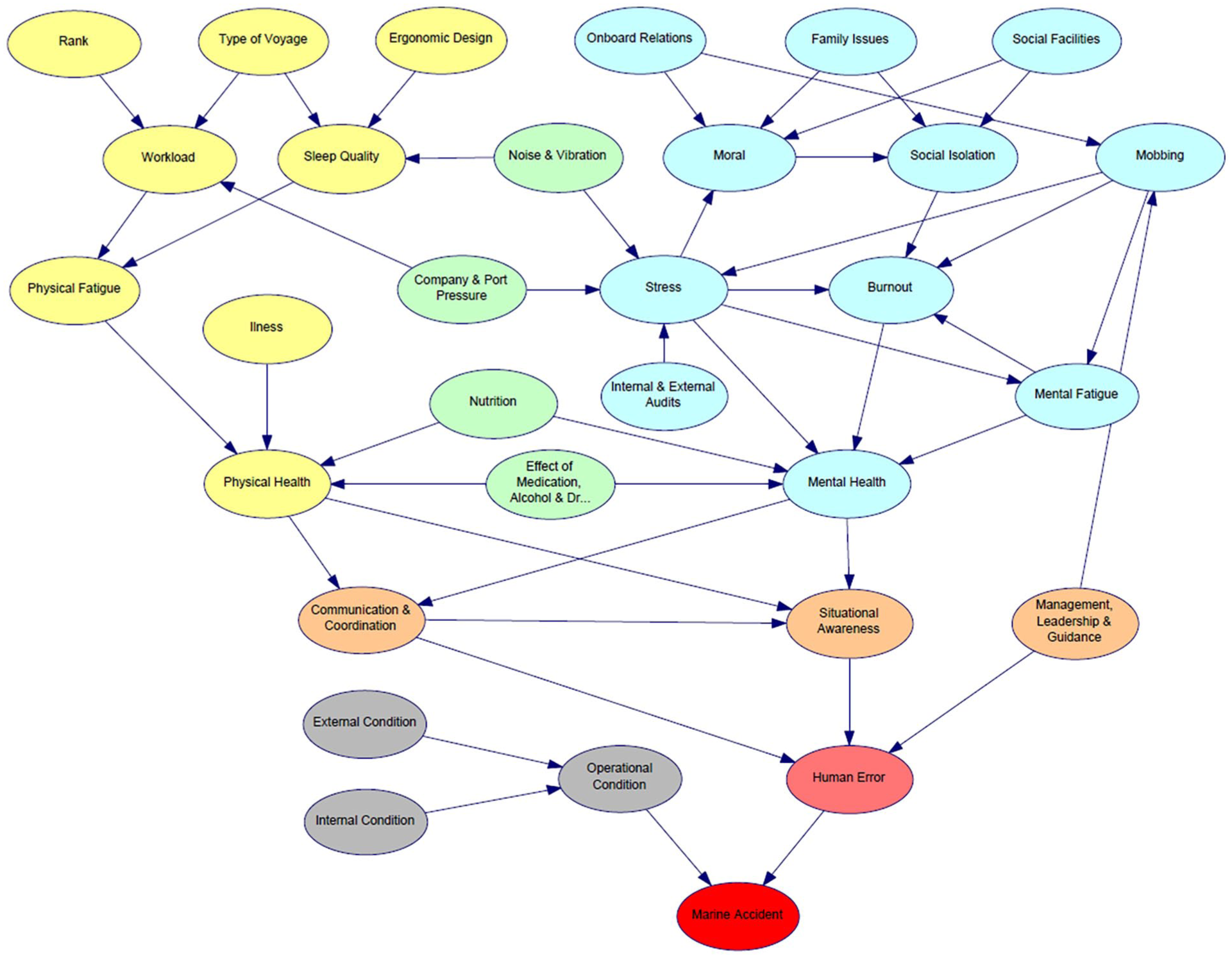
The FBN model summarizing the impact of physical and mental health issues on the occurrence of collision and grounding accidents.
Step 3: Determination of Fuzzy Logic-Based Probability Values for the Nodes in the Bayesian Network Structure
Expert opinions were consulted to determine the conditional probability values of the nodes included in the study. In order to assign these values within the network structure, interviews were conducted with 3 experts who actively contributed to the initial construction of the network and the assignment of weights to the nodes. The experts consulted in this study possess substantial knowledge and academic experience in the fields of maritime studies, marine accidents, and the physical and mental health of seafarers. Formal expert selection should follow established qualification criteria including: domain-specific expertise, years of practical experience, academic credentials, and track record in the field. In this research we considered these criteria to designate experts. Differences among expert opinions were resolved through joint evaluation meetings conducted after individual assessments during the fuzzification process. The consensus values reached during these sessions were incorporated into the model. Additionally, axiom tests were applied to assess the structural consistency and logical validity of the model. The positive results obtained from these tests support the reliability of the model. Information about the experts consulted in the study is provided below.
In weighting the experts’ inputs, their professional qualifications and experience were taken into consideration. The 3 selected experts possess a comparable level of in-depth knowledge, academic competence, and field experience in marine accidents, human factors, and the physical/mental health of seafarers. Based on this shared expertise profile, equal weight was assigned to their opinions during the construction of the conditional probability tables. Each expert’s contribution was considered scientifically equivalent, and no individual’s input was regarded as superior to the others. This approach ensures methodological transparency and supports the structural consistency of the model.
Expert opinions were obtained individually from each expert, and the seven-point fuzzy number scale presented in Table 2 was used for the evaluations. At the beginning of the evaluation process, the experts were provided with the necessary information about the structure and operating principles of the Bayesian Network. Subsequently, the conditional probability tables related to the sub-nodes were presented to the experts, and they were asked to assess the negative impact of each condition on the system. The conditional probability tables were created based on evaluations obtained independently from each expert. When significant differences in expert opinions were identified, these discrepancies were discussed through focused group meetings, and a consensus was reached. This structured process was applied to ensure the internal validity and consistency of the model. The calculations of fuzzy numbers were based on the studies referenced as Yıldız et al 79 and Özaydın et al. 80
Fuzzy Numbers 7-Level Linguistic Evaluation Scale.

Step 4: Verification of the FBN Structure
A reliability test is conducted on the Bayesian Network to evaluate the model’s structural accuracy and consistency. Within this scope, the conformity of the relationships between variables in the network to probability theory is examined through axiom tests. 24 The tests are conducted to verify the logical consistency of the model and to enhance the reliability of the inferences. 79 Successful results indicate that the Bayesian Network is a valid and reliable analytical tool.65,80 The contents of the axiom tests are presented below.
Axiom 1: Small increases or decreases in the probability values of each parent node are expected to result in proportional changes in the probabilities of the child node.
Axiom 2: When the probabilities in the parent nodes are gradually increased, the effects of these changes on the child node are expected to show a steady and consistent increase.
Axiom 3: In child nodes connected to multiple parent nodes, the combined effects of these parents are expected to be more pronounced compared to their individual effects.
Step 5: Analysis of the Relationship Between the Physical and Mental Health Conditions of OOWs and the Occurrence of Marine Accidents
The developed model is designed to dynamically predict the probability of ship accidents by taking into account the physical and mental health conditions of seafarers. Accordingly, a Bayesian Network model capable of forecasting accident probabilities under varying conditions has been constructed. Using this network structure, the effects of physical and mental health issues on marine accidents were analyzed based on varying conditions. Within this scope, the impacts of changes made to the nodes in the network on physical and mental health as well as accident risk were examined, and the obtained results were evaluated through comparison with the existing literature.
Application of Proposed Method
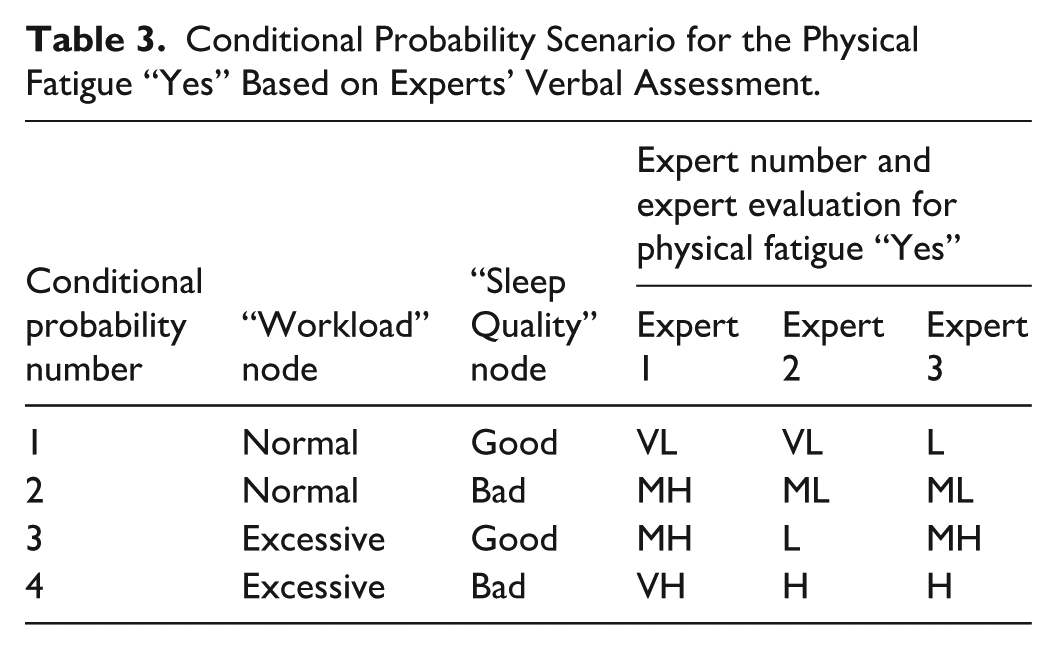
This section provides a detailed discussion of the methodological processes carried out within the frameworks of fuzzy logic and Bayesian Network approaches for the calculation of fuzzy probability values. As an illustrative example, verbal assessments based on expert opinions regarding the physical fatigue node, which serves as a sub-node, are presented (Figure 2, Table 3). The conditional probabilities for the physical fatigue node were constructed based on 4 different scenarios derived from the 2 variables above it: workload and sleep quality. For each conditional probability scenario, these 2 factors affecting the OOW’s sleep quality were evaluated by experts as shown in Table 3, using the linguistic terms defined in Table 2. Table 4 presents the fuzzy numbers corresponding to the experts’ verbal expressions. The formalizations and calculations in the sample application were based on the studies by Kaptan et al, 24 Yıldız et al, 79 and Özaydın et al. 80

Physical Fatigue node and its parent nodes.
Conditional Probability Scenario for the Physical Fatigue “Yes” Based on Experts’ Verbal Assessment.
Corresponding Numerical Values for Experts’ Verbal Expressions.

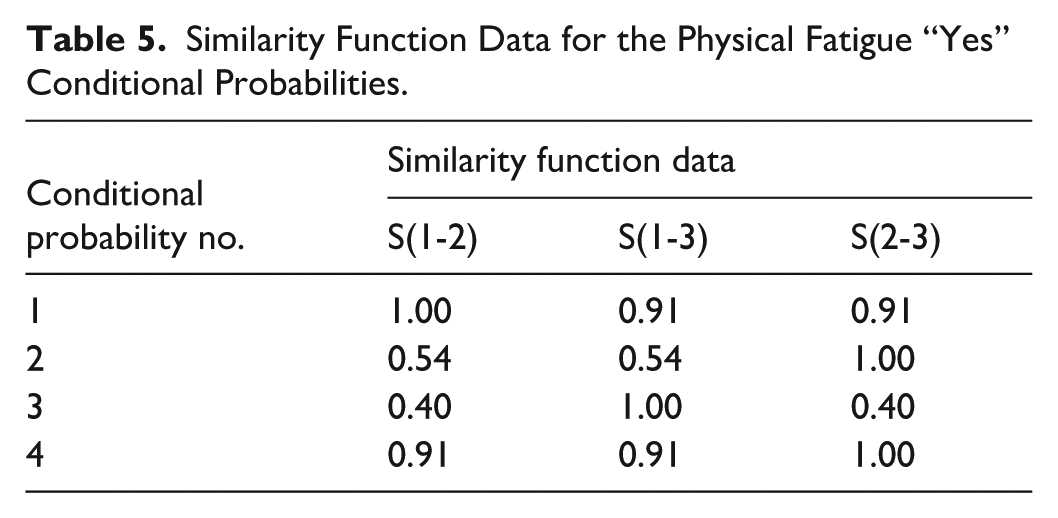
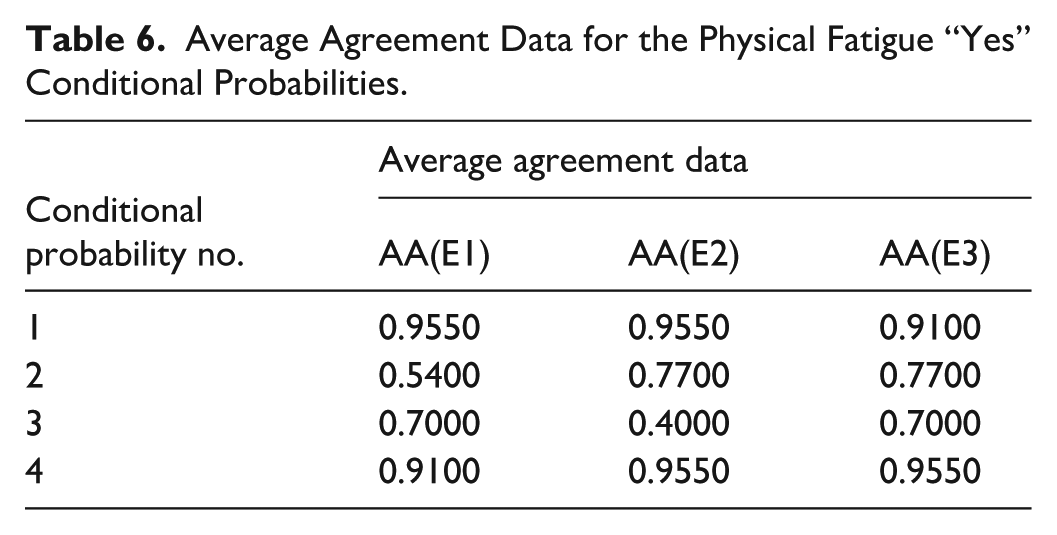
The aggregation phase consists of 4 fundamental steps, and the process for the first 4 conditional probability scenarios is presented through the tables below: The first step, Similarity Function data, is shown in Table 5; the second step, Average Consensus levels, in Table 6; the third step, Relative Consensus rates, in Table 7; and the fourth step, Consensus Coefficient results, are presented in Table 8. After completing the aggregation process, the final fuzzy probability values for the 4 conditional probability scenarios are presented in Table 9 during the defuzzification phase.
Similarity Function Data for the Physical Fatigue “Yes” Conditional Probabilities.
Average Agreement Data for the Physical Fatigue “Yes” Conditional Probabilities.
Relative Agreement Data for the Physical Fatigue “Yes” Conditional Probabilities.

Consensus Coefficient Data for the Physical Fatigue “Yes” Conditional Probabilities.

Defuzzification and Fuzzy Probability Data for the Physical Fatigue “Yes” Conditional Probabilities.


An example of calculating the similarity function for conditional probability number 2, S(1-2), is provided based on equation (1).

S(1-2) = 0.54
For triangular fuzzy numbers, the Average Agreement (AA) level of an expert’s opinion, noted as

An example of calculating the Average Agreement degree AA(E1) for conditional probability number 2 is provided based on equation (2).

AA(E1) = 1
The Relative Agreement (RA) level for each expert, denoted as

An example of calculating the Relative Agreement data RA(E1) for conditional probability number 2 is provided based on equation (3).

RA(E1) = 0.2596
The Consensus Coefficient (CC) degree of expert opinions

The coefficient β is used in the model to jointly consider the extent to which an expert agrees with others (RA: Relative Agreement) and the importance (weight) assigned to that expert. In this study, expert weights (W) were considered equal, and each expert was assigned a weight factor of 0.3333. β serves as an adjustment factor to balance both the consensus level among experts and their assigned weight based on expertise. In this study, β is set to a value of 0.5.
An example of calculating the Consensus Coefficient data CC(E1) for conditional probability number 2 is provided based on equation (4).


The aggregated result of the experts’ judgment

An example of generating fuzzy numbers for conditional probability number 2 is provided based on equation (5).


When triangular fuzzy mathematics are employed in computations, the outcomes inherently maintain their triangular fuzzy characteristics. To establish meaningful connections between these computational outputs, fuzzy values must undergo conversion into discrete numerical indicators, referred to as “Fuzzy Probability Score” (FPS).

An example of calculating the probability value of conditional probability number 2 is provided based on equation (6).

FPS1=0.4064
An example calculation of the posterior probability values for the Physical Fatigue node is provided below. Figure 3 is referenced in the example calculation. The abbreviations Physical Fatigue: PF, Workload: WL, and Sleep Quality: SQ are used in the calculations. The experts’ evaluation scores for the conditional probability tables are presented in Table 10.


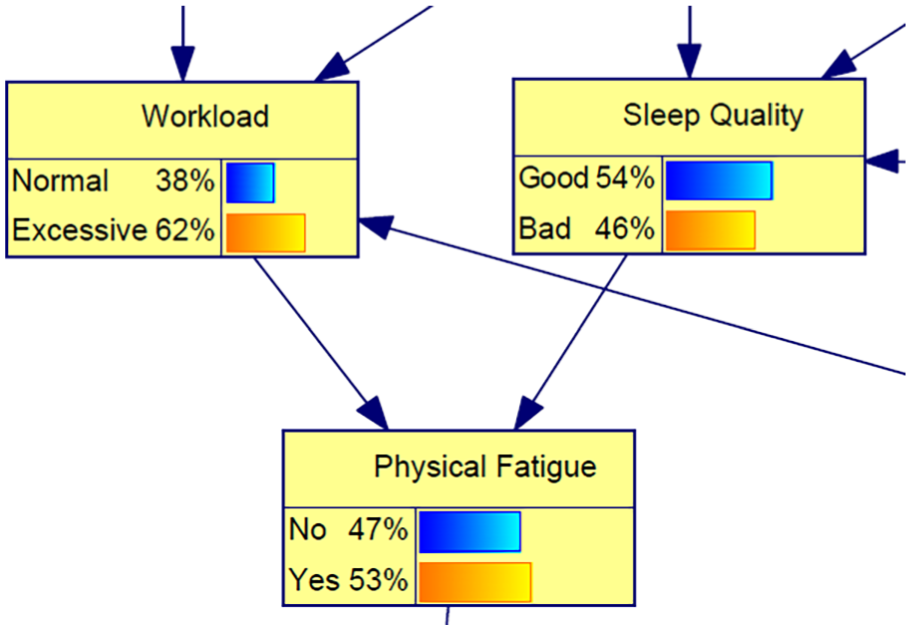
Posterior probability values of the physical fatigue node and its parent nodes.
Physical Fatigue Node With Conditional Probabilities in the Accident Network.

Moreover, the fuzzy probability values obtained for all conditional probability scenarios derived from a total of 31 nodes throughout the entire network structure were integrated into the GeNIe software 81 thereby yielding posterior probability distributions for the outcome nodes (Figure 4). In this study, a moderate level of variability was observed among expert opinions, with 29% showing high consensus, 42% moderate consensus, and 29% low consensus, resulting in an overall acceptable level of agreement.

Initial and posterior probability values of the nodes in the network structure created to analyze the effects of Physical Health and Mental Health on the occurrence of marine accidents.
Findings
This study analyzed the impact levels of physical and mental health-related inadequacies on the occurrence of marine accidents. The effects of physical and mental health on marine accidents are presented in Table 11. The influence of sub-nodes on the probability of marine accidents was calculated based on the parent nodes’ probabilities at 0% and 100% (results of sensitivity analysis). The difference between these probabilities is indicated in the “Range” column. The higher the value in the “Range” column, the greater the probability of marine accidents originating from that node. As an example, Figure 5 illustrates the effect of mental health on the probability of marine accidents. According to the study findings, mental health contributes significantly to marine accidents, with a value of 27%.
The Impact of Physical and Mental Health on the Occurrence of Marine Accidents.


The impact of mental health on the occurrence of marine accidents.
This study concluded that the mental health of OOWs is approximately 2.5 times more impactful than their physical health in the occurrence of marine accidents (Table 11). It was found that mental health problems weaken communication and coordination and pose a serious threat to situational awareness. Additionally, mental health problems play an indirect but significant role in human errors closely associated with OOWs’ actions, such as faulty decision-making, perception errors, and rule violations.
Upon examining the network structure developed in the study, among the inadequacies contributing to mental health problems, burnout, stress, and mental fatigue emerge as the primary factors most adversely affecting the mental health of OOWs (Table 12). The high impact rates of these 3 nodes clearly indicate the need for focused attention on these areas. Burnout is characterized as a long-term state of fatigue helplessness and hopelessness resulting from exposure to intense emotional demands related to work and it is commonly observed in professions such as seafaring that require continuous face to face interactions with the same individuals.65,82 In this study, the factors triggering burnout were identified, in order, as mobbing, stress, and mental fatigue. Stress is a condition in which an individual feels an imbalance between environmental demands and their capacity to cope with these demands, resulting in physical and mental responses. 83 It is a primary cause of many physical and mental problems and triggers numerous life-threatening diseases such as cancer. In this study the main sources of stress experienced by seafarers were identified as mobbing and company port pressure. Additionally, the study results revealed a strong relationship between stress, mobbing and mental fatigue which adversely affect the mental health of seafarers and consequently trigger the occurrence of marine accidents.
Sensitivity Analysis of Factors Adversely Affecting Physical and Mental Health.

The most significant factor affecting the physical health problems of OOWs was found to be physical fatigue. Physical intensity is a critical issue that plays a role at least 3 times greater than other factors in the development of physical health problems. In the maritime profession, seafarers frequently experience physical fatigue due to long working hours, shift-based operational schedules, sleep disturbances, and adverse environmental conditions onboard, such as vibration, noise, and wave motion. This physical fatigue can adversely affect both occupational safety and the overall health and performance of seafarers. The study results indicate that excessive workload is an influential factor on physical intensity among seafarers. Additionally, the study found that illness and the consumption of alcohol and drugs negatively impact the physical health of seafarers.
In the final stage of the study, the impact of inadequacies related to physical and mental health on factors triggering marine accidents was analyzed. For this purpose, a sensitivity analysis was conducted on the inadequacies associated with physical and mental health, and their effects on the parent nodes were examined (Figure 6). The analysis results indicate that problems related to mental health, such as mobbing, burnout, and mental fatigue, are prominent factors in the occurrence of collision and grounding accidents. Critical and highly important sub-factors causing errors by OOWs were identified as these 3 inadequacies along with stress. Factors playing a role in the formation of communication and coordination deficiencies and situational awareness deficits were determined as follows: burnout (critical), mental fatigue (high), stress (high), mobbing (moderate), being under the influence of alcohol and drugs (moderate), and physical fatigue (moderate).

The impact of Physical and Mental health-related inadequacies on factors triggering marine accidents.
Discussion
The findings of this study indicate that mental health is a more significant determinant than physical health in the occurrence of marine accidents. In particular, it has been identified that decision-making processes, levels of attention, and rule violations among OOWs, which are forms of human error, are closely associated with their mental health status. Similarly Lefkowitz and Slade 84 reported that seafarer experiencing psychological problems such as depression and anxiety have more than twice the risk of experiencing occupational accidents. This finding is consistent with the results of the current study.
Mental health problems have been found to cause deficiencies in communication and coordination, reduce situational awareness, and negatively affect the safety of maritime operations. While Yıldırım et al 85 emphasized that situational awareness is directly related to mental state, Sharma 86 stated that high stress levels among OOWs lead to reduced attention and lack of awareness, resulting in increased operational risks. These findings suggest that psychosocial factors such as burnout, stress, mental fatigue, and mobbing pose multidimensional risks to maritime safety.
The study revealed that burnout, mental fatigue, and stress have particularly negative effects on the mental health of OOWs (Table 12). The literature indicates that burnout develops as a result of chronic stress and that stress reinforces this process. Oldenburg et al, 8 Uğurlu et al, 65 Chung et al, 66 and Şendilmen Danaci and Kececi 87 reported an inverse relationship between burnout and mental health. In the present study, burnout was identified as a critical factor in the emergence of mental health problems. Additionally, findings indicating that burnout leads to distraction and increases the risk of accidents (Figure 6) were observed to be consistent with the literature. For instance, Bergefurt et al 88 conducted a path analysis to examine the expected relationships between mental health and workplace distractions. Their findings indicate that distractions play a significant role in the level of stress and burnout complaints. Additionally, Chung et al 66 noted that burnout among seafarers leads to reduced energy and increased distractibility, thereby elevating the risk of maritime incidents. These studies quantitatively and contextually support the claim that burnout can impair attention and increase the likelihood of human error in safety-critical environments. The data indicate that mobbing, company pressure, and excessive workload trigger stress and mental fatigue. These factors are understood to reduce the psychological resilience of seafarers, negatively affecting their decision-making processes. Mayhew and Grewal 89 and Österman and Boström 90 have indicated that excessive workload and hierarchical pressure may create a basis for mobbing, while Mayhew and Chappell 91 highlighted that continuous exposure to mobbing can have traumatic effects. Mental health has been identified as playing a significant role in the occurrence of serious marine accidents such as collisions and groundings. 92 These types of accidents are often associated with factors such as burnout, stress, and mental fatigue. Yıldırım et al, 85 reported that the impact of mental health on such accidents is 1.9 times greater compared to physical health. In the present study, this ratio was calculated to be approximately 2.5 times.
Physical health problems have been found to be primarily caused by physical fatigue, which is associated with factors such as prolonged working hours, shift-based operational schedules, sleep disturbances, and the ship environment. Uğurlu et al, 5 Uğurlu, 6 Jepsen et al, 16 and Dohrmann and Leppin 48 have shown that fatigue symptoms are linked to extended work durations, poor sleep quality, voyage type, and environmental factors. In addition to the existing literature, this study concludes that fatigue, encompassing both physical and mental aspects, constitutes a significant risk factor for marine accidents.
Overall, it has been concluded that the mental and physical health conditions of OOWs working on board are directly related to cognitive and behavioral factors associated with human error. Therefore, strategies aimed at preventing marine accidents should not be limited to physical safety measures alone; comprehensive approaches including psychological support services, rest scheduling, workload management, and improvements in working environments must also be adopted. Another approach involves incorporating mental health assessments alongside physical health evaluations in the seafarers’ health certification process. The protection of both mental and physical health of seafarers is considered a fundamental requirement for sustainable maritime safety.
The findings of the study offer significant practical applications for various stakeholders in the maritime industry. For example, policymakers can develop regulations that promote mental health monitoring; shipping companies can organize support and counseling programs to address stress and burnout; educational institutions can prepare training modules to enhance psychological resilience and mental health awareness. Additionally, insurance companies may adopt more comprehensive risk assessment models that take human factors into account. The use of the FBN approach in this study offers significant advantages in modeling complex and uncertain systems such as marine accidents. In particular, by systematically converting subjective judgments and linguistic uncertainties in expert opinions into probabilistic values using fuzzy logic, the model was able to produce results that more closely reflect real-world conditions. The validation of the model through axiom tests supports the logical consistency and reliability of the obtained results. Among the strengths of the study are the presentation of an innovative FBN approach that quantitatively models the relationship between seafarers’ health and marine accidents, the demonstration of the relative importance of mental and physical health factors, the handling of uncertainty in expert opinions through fuzzy logic, and the identification of specific focus areas for accident prevention strategies (burnout, stress, mental fatigue, mobbing, physical fatigue).
In this study, collision and grounding accidents are modeled under a single “marine accident” outcome based on the assumption that they arise from similar human factor-related causes. This assumption is grounded in the common human factors evident in both accident types. In particular, human fatigue, distraction, and loss of situational awareness are critical shared elements in both. Mental and physical impairments of the OOWs, decision-making errors, communication failures, and skill-based errors can similarly lead to accidents in both collision and grounding accidents.
However, the study also has certain limitations. First, the model was developed based on a limited number of expert opinions; incorporating a wider and more diverse group of experts could improve the generalizability of the results. Second, the model has not yet been calibrated with actual accident data, which limits its external validity. Testing and, if necessary, revising the model using real accident investigations would increase its predictive power and reliability in practice. The FBN model presents a static structure that assumes fixed causal relationships between factors; thus, it does not fully capture dynamic interactions or temporal changes. Nevertheless, the model’s flexible and modular design allows it to be adapted for more comprehensive analyses at the fleet level. In this context, additional variables such as the health conditions of OOWs on different ships, vessel types, operational conditions, and fleet management policies could be integrated into the model. In this way, the model can be scaled as a practical tool for fleet-wide risk assessment and the development of preventive strategies. However, such an implementation must be supported by broader datasets and more extensive expert input.
Conclusion
This study quantitatively analyzed the impact of OOWs’ physical and mental health on collision and grounding accidents using an FBN model. Results showed mental health issues increase accident risk about 2.5 times more than physical health problems. Mental health problems significantly raise risk by causing communication and coordination failures and loss of situational awareness. The model highlights the strong relationship between stress, mobbing, and mental fatigue, whose combined effect further increases accident risk. Physical fatigue is also important but less decisive. The study offers valuable insights for maritime stakeholders to develop accident prevention strategies.
Based on expert opinions, the model needs calibration with real accident data for improved accuracy. When compared to actual accident investigations, the model’s risk predictions are expected to align with general trends. The study focuses on specific accident types and ranks, and does not fully capture dynamic factor interactions. However, its flexible design allows potential expansion to fleet-level analyses.
Footnotes

Ethical Considerations
This study did not involve any methods requiring ethical approval, such as surveys, experimental procedures, biomedical interventions, observations, or clinical trials. Therefore, in accordance with relevant national and international ethical guidelines, obtaining ethics approval was not necessary.
Consent to Participate
This study did not involve any procedures requiring informed consent.
Author Contributions
Özkan Uğurlu: Conceptualization, Methodology, Formal Analysis, Software, Visualization, Writing—Original Draft, Writing—Review and Editing, Supervision, Data Curation. Fatih Sana: Methodology, Validation, Resources, Writing—Review and Editing, Investigation. Hasan Uğurlu: Methodology, Writing—Review and Editing, Formal Analysis, Investigation. Nihan Şenbursa: Writing—Review and Editing, Investigation, Data Curation.
Funding
The authors received no financial support for the research, authorship, and/or publication of this article.
Declaration of Conflicting Interests
The authors declared no potential conflicts of interest with respect to the research, authorship, and/or publication of this article.
Data Availability Statement
The datasets utilized and/or analyzed during this study are accessible from the corresponding author upon request.