



Abstract
COVID-19 vaccination is the hopeful savior to curb the pandemic. One of the most urgent public health challenges is vaccine hesitancy. Vaccine hesitancy persists despite the availability of COVID-19 vaccinations because of ignorance and unfavorable attitudes. This study evaluated the effect of virtual educational sessions on nursing students’ knowledge, attitude, and hesitancy regarding COVID-19 vaccination. A quasi-experimental 1-group pretest-posttest design was used. 350 undergraduate nursing students were recruited from each academic level using a convenience sampling technique. A self-administered structured questionnaire was used to assess nursing students’ knowledge, attitudes, and hesitancy toward COVID-19 vaccination. The Monte Carlo tests, chi-square, paired T-test, and Pearson correlation coefficient test were utilized. The mean of the total correct knowledge score and the mean of the total negative attitude score improved significantly from pre- to post-implementation of the virtual educational sessions (from 13.82 ± 5.08 to 35.59 ± 2.62 and from 36.38 ± 7.03 to 17.6 ± 5.13, respectively. Total vaccine hesitancy decreased significantly, with the proportion of doubtful and strongly hesitant students decreasing from 34.3% and 14.6% to 11.4% and 3.2%, respectively. The educational sessions had positive effects on undergraduate nursing students’ knowledge, attitude, and hesitancy regarding COVID-19 Vaccination, so Integration of the virtual educational sessions regarding COVID-19 vaccination into the curricula of educational nursing institutions is recommended.
Virtual educational sessions have proven effective in improving knowledge and changing attitudes towards multiple health topics, which contributes to enhancing awareness and making informed decisions 43.
This research contributes to the field by focusing on a specific target population: nursing students where one of the important population groups within the healthcare workforce. It offers an understanding of the impact that virtual education sessions focused on this group have on their perception and attitude toward vaccination against COVID-19. In doing so this paper assesses the success of such sessions in addressing specific facets of vaccination including safety, efficacy, and indispensability when it comes to managing the pandemic. The results presented here can help develop improved educational intervention strategies for promoting adherence to immunizations and enhancing general health among healthcare students.
This research advanced theory to change the nursing student behavior toward vaccination against Covid-19by implementing education intervention will improve knowledge and attitudes towards vaccines, this is aligned with health behavior change theories Health Belief Model and Social Cognitive Theory.
From a pragmatic perspective, this study permits understanding how virtual education sessions can decrease vaccine hesitancy among nursing students and how this approach can be implemented at a large scale and consistently in health care educations.
Therefore, concerning policy, this research supports the suggestion to make virtual education sessions on vaccination compulsory for nursing students. Such initiatives could help maintain that stakeholders in future healthcare services are knowledgeable about vaccination, and advocacy and endeavors are crucial for public health. These findings can also be used to set out educational policies targeting comprehensive vaccination understanding of other groups of healthcare students.
Introduction
The World Health Organization (WHO) classified COVID-19 as a pandemic in March 2020. 1 Millions of COVID-19 cases and fatalities have already occurred as a result of the pandemic, affecting over 200 nations. 2 The need for the COVID-19 vaccine has become critical in every area. 3 COVID-19 vaccination is a cost-effective and reliable public health intervention for averting the catastrophic outcomes of COVID-19 infection. 4 It is an effective preventive measure to provide direct immunity for vaccinated individuals and herd immunity for non-vaccinated individuals which is thought to be between 55% and 82%.5,6 The successful vaccination program relies on the uptake rates among the general population.
Vaccine hesitancy refers to a delay in taking or refusing safe immunizations, even in the availability of vaccine services. 7 Hesitancy to get the COVID-19 vaccination can be caused by a variety of factors, including concerns about the vaccine’s dangers and adverse effects, as well as ignorance of its efficacy and safety, the influence of religious beliefs, and exposure to false information that spreads online via social media.8,9 Additionally, there exists a wide range of attitudes and views, such as purposeful postponement of vaccination and vaccine refusal.
COVID-19 vaccination hesitancy has been identified among healthcare workers (HCWs) who are important for vaccination advocacy, in many countries. 10 Since COVID-19’s introduction, teaching about the virus and its related vaccine has not been included in the healthcare curriculum. 11 Healthcare students, particularly nursing students who are not certified vaccinators, have expressed feeling unprepared to advise patients and the public on the COVID-19 vaccine or to respond to inquiries regarding its significance, efficacy, and safety. 12
A double-blind randomized control trial with 508 Saudi participants investigated COVID-19 vaccination knowledge and concerns after video-based educational sessions under the leadership of Barnawi et al. 13 The participants in the experimental group who watched the session developed lower levels of concern and better knowledge comprehension than the control group participants. Research evidence demonstrates that video-based educational programs effectively teach the public while decreasing their concerns about vaccines. A different research study analyzed school team members through a nursing educational program targeting COVID-19 vaccine hesitancy. This educational program helped participants improve both their knowledge and their attitudes even though its delivery was not limited to virtual methods. Participants showed an important increase in their average desire for vaccination from 6.4 ± 1.1 to 8.9 ± 0.8 after receiving intervention materials. 14
The most important strategy for Boosting nursing students’ trust in the COVID-19 vaccination involves a multifaceted strategy. 15 Online education is one of the modalities today popularized by the occurrence of the worldwide coronavirus pandemic. 12 The COVID-19 epidemic has led to a notable surge in the utilization of language applications, virtual education, video conferencing equipment, and online educational software. 16
Virtual education is important to equip nursing students with information from reliable sources, identify adoption obstacles, and clear up misunderstandings regarding the COVID-19 vaccine. 17 The benefits of virtual education entail catering to different teaching styles, self-pacing, flexibility, and cutting expenses associated with time, travel, and the availability of trainers. 11 In this regard, This study aims to investigate the impact of virtual educational sessions on nursing students’ knowledge, attitudes, and hesitancy toward COVID-19 vaccination.
Significance of the Study
From March to May 2022, Egypt’s Ministry of Health and Population (MoHP) carried out a countrywide community-based survey to ascertain the COVID-19 vaccine coverage and people’s views toward immunization. According to the survey, Egypt’s vaccination rates fell short of the 70% WHO target. 18 Only 31.5% of the 1053 participants in another study 19 from 6 governorates in Egypt accepted the vaccination and are prepared to take it when it is available, while the remaining participants either hesitated or rejected with almost 20 million nurses globally, the nursing profession is the largest in the healthcare industry. 20
Nurses are seen as reliable providers of health data, and their increased exposure to illnesses contracted in a medical setting raises questions about their understanding of and perspectives on the COVID-19 vaccination.21,22 Eradicating vaccine misconceptions among nursing students is vital in the interest of public health because the group of nursing students is expected to become future professional nurses and patient educators. From the present study, the participant’s perception and attitudes toward vaccination affect their knowledge, skills, effectiveness, and capacity in preventing misconceptions and encouraging the public to take the vaccines. There is no doubt that by transferring a requisite set of knowledge on vaccination, as well as positive attitudes toward it among the nursing students, we will be preparing them for advocacy on vaccines, which will complement the government’s efforts in enhancing the public acceptance of vaccination, thus enhancing, generally, the immunization rates in the society. Issuing early invitations for vaccination not only contributes to the improvement of the quantities of vaccinated citizens but also fosters the key role of nurses as promoters of vaccination among people.
This paper aims to synthesize a relatively scarce body of knowledge about the value of virtual education for combating hesitancy about vaccines among nursing students. Although there are many studies available in the literature that investigated vaccine hesitancy in more diverse groups of healthcare consumers, the current research is particularly scarce in its focus on determining the effects of virtual exchange sessions on the understanding, knowledge, and practice of nursing students regarding COVID-19 vaccination. By focusing on this somewhat neglected and overlooked intersection, the current research offers important findings about using digital learning environments to educate future nurses as knowledgeable advocates for vaccination, hence important scholarly and real-world developments.
Aim of the Study
The current study aimed to evaluate the effect of implementing virtual educational sessions on nursing students’ knowledge, attitude, and hesitancy regarding COVID-19 vaccination.
Research Hypotheses
Method and Subjects
Study Design
The researchers followed a quasi-experimental research design (1 group pre- and post-test) to conduct the current study. In this design a single group of research participants is pretested, independent variable manipulated, and then post-tested without random assignment. 23 For this study, a quasi-experimental design has been opted for instead of a randomized controlled trial (RCT) based on the following practical and ethical reasons. Nursing students should not be randomly assigned to intervention and control groups because it may interfere with their academic activities in many ways and the demarcation between intervention and control groups would pose some logistic problems. Also, excluding potentially enriching educational content from a control group could create an ethical dilemma, all learners should have an equal chance of accessing learning that addresses key areas of public health. The quasi-experimental design enables the assessment of the impact of the intervention though the level of external validity is slightly compromised by these practical and ethical considerations Provided that the study must be both practical and ethically acceptable, the identification of schools meets these criteria.
The Consort Checklist was followed in this research. 24
Setting
The current study was carried out at Mansoura University’s Faculty of Nursing, located in Mansoura city, Egypt. The faculty comprises 4 floors, each serving a different purpose. There appear to be 2 amphitheaters on the bottom floor, along with offices for student affairs, an activities area for student welfare, and other administrative spaces. There is an amphitheater, 2 computer labs, and a meeting room on the first floor. The faculty dean’s and vice dean’s offices, 2 exam control rooms, a digital library, a book library, a quality and accreditation unit, and a public health unit are all located on the second level. It appears that the vice dean for the student affairs office, the postgraduate affairs office, and the nursing skill labs are located on the third level. Lastly, the vice dean of postgraduate studies office, academic staff offices, and 2 language laboratories make up the fourth level.
Participants
Three hundred fifty undergraduate nursing students who were currently registered in 4 academic levels at the Faculty of Nursing - Mansoura University were enrolled in the current study.
Sampling Size and Sampling Technique
The researchers used a convenience sampling technique to recruit the undergraduate nursing students from each academic level; first and second-academic-level students were recruited from the Medical/ Surgical Nursing Department, third-academic-level students were recruited from Woman’s Health and Midwifery Department while fourth-academic level students were recruited from Community Health Nursing Department.
Steve Thompson formula was utilized to calculate the sample size, at 5% ∞ error (95.0% significance) and 20.0 β error (80.0% power of the study).
25

Flow chart of participants’ recruitment.
Measurements
A Self-Administrative Structured Questionnaire
The researchers distributed this tool virtually in a Google form; It was divided into the following 4 parts:
Part 1: Demographic Characteristics
It was produced by the researchers and included 6 items; age, sex, residence, cellphone number, and academic email and level. 26
Part 2: Knowledge Regarding COVID-19 Vaccination
It was developed by the researchers. Knowledge questions classified into 9 categories with total number of 42 items; mechanism of action (n = 4), importance (n = 2), main types (n = 3), eligible population (n = 9), common side effects (n = 9), helpful tips to relieve common side effects (n = 4) and serious adverse events (n = 5) of COVID-19 vaccination, required measure before getting COVID-19 vaccination (n = 4) and time to call the doctor after COVID-19 vaccination (n = 2).
A panel of 5 experts from the Mansoura University Faculty of Nursing, with backgrounds in Medical-Surgical Nursing, Women’s Health and Midwifery, and Community Health Nursing, evaluated the content validity of the
Part 3: Vaccination Attitudes Examination (VAX) Scale
The VAX Scale is a psychometric validated instrument developed to measure multidimensional perceptions of vaccination and was adopted from Martin and Petrie 30 to assess nursing students’ negative attitudes regarding COVID-19 vaccination. It consisted of 12 statements covering 4 subscales (1, 2, 3 = mistrust of vaccine benefit; 4, 5, 6 = worries over unforeseen future effects; 7, 8, 9 = concerns about commercial profiteering; 10, 11, 12 = preference for natural immunity). Each statement is scored on a five-point Likert rating scale coded from 1 to 5. Each of the 4 subscales was grouped into 3 levels; low (answer 1, 2; scores from 3 to 6), intermediate (answer 3 or 4; scores from 7 to 12), or very/ high (answer 5; scores from 13 to 15) levels of negative attitudes toward COVID-19 vaccination. The overall factorial-matrix structure of the Arabic translation of the VAX was also clear and had acceptable internal consistency reliability and known-group validity Inter-factor correlation coefficients were estimated to be between .47 and .79. The estimates of Cronbach α fell between 0.87 and 0.93. 31
Part 4
The COVID-19 Vaccine Hesitancy Scale, adapted from Freeman et al 32 was used to measure vaccine hesitancy among undergraduate nursing students. This 7-item scale was particularly adapted to suit the cultural suitability and the linguistic translation in the Egyptian context. Each item utilized a 5-point response scale, with the options ranging from 1 to 5. This multiple-choice option included a “Don’t know” option though it was not included in the scores. Participants’ total scores ranged from 7 to 35; thus, a high score represents a higher level of hesitancy about receiving the COVID-19 vaccine. The total hesitancy scores were categorized into 3 levels; willing (answer 1 or 2; scores from 7 to 14), doubtful (answer 3; scores from 15 to 21), or strongly hesitant (answer 4 or 5; scores from 22 to 35) to have the COVID-19 vaccine.
Cultural Adaptation and Content Validity
The adaptation process also went through a validation process to check its cross-cultural and cross-contextual applicability to Egypt. A sample of 5 panels from Mansoura University Faculty of Nursing, the domain of Medical-Surgical Nursing, Women’s Health and Midwifery, and Community Health Nursing evaluated the content validity of the tool. They also considered the scale length and format, the use of the words, topics used, clarity, ordering of items, and coverage. Some items from the COVID-19 Vaccine Hesitancy Scale were renamed into culturally sensitive ones. The panel went over these changes and the researchers applied modifications that were necessary to complete the tool. The reliability of the used research study tool was checked by Cronbach’s coefficient alpha. The score for the reliability was = 0.76. consequently, there was no formal inter-rater reliability assessment made. On the other hand, inter-coder reliability was maintained through the provision of code definition guidelines besides daily/weekly meetings to address emerging coding differences. A pilot study was administered on 10% of the target population (N = 35 undergraduate nursing students who were excluded from the study. The main goal of the pilot study was to determine the understandability and applicability of the study tool. From this phase, it was possible to receive feedback on the tool and, more specifically, on its comprehensibility, and thus, there was no need for more extensive changes.
Procedure
Preparation of the Work Through
Study Framework
The researchers collected data throughout 2 months (August and September 2021). The framework of this study was carried out throughout 4 phases as the following:
Phase (1): Preliminary Assessment Phase
During the study vocation, the students attended the faculty of nursing for vaccination registration (either to confirm the vaccination appointment or to postpone for a specific reason, such as pregnancy or lactation). During registration day, the researchers had face-to-face meetings with the undergraduate nursing students. As they waited to register in the study hall, the researchers gave an overview of the goals and parameters of the ongoing investigation. Informed consent in writing, academic correspondence, phone numbers, and the consent of the participating students were obtained. The researchers created a group on What’s App. A Google form that included preliminary assessment data regarding students’ demographic characteristics, knowledge, attitude, and hesitancy regarding COVID-19 vaccination was sent to the group. Twenty-four students dropped out of the study at the stage used to determine eligibility. These cases were omitted from the study since they either did not get to the intervention or follow-up phases and since the dropout was before data could be collected, imputation was not required. The cause of withdrawal was a loss of interest.
Phase (2): Designing of the Educational Sessions
The researchers designed the educational sessions in the form of a printed English booklet as a simplified handout considering the preliminary assessment data and recent literature. Booklet outlines were foreground, objectives, content, and references. The booklet content was arranged in 4 parts; definition and types, importance and mechanism of action, eligible population, and what to expect after getting COVID-19 vaccination. The booklet content included 17 messages which were supported with pictures with sharp resolution, true color, and contrast and focused on what the undergraduate nursing students need to know and do.
Booklet messages were the definition and types of COVID-19 vaccination, the importance, and mechanism of action and benefits of COVID-19 vaccine, the difference between the immunity developed from getting COVID-19 infection and immunity from getting a COVID-19 vaccine, safety and effectiveness of COVID-19 vaccination, how long does protection from vaccination last? Myths and facts of vaccination, the eligible population of vaccination, what to expect when getting vaccination? Common side effects of vaccination, helpful tips to relieve common side effects of vaccination, serious and rare adverse events following vaccination, and time to call the doctor after vaccination were also included in the booklet messages.
Phase (3): Implementation of the Virtual Educational Sessions
The virtual educational sessions dedicated their attention to essential COVID-19 vaccination principles and they ran across 2 separate 2-h sessions. The undergraduate nursing students participated in Microsoft Teams sessions which conveniently fit their schedules and the platform links and invitations went through the WhatsApp group. Every virtual session accomplished distinct targets which focused on essential instruction about vaccine protection and performance, misperceptions, and vaccine significance in medical settings. Different interactive learning approaches were deployed to maintain student engagement through presentations, brainstorming sessions, brainstorms, and Microsoft PowerPoint software. Researchers published a complete booklet containing essential information that supported the discussion points from meetings. Students could access the learning materials easily through WhatsApp because the researchers distributed the comprehensive booklet using this platform. Student engagement received additional support from both active engagement in discussions and monitoring by Microsoft Teams analytics.
The evaluation of students’ technology and internet access determined the possible implementation of virtual interventions. Each student possessed a smartphone or computer device along with Microsoft Teams experience for their virtual sessions. The initial assessment determined students possessed stable internet access which reduced potential interruption risks throughout the study.
Phase (4): Evaluation of the Effectiveness of the Virtual Educational Sessions
At the end of the last session and before the students attended their second appointment for vaccination, the researchers carried out the post-test as the link was sent on the WhatsApp group included the same tools used for the pre-test. No missing data was observed during the follow-up phase, meaning that all the remaining participants completed all the requisite assessments and returned with full datasets.
Statistical Analysis
Data analysis was conducted using the IBM SPSS software package, version 23.0 (Armonk, NY: IBM Corp). Descriptive statistics were used to show the data as percentages and frequencies. For continuous variables, the arithmetic mean ± standard deviation and median were employed, whereas percentages were utilized for categorical variables. For quantitative variables differences over time were calculated; the Monte Carlo (MC) tests and chi-square (χ2) associations tests were applied. The use of the chi-square test of association was preferred because it measures the extent of the association between categorical variables and was relevant for testing whether the distributions of variables differ at different time points. However, to increase the reliability of the examination, especially when the sample may be small or the distribution of the data does not meet certain conditions of the usual chi-square test, the Monte Carlo (MC) method was used. For quantitative variables, the Wilcoxon Sign Ranked Test was used for non-normally distributed data because it is a non-parametric test that does not assume normality. The Paired T-test was utilized to compare 2 paired individuals within a single group. T-test in pairs for variables with normally distributed data. To determine if there was a positive or negative correlation between 2 quantitative variables, the Pearson correlation coefficient test was utilized. If P was more than .05, the final results were deemed not significant if P < = .05.
Results
Table 1. Reveals that 52% of the studied undergraduate nursing students aged from 18 to less than 20 years, 68.9% of them were females and 69.4% of them lived in urban areas.
Demographic Characteristics of the Studied Undergraduate Nursing Students (n = 350).

Figure 2. shows that 66% of the studied undergraduate nursing students got information through social media (Facebook, Instagram, and WhatsApp), followed by news from national TV/Radio (48.9%). While discussion among friends and family was the least source of information among 3.7% of them.

Source of knowledge about COVID-19 vaccination among the studied nursing students (n = 350).*
Table 2. presents that the mean of total correct knowledge scores was 13.82 (5.08) pre-implementation of the virtual educational sessions which increased to 35.59 (2.62) post-implementation of the virtual educational sessions. The difference was significant in the total knowledge scores of the studied undergraduate nursing students between pre and post-implementation of the virtual educational sessions (P ≤ .05).
Nursing Students’ Correct Knowledge Scores Pre and Post-Implementation of the Virtual Educational Sessions Regarding COVID-19 Vaccination (n = 350).

Note.
Table 3. indicates that regarding mistrust of COVID-19 vaccine benefits, 62% of the studied undergraduate nursing students agreed that they felt unsafe after being vaccinated pre-implementation of the virtual educational sessions which decreased to only 8.6% post implementation of the virtual educational sessions. Concerning concerns about unanticipated long-term effects of the COVID-19 vaccine, 74.3% of them agreed that the COVID-19 vaccine can cause unforeseen problems in children pre-implementation of the virtual educational sessions which decreased to 20.3% post-implementation of the virtual educational sessions. Relating concerns about commercial profiteering pre-implementation of the virtual educational sessions, 40% of the studied undergraduate nursing students agreed that COVID-19 vaccine programs are a big con which decreased to 5.4% post-implementation of the virtual educational sessions. Pre-implementation of the virtual educational sessions, the results display as regards preference for natural immunity, 34.9% of them concurred that exposure to viruses and bacteria naturally provides the best defense and that exposure to illnesses naturally is better for the immune system than exposure to the COVID-19 vaccination. This decreased to 1.7% and 2.6% post-implementation of the virtual educational sessions respectively. There were statistically significant differences in all items of the adapted VAX Scale results of the studied undergraduate nursing students between pre and post-implementation of the virtual educational sessions (P < .05).
Negative Attitudes Regarding COVID-19 Vaccination Among the Studied Nursing Students Pre and Post-Implementation of the Virtual Educational Sessions (n = 350).
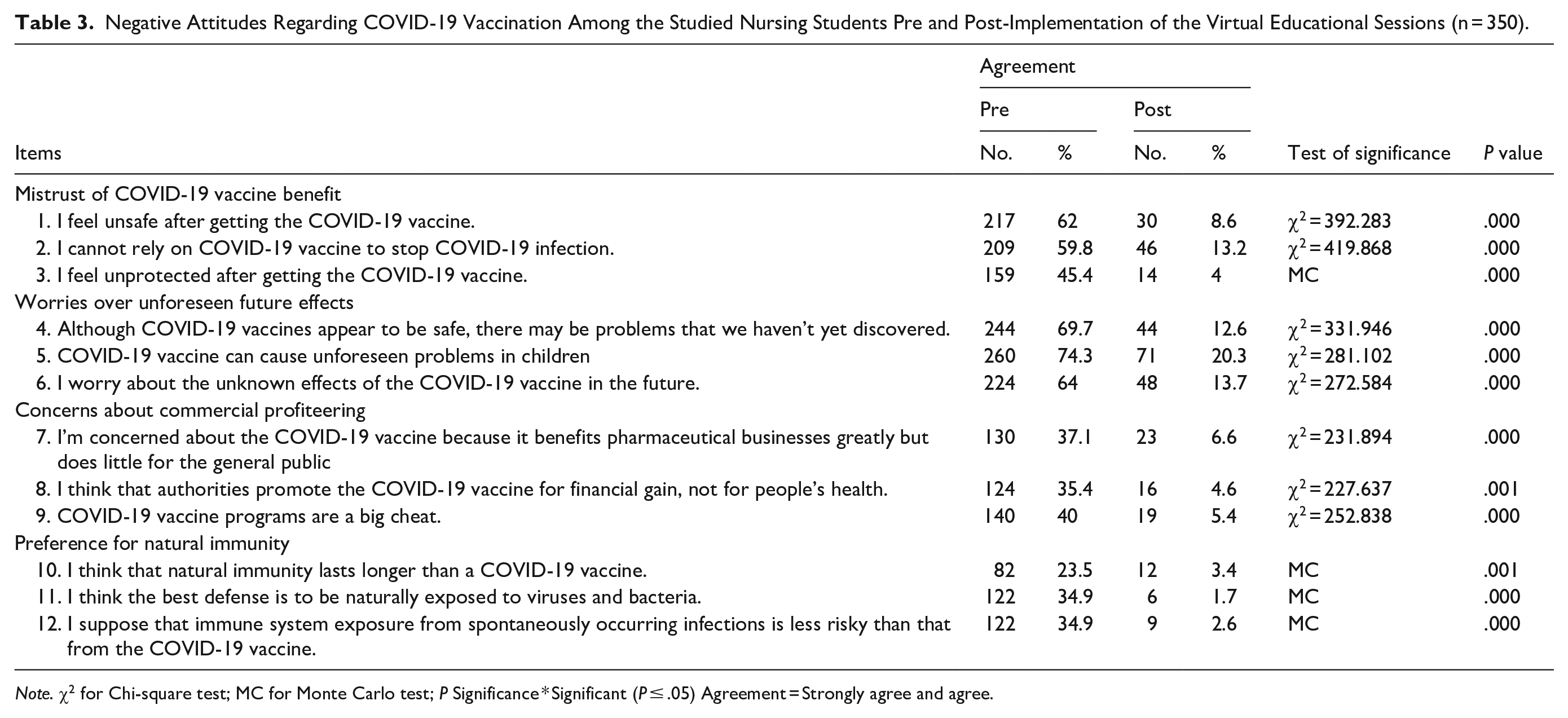
Note. χ2 for Chi-square test; MC for Monte Carlo test; P Significance * Significant (P ≤ .05) Agreement = Strongly agree and agree.
Figure 3. The modifications in undergraduate nursing students’ negative perception of COVID-19 vaccination appear through Graph 2 as an overview of pre-session and post-session perceptions. Before the intervention began students reported low negative attitudes toward vaccine mistrust at 13.4% while worries over future side effects reached 9.1% commercial profiteering doubts stood at 26.3% and natural immunity preference was at 39.7%. The educational sessions produced notable improvements because the percentages of students who responded in these ways increased to 93% for mistrust of vaccine benefits 72.9% for worries over unforeseen future effects 90% for concerns about commercial profiteering and 89.1% for preference for natural immunity. All subscales of the adapted VAX Scale revealed statistically significant findings at P < .05 which showed the intervention successfully decreased vaccine-related misconceptions and concerns.

Negative attitudes scoring level regarding COVID-19 vaccination among the studied nursing students pre and post-implementation of the virtual educational sessions (n = 350). Low level of negative attitude = (answer 1, 2; scores from 3 to 6), intermediate level of negative attitude = (answer 3 or 4; scores from 7 to 12), or very/high level of negative attitude = (answer 5; scores from 13 to 15) P Significance *Significant (P ≤ .05).
Table 4 conveys that 91.7% of the studied undergraduate nursing students showed an intermediate negative attitude scoring level regarding COVID-19 vaccination with a mean of 36.38 ± 7.03 pre-implementation of the virtual educational sessions. During post-implementation of the virtual educational sessions, only 9.4% of them showed an intermediate negative attitude scoring level with a mean of 17.6 ± 5.13. There was a statistically significant difference in the total negative attitudes scores of the studied undergraduate nursing students between pre and post-implementation of the virtual educational sessions (P < .05).
Mean Difference in the Total Negative Attitudes Scores of COVID-19 Vaccination Pre and Post-Implementation of the Virtual Educational Session (n = 350).

Note. MC for Monte Carlo test; t for Paired t-test; P Significance *Significant (P ≤ .05).
Low level of negative attitude (answer 1, 2; scores from 3 to 6), intermediate level of negative attitude (answer 3 or 4; scores from 7 to 12), or very/high level of negative attitude (answer 5; scores from 13 to 15).
Table 5 shows that 11.4% of the studied undergraduate nursing students would definitely take the approved COVID-19 vaccine if offered and if it was available at their local clinic as soon as possible pre-implementation of the virtual educational sessions compared to 54.3% and 55.1% post-implementation of the virtual educational sessions respectively. Pre-implementation of the virtual educational sessions, 11.1% of them would get the available COVID-19 vaccine as soon as possible and had a very keen attitude to receive the COVID-19 vaccine while post-implementation of the virtual educational sessions increased to 54% and 54.3% respectively. The results convey that 12.3% of the studied undergraduate nursing students would strongly encourage their families or friends if they were thinking of getting the COVID-19 vaccine and were eager to get a COVID-19 vaccine pre-implementation of the virtual educational sessions compared to 55.1% post-implementation of the virtual educational sessions. Moreover, 14.3% of them reported that taking a COVID-19 vaccine is really important pre-implementation of the virtual educational sessions which increased to 57.1% post-implementation of the virtual educational sessions. The results explain that there were statistically significant differences in all items of the adapted Oxford COVID-19 vaccine hesitancy scale results between pre and post-implementation of the virtual educational sessions (P < .05).
COVID-19 Vaccination Hesitancy Among the Studied Nursing Students Pre and Post-Implementation of the Virtual Educational Sessions (n = 350).

Note. χ2 for Chi-square test; MC for Monte Carlo test; P Significance * Significant (P ≤ .05).
Figure 4. conveys that 51.1%, 34.3%, and 14.6% of the studied undergraduate nursing students were willing, doubtful, and strongly hesitant to have the COVID-19 vaccine pre-implementation of the virtual educational sessions respectively. While post implementation of the virtual educational sessions, they improved to 85.4%, 11.4%, and 3.2% respectively. Overall, there was a statistically significant difference in the COVID-19 hesitancy scoring level between pre and post-implementation of the virtual educational sessions (P < .05).

COVID-19 Vaccination Hesitancy scoring level among the studied nursing students pre and post-implementation of the virtual educational sessions (n = 350). χ2 = 95.932 P = .000. t for Paired t-test χ2 for Chi-square test P Significance *Significant (P ≤ .05) Willing = scores from 7 to 14. Doubtful = scores from 15 to 21. Strongly hesitant = scores from 22 to 35.
Table 6. The research data demonstrates undergraduate nursing students presented a negative link between total COVID-19 vaccination knowledge and hesitancy scores at both pre- and post-intervention periods. Study participants showed a moderate negative relationship (r = −.682, P = .000) before educational sessions which indicated higher knowledgeable students displayed less vaccine hesitancy. The intervention led to a decrease in the negative relationship between knowledge and hesitancy (r = −.173, P = .001) although improved knowledge did not permanently eliminate hesitancy.
Correlation Between Total COVID-19 Vaccination Knowledge, Negative Attitudes, and Hesitancy Scores Among the Studied Nursing Students Pre and Post-Implementation of the Virtual Educational Sessions (n = 350).

Note. r: for Pearson correlation coefficient test; P Significance *Significant (P ≤ .05) If r = 0 = no correlation.
If r = 0 = no correlation If 0 < r < .25 = weak correlation. If .25 ≤ r < .75 = intermediate correlation.
If .75 ≤ r < 1 = strong correlation. If r = l = perfect correlation.
Study findings revealed that those who held negative views about COVID-19 vaccines tended to be more hesitant about vaccination. A moderate strength of association (r = .381) between negative attitudes and hesitancy appeared before intervention (P = .000). The educational sessions had a positive effect on negative attitudes because the post-intervention correlation between these variables diminished (r = .108, P = .044).
Discussion
Nursing students, among other future healthcare professionals, are the most trustworthy source of knowledge regarding the COVID-19 vaccination. Furthermore, vaccination uptake by the general public would rise if nursing students accepted the vaccine. They are essential to the public’s immunization program. 33 Thus, the current study aimed to assess the effect of implementing virtual educational sessions on nursing students’ knowledge, attitude, and hesitancy regarding COVID-19 vaccination.
The studied undergraduate nursing students had low total knowledge scores regarding COVID-19 vaccination with a mean of 13.82 (5.08) pre-implementation of the virtual educational sessions in that study. This matched with the results of the electronic survey of COVID-19 vaccines among nursing students which concluded that one-fifth only of them have good knowledge levels. 34 Low knowledge scores may be due to the novelty of COVID-19 vaccination and the conduction of this study immediately after vaccination drives began in Egypt.
Post implementation of the virtual educational sessions, the present study findings revealed statistically significant improvement in the total knowledge scores regarding COVID-19 vaccination with a mean of 35.59 (2.62). This is consistent with the findings of a researcher’s investigation. 14 This shows that, following the implementation of the educational intervention, the investigated sample’s overall level of knowledge had significantly improved. In the current study, two-thirds of the studied undergraduate nursing students got information regarding COVID-19 vaccination through social media (Facebook, Instagram, and WhatsApp). Although many such information resources provide easy and accessible ways of getting information, they can also present COVID-19 vaccination myths and misconceptions about its safety and efficacy which postpone vaccination programs. 35,36 This is consistent with the findings of the present study as the majority of the studied undergraduate nursing students showed an intermediate negative attitude concerning COVID-19 vaccination pre-implementation of the virtual educational sessions. High percentages of them had concerns regarding all subscales of the adapted VAX Scale; vaccine benefits, future effects, commercial profiteering, and immunity. This is supported by Saied et al 37 who said that the majority of students were worried about the vaccine’s side effects and safety as well as how COVID-19 could spread through the shot.
Between before and after the introduction of virtual educational sessions, there was a statistically significant difference in the undergraduate nursing students’ total negative attitudes scores. This is consistent with the findings of a study done by researchers 38 which showed that participants’ views significantly improved after the COVID-19 instructional bag was implemented compared to before.
The study conducted by Jiang et al 39 indicated that nursing students’ professional backgrounds and level of awareness of the COVID-19 vaccine requirement made them more likely to receive a vaccination. This is in contrast with the latest study’s findings as around half of the studied undergraduate nursing students hesitated (34.3% doubtful and 14.6% strongly hesitated) regarding COVID-19 vaccination pre-implementation of the virtual educational sessions; Whereas only 11.1% of them would get the available COVID-19 vaccine as soon as possible and 41.7% of them would get it when they have time. This is supported by the conclusion of the cross-sectional descriptive 40 concluded that nursing students were largely resistant to the COVID-19 vaccination. Because they have a bad attitude about getting vaccinated, the undergraduate nursing students under study exhibit a refusal to obtain vaccinations. This is confirmed by Jiang’s study’s findings 39 Hesitancy to get vaccinated was one of the top 10 challenges to the success of the vaccination drive and consequently global health. For effective vaccination, the majority of people must accept and use vaccines.40,41 Implementation of the intended virtual educational sessions improved COVID-19 vaccination acceptability among the studied undergraduate nursing students as only 14.6% of them hesitated while 85.4% of them were willing to be vaccinated.
Research data shows knowledge improvement about COVID-19 vaccines reduced vaccine hesitancy yet this reduction weakened after the intervention. The persistence of outside factors consisting of false information ethnic and social viewpoints and vaccination worries remains unmitigated by an enhanced understanding of vaccines alone. Public health campaigns alongside governmental policies as well as coverage from media outlets possibly influenced how participants learned about and felt toward vaccines against COVID-19 and their acceptance of them. Beyond the intervention, participants were influenced by personal COVID-19 encounters along with peer interactions and family and social group conversations regardless of the research project. The differences between access to reliable health information and exposure to misinformation contained in social media postings seem to impact the level of hesitancy.
The educational sessions appeared to be successful because they diminished the positive relation between negative attitudes and hesitancy after the intervention period. Additional targeted methods need to go beyond educational programs because post-intervention correlations remained weak indicating other aspects beyond knowledge need to be addressed to establish vaccine acceptance.
Most of the public universities during the COVID crisis struggled with the sudden need for virtual education after the lockdown in the Middle East region. Students and educators perceived many benefits of virtual education. Students admire the conveniences of education from home because it is more comfortable and does not involve travel. 42 On the other hand, virtual education aids teachers in conveying information to students to increase their understanding and facilitates the rapid and easy sending of communications. 43 The current virtual education sessions were effective in the improvement of COVID-19 vaccination knowledge, attitude, and acceptance among the studied undergraduate nursing students.
The effectiveness of the current virtual education sessions is due to the usage of multimodal educational methods and materials during the delivery of the sessions. And the simplicity of the informative booklet which was delivered based on the preliminary assessment data. This is supported by a researcher. 44 who stated that multimedia usage creates interactive learning activities. Moreover, the booklet designers should consider the readers’ knowledge and needs which may be quite different from the designer’s own.
For individuals who have access to the right technology, virtual education can be far more successful. 45 In this study, the researchers conducted 2 virtual educational sessions to present 17 messages regarding COVID-19 vaccination via online Microsoft Teams for undergraduate nursing students. The links were sent to the WhatsApp group.
Recommendation
Include virtual educational sessions on immunization in nursing programs to eliminate vaccine preconceptions. These sessions help to ensure that nursing students have adequate accurate information and positive attitudes about vaccines to enable them to make appropriate decisions and be well prepared to advocate for vaccines as nursing professionals.
Virtual educational sessions should be communicated as part of the general nursing curriculum to educate learners on vaccination. This approach equips nursing students to educate patients and enhance their vaccine confidence thus increasing the community’s vaccine uptake. The growth of virtual education and the ability to reach a large number of students means that it is an affordable solution for combating skepticism toward vaccines among medical learners and improving overall community health.
Longitudinal studies to assess the long-term impact of virtual education interventions or randomized controlled trials to compare the effectiveness of different educational approaches.
To enhance generalizability, future researchers need to examine various educational backgrounds within multiple institutions positioned in different locations.
Limitation
Limitations of the current study include several aspects that affect the generalizability of the results. First, the researchers used a quasi-experimental design without random assignment of participants, which may introduce bias into the results, as not all external factors that may influence students’ attitudes and knowledge were controlled. Second, the study was limited to a sample of 350 students from a single group, which reduces the ability to generalize the results to all nursing or other healthcare students. Additionally, the effect of the educational sessions may have been temporary, as the long-term sustainability of the improvement in knowledge and attitudes was not measured. The research was conducted exclusively within one Egyptian medical institution thus restricting broader population applicability of the obtained findings. Finally, Bias could also have arisen from sampling given that the selection involved convenience sampling, we decreased potential biases by gathering participants from a wide range of academic levels along with various backgrounds in our study sample. Assessments before and after our intervention helped us determine modifications in knowledge together with attitudes and hesitancy behavior thus boosting the reliability of our research outcomes.; hence the results may not be the best for the general population. Another possible method bias is measurement bias as the study tools may be influenced by social desirability bias through the provision of positive vaccination attitudes due to peer pressure. Recall bias may also affect the bias in self-reported past behaviors.
Conclusion
The current study findings concluded that about half of the undergraduate nursing students studied were hesitant toward COVID-19 vaccination due to the low mean of total correct knowledge scores and intermediate negative attitudes scoring level. The studied undergraduate nursing students significantly improved in COVID-19 vaccination knowledge, attitude, and hesitancy post-implementation of the virtual educational sessions.
Supplemental Material
sj-docx-1-inq-10.1177_00469580251339114 – Supplemental material for Effect of Implementing Virtual Educational Sessions on Nursing Students’ Knowledge, Attitude and Hesitancy Regarding COVID-19 Vaccination
Supplemental material, sj-docx-1-inq-10.1177_00469580251339114 for Effect of Implementing Virtual Educational Sessions on Nursing Students’ Knowledge, Attitude and Hesitancy Regarding COVID-19 Vaccination by Eman A. Fadel, Eman Alshawish, Rasha Hafez Ramadan El-Shaboury, Dalia E. Khalil, Fatma Zaghloul Mahmoud and Nagwa Ibrahim El-Feshawy in INQUIRY: The Journal of Health Care Organization, Provision, and Financing
Footnotes
Acknowledgements
The researchers would like to express their sincere gratitude and appreciation to all authorities in the Faculty of Nursing, Mansoura University, and the undergraduate nursing students for their support, voluntary participation, and cooperation in conducting the study.
This manuscript is based on a preprint titled [Effect of Implementing Virtual Educational Sessions on Nursing Students’ Knowledge, Attitude and Hesitancy Regarding COVID-19 Vaccination], which was published on [research square] and can be accessed at [ ] and research gate and accessed at 10.21203/rs.3.rs-5044444/v1. Society .org. OUCI
Ethical Considerations
The researchers obtained ethical approval from the Research Ethics Committee of the Faculty of Nursing, Mansoura University
Consent to Participate
Informed consent to participate was obtained from all of the students in the study.
Author Contributions
EA, FZ include contribution to study conception, design and interpretation of the data, RH include contribution to study drafting and writing important intellectual content, NI contribution to study revision of the manuscript for important intellectual content, DE include contribution to study collection, analysis and interpretation of the data, EA include contribution process of publication, FZ include contribution the final revision of the manuscript.
Funding
The author(s) received no financial support for the research, authorship, and/or publication of this article.
Declaration of Conflicting Interests
The author(s) declared no potential conflicts of interest with respect to the research, authorship, and/or publication of this article.
Data Availability Statement
The datasets generated during and/or analyzed during the current study are available from the corresponding author on reasonable request.
Supplemental Material
Supplemental material for this article is available online.
References
Supplementary Material
Please find the following supplemental material available below.
For Open Access articles published under a Creative Commons License, all supplemental material carries the same license as the article it is associated with.
For non-Open Access articles published, all supplemental material carries a non-exclusive license, and permission requests for re-use of supplemental material or any part of supplemental material shall be sent directly to the copyright owner as specified in the copyright notice associated with the article.
