




Abstract
Introduction
Vaccines are considered preventive measures to reduce coronavirus disease 2019 (COVID-19) spread around the world. There are many factors for adherence and acceptance of COVID-19 vaccination.
Objectives
The study aimed to investigate nursing students’ knowledge, perception, and factors that influence their adherence to COVID-19 vaccines.
Methods
A descriptive cross-sectional study design was conducted among nursing students at the Faculty of Nursing, Mansoura University, Egypt, during the period between September 1 and November 30, 2021.
Results
Of the total of 500 participants, 76% took a COVID-19 vaccination. About 89% of participants rated the correct answer related to COVID-19 vaccination. Obligatory to enter the faculty, protect family and friends, and protect myself were the most reasons of adherence (80.3, 73.7, and 70.8%, respectively) while fear of adverse events and lack of information about vaccine were the most reasons of nonadherence (87.5 and 79.2%, respectively) to COVID-19 vaccination. The majority of participants (62%) had expressed positive perception toward COVID-19 vaccination. Education level, training program about COVID-19, previous infection with COVID-19, perception toward COVID-19 vaccination, and knowledge toward COVID-19 vaccination were significantly (p = .035, p = .027, p = .009, p = .008 and p = .033, respectively) associated with students’ adherence to take COVID-19 vaccines.
Conclusion
Accurate knowledge and perception about COVID-19 vaccines are the stronger predictors of vaccine hesitance or acceptance among nursing students in Egypt. Campaigns to increase knowledge and perception of COVID-19 and its vaccines among nursing students are needed to improve vaccine acceptance and reduce vaccine hesitance.
Introduction/Background
The pandemic of coronavirus disease 2019 (COVID–19) is considered one of the most health care crises around the world that has a major effect on all the population and health care systems (Jiang et al., 2021). At the beginning of its spread with absence of active treatment or vaccination, measures and precautions were attempted globally to restrict its transmission such as quarantine, institutions closure, social distance, and general self-precautions including hand hygiene and wearing face mask (Lin et al., 2020). Consequently, these measures lead to negative impacts on global economy and psychological health of people such as anxiety and depression (Syed et al., 2021). To increase the herd immunity, vaccination of people around the world was one of the most selected strategies to control the accelerated spread of COVID-19 in which multiple types of vaccines were available by the end of 2020 (Wafula et al., 2022). It was reported that, without any treatment, the severe acute respiratory syndrome coronavirus 2 (SARS-CoV-2) herd immunity threshold will fall between 50% and 67% (Omer et al., 2020). Unfortunately, vaccine hesitancy is considered one of the most obstacles that may affect the accomplishment of the vaccines taking around the world. Several factors that may affect population adherence to take vaccination such as their knowledge, perceptions toward the vaccines as well as sociodemographic characteristics, rumors, and infodemic of false information, fear from signs, and symptoms related to the vaccines (Galle et al., 2021). Determining and dealing with these factors could help to increase populations adherence to take vaccines for the reason to increase their herd immunity, minimize spread of COVID-19, and save their lives.
Review of Literature
In December 2019, the COVID-19 has continued to spread around the world, causing Sars-CoV-2(Huang et al., 2020). As of January 24, 2022, the World Health Organization (WHO) estimates 349,641,119 confirmed cases of COVID-19 resulting in 5,592,266 deaths throughout the world (Chang et al., 2020). The impacts of the coronavirus pandemic on the world have been vast, innumerable, and incalculable. Beyond mortality, one must consider morbidity, economic, social, developmental, psychological, and infrastructure impacts around the world (Bryson et al., 2021; Zhou & Kan, 2021). However, despite the world's efforts, COVID-19 has persisted for the past 2 years and may continue to do so for the foreseeable future (Zhou & Kan, 2021).
The only viable ends to the COVID-19 pandemic are heard immunity or endemic status (Hafiz et al., 2022; Lytras & Tsiodras, 2021). Both of these scenarios may occur when enough of the world, or specific populations, have immunity to COVID-19. One of the routes of obtaining immunity is natural immunity, which may come from a prior infection with a virus similar to COVID-19, or it may follow infection with COVID-19, which carries all the risks of morbidity and mortality associated with COVID-19. The other route of immunity is vaccination, which carries much more modest risks (Gumel et al., 2021; Hafiz et al., 2022).
Campaigns have been implemented across the world to encourage as many people as possible to receive the COVID-19 vaccinations in order to prevent infection, prevent severe disease, and accelerate the transition to herd immunity (Gumel et al., 2021; Lytras & Tsiodras, 2021). Immunization programs in general, according to the WHO, save 2–3 million deaths globally each year and are not only cost-effective, but also an essential part of health care's proactive approach (Robertson et al., 2021). Unfortunately, many of factors may affect vaccination acceptance and vaccination hesitancy, such as fear of side effects of vaccine, probability of incompetence of vaccine, lack of knowledge about infection and vaccine, and fear of pain from injection among others (Yaqub et al., 2014). Vaccine refusal and vaccine hesitance have been around since the advent of vaccines but have become more prevalent in recent decades (Cerda & Garcia, 2021).
A rise in vaccine-preventable illnesses despite significant advances in immunizations over the past century caused the WHO to list vaccine reluctance or rejection as one of the top 10 global health concerns for 2019 (Dube et al., 2021; Mannan & Farhana, 2020). Public perception of vaccines plays an important role in vaccine hesitance (Ali et al., 2021). Policies regarding education, communication, and motivation have influenced the ability of countries around the world to vaccinate their citizens amid misinformation, hesitancy, and fears of side effects (Ali et al., 2021). Vaccine hesitance presents a strong barrier to eliminating vaccine preventable diseases, as well as the ability to respond to future pandemics as evidenced by the COVID-19 pandemic. Many studies on COVID-19 vaccine hesitance have been conducted over the past 2 years with a wide range of associated findings, depending on the specific population being studied, and more will be needed in the future as the situation around the world evolves(Balan et al., 2021; Belingheri et al., 2021; Biswas et al., 2021). Gender, low education, low literacy, lack of influenza vaccination in prior years, mistrust of government, and mistrust of health authorities have been identified as potential key attributes associated with COVID-19 vaccine hesitance(Pires, 2022; Wang et al., 2021). Over the past half century Egypt has made incredible strides in its vaccination rates for vaccine preventable diseases thanks to the National Immunization Program (El Sayed et al., 2011) In 2006 wild Poliovirus transmission was eliminated from the Egyptian population, and coverage for all childhood immunizations has exceeded 90% since the year 2000. Despite these monumental efforts, coverage for vaccine preventable illnesses still remains less than idea. In 2015, Egypt recorded nearly 5,000 children infected with measles (Galal et al., 2022). Among health care workers in 2019, only 13.4% received an annual influenza vaccine (Waheed et al., 2020). Doubts about the “halal” status of a vaccine can pose additional challenges to vaccine programs in Muslim predominant countries such as Egypt (Galal et al., 2022). With such an elaborate history surrounding vaccine hesitance and acceptance, along with long-standing government campaigns and a persistence of hesitance to certain vaccines, Egypt can potentially provide useful information on the key factors that still contribute to vaccine hesitance.
Nursing students represent the future face of health care as well as key resources of medical information in their community and future administrators of vaccines. Nurses and other health care professionals can play an important role in changing the attitudes and acceptance rates of patients toward vaccines (Qattan et al., 2021). Their opinion regarding COVID-19 vaccinations and their acceptance or hesitance toward COVID-19 vaccinations is especially relevant and important. Nursing students are expected to have training on vaccinations, direct contact with patients, and interactions with other medical professionals (Albaqawi et al., 2020; Manning et al., 2021). As a result, they should have a relatively well-informed perspective compared to the general population and represent a good target population for studying COVID-19 vaccine acceptance and hesitance. By extension, the long-term goal is to promote increased rates of vaccination in the general population of Egypt and the world at large in order to save lives, hasten herd immunity, and minimize the damage caused by the pandemic. Therefore, the goal of this research is to assist in efforts to minimize vaccine hesitance and promote vaccine acceptance by identifying key factors that influence the decision to accept or reject the COVID-19 vaccine among nursing students in Egypt.
Methods
Design and Setting
A descriptive cross-sectional study design was conducted among nursing students at the Faculty of Nursing, Mansoura University, Egypt, during the period between September 1 and November 30, 2021. The study aimed to investigate nursing students’ knowledge and perception and factors influence their adherence to COVID-19 vaccines.
Sample
The sample of the study consisted of 500 nursing students who agreed to participate over a period of 3 months. The sample size was calculated using the MedCalc software program (www.medcalc.org/index.php) at 5% α error (95% significance) and 20% β error (80% power for the study).
Survey Method
In light of the COVID-19 outbreak and to ensure compliance with the preventive measures related to the current public health guidelines in Egypt, an anonymous electronic web-based self-reported questionnaire was developed and adapted based on three previous studies(Balan et al., 2021; Belingheri et al., 2021; Biswas et al., 2021). Undergraduate nursing students from the Faculty of Nursing at Mansoura University, Egypt were asked to participate in the study.
To assess the knowledge, perception, and reasons for adherence and nonadherence of nursing students regarding the COVID-19 vaccine, the questionnaire was divided into 26 close-ended mandatory questions divided into four areas of investigation. Part 1 included six personal data questions aimed at describing the sociodemographic characteristics such as age, sex, residence, educational level, training program about COVID-19, previous infection with COVID-19, and adherence to take COVID-19 vaccine. Part 2 included six questions related to students’ knowledge about the COVID-19 vaccine; the concept of COVID-19, causes and risk factors, ways of prevention, side effects, complications, and management of COVID-19. Each question included three response alternatives: “Yes”, “No”, and the phrase “I do not know” to avoid guessing from the participants. Each question was scored 1 for a correct answer and 0 for an incorrect one, so that the total scores for the tool range from 0 to 6. Then, the total score of the students’ knowledge was converted to a percentage, over a range of 0%–100%. Part 3 included reasons for adherence and nonadherence to the COVID-19 vaccine which contained eight items related to reasons for adherence, and seven items related to reasons for nonadherence. Part 4 included students’ perception about COVID-19 vaccines which contained eight items with a 3-point Likert scale denoted as “Agree”, “I'm not sure”, and “Disagree”. Scores for overall knowledge were separated into unsatisfactory (< 70.0%) and satisfactory (≥ 70.0%). Perception about vaccination was assessed by assigning students points on a 2-point Likert scale of 0 to 2, where 2 indicates agreement and 1 indicates disagreement. A higher score indicated a good perception of the COVID-19 vaccine. Participants who answered yes to at least 70% of the questions were deemed willing to receive the COVID-19 vaccine.
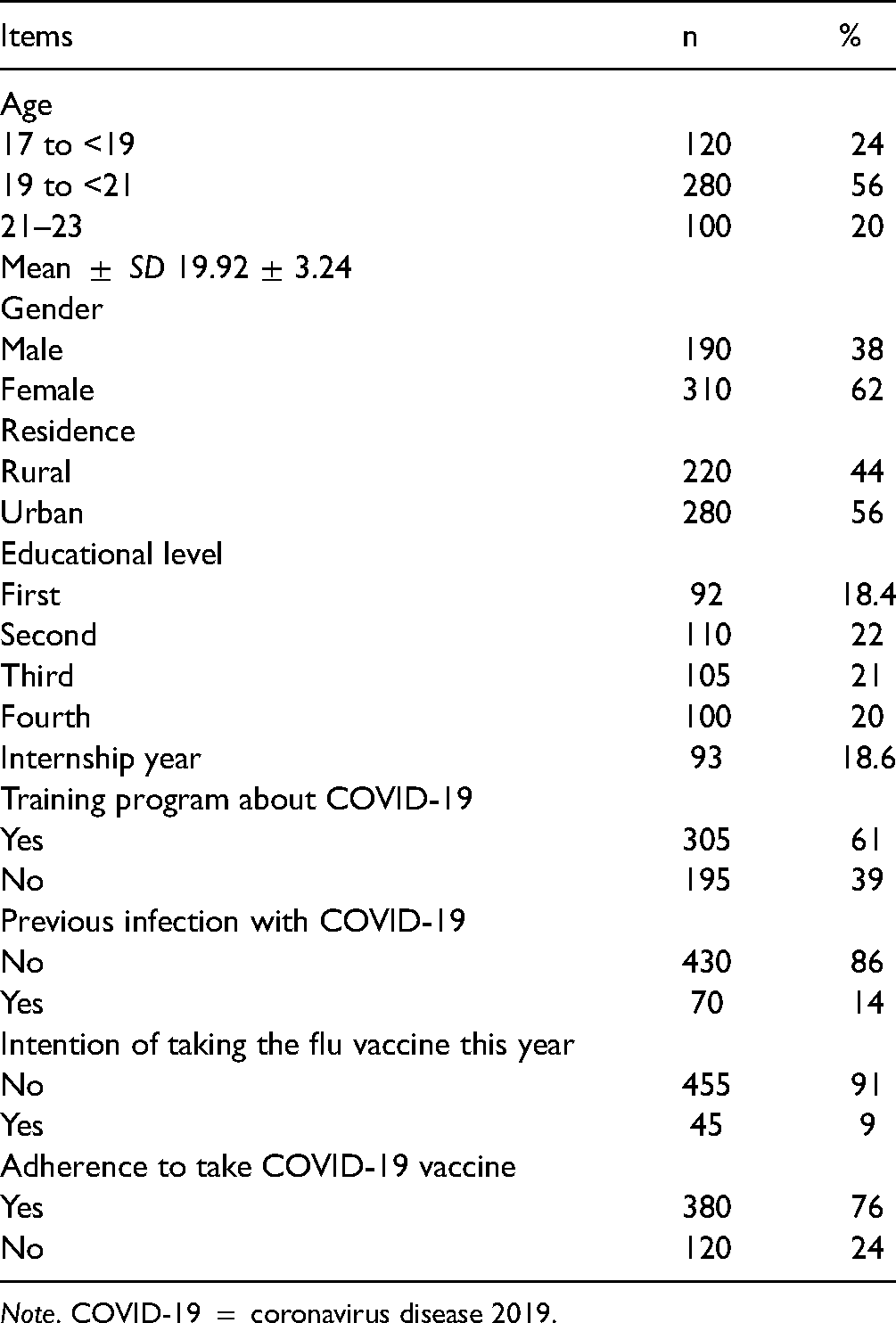
An electronic web-based questionnaire was designed and integrated into the Google survey tool (Google Forms). The internet link was distributed to nursing students via e-mail, as well as posted on university social media channels (WhatsApp and Facebook) in the period from September 1 and November 30, 2021. The average time needed to complete the questionnaire ranged from 15 to 20 min. The general information of the respondents is shown in Table 1 while the knowledge, adherence, and perception questions were shown in Table 2.
Demographic Characteristics of Studied Subjects.
Note. COVID-19 = coronavirus disease 2019.
Knowledge, Perception, and Reasons for Adherence and Nonadherence of Nursing Students Regarding Coronavirus Disease 2019 (COVID-19) Vaccine.

Note. A = Agree; DA = Disagree; N = Neutral.
Validity and Reliability
Content validity of the questionnaire was assessed by six experts (three epidemiologists and three academic nursing staff). A pilot study was accomplished to determine the readability of the items and reliability of the questionnaire through distributing the questionnaire to 50 students. The results indicated that the questionnaire was in general easy to understand, clear, and readable, and the reliability was tested using a Cronbach's alpha test with the results showing α = 0.80 for the students’ knowledge about the COVID-19 vaccine, α = 0.79 for reason for adherence and nonadherence to the COVID-19 vaccine, and α = 0.85 for students’ perception about COVID-19.
Ethical Considerations
The study was ethically approved by the Research Ethics Committee at the Faculty of Nursing, Mansoura University, Egypt with Ref. No. P.0235. A written informed consent was completed by the students before their participation. Participants were assured their participation would be voluntary, effort would be made to protect their anonymity, and only aggregated data would be communicated.
Statistical Analysis
The data was sorted, categorized, and analyzed using the Statistical Package for the Social Sciences (SPSS Inc.; version 21; IBM Corp., Armonk, NY, USA). Descriptive statistics using means and SDs for the continuous variables as well as frequencies and percentages for the dichotomous or categorical variables were used to describe the data. Inferential statistical analyses were used to answer the research questions and objectives. The chi-square test was employed to identify associations among variables, with significance set to p < .05.
Results
The study included 500 nursing students; their mean age was 19.92 ± 3.24 years. More than a half (62% and 56%) of the participants was female and urban residents, respectively. The majority of participants had attended a training program about COVID-19 (61%), did not have previous COVID-19 infection (86%), did not intend to take the flu vaccine this year (91%), and had received a COVID-19 vaccine (76%) (Table 1).
Regarding students’ knowledge about COVID-19 vaccine, Table 2 revealed that 91.6%, 86%, 93%, 88%, 91.8%, and 83.2% of all participants gave correct answers regarding the concept of COVID-19, causes and risk factors, ways of preventing spread, side effects, complications, and management of COVID-19, respectively. Among a total of 380 students who adhered to the COVID-19 vaccination, the main reasons were the obligation to enter the faculty (80.3%), protect family and friends (73.7%), and protect themselves (70.8%). In the same group, 66.1% of students adhere to the vaccine to protect patients, 57.9% adhere to the vaccination as a condition of returning to normal activities, 52.9% so as not to miss days of lessons, work, or internship, 52.4% of them agreed to comply with the ministry of health recommendations, and 48.7% of students reported adhering to be vaccinated to avoid wearing masks (Table 2). Also, the table demonstrates that the main reasons related to nonadherence to the COVID-19 vaccine were the fear of adverse events (87.5%), the lack of information about the vaccine (79.2%), and the opinion that the vaccine is unsafe reported by 72.5%. Furthermore, 66.7% believed that the vaccine is ineffective, 42.5% of them related the nonadherence to the sub-optimal protective efficacy, 29.2% of them returned the nonadherence to the previous COVID-19 diagnosis, and 23.3% disagree with vaccinations because the opinion that COVID-19 is not a threatening disease. As regard students’ perception toward COVID-19 vaccination, Table 2 revealed that 54% of university nursing students agreed with the importance of perceiving the COVID-19 vaccine. Moreover, 56% of them agree with the importance that everyone in the community should get the COVID-19 vaccine once available. Vaccination of COVID-19 should always be compulsory for health care workers once it is available, reported by 60.2% of them, 56% thought that approval of the vaccine guarantees its safety. Additionally, 40% of all respondents had neutral response regarding that getting vaccinated is the best preventive measure for COVID-19. On the other hand, 60% of them disagree that the vaccine was not tested for enough time, 52% of them disagree that the vaccine probably will not work necessary immunity, and half of them disagree with the unnecessary of the vaccine as they are healthy and low risk of infection (Table 3).
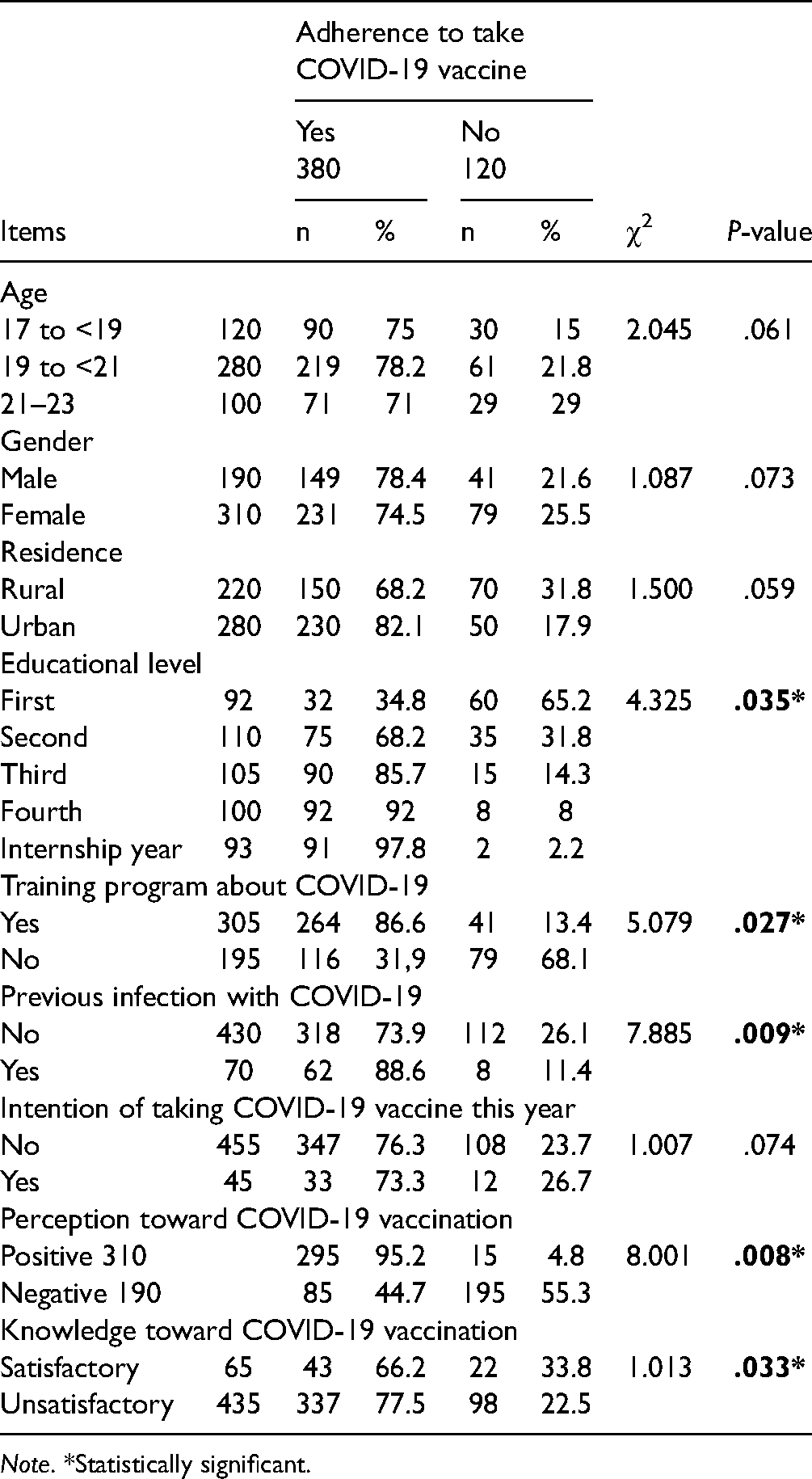
Relation Between Adherence to take Coronavirus Disease 2019 (COVID-19) Vaccine and Students’ Characteristic and Other Potential Factors (n = 500).
Note. *Statistically significant.
Table 3 illustrates the relationships between adherence to take COVID-19 vaccine with age, gender, residence, educational level, training program about COVID-19, previous infection with COVID-19, intention of taking the flu vaccine this year, and perception toward COVID-19 vaccination and knowledge. The educational level, attending training program about COVID-19, previous infection with COVID-19 and perception toward COVID-19 vaccination was significantly associated with Adherence to take COVID-19 vaccine (p = .035, p = .027, p = .009, p = .008, respectively). Where no significant associated between adherence to take COVID-19 vaccine with age, gender, residence and knowledge
Discussion
This study investigated various factors related to COVID-19 vaccine adherence among vaccinated and unvaccinated nursing students at an undergraduate university in Egypt during the months of September through November 2021. Interestingly, greater knowledge of COVID-19 and its vaccines was not associated with increased rates of vaccination; in fact, it was associated with decreased rates of vaccination. Instead, positive perception of COVID-19 vaccines was a key component of vaccine acceptance, with 95.2% of participants with a positive perception having received a vaccine while 55.3% of participants with a negative perception had not yet received a vaccine. This is a significant divergence from the belief that accurate knowledge of vaccines will lead to acceptance. Despite any training, education, or clinical experience nursing students may have had, their own perception of COVID-19 vaccines plays a more primary and potentially determining role in vaccine acceptance. Future efforts to increase vaccination rates among the study population should focus on influencing the public perception of vaccines.
Among the perceptions of the study participants, 30% felt that COVID-19 vaccines would not provide immunity. Fifty percent either agreed with or were neutral to the statement that they don’t need COVID-19 vaccines because they are healthy and at low risk of infection. A large majority, 64%, did not agree with the idea that vaccines are the best preventative measure. Only 56% felt that approval of vaccines guarantees its safety, which may indicate a mistrust of institutions. These results point to a surprisingly negative view of COVID-19 vaccines among the study participants. A review of global predictors of COVID-19 vaccine hesitancy found a similar pattern of predictors of vaccine hesitance, namely lower perceived risk of infection, lower levels of institutional trust, lower perceived severity of infection, and stronger belief that the vaccines are unsafe or will cause side effects (Pires, 2022). The only global predictor which was not consistent with the present study results was not being vaccinated against influenza. Hesitance to other vaccines in general, such as the seasonal influenza vaccination, was not correlated with hesitance toward the COVID-19 vaccine in the present study. This implies that the studied subject perceptions toward COVID-19 vaccines are new and distinct from their opinions on vaccines in general, or at least their opinions on influenza vaccines. The most common reasons for vaccine acceptance among participants who had already received a COVID-19 vaccine included that it was required to enter a facility or institute (80.3%), to protect family and friends (73.7%), to protect oneself (70.8%), and to protect patients (66.1%), while less common reasons included to return to normal life activities (57.9%), to avoid sick days (52.9%), to comply with health ministry recommendation (52.4%), and to avoid wearing masks (48.7%). These answers suggest that a vaccine requirement to enter a facility was one primary reason for receiving the vaccine. It is also interesting that protecting family and friends was a more common reason than protecting oneself or patients. Similar results can be seen in other studies (El-Elimat et al., 2021; Kregar Velikonja et al., 2021; Saied et al., 2021). These results suggest that campaigns which focus on an individual's social responsibility to get vaccinated, especially with regard to protecting family and friends, may be more influential than campaigns which focus on an individual's own personal risk or consequences of disease.
The present study also adds to the body of knowledge about other reasons for vaccine hesitance or acceptance. Fear of adverse events (87.5%), lack of information about the vaccine (79.2%), doubt in safety of vaccines (72.5%), and doubt in efficacy of vaccines (66.7%) were among the most common reasons for vaccine hesitance in the present study population and were consistent with other studies (Belingheri et al., 2021; Saied et al., 2021). In general, these various studies show that the reasons for vaccine hesitance are similar, but that the proportion of participants holding these opinions varies. This variation is likely population specific (Jiang et al., 2021; Saied et al., 2021). However, fear can also impact perception. Fear of vaccines, or their adverse events in the case of the present study, is opposed by fear of illness. Fear, anxiety, and worry all play a role in perception (Brewer et al., 2017). This may explain why subjects who had already gotten COVID-19 were more likely to be vaccinated. Direct exposure may have increased the fear and anxiety of the illness, prompting more subjects to get vaccinated. This also ties back in with the idea that a lower perceived risk of infection is associated with vaccine hesitance. Once a vaccine hesitance individual is infected, they can no longer believe they have a low risk of infection, and this may tip the scales in favor of them getting vaccinated.
Although knowledge scores were not associated with COVID-19 vaccine acceptance, we did find significant relationships between COVID-19 vaccination and both education level and previously attending a training program about COVID-19. These facts seem contradictory and may indicate a confounding variable. In contrast, research on other populations has found knowledge as a significant factor in vaccine hesitance, including studies from health care workers in New York and undergraduate students in Italy (Ciardi et al., 2021; Galle et al., 2021). Knowledge in the form of training programs on COVID-19 may still play some role in reducing vaccine hesitance; however, the present study indicates that perception is more important than knowledge among the study population. Future efforts to change and influence public perception will be important for both COVID-19 and any future immunization programs.
Campaigns on social media are one possible method of changing public opinion. An analysis of Twitter data in the United States found a correlation between statewide vaccine sentiment and the population's rate of vaccination (Ali et al., 2021). Misinformation from social media has also been found to have a strong impact on vaccine hesitance (Pires, 2022). As such, future campaigns to influence public perception via social media will be an important component of any vaccination program. Similarly, attempts to combat misinformation on social media and other platforms should be made.
Strengths and Limitations
This study is considered the first one that was conducted at the Faculty of Nursing, Mansoura University, Egypt, to investigate nursing students’ knowledge, perception, and factors that influence their adherence to COVID-19 vaccines. The results of this study have determined the factors that affect the adherence and nonadherence of nursing students to vaccines that may help to overcome these factors at the future campaign. However, limitations that may involve in this study such as the sample of this study was from one university of Egypt that limits the generalizability of the results.
Implications for Practice
Nursing students represent the cornerstone of information resources in the community and the future workers who will be responsible in the future administrations of vaccines. The result of the present study highlights the importance of assessment of knowledge, perceptions, and factors that effect of nursing adherence and nonadherence to vaccines. Findings of this study recommended the important of involving nursing students in educational campaign to increase their knowledge regarding the important of the vaccines to prevent the diseases. Factors affecting the adherence of nursing students that investigated in the findings of this study should be considered in the future educational program related to vaccines campaign.
Conclusion
Accurate knowledge and perception about COVID-19 vaccines are stronger predictors of vaccine hesitance or acceptance among nursing students in Egypt. Campaigns to increase knowledge and perception of COVID-19 and its vaccines among nursing students are needed to improve vaccine acceptance and reduced hesitance. Common perceptions among the vaccine hesitant included lower risk of infection, lower belief in the effectiveness of COVID-19 vaccines, and lower belief in the safety of COVID-19 vaccines. Concern for the wellbeing of family and friends supersedes concern for oneself in relation to COVID-19 and vaccines, so campaigns should prioritize the social and interpersonal implications of COVID-19 and vaccination over the personal implications. Future research on perception and vaccine hesitance among the more general population within Egypt would be useful in confirming the findings of the present study and guiding future implementation strategies.
Footnotes
Acknowledgments
The authors would like to thank all the nursing students for their participation in this study.
Author’s Contribution
Fadia Abdelkader, Sameer Alkubati, Mohammed Alsabri, Bander Albagawi, and Salman Alsaqri designed the study; Fadia Abdelkader and Asmaa Abo Seada conducted the survey and data collection; Mahmoud Al-Areefi and Sameer Alkubati analyzed the data; Fadia Abdelkader, Bander Albagawi, and Salman Alsaqri interpreted the results; Fadia Abdelkader and Sameer Alkubati wrote the first draft. Sameer Alkubati, Mohammed Alsabri, and Christopher McClean contributed to the drafting, elaboration, interpretation, and revision of the whole paper. Asmaa Abo Seada contributed in drafting and reviewing the paper. All authors read and approved the final manuscript.
Data Availability statement
Data and materials are available from the corresponding author upon request.
Declaration of Conflicting Interests
The author(s) declared no potential conflicts of interest with respect to the research, authorship, and/or publication of this article.
Ethical Approval
The study was ethically approved by the Research Ethics Committee at the Faculty of Nursing, Mansoura University, Egypt with Ref. No. P.0235. A written informed consent was completed by the students before their participation. Participants were assured their participation would be voluntary, effort would be made to protect their anonymity, and only aggregated data would be communicated.
Funding
The author(s) received no financial support for the research, authorship, and/or publication of this article.
