




Abstract
Background:
Human papillomavirus (HPV) infection is among the most common sexually transmitted infections worldwide and a leading cause of cervical cancer, which claims the life of one woman every minute globally. HPV vaccination is a proven, effective strategy to prevent cervical cancer. Despite vaccine availability, few studies have assessed awareness and perceptions among female secondary school students, a key target group for early vaccination. Addressing this gap is essential for designing interventions to improve vaccine acceptance and coverage.
Objectives:
This study aimed to assess knowledge and attitudes toward the HPV vaccine and identify associated factors among female secondary school students in Nifas Silk Lafto Sub-City, Addis Ababa, Ethiopia.
Methods:
Institutional-based cross-sectional study was conducted from May 10 to 20, 2023, in Nifas Silk Lafto Sub-City. Stratified sampling was used to select study participants. A total of 635 students were selected using a simple random sampling technique. Data were collected using structured self-administered questionnaires. The data were entered into EpiData version 4.6 and analyzed with SPSS version 25. Descriptive statistics (such as frequency, percentage, and means) were used to summarize the data, while binary and multivariable logistic regression analyses were performed to identify factors associated with the outcome variables. Adjusted odds ratios with 95% confidence intervals (CI) and p-value <0.05 were used to determine statistical significance.
Results:
A total of 616 students participated, with a response rate of 97%. Of the respondents, 55.5% had good knowledge and 58.6% had positive attitudes toward the HPV vaccine. Age between 18-20 years (AOR = 2.579, 95% CI = 1.446-4.598, p<0.001) and prior awareness of the HPV vaccine (AOR = 10.441, 95% CI = 6.530-16.694, p<0.001) were significantly associated with good knowledge. Factors significantly associated with a positive attitude included prior awareness of the HPV vaccine (AOR = 0.368, 95% CI = 0.239-0.567, p<0.001), receiving information from healthcare providers (AOR = 2.434, 95% CI = 1.055-5.615, p = 0.037), and knowledge about the HPV vaccine (AOR = 1.464, 95% CI = 1.000-2.144, p = 0.05).
Conclusions:
Overall knowledge and attitudes toward the HPV vaccine were low compared to other studies. Age and prior awareness of the HPV vaccine were significantly associated with knowledge. Additionally, prior awareness, source of information and knowledge significantly influenced attitudes toward the HPV vaccine. Therefore, targeted health education programs are recommended to improve awareness and attitudes among female secondary school students.
Background
Cervical cancer is the fourth most common cancer among women globally and a leading cause of cancer-related mortality, primarily caused by persistent infection with high-risk human papillomavirus (HPV) strains.1,2 HPV infection is one of the most common sexually transmitted infections worldwide, with over 50% of sexually active women exposed to at least one HPV type during their lifetime. 3 Early stages of cervical cancer are often asymptomatic, and late-stage disease typically presents with abnormal bleeding and pain, frequently due to low awareness about symptoms. 4
Vaccination against HPV is the most effective long-term strategy to prevent cervical cancer, particularly when administered to adolescent girls before the onset of sexual activity.5–7 Prophylactic HPV vaccines, composed of virus-like particles formed from L1 proteins, induce strong neutralizing antibody responses that significantly reduces the incidence of HPV-associated precancerous lesions.8,9 Since the introduction of HPV vaccination programs in 2006 for females and in 2011 for males, recommendations have extended to adolescents and young adults up to 26 years of age, with demonstrated safety and efficiency.10,11
Despite the vaccine’s proven benefits, knowledge gabs, negative attitudes, and misconceptions continue to hinder vaccine uptake. Studies indicate that many adolescents are unaware of HPV vaccination or hold incorrect beliefs, which may influence parental support and overall coverage.12–14 These barriers are particularly concerning in low- and middle-income countries, where cervical cancer burden remains high and vaccination programs are still expanding.
In Ethiopia, cervical cancer remains a major public health concern, with an estimated incidence of 23 per 100,000 women annually. 15 Ethiopia commercialized its HPV vaccine for the first time, introduced in 2018, targeting 14-year-old girls with support from the Global Alliance for Vaccines and Immunization. 16 However, vaccine uptake remains suboptimal, partly due to limited awareness and misconceptions among adolescents. 17 While some studies exist, previous research in Ethiopia has mainly focused on single government schools, excluding private schools, which limits generalizability. Evidence on knowledge and attitudes toward HPV vaccination among secondary school students in an urban setting remains limited.
Furthermore, adolescents and young adults are particularly vulnerable to HPV infection due to behavioral and biological risk factors such as early sexual activity, multiple sexual partners, low socioeconomic status and, low health literacy.18,19 Understanding students’ knowledge and attitudes toward HPV vaccination is critical to designing effective health education programs, improving vaccine acceptance, and ultimately reducing cervical cancer incidence.12,20
Therefore, this study aimed to assess the level of knowledge and attitudes toward the HPV vaccine and identify associated factors among secondary school students in Nifas Silk Lafto Sub-City, Addis Ababa. The findings are expected to provide evidence to guide targeted interventions, inform policymakers, and contribute toward achieving the WHO’s 90:70:90 cervical cancer elimination targets by 2030.
Methods
Study design, area, and period
A cross-sectional study was conducted in Nifas Silk Lafto Sub-City from May 10 to May 20, 2023. Nifas Silk Lafto, located in the southwest part of Addis Ababa, which is one of the 11 sub cities, with a population of approximately 316,108, comprising 148,892 males and 167,219 females. The sub-city is divided administratively into 12 woredas and 128 sub-woredas. 21 Within Nifas Silk Lafto, there are 32 secondary schools; 26 private and 6 government high schools. During the 2022/2023 academic year, a total of 26,367 students were enrolled, of whom 15,202 (57.66%) were female. Nifas Silk Lafto Sub-City was purposefully selected for this study due to its large, socioeconomically, and culturally diverse population, making it an ideal setting to assess knowledge and attitudes toward HPV vaccination.
Populations
The source population for this study comprised all female students attending secondary schools in Nifas Silk Lafto Sub-City, Addis Ababa, Ethiopia. The study population included female students randomly selected from chosen secondary schools within the sub-city using a simple random sampling technique. Eligible participants were regularly enrolled female students attending secondary school during the study period. Female students who were severely ill or absent at the time of data collection were excluded.
Sample size determination
The sample size was calculated using the single population proportion formula, based on a reported 51% positive attitude toward the HPV vaccine from a study conducted in Arba Minch town. 22 Assuming a 95% confidence interval (CI), 5% marginal error (d), and a design effect of 1.5, the initial sample size was calculated as 577. After adding a 10% non-response rate, the final sample size was adjusted to 635 participants

After adjustment for no-response rate adding 10%: n = 577+ (10% × 577) = 635
Sampling procedures
A stratified sampling method was employed to select participants from Nifas Silk Lafto Sub-City, Addis Ababa, which has 6 government and 26 private secondary schools. Using a simple random sampling (lottery method), 2 government and 9 private schools, about 34.4% of the total were selected. This proportion ensured a sufficiently large and representative sample, enhancing the generalizability of the findings, while minimizing selection bias.
The total sample size of 635 was proportionally allocated to each selected school based on the size of their student populations. The required number of participants from each school was further distributed across sections in grades 9 to 12 using proportional allocation. Finally, individual respondents were selected by simple random sampling within each grade and section (see Figure 1).

Schematic presentation of the sampling procedure for assessment of knowledge and attitude toward human papillomavirus vaccine and associated factors among female students in secondary School in Nifas Silk Lafito Sub-City, Addis Ababa, Ethiopia, 2023.
Data collection tool and procedure
A structured self-administered questionnaire adapted from previously validated studies in Ethiopia22,35 and pre-tested for clarity, relevance, and contextual suitability, was used to collect the data. The questionnaire includes part one: socio-demographic, part two: Source of information, part three: knowledge toward HPV vaccine, part four: attitude toward HPV vaccine (Supplemental File 1). The questionnaire was initially prepared in English and translated into Amharic and again back to English. Finally, the Amharic version was used for the data collection. The data was collected by four BSc midwives as a data collection facilitator with two MSc in nursing as a supervisor. The reliability of the data collection tool was assessed using Cronbach’s alpha, with a value of 0.82, indicating high internal consistency and reliability of the instrument
Data quality control
Before data collection, to ensure the quality of the data a pretest was done among 5% of the study subject in Kolfe Sub-City (out of the study area) before the actual data collection and one-day training was given to data collectors and supervisor about the objective of the study, the relevance of the study, confidentiality of information, respondent’s right, informed consent, and methods of data collection. Every day of data collection; the principal investigator, data collectors, and Supervisor has meetings to find a solution for the challenges face during data collection and the data collectors were submitted the collected data to the investigator. The collected data was checked for completeness.
Study variables
Dependent variable: Knowledge and Attitude
Independent variables: Socio-demographic factors (age of student, school types, religion, grade level of students, maternal education level, maternal occupation, paternal educational level, paternal occupation, family monthly income, number of daughters in the household), Information about HPV (had heard of HPV or not), preferred area for vaccination and source of information.
Operational definition
Knowledge: The knowledge about the HPV vaccine was assessed using a set of 16 questions, with each correct response scored as 1 point and each incorrect or “I don’t know” response scored as 0points. The cut point for categorizing knowledge levels was determined using the mean score as the threshold. Participants who scored above the mean were categorized as having “good knowledge,” indicating adequate understanding. Those scoring below this threshold were categorized as having “poor knowledge,” reflecting insufficient or incorrect understanding. These criteria were consistently applied throughout the study. 23
Attitudes: Attitudes toward HPV vaccines were assessed using 7 questions and categorized based on the mean total attitude score: poor if below the mean and positive if above the mean. 24
HPV vaccine: Human papillomavirus vaccine is the vaccine that protects against human papillomavirus, which is known to prevent cervical cancer and other HPV infections.
Data processing and analysis
The collected data were entered into EpiData version 4.6 and analysis was done using SPSS version 25 statistical packages. The distribution of continuous variables was assessed using Q-Q plot test, which indicated that the data were approximately normally distributed. Frequency and percentage used for the descriptive part and binary logistic regression model was used to identify the statistically significant variables. Variables that are statistically significant with p-value <0.25 at bi-variable logistic regression were entered into multivariable analysis to adjust the effects of confounders and to differentiate the associated factors. In the multivariable logistic regression model fitting, an adjusted odd ratio (AOR) with a 95% confidence interval (CI) was computed. A p-value less than 0.05 were considered to be statistically significant at 95% CI and the strength of association was declaring using odds ratio. Multicollinearity among independent variables was checked using the variance inflation factor, and all values were below 10, indicating no significant multicollinearity. The model fitness was tested by Hosmer Lemeshow test, with a p-value = 0.817, confirming that the model adequately fits the data. Finally, the result was presented in texts, tables, and graphs.
Ethical consideration
Ethical clearance and approval for this research were obtained from the Institutional Review Board (IRB) of Asrat Woldeyes Health Science Campus, Debre Berhan University (Ref. No: IRB 01/88/2015). Permission was subsequently secured from the Addis Ababa Nifas Silk Lafto Sub-City Education Bureau, and the respective school administrators were informed about the study’s objectives and procedures. Eligibility to participate in the study included obtaining written informed consent from participants aged 18 years and older. For participants under 18 years, written informed consent was obtained from their legally authorized representative, while verbal assent was secured from the adolescent girls themselves, ensuring ethical compliance and respect for participant autonomy. Confidentiality and anonymity were strictly maintained throughout data collection and reporting process. All study procedures were conducted in accordance with the ethical standards of the Helsinki Declaration.
Results
Socio-demographic characteristics of the respondents
A total of 616 students participated in the study with a response rate of 97%. About 266 (43.2%) were at the age of 16 and17, and the mean age of the students were 16.19(±1.145). Majority of the respondents 353(57.3%) were from private schools, 411 (66.7%) were in grades 9 and 10 and about 338(54.9%) were followers of orthodox. Regarding the mothers’ educational status of respondents, 207 (33.6%) reported secondary school and 64(10.4%) reported no formal education. The most responded paternal educational status was degree and above 266(43.2%). Regarding the maternal occupation, 186(30.2%) respondents reported being merchants. For paternal occupation, half of the study participants, or 308 (50%), responded privately owned business. The details are shown in Table 1.
Socio-demographic characteristics of secondary school female students in Nifas Silk Lafto Sub-City, Addis Ababa, Ethiopia, 2023 (n = 616).

Source of information
The majority of respondents, 440 (71.4%) had heard about the HPV vaccine. Among them, television was the main source for 154 (35%), followed by healthcare providers at 145 (33%) (Figure 2).
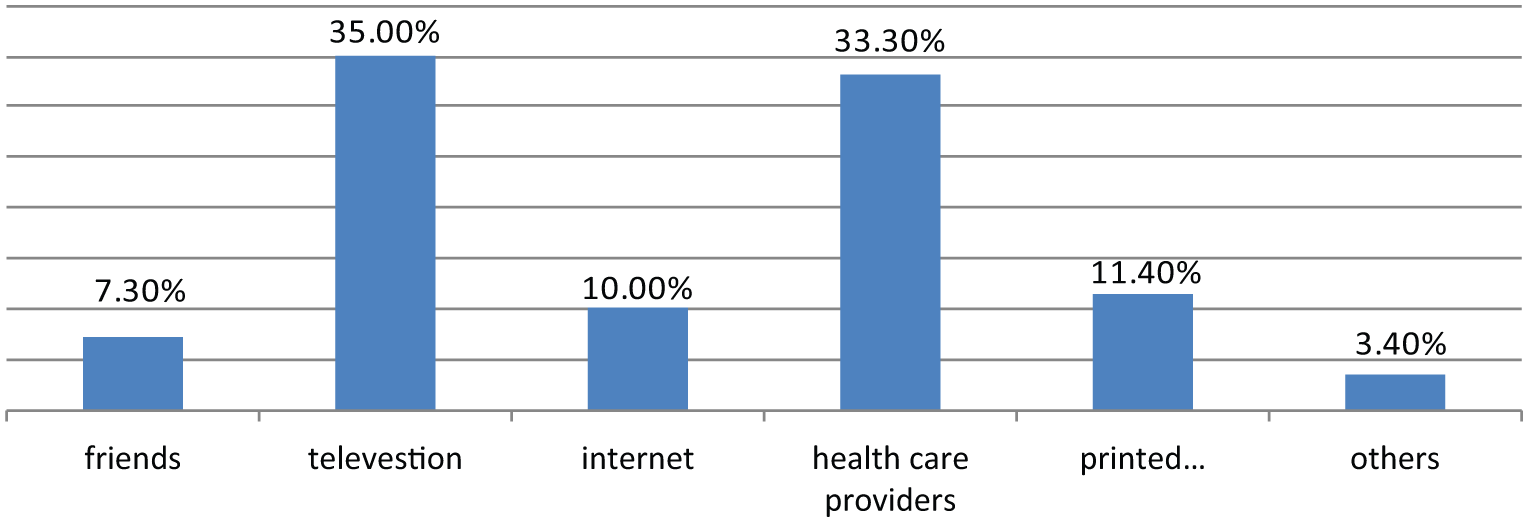
Primary source of information among secondary school female students in Nifas Silk Lafto Sub-City, Addis Ababa, Ethiopia, 2023 (n = 616).
Knowledge about human papillomavirus and its vaccine
Out of the total respondents of 428(69.5%) knew, the number of HPV vaccine is twice. A majority of respondents 424(68.9%) did not know HPV is transmitted by sexual contact. While 440(71.4%) had heard of the HPV vaccine prior to this study. Seventy-eight percent of respondents (78.9%) knew that the HPV vaccination prevents cervical cancer (Table 2).
Knowledge about HPV vaccine among secondary school female students in Nifas Silk Lafto Sub-City, Addis Ababa, Ethiopia, 2023 (n = 616).

Attitude of HPV and its vaccines
The majority of the participants 361(58.6%) had positive attitudes toward the HPV vaccine. Of the total study participants, 419(68.0%) believed vaccination helps to prevent HPV infection. 403(65.4%) of the study participants believed that may not have cervical cancer in the future. Less than three quarters, 447(72.6%), believed that HPV vaccination can prevent cervical cancer. 409(66.4%) agreed that they would recommend the vaccine to others (Table 3).
Attitudes about HPV vaccine among secondary school female students in Nifas Silk Lafto Sub-City, Addis Ababa, Ethiopia, 2023 (n = 616).

Factor associated with knowledge of HPV vaccine
Maternal education, maternal occupation, number of daughters, age, prior awareness of the HPV vaccine, source of information, and attitude toward HPV vaccine were associated with knowledge of HPV vaccine in the binary logistic regression analysis at p-value < 0.25. After multivariable logistic regression, age and prior awareness of HPV vaccine before this study were significantly associated with knowledge of HPV vaccine at p-value < 0.05.
Participants whose ages are between 18 and 20 years are 2.6 times more likely to have good knowledge than those aged between 14 and 15 years (AOR = 2.579, 95%CI = 1.446–4.498, P<0.001). Respondents who have prior awareness about HPV vaccine before this study were about 10.4 times more likely to have good knowledge about HPV vaccine than students who have not heard about HPV vaccine before this study (AOR = 10.441, 95% CI = 6.530–16.694, p < 0.001). The Hosmer Lemeshow goodness-of-fit model indicated adequate model fit (sig, value 0.817; Table 4).
BiVariable and multivariable analysis of factors associated with knowledge toward HPV vaccination among secondary school female students in Nifas Silk Lafto Sub-City, Addis Ababa, Ethiopia, 2023 (n = 616).

Notes: 1, reference category: *significant at P<0.05
AOR, adjusted odds ratio; CI, confidence interval; COR, crude odds ratio; HCP, Health care provider
Factors associated with attitude of HPV and its vaccine
For bivariate logistic regression analysis, school type, age, religion, prior awareness of HPV vaccine before this study, preferred area of vaccination, source of information, and knowledge of HPV vaccine were all candidate variables for multi-variable analysis at a p-value of <0.25. After controlling for confounders using the multivariate analysis model, prior awareness of HPV vaccine, source of information and knowledge toward HPV vaccine were significantly associated with attitude about HPV vaccine at a p-value of <0.05.
Students who had not heard about HPV vaccine before this study were about 63.2% less likely to have a positive attitude about the HPV vaccine than students who had heard about HPV vaccine before this study (AOR = 0.368; 95%CI = 0.239–0.567; p < 0.001). Students who had a good knowledge toward HPV vaccine were about 50% times more likely to have a positive attitude about HPV vaccine than students who had a poor knowledge toward HPV vaccine (AOR = 1.464; 95%CI = 1.000–2.144; p = 0.05). Participants who obtained information from health care providers were 2.4 times more likely to have a positive attitude about HPV vaccine than participants who obtained information from friends (AOR = 2.434, 95% CI = 1.055–5.615, p = 0.037). The Hosmer Lemeshow goodness-of-fit model was fitted (sig, value 0.33; Table 5).
BiVariable and multivariable analysis of factors associated with attitude toward HPV vaccination among secondary school female students in Nifas Silk Lafto Sub-City, Addis Ababa, Ethiopia, 2023 (n = 616).

Notes: 1, reference category: *significance at p < 0.05
COR, crude odds ratio; AOR, adjusted odds ratio; CI, confidence interval; HCP, Health care providers
Discussion
Knowledge of human papillomavirus infection and its preventive measures is very crucial in preventing cervical cancer. This study was conducted with the aim of assessing knowledge, and attitude toward HPV vaccine and its associated factors among secondary school female students in Nifas Silk Lafto Sub-City, Addis Ababa, Ethiopia. The findings of this study show that more than half of the respondents 55.5% (CI: 51.6–59.6) had good knowledge about HPV vaccine, which is consistent with the previous study conducted in Uganda (56.09%). 23 On the other hand, it is somewhat higher than the study conducted in Malaysia (38%) 25 and Arak, Iran (21%). 26 The discrepancy could be due to differences in information access and cut-off points to define the level of knowledge.
This study also indicates that the majority of the respondents (71.4%) heard about HPV vaccine which is consistent with china (69.2%) 27 and higher than a study conducted in Bangladesh (56%), 28 Pakistan (57%), 29 Lebanon (63.5%), 30 and Uganda (57%). 23 These dissimilarities may be due to the differences in culture and information access. On the other hand, the finding was lower than the study conducted in Finland (74.8%), 31 Italy (76.8%), 32 Hong Kong (92.8%). 33 The use of social mobilization and communication methods in HPV vaccine campaigns, the structure of national health care systems, and cultural diversity between nations are several probable explanations for the variations.
This study shows that 33% of the respondent’s main source of information about HPV vaccine was television, which is similar to a study conducted in Bangladesh (30%) 28 and lower than from television advertisements in Hong Kong (64.6%). 33 These differences could be due to education institutional structures, sampling procedures and tools, and the difference in socioeconomic and socio-demographic variables. The finding of this study reveals that less than half (44.8%) of the respondents know HPV vaccine recommended age for females, which is higher than a study conducted in India on female medical students (35%). 34 The reason for this variation may be the difference in study population and the time of study. This study shows that positive attitude of HPV vaccine was 58.6%(CI: 54.5-62.3), which is higher than the study conducted in south west Ethiopia in Jimma (44.4%). 35 Since the study in Jimma is conducted shortly after the HPV vaccine is made accessible in Ethiopia, a difference in the study period may be the reason for this discrepancy. This study shows that 67.4% respondents believed that the HPV vaccine is safe and highly effective, which is consistent with Indonesia (70%). 36 The result of this study shows age and prior awareness of HPV vaccine associated with knowledge and also prior awareness of HPV vaccine, source of information, and knowledge toward HPV vaccine associated with attitude.
In this study, participants whose age is between 18 and 20 years are 2.6 times more likely to have good knowledge than those age between 14 and 15 years. This study is supported by that conducted in Nigeria. 37 The association might be due to increasing age with increased access to health information and involvement in different school seminars. Not only this, but also in the different communities in Ethiopia, increasing age gives the right to access and take part in some activities.
In this study, respondents who had heard about HPV vaccine before this study were almost ten times to have good knowledge about HPV vaccine compared with those who have not heard about HPV vaccine before this study. This could be justified that those who have heard about HPV vaccine may know about HPV vaccine by reading different sources. Participants who have not heard about HPV vaccine before this study were about 63.2% less likely to have positive attitude about HPV vaccine than participants who had heard about HPV vaccine before this study. The possible reason might be due to students who haven’t heard about HPV vaccine may not read about it or ask others about the benefits. This does not increase their understanding and attitude of the HPV vaccines’ disadvantages and side effects.
Students who had a good knowledge toward HPV vaccine were about 50% times more likely to have a positive attitude about HPV vaccine compared with students who had a poor knowledge toward HPV vaccine. It may be hearing about the vaccine initiates the participants to read and know more about the benefits of the vaccine and also knowing the HPV vaccine would bring behavioral change. In this study, participants who obtained information from health care providers were 2.4 times more likely to have a positive attitude about the HPV vaccine than participants who obtained from friends. It may be that having information about the vaccine from the right or trustable person (health care providers) helps in recognizing the benefits of the vaccine, which in turn helps to develop a positive outlook for the vaccine.
Strengths and limitations of the study
This study employed a self-administered questionnaire, which enhanced the validity of responses by allowing participants to answer openly and confidentially. It identified key factors, such as age and prior exposure to HPV vaccine information that was significantly associated with knowledge and attitudes, offering valuable insights for designing targeted interventions. Additionally, the study highlighted the important role of information sources and community engagement in shaping attitudes toward HPV vaccination. Importantly, it contributes to the limited existing data on HPV vaccine awareness and attitudes within the specific community, addressing local public health needs.
However, several limitations should be considered. The cross-sectional design restricts the ability to establish causal relationships between variables such as knowledge and attitudes. The absence of qualitative data limits deeper exploration of participants’ perceptions, and excluding girls’ parents, who often serve as primary decision-makers for vaccination may have reduced the comprehensiveness of the findings. Moreover, the generalizability of the results may be limited beyond the specific population and geographic area studied. The reliance on self-reported data introduces potential biases, including social desirability and recall bias. Finally, the study did not assess the impact of educational interventions or track changes in knowledge and attitudes longitudinally, which would be important for evaluating the sustainability of such programs.
Conclusions
This study found a low prevalence of good knowledge and positive attitudes toward HPV and its vaccine compared to other studies. Age and prior awareness of the HPV vaccine were significantly associated with knowledge levels. Additionally, having heard about the HPV vaccine, the source of information, and existing knowledge significantly influenced attitudes. These findings suggest that knowledge and attitudes regarding HPV infection and vaccination play a crucial role in the success of HPV vaccination programs. Therefore, continuous public health efforts are necessary to emphasize the efficacy and safety of HPV vaccination as an essential preventive health measure.
To enhance the effectiveness of such programs on a broader scale, it is recommended that culturally tailored health education initiatives be implemented, targeting diverse populations through community and school-based interventions. Future research should focus on longitudinal monitoring of knowledge, attitudes, and vaccination uptake, as well as on identifying effective communication strategies and overcoming barriers to vaccine acceptance across different cultural and socioeconomic contexts. This approach will support the development of evidence-based policies and interventions, ensuring the global success of HPV vaccination programs.
Supplemental Material
sj-docx-1-smo-10.1177_20503121251409642 – Supplemental material for Knowledge, attitude, and associated factors toward human papillomavirus vaccination among female secondary school students in Nifas Silk Lafto Sub-City, Addis Ababa, Ethiopia: Multicenter cross-sectional study
Supplemental material, sj-docx-1-smo-10.1177_20503121251409642 for Knowledge, attitude, and associated factors toward human papillomavirus vaccination among female secondary school students in Nifas Silk Lafto Sub-City, Addis Ababa, Ethiopia: Multicenter cross-sectional study by Yechale Shumet, Girma Wogie, Abebayehu Melsew, Bereket Bedore and Ebisa Zerihun in SAGE Open Medicine
Footnotes
Acknowledgements
The authors extend their sincere appreciation to the Addis Ababa Nifas Silk Lafto Sub-City Education Bureau and the respective school administrators for their cooperation and support during data collection. Special thanks are also due to all the study participants for their time and willingness to provide valuable information. Finally, we gratefully acknowledge the contributions of all individuals who assisted directly or indirectly in the successful completion of this research.

Ethical considerations
Ethical clearance and approval for this research were obtained from the Institutional Review Board (IRB) of Asrat Woldeyes Health Science Campus, Debre Berhan University (Ref. No: IRB 01/88/2015). Permission was subsequently secured from the Addis Ababa Nifas Silk Lafto Sub-City Education Bureau, and the respective school administrators were informed about the study’s objectives and procedures.
Consent to participate
Written informed consent were obtained from participants aged 18 years and above. For adolescent participants younger than 18 years, verbal informed assent was obtained along with written informed consent from their parents or legally authorized representative. All Participants were fully informed about the study procedures, potential risks and benefits, and their right to withdraw at any time without any penalty. Confidentiality and anonymity were strictly maintained throughout data collection, and reporting process. All study procedures were conducted in accordance with the ethical standards of the Helsinki Declaration.
Consent for publication
Not applicable.
Author contributions
YS, GW, and AM contribute to the design of the study, analysis. YS, BB and EZ made the data analysis and interpretation of the data. EZ contributed to the design of the study and write-up of the manuscript. All authors read and approved the final manuscript.
Funding
The authors received no financial support for the research, authorship, and/or publication of this article.
Declaration of conflicting interests
The authors declared no potential conflicts of interest with respect to the research, authorship, and/or publication of this article.
Data availability statement
The datasets used and/or analyzed during the current study are available from the corresponding author on reasonable request.
Supplemental material
Supplemental material for this article is available online.
References
Supplementary Material
Please find the following supplemental material available below.
For Open Access articles published under a Creative Commons License, all supplemental material carries the same license as the article it is associated with.
For non-Open Access articles published, all supplemental material carries a non-exclusive license, and permission requests for re-use of supplemental material or any part of supplemental material shall be sent directly to the copyright owner as specified in the copyright notice associated with the article.
