




Abstract
The concept of pharmacovigilance (PV) is currently highlighted after emergency authorization and worldwide distribution of the urgently launched COVID-19 novel vaccinations. As they typically serve as the initial point of patient contact for medication-related issues, understanding the knowledge, perspectives, and attitudes of community pharmacists in PV and reporting adverse drug reactions (ADRs) is crucial to improving the healthcare system and public health policies. However, previous studies in Jordan have not focused entirely on community pharmacists. This study aimed to assess community pharmacists’ knowledge, perspectives, and attitudes on PV and ADRs reporting in Jordan. The applied methodology in this study was based on a cross-sectional study design using a validated questionnaire distributed to a convenient sample of Jordanian community pharmacists. Seventeen questions were designed from different pieces of literature relating to knowledge, perspectives, and attitudes of PV among community pharmacists. Descriptive statistics (frequencies and percentages) were used to report the results data. The study questionnaire was completed by 180 of 325 community pharmacists willing to participate (a response rate of 55.4%). Of them (n = 132, 73%) were aware of the concept of PV. Additionally (n = 84, 47%) of the community pharmacists would use the concept and policy of PV in their everyday work. Nevertheless, only (n = 36, 20.0%) of the community pharmacists thought an ADR should be reported if seen, and approximately 120 pharmacists (67.0%) believed it was essential to report ADRs as patient health matters. Although community pharmacists in Jordan showed a considerable awareness level of PV, they demonstrated a low level of its application. Thus, ADR reporting is not considered a mainstay among them, and the implementation of PV is not yet addressed. The results from this study shed light on community pharmacists’ perceptions and attitudes regarding ADR reporting and PV.
According to the World Health Organization (WHO), Pharmacovigilance (PV) is “the science and activities relating to the detection, assessment, understanding, and prevention of adverse effects or any other drug-related problems.” Adverse drug reactions (ADRs) are considered the main element in PV activity.
Community pharmacists’ perspectives and practices on PV and adverse drug reactions (ADRs) reporting have yet to be investigated in various governorates of Jordan. This understanding is crucial to improving the healthcare system and public health policies.
The current study will enlighten policymakers regarding ADR reporting and the implementation of PV, providing them with more insights into PV and healthcare system improvement. Furthermore, it serves as a foundation for investigating the efficacy of specific interventional strategies that address the obstacles to reporting ADRs.
Background
In the current era, the concept of pharmacovigilance (PV) was thrust into the spotlight when numerous novel vaccinations created in response to the COVID-19 pandemic received emergency authorization and were widely distributed worldwide, mandating the need for an effective post-marketing safety surveillance system. 1 The Department of Health in the World Health Organization (WHO) stated that PV is “the science and activities relating to the detection, assessment, understanding, and prevention of adverse effects or any other drug-related problems.” 2 Pharmacovigilance is also known as the science of improving patient care and patient safety concerning drug use by gathering, monitoring, analyzing, and assessing data from healthcare providers and patients. 3 If any drug is not tested against proper storage conditions, safety, and evidence-based indication before handing it out to the targeted audience, it can cause severe complications, which can eventually result in the death of an individual.4,5
Adverse drug event data are collected and reported through clinical trials from the beginning of the drug development process. Following that, ongoing post-marketing surveillance activities are carried out to gather comprehensive safety data for each medicine. Healthcare systems rely heavily on the spontaneous reporting of adverse drug reactions (ADRs) to monitor medicine safety once registered and marketed worldwide. 6 This makes it easier for regulatory agencies to find drugs that might have unidentified safety issues not found in clinical trials. 7
The WHO has described adverse drug reactions as “a response which is noxious and unintended, and which occurs at doses normally used in humans for the prophylaxis, diagnosis, or therapy of disease or the modification of physiological function.” 8 For the evaluation of drug effect monitoring, a surveillance system must be implemented by healthcare institutes so that there is some decline in morbidity and mortality rates. ADRs are the main element in PV activity as they ultimately lead to high morbidity and mortality rates. 9
In that context, healthcare professionals (HCPs) play a significant role in ensuring a robust PV system before providing patient-centered care because consumers are more likely to report ADRs to their physicians or pharmacists than to the pharmaceutical industry.10 -12 Unfortunately, because it is not required by law in most nations, HCPs worldwide have a meager rate of spontaneously reporting ADRs. These low rates of ADR reporting are a crucial issue for the healthcare industry and may impede regulatory efforts to remove medicines with unacceptable safety profiles from the market. 10 Since ADRs are a primary cause of hospitalizations, morbidity, and mortality, these delays significantly increase healthcare costs. 12
The identification, documentation, and reporting of ADRs are the responsibility of HCPs, and their contribution to the early detection and reporting of an ADR is essential. However, a healthcare provider’s ability to report an ADR is influenced by various factors, including ignorance, ambiguity, and difficulty comprehending the reporting system. 13 Numerous studies have demonstrated that optimizing PV knowledge, attitude, and practices among HCPs is crucial to formulating strategies and improving the ADR reporting system.14 -17
International studies have demonstrated that healthcare professionals’ perspectives on ADRs significantly impact their reporting rates, and they have very little knowledge of PV. Suyagh et al 18 and Xu et al 19 clearly describe this relationship. They demonstrated that perspectives of indifference, lack of compensation, competing workplace priorities, and dissatisfaction with reporting methods significantly influenced ADR reporting rates.18,19 With their high patient accessibility, community pharmacists are in place for reporting ADRs.20 -23
In Jordan, The Jordan Food and Drug Administration, through the Jordan PV Center, is responsible for PV and is committed to improving drug safety through the official statement of ADR reporting and continuous monitoring of ADRs. 24 Reporting ADRs is not obligatory; HCPs and customers can report ADRs through the online reporting form. 24
Locally, a study examined the knowledge and attitudes of pharmacists regarding ADR reporting. 18 However, the findings from this study suggested that pharmacists lack sufficient knowledge of ADR reporting and PV. Likewise, the review presumed that instructive projects in the announcing system are essential. It is known that pharmacists’ reporting of ADRs may largely be influenced by their level of ADR reporting knowledge. According to studies, ADR reporting can be improved through education in PV. 25 Several studies have been conducted to assess students’ understanding of PV and ADR reporting. These studies demonstrated that students lack adequate knowledge of PV and ADR reporting.26,27 Another local study investigated the overall knowledge, attitude, and practice of PV and ADR reporting among community and hospital pharmacists in 1 governorate of Jordan. 28 Pharmacists in this study showed moderate PV and ADR reporting knowledge on average, with most of them not knowing how to report. It is essential to note that community pharmacists’ knowledge, perspectives, and attitudes on PV and ADR reporting have yet to be investigated in various governorates of Jordan. This gap should be filled because community pharmacists typically serve as the initial point of patient contact for medication-related issues.
Aims of the Study
The main objectives of this study were to assess the understanding of the PV concept among community pharmacists in Jordan, their perspectives on reporting ADRs, and their attitudes toward reporting ADRs in the primary care setting, which is crucial to improving the healthcare system and public health policies.
Methods
Study Design and Settings
A cross-sectional study design was conducted among Jordanian community pharmacists in June 2022 to evaluate their understanding of the PV concept, their perception of ADR reporting, and their attitudes to ADR reporting.
Study Tool Development, Validation, and Reliability
The questionnaire was designed by the authors in concordance with the research aims and based on previous studies in the literature.14,15,17 -22,28 -37 The questionnaire was sent for review to a panel of 3 academic experts in clinical pharmacy practice to ensure face validity. The academic experts commented on the questionnaire items’ wording, clarity, and comprehensiveness and whether each item was relevant to the study’s aims and objectives. The academic experts’ comments were reviewed by the authors and used to refine the questionnaire. After completing the pilot-testing process with several community pharmacists (n = 30) to ensure the questions were clear, understandable, and reflected the study’s objectives, feedback adjustments were adopted, and the final refined questionnaire (Supplemental File) was developed and distributed manually to a convenient sample of community pharmacists who were willing to participate in this study. The pilot process responses and the questionnaires not completed by respondents or filled out only for demographic characteristics were excluded from the study. Cronbach’s α coefficient was used to assess the reliability of the questionnaire, where the overall test result was α = .927, indicating sufficiently high internal consistency of the study questionnaire. 38
Sample Size Calculation
This study was conducted among community pharmacists in Jordan (around 7200, according to the Jordan Pharmacists Association). 11 The minimum sample size required was calculated using a 95% confidence level and a 5% margin of error (significance α = .05) with a 70% response distribution and was found to be a (309). 39 A convenient sample of 325 community pharmacists was approached in their pharmacies, and they were willing to participate in the study.
Questionnaire Measures
Seventeen questions were made, which were used in the questionnaire to be responded to by different community pharmacists. The first 4 questions were dedicated to the demographic characteristics of respondents, followed by questions concerning the knowledge and perspectives of community pharmacists on PV. The remaining questions were dedicated to exploring the attitudes of community pharmacists regarding PV.
Statistical Analysis
Data collected from the questionnaires were analyzed using the Statistical Package for Social Science software SPSS, version 25. Descriptive statistics (frequency and percentage) were used to report the results. The reliability of the questionnaire was assessed using the Cronbach alpha test.
Results
One hundred eighty respondents from the 325 community pharmacists who were willing to participate in this study answered and returned the completely answered questionnaires (a response rate of 55.4%).
Table 1 portrays the study respondents’ demographic characteristics, where most of them were female (73%), held a Bachelor’s degree in pharmacy (87%), had 5 to 10 years of experience (47%), and worked in the middle governorates (73%) for 40 to 48 h weekly (70%).
Demographic Characteristics of Respondents (n = 180).

Information Concerning the Pharmacovigilance Concept
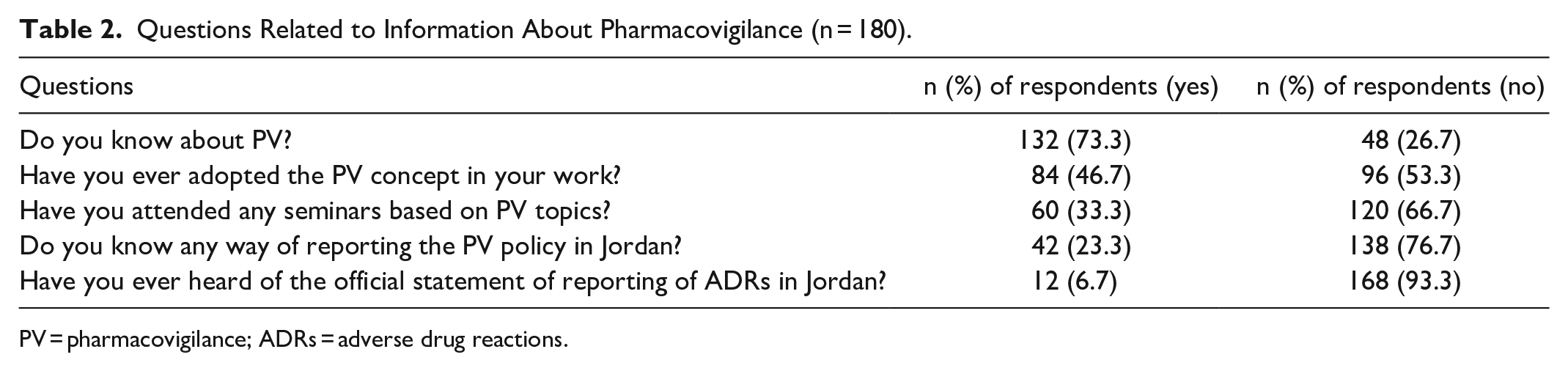
Responses to the survey questions regarding the pharmacovigilance concept knowledge (the second section) are depicted in Table 2.
Questions Related to Information About Pharmacovigilance (n = 180).
PV = pharmacovigilance; ADRs = adverse drug reactions.
After the analysis, it was observed that 132 (73%) of the participating community pharmacists were aware of the concept of pharmacovigilance. Nevertheless, 84 (47%) of them could use the concept and policy of pharmacovigilance in their everyday work. As ADRs can cause severe complications if not reported, community pharmacists should be aware of reporting these ADRs of any drug. However, only 12 (7%) of the community pharmacists were aware of the official statement of ADR reporting in Jordan.
Perspectives of Community Pharmacists on the Pharmacovigilance Concept
Table 3 portrays the frequency and percentages of responses to the questions asked of the participating community pharmacists to assess their perspectives on PV toward reporting ADRs.
Community Pharmacists’ Perspectives on PV in Reporting ADRs (n = 180).

ADRs = adverse drug reactions; PV = pharmacovigilance.
Most respondents who answered the survey questions think it is not mandatory to report any ADR if observed, with only 20% (n = 36) thinking an ADR must be reported. Approximately 67% (n = 120) of the respondents believe that reporting ADRs is crucial because patient health matters. Reporting ADRs is not considered necessary in the perspectives of 80% (n = 144) of community pharmacists, and 27% (n = 48) of them think that when they report any consequence of ADRs, any legal action against it is not taken. Most respondent community pharmacists 83% (n = 150) believed they lacked the PV knowledge in reporting ADRs.
Attitudes of Community Pharmacists to the Pharmacovigilance Concept
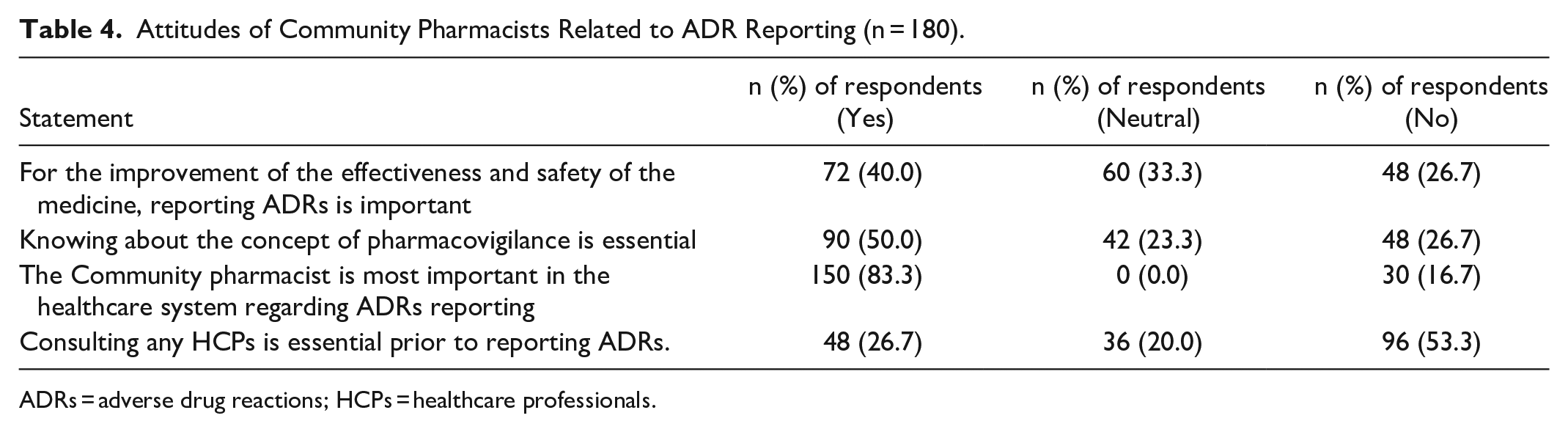
The final section included questions about the attitudes of community pharmacists in reporting ADRs in the context of pharmacovigilance. Responses to these statements are presented in Table 4.
Attitudes of Community Pharmacists Related to ADR Reporting (n = 180).
ADRs = adverse drug reactions; HCPs = healthcare professionals.
Most of the responding community pharmacists (n = 150, 83.3%) considered themselves to be the most important in the health care system regarding ADR reporting. It was found that 72 (40%) community pharmacists thought it important to report ADRs to improve the efficacy and safety of the medicine. Half of the community pharmacists believed that knowing the concept of PV is essential. Ninety-six (53%) community pharmacists thought it was unnecessary to consult any healthcare professional if they wanted to report any ADRs.
Discussion
This study revealed the knowledge and perspectives about PV among community pharmacists and explored their attitudes to PV in reporting ADRs in the primary care setting. Previous studies in Jordan have eventually targeted HCPs, hospitals, and community pharmacists in 1 geographical area or pharmacy students but have not focused entirely on community pharmacists among various governorates.18,28,32,33 For example, Suyagh et al 18 investigated Jordanian pharmacists’ awareness of PV in hospitals and the community and reported that PV is poorly understood by most community and hospital pharmacists. Including community and hospital pharmacists would be the reason for the disparity in awareness. This contrasted with the findings of this study.
Alnawaiseh and AL-Oroud 28 investigated the overall knowledge, attitude, and practice of PV and ADR reporting among community and hospital pharmacists in 1 governorate of Jordan. Contrary to our study regarding PV and ADR reporting knowledge, pharmacists in this study showed moderate knowledge on average (58.7%). However, most of them do not know how to report, which aligns with the results of this study.
A study conducted in Saudi Arabia found that 85.6% of participants were unaware of how to report ADRs. 20 Likewise, hospital pharmacists in Lebanon were not well-versed in the idea and procedures of PV and the spontaneous ADR reporting system. 40
Alshammari et al 31 found that most HCPs were unaware of the term “pharmacovigilance,” whereas Abu Hammour et al 32 mentioned that pediatricians were unaware of pharmacovigilance and ADR reporting. This was consistent with the results of this study.
A study showed that the primary cause of underreporting ADRs is HCPs’ inadequate understanding of PV and that enhancing PV initiatives primarily involves close monitoring by authorities and training activities tailored to the needs and preferences of HCPs. 15
The fact that Jordan has pharmacovigilance centers and an official standardized form for reporting ADRs was unknown to most of our participants. This is comparable to the findings from the studies by Suyagh et al 18 and Abdel-Latif and Abdel-Wahab, 35 which demonstrated that most pharmacists were unaware of the legal provisions that provide PV activities. The same scenario existed in the Kingdom of Saudia Arabia, where, although there are PV centers, research indicates that practicing pharmacists are unaware of them or the procedure for reporting ADRs. On the contrary, Oman has a national PV program, and according to a recent survey, about 90% of community pharmacists are aware of their national PV center.15,41,42
The healthcare system and each pharmacist should focus on strategies to improve ADR reporting as a general principle and encouragement.36,37 Through ongoing professional development programs, pharmacists should also be able to bridge knowledge and skill gaps in detecting and reporting ADRs. 25 Evidence shows that providing HCPs with ongoing education helps them change their behaviors and attitudes toward reporting ADRs.10,13,25 Such education should aim to increase pharmacists’ knowledge of ADRs and change pharmacists’ attitudes and perceptions about reporting ADRs, which should increase spontaneous reporting. 43
Additionally, boosting the post-marketing monitoring program and vigilance includes creating a communication plan to facilitate better relationships and exchanges with external stakeholders. Addressing prior issues should begin with giving stakeholders—especially the public and health professionals—relevant and easy-to-use feedback. 44
The results from this study will enlighten policymakers in Jordan about community pharmacist perspectives, knowledge, and attitudes regarding ADR reporting and the implementation of PV, providing them with more insights into PV system improvement. Furthermore, the current study serves as a foundation for a comprehensive, large-scale investigational study that explores community pharmacists’ perspectives and practices toward PV. The perspectives of other HCP groups, including nurses and hospital staff, regarding reporting ADRs in Jordan can be the subject of further research. This might include investigating the efficacy of specific interventional strategies that address the obstacles to reporting ADRs. It is possible to conduct research into how PV education programs change HCPs’ perspectives and how they report ADRs.
Strengths and Limitations
To the authors’ knowledge, this is the first study in Jordan that focused entirely on community pharmacists, reported their perspectives on PV, and explored their knowledge and attitudes to PV in ADR reporting. This would be considered a strength of this study. However, this study is not without limitations. The cross-sectional design using convenience sampling, the small sample size, and the relatively low response rate in retrieving completely answered questionnaires constrain the generalizability of the study findings. Additionally, the questionnaire items were more of a snapshot with a screening focus, including a close-ended and insufficient number of questions assessing participants’ knowledge of pharmacovigilance where measurable content and construct validity were not performed. Therefore, the findings from this study should be carefully interpreted.
Conclusion
This study showed that although community pharmacists in Jordan had a considerable awareness level of PV, they demonstrated a low level of its application. Thus, ADR reporting is not considered a mainstay among them, and the implementation of PV is not yet addressed. The findings from this study will help policymakers in Jordan gain more insight into community pharmacists’ awareness, knowledge, and attitudes regarding ADR reporting and the implementation of PV. Furthermore, it is recommended that information based on PV and ADR reporting should also be demonstrated to community pharmacists.
Supplemental Material
sj-docx-1-inq-10.1177_00469580241246464 – Supplemental material for Pharmacovigilance Concept Knowledge, Perspectives and Attitudes: A Cross-Sectional Study Among Community Pharmacists
Supplemental material, sj-docx-1-inq-10.1177_00469580241246464 for Pharmacovigilance Concept Knowledge, Perspectives and Attitudes: A Cross-Sectional Study Among Community Pharmacists by Mohammad Abu Assab, Hamza Alhamad, Fares Albahar, Wael Abu Dayyih, Soumaia Echarif and Hanadi Abu Assab in INQUIRY: The Journal of Health Care Organization, Provision, and Financing
Footnotes
Acknowledgements
Not applicable.
Author Contributions
MAA conceptualized the study and participated in its design, validation, data curation, formal analysis, resources, and administration. HA participated in the design, validation, and investigation of the study. FA participated in the study’s design, validation, and formal analysis. WA participated in the investigation and helped with the software and supervision of the study. SE participated in data curation, resources, and project administration. HAA participated in formal analysis, software, coordination, and visualization. All authors participated in writing the original manuscript draft and reviewing, editing, and approving the final manuscript.
Availability of Data and Materials
The data presented in this study are available from the corresponding author upon reasonable request.
Declaration of Conflicting Interests
The author(s) declared no potential conflicts of interest with respect to the research, authorship, and/or publication of this article.
Funding
The author(s) received no financial support for the research, authorship, and/or publication of this article.
Ethical Approval
This study was approved by the Ethics Committee for Scientific Research (ECSR) at Zarqa University in accordance with the requirements for protecting human subjects and the ethical principles related to research studies, approval number (6/2/2022).
Consent to Participate
Informed consent was obtained from all participants involved in the study so that participants’ willingness was taken before proceeding to work on the study. The study revealed no personal information about the participants except their demographic characteristics, and respondents’ confidentiality was kept anonymous until the end of the study.
Consent for Publication
Not applicable.

Supplemental Material
Supplemental material for this article is available online.
References
Supplementary Material
Please find the following supplemental material available below.
For Open Access articles published under a Creative Commons License, all supplemental material carries the same license as the article it is associated with.
For non-Open Access articles published, all supplemental material carries a non-exclusive license, and permission requests for re-use of supplemental material or any part of supplemental material shall be sent directly to the copyright owner as specified in the copyright notice associated with the article.
