




Abstract
Cancer is a leading cause of death, with a rapidly increasing global burden. Chemotherapy is the most effective cancer treatment, and with its benefits, there exist potential problems. The present study assesses cancer patients’ knowledge, attitude, and practice toward chemotherapy use. A descriptive cross-sectional study was conducted in the oncology wards of various tertiary care hospitals and cancer care centers in Lahore, Pakistan. Patients were included in the study based on convenient sampling. A structured questionnaire with 25 (close-ended) questions and a demographic profile was used to collect data. Descriptive statistics was used to analyze frequencies and percentages. Independent sample t-test and ANOVA were used to calculate the mean and standard deviation. Most patients were females (54%) and married (52.6%), with an unemployment rate of 39%. Patients with higher education depicted significantly higher scores in knowledge (9.61 ± 2.65), attitude (19.37 ± 2.70), and practice (3.89 ± 1.03) domains. Surprisingly, throughout the whole KAP domain, the patient’s attitude (18.42 ± 3.31) toward chemotherapy use, showed higher values, as compared to their knowledge (7.78 ± 3.26) and practice (3.66 ± 1.08) scores. The majority of the study participants had a positive attitude toward chemotherapy use, with limited knowledge, and practice.
To the best of our knowledge, limited studies have been conducted to evaluate the knowledge, attitude, and practice related to chemotherapy use among cancer patients, and the research that is carried out on this topic has reported limited knowledge, among cancer patients, with poor practice.
Evaluating the level of knowledge, awareness, and practice among cancer patients related to chemotherapy use, will help in improving medication therapy management and will help pharmacists to develop and implement pharmaceutical care services to better the aforementioned parameters.
Evidence of poor knowledge of cancer patients related to their chemotherapy and biased responses concerning attitude and practice indicates a lack of education of cancer patients toward their therapy, which implies the need to invest in research to develop and improve pharmaceutical interventions to improve cancer patient’s knowledge of their therapeutic regimen and to develop policies for its implementation.
Introduction
Cancer, an important barrier to increasing life expectancy, has been ranked as a leading cause of death, in every country of the world. There is a rapidly growing worldwide burden of cancer incidence and mortality with 19.3 million new cases and 10 million cancer deaths according to 2020 GLOBOCAN estimate 1 and by 2030 GLOBOCAN, an estimate of total 20.2 million cases will be diagnosed annually worldwide. 2 According to the International Agency for Research on Cancer (IARC), the number of prevalent cases of cancer in Pakistan is 0.32 million with 0.11 million proportion of cancer fatalities and also globally Pakistan has one of the highest burdens of breast cancer mortality. 3
Cancer is a chronic disease, in which the spread and entry of uncontrolled cell division to other parts of the body occur. 3 Cancer when diagnosed in the early stage can be treated. Therapy of cancer is expensive and relies upon several factors causing the disease. It is screened by various screening tests, and various therapies are presently accessible these days such as gene therapy, chemotherapy, surgical procedure, radiation treatment, immunotherapy, and so forth.2,4 Before starting therapy, patients need to be explained the extent of the disease, purpose of treatment, and treatment-related side effects, as most have difficulty understanding their disease and the purpose of treatment. 5
The most vital modality of cancer treatment is chemotherapy, which inhibits the growth and spread of cancer cells by destroying them using chemical agents or drugs, it affects both the psychological and physiological aspects of human life that is, nausea, vomiting, gastrointestinal disturbance, pain, stress and anxiety to name a few, thus depicting its own merits and demerits. 6 Cancer patients receive chemotherapy for months or even for years, and the adverse side effects can negatively affects them. 7 Thus, many people experience apprehension with the thought of using chemotherapy, but this anxiety can be reduced by providing them with the knowledge related to the therapy, with its potential benefits and side effects. Chemotherapy knowledge is a broad term, encapsulating the goals, duration, side effects related to therapy along with lifestyle adjustment, providing patients with relevant knowledge associated with their therapy, helping them to adhere to their chemotherapy regimen and making them well prepared with the course of action if and when the side effects occur.2,8,9
Patients do not necessarily feel well informed to follow instructions or to make treatment decisions, even after provision of adequate information, 8 as the personal assumptions related to cancer varies between both healthcare professionals and the patients. It is helpful to be aware of the attitude, cancer patients have related to challenges of cancer. 10 When making treatment related decision, special focus should be made on patient’s preference related to the balance between side effects and benefits, as identifying patient’s attitude toward therapy is crucial in achieving a balance between toxicity and survival. 11
In order to maintain an adequate physical and mental health, cancer patients are expected to be able to utilize the information provided to them and monitor their condition. 12 As cancer patients experience a multitude of symptoms during therapy, undergoing self-management is their top priority. 13 Attitude and practice related to cancer management can be affected by lack of knowledge, thus, affecting how they react to toxic side effects related to therapy.4,14
Previous studies have correlated level of knowledge of cancer patients with health literacy, 9 medication adherence 15 and self-care practices. 6 Adequate knowledge of chemotherapy among cancer patients have been reported in the past studies,16 -18 with 1 study depicting statistically significant knowledge deficit cancer patients. 15 A study from Rawalpindi Pakistan, reported limited knowledge among breast cancer patients in most aspects, while their attitude was fairly positive, providing hope for improving their knowledge in the future. 19 Katabalo et al, 20 reported positive attitude among cancer patients regarding use of chemotherapy. When it comes to practice, Gassmann et al, 14 explained the role of education and attitude in motivating cancer patients to better manage their symptoms and disease therapy.
The knowledge, attitude, and practice of healthcare professionals regarding cancer treatment and management have been explored in the past,21 -25 while little work has been done on evaluating these parameters from a patient’s point of view, especially in Pakistan. The aim of this study is to explore the knowledge, attitude, and practice (KAP) related to chemotherapy among cancer patients and to evaluate the characteristics associated with each domain.
Methods
Ethical Approval
This study was approved by the Ethical Committee of Akhtar Saeed College of Pharmaceutical Sciences, (Ref. No; 3559/ACPS). Informed consent was also obtained from each participant before conducting this study. The ethics in research was also taken into consideration, as no deception or false information was used as the basis of the research. The identity of the participants was kept completely anonymous and every research parameter was kept strictly confidential.
Study Design
A descriptive cross-sectional study was designed to investigate the knowledge, attitude and practice (KAP) related to chemotherapy among cancer patients receiving chemotherapy. The aim of this study was to check whether patients have the proper knowledge and attitude toward their chemotherapy, and follow the proper practice required.
Study Settings
Patients were enrolled in this study, who were receiving chemotherapy from various Cancer Research hospitals and Care Centers (where patients were provided ancillary services including palliative care, hospice services, and rehabilitation services, comprehensive daycare cancer services during chemotherapy, OPD, and cancer screening were also provided in some centers) within Lahore, Pakistan. Data collection was carried out from April 2022 to June 2022, via a comprehensible instrument of measure. The questionnaire was administered by well-trained undergraduate pharmacy students. They provided guidance to respondents when they had difficulty understanding the questions.
Participants
Inclusion of cancer patients in the study was based on convenience sampling, which was on their basis of availability, willingness to participate, geographical proximity and easy accessibility, thus a non-random sampling was done. 26 The patients included were receiving chemotherapy for more than 2 months, were coming to the hospital to receive chemotherapy on the basis of stage and type of their cancer. Most of them were coming every first and eighth day of their weekly therapy.
Participants were included in the study as per study inclusion and exclusion criteria;
Inclusion criteria
All cancer patients 18 years and above, receiving chemotherapy in cancer hospitals and research centers in Lahore, Punjab.
Exclusion criteria
Cancer patients who have not received chemotherapy. Patients below the age of 18, patients who were suffering from dementia and all other individuals were excluded from the study.
Sample Size
A total of 390 participants were included in the study. Raosoft Calculator® was used to calculate the sample size, as in Lahore, prevalence of cancer patients from 2010 to 2019 has been reported to be 58,394. 27 With a 95% confidence level, 5% margin of error, a sample size of 382 participants for the study was calculated, which was estimated to be representative of the population of cancer patients in Lahore, Punjab. Progressing with a 4% dropout in mind, to get an optimal response ratio, a total of 390 sample size was the final for data collection.
Questionnaire
The first part of the questionnaire comprised of sociodemographic variables, including age, gender, marital, education and employment status. Second part was a self-administered KAP questionnaire regarding chemotherapy use, designed by Wang et al 28 was used for data collection. The questionnaire was taken from an open access article, 28 distributed under the terms of Creative Commons Attribution License permitting unrestricted use, distribution and reproduction in any medium provided the original work is properly cited. The KAP questionnaire aimed to find out if the patients who are receiving chemotherapy understand the basics about their treatment or not, to find a better understanding about their attitude related to chemotherapy use and management practices.
The KAP Questionnaire comprised of 3 domains that is, Knowledge, Attitude, and Practice, comprising of 25 questions. The knowledge section comprised of 14 items, 5 for attitude and practice section with 6 items. The knowledge score ranged from 0 to 19, comprising of multiple-choice questions, with 0 score for wrong choice and 1 for the correct option or options respectively. In the attitude dimension, total score ranged from 5 to 25, as there are 5 levels of answers for each question, thus giving 1, 2, 3, 4, and 5 score corresponding to strongly disagree, disagree, neutral, agree and strongly agree respectively. Lastly, the practice dimension with the score ranging from 0 to 6, with 1 correct answer for each question, except for question 20th and 21st, where 1 score was given to either (b) or (c) choice.
Validation and Reliability
In order to ensure the internal validity and reliability of questionnaire a pilot study was initially conducted on 15 participants. The first 15 participants who responded were not included in the research when evaluating the data collected. Once the data from these 15 participants was collected a primary statistical analysis was run on it. Cronbach’s alpha was applied in order to measure the internal consistency and to measure the scale of reliability of our self-developed questionnaire. It was calculated to be 0.69 that is acceptable in the range.
Statistical Methods
Data analysis was accomplished by using statistical tools. Statistical Package for Social Sciences (IBM SPSS version 24.0) was used for analysis of the collected data. Descriptive statistics was applied for calculation of frequencies and percentages. Mean and standard deviation of the aggregate of each individual patient score of the 3 main sections was calculated. Predetermined set of correct answers were used, to determine the scores of each category (knowledge, attitude, and practice). Independent sample t-test and ANOVA was used to determine the mean and standard deviation of knowledge, attitude and practice score of individual demographic characteristics.
Results
Out of total of 390 individuals enrolled in the study, majority of the patients were females (53.8%), married (52.6%), employed (39.0%), and had higher education (45.9%) (Table 1). Majority (54.6%) of the patients didn’t know about the chemotherapy regimen and 56.9% didn’t even know the name of the drugs, and when asked regarding the knowledge about the harmful effects of chemo drugs on surrounding tissues, 41.8% didn’t have any knowledge about it. Patients also depicted poor knowledge when asked about the side effects of the chemotherapy drugs. They also had poor knowledge related to management of these side effects, however, when asked about chemotherapy induced constipation management, 47.4% knew to drink plenty of water for constipation and 72.3% said yes to drinking more water during chemotherapy as well (Table 2).
Baseline Sociodemographic Characteristics of Cancer Patients.

N = frequency, % = percentage.
Knowledge of Cancer Patients Regarding Chemotherapy.
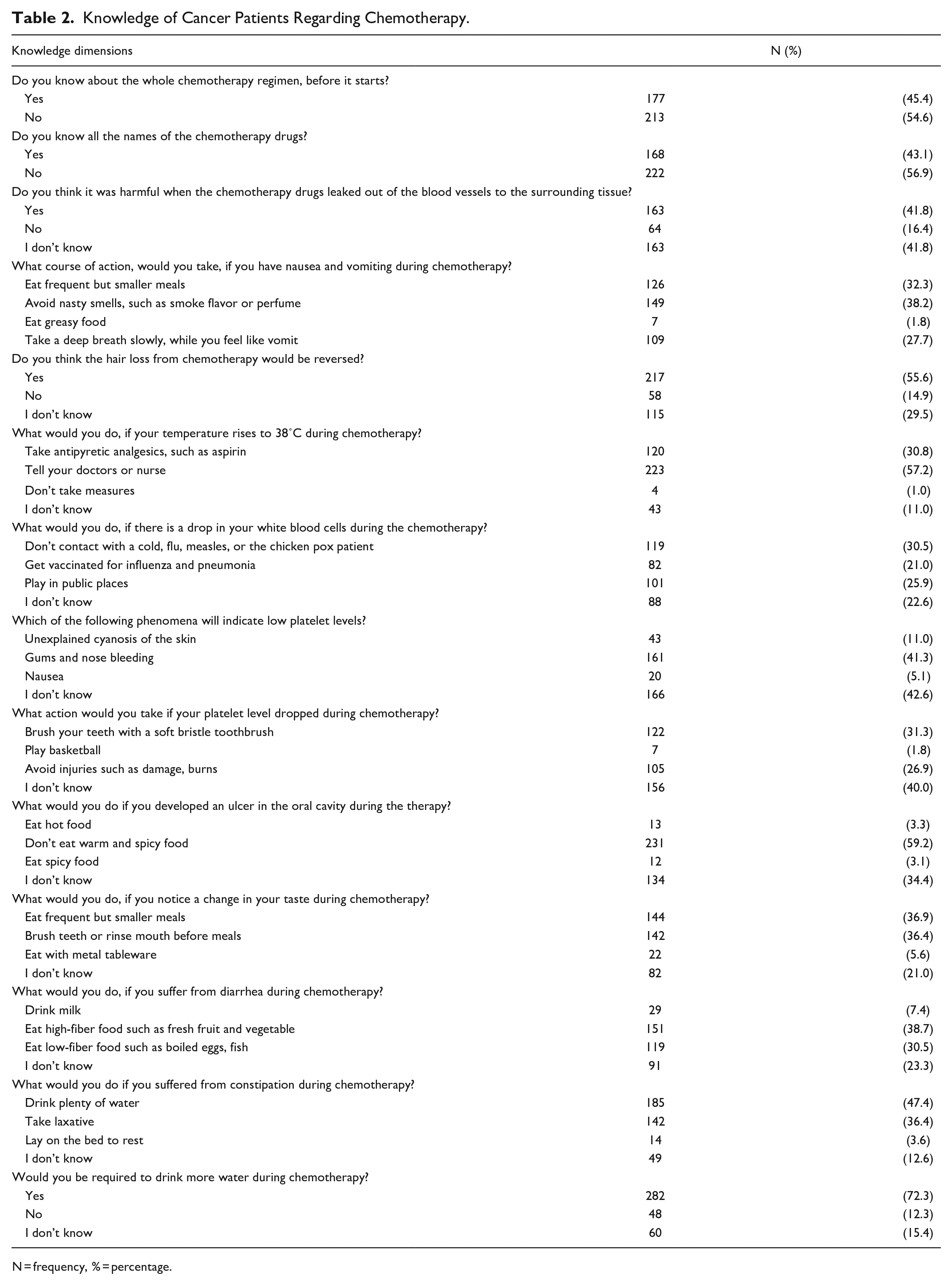
N = frequency, % = percentage.
In the attitude dimension summarized in Table 3. majority of the patients (3.79 ± 0.893) agreed that chemotherapy induced side effects will disappear after therapy and also majority agreed and strongly agreed with the fact that the chemotherapy induced nausea and vomiting can be prevented as well, while lesser number of patients in comparison (3.57 ± 0.895) strongly agreed to the fact that chemotherapy induced reactions can be prevented by self-care. Few strongly agreed with the fact that analgesics can cause addiction, however there was a strong agreement to receive health education on chemotherapy.
The Attitude of Patients Toward Chemotherapy Use.

Note. 5 = Strongly Agree, 4 = Agree, 3 = Neutral, 2 = Disagree, 1 = Strongly Disagree.
Regarding the practice related dimensions (Chart 1), a positive response was given when asked about quitting or never having any drink or smoke. Also, participants showed good chemotherapy management, when they reported that they visited the hospital regularly for their chemotherapy, however poor practice was observed when asked about the management associated with their hair loss. Also, poor management was reported by patients when asked about dealing with fatigue and the approach to take if the drug leaks from the vessels.

Practice of cancer patients regarding to chemotherapy management.
Table 4 illustrates the overall mean of Knowledge, Attitude, and Practice Score with demographic association. The knowledge score of the overall participants was low with a Mean ± SD of 7.78 ± 3.26, attitude of the patients related to their chemotherapy was good with an overall score of 18.42 ± 3.31, lastly their practice score was also low with value of 3.66 ± 1.08. The association of demographic characteristics with regards to mean KAP scores, showed significant association with reference to educational level (P < .001) in knowledge score, as the patients with higher level of education, showed increased knowledge score. Same was the case with the scoring of attitude (P < .001) and practice (P < .001), patients with higher education had better attitude and practice related to the use of chemotherapy. Another significant association was found with employment status (P < .001) with regards to chemotherapy knowledge, where patients who were working or retired showed better knowledge than those who were unemployed. Rest of the demographics (age, gender, marital status) did not show significant difference with regards to their knowledge, attitude and practice with regards to use of chemotherapy.
Association of Demographic Characteristics of Cancer Patients With Regards to Mean KAP Score.

KAP = knowledge, attitude, and practice, SD = standard deviation, *P ≤ 0.05.
The above data depicted patients to have poor knowledge and practice related to chemotherapy use, however, the attitude of patients was significantly good.
Discussion
Despite several cancer-related surveys, very few studies have been published to assess cancer patients’ chemotherapy related knowledge, attitude and practice (KAP). The sole purpose of analyzing patients’ KAP is to optimize chemotherapy regimens, minimize drug related side effects/toxicity, provide medication education and psychological support, and improve patients’ health and quality of life. 28 The majority of study participants’ knowledge of cancer chemotherapy was limited in most aspects. 19 However, higher level of education and patients’ employment status had a significant association with increased level of knowledge related to therapy, as reported by a study analyzing cancer knowledge among Moroccan population, where patients with higher level of education depicted highest levels of chemotherapy understanding and practice. This is also evident from a study on Ecuadorian population, where patients reported higher evidence of knowledge score among participants with jobs and tertiary level of education.29,30
In the present study only 46.4% of the patients had knowledge of chemotherapy. A majority 54.6% of the patients didn’t know about the chemotherapy regimen and 56.9% didn’t even know the name of the drugs. Our figures are lower as compared to other studies. According to Trovato patients who could understand frequency and duration of regimen, and could list chemotherapy medication were 91% and 52.2% respectively. 18 Similar results as ours have been observed before in studies, where the percentage of the respondents belonging from low socioeconomic backgrounds, with low levels of education and low income, were linked to forgetting medical information and developing a negative attitude about cancer chemotherapy, which however contradicts positive attitude depicted in our study.6,31
In the present study, patients were somehow aware of handling chemotherapy side effects. In the event of nausea and vomiting, patients avoided unpleasant odors, thought that hair regenerated following chemotherapy loss, and patients informed the doctor or nurse if their temperature rose beyond 38°C. In the case of a low WBC count, patients avoided contact with individuals suffering from the common cold, flu, measles, or chicken pox. However, they were not completely aware of complicated phenomenon’s as low platelet counts and developing mouth ulcers. People generally knew how to handle chemotherapy related nausea, vomiting and constipation and that having more water intake during chemotherapy was necessary as indicated in previous works on patients knowledge on self-care related to chemotherapy side-effects.32,33
Overall, relatively higher and positive attitude of patients about chemotherapy was noted in this study just like studies conducted previously, like a study from Northern Tanzania similarly reported positive attitude among cancer patients despite poor awareness related to chemotherapy. There was a statistically significant relationship between side effect knowledge and attitude toward chemotherapy treatment especially among cancer patients with higher education level. 20 Also, a study from Netherlands, found that cancer patients originally had positive attitude toward self-management practices. 34
A fair response to chemotherapy practice was noted. Majority of the patients said that they never smoked, would call a nurse right away if chemotherapy medications seeped out of their blood vessels and many chose to wear a hat to conceal hair loss. When asked what they did when they were fatigued after chemotherapy, the plurality selected continued bed rest, and the majority consented to return to the hospital on time for chemotherapy based on medical recommendations and further screenings.
Similar to Gilani et al 19 patients’ indicated their primary source of information in this study were their family members and guardians. Our findings also show that education on medication and nonpharmacological therapies might improve patients’ well-being. It was also seen that most patient problems were focused on chemotherapy side effects and cancer patients require to be given as much information as possible.28,35,36
Cancer chemotherapy knowledge, attitude, and practice significantly correlated with educational and employment status. Other than that, no significant association was found between demographics and knowledge, attitude, and practice. This could be correlated to the fact that limited demographics were used in this study, a further study comprising of a wide range of demographics with a larger sample size should be conducted to evaluate this association. This will further help to design patient education programs to improve knowledge and practices among patients belonging to different sociodemographic backgrounds. Therefore, while providing comprehensive chemotherapy-related education, patients’ specific differences and individual evaluations should be considered. 28 A previous study from Pakistan has reported poor quality of life among cancer patients, associated with increased anxiety related to the disease. 37 There is an increased need to evaluate cancer patients knowledge, attitude and behavior related to self-care practices in Pakistan, to help health-care providers and policy makers to develop and implement policies related to chemotherapy related education to cancer patients.
Limitations of our study include, firstly that data was collected from one city, hence, the evaluation cannot be associated with the whole of Pakistani population. Also, patients were included in the study based on convenience sampling, thus the sample may not be representative of the whole population of Lahore, and was subjected to biasness in choosing the participants for this study, and thus, making the results susceptible to more hidden biases. In addition, patients may be biased in their answers of attitude and practice section, in the presence of the investigators. Patient’s cancer type, stage and duration of therapy were not discussed in correlation to their knowledge, attitude and practice of therapy, which demands further research on this topic.
Conclusion
Knowledge related to chemotherapy was significantly deficient in cancer patients. However, their attitude toward their therapeutic regimen was positive with fair quality of practice behavior. Provisions should be made for medical education by health care professionals and policy makers to improve the knowledge and practices of cancer patients toward their chemotherapy regimen use and management. Further interventional studies are required to evaluate the impact of such policies on patient’s knowledge and behavior.
Footnotes
Authors’ Contribution
Availability of Data and Material
Can be obtained from corresponding author upon reasonable request.
Declaration of Conflicting Interests
The author(s) declared no potential conflicts of interest with respect to the research, authorship, and/or publication of this article.
Funding
The author(s) received no financial support for the research, authorship, and/or publication of this article.
