




Abstract
There is a natural relation between human health and the quality of their food and drinks, and elevating the quality input level of food production for all enterprises within the food supply chain system forms the foundation for preventing various potential food safety risks that may be encountered. Unlike the previous research on quality investment of food production by enterprises, this paper probes into the evolutionary routes of the behavior strategy selection of subjects in the food supply chain and the preconditions for the equilibrium points of the social co-governance system. It takes the approach of establishing a tripartite evolutionary game model of food suppliers, food manufacturers and consumers on the basis of the social co-governance framework, in view of the above, this paper focuses on the influence of the reputation mechanism and the market contracts among supply chain subjects on the selection of a behavior strategy for quality investment by enterprises under the condition of lawful regulation by government. The results show that every subject selects their own behavior strategy on the basis of the balance of their respective interests. The net disbursement incurred by enterprises for quality investment and the costs of participation in governance by consumers constitute the dominant factors that influence both enterprises’ selection of a behavior strategy and the level of social co-governance. Compared with the increase in economic punishment imposed on suppliers for production of risky food raw materials, it is more efficient to control food safety risks by lowering the costs of quality investment by suppliers. Accordingly, this paper proposes advice on policy in an attempt to provide inspiration for preventing and controlling food safety risks.
Foodborne diseases are among the most prominent global public health issues, and consumers worldwide generally face varying degrees of risk. By enhancing the governance effectiveness of food safety risks, urging enterprises to produce high-quality food, and establishing barriers to health management, it is crucial for preventing foodborne diseases.
This study establishes a social governance framework consisting of the government, food enterprises, and consumers. It is based on an evolutionary game model, investigating the evolutionary paths of behavioral strategy choices by key actors in the food supply chain and the stability conditions leading to the equilibrium point in the social governance system.
This study finds that, compared to increasing economic penalties for suppliers engaged in the production of risky food ingredients, reducing the cost of quality input for suppliers is more efficient in governing food safety risks.
Introduction
It is regarded in many respects that food safety impacts on human health, and foodborne diseases are the most direct representation of food safety problems. The WHO defines foodborne disease as the infective or toxic disease caused by poisonous or harmful materials that enter into human bodies through ingestion. Causes of foodborne disease include the pollution of food and its raw materials by waters, soil, air, and natural elements containing pathogeny, and the pollution resulting from optimistic bias and defects in practices of consumers, moral deficiency of producers and dealers as well as other human factors. Foodborne diseases are one of the most salient public health issues in the whole world, with the global consumers being confronted with the risk of foodborne disease in different extents. As estimated by the WHO, some 2 200 000 people died of foodborne and waterborne diarrhea worldwide every year. With the upgrade of economic level, modern agricultural production, animal husbandry and food production and processing, logistics and transportation, consumption methods, etc. are going through a profound change, and in its wake, the risk of foodborne disease takes on the characters of complexity, latency, and long duration. From the point of view of pollution in supply chain, the sections of the food supply chain may be exposed to 3 pollution risks: biological, chemical, and physical pollutions, which exist in all the sections of the food chain from farmland to dining table. Taking China as an example, in the 2008 to 2019 period, there were 433 257 food safety accidents reported in China, of which 43.47%, 32.96%, 12.34%, and 10.39% occurred in the sectors of manufacturing and processing, consumption, circulation, and cultivation of raw materials, respectively (p. 334). 1 All these indicate that it is urgently necessary to improve the capability to administer Chinese food supply chain, to take precautions against foodborne diseases, and to ensure the safety and health of consumers.
The food supply chain refers to a complicated framework in the form of chain or network composed of suppliers of raw materials, food processors and manufacturers, storage, logistics, and transport operators, distributors and sellers, and consumers. Food safety risks can emerge in any segment of the food supply chain and can also be transmitted and accumulate along the supply chain. 2 Foodborne diseases finally occur mainly in the section of food consumption, but the risk of such disease may come from all sections “from farmland to dining table,” and then be transmitted to the consumption through the supply chain. A great deal of research has proven that the main reason for food safety risks is information asymmetry among subjects in the supply chain. 3 The “market failure” sparked by such information asymmetry needs to be remedied through government’s intervention.4,5 A series of major food safety accidents have occurred in Western countries since the mid-1970s, including bovine spongiform encephalopathy and pork dioxin contamination. Meanwhile, China has seen incidents like the Cadmium Rice Event and Melamine Powdered Milk scandal, which indicate that “government failure” persists in the governance of food safety risks. 6 Through their long-term practice of New Public Management (NPM) and Post-New Public Management, Western countries realized that when a social co-governance system is formed through joint participation and effort toward common goals by multiple subjects, it can complement market failures and government failures through social forces.
In recent years, the practical implementation of social co-governance of food safety risks in China has confirmed the above conclusions. However, there are challenges at the practical level in China’s system of social governance for food safety risks, such as weak collaboration among stakeholders and a relatively low degree of coordination. On one hand, there is significant fragmentation in the relevant institutions for social governance of food safety. For example, under the fragmented regional management system for food safety and the management of credit information, the establishment and improvement of the food safety credit regulatory mechanism are objectively constrained by territorial jurisdiction. This limitation hampers the effective flow and sharing of information among various local regulatory authorities, presenting considerable difficulties in cross-regional regulatory collaboration and information sharing. On the other hand, the conflation of internal and external reports has rendered the existing food safety reporting system ineffective in fully realizing governance efficiency. Additionally, the lack of enthusiasm from the public to actively participate in food safety regulation has hindered the effective manifestation of the social supervision function in food safety. 7
Foodborne diseases not only endanger human health, but also hamper economic development, especially tourism, agriculture, and food industry. Therefore, it’s of great significance for ensuring human life and health as well as stable operation of economy to increase the efficiency of governance of food safety risk and to form a network in favor of human health. Food safety is, in a sense, “produced” first of all. At present, food safety issues in China are primarily caused by human factors related to producers and operators, and predominantly occur in the production and processing stages. Thus, it is the key to the prevention of foodborne diseases to strengthen the control of the quality of food safety supply chain, urge enterprises to improve their quality, and build up a barrier for health management. 8 However, enterprises are profit-driven, and for modern enterprises, risk management means the course of judging and weighing the costs and returns of reduction of risks and deciding what measures to take, an enterprise is likely to only invest in upgrading its quality when it estimates that it can achieve returns despite—or as a result of—such investment. In addition, quality investment actions by enterprises are also subject to the comprehensive effect of other stakeholders’ behavior. 9 Because of the factors impacting on quality investment by enterprises and the characteristics of foodborne disease risks, the market and social forces become an important part for building up a health-supporting organization and network. Under the framework of social co-governance, if an enterprise produces risky food raw materials or foods in violation of laws or regulations, consumers can report such behavior to the relevant authorities after buying food with foodborne disease risk, and the enterprise will face the economic punishment imposed by government, bear the economic liability imposed by stakeholders for promise-breaking and default, and suffer the loss of market reputation and sales as its behavior becomes publicized and consumers lose trust.
Thus, it can be seen that overall, quality investment by enterprises is dependent on the balance among the actions of government, market, society, and other related stakeholders. Based on China’s situation, this research probes into the evolution of the behavior strategy selection among subjects in the food supply chain, along with exploring the preconditions for the equilibrium points of the social co-governance system. This study closely examines the prominent issues in the production and processing stages of food safety. This paper focuses on the influence of (1) lawful supervision and regulation by government, (2) the reputation mechanism among consumers and other firms along the supply chain, and (3) market contracts with other actors along the food supply chain. By leveraging the technical advantages of market entities to enhance the collaborative efforts of social governance subjects, the study aims to explore strategies to overcome the practical challenges of social governance in food safety.
Literature Review
Continuous and efficient quality investment by enterprises, particularly updating technical equipment and perfecting production process, is regarded as a basic method for improving food production quality. 10 Currently, research supporting increased quality investments in the food supply chain is being conducted from 2 perspectives. On the one hand, starting from the standpoint of individual enterprises, such as Osei Tutuand Anfu found that a lack of proper processing equipment is the main factor influencing the food production quality of enterprises. 11 Singh and Sharma showed that the employment of the blockchain technology system by the enterprises can improve the quality of the foods produced by the supply chain system. 12 Garaus and Treiblmaier found that investing in establishment of an information database and transmission system can help promote the circulation of food information and reduce information asymmetry. 13 Khan et al pointed out that new purification techniques, such as microwave heating, irradiation, and sterilization, can effectively address most of the biological risks associated with microbial organisms, are important methods of countering food pollution and ensuring Food Quality and Safety. 14 On the other hand, the food supply chain is an integrated system, so improving food production quality requires not only investment by individuals, but also joint investment by all enterprises in the system. 15 Through research into the quality control system used in Europe’s pork supply chain, Wallace found that improvement of the sanitation and cleaning standards of the whole food supply chain is regarded as the key factor of upgrading production quality and lowering incidence of foodborne diseases. 16
However, despite businesses having a social responsibility to promote food safety, their decision-making is primarily based on their own interests rather than the overall interests of the supply chain system. To address this issue, some scholars have proposed solutions from the perspective of market contracts. Zhou et al pointed out that in a supply chain system dominated by manufacturers, they can use contracts to expressly delineate and specify the responsibility of suppliers and impose punishments for breach of contract, which plays a role in quality management within the supply chain jointly with other members. 17
Through research into China’s agricultural product supply chain, Hou et al found that a vertical contractual incentive among enterprises can improve food production quality and ensure food safety. 18 Mani and Gunasekaran pointed out that when a food safety accident occurs, manufacturers will bear the brunt of market shock, and as the core of the supply chain, they have the ability to control the behavior of other actors. 19 If manufacturers can establish long-term stable partnerships with their suppliers and other related enterprises and constrain the behavior of these suppliers through market contracts and other means, this can undoubtedly play a significant role in improving the production quality of the whole supply chain system. 20
Quality investment by enterprises reflects the interplay of numerous complicated elements. Compared with ordinary production, making quality investments will necessarily increase enterprises’ costs, yet enterprises’ ultimate aims are to survive and pursue economic returns. When production costs rise in a market where products are highly homogenized, profit spaces shrink and “bad money drives out good,” leaving enterprises facing substantial cost pressure. 21 Facing insufficient income or even losses, enterprises lack motivation to invest in their production processes, but rather tend to be cost saving. This phenomenon is more salient in small and medium food enterprises, and it constitutes the main underlying factor contributing to food safety problems. 22
Bold et al found that the ratio of investment to returns is a key factor influencing quality investment by enterprises. 23 Similar research by Hoffmann et al supports the above-mentioned conclusions, and found that the market premium for foods from safe manufacturers is a significant motivation for increasing quality investment by agricultural product processing enterprises. 24 Therefore, it is necessary to promote consumption demand for food from safe manufacturers in order to stimulate enterprises.
Consumption demand has a demonstrated influence on enterprises’ quality investment decisions. For example, because traceability information can transform the credence attribute of food into a search attribute, consumers are willing to pay higher prices for traceable foods, which can stimulate enterprises to invest in establishing a tracing system for food production. Liu et al indicated that an increase in consumption demand can help enterprises achieve better market profits and thus encourage them to make quality investment. 25 On the other hand, when a consumer buys risky food, the case can be reported to the relevant authorities, thus, the consumer can force the manufacturing enterprise to pay economic compensation as required by law. Furthermore, the market reputation formed after the enterprise’s illegal production of risky foods is made public knowledge will also cause the enterprise to lose profits, thereby forcing it to invest in quality upgrades. 26
Market reputation is an important factor in economics in that it compels enterprises to perform contractual obligations and observe market rules. 27 Classic economics research on the professional manager market has pointed out that even if there is no explicit incentive, professional managers will make efforts to improve their own enterprise’s behaviors in an attempt to protect and enhance their market reputation, for the sake of increased future market profits. 28 Kreps et al expounded the operation by market reputation of its function and established the KMRW (Kreps-Milgrom-Roberts-Wilson) reputation model, holding that when the stakeholders engage in repeated transactions, enterprises will make efforts to maintain their own reputation and realize a cooperative equilibrium by breaking the “prisoner’s dilemma” within a certain period. 29 To enterprises, market reputation is a type of scarce, inimitable asset, and a sound market reputation can help enterprises achieve long-term profitability and stimulate them to improve their behaviors continuously—and vice versa. 30
When the experiential perception of mass of consumers about certain enterprises is promoted to the perception of the entire market, the punishment mechanism via market reputation may have the knock-on effect, which will spread to other market actors. 31 Relevant research has indicated that the moral hazard of upstream suppliers can also cause the loss of market reputation to its midstream and downstream manufacturers and dealers. 32 Although no direct transactions occur between consumers and raw material suppliers, consumers have access to relevant information through government, media, and social organizations, and once consumers find any moral hazard by a raw material supplier, they will question the quality of the that supplier’s raw materials, which will cause manufacturer who purchase from those suppliers to also lose market reputation. 33 These manufacturers will thus be motivated to constrain supplier behavior through market contracts, so as to protect the market reputation of other subjects in the supply chain system.
With the development of processing and manufacturing techniques, many new unknown chemical, physical, and biological risks have emerged. The food industry has become risky, with high uncertainty, and the credence attribute of food has become more salient. Without testing devices, consumers will know nothing about preservatives, additives, and other information that food enterprises are not willing to disclose, and it is impossible for consumers to ascertain the quality of the food after eating it. If information cannot be transmitted effectively in a market, the reputation mechanism will struggle to fulfill its function. With such weakening of the market mechanism’s ability to governing risks, “market failure” can result, 34 thus requiring the government to intervene. Because the credence attribute of food has become more salient, in many situations, it is hard for consumers to know the information on food safety risks, therefore, the government and social organizations need to share and disclose/publish information on food safety risks. Undertaking its statutory responsibility for controlling food safety risks, the government will regulate and standardize food enterprise behaviors through administrative, economic, judicial, and technical methods, in order to improve food production quality. 35 It is an important method for effective prevention of foodborne diseases to monitor, assess, and hold warning communication on food safety risks. Monitoring the risk in food safety constitutes the foundation for implementing food safety supervision and administration.
For example, Yang et al proved that the probability of supervision and sampling inspection (SSI) of foods and the strength of economic punishment carried out by the government according to regulations both affect enterprise behaviors. 36 Accordingly, if the government establishes a credit system, discloses information objectively, faithfully, and effectively to consumers about punishments imposed on enterprises for illegal behaviors, and establishes a mechanism that encourages consumers to report risky enterprises, then the market reputations thus formed will influence consumer purchasing decisions. In other words, such a system will mean that consumers can “vote with their feet” based on this newly publicized knowledge of enterprise risky behavior and reputation, and thus impact enterprise profits. Accordingly, the governance mechanism of market reputation has a unique effect on changing enterprises’ behavior. 37
Compared with traditional governance methods implemented by government alone, social co-governance allows more economical and efficient resource-allocation methods and has become a basic mode of governing food safety risks in many countries. 38 In the social co-governance of food safety, participating subjects protect consumers from being infected by foodborne diseases and maximize social welfare through a combination of government enforcement, market self-governance, technical governance, social supervision, information sharing, and other methods. Different actors cooperate within their respective responsibility scope provided by law on the basis of the comprehensive balance of the interests of all participating subjects. 39 In more theoretical terms, all participating subjects are playing the “game,” and their behavior strategy reflects their assessment on how to best balance and coordinate their own interests with the common interest, thus forming a social co-governance system operating at different levels. It may be concluded that to some extent, the efficiency of food safety risk governance depends on reducing the moral hazards of enterprises by a repeated game among all stakeholders. However, China’s food safety risk social governance system faces issues such as weak collective efforts and low levels of coordination. On one hand, there is a severe fragmentation of relevant systems in food safety social governance. On the other hand, the conflation of internal and external reports renders the existing food safety reporting system unable to fully realize its governance efficacy. Additionally, the lack of enthusiasm among the public for participating in food safety supervision further diminishes the effectiveness of the social oversight function in food safety governance.
All the above-mentioned studies offer important foundations for this research, but they also have gaps, which this study seeks to fill. For example, when studying quality investment actions by enterprises, most previous research only considered the functions of economic punishment and incentives by government, and rarely did they research the influence on enterprise behavior of market reputations formed on the basis of consumer reports and publication of information by the government. Studies are even more rare on whether the market reputation mechanism has a knock-on effect among upstream and downstream enterprises in the supply chain.
The government and consumers, as crucial participants in social governance, play significant roles in mitigating food safety risks. Particularly, compared with those in Western countries, more than 90% of Chinese food enterprises are minor enterprises with poor technical equipment and insufficient quality investment, which is a unique feature of the Chinese food supply chain. However, only very few studies have researched the influence of market reputation on enterprises’ behavior in the context of the Chinese food supply chain. The innovations of this paper are as follows: (1) expanding analysis of the selection of a behavior strategy for quality investment into the framework of co-governance by the government, market, and society, (2) applying the evolutionary game to a 3-stage supply chain composed of raw material suppliers, food manufacturers, and consumers, (3) probing into the evolutionary routes of behavior strategy selection of subjects and the equilibrium points thereof, (4) testing the stability preconditions of different equilibrium points through numerical simulation, and (5) investigating the preconditions for participation in social co-governance by food chain subjects. This not only breaks through the current model of a 2-stage supply chain and expands the view to a more extensive conception of the supply chain, but it also expands beyond previous research that paid attention only to the influence of market reputation on a single enterprise. In addition, this paper also deals with the influence of different levels of social co-governance on food production quality throughout the whole supply chain system. In the numerical simulation section, we considered food supply chains primarily composed of small and medium-sized enterprises, further analyzing the variations in strategic choices made by key players in the Chinese food supply chain.
Assumptions for Research and Establishment of Model
For simplicity, this paper establishes a tripartite evolutionary game model composed of a producer and supplier of raw materials, X (called “supplier” for short), a processor and manufacturer, Y (called “manufacturer” for short), and consumers, Z. This model is used to analyze the influence of the reputation effect brought caused by negative information about food safety together with government involvement on the behavior strategy selection process by X, Y, and Z, respectively. Figure 1 schematically illustrates the operation of the food supply chain system based on government supervision and administration and a reputation mechanism.

Food Supply Chain System based on Government Supervision and Administration and the Reputation Mechanism.
When operating in a market economy, X and Y select their respective behavior strategy mainly by taking economic benefit as the main basis, whereas Z mainly makes decisions on the basis of consumption utility. The behaviors of X, Y, and Z have a common characteristic, namely, bounded rationality, which is the idea that individuals only consider limited information, not all information available to them, when making decisions, and their initial behaviors do not necessarily satisfy the requirements of effective social co-governance. Accordingly, we make the following assumption:
Now consider the case where X chooses not to make an effective quality investment but sells its original quality of raw materials to Y. Further assume that during this period, it still can obtain the expected economic return
Meanwhile, if Y selects to make an effective quality investment, it will test the raw materials supplied by X in order to ensure their quality. The probability of such a test is
If Y chooses not to make effective quality investment, it can still obtain the expected economic return
However, the market punishment inflicted on Y by the reputation mechanism following publication of information by the government is not sufficient to change the behavior of enterprises, that is to say, market punishment is less than the cost to make a quality investment, which leads to
If Z chooses not to participate in governance, it shows that the Z’s willingness to pay for safe food is low, and the expected consumer surplus for Z’s purchase of safe food is
Parameters and Their Meanings.

The Payoff Matrix.

The payoff matrix of the tripartite game shown in Table 2 was obtained on the basis of the above assumptions and the game relation among X, Y, and Z.
Evolutionary Equilibrium Strategies of Subjects
On the basis of the matrix of the tripartite game in Table 2, the replicator dynamic equation of X, Y, and Z may be calculated, respectively, and the evolutionary equilibrium strategies may be solved for every subject.
It is assumed that

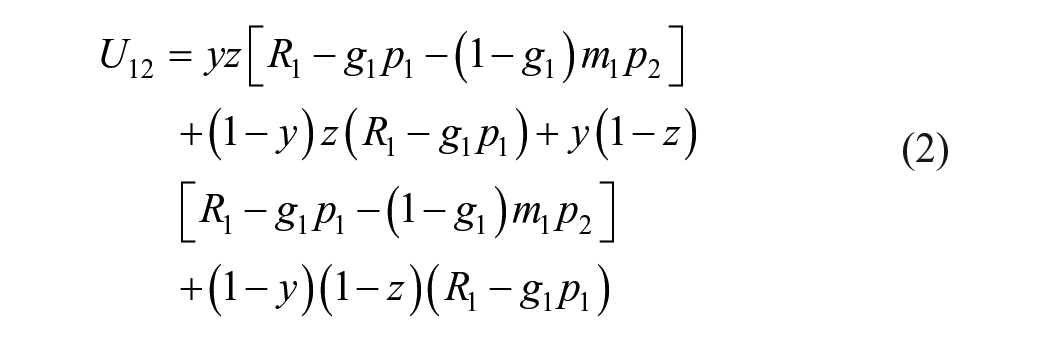

The replicator dynamic equation of X is as follows:

It is assumed that



The replicator dynamic equation of Y is as follows:

It is assumed that


The replicator dynamic equation of Z is as follows:

On the basis of the replicator dynamic equations (4), (8), and (12), the tripartite replicator dynamic equation is obtained as follows:

According to the stability theory of differential equations, at
Analysis of Evolutionary Strategy of Suppliers
At
Analysis of Evolutionary Strategy of Manufacturers
At
Similarly, at
Analysis of Evolutionary Strategy of Consumers
At
Analysis of Stability of Equilibrium Points of System
Drawing on Friedman for reference, the stability of an evolutionary equilibrium may be achieved through analysis of the partial stability of the Jacobian matrix of such system,
42
and in asymmetric games, the evolutionary stable equilibrium is undoubtedly a pure strategic equilibrium.
43
Therefore, this paper only analyzes the stability of the pure strategic equilibrium. Now, it is assumed that the replicator dynamic equations (4), (8), and (12) are all equal to zero, and eight pure strategic equilibrium points exist in the three-dimensional space

It can be known from Lyapunov’s theory of stability that when all the eigenvalues (
Stability Analysis of System Equilibrium Points.

Numerical Simulation
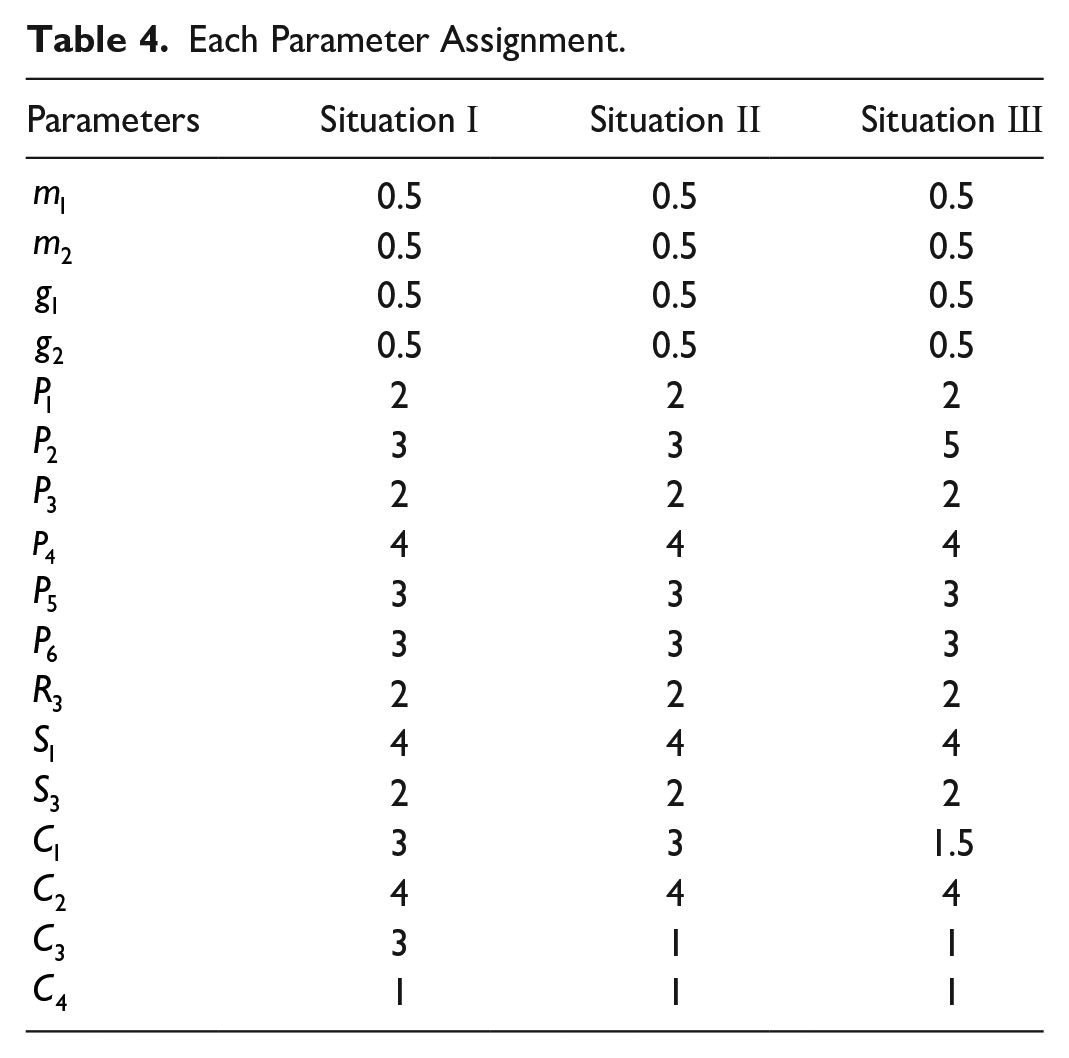
This section tests the validity of the 3 stability points in the social co-governance deduced above, and further elaborates on the influence of each subject’s initial intention and the model’s main parameters on the system’s stability. Based on the above assumptions and drawing on the studies by Gao et al, 46 the parameters under the 3 types of situations shown in Table 4 are assumed, and on this basis, a numerical simulation is conducted for each of the equilibrium points.
Each Parameter Assignment.
Numerical Simulation Under Three Types of Situations

Stability analysis of equilibrium point E3.
However, the strategy selected by X (not to make an effective quality investment) indicates that the restriction by Y of its suppliers’ behaviors will ultimately fail. In addition, it can be known from Figures 3 to 5 that in the above-mentioned 3 groups of initial intentions, the selection of behavior strategy by X, Y, and Z will not change. This confirms that the system’s stability is independent of initial intention, but that initial intention will influence the length of time required for the system to reach stability.

Initial intentions are (0.3,0.5,0.4).

Initial intentions are (0.5,0.8,0.6).
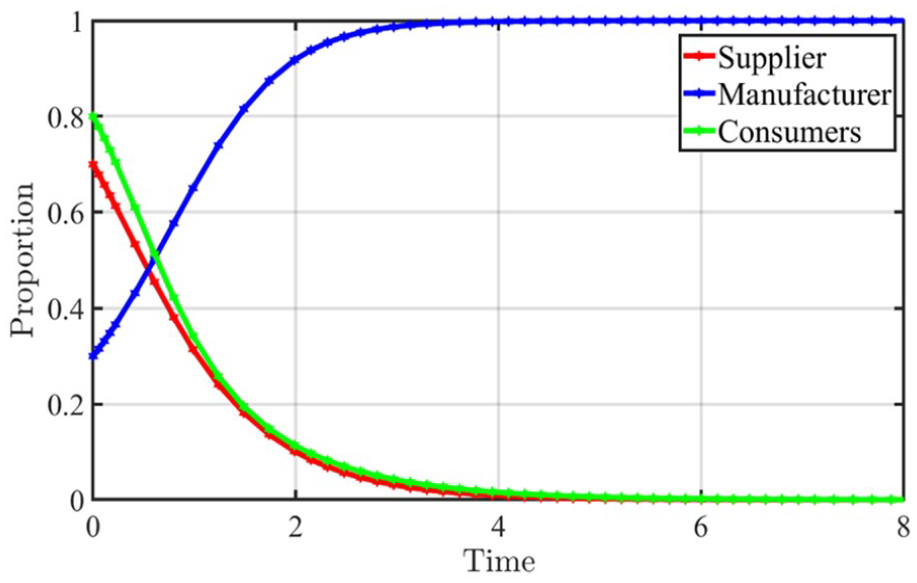
Initial intentions are (0.7,0.3,0.8).

Stability analysis of equilibrium point E4.
In addition, it can be known from Figures 7 to 9 that in the above-mentioned situations of 3 groups of initial intentions, the system’s final stability is independent of initial intention, but the initial intention will influence the length of time required for the system to reach stability.

Initial intentions are (0.3,0.7,0.9).
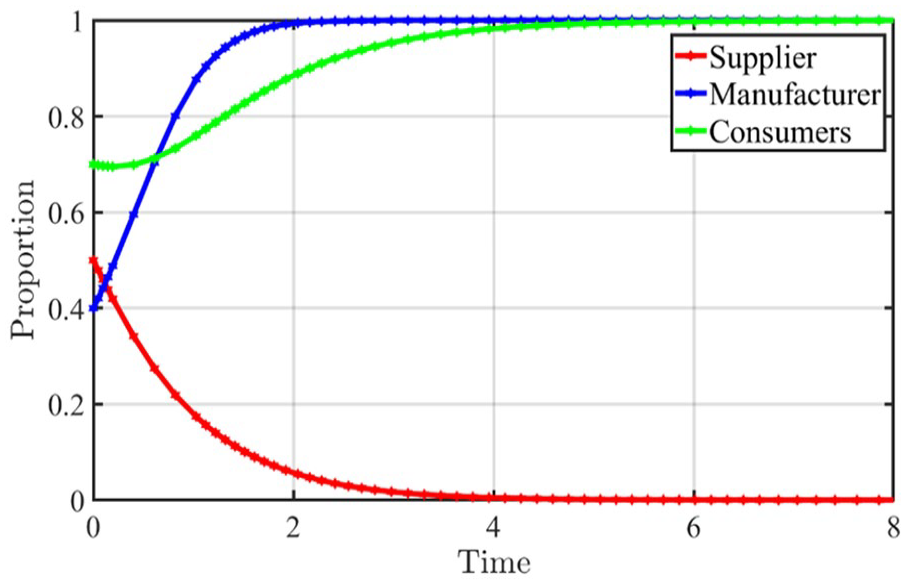
Initial intentions are (0.5,0.4,0.7).

Initial intentions are (0.7,0.6,0.5).

Stability analysis of equilibrium point E8.
Compared with Situation II, in the Situation III, manufacturers strengthen the SSI of suppliers and increase the economic punishment imposed for producing risky foods. Facing possible economic punishment from both government and manufacturers, upstream suppliers make a quality investment, and thus the quality of foods produced along the whole food supply chain is therefore improved. Similarly, it can be known from Figures 11 to 13 that in the above-mentioned 3 groups of initial intentions, the system’s final stability is independent of initial intention, but initial intention will influence the length of time required for the system to reach stability.

Initial intentions are (0.3,0.4,0.5).

Initial intentions are (0.5,0.6,0.7).

Initial intentions are (0.6,0.5,0.4).
Social co-governance of food safety risk takes diversified forms, and as far as this paper is concerned, of the main participants are suppliers, manufacturers, consumers, and government. Under the condition that the government carries out supervision and publication of SSI information according to laws, each subject selects a different behavior strategy through balancing their own interests and ensuring the common interest of food safety. Co-governance in the system’s equilibrium is attained over the course of repeated evolutionary games. Studies have shown that the system reaches an equilibrium status not because every subject’s behavior reaches the optimum point, but because the balance among their respective behaviors enables the whole system to achieve stability.
At this moment, the system satisfies the condition of λ < 0. In Situation II, for example, the equilibrium point is
Influence of Main Parameter Values on Selection of Behavior Strategy by Subjects
The above analysis tested stability preconditions for the 3 equilibrium points in the system:
Influence of governance participation costs by consumers on selection of behavior strategy
It is assumed that, with the other parameters remaining constant, the initial intention of subjects under Situation III is (0.5,0.6,0.7), and the cost of participation in governance is

Influence of costs of participation by consumers in governance on evolution of the system.
The above results indicate that the sums of the costs to participate in governance will directly influence consumers’ selection of a behavior strategy. When the costs of pursuing safe foods are too high, a rational consumer, by comparing the costs with consumption utility, judges that the necessary consumption utility cannot be obtained because of the too high costs and will choose not to participate in social co-governance. This conclusion matches objective reality. In addition, consumers face the “free riding” problem when participating in governance: when the number of consumers in the food market who choose to participate in governance exceeds a certain proportion, the influence on improvement of food quality from the market reputation formed through consumer participation in governance will reach a ceiling, and some consumers will choose “free riding” temporarily, rather than participate in governance, in order to save the costs of participation.
In contrast, when the general risk in the food market is relatively high, then, stimulated by the “food safety award reporting system” in which consumers will obtain a government award for participation in governance, consumers will have relative stronger intention to participate. However, when suppliers and manufacturers begin to make effective quality investments and the general risk in the food market therefore declines, consumers who choose to participate in governance will face fewer opportunities for complaint reporting and can hardly identify the source of risks. In addition, they will have to bear the participation costs. Thus, their behavior strategy will become to not participate in governance. As foodborne diseases occur and emerge mainly in the section of consumption, the absence of consumers leads to the vacancy in the social co-governance system for food safety risk, which will cause the insufficiency in the source of risk testing data, and thus intensify the contradiction between monitoring tasks and monitoring resources. Accordingly, it is necessary to perfect the system and its arrangements, expand the channels for consumer participation in governance, and lower the costs of consumer participation in governance.
Figure 15 presents the evolution of the system in the period in which the cost of consumer participation in governance is at the level of C3=0.5. It may be found that the system will always ultimately reach the optimum stable point of

Evolution of the system when C3 = 0.5.
Influence of costs incurred by suppliers on selection of behavior strategy by participating subjects
Enterprises select a behavior strategy on the basis of comparing costs and returns, but the extent of the influence of costs depends on their type. It is assumed that with the other parameters remaining constant, the initial intentions of the subjects under Situation III are (0.5,0.6,0.7). The dotted lines in Figure 16 represents the evolutionary routes of the system when the compensation paid by suppliers to manufacturers is

Influence of costs of suppliers on the evolution of the system.
With the increase in the sum of compensation
Taking
Figure 17 shows the evolutionary course of the system at
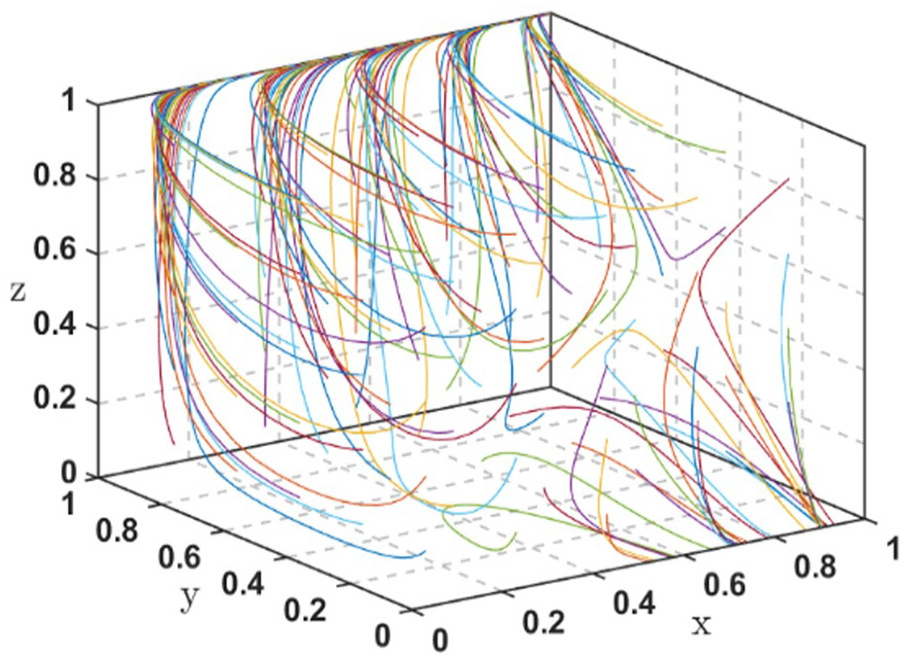
Evolution of the system when P2 = 1 and C1 = 1.
In addition, consumers’ intention to participate in governance gradually declines, probably because of high costs of participation in governance, which may finally lead manufacturers to choose the behavior strategy of not making an effective quality investment. Because market subjects attach importance to pursuit of individual economic benefit, they will probably lower their participation in social co-governance, driven by their respective different motivations, limitations of resources, differences in capability, and diversification of subjects’ demand. Therefore, it is necessary for the government to provide an award so as to stimulate motivation among market subjects for participating in social co-governance.
Now consider that the government increases the award for consumers’ complaint reporting and lowers the costs of their participation in governance. Figure 18 shows the evolution of behavior strategy selection by every subject when the award for consumers’ complaint reporting is

Evolution of the system when R3=2.5, C3=0.5 and C4=0.5.
The impact of a producer’s sampling capability on the strategic choices of participating subjects
Chinese food supply chain is predominantly composed of small and medium-sized enterprises (SMEs). As producers, SMEs have relatively limited resources and capabilities, lacking the ability to manage upstream suppliers. As suppliers, the decentralized nature of SMEs also poses challenges for downstream enterprises in terms of sampling inspections, leading to a reduction in the efficiency of producer sampling. In light of this unique situation in the Chinese food supply chain, with other parameters held constant, the study sets the effective sampling probability for producers at

Influence of the sampling capability of producers on evolution of the system.
In Figure 19, it is shown that as the sampling capability of producers decreases, the evolution rate of suppliers choosing to invest in quality slows down. When
Given the fundamental conditions of China’s food industry, it is necessary to strengthen supervision and sampling efforts for small and medium-sized enterprises to compensate for the insufficient sampling capability of producers. Additionally, it is essential to expedite the adjustment of the food industry structure by raising industry entry barriers, encouraging mergers and acquisitions within the industry to enhance industry concentration, improving the industry chain connection between large food processing enterprises and upstream suppliers, and promoting the development of advantageous enterprises to enhance the overall output quality of the entire food supply chain
Main Conclusions and Policy Implications
Social progress and technological transformation bring the overall revolution of edible agricultural products in the whole course of “plantation and breeding - production and processing - logistics and trading - consumption of food and drink.” Modern agricultural production, food processing and consumption practice, etc. increased the risk of food pollution by pathogeny of foodborne diseases, while the sophisticated whole-course supply chain network and the continuous weakening of the role of natural geographical barrier jointly step up the population susceptibility, exposure and spread of pathogeny of foodborne diseases. Thus, the pathogeny of foodborne diseases can pollute foods any time and then evolve from regional diseases into global epidemics rapidly. Under such a situation, it becomes a factual demand to introduce social mechanism, bring into full play, regulate the relationship among government, market, and society so as to form the social co-governance in which market and social forces jointly participate in monitoring of food safety risk. By establishing a tripartite game model based on the framework of social co-governance, this paper examined the selection of behavior strategies by food suppliers, manufacturers, and consumers, respectively, under the situation that government makes public its gathered SSI information and imposes economic punishment for illegal behaviors by enterprises. The preconditions for stability of the tripartite evolutionary model were tested by conducting a numerical simulation with MATLAB software. The influences of changes in related parameters on the behavior strategy selection by each subject and the influence of different levels of social co-governance on the food production quality of the whole supply chain system were analyzed. The main conclusions are reached as follows:
The net disbursement paid by suppliers for effective quality investment has direct influence on their selection of behavior strategies. It was found that manufacturers have to increase the compensation suppliers must pay by more than 1 unit in order to induce suppliers to make an effective quality investment, however, this target can also be achieved by lowering the suppliers’ costs for quality investment by 0.5 units. Therefore, although increasing the punishment to be paid by suppliers who engage in illegal behavior in production can help improve the quality of raw materials, it will be more efficient to lower the suppliers’ costs for making a quality investment. This conclusion is in keeping with that of Yadlapalli et al. 49 Therefore, it is necessary for manufacturers to not only punish suppliers on the basis of a market mechanism and supervise suppliers in accordance with contracts, but also assist suppliers to decrease the costs of making effective quality investments, so as to exert the functions of both the market mechanism and technical advances.
The net disbursement paid by manufacturers for an effective quality investment directly influences their selection of behavior strategies. It was found that the reputation mechanism has a knock-on effect, which has a binding force upon manufacturers’ behaviors. Therefore, manufacturers should not only be strictly self-disciplined, but also strengthen the management of their upstream suppliers, to prevent their own interests from being harmed by the knock-on effect of suppliers with a bad reputation. This is in keeping with the conclusion of Clarke and Boersma. 47 Therefore, government may focus regulations more on the upstream supply chain system and deter manufacturers through the knock-on effect, so as to urge manufacturers to restrain the behaviors of suppliers and realize management of the whole supply chain. Simultaneously, it is necessary to encourage the development of leading enterprises by promoting industry consolidation through mergers and acquisitions, thereby enhancing the industry concentration and strengthening the control capability of producers over the upstream of the supply chain.
The costs of participation in governance directly influence consumers’ behavior strategies. This paper has demonstrated that the selection of behavior strategy by consumers to participate in governance features “free riding,” so the level of social co-governance can only be upgraded by increasing the award for reporting complaints and lowering the costs of participation in governance. This conclusion is consistent with those of Dai et al. 50 Currently, the government’s disclosure of reputation information about market entities is inadequate. The disclosed information is fragmented, making it difficult to establish a valuable and widely disseminated reputation information flow in the food consumption market. This difficulty for consumers to promptly and effectively access market information has resulted in the lack of a reputation mechanism in the Chinese food market. Therefore, it is necessary to attach importance to the role of consumers in food safety governance, and in addition, the channels for consumers to access food safety information should be expanded so as to lower their costs of participation in governance. In addition, it is necessary to establish mechanisms that facilitate the dissemination of regulatory information and promote information sharing, strengthen the population of knowledge, and imperceptibly correct the “optimistic bias” and “cognitive bias” of residents in both urban and rural areas with respect to susceptibility and seriousness of foodborne diseases.
These findings indicate that, driven by pursuit of economic benefits, every subject in the supply chain will choose diversified behavior strategies, and rational behavior will not automatically be followed. In addition to conducting supervision and administration tasks and imposing economic penalties, the government should also lower the costs of quality investment by enterprises through incentive methods, enhance the industry chain connection between leading enterprises within the industry and upstream suppliers, thereby increasing the management capabilities of leading enterprises over their upstream suppliers, and encourage them to perform inter-restrictions among themselves through vertical contracts. Government should not only increase the award paid for consumers’ participation in governance, but also make public the relevant information, expand the information and access channels, simplify the procedures, and lower the costs of participation in governance. It should also help consumers transform from bystanders into participants so as to solve the issue of “free riding.” Government should form a health protection barrier in which all the social forces participate, by exerting the positive functions of the market and social forces, so as to monitor the whole course of food supply chain and prevent diseases from the sources of foodborne disease risks, and finally to protect the personal safety and health of consumers. This paper has proven that by realizing the balance among the respective interests of government, market, and social subjects and the social interest, all subjects can perform their respective duties toward common goals, forming the system of social co-governance. and restrict the behaviors of food enterprises and improve the production quality of the food supply chain. This is the most important finding of this paper.
This research was carried out on the basis of the situation of China, but it can serve as a reference for stimulating food enterprises to make quality investments in other countries as well because the expected return from a quality investment was a basic assumption, which is in conformity with the general law of market economics, and the social co-governance system has wide acceptance in Western countries as well as China. Therefore, countries can enhance industry concentration, leverage the role of leading enterprises in the supply chain, achieve end-to-end supervision of the food supply chain, improve the output quality of the food supply chain, and ensure the personal safety and health of consumers. However, this paper still has some limitations, as follows: this paper only considered the restricting function of information from complaints reported by consumers, governmental SSI results, and other negative reputation information, and the stimulating function of a sound market reputation on enterprises was ignored. In addition, the food transport and logistics, and sales segments were not included in the considered supply chain system. In addition, the study did not take into account the impact of enterprise heterogeneity on the effectiveness of quality investment. Therefore, we will in future expand the research framework and bring logistics and distribution enterprises and related subjects into the considered food supply chain system. Future research will also examine the stimulating or restricting functions of different market reputations concurrently, along with the resultant knock-on effects, revealing whether the reputation mechanism in the food market is effectively established and its intrinsic mechanisms. In addition, on the basis of the situation of China, we will seek to obtain the quality data of Chinese food industry enterprises to further prove the main conclusions reached in this paper.
Footnotes
Data Availability Statement
Data sharing not applicable to this article as no data sets were generated or analyzed during the current study.
Declaration of Conflicting Interests
The author(s) declared no potential conflicts of interest with respect to the research, authorship, and/or publication of this article.
Funding
The author(s) disclosed receipt of the following financial support for the research, authorship, and/or publication of this article: This study was supported by the National Social Science Fund of China: Research on social co-governance of food safety risks and cross-border cooperative governance mechanism (20&ZD117).
Ethical Approval
This article does not contain any studies with human participants performed by any of the authors.
Informed Consent
This article does not contain any studies with human participants performed by any of the authors.
