



Abstract
In the interests of satisfying the dental services demands of German citizens area-wide, constant, and thoughtful planning of supply and demand is essential. With an anonymous online survey of 375 dentists a pairwise comparison of 9 factors extracted as relevant from the existing scientific literature were analyzed with an analytic hierarchy process (AHP) and ranked considering the various business types. In general, 5 local environmental factors have a dominant impact on founders’ decision in German dentistry. In order: environment for the family, quality of life in private environment, real income, location of the practice, infrastructure. Real income is in first place (p = 0.287) for dentists who want to start a new single practice. For preferring a new community practice, it is on third place (p = 0.177) and for dentists who favor a takeover a single practice (p = 0.130) or joining a community practice (p = 0.096) or employment (p = 0.111) it is fourth place. For this purpose, the location of the practice is of greater priority than the real income for dentists who prefer not to start a new practice. The AHP method is a way to picture a priority list out of all relevant factors for setting up of a dental practice.
Keywords
There is a legal obligation to provide area-wide health care and this supply is severely endangered in the medical and dental care system.
This research investigates the concerns of the provider side in analyzing the factors influencing the career decision in seeking a deeper understanding of the decision-making process.
By gaining a deeper insight into the factors influencing dentists’ career decisions, more targeted incentives can be developed and the need for business knowledge can be communicated in a more pointed manner.
Introduction
Potential shortages in the German health care system require to be prevented.1,2 With every new practice there is a building block for full-coverage healthcare.
In dentistry it is prognostically imperative to rethink the allocation of service and its underlying causes. 3 As a sole provider of dental services, dentists control the provision of dental care. Therefore, investigating their decision-making process with regards to choosing a place of practice, is of paramount importance in order to steer the supply. Many personal aspects influence a decision where to work and about the conditions. 4
In an earlier developed methodological approach the decision whether a dentist becomes self-employed or works as an employee can be considered in a differentiated way. 5 The analytical hierarchy process (AHP), as a multi-criteria decision-making (MCDM) approach, 6 seems to be a suitable method for linking the factors identified. Subsequently their influence on the decision on the business type of dental practice can be evaluated.
State of Research
In a literature review by Langer et al, was stated that the studies in the field of health services research on “Supporting and Inhibiting Factors for SHI-Physicians in Germany” have a low methodological quality in the absence of economic evaluations. 7 The influence of factors on the career choice of medical students was addressed in a study conducted in 2011 at 5 German universities in the state of Baden-Württemberg. 8 For this purpose, 2 main categories were formed, individual aspects (IA) and occupational aspects (OA), including the sub-categories personal ambition, future perspective, work-life-balance (IA) and variety in job, patient orientation, job-related ambition, image (OA). Neglecting monetary aspects, personal ambition and future perspective were the most important factors. The compatibility of job and family was also essential. Gibis et al focused on the shortage of general practitioners, especially in rural areas. In their introduction, they mention the changing professional profile, the increased desire for specialization and working in the city. 9 Due to high financial risk, non-medical tasks and bureaucracy most of the participants were clearly opting against a branch office. Also a low income or the high purchase price of a practice and a high workload made decisions against own practice. The employment was clearly preferred with 92.2% to a branch office with 77.7%. These results were confirmed in 2016, in a nationwide online survey of 9.079 medical students in the Federal Republic of Germany (N = 85.009). The shortage of physicians was analyzed with a view to the next generation. 10 Generation Y listed the work-life balance, career opportunities, professional requirements and working atmosphere as particularly important parameters across all genders. The influence of a monetary incentives has recently been investigated. The question of whether the choice of profession and the decision to settle in a certain country depend on income expectations of medical students was in focus. 11 For this purpose, 231 medical students were asked whether they had thought about future income, how much they expected and from which source they obtained this information. There were large deviations in the students’ assessments. In most cases, they underestimated the actual real incomes of physicians in private practice. The attitudes and perceptions of physicians also came under investigation. An analysis of the effect of financial and non-financial incentives have on the decision of young doctors to set up their own practice were conducted. The survey showed that the influence of income has the greatest effect on the level of coverage. 12 A number of studies have pointed to family and personal quality of life influences as being particularly important.13,14 Graduates of 7 medical faculties from the practical year to a maximum of 6 years after completion of further education were surveyed in a longitudinal study over 6 years (2008-2014). There is a growing desire to work as employee and part-time. 15 Geographical distribution analyses indicate regional inequalities in allocation as well. 16 There are numerous studies focusing on decision criteria of medical doctors and students reflecting their views of setting up their own practice. The situation of dentists however, is less researched so far. Schwendicke et al found regional disparities in dental health care and a need for innovation in health care services. 3
The annual monitor of investments in dental start-ups for 2018 showed that 69% of the founders of new businesses between the ages of 31 and 40 and that the highest funding volumes were called upon in rural areas. 17 An analysis using AHP has already been carried out among physicians. 18 This revealed differences in priorities between rural and urban doctors. A further systematic analysis showed that the AHP is frequently used in healthcare research. 19
The interest of dentists in self-employment was examined in Nele Kettler’s survey. 20 She found that 53.1% would like to improve their quality of life during their time as dentists in training. Only 12.5% of the participants knew the organs of dental self-administration, and 18% of the participants did not know the differences between the various business types of practice. Two years later she could show that small and less populated areas were considered less than 10% of respondents as an advised region to work. 4
The Career Choices and Business Types in Dentistry
Before 2007, dentists had a legally mandatory regional allocation system, as still present in the medical sector. But since the Gesetzliche-Krankenversicherungs-Wettbewebs-Strärkungs-Gesetz, there exists no spatial distribution restrictions, related to the of establishment of a medical practice. In the same year, the possibility of permanent employment was also enshrined in law—Vertragsrechtsänderungsgesetz.
In addition to starting a new single practice (BT1) or a community practice (BT3), as well as taking over a single practice (BT2) or joining a community practice (BT4), there has been the possibility of working as an employed dentist (BT0) over the past 15 years. 21
Several changes could be observed over this period. On the one hand, investment costs increased significantly and hyperinflationary. Foundation capital for dental practice increased from 2014 to 142% within only 4 years. In 2018, the average investment costs for a new single practice start-up were 598 000 euros. 17 Furthermore, the numbers of start-ups in dentistry declined. Whereas in the 1990s around 4000 new practices were set up each year, in 2018 there were only 1214 new practices.21-23 Consecutively, the number of dentists in employment increased continuously. In 2007, the number of permanently employed panel dentists was 726, while in 2021 the number increased to 16 259. The number of self-employed panel dentists fell from 55 432 to 46 717 during this period. 24
A licensed dentist is therefore faced with several principal questions:
Do I want to work independently or as a permanent employee?
If I decide to become self-employed, will I practice on my own or a partner in a partnership? What form of business type is appropriate for me? What factors are important in these decisions?
Data and Method
Study Design
The type of mixed-method research design used in this study is exploratory sequential mixed. This entailed the collection of qualitative and quantitative data in 2 phases.
Qualitative data collection and analysis was done through systematic literature review. Second phase focused on tracing expert opinions on set-up indicators to identify the ranking of the relevant factors for own-practice business.
Literature Research
Relevant studies were searched in the 3 largest electronic databases for medicine-associated journals (Elsevier-Scopus, Springer-SpringerLink, MedLine-PubMed) from 2010 to August 2020. The search was conducted after the guidelines of H. Cooper with specified keywords from May 2020 to August 2020. 25
It was possible to include 33 relevant studies in the systematic literature search. The studies included can be divided into 5 different focus groups (financial, geographical, personal, regulatory, educational). All criteria extracted from papers included in the literature review were categorized. Nine relevant heuristics in this regard were identified. Hereafter the 9 determinants were defined as Selected Environmental Factors (SEF) as shown in Figure 1.
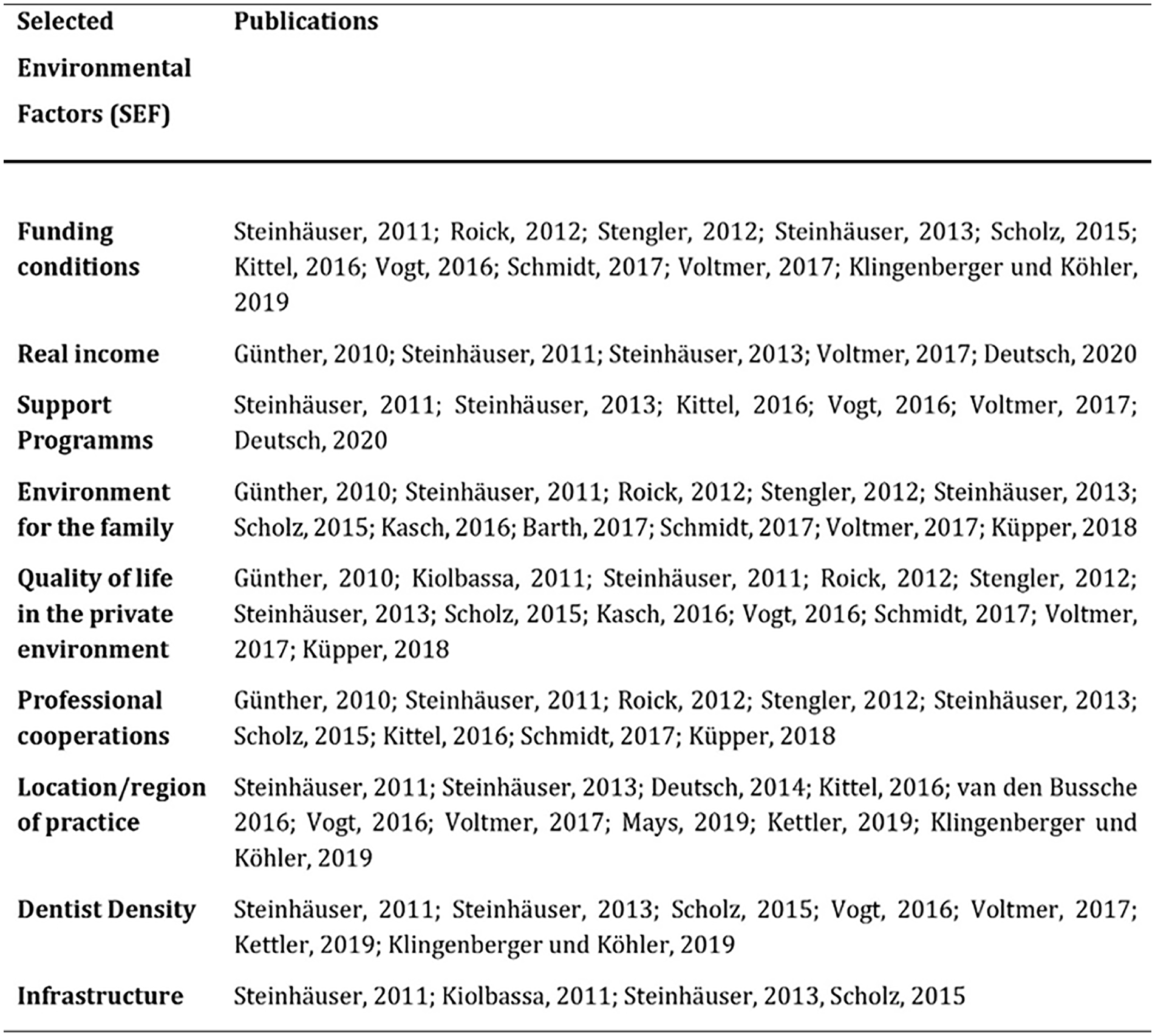
Environmental factors found (5).
Study Population
Dentists (N = 375, aged 26-64 years old) participated in this study and were selected based on the purposive sampling technique.
All participants were members of the regional dentist association Landeszahnärztekammer Hessen (LZKH).
The dentists for participation were selected for the postal loan numbers 64 000 to 64 999, using the member database of the LZKH via homepage (lzkh.de). For the postcode area 430 hits resulted. Of these, 220 dentists provided an e-mail address and were sent a request in February 2020 and a reminder in March.
The LZKH also provides a smartphone application (LZKH App) for its members.
Since the LZKH App has been active, 2106 Hessian dentists have downloaded the LZKH App and registered. The survey link was published on the LZKH App.
The anonymous online survey was conducted from February to March 2020.
AHP Method Implementation
As shown by the analysis of previously published studies, the decisions of dentists, depend on rational as well as intuitive factors and are always subjective in particular instances.10,12,13,20
With recourse to the theory of bounded rationality, well-known as the behavioral model of choice is better than rational actor assumptions, and the theory of satisficing that has arisen from these assumptions, 26 the factors found serve as heuristics that make it possible to represent the influences of the highly complex decision that leads to an alternative.
Assessing and ranking a set of 9 identified factors requires a reduction of complexity. The process of making a hierarchy of factors becomes more difficult with the integration of additional factors. Therefore, a method is needed to make an evaluation appear feasible. 27 To evaluate a set of alternatives in terms of several subjective and objective criteria, a common type of utility analysis seems unsuitable. Answering the questions addressed in this paper needs a more refined method.
With an explicit method of multi-criteria decision-making (MCDM), the analytic hierarchy process (AHP), which was elaborated by Saaty,28,29 a complex decision-making can be determined. The AHP enables a decision maker or a group of decision makers to cope with the central problem of how to evaluate a set of alternatives. Here it is crucial that all criteria of a decision are evaluated separately in pairwise comparisons.
The AHP was used in this study to investigate, whether the performance of the factors found in the review of existing scientific literature and presented above, have a decisive influence on the choice of business type when setting up a dental practice.
The methodoical model was tested in a pilot study prior to this study. 5
AHP Evaluation by Decision Makers
In second phase the resulted 36 pairwise comparisons were calculated in AHP according to Saaty’s approximation method. 30
The model of AHP has 4 steps.
(1) First structure a problem in a hierarchy (ie, Figure 2).
(2) Step 2 is a pairwise comparison of all given alternatives


Hierarchy for the decision for a business type in dentistry.
It is based on a scale, called the fundamental scale (ie, Figure 3), developed by Saaty. 28
(3) In the third step the priority vector or Eigenvector is calculated by an approximation method. 30

Fundamental scale example.
(1) Sum the elements of each column j:


(2) Divide each value by its column sum:

(3) Mean of row i:

(4) Calculated in step 4 the approximation of consistency (CI) following the axiom of transitivity.


And by using the proclaimed ratio index (RI) each AHP will have a consistency ratio (CR).
In his first remarks on the tolerance of inconsistency, Saaty recommended not much more than 10%, that is, CR ≤ 0.1. 30 Inconsistency, which is an error in the measurement of consistency, has been widely discussed since then.
The result interpretation of comparative complexities is even accepted with CR ≤ 0.2. 31
Differentiation of Business Types
The evaluation of the defined business types can be performed by separating the participants based on the question containing the survey questionnaire:
“What decision would you most like to make today?”
(a) Set up a new single practice (BT1)
(b) Take over a single practice (BT2)
(c) Set up a new community practice (BT3)
(d) Join a community practice (BT4)
(e) Work as an employee (BT0)
With the geometric mean aggregation procedure of the judgments of the individuals in a group, represented by reciprocal pairwise comparisons, the principals of AHP are satisfied. 32
“The alternative that is finally selected never permits a complete or perfect achievement of objectives but is merely the best solution that is available under the circumstances.”
33
Sensitivity Analysis
Sensitivity analysis is a way of checking the results of the decision. It helps to identify the impact of rank reversals (changes in the priority) of the criteria. It is apparent that there is variation in the relative weighting and/or importance of the criteria. With this method, the alternatives show how sensitive they are to the importance of the criteria. It shows how well each alternative performs on each criterion when increasing or decreasing the importance of the criteria. Given the possibility that conditions may change over time, sensitivity analysis seems useful to analyze decision-making. The performance of sensitivity analysis was done using a special software called SuperDecision, version 2.10.0.
Results
The group decisions are plotted in the reciprocal matrix and calculated according to the approximation method described by Saaty (ie, Step 2 to Step 4 in [5]). 30 A total of 375 out of 1162 dentists answered the questionnaire (47.5% female). This represents a response rate (RR) of 32.3%.
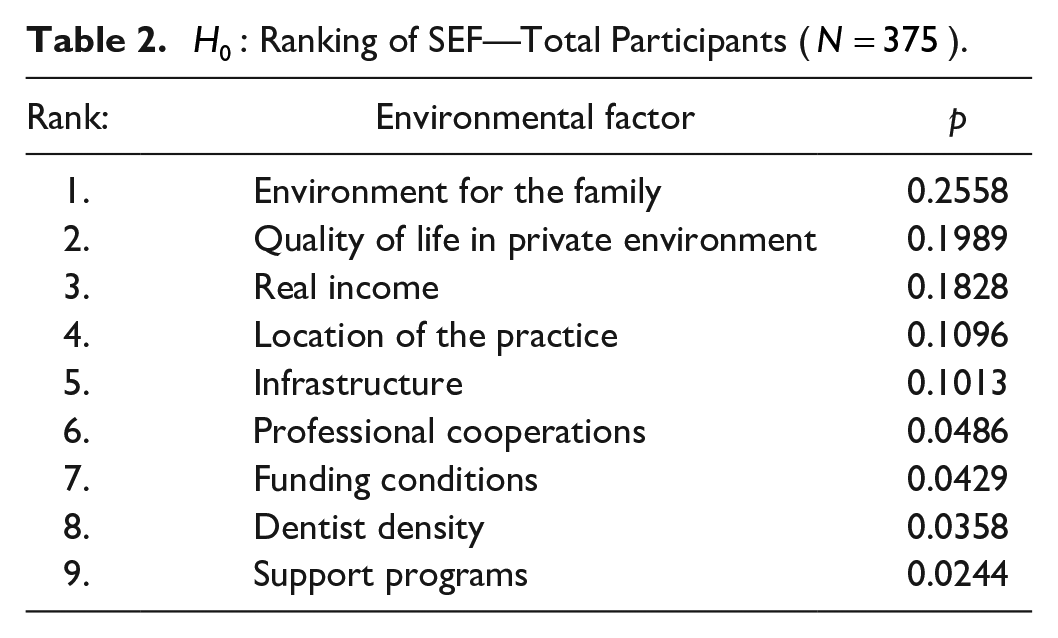
Table 1 shows the reciprocal matrix A with group results. It includes the calculated Normalized Eigenvektor (NEV) and the consistency ratio (C.R.). Table 2 summarizes the results. The priorities are presented in descending hierarchical rank order.
Total Participants:

C.R. = 0.1256
Preferences of the Business Types
To examine the weighting of the study participants and to be able to represent the performance of the SEF in relation to the business type, it is necessary to differentiate according to the method of group decision-making and the respective preferred BT:
About 22% of the respondents (83 participants) preferred to start a new single practice (BT1). Of these, 64 respondents were male, and 19 respondents were female (
About the same proportion of respondents (81 participants) opted to take over a single practice (BT2) as their preferred business type. Of these, 37 were female dentists and 44 were male dentists (
Only 20 participants (5%) decided to start a new community practice (BT3), 7 female dentists and 13 male dentists (
In turn, 85 study participants voted in favor of joining a community practice (BT4). Of these, 32 (38%) were men and 53 (62%) women (
About 28% of the survey participants preferred non-self-employed work in an occupational position. Of these were 41.5% male dentists and 58.5% female dentists (
If a look is taken at the consistency ratio (CR), it is noticeable that BT0 (
These results can now be presented in order and weight. The SEF ranking can be precisely differentiated by the percentage breakdown. Thus, not only a nominal order, but also the exact weighting is evident. Figure 4 presents a comparable overview of the given alternatives (business types).

Ranking of SEF for BT1, BT2, BT3, BT4, BT0.
Sensitivity Analyses
Figure 5 includes the sensitivity analyses of the 9 criteria. The vertical lines show the priority weighting of the corresponding criteria (SEF) and are read at the intersection of the x-axis. The priorities for the alternatives (BTs) are read off the y-axis, which are determined by the intersection of the line of the business type with the (vertical) priority line of the SEF. When the vertical line runs along the x-axis, we get the new priority of the SEF, which is read on the y-axis. From this we can see that the gradient sensitivity reflects the fact that the ranking of the BTs alters when the weighting of the SEF changes.

Sensitivity analysis of SEF.
Discussion
This paper is based on a literature review and the most commonly used integrated approach of multi-criteria decision-making approaches, the AHP. 6 It is capable of handling multiple quantitative and qualitative factors, as in this present instance.
A systematic review on applying the Analytic Hierarchy Process in healthcare research could show that most of the authors rely on literature research and expert opinions. 19
First, the 9 criteria used are extracted from papers included in the literature review. They should be considered as always in need of re-examination.
Second, it was observed that financial conditions are not the most widely adopted criterion. 6
Compared to the investigations by Kittel et al. with a similar study design, these results confirm that mainly family and private life have a high value for doctors. 18 Real income is in third position and followed by location of the practice and infrastructure. These 5 most influential criteria together represent a weighting of 84.84%. Thus, the factors dentist density, professional cooperations, funding conditions and support programs together account for only 15.16%. They can be considered negligible for the decision.
If tracing the preferences of the different groups of business types, all rankings have in common that infrastructure ranks on fifth place.
Real income is the most influential factor among dentists who prefer to start a single practice (BT1). For taking over a single practice (BT2), joining a community practice (BT4) and permanent employment (BT0), real income is a comparatively weak factor in fourth place. For each of these groups (BT2, BT4, BT0), location of the practice is the third most relevant factor. These 3 groups share the finding that the factors environment for the family and quality of life in private environment account for over 50% of the weighting. In the case of setting up a new practice (BT1, BT3), these factors are weighted at under 50%.
This may be a hint that the traditional single-criterion approach based on financial terms is less supportive and of sufficient reliability for contemporary supply management. 12 Similar studies highlighting social and private factors as relevant are supported by these findings.13,14 However, with dentists instead of physicians, a slightly different target group was investigated here for which previous data of this kind were not available.
Except when the intention is to support the classic setting up of new single practices, a traditional cost-based incentive cannot lead to the potential decision that the dental supplier set up a practice, because the decision-oriented criteria (environment for the family, quality of life in private environment, location of the practice and so on) play a more decisive role.
Conclusion
In this paper a literature review, an expert survey, and a prioritization with AHP was conducted. This method inevitably made a priority list out of 9 factors. The group decision in ordinal rank from top is environment for the family, quality of life in private environment, real income, location of the practice, infrastructure, professional cooperation, funding conditions, dentist density, support programs. The influence of private quality of life and family environment are the most relevant for the majority of alternatives (business types). For dentists who preferred a new single practice only, real income was the most important determinant. This approach can aid the researchers and decision makers to effectively address the problem of declining dental offices. A differentiated view of the influences on the set-up of dental practices would be highly helpful for the demand planning and community management of undersupplied municipalities or those threatened by shortage. The simple and clear presentation of the preferences for the different alternatives of the business types can make it easier for municipalities and stakeholders to develop strategies or targeted incentives to ensure dental care in their vicinities. Going forward, more research is needed to determine the reasons for declining self-employment. One possibility for further development might be to get students in the final semester to weight the factors. The securing of dental healthcare in rural areas will remain a necessary debated matter. Strategies for addressing this issue are desirable and will hopefully be the subject of future research.
Footnotes
Acknowledgements
The author is grateful to the Landeszahnärztekammer Hessen for supporting the survey by providing a link in their mobile Application.
Declaration of Conflicting Interests
The author declared no potential conflicts of interest with respect to the research, authorship, and/or publication of this article.
Funding
The author received no financial support for the research, authorship, and/or publication of this article.
Ethical Approval
An ethical board approval was not required for this study as the online survey conducted was anonymous and did not contain any ethically concerning questions.
