



Abstract
- What do we already know about this topic
The role of bibliometric analysis is increasingly recognized as a well-established part for research evaluation methodology both in basic and clinical medicine fields. - How does your research contribute to the field?
Output was increasing during this period as China, Japan, and South Korea remain the top contributing countries, with keywords and references analysis providing unique clue on the future directions of this field. - What are your research’s implications toward theory, practice, or policy?
Bibliometric analysis provides an insightful result depicting the trajectory of research development with a future perspective.
Introduction
Gastric cancer remains a global malignancy and serves as one of the most common malignancies around the world. 1 It is ranked the third among the causes of cancer death. 1 Around 784 000 deaths are recorded in 2018. 2 East Asia, Eastern Europe, and Central/Southern America are areas of gastric cancer with highest incidence and mortality. 3 Notably, overall gastric cancer incidence rates may be predictively falling in most of countries up to 2035, including both high incidence and low incidence. 4 However, increasing cases of gastric cancer may still occur in young and ageing populations.1,4
As a clinical heterogeneous disease with molecular characterizations, gastric cancer is mainly treated by endoscopic resection at early stage, or surgery at advanced stage.5,6 Chemotherapy, including platinum and fluoropyrimidine, is commonly used in advanced gastric cancer for survival benefits. 7 Meanwhile, licensed targeted therapies, including trastuzumab (anti-HER2), ramucirumab (anti-angiogenic), and pembrolizumab (anti-PD1), are gaining increasing attention in prognostic studies.1,7 Mechanistically, large numbers of prognostic biomarkers have been identified in gastric cancer due to advancement of bioinformatics methods.8,9 In fact, prognostic studies in gastric cancer have now become fully fledged.
The role of bibliometric analysis is increasingly valued. It has become a well-established part for research evaluation methodology both in basic and clinical medicine fields. It offers reliable and repeatable patterns to study the current status of each research subject as well as enables a possible ranking algorithm. 10 A sufficient number of prognostic studies in gastric cancer have been published. It is feasible and necessary to perform a literature evaluation using bibliometric methodology, in order to provide clues navigating future studies. Up now, such analysis remains largely sparse.
Of note, Powell et al studied the 100 most cited papers in gastric cancer in 2015 and highlighted the 3 most ubiquitous topics: the pathology, etiology, and basic science of gastric cancer. 11 However, bibliometric analysis regarding the prognosis and gastric cancer is not specified. Hereby, we focused on the studies concerning the prognosis and gastric cancer via bibliometric analysis with literature resources retrieved from Web of Science from 2000 to 2020. This study is aimed to identity nations, universities, references, keywords, and authors with most contributions in the field during the last 20 years.
Materials and Methods
Web of Science, a comprehensive database for science citation index, was selected for the resource of bibliometric analysis in this study.10,12 Search terms were as the following: TI = (*stomach* OR *gastric*)AND (*neoplasm* OR *cancer* OR *carcinoma*) AND (prognosis). Articles published between 2000 and 2020 within the database of Web of Science Core Collection were included. Letter, comments, and meeting abstracts were excluded from this collection process. The language was not restricted. All literatures were searched in January 2021.
CiteSpace version 5.7.R1 13 and R software program version 4.0.3 14 were selected for bibliometric analysis. Parameters including authors, journals, affiliations, countries, publication number, H-index, impact factor, centrality, and citation bursts were recorded accordingly. Local polynomial regression was used for the determination of changing outputs of publications. P value<.05 was considered as statistical significant.
H-index, also named as Hirsch index or Hirsch number, is an author-specific metric to measure the publications of a certain scholar both in productivity and citation. 15 It was originally proposed by Jorge Hirsch to quantify the academic contribution of individual theoretical physicists’ relative quality. 16 Now, it has been widely used across the scientific community. Impact factor (IF), another impactful parameter reflecting the yearly scientometric index, was initially devised by the Institute for Scientific Information from 1975. 17 IF has been currently used in many fields across the globe. It serves as a reliable bibliometric indicator to evaluate the quality of research, journal, and institution. 17 Centrality is used to measure the importance of a given node in a network with comparable high value indicating a pivotal status. 18 In this study, centrality helped the identification of scholars and institutions with high academic performance as well as corresponding relationships with fellows. Citation bursts indicate a reference or keyword frequently used in a period. These parameters facilitated the identification of research focus and distribution of increasing attention in a period. 13
Results
A total of 1721 articles were included from 2000 to 2020 (Figure 1A). A Locally Weighted Scatterplot Smoothing (LOWESS) fit was used in the correlation between the number of publication and year of publication (Figure 1B). Apparently, the number of publication was remarkably increased from 16 in 2000 to 225 in 2020. The curve of annual publications regarding the prognostic studies in gastric cancer. (A) The number of publications in each year from 2000 to 2020; (B) the linear model fitting the time trend of the studies of gastric cancer; the gray zone indicates 95% confidence interval.
Top 10 Journals That Published Articles on Gastric Cancer and Prognosis.

aIndicates a tie for fourth place.
bIndicates a tie for fifth place.
IF = impact factor.
The most cited authors and in-between cooperation networks as well as the top 10 names with published studies were displayed (Figure 2, Table 2). Cooperation relationship of authors contributing to the included studies is displayed in networks. The thickness of connection indicates the cooperation degree; the size of the circle indicates the value of centrality. Top 10 Contributing Authors Published Prognostic Articles on Gastric Cancer between 2000 and 2020. a Indicates a tie for second place. b Indicates a tie for sixth place. c Indicates a tie for eighth place. d Indicates a tie for ninth place. e The H-index in this table was calculated only based on the gastric cancer and prognosis papers published by the author.

The Top 10 Countries Contributed to Publication of Prognostic Articles in Gastric Cancer between 2000 and 2020.

TC = total citations; AAC = average article citations.
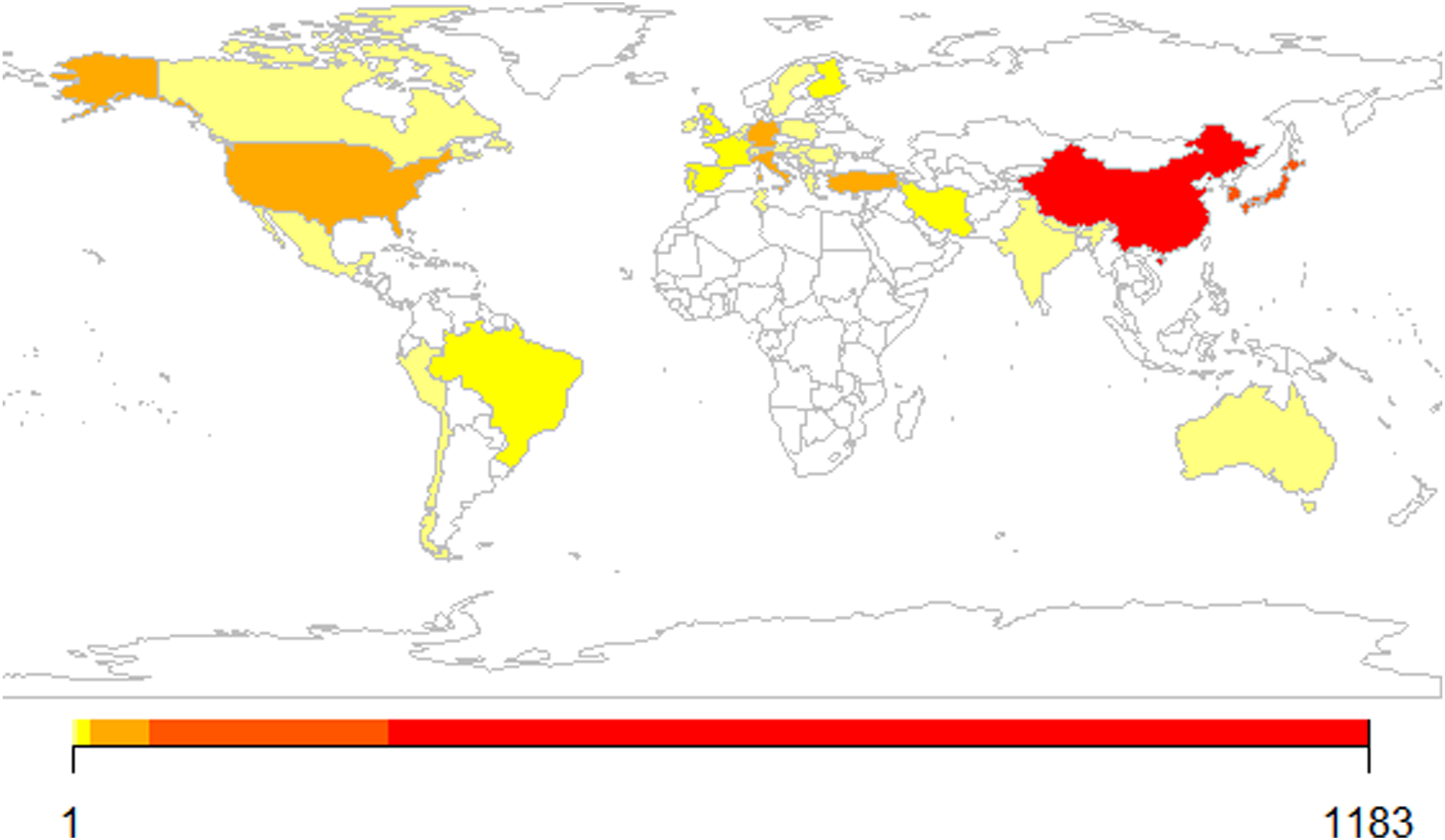
Countries contributing to the prognostic studies of gastric cancer across the world with marked color indicating the number of publications. Yellow indicates low number of publication while red indicates high.

Cooperation relationship of countries contributing to the studies is displayed in networks. USA: United States of America. The thickness of connection indicates the cooperation degree; the size of the circle indicates the value of centrality.
The Top 10 Universities Published Prognostic Articles On Gastric Cancer Between 2000 and 2020.


Cooperation relationship of institutions contributing to the studies is displayed in networks; Univ: University; Prov: Province; Hosp: Hospital; Mil: Military. The thickness of connection indicates the cooperation degree; the size of the circle indicates the value of centrality.
The top 52 keywords with the strongest citation bursts between 2000 and 2020 were displayed (Figure 6). The citation bursts showed a dynamic change over a period of time. Notably, “statistics”, “resistance”, “mortality”, “lncrna”, “diagnosis”, “outcome”, “migration”, “promote,” and “regulatory t cell” were the rising latest keywords since 2017 (Figure 6). Top keywords with the strongest citation bursts between 2000 and 2020. Green bar indicates the period of citation bursts.
Reference analysis is one of the commonly used methods in bibliometric analysis. The top 62 references with the strongest citation bursts between 2000 and 2020 were displayed (Figure 7). The strongest citation burst was achieved by Jemal A. CA-CANCER J CLIN in 2011 (strength=45.28).
19
There were 2 articles showed rising strength since 2018, Van Cutsem E. LANCET
20
and Japanese Gastric Cancer Association. GASTRIC CANCER.
21
Top references with the strongest citation bursts between 2000 and 2020. Green bar indicates the period of citation bursts.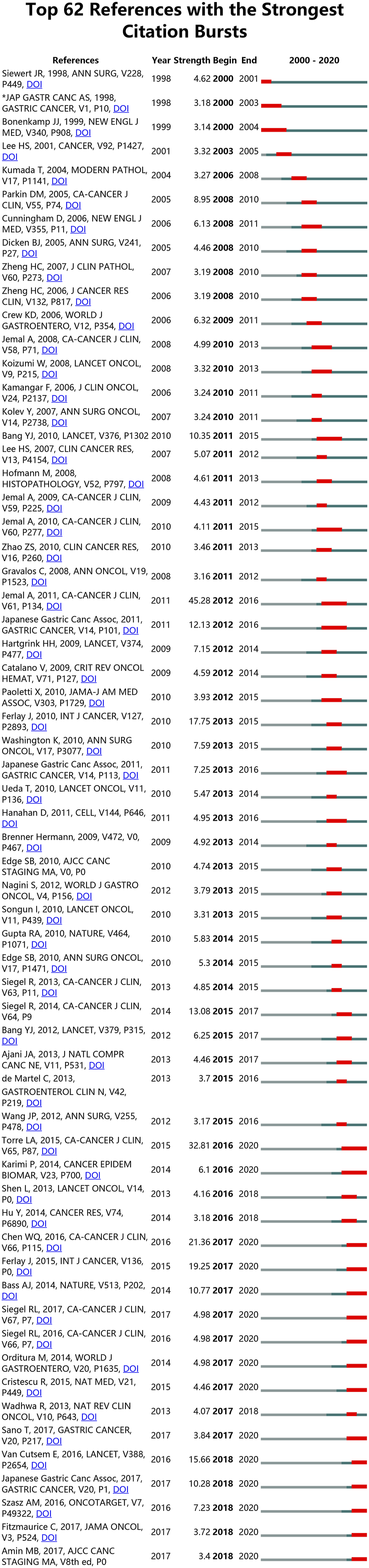
Discussion
This study performed a bibliometric analysis on the prognostic studies in gastric cancer between 2000 and 2020. Output was increasing during this period. Top 10 journals and authors were identified mostly contributing to the field. China, Japan, and South Korea remain the top contributing countries. Keywords and references analysis provided unique clue on the future directions of this field.
Previously, Powell et al have conducted a landscape bibliometric analysis in gastric cancer and presented insightful clues on the most cited 100 papers across the world. 11 This study is more specific in citations–authors–institutions analysis. Interestingly, it also highlighted the most referred topics, including pathology (57%), etiology (47%), science (44%), genetics (31%), and prognosis (30%). Hereby, we found out the published number of papers in prognosis have been significantly increased during the last 5 years (Figure 1A). For citation comparison, we reported a list of top 62 references with the strongest citation burst, specified with citation burst period (Figure 7). It opened up another perspective on how to compare and analyze the most cited papers.
The strongest citation burst article identified by this bibliometric analysis is by Jemal A. et al published in CA-CANCER J CLIN in 2011. 19 The most frequently cited period was 2012 to 2016. This article reported an overview of global cancer statistics, demonstrating the estimated results of cancer cases and deaths in 2008 as well as region-specific incidence and mortality rates. 19 Meanwhile, Jemal A. et al highlighted and commented preventive measures that target possible patterns for incidence and mortality across several malignancies. This article indeed shared a global perspective over cancer epidemiology and policies.
The studies of Van Cutsem E. and Japanese Gastric Cancer Association showed remarkable increasing impact, separately.20,21 Van Cutsem E. et al systematically updated the current knowledge of the causes, classification, diagnosis, and treatment of gastric cancer. 20 The study published by Japanese Gastric Cancer Association was an English version of the treatment guideline in Japan. 21 It compiled several therapeutic topics, including surgery and lymphadenectomy, postoperative follow-up, risk calculation prior to surgery, and others. 21 These contents made the 2 studies the most popular references among others.
Among the top 10 countries, China, Japan, and South Korea are the countries with the most publications. They are also the hotspots with the highest incidence and mortality rates of gastric cancer. However, both Japan and Korea develop national screening program for gastric cancer to improve the early diagnosis and therapeutic intervention.22,23 Overdose of salt in diet leads to potential gastritis. 24 Regional cultures, such as China and Japan, are close to pickled and salty foods. 24 Environmental and diet shift of Japanese immigrants into the United States substantially contributes to reducing rate of gastric cancer. 25
Clearly, top keywords with burst citations kept changing dynamically over this period, reflecting a redistribution of research interests and resources. Particularly, the keyword “regulatory t cell” became increasingly cited by new studies and signified as a future direction. Regulatory T cells are essential to the tumor microenvironment regulation and immune homeostasis as well as tumor immune escape.26,27 Li et al reported that regulatory T cells interacted with other immunocompetent cells to confer a complex immune community with significant prognostic impact in gastric cancer. 28 High expression of tumor-infiltrating Foxp3+ regulatory T cells was significantly correlated with poor overall survival. 28 Another pilot study by Liu et al indicated that inducible costimulator+ Foxp3+ regulatory T cells both in peripheral blood and tumor tissue predict poor outcome in gastric cancer. 29 Interestingly, regulatory T cells modulate the TGF-beta1 signaling pathway and promote the expression of leucine-rich repeat containing G protein-coupled receptor 5 (Lgr5), a biomarker commonly overexpressed in tumors. 30
Of note, ONCOTARGET and TUMOR BIOLOGY, with the number of publications accounting for 6.4% of all publications, were removed from the MEDLINE index without new IF since 2017. Specifically, TUMOR BIOLOGY was deselected from July 2017 by Web of Science while ONCOTARGET was removed from MEDLINE since volume 8 in 2017. These conducts had exerted negative impact on the capability of these 2 journals to receive more research results since then. Therefore, it is reasonable to presume that significant amount of subsequent prognostic studies of gastric cancer chose other journals.
Also, there is another disputable topic: Quality versus quantity debate. Based on the results from this study, the references with burst citations, such as the studies by Jemal A. et al, Van Cutsem E. et al, and Japanese Gastric Cancer Association, were not from China, the country with the most publications in this field. Similar results were also found in the top journal list. We believe that it depends on the situations in which direction is better. If the aim is to provide a policy-changing study or a full picture for decision-maker, it is better to take a high quality study.
Limitations remain in this study. Notably, due to the pronunciation of Chinese name and in abbreviation writing style, in some rare cases, an English name may reflect several Chinese authors if other specific information, such as institution or publication year, is not disclosed. Perhaps not all prognostic studies were strictly included even with predefined criteria. It is possible some mechanistic or bioinformatics studies also contain essential prognostic parts. Meanwhile, possibility exists that some non-English studies also provide insightful clues, such as original Japanese, Chinese, and Korean studies. Limitations in synonyms may potentially contribute to the outcome. For example, possible synonyms for “neoplasm OR cancer OR carcinoma” also include “tumor” and “tumour.” Noteworthy, there are inherent limitations of bibliometric analysis, such as disproportionate citation, self-citation, powerful person bias, and older journal bias, that should be paid attention to. Moreover, co-authors may also show important connections, which have not been included for bibliometric analysis.
Conclusion
China, Japan, and Korea are the top 3 nations with most contribution in the prognostic studies of gastric cancer. Top used keywords and references are changing dynamically. This bibliometric analysis provided a thought-provoking, insightful result concerning the trajectory of research development in prognosis of gastric cancer with a future perspective.
Footnotes
Declaration of Conflicting Interests
The author(s) declared no potential conflicts of interest with respect to the research, authorship, and/or publication of this article.
Funding
The author(s) disclosed receipt of the following financial support for the research, authorship, and/or publication of this article: This study is supported by simulation-based clinical teaching program of Shanghai Ninth People’s Hospital (2020 (32) (simulation teaching group, led by Prof. Yousheng Li).
Author’s Note
CY and YZ carried out data analysis; CY and YZ drafted the manuscript; and CY and YZ participated in study design, data collection, and analysis; All authors read and approved the final manuscript.
Ethical approval
This article does not contain any studies with human participants or animals performed by any of the authors.
